Gulf War 1 desert storm
http://en.wikipedia.org/wiki/Gulf_War
Reasons and campaign for intervention

Cheney meets with Prince Sultan, Minister of Defence and Aviation in Saudi Arabia to discuss how to handle the invasion of Kuwait
The United States and the United Nations gave several public justifications for involvement in the conflict, the most prominent being the Iraqi violation of Kuwaiti territorial integrity. In addition, the United States moved to support its ally Saudi Arabia, whose importance in the region, and as a key supplier of oil, made it of considerable geopolitical importance. Shortly after the Iraqi invasion, Secretary of Defense Dick Cheney made the first of several visits to Saudi Arabia where King Fahd requested US military assistance. During a speech in a special joint session of the U.S. Congress given on 11 September 1990, U.S. President George H.W. Bush summed up the reasons with the following remarks: "Within three days, 120,000 Iraqi troops with 850 tanks had poured into Kuwait and moved south to threaten Saudi Arabia. It was then that I decided to act to check that aggression."[51]
[ ](http://en.wikipedia.org/wiki/File:Powell,_Schwarzkopf,_and_Wolfowitz_at_Cheney_press_conference,_February_1991.jpg)
[ ](http://en.wikipedia.org/wiki/File:Powell,_Schwarzkopf,_and_Wolfowitz_at_Cheney_press_conference,_February_1991.jpg "Enlarge")
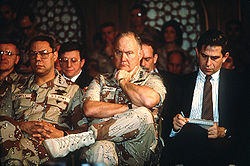
Gen. Schwarzkopf, Gen. Colin Powell (left), and Paul Wolfowitz (right) listen as Secretary of Defense Dick Cheney addresses reporters regarding the 1991 Gulf War.
The Pentagon claimed that satellite photos showing a buildup of Iraqi forces along the border were the source of this information, but this was later shown to be false. A reporter for the Saint Petersburg Times acquired commercial satellite images made at the time in question, which showed nothing but empty desert.[52]
Other justifications for foreign involvement included Iraq’s history of human rights abuses under President Saddam. Iraq was also known to possess biological weapons and chemical weapons, which Saddam had used against Iranian troops during the Iran–Iraq War and against his own country's Kurdish population in the Al-Anfal Campaign. Iraq was also known to have a nuclear weapons program.
Although there were human rights abuses committed in Kuwait by the invading Iraqi military, the ones best known in the U.S. were inventions of the public relations firm hired by the government of Kuwait to influence U.S. opinion in favor of military intervention. Shortly after Iraq’s invasion of Kuwait, the organisation Citizens for a Free Kuwait was formed in the U.S. It hired the public relations firm Hill & Knowlton for about $11 million, paid by the Kuwaiti government.[53]
Among many other means of influencing U.S. opinion (distributing books on Iraqi atrocities to U.S. soldiers deployed in the region, 'Free Kuwait' T-shirts and speakers to college campuses, and dozens of video news releases to television stations), the firm arranged for an appearance before a group of members of the U.S. Congress in which a woman identifying herself as a nurse working in the Kuwait City hospital described Iraqi soldiers pulling babies out of incubators and letting them die on the floor.
The story was an influence in tipping both the public and Congress towards a war with Iraq: six Congressmen said the testimony was enough for them to support military action against Iraq and seven Senators referenced the testimony in debate. The Senate supported the military actions in a 52-47 vote. A year after the war, however, this allegation was revealed to be a fabrication. The woman who had testified was found to be a member of the Kuwaiti Royal Family, in fact the daughter of the Kuwaiti ambassador to the U.S.[54] She had not been living in Kuwait during the Iraqi invasion.
The details of the Hill & Knowlton public relations campaign, including the incubator testimony, were published in a John R. MacArthur's Second Front: Censorship and Propaganda in the Gulf War (Berkeley, CA: University of CA Press, 1992 update 2004 http://www.ucpress.edu/book.php?isbn=9780520242319), and came to wide public attention when an Op-ed by MacArthur was published in the New York Times. This prompted a reexamination by Amnesty International, which had originally promoted an account alleging even greater numbers of babies torn from incubators than the original fake testimony. After finding no evidence to support it, the organization issued a retraction. President George H. W. Bush then repeated the incubator allegations on television.
At the same time, the Iraqi army committed several well-documented crimes during its occupation of Kuwait, such as the summary execution without trial of three brothers after which their bodies were stacked in a pile and left to decay in a public street.[55] Iraqi troops also ransacked and looted private Kuwaiti homes, one residence was repeatedly defecated in.[56] A resident later commented, "The whole thing was violence for the sake of violence, destruction for the sake of destruction... Imagine a surrealistic painting by Salvador Dalí".[57]
---
The New York Times Op-Ed, Monday, January 6, 1992
Remember Nayirah, Witness for Kuwait? i download doc
The New York Times Op-Ed, Monday, January 6, 1992
Remember Nayirah, Witness for Kuwait?
By John R. MacArthur
In his urgent arguments during the fall and winter of 1990 for military action against Saddam Hussein, President Bush made much of the Iraqi leader's cruelty toward the Kuwaiti people. Mr. Bush's allegations of atrocities by Iraqi forces generally went unchallenged. Mr. Hussein's violent disposal of dissident Iraqis was a matter of record, so few politicians, journalists or human rights investigators were prepared to question the President's campaign to paint his opponent as Adolf Hitler reborn.
Some claims were no doubt true, but the most sensational one--that Iraqi soldiers removed hundreds of Kuwaiti babies from incubators and left them to die on hospital floors--was shown to be almost certainly false by an ABC reporter, John Martin, in March 1991, after the liberation of Kuwait. He interviewed hospital doctors who stayed in Kuwait throughout the occupation.
But before the war, the incubator story seriously distorted the American debate about whether to support military action. Amnesty International believed the tale, and its ill-considered validation of the charges likely influenced the seven Senators who cited the story in speeches backing the Jan. 12 resolution authorizing war. Since the resolution passed the Senate by only five votes, the question of how the incubator story escaped scrutiny--when it really mattered--is all the more important. (Amnesty International later retracted its support of the story.)
A little reportorial investigation would have done a great service to the democratic process. Americans would have been interested to know the identity of "Nayirah," the 15-year-old Kuwaiti girl who shocked the Congressional Human Rights Caucus on Oct. 10, 1990, when she tearfully asserted that she had watched 15 infants being taken from incubators in Al-Adan Hospital in Kuwait City by Iraqi soldiers who "left the babies on the cold floor to die." The chairmen of the Congressional group, Tom Lantos, a California Democrat, and John Edward Porter, an Illinois Republican, explained that Nayirah's identity would be kept secret to protect her family from reprisals in occupied Kuwait.
There was a better reason to protect her from exposure: Nayirah, her real name, is the daughter of the Kuwaiti Ambassador to the U.S., Saud Nasir al-Sabah. Such a pertinent fact might have led to impertinent demands for proof of Nayirah's whereabouts in August and September of 1990, when she said she witnessed the atrocities, as well as corroboration of her charges. The Kuwaiti Embassy has rebuffed my efforts to interview Nayirah.
Today, we are left to ask why Mr. Lantos and Mr. Porter allowed such glaring omissions. What made Nayirah so believable that no one on the caucus staff bothered to check out her story?
One explanation might lie in how Nayirah came to the Congressmen's attention.Both Congressmen have a close relationship with Hill and Knowlton, the public relations firm hired by Citizens for a Free Kuwait, the Kuwaiti-financed group that lobbied Congress for military intervention. A Hill and Knowlton vice president, Gary Hymel, helped organize the Congressional Human Rights Caucus hearing in meetings with Mr. Lantos and Mr. Porter and the chairman of Citizens for a Free Kuwait, Hassan al-Ebraheem. Mr. Hymel presented the witnesses, including Nayirah. (He later told me he knew who she was at the time.)
Until he started working on the Kuwait account, Mr. Hymel was best known to the caucus for defending the human rights record of Turkey, a Hill and Knowlton client criticized for jailing people without due process and torturing and killing them. He is also one of the firm's lobbyists for the Indonesian Government, which has killed at least 100,000 inhabitants of East Timor since 1975.
Mr. Lantos's spokesman says that Hill and Knowlton's client list doesn't concern the Congressman, who accepted a $500 contribution from the firm's political action committee in 1988. In fact, Mr. Lantos and Mr. Porter allowed the Congressional Human Rights Foundation, a group they founded in 1985, to be housed in Hill and Knowlton's Washington headquarters. The firm provides a contribution to the foundation in the form of a $3,000 annual rent reduction, and the Hill and Knowlton switchboard delivers messages to the foundation's executive director, David Phillips.
Hill and Knowlton's client, Citizens for a Free Kuwait, donated $50,000 to the foundation, sometime after Iraq's invasion of Kuwait on Aug. 2, 1990. (The foundation's main supporter is the U.S. Government-financed National Endowment for Democracy.)
Since the gulf war, Hill and Knowlton's collaboration with the Lantos-Porter human rights enterprise has been strengthened by the naming of the firm's vice chairman, Frank Mankiewicz, to the foundation's board in October 1991. Perhaps the Congressmen and directors were impressed by the recent addition of China to Hill and Knowlton's prestigious portfolio of clients. (The firm's clients, Indonesia and Turkey, were notably absent from the foundation's 1990-91 list of human rights "activities.")
Congress and the news media deserve censure for their lack of skepticism about the incubator story. As for Representatives Lantos and Porter, they deserve a medal from the Emir for their work on behalf of the Kuwaiti cause. But their special relationship with Hill and Knowlton should prompt a Congressional investigation to find out if their actions merely constituted an obvious conflict of interest or, worse, if they knew who the tearful Nayirah really was in October 1990.
---
John R. MacArthur, publisher of Harper's Magazine, is the author of Second Front: Censorship and Propaganda in the Gulf War and The Selling of "Free Trade."
TheFirst Persian Gulf War became known as the Nintendo War when powerful visual
persuasions of smart bombs blasting precision targets aired repeatedly on television
coverage. The electronic graphic style of war coverage, already proven to be pow-
erful and popular, would be adapted in earnest to interactive fantasies of war.
(From America's Army to Call of Duty: Doing Battle with the Military Entertainment Complex)
http://webcache.googleusercontent.com... http://www.youtube.com/watch?v=N90Blpx8l8w