conveyor Belt
PRIMARY 8 26
new 5/19 added upwelling (see sep disambig)
whitehouse zetajoules 5 26 warming
see heat transfer at bottom (mann, a million power plants, 5-10 degree drop vs 1 --> famine.)
moderation?
see weather global weirding
1219 bak circulation
see ocean warming
is heat redistribution boost for buffer?
-=-=
yt 10 26
Oct 13, 2026
- Johan Rockström, Co-Founder, Planetary Guardians; Director, Potsdam Institute for Climate Impact Research, Germany 🇩🇪
- H.E. Jóhann Páll Jóhannsson, Minister of the Environment, Energy, and Climate, Iceland 🇮🇸
Moderated by H.E. Katrín Jakobsdóttir, Chair of the Polar Dialogue, Senior Emissary, Arctic Circle; Prime Minister of Iceland 2017-2024 🇮🇸 Arctic Circle is the largest network of international dialogue and cooperation on the future of the Arctic. It is an open democratic platform with participation from governments, organisations, corporations, universities, think-tanks, environmental associations, indigenous communities, concerned citizens, and others interested in the development of the Arctic and its consequences for the future of the globe. It is a nonprofit and nonpartisan organisation.
AMOC Collapse: A National Security Threat?
---
Trump has long craved Greenland, a large island in the North Atlantic controlled by Denmark. He has played a game of chicken by threatening to conquer the island and even vowed at a July NATO summit in Ankara to take Greenland for the United States. He has repeatedly posted a meme of his face acquisitively looming over a Greenlandic village with the slogan “Hello Greenland!”
Now Greenland Energy, a company created by Trump supporter Larry Swets of Texas last year in the midst of Trump’s imperialist rhetoric toward the island, has started moving drilling equipment to East Greenland’s Arctic basin. They claim they will mine $1 trillion in crude oil beneath the Jameson Land region. Both Denmark and Greenland are protesting. And, as one prominent TV news anchor pointed out, America may have in effect begun to invade Greenland.
“The minister in charge of mineral resources in the Greenland government did a local interview in Greenland in which he said he was absolutely sure this American oil company would never break the law and try to start this drilling project without permission,” MS NOW’s Rachel Maddow explained. “Should that happen, he said, Greenland has the means to stop their actions. He said, ‘This is a society governed by the rule of law, so I have some broad-shouldered men in black uniforms in the first instance who can help me deal with some illegal activities if I ask for them’ — by which he means, I think, the Greenlandic police. Then he said, ‘Ultimately, I'm sure that the Arctic Command will also contribute’ — by which he means the Danish military would also, he believes, intervene to stop this American oil company from trying to drill for oil in Greenland without any permission to do so.”
Maddow added, “So you put all this together: this Trump-aligned oil company based in Texas saying, ‘We're going to drill for oil in Greenland.’ Greenland saying, ‘Oh, no, you're not.’ The company going ahead and dropping off their drilling equipment anyway. Local residents saying, ‘We'll fight tooth and nail.’ The local government saying, ‘We'll use the police, we'll use the Danish military.’ You put it all together, and it kind of seems like we're invading Greenland. I mean, this company has somehow hornswoggled itself into a partnership with Dr. Phil to make what sure looks like propaganda TV shows about this ‘heroic and exciting’ oil-drilling project — which the government of Greenland says is illegal, and which they don't have permission to carry out.”
Ultimately she asked, “Honestly — is this how we invade Greenland? With Dr. Phil doing a ride-along, like he did with ICE [which Greenland Energy says they are going to do]? All because a Trump donor billionaire says he needs to drill this oil, and who cares what this little country says?”
If America invades Greenland, the European Union could activate its Anti-Coercion Instrument, a series of boycotts and trade restrictions that would effectively devastate America’s economy in retaliation for violating the sovereignty of European nations.
"The EU’s single market counts roughly 450 million consumers," wrote the German Marshall Fund's Antonia Wunnerlich and Georgina Wright in February. "As a result, these tools can have significant extraterritorial impact, even targeting foreign businesses without European subsidiaries. US and Chinese services firms are particularly exposed because their home countries run sizeable services surpluses with the EU."
Additionally, Greenland’s ice sheet is melting as a result of man-made climate change, which is destabilizing the Atlantic Meridional Overturning Circulation. If the situation worsens, it could lead to rising sea levels, widespread floods, severe storms and other extreme weather events.
“That rate of Greenland melt is approaching or exceeding rates of melt during natural warming periods over the past 12,000 years is not surprising,” Michael Mann, at the time a professor of atmospheric science at Penn State University, told this journalist for Salon in 2020. “It’s what I would expect given the evidence we have already.” He also said that one of his studies found “evidence of the freshening of the sub-polar North Atlantic that we would expect as Greenland continues to melt. That freshening is reducing the stratification of the ocean and likely slowing down the ‘conveyor belt’ ocean circulation (the real-world equivalent of the ‘The Day After Tomorrow’ scenario) showing how these potentially threshold-like climate responses are potentially linked.”
Mann added, “As I am fond of saying, uncertainty is not our friend. It’s cutting against us, not in our favor, as we see and learn more.”
omfg
Scientists warn Trump plan to axe US ocean monitoring system will leave world ‘flying blind’
Experts say dismantling the ocean observation system will ‘severely degrade’ the accuracy of weather predictions
Seascape: the state of our oceans is supported by
[
Fri 5 Jun 2026
The Trump administration’s plan to dismantle an ocean observation system vital to understanding the climate crisis and marine ecosystems would “severely degrade” the accuracy of weather predictions and El Niño forecasts, with economic consequences for the US, European and American scientists have warned.
Decommissioning the US system, which plays a major part in a global ocean observation network, would lead to a massive increase in error in the annual estimates of ocean heating rates, according to research published last month.
As a result, the forecasts and early warning systems for storms, tropical cyclones and El Niño would degrade, “sometimes dangerously so”, according to Sabrina Speich, an expert in global ocean monitoring at the Ecole Normale Supérieure (ENS) in Paris and chair of the ocean expert panel of the Global Climate Observing System.
The Ocean Observatories Initiative (OOI), run by the US National Science Foundation, is a vast network of seafloor systems, underwater gliders and moored surface platforms that feeds data to researchers, policymakers, educators and mariners worldwide. The initiative, which covers both US coastlines and extends into the North Atlantic and Southern Ocean, has been used to study marine heatwaves, harmful algal blooms, subduction zone earthquakes, ocean acidification and fisheries variability.
Dismantling it would remove a major component of the Global Ocean Observing System (GOOS), a network of robotic floats, moored buoys and research vessels experts describe as the “eyes and ears” of the ocean. The warning systems based on the data, “save lives”, experts say.
Prescient research published in Nature Climate Change last month showed how data losses in GOOS, a UN-coordinated framework for ocean data for weather and climate collected by several countries, could degrade the ocean heat estimates that underpin weather prediction, El Niño forecasting and fisheries management. Losing US observations would be worse than randomly losing 80% of all ocean data worldwide, it found. US-funded platforms span every ocean basin, plugging critical gaps that no other nation currently fills.
Speich, a co-author of the research, said: “Ocean heat content is the most robust indicator of climate change we have – not just of what is happening in the ocean, but of the entire climate system”. Vertical temperature profiles that provide ocean heat content, are “amongst the simplest measurements we can make”, she said.
“Lose them, and you lose your ability to track not just ocean warming but the climate system as a whole – they are a proxy for variables that become unavailable the moment the observations stop.
“Forecasts would continue – but they would degrade, sometimes dangerously so. Atmospheric observations alone are not sufficient” said Speich. “Ocean data [is] fundamental to early warning systems for tropical storms, cyclones and El Niño. And the consequences would not stop at science: the economic costs would be felt within the United States itself, from agriculture to insurance to disaster response.”
The loss of US observations, in a year predicted to be an El Niño year, with “supercharged” weather extremes, could also “lose the ability to see it coming clearly to act in time”, she said.
“The stakes are concrete: farmers in the US and across South America use El Niño forecasts to decide what to plant and when – whether to expect drought or flooding shapes every agricultural decision months in advance.”
The most recent El Niño, which hit in 2023-2024, was one of the five strongest on record and contributed to 2024’s record-breaking increase in global temperature.
Removing US observations alone would produce a 163% increase in error for annual ocean heating rates, the research by Speich and her co-authors found.
On Thursday, the European Union said it would boost its own monitoring of the world’s oceans by investing in a €92m ($107m) initiative called OceanEye, more than half of which will go to GOOS. The announcement, by the European Commission, was long-planned, not a direct response to the US move.
John P Abraham, professor of engineering at the University of St Thomas, in Minnesota, and co-author of the research paper, described the US administration’s move to dismantle the $368m OOI system as “penny-wise, pound foolish”.
“The US government wants to save less than a billion in sensors, which are the eyes and ears of the ocean” said Abraham. “We have hundreds of billions in climate costs per year. The cost of the observation system is a fraction of the climate costs from hurricanes and storms that hit the US. ”
The US suffered more than 400 climate and weather disasters where damages exceeded or reached $1bn,between 1980 and 2024. In 2024 alone, the costs of such disasters amounted to $177bn. This “billion dollar climate and weather product”, managed by the National Oceanic and Atmospheric Administration (Noaa) will no longer be updated due to “evolving priorities”, according to a note on its website.
The system, is, Abraham said is “quite an inexpensive way to reduce climate-related costs”.
“This is not about saving money, this is about killing climate science research,” Abraham said.
Samantha Burgess, the strategic climate lead at the Copernicus Climate Change Service (C3S), the European Union’s Earth observation system which integrates European space data with in-situ measurements to monitor changes and provide forecasts, said ocean observations are “irreplaceable” because “we can’t see the deep ocean from space.” They “save lives” by warning us of severe storms, she said.
Burgess said: “We need international cooperation to get the best available observations to mitigate risks in our changing world. Without ocean observations we are flying blind.”
A statement earlier this week by the National Science Foundation, which funds and oversees the OOI, said the program was not being cancelled entirely and described the plans as a “descope”, or reduction of elements, though it was not clear what data collection capacity would be left.
ref guk
The Trump administration plans to dismantle a $368m deep-sea observation system that has for more than a decade provided crucial data on ocean systems and climate change.
In a notice, the National Science Foundation (NSF) announced that it had “initiated descoping of the Ocean Observatories Initiative” (OOI), a vast ocean observation network comprising more than 900 instruments that collect data on ocean health, including current patterns, climate variability and marine biodiversity.
The notice, issued on 21 May, came just days after Trump fired all members of the independent board that oversees the NSF.
A statement by NSF head of media affairs, Mike England, said the program was not being cancelled entirely and described the plans as a “descope”, or reduction of elements, though it was not clear what data collection capacity would be left.
The NSF’s notice described plans to remove “all in-water infrastructure” from observation sites off the coasts of North Carolina, Oregon, Washington and Alaska, as well as from the Irminger Sea, a marginal sea between Greenland and Iceland.
Some scientists expressed dismay at the plan, while Democratic lawmakers said they would fight it, including Senator Chris Van Hollen of Maryland, who called it a “shortsighted move” that would “end up costing American taxpayers more not less”, the New York Times reported.
Senator Sheldon Whitehouse, a Rhode Island Democrat, said on X: “Fossil fuel is heating our oceans by the zettajoule, so Trump’s corrupt fossil fuel stooges want to turn off the monitors.”
Following the announcement, the OOI’s principal investigator, Jim Edson, said the NSF’s plan involves a phased recovery and infrastructure removal process expected to take place over the next 15 months. “As infrastructure is recovered from each array, the associated real-time data streams and observing capabilities at those locations will come to an end,” Edson said.
The move will bring to an end more than a decade of continuous ocean monitoring after the system first became operational in June 2016.
Describing the network as having “delivered the world’s most advanced continuously operating ocean observing systems”, Edson added: “We are profoundly grateful for the extraordinary efforts of the scientists, engineers, operators, educators, students and partners who made this facility possible and who continue to advance its legacy through the use of its data.”
The dismantling of the OOI marks another step in the Trump administration’s rollback of science and climate initiatives. It also follows Trump’s push to expand deep-sea mining and loosen fishing regulations, a policy that has alarmed ocean scientists and climate experts.
Hilary Palevsky, a professor focusing on marine biogeochemistry and oceanography at Boston College, pointed to the significance of the data that will be lost, particularly given the sophisticated engineering required to deploy and maintain the instruments.
“One of the real powers of this OOI and a lot of the collection of autonomous data is that scientists like me don’t have to have the expertise or the resources to be able to deploy this kind of infrastructure ourselves,” Palevsky said. “Being able to have instruments, both actually out in the atmosphere floating in the surface ocean, as well as surviving through the really deep mixing and waves in the subsurface.”
She said: “Over the more than 10 years that these things have been deployed, they’ve just gotten better and better at it. And so the data return has also gotten better and better over time … the scientific community was really just getting to the point of being able to capitalize on the data that had been collected so far … I’m really disappointed for the continuation of this important data set.”
Palevsky also warned that rebuilding such a network in the future would be difficult, saying: “If we want to put [the instruments] back out again, we need people who know how to do it and the team that knows how to do it is being dismantled along with the infrastructure program itself.
“We’re potentially at risk of having a gap in our ability to regain the expertise to do things that we had sort of just figured out how to pull off.”
For Palevsky and her students, OOI data has helped shed light on biological production in the ocean and its role in carbon sequestration – the process by which carbon dioxide is captured and stored – as well as deep-ocean processes, marine ecosystems and fisheries.
Data from the OOI has also contributed to research on the Atlantic Meridional Overturning Circulation (AMOC), a critical system of Atlantic Ocean currents that studies suggest may be more vulnerable to collapse than previously thought, with potentially severe consequences for the global climate.
“One of the important processes in the AMOC is what we call convection, this really deep mixing of surface waters into the deep ocean that happens in winter, basically driven by the surface ocean getting really cold because the atmosphere gets super cold in winter and big, windy storms blow across the surface ocean,” Palevsky said.
“We have gained some really important insights into both how that happens in the Irminger Sea in particular, and how the drivers of that process vary from year to year from the observations that have been gained at this site,” she added.
For scientists like Palevsky, the consequences of dismantling the OOI extend far beyond ocean researchers, particularly as climate change intensifies extreme weather events around the world.
“As we reduce the amount of data that we have, the observations, as well as the science more generally to understand what’s happening in the climate system, it makes it much harder for us as a society to understand what we’re facing and what we need to do to plan for and adapt to it,” she said.
In a statement to the Guardian, the NSF head of media affairs, Mike England, said the program was not being cancelled entirely: “The NSF is not cancelling the Ocean Observatories Initiative. The decision to descope aligns with NSF’s wider strategy of a nimbler approach to prioritize support for evolving scientific priorities and emerging technologies, as well as smart lifecycle management within its research infrastructure portfolio.”
---
5 26 BEN MILES
New Evidence We are Entering AMOC Collapse - YouTube
5 26 PAUL BECKWITH?
==
---
AN GRIST 11 25
Consider your morning cup of coffee. Your kettle’s heating element — or flame on a stove — warms up water that you infuse with beans and pour into a mug. Maybe you get busy and the cup of joe sits there for a while, releasing its heat into the atmosphere of the room, until it reaches equilibrium with the indoor temperature. In other words: It got cold.
*This story was originally published by Grist. Sign up for Grist's weekly newsletter here
Now consider that the expansive Southern Ocean, which wraps around Antarctica, could one day do much the same thing. Since the Industrial Revolution kicked off, humans have dialed up the kettle to its max, adding extraordinary amounts of heat into the atmosphere, more than 90 percent of which has been absorbed by the sea. (It’s also taken up a quarter of our CO2 emissions.) Under climate change, the Southern Ocean has been storing warmth which, like your morning jolt, can’t stay there forever, and will someday return to the atmosphere.
New modeling suggests that this “burp” of heat — the scientists called it that, by the way — could be abrupt. In a scenario where humanity eventually reduces its greenhouse gas emissions and then goes “net negative,” finding ways to remove those planet-warming pollutants from the atmosphere, global temperatures fall. But suddenly the Southern Ocean belches its accumulated heat, leading to a rate of planetary warming similar to what humanity is causing right now. And the thermal burping would continue for at least a century.
Put another way: According to this modeling, at least, humans figure out a way to reverse climate change, only to see the Southern Ocean essentially restart it. While there would be nothing our descendants could do to stop this — since the warming would be driven by already stored heat — the calculations are yet another urgent call to reduce that pollution as quickly and dramatically as possible.
This sudden eructation is not a sure thing, however — it’s the prediction of a model. But it’s a step toward understanding how the planet could respond as humans continue to manipulate the climate, both warming and cooling it. “The question is: How will the climate system, and specifically the ocean, react to scenarios where we remove CO2 from the atmosphere, and when we have a net global cooling effect?” said Svenja Frey, an oceanography PhD student at Germany’s GEOMAR Helmholtz Centre for Ocean Research Kiel and coauthor of the paper.
The Southern Ocean may encircle the frozen continent of Antarctica, but it’s very effective at storing heat: It alone holds around 80 percent of the warmth that’s taken up by all the oceans. Some of this comes from currents that transport relatively toasty waters south, but also lots of upwelling in the Southern Ocean brings cold water to the surface to be warmed up.
The skies above the Southern Ocean are also somewhat less reflective than elsewhere around the globe. Cargo ships and industries in the Northern Hemisphere spew air pollution in the form of aerosols, which themselves bounce solar energy back into the cosmos and help brighten clouds, which reflect still more. That cooling phenomenon has vied, in a sense, with the warming that’s come from the burning of fossil fuels. “That competition hasn’t been as prevalent over the Southern Hemisphere, because it’s this slightly more pristine atmosphere,” said Ric Williams, an ocean and climate scientist at the University of Liverpool, who studies the Southern Ocean but wasn’t involved in the paper.
In the scenario the researchers modeled, the atmospheric concentration of CO2 increases by 1 percent every year until the total amount is double what the planet had before the Industrial Revolution. Then negative emissions technologies reduce the carbon concentration by 0.1 percent annually. (The study didn’t look a specific techniques, but one option is direct air capture of CO2, though this remains expensive and limited in scale.) In response, the atmosphere, land, and oceans cool.
But something starts brewing in the Southern Ocean. Its surface becomes colder, but also saltier due to the formation of new sea ice: When sea water freezes, it rejects its salt, which is then absorbed into the surrounding waters and makes the surface layer heavier. “At the same time, we have these warm, deeper waters,” Frey said. “At some point, the water column becomes unstable, and that’s when we have the deep convection event.”
In other words, a burp. It’s just one way that our planet’s extraordinarily complex and intertwining systems might respond to rising and falling emissions in the centuries ahead. “There’s very large uncertainty in the Earth system response to net-negative emissions — we don’t understand that very well,” said Simon Fraser University climate scientist Kirsten Zickfeld, who studies these dynamics but wasn’t involved in the new paper. “We may well encounter surprises along the way, as this paper shows.”
To be clear, in this scenario, removing atmospheric carbon significantly reduces global temperatures, even factoring in the burp. And the faster we move away from fossil fuels, the less CO2 we’ll have to remove down the line. “Doing negative emissions and reducing our carbon load in the atmosphere is a good thing,” Williams said. “I would just add that, rather than do negative emissions, it’s better not to do the positive emissions in the first place.”
This article originally appeared in Grist at https://grist.org/oceans/hey-so-one-day-the-ocean-might-burp-up-a-bunch-of-heat/.
Grist is a nonprofit, independent media organization dedicated to telling stories of climate solutions and a just future. Learn more at Grist.org
---
more heat dome, greece US midwest
jeff goodell bk kpfa 7/26/23 upfront hotter water quickly loses O2 see salmon
https://www.alternet.org/ocean-temps/
100 degree fla, coral bleach
https://www.alternet.org/weve-fallen-off-a-cliff/
no lnx twt an 7 23
'We’ve fallen off a cliff': Scientists warn Atlantic currents could collapse as early as 2025
Brett Wilkinsand Common DreamsJuly 26, 2023
"It is very plausible that we've fallen off a cliff already and don't know it," said one researcher.
The system of Atlantic Ocean currents that drive warm water from the tropics toward Europe is at risk of collapsing in the coming decades, an analysis of 150 years of temperature data published Tuesday concluded.
"The Atlantic Meridional Overturning Circulation (AMOC), which includes the Gulf Stream, is a major tipping element in the climate system and a future collapse would have severe impacts on the climate in the North Atlantic region," states the study, which was published in the scientific journal Nature Communications.
Although the analysis notes that "assessments by the Intergovernmental Panel on Climate Change (IPCC), based on the Climate Model Intercomparison Project (CMIP) model simulations suggest that a full collapse is unlikely within the 21st century," the study's authors "estimate a collapse of the AMOC to occur around mid-century under the current scenario of future emissions."
"We show that a transition of the AMOC is most likely to occur around 2025-2095," the paper states with "95% confidence."
University of Copenhagen professor Peter Ditlevsen, who led the study, told The Guardian: "I think we should be very worried. This would be a very, very large change. The AMOC has not been shut off for 12,000 years."
Bill McKibben, co-founder of the climate action group 350.org, tweeted that "Gulf Stream collapse used to be viewed as a far-off and remote possibility... Less so now."
Meteorologist and climate journalist Eric Holthaus called the study's findings "incredibly worrying."
The Washington Post reports:
The new study adds to a growing body of evidence that this crucial ocean system is in peril. Since 2004, observations from a network of ocean buoys [have shown] the AMOC getting weaker—though the limited time frame of that data set makes it hard to establish a trend. Scientists have also analyzed multiple "proxy" indicators of the current's strength, including microscopic organisms and tiny sediments from the seafloor, to show the system is in its weakest state in more than 1,000 years.
For thousands of years, the Gulf Stream has carried warm waters from the Gulf of Mexico northward along the eastern North American seaboard and across the Atlantic to Europe. As human-caused global heating melts the Greenland ice sheet, massive quantities of fresh water are released into the North Atlantic, cooling the AMOC—which delivers the bulk of the Gulf Stream's heat—toward a "tipping point" that could stop the current in its tracks.
According to The Guardian:
A collapse of AMOC would have disastrous consequences around the world, severely disrupting the rains that billions of people depend on for food in India, South America, and West Africa. It would increase storms and drop temperatures in Europe, and lead to a rising sea level on the eastern coast of North America. It would also further endanger the Amazon rainforest and Antarctic ice sheets.
"It is very plausible that we've fallen off a cliff already and don't know it," Hali Kilbourne, an associate research professor at the University of Maryland Center for Environmental Science, toldThe New York Times. "I fear, honestly, that by the time any of this is settled science, it's way too late to act."
Other studies—including one published in March and another in 2021—have also concluded that the AMOC is at risk of collapsing this century.
Meanwhile in the Southern Hemisphere, Antarctic currents that enrich 40% of Earth's deep oceans with oxygen and nutrients essential for marine life have slowed dangerously in recent decades and could also collapse by mid-century, an Australian study released in May showed.
FROM YOUR SITE ARTICLES
New evidence that an extraterrestrial collision 12,800 years ago triggered an abrupt climate change for Earth ›
What was the 'catastrophic implosion' of the Titan submersible? An expert explains ›
Atlantic Salmon Is Basically Extinct: You’re Eating a Genetically Eroded Version ›
RELATED ARTICLES AROUND THE WEB
A major Atlantic current is at a critical transition point | NOVA | PBS ›
Is Atlantic Ocean current near collapse? Could be sooner than ... ›
A Stagnant Jet Stream Is Fueling Intense Heat Worldwide. Could ... ›
affects sharks CA, orcas attack boats?
https://science.howstuffworks.com/environmental/earth/oceanography/amoc-news.htm
Imagine a world where North America is locked in snow. Winter storms ravage Europe, while Australia bakes in permanent drought. This isn't just the plot of Roland Emmerich's 2004 disaster flick "The Day After Tomorrow." It's also what could happen if a crucial network of currents in the Atlantic Ocean were to shut down.
Unfortunately, research published Aug. 5, 2021 in Nature Climate Change suggests that these currents are weakening due to manmade climate change. And if nothing is done to prevent it, they may collapse completely.
The Pulse of the Ocean
The Atlantic Meridional Overturning Circulation, or AMOC, plays an essential role in regulating ocean temperatures. It is composed of a network of currents branching throughout the Atlantic Ocean like veins and arteries — some scientists compare it to the ocean's pulse.
The AMOC works like a perpetually turning conveyor belt. As water warms in the tropics, it "upwells," or rises to the surface, becoming more buoyant and less salty. This warm upwell rushes northward towards the polar regions, where it cools, becoming denser and saltier, before sinking once more. The cold, dense water is then whisked back to the tropics to start the cycle anew.
"The crucial ingredient is a positive feedback loop," says Niklas Boers, a researcher at the Potsdam Institute for Climate Impact Research in Germany. Salt water's density keeps the AMOC churning. However, "this also means that when large amounts of freshwater are added to the North Atlantic," Boers says, "the positive feedback might collapse."
Such an event is known as a "tipping point," a kind of ecological threshold that, once crossed, can take centuries or even millennia to stabilize. And evidence suggests that the tipping point is edging closer. In a 2019 report, the Intergovernmental Panel on Climate Change (IPCC) deemed the AMOC "very likely" to continue weakening under climate change.
The AMOC Run Amok
So, what would a world with a collapsed AMOC look like?
Since the AMOC has been "on" for all of recorded human history, it's difficult to say for sure. But Earth's ancient past offers some clues.
The last time the AMOC shut down was during a period known as the Younger Dryas, some 14,500 years ago. The most recent ice age was coming to an end; as temperatures rose, massive glacial melt off the North American landmass flooded into the Atlantic, disrupting the flow of oceanic currents. Then something strange happened: without a current to carry tropical waters to higher latitudes, the north polar warming trend reversed. The Northern Hemisphere was plunged into near-glacial conditions for the next 3,000 years.
If this were to happen again, Boers says, "we'll see much cooler temperatures in northern Europe." Certain regions could cool by as much as 14 degrees Fahrenheit (8 degrees Celsius). Unlike the Younger Dryas period, some of this freezing may be offset by global warming trends; however,AMOC collapse plus a warmer planet would permanently flood some cities along the United States' eastern seaboard.
In contrast, the Southern Hemisphere would experience even more warming, particularly around Antarctica. Many parts of Europe would also experience severe flooding and winter storms. "For Western Africa," Boers says, "it has been suggested that an AMOC collapse could lead to permanent drought conditions."
So, with that in mind, how close are we to "The Day After Tomorrow"?
A Real-life Disaster Movie?
Theoretically, the AMOC could be shut down by another massive influx of freshwater from a melted glacier the size of, say, Greenland. And the accelerated rate of glacial melt in that region does make this possibility alarming, to say the least.
That said, the effects wouldn't be as or
 as disaster movies portray. Many comprehensive climate models don't predict a total AMOC shut down for another 250-300 years under current emissions, though they predict a bevy of negative consequences as the currents slowly slide toward collapse.
Climate catastrophe is a slow-burn issue — but it's one that has a clear solution. "Avoid emitting greenhouse gases," says Boers. We live at a tipping point in Earth's history, one where our species faces a choice: We can either be the hero of the movie, or the disaster.
cf al gore Inc truth
https://www.alternet.org/2021/08/gulf-stream-collapse/
no lnx pix twt
'Unimaginably catastrophic': Researchers fear Gulf Stream system could collapse
Jessica Corbett and Common Dreams August 05, 2021
While heatwaves, fires, and floods produce warnings that "we are living in a climate emergency, here and now," a scientific study suggested Thursday that a crucial Atlantic Ocean current system could collapse, which "would have severe impacts on the global climate system."
The study, published in the journal Nature Climate Change, focuses on the Atlantic Meridional Overturning Circulation (AMOC), which includes the Gulf Stream. As the United Kingdom's Met Office explains, it is "a large system of ocean currents that carry warm water from the tropics northwards into the North Atlantic," like a conveyor belt.
Previous research has shown AMOC weakening in recent centuries. The author of the new study, Niklas Boers of the Potsdam Institute of Climate Impact Research (PIK), found that this is likely related to a loss of stability.
"The Atlantic Meridional Overturning is one of our planet's key circulation systems," Boers, who is also affiliated with universities in the U.K. and Germany, said in a statement.
"We already know from some computer simulations and from data from Earth's past, so-called paleoclimate proxy records, that the AMOC can exhibit—in addition to the currently attained strong mode—an alternative, substantially weaker mode of operation," he continued."This bi-stability implies that abrupt transitions between the two circulation modes are in principle possible."
In the absence of long-term data on the current system's strength, Boers looked at its "fingerprints," sea-surface temperature and salinity patterns. He said that "a detailed analysis of these fingerprints in eight independent indices now suggests that the AMOC weakening during the last century is indeed likely to be associated with a loss of stability."
"The findings support the assessment that the AMOC decline is not just a fluctuation or a linear response to increasing temperatures," he continued, "but likely means the approaching of a critical threshold beyond which the circulation system could collapse."
As The Guardian's Damian Carrington reports, the collapse of "one of the planet's main potential tipping points"would be devastating on a global scale:
Such an event would have catastrophic consequences around the world, severely disrupting the rains that billions of people depend on for food in India, South America, and West Africa; increasing storms and lowering temperatures in Europe; and pushing up the sea level in the eastern U.S. It would also further endanger the Amazon rainforest and Antarctic ice sheets.
The complexity of the AMOC system and uncertainty over levels of future global heating make it impossible to forecast the date of any collapse for now. It could be within a decade or two, or several centuries away. But the colossal impact it would have means it must never be allowed to happen, the scientists said.
"The signs of destabilization being visible already is something that I wouldn't have expected and that I find scary," Boers told the newspaper. "It's something you just can't [allow to] happen."
It is unclear what level of global heating would cause a collapse, "so the only thing to do is keep emissions as low as possible," he added. "The likelihood of this extremely high-impact event happening increases with every gram of CO2 that we put into the atmosphere."
Some climate action advocates responded to the study by highlighting a science fiction movie that, as famed film critic Roger Ebert wrote nearly two decades ago, "is ridiculous, yes, but sublimely ridiculous—and the special effects are stupendous."
"We all laughed at The Day After Tomorrow, back in 2004," said Guy Shrubsole, policy and campaigns coordinator at Rewilding Britain. "Turned out it was a documentary."
The environmental advocacy group 350 Tacoma responded to the findings with a call to action.
"There are warning signs that the Gulf Stream could collapse, an unimaginably catastrophic (and irreversible) impact of fossil fuel-caused climate breakdown," the group tweeted. "Scientists say we cannot allow this to happen. People in power stand in our way."
The study comes ahead of a United Nations climate summit in Glasgow set to begin October 31. Last month, U.N. Secretary-General António Guterres noted the upcoming event and reminded leaders of wealthy countries that "the world urgently needs a clear and unambiguous commitment to the 1.5-degree goal of the Paris agreement," and "we are way off track."
The Day After Tomorrow - Official® Trailer [HD]
www.youtube.com
RELATED ARTICLES AROUND THE WEB
The Gulf Stream is slowing to a 'tipping point' and could disappear ... ›
Slowing Gulf Stream current to boost warming for 20 years - BBC ... ›
Climate crisis: Scientists spot warning signs of Gulf Stream collapse ... ›
https://www.alternet.org/2020/09/scientists-find-new-signs-of-climate-breakdown-in-study-of-warming-oceans
In a rare calm moment during a historically active Atlantic hurricane season, an international team of climate scientists on Monday published a new study in the journal Nature Climate Change showing that human-caused global heating is making the world's oceans more "stable"—which, as co-author Michael Mann explained, is "very bad news."
Mann, director of the Earth System Science Center at Penn State, detailed researchers' findings about ocean stratification in a piece for Newsweek. Using "more comprehensive data and a more sophisticated method for estimating stratification changes" than past studies, the scientists found that "oceans are not only becoming more stable, but are doing so faster than was previously thought."
The team—led by Guancheng Li of the Institute of Atmospheric Physics in China—specifically found that stratification globally increased by a "substantial" 5.3% from 1960 to 2018, mostly in the upper 650 feet or so of the world oceans. "This seemingly technical finding has profound and troubling implications," Mann noted.
"The more stable the upper ocean, the less vertical mixing that takes place. This mixing is a primary means by which the ocean buries warming surface waters. So the surface warms up even faster. It's what we call a 'positive feedback'—a vicious cycle," he wrote. "That's bad for a number of reasons."
Thank you to @MichaelEMann for patiently and clearly explaining to non scientists why increased ocean stabilizati… https://t.co/yW2BmQhKGp
— Dr Naomi Wolf (@Dr Naomi Wolf)1601306893.0
Noting the ongoing storm season and previous warnings from scientists—including him—that the increasingly devastating recent hurricanes "have fed off warmer surface waters," Mann explained that "a more stably stratified ocean potentially favors more intense, destructive hurricanes." Warmer waters also "absorb less atmospheric carbon dioxide" and "hold less dissolved oxygen."
In other words, the new study indicates that "humans have made the oceans more stable, and the result will be more extreme weather and the acceleration of climate change," as study co-author John Abraham wrote Monday for The Guardian. Like Mann, he detailed the research team's findings about the stratification of the oceans, and the implications. Then, he added:
It is not all doom and gloom. The good news is we know why the climate is changing and we know how the oceans are responding. We can do something about this problem—we have the ability to slow down climate change. We just lack the will and leadership.
But if 2020 has shown us anything, it has revealed that humans can change and adapt quickly to situations. There is hope that we can navigate the challenges resulting from a more stable ocean—but we must start immediately.
Both co-authors' pieces provoked calls for swift, bold, global efforts to address the climate crisis:
Canada has oceans on 3 sides-we can't ignore the climate news that The Oceans Appear to Be Stabilizing. Here's Why… https://t.co/SfWJWWRHr7
— Friends Of Halifax Common (@Friends Of Halifax Common)1601308426.0
"Das bedeutet, dass das CO2-Budget, das zur Vermeidung kritischer Erhitzung (z.B. 1,5°C) übrig bleibt, möglicherwei… https://t.co/675YBTSybJ
— Parents For Future #SystemChangeNotClimateChange (@Parents For Future #SystemChangeNotClimateChange)1601315583.0
Ending his piece on a similar note, Mann wrote that "in short, it's unwise to be complacent given the accumulating scientific evidence that climate change and its impacts may well be in the upper end of the range that climate scientists currently project. There is ever-greater urgency when it comes to acting on climate. But there is agency as well. Our actions make a difference—something to keep in mind as we head into a presidential election whose climate implications are monumental."
Mann is on the mounting list of climate experts and advocates supportingDemocratic presidential nominee Joe Biden in his effort to oust President Donald Trump—who has, at various points, ignored and exacerbated the climate emergency. Earlier this month, the editors ofScientific American as well as the political action arms of both 350 and Friends of the Earth also endorsed the former vice president.
"The stakes are clear and present," Tamara Toles O'Laughlin from 350 Action said of the general election, for which early voting is already underway in some states. "The planet cannot withstand four more years of Trump."
a major ocean current in the Arctic is faster and more turbulent as a result of rapid sea ice melt, a new study from NASA shows. The current is part of a delicate Arctic environment that is now flooded with fresh water, an effect of human-caused climate change.
Using 12 years of satellite data, scientists have measured how this circular current, called the Beaufort Gyre, has precariously balanced an influx of unprecedented amounts of cold, fresh water —a change that could alter the currents in the Atlantic Ocean and cool the climate of Western Europe.
The Beaufort Gyre keeps the polar environment in equilibrium by storing fresh water near the surface of the ocean. Wind blows the gyre in a clockwise direction around the western Arctic Ocean, north of Canada and Alaska, where it naturally collects fresh water from glacial melt, river runoff and precipitation. This fresh water is important in the Arctic in part because it floats above the warmer, salty water and helps to protect the sea ice from melting, which in turn helps regulate Earth's climate. The gyre then slowly releases this fresh water into the Atlantic Ocean over a period of decades, allowing the Atlantic Ocean currents to carry it away in small amounts.
But the since the 1990s, the gyre has accumulated a large amount of fresh water — 1,920 cubic miles (8,000 cubic kilometers) — or almost twice the volume of Lake Michigan. The new study, published in Nature Communications, found that the cause of this gain in freshwater concentration is the loss of sea ice in summer and autumn. This decades-long decline of the Arctic's summertime sea ice coverhas left the Beaufort Gyre more exposed to the wind, which spins the gyre faster and traps the fresh water in its current.
Persistent westerly winds have also dragged the current in one direction for over 20 years, increasing the speed and size of the clockwise current and preventing the fresh water from leaving the Arctic Ocean. This decades-long western wind is unusual for the region, where previously, the winds changed direction every five to seven years.
Scientists have been keeping an eye on the Beaufort Gyre in case the wind changes direction again. If the direction were to change, the wind would reverse the current, pulling it counterclockwise and releasing the water it has accumulated all at once.
"If the Beaufort Gyre were to release the excess fresh water into the Atlantic Ocean, it could potentially slow down its circulation. And that would have hemisphere-wide implications for the climate, especially in Western Europe," said Tom Armitage, lead author of the study and polar scientist at NASA's Jet Propulsion Laboratory in Pasadena, California.
Fresh water released from the Arctic Ocean to the North Atlantic can change the density of surface waters. Normally, water from the Arctic loses heat and moisture to the atmosphere and sinks to the bottom of the ocean, where it drives water from the north Atlantic Ocean down to the tropics like a conveyor belt.
This important current is called the Atlantic Meridional Overturning Circulation and helps regulate the planet's climate by carrying heat from the tropically-warmed water to northern latitudes like Europe and North America. If slowed enough, it could negatively impact marine life and the communities that depend it.
"We don't expect a shutting down of the Gulf Stream, but we do expect impacts. That's why we're monitoring the Beaufort Gyre so closely," said Alek Petty, a co-author on the paper and polar scientist at NASA's Goddard Space Flight Center in Greenbelt, Maryland.
The study also found that, although the Beaufort Gyre is out of balance because of the added energy from the wind, the current expels that excess energy by forming small, circular eddies of water. While the increased turbulence has helped keep the system balanced,it has the potential to lead to further ice meltbecause it mixes layers of cold, fresh water with relatively warm, salt water below. The melting ice could, in turn, lead to changes in how nutrients and organic material in the ocean are mixed, significantly affecting the food chain and wildlife in the Arctic. The results reveal a delicate balance between wind and ocean as the sea ice pack recedes under climate change.
"What this study is showing is that the loss of sea ice has really important impacts on our climate system that we're only just discovering," said Petty.
News Media Contacts
Rexana Vizza / Matthew Segal
Jet Propulsion Laboratory, Pasadena, Calif.
818-393-1931 / 818-354-8307
rexana.v.vizza@jpl.nasa.gov / matthew.j.segal@jpl.nasa.gov
820
https://www.ecowatch.com/earth-sea-ice-melt-study-2647072206.html
no lnx gik ref
Earth has lost 28 trillion tonnes (approximately 31 trillion U.S. tons) of ice in just 23 years, and the climate crisis is largely to blame.
The finding comes in a review paper published in The Cryosphere this month that used satellite data and numerical modelling to calculate all the ice that melted worldwide between 1994 and 2017.
"In the past researchers have studied individual areas – such as the Antarctic or Greenland – where ice is melting. But this is the first time anyone has looked at all the ice that is disappearing from the entire planet," study coauthor and director of Leeds University's Centre for Polar Observation and Modelling Andy Shepherd told The Guardian. "What we have found has stunned us."
Arctic sea ice, Antarctic ice shelves, mountain glaciers, the Greenland and Antarctic ice sheets, and Southern Ocean sea ice all lost mass during the study period, the researchers wrote. About 68 percent of those losses were caused by warmer air temperatures, while the remaining 32 percent were caused by warmer ocean water.
"There can be little doubt that the vast majority of Earth's ice loss is a direct consequence of climate warming," the researchers wrote, as The Guardian reported.
In fact, the total ice loss recorded matches the worst-case scenario predicted by the Intergovernmental Panel on Climate Change (IPCC). And it's likely to get worse. The researchers prognosticate a meter (approximately three feet) of sea level rise by 2100.
"To put that in context, every centimetre of sea level rise means about a million people will be displaced from their low-lying homelands," Shepherd told The Guardian.
But sea level rise isn't the only consequence of ice melt. For one thing, the melting ice exposes darker ocean waters or soil, which absorb the sun's heat rather than reflect it, increasing global heating. The fresh water melting from ice sheets also disrupts Arctic and Antarctic ocean ecosystems, while the loss of mountain glaciers threatens the drinking water of several communities.
"What more can be said? What further evidence are we waiting for?" UK Green Party co-leader Caroline Lucas tweeted in response to the news. "Feel so overwhelmingly sad - and so angry too. We can't say we didn't know. Are we really saying we just didn't care?"
This has been a bad summer for ice news. Another study published this month found that Greenland's ice sheet had reached the "point of no return" and would continue to melt even if the climate crisis were halted. A third study found that Greenland lost a record amount of ice in 2019.
Arctic Sea Ice Melting by 2035 Is Possible, Study Finds - EcoWatch ›
Greenland Lost 600 Billion Tons of Ice Last Summer, Raising Sea ... ›
Retreating Antarctic Glacier Could Raise Sea Levels 5 Feet ... ›
Greenland Lost an Unprecedented Amount of Ice in 2019, Study Finds ›
How does sea ice affect global climate? ›
Arctic Ice Melt Is Changing Ocean Currents – Climate Change: Vital ... ›
https://climate.nasa.gov/news/2950/arctic-ice-melt-is-changing-ocean-currents/
tags: climate crisis sea ice sea level rise arctic greenland antarctica glaciers oceans
==
==
aha yikes: ocean buffer turns into amplifier?! 5/20 typhoon displace india? bangladesh in covid outbreak --> camps
https://insideclimatenews.org/news/18052020/hurricane-tropical-storms-climate-change
New warnings of a global warming-driven increase in the most deadly and destructive tropical storms are especially scary in regions already hit hard, including the Southeastern U.S., where Hurricane Michael damaged 60,000 homes in 2018, and the Caribbean, where Hurricane Maria killed nearly 3,000 people in Puerto Rico and crippled the island's infrastructure.
There's more of the same ahead, recent federal research suggests. One study found that the chances of major tropical storms forming increased globally by 6 percent in each of the last four decades. A second shows the biggest increase in frequency in already storm-battered areas, including Florida, the Bahamas, eastern Africa, Japan, China and the Philippine Islands.
The results bolster "projections of increased (tropical cyclone) intensity under continued warming," the authors of the first study wrote. Those researchers focused on storms with winds greater than 115 mph (category 3 or above), because those cause the most damage.
The findings landed as residents are warily watching Tropical Storm Arthur spin toward the Carolina coast well ahead of the official start of the hurricane season, and with projections for above-average hurricane activity in the Atlantic this summer.
In the Bay of Bengal, Tropical Cyclone Amphan is projected to drive a deadly surge of flooding toward Bangladesh this week, with winds of more than 170 mph. Emergency responders are struggling to evacuate up to a million people, and provide them with emergency shelter during the global coronavirus pandemic, which requires evacuees maintain physical distancing to prevent the spread of the disease.
New tropical storm data from 2010 to 2017 showed that "the probability of a hurricane having wind speeds of at least 100 knots increased by approximately 15 percent between the early and latter halves of the 39-year record."
Overheated oceans caused by global warming are super-charging tropical storms, but year-to-year variations are also affected by short-term climate cycles like El Niño. The new study helps sort out the different influences, making it "95 percent certain" that oceans heated by global warming are brewing up bigger storms more often, according to National Oceanic and Atmospheric Administration (NOAA) hurricane scientist Jim Kossin, who led the study.
"This shows us there is a global trend of more stronger hurricanes," Kossin said. "It's consistent with our expectations, based on physics." Warmer oceans supply more energy for storms and the warmer atmosphere holds more moisture.Several recent studies show how those combine to cause more damage worldwide, and pin down the role of global warming.
Increasingly, such projections help city planners and coastal developers consider if they should abandon some areas, build seawalls or floodgates, or discourage development on the most vulnerable beaches and bluffs in the next few decades.
Tropical storm frequency has increased in the warm waters of the Atlantic hurricane belt, where dangerous storms often spin toward the Southeastern U.S. and the Caribbean, while decreasing in the southern Indian Ocean and Western North Pacific, according to the second study.
Hiroyuki Murakami, a climate scientist with the NOAA's Geophysical Fluid Dynamics Laboratory, led that research, which was published May 4 in PNAS. Murakami said the average annual number of tropical storms globally had held steady at 86 since 1980. The frequency increased in hotspots like the Arabian Peninsula and East Africa, Southeast Asia, around the Hawaiian Islands and especially in the eastern Atlantic.
...[graph]
==
820
Arctic Sea Ice Melting by 2035 Is Possible, Study Finds
Alex Kirby
The temperature of the Arctic matters to the entire world: it helps to keep the global climate fairly cool. Scientists now say that by 2035 there could be an end to Arctic sea ice.
The northern polar ocean's sea ice is a crucial element in the Earth system: because it is highly reflective, it sends solar radiation back out into space. Once it's melted, there's no longer any protection for the darker water and rock beneath, and nothing to prevent them absorbing the incoming heat.
High temperatures in the Arctic during the last interglacial – the warm period around 127,000 years ago – have puzzled scientists for decades.
Now the UK Met Office's Hadley Centre climate model has enabled an international research team to compare Arctic sea ice conditions during the last interglacial with the present day. Their findings are important for improving predictions of future sea ice change.
What is striking about the latest research is the date it suggests for a possible total melt − 2035.Many studies have thought a mid-century crisis likely, with another even carefully specifying 2044 as the year to watch. So a breathing space of only 15 years may surprise some experts.
During spring and early summer shallow pools of water form on the surface of the Arctic sea ice. These "melt ponds" help to determine how much sunlight is absorbed by the ice and how much is reflected back into space. The new Hadley Centre model is the UK's most advanced physical representation of the Earth's climate and a critical tool for climate research, and it incorporates sea ice and melt ponds.
The researchers report their findings in the journal Nature Climate Change. Using the model to look at Arctic sea ice during the last interglacial, they concluded that the impact of intense springtime sunshine created many melt ponds, which played a crucial role in sea ice melt. A simulation of the future using the same model indicates that the Arctic may become sea ice-free by 2035.
The joint lead author of the team is Dr Maria Vittoria Guarino, an earth system modeller at the British Antarctic Survey (BAS) in Cambridge. She says: "High temperatures in the Arctic have puzzled scientists for decades. Unravelling this mystery was technically and scientifically challenging. For the first time, we can begin to see how the Arctic became sea ice-free during the last interglacial.
"The advances made in climate modeling mean that we can create a more accurate simulation of the Earth's past climate which, in turn, gives us greater confidence in model predictions for the future."
Dr. Louise Sime, the group head of the palaeoclimate group and joint lead author at BAS, says, "We know the Arctic is undergoing significant changes as our planet warms. By understanding what happened during Earth's last warm period we are in a better position to understand what will happen in the future.
Melt Ponds Crucial
"The prospect of loss of sea ice by 2035 should really be focusing all our minds on achieving a low-carbon world as soon as humanly feasible."
Dr. David Schroeder from the University of Reading, UK, who co-led the implementation of the melt pond scheme in the climate model, says, "This shows just how important sea ice processes like melt ponds are in the Arctic, and why it is crucial that they are incorporated into climate models."
The extent of the areas sea ice covers varies between summer and winter. If more solar energy is absorbed at the surface, and temperatures rise further, a cycle of warming and melting occurs during summer months.
When the ice forms, the ocean water beneath becomes saltier and denser than the surrounding ocean. Saltier water sinks and moves along the ocean bottom towards the equator, while warm water from mid-depths to the surface travels from the equator towards the poles.
Scientists refer to this process as the ocean's global "conveyor-belt." Changes to the volume of sea ice can disrupt normal ocean circulation, with consequences for global climate.
==
==
https://www.dailykos.com/stories/2020/2/7/1917287/-Climate-breakdown-shock-Ocean-circulation-is-ramping-up-significantly-due-to-global-heating
no lnx grafic many
Climate breakdown shock - Ocean circulation is ramping up significantly due to global heating.
Pakalolo
Community (This content is not subject to review by Daily Kos staff prior to publication.)
Friday February 07, 2020 · 1:19 PM PST
Recommend 265 Comments 5 New
Ocean currents.
This visualization shows the sea surface currents and temperatures in the worlds oceans (2014). NASA Global Sea Surface Currents and Temperature
PUBLISHED TO
Pakalolo
trending
TAGS
GlobalWarming
oceancurrents
Recommended
Wind
PlanetaryClimateEmergency
climatebreakdown
Faster than previously expected. Those four words are horrifying when it comes to describing the changes to our climate. We have been reading about these phenomena frequently lately and, they haunt with such dire consequences as increasing permafrost thaw, marine heatwaves, climate migration, increasing pressure on our food systems, to name just a few. Every one is occurring much faster than climate models suggest. I suspect that there are so much feedbacks not accounted for in current climate models that we should not be surprised anymore.
I try not to be a “doomer” when I discuss climate change. I still believe we can save some of what is left, even when the shit hits the fan if we try. But with the faster than expected daily breaking news makes me think that perhaps, in actuality, I am a Pollyanna. Because I report almost exclusively on climate chaos, I am usually wrong about timeframes of tipping points. Tipping points always tend to be happening sooner than what is in my diaries.
Anyway, I am scared to death to think of our immediate future.
Shijian Hu, a researcher from the Chinese Academy of Sciences | CAS · Institute of Oceanology, worked in coordination with other global experts using Argo floats, along with other data. They found “a global increase in wind speed over the ocean of about 2% per decade since the 1990s, which translates into about a 5% increase per decade in the speed of ocean currents”. It’s happening faster than expected.
Chris Mooney of the Washington Post writes on the findings:
The change is being driven by faster winds, which are adding more energy to the surface of the ocean. That, in turn, produces faster currents and an acceleration of ocean circulation.
It’s the latest dramatic finding about the stark transformation of the global ocean - joining revelations about massive coral die-offs, upheaval to fisheries, ocean-driven melting of the Greenland and Antarctic ice sheets, increasingly intense ocean heatwaves, and accelerating sea level rise.
“The Earth is our patient, and you look for symptoms of how it is reacting to anthropogenic greenhouse gas forcing,” said Michael McPhaden, a NOAA researcher and one author of the new study in Science Advances. “This is another symptom.”
Paul Voosen of Science Magazine writes:
Oceanographers have suspected that climate warming is affecting ocean circulation, but so far, observations haven’t shown a trend, says Hu Shijian, an oceanographer at the Chinese Academy of Sciences’s Institute of Oceanology and lead author of the study. The Kuroshio Current, running up Eastern Asia, has seemed stable, whereas the Agulhas, flowing along Africa’s eastern coast, has broadened, fracturing into meandering eddies. The Atlantic Ocean’s Gulf Stream may be weakening as Arctic melt slows its driver, the sinking of salty water in the North Atlantic, whereas currents in the Pacific Ocean have seen a strong uptick. Hu decided only a global view could reveal any overall trend.
No sustained, direct measurements of currents around the world are available, however. Instead, Hu’s team turned to so-called reanalyses, which combine observations of the ocean and atmosphere with computer models to fill in the gaps and produce a global picture. The approach is tricky to use for time spans of decades: Changes in observations, for example when new satellites come online, can cause unknown biases.
So Hu’s team combined five different reanalyses of ocean circulation, hoping their differing methods could reveal a true trend. From each one they extracted the ocean’s kinetic energy month by month, at a coarse scale that would ignore the turbulence of eddies and storms.And each showed a distinct rise starting around 1990.
Was it real? A look at data from the Argo array, a fleet of nearly 4000 robotic floats deployed around the world, provided the best test. The floats have been bobbing up and down in the ocean’s uppermost 2000 meters for the past 15 years, measuring temperature and salinity. They don’t track velocity through the water column. But their data do indicate where winds have piled up water, helping create differences in pressure that drive large-scale flows. By combining those data with the floats’ own current-borne trajectories, investigators can reconstruct overall currents and their speed.
The data set, compiled by oceanographer Alison Gray of the University of Washington, Seattle, covers only 6 years, from 2005 to 2010, but Hu found that it reveals an even clearer global speedup than the reanalysis models. “The evidence in the Argo data is absolutely astonishing,” says Eleanor Frajka-Williams, an oceanographer at the United Kingdom’s National Oceanography Centre, who was not part of the study.
From the Scientist
The most important influence of changes in ocean circulation probably is on the biology,” says marine systems modeler George Nurser of the National Oceanography Centre in the UK who also was not part of the research team. For example, some fish species only spawn at particular temperatures. The accelerated movement of water masses might therefore alter spawning grounds, or it may impact the connectivity between marine ecosystems.
Aside from altered geographical distributions, food sources may be affected, says Forget. “Marine ecosystems rely on nutrients that in many ways come from below, so if you increase the mixing near the surface where marine ecosystems reside, you might expose them to more nutrients.”
Acceleration of the ocean’s circulation is not necessarily good or bad news regarding climate change, says Russell. “There are always winners and losers in these situations.” And there are likely to be ongoing debates about the effects, the major drivers of the trend, and how long it might last, she says. “But to have this paper as the launching spot for those debates is marvelous.”
NASA has new information on arctic melt and how it is changing ocean currents in the Beaufort Gyre.
A major ocean current in the Arctic is faster and more turbulent as a result of rapid sea ice melt, a new study from NASA shows. The current is part of a delicate Arctic environment that is now flooded with fresh water, an effect of human-caused climate change.
Using 12 years of satellite data, scientists have measured how this circular current, called the Beaufort Gyre, has precariously balanced an influx of unprecedented amounts of cold, fresh water — a change that could alter the currents in the Atlantic Ocean and cool the climate of Western Europe.
The Beaufort Gyre keeps the polar environment in equilibrium by storing fresh water near the surface of the ocean. Wind blows the gyre in a clockwise direction around the western Arctic Ocean, north of Canada and Alaska, where it naturally collects fresh water from glacial melt, river runoff and precipitation. This fresh water is important in the Arctic in part because it floats above the warmer, salty water and helps to protect the sea ice from melting, which in turn helps regulate Earth's climate. The gyre then slowly releases this fresh water into the Atlantic Ocean over a period of decades, allowing the Atlantic Ocean currents to carry it away in small amounts.
But the since the 1990s, the gyre has accumulated a large amount of fresh water — 1,920 cubic miles (8,000 cubic kilometers) — or almost twice the volume of Lake Michigan. The new study, published in Nature Communications, found that the cause of this gain in freshwater concentration is the loss of sea ice in summer and autumn. This decades-long decline of the Arctic's summertime sea ice coverhas left the Beaufort Gyre more exposed to the wind, which spins the gyre faster and traps the fresh water in its current.
Persistent westerly winds have also dragged the current in one direction for over 20 years, increasing the speed and size of the clockwise current and preventing the fresh water from leaving the Arctic Ocean. This decades-long western wind is unusual for the region, where previously, the winds changed direction every five to seven years.
snip
"If the Beaufort Gyre were to release the excess fresh water into the Atlantic Ocean, it could potentially slow down its circulation. And that would have hemisphere-wide implications for the climate, especially in Western Europe," said Tom Armitage, lead author of the study and polar scientist at NASA's Jet Propulsion Laboratory in Pasadena, California.
Fresh water released from the Arctic Ocean to the North Atlantic can change the density of surface waters. Normally, water from the Arctic loses heat and moisture to the atmosphere and sinks to the bottom of the ocean, where it drives water from the north Atlantic Ocean down to the tropics like a conveyor belt.
This important current is called the Atlantic Meridional Overturning Circulation and helps regulate the planet's climate by carrying heat from the tropically-warmed water to northern latitudes like Europe and North America. If slowed enough, it could negatively impact marine life and the communities that depend it.
"We don't expect a shutting down of the Gulf Stream, but we do expect impacts. That's why we're monitoring the Beaufort Gyre so closely," said Alek Petty, a co-author on the paper and polar scientist at NASA's Goddard Space Flight Center in Greenbelt, Maryland.
78526178_1013484169000669_274769111127425024_n.jpg
This content was created by a Daily Kos Community member.
historyschmistory
Feb 07, 2020 at 01:24:34 PM
Has anyone considered what will happen if a large amount of melting freshwater floods into the North Atlantic and shifts the pattern far south?
I have read the theory that flooding of melting freshwater through the St. Lawrence seaway into the North Atlantic could have shut down (shifted south) the North Atlantic circulation which cause the Little Ice Age and that it took several hundred years to reestablish itself.
tampaedski
Feb 07, 2020 at 01:38:56 PM
My guess is the increase in winds has more of a N/S component than normal, result in more mixing of heat. It’s probably been going on for a long time, evidenced by the arctic amplification of the warming.
jamess
Feb 07, 2020 at 01:56:35 PM
These unexpected accelerating rates of change,
is why i once was reluctantly advocating for geo-engineering solutions.
But after being hammered for posting such desperate “dangerous” ideas,
i quit covering the topic.
i have to wonder now, which outcome will be ultimately the most dangerous.
Gradual course corrections are at this point, still leave the titanic cruising through a growing icefield.
it seems to me.
if uncontroled raging epic wildfires — are not a global wakeup call, i can’t imagine what would be ...
Pakalolo AUTHORjamess
Feb 07, 2020 at 02:04:08 PM
Jason Box put up a new video on geoengineering. He was convinced that it needed to be done despite the risks. He concluded that carbon drawdown is the only solution.
==
icn 1219
...One intriguing question has been how the loss of Arctic sea ice will affect weather patterns in North America, Europe and Asia.
Melting that much of Earth's icebox could alter wind patterns that shunt weather systems around the Northern Hemisphere, scientists reasoned early in the decade. A study in 2012 suggested a mechanism: Sea ice melt alters the jet stream by reducing the temperature contrast between the Arctic and the mid-latitudes. As the jet stream weakens, it enables areas of rainy weather or hot, dry conditions to linger longer over a given area, leading to extreme rainfall or heat waves and drought.
As the decade ended, studies seemed to support that early conclusion. Research published by Michael Mann, Stefan Rahmstorf and others showed how heat waves, floods and wildfires are linked with a jet stream pattern that, in turn, is related to an over-heated Arctic. In a climate warmed by greenhouse gases, the jet stream is more likely to set up in a pattern that causes extremes to linger longer over Europe and North America.
Arctic Melting Also Effects Ocean Currents
Another major advance in climate research this decade relates to how the melting Arctic will affect a key Atlantic Ocean current that balances Earth's climate by carrying warm, salty water north in the upper layers of the ocean and colder water southward in the ocean depths.
Early in the decade, scientists were still speculating about whether such a slowdown was happening, but now, "for the first time the IPCC has confirmed that the AMOC has slowed down, as predicted by models," Rahmstorf said.
Slowing of the AMOC, the Atlantic Meridional Overturning Circulation, has been identified as one of the main tipping points in the planet's climate system. Changes in the circulation "have been responsible for some of the strongest and most rapid climate shifts during the Quaternary Period (the past 2.6 million years)," one study said.
[graf/ map currents]
There are already signs that the weakening of the Atlantic circulation is having an effect on U.S. fisheries and storms. Ice melting off Greenland as the Arctic warms is believed to play a key role. Credit: NASA]
Total collapse of the current, still seen as unlikely, would raise sea level by 30 inches around the North Atlantic, but even a slowdown will have a similar effect, to a lesser degree.
"The current is balanced, in part, by the slope of the sea surface as it climbs away from the East coast toward the center of the North Atlantic Ocean gyre," explained Penn State climate scientist Michael Mann. "If the current slows, that slope must decrease, which is accomplished by the sea surface rising along the coast. That can add as much as an extra foot to sea level rise over the next century over parts of the East Coast."
The slowdown will likely push tropical rainfall belts southward, disrupting agriculture and ocean ecosystems. A study in 2016 showed how global warming is shifting other currents in ways that could bring more intense storms to land areas, like the rainstorms that brought record flooding to Japan.
Marine Heat Waves Drive Ecosystem Tipping Points
Scientists have long known that the oceans are absorbing about 93 percent of the heat trapped by greenhouse gases, but it wasn't until the last few years that they showed how that's manifesting in marine heat waves that are driving some ocean ecosystems to tipping points.
The most visible might be the mass die-offs of coral reefs in 2015 and 2016 as the oceans seethed at near record warmth for months on end.
The impacts of another marine heat wave, known as the Pacific warm blob, cascaded through Pacific Ocean ecosystems in 2014 and 2015, causing widespread disruption to the food chain and promoting toxic algae blooms. Another began forming in the Pacific in 2019.


Marine heat waves don't just affect the water. The Pacific warm blob was also linked with California's extreme drought that pushed some inland forest ecosystems past the brink. The large area of stagnant heat over the ocean blocked cooler marine air from reaching the coast, enabling the heat to build up.
Since the 1920s, marine heat waves have become 34 percent more frequent, and research shows about 87 percent of them can be attributed to human-caused global warming.
Potential for West Antarctic Ice Sheet Collapse
At the start of the 2010s, scientists were just beginning to understand how vulnerable parts of Antarctica are to human-caused global warming. New studies this past decade showed that what was once considered a nearly invincible fortress of ice is crumbling at the edges.
Just a little more warming could push parts of the Antarctic ice sheets past a tipping point that would raise sea level faster and higher than anticipated by the climate assessments commonly used for coastal planning around the world.
"I'd say one of the big things this decade includes the potential collapse of West Antarctica, based on new research," said University of Colorado climate scientist Mike MacFerrin. "Just this year, we have evidence that Antarctica's recent speedup of ice loss is, in fact, human-caused."
[graf]
Concerns about an abrupt collapse of parts of Antarctica's ice shelves intensified in 2016 with a study suggesting that water from surface melting could seep deep into the ice, refreeze and split off huge slabs of the shelves in a relatively short time. Radar surveys showing the thinning of the Thwaites Glacier helped trigger a massive international research effort to track the melting in that area, and scientists are also watching the Pine Island Glacier for signs of disintegration.
The worst-case tipping point scenarios shouldn't be off the table, said Jason Box, a climate scientist with the Geological Survey of Denmark and Greenland.
Box said the research showing destabilization of the West Antarctic Ice Sheet is a key climate science advance of this past decade "that should have been like a real wake-up call moment," he said.
Connecting Climate Change to Weather Extremes
Only a few years ago, scientists were reluctant to connect any specific extreme weather event to global warming.
In 2011 and 2012, Rahmstorf and other scientists triggered debates when they wrote that there was strong evidence linking specific events or an increase in their numbers to the human influence on climate. Since then, scientists who specialize in attribution research have found global warming fingerprints on nearly every heat wave they've studied.
"Looking back over the past decade, it's astonishing how firmly we've moved out to the tails of the probability distribution. Extremes are common and are commonly attributed to human activities," said Oregon State University climate researcher Philip Mote. "We're living the worst-case scenario."
[grf]
One area of research during the 2010s with ominous findings was how global warming affects the intensity tropical storms, including North Atlantic hurricanes that affect the densely populated East Coastof the U.S. A 2016 study tracked a persistent shift of storm tracks toward that area.
"We've seen extreme events, with every major ocean basin having at least one big, catastrophic hurricane in the last few years," said NOAA climate scientist Deke Arndt. "We had Dorian and Michael, with rapid intensification so early in its development and close to the equator," he said. "Every basin has come up with monstrous storms."
Seeing the Risks, More Scientists Are Speaking Out
Pompeo actually just cheered the ‘new opportunities’ presented by the Arctic’s melting ice sheets
by Cody Fenwick May 6, 2019
scientists Say Ocean Circulation Is Slowing. Here’s Why You Should Care.
Hotter summers in Europe, changing rainfall in the tropics, hurricane risks along the U.S. coast: If Atlantic currents keep weakening, we'll feel it.
BY BOB BERWYN, INSIDECLIMATE NEWS
MAY 7, 2018
Scientists have found new evidence that the Atlantic Ocean's circulation has slowed by about 15 percent since the middle of the last century. If it continues to slow, that could have profound consequences for Earth's inhabitants.
Studies suggest it would mean much colder winters and hotter summers in Europe, changing rainfall patterns in the tropics, and warmer water building up along the U.S. coast that can fuel sea level rise and destructive storms. The changes in the North Atlantic could also intensify streams of icebergs into shipping lanes and coastal ice jams that hinder navigation.
There are already signs that the weakening is having an effect. In 2015, scientists traced the imminent collapse of the commercially important cod fishery in the region to rapidly warming water in the Gulf of Maine, which fits the pattern of slowing Atlantic circulation. Record-warm water off the East Coast that helped fuel 2011's destructiveHurricane Irene, as well as Superstorm Sandy a year later, appears to fit that pattern, as well, according to NASA.
So what exactly is going on here?, the Basics: What Is Ocean Circulation?
The oceans have thousands of currents, gyres and eddies that carry water around the planet. Their movements regulate the Earth's climate and transport carbon, heat and nutrients.
Together, these currents act like a giant conveyor belt that transports heat from the tropics to the higher latitudes. As warm water from the tropics flows toward the poles in wind-driven currents near the surface, it cools, becoming denser and heavier, and eventually sinks. It then begins flowing back toward the equator in a slow journey deep in the ocean.
Scientists call this the thermohaline circulation because it's driven by temperature and salinity.

"Theocean is the flywheel of the climate," said oceanographer Lisa Beal, with the University of Miami's Rosenstiel School of Marine and Atmospheric Science. "It sets the timing of climate change. It can do things like store heat in one place and release it somewhere else 1,000 years later."
What Happens If the Atlantic Circulation Slows?
In the Atlantic, the ocean conveyor belt is known as the Atlantic Meridional Overturning Circulation, or AMOC for short. The Gulf Stream, a wind-driven current thatbrings warm water northward along the U.S. coast, is a key part of it.
If the AMOC continues to weaken at the pace shown by the new research, it would affect temperatures and weather patterns in all countries bordering the Atlantic Ocean, as well in the ocean itself by changing rainfall patterns around the equator.
Europe could see much colder winters and hotter summers, according to a new study published in in the journal Paleoceanography and Paleoclimatologythat also showed the potential for a weakening AMOC to cause abrupt climate shifts.
[vid]
Scientists aren't exactly sure how a weakening AMOC would affect Florida, the Gulf Coast and the rest of the U.S. East Coast, where the Gulf Stream influences temperatures, storm paths and rainfall, but there are some regional clues, including the warming ocean waters off New England.
Fisheries experts in the Northeast say continued weakening of the AMOC is expected to continue heating that area much faster than the average. That will "further impact fisheries and living marine resources in the region," said researcher Vincent Saba of NOAA's Northeast Fisheries Science Center.
The center's scientists say rising levels of CO2 in the atmosphere have affected the AMOC and slowed the redistribution of heat in the North Atlantic. Waters along the Northeast Continental Shelf have warmed, and the Gulf of Maine has warmed faster than 99 percent of the global ocean over the past 10 years, impacting the distribution of fish and other species and their prey.

[vid]
at the far southern end of the Atlantic, the circulation of deep, cold water near Antarctica may also be vulnerable to disruption, a recent study in the journal Science Advances suggests.
Those concerns were also reinforced by new research led by scientists at Germany's Potsdam Institute for Climate Impact Research who analyzed decades of ocean temperature data and found a weakening of the AMOC over time, particularly since the middle of the 20th century.
Scientists know the AMOC's strength fluctuates. For example, previous NASA research looking at much shorter periods of time found no change from 2002 to 2009.
But the new analysis of longer data sets, published in the journal Nature, shows weakening that's consistent with climate model projections of the ocean's response to warming caused by rising carbon dioxide levels. The U.S. Global Research Program warns the AMOC could weaken further by mid-century.
What's Causing Ocean Circulation to Slow?
After ruling out most other causes, scientists say an influx of cold, fresh water from melting Greenland ice is probably disrupting the ocean conveyor belt at a delicate point, where the cooled surface water starts sinking.
Fresh water pouring off the Greenland Ice Sheet and increased rainfall make the water less saline, and less dense than saltier water. That makes it harder to sink and drive the current's journey southward, explained Alexander Robinson of the University of Madrid, a co-author of the Nature study.
"If we do not rapidly stop global warming, we must expect a further long-term slowdown of the Atlantic overturning," Robinson said. "We are only beginning to understand the consequences of this unprecedented process—but they might be disruptive..
[vid]
satellite data above show Greenland losing mass as its ice melts. Credit: NASA
The same thing may be happening near Antarctica, according to University of Tasmania researcher Alessandro Silvano, who measured the freshening effect of melting glaciers.
"Our results suggest that increased glacial meltwater input in a warming climate will both reduce Antarctic Bottom Water formation and trigger increased mass loss from the Antarctic Ice Sheet, with consequences for the global overturning circulation and sea level rise," he concluded with co-authors in the *Science Advances* study.
There's also evidence that suggests changes in the ocean's circulation long ago were associated with extreme climate instability, including sharp and sudden surges in glaciation. Chemical tracers in ocean-bottom sediments show that link and also suggest that the AMOC is weaker now than at any time in at least the past 1,000 years.
Another study published in Naturelast month describes changes starting about 150 years ago in the deep, cold current that heads southward from Greenland that suggests freshwater from ice melt at the end of the "Little Ice Age" may have had an impact. The researchers also found evidence that the AMOC has been weaker over the century and a half than in the previous 1,500 years.
We're seeing that kind of melting from Greenland again today as global temperatures rise. Some scientists are warning that serious climate change impacts could be more abrupt than expected, like rapid sea level rise of 20 feet within a century, or a sudden switch to drought-deluge cycles in California.
What Can Be Done About it?
The polar ice caps will continue to melt for centuries even if global greenhouse gas emissions stop immediately because of high levels of CO2 already built up in the atmosphere, so there's no realistic way to quickly stop changes to ocean circulation.

The recent AMOC studies don't show what the long-term implications are, so it's uncertain if the circulation could stabilize at some new level if human-caused CO2 emissions are stopped, if the changes will gradually persist into the future, or if the oceans will pass a climate tipping point into some new, as-yet unknown state.
But understanding the effects can help people prepare. And if scientists can identify where circulation changes may cause oceans to warm exceptionally fast in coming decades, those areas could plan for storm potential and an extra measure of sea level rise that will happen as the oceans warm and expand.
Similarly, identifying how changes to ocean circulation affect adjacent land areas, with heat waves, droughts or flooding, would help communities develop more resilience to climate impacts.
Beyond the Atlantic
Other parts of the ocean circulation system are also changing as the planet warms, Beal said. That includes the Indian Ocean, where sea surface temperatures have warmed 1 degree Celsius since 1950 compared to the global average 0.6 degrees ocean warming.
"The heat gain in the Indian Ocean has been massive.In the last 20 years, the Indian Ocean has accounted of one-quarter of the total global ocean heat gain, andwe don't know where this heat will end up," she said.
In that region, the circulation includes big gyres that are important heat transporters. Understanding of those systems is still scant, but the changes are already affecting millions of people in some of the world's most densely populated and poorest areas along the coasts of southern Asia. Sea level there is rising faster than the global average, increasing the chances of deadly heat waves and possibly altering the monsoon cycle.
[vid] animation above shows surface currents around the world. Credit: NASA]
In the wider Pacific Basin, surface currents spread heat from east to west. Overall, the circulation in the Pacific Ocean transports much more heat energy than the AMOC, making it important to understand how global warming will affect that system, as well, Beal said.
One such study in 2016 documented changes to major currents running along the eastern coasts of South Africa, Asia, Australia, and South America and found some of the currents were releasing 20 percent more heat than 50 years earlier, raising the risks of damaging storms along those coasts.
==
https://www.alternet.org/2019/12/new-iucn-report-on-ocean-oxygen-loss-gives-ultimate-wake-up-call-to-act-on-climate/
no lnx
New IUCN report on ocean oxygen loss gives ‘ultimate wake-up call’ to act on climate
Written by Andrea Germanos / Common Dreams December 8, 2019
A new report on ocean oxygen loss released Saturday should serve as the “ultimate wake-up call” to take bold action to rein in planet-warming emissions and save the world’s “suffocating seas,” researchers said.
The publication from the International Union for Conservation of Nature (IUCN) shows how the problem known as ocean deoxygenation, driven by global warming and human-caused nutrient pollution, is expanding, with impacts on humans and marine ecosystems alike.
“With this report, the scale of damage climate change is wreaking upon the ocean comes into stark focus. As the warming ocean loses oxygen, the delicate balance of marine life is thrown into disarray,” said IUCN acting director general Dr. Grethel Aguilar.
Representing the expertise of over five dozens scientists across 17 countries, the report is framed as “the largest peer-reviewed study conducted so far on ocean deoxygenation.”
Driving the problem is climate change, both directly, as oxygen is less soluble in warmer waters, and indirectly by affecting ocean dynamics. Deoxygenation is also being fueled by nutrient pollution, such as phosphorus and nitrogen, from sewage, agriculture, and aquaculture. Those factors are summed up in an infographic from IUCN:
Infographic on deoxygenation from IUCN
A four-minute video entitled “A Breathless Ocean” released by the IUCN explains the process further:
The researchers found that from 1960-2010 overall ocean oxygen reserves fell by 2%, and they say the level could drop by as much as a further 7% by 2100.
While there were just 45 ocean sites around the world with low oxygen conditions in the 1960s, 700 such sites now exist. The number of areas in the global ocean depleted of oxygen, or anoxic waters, has quadrupled, the report found.
That’s bad news, because changes in oxygen levels mess with species distribution. Species like jellyfish want low-oxygen areas, but low-oxygen sensitive ones, including most fish, don’t.
Those species are then driven to other areas not affected by deoxygenation, but that can leave them susceptible to over-fishing by commercial operations.
Humans dependent on the affected species, especially smaller-scale fisheries, are adversely impacted. Communities may have a reduced catch or are forced to spend more to obtain the affected species—impacts that threaten not only nutrient loss but cultural loss.
“We are now seeing increasingly low levels of dissolved oxygen across large areas of the open ocean. This is perhaps the ultimate wake-up call from the uncontrolled experiment humanity is unleashing on the world’s ocean as carbon emissions continue to increase,” said report co-editor Dan Laffoley, the principal advisor on Marine Science and Conservation for IUCN’s Global Marine and Polar Program.
“To stop the worrying expansion of oxygen-poor areas,” said Laffoley, “we need to decisively curb greenhouse gas emissions as well as nutrient pollution from agriculture and other sources.”
That points to action global leaders must commit to right now as they attend COP 25.
According to Minna Epps, IUCN Global Marine and Polar Program director, “Decisions taken at the ongoing climate conference will determine whether our ocean continues to sustain a rich variety of life, or whether habitable, oxygen-rich marine areas are increasingly, progressively, and irrevocably lost.”
==
palm oil indonesia burn peat soil carbon
...The connection matters because the Salim Group has benefited from more than $1.5 billion in loans and capital from foreign investors, including the American firms BlackRock and Vanguard, and Salim companies have pledged that their palm oil is not a product of recent deforestation or peatland destruction. Satellite images from 2017 confirmed that the forests on the Sintang plantations were now virtually gone. (A Salim Group executive, Mark Wakeford, declined to comment about the Sintang companies.)
==
==
UN report
World’s Emissions Gap Is Growing, with No Sign of Peaking Soon, UN Warns 11/19.
==
see 12/21 game over call: above
Climate Tipping Points Are Closer Than We Think, Scientists Warn
From melting ice caps to dying forests and thawing permafrost, the risk of ‘abrupt and irreversible changes’ is much higher than thought just a few years ago.
BY BOB BERWYN, INSIDECLIMATE NEWS
NOV 27, 2019
https://insideclimatenews.org/news/27112019/climate-tipping-points-permafrost-forests-ice-antarctica-greenland-amazon-nature
Humans are playing Russian roulette with Earth's climate by ignoring the growing risk of tipping points that, if passed, could jolt the climate system into "a new, less habitable 'hothouse' climate state," scientists are warning ahead of the annual UN climate summit.
Research now shows that there is a higher risk that "abrupt and irreversible changes" to the climate system could be triggered at smaller global temperature increases than thought just a few years ago. There are also indictations that exceeding tipping points in one system, such as the loss of Arctic sea ice, can increase the risk of crossing tipping points in others, a group of top scientists wrote Wednesday in the scientific journal Nature.
"What we're talking about is a point of no return, when we might actually lose control of this system, and there is a significant risk that we're going to do this," said Will Steffen, a climate researcher with the Australian National University and co-author of the commentary. "It's not going to be the same conditions with just a bit more heat or a bit more rainfall. It's a cascading process that gets out of control."
The scientists focused on nine parts of the climate system susceptible to tipping points, some of them interconnected:
- Arctic sea ice, which is critical for reflecting the sun's energy back into space but is disappearing as the planet warms.
- The Greenland Ice Sheet, which could raise sea level 20 feet if it melts.
- :{Boreal forests, which would release morecarbon dioxide:(style="background-color:#ffff66ff"):}:(CO2) than they absorb:{ if they die and decay or burn.}:
- Permafrost, which releases methane and other greenhouse gases as it thaws.
- The Atlantic Meridional Overturning Circulation, a key ocean current, which would shift global weather patterns if it slowed down or stopped.
- The Amazon rainforest, which could flip from a net absorber of greenhouse gases to a major emitter.
- Warm-water corals, which will die on a large scale as the ocean warms, affecting commercial and subsistence fisheries.
- The West Antarctic Ice Sheet, which would raise sea level by at least 10 feet if it melted entirely and is already threatened by warming from above and below.
- Parts of the East Antarctic Ice Sheet that would also raise sea level significantly if they melted.
Just looking at Arctic changes shows how the links between parts of the climate system susceptible to tipping can amplify global warming and its effects, said Tim Lenton, director of the Global Systems Institute at Exeter University and an author of the commentary.
Shrinking sea ice increases ocean heat because it no longer reflects as much of the sun's energy back to space and it enables the darker water to absorb more warmth. The ocean heat extends over land and, combined with other heating effects, thaws permafrost, which releases more heat-trapping gases to the atmosphere, Lenton said.
Research shows that melting of the Greenland Ice Sheet may also be slowingtheAtlantic Meridional Overturning Circulation, a key Atlantic Ocean current that transports heat between the Northern and Southern Hemispheres and directs rainfall around the planet. That could disrupt monsoon rains critical to agriculture in developing countries.
"If you transfer less heat from south to north, it warms up the Southern Hemisphere, which affects the Antarctic ice sheets. When you start thinking about this, heading to a new climate state becomes very plausible indeed," he said.
The ocean circulation slowdown was documented in a 2015 study by researchers including Michael Mannand Stefan Rahmstorf, a co-author of the new commentary. Cold water from the melting Greenland Ice Sheet is likely slowing the current, showing "how these tipping point responses are actually interrelated, not independent,"Mann said. "If one goes early then so too may the others, like dominoes."
Lack of Policy Urgency as Permafrost Thaws
Despite increasingly urgent warnings about the effects of rising greenhouse gas emissions, two new reports published this week by the United Nations show that international efforts to slow global warming are falling far short of what scientists recommend.
The Emissions Gap Report—an annual assessment of global pledges to cut greenhouse gas emissions—shows that countries' current pledges under the Paris climate agreement will still raise global temperatures 3.2°C (5.8°F) by the end of the century, well beyond the Paris goal of limiting warming to well below 2°C (3.6°F). The Production Gap Report shows that the amount of oil, gas and coal that countries already plan to produce will lead to 50 percent more fossil fuels produced by 2030 than would be allowable to stay under 2°C warming.
The Earth is now warming faster and CO2 levels "are increasing at rates that are an order of magnitude higher than at the end of the last ice age," when rapid climate change destabilized the climate quickly, the scientists wrote in the Naturecommentary.
"To err on the side of danger is not a responsible option," they wrote.
long, cont....]
...The Western U.S. may already be seeing a forest dieback tipping point, Overpeck said.
"Much of our western forest cover is either dying or burning, leading to irreversible changes in vegetation that, in turn, impact water supplies and natural carbon storage," he said.
Some Tipping Points Are Already Close
One of the biggest concerns is that some tipping points, like the meltdown of alpine glaciers and near-total loss of coral reefs, will be reached even if the world meets the goals of the Paris climate agreement, said Katherine Richardson, a climate researcher at the University of Copenhagen and co-author of the commentary.
If multiple tipping points are reached, it's questionable whether emissions reductions will be enough to stabilize the climate system, she said.
"Another problem we have is that we have taken a cost-benefit approach," she said. "Economists assume high-impact tipping points are low probability events, but we may already have passed some of them—which completely changes the way we should be doing our cost-benefit analyses.
"In 2001, IPCC said not to worry (about tipping points) until there is 5 degrees Celsius warming, now they're saying 1 to 2 degrees. Economists have to stay on top of the science."
[map graf scary]
Richardson said she had just explained that morning to the Danish Parliament that some of the common tools for cutting emissions weren't proving to be effective enough, including the European Union's carbon trading marketat its current prices.
"There are so many emissions credits floating around that using them won't have any effect on total emissions or atmospheric concentrations on a meaningful time scale. We can't wait 30 to 40 years," she said. The UN Emissions Gap Report released this week "basically says we've done nothing so far."
The new Nature article reinforces other recent similar warnings, said climate scientist Katharine Hayhoe, director of the Texas Tech University Climate Science Center.That includes a chapter in thelatest U.S. National Climate Assessment on "potential surprises" in the climate system, "The scariest thing that you'll ever read that's not by Stephen King," Hayhoe said.
It explores climate impacts and feedback systems that we don't fully understand, she said, and "that may be far more worrisome than what we do know."
==
gray whales
165 west coast, 90% do not strand/wash up; arctic krill b/c AGW
==
omg (whales starve off CA no food)
Pompeo actually just cheered the ‘new opportunities’ presented by the Arctic’s melting ice sheets
519 the conv
...It is much more challenging to quantify the carbon dioxide stored in ocean reservoirs. Vast regions of the seafloor contain sites of active volcanism and hydrothermal venting, but scientists know virtually nothing about how much carbon dioxide is accumulating in surrounding rocks and sediments. In my view, there is an urgent need to study marine settings where carbon dioxide is likely accumulating, and then to assess how susceptible they may be to destabilization.Carbon dioxide is also venting around Mammoth Mountain, California, at spots where magma rises through Earth’s crust and stalls at shallow depths. High concentrations of carbon dioxide in the soil have killed more than 100 acres of trees. Scientists are working to identify and characterize other sites on land where such releases could occur.
Warming oceans, increasing risk
This is not an endeavor that should be deferred. Earth’s oceans are warming rapidly, and climate models project that they will warm fastest near the poles, where deep currents form that carry warming waters downward from the surface.
As these warm waters sink into the ocean’s interior, they transport excess heat towards sites where carbon dioxide reservoirs can form. Those warmer waters will eventually destabilize the hydrate seals that keep liquid carbon dioxide trapped.
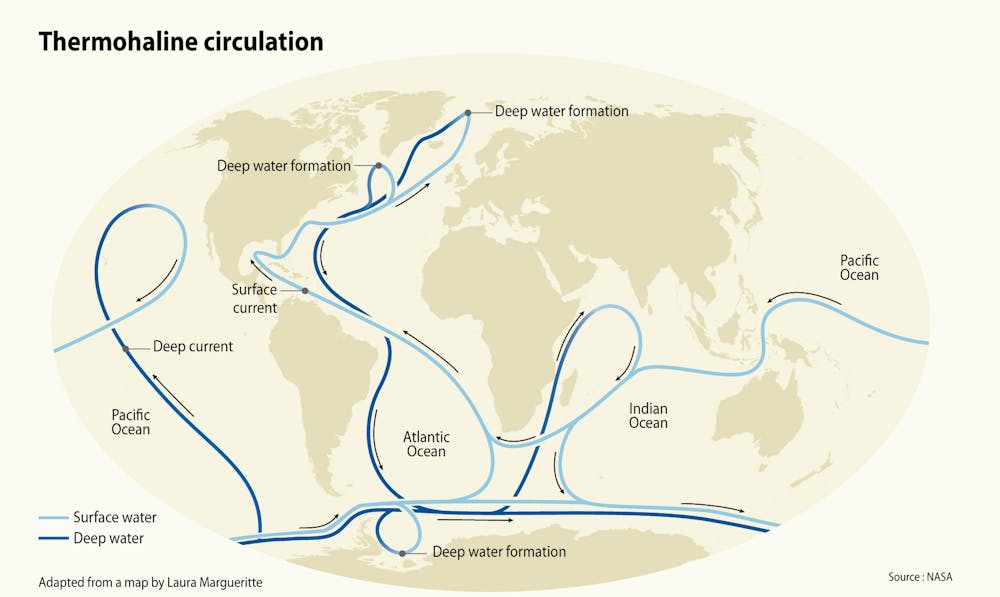 :{A very large, slow current called the thermohaline circulation carries warm water to Earth’s polar regions, where it cools and sinks to the deep oceans.:(style="margin:0px;padding:0px;border:0px;outline:0px;vertical-align:baseline;background-image:initial;background-position:initial;background-size:initial;background-repeat:initial;background-attachment:initial;background-origin:initial;background-clip:initial"):}::{:(style="margin:0px;padding:0px;border:0px;outline:0px;vertical-align:baseline;background-image:initial;background-position:initial;background-size:initial;background-repeat:initial;background-attachment:initial;background-origin:initial;background-clip:initial;border-style:initial;border-color:initial;border-image:initial;outline-color:initial;outline-style:initial;background-image:initial;background-position:initial;background-size:initial;background-repeat:initial;background-attachment:initial;background-origin:initial;background-clip:initial"):}:Maphoto/Riccardo Pravettoni via GRID-Arendal, CC BY-ND]
One such reservoir occurs in the western Pacific west of the Okinawa Trough in the East China Sea. The temperature of the bottom waters at this location is 37 to 39 degrees Fahrenheit (3 to 4 degrees Celsius), which means the hydrate cap is within about 4-5 degrees Celsius of its melting point.
Importantly, warm hydrothermal fluids are rising from below the carbon dioxide reservoir toward the surface. As the oceans continue to warm, the temperature difference between cold ocean waters and warmer hydrothermal fluids will decrease. This will cause the hydrate to thin, potentially to a point where it will no longer keep liquid carbon dioxide from escaping.
To date there has been no research to assess whether these ocean carbon dioxide reservoirs are vulnerable to rising ocean temperatures. But Earth’s pre-historic record clearly demonstrates that geologic reservoirs can be destabilized – and that when they are, it leads to rapid increases in atmospheric carbon dioxide and global warming. In my view, this represents an important unknown risk that cannot be ignored.
==
https://e360.yale.edu/features/will_climate_change_jam_the_global_ocean_conveyor_belt
...A similar string of moorings across the middle of the Atlantic, delving as deep as 3.7 miles from the Canary Islands to the Bahamas, has already detected a disturbing drop in this ocean’s massive circulation pattern. Since those moorings were installed in 2004, they have seen the Atlantic current wobble and weaken by as much as 30 percent, turning down the dial on a dramatic heat pump that transports warmth toward northern Europe. Turn that dial down too much and Europe will go into a deep chill.
Researchers have been worried about an Atlantic slowdown for years. The Atlantic serves as the engine for the planet’s conveyor belt of ocean currents: The massive amount of cooler water that sinks in the North Atlantic stirs up that entire ocean and drives currents in the Southern and Pacific oceans, too. “It is the key component” in global circulation, says Ellen Martin, a paleoclimate and ocean current researcher at the University of Florida. So when the Atlantic turns sluggish, it has worldwide impacts:The entire Northern Hemisphere cools, Indian and Asian monsoon areas dry up, North Atlantic storms get amplified, and less ocean mixing results in less plankton and other life in the sea.
A single Atlantic Ocean current system accounts for up to a quarter of the planet’s heat flux.
Paleoclimatologists have spotted times in the deep past when the current slowed quickly and dramatically, cooling Europe by 5 to 10 degrees C (10 to 20 degrees F) and causing far-reaching impacts on climate. Modelers have tried to predict how human-caused climate change might impact the Atlantic current, and how its slowdown might muck with the world’s weather even more. But years of intensive peering at this question haven’t yet provided much clarity.
Now, debate is raging about whether the recent Atlantic slowdown has been triggered by climate change, or is just part of a normal cycle of fast and slow currents. New studies in the last few years and months have come out supporting both prospects. The new data from the north, Lozier and others hope, might help to sort things out.
When the Hollywood blockbuster “The Day After Tomorrow” threw the Atlantic Ocean current into the popular spotlight in 2004, researchers laughed at its portrayal of an ocean current shutdown. In the movie, the world was plunged into a new ice age in a matter of days, with cold fronts literally chasing people at a sprint. But the disaster at the core of the film was based in some reality.
A huge amount of heat is moved around our planet by a single ocean current system — the Atlantic Meridional Overturning Circulation (AMOC)— which accounts for up to a quarter of the planet’s heat flux. The system is driven by density: waters that are cold or salty are denser and so dive down to the ocean floor. As a result, today, cold waters sink in the North Atlantic and flow southwards, while warm tropical waters at the surface flow northwards in the Gulf Stream, making northern Europe unusually mild for its latitude. But if northern waters get too warm, or too fresh from melting ice, then they can stop being dense enough to sink. That causes a major traffic jam for the water attempting to move north, and the system grinds to a halt.
Illustration depicting the circulation of the global ocean. Throughout the Atlantic Ocean, the circulation carries warm waters (red arrows) northward near the surface and cold deep waters (blue arrows) southward.
Illustration depicting the circulation of the global ocean. Throughout the Atlantic Ocean, the circulation carries warm waters (red arrows) northward near the surface and cold deep waters (blue arrows) southward. IMAGE COURTESY OF NASA/JPL
This has happened before. Researchers have spotted dramatic AMOC slowdowns of more than 50 percent during the last glaciation some 100,000 to 10,000 years ago, over a period perhaps as short as decades. The theory — which is being debated — is that as ice sheets got too big to stay stable, armadas of icebergs broke off, floated out to sea, and melted; even though the waters were chilly, the huge influx of freshwater made them less dense, and so they stopped up the currents. Looking further back in time to the last interglacial period about 120,000 years ago, which is more like today’s interglacial world, is trickier. But a study of some proxy measurements has shown that there may have been rapid slowdowns in the last interglacial, too.
“It seems to be a fairly stable system, until we push it just the right amount and then we’re in terrible shape,” says Martin. “I don’t think you want to play with the AMOC.”
The last review by the Intergovernmental Panel on Climate Change concluded that the AMOC is very likely to slow by the end of the century, perhaps by as much as 54 percent in the worst-case scenario, where emissions keep going up and global temperatures rise about 4 degrees C. But the range of possible slowdowns in these predictions is huge, starting at just 1 percent for an emissions-restricted world.
“The jury is still out. Weakening is a possibility, but it hasn’t been proven yet,” says one scientist.
If the North Atlantic current slows dramatically, then the entire Northern Hemisphere would cool; a complete collapse of the current could even reverse global warming for about 20 years. But the heat that ocean currents fail to transport northwards would make parts of the Southern Hemisphere even hotter. And a cooler north isn’t necessarily good news. Should the AMOC shut down, models show that changes in rainfall patterns would dry up Europe’s rivers, and North America’s entire Eastern Seaboard could see an additional 30 inches of sea level rise as the backed-up currents pile water up on East Coast shores.
But to pin down what the AMOC is going to do, researchers need to better understand what it’s doing right now. And that is proving tricky.
The problem researchers face is that the AMOC is extremely capricious, wobbling around more from year to year than the expected shift to date from global warming. Just like temperature or sea level records, this makes for a very noisy signal in which it’s hard to see long-term trends. “It’s analogous to the early difficulty seeing a global warming signature,” says Columbia University paleoclimatologist and oceanographer Jerry McManus. “Now that signature is compelling, but it took a while to see it clearly. Now that’s happening with AMOC. ”
The first string of moorings put in the ocean to investigate this current — the so-called RAPID array, with more than a dozen moorings from Florida to the Canary Islands — were deployed in 2004. They have shown a drop in water flow from 20 sverdrups (or million cubic meters of water per second) to 15 sverdrups over a decade. But the variability is huge. In 2009 to 2010, for example, the current was particularly sluggish for some reason, with water transport dropping by about a third. That helped to make the next winter the coldest for the United Kingdom since 1890, with heavy snowfalls and travel chaos. And from New York to Newfoundland, sea levels were boosted by five inches. Lozier’s data from the northern part of the ocean — in an array called OSNAP — will add a missing piece to the puzzle of what the current is up to.
...
==
Effects of Climate Change - Currents: NOAA's National Ocean Service ...
https://oceanservice.noaa.gov/education/tutorial_currents/05conveyor3.html
1.
Global Conveyer Belt: Ocean Current Slowing | Climate Central
https://www.climatecentral.org/gallery/.../global-conveyer-belt-ocean-current-slowing
1.
Global Ocean Conveyor Belt | Climate Matters
medialibrary.climatecentral.org/resources/global-ocean-conveyer-belt
1.
How Climate Change Could Jam The World's Ocean Circulation - Yale ...
https://e360.yale.edu/.../will_climate_change_jam_the_global_ocean_conveyor_belt
1.
Scientists Say Ocean Circulation Is Slowing. Here's Why You Should ...
https://insideclimatenews.org/.../atlantic-ocean-circulation-slowing-climate-change-hea...
1.
**The California Current flows southward along the West Coast of North America delivering cool, nutrient-rich water from British Columbia to Baja California.** Prevailing northwesterly winds drive the current and stimulateupwelling:{:(style="box-sizing:border-box;background:url("):}:, a process by which cold water rises from the depths to support biodiversity off the coast.
Weird is the new normal
Life in the California Current naturally fluctuates from year to year, partially due to temperature changes, said John C. Field, a fisheries biologist with the National Oceanic and Atmospheric Administration (NOAA).
Purple-striped jellies and other gelatinous creatures sometimes dominate the California Current. The reasons are still a mystery.
In cold-water years, he says, upwelling brings nutrient-rich deep waters to the surface, typically supporting an abundance of rockfish, krill and market squid. Warm-water years, when less upwelling occurs, bring more sub-tropical species, such as pelagic red crab. Some years, jellies and other gelatinous creatures dominate the current, for reasons scientists don’t yet understand.
John participates in an ecosystem survey:{:(style="box-sizing:border-box;background-image:url("):}: that monitors annual changes in marine life off the coast of California. Throughout the survey’s 33 years, he said, only one regime has dominated at a time: either a cold-water or a warm-water regime. The spring of 2015, however, was different. There were high catches of cold-water species, warm-water species, and all the gelatinous stuff.
“It was really a blend of everything,” John said. “We usually get one type of thing or the other, but nothing like this. It was a really unusual year.”
Scientists don’t know what causes weird years like this — or whether the changing climate will make them more frequent.
Fishery business
As sea surface temperatures rise, fish are getting fidgety. Scientists predict cool-water fish populations will shift farther toward the poles:{:(style="box-sizing:border-box;background:url("):}: in the Northeast Pacific Ocean. The fish in the California Current may follow suit, said Tony Koslow:{:(style="box-sizing:border-box;background:url("):}:, a researcher from Scripps Institution of Oceanography at the University of California, San Diego.
In a paper:{:(style="box-sizing:border-box;background:url("):}: published last year, Tony and others found the abundance of fish in the California Current has declined dramatically for the past four decades, a trend likely driven by climate change....
==
https://oceanexplorer.noaa.gov/explorations/02quest/background/upwelling/upwelling.html
6/17
https://sanctuaries.noaa.gov/news/features/0609_changingclimate.html
...Changes in Currents and Upwelling
Scientists have found that ocean temperature has a major influence on currents and upwelling activity, which are fundamentally important to marine ecosystems around the world. Upwelling - circulation of cool water from the deep ocean to warmer areas near the surface - is especially crucial in places such as Cordell Bank National Marine Sanctuary off the Northern California coast and Stellwagen Bank National Marine Sanctuary off Massachusetts, where thriving communities of marine life depend on the nutrients it pulls up from the depths.
- It is difficult to predict how warming sea surface temperatures will alter upwelling and currents, but any changes in ocean circulation are likely to have serious consequences for marine life.Without the influx of nutrients from deep water, sites like Cordell Bank and Stellwagen Bank could see devastating collapses in marine communities, with declines in tiny organisms like plankton and krill at the bottom of the food web leading to starvation for fish, seabirds, whales and other high-level consumers.
==
ocean warming, demoic acid, loss of food
drilled early ff sci report said warming wd shift fish pops.
==
omg (whales starve off CA no food)
Pompeo actually just cheered the ‘new opportunities’ presented by the Arctic’s melting ice sheets
by Cody Fenwick May 6, 2019
Secretary of State Mike Pompeo has never been terribly worried about climate change, but in a new speech to the Arctic Council Ministerial Meeting in Finland on Monday, he seemed…
==
https://www.alternet.org/environment/climate-disaster-looms
// irish famine year w/o summer
...because the UK, Germany, the Netherlands, Poland, and all of Northern Europe and Scandinavia are at roughly the same latitudes as the area from central Canada to Alaska, the only thing that keeps them warm enough to sustain rich crop yields (unlike Alaska) is the heat distributed to them from the Great Conveyor Belt/AMOC.
And the main thing that keeps the AMOC moving is the incredible salinity that forms in the North Atlantic as the current gives up both heat and water vapor, (leaving behind the salt) into the soon-to-warm-Europe air with the warmth. Because the strongly saline water is so much denser/heavier than normal seawater, it sinks vigorously toward the deeper parts of the ocean, pulling the rest of the current behind it and helping maintain the AMOC’s flow.
Should something begin to inject fresh water into that region, thus diluting the salinity of the AMOC there, it would reduce the density of that water column and thus could shut down the Conveyor Belt. And that would shut off Europe’s main heat source.
This is a scenario that most climate scientists—until this year—considered a remote possibility, even in the next century.
But it’s beginning to happen right now, both in Antarctica and off the coast of Greenland and Western Europe, because of massive glacier melts.
One part of the thermohaline circulation of the AMOC runs around Antarctica. And, because of global warming, Antarctica is shedding hundreds of billions of tons of ice-melt fresh water into the ocean every year—which is diluting and cooling saltwater and reducing local thermohaline circulation.
As Chris Mooney notes in the 4/3/18 Washington Post (“One Of The Most Worrisome Predictions About Climate Change May Be Coming True”):
“The new research, based on ocean measurements off the coast of East Antarctica, shows that melting Antarctic glaciers are indeed freshening the ocean around them. And this, in turn, is blocking a process in which cold and salty ocean water sinks below the sea surface in winter, forming ‘the densest water on the Earth’...”
Meanwhile, the northern part of the Great Conveyor Belt—which warms Europe—is also faltering in the North Atlantic, largely as a result of hundreds of billions of tons of cold, fresh water from Greenland glacier-melt, caused by global warming, pouring into it every few minutes.
New research from University College London and the Woods Hole Oceanographic Institution (“Anomalously Weak Labrador Sea Convection and Atlantic Overturning”) found that the hiccups in the Great Conveyor Belt began around the time of the Industrial Revolution, when we—for the first time in millions of years of human evolution—started spewing billions of tons of fossil-fuel-derived carbon dioxide into the atmosphere. The Great Conveyor Belt has been deteriorating ever since, and the speed of its disintegration is now alarming observers worldwide.
Scientists are concerned that we may even be close to a tipping point, where this river of warm, salty water could change or collapse rapidly and with little warning—a change that probably would take tens of thousands of years to undo or reset.
As Dr. Michael Mann,one of the world’s most respected climate scientists and the founder of the “hockey stick” that Al Gore popularized, told me on my :
“This is a potentialtipping point in the climate system, which is to say it could happen very abruptly once it starts to happen. The danger is that we’ve already seen a substantial slowdown in this ocean circulation pattern, [and that] suggests the possibility that we could be right up against that tipping point where it essentially just shuts down.”
Mann added that until the recent research came in, pretty much everybody thought we had 100 years or so before we needed to begin to even seriously consider this potentially catastrophic scenario:
“If you talked with climate modelers even 5 or 6 years ago, they would have told you that this scenario isn’t likely to play out for at least another century or so. … So something that we didn’t expect to happen for the better part of a century is happening already.”
And lest Americans think this will only be a European problem, shutting down the AMOC/Gulf Stream, which warms the American northeast, would also have a catastrophic impact on that region of the United States and Canada.
As NASA’s scientists note on one of the few climate-change web pages the Trumpies haven’t yet removed:
“Without thevast heat that these ocean currents deliver—comparable to the power generation of a million nuclear power plants—Europe's average temperature would likely drop 5 to 10°C (9 to 18°F), and parts of eastern North America would be chilled somewhat less. Such a dip in temperature would be similar to global average temperatures toward the end of the last ice age roughly 20,000 years ago.”
Compare that to the damage a mere 1° C drop in the 1816 Year Without a Summer caused to both Europe and the eastern part of North America in 1816. Civilization—and billions of people—probably would simply no longer survive as we know it....