RESPONSIBLE SCIENCE policy coalition
---
ESTB 5 26
MERRI OK
---
oct 2018 lab
What is the Responsible Science Policy Coalition? Here Are Some Clues
Read the full article by Michael Halpern
“An interesting new group has popped up called the Responsible Science Policy Coalition (RSPC) that seems to have a significant interest in chemical safety policy. Are they legitimate? As Congress prepares for another hearing into the dangers of per- and polyfluoroalkyl substances, known as PFAS, it’s worth digging into who these folks might be…
In July, the Responsible Science Policy Coalition surfaced at a meeting of the Council of Western Attorneys General where they expressed being ‘eager to help your state with your issues.’ In their presentation to the attorneys general, the RSPC argued that there are ‘lots of problems with existing PFAS studies’ and that these studies ‘don’t show the strength of association needed to support causation.’
The RSPC also submitted a comment on the ATSDR draft toxicology assessment that extensively detailed why, in their view, ATSDR’s scientific approach was sub-par.
Where, then, did the Responsible Science Policy Coalition come from, and why do they care so much about PFAS? Here’s what we know. According to the PowerPoint presentation, RSPC is a new coalition made up of 3M, Johnson Controls, and unnamed other companies.
The inclusion of 3M is particularly notable because the company spent decades hiding the science about the dangers of PFAS. 3M used such chemicals in many highly-used products including Scotchgard and firefighting foam…
RSPC seems to be led by Jonathan Glendill and James Votaw. Glenhill is the president of the Policy Navigation Group, whose list of past and present clients is dominated by industry groups. Votaw is a lawyer for Keller and Heckman; the address given for RSPC is the address of Keller and Heckman’s DC offices. Votaw has signed the three comments from RSPC on the ATSDR study (the first two were extension requests). Votaw’s practice concentrates on environmental and health and safety regulation, including chemicals and pesticides.
Keller and Heckman’s chemicals practice is more circumspect, but their pesticides practice is described in part as ‘[helping] clients defend existing markets worldwide against governmental pressure and environmentalist activism.’ They can help companies ‘defend against an EPA enforcement action’ and ‘secure successful tolerance reassessments.’ …
A name like the Responsible Science Policy Coalition makes insinuations of course—that most people are pulling numbers out of thin air and pursuing haphazard or irresponsible science policy, and we really need some adults in the room. The same words are reused again and again in the names of these types of organizations, and ‘responsible’ is no different. There’s the Citizens Alliance for Responsible Energy, the Coalition for Responsible Healthcare Reform, the Coalition for Responsible Regulation, and more.
Less charitably, groups like RSPC are known as front groups. Disguised by innocuous-sounding names and with a veneer of independence, they principally exist to create doubt and confusion about the state of the science to avoid regulation of the products their members create. Plenty of industries have them. The American Council on Science and Health has long conducted purportedly independent science that was in fact funded by corporate interests. The Groundwater Protection Council fights federal regulation of fracking. The Western States Petroleum Association, the top lobbyist for the oil industry in the western United States, was found in 2014 to be running at least sixteen different front groups in order to undermine forward-looking policies like California’s proposal to place transportation fuels under the state’s carbon cap.
Could the Responsible Science Policy Coalition meet its stated goal to ‘accelerate research and promote best practices and best available science in policy decisions?’ Perhaps. But those looking to RSPC for advice should be wary of the fact that so far, it seems to exist to encourage more relaxed regulation of PFAS chemicals – a decision that is worth a lot of money to the organization’s key members.”
---
GGL 5 26
[### What is the Responsible Science Policy Coalition? Here Are ...

The Equation - Union of Concerned Scientists
https://blog.ucs.org › michael-halpern › what-is-the-res...](https://blog.ucs.org/michael-halpern/what-is-the-responsible-science-policy-coalition-here-are-some-clues/)
Sep 25, 2018 — An interesting new group has popped up called the Responsible Science Policy Coalition (RSPC) that seems to have a significant interest in chemical safety ...Read more
:{:{The Senate Environment and Public Works Committee will convene tomorrow for a hearing on the federal responses (or lack thereof) to the risks associated with the class of toxic chemicals known as PFAS, inviting representatives from the Environmental Protection Agency (EPA), Department of Defense, Agency for Toxic Substances and Disease Registry (ATSDR) and National Institute of Environmental Health Sciences to testify.}:
It has been encouraging to see Congress conducting oversight on the government’s failures to protect us from PFAS. While the federal government is responsible for its regulatory inaction once it learned of PFAS’ dangers, the companies who created, manufactured, and processed these chemicals and then dumped them unrestricted into our environment—fully understanding their persistence and even toxicity—should be required to answer and pay for their behavior.}:
Today, we added a case study to our Disinformation Playbook that explores how DuPont and 3M chose to bury unfavorable research linking PFAS to health issues, a decision that staved off regulatory scrutiny and allowed the companies to continue to profit while workers in their facilities, and the rest of us downstream, faced the consequences. This is only one of the strategies from the disinformation playbook that the makers of PFAS, and the chemical industry trade associations that they are part of, have employed to undermine public health.
The Fake
In our new case study, we illustrate how DuPont and 3M used “The Fake” by concealing health studies linking exposure to increased rate of tumors, liver damage, and birth defects:
In the 1960s, for example, DuPont researchers found PFOA could increase liver sizein animals. According to theNew York Times,other documents revealed that by the 1990s, the company knew that PFOA caused multiple types of cancerous tumors. The companydid not shareits knowledge with the public, regulators, or even largely its own workers, who faced elevated levels of cancers and the possibility ofgiving birth to children with birth defects, among other health effects.
DuPont was not the only company to engage in such corporate disinformation. In early 2018, the Minnesota Attorney General’s Office released documents showing that the chemical company 3M had alsoconcealed and downplayedthe dangers of PFAS for decades. 3M, which invented PFOA and used another variety of PFAS called PFOS in its popular product Scotchgard, hadconducted scientific studies in the 1970sthat showed the toxicity of the chemicals, but did not turn over any of its science to the Environmental Protection Agency for more than 20 years.
The Diversion
:{:{PFAS makers and users have also used “The Diversion,” a strategy to manufacture uncertainty about the science and deceive the public. As the body of evidence linking PFAS exposure to assorted health effects has grown, 3M, DuPont, and the chemical industry trade associations that they are affiliated with have continued to use disinformation to fight off regulations.}:
The Centers for Disease Control and Prevention’s (CDC) Agency for Toxic Substances and Disease Registry (ATSDR) issued a toxicological profile on PFOA, PFOS and a handful of other PFAS variants and determined that the risk levels for PFAS were 7 to 10 times lower than the EPA’s current health advisory. In 2018, 3M helped form the Responsible Science Policy Coalition, an advocacy group that has cast doubt on the findings of the ATSDR report and other science showing the health effects of PFAS. This organization joins the ranks of scores of other front groups with innocuous-sounding names that promote disinformation and fight tooth and nail against regulation that would protect public health. My colleague, Michael Halpern, described some of their methods in a blog post last year:}:
*In July, the Responsible Science Policy Coalitionsurfaced at a meeting of the Council of Western Attorneys Generalwhere they expressed being “eager to help your state with your issues.” In their presentation to the attorneys general, the RSPC argued that there are “lots of problems with existing PFAS studies” and that these studies “don’t show the strength of association needed to support causation.”
*The RSPC alsosubmitted a commenton the ATSDR draft toxicology assessment that extensively detailed why, in their view, ATSDR’s scientific approach was sub-par.
The Fix
The infiltration of state and federal governments by individuals pushing the chemical industry’s agenda has hamstrung further regulation of PFAS to protect public health, in a textbook use of “The Fix.” In West Virginia, several employees at the state’s Department of Environmental Protection ended up working for firms hired by DuPont. At the national level, starting in 2003, DuPont’s PFOA strategy for the EPA was led by former EPA deputy administrator Michael McCabe, and his successor at EPA also joined DuPont’s efforts after leaving the agency in 2003. DuPont had access to inside information at the agency and drafted quotes for EPA officials, a practice McCabe later said was “customary.”
In 2006, a draft report by the EPA’s Science Advisory Board found PFOA to be a likely human carcinogen. In response to the report, an internal DuPont email noted that “In our opinion, the only voice that can cut through the negative stories, is the voice of EPA. We need EPA…to quickly (like first thing tomorrow) say the following: Consumer products sold under the Teflon brand are safe.” A few weeks later, EPA issued such a statement. McCabe denied that EPA made the statement in exchange for DuPont’s phase-out of PFOA, while EPA has declined to comment.
:{:{Last year, the revolving door between industry and EPA’s Office of Chemical Safety and Pollution Prevention impacted the release of the aforementioned ATSDR report. In May 2018, documents we obtained revealed that the White House and EPA blocked a draft government study on PFAS after a Trump administration official warned the study’s release would lead to a “public relations nightmare.”}:
The Trump administration has close ties with the chemical industry, and EPA employee Nancy Beck—one of the employees involved in the effort to bury the study—worked at the American Chemistry Council, a chemical industry trade association, before joining Trump’s EPA. The documents were released the week before an EPA conference on PFAS in which community members and journalists—but not industry employees—were shut out from attending. In mid-June, after significant bipartisan Congressional pressure, ATSDR finally released its report.}:
As the disinformation drags on, local action is powerful
:{:{As the same players use the same tired old plays to divert attention away from dangerous chemicals and real solutions, the agencies that have promised to keep us safe from PFAS by figuring out how to regulate them and clean them up have been failing to do so. Just last month, EPA released its long-awaited PFAS “action” plan that was seriously lacking in any real action. In lieu of meaningful federal action, states like Vermont, New Jersey, and Minnesota have set enforceable drinking water standards stricter than EPA’s health advisory.}:
Michigan’s Governor Gretchen Whitmer yesterday directed the Michigan Department of Environmental Quality to begin the process of establishing standards for PFAS in the state. States have taken the lead not only in setting enforceable drinking water and groundwater standards, and passing legislation that further regulates these chemicals, but also in holding companies accountable for poisoning our waterways and bloodstreams.}:
Take my home state of New Jersey, in which the governor just this week ordered 3M, DuPont, DowDuPont, Chemours, and Solvay to assess and eventually clean up the very expensive PFAS-related pollution in the state. This comes after class action lawsuits have compelled DuPont and 3M to pay West Virginia, Ohio, and Michigan residents for PFAS-related pollution. And as states work to hold companies accountable, grassroots organizations and community members are standing up to fight corporate power across the country.
As Congress continues to consider legislation related to this class of chemicals, it is essential that there are provisions holding companies responsible for polluting, and for spreading disinformation in order to keep on polluting. Companies should be held liable for all of the damage they have done in lives lost and harmed and natural resources destroyed. You can help by contacting your members of congress to urge them to join the recently created PFAS task force (and scientists- you can use your expertise to encourage Congressional oversight here).
Posted in: Science and Democracy
Tags:3M, Countering Disinformation, disinformation playbook, dupont, EPA, oversight, PFAS, the diversion, the fake, the fix
---
AI Overview
+1
The Responsible Science Policy Coalition (RSPC) emerged around 2018 as a group with a significant,, yet largely opaque, focus on chemical safety policy, particularly regarding PFAS. Critics have described the RSPC as a potential industry front group, using a neutral name to create doubt about scientific consensus to avoid regulations.
The Equation - Union of Concerned Scientists +1
Key Aspects of the Responsible Science Policy Coalition:
- Focus on Chemical Regulation: The group has historically focused on influencing policy surrounding per- and polyfluoroalkyl substances (PFAS), which are commonly used in products like nonstick cookware and firefighting foams.
 The Equation - Union of Concerned Scientists
- Controversy and Criticism: According to this article from the UCS blog, analysis from groups like the Union of Concerned Scientists suggests the RSPC functions as a "front group." Such organizations often exist to cast doubt on scientific studies that suggest regulation of member-created products is necessary.
 The PFAS Project Lab
- Context of Formation: The RSPC appeared during times of increased scrutiny on PFAS, including when reports from the Agency for Toxic Substances and Disease Registry (ATSDR) on health risks were heavily debated.
 The Equation - Union of Concerned Scientists
- Industry Influence Concerns: The group was identified alongside other industry-backed organizations, such as the American Council on Science and Health and the Groundwater Protection Council, which often aim to counter federal regulatory actions.
 The PFAS Project Lab
*Note: The results indicate this entity was active around 2018. It should not be confused with established groups like The Science Coalition or the Coalition for the Life Sciences.
What is the Responsible Science Policy Coalition? Here Are ...
Sep 25, 2018 — An interesting new group has popped up called the Responsible Science Policy Coalition (RSPC) that seems to have a significant int...

The Equation - Union of Concerned Scientists
Responsible Science Policy Coalition – to spread disinformation
Oct 4, 2018 — A name like the Responsible Science Policy Coalition makes insinuations of course—that most people are pulling numbers out of thin...
---
2018 3M
political-chemicals-cleanup-3m-1012445
By Annie Snider11/23/2018
Chemical industry giant 3M is waging an aggressive campaign to stave off new regulations and potentially billions of dollars in damages stemming from a contamination crisis that has fouled tens of millions of Americans’ drinking water.
The Minnesota-based company is putting its lobbying muscle to work in Washington and courting the support of state attorneys general as it faces potentially massive financial liability for toxic pollution linked to two of its nonstick and water repellent chemicals, which have turned up in the water supplies of more than 1,500 U.S. communities.
A key component of 3M’s campaign to fend off government action is a new industry advocacy group that began weighing into the debate this summer, arguing that the chemicals don’t pose a health threat — a conclusion that numerous government agencies and independent studies have disputed. The industry group’s efforts to raise doubts about the science have caused alarm among public health watchdogs who call them reminiscent of the tobacco industry’s old playbook.
3M’s combative posture contrasts with a more conciliatory approach taken by other giant companies that have been implicated in the pollution crisis, as well as the industry’s primary lobbying group, the American Chemistry Council. Those organizations have supported federal efforts to evaluate and regulate the chemicals, banking on the Trump administration to deliver industry-friendly rules.
But as the chemicals’ original and biggest manufacturer, 3M faces a different scale of risk.
A glimpse at the scope of its potential liability emerged in February, when 3M reached an $850 million settlement with Minnesota for damage the company’s chemicals caused to the state’s drinking water. New York state soon filed its own lawsuit, and outgoing Republican Michigan Gov. Rick Snyder asked his state’s attorney general to pursue litigation as well. Meanwhile, dozens of other personal injury, class-action and property damage lawsuits are piling up against the company across the country. Altogether, industry experts say the company’s liability could reach the tens of billions of dollars.
Joshua Aguilar, an equity analyst with Morningstar, said analysts view the Minnesota settlement as a one-off event, at least for now, but that the litigation from other states and class-action suits could threaten the company’s value.
“If you have different jurisdictions where this becomes serious, you have to settle one, you have to settle another, it becomes a contagion effect,” he said.
The chemicals, known as PFOA and PFOS, have been used for five decades in products ranging from firefighting foam to Teflon to 3M’s signature Scotchgard. They take years to break down in the environment, giving them the nickname “forever chemicals.” They also accumulate in human bodies, where they have been linked to kidney and testicular cancer, immune disorders and other ailments — and have been found in more than 99 percent of Americans’ blood.
Communities from New York to Michigan to Colorado have been in an uproar as more contaminations have come to light. Earlier this year, POLITICO reported that the Trump administration sought to block a federal study finding they pose a danger at lower levels than the EPA previously deemed safe — a conclusion one White House said warned could be “a public relations nightmare.” That study, published by an agency of the CDC, finally came out this summer.
3M did not respond to multiple questions from POLITICO about its political activity and lobbying around the chemicals, which are part of a broader category of substances known as PFAS. But it acknowledged its membership in the new advocacy group, the Responsible Science Policy Coalition, as well as being a member of other business-oriented organizations such as the U.S. Chamber of Commerce, the National Association of Manufacturers, the Business Roundtable and the American Chemistry Council.
“3M is a technology and manufacturing company committed to scientific research and environmental stewardship,” company spokesperson Fanna Haile-Selassie said in a statement. She noted that the company, which lobbies on a wide variety of topics from taxes to health care, “voluntarily discloses its political activities and the public policy reasons behind them.”
An industry source with knowledge of the Responsible Science Policy Coalition said 3M is its main backer.
3M’s political action committee poured money into state-level campaigns this year including to attorney general candidates in Michigan, Ohio, California and Alabama — all states with major PFAS contaminations. The company also made its first contributions since at least 2013, totaling more than $36,000, to the Republican Attorneys General Association and its Democratic counterpart. Those groups, in turn, donate millions to their parties’ candidates for state attorney general without disclosing which contributions were directed by which corporate donors.
Some attorneys general have proven receptive to the company’s message.
In Alabama, where the chemicals made by 3M’s manufacturing plant in Decatur have contaminated the Tennessee River, a drinking water source for 4.7 million people, the freshly reelected attorney general has refused to join a drinking water utility’s lawsuit against the company. GOP Attorney General Steve Marshall received $2,000 from 3M’s political action campaign, and RAGA gave $735,000 during his bruising primary — a contribution that both Republicans and Democrats in the state argue violates Alabama’s ban on contributions between political action committees. Records do not indicate whether 3M directed any of its RAGA donations to him.
The northern Alabama water utility that supplies some of the state’s poorest communities with water drawn from just downstream of the 3M plant has sued the company over the contamination. The water utility’s manager formally requested Marshall’s help in the litigation an Oct. 12 letter, and said that Marshall’s predecessor, former Alabama Attorney General Luther Strange, had been collaborating with the water utility on the issue before Strange was appointed to the state’s open U.S. Senate seat in February 2017. But Marshall told a Huntsville television station last month that he is trying to determine whether his office has a role in the contamination case, WHNT-TV reported.
“I’m not the environmental watchdog,” he told the station. “My job is to make sure that we enforce the laws and do things that are appropriate for the people of this state.”
Marshall’s office declined to respond to POLITICO’s queries about the campaign contributions or his stance on the lawsuit.
State attorneys general were also the audience for the first public appearance of the Responsible Science Policy Coalition.
The coalition’s lobbyist warned against acting too fast to regulate the chemicals when he spoke on a panel at the Conference of Western Attorneys General in New Mexico in July.
“So much of what you see in emerging chemicals is people jump forward because of public pressure and things like that, make decisions, but then as more science emerges, we realize, ‘Oh, maybe that wasn’t the right decision,’ and it’s very hard to pull things back once you’ve done them,” lobbyist Jonathan Gledhill told the attorneys general, according to  posted online by the conference.
Representatives of the coalition have also met with several congressional offices and EPA political appointees in recent months, arguing that “the weight of current scientific evidence does not show that PFOS or PFOA cause adverse health effects in humans at current levels of exposure.” That conclusion flies in the face of findings by leading independent scientific researchers, EPA and the CDC.
The lobby group contends it is simply interested in assuring a sound process.
“The Coalition supports EPA’s ongoing efforts to evaluate and develop appropriate regulations and guidance for PFAS and to collaborate on testing, remediation and research that will help assist federal agencies, states and communities to more comprehensively evaluate PFAS occurrences,” coalition attorney James Votaw said in a statement to POLITICO.
But Michael Halpern, deputy director of the Center for Science and Democracy at the Union of Concerned Scientists, called the strategy a classic industry approach to delaying and undermining regulations.
“The goal is to stave off regulation by questioning the science,” Halpern said. He likened the new industry group to a similarly named organization, the Advancement of Sound Science Coalition, that the tobacco industry used in the early 1990s to attack EPA’s findings on secondhand smoke.
Briefing materials from the Responsible Science Policy Coalition obtained by POLITICO feature charts comparing the average concentration of the chemicals in Americans’ blood with the levels at which the chemicals have been found to harm animals in industry-backed studies. The implication is that humans’ exposure is far below the level that causes harm.
But David Savitz, an epidemiologist at Brown University’s School of Public Health, called the approach “disingenuous.” He said scientists recognize that humans’ bodies aren’t the same as those of lab animals, and they adjust the comparisons to account for those differences.
Moreover, he said, looking at the average person’s exposure is misleading because people living near contaminated hotspots, like manufacturing sites or military bases, have far higher risks.
Indeed, 3M’s own internal documents, which were handed to the Minnesota attorney general’s office as part of the lawsuit that settled in February, show that the company has known since the 1970s that the chemicals were toxic, according to reporting by The Intercept.
The coalition’s efforts to question the chemicals’ harm have set off alarm bells on Capitol Hill, where Sen. Tom Carper of Delaware, the top Democrat on the Senate Environment and Public Works Committee, pressed Trump administration officials during a recent hearing to dispute the group’s arguments that the chemicals aren’t linked to illnesses.
“What this country needs is responsible regulation to protect the public’s health and the environment, not more efforts to delay solutions and downplay risks,” Carper said in a statement to POLITICO.
3M’s campaign against government regulation has even caused concern from others within industry. DuPont, which faces major liabilities for PFOA, and the industry’s biggest lobbying group, the American Chemistry Council, have backed EPA’s efforts to evaluate and regulate the chemicals, banking on the Trump administration to write the most industry-friendly regulations that they can hope for.
“You are never going to have a more favorable administration than this administration to set standards,” a person in the industry said, speaking on the condition of anonymity to discuss internal industry discussions. “It doesn’t get any better than this.”
Former EPA Administrator Scott Pruitt committed to taking the first step toward potentially regulating PFOA and PFOS in drinking water and setting cleanup standards. His successor, acting Administrator Andrew Wheeler, has reiterated that pledge.
Asked about agency officials’ meetings with 3M and the new coalition, EPA spokeswoman Molly Block said they have met with a “variety” of individuals and officials about the chemicals. She said the agency will issue a plan that outlines short- and long-term steps for dealing with the chemicals.
Still, a version of the strategy 3M is deploying at the national level has already borne fruit in the company’s home state of Minnesota. There, years before this February’s hefty legal settlement, 3M persuaded lawmakers and regulators to pull back from formally declaring the chemicals hazardous — a designation that could have brought even wider-reaching legal consequences.
But now the company is facing a new challenge, from a novel legal technique aimed at short-circuiting 3M’s efforts to question the science.
As part of a class-action lawsuit brought on behalf of residents near DuPont’s Teflon manufacturing plant in Parkersburg, W.Va., a decade and a half ago, DuPont agreed to do medical monitoring and to convene an independent science panel to evaluate PFOA’s health effects. Those studies produced the lion’s share of evidence about the chemical’s effects on human health. And crucially, the settlement required that the company not only fund the independent research but be bound by its findings.
This February, that science led to a settlement between DuPont and residents affected by its plant’s water contamination, with the company agreeing to pay $670 million to 3,550 residents.
The Cincinnati attorney behind that suit has since filed a new lawsuit, on behalf of an Ohio firefighter, that seeks to create another independent science panel that would look at PFOA, PFOS and other chemicals in the class, whose findings would bind 3M, DuPont, Chemours and other major manufacturers of the chemicals.
“There is tremendous fear, anxiety, and uncertainty across the country as to the serious public health threat posed by PFAS contamination,” the attorney, Robert Bilott, said in a news release announcing the lawsuit in October. “This lawsuit could provide a mechanism for addressing and resolving those concerns through a truly comprehensive and independent, science-based process paid for by those that actually created the problem — and not by the American taxpayers.”
Filed Under:
---
ppt testimony
devon hill et al keller and heckman votow
gledhill rollins jim policy navigation gp
1001 g str suite 500 nw
---
E AND 3 GOOD ONE
With growing concerns about drinking water contamination in communities nationwide, lobbyists have rushed to shape the emerging congressional debate around a decades-old class of widely used toxic chemicals.
Nearly two dozen groups disclosed lobbying federal officials on issues related to "per- and polyfluoroalkyl substances," or "PFAS," in the last quarter of 2018 — the most recent period for which data are available — up from just one company during the same period a year before, according to an E&E News analysis of filings.
Amid a flurry of regulatory and legislative action on the chemicals, organizations representing environmentalists, doctors and cities have entered the lobbying fray alongside powerful industry associations and giant corporations like Exxon Mobil Corp., Dow Chemical Co. and Chemours Co.
Overall, 28 separate entities have specifically listed lobbying Congress or agencies on PFAS since the issue first popped up in a filing by French chemical maker Arkema Inc. from the fourth quarter of 2017. Beyond Capitol Hill, some of the top advocacy targets were EPA, the Department of Health and Human Services, and White House offices.
And the number of groups that in the last two years spoke to congressional members and agency officials about the chemicals — found in everything from nonstick cookware to firefighting foam but only recently linked to health risks like cancer — could be even higher.
That’s because some outfits could be obscuring their PFAS advocacy by only disclosing lobbying on a vague issues such as "drinking water" or "chemicals." And the American Chemistry Council has been advocating on what the lobby group refers to "fluorotechnology" for several years.
But K Street’s newfound interest in PFAS in particular comes as no surprise to Betsy Southerland, the former director of science and technology in EPA’s Office of Water.
"Early on, I don’t think we had a lot of lobbying on either side of the issue — either for more regulation or no regulation — because people were clueless," said Southerland, who left EPA in 2017 after more than three decades at the agency.
"As more and more communities monitor for these things, they become aware that they have a problem. So I think that’s why you’re seeing a spike in the lobbying right now," she said.
How the wave began
Arkema led the lobbying surge. At the end of 2017, it began contacting lawmakers about "PFAS and related fluorochemistry issues" in the 2018 National Defense Authorization Act, disclosures show.
That annual military spending bill, which was signed into law in December 2017, provided $7 million for HHS to lead a study on the human health implications of PFAS exposure.
An Arkema spokeswoman said the company has "a general interest in issues associated with PFAS" as a consumer of the chemical. She said the firm has provided perspective to Congress in that capacity, and it also commented on legislative proposals "from a broader industry perspective."
Water and chemical groups were the next to begin lobbying on the toxins. At the beginning of last year, PFAS showed up in disclosures filed by the National Ground Water Association — which represents water developers, managers and users — and the National Association for Surface Finishing, a trade group for companies that use PFAS and other types of coating materials.
The water association lobbied Congress on "PFAS contamination" while the surface finishing group contacted EPA about "PFAS research and policy initiatives," filings show.
The following quarter, some environmental groups, a site remediation outfit, and the affected city of Tucson, Ariz. joined the rush to lobby lawmakers and agencies on PFAS policy.
Over the same three-month period, EPA held a "national summit" on the toxins and Sen. Jeanne Shaheen (D-N.H.) and Rep. Carol Shea-Porter (D-N.H.) introduced the "PFAS Registry Act."
It sought to create a database of Armed Forces members who served on bases where PFAS-based firefighting foams were used.
News also broke during that time that the Trump administration was suppressing the findings of the draft HHS report ordered by the 2018 military spending bill.
After bipartisan uproar, the administration ultimately released the study, which found that "minimum risk levels" for several types of PFAS should be seven to 10 times lower than the health advisories from EPA (Greenwire, June 20, 2018).
By the time the HHS report finally came out, a full-fledged lobbying boom was underway. Groups that disclosed contacting federal officials about "PFAS" for the first time included deep-pocketed industry associations like the U.S. Chamber of Commerce, National Association of Manufacturers and American Chemistry Council.
Prominent environmental groups involved at that point included the Union of Concerned Scientists, the Natural Resources Defense Council and the advocacy arm of the Environmental Defense Fund.
Legislative activity around PFAS had also ramped up. Lawmakers introduced at least six bills related to the toxins in August and September of 2018, congressional records show. One, the 2019 military spending bill, H.R. 5515, became law.
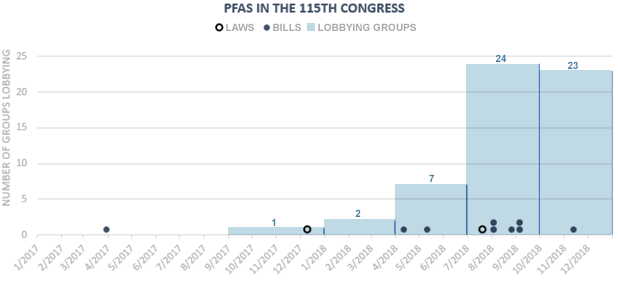 Lobbying and legislative activity on PFAS spiked at the end of last Congress. | Claudine Hellmuth/E&E News (graphic); Senate Office of Public Records and Congress.gov (data)
That statute included a provision that requires the Pentagon to assess PFAS contamination at military bases and make plans to clean it up and to help soldiers who may have been exposed to it.
What they want now
Environmentalists mainly want lawmakers and EPA to restrict the use of PFAS, E&E News found by reviewing filings and contacting groups interested in the issue. Companies, on the other hand, generally are calling for more study of the chemicals.
"There are many developing legal and regulatory actions at the state level, as well as an EPA inquiry on PFAS," said Michael Short, a spokesman for the manufacturers’ association. "These actions must be based on the best scientific information possible."
The American Academy of Pediatrics said in a statement that it got involved to highlight "children’s unique susceptibility to and potential negative health effects from exposure to these chemicals."
And one outfit that registered to lobby on the issue appears to be a front for companies that have a financial interest in opposing strict regulation of PFAS.
The Responsible Science Policy Coalition is run by Keller & Heckman LLP. The law firm declined to comment on who was bankrolling its advocacy, and the person listed on the filing, Jonathan Gledhill of Policy Navigation Group, did not respond to multiple requests for comment.
But according to a July 2018 PowerPoint presentation obtained by the Union of Concerned Scientists, the coalition’s key members were 3M Co. and Johnson Controls International PLC.
3M and a Johnson Controls subsidiary were both named in a lawsuit from New York state seeking to recover the costs of cleaning up environmental contamination from PFAS in firefighting foam used across the state’s five military and civilian airports (Greenwire, June 21, 2018).
A bill called the "PFAS Action Act," H.R. 535, already has surfaced this Congress, and a bipartisan group of members has formed a working group on the issue (E&E Daily, Jan. 24).
Meanwhile, EPA is showing few signs that it’s moving to crack down on the toxins. The agency is reportedly preparing to declare that PFOA and PFOS — two widespread forms of PFAS — are hazardous under the Superfund law, but isn’t planning to set a mandatory drinking water standard for them under the Safe Drinking Water Act.
As a result, companies would be required to clean up past PFOA and PFOS contamination yet they could continue to use other forms of PFAS without any federal restrictions (Greenwire, Jan. 29).
Asked for an update on its PFAS plans, EPA’s press office said they were currently undergoing interagency review.
"Unlike continued claims to the contrary in the press, the truth is that EPA is moving forward using its authorities under the Safe Drinking Water Act," David Ross, the assistant administrator in charge the water office, said in a statement.
"Across the agency, additional actions are already underway to prevent and clean up PFAS; take enforcement actions where appropriate; and use sound science to help inform our efforts to identify, understand, treat, or remove PFAS in impacted communities," said Ross.
Southerland, however, has heard from former colleagues that EPA intends to effectively put state regulators in charge of setting PFAS limits for drinking water, as previous reporting has suggested. Such a move would and create tremendous regulatory uncertainty, which in this case would be to industry’s benefit.
The amount of PFAS allowed in drinking water "could vary across every state in the country," the longtime EPA staffer warned.
"The more variety you have, the more ability industry has to say ‘this is bullshit, nobody knows what the actual level of concern is, so we’re going to do what’s cost effective for us.’"
That’s bad news for the public, according to Southerland, who’s become an outspoken critic of the Trump EPA. But it means more work for industry lobbyists in the coming years.
"They have a cash cow in EPA," she said. "There’s nothing they cannot get from EPA."
---
GGL 5 26
[### What is the Responsible Science Policy Coalition? Here Are ...

The Equation - Union of Concerned Scientists
https://blog.ucs.org › michael-halpern › what-is-the-res...](https://blog.ucs.org/michael-halpern/what-is-the-responsible-science-policy-coalition-here-are-some-clues/)
Sep 25, 2018 — An interesting new group has popped up called the Responsible Science Policy Coalition (RSPC) that seems to have a significant interest in chemical safety ...Read more
[### Responsible Science Policy Coalition – to spread ...

The PFAS Project Lab
https://pfasproject.com › 2018/10/04 › what-is-the-resp...](https://pfasproject.com/2018/10/04/what-is-the-responsible-science-policy-coalition-here-are-some-clues/)
Oct 4, 2018 — “An interesting new group has popped up called the Responsible Science Policy Coalition (RSPC) that seems to have a significant interest in ...Read more
Missing: advocacy | Show results with: advocacy
[### Inside a corporate giant's fight to thwart a massive pollution ...

Politico
https://www.politico.com › story › 2018/11/23](https://www.politico.com/story/2018/11/23/political-chemicals-cleanup-3m-1012445)
Nov 23, 2018 — But it acknowledged its membership in the new advocacy group, the Responsible Science Policy Coalition, as well as being a member of other ...Read more
[### responsible science policy coalition

House.gov
https://docs.house.gov › meetings › HHRG-116-G...](https://docs.house.gov/meetings/GO/GO28/20190910/109902/HHRG-116-GO28-20190910-SD008.pdf)
Jul 24, 2018 — © RESPONSIBLE SCIENCE POLICY COALITION 1001 G STREET, NW SUITE 500 WEST, WASHINGTON , DC 20001. Page 3. RSPC. ▫ New PFAS Coalition. ▫ Key ...Read more
Missing: advocacy | Show results with: advocacy
[### K Street profits from drinking water fears

E&E News by POLITICO
https://www.eenews.net › Articles](https://www.eenews.net/articles/k-street-profits-from-drinking-water-fears/)
Feb 5, 2019 — The Responsible Science Policy Coalition is run by Keller & Heckman LLP. The law firm declined to comment on who was bankrolling its advocacy ...Read more
[### 3M Fighting to Avoid Liability and Hoping to Save Billions

Stag Liuzza
https://stagliuzza.com › Environmental Torts](https://stagliuzza.com/news/3m-fighting-to-avoid-liability-and-hoping-to-save-billions/)
Representatives of the Responsible Science Policy Coalition have met with several congressional offices and an Environmental Protection Agency (EPA) political ...Read more
[### ISSUE: Environmental Policy Alert | Page 153

InsideEPA.com |
https://insideepa.com › topics › issue-environmental-poli...](https://insideepa.com/topics/issue-environmental-policy-alert?page=152)
... Responsible Science Policy Coalition (RSPC), a group... Ahead Of Wheeler Vote, Democratic Senators Praise EPA WIFIA Program. BALTIMORE -- As the Senate ...
[### How the Chemical Industry Deployed the Disinformation ...

The Equation - Union of Concerned Scientists
https://blog.ucs.org › genna-reed › how-the-chemical-i...](https://blog.ucs.org/genna-reed/how-the-chemical-industry-deployed-the-disinformation-playbook-on-pfas/)
Mar 27, 2019 — In 2018, 3M helped form the Responsible Science Policy Coalition, an advocacy group that has cast doubt on the findings of the ATSDR report ...Read more
[### - THE DEVIL THEY KNEW: PFAS CONTAMINATION AND ...

GovInfo (.gov)
https://www.govinfo.gov › content › pkg › html](https://www.govinfo.gov/content/pkg/CHRG-116hhrg37952/html/CHRG-116hhrg37952.htm)
Are you aware of 3M's membership to an organization entitled Responsible Science Policy Coalition? Ms. Rutherford. Congresswoman, we are members of many ...Read more
Missing: advocacy | Show results with: advocacy
[### Part II. Case Studies in Toxic Product Defense

Debunking Denial
https://debunkingdenial.com › part-ii-case-studies-in-to...](https://debunkingdenial.com/part-ii-case-studies-in-toxic-product-defense/)
Jul 3, 2020 — Also in 2018, a new misleadingly named industry front organization, the Responsible Science Policy Coalition, was formed with funding from ...Read more
---