forever chems pfas 2 bak
---
PRIMARY 10 26 EZ MAHA PFAS FUCKERY REF2 ZELDIN
SEE MERCURY EPA CUTS ON PFAS heated 10 25
ERIN BROCKOVICH
SEE CANCER LEUKEMIA
VOUGHT?
WHEELER ZELDIN NANCY BECK ACC
SUPERFUND?
BAYER CORTEVA DOW 3M KOCH DUNLAP
WM BARR 4?
MERRI OK
---
mta movie mtg 5 26
Corporate “rights” used to challenge regulation
Corporations have used constitutional claims (First, Fifth, and Fourteenth Amendments) to fight rules.
Examples relevant to PFAS-type harms:
Challenging mandatory disclosure of chemical risks (First Amendment “compelled speech”)
Arguing regulations are a “taking” of property under the Fifth Amendment
Claiming unequal treatment under the Fourteenth Amendment
👉 Result: Agencies like the EPA face constant legal barriers when trying to restrict harmful chemicals.
jennie relative teeth outCHEMO
---
-=-=
=-=-=
-=-=
MMA
MAHA Summit entrenches a divide between administration-aligned advocates and popular influencers
Some grassroots activists and popular influencers were notably absent from the event headlined by Robert F. Kennedy Jr. and JD Vance
Written by Alyssa Tirrell
Published 10/02/26
What does this week’s MAHA Summit tell us about the state of the movement?
Earlier this week, the MAHA Center hosted the second annual MAHA Summit, described by the organizers as a convention of “senior health leaders across technology, business, and government working to make Americans healthier.” The summit's apparent cooperation with industry figures and the Trump administration seemed to drive further an existing wedge within the MAHA coalition, putting administration-aligned advocates at odds with some grassroots activists and popular influencers. As one activist put it, “I don’t recognize this version of MAHA.”
The MAHA Center — the nonprofit arm of a triad of organizations, including MAHA Action and the MAHA PAC, all tied to Health and Human Services Secretary Robert F. Kennedy Jr. — describes MAHA as “a nationwide movement focused on reversing the chronic disease epidemic in America through advocacy, grassroots activism, and policy reform.”
Nonetheless, several prominent grassroots advocates and MAHA influencers were absent from the lineup — including Turning Point USA’s Alex Clark, Moms Across America’s Zen Honeycutt, and Kelly Ryerson, known online as Glyphosate Girl. Instead, the panels primarily featured Trump administration officials and industry representatives — from health tech, insurance, and agriculture — many of whom delivered sales or policy pitches.
In recent months, elected Republicans have faced backlash from MAHA advocates for apparently siding with industry interests on priorities like glyphosate and agricultural legislation. An invitation to participate in the summit could have been an olive branch to MAHA influencers — but if they received invites, it appears those influencers declined.
A panel on reform at the Centers for Medicare & Medicaid Services did feature podcaster Russell Brand as a moderator — a bizarre choice, not least because Brand has faced charges for numerous counts of rape and sexual assault. In his introductory remarks, Chief Executive Officer of MAHA Holdings Alex Hardy told the audience, “You'll hear from Russell Brand and Dr. [Mehmat] Oz. One's a heart surgeon, and one's a heart throb. We'll let you decide which is which.”
Some issues of recent MAHA activism featured lightly if at all during the panels. There were no dedicated panels for vaccine reform, glyphosate, and data centers — all of which have propelled MAHA advocacy in recent months and some of which would require a brush with industries that were represented among the summit’s speakers.
AI innovation was particularly emphasized throughout the summit, but the MAHA backlash against data centers was only mentioned in passing, when CMS Deputy Administrator Dan Brillman said, “The 58% that don’t use it, hate it. They hate data centers. We need more people using AI to better their health.” At the end of the event, RFK Jr. further promoted AI, telling the audience that it could “free us from medical tyranny” of experts.
Kelly Ryerson and Alex Clark also suggested that the MAHA Summit was not geared toward the women who made the movement a major political force. Ahead of the event, Ryerson told the Washington Examiner, “The MAHA Summit lineup does not reflect the issues that birthed the original MAHA movement and drove voters, especially women, to show up and vote for this coalition,” adding, “I don’t recognize this version of MAHA.” Similarly, NBC reported that Clark did not attend the summit. “Where are the original women who started the movement?” Clark asked.
Of the nearly 60 speakers who featured on the agenda, only 7 were women — one of whom was RFK Jr.’s wife Cheryl Hines, who appeared for just 5 minutes to announce future MAHA events.
Women have played a critical role in the movement — the introductory remarks of the event even paid lip service to “MAHA moms.” So it’s notable that the women of MAHA were largely excluded or chose not to participate in the summit. Their absence suggests that the MAHA coalition is now facing a familiar political question: Is compromise with prevailing power players a sign that the movement is succeeding or failing?
Is the summit just the tip of the iceberg?
The MAHA Summit highlighted an existing fracture in the foundation of the MAHA coalition. In recent months, MAHA Action and popular influencers have taken opposing lines on at least two issues related to the Trump administration.
One such example followed from the EPA announcement this past May that it would drop limits on some PFAS in drinking water. Ryerson, Clark, and MAHA activist Alexandra Muñoz expressed frustration with the move, while MAHA Action praised EPA efforts.
Before the rule was announced, Clark and Muñoz urged the EPA to change course. Clark wrote, “Don't weaken PFAS regulation!!!” and Muñoz posted, “Don't allow more PFAS in our drinking water!!!!”
In response to the change, Clark again expressed her frustration with the move, writing, “We are running one of the largest uncontrolled chemical experiments in human history from an alleged ‘MAHA EPA.’”
Ryerson seemed to agree with Clark and Muñoz, writing, “Yesterday, as predicted, the EPA announced they will be removing limits on certain PFAS in tap water.” Her post also included a quote she had given to The New York Times, strongly advising the EPA “not to move forward on deregulating PFAS if they want to win the November midterms.”
According to the New York Times, EPA Administrator Lee Zeldin “sought to counter that anger by appearing Monday with Robert F. Kennedy Jr., the health and human services secretary who spearheaded the MAHA movement, and announcing nearly $1 billion to help states address the contaminants in drinking water.”
MAHA Action backed Zeldin's spin, praising the administration's move. The account wrote, “The EPA is putting $1 billion toward cleaning PFAS from America’s drinking water. After decades of contamination, communities are finally getting help to confront the ‘forever chemicals’ poisoning their water.”
In a separate joint post with MAHA Action President Tony Lyons, MAHA Action wrote that Zeldin and the EPA were “declaring war on forever chemicals.”
A similar dynamic ensued following the announcement of Heidi Overton's nomination for FDA commissioner late last month. Again MAHA Action fell in line with the administration, while Clark, Ryerson, and Muñoz criticized the move.
MAHA Action and Lyons, along with the account MAHA Mommas, praised Overton's nomination, writing, “Secretary Kennedy has given his full endorsement of President Trump’s pick for the next FDA Commissioner, Dr. Heidi Overton.” The post added, “Kennedy is making clear that under Overton, the FDA will answer to science and the American people, not the status quo.”
Clark pushed back, writing, “This is who wrote the glyphosate executive order by the way,” seemingly referring to a February executive order aimed at boosting glyphosate production. Clark’s post was shared by Muñoz. (White House officials disputed the claim that Overton wrote the order, saying it was authored by Trump’s national security advisory team.)
Ryerson again seemed to agree with Clark and Muñoz, writing of the nomination, “Very sad day for MAHA."
The divide hasn’t escaped Lyons, it seems. Earlier this fall, he discussed the MAHA coalition’s role in driving GOP midterm results with Rumble’s Flyover Conservative, saying, “I think the strategy has to be to look at the coalition that worked in the fall of 2024, where we got a few million people to switch parties and to recognize that, like I said before, the party that they thought represented them really didn't.”
Lyons added, “On the more activist side of the MAHA movement — activists are never happy, they're not meant to be happy, the idea for activism is that you can always do better.”
//
MAHA advocates are rallying against GOP “traitors” who passed the farm bill
09/17/26
04/28/26
03/30/26
-=-=
---
an 7 26 grist
On a 200-acre farm and cattle ranch in Bandera, Texas, Mollie Engelhart grows organic produce, sells raw milk, and writes a daily column about the power of regenerative agriculture. She’s a farmer and a Make America Healthy Again mom who doesn’t like being called a MAHA mom. She prefers to think of herself as “MAHA-aligned.”
In May, Engelhart opened her ranch to a couple hundred pro-MAHA politicians, activists, and leaders for a two-day MAHA farming retreat. Department of Health and Human Services Secretary Robert F. Kennedy Jr., was there. Engelhart’s brother, Ryland, is one of the more well-known figureheads of the movement.
*This story was originally published by Grist. Sign up for Grist's weekly newsletter here.
Her biggest issue with the MAHA label is what she considers the “blue team or red team” politicization of it. Like many MAHA-aligned supporters, she voted for President Donald Trump in the last election largely because of RFK Jr.’s endorsement and their joint promise to clean up America’s chemical-laden food system. Back then, she had faith Trump would make good on that promise. But in the last year and half, that faith has frayed.
“I think that one hundred percent the MAHA movement is very disappointed and disenchanted, and I am not the only one,” said Engelhart. “MAHA voters are homeless.”
MAHA’s disenchantment with the Trump administration has much to do with its open support of Bayer, the manufacturer of the popular pesticide Roundup, which just won a Supreme Court case over the claim that the company failed to adequately warn users about the cancer risk of its weedkiller. First, the administration urged the Supreme Court to take up the case. Then, in February, the president signed an executive order that classified glyphosate-based herbicides like Roundup key to national security and called for increased domestic production of the chemical. In March, it was reported that top officials at the Environmental Protection Agency met with Bayer CEO to discuss “litigation” issues. The following month, the administration sent a lawyer to argue on behalf of the chemical company in a Supreme Court hearing.
Tens of thousands of plaintiffs had sued Bayer, alleging that the active ingredient in Roundup has caused cancer and other health issues and that the company failed to follow state laws when it did not include a warning about cancer risk on its label. But now, the court’s ruling means that states cannot mandate more information on the product’s label than required by federal law, and any such claims against Bayer will have limited pathways of legal recourse.
Just hours after the decision was released, Trump signed an executive order framed as boosting regenerative agriculture and American farm resilience. (Broadly speaking, the term “regenerative agriculture” refers to farming methodologies that boost soil health and its potential for carbon capture, though there is no federal standard or definition like there is for “organic,” leaving it open to interpretation — and, in some cases, greenwashing.) The contradictions between the two actions have sparked a new barrage of criticisms from MAHA voters. “It does seem a little schizophrenic,” said Engelhart. “None of us can be a one-issue voter anymore…I don’t think that anybody is just going to blindly go and vote for one party or another,” she added.
That sentiment is already showing up in the data, though the picture is far from clear-cut. Polling results from last October found that roughly 74 percent of MAHA-supporters identified as Republicans, with 59 percent also identifying as Make America Great Again supporters — the president’s most loyal base. Meanwhile, a POLITICO poll conducted this spring revealed that 47 percent of self-identified MAHA respondents who voted for Trump believe the administration has not done enough to “Make America Healthy Again.” And a Kaiser Family Foundation poll found that 28 percent of MAHA voters somewhat or strongly disapprove of the way the administration is handling food and vaccine policy, which may affect turnout in the midterm elections that could decide control of Congress. Limiting pesticide use, however, remains one of the movement’s defining causes, with 94 percent of MAHA adherents in favor of reducing exposure to harmful chemicals.
South Dakota farmer Jonathan Lundgren was at the White House on the day that the Supreme Court ruling was announced. Days earlier, he’d been invited to the Rose Garden for a dinner recognizing farmers and was asked to join Trump in the Oval Office for the signing of the regenerative agriculture executive order. Lundgren raises bees, sheep, and poultry, and grows flowers and apples on a 50-acre regenerative farm in Estelline, South Dakota. Like Engelhart, he shirks the political implication of identifying as MAHA, but considers himself aligned with the pro-regenerative agriculture and anti-pesticide faction of the movement.
“They needed some farmer faces to kind of give the whole thing a spin,” he said. Lundgren called the executive order “meaningful,” though it’s not lost on him that it doesn’t introduce new funding or regulations.
Experts say it doesn’t do much at all. “It may sound great, but fundamentally, there’s nothing really new or substantive or meaningful in the EO that I can see that actually changes the equation for how the administration treats regenerative agriculture,” said Mike Lavender, policy director at the National Sustainable Agriculture Coalition.
Inside the Oval Office meeting, Lundgren watched on as Kennedy’s team swiftly mobilized to try to soften the MAHA backlash to the Supreme Court ruling with the president’s executive order, which culminated in an explosive argument between a Department of Health and Human Services official and a top farming lobbyist who was concerned that the order would imply that there are safety issues in the U.S. food supply. Lundgren himself stopped using Roundup about eight years ago when he noticed that agrochemicals were “causing more problems than they were solving” on his farm. But he can’t escape the downwind effects of nearby farms that spray it. Right now, he’s watching scores of bees slow down before outright dying, and his orchard’s leaves cup from herbicide drift. Then there’s the human toll.
“We’re sick this time of year, and it’s a direct result of all of these pesticides being applied. My family is sick. That ain’t right,” Lundgren told Grist. His daughter is grappling with asthma and allergy flare-ups while his farm staff battles recurring headaches and fatigue. “It’s so intense that we call it in my community ‘The Spray Flu.’”
He says these dual actions by the administration, as well as the EPA’s recent approval of yet another batch of pesticides that contain PFAS, often called “forever chemicals,” have changed how he plans to vote in the midterms.
“We’re in a weird state right now that has never really happened before, where food safety and the health of our children is weighing very heavily on American politics,” said Lundgren. “This is far broader than the farming community. I think that this is consumers; I think this is parents; I think this is society at-large.”
Others argue that, despite the administration’s recent pro-regenerative ag messaging, Trump’s track record of anti-climate and pro-chemical policies has not helped the movement to clean up the food system, but hindered it.
Kelly Ryerson, a leading MAHA mom and co-founder of the farming organization American Regeneration, agrees that, when taken together, the ruling and the order reveal a disconnect. “It’s inconsistent, to say the least,” said Ryerson. “If Trump is going to be doing things like the Supreme Court situation, it’s certainly not what anyone voted for…it’ll be really hard to come back from this now.”
For Ryerson, a registered independent who voted for Trump, the two actions have shifted how she plans to approach the midterms. “I don’t care if they’re a Republican or Democrat, I’m going to support the candidate that wants to decrease toxic exposures,” she said.
This article originally appeared in Grist at https://grist.org/food-and-agriculture/trump-tried-to-appease-mahas-fury-over-roundup-it-backfired/.
Grist is a nonprofit, independent media organization dedicated to reporting on climate change.
---
ref 12/25
how-trumps-big-ag-bailout-is-alienating-his-maha-base
At a White House roundtable last Monday, president Donald Trump, alongside Agriculture Secretary Brooke Rollins and a handful of other leaders in the government, announced a $12 billion farm aid program intended to offset the economic blowback that U.S. farmers have faced this year as a result of the president’s volatile trade policies.
But there’s a catch: only major commodity farming operations — such as those that grow corn, cotton, peanuts, rice, wheat, and soybeans — will be eligible for more than 92 percent of the money, which is scheduled to begin flowing in February. Just $1 billion of the bailout has been set aside for farmers who produce other crops; when those payments will be made available has not yet been announced.
The move is par for the course from the administration, which has allocated a near-record total of $40 billion in farm subsidies this year, with at least two-thirds of those payments having gone to commodity farms. But Trump’s latest billion-dollar bailout does much more than funnel even more cash into Big Ag, which accounts for a significant share of the roughly 10 percent of total greenhouse gas emissions released by agricultural activities nationwide. The corporate handout is also adding kindling to a feud brewing within factions of the right wing in American politics.
During the president’s 2024 re-election campaign, Trump and Robert F. Kennedy, Jr. both repeatedly promised to reign in the widespread use of dangerous pesticides and industry influence within the federal government. This messaging struck a chord with everyone from mom influencers to chiropractors and vaccine skeptics — all eager for an administration that would do away with all the corporate-fueled toxicity in the air we breathe, water we drink, and food we eat. Voters rallied around the need to clean it all up, and quickly.
After taking office, the administration changed course. Its new Environmental Protection Agency administrator Lee Zeldin has initiated a series of actions that have softened regulations on the chemical industry, including on products that have agricultural applications. In March, Zeldin promoted Nancy Beck to help lead the agency’s chemicals office. Beck previously worked as a lobbyist for the chemical industry, and as an EPA official during the first Trump administration, she fought against rigorous chemical regulations and became known for championing industry interests.
Read Next
2025: The year the US gave up on climate, and the world gave up on us
Over the course of the year, the agency has sought to approve five pesticides containing PFAS, or “forever chemicals,” for farm use on commodity crops such as canola, corn, soybeans, and wheat. Using a very narrow definition of PFAS, which excludes chemicals with single fluorinated carbons, the agency contends that these five pesticides are not technically “forever chemicals” — even though under the international intergovernmental definition, they are.
The EPA is mandated to assess the cumulative risks of all chemicals that are classified as PFAS, which persist in the environment for incredibly long times and have been linked to a variety of harmful human health conditions. So the agency’s narrowed definition may have grave implications and has alarmed environmentalists and public health experts alike. A Grist review of the Office of Chemical Safety and Pollution Prevention proposed assessment documents confirmed that the agency plans to forgo the certain compound risk assessments, which measure how the substances interact with other pesticides, in its review process for all five of the proposed pesticides. Two of those five chemicals, cyclobutrifluram and isocycloseram, have already been green-lit for use in agricultural production — and neither were tested using the cumulative risk approach.
In response to Grist’s request for comment, an EPA spokesperson denied that forgoing the cumulative risk assessments in the agency’s evaluation process is cause for concern. The spokesperson noted that Zeldin “corrected the record on the fake news from Democrats and their media allies” and underscored that the registrations of the five newly proposed pesticides are all in “full compliance” with federal law.
“The administrator made clear that protecting American families remains the top priority — ensuring that EVERY approved pesticide undergoes thorough gold-standard scientific safety evaluations and poses no health risks when used as directed, with NO exceptions. Period,” the spokesperson wrote in an email. “The Trump EPA has not approved any pesticides containing PFAS. This is basic chemistry. And it’s not just us saying this — in fact, it was the Biden EPA that officially ruled single fluorinated compounds are NOT PFAS or ‘forever chemicals.’”
While the EPA’s actions adhere to federal review mandates, a former staffer in the office of pesticide programs, who asked to remain anonymous, said that there is still cause for concern about whether the agency’s newfound priorities increase the risks posed to long-term environmental and human health. According to the former employee, Zeldin’s agency is streamlining new approval applications at the expense of reevaluating older pesticides that have been recently found to be linked to health complications but are still being widely commercially distributed. And if the EPA doesn’t conduct cumulative risk assessments on the proposed pesticides, the former staffer warned that the agency will have a limited understanding of how the chemicals might interact with ones that are already in use.
Other major pesticide-related changes at EPA this year include changes to how companies report PFAS chemical use, the alteration of endangered species protections to enable the use of some pesticides in agricultural applications, and the proposed reinstatement of pesticides, such as dicamba, that were previously vacated by different federal courts. Though it’s been used as a common weed killer for over half a century in the U.S., the chemical has become more widespread on soybean and cotton farms in the last decade, and has been linked to some cancers and ecosystem degradation.
Read Next
Trump’s latest USDA cuts undermine his plan to ‘Make America Healthy Again’
While many industry farm groups have voiced their support for the EPA’s approach to pesticide regulation, another bloc of the nation’s conservative movement finds it in direct contradiction with their interests: the Make America Healthy Again coalition.
In May, to much fanfare, a team led by Kennedy released the first MAHA report. But to the dismay of MAHA supporters anticipating a crackdown on pesticides, the document fell short of the campaign’s strong language. The following month, Zeldin hired another former lobbyist to a lead regulatory position. Kyle Kunkler, a former American Soybean Board lobbyist who fought pesticide restrictions, was brought in to take charge of pesticide policy — one of four prominent industry insiders hired by the EPA under Zeldin’s stewardship.
Then, the highly anticipated follow-up to the report, intended to lay out a strategy on how to accomplish its goals, was released in September. That document didn’t mention pesticides at all — a “gift to Big Ag” that fed the MAHA movement’s growing discontent.
The MAHA discord over Big Ag’s influence on policy was further heightened when, in November, the EPA started rapidly finalizing the approval of several of the newly proposed PFAS pesticides, pushing tensions to their breaking point. Behind the scenes, an effort by some congressional Republicans to limit corporate lawsuits on pesticides came just before the Trump administration urged the Supreme Court, earlier this month, to take up a pesticide manufacturer’s appeal in a landmark case that would block thousands of lawsuits brought by cancer patients who allege the weed killer Roundup is to blame.
“Obviously the people at EPA are entrenched in this industrial agricultural system in the beginning, right? Like, that’s pretty clear with what happened with dicamba,” said J.W. Glass, an EPA policy analyst at the conservation nonprofit Center for Biological Diversity. “What’s dicamba used primarily on? Modified soy. What’s atrazine primarily used on? Corn and soy. The issue is, when you even call into question pesticides that industrial agriculture is so reliant on, it provokes such a vicious response … It is almost like a golden goose that cannot be touched.”
But that hasn’t dampened the mounting frustrations from a bloc of the MAHA movement. Nearly three weeks ago, a group of MAHA leaders and activists launched a campaign to publicly urge Trump to fire Zeldin. “Rather than supporting your initiative to ‘Make America Healthy Again,’ which millions of Republicans and independents alike embraced, Administrator Zeldin has prioritized the interests of chemical corporations over the well-being of American families and children,” the group stated in the petition that’s racked up more than 8,000 signatures. “These chemicals, now being released into our food and water supplies, pose serious threats to both present and future generations.”
“I think there’s been a large misconception in the Republican Party, thinking that the constituents don’t really care about these issues,” Kelly Ryerson, one of the organizers of the petition, told Grist. “A key part” of the MAHA agenda, Ryerson continued, “is removing corporate interests from our regulators.”
“If anything, the EPA is significantly worse off in this administration than it was during the Biden administration,” she added. “And that is something that really frustrates tons and tons of voters that came along with this promise.”
The coalition’s ire, however, seems to be only aimed at Zeldin (who recently teased his own forthcoming MAHA agenda). Ryerson has nothing but praise for other leaders in the administration — Kennedy, Rollins, and the president himself. Last Wednesday, Kennedy and Rollins announced a pilot program that will direct $700 million toward supporting regenerative agriculture, which Ryerson cited as one example of the administration’s commitment to cleaning up the nation’s food system.
All the while, the administration’s support for industrial farms, which are the major users of toxic pesticides, has far outweighed its support for farms that practice more planet-friendly methods. Ryerson freely admits this; she said that factory farming “has dominated agriculture, and we all know it’s a really inconvenient fact, but we all know that it’s killed our soil.” Still, she said, the problem lies with the EPA.
“The MAHA movement,” Ryerson continued, “we would love to see a complete overhaul of our ag system that is just spending this ridiculously obscene amount of money on subsidies for products that aren’t even really food for us at all.”
And yet, Trump shows no signs of abandoning his billion-dollar farm bailout playbook — propping up the very pesticide-sustaining system that MAHA is rallying against.
---
Next Story
The EPA website got the basics of climate science right. Until last week.
---
---
ggl 5 26
AI Overview
PFAS ("forever chemicals") are synthetic compounds that take centuries to degrade, accumulating in the body and the environment. Health organizations formally classify certain types, like PFOA, as known human carcinogens. Prolonged exposure is scientifically linked to significantly increased risks of specific cancers. [1, 2, 3, 4, 5]
Primary Cancer Links
According to the National Cancer Institute and extensive research, PFAS exposure is primarily associated with:
- Kidney & Testicular Cancers: The strongest established links in human studies.
- Hormone-Related Cancers: Elevated odds of ovarian and uterine cancers, particularly observed in women.
- Liver & Digestive Cancers: Rising evidence connects water contamination to mouth, throat, and digestive tract cancers.
- Childhood Leukemia: Early exposure has been linked to increased risk of acute lymphoblastic leukemia. [1, 2, 3, 4, 5]
- ...
Researchers suggest that PFAS act as endocrine disruptors. They interfere with hormone functions, alter reproductive and metabolic systems, and can damage DNA. Because they resist natural degradation, continuous low-dose exposure can lead to years of cellular damage. [1, 2, 3, 4, 5]
Common Exposure Sources
You can encounter PFAS in everyday products and environments:
- Drinking Water: Estimated to be in nearly 45% of U.S. public tap water supplies.
- Household Items: Nonstick cookware, stain-resistant fabrics, cosmetics, and fast-food packaging.
- Workplace: Firefighting foams and protective gear contain high levels. [1, 2, 3, 4]
---
---
ggl 5 26
AI Overview
As of May 2026, legal battles over "forever chemicals" (PFAS) are intensifying, with courts largely supporting EPA efforts to designate substances like PFOA and PFOS as hazardous under the Superfund law, keeping manufacturers liable for cleanups. Litigation has expanded to over 13,000 cases, with major settlements reaching billions of dollars. [1, , 3]
Key legal and regulatory developments in 2026:
- Court Support for Regulation: A federal appeals court signaled support for EPA's hazardous substance designation for PFAS, upholding accountability for pollution. [1]
- State-Level Action: New state laws are taking effect, such as a California measure prohibiting PFAS in menstrual products as of Jan 1, 2025, and tighter bans in 2027. [1]
- Drinking Water Standards: A coalition of attorneys general is defending EPA's national drinking water standards for six PFAS, aiming to protect public water systems. [1]
- Litigation Trends: While many lawsuits target chemical manufacturers, cases are expanding to include entities throughout the supply chain. Some suits, such as those regarding biosolids, are being dismissed if they don't prove mandatory regulatory violations. [1, 2,
 ]
- Challenges: Industry groups continue to challenge these regulations, citing the need for cost considerations in EPA rules. [1]
AI Overview
PFAS ("forever chemicals") litigation and regulation are accelerating in 2026, shifting from early contamination lawsuits to widespread bans, strict federal drinking water standards, and scrutiny of commercial marketing practices. Federal courts are currently reviewing challenges to EPA "superfund" designations of PFAS as hazardous substances, which could solidify liability for manufacturers and industrial users.
 E&E News by POLITICO +4
Key Legal and Regulatory Developments (2025–2026)
- Federal Hazardous Substance Designation: Judges are currently evaluating the EPA’s designation of PFOA and PFOS as hazardous substances under the Superfund law (CERCLA), a move that would significantly expand liability for cleanup costs.
 E&E News by POLITICO
- Drinking Water Standards: The EPA has affirmed, as of May 2025, strict Maximum Contaminant Levels (MCLs) for certain PFAS compounds.
 Bryan Cave Leighton Paisner - BCLP
- State-Level Bans: States are implementing strict bans. For example, Minnesota's "Amara's Law" is phasing out non-essential PFAS uses, and Maine is expanding its ban to products like cosmetics and cookware in 2026.
National Sea Grant Law Center +2
- Massive Settlements: Courts have approved major settlements, including over $12 billion from 3M and over $1 billion from DuPont/Chemours/Corteva, to address contamination in public water systems.
 Fredrikson & Byron P.A.
- Industry Challenges: Industry groups are fighting these regulations, arguing the EPA did not adequately consider the costs to businesses.
 E&E News by POLITICO
Commercial Speech and Marketing Liability
- "Safe" or "Non-Toxic" Claims: Companies are facing lawsuits for "false advertising" or "misleading" marketing when they label products containing PFAS as "safe," "non-toxic," or "eco-friendly," according to a Consumer Reports report.
 Steptoe +4
- Consumer Protection Suits: Plaintiffs are using state consumer protection laws to target companies that fail to disclose the presence of PFAS in consumer goods, such as food packaging, cosmetics, and textiles.
 Benesch Law +4
- Litigation Strategy: Litigation is increasingly focusing on the "duty to warn" and whether companies misrepresented the safety of these products.
 Steptoe +2
Key Court Rulings
- Manufacturer Liability: Courts have allowed lawsuits to proceed against manufacturers like 3M and DuPont for allegedly hiding the known health risks of PFAS for decades.
- Regulatory Backlash: A federal court dismissed a 2024 lawsuit against the EPA for failing to regulate PFAS in sewage sludge, maintaining the agency's current, slow-moving pace.
- State Law Validated: Minnesota’s ban on PFAS in products survived a preliminary legal challenge in federal court in 2025, setting a precedent for other state-level bans.
 Fafinski Mark & Johnson +4
---
---
---
GGL 5 26
[### What is the Responsible Science Policy Coalition? Here Are ...

The Equation - Union of Concerned Scientists
https://blog.ucs.org › michael-halpern › what-is-the-res...](https://blog.ucs.org/michael-halpern/what-is-the-responsible-science-policy-coalition-here-are-some-clues/)
Sep 25, 2018 — An interesting new group has popped up called the Responsible Science Policy Coalition (RSPC) that seems to have a significant interest in chemical safety ...Read more
:{:{The Senate Environment and Public Works Committee will convene tomorrow for a hearing on the federal responses (or lack thereof) to the risks associated with the class of toxic chemicals known as PFAS, inviting representatives from the Environmental Protection Agency (EPA), Department of Defense, Agency for Toxic Substances and Disease Registry (ATSDR) and National Institute of Environmental Health Sciences to testify.}:
It has been encouraging to see Congress conducting oversight on the government’s failures to protect us from PFAS. While the federal government is responsible for its regulatory inaction once it learned of PFAS’ dangers, the companies who created, manufactured, and processed these chemicals and then dumped them unrestricted into our environment—fully understanding their persistence and even toxicity—should be required to answer and pay for their behavior.}:
Today, we added a case study to our Disinformation Playbook that explores how DuPont and 3M chose to bury unfavorable research linking PFAS to health issues, a decision that staved off regulatory scrutiny and allowed the companies to continue to profit while workers in their facilities, and the rest of us downstream, faced the consequences. This is only one of the strategies from the disinformation playbook that the makers of PFAS, and the chemical industry trade associations that they are part of, have employed to undermine public health.
The Fake
In our new case study, we illustrate how DuPont and 3M used “The Fake” by concealing health studies linking exposure to increased rate of tumors, liver damage, and birth defects:
In the 1960s, for example, DuPont researchers found PFOA could increase liver sizein animals. According to theNew York Times,other documents revealed that by the 1990s, the company knew that PFOA caused multiple types of cancerous tumors. The companydid not shareits knowledge with the public, regulators, or even largely its own workers, who faced elevated levels of cancers and the possibility ofgiving birth to children with birth defects, among other health effects.
DuPont was not the only company to engage in such corporate disinformation. In early 2018, the Minnesota Attorney General’s Office released documents showing that the chemical company 3M had alsoconcealed and downplayedthe dangers of PFAS for decades. 3M, which invented PFOA and used another variety of PFAS called PFOS in its popular product Scotchgard, hadconducted scientific studies in the 1970sthat showed the toxicity of the chemicals, but did not turn over any of its science to the Environmental Protection Agency for more than 20 years.
The Diversion
:{:{PFAS makers and users have also used “The Diversion,” a strategy to manufacture uncertainty about the science and deceive the public. As the body of evidence linking PFAS exposure to assorted health effects has grown, 3M, DuPont, and the chemical industry trade associations that they are affiliated with have continued to use disinformation to fight off regulations.}:
The Centers for Disease Control and Prevention’s (CDC) Agency for Toxic Substances and Disease Registry (ATSDR) issued a toxicological profile on PFOA, PFOS and a handful of other PFAS variants and determined that the risk levels for PFAS were 7 to 10 times lower than the EPA’s current health advisory. In 2018, 3M helped form the Responsible Science Policy Coalition, an advocacy group that has cast doubt on the findings of the ATSDR report and other science showing the health effects of PFAS. This organization joins the ranks of scores of other front groups with innocuous-sounding names that promote disinformation and fight tooth and nail against regulation that would protect public health. My colleague, Michael Halpern, described some of their methods in a blog post last year:}:
*In July, the Responsible Science Policy Coalitionsurfaced at a meeting of the Council of Western Attorneys Generalwhere they expressed being “eager to help your state with your issues.” In their presentation to the attorneys general, the RSPC argued that there are “lots of problems with existing PFAS studies” and that these studies “don’t show the strength of association needed to support causation.”
*The RSPC alsosubmitted a commenton the ATSDR draft toxicology assessment that extensively detailed why, in their view, ATSDR’s scientific approach was sub-par.
The Fix
The infiltration of state and federal governments by individuals pushing the chemical industry’s agenda has hamstrung further regulation of PFAS to protect public health, in a textbook use of “The Fix.” In West Virginia, several employees at the state’s Department of Environmental Protection ended up working for firms hired by DuPont. At the national level, starting in 2003, DuPont’s PFOA strategy for the EPA was led by former EPA deputy administrator Michael McCabe, and his successor at EPA also joined DuPont’s efforts after leaving the agency in 2003. DuPont had access to inside information at the agency and drafted quotes for EPA officials, a practice McCabe later said was “customary.”
In 2006, a draft report by the EPA’s Science Advisory Board found PFOA to be a likely human carcinogen. In response to the report, an internal DuPont email noted that “In our opinion, the only voice that can cut through the negative stories, is the voice of EPA. We need EPA…to quickly (like first thing tomorrow) say the following: Consumer products sold under the Teflon brand are safe.” A few weeks later, EPA issued such a statement. McCabe denied that EPA made the statement in exchange for DuPont’s phase-out of PFOA, while EPA has declined to comment.
:{:{Last year, the revolving door between industry and EPA’s Office of Chemical Safety and Pollution Prevention impacted the release of the aforementioned ATSDR report. In May 2018, documents we obtained revealed that the White House and EPA blocked a draft government study on PFAS after a Trump administration official warned the study’s release would lead to a “public relations nightmare.”}:
The Trump administration has close ties with the chemical industry, and EPA employee Nancy Beck—one of the employees involved in the effort to bury the study—worked at the American Chemistry Council, a chemical industry trade association, before joining Trump’s EPA. The documents were released the week before an EPA conference on PFAS in which community members and journalists—but not industry employees—were shut out from attending. In mid-June, after significant bipartisan Congressional pressure, ATSDR finally released its report.}:
As the disinformation drags on, local action is powerful
:{:{As the same players use the same tired old plays to divert attention away from dangerous chemicals and real solutions, the agencies that have promised to keep us safe from PFAS by figuring out how to regulate them and clean them up have been failing to do so. Just last month, EPA released its long-awaited PFAS “action” plan that was seriously lacking in any real action. In lieu of meaningful federal action, states like Vermont, New Jersey, and Minnesota have set enforceable drinking water standards stricter than EPA’s health advisory.}:
Michigan’s Governor Gretchen Whitmer yesterday directed the Michigan Department of Environmental Quality to begin the process of establishing standards for PFAS in the state. States have taken the lead not only in setting enforceable drinking water and groundwater standards, and passing legislation that further regulates these chemicals, but also in holding companies accountable for poisoning our waterways and bloodstreams.}:
Take my home state of New Jersey, in which the governor just this week ordered 3M, DuPont, DowDuPont, Chemours, and Solvay to assess and eventually clean up the very expensive PFAS-related pollution in the state. This comes after class action lawsuits have compelled DuPont and 3M to pay West Virginia, Ohio, and Michigan residents for PFAS-related pollution. And as states work to hold companies accountable, grassroots organizations and community members are standing up to fight corporate power across the country.
As Congress continues to consider legislation related to this class of chemicals, it is essential that there are provisions holding companies responsible for polluting, and for spreading disinformation in order to keep on polluting. Companies should be held liable for all of the damage they have done in lives lost and harmed and natural resources destroyed. You can help by contacting your members of congress to urge them to join the recently created PFAS task force (and scientists- you can use your expertise to encourage Congressional oversight here).
Posted in: Science and Democracy
Tags:3M, Countering Disinformation, disinformation playbook, dupont, EPA, oversight, PFAS, the diversion, the fake, the fix
---
report long Part II. Case Studies in Toxic Product Defense – Debunking Denial
...
:{:{Beginning in 1951, PFOA was produced in the U.S. only by the 3M company, and was purchased from them by DuPont to prevent clumping of material during the fabrication of Teflon. Though the health hazards of PFOA were not yet known, 3M had recommended to DuPont that they dispose of it via incineration or chemical waste facilities. In 1998, 3M scientists launched a program to look for PFAS contamination in human blood samples from multiple worldwide populations.}:
It was found to be present at detectable levels for all the studied population samples, except for one from the late 1940s, before PFOA had been widely used in commercial products. Under pressure from the EPA, 3M announced a phaseout of its production of PFOA and PFOS, and hence of its lucrative Scotchgard product, in 2000. But because the chemicals last “forever,” 3M was hardly off the hook for later lawsuits regarding its legacy disposals of the chemicals. But DuPont was hardly ready to give up on Teflon. In 2002, it built its own PFOA production plant in Fayetteville, North Carolina.}:
:{:{Public awareness of the health hazards of PFAS began to emerge at the turn of the 21st century, after farmer Wilbur Tennant, whose land was adjacent to a landfill for waste from the DuPont Washington Works factory in Washington, West Virginia, noticed his cows contracting strange diseases and dying in large numbers. Tennant suspected toxic runoff from the DuPont landfill to be the source of the problem, but had no success getting local help on the issue, since the factory was the major employer around Parkersburg.}:
His neighbors suggested he contact Rob Bilott (see Fig. 3), who had visited their farm often as a young boy, and who was then a corporate lawyer for a large firm in Cincinnati. Bilott specialized in helping chemical corporations deal with environmental regulations but, after seeing the video evidence Tennant brought to a meeting with him, decided to work against one of the largest of the chemical companies by taking on the farmer’s case. Asked about his decision, Bilott said, “It was a great opportunity to use my background for people who really needed it*.’’}:
 Figure 3.Rob Bilott, the lawyer who exposed the toxicity of DuPont’s PFOA.
:{Needless to say, DuPont did not take kindly to the suit Bilott filed against them in 1999 in the Southern District of West Virginia. DuPont’s first action was to commission a study of Tennant’s property and cows, carried out by a team of six veterinarians chosen by DuPont and by the EPA. Their report found no culpability on DuPont’s part, but rather attributed the cows’ diseases and death to “poor husbandry.”
Bilott had little luck trying to understand the real cause of the problem, until he came across a communication between DuPont and EPA that mentioned PFOA, a chemical Bilott had never heard of, despite his work on environmental law for chemical corporations. In preparation for the trial, he asked DuPont to share all the documentation they had about PFOA, but the company refused, until a court ordered them to do so in the Fall of 2000. In response to the court order, DuPont tried to inundate Bilott by sending him 110,000 pages of information. DuPont’s lawyers must have figured that would end Bilott’s crusade, but instead they learned why toxic producers fear the discovery process in civil lawsuits.}:
Of his painstaking work reading through the voluminous, historic documentation, Bilott said: “*It was one of those things where you can’t believe you’re reading what you’re reading. That it’s actually been put in writing. It was the kind of stuff you always heard about happening but you never thought you’d see written down.’’ The documents revealed that over the years, DuPont had pumped hundreds of thousands of pounds of PFOA powder through outfall pipes at the Washington Works plant into the Ohio River, and dumped an additional 7100 tons of PFOA-laced sludge into open, unlined pits on the property. PFOA thus entered the drinking water supply of some 100,000 inhabitants of surrounding communities.
:{:{Even more damaging was the revelation from the documents that DuPont and 3M had been carrying out secret research on the health impacts of PFOA for decades.}: They had discovered that it caused liver damage, birth defects and cancerous testicular, pancreatic and liver tumors in laboratory animals and that it was retained at high concentrations in the blood of factory workers at the Washington facility. Two of seven tested pregnant employees of DuPont’s Teflon division gave birth to infants with eye defects.
Dust vented from chimneys in the factory was found to settle far beyond the property line, and PFOA was found present in the local water supply. In 1991 DuPont scientists had established an internal safety limit of one part per billion PFOA contamination in drinking water available to their employees. They had even found extraordinarily high PFOA concentrations in the creek that ran by their landfill and Tennant’s farm. In 1993, DuPont management had decided against switching to a less toxic alternative to PFOA their scientists had been working on, because it would introduce too much risk into what was then a billion dollar profit per year product. None of this information had been divulged publicly, in their commissioned report about Tennant’s cows, or to the EPA.}:
When Bilott informed DuPont’s lawyer that he had all of this information, the company quickly settled the Tennants’ lawsuit. But that did not satisfy Bilott, who was concerned about the health of all the people exposed to that drinking water supply. In August 2001, he filed a class action suit against DuPont on behalf of 70,000 residents in six water districts in Ohio and West Virginia, whose drinking water supply had PFOA contamination above the internal company safety limit set by DuPont. In March 2001 he sent a 972-page letter detailing the threat to the Director of every relevant regulatory agency, including EPA, and to the U.S. Attorney General, demanding immediate action to regulate PFOA and clean the local drinking water around Parkersburg.
For the first time, DuPont recognized a formidable adversary, describing Bilott in an internal memo as a threat to “the entire fluoropolymers industry.” They first tried, but failed, to get a court to issue a gag order blocking Bilott from communicating with federal agencies. In light of the files Bilott sent them, EPA launched a health risk assessment process for PFOA, and then filed suit against DuPont in 2004 for violating the 1976 Toxic Substances Control Act. According to that act, the EPA can test chemicals only when it has been provided evidence of harm, but companies are required to inform EPA when they discover toxic effects. DuPont had clearly failed to meet that requirement.
:{:{In the face of the class action suit and the EPA assessment, DuPont engaged the product defense industry in full force. They first recommended to the state government of West Virginia that the product defense firm TERA, under the leadership of Michael Dourson, could assemble an “independent” panel of experts to advise the state as to the safe level for humans of PFOA contamination in drinking water.}:
According to an internal DuPont e-mail uncovered in subsequent litigation, TERA was chosen because they could be trusted to “assemble a package and then sell this to EPA, or whomever we desired.” And Dourson came through, convincing West Virginia to adopt a safety limit of 150 ppb in 2002, when DuPont’s own internal safety limit was 1 ppb and toxicologists advising Bilott were recommending 0.2 ppb. On what basis the TERA panel determined this limit we do not know, because the West Virginia Department of Environmental Protection – with several lawyers regularly used by DuPont then in leadership positions – destroyed the evidence as part of their “*standard practice and policy of destroying documents they anticipate might be the subject of a subpoena in this litigation.”}:
In addition, DuPont hired ChemRisk to downplay the risk to the plaintiffs in Bilott’s class action suit. ChemRisk’s Dennis Paustenbach argued that his estimate of the daily intake of PFOA by residents living within five miles of the Washington Works plant over the preceding 50 years would have been 10,000 times below the safe limit established by an “independent” panel – that would be the TERA panel that DuPont helped to set up.
In 2003, DuPont further engaged the Weinberg Group to help them navigate the legal and regulatory threats. In a remarkable April 2003 letter, the Weinberg Group’s vice president for product defense, P. Terrence Gaffney, laid out their strategy in detail for DuPont vice president Jane Brooks, thereby providing a discoverable written “blueprint” of the allegedly “independent” pseudo-scientific approach of the product defense industry. Here are some excerpts from that letter:
:{:{“We must implement a strategy at the outset which discourages governmental agencies, the plaintiffs’ bar, and misguided environmental groups from pursuing this matter any further than the current risk assessment contemplated by the Environmental Protection Agency (EPA) and the matter pending in West Virginia…We can assist with all phases of the technical and scientific defense, but more importantly, shape the debate and direction of the PFOA issue… we will harness, focus, and involve the scientific and intellectual capital of our company with one goal in mind—creating the outcome our client desires}:
…This would include facilitating the publication of papers and articles dispelling the alleged nexus between PFOA and teratogenicity as well as other claimed harm… it matters little that the industry is satisfied PFOA is safe. The real issue is the perception outside the industry. This battle must be won in the minds of the regulators, judges, potential jurors, and the plaintiffs’ bar…Ours is a task-oriented organization in which clients make specific assignments under carefully planned, client-controlled budgets… some preliminary suggestions of tasks for managing issue related to PFOA include:}:
- develop ‘blue ribbon panels’ of thought leaders on issues related to PFOA IN REGIONS WHERE MANUFACTURING PLANTS ARE LOCATED to create awareness of safety regarding PFOA in areas of likely litigation, and in particular where medical monitoring claims may be brought;
- develop an aggressive campaign focused on the safety and utility of PFOA and the products in which it is used;
- coordinate the retrieval, organization, and analysis of literature to date (both internal and extemal) regarding safety of PFOA and create a centralized searchable database for industry use;
- begin to identify and retain leading scientists to consult on the range of issues involving PFOA so as to develop a premium expert panel and concurrently conflict out experts from consulting with plaintiffs;
- begin to coordinate focus groups of mock jurors to determine the best ‘themes’ for defense verdicts and perspectives on management of company documents and company conduct;
- reshape the debate by identifying the likely known health benefits of PFOA exposure by analyzing existing data, and/or constructing a study to establish not only that PFOA is safe over a range of serum concentration levels, but that it offers real health benefits (oxygen carrying capacity and prevention of CAD);
- coordinate the publishing of white papers on PFOA, junk science and the limits of medical monitoring;
- work with industry lobbyists to ensure they remain on message regarding the scientific issues related to PFOA;
- *provide the strategy to illustrate how epidemiological association has little or nothing to do with individual causation.”
By 2002, the EPA issued preliminary findings that PFOA might indeed pose human health risks not only to those drinking tainted water, but also to those who cooked with Teflon pans and to members of the general public. By 2003, it was revealed that PFOA appeared in blood samples of adult Americans at an average concentration of 4—5 ppb. In the light of these developments, and in spite of the efforts of their product defense teams, DuPont chose to settle the lawsuits. They got off easy with the EPA during the George W. Bush administration, paying a $16.5 million fine in 2005, without having to admit liability. This was the largest civil penalty the EPA had ever obtained up to that point, but it was a pittance for DuPont.
:{:{The September 2004 settlement of the class action suit was not so straightforward. Bilott had brought the suit under a recent West Virginia state law that recognized “medical-monitoring” claims. According to this law, a plaintiff needed only to prove that he/she had been exposed to a toxin, without the necessity of proving that a subsequent medical condition was a direct result of that exposure. If the plaintiff were to win such a case, then the defendant would be required to fund regular medical tests of the plaintiff.}:
If the plaintiff then later fell ill, he/she would be entitled to sue retroactively for damages. In the settlement, DuPont agreed to pay a cash award of $70 million to the 70,000 plaintiffs, plus additional amounts to improve the water treatment facilities involved and to fund a research program to determine whether there was a “probable link” between PFOA exposure and any diseases. If such links were found to exist, then DuPont would pay for medical monitoring of the plaintiffs in perpetuity. Until that research program delivered results, plaintiffs were forbidden from filing personal injury suits against DuPont.}:
Bilott outsmarted DuPont again. He got the class action plaintiffs to agree to provide their medical information and to donate their blood samples for the research program, in exchange for receiving their share of the settlement payout. The epidemiologists working on the research program then had inexhaustible funding from DuPont, as part of the settlement, plus medical records and blood samples from 69,000 plaintiffs. This fueled the largest epidemiological study in history. Because there was so much data and so many potential disease links to explore, it took a full seven years (and cumulative $33 million of DuPont funding) before the program produced publicly available results.
During that interval – an excruciating delay for the plaintiffs and a time of enormous stress for Bilott – DuPont and the chemical industry front organizations kept up the public relations claiming that there were negligible risks to human health. The misleadingly titled American Council on Science and Health reported in 2005 that “the current data indicate that we can expect no risk to human health associated with the levels of PFOA exposure found in the general population.” But by the end of 2011, the exhaustive study resulting from Bilott’s class action suit had established “a ‘probable link’ between PFOA and kidney cancer, testicular cancer, thyroid disease, high cholesterol, pre-eclampsia and ulcerative colitis,” while finding no evidence to support a possible link to a variety of other conditions.
Armed with these findings, Bilott worked with more than 3500 former plaintiffs who had suffered from the linked diseases to file individual personal injury lawsuits against DuPont. The first three of these suits that went to court ended with DuPont being hit with a cumulative $19.7M in damages. Meanwhile, DuPont agreed with EPA to cease production of PFOA in 2013. They spun off their chemical businesses to a new corporation called Chemours, and Chemours has been producing the alternative “short-chain” PFAS (named GenX) considered by DuPont scientists back in 1993, but then rejected by DuPont management. In 2017 DuPont and Chemours decided to settle the remaining personal injury lawsuits for a total of $671.7M.
:{:{The 2017 settlement may have seemed to end the PFOA saga, but what about all the other chemicals in the PFAS class, including 3M’s PFOS and Chemours’ new GenX? In 2012, Harvard epidemiologist Philippe Grandjean published a study linking PFAS exposure to disruption of immune system function, especially affecting children’s antibody responses to childhood vaccinations. 3M scientists criticized the Grandjean paper, claiming that it was refuted by previous studies.}:
Nonetheless, the National Toxicology Program reviewed the literature spanning both human and animal evidence and concluded in 2016 that “the PFOA used in Teflon and PFOS in Scotchgard are presumed to be immune hazards to humans.” That same year, EPA published a health advisory suggesting that the safe limit of PFOA and PFOS in drinking water should be set at 0.07 ppb, a factor of 2,000 below the level TERA had set for West Virginia in 2002. Grandjean later uncovered evidence that internal 3M research had revealed the impact of PFAS on immune system function back in 1978, but that the evidence had been suppressed by 3M.}:
Because PFAS don’t break down in the environment, the fact that 3M had ceased producing PFOA and PFOS by 2002 did not shield them from litigation. The state of Minnesota sued 3M in 2016, accusing the local company of dumping large amounts of PFAS waste over many years, all the while knowing, but hiding, the fact that these chemicals were extremely hazardous. 3M lawyers used the same approach DuPont had tried previously, engaging the product defense consultants at Gradient and Exponent to downplay the risk. Gradient scientist Barbara Beck provided a report for the court, claiming that the state overestimated both the exposures and the risk to the Minnesota public. Exponent scientists published a paper in the preferred industry-friendly journal Critical Reviews in Toxicology, reaching the de rigueurconclusion that the “*available evidence is insufficient to conclude that a causal relationship has been established between PFOA or PFOS exposure and any immune condition in humans.”
But in the end, 3M settled the Minnesota lawsuit in 2018 for $850M, of course without admitting any liability. But after the settlement, the Minnesota Attorney General publicly released many of the documents she would have used in trial, revealing among many other facts the millions of dollars 3M had paid to academic scientists to produce papers intended as “defensive barriers to litigation.”
And Rob Bilott was not done yet. In 2018 he filed a new lawsuit against several companies, including 3M, DuPont and Chemours, initially on behalf of a firefighter who had used fire-suppressing foams and firefighting equipment utilizing PFAS for 40 years. Bilott’s intention is to make this a class action suit “*seeking new studies and testing of the larger group of PFAS chemicals on behalf of a proposed nationwide class of everyone in the United States who has PFAS chemicals in their blood.” That class may include a large fraction of the U.S. population!
The Agency for Toxic Substances and Disease Registry (ATSDR) within the U.S. Centers for Disease Control produced a 2018report recommending even more stringent minimal risk levels for PFAS contamination in drinking water than were contained in the EPA’s 2016 health advisory. The Trump administration tried to block public release of this report, but capitulated under intense Congressional pushback. The pushback was led by legislators representing districts containing military bases, which had used PFAS-based fire-fighting foams for decades. Also in 2018, a new misleadingly named industry front organization, the Responsible Science Policy Coalition, was formed with funding from 3M and other companies for the express purpose of helping western states avoid lawsuits regarding PFAS contamination of drinking water.
Furthermore, ProPublica reports that two new analyses of drinking water reveal that the EPA and the Department of Defense have for years been using tests designed to downplay PFAS exposure levels, by factors of more than 20. The Environmental Working Group, a public advocacy organization whose scientists have studied PFAS pollution, has estimated that as many as 110 million Americans are now at risk of exposure to dangerous levels of PFAS contamination of drinking water. Their estimate is backed up by detailed maps of the locations in the U.S. where industrial and military site discharges of PFAS are known to have occurred and where drinking water contamination has been measured to exceed the ATSDR minimal risk levels. The mechanisms by which PFAS leaches into our water supply are summarized in Fig. 4.
...
minnesota
...Federal Constitutional Challenge
In Cookware Sustainability Alliance v. Kessler,manufacturers of products containing intentionally added PFAS filed a lawsuit against the Commissioner of the MPCA, seeking to strike down Amara’s Law as unconstitutional. The lawsuit was brought in the Federal District of Minnesota by the Cookware Sustainability Alliance (the “CSA”), a non-profit trade organization whose members are leading manufacturers of non-stick cookware, a product that commonly contains intentionally added PFAS and is subject to Phase I prohibitions. See Minn. Stat. § 116.943, subd. 5(a)(3). The CSA challenged the constitutionality of Amara’s law on three grounds:
(1) that the Phase I and Phase III prohibitions violate the Commerce Clause of the U.S. Constitution by imposing restraints on trade that constitute overt discrimination against out of state manufacturers to the benefit of in-state manufacturers or, alternatively, that such restraints on trade imposes a burden on interstate commerce that is excessive relative to the local benefits accomplished by Amara’s Law;
(2) that the Phase II disclosure requirement compels speech in violation of the First Amendment to the U.S. Constitution; and
(3) that the Phase II disclosure requirement is preempted by federal trade secret protection laws and, therefore, violates the Supremacy Clause of the U.S. Constitution.
The CSA immediately moved for a preliminary injunction, asking the U.S. District Court for the District of Minnesota to enjoin the MPCA from enforcing Phase I of Amara’s law pending the litigation. Judge Tunheim denied the CSA’s motion, noting that the CSA’s arguments that Phase I of Amara’s Law violates the Commerce Clause are “highly unlikely” to prevail. See Cookware Sustainability All. v. Kessler, No. 25-41, 2025 U.S. Dist. LEXS 33248, at *10, *14 (D. Minn. Feb. 25, 2025).
Following Judge Tunheim’s ruling, the Commissioner moved to dismiss the CSA’s action in its entirety, arguing that “[n]one of the Alliance’s claims are legally viable.” The court has not yet ruled the CSA’s challenges against Phase II of Amara’s Law, and the case is proceeding.
....
[### Attorney General Schwalb Sues Major Chemical Companies ...

OAG DC (.gov)
https://oag.dc.gov › release › attorney-general-schwalb-...](https://oag.dc.gov/release/attorney-general-schwalb-sues-major-chemical)
Jul 18, 2023 — Attorney General Brian L. Schwalb today announced a lawsuit against over 25 chemical companies, including The 3M Company (3M) and DuPont De Nemours, Inc.
---
E AND E
Judges signal support for ‘forever chemicals’ Superfund rule
By Ellie Borst | 01/20/2026
A federal appellate court panel did not seem swayed by industry groups’ plea to toss EPA’s hazardous substance designations for two types of PFAS.
Judges appeared ready to back EPA’s decision to designate two “forever chemicals” as hazardous under the federal Superfund law, keeping polluters on the hook for cleanups.
During oral arguments in the U.S. Court of Appeals for the District of Columbia Circuit on Tuesday, the three-judge panel weighed arguments that EPA didn’t do enough to consider the costs the rule would impose on businesses.
That rule, one of the few Biden-era rules the Trump administration has said it will defend, adds PFOA and PFOS — two of the most-studied chemicals in the PFAS, or per- and polyfluoroalkyl substances, family — to its list of “hazardous substances” under the Superfund law.
“The only question before us is could they [EPA] permissibly designate these chemicals as hazardous. And, they look at the science, and you haven’t contested any of this,” said Judge Gregory Katsas, a Trump appointee.
EPA concluded exposure to PFOA and PFOS was linked to increased risk of various cancers, liver damage, birth defects, immunosuppression and many other serious adverse health impacts.
“It just seems like that’s a categorically rational decision on the threshold question whether to designate or not,” Katsas said.
Elbert Lin, partner at the firm Hunton Andrews Kurth representing a coalition of industry groups led by the U.S. Chamber of Commerce, presented the case regarding “an internal inconsistency in how you treat costs and benefits” pertaining to the rule.
EPA during the rulemaking process estimated polluters may pay upwards of $18 million “in additional cleanup expenditures” per year.
“The problem here is with the way EPA did its analysis,” Lin said. “The point is that the EPA has decided that $18 million of new costs will be treated solely as benefits. That is a big conceptual swing, no matter what that number is.”
Judge Patricia Millett, an Obama appointee, contested that the number does matter.
“You have to show that it was going to make a difference, don’t you?” Millett asked. “It just seems to me you’re wanting a lot more in picking out those numbers.”
Judge Neomi Rao, a Trump appointee, also questioned Lin’s logic.
“I’m not exactly sure what you, even ideally, what you would like from this court,” Rao said.
“Our argument is that their interpretation of the statute is incorrect,” Lin said.
“What would we say the correct interpretation is?” Rao said. “Usually when you say that the agency has gotten it wrong, courts have some account of what the right interpretation is. I don’t see what that would be.”
That cost analysis was a factor EPA considered and “was not the central justification for the rule,” said Riley Walters, Justice Department counsel appearing on EPA’s behalf.
“We don’t think the court needs to decide whether EPA is required to consider cost,” Walters said, adding that the estimation analyses “were merely illustrative.”
It’s difficult to get an exact number because EPA calculates the price to clean up hazardous contamination on a site-by-site basis.
“The sort of precision they are looking for can’t be provided at this stage,” said Jonathan Kalmuss-Katz, an Earthjustice attorney representing environmental advocacy groups in support of EPA’s rule. “When EPA lists a Superfund site, it has no idea how much the remediation of that site is going to cost. Here, we are stages before that. … This is a decision to add two substances to a list of some 800 hazardous substances.”
Millett said she thinks EPA has “dealt with the uncertainties and the complexities” in explaining its cost-benefit analysis approach.
“I don’t know what more we asked of them in this context,” Millett said.
---
---
01/17/2025
Attorney General Tong Leads Amicus Brief Defending Nationwide PFAS Forever Chemical Drinking Water Standards
(Hartford, CT) – Attorney General William Tong today led a coalition of 18 attorneys general filing an amicus brief in the U.S. Court of Appeals for the D.C. Circuit defending a U.S. Environmental Protection Agency rule establishing nationwide drinking water standards for certain per- and polyfluoroalkyl “PFAS” forever chemicals under the Safe Drinking Water Act.
The federal rule expands nationwide drinking water protections for four new PFAS and sets enforceable standards for six PFAS chemicals found in drinking water across the country: PFOA, PFOS, PFHxS, GenX, PFNA, and PFBS. The rule sets regulations for each chemical individually, and as mixtures, recognizing appropriately that these threats cannot be addressed in isolation. Under the rule, public water systems across the United States are required to test and, if necessary, treat drinking water for these contaminants.
“Enforceable, federal drinking water standards for PFAS are a necessary measure to protect public health from the pervasive threat of forever-chemicals. EPA’s rules are fully lawful and backed by sound science, and should be upheld,” said Attorney General Tong.
:{:{The states have powerful interests in protecting the health of their residents from the harms of PFAS consumption through drinking water. These toxins were used for decades in myriad industrial and military settings, including airports and fire departments, and they continue to be used in countless consumer products, from car seats and strollers to non-stick cookware and food packaging. PFAS will remain as pollutants in the environment without degrading, earning them the nickname “forever chemicals.”}:
Decades of research shows that the presence of PFAS in drinking water threatens public health and safety. PFAS are highly toxic to humans and animals, with even minimal exposures over time associated with deleterious effects to human health, including various types of cancer, liver impacts, and ulcerative colitis. Dangerous and highly-mobile, PFAS wind their way from numerous sources into our drinking water systems, and then into our bodies—where they accumulate and persist.}:
In the amicus brief, the states argue that the rule would significantly improve public health and should be upheld. The brief supports EPA’s decision to regulate PFAS contaminants both individually and as mixtures using a well-established hazard index approach, as well as the economic analysis underpinning the regulations, and EPA’s compliance with all procedural requirements.
Several states, including Connecticut, have repeatedly urged Congress and EPA to take prompt and aggressive actions to respond to the national PFAS crisis. Testing has already revealed thousands of contaminated drinking water sources across every state and the District of Columbia. Resources are available for public water systems to install treatment for PFAS, including billions in congressional funding from the Bipartisan Infrastructure Law, but more work is needed to secure our public water supply.
Connecticut has taken its own actions to protect against PFAS contamination and to hold chemical manufacturers accountable for knowingly contaminating our waters and natural resources. Attorney General Tong brought two lawsuits on behalf of Connecticut against 28 chemical manufacturers in January 2024, seeking both injunctive and monetary relief—compelling the companies to dispose of their toxic chemical stocks, abate all pollution in Connecticut, disclose all research, and to compensate the state for past and future remediation and testing expenses. The complaints seek substantial penalties for widespread violations of numerous state laws dating back decades. In December 2024, a federal judge granted Connecticut’s motion to remand one of the lawsuits back to state court.
The attorneys general of Connecticut, California, New Jersey led the brief, joined by the attorneys general of Arizona, Colorado, Delaware, District of Columbia, Hawaii, Illinois, Maryland, Massachusetts, Michigan, Minnesota, New York, North Carolina, Oregon, Rhode Island, and Wisconsin.
Assistant Attorney General Christopher Kelly and Deputy Associate Attorney General Matthew Levine, Head of the Environment Section, assisted the Attorney General in this matter.
Twitter: @AGWilliamTongFacebook: CT Attorney General
Media Contact:
Elizabeth Benton
elizabeth.benton@ct.gov
Consumer Inquiries:
860-808-5318
attorney.general@ct.gov
---
steptoe
pfas-lawsuits-on-the-rise-trends-risks-and-takeaways
over the past several years, litigation over the chemicals known as per- and polyfluoroalkyl substances (PFAS) has been growing both in scope and complexity. This article provides a basic overview of PFAS litigation, focusing primarily on environmental litigation (both in the United States and the European Union) as well as consumer products litigation (in the United States), and offering insights on what the cases typically look like, lessons learned, and the road ahead.
I. What are PFAS
:{:{PFAS are a large complex group of synthetic (i.e., man-made, rather than naturally occurring) chemicals that have been used in various consumer and industrial applications since the 1950’s. To provide just a few examples, PFAS have been used in nonstick cookware, water-resistant clothing, stain-resistant carpeting, and firefighting foam. At a basic level, PFAS molecules comprise a chain of carbon atoms linked to fluorine atoms. The carbon-fluorine bond, one of the strongest in nature, facilitates the many beneficial uses of PFAS but also makes PFAS slow to degrade in the environment, earning PFAS the moniker "forever chemicals."1}:
While the science on the effects of PFAS is still developing, plaintiffs typically assert that PFAS are slow to degrade, bioaccumulate (build-up) in the body, impact humans through multiple exposure pathways (e.g., air, drinking water, food packaging), and cause negative health effects. It is important to note, however, that the thousands of different chemicals under the PFAS umbrella do not all behave in the same way, so treating this entire group as a monolith is both scientifically and conceptually unsound.}:
II. PFAS Litigation Trends
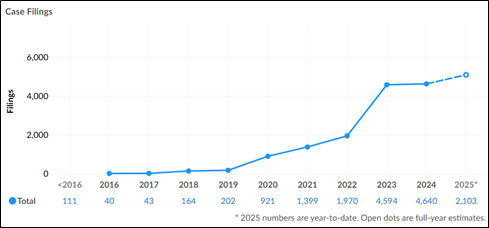
PFAS litigation has expanded significantly in recent years. A search of public federal court filings in the US referencing PFAS shows the following trend2:
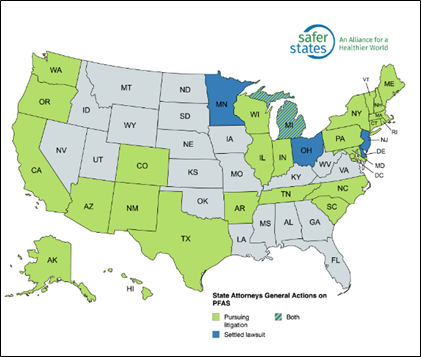
As of December 2024, the Attorneys General of 30 states and DC have initiated litigation against the manufacturers of PFAS chemicals for contaminating water supplies and other natural resources.3^
:{:{Last year alone, 3M announced settlements for $10.3 billion (payable over 13 years), to settle with certain public water systems as a result of alleged PFAS contamination in drinking water (discussed further below).4 DuPont (and related entities) similarly announced settlements for nearly $1.2 billion in 2023 (funded in full and deposited with the court following preliminary judicial settlement approval) to resolve PFAS claims by the public water systems.5}:
In May of 2025, 3M announced a settlement (subject to court approval) with the State of New Jersey for up to $450 million ($285 million to be paid this year, with additional payments over the next 25 years), to resolve PFAS claims.6 DuPont (and its spinoff company) are currently in the middle of a landmark multi-phase trial against the State of New Jersey over their use of PFAS chemicals at the Chambers Works manufacturing plant and the alleged resulting environmental exposure.7}:
:{:{PFAS litigation is not limited to environmental exposure or drinking water contamination. The State of Texas, for example, recently sued PFAS manufacturers for falsely advertising PFAS-containing household products as being safe for families.8And the plaintiffs' bar has taken the fight to consumer products, suing multiple technology companies for allegedly having PFAS in wearable products, suing food and beverage companies for PFAS allegedly found in packaging, and suing pharmaceutical companies for PFAS found in bandages, among many others.}:
In short, PFAS litigation is growing both in terms of the number of lawsuits filed, the types of plaintiffs bringing the suits, and the number of industries impacted.}:
III. PFAS Environmental Litigation
A. United States
:{:{In the United States, a typical PFAS environmental litigation timeline looks like any other complex case: a complaint is filed, followed by an answer or a motion to dismiss, fact discovery, expert discovery, Daubertand summary judgment motions, then pre-trial motions, trial, and possibly appeal. A few things, however, make PFAS litigation unique.}:
For example, (1) depending upon the jurisdiction and court, there may be a low bar for plaintiffs to assert claims, (2) there are high costs to defend the suits, as often there is no mechanism to challenge the science behind plaintiffs’ assertions until completion of expert discovery, (3) the standards of PFAS testing and detection are still being developed, (4) as noted above, PFAS chemistries are not all the same, though plaintiffs often attempt to treat them as such to their advantage, and (5) most judges are less familiar with PFAS matters than the more typical cases on their dockets.}:
:{:{In environmental cases, the plaintiffs can include individuals, putative class representatives, water companies, and state and local governments. The claims that are typically asserted include negligence or gross negligence, private and public nuisance, trespass, strict liability (failure to warn, abnormally dangerous activity, or design defect), and violation of state and federal environmental laws.}:
Defendants can include not only manufacturers of PFAS but also companies that utilize PFAS in their operations or activities. While some defenses (e.g., lack of standing or statute of limitations) can be asserted at the pre-discovery phase on a motion to dismiss, the strongest defenses (e.g., lack of causation) are often heavily dependent on expert discovery and cannot be introduced until months or even years into the case.}:
:{:{The damages the plaintiffs seek also vary. For example, a state government may attempt to seek damages for remediation/cleanup costs or damages to natural resources. A town may attempt to seek the costs to cover the installation of industrial filters to filter out PFAS from the municipal water supply. Individuals can attempt to seek damages for costs of purchasing personal filters or bottled water, or damages for diminution of property values. Individuals with personal injuries allegedly caused by PFAS may attempt to seek damages typically associated with personal injury claims. Perhaps the most unique form of damages comes in the form of "medical monitoring."}:
These are damages sought by individuals exposed to PFAS, who are currently perfectly healthy, but allege that they are at an "increased risk" of developing certain diseases in the future due to their present PFAS exposure. Thus, they seek to have defendants pay for monitoring (usually in the form of specific medical exams) for some period of time in the future. Notably, different states have taken different approaches to medical monitoring, and there is no uniformity on:
(1) whether medical monitoring is even recognized, (2) whether a plaintiff can seek medical monitoring without a present personal injury, (3) whether medical monitoring is a cause of action or a measure of damages accompanying a separate cause of action, (4) the elements that a plaintiff is required to demonstrate to obtain medical monitoring, (5) whether—and this is particularly significant for certification of class action lawsuits—medical monitoring is considered to be "injunctive" or "declaratory" relief (as in the case of a court-supervised monitoring program), or (6) whether it can constitute a simple payment of money to plaintiffs who can then use the funds for future testing (which would likely not be considered to be "injunctive" or "declaratory" relief, making a different provision of the class certification rule come into play).9}:
Of particular note in the environmental litigation landscape, in 2018, the Judicial Panel on Multidistrict Litigation consolidated cases involving PFAS in aqueous film-forming foams (AFFF) in a multidistrict litigation (MDL) in the District of South Carolina before Judge Richard Gergel. The MDL comprises thousands of cases, including claims by public water providers seeking drinking water testing and remediation costs (many of these have reached settlements referenced at the beginning of this article), individuals seeking personal injury claims and medical monitoring, property owners seeking remediation and cleanup costs for contamination, and states seeking natural resource damages.10^ In 2024, Judge Gergel selected plaintiffs with certain personal injuries for bellwether trials, with the first trial date set for October 2025.11^
B. European Union
....
In the area of consumer product suits, companies should consider: (1) phasing out PFAS usage in their products, (2) reviewing their advertising statements....
---
[### “They Poisoned the World”: The Corporate Cover-Up & ...

Democracy Now!
https://www.democracynow.org › forever_chemicals](https://www.democracynow.org/2025/8/8/forever_chemicals)
Aug 8, 2025 — Talk about what PFAS, what these forever chemicals, have to do with the secret Manhattan Project that developed the atomic bomb. MARIAH ...
[### Congresswoman McCollum & Senator Durbin Reintroduce ... Congresswoman Betty McCollum (.gov)
http://mccollum.house.gov › media › press-releases › co...](http://mccollum.house.gov/media/press-releases/congresswoman-mccollum-senator-durbin-reintroduce-forever-chemical-regulation)
Mar 19, 2026 — “With the Forever Chemical Regulation and Accountability Act, we can work toward phasing out the unnecessary uses of PFAS, protecting consumers ...Read more
Missing: speech | Show results with: speech
---
HEATED EMAIL 12 25
...
California nearly triggered a seismic shift in American kitchens this fall.
A bill phasing out the sale of nonstick pans made with polytetrafluoroethylene—a type of PFAS “forever chemical”—cleared the state legislature in September with overwhelming support. Given the well-documented health risks associated with production of PTFE, commonly known as Teflon, advocates fully expected Gov. Gavin Newsom to sign SB 682 into law.
But then the celebrity chefs showed up.
Days before Newsom was set to rule on the bill, a wave of similarly worded letters to the California State Legislature appeared. Celebrity chefs Rachael Ray, David Chang, Thomas Keller, and Marcus Samuelsson all insisted that Teflon was safe when used correctly. Their letters warned that the bill was alarmist, unnecessary, and unfair to home cooks and professional chefs alike. Their message was polished, unified, and amplified across national media.
In the end, Newsom echoed their concerns. “I am deeply concerned about the impact this bill would have on the availability of affordable options in cooking products,” he wrote in his veto message.
But the chefs weren’t acting alone. They were working on behalf of The Cookware Sustainability Alliance, a newly created lobbying group representing some of the world’s largest pan manufacturers, which argued the bill would drive up consumer prices and needlessly restrict a “safe” product.
The reason the chefs’ letters aligned so cleanly with the CSA’s talking points is, in retrospect, unsurprising: They all have financial relationships with companies that produce and sell PTFE-coated pans—the same companies that fund the CSA, a joint investigation by Atmos and Heated found.
How celebrity chefs profit from PFAS
In her letter to Newsom, former Food Network talk show host Rachael Ray called PTFE-coated pans “a key component of durable, affordable nonstick cookware used by millions of home cooks across the country.”
She didn’t mention that she’s behind one of the bestselling nonstick lines in the country: Her “Cook + Create” collection, made with PTFE coatings, fills shelves at Walmart, Target, Macy’s, QVC, and Amazon.
Similarly, David Chang, chef and founder of the Momofuku restaurant group, told Newsom that banning PTFE-coated pans “risks placing unnecessary burdens on the very families we all want to support.” He left out that he sells his own PTFE-coated nonstick line, “io,” which carries a PFAS disclosure.
Thomas Keller, the Napa Valley chef behind the famed three Michelin star restaurant The French Laundry, also warned Newsom that eliminating PTFE-coated pans would eliminate “an important option for cooks who depend on them to prepare wholesome meals with confidence.” He omitted his commercial partnership with Hestan Culinary, whose high-end Insignia line includes a PTFE-coated skillet.
Marcus Samuelsson, a frequent television personality known for his Harlem restaurant Red Rooster, cautioned that California’s ban on PFAS would “have unintended and far-reaching consequences for both professional kitchens and everyday home cooks.” He left out that he’s an official chef ambassador for cookware company All-Clad, for which he appears in the company’s promotional materials, cooking videos, and retail campaigns. All-Clad’s nonstick lines rely on PTFE coatings.
While PFAS-free alternatives like ceramic nonstick pans are widely available at stores, the chefs’ letters largely dismiss them as “less effective” and “more costly,” intimating that PTFE is an essential tool for home and professional cooks.
In total, seven chefs wrote letters asking the California legislature to block the PFAS bill. Each had a financial stake—whether through sales, endorsements, or partnerships—in cookware made by companies that fund the CSA.
None of the chefs who wrote letters responded to a request for comment.
The great Teflon debate
The Cookware Sustainability Alliance first emerged in 2024 and quickly became the most aggressive opponent of PFAS-in-cookware legislation in the United States.
Its members include five global cookware manufacturers, among them Meyer Corporation and the French conglomerate SEB. Together, Meyer and SEB dominate the nonstick market: Meyer produces more than 120,000 pans a day while SEB is the world’s largest cookware company, with brands ranging from All-Clad to Hestan.
The core of CSA’s argument is that PTFE is safe and different from the “bad” kind of PFAS.
Unlike some of the more well-known PFAS classes like PFOA and PFOS, Teflon isn’t deemed a hazardous substance by the EPA. It is a stable, inert subclass of the chemical that doesn’t dissolve in water and can’t accumulate in the human body. When it comes to cooking with it, the pans are safe when used properly—as in, not heated above 500 degrees Fahrenheit and not scratched.
“There’s between 12,000 and 15,000 chemicals that are considered part of the PFAS group,” said Steve Burns, CSA president. “The one that coats cookware is fluoropolymers, PTFE, Teflon. And we believe it to be safe, and almost every scientist and study I’ve ever seen agrees.”
On a technical level, researchers do tend to concur. But that safety has limits. Overheated PTFE can release fumes that cause “polymer fume fever,” also known as “Teflon Flu,” says PFAS researcher Rainer Lohmann. And scratched pans shed microparticles with unknown long-term health impacts.
But those issues pale in comparison to the biggest problem: the way PTFE is made.
“Making these fluoropolymers, or Teflon, is actually a very messy and dirty process,” said Lohmann, who leads the University of Rhode Island’s PFAS research program. “The communities that live next to where [Teflon] is made … some of them call themselves the ‘sacrifice zones.’”
“You can think of [a Teflon pan] like a blood diamond. The diamond is beautiful, but the production has a trail of misery.”
That’s because making Teflon requires using fluorinated processing aids such as PFOA and, more recently, GenX—compounds that persist indefinitely once released into the environment. Oral exposure in animals has shown detrimental effects on certain organs including the liver and kidneys, compromised immune systems, cancer associations, and potential developmental problems in offspring.
Communities polluted by Teflon production include Parkersburg, West Virginia, where seven decades of PTFE production at DuPont’s Washington Works facility contaminated the Ohio River and local groundwater, leading to animal die-offs and exposing residents to some of the highest PFAS levels ever measured in human blood. This is the same contamination scandal depicted in the film Dark Waters.
And in North Carolina, Chemours’s Fayetteville Works facility shifted from PFOA production to GenX as a “safer” alternative. Then a 2017 study found GenX and other PFAS released by Chemours into the Cape Fear River contaminated the drinking water of more than 250,000 people, appearing in high levels in residents’ blood and even in homegrown produce.
Across the pond in Dordrecht, the Netherlands, a Chemours plant manufacturing Teflon contaminated surrounding air, soil, and drinking water, prompting Dutch health officials this spring to conduct a rare, targeted risk assessment for nearby neighborhoods.
“The problem with PFAS is not just the exposure that you get from the actual product itself, which is still problematic, but you have to look at the whole life cycle of PFAS,” said Gretchen Salter, policy director of Safer States. “This argument that says that PFAS polymers are safe is completely ignoring both the manufacturing and the disposal of that product.”
Burns doesn’t dispute the harms of PTFE manufacturing. But he argues that the cookware industry shouldn’t be punished for a problem originating with the chemical industry.
“We’re not the source. We’re two steps removed from the source,” he said. “I understand the concern, but you’re targeting a product in a kitchen when you should be talking about what’s happening in a factory.”
Burns also argues that PTFE is everywhere: in pacemakers, semiconductors, fuel lines, and medical devices. “My Apple Watch has fluoromers in it,” he said. “Nobody’s targeting Apple.”
And he’s correct that cookware is nowhere near the biggest consumer of PTFE chemicals; that title goes to industrial and electronics uses. So Burns asks: Why single out cookware?
Public health advocates have an answer: because people don’t eat off Apple Watches or semiconductors. They say cookware is one of the most direct, daily exposure routes to PTFE, and one of the easiest to replace with PFAS-free alternatives.
Advocates also say responsibility doesn’t end at the factory gate. Lohmann argues that downstream users can’t simply turn a blind eye to the health impacts of the chemicals they use and advocate for.
“You can think of it like a blood diamond,” Lohmann said. “The diamond is beautiful, but the production has a trail of misery.”
The fight expands nationwide
SEB, in particular, had already been through a political firestorm by the time California’s bill SB 682 reached Newsom’s desk. In early 2024, the French Parliament introduced a sweeping PFAS bill that initially included nonstick cookware. SEB, alongside several chemical companies, mounted an intense and ultimately successful pushback campaign that stripped cookware from the legislation.
The episode served as a warning shot: If France could attempt to ban PFAS pans, so could the United States. CSA was built to ensure that never happened.
In the past year, CSA has been active in 13 states where local lawmakers are considering regulating PFAS in consumer goods—and the organization has seen lots of success.
The group sued Minnesota in January, using the commerce clause to argue that a ban on PTFE was bad for interstate business. It also lobbied lawmakers in Rhode Island, Maine, and Connecticut to support amendments that would remove cookware from their existing bans. While those efforts were unsuccessful, CSA was integral in getting New Mexico and Illinois to remove fluoropolymers from their PFAS ban. It also convinced Vermont to delay implementing its ban on cookware by several years to 2028.
CSA spent thousands wining and dining lawmakers and paying their lobbyists this year, paying at least $15,000 in Vermont, $25,000 in Connecticut and $218,000 California, according to campaign finance records.
No PTFE bans in cookware have been passed in any states since CSA came on the scene in 2024, Burns said.
“I’m not going to claim complete credit, but I will claim partial credit that we are showing up and we’re talking about fluoropolymers,” he said. “We’re trying to de-wonkify it and make it just understandable.”
While CSA has netted many wins this past year, none were as important as the Golden State victory. As the world’s fourth-largest economy, any California ban on PTFE in cookware would have had trickle down effects to the way pans are made across the country. The bill in question would have ended sales of PTFE-coated pans in the state and limited the entrance of them to its ports—two of the largest in the country.
“I think it speaks to the gravity of California policy and our share on the market nationwide. You know, we have 40 million people here,” said Ben Cheever, press secretary for State Sen. Ben Allen, who introduced the bill.
Ultimately, CSA’s argument that the bill would be a knock on affordability, rather than a boost to health, is what netted them Newsom’s veto.
Cheever says it’s a false comparison and that healthcare and utility costs related to environmental exposure are still a major concern.
“We’ve been quite adamant about how environmental policy is getting used as a scapegoat for affordability issues right now, and we really think that if we take a stronger approach to protecting our environment, and in turn our public health and public infrastructure, it’s a strong point in favor of making things more affordable,” he said.
---
---
---
mma vid]
March 4, 2026, edition of MAHA Action's MAHA Media Hub, streamed on YouTube
TONY LYONS (MAHA ACTION PRESIDENT): Secretary Kennedy, as always, has our back. He has everyone's back and the administration is putting hundreds of millions of dollars towards digging us out of the glyphosate hole. But we have to remember that our voices transcend policies. We also have to remember that there are going to be setbacks, but that we have the opportunity to reverse 50 years of corruption in the next three years if we can stick together and stay focused. Secretary Kennedy said it best when he told the Austin audience, “I recognize that it would give me actual real power to make these kinds of changes, to push for these kinds of changes. For the last year, President Trump has let me go up against big pharma, big food, big insurance, big hospitals, and all of those other untouchables.” So we're moving forward, but these are very tough battles. And we, as the MAHA movement, won't ever give up.
Now we have to take the fight to the Supreme Court. Justices will soon hear arguments in Monsanto vs. Durnell. John Durnell is the man who developed non-Hodgkin's lymphoma after using Roundup for 20 years. And this has been true of so many others. And a jury of his peers found Monsanto liable.
So it's vital that we make our voices heard to the court. If Bayer Monsanto gets their way, state regulators will be prohibited from putting accurate warning labels on products like glyphosate, while people like John Durnell will effectively be prohibited from seeking justice before a jury in state courts, even when they face a terminal illness like he does. So MAHA can never support liability shields, not for pesticides, not for vaccines, and not for any other product. But we're always open to dialogue and debate to engaging with all stakeholders to get the job done and to come up with better answers.
So in this case, though, making matters worse, and more complicated, the Department of Justice filed a brief in support of Monsanto. But this is why MAHA is here. This is why we exist, to raise awareness when mistakes are made. And this is one such mistake. The brief does not match the long-held views of both Secretary Kennedy or President Trump. And our job then is to help this incredible administration not be swayed by the same corrupt forces that got us here in the first place. This is just going to be — it's going to be a constant battle, but one that I think that MAHA and the Trump administration can win together.
//
:{:{10/09/25}:
:{:{12/10/25}:
01/23/26
---}:
---
the hill seal award
This is the shocking true-life story of how PFAS—a set of toxic chemicals most people have never heard of—poisoned the entire country. Based on original, shoe-leather reporting in four highly contaminated towns and damning documents from the polluters’ own files, Poisoning the Well: How Forever Chemicals Contaminated America(Island Press, 2025) traces an ugly history of corporate greed and devastation of human lives.
We learn that PFAS, the ‘forever chemicals’ found in everyday products, from cooking pans to mascara, are coursing through the veins of 97% of Americans. We witness the pain of families who lost sisters and daughters, cousins and neighbors, after PFAS leached into their drinking water. We discover evidence that the makers of forever chemicals may have known for decades about the deadly risks of their products—because their own scientists have been documenting these dangers since the 1960s. And we see the failure of our government, time after time, to provide basic protections to its citizens.
It is impossible to read this searing exposé without being infuriated by the recklessness of corporate America. But readers will also be awed by the spirit of ordinary people who, while fighting for their own lives, took it upon themselves to fix a broken regulatory system. Heart-wrenching and maddening, stirring and uplifting, Poisoning the Well offers a unique window into the worst and best of human nature. It is essential reading for anyone concerned about the unfettered power of industry and the invisible threat it poses to the health of the nation—and to each of us.
Sharon Udasin is a reporter for The Hill, covering U.S. West climate & policy from her home base in Boulder, Colorado. She was a Ted Scripps Fellow in Environmental Journalism at the University of Colorado Boulder and has also reported for The Jerusalem PostandThe New York Jewish Week. A graduate of both the University of Pennsylvania and Columbia Journalism School, Sharon also received a 2022 SEAL Environmental Journalism Award and was honored by the Heschel Center for Environmental Learning and Leadership in 2013.
Rachel Frazin covers energy and environment policy forThe Hill: that’s everything from climate change to gasoline prices to toxic chemicals to renewable and fossil energy. It was through this work that she learned about, and became alarmed by, "forever chemicals." She is originally from South Florida, and she studied journalism and political science at (the very cold) Northwestern University. Previously, her work has appeared in the Chicago Sun-Times, The Daily Beast,theTampa Bay Times,andThe Palm Beach Post.
---
MMA
Maria Bartiromo omits MAHA calls for EPA Secretary Lee Zeldin’s resignation in interview on the agency’s action on forever chemicals
Special ProgramsClimate & Energy
Written by Ilana Berger
Published 12/10/25
In a December 8 Fox Business segment, host Maria Bartiromo asked EPA Secretary Lee Zeldin about the agency's recent approval of a number of “forever chemical” pesticides but ignored a petition from major “Make America Healthy Again” influencers over the move, citing only concerns from “environmental advocates” that she said the EPA has fact-checked “as misinformation.”
Just a few days earlier, The New York Times reported on a petition spearheaded by MAHA influencers calling for President Donald Trump to oust Zeldin, but Bartiromo did not mention the petition or specify who is involved.
Since Zeldin’s appointment, the EPA has approved pesticides that contain several different pesticides that are classified by many as PFAS, or cancer-linked “forever chemicals,” a move that the petition authors say “has prioritized the interests of chemical corporations over the well-being of American families and children.”
Video
Citation
From the December 8, 2025, edition of Fox Business' Mornings with Maria
The petition represents a boiling point in the ongoing tensions between MAHA champion Health and Human Services Secretary Robert F. Kennedy Jr., members of the movement, and other parts of the Trump administration.
Bartiromo said during the segment, “Environmental advocates and critics are calling these forever chemicals” and warning of “long-term risks like reproductive issues and liver toxicity.” She added, “The EPA fact-checking that as misinformation. … What can you tell us?”
Not only did Bartiromo fail to mention the MAHA component of those “environmental advocates” — a broad public health effort that helped Trump win the election — but she also referred to a November 26 “fact check” on the EPA’s website claiming to debunk “false claims that agency recently approved ‘Forever Chemical’ Pesticides” with PFAS. However, the most widely accepted definition, from the Organisation for Economic Co-operation and Development, which was developed by an international group of scientists, does classify these recently approved substances as PFAS. According to the Natural Resources Defense Council, a similar definition is “already in use in 23 states.”
Zeldin defended the agency, saying, “It’s not forever chemicals. It’s actually better and safer than what it is replacing.” Zeldin continued, “There are some people, though, whenever they see something on the internet, they just take it at its word.”
Earlier in the interview, Bartiromo brought up Michigan Gov. Gretchen Whitmer, saying she’s “leading a charge with six other Democrat governors, urging the EPA to monitor and collect data on microplastics in drinking water by adding them to the unregulated contaminants list under the Safe Drinking Water Act.”
Again, she avoided mentioning MAHA, even though Kennedy has called attention to the issue, and a September strategy report from the “MAHA Commission to President Donald J. Trump” highlighted the need to evaluate “the risks and exposures of microplastics and synthetics, including in common products such as textiles.”
Zeldin dodged the question about microplastics, saying, “This isn’t a new issue,” and then praised an ExxonMobile refinery for “innovation with plastic recycling,” saying it’s “taking a plastic and they are getting it right down to its original raw chemical compound.”
Zeldin was describing chemical recycling, a process that experts say is not an effective way to reduce plastic pollution. The facility he praised, in Baytown, Texas, has faced strong opposition from Texas residents. Environmental groups also sued Exxon for repeated violations of federal air pollution limits at the facility, leading to a $14.25 million civil penalty.
“You’ve been doing a great job there running the EPA,” Bartiromo concluded.
---
~ DAGEN M
---
icn gmail 12 25
BY SYDNEY CROMWELL
Well before the ban took effect, the “forever chemicals” linked to cancer, birth defects and other serious health problems had tainted drinking-water wells, vegetable roots, beef and milk in Maine.
---
---
11 25
MAHA Slams “Corporate Capture” While Trump Strips Regulations
between frenzied claims about Tylenol and disparaging remarks about autism, the voices of the “Make America Healthy Again” movement empowered by President Donald Trump have directed criticism at the country’s massive food, pharmaceutical, and chemical industries — still-too-rare targets for the leaders of either political party in the U.S.
When the White House unveiled its comprehensive report on how to “Make Our Children Healthy Again” in May, it slammed “corporate capture” of regulatory bodies and argued that companies responsible for making children less healthy wield undue influence in Washington. A subsequent strategy report, released last month, called to “protect public health from corporate influence.”
“It was one of the first times I saw the federal government actually call out corporate capture and how chemical companies influence regulation,” said Darya Minovi, a senior analyst for the Center for Science and Democracy.
But the Trump administration’s political marriage of unbridled crony capitalism and fringe health conspiracism is not without its contradictions.
While the “Make America Healthy Again,” or MAHA, movement preaches a healthy utopia for the nation’s children free of real and imagined toxins, public health experts say the Trump administration has pursued an aggressive deregulation campaign that has opened the floodgates for toxic chemicals in our food, water, and air — while also defunding vital medical research and spreading dangerous medical misinformation.
“There’s a lot of rhetoric about problems that they’re solving,” Minovi said. “But when I’m looking at the actual actions that the administration is taking, largely, these actions are not making any kids or families healthier.”
A glaring tension between the MAHA movement’s purported goals and the Trump administration’s aggressive deregulatory strategy is the issue of environmental toxins, particularly PFAS, also known as forever chemicals, found in many household items.
These chemicals, which can disrupt liver, kidney, and thyroid functioning, are especially harmful to children.
[
Related
Trump EPA’s Next Move: Making It Harder to Sue for Getting Cancer from Roundup
https://theintercept.com/2025/03/21/trump-epa-monsanto-roundup-bayer-cancer-chemicals/)
The strategy report, drafted by the Make America Healthy commission led by Health and Human Services Secretary Robert F. Kennedy Jr., laid out a series of recommendations to “end chronic childhood disease,” which included studying the cumulative effect of chemicals in the environment. But in May, the Environmental Protection Agency announced that it was rolling back restrictions on the acceptable levels of these forever chemicals within drinking water, which were put in place during the Biden administration. And in the spring, the agency ended a grant to research children’s exposure to chemicals from soil and dust, accordingto the KFF Health News.
“When it comes to actually taking action, we’re not really seeing policies that are getting ahead of corporate capture and holding the chemical industry responsible,” Minovi said.
Over the coming months, the EPA has announced it will take 31 separate deregulatory actions, including loosening restrictions on power plants that emit air pollution and eliminating safeguards put in place during the Biden administration for petrochemical accidents.
Most Read
[
YouTube Quietly Erased More Than 700 Videos Documenting Israeli Human Rights Violations
Nikita Mazurov, Jonah Valdez](https://theintercept.com/2025/11/04/youtube-google-israel-palestine-human-rights-censorship/)
[
A Journalist Asked Why Israel Isn’t Paying to Rebuild Gaza. It Cost Him His Job.
Arthur Neslen](https://theintercept.com/2025/11/04/journalist-israel-gaza-nova-gabriele-nunziati/)
[
Man Jailed for Facebook Meme Is Freed in Tennessee
Liliana Segura](https://theintercept.com/2025/10/30/larry-bushart-tennessee-free-speech-charlie-kirk-meme/)
Alongside pursuing a deregulatory strategy that experts predict will introduce more chemicals into the air, water, and food supply, the administration has also moved aggressively to cut research, including on childhood diseases.
For example,in August, the Trump administration announced it was cutting federal funding to a network researching pediatric brain cancer.
White House spokesperson Kush Desai denied cutting cancer research funding, saying HHS canceled grants supporting “DEI and other ideological pet projects,” and that the money was reallocated.
“President Trump made a pledge to Make America Healthy Again by restoring accountability, transparency, and Gold Standard Science in public health decision-making,” wrote Desai. “The President and White House maintain complete confidence in Secretary Kennedy and the rest of the HHS team to deliver on this pledge.”
The Department of Health and Human Services and the EPA did not respond to The Intercept’s request for comment.
Food assistance and educational programs have also come under fire during the Trump administration. Earlier this year, Republicans enacted the most significant cut to the Supplemental Nutrition Assistance Programin history. The program provided food assistance to roughly 1 in every 5 children in the United States, as well as nutrition education.
“A lot of this movement is designed to benefit privileged people who have the resources to access certain healthier foods or a community with clean air,” said Minovi, as opposed to “everyday people who might actually depend on public policies to ensure they have healthy food, clean air, clean water in their community.”
“A lot of this movement is designed to benefit privileged people who have the resources to access certain healthier foods or a community with clean air.”
The recommendations emerging from HHS and the MAHA movement about vaccines and autism are particularly troubling, said Jill Rosenthal, director of public health policy at the Center for American Progress. “It’s a matter of promoting a personal agenda that RFK has rather than following decades of good science,” she said.
Riddled throughout the MAHA strategy and separate report are concerns over vaccines and the vaccine schedule, which is used to determine the timing for childhood vaccinations.
Both RFK Jr. and Trump have peddled pseudoscientific conclusions connecting autism to vaccination, suggesting that the vaccine schedule needs to change. During the press conference last week, Trump advised against vaccinating children for Hepatitis B until they’re 12 years old, which runs at odds with medical guidelines.
“They’re making it more difficult for children to get routine childhood vaccinations. We know that vaccination has saved millions of lives, and so any efforts that make it harder for children to access vaccines are really, really jeopardizing kids’ health,” said Rosenthal. “Instead of following the science and believing what evidence we already have, we’re just creating a lot of distrust and making it harder for people to keep their kids healthy.”
The recent recommendations that pregnant women avoid Tylenol also carry risk for pregnant people and their future children.
“In the near term, I think that pregnant patients are going to be worried enough that they seek alternate forms of medication to treat their pain,” said Dr. Mariana Montes, a former pediatrician and obstetric anesthesiologist. “That’s extremely concerning, because there is nothing that’s been proven safe for pregnancy except for acetaminophen.”
Ibuprofen, the active ingredient in Advil, has been known to lower amniotic fluid — the liquid in utero that surrounds and protects the fetus — and can have negative effects on kidney and heart development, said Montes.
“Patients might choose to take ibuprofen without knowing the effects, and then unknowingly actually harm a healthy pregnancy because they’re so worried about taking Tylenol,” she said.
[
Related
RFK Jr. Talks About Public Health, but He’s Joining an Administration That’ll Make Us Sicker Than Ever
https://theintercept.com/2024/11/14/rfk-jr-health-human-services-water-air-project-2025/)
Left with fewer options they believe are safe, Rosenthal warns that pregnant people might forgo medication altogether, even when they have a fever. “If women avoid taking Tylenol, for instance, when they have a fever, it can increase the risk of birth defects,” she said. “So by scaring women away from taking needed medication, it can actually impact their health and the health of their developing babies.”
The stigma these types of pronouncements cause for people with autism is also a serious concern.
“It’s necessary to point out the ableist language in this whole autism debacle,” said Minovi. “Of course, it’s a condition that needs to be understood and studied, and obviously impacts families significantly, but the way in which the administration, particularly RFK, talks about it is dismissive and negative about people’s lived experiences.”
Republicans, who once denounced former First Lady Michelle Obama for attempting to make school lunches moderately healthier, now inhabit a coalition whose purported goals would have instantly launched “nanny state” accusations just a few years prior.
But the MAHA movement has been so successful despite its inherent contradictions, Rosenthal said, because there’s a “kernel of truth” to what it’s preaching.
“For instance, ultra-processed food is not the first choice for how we want to take care of our bodies,” Rosenthal said, “but at the same time, is that the best way to use limited resources and protect or promote child health? Not when we have kids who don’t have enough to eat, right?”
Minovi said it’s understandable that people are drawn to this movement — which only heightens culpability for people like RFK Jr. and Trump.
“These are families that are just trying to do right by their kids, and the concerns that folks are raising are valid,” said Minovi. “The behavior of the leaders in this movement is nothing short of predatory.”
---
---
EWG
Another PFAS-containing pesticide headed for US registration
By Brian Bienkowski
US regulators are poised to approve a pesticide made with a controversial class of toxic chemicals, stoking concerns of new risks for farms across the country.
Is there PFAS in your pint?
By Brian Bienkowski
Many popular beers — from both small breweries to large domestic and international ones — contain types of per- and polyfluoroalkyl substances (PFAS) linked to cancer and other health problems, according to a new study published in Environmental Science and Technology that looked at PFAS in 94 samples of beer.
---
ymail 6 24 pro publ
Even after years of reporting on forever chemicals, ProPublica reporter Sharon Lerner had questions that nagged at her. She knew that a handful of 3M scientists and lawyers had learned in the 1970s that one of the company’s fluorochemicals, PFOS, had seeped into the blood of people around the country and that company experiments around that time had shown that PFOS was toxic. But 3M kept making the compound until 2000. What did it mean, Lerner wondered, for a sprawling multinational company to know that its products were dangerous even as it kept making them? Who at the company knew? And how much, exactly, did they know? And how had 3M kept its dark secret for decades? For years, no one from inside the company had spoken publicly. Then last year, a former 3M chemist reached out to Lerner.
“Toxic Gaslighting: How 3M Executives Convinced a Scientist the Forever Chemicals She Found in Human Blood Were Safe” offers the inside story of how the company allowed PFOS to seep into all of us while sitting on research that showed the chemical is toxic.
Through Lerner’s reporting, we learned that in the late 1990s, when 3M chemist Kris Hansen showed her colleagues that its chemicals had been detected in the blood of people across the country, her bosses questioned her findings, halted her work and reassigned her to other projects. They told her the chemical wasn’t harmful — even though 3M’s own experiments in the 1970s had shown it was toxic. The known dangers of PFOS had remained hidden from the public and from many at the company for years.
When Hansen learned, decades later, how much the company had known and how little it had told her, she felt enraged at 3M and at herself. For years, she had repeated the company’s claim that PFOS was not harmful. “I’m not proud of that,” she told Lerner. With ProPublica’s help, she’s making these secrets, and the process through which they were kept, public.
Even after learning that the compound was toxic and accumulating in people’s bodies, 3M continued to produce tens of millions of pounds of PFOS and other chemicals that break down into it. In 2022, in the face of mounting lawsuits over PFAS, 3M said that it would stop making the broader group of forever chemicals known as PFAS and “work to discontinue the use of PFAS across its product portfolio” by the end of 2025. (PFOS is a PFAS compound.) When ProPublica sent the company detailed questions about Hansen’s account, a spokesperson responded without answering most of them or mentioning Hansen by name. In a written statement, a 3M spokesperson said that the company “is proactively managing PFAS” and that its approach to the chemicals has evolved along with “the science and technology of PFAS, societal and regulatory expectations, and our expectations of ourselves.” The company and its scientists have not admitted wrongdoing or faced criminal liability for producing forever chemicals or for concealing their harms.
When Hansen was ready to tell her story, she reached out to Lerner, specifically, because of the reporter’s body of work. Lerner had spent nearly a decade extensively detailing how manufacturers of forever chemicals like 3M covered up the dangers.
Thanks to Lerner’s commitment, and Hansen’s willingness to speak, we now know more about corporate cultures of silence, systematic compartmentalization of research and suppression of dangerous and expensive truths. Trusted nonprofit investigative newsrooms like ProPublica’s, with relentless reporters who stick with a story for decades, play a critical role in bringing long-held toxic secrets to light.
---
drink
https://www.alternet.org/explosive-epa-study-pfas-water/
---
12 22
3M Says It Will Stop Making and Using Forever Chemicals by End of 2025
As awareness grows about the health impact and prevalence of the environmental toxins known as forever chemicals, could the corporate tide finally be turning against them?
U.S.-based conglomerate 3M announced Tuesday that it would stop its use and manufacture of per- and polyfluoroalkyl substances (PFAS) by the end of 2025.
---
sci can brk down]
https://www.alternet.org/2022/08/epa-forever-chemicals-hazardous-substances/
---
an 2 23
https://www.alternet.org/forever-chemicals-hundreds-animal-species/
---
https://theintercept.com/2022/08/05/pfas-waste-epa-afff-us-ecology/
---
https://www.eenews.net/articles/how-bidens-team-rushed-to-dump-a-trump-era-pfas-assessment/
no lnx
How Biden’s team rushed to dump a Trump-era PFAS assessment
By E.A. Crunden | 09/01/2021
Trump administration appointees interfered with development of a toxicity assessment for a "forever chemical" and made changes that were "not scientifically sound," documents obtained by E&E News through the Freedom of Information Act show. Claudine Hellmuth/E&E News (illustration); EPA (document); unclelkt/Pixabay (hand)
:{:{}:
}:
Trump-era EPA appointees engaged in "considerable political level interference" on an assessment for a controversial "forever chemical," documents obtained by E&E News indicate.
:{:{}:
}:
But the Biden administration wasted no time in yanking that document, moving to scrub the assessment of alterations made by political appointees and restore language advocated by EPA career scientists shortly after the president’s inauguration.
At issue is a toxicity assessment for PFBS, part of the per- and polyfluoroalkyl substances family. PFBS is a replacement chemical for PFOS — one of the two most well-studied and controversial PFAS, due to health risks like cancer. The replacement compound, a surfactant, is used in manufacturing processes and to make stain-resistant coatings for various consumer items like clothes, among other purposes.
Documents obtained under the Freedom of Information Act shed light on the agency back-and-forth over the toxicity assessment for PFBS, released in the last days of the Trump administration, only to be clawed back as soon as Biden took office. Staff conversations show the process of withdrawing and replacing the document came after a contentious publication process that saw significant input from political appointees, in a breach with agency processes.
In an email sent Jan. 21, shortly after Biden’s inauguration, then-head of EPA’s Office of Research and Development Jennifer Orme-Zavaleta conveyed wishes that the PFBS assessment be removed.
"During the rush of the last administration to complete various tasks, there was a PFAS assessment on PFBS along with an internal deliberative memo from [the EPA chemicals office] that apparently were posted Tuesday," she wrote to Jane Nishida, then-acting EPA administrator, in an email marked with a "high" importance level.
In January, anonymous EPA staffers raised concerns that the assessment had been politically compromised (Greenwire, Jan. 14).
As Biden took office, leadership in the research office and the Office of Chemical Safety and Pollution Prevention immediately requested that the assessment and related documents be taken down at once, Orme-Zavaleta said. "The materials posted are not supported by ORD or OCSPP career scientists and violate the Agency’s scientific integrity policy. We will work to correct the document, brief new leadership then follow up with [the Office of Public Affairs] on the correct release."
At the heart of the controversy was a significant shift from a draft assessment, which offered a reference dose — or an indicator of how much individuals can be exposed to a chemical before experiencing adverse health impacts.
:{:{}:
}:
A key component of deriving that reference dose are uncertainty factors, which are applied to reflect data limitations. For the PFBS assessment, uncertainty factors were crucial, given a lack of information around areas like immunotoxicity and mammary gland development. But the new document refuted any database deficiency and shifted the reference dose to a range.
While the assessment was a science, rather than regulatory, document, critics worried the change would allow for industry and government to cherry pick numbers when setting threshold levels. An EPA spokesperson confirmed to E&E News that the Biden administration "immediately began working with EPA’s career scientists and staff" to withdraw and replace the document.
Orme-Zavaleta, who recently retired, meanwhile said the document published under Trump reflected "considerable political level interference" and became "a poster child for why it’s critical to have scientific integrity policies in federal government."
Pushback on a Trump EPA priority
The PFBS assessment was a priority for the Trump administration, and former Deputy Assistant Administrator for Science Policy David Dunlap[kochsucker] highlighted the issue as a major focus.
EPA originally planned to publish the assessment in late October 2020. But the schedule was delayed amid last-minute comments and concerns about the uncertainty factors from the Office of Pollution Prevention and Toxics.
A December document reviewed by E&E News showed that Office of Chemical Safety and Pollution Prevention Deputy Assistant Administrator David Fischer — a former official with the American Chemistry Council, which represents PFAS manufacturers and has lobbied extensively against a crackdownon the chemicals — asked senior toxicologists to review the Office of Research and Development’s PFBS work. Fischer’s office countered ORD’s findings regarding uncertainty factors for chronic and subchronic reference doses.
Fischer did not respond to a request for comment. But EPA confirmed to E&E News that the process became bogged down by his office’s previous political leadership, in a deviation from regular practices.
In early January, leading up to posting the assessment, Office of Pollution Prevention and Toxics Deputy Director Tala Henry shared a draft with officials, noting it included proposed in-line edits supporting a range of uncertainty factors.She commented that former EPA Administrator Andrew Wheeler had requested the inclusion of those edits. Conversations indicate officials sought to publish the assessment in advance of a Wheeler PFAS-centric interview.
Orme-Zavaleta confirmed to E&E News that political leadership decided to modify ORD’s peer-reviewed assessment in keeping with Wheeler’s preferences and that she did not learn of the changes until January. She called the back-and-forth "one of the more infuriating experiences I have ever encountered."
Her emails show that she pushed back, arguing Wheeler "did not have complete information" in making his request. The PFBS assessment had previously been considered final.
"The type of changes OCSPP proposes would require us to go through the whole process of intra/inter-agency review [and workgroup efforts] … which will take anywhere from 6-8 months," she said.
But a day later, Wheeler’s senior adviser, Taylor Hoverman, announced the process would move forward. The agency’s political leadership negotiated a fast-tracked review through the Office of Management and Budget that is not typically part of EPA’s processes for toxicity assessments. Soon afterward, EPA published the document.
‘Very unusual’ levels of input
Multiple political appointees kept a close eye on the PFBS assessment process. In one instance, the Department of Defense gave EPA feedback disputing the agency’s approach to uncertainty factors. Former career staff said those comments came as part of an interagency review process and in response to language inserted by Fischer. Emails show Dunlap wound up editing EPA’s response to the Department of Defense, taking an active role in shaping the final product. He continued asking for updates on the status of the assessment as it proceeded.
Orme-Zavaleta said the level of involvement was irregular. "David Dunlap was engaging in the decision making process for PFBS without consulting with or including anyone else from ORD," she said. "I am also not aware of any other [EPA administrator] weighing in on a science decision in an assessment before."
Betsy Southerland, a former longtime EPA top scientist, said Dunlap’s level of involvement was "very unusual." She said an official at Dunlap’s level would not typically have edited a technical document as he did.
"[Deputy assistant administrators] certainly keep track of the progress on high-priority projects and ensure work is done on schedule and following all peer-reviewed guidance and standard processes, but rarely if ever rewrite documents since they are generally not subject matter experts," Southerland said.
Kyla Bennett, who directs science policy for Public Employees for Environmental Responsibility, meanwhile expressed alarm. The conversations, she said, "prove what we always suspected — Trump Administration political appointees improperly manipulated science at EPA," adding the revelations were "disturbing."
Dunlap did not respond to a request for comment.
Career staff, meanwhile, were unhappy with the changes imposed by political officials. EPA senior science adviser Louis D’Amico voiced harsh criticism in an email sent on Jan. 6.
"This is precedent setting, and flies completely in the face of legitimate and necessary separation between risk assessment and risk management," he told Orme-Zavaleta and Samantha Jones, the acting associate director for health at EPA’s National Center for Environmental Assessment.
"A decision to release a ‘range of values’ in EPA assessments should be discussed across the agency, including program offices and regions."
Jones agreed in a response email, also taking issue with changes stating that the individual value generated for PFBS would be dependent on "the needs of the program office and in the type of risk assessment being performed," including for the general population.
That note, Jones said, "should NOT be in a scientific foundational document. It would go into the risk assessment by the program."
A speedy reversal
Only a day after Biden took office, EPA staff began the process of taking down the PFBS assessment.
In a Feb. 9 email, EPA science communications specialist Kacey Fitzpatrick linked the issue more clearly to former Administrator Wheeler, saying the changes made to the PFBS assessment were at "political direction" and "not scientifically sound."
"Administrator Wheeler determined that uncertainty factors were policy, not scientific judgements. … This is contrary to long-standing risk assessment practices based on National Academy of Sciences (NAS) guidance," Fitzpatrick wrote to Carolyn Hubbard, ORD’s science communications director, in an email laying out the agency’s response. "This constitutes a violation of the agency’s Scientific Integrity Policy and the documents have been removed from the EPA website while the agency completes its review."
:{:{}:
}:
The old document was pulled that same day (E&E News PM, Feb. 9).
Two months later, EPA released its replacement — one Orme-Zavaleta said in a statement "fixes errors in the version issued earlier this year, was developed by EPA career scientists, and upholds the values of scientific integrity"(Greenwire, April 8).
:{:{}:
}:
The new assessment set a chronic reference dose of 300 parts per trillion per day, along with a subchronic dose of 1,000 ppt per day. That reference dose is much stricter than the 2018 Trump EPA’s original chronic dose recommendation of 10,000 ppt per day with a subchronic range from 40,000 ppt to 100,000 ppt.
That replacement didn’t mark the end of the saga. EPA’s Office of Inspector General said in June that it would probe the agency’s decisionmaking regarding the assessment (Greenwire, June 16). At the time, EPA said it was "committed to upholding scientific integrity" and would support and assist the review.
For her part, Orme-Zavaleta said the PFBS assessment published under Biden "could have been a good news story" if released under Trump, offering the administration a significant action at a time of mounting focus on PFAS. Instead, the release of the compromised assessment eroded faith in an agency that prides itself on science-based decisions.
"Scientific integrity, coupled with sound external peer review and quality assurance procedures are critical for ensuring public trust," she said. "When these measures break down or are manipulated, it erodes public trust and jeopardizes our ability to protect public health and the environment, which first and foremost is EPA’s mission."
---
---
https://www.politico.com/news/2021/01/13/trump-epa-toxic-chemical-458962
no lnx many
trump’s EPA team overrules career scientists on toxic chemical
Changes to the safety assessment for a major cause of water pollution are the administration's latest “landmine” for Joe Biden's incoming appointees, one Democratic aide said.
The draft assessment EPA released for public comment in November 2018 took the standard approach of providing a single number describing how toxic the chemical is to humans. | Getty Images
By ANNIE SNIDER
01/13/2021
Political officials at EPA have overruled the agency’s career scientists to weaken a major health assessment for a toxic chemical contaminating the drinking water of an estimated 860,000 Americans, according to four sources with knowledge of the changes.
:{:{}:
}:
The changes to the safety assessment for the chemical PFBS, part of a class of "forever chemicals" called PFAS, is the latest example of the Trump administration's tailoring of science to align with its political agenda, and another in a series of eleventh-hour steps the administration has taken to hamstring President-elect Joe Biden's ability to support aggressive environmental regulations.
“They’re just trying to lay as many landmines as possible,” said a Democratic congressional aide with knowledge of the changes. “Every single thing that they’re doing ends up being a landmine for whoever comes next. It’s going to take a lot of time to unravel, which sort of takes away from the ability to do anything proactive.”
An EPA spokeswoman did not respond to a request for comment on the changes, but defended its effort to tap scientists from a different part of the agency to rewrite the rule.
:{:{}:
}:
PFBS is a replacement for a related chemical, PFOS, that was used for decades in Scotchguard and military firefighting foam before being phased out in the mid-2000s. PFBS has been in military firefighting foam, carpeting and food packaging,but independent scientists say it may not be much safer than the toxin it replaced. It has been linked with with thyroid, kidney and reproductive problems at very low levels of exposure.
While the new assessment is a science document, not a regulatory one, the changes in question open the door for state and federal regulators to potentially set less stringent cleanup standards, drinking water limits and other standards.
The broader class of PFAS, of which PFOS is a part, has been used in everything from stain-resistant carpeting to Teflon to microwave popcorn bags, and are linked with kidney and testicular cancer, immune effects and other health ailments. The chemicals contaminate the drinking water supplies of an estimated 200 million Americans, according to an analysis by the nonprofit Environmental Working Group.
Trump administration officials at EPA have vowed to aggressively address PFAS, touting a multi-pronged PFAS Action Plan. But they have fought efforts by lawmakers to accelerate work on a federal drinking water limit for the chemicals,and in 2018 POLITICO reported that White House officials sought to block a CDC assessment finding they are dangerous at much lower levels of exposure than EPA said was safe, calling it “a public relations nightmare.”
The PFBS assessment has been in the works for more than three years, and has been a particular concern for the Defense Department, which faces massive cleanup liability.
The draft assessment EPA released for public comment in November 2018 took the standard approach of providing a single number describing how toxic the chemical is to humans, called a “reference dose.” Regulators can then use that number to calculate a safety limit for different populations — for instance, for pregnant women or people with compromised immune systems.
But the final assessment sent to the White House for review Monday replaces that single reference dose value with a range of values, the sources said, a change made by staffers in the agency's pesticides office at the direction of political officials— not the career scientists at EPA who specialize in assessing the human health risks of chemicals.
EPA spokeswoman Molly Bock defended this reassignment, saying that it is "routine" to consult with other parts of the agency.
"This collaboration is important as other program offices have information and expertise that can improve the scientific quality of the work product under review. This aligns with EPA’s PFAS Action Plan, which is the first multi-media, multi-program office plan to address an emerging contaminant of concern," she said.
But the alterations were so alarming that several of the career EPA scientists who spent years working on the study have asked that their names be removed from the document, two of the sources said.
Environmental advocates say the range approach would allow industry and state and local officials to “cherry-pick” the number they like best, regardless of whether it is sufficiently protective.
“The dream of industry has always been a range of values so that you really can choose anywhere within that range,” said Betsy Southerland, a former top EPA scientist who led the agency’s work on the health assessment for two other PFAS chemicals in 2016.
The new range of reference doses in the final assessment includes slightly weaker values than EPA forward put forward in its draft assessment in November 2018, two of the sources said. But the most alarming part isn't the numbers themselves, they said, since the conclusion is still that PFBS is dangerous at very low levels of exposure. Rather, it's the fact that political officials upended the scientific process to arrive at them.
“It’s not orders of magnitudes, but that’s irrelevant. How much does it matter if you get one drop or two drops of cyanide?” said the source, a senior EPA scientist.
In a related move late last week, the Trump administration threw up a new roadblock to environmental health assessments with a new mandate from the powerful Office of Management and Budget, which resides at the White House.
On Friday, OMB ordered that the agency's gold-standard health assessments go through White House review -- a process that environmental and public health advocates say inserts political interference into documents that are meant to be purely scientific and have already been peer reviewed.
The order, sent from OMB to EPA Administrator Andrew Wheeler in a memo reviewed by POLITICO, effectively reinstates a process that was in place under the George W. Bush administration, which a government watchdog found “limits the credibility” of assessments from EPA’s premiere risk assessment program, the Integrated Risk Information System. The IRIS program has for years been a top target for the chemicals industry, Republicans on Capitol Hill and Trump's EPA research chief, David Dunlap, in his former role as a chemicals expert at Koch Industries.
The PFBS assessment is the first to go through the newly-mandated White House review, and the sources said they expect it to be perfunctory, aimed primarily at establishing a precedent. The assessment could be finalized as soon as Wednesday, they said.
“There’s no need for there to be a political review of these documents,” said Genna Reed with the Union of Concerned Scientists. “Largely it is an opportunity for political officials to interfere with the information, to weaken the science, and to play up uncertainty.”
OMB spokesman Edie Heipel defended the move, saying there is “nothing controversial about ensuring good science unless you are worried that your work won’t stand up to scrutiny from other scientists across the government.”
[SECRET SCI BS] These latest moves come after EPA Administrator Andrew Wheeler last week finalized a sweeping regulation limiting the agency’s ability to rely on scientific studies that don’t make all of their underlying data public – a requirement that public health advocates say will make it harder for the agency to use research on the health effects of toxic chemicals on humans.
To be sure, the incoming Biden administration is expected to attempt to reverse many of these moves. Environmental groups [EG EDF] have already filed suit seeking to overturn last week’s scientific transparency rule. But critics of the move say it will take some time to unwind, leaving health and safety gaps in the meantime.
---
---
hmmn
https://westernwire.net/epas-wheeler-looks-to-second-term-goals-removing-agency-silos-community-collaboration/
july 2020
Environmental Protection Agency Administrator Andrew Wheeler’s quest to deliver environmental justice and look forward to a second Trump term includes directing a more efficient and responsive collaboration with local officials, the agency head said earlier this week.
“EPA turns 50 years old this year, and we have a very rich history,” Wheeler said. Looking at the next 50 years, he added, “we need to tear down the silos within the agency. We have our air office, we have our water office, we have our waste office and chemical office. We need to be taking more of a cross-medium approach,” he continued.
“One of the focuses of the second term will be how we can address the environmental problem on a community by community basis, instead of just going in and saying, ‘we’re here to help you with your Superfund site or groundwater problem,’” Wheeler said. “We need to be taking more of a holistic approach” in caring for communities’ water, air, and other environmental problems, not just issue by issue, he explained.
That includes an “aggressive” approach to per- and polyfluoroalkyl substances (PFAS). These synthetic chemicals can be found in both consumer and industrial products and can be released into the soil and water sources. PFAS health effects continue to be studied, and cleanup efforts are ongoing.
“With federal technical assistance efforts underway across the country, the Trump Administration is bringing much needed support to state, tribal, and local governments as part of the agency’s unprecedented efforts under thePFAS Action Plan,” said Wheeler. “These partnerships allow for collaboration, encourage cutting edge research, and information sharing—ensuring that our joint efforts are effective and protective of public health.”
Collaboration with local officials and residents, whether on removing metals or PFAS, and access to information is critical, Wheeler said. “The public will also be better informed as EPA makes facility groundwater monitoring data more accessible and understandable,” EPA said in a separate release.
Wheeler visited Wyoming and Montana last week where he signed a memo of understanding (MOU) with the Nuclear Regulatory Commission on Wyoming’s historic uranium sites and visited a converted depot that is now a brewpub near Kalispell, Montana. This week he toured the Colorado Smelter Superfund Site in Pueblo, Colorado. He was joined by EPA Associate Deputy Administrator Doug Benevento and Region 8 Administrator Greg Sopkin, as well as local officials on his three-state swing.
According to Wheeler, the administrator should take note of successes but should also acknowledge ongoing projects, such as the one inPueblo, and not just show up to accept accolades once the project is completed. “I’m here in the middle [of the project] to see how things are going and to see what we can do better, not only here. What can we take from lessons learned here to apply to other sites in the west, and then the entire country,” Wheeler concluded.
The administrator visited EPA Region 8 headquarters in Denver Tuesday, before departing for Washington, D.C.
---
ref
off bs PR
no name
https://www.epa.gov/newsreleases/trump-epa-continues-aggressively-address-pfas-federal-state-and-local-level
Trump EPA Continues to Aggressively Address PFAS on the Federal, State, and Local Level
Building on the assistance provided to more than 30 states, Trump Administration continues its commitment to supporting state, tribal, and local communities in addressing PFAS
July 28, 2020
Contact Information
EPA Press Office (press@epa.gov)
WASHINGTON (July 28, 2020) — Aggressively addressing per- and polyfluoroalkyl substances (PFAS) continues to be an active and ongoing priority for the U.S. Environmental Protection Agency (EPA). In July alone, EPA has made significant progress implementing the PFAS Action Plan —the most comprehensive cross-agency plan ever to address an emerging chemical of concern. Together, these efforts are helping EPA, states, tribes, and local communities across the country target PFAS reductions and protect public health.
“With federal technical assistance efforts underway across the country, the Trump Administration is bringing much needed support to state, tribal, and local governments as part of the agency’s unprecedented efforts under the PFAS Action Plan,” said EPA Administrator Andrew Wheeler. “These partnerships allow for collaboration, encourage cutting edge research, and information sharing—ensuring that our joint efforts are effective and protective of public health.”
EPA Moves Forward on New PFAS Policies
On July 27, EPA transmitted two new PFAS proposals to the Office of Management and Budget (OMB) for interagency review.
First, EPA submitted the Interim Guidance on the Destruction and Disposal of PFAS and Materials Containing PFAS. The guidance would provide information on technologies that may be feasible and appropriate for the destruction or disposal of PFAS and PFAS-containing materials. It would also identify ongoing research and development activities related to destruction and disposal technologies, which may inform future guidance. Yesterday’s action is the first step toward EPA fulfilling its FY 2020 National Defense Authorization Act (NDAA) obligation to publish interim guidance on the destruction and disposal of PFAS within one year.
Second, EPA transmitted the Unregulated Contaminant Monitoring Rule 5 (UCMR 5) proposal to OMB for interagency review. Consistent with EPA’s commitment in the PFAS Action Plan and the requirements of the FY 2020 NDAA, EPA anticipates proposing nationwide drinking water monitoring for PFAS under UCMR 5 utilizing new methods that can detect PFAS that could not be detected before as the new methods detect more PFAS chemicals at lower concentrations than previously possible.
EPA Publishes Action that Strengthens PFAS Regulations
Yesterday, EPA’s final Significant New Use Rule for long-chain PFAS published in the Federal Register. This final rule strengthens the regulation of PFAS by requiring notice and EPA review before the use of long-chain PFAS that have been phased out in the United States could begin again. Additionally, products containing certain long-chain PFAS used in a surface coating and carpets containing perfluoroalkyl sulfonate chemical substances can no longer be imported into the United States without EPA review.
EPA Collaborates with Federal Partners on PFAS Research
Also yesterday, EPA, the U.S. Department of Defense, the U.S. Department of Agriculture, and the U.S. Department of Health and Human Services announced a partnership with the National Academies of Sciences, Engineering, and Medicine to coordinate a workshop to review federal PFAS research efforts and help identify possible research gaps. This collaborative workshop will ensure PFAS research across the federal government is properly coordinated, complementary, and avoids unnecessary duplication. Click here to access EPA’s PFAS research page and here for the status of specific PFAS research projects.
EPA Provides Help Where It Is Needed
Just as important as the progress on PFAS at the federal level, EPA has formed partnerships with states, tribes, and local communities across the country. These joint projects allow EPA to take the knowledge of its world class scientists and apply it in a collaborative fashion where it counts most.
In July, EPA Region 5 presented results from EPA’s analyses of PFAS relating to chrome electroplating operations to more than 500 participants on a public webinar hosted by the Michigan Department of Environment, Great Lakes, and Energy. The data reports EPA provided to Michigan represent just 2 of 27 recent data reports EPA’s Office of Research & Development has delivered to states across the country, providing the results of analyses of PFAS in water, soil, sediment, air emissions, vegetation, and other media. In all, these 27 data reports provide results on just under 1,000 samples collected in conjunction with states and analyzed by EPA.
Other examples of that technical assistance to states and localities include:
- In conjunction with the New Hampshire Department of Environmental Services (NHDES), EPA provided analyses of PFAS in air emissions, char, and dispersants at an industrial site, along with analyses of PFAS in water (surface/ground) and soil collected in proximity to this site. NHDES used the results to inform air permitting requirements for the site.
- At the request of West Virginia Department of Environmental Protection (WVDEP), EPA scientists analyzed PFAS samples collected during air emission testing at an industrial facility near Parkersburg. The results helped demonstrate the effectiveness of emissions controls for GenX and other legacy PFCAs and allowed the WVDEP to make the appropriate regulatory decisions.
EPA Improves Available Tools for States, Tribes, and Communities to Address PFAS
On July 15, EPA added new treatment options for four new PFAS compounds and 20 new scientific references to the Drinking Water Treatability Database, increasing the agency’s depth of knowledge on these emerging chemicals of concern. The update serves as an important tool for states, tribes, and communities across the country who can now use these new technologies to better manage PFAS in drinking water and protect public health.
On July 21, EPA publicly released updates to the CompTox Chemical Dashboard, including new data and predictive models for PFAS that will help prioritize PFAS for further testing, help inform categorization efforts, and ultimately help the agency determine the true risk of potential exposure to these substances. The Dashboard is a one-stop-shop for information on not just PFAS chemicals, but also hundreds of thousands of other chemicals.
EPA Continues Innovative Approaches to Studying PFAS
On July 1, EPA’s PFAS Innovative Treatment Teamcompleted a Memorandum of Understanding with a U.S.-based company specializing in disposal of biosolids, green waste, and biomass and plans to conduct field research with them this summer. The PFAS Innovative Treatment Team continues to line up field and laboratory research projects for the remainder of the summer to study ways of destroying PFAS and has met with several groups to discuss conducting field sampling at aqueous film forming foam (AFFF) incineration facilities.
Background on the PFAS Action Plan
Per- and polyfluoroalkyl substances (PFAS) are a group of synthetic chemicals that have been in use since the 1940s. PFAS are found in a wide array of consumer and industrial products. PFAS manufacturing and processing facilities, facilities using PFAS in production of other products, airports, and military installations are some of the contributors of PFAS releases into the air, soil, and water. Due to their widespread use and persistence in the environment, most people in the United States have been exposed to PFAS. There is evidence that continued exposure above specific levels to certain PFAS may lead to adverse health effects.
As part of EPA’s aggressive efforts to address these risks, the agency issued the PFAS Action Plan in February 2019. The Action Plan is the agency’s first multi-media, multi-program, national research, management, and risk communication plan to address a challenge like PFAS. The plan responds to the extensive public input the agency received during the PFAS National Leadership Summit, multiple community engagements and through the public docket. The PFAS Action Plan outlines the processes and tools EPA is using to develop to assess the PFAS risk and assist states, tribes and communities in addressing their unique situations.
---
2/19 d post op ed
when Andrew Wheeler appeared for his confirmation hearing last month, his responses to questions from U.S. senators were disingenuous at best and often outright misleading. This should come as no surprise since the former coal lobbyist stands with the polluters he’s supposed to oversee rather than the American people he would be charged to protect as head of the Environmental Protection Agency.
Following the resignation of Scott Pruitt amid ethics scandals, we had hoped that the next EPA administrator would uphold the agency’s mission: To protect public health and the environment. However, as acting administrator, Wheeler has shown that in his hands commonsense protections are in greater jeopardy than ever.
That’s why the Colorado Latino Forum and other grassroots advocates oppose his nomination to become EPA administrator, and urge Colorado Sen. Cory Gardner to do the same.
Among the critical rules at risk are the Mercury and Air Toxics Standards, also known as the MATS rule. MATS, which even industry supports, limits the amount of mercury coal-fired power plants can dump on our air.
Mercury is extremely dangerous to humans, especially babies, and research has shown there is no safe level of exposure. When ingested, it passes through the bloodstream into the placenta and then into the brain of a fetus. Once there, mercury can cause severe brain damage. In adults, even slight mercury exposure can lead to serious brain, heart, kidney, lung and immune system problems.
EPA created MATS in 2011 not just to limit mercury emissions, but also emissions of lead, arsenic, chromium and other toxic chemicals. The rule went into effect in 2012 and has been a huge success. According to the Edison Electric Institute, the owners and operators of these plants have invested more than $18 billion to adhere to MATS. Coupled with other requirements, these investments “have reduced mercury emissions by nearly 90 percent over the past decade.”
Yet in December, Wheeler proposed to rollback MATS, using tactics that would overturn the government’s determination that regulating mercury emissions is “appropriate and necessary.” This is deeply problematic for Colorado, which has 11 coal plants and gets some 60 percent of its energy from coal.
Like so many of Trump’s appointees, Wheeler spent his career helping big industry maximize profits, regardless of the risk to people’s health. So it is no surprise that he would like to deregulate the way power plants operate, allowing them unfettered ability to pollute our air.
But while MATS is a major concern, it is not our only worry.
If Wheeler’s appointment to the EPA is confirmed, he’d be free to attack standards that provide Americans with cars that emit fewer greenhouse gases.
He is also keen to weaken a proposed ban on methylene chloride,a lethal chemical found in paint strippers that has killed workers in Colorado. In fact, this substance is so dangerous that Lowes recently removed products with this chemical from its shelves.
Under his stewardship, EPA also scrapped a plan for an enforceable drinking water standard to manage PFAS, a class of chemicals used in Teflon pans and other fire or water repellent products. PFAS, which have polluted communities in Colorado, are linked in some studies to serious medical problems, including infertility, and impaired fetal development.
Sen. Gardner supports these safeguards. He has even co-sponsored a bipartisan amendment to an appropriations bill to address PFAS water contamination near military bases.
We urge him to stand up for the health of Colorado and all Americans by voting no on Wheeler’s nomination.
Ean Thomas Tafoya is treasurer of the Colorado Latino Forum and chair of the Environmental Justice Committee.
d post op ed BS
By DOUG BENEVENTO |
February 26, 2019
Ean Thomas Tafoya’s February 13 critique of EPA Acting Administrator Andrew Wheelerwas replete with inaccuracies and ignored the real record of the agency’s actions taken to protect human health and the environment here in Colorado.
First, the claim that Andrew Wheeler wants to “roll back” a rule that establishes standards for mercuryemissions is not true. In fact, in 2015, the Supreme Court determined the previous administration failed to perform the required steps in developing the Mercury and Air Toxics Standards, including failing to consider a cost-benefit analysis. Our proposal corrects flaws in the previous administration’s 2016 response to the Supreme Court order. We completed the long-overdue, cost-benefit analysis and maintained the existing rule while soliciting feedback from the public on options.
Even more egregious, and inaccurate, are Mr. Tafoya’s attacks on the Environmental Protection Agency’s actions to address harmful contaminants in our water resources. Take for example PFAS, a class of contaminants found in groundwater at three known locations here in Colorado. These substances pose significant human health concerns, and the EPA has worked closely with state and local agencies, as well as water utilities, to address exposure.In fact, last week, at Andrew Wheeler’s direction, the EPA released the first comprehensive national plan to address this threat to our nation’s drinking water.
The progress the EPA is making to clean up Superfund sites under the leadership of Acting Administrator Wheeler should also be noted. [record # left to BIDEN ]
In 2014, several neighborhoods in Pueblo were found to be contaminated with heavy metals to the extent that they required cleanup under Superfund, a law designed to clean up the nation’s most polluted sites. At the funding levels the EPA had originally established for this site, it would have taken well over a decade to clean up lead and arsenic at impacted homes, meaning a decade of exposure for children. When brought to the attention of Andrew Wheeler, he accelerated funding for the site to complete the cleanup in three to four years. We are working similarly to improve the quality and pace of progress at other sites here in Colorado, and across the West.
While the Senate will deliberate and vote to determine who the next EPA administrator will be, that process should not be an invitation for the Colorado Latino Forum or other opportunists to engage in scare tactics that mislead the people of Colorado. The public deserves better.
Doug Benevento is the administrator for the U.S. Environmental Protection Agency’s Region 8, serving Colorado, Montana, North Dakota, South Dakota, Utah, Wyoming and 27 Tribal Nations.
---
---
no lnx
thehill
lawmakers on both sides of the aisle pressed President Trump’s pick for the No. 2 position at the Environmental Protection Agency (EPA) on a range of issues during an at times contentious Senate hearing Wednesday.
Sens. Joni Ernst (R-Iowa) and Tammy Duckworth (D-Ill.) pressed Douglas Benevento about ethanol requirement exemptions for small refineries after a federal court ruled that the EPA would have to reconsider certain waivers.
The EPA has the option to appeal the court’s decision.
“Can you commit to me that the EPA will not grant any of these pending small refinery exemptions of 2019 until the legal action is settled?” Ernst asked during the Senate Environment and Public Works Committee hearing.
Benevento said he would get back to her with a response.
“Our farmers and producers are tired of being yanked around by the EPA and again these illegal [exemptions],” Ernst replied. “A number of these ‘small refineries’ are actually owned by much larger companies, oil companies like Exxon and Chevron.”
After the nominee similarly told Duckworth that he’d get back to her on whether the agency would temporarily stop issuing the waivers until the litigation is resolved, the senator said, “It’s an easy thing to say. Don’t grant any more waivers, since you’re going to be appealing this ruling, or if you’re not going to appeal the ruling, then you don’t need to grant any more waivers.”
“I just don’t think it would be prudent to be making a regulatory decision right here,” Benevento responded.
“This is not a regulatory decision, this is just suspending any future actions on granting any more small refinery waivers,” Duckworth said.
Sen. Sheldon Whitehouse (D-R.I.) also raised concerns about the agency’s ethics rules, particularly asking questions about Mandy Gunasekara, who is expected to return to the agency after leaving early last year and founding an energy nonprofit.
“You haven’t updated your ethics rules, you don’t even ask about dark money conflicts of interest. You’re still using ethics rules that predate the explosion of dark money that has corrupted our politics,” Whitehouse said.
“How could you possibly know if she is behaving in violation of her duty of impartiality without knowing who her big funders were through this time when she was in her hiatus from the EPA?” the senator added, referring to Gunasekara.
“We expect all employees to follow the ethics rules as they are written and to coordinate all their activities — their obligations — with career ethics counsel,” Benevento responded.
“And you don’t ask the right questions ... so it becomes a self-fulfilling prophecy,” Whitehouse replied.
Sen. Shelley Moore Capito (R-W.Va.) also questioned Benevento on contamination by a class of cancer-linked chemicals known as PFAS.
“We need to make sure ... we have the backup science,” the nominee said on PFAS. “We’re moving as quickly as science allows us to move and as quickly as the statute allows us to move.”
“Time is of the essence here. I think that this is so pervasive and I don’t know what the damage could be,” Capito said. “Quicker is better, more aggressive is better, and using the science, yes, but also, we all know that things can get expedited and move faster if you have the passion behind it.”
“Where we find PFAS, we are making sure to cut off exposure,” Benevento said.
PFAS chemicals can be found in a variety of products and are also known as “forever chemicals” because of their persistence in the environment and the human body.
President Trump announced last month that he would nominate Benevento to be the deputy EPA administrator.
Benevento has held various roles at the EPA since 2017, including serving as associate deputy administrator. Before joining the Trump administration, he worked for Xcel Energy, a gas and electric utility. He was also registered as a lobbyist for Colorado Interstate Gas.
He is reportedly close with Andrew Wheeler, the agency's administrator. According to E&E News, Wheeler was a groomsman in Benevento's 2000 wedding.
---
---
https://www.euronews.com/green/2021/09/14/poisoning-generations-us-company-taken-to-eu-court-over-toxic-forever-chemicals-in-landmar
By Parisa Hashempour • Updated: 14/09/2021
A major chemical company will appear in court today, accused of inaction over toxic ‘forever chemicals.’
US-based Chemours has been named in a landmark case at the EU Court of Justice, over allegations that the chemical giant has worked to prevent action on harmful chemicals.
Chemours, a spinoff from chemical company DuPont which includes popular brands such as Teflon, will substitute now-banned chemical PFOA with so-called GenX chemicals.
PFOAs were banned globally in 2019 on account of the persistence with which they remain in the environment and their links to cancer and other illnesses.
The chemicals were the subject of the 2019 film 'Dark Waters' starring Mark Ruffalo, based a real legal battle between DuPont and a town in West Virginia the company poisoned with PFOAs.
[poster]
however, today’s case raises concerns that GenX may present many of the same issues.
Used for their non-stick properties to manufacture cookware, paint and apparel, the chemicals, which are part of a family named PFAS, are also known as C3 Dimer Acid or ‘forever chemicals’ because they do not degrade in the environment.
Substances of 'very high concern’
CHEM Trust, the European Chemicals Agency, the Government of the Netherlands, and ClientEarth will appear at court to defend the listing of GenX chemicals as very high concern substances.
Inclusion in this list would mean manufacturers have a duty to communicate information on such chemicals within their supply chain, but crucially it would act as a signal for the market to invest in chemical and technological alternatives.
“Chemours is substituting a known harmful chemical with equally concerning twins. This is a nonsensical and short-sighted substitution,” says ClientEarth in-house lawyer Alice Bernard.
Environmental agencies and others warn GenX chemicals pose risks that include human health issues such as links to liver, kidney and blood toxicity, as well as repercussions for the environment.
The chemical, which can travel through water, has been detected in Arctic seawater as well as drinking water and surface water throughout Europe.
“The EU is trying to stop irreversible contamination by putting GenX chemicals on its ‘substances of very high concern’ list,” Bernard explains. “This decision is not only scientifically and legally grounded, it’s common sense.”
- Turtles are being born with deformities due to toxic chemicals in the Great Barrier Reef
- Air pollution has a more devastating effect on life expectancy than smoking and war
- Penises are shrinking because of pollution, warns environmental scientist
Potentially poisoning future generations
The persistence of these chemical types, along with their high level of mobility, means toxic effects can linger for generations.
“If these chemicals continue spreading around the globe, there will be no turning back,” adds Ninja Reineke, Head of Science at CHEM Trust.
In a statement, Chemours said they had never seen any toxic or harmful effect in any tests taking place on the plant’s discharge water.
“Over a decade of scientific data has been collected regarding the safety profile of C3 dimer acid [GenX],” commented Dr Damian Shea, a professor at North Carolina State University who compiled a toxicology analysis for the company.
“These data, including numerous toxicology studies, provide compelling scientific evidence that the low levels of C3 dimer acid detected in the environment do not pose a risk to human health.”
In the past, DuPont and Chemours have settled multiple lawsuits relating to chemical exposure. In 2017, the companies settled a 3,550 personal injury claim for €570 million which related to a PFOA leak from a plant in West Virginia.
The Court of Justice is expected to hand down its judgment on the case of GenX substances in early 2022.
---
---
https://www.ecowatch.com/chemicals-covid-19-risk-pfas-2647433222.html?
---
truthout 1020
More Traces of Cancer-Causing PFAS in Arctic Raise Alarm Over Global Spread
---
https://theintercept.com/2020/09/29/epa-white-house-pfas-pfoa-pfos/
the CHEMICALS ARE linked to cancer, reproductive and developmental harm, liver problems, and immune dysfunction. They stay in the body for years — and persist in the environment indefinitely. And they’ve contaminated thousands of sites around the country, including hundreds where the military used firefighting foam laced with the chemicals. Yet somehow the industrial compounds PFOS and PFOA —part of a family of chemicals called PFAS — are not hazardous, according to the Trump administration.
Trump’s Environmental Protection Agency promised to designate the two chemicals as hazardous substances more than two years ago. And staff completed its work on the policy change in September of last year, according to agency insiders. But the proposed change to the law, which would help hold polluters liable for billions of dollars of costs of cleaning up the toxic chemicals, has stalled at the White House.
At a summit on the PFAS chemicals held on May 22,2018, EPA Administrator Scott Pruitt that the agency would designate PFOS and PFOA as “hazardous substances.” While seemingly a mere technical tweak, the change in the official categorization of the chemicals, which were used for nonstick coatings and in firefighting foam and have contaminated industrial areas and military sites, would help “to get accountability,” as Pruitt noted at the time.
“This administration hasn’t taken a single action to reduce the ongoing emissions of PFAS, to clean up legacy PFAS pollution or any take any meaningful action to require water utilities to take PFAS out of the drinking water,” said Scott Faber, senior vice president for government affairs at the Environmental Working Group. “The PFAS Action Plan was just a plan to plan.”Pruitt also said that the EPA would develop toxicity values for two other PFAS chemicals, GenX and PFBS, which were introduced as sustainable substitutes for PFOA and PFOS, respectively, but have since also been found to have contaminated water around the country and present many of the same healthdangers as the chemicals they replaced. The development of the GenX and PFBS values, a critical step toward regulating the chemicals, was already underway and “should be done by December of this year,” Pruitt said back in 2018.
While Pruitt resigned amid a swirl of ethical scandals three months after speaking at the summit, both commitments made it into the PFAS Action Plan, which the agency issued in February 2019 under the leadership of Pruitt’s successor, Andrew Wheeler. At the time of the plan’s release, the agency said that “EPA has already begun the regulatory development process for listing PFOA and PFOS as hazardous substances.” Wheeler described the 72-page document as “the most comprehensive cross-agency plan it has ever undertaken to address a chemical,” according to a CNNreport, which explained that action items were “expected to take months to implement."
yet almost two years later, the Trump administration has not finalized the hazardous substances designation for PFOA and PFOS, released the toxicity standards for the two chemicals, or taken several other steps promised in what it continues to tout as an aggressive plan to address PFAS pollution.
Asked about the delayed action on PFAS, a spokesperson for the EPA referred me to statements EPA administrator Wheeler made in a speech he delivered at theAmerican Enterprise Institute last week. “The PFAS family of chemicals have been around since at least the 1950s and no administration ever took them on,” Wheeler said to the audience at the right-wing think tank. “In 2019 EPA took the historic step of creating a PFAS Action Plan that uses all our program offices to deal with this emerging chemical of concern.”
While several policy promises remain unfulfilled, some of the work necessary to make those changes was completed long ago, according former EPA staff members.
Jim Woolford, who was director of the EPA’s superfund program from 2006 until retiring in April, said that he and his colleagues began work on the rule that would have designated PFOS and PFOA as hazardous substances in the late spring of 2019. “I can’t tell you how many hours my staff put into that,” said Woolford, who described several months of late nights during which his team pulled together scientific research that provided the justification for the hazard designation and coordinated with other offices within the EPA. After several rounds of edits, his team handed in their final draft of the proposed regulation in September 2019.
“Then it just sat there,” said Woolford.
Aggressive Delays
While the Trump EPA has openly expressed its derision for climate protections, the agency has fashioned itself as aggressively leading the fight for PFAS-polluted communities across the country. Yet even as the Trump administration is racing to finish some of its work in other areas, it is slow-walking promised changes to clean up PFAS contamination, according to environmental advocates.
The designation of PFAS as hazardous substances is a central focus of their criticism because it would be hugely consequential for polluted communities that have been unable to get polluters to pay to clean up the chemicals left behind from firefighting foam and industrial processes. If a chemical is deemed hazardous, its discovery automatically triggers an investigation and possible cleanup. Despite the fact that PFAS have been shown to persist indefinitely in nature and to cause multiple diseases, including cancer, PFAS still lack the designation, which gives agencies discretion over whether or not to clean them up. Critically, the hazardous substance designation would permit polluted communities to sue for cleanup costs.
In Oscoda, Michigan, near the Wurtsmith Air Force Base, PFOS-laden foam floats on lakes, and the fish are too contaminated to eat. Yet the Air Force has argued that, because the chemical isn’t officially a hazardous substance, “the federal government is immune” from a state law that would have required them to clean up the highly polluted base to the state’s legal standard.
“DOD will just not comply with it,” said Anthony Spaniola, an attorney and activist with Need Our Water in Oscoda. While Spaniola waits for the EPA to make good on its pledge to designate PFOA and PFOS as hazardous, he has been trying to devise other strategies to compel the military to clean up the pollution. “But even when the Air Force treats you like dirt, suing them is really difficult,” he said. “And every time we think we find a new legal avenue, it always leads back to the hazardous substances designation. We just can’t get past it.”
Read Our Complete CoverageBad Chemistry
The military has pointed to the fact that PFAS aren’t yet officially hazardous in justifying their decisions not to clean up the chemicals in other recent cases. In New Mexico, the Air Force challenged a state permit that defined PFAS as hazardous substances last year. And the Air Force defended its decision not to clean up PFAS pollution that was beyond the boundaries of three bases in Georgia because the chemicals aren’t regulated.
Asked about the pollution in Michigan, New Mexico, and Georgia, Air Force spokesperson Mark Kinkade emailed a statement that said, in part, “The Air Force is part of the communities where we serve, and we share community concerns about this issue. The Air Force has aggressively tackled PFOS/PFOA contamination of drinking water, and will continue to take action to protect drinking water.”
While the statement acknowledged that the Air Force has already begun to address the releases of PFOS and PFOA “attributable to Air Force mission related activities,” it pointed out, “We are not yet in the part of the process when determinations are made concerning risk and the need for and standards to be used for cleanup. Consequently no decisions concerning cleanup have yet been made. We recognize people have many concerns about potential contamination, and we will continue to partner in good faith with local communities, state regulatory authorities, federal interagency partners, and Congress to address unacceptable risks posed by PFOS/PFOA.”
Kinkade’s statement also noted that “the Air Force looks to the Department of Defense to determine if the standards are to be used as potential cleanup levels.”
A statement from the Department of Defense in response to questions for this story said, “DoD has taken action to quickly address PFOS and PFOA in drinking water from DoD activities. No one is drinking water above the Environmental Protection Agency’s lifetime health advisory level where DoD is the purveyor of the water. DOD continues to work closely with the EPA and other partners to gain a better understanding of PFAS, including support for EPA establishing objective, science-based regulatory standards under the federal clean up law.”
Part of a filtration system designed to filter out PFAS from the drinking water supply in Horsham, Pa., on Aug. 22, 2019.
Photo: Bastiaan Slabbers/NurPhoto via Getty Images
The Navy has taken a similar tack in Horsham, Pennsylvania,where it halted the removal of contaminated soil from the former Naval Air Station Joint Reserve Base Willow Grove in June 2019. “There is no requirement to take the soil out,” Gregory Preston, director of the Navy’s Defense Base Closure and Realignment Commission’s Program Management Office East, said by way of explaining the decision. “There are no limits, there are no regulations.”
Two suits filed by families living near the same base in Pennsylvania whose water was contaminated by PFAS-containing firefighting foam were dismissed in January because the chemicals aren’t officially considered hazardous. The Navy pays when PFOA and PFOS are present in drinking water at levels above 70 parts per trillion — a nonbinding health advisory level the EPA set in 2016. But even though many experts feel that level is not low enough to protect health, the Navy and other branches of the military won’t pay for providing clean water when there is contamination that doesn’t meet that threshold. Some districts that do remove lower levels of the chemicals are often left shouldering the burden of those costs.
“In this community alone, the townships went out of pocket $15 million,” said Mark Cuker, an attorney who represented one of the families who sued the military over the contamination near the Pennsylvania base.
Dozens of private well owners also had contamination that fell below the federal cutoff. “If it were a hazardous substance, they could have forced the Navy to provide bottled water, pay for a filtration system on their well, or connect them to public water,” said Cuker. Instead, part of the cost of addressing the water contamination was covered by a $10 million grant from the state — a solution Cuker said let the Navy off the hook.
“Why are the Pennsylvania taxpayers having to subsidize the cleanup of pollution that the Navy put into our community?” he asked.
A spokesperson for the Navy referred The Intercept to the Department of Defense response.
Tens of Billions at Stake
The thousands of sites polluted by military and industrial activity will cost tens of billions of dollars to clean up, according to experts. And the massive liability at stake both for the military and the chemical manufacturers is likely at the root of the failure to designate PFOA and PFOS as hazardous substances, said the Environmental Working Group’s Faber.
“No one believes PFAS pollution is something that should remain in our soil and water,” said Faber. “The only dispute is over who should pay for it. Should it be the companies that knowingly and secretly contaminated our water and soil for decades? Or should it solely be the taxpayers?”
Meanwhile, residents of contaminated communities across the country have expressed feeling powerless over polluters, and the companies that stand to lose if the change is finalized have the administration’s ear, according to Faber. “I’m confident that many of the industries who helped create the PFAS contamination crisis are also big donors to the campaign to reelect Donald Trump,” he said.
Although corporations are barred from contributing to federal candidates’ campaigns, the idea of holding companies liable for pollution is clearly of great interest to many large and influential corporations.3M, DuPont, Chemours, and Daikin Industries were among the chemical manufacturers that lobbied on the PFAS Action Act, which was introduced in the House in 2019 and passed in January 2020. The bill calls for making PFOS and PFOA hazardous substances along with other steps to regulate the chemicals.
While there are questions about whether chemical manufacturers may dodge liability for PFAS pollution by using an exemption to the Superfund law for manufacturers of useful products, other companies are likely to find themselves on the hook for cleanup costs if PFOA and PFOS are deemed hazardous. Oil companies, which have used firefighting foam to put out fires at refineries and rigs, may also face costly suits. Royal Dutch Shell, Phillips 66, BP, Exxon Mobil, and the American Petroleum Institute were among dozens of companies and trade associations that lobbied on the bill.
The EPA hasn’t officially backed away from its plan for the hazardous designation, but in January, the White House weighed in against the PFAS Action Act, saying that it “would create considerable litigation risk, set problematic and unreasonable rulemaking timelines and precedents, and impose substantial, unwarranted costs on Federal, State, and local agencies and other key stakeholders in both the public and private sectors.”
Some of the resistance in taking steps to regulate PFAS comes from the Department of Defense, according to Betsy Southerland, who worked at the EPA for 30 years and most recently served as director of science and technology in the Office of Water. Southerland resigned in protest of industry influence over the agency in 2017. The Defense Department reacted badly to the EPA’s release of a drinking water health advisory for PFOA and PFOS in 2016, according to Southerland, who oversaw the work on the health advisory. “DOD knew they had all this contamination, so they were furious,” she said.
According to Southerland, those tensions influenced guidance for the cleanup of groundwater near contaminated sites, which the EPA committed to at the 2018 summit. Such guidance typically includes three numbers — two lower values to guide monitoring and standard cleanup as well as a third higher emergency threshold, which allows the EPA to immediately step in to protect people from dangerous drinking water. But the groundwater guidance the EPA released at the end of 2019 didn’t include the crucial number that would allow the agency to take emergency action.
“When I saw that,” Southerland said, “I thought: DOD won.”
Regulatory Foot-Dragging
While it has issued a provisional toxicity value for PFBS to be used at Superfund sites, the EPA has yet to finalize the assessments of PFBS and GenX, which it released in draft form and shared with the White House Office of Management and Budget in November 2018. The delay sets back the process of setting binding limits on the chemicals under the Safe Drinking Water and Clean Water Act, which are built on these toxicity values.
Emily Donovan, who lives in Wilmington, North Carolina, where drinking water is polluted with GenX, has been eagerly anticipating those numbers for years. While she has been waiting, scientists have identified four other PFAS compounds from the same local plant that have been found both in the local drinking water and in the blood of people who drink that water. While the EPA hasn’t finalized the GenX value, it has yet to even announce plans to assess the toxicity of these newer compounds, which has infuriated Donovan. “We are continually seeing our neighbors get sick and the EPA can’t even figure out if the four new compounds in our blood in North Carolina are harmful,” said Donovan, who dismissed the commitments made in the EPA’s action plan as “propaganda.”
Part of the two-year delay in finalizing the GenX and PFBS standards can be explained by additional scientific requirements the Trump administration has imposed on them, said Southerland.
Even though the draft values had undergone extensive peer review before they were issued in November 2018, the Trump administration sent them “back to the National Toxicology Program to make sure the studies were appropriate,” Southerland said. “They’re looking for opportunities where they can challenge the scientific underpinnings.”
The treatment of the draft assessments was in keeping with the Trump administration’s foot-dragging approach to the chemicals, according to Southerland. “It’s just been a struggle to get anything done on PFAS because [the Office of Management and Budget] always tries to see if there’s a way to challenge the science,” she said.
Asked about the delays, a spokesperson for OMB emailed the following statement: “Your question demonstrates your lack of understanding of the interagency review process. OMB facilitates interagency review. Nothing is being ‘held up’ and the Administration is executing on its PFAS plans across many more agencies than just EPA. Your view is also likely too narrow.”
The glacial pace at which the EPA is evaluating the toxicity of just these two chemicals bodes poorly for its ability to evaluate the more than 600 other PFAS compounds that are in active use, Southerland said. “At that rate, it’ll take us generations to do them all,” she said. “If that’s the aggressive PFAS action plan that Wheeler touts all the time, then, wow. That’s very disappointing.”
---
---
https://www.ecowatch.com/trump-epa-2647067465.html
toxic 10 epa rollbacks ewg
From the beginning, the Trump administration has aggressively slashed environmental regulations. A New York Times analysis identified 100 environmental protections that have been reversed or are in the process of getting rolled back. The administration's record on chemical safety has been especially hazardous for the health of Americans, especially children.
One year into President Trump's term, EWG detailed how the Trump administration has stacked the Environmental Protection Agency with industry lawyers and lobbyists, undermined worker safety and cooked the books on chemical safety assessments. Midway through his second year, we reported how the EPA reversed a ban on a brain-damaging pesticide, delayed chemical bans and killed a rule to protect kids from toxic PCBs in schools. Last year, we reported that the EPA had rescinded safety rules at chemical plants, rubber-stamped untested new chemicals and silenced researchers.
As Trump's first term nears its end, things are even worse. Here are 10 more ways the Trump administration has continued to make life more toxic for Americans.
1. Failed to Aggressively Regulate Toxic ‘Forever Chemicals’
The toxic fluorinated chemicals known as PFAS contaminate more than 2,200 sites across the nation. Because they never break down in the environment, PFAS are often called "forever chemicals." They build up in our bodies and are linked to cancer, reproductive and developmental harms and reduced effectiveness of vaccines. Even though the EPA has known about the risks from PFAS chemicals since at least 1998, they remain virtually unregulated.
In February 2019, the EPA released a toothless PFAS "action plan" that lacked deadlines for action and failed to address the use of PFAS in everyday products, contamination from PFAS air emissions or disposal of PFAS waste, among other concerns. A year and a half later, key goals from the plan, including regulating PFAS under the Superfund law and setting drinking water standards, remain unfulfilled.
When Congress stepped in and sought to designate PFOA and PFOS – the two most notorious and well-studied PFAS – as "hazardous substances" and to set deadlines for agency action, Trump threatened a veto. Trump's EPA also weakened a rule designed to regulate PFAS in consumer products.
2. Allowed a Rocket Fuel Chemical to Stay in Drinking Water
Perchlorate is a component of rocket fuel that also frequently contaminates drinking water sources. Perchlorate can interfere with thyroid function, which can also harm childhood brain development.
Almost a decade ago, the EPA determined that these harms warranted regulation under the Safe Drinking Water Act. The agency then dragged its feet for years. In 2016, the Natural Resources Defense Council sued to force the EPA to finally set a legal limit for perchlorate in drinking water. In a court-approved consent decree, the EPA agreed to propose a standard by October 2018 and finalize it by 2019. However, the EPA sought extensions and failed to meet these deadlines.
The EPA finally proposed a drinking water standard in June 2019 but also suggested that it might not regulate perchlorate after all. A year later,the EPA withdrew its decision to regulate perchlorate in drinking water.
3. Allowed Scores of New Chemicals, Including New Toxic PFAS, Onto the Market Without Adequate Oversight
In 2016, Congress substantially changed the way new chemicals are approved under the Toxic Substances Control Act, or TSCA.
Under the old law, chemicals were frequently approved by default, often without any health and safety information. As a result, unsafe chemicals were allowed to be used for years or decades before the health and environmental hazards came to light. Inadequate oversight of new chemicals can also lead to regrettable substitution – when chemicals are finally found to be unsafe, they are often replaced by unstudied chemicals that may be just as or even more toxic.
The 2016 update was supposed to fix the new chemicals program by requiring the EPA to make an affirmative safety finding on new chemicals and restrict use if industry failed to provide sufficient safety data. Nonetheless, the Trump EPA has approved scores of new chemicals in a process that lacks transparency and contravenes the 2016 law.The EPA has also ignored known health concerns, limited its consideration of worker risks and denied requests for public files in the new chemicals program.
The EPA has also exploited loopholes in the new law to quickly approve new chemicals, including toxic PFAS. A recent investigation found that the EPA has been quietly approving new PFAS chemicals, through a provision known as the low volume exemption in the new chemicals program. As a result, the EPA is greenlighting new PFAS chemicals on an expedited basis, without public scrutiny. One PFAS, used in ski wax, was approved despite a finding that the chemical could "waterproof the lungs," resulting in severe health impacts.
Since the law was updated in 2016, the EPA has reviewed more than 3,000 new chemicals submissions. More than 1,000 of these chemicals have been approved through the low volume exemption, and since 2016, manufacturers have begun producing at least 900 new chemicals, many without adequate safety data. Environmental groups have sued the EPA over its failures to protect the public and the environment from risks from new chemicals.
4. Failed to Protect Workers From a Deadly Paint-Stripping Chemical
Methylene chloride is a highly toxic chemical used in paint strippers that is responsible for more than 60 deaths since 1980. In the final days of the Obama administration, the EPA proposed a ban on "methylene chloride for consumer and most types of commercial paint and coating removal."
After significant pressure from families who lost loved ones due to methylene chloride exposure, the Trump EPA eventually issued a final rule in 2019. However, the EPA narrowed the rule so that it would apply only to consumeruses of methylene chloride, not commercial uses. That means workers are not protected, even though a Center for Public Integrity investigation found that most deaths from methylene chloride take place at work.
A separate EPA evaluation of methylene chloride found that manufacturing, disposal and several other uses of methylene chloride pose no "unreasonable risk." Environmental groups have filed lawsuits challenging the rule and the recent evaluation.
5. Cooked the Books on the “Civil Action” Chemical
Trichloroethylene is a chemical solvent made infamous by the book and movie  ." The EPA considers it to be a known carcinogen, and it is one of the primary contaminants that sickened scores of veterans who served at Camp Lejeune, in North Carolina.
As with methylene chloride, in the final days of the Obama administration, the EPA proposed banning three uses of TCE: spot cleaning, aerosol degreasing and vapor degreasing. In December 2017, the Trump EPA shelved these proposed bans, claiming that it would study those uses in a separate ongoing risk evaluation of TCE.
However, the EPA dramatically rewrote the accepted science on TCE in the draft risk evaluation released in February. As EWG warned in 2018, the solvents industry aggressively lobbied the EPA to ignore a key 2003 study finding that TCE causes heart deformities in developing fetuses. TCE's connection with fetal heart defects was an important basis for the Obama EPA's decision to ban three uses of TCE. An independent review of the EPA's science found that "prenatal exposure to TCE can cause human cardiac defects" and that the study "remains a valid choice" for assessing risk.
The lobbyists succeeded. The EPA's draft risk evaluation questioned the study's design and minimized its significance. An investigation by Reveal News compared the draft risk evaluation with a leaked earlier draft. It found that the earlier draft had relied extensively on the 2003 study and used it as a benchmark for the risk calculations. Reveal also reported that then-EPA chemicals safety chief Nancy Beck – "the scariest Trump appointee you've never heard of" – ordered that the risk evaluation be rewritten to downplay the risks of TCE. With the EPA giving significantly less weight to risks from fetal heart deformities, it's unlikely the agency will finalize the proposed bans.
6. Pressured EPA Scientists to Drop Evaluations of Toxic Chemicals – Including Formaldehyde
The Trump EPA is undermining the work of independent scientists within the Integrated Risk Information System program, known as IRIS. The program's work is supposed to be impartial and non-political. Its scientific assessments are intended to support the work of other EPA program offices and regional offices. IRIS is a frequent target of chemical industry attacks because its independent safety assessments often don't align with industry objectives.
In 2018, the Trump EPA tried to defund the IRIS program. EPA leadership also pressured IRIS to drop critical health assessments. In March 2019, a Government Accountability Office report disclosed that EPA leadership directed agency offices to limit the number of chemicals they wanted IRIS to review, and cut in half the number of IRIS's ongoing or upcoming assessments.
One of the halted assessments was IRIS's decades-long review of formaldehyde, a widely used chemical and known human carcinogen. This is surprising because former EPA Administrator Scott Pruitt indicated to the Senate Environment and Public Works Committee in January 2018 that the report was complete and ready for release. However, answering questions for the record following a 2019 Senate hearing, EPA Administrator Andrew Wheeler said formaldehyde was "not a top priority."
Instead of releasing the IRIS study on formaldehyde to the public, the EPA has instead decided that the Office of Chemical Safety and Pollution Prevention – under the leadership of Nancy Beck – should conduct its own assessment of formaldehyde. As with TCE, this action will give the agency an opportunity to distort the science and minimize risks. Because these reviews take years, it will also significantly delay any EPA regulatory action on formaldehyde.
7. Rolled Back Clean Water Protections
Industrial chemical pollutants are often discharged into drinking water supplies. But the Trump administration has made it a priority to roll back theClean Water Rule, which more clearly defined which kinds of bodies of water are subject to the Clean Water Act. EWG's analysis found that the Clean Water Rule, if implemented as proposed by the Obama administration, would have protected drinking water sources for more than 117 million Americans.
The EPA's own science advisors have opposed the rollback of the Clean Water Rule, but the Trump administration repealed it in 2019, proposed its own rule in January and finalized it in April. The new rule covers far fewer bodies of water and would leave 234,000 miles of small streams unprotected. EWG estimates that at least 72 million Americans draw at least half their drinking water from small streams.
Because of the repeal, those bodies of water will no longer be subject to pollution limits. Protection for small and seasonal streams and wetlands is important because they often flow into larger bodies of water, including sources of drinking water. Polluted drinking water sources strain municipal water utilities tasked with filtering out contaminants regulated under the Safe Drinking Water Act, and risk exposing the public to more contaminants that aren't regulated under the act.
8. Cooked the Books on Asbestos
Asbestos is a highly toxic, naturally occurring chemical linked to a particularly deadly form of cancer called mesothelioma.An estimated 40,000 Americans die every year from asbestos-related diseases. Although the toxicity of asbestos is well understood, the EPA has never actually banned most uses. The EPA attempted a ban in 1989, but most of the rule was overturned by the Fifth Circuit Court of Appeals in 1991.
After Congress reformed TSCA in 2016, the EPA announced that asbestos would be one of the first 10 chemicals reviewed under the new law. Many hoped that this time, the EPA would finally ban asbestos.
Instead, when the EPA released its draft risk evaluation in May, it found that several uses of asbestos, including import of asbestos and asbestos-containing products and distribution of asbestos-containing products, did not pose an unreasonable risk. The EPA made its risk determinations by ignoring exposure from "legacy" uses of asbestos, such as old insulation and building tiles. Although in November the Ninth Circuit Court of Appeals ordered the EPA to fix this error, it has yet to do so.
Instead of banning asbestos, in April 2019 the EPA published a rule requiring notice and approval before manufacturers could resume using it in some applications the agency considered abandoned. However, leaked documents show that more than a dozen EPA staffers urged an outright ban on asbestos instead.
9. Proposed a Loophole for Toxic Air Pollution
In July 2019, the Trump EPA proposed to reverse a longstanding policy requiring large power plants, refineries and other industrial polluters to always meet certain strict controls, even after reducing emissions. The new rule creates a loophole in the Clean Air Act regulations that would allow large industrial facilities to reclassify themselves, from "major sources" of air pollution to "area sources."
That change would allow them to opt out of strict pollution control standards, called "maximum achievable control technology," and substantially increase their emissions of dangerous air pollutants. EPA's own data shows that more than 3,900 large facilities that emit pollutants like mercury and :{benzene could take advantage of this loophole. The Environmental Defense Fund estimates the loophole could increase toxic air emissions by as much as 480 percent, or almost 50 million pounds per year.}:
This rollback is especially alarming in the midst of the global coronavirus pandemic. Studies have found that people who live in areas with high levels of air pollution are at greater risk for severe cases of COVID-19.
10. Continuing Its Quest to Censor Science
In 2018, the EPA proposed a disastrous rule significantly limiting the kinds of science the agency can rely on to justify environmental regulations. The rule would have prohibited the agency from using studies that don't make their underlying data publicly available or whose results can't be replicated. That change would prevent the EPA from including in its future risk assessments most human health studies, because personal medical data must remain confidential. The rule would undermine studies that are foundational to clean air regulations.
The proposal sparked enormous opposition from scientists, academics and environmental health advocates. More than 600,000 public comments were submitted to the agency, the vast majority in opposition. In September 2019, the EPA dropped the proposal from its regulatory agenda.
But the Trump EPA is at it again. In March, the agency issued a supplemental proposal that is actually worse than the original proposal. The 2018 proposal applied to all "dose response" studies, but the new proposal applies to all studies. The new proposal also applies retroactively, which means the EPA could use it to gut existing regulations.
As these actions – and dozens of others – show, the Trump EPA has aggressively worked to erode and eliminate vital environmental and public health protections. The public needs an EPA that will prioritize people and planet over polluters and profit.
---
https://theintercept.com/2020/08/23/pfas-3m-decatur-alabama/
---
Toxic PFAS Fallout Found Near Incinerator in Upstate New York
Sharon Lerner
PFAS contamination was found in soil and water near an incinerator in New York state that has been burning firefighting foam for the Department of Defense.
---
still no fed law, trump admin threat veto; mark ruffalo movie Dk waters
does not brk down in nature or ppl thus massive liability
FEBRUARY 15, 2020
Exposure
Environmental lawyer Robert Bilott chronicled his 20-year legal battle against DuPont.
https://www.c-span.org/video/?468718-10/exposure
pfos
---
---
120 bernie gaining ground in Iowa? corp press ignores? nader et al see corp dem bias to ctr?
https://www.ecowatch.com/bernie-sanders-fracking-ban-2644992555.html
While Sen. Bernie Sanders (I-Vt.) has been in Washington this week for the impeachment trial, he has put forth two bills to help the environment.
On Tuesday, he pushed forward a bill to ban hydraulic fracturing, or fracking, as The Hill reported. The bill, titled "A bill to ban the practice of hydraulic fracturing, and for other purposes," will go to the Committee on Energy and Natural Resources for review.
While the text of the bill is not yet available, Sen. Jeff Merkley from Oregon is a co-sponsor of the bill. On Thursday, Sanders tweeted that he also worked on the bill with Reps. Alexandria Ocasio-Cortez (D-N.Y.) and Darren Soto (D-Fla.), as The Hill reported.
"I don't mind if @MarkRuffalo spoils his own movies. But please, don't ruin the surprise of our new legislation with Rep. @AOC, @SenJeffMerkley and @RepDarrenSoto. I don't want the dirty fracking industry CEOs to know what hit them," wrote Sanders in his tweet, which embedded a video of the actor and activist, Mark Ruffalo, touting a potential federal ban on fracking.
...
he bill drew support from several environmental activist organizations.
"Senator Sanders' bill names the problem and provides the only solution," Natalie Mebane, Associate Director of Policy at 350.org, said in a statement. "In order to avoid the worst of the climate crisis, we must rapidly transition off of fossil fuels, and end fracking and the dangerous pipelines that come with it."
The ban on fracking that Sanders and Sen. Elizabeth Warren advocate has democrats concerned that such a policy could push Pennsylvania, a crucial swing state, to President Donald Trump in November.
"In Pennsylvania, you're talking hundreds of thousands of related jobs that would be — they would be unemployed overnight," said John Fetterman, Pennsylvania's lieutenant governor, to The New York Times. "Pennsylvania is a margin play. And an outright ban on fracking isn't a margin play."
Sanders not only introduced a ban on fracking. On Wednesday, he, along with Sen. Jeff Merkley (D-Ore.) and Sen. Ed Markey (D-Ma), introduced The Preventing Future American Sickness (PFAS) Act, which takes aim at 'forever chemicals' polluting waterways, as The Hill reported.
As EcoWatch reported, a recent study from the Environmental Working Group found that toxic forever chemicals, or PFAS, are far more prevalent in drinking water than previously thought.
"As hundreds of communities across the country are dealing with toxic PFAS contamination in their drinking water," Sanders says in a statement put out by Food and Water Watch, "it is unconscionable that huge corporations like DuPont have, for decades, concealed evidence of how dangerous these compounds are in order to keep profiting at the expense of human health. Congress must pass this legislation to put an end to corporate stonewalling and criminal behavior and tackle this public health crisis. It is not a radical idea to demand that when people in the world's richest country turn on their taps, the water they drink is free of toxic chemicals."
The legislation would ban the chemicals from food packaging and ban the incineration of PFAS firefighting foam. It would also direct the Environmental Protection Agency to designate PFAS as hazardous under both the Clean Air and and the Comprehensive Environmental Response, Compensation, and Liability Act — commonly called CERCLA or Superfund, as Common Dreams reported.
Labeling the chemicals as hazardous substances would force manufacturers to foot the bill for cleaning them up, according to The Hill.
"Every American—regardless of the color of their skin, their zip code, or their income—has the right to be free from exposure to a slew of carcinogens and hazardous chemicals," said Merkley, as Common Dreams reported. "But millions of people are ingesting dangerous PFAS chemicals against their will through the air they breathe, the water they drink, and the food they eat. Congress needs to come together to put the health of our communities above the wish lists of American's biggest polluters, and that means establishing and enforcing chemical standards that protect Americans from PFAS substances."
Both bills face an uncertain future in a Republican-controlled senate. Even if they did get through the Senate, Trump has said he would veto them, as Common Dreams reported.
---
BAK
---
120 bak forever
---
120 bernie gaining ground in Iowa? corp press ignores? nader et al see corp dem bias to ctr?
https://www.ecowatch.com/bernie-sanders-fracking-ban-2644992555.html
While Sen. Bernie Sanders (I-Vt.) has been in Washington this week for the impeachment trial, he has put forth two bills to help the environment.
On Tuesday, he pushed forward a bill to ban hydraulic fracturing, or fracking, as The Hill reported. The bill, titled "A bill to ban the practice of hydraulic fracturing, and for other purposes," will go to the Committee on Energy and Natural Resources for review.
While the text of the bill is not yet available, Sen. Jeff Merkley from Oregon is a co-sponsor of the bill. On Thursday, Sanders tweeted that he also worked on the bill with Reps. Alexandria Ocasio-Cortez (D-N.Y.) and Darren Soto (D-Fla.), as The Hill reported.
"I don't mind if @MarkRuffalo spoils his own movies. But please, don't ruin the surprise of our new legislation with Rep. @AOC, @SenJeffMerkley and @RepDarrenSoto. I don't want the dirty fracking industry CEOs to know what hit them," wrote Sanders in his tweet, which embedded a video of the actor and activist, Mark Ruffalo, touting a potential federal ban on fracking.
...
he bill drew support from several environmental activist organizations.
"Senator Sanders' bill names the problem and provides the only solution," Natalie Mebane, Associate Director of Policy at 350.org, said in a statement. "In order to avoid the worst of the climate crisis, we must rapidly transition off of fossil fuels, and end fracking and the dangerous pipelines that come with it."
The ban on fracking that Sanders and Sen. Elizabeth Warren advocate has democrats concerned that such a policy could push Pennsylvania, a crucial swing state, to President Donald Trump in November.
"In Pennsylvania, you're talking hundreds of thousands of related jobs that would be — they would be unemployed overnight," said John Fetterman, Pennsylvania's lieutenant governor, to The New York Times. "Pennsylvania is a margin play. And an outright ban on fracking isn't a margin play."
Sanders not only introduced a ban on fracking. On Wednesday, he, along with Sen. Jeff Merkley (D-Ore.) and Sen. Ed Markey (D-Ma), introduced The Preventing Future American Sickness (PFAS) Act, which takes aim at 'forever chemicals' polluting waterways, as The Hill reported.
As EcoWatch reported, a recent study from the Environmental Working Group found that toxic forever chemicals, or PFAS, are far more prevalent in drinking water than previously thought.
"As hundreds of communities across the country are dealing with toxic PFAS contamination in their drinking water," Sanders says in a statement put out by Food and Water Watch, "it is unconscionable that huge corporations like DuPont have, for decades, concealed evidence of how dangerous these compounds are in order to keep profiting at the expense of human health. Congress must pass this legislation to put an end to corporate stonewalling and criminal behavior and tackle this public health crisis. It is not a radical idea to demand that when people in the world's richest country turn on their taps, the water they drink is free of toxic chemicals."
The legislation would ban the chemicals from food packaging and ban the incineration of PFAS firefighting foam. It would also direct the Environmental Protection Agency to designate PFAS as hazardous under both the Clean Air and and the Comprehensive Environmental Response, Compensation, and Liability Act — commonly called CERCLA or Superfund, as Common Dreams reported.
Labeling the chemicals as hazardous substances would force manufacturers to foot the bill for cleaning them up, according to The Hill.
"Every American—regardless of the color of their skin, their zip code, or their income—has the right to be free from exposure to a slew of carcinogens and hazardous chemicals," said Merkley, as Common Dreams reported. "But millions of people are ingesting dangerous PFAS chemicals against their will through the air they breathe, the water they drink, and the food they eat. Congress needs to come together to put the health of our communities above the wish lists of American's biggest polluters, and that means establishing and enforcing chemical standards that protect Americans from PFAS substances."
Both bills face an uncertain future in a Republican-controlled senate. Even if they did get through the Senate, Trump has said he would veto them, as Common Dreams reported.
---
---
Mark Ruffalo speaks at the Fight Forever Chemicals Campaign kick off event on Capitol Hill on Nov. 19, 2019 in Washington, DC, with co-chairs of the PFAS task force Brian Fitzpatrick (R-PA) and Rep. Dan Kildee (D-MI). Paul Morigi / Getty Images]
The White House announced Tuesday that it plans to veto the PFAS Action Act of 2019, which aims to keep harmful forever chemicals out of groundwater,as Newsweek reported.
'Forever' chemicals, which are often referred to as PFAS (per- and polyfluoroalkyl chemicals), are a class of heat and water-resistant chemicals used in a variety of industrial products, flame retardants and nonstick products, such as raincoats, cookware and packaging and have leeched into water supplies in almost every state in the country, according to The Hill.They are known carcinogens and do not degrade in the environment nor in the human body.
The bill before congress is sponsored by congresswoman Debbie Dingell (D-Michigan)with the intention of reducing unintended, involuntary exposure to PFAS.
"PFAS is a clear threat to human health and our environment," wrote Dingell in a November 2019 statement, as Newsweek reported.
"The reality is a lot of contamination is connected to military sites and the Defense Department," Dingell's statement continued. "We are continuing to champion strong provisions in the National Defense Authorization Act to identify PFAS as a hazardous substance for the purpose of clean up under the EPA's Superfund program and facilitate coordinated response between local communities and the military."
The sweeping legislation that Dingell proposed came after there was no mention of regulating PFAS in the annual defense policy bill. Furthermore, the U.S. Environmental Protection Agency (EPA) said it would decide whether or not to regulate PFAS by the end of 2019, but it missed its own self-imposed deadline, according to The Hill.
A vote on Dingell's bill is scheduled for Thursday, where it is expected to pass the Democratic-controlled House. However, it is likely to face a backlash in the Republican-controlled Senate, according to The Hill. It also may never come up for a vote in the Senate after the White House announced its intention to veto the legislation.
The White House dismissed the bill as not cost-effective and as an affront to the power structure in place, saying in a statement that the bill would "supersede existing statutory requirements" that would prevent the EPA from making proper decisions about the treatment of PFAS in the environment, as Newsweek reported.
"By doing so," the statement read, "the bill would create considerable litigation risk, set problematic and unreasonable rulemaking timelines and precedents, and impose substantial, unwarranted costs on Federal, State, and local agencies and other key stakeholders in both the public and private sectors."
Environmental activists were aghast at the White House's decision to veto legislation that would require making drinking water safer.
"Enough is enough," said Scott Faber, senior vice president for government affairs at theEnvironmental Working Group, in a statement. "For too long, the EPA has failed to treat the PFAS contamination crisis like a crisis. Trump's EPA has sunk to a whole new level of failure."
The EPA currently recommends that water supplies not have more than70 parts per trillion of PFAS, but there is no firm requirement in place.Critics say that not only is a requirement needed, but one that is much lower than the current recommended level, as The Hill reported.
"Just days after failing to meet a PFAS deadline, the Trump administration has threatened to veto legislation that would set PFAS deadlines," said Faber in a statement. "It's never been clearer that it's time for Congress to set tough deadlines to reduce PFAS releases into the air and water, set PFAS drinking water standards, and clean up legacy PFAS pollution. If the Trump administration won't take the necessary steps to protect the public from PFAS, it's up to Congress to act."
---
https://theintercept.com/collections/bad-chemistry/
Bad Chemistry
European Countries Announce Plan to Phase Out Toxic PFAS Chemicals by 2030
Sharon Lerner — Dec. 19
A strategy report submitted to the European Commission maps out a comprehensive attack on PFAS chemicals, which have contaminated water around the world.
WASHINGTON, DC- Feb. 02: Linda Birnbaum, director of the National Institutes of Environmental Health Sciences and National Toxicology Program, during the Senate Environment and Public Works hearing on chromium-6 and perchlorate and other chemicals that have been found in drinking water supplies the U.S. (Photo by Scott J. Ferrell/Congressional Quarterly/Getty Images)
Bad Chemistry
Top U.S. Toxicologist Was Barred From Saying PFAS Cause Disease in Humans. She’s Saying It Now.
Sharon Lerner — Oct. 24
Linda Birnbaum, former head of National Institute of Environmental Health Sciences, says she was barred from saying PFAS is a cause of human disease.
Bad Chemistry
Toxic PFAS Chemicals Found in Artificial Turf
Sharon Lerner — Oct. 8
The presence of the PFAS chemicals in turf adds to growing concerns about the grass replacement that covers more than 1,000 acres around the country.
Bad Chemistry
EPA Allowed Companies to Make 40 New PFAS Chemicals Despite Serious Risks
Sharon Lerner — Sep. 19
New PFAS compounds present many of the same threats associated with PFOA, PFOS, and the other chemicals they replaced.
Bad Chemistry
Industry Cites 3M Research on Cancer Patients Exposed to PFOA to Claim the Chemical Isn’t So Bad
Sharon Lerner — Aug. 12
The 3M-funded study is at odds with extensive scientific literature based on large populations of people who had been exposed to PFAS for years.
Bad Chemistry
EPA Move to Phase Out Animal Experiments Could Mean the End of Toxics Regulations
Sharon Lerner — Jul. 3
The chemical industry’s and the Trump EPA’s eagerness to phase out experimental testing on lab animals appears to be a sneak attack on chemical regulation.
Bad Chemistry
Teflon Toxin Safety Level Should Be 700 Times Lower Than Current EPA Guideline
Sharon Lerner — Jun. 18
New data suggests that the safety threshold for PFOA in drinking water should be as low as .1 parts per trillion, according to a top U.S. toxicologist.
Bad Chemistry
3M Knew About PFAS Food Contamination in 2001
Sharon Lerner — Jun. 12
According to a 2001 study sponsored by 3M, 12 samples of food from around the country tested positive for PFAS chemicals.
Dairy farmer Fred Stone prepares for the evening milking even though the milk will be discarded, after discovering the soil, hay, and the milk from the cows on the farm contain extremely high levels of PFAS chemicals resulting from a 1980's state program to fertilize his pastures with treated sludge waste and making the milk unsuitable for sale, at the Stoneridge Farm in Arundel, Maine, U.S., March 11, 2019. Picture taken March 11, 2019. REUTERS/Brian Snyder - RC1B47AAE040
Bad Chemistry
Toxic PFAS Chemicals Found in Maine Farms Fertilized With Sewage Sludge
Sharon Lerner — Jun. 7
The evidence of PFAS in sludge comes just days after an FDA investigation revealed that the nonstick compounds had made their way into some foods.
---
https://www.wired.com/story/pfas-forever-chemicals-are-in-your-popcornand-your-blood/
==
https://theintercept.com/2019/09/19/epa-new-pfas-chemicals/
40 kinds
==
- Recommended Unsafe Levels of Drinking Water Contaminants
Poly- and perfluoroalkyl substances (PFAS), which are used in firefighting foam and a variety of nonstick, cleaning, packaging and other household products, have been linked to thyroid disease and kidney, liver, pancreatic and testicular cancer. According to a recent study by the Environmental Working Group and Northeastern University, these chemicals threaten the drinking water supplies of an estimated 19 million Americans. A 2018 Union of Concerned Scientists report, meanwhile, found that PFAS water contamination at130 military bases across the country exceed the 11-parts-per-trillion safety threshold determined by the Department of Health and Human Services Agency for Toxic Substances and Disease Registry. Nearly two-thirds of the sites had contamination that was more than 100 times higher than the safe level.
In February, Wheeler announced the “first-ever nationwide action plan” to regulate PFAS chemicals in water, saying the agency would develop and set a limit for two of the most prevalent PFAS chemicals, perfluorooctanoic acid and perfluorooctanesulfonic acid. During the announcement, he told reporters he believes the agency’s voluntary 70-part-per-trillion health-advisory level for the chemicals is “a safe level for drinking water,” despite the fact that this level is more than six times higher than what the Disease Registry considers safe.
==
Bad Chemistry3M Knew About PFAS Food Contamination in 2001
Sharon Lerner
---
Drinking Water Crisis Update: Supplies in 43 States Found Contaminated With Harmful PFAS Chemicals
1 hour ago
==
intercept
New Jersey Is Making Companies Pay for Toxic Contamination — Shining a New Light on a Little-Known Offender
Sharon Lerner — 4:30 a.m.
In the absence of federal regulations, New Jersey is the first state to set safety levels for PFAS contamination and make companies pay for clean up.
==
annie snider politico no lnx
Trump administration has placed a former Koch Industries official in charge of research that will shape how the government regulates a class of toxic chemicals contaminating millions of Americans’ drinking water — an issue that could have major financial repercussions for his former employer.
David Dunlap, a deputy in EPA’s Office of Research and Development, is playing a key role as the agency decides how to protect people from the pollution left behind at hundreds of military bases and factories across the country.
President Donald Trump has not nominated anyone to run the office. That effectively allows Dunlap to avoid the Senate confirmation process while overseeing a central part of EPA's work that could impose cleanup costs on companies that have used the chemicals, including major Koch subsidiary Georgia-Pacific. The paper and pulp conglomerate is already facing at least one class-action lawsuit related to the chemicals.
Previously undisclosed documents obtained by POLITICO show Dunlap began working on the issue almost immediately upon arriving at EPA in October. He had spent the previous eight years as Koch Industries' lead expert on water and chemical regulations, a position that typically includes helping companies to limit regulatory restrictions and liability for cleanups.
Democratic lawmakers and environmentalist say the prevalence of administration officials who came from the chemicals industry contributes to its hands-off approach to the chemicals, which are appearing in drinking water supplies across the country to rising public alarm. Known as per- and polyfluoroalkyl substances, or PFAS, the chemicals have been linked with kidney and testicular cancer, as well as other ailments.
Both Republicans and Democrats have urged a stronger approach from acting EPA Administrator Andrew Wheeler — who faces a confirmation vote in the Senate Environment Committee Tuesday — but he has stopped short of using all the tools in the agency's arsenal.
Just last week, POLITICO reported the agency has decided against setting drinking water limits for the two most well-understood chemicals in the class in a forthcoming plan for the chemicals, and the new documents show Dunlap was involved in high-level meetings preceding that decision.
Sen. Tom Carper of Delaware, the top Democrat on the Senate Environment and Public Works Committee, said Dunlap’s hiring adds to his concerns about the Trump administration's handling of the issue.
“Coming on the heels of Mr. Wheeler’s failure to commit to setting a drinking water standard for PFAS, this potential conflict of interest within the agency paints a bleak picture about EPA’s priorities on chemical safety with respect to these particular substances. I look forward to learning more about Mr. Dunlap’s role in the development of EPA’s PFAS management plan,” Carper said in a statement.
Dunlap’s ethics agreement bars him from “participating in any particular matter involving specific parties” related to Koch Industries, but the agency’s ethics officials have typically taken a narrow interpretation of such prohibitions. And while Dunlap voluntarily recused himself from work on formaldehyde, which Georgia-Pacific produces, the agreement includes no mention of PFAS.
Koch Industries spokesperson David Dziok said that Dunlap worked on a broad set of issues related to water and chemicals during his time with the company, but that "PFAs were not part of the portfolio he managed."
Dunlap did not respond to a request for comment. EPA did not answer specific questions about Dunlap’s involvement in the agency’s work and his potential conflict of interest.
Dunlap's calendars, obtained by POLITICO under the Freedom of Information Act, show he participated in at least nine PFAS meetings in his first six weeks on the job, including an Oct. 22 briefing with Wheeler, chief of staff Ryan Jackson and other top political officials. At the time, agency leaders were writing a wide-ranging chemical management plan in which they decided not to set a drinking water standard for the two specific chemicals — PFOA and PFOS. That plan has been under review at the White House since December.
Andrew Wheeler
Both Republicans and Democrats have urged a stronger approach from acting EPA Administrator Andrew Wheeler but he has stopped short of using all the tools in the agency's arsenal. | Chip Somodevilla/Getty Images
While those two older chemicals are no longer used in the U.S., EPA estimates that there are between 5,000 and 10,000 similar chemical compounds, used in everything from nonstick cookware to water resistant jackets to microwave popcorn bags. Industry has argued that the newer compounds are less dangerous to human health, but scientists say there is reason to worry that the entire class of PFAS compounds poses a risk. Public health advocates are pushing EPA to regulate the chemicals as a class, arguing that evaluating each one individually will take decades, if it happens at all.
The calendars also show Dunlap helping to shape EPA's approach to these newer compounds that are still in use. He participated in an Oct. 31 call with career staff in his division on two chemicals, GenX and PFBS, for which they were preparing health assessments. Research has shown those new chemicals can also be dangerous, and that those dangers may be greater when people are exposed to them in combination with other chemicals, as they often occur in drinking water. Environmental groups have said the chemicals should be evaluated together to account for those risks, but EPA took the opposite approach when it released the GenX and PFBS health assessments two weeks later.
Then on Nov. 5, Dunlap was scheduled to join a call with staff scientific leads to discuss the next slate of chemicals for which they would prepare health assessments. Dunlap's former employer has a stake in which chemicals EPA focuses on: A company spokesperson said Georgia-Pacific may still be using PFAS in its products, as it has in the past, but she would not say which specific chemicals it uses. There are very few legal requirements for companies to tell the public or regulators which chemicals they use in their processes and at which factories.
In response to questions about Dunlap's role, an EPA spokesperson said, "Addressing PFAS is an Agency-wide effort with David Ross, the EPA’s Assistant Administrator for the Office of Water, serving as the EPA staff lead on addressing PFAS."
However, the research overseen by Dunlap lays the groundwork for any regulatory decisions Ross is coordinating. EPA officials have underscored the importance of research to their PFAS work in a number of public presentations, including briefings to the agency's Science Advisory Board and at meetings in affected communities.
Exclusive: Trump EPA won't limit 2 toxic chemicals in drinking water
By ANNIE SNIDER]
Georgia-Pacific, which manufactures products like Brawny paper towels and Dixie cups, has not only used PFAS in some of its food packaging products, but has also owned facilities where the chemicals were disposed, creating a cleanup liability that could prove costly.
The company is already facing a class-action lawsuit from citizens in the town of Parchment, Mich., where last summer state officials discovered the chemicals in drinking water at concentrations as much as 26 times higher than EPA’s recommended limit. That contamination was traced to a paper mill that Georgia-Pacific previously had a stake in.
Georgia-Pacific spokesperson Karen Cole said the company believes that “only a very small percentage of our food wrap and related products — if any” contain the chemicals today, and noted that PFOA and PFOS were phased out of use in food wrappers "several years ago." She said Georgia-Pacific does not apply the PFAS itself, but gets paper from a supplier that in some cases has previously treated it with PFAS.
“We are currently evaluating past manufacturing practices to better understand any potential previous use of these materials,” she said by email.
In his LinkedIn profile, Dunlap describes himself as the “lead and subject matter expert” on water and chemicals issues for Koch’s entire suite of companies during his eight years there. Even if he did not directly manage the company's work on PFAS, it would be “hard to believe that he had not touched any decisions on PFAS with that broad of a scope of responsibilities," said Erik Olson, who leads the Natural Resources Defense Council’s public health work.
Olson said Dunlap’s oversight of EPA’s research on the chemicals raises red flags. “You want an independent, hardheaded scientific review of these issues; you don’t want somebody who is already taking the industry party line,” he said.
According to federal disclosures, Koch Industries spent at least $90,000 in 2018 lobbying on issues related to chemicals. The American Chemistry Council, the chemicals industry’s largest lobbying group, which Georgia-Pacific has worked through in the past to influence policy on toxic chemicals, spent $9 million last year lobbying lawmakers, EPA and other agencies, including on PFAS issues.
The Food and Drug Administration governs the use of chemicals in food wrappers, and has approved 21 PFAS blends for such use, according to Tom Neltner, the chemicals policy director for the Environmental Defense Fund who has conducted research on paper mills’ use of the compounds. But he said the greater liability that paper companies like Georgia-Pacific may face comes from manufacturing waste that contains the chemicals, such as leftover paper trimmings.
That waste can end up in landfills or compost that is used to grow fruits and vegetables, Neltner said.
"There's a legitimate threat there and, from my perspective, the conflicts of interest that [Dunlap] has having worked as a regulatory compliance director at Georgia-Pacific raises questions about whether he can make those objective decisions or should be recused," he said.
Moreover, Georgia-Pacific may well have cleanup responsibility for other sites like the one in Michigan. During the time it operated the manufacturing plant, from 2000 to 2015, Georgia-Pacific closed a landfill that had also been used by other companies, including at least one that the company says it believes used a 3M-patented PFAS. The class-action lawsuit filed by citizens alleges that Georgia-Pacific did not properly close the landfill to prevent the chemicals from leaching into nearby water. Georgia-Pacific is currently working with the state of Michigan to trace the chemicals' movement through groundwater.
Under the Superfund law, a company can be held liable for cleanup even if it wasn’t primarily responsible for the contamination.
==
former Koch Industries official is overseeing research at the Environmental Protection Agency that will inform the regulation of certain toxic chemicals found in drinking water, causing some to raise concerns over a possible conflict of interest. David Dunlap was hired to the EPA in October and did not require Senate confirmation for his position. Regulations on the toxic chemicals will determine whether companies that produce them—such as Koch Industries—can be held liable for cleanup costs.
---
ewg
– A former chemical and fossil fuel industry executive who recently oversaw the anti-environmental agenda of the Koch brothers is playing a lead role crafting the Trump administration’s plan to address the crisis of PFAS contamination in the nation’s drinking water supply, according to a report today by Politico.
David Dunlap, a top political appointee in the Office of Research and Development at the Environmental Protection Agency, has played a significant role in shaping the agency’s plan for addressing PFAS contamination in the tap water supplies of more than 100 million Americans. According to documents obtained by Politico through a public records request, Dunlap began working on the issue almost immediately after coming to EPA, in October, and has participated in at least nine meetings on PFAS, including one briefing with Andrew Wheeler, the agency’s acting administrator.
Dunlap, a chemical engineer, had been the director of environmental affairs at Koch Industries since 2010, before coming into the Trump administration. On his LinkedIn profile, Dunlap described his position at Koch Industries as a “subject matter expert” on water, including the Safe Drinking Water Act, chemical management and the Toxic Substances Control Act. Before working for Koch, Dunlap worked at the Chlorine Institute.
Last week, Politico Pro’s Annie Snider reported that, according to her sources, Wheeler will not move to regulate any of the PFAS family of fluorinated chemicals by setting a legal limit, known as a maximum contaminant level, under the federal Safe Drinking Water Act.
Studies have linked PFAS chemicals to cancer, kidney disease, weakened childhood immunity and other health problems.
“When Andrew Wheeler, a former coal lobbyist, installs a former Koch executive to clean up toxic chemicals in drinking water, the chances of it happening are about as likely as snowfall in San Diego,” said EWG Senior Vice President of Government Affairs Scott Faber. “We hope both Wheeler and Dunlap will follow EPA’s mission statement instead of the demands of the chemical industry and adopt a health-protective drinking water standard that will reduce PFAS in the drinking water serving millions of people.”
EWG and researchers at Northeastern University have tracked 172 PFAS contamination sites in 40 states. Drawing on unreleased data from EPA tests, EWG estimates that water supplies for as many as 110 million Americans may be contaminated.
==
---
https://www.alternet.org/news-amp-politics/heres-how-epa-and-pentagon-deliberately-hid-growing-toxic-threat-americans
no lnx
Here's How the EPA and Pentagon Deliberately Hid a Growing Toxic Threat from Americans
It’s long been known that, in certain concentrations, these compounds could be dangerous if they got into the water supply.
By Abrahm Lustgarten / ProPublica July 9, 2018, 8:47 AM GMT
The chemicals once seemed near magical, able to repel water, oil and stains.
By the 1970s, DuPont and 3M had used them to develop Teflon and Scotchgard, and they slipped into an array of everyday products, from gum wrappers to sofas to frying pans to carpets. Known as perfluoroalkyl substances, or PFAS, they were a boon to the military, too, which used them in foam that snuffed out explosive oil and fuel fires.
It’s long been known that, in certain concentrations, the compounds could be dangerous if they got into water or if people breathed dust or ate food that contained them. Tests showed they accumulated in the blood of chemical factory workers and residents living nearby, and studies linked some of the chemicals to cancers and birth defects.
Now two new analyses of drinking water data and the science used to analyze it make clear the Environmental Protection Agency and the Department of Defense have downplayed the public threat posed by these chemicals. Far more people have likely been exposed to dangerous levels of them than has previously been reported because contamination from them is more widespread than has ever been officially acknowledged.
Moreover, ProPublica has found, the government’s understatement of the threat appears to be no accident.
The EPA and the Department of Defense calibrated water tests to exclude some harmful levels of contamination and only register especially high concentrations of chemicals, according to the vice president of one testing company. Several prominent scientists told ProPublica the DOD chose to use tests that would identify only a handful of chemicals rather than more advanced tests that the agencies’ own scientists had helped develop which could potentially identify the presence of hundreds of additional compounds.
The first analysis, contained in an EPA contractor’s PowerPoint presentation, shows that one chemical — the PFAS most understood to cause harm — is 24 times more prevalent in public drinking water than the EPA has reported. Based on this, the Environmental Working Group, an advocacy organization whose scientists have studied PFAS pollution, has estimated that as many as 110 million Americans are now at risk of being exposed to PFAS chemicals.
In the second analysis,ProPublicacompared how the military checks for and measures PFAS-related contamination to what’s identified by more advanced tests. We found that the military relied on tests which are not capable of detecting all the PFAS chemicals it believed to be present. Even then, it underreported its results, sharing only a small part if its data. We also found that the military’s own research programs had retested several of those defense sites using more advanced testing technology and identified significantly more pollution than what the military reported to Congress.
Even before the troubling new information about PFAS chemicals emerged, the government had acknowledged problems relating to them were spreading. Past EPA water testing, however incomplete, identified drinking water contamination across 33 states that Harvard researchers estimated affected some 6 million people. The military suspected drinking water at more than 660 U.S. defense sites where firefighting foam was used could be contaminated; earlier this year, it announced it had confirmed contamination in 36 drinking water systems and in 90 groundwater sites on or near its facilities.
The new analyses suggest these findings likely represent just a fraction of the true number of people and drinking water systems affected.
:{:{}:
}:
In written responses to questions, the EPA did not directly address whether it had understated contamination from PFAS chemicals. The agency said it had confidence in its current testing procedures and had set detection limits at appropriate levels. It also stated that it is taking steps towards regulating some PFAS compounds and registering them as “hazardous substances,” a classification that triggers additional oversight under waste and pollution laws.
The agency will “take concrete actions to ensure PFAS is thoroughly addressed and all Americans have access to clean and safe drinking water,” then-EPA Administrator Scott Pruitt, who recently resigned, said in the written statement to ProPublica in May.
The Department of Defense also responded to questions in writing, defending its testing methods as the best available and calling it difficult to fully assess risks from PFAS because the EPA has not regulated these chemicals. A DOD spokeswoman said the Pentagon’s research group has a program underway aimed at enhancing the test methods and detecting more PFAS compounds, but suggested that no alternatives were ready for use. She did not answer questions about why the agency reported contamination levels for only two chemicals to Congress when it would have had data on many more, stating only that the Pentagon “is committed to protecting human health and the environment.”
Environmental experts aren’t convinced.
“Widespread contamination may be harming the health of millions or even tens of millions of Americans and the government is intentionally covering up some of the evidence,” said Erik Olson, a senior director for health, food and agriculture initiatives at the Natural Resources Defense Council, in an interview. The EPA and Defense Department “have done all they can to sort of drag their feet and avoid meaningful regulatory action in making significant investment in cleanups.”
In May, a Politico report revealed that the EPA and the White House, along with the Defense Department, had pressured a division of the Centers for Disease Control and Prevention to withhold a health study expected to warn that people exposed to PFAS chemicals face greater health risks than were previously understood. That report was quietly released in mid-June and, indeed, estimated safe levels of exposure are seven to 10 times smaller than what the EPA has said.
Such a determination could spur stricter limits on exposure than the EPA appears to have considered. Paired with an emerging realization that testing by the EPA and DOD hasn’t captured the true extent of contamination, the government could be forced to reconceive its approach to these compounds, said David Sedlak, the director of the Institute for Environmental Science and Engineering at the University of California, Berkeley, who helped develop one of the most advanced commercial tests for PFAS substances.
“Not talking about it isn’t going to make the problem go away,” Sedlak said. “And because these compounds are forever — they aren’t going to degrade on their own — eventually there is going to be a day of reckoning.”
The PFAS compounds might not exist if weren’t for a lab accident in 1938, when a frozen block of refrigerant turned into an extraordinarily slippery white, waxy mass. A decade laterDuPont was manufacturing it as Teflon. 3M developed its own version, the molecularly similar PFOA in 1954, when a chemist inadvertently spilled a mixture of chemicals on her shoe and found the stain was impervious to soap or water. They called it Scotchgard.
These products work, in part, because the chemicals they contain are made up of some of thestrongest and most resilient molecular bonds in existence, thanks to a unique structure that keeps them from breaking down. There are thousands of variations, all characterized by extremely strong daisy chains of carbon and fluorine molecules and differentiated mostly by the length of their “tails” — the string of carbon molecules that can be anywhere from two to 14 units long.
In the mid-1970s, with the use of the chemicals proliferating, Dupont and 3M began privately testing the blood of their plant workers and others. The companies had grown increasingly concerned about the toxicity of PFAS compounds, learning that they “bio-accumulate” in food and people and that they could cause harm. But it wasn’t until 2000, when 3M pulled Scotchgard from the market, that the EPA began to investigate PFAS’s potential damage to human health and the environment, and soon after, that the blood tests became public.
At first, the EPA took steps that suggested it would quickly get to the bottom of the problem. Citing the spread of contaminants in water supplies in Minnesota and Ohio, in 2002 the agency launched a “priority review” of some PFAS compounds. It wrote then that exposure can “result in a variety of effects including developmental/reproductive toxicity, liver toxicity and cancer.”
By 2003, the EPA launched its first draft risk assessment for PFOA, typically a substantial step towards establishing strict regulatory standards that limit a chemical’s use and mandate its cleanup. When the draft was released in early 2005, it said that while the epidemiological evidence remained inconclusive, rats tested with PFOA were more likely to develop liver and pancreatic cancers, and there were worrisome signs that workers in plants that manufactured PFOA had a higher risk of dying of prostate cancer.
The EPA also asked industries to voluntarily phase out PFOA-related products, including the firefighting foam, by 2015.
The question was then — and remains today — how much exposure to PFAS chemicals would make people seriously ill?
In 2009, the agency attempted an answer, issuing “provisional” voluntary guidelines for safe levels of the chemicals in drinking water. This meant that for the first time, the government offered a precise, scientific measure for how much of the compounds was too much. But it didn’t mandate those limits, or create a regulation enforceable by law. And even those limits — it would later become clear — proved too loose.
Meanwhile, other instances of water contamination — in Minnesota and Alabama — heightened concerns. One study of 60,000 residents in West Virginia and Ohio exposed to high levels of PFOS and PFOA from a DuPont manufacturing plant and an Army airfield showed they had high rates of thyroid malfunction, testicular and kidney cancers and preeclampsia. The study was completed as part of a roughly $107 million settlement of a lawsuit against DuPont. Studies on animals also linked the chemicals to structural birth defects and dramatic changes in hormone levels.
In 2013, with concern rising over the ubiquity of PFAS compounds, the EPA decided it would test for some of the chemicals in public drinking water systems. The agency regulates chemicals under the Safe Drinking Water Act and adds new substances to the list based on tests showing they’re widespread enough to pose a national threat. Listing a chemical for such testing is often a step toward creating enforceable regulations for it.
:{:{}:
}:
At the same time, the agency began to reconsider the health advisory limit it had established in 2009. In 2016, the agency announced a dramatically lower limit for how much PFAS exposure was safe for people, suggesting a threshold less than one-eighth the amount it had once assured would cause no harm. Under the new guidelines, no more than 70 parts per trillion of the chemicals, less than the size of a single drop in an Olympic pool, were deemed safe.
Yet even this standard remains voluntary and unenforceable. Until there’s a true limit on the concentration of PFAS compounds allowable in drinking water, soil and groundwater — and the classification of PFAS as a hazardous substance — the EPA can’t hold water utilities, companies or other polluters to account. It also can’t compel the Department of Defense to adhere to the standard or clean up contamination.
There is increasing evidence that PFAS contamination is more widespread on and around military bases than previously thought.
The Department of Defense launched a full-scale review of contamination in drinking water systems at its facilities in 2016, despite the lack of clear regulatory limits from the EPA.
This spring the Pentagon reported to Congress that 564 of the 2,445 off-base public and private drinking water systems that it had tested contained PFOS or PFOA above the EPA’s advisory limits. It also announced that groundwater at 90 out of 410 military bases where it tested contained dangerous levels of these two chemicals. A staggering 61 percent of groundwater wells tested exceeded the EPA’s threshold for safety, according to the presentation Maureen Sullivan, the deputy assistant secretary of defense for environment, safety and occupational health, gave to Congress in March. Attending to the problem, several news outlets have reported, would cost the Pentagon at least $2 billion.
In presenting its liabilities to Congress, the Defense Department took an important step in wrestling with a troublesome issue, much as the EPA had in undertaking national data collection.
But both agencies have quite deliberately chosen not to use the most advanced tools or to collect the most comprehensive data on contamination, researchers say.
To identify PFAS compounds in drinking water, the EPA uses a lab test called “Method 537,” which separates microscopic molecules so they can be more easily seen. It’s not the most sophisticated test available, but scientists have used it enough to give them — and regulators — extraordinary confidence in its results. This is the test the EPA chose in 2013, when it directed its labs across the country to test water samples to evaluate emerging PFAS chemical contaminants to help determine whether they should be regulated.
But even though the Method 537 test can detect 14 PFAS compounds, the EPA only asked for data on six of them. The EPA said this was to allow for testing of non-PFAS pollutants, since the agency is only allowed to target a certain number of emerging contaminants in each round of tests.
The agency also set detection thresholds for the six PFAS compounds included as much as 16 times higher than what the test was sensitive enough to detect — so high that only the most extreme cases of contamination were reflected in the federal drinking water dataset.
Indeed, according to a recent presentation by Andrew Eaton, vice president of Eurofins Eaton Analytical, the largest drinking water test lab in the country, which handled testing of more than 10,000 samples from 1,100 public water systems — about 30 percent of the EPA’s water samples overall — vast amounts of detected contamination was ignored by design.
Through its federal water quality reporting, the EPA has said publicly that PFOA was detected in just 1 percent of water samples across the nation. But when Eaton recently went back and reanalyzed the data the EPA didn’t want, he found PFOA was in nearly 24 percent of the samples his company tested.
Another chemical, PFBS, is considered a sentinel because in situations where it is a component of contamination also containing PFAS and PFOA, it travels further and faster in water and shows up months or years ahead in places where PFOA or PFOS are ultimately detected. The EPA has reported that PFBS was found in less than one-tenth of 1 percent of all its water samples — not even one in 100. Eaton’s re-analysis detected the sentinel chemical in nearly one out of eight of samples.
“It basically says the plume is on its way, that’s the leading indicator… PFOS and PFOA is likely on the way to your house,” said Jennifer Field, a professor of environmental and molecular toxicology at Oregon State University. Field is a leading expert on test methods for PFAS compounds. The Department of Defense helps fund her research. “If you are on the hydrological flow path it’s a matter of time and distance.”
The EPA defended its detection limits, saying its testing protocol is designed to yield consistent, reliable results even if labs conducting the tests are less sophisticated.
But the government is far from certain that lower levels of PFAS compounds than those that count as contamination by the EPA’s definition aren’t health threats. The EPA has repeatedly lowered how much exposure to PFAS compounds it considers acceptable. And when the CDC finally released its health analysis for PFAS compounds in June, it called for limits of one compound to be 10 times lower than the EPA’s current threshold, and another to be seven times lower. Such a standard would be more in line with some states, which already have tougher limits in place. New Jersey, for example, has set its exposure limit for PFOA at roughly one-fifth of what the EPA prescribes.
The EPA’s testing protocol — which only certifies the 537 test, with its limitations — also hasn’t kept up with fast-evolving science around PFAS chemicals. Researchers have identified new forms of the chemicals and, potentially, new dangers from these variants.
In 2016, Field and several other researchers — as part of a Defense Department research program examining water samples from 15 defense sites where firefighting foam was used (researchers declined to name them) — identified 40 new families of PFAS chemicals, consisting of some 240 compounds they’d never seen before.
“You’re starting to get this idea that more complex chemistry was used at these sites than was picked up in the tests, and that’s kind of the punchline,” said Field, of the firefighting foam sites in particular. “There is more mass down there, there are more species and in higher concentrations than what you see.”
Method 537, as a rule, is not capable of detecting these additional compounds. Yet when the Pentagon launched its own water testing program at U.S. bases in 2016, it chose to use the EPA’s outdated testing process, even though a test capable of detecting the presence of dozens of additional PFAS compounds was available. That test, called the Top Assay, was even developed with Defense Department support.
Instead, the Defense Department relied exclusively on the 537 test and then, when it reported its findings to Congress this past March, it offered only the results for PFOS and PFOA and not the other 12 compounds the test process identifies, because that’s what Congress had asked for. Indeed, according to one memorandum from the Department of the Navy, the armed services were explicitly instructed to withhold their extra data — at least for the time being — because it was “not being used to make decisions.”
“If you were going to spend $200 million testing DoD sites across the country, wouldn’t you want to test for all of the chemicals you know you used?” asked Jane Williams, executive director of California Communities Against Toxics, who has been active on chemical cleanup issues at Defense sites.
“It’s almost like a deliberate thing, where you’re going to tell people their water is safe to drink, and you know that you have a gap in your testing and you know that you haven’t found all of the chemicals in the water.”
Scientists are only now beginning to understand the importance of the information the government is choosing to leave out. Field has found, for example, not only that there are more variations of PFAS compounds, but that some degrade over time into PFOS or PFOA, or, like PFBS, travel faster in the environment, making them predictors for other contaminants soon to come.
Many of the variants with shorter “tails” — or shorter chains of molecules than the test methods can detect — “are likely to break through systems designed to capture” them, Field and others wrote in a 2017 paper published in the journal Environmental Science and Technology. They are also more likely to elude the water treatment methods the EPA and the Department of Defense are using to clean water identified as contaminated.
The consequence of these systemic blind spots is that “by the time you see PFOS and PFOA you may have been drinking other things for a longer period of time,” Field said.
When Field retested water samples at several U.S. defense sites using the most advanced testing available, she found that many of these obscure additional chemicals were nearly uniformly present — and in huge numbers. At one site, for example, where PFOS was detected at 78,000 parts per trillion, another obscure PFAS compound was present at nearly three times that concentration.
Based on Eaton’s higher-resolution detection rates, scientists at the Environmental Working Group, an advocacy organization that researches the dangers of PFAS compounds, have generated new estimates of contamination linked to the chemicals.
They now think more than 110 million people have been exposed to the compounds through their drinking water, more than five times as many as the group had previously estimated.
The EPA “has really underplayed the extent of contamination,” said David Andrews, a senior scientist at EWG. “The scope of the problem seems to be expanding.”
Abrahm Lustgarten covers energy, water, climate change and the environment for ProPublica. He is a former staff writer and contributor for Fortune, and has written for Salon, Esquire, the Washington Post and the New York Times.
---
Trmp Admin. Blocked Toxic Chemicals Study Fearing 'Public Relations Nightmare'
Officials with the White House and the U.S. Environmental Protection Agency ( EPA) tried to block a critical report on a class of toxic chemicals after a White House aide warned that a "public relations nightmare" would follow after its release, according to emails reported by POLITICO on Monday.
The Agency for Toxic Substances and Disease Registry (ATSDR)—a unit within the Department of Health and Human Services—was poised to release a report on per- and polyfluoroalkyl substances (PFAS) polluting water supplies in sites around the country, including chemical plants and military bases.
The ATSDR draft assessment on PFAS chemicals concludes that they "pose a danger to human health at a far lower level than EPA has previously said was safe." The ATSDR recommends a safety level for PFAS exposure in drinking water that's six times lower than the EPA's current recommendations.
"The public, media and Congressional reaction to these new numbers is going to be huge," the unidentified Trump aide wrote in an email obtained by the Union of Concerned Scientists through the Freedom of Information Act.
"The impact to EPA and [Department of Defense] is going to be extremely painful. We [DoD and EPA] cannot seem to get ATSDR to realize the potential public relations nightmare this is going to be."
The email from the unidentified aide was forwarded on Jan. 30 by James Herz, a political appointee who oversees environmental issues at the Office of Management and Budget (OMB).
In another email on Jan. 30, Nancy Beck, a former chemical industry lobbyist who now heads the EPA's chemical safety office, suggested that the OMB's Office of Information and Regulatory Affairs "can step up and coordinate interagency review" of the ATSDR study.
POLITICO noted that the draft study remains unpublished more than three months later.
PFAS are man-made chemicals used in products such as non-stick cookware, water-repellent clothing, stain resistant fabrics and carpets. These substances are persistent, resist degradation in the environment and can bioaccumulate, meaning their concentration in bodies can increase over time.
Exposure to PFAS is a major public health concern. According to the Environmental Working Group, the chemicals have been linked to several types of cancer, thyroid disease weakened childhood immunity and other health problems. They contaminate drinking water systems serving 16 million Americans in 33 states, including military bases and chemical-manufacturing plants nationwide.
As POLITICO pointed out, the ATSDR document could lead to significant cleanup costs at these sites. "Some of the biggest liabilities reside with the Defense Department, which used foam containing the chemicals in exercises at bases across the country. In a March report to Congress, the Defense Department listed 126 facilities where tests of nearby water supplies showed the substances exceeded the current safety guidelines," the publication reported.
In response to the revelations, Carol Shea-Porter (D-NH) sent a letter to the House Oversight and Government Reform Committee asking it to investigate and hold hearings.
"Congress must hold hearings and investigate how it is possible that the EPA, the White House, and HHS have, for months, possessed research that could have helped families understand the health impacts of their exposure to toxic chemicals, but instead, have failed to even tell anyone that this study exists at all," Shea-Porter said in astatement.
"Unlike Scott Pruitt's Pollution Protection Agency, there is still one government agency clearly trying to safeguard the public from these dangerous chemicals," said Environmental Working Group president Ken Cook in a statement. "Only Scott Pruitt and the Trump administration would consider reducing drinking water contamination for the American people to be a 'nightmare.'"
RELATED ARTICLES AROUND THE WEB
- Scott Pruitt's Sly Plan to Censor Science | NRDC ›
- Lawmakers call for probe after emails reveal Trump administration ... ›
---
https://www.alternet.org/personal-health/millions-americans-are-ingesting-chemical-some-experts-believe-has-no-safe-exposure
Deichelbohrer has lived in her home roughly three miles from Wurtsmith Air Force Base near the shores of Lake Huron, Michigan, for about 20 years. Her husband passed away two years ago. Her daughter moved out eight years before that. And Deichelbohrer, now 65, lives in the roomy four-bedroom house alone with her five cats and a dog.
Deichelbohrer's home now feels too big for her and her pets, and she would like to sell up and move to smaller surrounds. However, tests conducted on her private drinking water well showed that it has been contaminated with toxic Per- and Polyfluorinated Alkyl Substances (PFAS). These human-made chemicals are used ubiquitously in industry, including the manufacturing of nonstick cookware, textiles, paper and paints, as well as firefighting foams used for decades at military bases like Wurtsmith.
The tests on Deichelbohrer's well showed levels of PFAS contamination below a federal advisory around which there's much discrepancy between experts, some of whom say the threshold isn't nearly protective enough of people's health. Authorities have issued Deichelbohrer a filter for her kitchen tap water, but the water piped to the rest of her house is untreated, she said. And she's concerned that, unless her home is permanently connected with the cleaner municipal drinking water supply -- a costly procedure -- it will be difficult to sell.
What's more, Deichelbohrer, who said she suffers from diabetes and high blood pressure, wonders whether the contaminated water has affected her health, or that of her family. "I really don't know ... 20 years I've been drinking that water," she said, before pointing out one of the grim ironies of living in one of the wettest places in the nation. "I've got lots of water around me; I just can't drink any of it."
But Deichelbohrer's story is just the tip of the iceberg. PFAS contamination is not only a problem at Wurtsmith -- a superfund site around which more than half of the private wells tested contain PFAS to some degree, and where the extent of the pollution has yet to be fully delineated -- but nationally and internationally, where the environmental toll of PFAS contamination is only starting to be realized. This, despite the fact that some of the potential harmful health problems from human exposure to these chemicals have been known for decades, said attorney Robert Bilott, whose lawsuit against DuPont in the early 2000s was integral to lifting the lid on the issue.
"The first letter I recall sending out is a letter alerting the EPA [Environmental Protection Agency] and state regulatory agencies to the problem on March 6, 2001," Bilott said. "We're sitting here almost 17 years later, and it's still not properly regulated by the federal government, which is really rather remarkable."
The human health impacts associated with over-exposure to PFAS include cancer, developmental effects on fetuses during pregnancy and on breastfed infants, as well as liver, immune and thyroid problems. What's more, Bilott believes there is no safe exposure threshold.
"The concept that there is a safe level of any amount of these types of chemicals in the water is just not workable," he said. "It just doesn't fit into the current way people are trying to regulate and set limits for these chemicals."
Decades of Dangerous Exposure
Wurtsmith was decommissioned in 1993, and a cleanup of the former base has been ongoing ever since. PFASs were detected in "measurable quantities" in 2003, but it was only in recent years that authorities have actively responded to the threat of these contaminants. Levels of perfluorooctanesulfonic acid (PFOS -- a member of the PFAS family) have been found in the groundwater at quantities of over 600,000 parts per trillion (ppt). To put that in perspective, the EPA established a recommended though nonbinding drinking water threshold of 70 ppt for two of the more commonly found PFASs: perfluorooctanoic acid (PFOA) and PFOS.
While only two of the 273 private drinking-water wells tested so far around Wurtsmith contained PFOA and PFOS above the EPA's advisory (one well containing levels as high as 3,396 ppt), more than half -- like Deichelbohrer's -- contain lower levels of these chemicals, and numerous experts believe that the federal threshold is far too lenient. The results of a 2012 study, for example, led researchers to suggest a PFAS drinking water threshold of no higher than 1 ppt.
Authorities also admit they don't know if the PFASs in the drinking-water wells will remain at low levels, or how long PFASs have been there. As a precaution, those affected have been told not to use their well water for drinking, cooking, making baby formula or food, or washing fruits and vegetables.
Fears of PFAS exposure at Wurtsmith stretch beyond those living in close proximity to the base, and extend to former servicemembers based there in the past -- some of whom remember the liberal way in which the PFAS-laced firefighting foam was used and disposed of.
...
---
new doc
https://www.democracynow.org/2018/1/23/dupont_vs_the_world_chemical_giant
... three guests who personally battled with DuPont and are featured in the new documentary called “The Devil We Know,” that looks at how former DuPont employees, residents and lawyers took on the chemical giant to expose the danger of the chemical C8, found in Teflon and countless household products—from stain- and water-resistant apparel to microwave popcorn bags to dental floss. The chemical has now been linked to six diseases, including testicular and kidney cancers. We speak with Bucky Bailey, whose mother worked in the Teflon division of a DuPont plant in West Virginia while she was pregnant with him, and who was born with only one nostril and a deformed eye and has undergone more than 30 surgeries to fix the birth defects; Joe Kiger, lead plaintiff in a class action lawsuit against DuPont, and a school teacher in Parkersburg, West Virginia, who suffered from liver disease; and Rob Bilott, the attorney that brought DuPont to court.
:{:{}:
}:
stainmaster carpet, microwave popcorn, gortex....3M scotchgard 1st
---
epa SAB pruitt
reveal
The new appointees also include scientists who have served as expert witnesses for industries regulated by the EPA. Dr. Samuel Cohen, a cancer expert at the University of Nebraska, testified on DuPont’s behalf in a lawsuit holding the company liable for illnesses related to drinking water contaminated with perfluorooctanoic acid, or PFOA, a chemical DuPont used in a West Virginia plant that made Teflon.Cohen testified that the plaintiff’s kidney cancer was caused by her obesity, not PFOA, yet an independent science panel has found aprobable link between the chemical and serious health conditions, including kidney cancer.
Cohen did not respond to a request for comment.
---
http://www.alternet.org/food/toxic-pfcs-impact-immune-system-have-contaminated-drinking-water-millions-americans
Fluorine-based chemicals that can cause cancer, developmental toxicity and numerous other detrimental health effects have contaminated the drinking water of millions of Americans, and the blood of people and animals worldwide. But how did these chemicals get there—and what happens when they’re passed on to future generations?
A series of new, peer-reviewed studies connect the dots from the pollution sources, to drinking water supplies, to women’s blood, and bolster earlier findings that these chemicals can harm the immune systems of fetuses exposed in their mothers’ wombs. Perfluorinated chemicals, or PFCs, are used in Teflon, Scotchgard and hundreds of other products.
A study published recently in Environmental Science & Technology Letters points to military bases, airports, industrial sites and wastewater treatment plants as the major sources of PFCs in drinking water. PFC pollution from industrial facilities has long been known, but the new study found that drinking water contamination, detected by nationwide tests mandated by the Environmental Protection Agency, correlates strongly to military and civilian airports' use of firefighting foams.
“During fire-fighting practice drills, large volumes of these toxic chemicals wash into surface and ground waters and can end up in our drinking water,” said Arlene Blum, co-author of the study and executive director of the Green Science Policy Institute. “Such toxic and persistent chemicals should only be used when essential, and never for training. There are non-fluorinated fire-fighting foams that should be considered for use instead.”
Environmental Working Group collaborated on the study with researchers at Harvard University, the Green Science Policy Institute, Silent Spring Institute, University of California at Berkeley, University of Rhode Island and Colorado School of Mines, as well as the EPA and the California Department of Toxic Substances Control.
In June, a study from the California Department of Toxic Substances Control found elevated levels of two PFCs—PFOA, formerly used to make DuPont's Teflon, and PFOS, formerly an ingredient in 3M's Scotchgard—in the blood of women whose water supply was contaminated with those chemicals. PFOA and PFOS levels were 38 percent and 29 percent higher, respectively, in women with detectable levels in their drinking water.
PFCs can be passed via the umbilical cord from mother to unborn fetus, as well as from mother to baby through breast milk. Another study, published recently in Environmental Health Perspectives, connects early life exposure to PFCs with reduced immune system responses that persist into adolescence. The author, Phillipe Grandjean of the Harvard School of Public Health, said the EPA's non-enforceable health advisory level for PFOA and PFOS in drinking water is much too high to protect against immune system harm. This paper comes just a month after the National Toxicology Program published a draft review of the science indicating that PFOA is presumed to harm the immune system.
And Grandjean said the contamination revealed by EPA's water tests is only the tip of the iceberg, because the tests don't include the small water systems and private wells that serve more than 30 percent of Americans.
“Our research has documented harm to the human immune system from these substances at levels much below those that were detectable in the [EPA tests] and even more water supplies are likely to contaminated at these low levels,” Grandjean said.
In April, EWG submitted a letter to EPA Administrator Gina McCarthy, requesting expedited action on setting an enforceable national drinking water standard, and calling for additional data collection and testing to identify and remediate sources of pollution.
PFOA and PFOS have been phased out, but significant work remains to clean up the legacy of pollution left from decades of their use in hundreds of products. Meanwhile, chemical makers have introduced hundreds of replacement chemicals, many of which share similar characteristics to the ones that have caused such widespread contamination.
This article was originally published by Environmental Working Group.
==
---