cold kills more
see main more ppl die cold
2x
mma 12 23
Right-wing media coverage of this year’s COP28 global climate summit included mocking, downplaying, and denying the reality that the climate crisis is increasingly claiming lives through extreme weather and climate-fueled disease — tactics right-wing media figures have deployed for at least the past three years.
On December 4, Hillary Clinton focused on the key role women play in building a climate-resilient world. During her remarks, Clinton referenced a recent report on deaths related to extreme heat:
“We're seeing and beginning to pay attention and to count and record the deaths that are related to climate, and by far the biggest killer is extreme heat. I mean, even in Europe last summer, which has the ability to count and figure out what happened, they recorded 61,000 deaths because of the heat in Europe. We don't have that kind of number yet from Africa, Asia, Latin America, but we know and estimate that we probably could measure about 500,000 deaths, and the majority of those are women and girls, and particularly pregnant women.”
Right-wing media reacted to her remarks by trying to minimize the impact of our overheated planet, pushing their go-to red herring argument that cold kills more than heat, and suggesting that a warmer planet actually saves lives.
Right-wing media deny, downplay, and mock extreme heat-related deaths
- Fox host Jesse Watters mocked the idea that there’s a high death toll associated with extreme heat and invoked the argument that cold kills more than heat.“But if a 90-year-old Sicilian woman without air conditioning dies one afternoon in August, when it's hot, Hillary's calling that a climate death,” Watters claimed. “This is like when someone with COVID ODs on fentanyl and the hospital calls it a COVID death. Now, if Hillary wants to save hot Italians from dying in August, we could encourage air conditioning instead of spending trillions.” The Fox host went on to say: “And did you know for every one person who dies from the heat, nine die from the cold? … Sounds like warm winters keep more people alive in Europe. Hillary should be pro-climate change if she really cared about saving lives”. Fox News, *Jesse Watters Primetime*, [12/5/23]
- On The Charlie Kirk Show, fossil fuel advocate Alex Epstein claimed that more people will likely die from cold than heat and that fossil fuels are “pro-human.” “Even in the extreme warming scenarios we’ll be totally fine, and probably still more people will die from cold than heat,” he claimed. ”When you look at the science and the economics from a pro-human perspective, it's very positive for fossil fuels.” Salem Media Group, *The Charlie Kirk Show*, [12/5/23]
- On The Daily Wire’s The Matt Walsh Show, Walsh claimed that none of Clinton’s remarks were true before claiming that extreme cold kills far more than extreme heat. “Just as a factual matter, just so you know, none of that is true. It's not even close. Extreme cold kills far more people than extreme heat,” he said. “But the point of what Hillary Clinton was saying wasn’t really about extreme heat or extreme cold. Her goal is to convince you that a lot of people are dying due to the climate. … Talking about deaths related to climate is like talking about deaths related to physical existence.” The Daily Wire, *The Matt Walsh Show*, [12/5/23]
- Rita Panahi, a columnist for Murdoch-owned News Corp.’s Australian paper the Herald Sun, responded on X (formerly Twitter) to a video of Clinton speaking by dismissing heat-related deaths and calling Clinton a liar. She posted: “Where is the @CommunityNotes on this? Cold kills considerably more people than heat...even in warm climates like Australia. Clinton is a pathological liar or ignorant of basic data.” Twitter/X, [12/4/23]
- The Gateway Pundit claimed that Clinton attended COP28 “to lie about the number of deaths attributed to climate change.”It also argued that climate-related deaths are declining. The Gateway Pundit, [12/4/23]
Right-wing media’s history of dismissing climate-related deaths
Since at least the summer of 2021, right-wing media figures have been relying on the red herring argument that cold kills more than heat and that somehow global warming saves lives. The claim is most notably associated with climate skeptic and right-wing media darling Bjorn Lomborg, who has published several op-eds making this argument including in USA Today, a piece that was applauded by podcaster and PragerU founder Dennis Prager.
In another 2021 op-ed in the New York Post, Lomborg claimed that global warming saves 166,000 lives each year. The op-ed was intended to downplay the latest warning on the climate crisis from the Intergovernmental Panel on Climate Change. Using a study published by the Lancet which found that about half a million people die from heat per year, but 4.5 million people die from cold, Lomborg claimed:
As temperatures have increased over the past two decades, that has caused an extra 116,000 heat deaths each year. This, of course, fits the narrative and is what we have heard over and over again. But it turns out that because global warming has also reduced cold waves, we now see 283,000 fewer cold deaths.
You don’t hear this, but so far climate change saves 166,000 lives each year.
Lomborg later appeared on Fox News’ The Journal Editorial Report to discuss the IPCC findings and push the argument that cold kills more than heat.
The Wall Street Journal published a similar op-ed by Lomborg on September 16, 2021, titled “Climate Change Saves More Lives Than You’d Think,” in which he again misleadingly claimed that “global warming now prevents more than 166,000 temperature-related fatalities annually.”
Climate Feedback, a collection of climate scientists who review dubious climate claims in various media outlets, debunked his New York Post piece, writing that “Lomborg’s claims are based on a misinterpretation of a scientific study and wrong interpretation of data.” The piece cited Aaron Bernstein of the Center for Climate, Health and the Global Environment at the Harvard Chan School of Public Health, who wrote:
The issue with Lomborg’s argument is that he is using cherry-picked data that may be compelling in isolation, but belies a firm grasp of the science, which makes clear that unmitigated climate change is a disaster for human health and welfare, even if we may, in the near term, see reductions in cold deaths.
A recent article in Forbes also pushed back on the the argument that a warming world is better for human life:
However, we shouldn’t read into this that global warming is a good thing. Climate change has long-term impacts on sea levels, animal and plant life, and agriculture, each of which can have lasting deleterious effects on human health and wellbeing. Also, heat exposure deaths disproportionately impact impoverished regions of the world, including poor areas of the U.S. which implies that over time they’re much more affected by temperature-related deaths.
These claims have persisted in right-wing media, however, reemerging in the summer of 2022, when destructive wildfires and deadly heat were concurrently affecting part of the United States, and again this past summer as record heat waves impacted the U.S., Europe, and parts of Asia.
- Daily Wire founder Ben Shapiro suggested the media downplay cold-related deaths because “the cold narrative doesn’t tend to play into the climate change narrative.” “You always know that it’s the slow season news-wise when you start getting weather reports from Europe,” he said. “The thing that they will never tell you, the media, is that more people die of cold every year than die of heat every year, but the cold narrative doesn’t tend to play into the climate change narrative that they wish to promulgate.” The Daily Wire, *The Ben Shapiro Show*, [7/19/22]
- On Tucker Carlson Tonight, Lomborg suggested that climate change is less dire because “many more people die from cold” than heat. “Actually, over the last 20 years at least, we’ve seen more people being saved than extra people dying,” he added. “We need to hear both sides of that story if we’re going to be well-informed.” Fox News, *Tucker Carlson Tonight*, [7/20/22]
- Tucker Carlson used this argument the following month during a segment where he claimed the existence of winter disproves the science of climate change. He said: “The real threat to people is global cooling, otherwise known as winter. Far more people freeze to death every year than die of heat. In 2019, for example, four times as many people died of cold as of heat.” Media Matters, [8/29/22]
- Lomborg appeared on Fox News’ America Reports to push the cold deaths claim. “There is a lot, as you point out, a lot of worry about heat waves, but remember, cold is actually much, much more dangerous,” he said. “So, the Global Burden of Disease estimate that every year about 2,500 Americans die from too hot temperatures, but they estimate that 123,000 people die from too low temperatures. Why are we only hearing about the heat waves and not hearing about a lot of the danger from cold?” Fox News, *America Reports*, [7/27/23]
- Scott Shellady (aka the Cow Guy) on Varney & Co. invoked the claim to suggest a warmer world is “actually saving lives.” “Just so everybody knows, cold temperatures kill more people than hot temperatures,” he said. “You’re going to see a lot of this hyperbolic, dramatic headline stuff, but at the end of the day — even places like India, Stuart, seven people will die of cold versus one person dying of heat. So as the world gets a little warmer, we are actually saving lives.” Fox Business, *Varney & Co.*, [7/25/23]
- According to The Independent, right-wing U.K. politician David Frost used the narrative to argue against climate action, telling Parliament that “rising temperatures are likely to be beneficial” and “a decline in deaths from cold temperature periods has more than offset any increase in the number of deaths associated with warmer temperature over the same period.” The Independent, [7/24/23]
- Patrick Moore, a climate denier who falsely claims he co-founded Greenpeace, posted on X that the media “are lying about the ‘heat waves’ killing more people than cold.”“Not to belabor the point, but many media, and weather reporters who are supposed to be professional, are not just exaggerating,” he wrote. “They are lying about the ‘heat waves’ killing more people than cold.” Twitter/X, [7/24/23; Media Matters, 2/27/14]
- Lomborg went on Fox Business’ Kudlow to claim that “in the U.S. about 2,500 people die from heat, but 133,000 people die from cold.” He added: “We've seen about 116,000 extra heat deaths but 283,000 fewer cold deaths because of increasing temperatures.” Fox Business, *Kudlow*, [7/21/23]
- Shapiro suggested that climate change saves lives.“Many, many, many more people die of cold than heat,” he said. “If indeed the world is getting warmer on average, … that may mean relief from death.” The Daily Wire, *The Ben Shapiro Show*, [7/20/23]
- Far-right radio host Steven Crowder hosted Lomborg, who downplayed the climate crisis by arguing that more people die from cold than heat. “We are not talking about a world where most people die from heat,” he said. “No, most people die from cold. Cold is fantastically more dangerous for a lot of different reasons.” Rumble, *Louder with Crowder*, [7/19/23]
- On Fox News' America’s Newsroom, Lomborg suggested that more air conditioning is the way to address extreme heat deaths. “The way to fix this, of course, is to make sure that people get lots of air conditioning and that they can actually afford the energy that they will run their air conditioning on,” he said. “That’s one. The second one is to remember that, yes, there are many people dying from heat, but many, many more people dying from cold.” Fox News, *America’s Newsroom*, [7/17/23]
- Right-wing British pundit Brendan O’Neill wrote that “global warming could be good for humankind.” Citing Lomborg, O’Neill claimed “it’s possible that the rising heat of recent years is good for us. For here’s the thing: extreme cold kills far greater numbers than extreme heat.” Spiked, [7/14/23]
mma 8 22
TUCKER CARLSON (HOST): The Europeans have discovered that the real threat to human civilization is not global warming, it never was global warming. The real threat to people is global cooling, otherwise known as winter. Far more people freeze to death every year than die of heat. In 2019, for example, four times as many people died of cold as of heat. That's according to the Institute for Health Metrics and Evaluation. So when temperatures in Europe begin to drop a few months from now, this is a huge problem and that will be obvious to everyone. It's not global warming, it's global cooling. That's what's going to kill your grandmother.
legit src but
https://www.wral.com/study-finds-very-concerning-74-increase-in-deaths-associated-with-extreme-heat-brought-on-by-the-climate-crisis/19834115/?version=amp
cNN — A pair of new studies out Thursday find a "very concerning" rise in the number of climate-related deaths and paint a picture of world where people struggle with regular temperature extremes.
One of the studies finds the number of deaths caused by high temperatures increased by 74% globally between 1980 and 2016. Deaths related to extreme cold increased 31% since 1990, a new report, the first of its kind, finds.
Human-caused climate change -- generated by carbon, methane and other greenhouse gas emissions from industry, transportation, and agriculture -- has led to a "new normal" with more days of extreme temperatures than in recorded history. The studies published Thursday provide more evidence that both hot and cold extremes can be deadly.
...Climate change deniers will tell you that more people die of the cold than heat, so warmer winters will be a good thing. This is deeply misleading. Vulnerable people die of the cold because of poor housing and not being able to afford to heat their homes. Society, not climate, kills them.
This argument is also factually incorrect.In the US, for example, heat-related deaths are four times higher than cold-related ones.This may even be an underestimate as many heat-related deaths are recorded by cause of death such as heart failure, stroke, or respiratory failure, all of which are exacerbated by excessive heat.
https://theconversation.com/the-five-corrupt-pillars-of-climate-change-denial-122893
no lnx many
The Conversation
The five corrupt pillars of climate change denial
November 28, 2019
Author
Mark Maslin
Professor of Earth System Science, UCL
Disclosure statement
Mark Maslin is a Founding Director of Rezatec Ltd, Director of The London NERC Doctoral Training Partnership and a member of Cheltenham Science Festival Advisory Committee. He is an unpaid member of the Sopra-Steria CSR Board. He has received grant funding in the past from the NERC, EPSRC, ESRC, Royal Society, DIFD, DECC, FCO, Innovate UK, Carbon Trust, UK Space Agency, European Space Agency, Wellcome Trust, Leverhulme Trust and British Council. He has received research funding in the past from The Lancet, Laithwaites, Seventh Generation, Channel 4, JLT Re, WWF, Hermes, CAFOD and Royal Institute of Chartered Surveyors.
Partners
University College London
The fossil fuel industry, political lobbyists, media moguls and individuals have spent the past 30 years sowing doubt about the reality of climate change - where none exists. The latest estimate is that the world’s five largest publicly-owned oil and gas companies spend about US$200 million a year on lobbying to control, delay or block binding climate policy.
Their hold on the public seems to be waning. Two recent polls suggested over 75% of Americans think humans are causing climate change.School climate strikes, Extinction Rebellion protests, national governments declaring a climate emergency, improved media coverage of climate change and an increasing number of extreme weather events have all contributed to this shift. There also seems to be a renewed optimism that we can deal with the crisis.
But this means lobbying has changed, now employing more subtle and more vicious approaches – what has been termed as “climate sadism”. It is used to mock young people going on climate protests and to ridicule Greta Thunberg, a 16-year-old young woman with Asperger’s, who is simply telling the scientific truth.
Anti-climate change lobbying spend by the five largest publicly-owned fossil fuel companies. Statista, CC BY-SA
At such a crossroads, it is important to be able to identify the different types of denial. The below taxonomy will help you spot the different ways that are being used to convince you to delay action on climate change.
Do experts have something to add to public debate?
1. Science denial
This is the type of denial we are all familiar with: that the science of climate change is not settled. Deniers suggest climate change is just part of the natural cycle. Or that climate models are unreliable and too sensitive to carbon dioxide.
Some even suggest that CO₂ is such a small part of the atmosphere it cannot have a large heating affect. Or that climate scientists are fixing the data to show the climate is changing (a global conspiracy that would take thousands of scientists in more than a 100 countries to pull off).
All these arguments are false and there is a clear consensus among scientists about the causes of climate change. The climate models that predict global temperature rises have remained very similar over the last 30 years despite the huge increase in complexity, showing it is a robust outcome of the science.
Read more: Five climate change science misconceptions – debunked
[graph] Model reconstruction of global temperature since 1970. Average of the models in black with model range in grey compared to observational temperature records from NASA, NOAA, HadCRUT, Cowtan and Way, and Berkeley Earth. Carbon Brief, ]
The shift in public opinion means that undermining the science will increasingly have little or no effect. So climate change deniers are switching to new tactics. One of Britain’s leading deniers, Nigel Lawson, the former UK chancellor, now agrees that humans are causing climate change, despite having founded the sceptic Global Warming Policy Foundation in 2009.
It says it is “open-minded on the contested science of global warming, [but] is deeply concerned about the costs and other implications of many of the policies currently being advocated”. In other words, climate change is now about the cost not the science.
2. Economic denial
The idea that climate change is too expensive to fix is a more subtle form of climate denial. Economists, however, suggest we could fix climate change now by spending 1% of world GDP. Perhaps even less if the cost savings from improved human health and expansion of the global green economy are taken into account. But if we don’t act now, by 2050 it could cost over 20% of world GDP.
We should also remember that in 2018 the world generated US$86,000,000,000,000 and every year this World GDP grows by 3.5%. So setting aside just 1% to deal with climate change would make little overall difference and would save the world a huge amount of money. What the climate change deniers also forget to tell you is that they are protecting a fossil fuel industry that receives US$5.2 trillion in annual subsidies – which includes subsidised supply costs, tax breaks and environmental costs. This amounts to 6% of world GDP.
The International Monetary Fund estimates that efficient fossil fuel pricing would lower global carbon emissions by 28%, fossil fuel air pollution deaths by 46%, and increase government revenue by 3.8% of the country’s GDP.
3. Humanitarian denial
Climate change deniers also argue that climate change is good for us. They suggest longer, warmer summers in the temperate zone will make farming more productive. These gains, however, are often offset by the drier summers and increased frequency of heatwaves in those same areas. For example, the 2010 “Moscow” heatwave killed 11,000 people, devastated the Russian wheat harvest and increased global food prices.
Geographical zones of the world. The tropical zones span from the Tropic of Cancer in the North to the Tropic of Capricorn in the South (red shaded region) and contains 40% of the World population. Maulucioni/Wikipedia, CC BY-SA
More than 40% of the world’s population also lives in the Tropics – where from both a human health prospective and an increase in desertification no one wants summer temperatures to rise.
Deniers also point out that plants need atmospheric carbon dioxide to grow so having more of it acts like a fertiliser. This is indeed true and the land biosphere has been absorbing about a quarter of our carbon dioxide pollution every year. Another quarter of our emissions is absorbed by the oceans. But losing massive areas of natural vegetation through deforestation and changes in land use completely nullifies this minor fertilisation effect.
Climate change deniers will tell you that more people die of the cold than heat, so warmer winters will be a good thing. This is deeply misleading. Vulnerable people die of the cold because of poor housing and not being able to afford to heat their homes. Society, not climate, kills them.
This argument is also factually incorrect.In the US, for example, heat-related deaths are four times higher than cold-related ones.This may even be an underestimate as many heat-related deaths are recorded by cause of death such as heart failure, stroke, or respiratory failure, all of which are exacerbated by excessive heat.
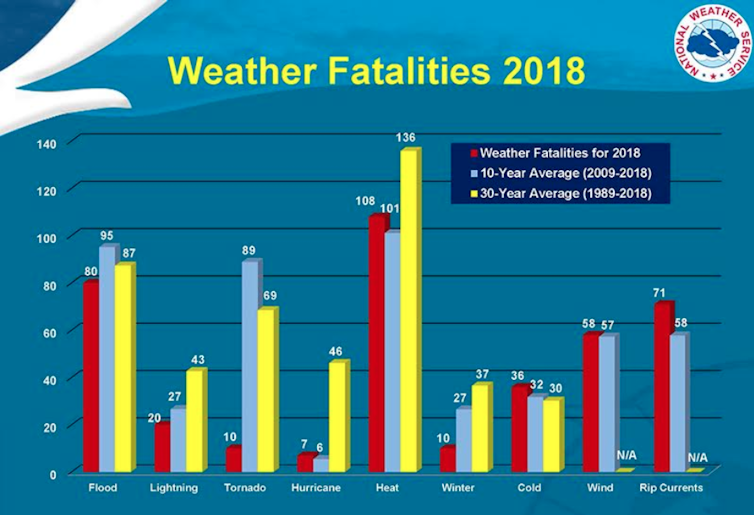
US weather fatalities for 2018 alongside the ten- and 30-year average. National Weather Service, ]
4. Political denial
Climate change deniers argue we cannot take action because other countries are not taking action. But not all countries are equally guilty of causing current climate change. For example, 25% of the human-produced CO₂ in the atmosphere is generated by the US, another 22% is produced by the EU. Africa produces just under 5%.
Given the historic legacy of greenhouse gas pollution, developed countries have an ethical responsibility to lead the way in cutting emissions. But ultimately, all countries need to act because if we want to minimise the effects of climate change then the world must go carbon zero by 2050.
[graf Per capita annual carbon dioxide emissions and cumulative country emissions. Data from the Global Carbon Project. Nature. Data from the Global Carbon Project]
Deniers will also tell you that there are problems to fix closer to home without bothering with global issues. But many of the solutions to climate change are win-win and will improve the lives of normal people. Switching to renewable energy and electric vehicles, for example, reduces air pollution, which improves people’s overall health.
Developing a green economy provides economic benefits and creates jobs. Improving the environment and reforestation provides protection from extreme weather events and can in turn improve food and water security.
5. Crisis denial
The final piece of climate change denial is the argument that we should not rush into changing things, especially given the uncertainty raised by the other four areas of denial above. Deniers argue that climate change is not as bad as scientists make out. We will be much richer in the future and better able to fix climate change. They also play on our emotions as many of us don’t like change and can feel we are living in the best of times – especially if we are richer or in power.
But similarly hollow arguments were used in the past to delay ending slavery, granting the vote to women, ending colonial rule, ending segregation, decriminalising homosexuality, bolstering worker’s rights and environmental regulations, allowing same sex marriages and banning smoking.
The fundamental question is why are we allowing the people with the most privilege and power to convince us to delay saving our planet from climate change? grafs