Cooling
trad this was brief 70s science quickly moved on from that has been bad faith BS // ehrlich
AHA THIS IS SCI SUPPRESS, ANTI-EXPERT
see cold kills more ppl BS (texas polar vortex]
eg
rogan tiktok escalator boost amplify conspiracy clickbait
see david sacks VC new rep natcon musk twit BS well suited for edgelords
https://www.mediamatters.org/tiktok/climate-change-conspiracy-theory-about-cataclysmic-changes-earths-magnetic-field-goes-viral
mma 5 23 no vid
joe Rogan’s podcast is fueling a bizarre TikTok conspiracy theory that falsely attributes climate change impacts to cyclical changes in Earth’s magnetic field, seemingly violating the app’s new climate misinformation policy.
The conspiracy theory’s viral spread on the platform highlights TikTok’s persistent climate misinformation problem, even as it has begun implementing a new policy banning content that “undermines well-established scientific consensus, such as denying the existence of climate change or the factors that contribute to it.”
Inspired by the January 18 episode of The Joe Rogan Experience, content creators have latched onto claims made in a pseudoscientific book called The Adam and Eve Story: The History of Cataclysms. (Along with pushing the cataclysmic pole hypothesis, the book claims that Jesus Christ lived in India for nearly 18 years and was abducted by aliens in a “space vehicle” after his crucifixion.)
Between January and April, Media Matters identified seven viral clips from the Joe Rogan Experience episode discussing the conspiracy theory, which garnered over 20 million cumulative views on TikTok. The videos feature clips of Rogan discussing the book with “independent researcher” Jimmy Corsetti, who runs the YouTube channel Bright Insight, and Ben van Kerkwyk, who runs the channel UnchartedX.
Joe Rogan keeps platforming conspiracy theorists and skeptics of human-caused climate change, driving misinformation
In the January 18 episode of The Joe Rogan Experience, the host brought up “the Adam and Eve” theory and asked Corsetti, “How much of that is agreed upon, that there could be a time where the magnetic poles actually shift?”
Corsetti replied that “This is science,” explaining, “The Adam and Eve Story", the theory on that is that it happens in cycles of 6,500 years and that it’s a 90-degree flip, but six days later, around the seventh day, it corrects itself.” He continued to describe “a planet flip, 90 degrees, and that because of it the Earth essentially does a standstill, the sun will be direct — will basically stay in the same spot, causing heating like we’ve never experienced — and that the wind and the waters continue with their momentum, because essentially the wind travels at approximately 1,000 miles an hour at the equator, so the theory is that when that event happens it’s going to be cataclysmic.:
[vid]
corsetti’s nonsensical explanation was widely shared on TikTok, with one viral clip receiving nearly 11 million views.
In reality, NASA reports that pole reversals, when Earth’s North and South Poles swap locations — which “take place over hundreds to thousands of years,” not a mere seven days— have occurred “183 times in the last 83 million years, and at least several hundred times in the past 160 million years.” Notably:
Plant and animal fossils from the period of the last major pole reversal don’t show any big changes. Deep ocean sediment samples indicate glacial activity was stable. In fact, geologic and fossil records from previous reversals show nothing remarkable, such as doomsday events or major extinctions.
Additionally, there's “no evidence” that any magnetic excursion event (periods of “shorter-lived but significant changes in the magnetic field’s intensity”) has impacted the Earth’s climate within the last 2.8 million years. Scientists aren’t sure when the next pole reversal will occur, but a recent study suggests that won’t be anytime soon. And if it is, a doomsday scenario is unlikely.
Corsetti acknowledged this but claimed that scientists “don’t know what they’re talking about.”
Rogan has previously drawn criticism for leveraging his massive reach and influence to amplify climate denial, and his podcast has catered to guests such as Michael Shellenberger and Bjorn Lomborg, who use cherry-picked and decontextualized talking points to downplay the devastating impacts of climate change and to attack climate solutions. He has also hosted figures who downright deny the fact that fossil fuel consumption is driving climate change, such as Steve Koonin, Jordan Peterson, and Randall Carlson, who has appeared on the podcast at least six times and said that and that
 actions.
In their discussion of The Adam and Eve Story, Rogan and his guests also downplayed the impacts of climate change that millions of people are experiencing and praised Donald Trump for suggesting that the Earth is actually cooling.
“Right now we should be grateful that it’s nice and cozy because we can live when it’s warm,” Corsetti said.
Rogan then cited r Carlson, saying, “Global warming’s not scary. It’s global cooling, that’s what’s really scary.” The host further suggested that climate change is “ this narrative that just gets repeated over and over and over and this fearmongering and everyone gets freaked out. It’s not to say that we aren’t polluting, we certainly are, and it’s not to say that we shouldn’t improve, we certainly should, but if the fucking magnetic poles might shift and we might get hit by a giant rock from space, we might have bigger problems.If we’re going to be concentrating on nonsense, which is really par for the course with human beings, we’re going to be concentrating on these things we’re really not going to fix over the short-term, when something might happen that makes all of it a moot point.” PSEUDO LOMBORGIAN BS
Media Matters also identified two viral clips of this exchange on TikTok with 2 million and 2.6 million views, respectively.
What is The Adam and Eve Story?
The book was written in 1965 by Chan Thomas, who worked in the aerospace industry and claimed to be a psychic. The book was not available to the public until 2013, however, when 57 pages were released by the CIA, and this censorship has captured the imaginations of conspiracy theorists. Since its declassification, The Adam and Eve Story has worked its way into the broader conspiracy theory ecosystem.
Thomas argued that the Earth’s magnetic poles shift every several thousand years, causing cataclysmic events such as tsunamis that destroy civilizations and drastically alter Earth’s geology — one example he used was the flood in the Noah’s Ark narrative in the Bible’s Book of Genesis. Chan predicted that such an event would occur in the near future, and some are now framing increasingly extreme weather events such as hurricanes, floods, and droughts as evidence that the next cataclysm is approaching.
A TikTok account for a podcast called No Regulars posted a March 1 video that has been viewed nearly 18 million times in which host Darris Watkins says that the book’s explanation of cataclysmic magnetic pole shifts actually “makes sense” in describing climate change and “explains a lot” because “the Sahara desert used to be green and like Antarctica used to have forests … So now like some places turn cold, some places turn hot.[pix?]
the popularity of these conspiracy theories among TikTok users may indicate one way that climate misinformation is evolving to reach young people.
Climate misinformation disguised as ancient civilization conspiracy theories
At the time Thomas wrote The Adam and Eve Story, the public at large was not informed of the consequences of anthropogenic climate change. Despite fossil fuel companies being aware of the potential for human-caused global warming as early as the 1950s, people weren’t yet experiencing the ecological effects of increasing temperatures. But when the book was declassified in 2013, it was released into a world grappling with the dire effects of climate change.
While it was not written to provide an alternative explanation for climate change, The Adam and Eve Story provides a framework for interpreting its effects outside of an anthropogenic explanation. This narrative, which shifts blame away from our fossil fuel economy onto planetary forces beyond human control, can serve as climate misinformation.
Rogan’s guests and other proponents of this conspiracy theory purport to be interested in its ramifications for scientific understanding of ancient civilizations, but climate misinformation often serves as a backdrop for their discussions. At one point in their interview, Rogan suggested “that there was incredibly sophisticated technology that existed and … was wiped out. And that we’re talking about a really advanced civilization that lived a long time ago that’s more advanced than we are today but moved in a different direction, like we moved in the direction of combustion engines and electronics and they moved in some other direction but achieved maybe many thousands of years more sophistication in that direction than we have with our internal combustion engines.”
While climate change may not take center stage in these speculations, the implications that humans are not having any influence over our warming planet and that near-apocalyptic events are always inevitable as a result of natural cycles in the Earth’s magnetic field are nonetheless harmful misinformation that lets politicians and fossil fuel companies off the hook for their role in the climate crisis. (Meanwhile, the world’s biggest oil and gas companies just raked in record first-quarter profits.)
Cataclysm narratives as climate sedatives
Narratives that frame climate change as an inevitable disaster caused by forces beyond our control are a key argument of climate denial: If climate change is caused by changes in the Earth’s magnetic field, then there is no point in implementing sweeping action to curtail fossil fuel emissions. In the past, the Earth’s orbit, the sun, and cosmic rays have all similarly been used to provide alternative explanations for climate change.
There is overwhelming scientific consensus that climate change is caused by burning fossil fuels. The only way to avert increasing social, political, and ecological effects of climate change is by transitioning away from a fossil fuel economy.
Despite its appearance as a conspiracy theory about ancient civilizations,The Adam and Eve Story is being used to undermine the scientific consensus regarding the cause of climate change. As TikTok ramps up the enforcement of its new climate misinformation policy, the platform should account for the ways climate denial is often incorporated into seemingly harmless conspiracy theories.
Finally, Spotify still has no clear policy regarding the promotion of climate misinformation on its platform. Spotify reportedly paid $200 million for exclusive rights to Rogan’s show, which was the top podcaston its platform in 2022. As Rogan’s contract is expected to expire in 2023, Spotify will have to decide whether platforming his misinformation and hate speech is worth the profit.
MMA 4 25
April 22, 2025, edition of Fox News' Hannity
SEAN HANNITY (HOST): Make no mistake, at the end of the day, this has nothing to do with the Earth cooling, global warming, which has evolved into the generic climate change, so if it gets warm, they have a name for it. If it gets cold, they have a name for it. If it snows, they've got a name for it. If it doesn't snow, they have a name for it.
Look at this list. It's the Green New Deal. Look, everything on this list has nothing to do really with climate. Climate warming, climate cooling, climate changing is the left's mechanism for Marxism, statism as represented by that list, to each according to their need, from each according to their ability. The only thing Democrats really care actually is political power and you being dependent on them.
---
mma 8 22
TUCKER CARLSON (HOST): The Europeans have discovered that the real threat to human civilization is not global warming, it never was global warming. The real threat to people is global cooling, otherwise known as winter. Far more people freeze to death every year than die of heat. In 2019, for example, four times as many people died of cold as of heat. That's according to the Institute for Health Metrics and Evaluation. So when temperatures in Europe begin to drop a few months from now, this is a huge problem and that will be obvious to everyone. It's not global warming, it's global cooling. That's what's going to kill your grandmother.
:{
}:
legit src but
https://www.wral.com/study-finds-very-concerning-74-increase-in-deaths-associated-with-extreme-heat-brought-on-by-the-climate-crisis/19834115/?version=amp
:{
}:
cNN — A pair of new studies out Thursday find a "very concerning" rise in the number of climate-related deaths and paint a picture of world where people struggle with regular temperature extremes.
One of the studies finds the number of deaths caused by high temperatures increased by 74% globally between 1980 and 2016. Deaths related to extreme cold increased 31% since 1990, a new report, the first of its kind, finds.
Human-caused climate change -- generated by carbon, methane and other greenhouse gas emissions from industry, transportation, and agriculture -- has led to a "new normal" with more days of extreme temperatures than in recorded history. The studies published Thursday provide more evidence that both hot and cold extremes can be deadly.
4x aerosols which we regulated against:
However, these are media articles, not scientific studies. A survey of peer reviewed scientific papers from 1965 to 1979 show that few papers predicted global cooling (7 in total). Significantly more papers (42 in total) predicted global warming (:{Peterson 2008:(style="background-color:#fff200;"):}:). The large majority of climate research in the 1970s predicted the Earth would warm as a consequence of CO2. Rather than 1970s scientists predicting cooling, the opposite is the case....
Yes, their global cooling projection was based on a quadrupling of atmospheric aerosol concentration. This wasn't an entirely unrealistic scenario - after all, sulfur dioxide (SO2) emissions were accelerating quite rapidly up until the early 1970s(Figure 2). These emissions caused various environmental problems, and as a result, a number of countries, including the USA, enacted SO2 limits through Clean Air Acts. As a result, not only did atmospheric aerosol concentrations not quadruple, they declined starting in the late 1970s:
related to pause/ hiatus?
more likely it's just anti-sci, // standup comic bacon is health food now?! [fauci on masks?]
gmail --> mrc newsbusters
https://www.newsbusters.org/blogs/business/joseph-vazquez/2022/02/03/eco-baloney-bloomberg-opinion-editor-suggests-blotting-out
Eco Baloney: Bloomberg Opinion Editor Suggests Blotting ‘Out the Sun’ to Fight Warming
Joseph Vazquez
February 3rd, 2022 11:32 AM
A Bloomberg Opinion editor actually suggested humanity just blot out the sun to fight global warming. Michael Newman wrote a senseless blog headlined, “What if We Blotted Out the Sun to Fight Global Warming?” He probably subconsciously realized the suggestion was insane, as he hedged in his subheadline: “It’s risky, but then again the path we’re on now may be even riskier.”
Newman called “solar geoengineering” one of the “great hopes” to “stop or slow climate change.” He explained the idea as “an attempt to figure out a way to cool the planet by deflecting some of the sun’s rays before they reach us humans.” Newman based his argument on an equally absurd article by Bloomberg Opinion columnist Clara Ferreira Marques headlined: “Solar Geoengineering Research Is a Risk Worth Taking.”
As Newman summarized, “Clara argues it’s ‘terrifying and terrible in the way that chemotherapy is: We don’t want it, but can we deny ourselves the possibility?’” But Newman undercut himself by admitting that “The science isn’t yet there,” and that “a group of scientists argue it should be banned now — and they are not wrong that it is a risky and last-resort proposition.” Or, perhaps dimming the thing that makes life possible on Earth is just as crazy as it sounds, and Newman pushing it as a solution makes no sense at all.
Climate Depot founder Marc Morano slapped down Newman’s blot “out the sun” as a “last-resort” argument in comments emailed to MRC Business. Morano referenced his book Green Fraud (2021), which pointed to a Newsweek article from April 28, 1975 showing how climate change extremists advocated for “melting the arctic ice cap by covering it with black soot” to stave off global cooling. According to Morano, Newman’s argument is “a redo of the 1970s. Before fossil fuels caused global warming, fossil fuels caused global cooling and the ice age in the 1970s!”
Morano further analyzed the narrative shift:
They were worried that our fossil fuel pollution was blocking out the sun creating global dimming and the next ice age. They were trying to geoengineer the climate back in the 1970s and here we have come full circle now trying to do it the other way by essentially cooling the planet instead of trying to warm it.
But as is the case with much of the eco-extremist fear mongering, outrageous proposals like blotting out the sun are just political gibberish to convince politicians to push more meaningless climate regulations.
“Climate activists are using the threat of ‘blotting out the sun’ as a form of lobbying for ‘climate action,’” Morano argued. “They are saying, 'We are being forced to do this risky radical experiment on our planet' unless we reduce our emissions. It's one level of futile to pass legislation to attempt to regulate the climate and a whole different level to monkey around with the physics and mechanics of the atmosphere.”
Conservatives are under attack. Contact letters@bloomberg.net and demand the outlet stop peddling insane climate ideas like blotting out the sun.
missing the pt that climate affects rainfall?
matt t hate inc bk
:{13. TURN IT OFF:(style="box-sizing:inherit"):}:
(pp. 201-212)
DOI: 10.2307/j.ctvm7bd2k.17
One Monday in the fall of 1972, oddly enough on September 11, CBS anchorman Walter Cronkite decided to end his nightly broadcast with bad news.
“Professor Hubert Lamb says a new Ice Age is creeping over the northern hemisphere,” Cronkite began.
It could have been a joke, or serious. Nothing in his delivery gave any hint.
Cronkite’s face was an advanced messaging machine, a broadcasting Ferrari.
He went on: “It won’t be as bad as the last Ice Age 60,000 years ago when New York, Cincinnati and St. Louis were under five thousand feet of ice. Presumably, no traffic moved,...
ref
https://www.tandfonline.com/doi/full/10.1080/09644016.2020.1863703
early oil industry disinformation on global warming
Benjamin Franta ORCID
Pages 663-668 | Published online: 05Jan 2021
Download citation https://doi.org/10.1080/09644016.2020.1863703
Full Article Figures & data References Citations Metrics Licensing Reprints & Permissions PDF EPUB
ABSTRACT
Determining the onset of organized disinformation about global warming is critical for understanding its political history and evaluating the responsibilities of fossil fuel producers and other relevant parties today. A newly discovered archival document shows the American Petroleum Institute was promulgating false and misleading information about climate change in 1980, nearly a decade earlier than previously known, in order to promote public policies favorable to the fossil fuel industry. This finding demonstrates early use of public-facing disinformation about global warming by the petroleum industry and suggests commercial fossil fuel interests played a more obstructive role in climate change discourse and policy throughout the 1980s than previously understood.
KEYWORDS: Climate change global warming American Petroleum Institute fossil fuel industry disinformation denial
In the historiography of climate change politics, organized disinformation (false or misleading information promulgated by an organization) about global warming is often understood to commence in 1989 with publications from the George C. Marshall Institute (Brulle 2020a) and the founding of the Global Climate Coalition (Brulle 2020b). Some writers (Rich 2018), as well as fossil fuel industry representatives (Walrath 2018), have argued that this apparent lack of organized disinformation prior to 1989 proves that commercial interests bear no or little responsibility for the lack of proactive climate policy throughout the 1980s.A document not yet noticed by historians, however, shows that the American Petroleum Institute (API) was publicly downplaying the threat of climate change as early as 1980.
In August 1980, the API published Two Energy Futures: A National Choice for the 80s (American Petroleum Institute 1980). The policy booklet acknowledged that carbon dioxide was a ‘pollutant’ and that fossil fuels could cause global warming, stating (American Petroleum Institute 1980, p. 80):
When coal (or any other fossil fuel) is burned, carbon dioxide emissions occur. In itself, carbon dioxide is harmless – nature itself is a major source. However, some scientists believe that large concentrations of carbon dioxide in the atmosphere can, in time, cause climatic changes – specifically, higher temperatures worldwide (the ‘greenhouse’ effect).
After this acknowledgment, however, the API proceeded to cast doubt upon the danger of global warming, invoking the popular astronomer Carl Sagan:
Other scientists are more sanguine about the presence of carbon dioxide in the atmosphere. Some scientists, including Dr. Carl Sagan, Cornell University astronomer, see a cooling phenomenon as counteracting the greenhouse effect.
To support this message of reassurance, the API cited an article in the magazine The Wilson Quarterly (Woodrow Wilson International Center for Scholars 1980), which itself was a summary of an article by Sagan, physicist Owen Toon, and astrophysicist James Pollack in the journal Science (Sagan et al. 1979).
But the article by Sagan and colleagues did not state that global warming from fossil fuels was not a threat, as suggested by the API. Rather, the scientists proposed that human societies had over thousands of yearscaused desertification and deforestation of large areas of Earth, gradually increasing the planet’s albedo and lowering globally averaged temperatures by about 1 degree Celsius. Continued desertification and deforestation might reduce the planet’s temperature by another 1 degree Celsius by the end of the twenty-first century, the scientists estimated.
But such cooling, they noted, would require that nearly all of Earth’s surface be deforested, transformed into desert, and/or salinized into salt flats, and even then, global warming from fossil fuels would be only partly counteracted. ‘The surface albedo of the earth will reach an asymptotic limit long before the carbon dioxide abundance will,’ the scientists observed, warning, ‘Global temperature changes of this magnitude [1–2 degrees Celsius] have profound consequences for human populations.’ The API’s public reassurance that Sagan was ‘sanguine’ (i.e. optimistic) about the buildup of carbon dioxide from fossil fuels was false.
Sagan also discussed global warming in his widely read 1980 book Cosmos, where he issued a stark admonition (Sagan 1980):
The surface environment of Venus is a warning: something disastrous can happen to a planet rather like our own. … the carbon dioxide content of the Earth’s atmosphere is increasing dramatically. The possibility of a runaway greenhouse effect suggests that we have to be careful: Even a one- or two-degree rise in the global temperature can have catastrophic consequences.
Again, Sagan’s words were far from the posture of reassurance falsely attributed to him by the API.
Having created the false impression that scientists did not view global warming from fossil fuels as a significant threat, the API suggested that expanded fossil fuel use – specifically expanded coal and synthetic fuel production – would be safe (American Petroleum Institute 1980, p. 80):...
https://www.ecowatch.com/native-americans-colonization-climate-change-2627721578.html
The widespread genocide of Native Americans by European colonizers between the 16th and 17th century killed so many that it helped cool the globe, according to new research.
A study published in the journal Quaternary Science Reviews calculates that the 56 million indigenous deaths across the Americas caused by disease and European-led massacres led to the overgrowth and reforesting of large tracts of agricultural land, contributing to a 0.15C degree drop in the early 1600s known as the Little Ice Age.
"For once, we've been able to balance all the boxes and realize that the only way the Little Ice Age was so intense is ... because of the genocide of millions of people," coauthor Mark Maslin told CNN.
As reported by the BBC:
"The [research] team reviewed all the population data it could find on how many people were living in the Americas prior to first contact with Europeans in 1492.
It then assessed how the numbers changed in following decades as the continents were ravaged by introduced disease (smallpox, measles, etc), warfare, slavery and societal collapse.
It's the UCL group's estimate that 60 million people were living across the Americas at the end of the 15th Century (about 10% of the world's total population), and that this was reduced to just five or six million within a hundred years.
The scientists calculated how much land previously cultivated by indigenous civilisations would have fallen into disuse, and what the impact would be if this ground was then repossessed by forest and savannah.
The area is in the order of 56 million hectares, close in size to a modern country like France.
This scale of regrowth is figured to have drawn down sufficient CO₂ that the concentration of the gas in the atmosphere eventually fell by 7-10ppm (that is 7-10 molecules of CO₂ in every one million molecules in the air).
'To put that in the modern context - we basically burn (fossil fuels) and produce about 3ppm per year. So, we're talking a large amount of carbon that's being sucked out of the atmosphere,' explained co-author Prof Mark Maslin,"
deeper dive:
CNN, The Guardian, BBC, Miami Herald, NY Daily News
For more climate change and clean energy news, you can follow Climate Nexus on Twitter and Facebook, and sign up for daily Hot News.
RELATED ARTICLES AROUND THE WEB
- What Standing Rock Gave the World - EcoWatch ›
- European colonisation of the Americas killed 10% of world ... ›
- New Worlds of Climate Change: The Little Ice Age and the ... ›
- Climate foiled Europeans' early exploration of North America ... ›
==
7/15
http://thinkprogress.org/climate/2015/07/13/3679662/global-warming-speed-up-not-ice-age/
What were climate scientists predicting in the 1970s?
http://www.skepticalscience.com/ice-age-predictions-in-1970s-intermediate.htm
Mainstream Media
What was the scientific consensus in the 1970s regarding future climate? The most cited example of 1970s cooling predictions is a1975 Newsweek article "The Cooling World" that suggested cooling "may portend a drastic decline for food production."
"Meteorologists disagree about the cause and extent of the cooling trend… But they are almost unanimous in the view that the trend will reduce agricultural productivity for the rest of the century."
A 1974 Time magazine article Another Ice Age? painted a similarly bleak picture:
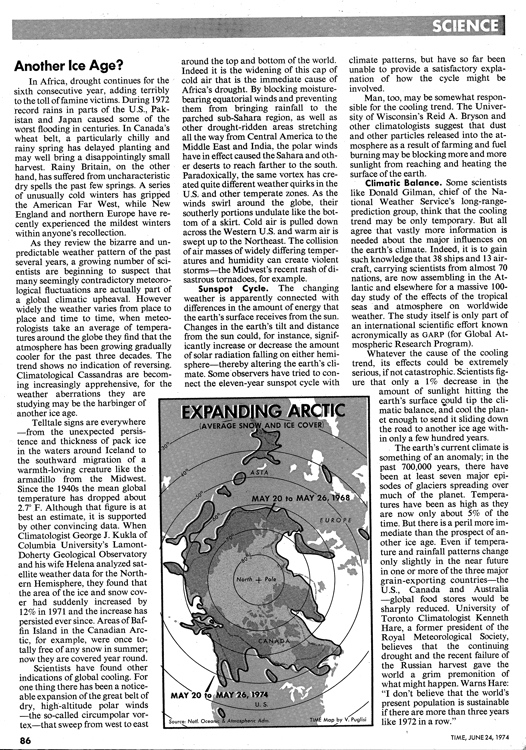
"When meteorologists take an average of temperatures around the globe, they find that the atmosphere has been growing gradually cooler for the past three decades. The trend shows no indication of reversing. Climatological Cassandras are becoming increasingly apprehensive, for the weather aberrations they are studying may be the harbinger of another ice age."
Peer-Reviewed Literature
However, these are media articles, not scientific studies. A survey of peer reviewed scientific papers from 1965 to 1979 show that few papers predicted global cooling (7 in total). Significantly more papers (42 in total) predicted global warming (:{Peterson 2008:(style="background-color:#fff200"):}:). The large majority of climate research in the 1970s predicted the Earth would warm as a consequence of CO2. Rather than 1970s scientists predicting cooling, the opposite is the case.
Figure 1: Number of papers classified as predicting global cooling (blue) or warming (red). In no year were there more cooling papers than warming papers (Peterson 2008).
Scientific Consensus
In the 1970s, the most comprehensive study on climate change (and the closest thing to a scientific consensus at the time) was the 1975 US National Academy of Sciences/National Research Council Report. Their basic conclusion was "…we do not have a good quantitative understanding of our climate machine and what determines its course. Without the fundamental understanding, it does not seem possible to predict climate…"
This is in strong contrast with the current position of the US National Academy of Sciences: "...there is now strong evidence that significant global warming is occurring... It is likely that most of the warming in recent decades can be attributed to human activities... The scientific understanding of climate change is now sufficiently clear to justify nations taking prompt action." This is in a joint statement with the Academies of Science from Brazil, France, Canada, China, Germany, India, Italy, Japan, Russia and the United Kingdom.
In contrast to the 1970s, there are now a number of scientific bodies that have released statements affirming man-made global warming. More on scientific consensus...
- National Oceanic and Atmospheric Administration
- Environmental Protection Agency
- NASA's Goddard Institute of Space Studies
- American Geophysical Union
- American Institute of Physics
- National Center for Atmospheric Research
- American Meteorological Society
- The Royal Society of the UK
- Canadian Meteorological and Oceanographic Society
- American Association for the Advancement of Science
Reasoning Behind Cooling Predictions
Quite often, the justification for the few global cooling predictions in the 1970s is overlooked. Probably the most famous such prediction was Rasool and Schneider (1971):
"An increase by only a factor of 4 in global aerosol background concentration may be sufficient to reduce the surface temperature by as much as 3.5°K."
Yes, their global cooling projection was based on a quadrupling of atmospheric aerosol concentration. This wasn't an entirely unrealistic scenario - after all, sulfur dioxide (SO2) emissions were accelerating quite rapidly up until the early 1970s(Figure 2). These emissions caused various environmental problems, and as a result, a number of countries, including the USA, enacted SO2 limits through Clean Air Acts. As a result, not only did atmospheric aerosol concentrations not quadruple, they declined starting in the late 1970s:
Figure 2: Global sulfur dioxide emissions by source (PNNL)
Similarly, if we now limit CO2 emissions, we can also eventually get global warming under control.
Summary
So global cooling predictions in the 70s amounted to media and a handful of peer reviewed studies. The small number of papers predicting cooling were outweighed by a much greater number of papers predicting global warming due to the warming effect of rising CO2. Today, an avalanche of peer reviewed studies and overwhelming scientific consensus endorse man-made global warming. To compare cooling predictions in the 70s to the current situation is both inappropriate and misleading. Additionally, we reduced the SO2 emissions which were causing global cooling. The question remains whether we will reduce the CO2 emissions causing global warming.
- The Myth of the 1970's Global Cooling Scientific Consensus, published by the American Meteorological Society.
- Was an imminent Ice Age predicted in the '70's? by William Connelly documents all the scientific literature in the 70's on global cooling.
- Past Cycles: Ice Age Speculations by Spencer Weart (part of the *History of Global Warming* series) documents the development of ice age science.
- Logical Science goes to the trouble of purchasing the 1975 National Academy of Sciences report to see what the NAS had to say about global cooling in the 70's.
- James Hansen responds to the claims that "Hansen predicted an ice age in the 70's", explaining the role of his computer program used in Rasool's paper.
- Check out this *New York Times* article from 1956 that discusses a forecasted increase in global temperatures as emissions from burning fossil fuels increase atmospheric CO2. Thanks to George Morrison for the heads up.
- Robert Brulle at the Wonk Room looks at a range of *New York Times* articles on climate science in the late 60's and early 70's.
- The 1979 report from the National Academy of Sciences, "Carbon Dioxide and Climate: A Scientific Assessment" finds "when it is assumed that the CO2 content of the atmosphere is doubled and statistical thermal equilibrium is achieved, the more realistic of the modeling efforts predict a global surface warming of between 2°C and 3.5°C, with greater increases at high latitudes."
‘They predicted global cooling in the 70s’–But that didn’t even remotely resemble today’s consensus
By Coby Beck
(Part of the How to Talk to a Global Warming Skeptic guide)
Objection: The alarmists were predicting the onset of an ice age in the ’70s. Now it’s too much warming! Why should we believe them this time?
Answer: It is true that there were some predictions of an “imminent ice age” in the 1970s, but a cursory comparison of those warnings and today’s reveals a huge difference.
Today, you have a widespread scientific consensus, supported by national academies and all the major scientific institutions, solidly behind the warning that the temperature is rising, anthropogenic CO2 is the primary cause, and it will worsen unless we reduce emissions.
In the 1970s, there was a book in the popular press, a few articles in popular magazines, and a small amount of scientific speculation based on the recently discovered glacial cycles and the recent slight cooling trend from air pollution blocking the sunlight. There were no daily headlines. There was no avalanche of scientific articles. There were no United Nations treaties or commissions. No G8 summits on the dangers and possible solutions. No institutional pronouncements. You could find broader “consensus” on a coming alien invasion.
Quite simply, there is no comparison.
If you want some additional detail, Real Climate has discussed this, and William Connelly has made a hobby of gathering everything that was written about global cooling at the time.
===
JBS 404 wayback:
Vol. 13, No. 25 December 8, 1997 | **More on Environmentalism** |
Hot and Cold Running Alarmism
by Gary Benoit
http://www.jbs.org/speaker-bios/gary-benoit
The threat of catastrophic climatic change is nothing new. For example, the April 28, 1975 issue of Newsweekdarkly warned: "There are ominous signs that the earth's weather patterns have begun to change dramatically and that these changes may portend a drastic decline in food production -- with serious political implications for just about every nation on earth. The drop in food output could begin quite soon, perhaps only ten years from now.... The evidence in support of these predictions has now begun to accumulate so massively that meteorologists are hard-pressed to keep up with it."
Unlike today, however, the mounting evidence that atmospheric scientists then struggled to keep up with was principally used to support a theory of global cooling, not global warming, The Newsweekarticle, entitled "The Cooling World," continued: "In England, farmers have seen their growing season decline by about two weeks since 1950, with a resultant over-all loss in grain production estimated at up to 100,000 tons annually. During the same time, the average temperature around the equator has risen by a fraction of a degree -- a fraction that in some areas can mean drought and desolation. Last April, in the most devastating outbreak of tornadoes ever recorded, 148 twisters killed more than 300 people and caused half a billion dollars' worth of damage in thirteen U.S. states."
"Another Ice Age"
Newsweekpatiently explained to its lay readers that scientists thought "these seemingly disparate incidents represent the advance signs of fundamental changes in the world's weather. The central fact is that after three quarters of a century of extraordinarily mild conditions, the earth's climate seems to be cooling down." So much so, in fact, that one possible solution cited by Newsweekwas to melt the arctic ice cap by "covering it with black soot." But such a spectacular step, Newsweekacknowledged, might create a "far greater" problem than it solves. Today, of course, the concern among doomsayers is not too much ice, but too little.
Newsweekwas not alone in spreading this eco-babble. Timemagazine for June 24, 1974 declared: "However widely the weather varies from place to place and time to time, when meteorologists take an average of temperatures around the globe they find that the atmosphere has been growing gradually cooler for the past three decades." Not only did that supposedly alarming trend show "no indication of reversing," but "Climatological Cassandras are becoming increasingly apprehensive, for the weather aberrations they are studying may be the harbinger of another ice age." The Timearticle even included a map depicting the "expanding Arctic" and referenced one scientific finding that "the area of the ice and snow cover" in the Northern Hemisphere "had suddenly increased by 12% in 1971" and that this increase "has persisted ever since." "Areas of Baffin Island in the Canadian Arctic ... were once totally free of any snow in the summer," Timeobserved. "[N]ow they are covered year round." How different that is from today's alarmist headlines about disappearing glaciers!
Echoing the "cooling" rhetoric, the February 1974 issue of Fortunemagazine warned that the temperature had already dropped about 2.7° F since the 1940s. That "hardly seems dramatic," Fortuneadmitted, "but the effects have been substantial. Icelandic fishing fleets that learned to range northward during the warm period have now had to return to traditional waters to the south. For the first time in this century, ships making for Iceland's ports have found navigation impeded by drifting ice." So serious was the cooling trend that "it could bring massive tragedies for mankind."
Authoritative Opinions
Of course, when issuing its dire predictions about global cooling the mainstream media was quick to cite various prestigious scientific authorities. One such authority widely quoted at the time was Dr. Reid Bryson, director of environmental studies at the University of Wisconsin. Bryson theorized that agricultural and industrial activities were causing an increase of dust and other particles in the atmosphere, and that these particles were increasingly preventing sunlight from reaching the earth, thereby fueling a cooling trend that, sometime after 1930, began overpowering the greenhouse effect of CO2. Fortunequoted Bryson as saying that this trend, "if it continues, will affect the whole human occupation of the earth -- like a billion people starving. The effects are already showing up in rather drastic ways."
Was this the uninformed gibberish of a pseudo-scientist? Not according to Fortune, which quoted another eminent scientist as noting that Bryson "is the most important figure in climatology today." Besides, "most climatologists agree that a diminution of the sunlight as small as 1 percent would suffice to initiate a cool period and perhaps even major glaciation." But now, the same industrialization these "experts" were blaming for part of the cooling is being blamed for part of the warming.
Another '70s proponent of the global cooling theory was Dr. Stephen Schneider, who spent two decades at the National Center for Atmospheric Research in Colorado before joining the faculty at Stanford University in 1992. In an article he co-authored for the July 9, 1971 issue of Sciencemagazine, Schneider warned that "an increase by a factor of 4 in the equilibrium dust concentration in the global atmosphere, which cannot be ruled out as a possibility within the next century, could decrease the mean surface temperature by as much as 3.5° K [6.3° F]. If sustained over a period of several years, such a temperature decrease could be sufficient to trigger an ice age!" On the other hand, the warming effect of CO2 was much less significant, since, "as more CO2 is added to the atmosphere, the rateof temperature increase is proportionally less and less, and the increase eventually levels off." "[I]f CO2 is augmented by another 10 percent in the next 30 years, the increase in the global temperature may be as small as 0.1° K [0.18° F]," Schneider calculated, and doubling CO2 would change global temperature by 0.8° K (1.4° F). Consequently, "the net result" between the sunlight-blocking dust and greenhouse CO2 "will be a cooling of Earth."
But Schneider has now jumped from the "global cooling" bandwagon to sound the alarm about global warming, and places far more importance on the effect of CO2 on temperature. Regarding MIT scientist Richard Lindzen's estimate that a doubling of CO2 would result in an increase of only 1° F, for instance, Schneider scoffed: "I don't know what line from God he has." Unfortunately, the article in the June 18, 1996 New York Timesthat recorded this priceless contribution to the global warming debate somehow overlooked Schneider's 1971 predictions -- as have other elements of the establishment echo chamber that cite Schneider as an expert on the global warming phenomenon.
In 1976, 13 years before he wrote his book Global Warming, Schneider endorsed Lowell Ponte's book The Cooling, claiming that it "points out in clear language that the climatic threat could be as awesome as any we might face...." U.S. Senator Claiborne Pell (D-RI) agreed, writing in the foreword that "The Coolingcould prove to be the most important and prophetic popular science book of the 1970s."
The book warned that "the cooling will cause world famine, world chaos, and probably world war, and this could all come by the year 2000." And it cited the southward migration of the warm-climate armadillo as just one effect of the cooling that had already taken place. Now environmentalist Vice President Al Gore and others are voicing concern about global warming causing a northward migration of the warm-climate disease malaria. What they don't bother to mention is that the banning of DDT -- not global warming -- has made the resurgence of that disease all but inevitable.
Covering the Bases
Climatological "experts" who once embraced the global cooling theory have now rejected it in favor of global warming. Yet even in the context of the present debate, the spectre of global cooling can still haunt the excited imaginations of climatological chicken littles. Sometimes all it takes to provoke such speculation is a single cold snap, such as occurred in the winter of 1994. The January 31, 1994 issue of Timemagazine published an article entitled "The Ice Age Cometh?" that pondered: "What ever happened to global warming? Scientists have issued apocalyptic warnings for years, claiming that gases from cars, power plants, and factories are creating a greenhouse effect that will boost the temperature dangerously.... But if last week is any indication of winters to come, it might be more to the point to start worrying about the next Ice Age instead."
Of course, the temperature sometimes goes up and other times goes down. In an attempt to cover all the bases, Newsweekwent so far as to publish a cover story in its January 22, 1996 issue blaming global warming for blizzards as well as for floods and hurricanes. "According to the boldest climatological theories, global warming will produce more extreme weather of all kinds -- hot as well as cold and, especially, wet as well as dry," claimed Newsweek. "The Blizzard of '96 [which had occurred while the magazine was preparing its "global warming" story] was the perfect peg to look at the issue of global warming. And so we have" -- complete with a photo of blizzard conditions on the cover to complement the chilling headline "The Hot Zone." Thus, if we are to accept this theory, man-induced "global warming" must be held accountable for whatever bad weather takes place.
Stephen Schneider once noted that "as scientists ... ethically bound to the scientific method ... we must include all the doubts, the caveats, the ifs, ands, and buts." On the other hand, "we need to get some broad-based support, to capture the public's imagination," which entails "getting loads of media coverage." Consequently, that means "we have to offer up scary scenarios, make simplified, dramatic statements, and make little mention of any doubts we might have." This dilemma for Schneider and his fellow catastrophic climatologists is made easier by the fact that the opinion cartel has assigned their embarrassing "ice age" predictions to the memory hole.
===
crichton:
Such fears had been building for many years. In the first Earth Day in
1970, UC Davis’s Kenneth Watt said, “If present trends continue, the
world will be about four degrees colder in 1990, but eleven degrees
colder by the year 2000. This is about twice what it would take to put
us in an ice age.” International Wildlife warned “a new ice age must
now stand alongside nuclear war” as a threat to mankind. Science
Digest said “we must prepare for the next ice age.” The Christian
Science Monitor noted that armadillos had moved out of Nebraska
because it was too cold, glaciers had begun to advance, and growing
seasons had shortened around the world. Newsweek reported
“ominous signs” of a “fundamental change in the world’s weather.”
But in fact, every one of these statements was wrong. Fears of an ice
age had vanished within five years, to be replaced by fears of global
warming. These fears were heightened because population was
exploding. By 1995, it was 5.7 billion, up 10% in the last five years.
Back in the 90s, if someone said to you, “This population explosion is
overstated. In the next hundred years, population will actually
decline.” That would contradict what all the environmental groups
were saying, what the UN was saying. You would regard such a
statement as outrageous.