NW nat gas
===
10 24
for the first time, a gas utility could be on the hook for its role in deceiving the public about the climate crisis. Multnomah, Oregon, has added NW Natural — Oregon’s oldest and largest supplier of “natural” gas, also known as fossil or methane gas — to the list of defendants in a lawsuit that seeks to make fossil fuel companies pay $52 billion for their role in the deadly 2021 Pacific Northwest heat dome.
NW Natural “has routinely misrepresented” the climate harms of gas while undermining the energy transition “in an effort to frighten customers and discourage policy makers from using their authority to protect the public,” according to the county’s amended complaint. The company has portrayed gas as “safe, clean, and environmentally friendly,” despite the fact that methane, its primary component, is 80 times more potent as a greenhouse gas than carbon dioxide.
In its original complaint, Oregon’s most populous county argued that oil and gas companies’ decades-long climate deception helped lead to the heat dome that killed 69 people in Multnomah — an event scientists said would have been “virtually impossible” without climate change. The 2023 lawsuit seeks to recover costs incurred from other extreme weather events and make Exxon, Chevron, McKinsey, and other defendants pay for a range of adaptation measures to protect residents from future ones. The updated complaint now adds that NW Natural “engaged in an enterprise of misrepresentation about the effects its products would have on the climate, and that the use of its products could cause an extreme heat event to occur.”
That enterprise has reportedly ramped up in recent years as the company fights a growing push for policies to limit emissions and phase out their product. The utility has run advertising campaigns touting “renewable natural gas,” targeted children through school books depicting gas as safe and clean, and created front groups posing as local grassroots advocates to fight electrification and promote “consumer choice,” according to evidence cited by the complaint and further detailed in additional reporting, investigations, and challenges to state regulators.
“As we learned in this country when we took on big tobacco, this is not an easy step or one I take lightly but I do believe it’s our best way to fight for our community and protect our future,” Multnomah County Chair Jessica Vega Pederson said in a press release.
Like many fossil fuel and petrochemical companies, NW Natural sponsors sporting events, concerts, and small nonprofits in the region reliant on external funding. The utility’s embedded presence in the community makes it all the more important for the county to “highlight the insidious nature of their communications,” said Carra Sahler, a Multnomah County resident and Director and Staff Attorney at the Green Energy Institute at Lewis & Clark Law School, which has represented advocacy groups in cases against NW Natural for customer rate hikes.
Sept 13, 2024 via X
“People want to trust that their utility is doing the right thing, that the utility is providing the information necessary for them to make choices about their energy use,” Sahler said. “It feels like we’ve crossed into a new era where there is no way forward but to stop [NW Natural] from spreading misinformation.”
“Renewable natural gas”
On a “low carbon energy future” page on its website, NW Natural claims it “has an important role to play in helping our region move to a lower-carbon, renewable energy future in a more resilient and affordable way.” The company goes on to boast its investments in so-called “renewable natural gas,” or gas acquired from decomposing organic matter at livestock operations and landfills.
For years, the utility has used customers’ money to fund ad campaigns promoting “renewable natural gas,” blasting out the slogan “Less We Can,” and insinuating that the company is already providing the “renewable” energy source to Oregon homes. The utility calls RNG a “carbon neutral resource,” but its own filings with Oregon regulators show that’s not true: two of its extraction sites at Tyson slaughterhouses in Nebraska, for example, have a climate footprint.
The company also appears to overstate its use of RNG in its operations. At the Tyson slaughterhouses, the Nebraska-sourced gas is piped mainly to Nebraska customers rather than Oregonians, ProPublica reporters found. And according to the company’s reports, RNG makes up less than 1% of the total gas acquired by NW Natural — a statistic the company blames on “uncertain support from policy makers and regulators, coupled with ongoing barriers created by certain climate advocates.”
According to ads and internal powerpoints scrutinized by DeSmog and documents revealed by ProPublica, the RNG ad campaigns were part of a strategy to beat back the growing “anti-fossil fuel chorus.” That strategy also involved convincing the state legislature to greenlight a state-produced inventory of Oregon’s “technical potential” for “RNG,” and using the highest possible estimates — the amount of RNG Oregon could produce if it had unlimited money — to successfully lobby for another bill to make ratepayers cover the added costs of the biogas, and establish voluntary goals for its use, which the utility would then use to battle regulation.
Targeting schools
NW Natural’s campaign to “promote the continued use and consumption of fossil fuel gas by influencing public opinion” also “targets the next generation through children,” according to Multnomah’s complaint, which cites “gas-related” activity workbooks sent by NW Natural to schools. The books, which target children as young as kindergartners, use puzzles, word games, cartoons, and other activities depicting fossil gas as safe, clean, and beneficial for society, reporting from DeSmog found.
Screenshot from formal testimony to the PUC on April 22, 2022, cited in Multnomah’s complaint.
A group funded by the utility, called Bonneville Environmental Foundation, also planned an event for teachers — which was ultimately canceled after students planned to protest— called “Clean Energy Teacher Training: Exploring Renewable Gas.” The utility promised each teacher who attended the session in Portland a $200 stipend, plus reimbursement for mileage if they traveled more than 50 miles.
In 2022, a coalition of nonprofits and state representatives sent a letter calling on Oregon Attorney General Ellen Rosenblum to investigate the utility’s “misleading advertising,” stating that “it is particularly concerning that school children are being subjected to misinformation from corporate entities of any kind, but especially by a fossil fuel corporation selling a product that is harmful to children’s health.” In 2023, the group once again called on the AG to “investigate and sue NW Natural if appropriate.”
In response to concerns raised by a coalition of local environmental and consumer advocates, the state Public Utility Commission ruled in April that NW Natural can no longer charge ratepayers for pro-gas advertising targeting schoolchildren.
Battling climate action
NW Natural hasn’t just advertised fossil gas as a cleaner, “renewable” fuel — it has also fought policies to reduce emissions and shift toward electrification. Reports show the utility hired a scientist to oppose bans on gas in new construction, worked with a public relations firm and its front group to “defeat policies detrimental to the natural gas industry,” and sued the Oregon Environmental Quality Commission over the state’s landmark Climate Protection Program that aimed to reduce emissions.
The company even posed as a local grassroots group to oppose a partial ban on new natural gas construction by Eugene’s City Council in 2023. Just days after the ban was passed, “Eugene Residents for Energy Choice” was registered with the Oregon Secretary of State. Funded by NW Natural to the tune of nearly $950,000 in a span of two weeks, the group collected signatures to revoke the ban — which was ultimately repealed by the city council.
Recently, state regulators accused NW Natural of misleading consumers about Oregon’s carbon crediting program after the utility claimed in a newsletter that the program would raise rates without reducing greenhouse gas emissions.
NW Natural’s actions are part of a much larger push by the gas industry to fight regulations, including longstanding campaigns by the American Gas Association — an industry trade group of which it is a member, and where its CEO, David Anderson, [sits on the board]
https://substack.com/redirect/29c56708-84aa-4364-b1fc-3a6c46f36cba?j=eyJ1IjoiN3ltancifQ.i0HJl3aVWG8sHp566T-pebMssFGKcgvxVOFLuZyEDpw
. As more communities pass laws to tighten standards for appliances and limit new construction of gas pipelines to homes and businesses, the group’s campaigns to counter scientific evidence that using gas stoves is harmful to human health have resurfaced.
Another new defendant
Multnomah County’s amended complaint adds one more new defendant to the case: the Oregon Institute of Science and Medicine. The nonprofit ran the 1998 “Oregon Petition,” which claimed to capture signatures from 17,000 scientists who agreed there was “no convincing scientific evidence that human release of greenhouse gasses is causing or will, in the foreseeable future, cause catastrophic heating of the Earth’s atmosphere and disruption of the Earth’s climate.”
In reality, the petition was not signed by 17,000 scientists, but included fictitious names, deceased persons, and celebrities, according to the complaint. The project was designed to look as though it was approved by the National Academy of Scientists, but was actually authored by Fred Seitz, cofounder of the Exxon-backed think tank GMI.
“A signal to the gas industry”
In June, the county won a procedural victory when a federal courtruled that its lawsuit could move forward in state court.
Pat Parenteau, an environmental law professor and senior fellow at Vermont Law School, said the evidence of the utility’s deception cited in the complaint fell short of the “massive” amount of evidence plaintiffs have cited against oil companies. Further evidence of NW Natural’s deception could expand through the course of discovery and additional reporting, he added.
Michael Gerrard, director of the Sabin Center for Climate Change Law at Columbia University, agreed that gas utilities’ “histories of climate deception have not been as thoroughly mined as those of the oil companies,” but noted that additional evidence could land more utilities in court for climate deception.
“It does send a signal to the gas industry that these sorts of plaintiffs are looking at them more closely than they have in the past,” Gerrard said.
===
ref 1
A heat dome killed their residents. Now they’re suing Big Oil.
Multnomah County, Oregon, aims to put fossil fuel companies on trial for fueling climate disasters like the deadly 2021 heat dome.
Jun 23, 2023
Emily Sanders is the Center for Climate Integrity’s editorial lead. CCI staff writer Isabella Garcia, a Multnomah County resident, contributed to this reporting.*
As we approach the second anniversary of a deadly heat dome that devastated communities throughout the Pacific Northwest, an Oregon county is now suing Big Oil companies and their enablers to hold them accountable for the damage. Multnomah County is the first community to file a climate accountability lawsuit over the heat dome — which officials say killed 69 local residents, scientists say was “virtually impossible” without climate change, and county leaders say was fueled by the fossil fuel industry’s fraud.
Multnomah is charging some of the largest oil, gas, and coal companies — including Exxon, Chevron, Shell, BP, Koch Industries, Peabody, and others — with lying to “the County, the public, and the scientific community about the catastrophic harm” they knew fossil fuels would cause. The industry’s campaigns of disinformation, they say, delayed climate action for years and left residents to pay the ultimate price while the companies rake in record-breaking profits.
Like numerous other lawsuits filed in the United States to hold fossil fuel, tobacco, opioid, and other industries liable for damages they knowingly caused, Multnomah’s case charges the industry with violating fraud and tort laws, like negligence and public nuisance. The lawsuit says Big Oil should face a jury trial and pay more than $51.5 billion to help the county adapt and cover the costs of past and future climate disasters, including more frequent and extreme heatwaves and wildfires.
After voting yesterday afternoon to take legal action against Big Oil, county officials led hundreds of local residents and climate activists on a march to the Multnomah County Courthouse, where they held a press conference announcing the suit.
“The climate crisis is costing us money today, and will cost us more money in the future as we try to adapt,” Multnomah County Chair Jessica Vega Pederson said during the press conference Thursday. “We’re not looking for a payout, we’re looking to be paid back.”
Multnomah County Chair Jessica Vega Pederson is joined by fellow county commissioners in front of the Multnomah County Courthouse to file a climate accountability lawsuit against Big Oil, June 22, 2023. Credit: Isabella Garcia
Here are the highlights:
Multnomah experienced one of the deadliest climate disasters in U.S. history — and they say Big Oil should help pay for the damage.
In June 2021, the Pacific Northwest found itself trapped under an unrelenting heat dome, a phenomenon during which hot air remains in the atmosphere for several consecutive days and nights. In Multnomah County, temperatures rose to 108°, 112°, and 116°Fahrenheit — heat extreme enough to shut down bodily functions. Sixty nine people in the county lost their lives as a result — more heat deaths than have occurred in the entire state of Oregon over the past two decades.
“These were some of the most vulnerable people in Multnomah County, and in 2021 they paid the price that Big Oil ought to be covering for in our communities with their lives,” said Vega Pederson during the county commission’s board meeting introducing the lawsuit.
That harm wasn’t equally distributed, Vega Pederson explained: the elderly, those living alone, those experiencing homelessness, and people living in lower-income neighborhoods without air conditioning made up the majority of the county’s deaths.
Major oil and gas companies and their trade associations, the lawsuit argues, carried out a “scheme to rapaciously sell fossil fuel products and deceptively promote them as harmless to the environment, while they knew that carbon pollution emitted by their products into the atmosphere would likely cause deadly extreme heat events like that which devastated Multnomah County in late June and early July 2021.” Now the county, which experienced three times the typical annual amount of emergency visits from heat-related illness in one week and scrambled to open cooling centers and offer other life-saving provisions during the heat dome, says Big Oil should pay to protect its residents from future extreme heat events.
It’s the first time the oil industry has faced legal action for its role in causing an individual heat wave, which was made at least 150 times more likely by climate change, according to a peer reviewed study. The new charges are reflective of a growing field of attribution science, which can link disasters to climate change and even individual polluters.
Outside legal counsel Roger Worthington holding up a printed copy of the lawsuit in front of the Multnomah County Courthouse, June 22, 2023. Credit: Isabella Garcia
The case charges new defendants with climate deception.
Multnomah County is suing at least two new defendants that haven’t yet appeared in other climate accountability cases: the Western States Petroleum Trade Association, and the notorious consulting firm McKinsey and Company, which the suit says aided the fossil fuel companies in their efforts to “sow ‘scientific’ and public doubt in furtherance of their ceaseless, ravenous quest for more wealth.”
McKinsey is a global consulting firm that has worked with at least 43 of the world’s largest polluters and made tens of millions in profits from two of the biggest offenders — top clients Chevron and Saudi Aramco, according to the complaint. “McKinsey’s claims of commitment to environmental protectionism stand in stark contrast to the millions of dollars it has earned assisting its fossil fuel and mining company clients in promoting themes to deny the existence and/or gravity of [anthropogenic climate change]”, the lawsuit reads.
 Climate activists marched with county leaders to file the climate accountability lawsuit in Oregon state court, June 22, 2023. Credit: Isabella Garcia
Western States Petroleum Association (WSPA) is the oldest petroleum trade association in the U.S., which represents fossil fuel companies operating in Arizona, California, Nevada, Oregon, and Washington. WSPA members include Exxon, Shell, Chevron, and BP, and the group “has engaged in a climate deception/misinformation campaign in Oregon to continue to further the business objectives of its carbon polluting members,” according to the complaint.
Multnomah County is the first local government to sue Big Oil since the Supreme Court cleared a path for similar climate accountability suits to move toward trial.
When the U.S. Supreme Court this spring refused to hear fossil fuel industry petitions to prevent similar cases from moving toward trial in state court, many predicted that it was just a matter of time until more communities filed suit. Multnomah County’s lawsuit is strong evidence that we can expect many more local governments to turn to the courts to make Big Oil pay.
---
ICYMI News Roundup
- Senate examines role of ‘dark money’ in delaying climate action
- Landmark Climate Trial Ends After Focus on Montana Constitution
- Rightwing war on ‘woke capitalism’ partly driven by fossil fuel interests and allies
Thanks for reading ExxonKnews
---
ref 2
Revealed: the 20 firms behind a third of all carbon emissions | Climate crisis | The Guardian
the Guardian today reveals the 20 fossil fuel companies whose relentless exploitation of the world’s oil, gas and coal reserves can be directly linked to more than one-third of all greenhouse gas emissions in the modern era.
New data from world-renowned researchers reveals how this cohort of state-owned and multinational firms are driving the climate emergency that threatens the future of humanity, and details how they have continued to expand their operations despite being aware of the industry’s devastating impact on the planet.
The analysis, by Richard Heede at the Climate Accountability Institute in the US, the world’s leading authority on big oil’s role in the escalating climate emergency, evaluates what the global corporations have extracted from the ground, and the subsequent emissions these fossil fuels are responsible for since 1965 – the point at which experts say the environmental impact of fossil fuels was known by both industry leaders and politicians.
The top 20 companies on the list have contributed to 35% of all energy-related carbon dioxide and methane worldwide, totalling 480bn tonnes of carbon dioxide equivalent (GtCO2e) since 1965.
Q&A
What is the polluters project?
Show
Those identified range from investor-owned firms – household names such as Chevron, Exxon, BP and Shell – to state-owned companies including Saudi Aramco and Gazprom.
Chevron topped the list of the eight investor-owned corporations, followed closely by Exxon, BP and Shell. Together these four global businesses are behind more than 10% of the world’s carbon emissions since 1965.
3:46
Why we need political action to tackle the oil, coal and gas companies - video explainer
Twelve of the top 20 companies are state-owned and together their extractions are responsible for 20% of total emissions in the same period. The leading state-owned polluter is Saudi Aramco, which has produced 4.38% of the global total on its own.
Michael Mann, one of the world’s leading climate scientists, said the findings shone a light on the role of fossil fuel companies and called on politicians at the forthcoming climate talks in Chile in December to take urgent measures to rein in their activities.
“The great tragedy of the climate crisis is that seven and a half billion people must pay the price – in the form of a degraded planet – so that a couple of dozen polluting interests can continue to make record profits. It is a great moral failing of our political system that we have allowed this to happen.”
The global polluters list uses company-reported annual production of oil, natural gas, and coal and then calculates how much of the carbon and methane in the produced fuels is emitted to the atmosphere throughout the supply chain, from extraction to end use.
It found that 90% of the emissions attributed to the top 20 climate culprits was from use of their products, such as petrol, jet fuel, natural gas, and thermal coal. One-tenth came from extracting, refining, and delivering the finished fuels.
The Guardian approached the 20 companies named in the polluters list. Eight of them have replied. Some argued that they were not directly responsible for how the oil, gas or coal they extracted were used by consumers. Several disputed claims that the environmental impact of fossil fuels was known as far back as the late 1950s or that the industry collectively had worked to delay action.
Most explicitly said they accepted the climate science and some claimed to support the targets set out in the Paris agreement to reduce emissions and keep global temperature rises to 1.5C above pre-industrial levels.
All pointed out efforts they were making to invest in renewable or low carbon energy sources and said fossil fuel companies had an important role to play in addressing the climate crisis. PetroChina said it was a separate company from its predecessor, China National Petroleum, so had no influence over, or responsibility for, its historical emissions. The companies’ replies can be read in full here.
The latest study builds on previous work by Heede and his team that has looked at the historical role of fossil fuel companies in the escalating climate crisis.
The impact of emissions from coal, oil and gas produced by fossil fuel companies has been huge. According to research published in 2017 by Peter Frumhoff at the Union of Concerned Scientists in the US and colleagues, CO2 and methane emissions from the 90 biggest industrial carbon producers were responsible for almost half the rise in global temperature and close to a third of the sea level rise between 1880 and 2010. The scientists said such work furthered the “consideration of [companies’] historical responsibilities for climate change”.
Heede said: “These companies and their products are substantially responsible for the climate emergency, have collectively delayed national and global action for decades, and can no longer hide behind the smokescreen that consumers are the responsible parties.
“Oil, gas, and coal executives derail progress and offer platitudes when their vast capital, technical expertise, and moral obligation should enable rather than thwart the shift to a low-carbon future.”
Heede said 1965 was chosen as the start point for this new data because recent research had revealed that by that stage the environmental impact of fossil fuels was known by industry leaders and politicians, particularly in the US.
In November 1965, the president, Lyndon Johnson, released a report authored by the Environmental Pollution Panel of the President’s Science Advisory Committee, which set out the likely impact of continued fossil fuel production on global heating.
In the same year, the president of the American Petroleum Institute told its annual gathering: “One of the most important predictions of the [president’s report] is that carbon dioxide is being added to the Earth’s atmosphere by the burning of coal, oil and natural gas at such a rate by the year 2000 the heat balance will be so modified as possibly to cause marked changes in climate beyond local or even national efforts.”
Heede added: “Leading companies and industry associations were aware of, or wilfully ignored, the threat of climate change from continued use of their products since the late 1950s.”
The research aims to hold to account those companies most responsible for carbon emissions, and shift public and political debate away from a focus just on individual responsibility. It follows a warning from the UN in 2018 that the world has just 12 years to avoid the worst consequences of runaway global heating and restrict temperature rises to 1.5C above pre-industrial levels.
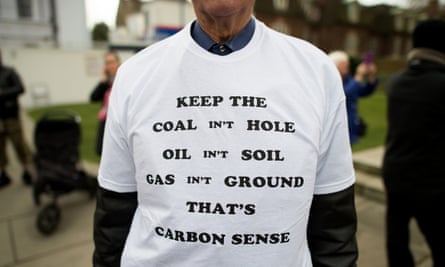
An activist outside the Houses of Parliament in London, 2015. Photograph: Leon Neal/AFP/Getty
The study shows that many of the worst offenders are investor-owned companies that are household names around the world and spend billions of pounds on lobbying governments and portraying themselves as environmentally responsible.
A study earlier this year found that the largest five stock-market-listed oil and gas companies spend nearly $200m each year lobbying to delay, control or block policies to tackle climate change.
Heede said the companies had a “significant moral, financial, and legal responsibility for the climate crisis, and a commensurate burden to help address the problem”.
He added: “Even though global consumers from individuals to corporations are the ultimate emitters of carbon dioxide, the Climate Accountability Institute focuses its work on the fossil fuel companies that, in our view, have their collective hand on the throttle and the tiller determining the rate of carbon emissions and the shift to non-carbon fuels.”
Explore more on these topics
- The polluters
- Climate crisis
- Fossil fuels
- Greenhouse gas emissions
- Oil and gas companies
- ExxonMobil
- Chevron
- news
---