boris johnson
net zero
tried to come back after truss fiasco
10 22
===
lONDON—However hard they try — and try they do — the British cannot beat Americans for dysfunctional, embarrassing, weird, indeed criminal, politics.
They haven’t witnessed anything like a former “adult film” star conjuring a picture of the 45th president in his underwear, telling her right before they had sex that she reminded him of his daughter, an encounter she describes as “brief.”
Maybe if Prince Andrew had been forced to listen to one of convicted pedophile Jeffrey Epstein’s teenagers discuss her, um, “date” with His Royal Highness in a public courtroom, it might come close to this cringe-making awkwardness.
But the prince settled out of court, so no points there.
Still, while Conservative Prime Minister Rishi Sunak can’t begin to compete with Donald Trump’s epic vulgarity, and members of Parliament insist on speaking in sentences complete with nouns and verbs — unlike many in Congress (looking at you, Marjorie Taylor “peachtree dish” Greene) who could use some English lessons — that doesn’t mean they aren’t giving it their all.
The sitting Tory government knows it’s likely to lose the next election bigly, so for some reason best known to themselves (or attributable to the subsidized booze in the House of Commons bar) they’ve decided to copy every stupid, crazy, hateful hairball of an idea puked up by our own Republicans.
You’re welcome, Britain.
Diversity initiatives in government? No mas.
No more networks for Muslim staff in the Civil Service. No more support of LGBTQ employees.
And no more attaching official IDs to “rainbow lanyards” or other displays of supposedly “woke” tendencies.
Studies show that most Britons support diversity and inclusion in the workplace, but who cares what the voters want?
Define a woman?
The sick and spiteful policies of Florida’s own mini-Mussolini have inspired the Conservatives to embrace a bunch of lousy schemes, such as a new education ruleforbidding schools to teach about where babies come from, contraception, consent, etc. to any kid under 9 — which apparently doesn’t happen anyway — and bans discussion of gender identity.
Don’t say “gay,” don’t say “sex,” and certainly don’t say “trans.”
Rishi Sunak, who likes to say “a man is a man and a woman is a woman,” wants it made clear to the Youth of the U.K. that being trans is bad.
He’s fond of accusing Labour leader Keir Starmer of being “unable to define a woman” (a favorite talking point among U.S. Republicans) and recently added to his image as a jerk of the first order by making a transphobic “joke”in the House of Commons.
He made said “joke” on the day the mother of Brianna Ghey, a 16 year-old trans girl murdered by two teenagers, was sitting in the Commons gallery.
Sunak refused to apologize.
Ronald Dion DeSantis would be proud.
Protests
USF campus police using tear gas on protestors on the USF campus in Tampa on April 30, 2024 (photo credit: Tampa Bay SDS)
Top Gov would not, however, be proud of how the British government is handling pro-Palestinian protests at universities.
Not once have the police been summoned to break up the encampments which have sprung up on the silky lawns of Oxford and in the hallowed halls of the London School of Economics.
The Tories would much prefer the approach of Columbia’s president, Minouche Shafik, who didn’t seem to mind how the cops treated her students and has categorically refused to divest from Israel.
Fun fact: Not only is the dual U.S.-U.K. citizen Shafik a distinguished economist, she was awarded a life peerage by Prime Minister Boris Johnson, he of the hair and the endless scandals.
Baroness Shafik sits in the House of Lords — when she’s not screwing up a major educational institution, that is.
In contrast to Columbia and other seats of learning across the country, many British universities are actually discussing divestment with student demonstrators.
Trinity, the richest college at the very rich Cambridge University, has agreed to give up its stock in arms companiesthat supply the Israeli military.
Gaza protests across the U.K. have been almost entirely peaceful, but that’s not stopping Rishi Sunak from scaremongering, summoning university headsand demanding they take “personal responsibility” for the safety of students, especially Jewish students, some of whom feel understandably uncomfortable about their classmates’ vehement opposition to Israeli policy.
Antisemitism
It’s undeniable there’s a fair amount of anti-semitism in the U.K. , some on the left, some on the right. “Free Palestine” has been spray-painted on buildings in London neighborhoods known to have a substantial Jewish population and Jewish kids verbally harassed.
Some Jewish students say the academic environment is hostile, making them feel vulnerable; others, such as Jews for Justice for Palestinians, have joined the protests.
A group of rabbis, lawyers, and other prominent British Jews have called for a ceasefire.
It’s not that Sunak really likes Israel; it’s more that he really dislikes universities, even though he has degrees from two of them (Oxford and Stanford).
Universities teach young people to question authority, especially the Conservative Party, and often encourage students to pursue what he has called “useless” degrees, the kind that don’t lead to high-paying jobs providing a good “return on investment” to society.
Sunak means degrees in subjects such as the arts and the humanities.
(He himself studied philosophy at Oxford).
Kind of reminds you of Top Gov (Yale and Harvard), doesn’t it?
Brown folks
Then there’s immigration: Ron DeSantis, Donald Trump, and the rest of their whole sick crew despise immigrants — unless they’re rich, conservative and, ideally, from Norway or some other white country.
Brown folks are not welcome.
Dislike of foreigners is also a core value of British Conservatives; they don’t like brown people, either.
They are, however, pretty ecumenical in their xenophobia: Brexit was fueled by pissed-off Britons wanting to throw those dang Poles, Italians, Germans, Filipinos, and other not-English types out of this green and pleasant land.
Never mind the fruit rotting on the vines for lack of farm laborers and the dire shortage of nurses and other health care workers.
I have to admit that on immigration policy, the Sunak government may have Florida and Texas beat.
You will recall Top Gov sent planes to collect asylum seekers from Texas and flew them off to Massachusetts to keep them out of Florida (makes zero sense, I know).
The Tories are more ambitious: They mean to catch the boatloads of desperate refugees when they arrive from France and dispatch them to Rwanda to be “processed.”
Yes, Rwanda, which the Tory government has declared “a safe country,” despite strong rulings to the contrary by the British High Court, and despite what the U.S. State Department calls “significant human rights issues,” i.e. targeting journalists, violence against LGBTQ people, and extra-judicial killings.
The British government has, to date, paid the Rwandan government £370 million pounds.
So far, they’ve flown exactly one guy there.
Slow start
Sunak allows that, sure, it’s a slow start, but it’s not his fault, it’s those human rights groups, high court judges, and flaming liberals in the House of Lords.
He boasts the government is poised to export pesky asylum seekers any day now: Commercial charters have been booked and planes are waiting on runways ready to take off.
Problem is, of the 5,700 refuges deemed “eligible” for removal, more than half of them have disappeared, blending into the general British population, probably working and contributing to the economy.
While the Sunak government has yet to go so far as to claim asylum seekers are rapists and murderers “poisoning the blood” of the nation, their xenophobic rants are nonetheless reminiscent of Trump’s.
Priti Patel, a former Tory cabinet minister, warned that immigration would destroy the U.K. from within.
MP Suella Braverman utters dire warnings about the cross-Channel “invasion.”
Braverman embraces the Great Replacement conspiracy theory, railing against threats to “the West” and dilution of “English culture” from too damn much diversity.
Racist snark
For months, Rishi Sunak seemed to like her racist snark, but then she went too far, accusing the London police of “playing favorites” and being too nice to pro-Palestinian demonstrators.
That was too much for a law-and-order suck-up like Sunak and he fired her.
Unrepentant, she is now the darling of fascist-adjacent groups such as Britain First.
(That name sounds kind of familiar … .)
More fun facts: Sunak, Patel, and Braverman are all the children of immigrants. Their parents came to Britain from Uganda, Mauritius, and Tanzania, children of immigrants from India themselves.
Apparently British Conservatives are so eaten up with prejudice and paranoia they wouldn’t recognize irony if it slapped them upside the head.
Barring some almighty intervention, Labour is going to beat them like a rented mule, and while the party of Keir Starmer isn’t going to bring about the New Jerusalem, they’re unlikely to spend their time in government tormenting the weak and the vulnerable.
They might even do some good.
Meanwhile, the Tories might want to stop taking their cues from Ron DeSantis and his master, the Beast of Mar-a-Lago.
As Rick Wilson, the smartest (ex) Republican in the U.S., reminds us, everything Trump touches dies.
Florida Phoenix is part of States Newsroom, a nonprofit news network supported by grants and a coalition of donors as a 501c(3) public charity. Florida Phoenix maintains editorial independence. Contact Editor Diane Rado for questions: info@floridaphoenix.com. Follow Florida Phoenix on Facebook and Twitter.
https://www.opendemocracy.net/en/dark-money-investigations/global-warming-policy-foundation-net-zero-watch-koch-brothers/
pix
Steve Baker MP, a trustee of the lobby group, has led the opposition to the government's net-zero policies
An influential Tory-linked lobby group leading the backlash against the UK government’s net-zero policy has received hundreds of thousands of dollars from an oil-rich foundation with huge investments in energy firms, openDemocracy can reveal.
The Global Warming Policy Foundation (GWPF), which also campaigns as Net Zero Watch, has also received more than half a million dollars through a fund linked to the controversial billionaire Koch brothers.
The GWPF has long refused to disclose its donors and claims it will from anyone with an interest in an energy company.
But tax documents filed with US authorities and uncovered by this website reveal the network of dark money behind it for the first time – including the $30m shares in 22 companies working in coal, oil and gas that are held by one of its donors.
shadow climate secretary Ed Milibandsaid: “US right-wing groups with links to big oil are desperate to stop action against the climate crisis. Now they are trying to extend their reach into UK political debate."
A registered UK charity, the GWPF is one of the most vocal groups in British politics opposing the government’s ‘net zero’ plans and has been at the forefront of recent calls to restart fracking.
The Tufton Street-based group’s trustees include former chancellor Nigel Lawson and Steve Baker, who leads the ‘Net Zero Scrutiny’ group of backbench Tory MPs and was recently criticised for sharing a paper by the group that denied the climate crisis.
Over four years the GWPF’s US arm, the American Friends of the GWPF, received more than $1.3m from US donors. At least $864,884 of this has been channelled to the UK group, with some being held back for expenses.
Of the £1.45m that the GWPF has received in charitable donations since 2017, at least 45% has come from the US.
American ideological groups are trying to interfere in British democracy
The Global Warming Policy Foundation’s US ‘friends’ group did not have to declare the sources of this so-called ‘dark money’ – but openDemocracy has discovered through the filings of other groups that:
- Between 2016 and 2020 the American Friends of the GWPF received $620,259 from the Donors Trust. Described as a “dark money ATM” for the US political Right, the secretive trust has given hundreds of millions of dollars to more than 100 groups working to cast doubt on the scientific consensus behind climate change.
- The Donors Trust has received millions from the Koch brothers, who inherited their father’s oil empire and spent hundreds of millions of dollars funding the climate denial movement before David Koch’s death in 2019. More recently, it received nearly $4.8m from America First Works, a non-profit closely tied to Donald Trump that contributed millions to his failed 2020 reelection bid as well as to campaigns to restrict mail voting. The GWPF told openDemocracy that the Donors Trust was simply a “middleman, matching donors to those seeking funding” and that it was “able to vet [donors with which it was matched] in line with our funding policy”.
- TheGWPF also received $210,525 in 2018 and 2020 from the Sarah Scaife Foundation – set up by the billionaire libertarian heir to an oil and banking dynasty. The US-based foundation has $30m worth of shares in 22 energy companies including $9m in Exxon and $5.7m in Chevron, according to its financial filings. It has bankrolled numerous conservative causes, including the right-wing Daily Caller news site and the Heritage Foundation think tank.
“It is disturbing that the Global Warming Policy Foundation is acting as a channel through which American ideological groups are trying to interfere in British democracy,” said Bob Ward, policy and communications director at the LSE Grantham Research Institute on Climate Change and the Environment.
Founded by Lawson and university lecturer Benny Peiser in 2009, the GWPF has long been accused of promoting climate denialism.
Last week, Peiser the unfounded claim that Putin has “colluded with the green movement in Europe and all over the world”.
The GWPF – which Greenpeace UK said has “spent the last twenty years campaigning to preserve our addiction to fossil fuels” – has become increasingly prominent in recent years.
The group was forced to set up a new non-charitable organisation for its political lobbying in 2014 after the Charity Commission found its stance on climate change breached charity rules.
Labour MP Graham Stringer sits on its board of trustees, while two of Global Warming Policy Foundation’s staff recently became advisers to Tory MP Craig Mackinlay. Another trustee, Terence Mourdant, is a long-standing Tory donor who gave £25,000 to Boris Johnson’s leadership campaign.
Steve Baker, who joined the GWPF last year and has called on Boris Johnson to resign over partygate, is a long time admirer of US libertarians. He has previously received expenses-paid trips to conferences organised by US conservative groups that have been accused of opposing environmental action.
‘Net Zero Watch’
In October last year, the UK government announced its strategy for reducing carbon emissions to net zero by 2050.
The same month, the GWPF’s campaigning arm – the similarly-named Global Warming Policy Forum – rebranded itself as Net Zero Watch, a name it continues to use alongside the original moniker.
In a statement announcing the change, Peiser claimed that in a “net zero future you will be poorer and colder” and “that a political backlash is long overdue” in response to the policy.
Net Zero Watch has repeatedly claimed that the cost of living crisis is the result of net-zero policies.In a report published in March, it said that renewable energy is responsible for the crisis and called for the government to reintroduce coal power plants and restart fracking.
Climate policy researchers said that the group is spreading “misinformation and propaganda” about net zero rather than providing analysis.
Net Zero Watch has found allies in Parliament among a group of 20 Tory MPs and Peers, who formed the Net Zero Scrutiny Group, a cadre of backbench Conservative MPs modelled on the European Research Group that has emerged as a staunch critic of Boris Johnson’s net-zero plans.
Net Zero Scrutiny Group members include former work and pensions secretary Esther McVey; Robert Halfon, a former schools minister; and Tory peer Peter Lilley, who is a former trustee of the GWPF.
Craig Mackinlay and Steve Baker, the MPs leading the group, are regularly quoted on press releases from Net Zero Watch and have repeated some of its lines on the economic cost of net zero word-for-word.
In February, Harry Wilkinson, currently head of policy at Net Zero Watch, and Ruth Lea, a former GWPF trustee, began working for Mackinlay as parliamentary advisers. Wilkinson has previously tweeted that “The ‘climate crisis’ is a religious belief, nothing to do with science.”
The GWPF shares its Tufton Street address with a number of anonymously funded think tanks who have become increasingly vocal in their opposition to climate change mitigation policies.
Earlier this year, Nigel Farage announced he was forming a new campaign for a referendum on net zero.
Farage’s financial backers include the private equity billionaire Jeremy Hosking who openDemocracy recently revealed has huge financial interests in fossil fuels.
The GWPF disputed that the Sarah Scaife Foundation has an interest in oil companies, telling openDemocracy: “The wealth that ultimately created the Scaife Foundation was created at the end of the nineteenth century and the start of the twentieth. It would be ludicrous to suggest that three generations on, it represents an oil company interest.”
Steve Baker MP said: "I understand the GWPF has already given a response to these allegations, which appear to be ridiculous.
It is an extraordinary fact that the same newspapers and commentators who would usually be the first to protest any kind of poverty are wasting the public's time with these attempts to distract from the real issues at hand. It would be better if the political world focused their attention on how our current energy strategy has driven up energy prices and contributed to the terrible cost-of-living crisis that so many are experiencing.”
https://www.alternet.org/2022/10/right-wing-zombie-populists-power/
After former U.K. Prime Minister Liz Truss announced her resignation, there was much talk in the British media about the Conservative Party making Boris Johnson prime minister again. It didn’t happen: the Tories ultimately went with 42-year-old Rishi Sunak, former chancellor of the Exchequer.Sunak took office on Tuesday, October 25.
Some journalists in the United States have put a positive spin on all the chaos at 10 Downing Street, arguing that the political downfalls of Johnson and later, Truss, show that at least the British right — chaos and all — still believes in democracy. According to that argument, the right-wing Tories who were shouting that Johnson had to go only to say the same thing about his successor Truss not long after that are quite a contrast to Republicans in the United States who are terrified to say one word against former President Donald Trump even after the violent January 6, 2021 insurrection.
For The Atlantic’s Yascha Mounk, however, one of the biggest takeaways of Truss’ political downfall is the fact that some Tories were even talking about putting Johnson in 10 Downing Street again — which, Mounk argues, shows how resilient a right-wing “zombie populist” can be despite scandals and a record of “failure.”
READ MORE: [Boris Johnson couldn’t escape accountability – unlike Donald Trump: journalists
“After the extended chaos of the Johnson years and the short-lived debacle of Liz Truss’ premiership, Sunak was virtually the last remaining Conservative of any public standing who could credibly promise a modicum of competence and stability,” Mounk explains in a think piece published by The Atlantic on October 26. “Harder to parse is why Johnson was in contention at all. How could Johnson have come so close to returning from the political wilderness less than four months after disgrace forced the announcement of his departure from office?”
Mounk continues, “The story of Johnson’s near resurrection, though remarkable, is less peculiar than it might seem. Charismatic populists have a knack for making unlikely comebacks, even if their own friends and allies have long given them up for dead. And irresponsible politicians can do very well when they have a good feel for the pulse of public opinion. For this type of demagogue, Johnson’s enduring appeal is the norm, not the exception.”
When Mounk describes Johnson as a right-wing populist, he isn’t calling the former British prime minister an authoritarian — which is how he views Trump and Hungarian Prime Minister Viktor Orbán. But he brings Johnson up to show the “staying power” that “populist leaders” can have.
“The plausible, if short-lived, prospect of Johnson’s return to Downing Street should be a warning sign of what is to come in other countries,” Mounk stresses. “For it illustrates three underlying truths about populist leaders that will continue to shape the politics of the United Kingdom and other democracies, including the United States, for years to come.”
Mounk continues, “First, populists have extraordinary staying power, showing virtual immunity from the sort of scandal, disgrace or failure that can finish a conventional politician’s career. Second, policy counts nearly as much as style:The degree to which a populist’s program is actually popular really matters. Third, because most of the politicians who are attacking democratic institutions at the moment come from the right, conservative parties have a crucial part to play in preserving democracy.”
Mounk adds, however, that the word populist “has never been a perfect fit for Johnson” even though it has often been used to describe him.
“While he has, at times, been willing to play dangerously fast and loose with democratic rules, he never attempted to concentrate power in his own hands or to impede its peaceful transfer,” Mounk argues. “A second term for Trump would presage a genuine democratic emergency; a return of Johnson would have been more likely to turn into a depressing farce.”
Mounk observes that “populists around the world” have “proved to have remarkable staying power, even after they were hounded from office in ignominy.”
“Italy’s Silvio Berlusconi left office in disgrace after being sentenced to a term in prison and ruining his country’s finances,” Mounk notes. “He later successfully appealed the criminal conviction. Now, he is a crucial partner in the country’s new government…. In the United States, Trump seemed to lose his hold over the Republican Party after the January 6 assault on the Capitol. Now, he appears poised to claim the party’s nomination for the 2024 presidential election. Orbán in Hungary, Jarosław Kaczyński in Poland, and the Marcos family in the Philippines have all shown similar durability.”
The ability of “zombie populists” to make a comeback, Mounk warns, “should worry American readers.”
“Like other populists who have left power under ignoble circumstances, Trump retains significant public support,” Mounk writes. “If he runs in 2024, he can count on the passionate supporters who make up a large portion of the Republican Party’s primary electorate. And unlike some right-wing parties, the GOP seems to have neither the will nor the capacity to stand up to its most radical members. Before Trump has even declared his candidacy, most senior members of his party are scared to criticize him.”
READ MORE: How bankrupt liberalism is empowering fascist movements in Europe and the US
https://www.desmog.com/2020/02/13/mapped-boris-johnson-s-government-and-tufton-street-lobbying-network/
https://www.alternet.org/2021/10/boris-johnson/
covid fail
guk media crit; 2 rw tabloids read by older ppl, infl TV; left get news online
The Conservative Party has received nearly £1.5 million of donations from polluting interests and funders of climate science denial in the past three months, DeSmog analysis shows.
The...
a bunch like this: including game-over libtard cf nial f
https://www.alternet.org/2020/04/the-failures-and-inadequacies-of-neoliberalism-are-now-on-stark-display/
no lnx
The failures and inadequacies of neoliberalism are now on stark display
Written by Subin Dennis / Independent Media Institute April 10, 2020
It is a sign of how bad things are when the editorial board of the Financial Times, the world’s leading business newspaper, carries an editorial calling for “radical reforms… reversing the prevailing policy direction of the last four decades.” The FT editorial of April 3 has advocated, among other things, a more active role for governments in the economy, ways to make labor markets less insecure, and wealth taxes. The FT’s editorial board, increasingly concerned about saving capitalism from itself, had written about the need for “state planning” and a “worker-led economy” last year in August. But the April 3 editorial has garnered much more attention since it comes amidst a massive crisis.
By now it has become obvious that substantial state intervention in the economy—frowned upon by the apostles of neoliberal economics—is back to the center stage across the world.
The situation is such that the public sector, long maligned by neoliberal economists and weakened by governments beholden to neoliberalism, is playing a major role in the fight against coronavirus. Its role would have been much more effective and wide-ranging if it hadn’t been hit hard by decades of fund cuts and waves of privatization. Nevertheless, with the ineffectiveness of private production with profit motive as its driving force to handle a crisis becoming more evident, the public sector, production with state direction, and some amount of planning are making a major comeback.
Public Health Care
The case of the sectors that are directly concerned with health care provision is the most conspicuous, with the inadequacies of private health care during a crisis becoming evident to even right-wing leaders.
We see Boris Johnson, the Prime Minister of the UK, repeatedly talking about the need to protect the National Health Service (Britain’s publicly funded health care system). He even said, “there really is such a thing as society,” contradicting Margaret Thatcher, his conservative predecessor who batted for pure individualism in 1987 by saying “There is no such thing as society.”
Britain and many other countries in Western Europe have had relatively robust public health care systems. In many of these countries, such as Italy, Spain and the UK, public health care systems have suffered in recent years because of fund cuts and privatization of public facilities. Apart from the policy vision of the leaders of these countries themselves, they also came under pressure from the technocrats of the European Commission, who repeatedly demanded spending cuts on health care. Along with the easy-going attitude displayed by many of the Western governments in the early weeks of the coronavirus outbreak, such weakening of the public health care systems have made their response to the coronavirus outbreak a more arduous task. For now, the governments of Spain and Ireland have temporarily taken over their private hospitals to deal with the crisis.
The case of the United States, with its private, insurance-based health care system, is far worse.Not only was a sufficient number of testing kits unavailable in the United States for months, but the costs of testing and treatment remain prohibitive for a large section of the population, particularly to the 30 million uninsured and 44 million underinsured. This means that many people simply wouldn’t be able to afford to get tested and treated, endangering the health and lives of themselves and others.
The difference between the United States on the one hand, and China and South Korea on the other, comes readily into the picture here. Testing and treatment for coronavirus is free in China, which was crucial in the country’s success in bringing the epidemic under control. South Korea has done extensive testing, which was made available for free. Treatment costs were covered by the government and the insurance companies.
The Importance of the Public Sector, However, Goes Much Further
In times of crises such as the present one, which is comparable to war, the ability of economies to produce (or at least source) and distribute things becomes critical. Two kinds of things assume particular importance:
Essential things that are necessary for the immediate sustenance of the people.These include food and medicines, and in turn, the things necessary to produce them. If there are large gaps in the supply and distribution of these things, there would be a famine. If the gap is smaller, there would still be many unnecessary deaths. Even leaders who are otherwise callous about starvation deaths would be concerned about such an eventuality during a crisis, because social tensions that could rise as a result of this would make it even more difficult to tide over the crisis, whether it is a war or a pandemic. During the Second World War, Britain resorted to rationing to solve this problem. The people of India were squeezed to finance the Allies’ war in South Asia with Japan, and the result was the Bengal Famine, which took the lives of 3 million people.
The kind of things that are necessary to tide over the crisis. During times of war, armaments would be the most crucial among these. In the case of the coronavirus crisis, the main things would be items like ventilators, masks, hand sanitizer, gloves and medicines to treat the symptoms. Large gaps in the supply of these things would be disastrous. In the case of a war, such gaps could lead to defeat in war. In the case of a lethal pandemic, people would die in huge numbers, as we see right now. We could say this is an industrial famine of sorts contributing to the casualties, with countries unable to make ICUs, ventilators and masks fast enough in adequate quantities, and in many cases, to set up hospitals and quarantine facilities quickly enough.
It is in this context that leaders of government who ideologically disagree with state intervention in the economy are seen taking direct action in commandeering private companies to produce necessary things.
Thus we see Donald Trump, who had initially resisted the pressure to use the Defense Production Act—a wartime law—to mobilize private industry, finally using the law to direct General Motors to produce ventilators.
The government of Italy directed its only producer of ventilators, Siare Engineering, to ramp up the production of ventilators for the country, and sent engineers and other staff members from the Ministry of Defense to help with production. The company canceled all its orders from abroad to produce for the country.
Countries with a large public sector, robust industrial capacity, and the ability to effectively intervene in the market would be at a considerable advantage here. That is the case with China, which put the state-owned China State Construction Engineering to work to construct two emergency quarantine hospitals at breath-taking speed. The state ensured the flow of products such as grain, meat and eggs into the Hubei province while it was under lockdown, and coordinated the production and distribution of masks and other medical products. Once the outbreak within the country was under control, it began supplying masks and ICU equipment to other countries in need.
India, a large country with a poor health care system, does not have enough masks and Personal Protective Equipment (PPE) for its health workers. The number of ICU beds and ventilators available in the country is very low. For a population of 1.34 billion, it only has 31,900 ICU beds available for COVID-19 patients, according to the country’s Health Ministry officials. To compare, Germany, with 82.8 million people, had 28,000 ICU beds as of mid-March.
If the number of COVID-19 patients in India surges, hospitals and their critical care facilities will be overwhelmed. The public sector Bharat Electronics Limited has been asked to produce 30,000 ventilators to meet the urgent need. Hindustan Lifecare (another public sector company) and the Rail Coach Factory under the Indian Railways are going to manufacture ventilators. The public sector Ordnance Factory Board (OFB), which the government has tried continuously to weaken in the recent years, is now producing masks, sanitizer and coveralls for Personal Protective Equipment (PPE). It has also developed a ventilator prototype and is preparing for production.
Within India, it is the state of Kerala that has dealt with the pandemic in the most effective manner. In the Left-ruled state, which has resisted the policy of privatization pushed by successive central governments, public sector companies are manufacturing hand sanitizer and gloves, and have raised the production of essential medicines.Kudumbashree, a massive government-backed organization of women’s collectives with 4.5 million members, is making masks, which the public sector is helping distribute. Mass organizations of youth and popular science activists are pitching in by making hand sanitizer. Volunteers supported by a state-led initiative have developed a respiratory apparatus that could free up ventilators.
It is not as if making masks, sanitizers and gloves requires advanced technology. But industrial capacity is needed to churn them out in large numbers, or at least large mass organizations, class organizations or collectives that can mobilize people to manufacture them. The inability of the United States to even ensure the supply of such items stands out in this regard. Four decades of neoliberalism seem to have led not only to the undermining of industrial capacity useful for public purposes, but also to the hollowing out of collective energies.
Need for Production Capabilities and Societal Control Over Them
In short, the lesson is that in times such as these, a society needs two things.
It needs production capabilities. During a time of crisis, if a country doesn’t have the necessary industrial capacity, it will be in trouble even if it has money to buy if the other countries that do have the production capabilities block the export of the required goods. This is what is happening right now to so many countries, such as Italy and Serbia. (In the mad scramble for resources, there have even been reports of countries offering higher amounts to buy masks ordered by other countries, and of some countries even seizing shipments for themselves.) Not only is industrial capacity needed, but some excess capacity is also required in some crucial areas. As the public health expert T. Sundararaman pointed out recently, the public health care system needs to have unused capacity, which will allow it to expand and take on the extra load when there is an emergency.
Excess industrial capacity in China, which is often seen as a problem (including by sympathetic observers), turned out to be useful, with the country being able to manufacture essential goods to not just meet its own demands, but also that of other countries.But relying on market forces doesn’t give any guarantee of industrial capacity being built up. The kind of production capabilities built without planning would be haphazard, and may not cover the needs of an emergency when it presents itself. India, which adopted a strategy of substantial economic planning during the first few decades after independence, only to abandon it in the recent decades, is witnessing this to its peril right now.
The society, or the state as the representative of society, needs to be able to control the production facilities.When a crisis hits a country with production capabilities in the private sector, the state can invoke emergency powers to bring them under control. But it would be a painful process, especially in countries where the private corporate sector is not used to submit to discipline. Given the enormous influence that the corporates have over the state itself, the state might try to prolong having to invoke such emergency powers, as was seen in the United States, and that could have disastrous consequences. India has the worst of all possible worlds—cronyism is rampant, industrialization has not taken off (whether it is because of cronyism or in spite of it need not detain us here), and the public sector has been undermined.Even when the state is trying to play a more active role, its efforts could be undermined by private firms acting in their own self-interest of maximizing profits. This was seen in the United States, where private companies were engaging in price gouging, by selling masks that are normally sold for 85 cents for $7, leading to the New York state governor to call upon the federal government to nationalize the acquisition of medical supplies. He said that the U.S. government should order factories to produce masks, gowns and ventilators; otherwise the situation would be impossible to manage. The state using private facilities can be costly as well, as was seen in Britain, where the National Health Service is paying 2.4 million pounds per day as rent to private hospitals for 8,000 beds.
Does calling for more domestic production capabilities that the state can control mean that every country should be left to fend for itself? Certainly not—every country cannot produce everything; smaller countries would find it particularly difficult. International trade would be needed for countries to procure things that they cannot produce for themselves. But as the developments of the recent months show, today’s trade regime has nothing to do with solidarity, and it provides no guarantee of countries being able to access goods during an emergency. This is no accident. Lack of solidarity is embedded in the way capitalism has developed, with the bulk of the world’s wealth concentrated in the hands of a few countries, and within countries, in the hands of the super-rich. This system has to be overhauled for a regime of solidarity to emerge. Production and its fruits becoming less concentrated in some regions of the world and in the hands of a minority would pave the way for power relations to be less unequal, which is a precondition for real solidarity among people and societies.
Along with socialized health care, an immediate stop to privatization, and a stronger, expanded public sector should become part of the transitional demands of the left as we search for an exit from the pandemic crisis.
Subin Dennis is an economist and a researcher at Tricontinental: Institute for Social Research. He was the Delhi State vice president of the Students’ Federation of India.
This article was produced by Globetrotter, a project of the Independent Media Institute.
==
220
after Boris Johnson's first cabinet reshuffle as Prime Mininster, it looks possible it could be the latter.
And that matters, because those running the show may not be coming from exactly the place that those who voted to 'take back control' might expect.
Many of the SPADs that now find themselves holding all sorts of strings came from a set of lobby groups based in and around offices in Westminster's Tufton Street. These groups have campaigned to roll-back or discard the UK's environmental regulations as the country seeks trade deals with the world's major polluters. Many of the groups are also tied to funders of climate science denial and take money from Big Oil.
Representative democracy that is not.
And what of the most important climate portfolio this year, the Presidency of the annual UN climate talks (known as 'COP26') set to be held in Glasgow in November?
Having sacked former Energy Minister Claire O'Neill for not having enough diplomatic experience for such an important job, Boris decided that actually the job isn't that big afterall and can be done part-time.
With that in mind, he gave the role to former International Development Secretary and new Business/Energy/Industrial Strategy Secretary Alok Sharma.
Sharma has taken mulitple donations from Ukranian energy tycoon and major Tory donor Alexander Temerko - the latest registered as recently as last month. He's also fan of airport expansion and has a patchy voting record on climate measures, meaning his appointment was subject to raised eyebrows in some climate campaigning quarters.
Sharma says he's "looking forward to a busy year ahead". He has nine months to not only get the show on the road, but get all the electic vehicles pointing in the right direction, ready to hurtle along the track. God speed.
Find out more about Alok Sharma: The minister with nine months to prepare UK for COP26
The final major change to the UK's crack environmental team saw Boris boot climate champion Theresa Villiers out of office early in the morning, to replace her with farmers' favourite George Eustice as Environment Secretary by afternoon.
Eustice is from a farming family and has been variously described as a "key ally, "good countryman", and "first-class" by landed gentry types keen on rural pursuits. He has rarely voted for pro-environment measures, however, causing more than a little outrcy in green quarters.
He also once took part in an antler throwing competition during a trip to Latvia. Mercifully, there is a video.
boris j cool w/ huawei? 5G
https://www.alternet.org/2020/01/it-looks-like-its-finally-curtains-for-the-donald-and-boris-show/
==
==
https://www.democracynow.org/2019/12/13/uk_election_boris_johnson_jeremy_corbyn
on DN corbyn loss, no brakes as in US Congress and constit, so monarch powers?! as problems are revealed, go for racist scapgoating
the British Conservative Party has won a decisive majority in Thursday’s general election, winning seats in Labour Party strongholds and paving the way for Britain’s exit from the European Union by January 31. Prime Minister Boris Johnson is projected to have 364 seats in the House of Commons compared to Labour’s 203 seats. That would give the Conservatives about a 75-seat majority, the largest since Margaret Thatcher’s landslide in the 1987 election. Johnson’s message throughout the campaign was focused on “getting Brexit done,” reflecting public exhaustion with the issue that has paralyzed British politics ever since the 2016 referendum. His win comes despite his long record of racist and anti-Muslim statements, as well as accusations of sexual harassment. Following the election, Labour Leader Jeremy Corbyn announced he will resign as party leader, though he will continue to sit as an MP. The Labour membership grew dramatically during Corbyn’s tenure, with the party adopting radical policies focused on ending austerity, reinvesting in the National Health Service and promoting social justice. We get response from George Monbiot, a columnist for The Guardian and author of “Out of the Wreckage: A New Politics for an Age of Crisis,” and Priya Gopal, university lecturer in the Faculty of English at the University of Cambridge and author of the new book “Insurgent Empire: Anticolonial Resistance and British Dissent"
omg
https://www.alternet.org/2019/12/after-a-big-win-for-boris-johnson-and-brexit-the-british-left-faces-the-darkness
no lnx
After a big win for Boris Johnson and Brexit, the British left faces the darkness
Written by Andrew O'Hehir / Salon December 13, 2019
British general elections have a tendency to deliver last-minute surprises, and the U.K.’s third in less than five years did not disappoint. Unfortunately for the Labour Party, the British left and the anti-Brexit forces, the surprise of 2019 appears to be a catastrophic wipeout.
Polls leading into Thursday’s election had suggested a tightening race that could end in a “hung parliament.” Lines — sorry, queues — at polling places were lengthy, and British social media buzzed with the possibility that left-wing Labour leader Jeremy Corbyn might win just enough seats to forge a coalition government with the Scottish National Party, ousting preening, Trump-flavored Prime Minister Boris Johnson and the Conservative Party and paving the way for a second Brexit referendum.
None of that will happen now. As Johnson told a cheering crowd at Conservative Party headquarters in London, the Tories had won a “stonking” victory, which will ensure that the U.K. leaves the European Union sooner rather than later, and will lock down the right’s hold on power in Britain for the next several years.
With most votes counted early on Friday morning, the BBC reports that the Tories will win an outright majority of roughly 364 seats in the 650-seat House of Commons, a gain of 47 from the indecisive 2017 election.
If possible, the news for Labour and Corbyn, its controversial leader, is even worse than that. While the Conservative vote share is only slightly higher than it was in 2017, Labour’s vote has declined by roughly 8 percent. After gaining 30 seats in 2017 for a total of 261 — its biggest electoral gain for 20 years — Labour stands to lose 57 or 58 seats this time around, potentially its worst overall election result since World War II.
There are several interesting footnotes to this election, including abig comeback by the Scottish National Party, who have won at least 48 seats, virtually wiping out both Labour and the Tories north of the border and reigniting the push for Scottish independence. The centrist Liberal Democrats, who had hoped to thrive by being the only party clearly against Brexit, remain irrelevant, with party leader Jo Swinson losing her seat to the SNP.
But for Labour and the overall British left, no sugarcoating is possible. This election is an unmitigated disaster.
As author and journalist David Kogan told me in a recent interview, the British left saw Corbyn’s unexpected victory in the Labour leadership campaign of 2015 as a historic opportunity to pursue systemic progressive change. That opportunity is gone now, and for years to come. Let’s take a moment to acknowledge that for many people in Britain and around the world, this is a crushing blow.
Whatever you make ofJeremy Corbyn, he is a person of great moral decency and unbending principle, who engaged and aroused a generation of young activists. For practical purposes his political career is now over: Late on Thursday, Corbyn said he intended to remain as leader for a period of “reflection,” although many in the party would clearly prefer he quit immediately. He certainly will not try to lead Labour into another election.
Exactly why did this election go so badly south for Labour, and what lessons does this debacle hold for Americans who yearn to defeat Donald Trump next November? It’s way too early to offer definitive answers to those questions — especially from thousands of miles away — but if you spent any time on political Twitter on Thursday evening, you know that plenty of people gave it a try.
The fairest answer is probably that damn near everything went wrong for Labour, and that outside observers will draw whatever lessons they like, mostly the ones that support whatever they already believe. Democratic “moderates” in the U.S. are already using the Corbyn catastrophe, for instance, to warn darkly that their own party must not take a chance on a leftist or progressive candidate like Bernie Sanders or Elizabeth Warren in 2020. Whatever the merits of that argument, it doesn’t have much to do with what just happened across the pond.
It’s perfectly true that Corbyn was the most prominent leftist leader of any major political party in any major Western democracy over the last several years, and that he pushed an unrepentant progressive agenda. But that agenda — expanding public services and ending the era of austerity — was widely popular in almost every detail, and was not the reason Labour lost this election so badly.
Corbyn himself, as a political personality, is another matter. Four years as party leader have exposed the fact that he was a lifelong activist with no management experience. He has alternately seemed too weak and too autocratic — and has also been subjected to relentless vilification by the pro-Tory press.Fairly or not, people in Britain who didn’t adore him had largely come to fear and dislike him. So far, it seems that many Labour candidates think Corbyn’s presence at the top of the party is the biggest reason they lost, but not necessarily because middle-ground voters perceived him as too radical.
It was hugely damaging that Corbyn refused to take a clear position on Brexit, the overarching political issue that dominated this election. To be fair, he didn’t have great options, and his promise to act as a “neutral referee” on Brexit reflected an awkward split within his party’s base.To oversimplify the equation slightly, traditional working-class Labour voters in the north of England tended to support Brexit, while affluent, cosmopolitan Labour voters in and around London overwhelmingly opposed it. Still, if the party’s leader had taken a clear position and stuck with it (as in fact he did in the 2017 campaign), the results might have been different.
Corbyn also appeared indecisive, or somewhat worse than that, when it came to Labour’s burgeoning anti-Semitism scandal, in which some Jewish Labour MPs or candidates were targeted for abuse by pro-Palestinian leftists. As David Kogan puts it, there was no evidence that Corbyn himself harbored hateful views, but also no evidence that he cared about the problem all that much or understood how badly it had damaged the party’s reputation.
There are no precise parallels to either of those things in American politics, although there are certainly echoes. To this point, allegations of anti-Semitism against Democratic members of Congress have done no lasting damage — largely because their source, one might say, is compromised. But Brexit, I suppose, is metaphorically similar to Donald Trump’s border wall, which is more or less the instrument he used to pry Ohio, Florida, Iowa, Michigan, Wisconsin and Pennsylvania away from the Democrats.
In both cases, we’re talking about a political party struggling to adapt to rapid change, so far without success. One analysis of the British election I encountered late on Tuesday night suggested that Labour might actually gain a few previous Tory seats in London, while losing many more longtime Labour seats in what was once the party’s working-class northern heartland. (This appears accurate so far.) That would be England’s version of the Big Sort, in which geography, educational level and generational identity — along with race, of course — become the dominant social dividing lines and political signifiers.
Jeremy Corbyn and the British left just experienced a painful illustration of this cultural and demographic shift in action, and of how it nourishes a politics of rage and resentment that can undermine and endanger democracy. Americans already know about this: You can feel certain you’re on the right side of history, and still end up, shocked and dismayed, on the wrong side of electoral arithmetic. The trick, of course, is to find a way to win without sacrificing your essential principles. Does anyone ever do that?
==
==
https://theintercept.com/2019/12/03/someone-please-ask-trump-boris-johnson-meddled-2016-calling-unfit-office/
==
desmog 12129
Ukrainian connection
Three members of Offshore Group Newcastle, a company that fabricates steel for oil platforms, have also been members of the Leader's Group. The company has donated almost £500,000 to the Conservative Party since 2012.
OGN is now in liquidation, but one of its former directors, Alexander Temerko, remains very politically active. He has given the Conservative Party and Tory MPs over £600,000 as an individual since 2012.
Ukrainian-born Temerko became a British citizen in 2011, describes himself as a “vocal champion of UK energy security and independence.” He is theformer deputy chairman of Russia’s Yukos Oil Company. He is currently director of AQUIND Limited, which is building an electricity interconnector between the UK and mainland Europe.
openDemocracy reports that Temerko is said to be particularly close to Boris Johnson, with the two men sometimes calling each other “Sasha”, the Russian diminutive for Alexander, which is Johnson’s real first name. Temerko was reportedly involved in an unsuccessful attempt led by members of a group of hardline Conservative MPs, the European Research Group, to remove Theresa May as leader in December 2018.
OGN directors David Edwards and Dennis Clarke were also members of the Leader's Group, but Edwards deceased in May 2017 and Clarke retired the same year.
The Conservative Party and all the donors named here have been contacted for comment.
==
https://www.desmog.co.uk/2019/11/19/election-2019-boris-johnson-conservative-party-climate-science-denial-funding
This election cycle has seen an unprecedented number of announcements from all parties on renewable energy, reforestation, and other items generally reserved for only the greenest on the political spectrum. So much so that some are calling this the ‘climate election’.
But elections are expensive things, and politicians rarely turn down a cheque. So if climate change really is going to be a vote decider, it makes sense to take a look at who is funding our politicians. In particular, where have those known to support climate science denial campaigns in the UK put their cash?
DeSmog has analysed donations registered on The Electoral Commission database and found that — by a very long distance — supporters of climate science denial have donated predominantly to the Conservative Party and Tory politicians.
94% of the cash from the 181 donations we uncovered went to the Conservatives — over £5 million in total. £245,657 of this went to Conservative MPs (some of whom have since stood down).
The next highest recipient was Vote Leave, with £325,000 of registered donations. The Liberal Democrats received one donation of £2,000 in 2011. Labour received no donations from these sources.
Here's more about the method used for this analysis, and here's the source data.
MPs
The incumbent that received the most donations was Uxbridge and South Ruislip MP and Prime Minister, Boris Johnson — receiving £32,000. West Suffolk MP and Health Secretary Matt Hancock received the same amount.
Johnson’s received multiple donations from Australian hedge fund manager, Michael Hintze, a funder of the UK’s principal climate science denial campaign group, the Global Warming Policy Foundation (GWPF). Hintze was also a major backer of Vote Leave in the run up to the Brexit referendum, donating £100,000.
Environmental campaigners criticised the Natural History Museum for accepting a £5 million donation from Hintze in 2014, subsequently naming one of its galleries after him.
Johnson also received a £25,000 donation from First Corporate Shipping (FCS), the trading name of Bristol Port, owned by GWPF-director Terence Mordaunt.
High-profile Johnson opponent, Jeremy Hunt, who came second in the Conservative leadership election in June 2019, also received £25,000 from FCS in May 2019. The Liberal Democrats received £2,000 from FCS in November 2011.
Johnson has also received donations from baby-bottle manufacturer and GWPF-donor Edward Atkin, who has given over £220,000 to the Conservative party since 2002. Atkins’ charitable foundation failed to donate to the GWPF in 2017 for the first time since 2012.
Hancock’s donations all came from currency manager Neil Record, another known GWPF funder and Chairman of the Global Warming Policy Forum — the group’s official campaign arm. Record is also Chairman of the UK-based libertarian think tank, the Institute of Economic Affairs (IEA), which has been instrumental in campaigning for a hard Brexit. The IEA keeps its funders secret, but a couple are known — including oil giant BP and British American Tobacco.
Two other MPs explicitly pushing for a hard Brexit have also been significant recipients of donations from supporters of climate science denial — former International Trade Secretary Liam Fox and former Brexit Secretary David Davis, receiving £20,439 and £7,000 respectively.
Both Fox, who has close ties to a trans-Atlantic network of lobby groups pushing for the UK to strip back environmental regulations as part of a hard Brexit, and Davis received two large donations from Hintze and his CQS hedge fund.
One of the GWPF’s newest directors and donors, Anglia Ruskin University chairman Jerome Booth, has mainly donated to Sutton Coldfield MP Andrew Mitchell — donating £30,000 since 2007.
The individual that received the most donations overall was the former MP for Tatton and Chancellor of the Exchequer, George Osbourne. His donations all came from Hintze and his group of CQS companies, who gave almost £39,000 in total. Former Prime Minister Theresa May also received a £1,200 donation from Hintze in September 2009.
The Conservative Party and none of the MPs responded to a request for comment.
GWPF associates
Other GWPF associates have also made significant political donations.
Viscount Matt Ridley, a hereditary peer with a coal mine on his Blagdon estate, who is an academic advisor to the GWPF, has given over £40,000 to the Northumberland Dining Club — a little-known political group that runs fundraising events for the Conservative Party. He also donated over £18,000 to Vote Leave.
GWPF trustee and Tory peer Baroness Nicholson has donated over £48,000 to the Conservative Party, and £10,000 to the Liberal Democrats (to which she switched allegiance from 1995 to 2016).
GWPF trustee Ruth Lea also gave £1,250 to the Conservative Party in 2009. Lea is closely associated with a number of lobby groups pushing to roll back environmental regulations through a hard Brexit, based out of offices in and around 55 Tufton Street, including the IEA, Taxpayers’ Alliance, and Centre for Policy Studies.
Method
DeSmog searched the Electoral Commission database for donations from all known donors to the UK’s principal climate science denial campaign group, the Global Warming Policy Foundation (GWPF), and the donors’ associated companies. We also searched for donations from all of the Foundation and Forum’s board members and members of its advisory council.
You can find a full list of names in the GWPF’s profile in DeSmog’s Disinformation Database.
==
https://www.desmog.co.uk/2019/09/18/populism-climate-science-denial-european-union
no lnx many grafs
How the Rise of Populism is Fuelling Climate Science Denial Across Europe
Read time: 10 mins
By Mat Hope • Wednesday, September 18, 2019 - 08:01
In Europe, populism points one way, climate science the other
By Mat Hope, DeSmog, and Eduardo Robaina, La Marea/Climática. Lee en español en Climática.
This story is part of Covering Climate Now, a global collaboration of more than 250 news outlets to strengthen coverage of the climate story.
In December 2015, European Commission President Jean-Claude Junker stood at a podium to hail the world’s first comprehensive agreement to take action on climate change, and told the world, “the Paris Agreement now reflects our ambition worldwide.” While the European Union’s leaders stand by that sentiment, a lot has changed since then.
The Union is facing a credibility crisis, threatened by Brexit and the rise of populism across the continent. Its leadership is facing calls to simultaneously increase its ambition to tackle climate change and cut the very regulations that would deliver reductions in globe-warming pollution.
Climate policy — a seemingly unlikely candidate for controversy back in 2015 — is suddenly at the heart of a European power struggle.
Boris Johnson’s Cabinet of Climate Science Deniers
The EU’s struggles are mirrored, somewhat ironically, in the UK. Boris Johnson used his first address as the UK’s new Prime Minister to tell parliament that his government would “place the climate change agenda at the absolute core of what we are doing.”
This came as something of a surprise, given Johnson’s previous statements on climate change.
In December 2015, following the signing of the landmark Paris Agreement, Johnson wrote a column for one of the UK’s top broadsheet newspapers, the Daily Telegraph, in which he said that mainstream climate science was “without foundation”. In the same column, he praised the work of notorious climate science denier Piers Corbyn (who happens to be the brother of the now leader-of-the-opposition, Jeremy Corbyn).
This general disdain for the idea that climate change is a problem was in evidence during Johnson’s time as Foreign Secretary, where he presided over a 60 percent cut in the UK’s “climate attaches”. And despite early words reaffirming his commitment to climate action, Johnson’s behavior as Prime Minister has been more in keeping with this latter version of himself.
On taking office, he quickly surrounded himself with key allies from his days leading the UK’s pro-Brexit campaign, both in his cabinet and his close staff. All the appointees are part of a network of trans-Atlantic thinktanks and campaign groups pushing for environmental deregulation post-Brexit, based in and around offices at the now notorious address of 55 Tufton Street.
Matthew Elliott — formerly Chief Executive of Vote Leave, founder of theTaxpayers’ Alliance, and husband of a former Koch brothers employee and current chief of Republicans Overseas UK — is reportedly advising Johnson’s newly appointed Chancellor of the Exchequer, Sajid Javid. One of Elliott’s former employees at the Taxpayers’ Alliance, Chloe Westley, is now working in the Prime Minister’s Office at Number 10. And several other staffers from the network are now advising cabinet members including Secretary of State for International Trade, Liz Truss.
Johnson’s prime ministerial campaign was also funded by two donors with close ties to the Global Warming Policy Foundation — the UK’s premier climate science denial campaign group, which is based in 55 Tufton Street — hedgefund manager Michael Hintze and Bristol Port owner Terence Mordaunt.
Johnson’s loyalty to this network is partly born from the necessity of keeping the electoral threat of Nigel Farage’s Brexit Party at bay. At the last European Union parliament election in May 2019, Farage’s new outfit emerged victorious, sending 29 MEPs to the European Parliament. Of those, the UK public elected 10 Brexit Party candidates who have denied or downplayed the climate crisis or who have well-publicised ties to climate science denial groups.
To counter that threat, the Prime Minister is now largely aping the populist party’s positions, including its antipathy towards climate action....
==
UN odd given cabinet?
...Angela Merkel, for example, has pledged a “$60 billion package of climate policies aimed at getting Germany back on track to meet its goal of reducing greenhouse gas emissions by 2030.” British Prime Minister Boris Johnson doubled foreign climate aid to $14.4 billion over the next five years.
Touching were developing nations and small island states that used their limited resources to plant trees to bolster coastlines and avoid coal as fuel.
A total of “77 countries—many in the industrialized world—committed to net zero carbon emissions by 2050. They were joined by 10 regions and more than 100 cities—including several of the world’s largest,” said UN Secretary-General Guterres in his closing remark...
https://www.desmog.co.uk/2019/08/27/how-dark-money-overseas-flows-boris-johnson-s-government
With Boris Johnson sauntering into Downing Street having recrafted his own script from guffawing jester to grave populist, swathes of right-wing lobbyists have stealthed their way from the fringes of Westminster to the heart of government.
We know this, because we've been watching this slow erosion of democracy for years. In the time since the Brexit referendum, we and others have sought to uncover the connections of those now in the cabinet – the money and friendly relationships behind the big changes taking place in Britain.
A cursory glance at how their multitudinous ties overlap reveals a network of dark money, shady think tanks and overseas influence that now runs right through Whitehall. Cohesive strategies or motivations are hard to pin down, but the one binding factor between them is a foreign-influenced deregulatory agenda frequently couched within the rhetoric of national freedom and liberty.
While the links between Brexit interests and big business are extensive, much of this money and influence seems to pour throughMatthew Elliott, the former Vote Leave chief exec who now finds himself holding the government's purse strings. The Elliott example illustrates how power often stretches far out of public view.
lil sus map]
Vote Leave in the cabinet
The most prominent of the incomers, thanks in part to his dramatisation by Benedict Cumberbatch earlier this year, is Johnson’s new chief of staff Dominic Cummings. His frequently-referenced libertarian ‘anarchic’ proclivities have gifted him a semi-mythic status as an enticing new Whitehall villain.
But perhaps more instructive in terms of understanding the path of this new government are those arrivals via thinktanks and pressure groups whose special interests lie in limiting the role of the same government they are now part of.
Desmog has detailed how several of the new Johnson cabinet are now being advised by ex-staff from what’s known as the Tufton Street network – a group of organisations linked through their use of the same building in Westminster, and ideologically aligned through their lobbying on behalf of business interests.
One notable member of the Tufton Street network is the Taxpayers’ Alliance, a low-tax, anti-regulation pressure group whose campaigning work has provided a training ground for many of those now in government.
The Taxpayer’s Alliance was founded in 2004 by Matthew Elliot, a man who was Cummings’ ex-boss on the Vote Leave campaign and has played a part in a slew of right-wing projects over the past decade, and who is now Sajid Javid’s advisor at the Treasury.
Elliott finds other ex-colleagues now in government too, including the Taxpayers' Alliance’s former campaign manager Chloe Westley who is now Digital Advisor at Number 10, alongside many others from Vote Leave.
Trump towering
Through another of Elliott’s affiliates, Shanker Singham, there are links to the same deregulatory agenda which has swept through the US since Donald Trump came to power in 2016.
An investigation last year by Unearthed, Greenpeace’s investigative unit, revealed how Singham, via the prominent right-wing think thank the Institute of Economic Affairs (IEA), was willing to offer US agribusiness lobbyists access to prominent British politicianswhilst also authoring research on their behalf. The IEA, it is distinctly unshocking to find, is funded by BP and the tobacco industry.
Start chipping away at the glossy paint and you find that much of the funding for these ‘independent reports’ on trade policy and campaigns for national sovereignty come from hedge funds, big business, and billionaire industrialists like the Koch brothers. Many of these same people are also infamous funders of climate science denial.
Lobbying, industry funding and dark money in politics are nothing new, but the dramatically-shifting terrain being offered by Brexit and a changing global order have opened up space for powerful foreign interests to make significant inroads in just a few years.
Fighting for more sovereignty is all very well, but you should know whose sovereignty it is you’re fighting for.
bit lost see clintel
https://www.desmog.co.uk/2019/09/06/climate-science-deniers-planning-coordinated-european-misinformation-campaign-leaked-documents-reveal
A coalition of climate science denial groups is gearing up for a European media blitz later this month, in an apparent bid to derail efforts to set an EU-wide “net zero” emissions target, documents obtained by DeSmog show.
Plans for a self-styled “European Declaration” include press conferences in Brussels, Rome and Oslo and a letter to be sent to leaders of EU and UN institutions, scheduled for mid-September.
The letter claims to have “400 independent Climate Scientists and Professionals” signed up so far.
Some notable signatories are part of a trans-Atlantic network of thinktanks pushing for environmental deregulation post-Brexit, and have a history of climate science denial. A number of former employees of thenetwork’s member organisations are now staffers in Boris Johnson’s cabinet Brulle, Professor of Sociology at Drexel University and an expert on climate science denial, told DeSmog the campaign looked like a panicked response to recent high-profile efforts to highlight the climate crisis:
“The rise of the Extinction Rebellion movement, and the immense popularity and influence of Greta Thunberg, are having a significant impact on media coverage of climate change and concern about this issue. I would suspect that the aim of the campaign is to blunt the impact of these climate advocacy efforts.”
“The talking points are stale and patently scientific nonsense. That isn't critical. The point would be to keep the ‘contested’ nature of climate change alive.”
Geoffrey Supran, a Research Associate at Harvard University who gave evidence to the European Parliament in March on oil giant ExxonMobil’s historic promotion of climate science denial, said he thought the move was an attempt to distract from the various upcoming efforts to increase action on climate change globally, such as the UN Climate Action Summit at the end of the month:
“These people are the rhetorical equivalent to the kid in the classroom screaming ‘Look at me! Look at me!’ They're desperate for attention.”
“As always, they presumably hope to muddy the waters of public and political discourse on the climate crisis. To feed the echo chamber of sympathetic right-wing media and blogs, and to prey on naive and unsuspecting journalists who may be tempted to exercise false balance in their climate coverage.”
Coordinated effort
The campaign is being spearheaded by a new Netherlands-based climate science denial group called the Climate Intelligence Foundation (CLINTEL), launched in April with funding from Niek Sandmann, a multimillionaire real estate developer.
The group’s co-founder Guus Berkhout, an engineering professor who began his career at Shell and set up the Delphi Consortium in the 1980s to develop new exploration methods for the oil and gas industry, told DeSmog that interest in the campaign had been “overwhelming”.
Berkhout said there were plans to hold press conferences in European capitals and that the effort was being “expanded to a World Climate Declaration”. He declined to offer further details or comment.
In addition to CLINTEL, the international organising group includes some well-known figures from the climate misinformation world, including:
- Professor Richard Lindzen, former Distinguished Senior Fellow at the Cato Institute (USA)
- Viv Forbes, Chairman of the Carbon Sense Coalition (Australia)
- Professor Fritz Vahrenholt, Speaker at the European Institute for Climate and Energy (Germany)
- Professor Jeffrey Foss, Contributor to the Frontier Centre for Public Policy (Canada)
- Jim O’Brien, Chair and Co-founder of the Irish Climate Science Forum (Ireland)
- Terence Dunleavy, Founding Chairman of the International Climate Science Coalition (New Zealand)
In an email seen by DeSmog, Berkhout explains that “signatures are being collected from persons who give a valuable contribution to the climate debate and are recognised as such”. He goes on to boast that there are “already a lot of great names on the list”.
Of the 400 signatories, only a handful have a background in climate science, with the majority being writers, engineers and geologists with no direct expertise in the field.
In addition to the Cato Institute's Richard Lindzen,the list features numerous figures from US-based libertarian groups, including Patrick Michaels of the Competitive Enterprise Institute, and Charles Battig and Willie Soon from the Heartland Institute, which provides a total of 12 signatures alone. All three organisations are members of the Atlas Network, a Koch-funded international umbrella body of free-market groups.
UK affiliates of the network include the Institute of Economic Affairs (IEA), the Adam Smith Institute (ASI) and the Taxpayers’ Alliance. A number of former employees of these groups are now working in Boris Johnson’s government.
Taxpayers’ Alliance founder Matthew Elliott is reportedly advising new Chancellor Sajid Javid, whose Conservative leadership campaign he ran, while former employee Chloe Westley has joined Boris Johnson’s Number 10 team. International Trade Secretary Liz Truss has appointed two special advisors from the IEA and ASI.
UK support
The UK’s principal climate science denial group, the Global Warming Policy Foundation(GWPF), founded by former Chancellor Nigel Lawson in the run-up to the 2009 Copenhagen climate summit, is also well-represented in the campaign.
At least four members of its Academic Advisory Council feature in the letter’s signatories, and other contributors to the GWPF have also backed the “declaration”.
One is Northumbria University Professor Valentina Zharkova, who gave a lecture to the group last year claiming that climate change is caused by natural solar cycles. A paper Zharkova co-authored in June on the same subject was criticised for containing “basic errors” and an investigation into how it came to be published was launched by the scientific journal that printed it.
CLINTEL also has close ties to the GWPF. Berkhout wrote an essay for the UK group last year insisting that climate change was purely a natural phenomenon. And in February, the GWPF published an article by its Dutch counterpart that said: “Yes, the Earth is warming up. But that is business as usual. Earth’s history tells us that climate change has always happened.”
The following month GWPF director Benny Peiser spoke at a gathering in Amsterdam where CLINTEL announced its upcoming launch.
At that event, Berkhout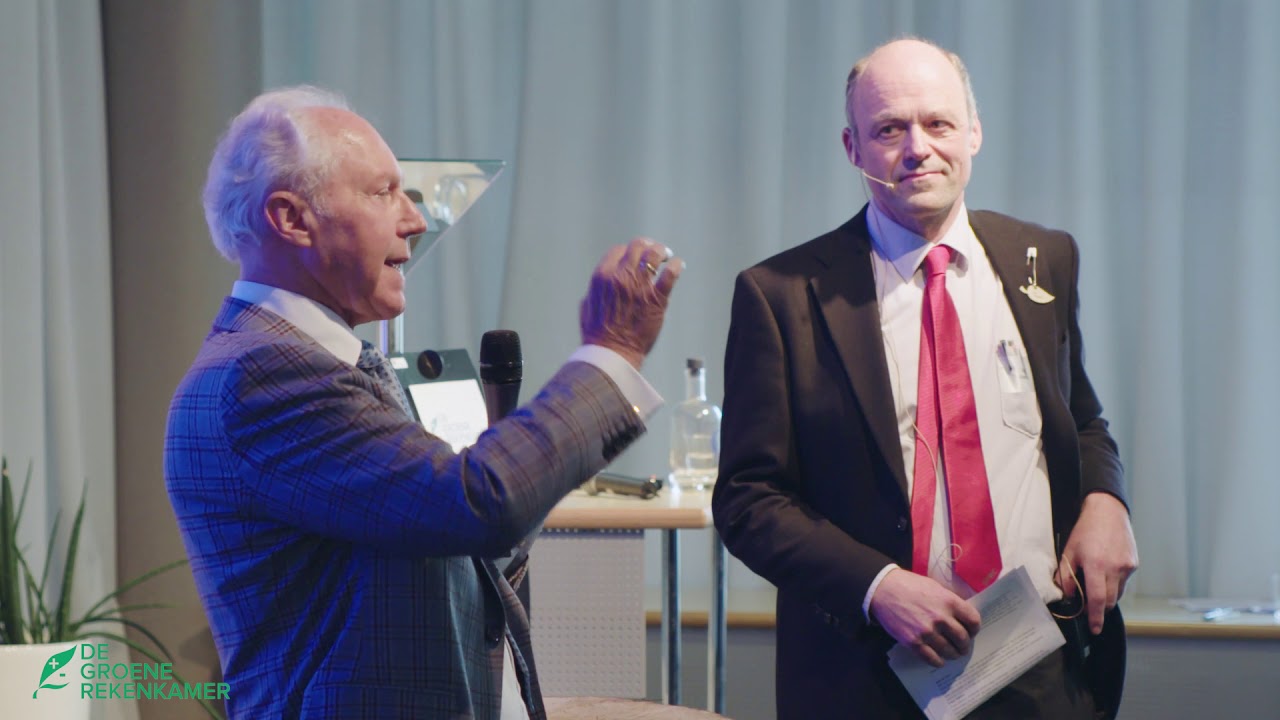 : “in this whole audience, apart from the organisation and a few brave ones, I don't see young people. So the first thing we are going to do is talk with the young people.” CLINTEL currently has a youth wing called “Young Clintel”.
The GWPF did not respond to a request for comment.
Other UK signatories include directors and former directors of lesser-known oil and gas companies, as well as five Fellows of the Geological Society, a professional body representing Earth scientists.
In addition to the EU “net zero” emissions target under consideration, planned “climate strike” protests and the upcoming UN Climate Action Summit, the media offensive may also, given its European focus, be timed to coincide with a crunch government meeting in Germany on how the country will meet its 2030 emissions target, set to take place on 20 September.
German signatories to the letter include a spokesperson for the European Institute for Climate and Energy (EIKE), which a Der Spiegel investigation earlier this year found had been working closely with the insurgent, far-right Alternative for Germany party to campaign against action on climate change.
https://theintercept.com/2019/09/04/boris-johnson-brexit-trump/
"Boris JOHNSON AND Donald Trump, brothers in chaos,” read a headline in the Los Angeles Times over the weekend.
Chaos, indeed. The two right-wing soul mates seem to be competing with one another to see who can do more damage to the political, economic, and social fabric of their respective countries. The American president and British prime minister have chaos in common, which, as I pointed out a year ago, is not a bug of their rule; it is a feature.
And so it continues. “On Tuesday, Parliament voted, 328 to 301, to seize control so it could debate a bill that would attempt to prevent the United Kingdom from leaving the European Union without a plan in place on October 31,” Vox explained. “The vote was greeted with cheers, and cries of ‘not a good start, Boris!’”
In the space of a few hours, the new British prime minister lost his first-ever vote in the House of Commons and his parliamentary majority too.
Like Trump, Johnson likes to make grandiose and populist pledges — but then fails to deliver on them. His demagoguery is perhaps matched only by his incompetence. Is it any wonder then that the comparisons between the U.K. premier and the U.S. president have come thick and fast — including, on occasion, from the two leaders themselves?
“I was in New York, and some photographers were trying to take a picture of me, and a girl walked down the pavement towards me, and she stopped and she said, ‘Gee, is that Trump?'” Johnson told a British TV interviewer in March 2016. At the time, the then-mayor of London didn’t welcome the comparison, saying that being mistaken for Trump was “one of the worst moments” for him and that he was “genuinely worried” about the prospect of a Trump presidency.
The British prime minister, though, has since become a loud cheerleader for the U.S. president, lauding his “many, many good qualities” and heaping praise on Trump’s economic record.
The narcissist-in-chief in the White House has, of course, returned the compliments, referring to Johnson as “Britain Trump” and describing him as “a really good man.”
Their bromance makes sense: The similarities between the two leaders really are striking — and I’m not just referring to their ridiculous blond hairstyles.
The Similarities
Where to begin? Both men came to power after demonizing immigrants. Trump called Mexicans “rapists” and promised to build a wall to keep them out of the United States; Johnson was one of the leaders of the pro-Brexit, anti-immigration “Vote Leave” campaign and repeatedly suggested that the U.K. would be flooded with millions of Turkish migrants if it remained a member of the European Union.
Both men are also card-carrying Islamophobes. Trump has his Muslim ban and a long history of anti-Islam rhetoric; Johnson once described “Islam as the problem” and compared veiled Muslim women to bank robbers, which led to a spike in Islamophobic hate crimes.
Both of them fail to command popular support.Trump obtained 3 million fewer votes than Hillary Clinton in November 2016; Johnson became prime minister in July after winning the support of only 0.13 percent of the U.K. population.
Related
Trump and Brexit Have Chaos in Common — A Symptom of Political Self-Harm
Both have cynically disregarded democratic norms. In February, Trump declared a bogus “emergency” at the southern border to try and fund the building of his border wall. Last month, Johnson announced that he would be suspending parliament for five weeks, starting September 9, to try and circumvent opposition from British lawmakers to a “no-deal” Brexit.
Both are notorious liars. Trump, according to the Washington Post fact-checkers, has told more than 10,000 untruths since coming to office less than three years ago; Johnson was fired from his job at the Times of London for falsifying quotes, while his former editor at the Daily Telegraph has referred to his “contempt for the truth.”
Both have a long and sordid history of infidelity.
Both are elitists masquerading as populists. Trump received $413 million from his father’s real estate empire and lived in a gold, three-story penthouse in Manhattan; Boris is a graduate of the upper-crust schools Eton and Oxford and, of course, a former member of the infamous Bullingdon Club.
The Big Difference
On Tuesday, though, one key difference emerged between the men: Johnson still faces resistance on the right. Conservative Member of Parliament Phillip Lee, for example, deprived the prime minister of his razor-thin majority when he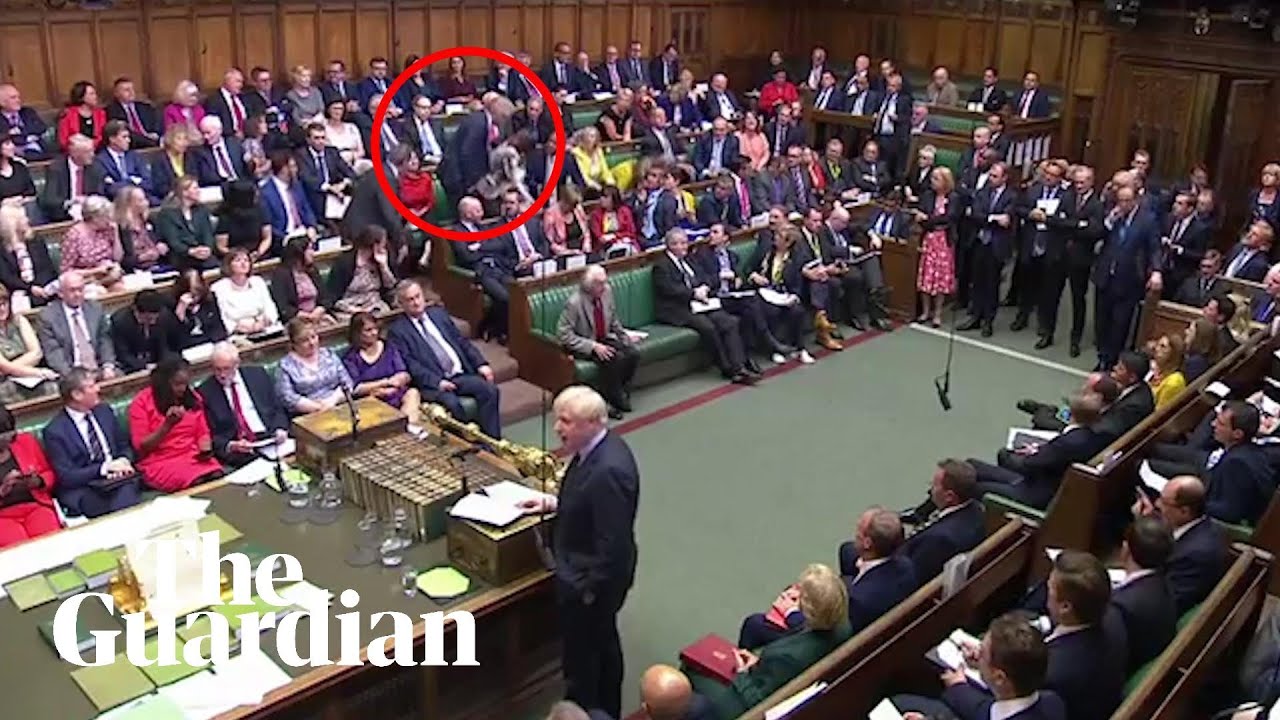 of the House of Commons and defected to the Liberal Democrats, the third party of British politics, while Johnson was mid-speech.Then, 21 Conservative MPs, including two former finance ministers and the grandson of Winston Churchill, voted with the opposition to wrest back control of the parliamentary agenda and try and delay Brexit, for which they were promptly expelled from the party. “This is not how any of us expected our careers in the Conservative Party to end,” said former Conservative minister Sam Gyimah, before adding that he was “proud” of his role in helping to halt a “damaging” no-deal Brexit.
Compare and contrast such behavior with that of the congressional Republican Party, which has been shamefully complicit in all of Trump’s open bigotry, dishonesty, corruption, and authoritarianism.
Take the U.S. Senate, where Trump’s former GOP opponents have either left the scene or rolled over. John McCain is dead; Bob Corker and Jeff Flake have retired; Mitt Romney likes to issue pained statements but little else; Ben Sasse long ago went quiet online; and Lindsay Graham and Rand Paul have morphed from Trump critics to Trump apologists. Ted Cruz, whose father and wife were smeared and mocked by Trump, now hosts rallies with the president and gushes over his “achievements on behalf of ordinary Americans” and — don’t laugh — “strong stand against North Korea.”
In the House, Rep. Justin Amash quit the party after becoming the sole Republican to call for the president’s impeachment, but the rest of his (former) GOP colleagues have stayed in the party — and stayed silent. Racist tweets about “the Squad”? See no evil. Crying kids separated from their parents at the border? Hear no evil. Condemning American Jews as “disloyal” and Latino immigrants as invaders? Speak no evil.
These are the spineless sycophants who have allowed a former reality TV star to hijack their Grand Old Party.
In the coming days and weeks, as the Brexit saga continues and a possible general election is held, Johnson could find himself out of a job (which would make him, incidentally, the shortest-serving prime minister in U.K. history). If he’s ousted, leading British Conservatives can justifiably take some credit for it.
As former Obama adviser Ben Rhodes tweeted Tuesday: “Conservative MPs in UK finally standing up to Boris sadly underscores how much conservatives in the US have been cowardly in the face of Trump.”
“Cowardly” might be an understatement. Quivering Republicans have turned the party of Lincoln into a cult of Trump. They are the president’s supine enablers — and history won’t be kind to them.
==
https://en.wikipedia.org/wiki/Boris_Johnson
Alexander Boris de Pfeffel Johnson (/:{ˈfɛfəl:(style="border-bottom:1px dotted"):}:/[5]; born 19 June 1964) is a British politician, serving as Prime Minister of the United Kingdom and Leader of the Conservative Party since July 2019. He has been Member of Parliament (MP) for Uxbridge and South Ruislip since 2015 and was previously MP for Henley from 2001 to 2008. He also served as Mayor of London from 2008 to 2016 and Foreign Secretary from 2016 to 2018. Johnson identifies as a one-nation conservative and has been associated with both economically and socially liberal policies.
Born in New York City to upper-middle class English parents, Johnson was educated at the European School, Brussels I, Ashdown House, and Eton College. He read Classics at Balliol College, Oxford, where he was elected President of the Oxford Union in 1986. He began his career in journalism at The Times but was dismissed for falsifying a quotation. He later became The Daily Telegraph's Brussels correspondent, with his articles exerting a strong influence on growing Eurosceptic sentiment among the British right wing. He was an assistant editor of the Telegraph from 1994 to 1999, and edited The Spectator from 1999 to 2005. He was elected MP for Henley in 2001, and served in the Shadow Cabinet under Conservative leaders Michael Howard and David Cameron. He largely adhered to the Conservatives' party line but adopted a more socially liberal stance on issues such as LGBT rights in parliamentary votes.
Selected as the Conservative candidate for the 2008 London mayoral election, Johnson defeated Labour incumbent Ken Livingstone and resigned from the British House of Commons. During his first term as Mayor of London, he banned alcohol consumption on much of the capital's public transport, and introduced the New Routemaster buses, cycle hire scheme, and Thames cable car. In 2012, he was re-elected, again defeating Livingstone. During his second term, he oversaw the 2012 Olympics. In 2015, he was elected MP for Uxbridge and South Ruislip, stepping down as Mayor the following year. In 2016, Johnson became a prominent figure in the successful Vote Leave campaign for Brexit as part of the United Kingdom's withdrawal from the European Union. He was subsequently appointed Secretary of State for Foreign and Commonwealth Affairs by Theresa May, but resigned in criticism of May's approach to Brexit and the Chequers Agreement two years later. In 2019, he was elected Conservative Leader and appointed Prime Minister.
Johnson is a controversial figure within British politics and journalism. Supporters have praised him as an entertaining, humorous, and popular figure, with an appeal stretching beyond traditional conservative voters. He has been criticised by figures on both the left and the right for using racist and homophobic language, as well as alleged elitism, cronyism, dishonesty, and laziness. Johnson is the subject of several biographies and a number of fictionalised portrayals.
- :{1:(style="display:table-cell;padding-left:0px;padding-right:0.5em"):}::{Early life, family and education:(style="display:table-cell"):}:
- :{2:(style="display:table-cell;padding-left:0px;padding-right:0.5em"):}::{Early career:(style="display:table-cell"):}:
- :{2.1:(style="display:table-cell;padding-left:0px;padding-right:0.5em"):}::{*The Times* and *The Daily Telegraph*: 1987–1994:(style="display:table-cell"):}:
- :{2.2:(style="display:table-cell;padding-left:0px;padding-right:0.5em"):}::{Political columnist: 1994–1999:(style="display:table-cell"):}:
- :{2.3:(style="display:table-cell;padding-left:0px;padding-right:0.5em"):}::{*The Spectator* and MP for Henley: 1999–2008:(style="display:table-cell"):}:
- :{3:(style="display:table-cell;padding-left:0px;padding-right:0.5em"):}::{Mayor of London:(style="display:table-cell"):}:
- :{3.1:(style="display:table-cell;padding-left:0px;padding-right:0.5em"):}::{Mayoral election: 2007–2008:(style="display:table-cell"):}:
- :{3.2:(style="display:table-cell;padding-left:0px;padding-right:0.5em"):}::{First term: 2008–2012:(style="display:table-cell"):}:
- :{3.2.1:(style="display:table-cell;padding-left:0px;padding-right:0.5em"):}::{Policies:(style="display:table-cell"):}:
- :{3.2.2:(style="display:table-cell;padding-left:0px;padding-right:0.5em"):}::{Relations with police, finance, and the media:(style="display:table-cell"):}:
- :{3.2.3:(style="display:table-cell;padding-left:0px;padding-right:0.5em"):}::{Re-election campaign:(style="display:table-cell"):}:
- :{3.3:(style="display:table-cell;padding-left:0px;padding-right:0.5em"):}::{Second term: 2012–2016:(style="display:table-cell"):}:
- :{4:(style="display:table-cell;padding-left:0px;padding-right:0.5em"):}::{Return to Parliament:(style="display:table-cell"):}:
- :{4.1:(style="display:table-cell;padding-left:0px;padding-right:0.5em"):}::{Brexit campaign: 2015–2016:(style="display:table-cell"):}:
- :{4.2:(style="display:table-cell;padding-left:0px;padding-right:0.5em"):}::{Foreign Secretary: 2016–2018:(style="display:table-cell"):}:
- :{4.3:(style="display:table-cell;padding-left:0px;padding-right:0.5em"):}::{Return to the backbenches: 2018–2019:(style="display:table-cell"):}:
- :{4.4:(style="display:table-cell;padding-left:0px;padding-right:0.5em"):}::{2019 leadership election:(style="display:table-cell"):}:
- :{5:(style="display:table-cell;padding-left:0px;padding-right:0.5em"):}::{Prime Minister of the United Kingdom:(style="display:table-cell"):}:
- :{5.1:(style="display:table-cell;padding-left:0px;padding-right:0.5em"):}::{Cabinet:(style="display:table-cell"):}:
- :{5.2:(style="display:table-cell;padding-left:0px;padding-right:0.5em"):}::{Spending plans:(style="display:table-cell"):}:
- :{5.3:(style="display:table-cell;padding-left:0px;padding-right:0.5em"):}::{Foreign policy:(style="display:table-cell"):}:
- :{6:(style="display:table-cell;padding-left:0px;padding-right:0.5em"):}::{Political views and ideology:(style="display:table-cell"):}:
- :{7:(style="display:table-cell;padding-left:0px;padding-right:0.5em"):}::{Public persona:(style="display:table-cell"):}:
- :{8:(style="display:table-cell;padding-left:0px;padding-right:0.5em"):}::{Personal life:(style="display:table-cell"):}:
- :{9:(style="display:table-cell;padding-left:0px;padding-right:0.5em"):}::{Reception and legacy:(style="display:table-cell"):}:
- :{10:(style="display:table-cell;padding-left:0px;padding-right:0.5em"):}::{Bibliography:(style="display:table-cell"):}:
- :{11:(style="display:table-cell;padding-left:0px;padding-right:0.5em"):}::{See also:(style="display:table-cell"):}:
- :{12:(style="display:table-cell;padding-left:0px;padding-right:0.5em"):}::{References:(style="display:table-cell"):}:
- :{13:(style="display:table-cell;padding-left:0px;padding-right:0.5em"):}::{Further reading:(style="display:table-cell"):}:
- :{14:(style="display:table-cell;padding-left:0px;padding-right:0.5em"):}::{External links:(style="display:table-cell"):}:
Early life, family and education
...
After Theresa May became leader of the Conservative Party and Prime Minister, she appointed Johnson Foreign Secretary in July 2016.[334] Analysts saw the appointment as a tactic to weaken Johnson politically: the new positions of "Brexit Secretary" and International Trade Secretary left the Foreign Secretary as a figurehead with few powers.[334][335] Johnson's appointment ensured that he would often be out of the country and unable to organise and mobilise backbenchers against her, while also forcing him to take responsibility for problems caused by withdrawing from the EU.[336][337] Johnson's appointment was criticised by some journalists and foreign politicians due to his history of controversial statements about other countries.[338][339][340] Former Prime Minister of Sweden Carl Bildt said: "I wish it was a joke".[341] A senior official in Obama's government suggested Johnson's appointment would push the US further towards Germanyat the expense of the Special Relationship with the UK.[342]
Johnson's visit to Turkey on 25-27 September 2016 was somewhat tense due to his having won Douglas Murray's poetry competition about the President of Turkey, Recep Tayyip Erdoğan, four months earlier.[343] When questioned by a journalist whether he would apologise for the poem, Johnson dismissed the matter as "trivia".[344] Johnson pledged to help Turkey join the EU and expressed support for Erdogan's government.[345] Johnson supported the Saudi Arabian-led intervention in Yemen and refused to block UK arms sales to Saudi Arabia,[346] stating there was no clear evidence of breaches of international humanitarian law by Saudi Arabia in the war in Yemen.[347] In September 2016, human rights groups accused him of blocking the UN inquiry into Saudi war crimes in Yemen.[348]Given the UK-Saudi alliance, in December, he attracted attention for commenting that the Saudis were akin to the Iranians in "puppeteering and playing proxy wars" throughout the Middle East.[349][350][351] May said his comments did not represent the government's view.[352]
In November 2016, Johnson told the Foreign Affairs Select Committee that Nazanin Zaghari-Ratcliffe—a British-Iranian dual citizen serving a five-year prison sentence in Iran after being arrested for training citizen journalists and bloggers in a BBC World Service Trust project—had been "simply teaching people journalism". Zaghari-Ratcliffe had said that her visit had been made simply for her daughter to meet her grandparents. Facing criticism, Johnson stated he had been misquoted and that nothing he said had justified Zaghari-Ratcliffe's sentence.[353][354] In May 2018, Johnson backed[355][356] the Iran nuclear deal framework despite Donald Trump's withdrawal.[357] Johnson said that the deal brought economic benefits to the Iranian people.[358] Johnson described the Gülen movement as a "cult" and supported Turkey's post-coup purges. He said that **Turkey'**s coup attempt"was deeply violent, deeply anti-democratic, deeply sinister and it was totally right that it was crushed."[359]
Foreign Ministers of the U.S., the U.K.,Saudi Arabia and the United Arab Emirates, before a working dinner focused on Yemen, 19 July 2016

In April 2017, Johnson said that Gibraltar's sovereignty was "not going to change" after Brexit.[360] Johnson promised while in Northern Ireland that Brexit would leave the Irish border "absolutely unchanged".[361] In May 2017, during the 2017 United Kingdom general election, he was criticised by a woman for discussing ending tariffs on Indian whisky in a Sikh temple in Bristol (alcohol use is prohibited in Sikhism). He later expressed regret that the protestor held differing views to his on alcohol.[362]
Johnson visited the islands of Anguilla, and Tortola (in the British Virgin Islands) on 13 September 2017 to confirm the United Kingdom's commitment to helping restore British territories devastated by Hurricane Irma.[363][364] He said he was reminded of photos of Hiroshima after it had been hit by the atom bomb.[365]
In September 2017, he was criticised for reciting lines from Rudyard Kipling's poem Mandalay while visiting a Myanmar temple; the British ambassador, who was with him, suggested it was "not appropriate".[366][367][368] In October 2017, he faced criticism for stating that the Libyan city of Sirte could become an economic success like Dubai: "all they have to do is clear the dead bodies away".[369][370] Johnson did not condemn the actions of the Spanish government and police during an outlawed Catalonia's independence referendum on 1 October 2017.[371]
Johnson met withMyanmar's de facto leader Aung San Suu Kyi in September 2016

Johnson has backed a more aggressive policy toward Russia.[372][373] Following the March 2018 Poisoning of Sergei and Yulia Skripal in Salisbury, an act which the UK government blamed on Russia,[374][375] Johnson compared Vladimir Putin's hosting of the World Cup in Russia to Adolf Hitler's hosting of the Olympic Games in Berlin in 1936.[376] Russia's Foreign Ministry denounced Johnson's "unacceptable and unworthy" parallel towards Russia, a "nation that lost millions of lives in fighting Nazism".[377] Johnson described the Nord Stream 2 gas pipeline from Russia to Germany as "divisive" and a "threat" that left Europe dependent on a "malign Russia" for its energy supplies.[378]
Johnson has condemned the persecution of the Rohingya Muslims in Myanmar.[379] He compared the Rohingya situation with the displacement of Palestinians in 1948.[380]Johnson supported the Turkish invasion of northern Syria aimed at ousting the Syrian Kurds from the enclave of Afrin.[381]
In a September 2017 op-ed, Johnson reiterated that the UK would regain control of £350m a week after Brexit, suggesting it go to the National Health Service (NHS).[382] He was subsequently criticised by cabinet colleagues for reviving the assertion, and was accused of "clear misuse of official statistics" by the chair of the UK Statistics Authority, Sir David Norgrove.[383][384] The authority rejected the suggestion that it was quibbling over newspaper headlines and not Johnson's actual words.[384] Following the 2017 general election, Johnson denied media reports that he intended to challenge May's leadership.[385] In a February 2018 letter to May, Johnson suggested that Northern Ireland may have to accept border controls after Brexit and that it would not seriously affect trade, having initially said a hard border would be unthinkable.[386]
Johnson said that US recognition of Jerusalem as capital of Israel is a "moment of opportunity" for peace.[392] In June 2018, Johnson accused the UNHRC of focusing disproportionately on the Israeli–Palestinian conflict and Israel's occupation of the Palestinian territories.[393]In March 2018, Johnson apologised for his "inadvertent sexism" after being criticised for calling Shadow Foreign Secretary Emily Thornberry as "Lady Nugee"; Thornberry was married to Christopher Nugee but did not use his surname.[387] In June, he was reported as having said "fuck business" when asked about corporate concerns regarding a 'hard' Brexit.[388][389][390][391]
Secret recordings obtained by BuzzFeed News in June 2018 revealed Johnson's dissatisfaction with the Prime Minister Theresa May's negotiating style, accusing her of being too collaborative with the European Union in Brexit negotiations. Comparing May's approach to that of the US President Donald Trump – who was at the time was engaged in a combative trade war with the EU due to its raising of tariffs on metal – Johnson said: "Imagine Trump doing Brexit. He'd go in bloody hard ... There'd be all sorts of breakdowns, all sorts of chaos. Everyone would think he'd gone mad. But actually you might get somewhere. It's a very, very good thought." He also called Phillip Hammond and the Treasury "the heart of Remain" and accused individuals of scaremongering over a Brexit "meltdown", saying "No panic. Pro bono publico, no bloody panic. It's going to be all right in the end."[394]
In July 2018, three days after the cabinet had its meeting at Chequers to agree a Brexit strategy,[395] Johnson, along with Brexit Secretary David Davis,[396] resigned his post.[397]
Return to the backbenches: 2018–2019
By resigning as Foreign Secretary, Johnson returned to the role of a backbench MP. In July, Johnson delivered a resignation speech, stating that ministers were "saying one thing to the EU about what we are really doing, and pretending another to the electorate". In it, he said that "it is not too late to save Brexit. We have time in these negotiations. We have changed tack once and we can change once again".[398] Buzzfeed reported that Johnson had been in contact with Steve Bannon, Donald Trump's former chief adviser. In interviews, Bannon had praised Johnson and said that he should challenge Theresa May for the party leadership.[399][400] In January 2019, Johnson came under criticism for remarks he had made during the 2016 Leave campaign regarding the prospect of Turkish accession to the European Union; he denied making such remarks.[401] In March 2019, Johnson said that expenditure on investigating historic allegations of child abuse, instead of more police on the streets, was money "spaffed up the wall".[402] The claim was strongly criticised by a victim, anti-abuse organisations, a police chief and Shadow police minister Louise Haigh.[403]
Journalism
In July 2018, Johnson signed a 12‑month contract to write articles for the Telegraph Media Group.[404] In August, the Advisory Committee on Business Appointments (ACoBA) reported that this employment was a breach of the Ministerial Code.[405][404] In December, Johnson was ordered to apologise to Parliament for failing to declare £50,000 of earnings. The Parliamentary Commissioner for Standards found that the errors were not inadvertent and that Johnson had failed on nine occasions to make declarations within the rules.[406]
In one of the first articles published by The Daily Telegraph Johnson discussed the Danish face veil ban, he arguing against any ban on the burqa or niqab but suggested that such garments make the wearer resemble a "letter box" and "bank robber".[407] The Muslim Council of Britain (MCM) accused Johnson of "pandering to the far right", while Conservative peer Baroness Warsi accused him of "dog whistle" politics.[408][409] Several senior Conservatives, including May, called on Johnson to apologise.[410][411] Others, such as MP Nadine Dorries, argued that his comments did not go far enough and that face veils should be banned.[412] A Sky Newspoll found 60% thought Johnson's comments were not racist, to 33% who did; 48% thought he should not apologise, while 45% thought he should.[413] An independent panel was set up to review Johnson's comments.[414] In December, the panel cleared him of wrongdoing, stating that while his language could be considered "provocative", he was "respectful and tolerant" and was fully entitled to use "satire" to make his point.[415] In September 2018, Johnson wrote: "We have opened ourselves to perpetual political blackmail. We have wrapped a suicide vest around the British constitution—and handed the detonator to Michel Barnier." Senior Tories heavily criticised him, with Alan Duncan of the Foreign Office vowing to ensure the comments marked "the political end of Boris Johnson".[416][417]
In April 2019, the Independent Press Standards Organisation ruled that a claim in a 6 January 2019 article in The Daily Telegraph, "The British people won't be scared into backing a woeful Brexit deal nobody voted for", authored by Johnson,[418] that a no-deal Brexit was "by some margin preferred by the British public" was false, and "represented a failure to take care over the accuracy of the article in breach of Clause 1 (i)" of its guidelines, and required that a correction to the false claim be published in the print edition, and appended to the online version.[419]
Alleged misconduct in public office
Marcus Ball, a private prosecutor, crowdfunded more than £200,000 from nearly 6,000 supporters to prosecute Johnson on three counts for the criminal offence of misconduct in public office.[420] Johnson was alleged to have abused the public's trust during the 2016 United Kingdom European Union membership referendum by lying about the UK's spending on European Union membership in his public offices as a Member of Parliament and as Mayor of London.[421] On 23 February 2019, the prosecution laid an information of the case at Westminster Magistrates' Court and filed an application for a summons against Johnson.[422] The case was thrown out by the High Court on 7 June.[423]
2019 leadership election
Main article: 2019 Conservative Party leadership election
After May's resignation on 7 June, Johnson formally launched his campaign five days later, saying, "After three years and two missed deadlines, we must leave the EU on October 31st. We must do better than the current Withdrawal Agreement that has been rejected three times by Parliament—and let me clear that I am not aiming for a no-deal outcome. I don't think that we will end up with any such thing. But it is only responsible to prepare vigorously and seriously for no deal. Indeed, it is astonishing that anyone could suggest dispensing with that vital tool of negotiation."[426] On the campaign trail, Johnson warned of "catastrophic consequences for voter trust in politics" if the government pushed the EU for further delays. He advocated removing the backstop from any Brexit deal and replacing it with alternative arrangements, and promised to retain the £39 billion divorce payment the UK is due to give the EU upon withdrawal "until greater clarity emerges". Johnson initially pledged to cut income tax barrier for earners of more than £50,000 by raising the 40% tax threshold to £80,000, but backed away from these plans after coming under assault in a televised BBC debate.[427] He has also said he plans to lift the level at which low paid workers start to pay National Insurance.[428]On 16 May 2019, Johnson confirmed that he would stand in the forthcoming leadership election following Theresa May's anticipated resignation.[424] In an interview in early June, just before visiting the UK, US President Donald Trump endorsed Johnson for the role, saying of the election: "I think Boris would do a very good job" of being Prime Minister.[425]
...
Foreign policy
Johnson said his government will be very "pro-China" in an interview with the Hong Kong broadcaster Phoenix TV. He voiced support for Chinese President Xi Jinping's infrastructure investment effort, the Belt and Road Initiative, and promised to keep the United Kingdom "the most open economy in Europe" for Chinese investment.[450]
Johnson supported the European Union–Mercosur Free Trade Agreement,[451] which would form one of the world's largest free trade areas.[452] The fear is that the deal could lead to more deforestation of the Amazon rainforest as it expands market access to Brazilian beef.[453]
Political views and ideology
Ideologically, Johnson has described himself as a "One-Nation Tory".[454][455] The political scientist Tony Travers of the London School of Economics described Johnson as "a fairly classic—that is, small-state—mildly eurosceptic Conservative" who like his contemporaries Cameron and Osborne also embraced "modern social liberalism".[456] The Guardian stated that while mayor, Johnson blended economic and social liberalism,[457]with The Economist claiming that in doing so Johnson "transcends his Tory identity" and adopts a more libertarian perspective.[458] Stuart Reid, Johnson's colleague at The Spectator, described the latter's views as being those of a "liberal libertarian".[459] Business Insider noted that as London Mayor, Johnson gained a reputation as "a liberal, centre-ground politician".[460] Johnson's biographer and friend Andrew Gimson said that while "in economic and social matters, [Johnson] is a genuine liberal", he retains a "Tory element" to his personality through his "love of existing institutions, and a recognition of the inevitability of hierarchy".[461]
[I am] free-market, tolerant, broadly libertarian (though perhaps not ultra-libertarian), inclined to see the merit of traditions, anti-regulation, pro-immigrant, pro-standing on your own two feet, pro-alcohol, pro-hunting, pro-motorist and ready to defend to the death the right of Glenn Hoddle to believe in reincarnation.
—Boris Johnson[139]
Stuart Wilks-Heeg, executive director of Democratic Audit, said that "Boris is politically nimble",[456] while biographer Sonia Purnell stated that Johnson regularly changed his opinion on political issues, commenting on what she perceived to be "an ideological emptiness beneath the staunch Tory exterior".[462] She later referred to his "opportunistic—some might say pragmatic—approach to politics".[463] In 2014, former Mayor Ken Livingstone stated in an interview with the New Statesmanthat, while he had once feared Johnson as "the most hardline right-wing ideologue since Thatcher", over the course of Johnson's mayoralty he had instead concluded that he was "a fairly lazy tosser who just wants to be there" while doing very little work.[464]
Writing for Prospect, Philip Collins suggested that Johnson and other Brexiteers in the Conservative Party were "British Gaullists" who were "drawing on a conception of the nation in which the dormant spirit of liberty is being reborn." He suggested that this was a form of nationalism, albeit not of the "chauvinistic" variety.[465] In Politico, Michael Hirsch compared Johnson to Trump, suggesting that both were advocates of a "New Nationalism".[466] Johnson responded that he is "not a nationalist if by that you mean I'm a xenophobe or someone who deprecates other countries and cultures".[467]
Purnell has noted that Johnson "is nothing if not an elitist".[468] In an article titled "Long Live Elitism", Johnson stated that "without elites and elitism man would still be in his caves".[469] However, since the Brexit campaign, he has criticised the "cynicism of the elite" about Brexit,[470] described an "elite conspiracy to thwart Brexit",[471] and accused the elite of being "frankly indifferent to the suffering that their policies are causing".[472] Some media sources have therefore called him a "populist".[473][474][475]
Immigration and the European Union
In 2003, Johnson said of the EU, "I am not by any means an ultra-Eurosceptic. In some ways, I am a bit of a fan of the European Union. If we did not have one, we would invent something like it."[478] From 2009 onwards, he advocated for a referendum on Britain's EU membership.[480][478][481] In 2018, during the Brexit negotiations, he called for Britain to leave the Single Market.[478] He stated that Britain's EU membership had led to the suppression of the wages of its "indigenous" people and said the EU was intent on creating a "superstate" that wants to rob Britain of its sovereignty.[478] In 2019, Johnson said he would take Britain out of the EU on 31 October whether there was a deal in place or not.[482]If the UK would leave under a "No Deal Brexit", it would leave the EU without a formal agreement and subsequently have to trade with the world (including EU member states) on World Trade Organization terms.[483][484] On 19 August 2019, Johnson wrote a letter to the EU and asked for the removal of "backstop" accord, which was signed by the previous Prime Minister Theresa May. However,the proposal was rejected by the President of the European Council, Donald Tusk.[485]Purnell believed that it was the influence of Johnson's maternal family, the left-wing Fawcetts, that led to him developing "a genuine abhorrence of racial discrimination".[476]Johnson praised the former Prime Minister Winston Churchill, saying that "Churchill saved this country and the whole of Europe from a barbaric fascist and racist tyranny and our debt to him is incalculable." He added that Churchill had "an extraordinary record as a social reformer who cared deeply for working people and their lives."[477] As Mayor of London, Johnson was known as a supporter of immigration.[478] In 2018, during the Brexit negotiations, he advocated for a more liberal approach to immigration than British Prime Minister Theresa May.[479]
...
==
https://www.alternet.org/2019/08/boris-johnson-tremendously-humiliated-donald-trump-on-a-global-scale-at-g-7-meeting-cnn-analyst/
no lnx
Boris Johnson ‘tremendously humiliated’ Donald Trump on a global scale at G-7 meeting: CNN analyst
Written by Sarah K. Burris / Raw Story August 26, 2019
United Kingdom Prime Minister Boris Johnson was one of President Donald Trump’s favorite people to take over for Theresa May when she resigned this summer. But Johnson also mocked the U.S. president and humiliated him on a global scale, said New York Magazine reporter Olivia Nuzzi.
During a panel discussion on CNN Sunday, CNN’s Ryan Lizza opened by saying that Johnson is in a tight spot as he’s trying to negotiate Brexit while serving as an international leader to the G-7. Johnson also needs to negotiate a trade deal with Trump, but he clearly is going about it in the worst possible way.
“Even when you see Boris, who is a laughing stock in many ways, kind of condescending to the president and saying, ‘Well, the U.S. economy is great,’ there seems to be a bit of a wink when he said that before, bringing in his criticism,” Nuzzi explained. “And I think that’s tremendously humiliating for the U.S. On a global stage like that.”
The host asked if it was a response to the increasing isolation the president is leading the U.S. into. At the same time, the G-7 threw a curveball to Trump by allowing Iran Foreign Affairs Minister Mohammad Javad Zarif to make a surprise appearance. The U.S. is going at it alone on climate change, Iran and Russia.
“I think it underscores that’s the effect of Donald Trump’s actions, right?” Nuzzi said. “He has said previously that he tried to make the ‘America First’ slogan sound less frightening by saying ‘America First does not mean America alone,’ but in practice, we’ve seen the U.S. Is really isolated from the global community.”
She also noted that it’s almost like the White House simply transferred it’s disastrous policy arm overseas this week. There is a running joke that every time Trump wants to cover something up or distract from huge news, he launches “Infrastructure Week.” Nuzzi said it’s almost like they’re having an “Infrastructure Week” overseas.
“I think his inexactitude is really causing a lot of problems,” she explained. “You know, in America, we know how to interpret Donald Trump. We know when he says things, it’s — it may sound like one thing in the moment, but it’s probably not the case. He’ll probably change it later on in the week or later on in the hour. We’re learning — seeing again, as we have in the past when he’s taken trips like this that when he says things in the exact way or ways that are confusing, it can have realtime effects and confuse the global community and impact the conversation away — that it doesn’t here domestically.”
Watch the full discussion below:
==
desmog
Is Boris Johnson's Cabinet the Most Anti-Climate Action Ever?
Boris Johnson conducted an extraordinary cull of government ministers on his first day as Prime Minister. His mission was mainly to bring in new, more pro-Leave blood to replace the supposed...
desmog 819
England recently experienced its most severe blackout in more than a decade, leading to a cacophony of calls from the usual suspects to scrap windfarms and abandon plans to turn the country’s electricity supply from brown to green.
The blackout was caused by two power plant outages last Friday – at the Little Barford gas-fired power plant and the Hornsea offshore wind farm. While National Grid was quick to explain that this was a “rare and unusual event”, the breakdown was used to push an anti-climate action agenda under the auspices of debate over energy policy.
==
619 guk
Bannon: ‘We went back and forth’ on the themes of Johnson’s big speech
The Observer
Boris Johnson
In a London hotel, the far-right activist told how he had exchanged texts with the former foreign secretary on his big resignation speech
Carole Cadwalladr
@carolecadwalla
Sat 22 Jun 2019 16.04 EDT Last modified on Sat 22 Jun 2019 16.25 EDT
Boris Johnson has denied having links to the US activist Steve Bannon.
On 16 July last year, days after his resignation as foreign secretary, the Daily Telegraph gave most of its front page to the man whose career it had done so much to nurture and promote: Boris Johnson. “He’s back,” roared the masthead. “Boris Johnson returns to his Telegraph column.”
It was a major coup for the paper. Johnson’s column – for which he was paid £275,000 a year – regularly made headlines and it had been missed during the year he had reluctantly given it up to be foreign secretary.
And now he was back. For the paper, it was already paying dividends. Beneath a photo of Johnson, the banner headline on the front page said: “It’s time to believe in our Great Britain.” And underneath, in smaller type: “Boris Johnson in rallying call for the nation to look to a brighter, post-Brexit future.”
In a hotel room in central London, someone was giving careful consideration to the text: the man who had guided Donald Trump’s path to power, Steve Bannon. He seemed to have no doubt: the headline, the framing of Johnson’s forthcoming resignation speech, the “rallying call”, these were the themes he said he and Johnson had “gone back and forth on text” about over the weekend.
He was “unequivocal” about it, says Alison Klayman, the film-maker who captured it while shooting her forthcoming documentary, The Brink.
There’s no doubt the video is terrible timing for Johnson. It’s not just that this link to Bannon, like so many things, is something he has denied. It was nothing more than “a lefty delusion”, he said last summer. And even up until last week, his team was keeping to the line that the contact was restricted to “one text – an invitation to meet that Johnson declined”.
2:59
Steve Bannon says he advised Boris Johnson on key Leave speech linked to leadership bid - video]
When told there was a video of Bannon talking about it, his advisers changed track. A spokesman told the Observer that the idea of him taking advice from Bannon was “preposterous to the point of conspiracy”. He conspicuously failed to repeat the previous denials about the pair being in touch, however.
But Johnson has been caught in lies before and shrugged them off. It’s why Bannon compares him to Trump. He has described him as “one of the most important persons on the world stage today” and drawn the obvious comparison: “Look at some of the scandals around Trump – the sexism and racism. Nothing sticks. You can’t lay a glove on him.”
But what’s new and potentially toxic for Johnson is what the apparent relationship with Bannon says about him. Johnson’s love life is once again dominating the news, but it’s his engagement with populist far-right politics and rhetoric that could and should worry other people more.
Why? Because Bannon is the man who laid the groundwork for Donald Trump’s victory. First as the executive chairman of Breitbart, the far-right website, and then as Trump’s campaign manager and chief strategist. A man who is open in admiration of both Mussolini and Stephen Yaxley-Lennon, aka Tommy Robinson, the former EDL leader whom he described as “the backbone of Britain” and who has been working with openly racist far-right leaders across Europe.
Tamsin Shaw, a professor of philosophy at New York University who has been researching Bannon’s world view, said: “He collaborated with publishers of neo-Nazi white nationalist websites to turn Breitbart into a platform for the alt-right. And his main initiative in the White House was the Muslim ban.”
Johnson did not welcome the reports last year that first suggested he and Bannon were close. When Matthew d’Ancona, a Guardian columnist who had succeeded him as editor of the Spectator, wrote an article headlined “Ignore Boris Johnson’s sex life. His flirtation with Steve Bannon is the real worry,” he was bombarded with calls from Johnson.
“I stopped counting at 15 – though the calls continued,” he revealed in an article for news website Tortoise this year. Johnson then resorted to texts. The reason: “Boris Johnson was furious with me for writing about his contact with Steve Bannon.”
...
...
Recipient | Total | Donors |
|---|---|---|
| Vote Leave | $146,000 | Michael Hintze |
| David Davis | $14,637 | Michael Hintze |
| Liam Fox | $13,303 | Michael Hintze |
| Boris Johnson | $7,213 | Michael Hintze |
| Theresa May | $1,752 | Michael Hintze |
| Conservative Party | $0 | Michael Hintze |
| Global Warming Policy Foundation | $0 | Michael Hintze |