edgelord technorati
5 23
SEE DISRUPTOR
SEE BROLIARCHY
fash-y? MACHO
// tech bro MUSK THIEL
DAVID SACKS
JDV?
NATCON
---
NERD REICH?
What Is Silicon Valley's 'Nerd Reich,' and Is It Taking Over the US Government? | KQED
Sixty percent of surveyed American adults said they had an unfavorable view of Elon Musk — the billionaire Tesla CEO, who has been intimately involved with the federal government for months through his leadership of the unofficial Department of Government Efficiency.
Since the inauguration of President Donald Trump, Musk’s DOGE has slashed large swaths of federal jobs and cut funding to programs as varied as the U.S. Agency for International Development to energy-saving initiatives for low-income families. And this March poll of 1,000 people by the Marquette Law School is just one indicator that some Americans are tired of wealthy tech figures being involved in the nation’s politics.
“We’re learning a big lesson here, which is that we can have democracy or we can have billionaires, but we can’t have both,” San Francisco journalist Gil Duran said.
KQED Forum’s Mina Kim spoke to Duran, who formerly worked for California politicians like Jerry Brown and Kamala Harris, about the “Silicon Valley tech billionaire politics” that are the focus of hisnewsletter, The Nerd Reich — and what he thinks tech elites might want next.
*This interview has been edited for brevity and clarity.
Before DOGE, there was RAGE
Gil Duran: Curtis Yarvin is a San Francisco software programmer who, in the early 2000s, started blogging under the name “Mencius Moldbug.” And in his blog posts — very internet troll stuff — he laid out these ideas for replacing democracy with tech-controlled dictatorships.
He specifically focused on San Francisco, which he said in his corporate tech dictatorship would be renamed “Frisk Corp.” In Frisk Corp, you would have to swipe in with RFIDchips and be under total surveillance, and give up all of your freedom in exchange for security.
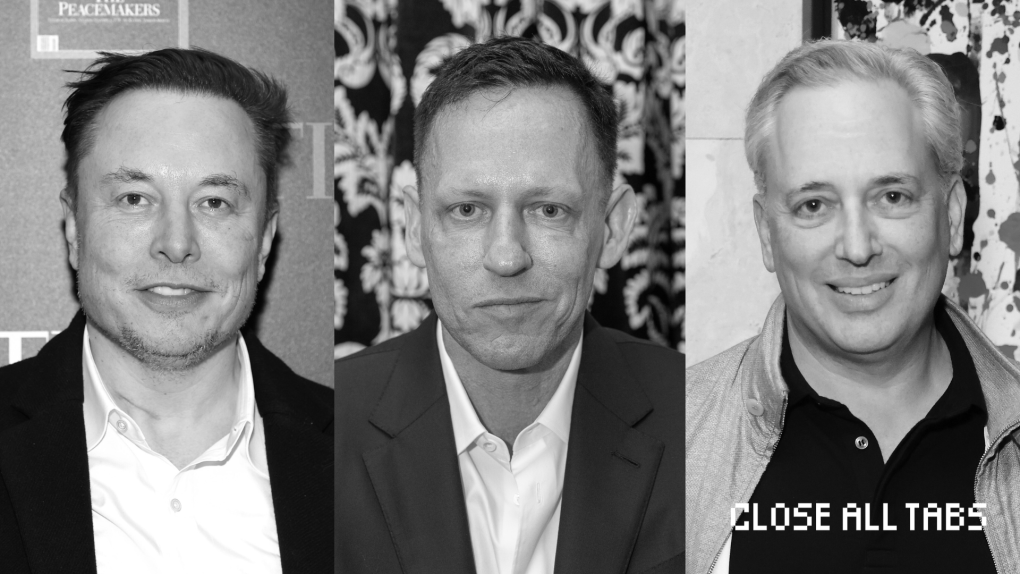
The Broligarchy Pt 1: Chronicles of the PayPal Mafia
The important thing to understand about Curtis Yarvin is that he became a favorite thinker of Peter Thiel, the PayPal Mafia billionairewho founded Palantir and got even richer off of government surveillance. Some people call him Peter Thiel’s house philosopher.
In 2012, [Yarvin] gave a speech in which he said that the government needed to be reformed with something he called RAGE — Retire All Government Employees. And that entailed taking over the federal government, purging the bureaucracy of anybody who’s a Democrat or who believes in democracy, and replacing all federal employees with people who would answer to a CEO-dictator-type of person. Very much mirroring what Elon Musk is doing with DOGE at this current time.
If it weren’t for these billionaires, [Yarvin would] be just an anonymous internet troll. The whole reason this has gone national is because of JD Vance. [And] to understand JD Vance, you have to understand that he is largely a creation of Peter Thiel. At every step of JD’s career, Peter Thiel has been there, funding him.
Mike Pence looks on as Donald Trump shakes the hand of Peter Thiel during a meeting with technology executives during the first Trump Administration. (Drew Angerer/Getty Images)
Predicting the ‘cognitive elite’
Yarvin is largely deriving his ideas from other places.
To really understand this, you have to go back to a 1997 book called The Sovereign Individual, which basically was one of these dark, apocalyptic-style books, and it predicted that in the 21st century, the information age would undermine the existing economy and existing nation-states. Thatthe Information Agewould kill lots of jobs and result in a lot of violence and chaos, and also lead to the rise of a so-called “cognitive elite”: people who are able to become wealthy off of technology and don’t need traditional jobs to survive.
It would be their mission to escape from existing countries using something called cyber currency — basically crypto, which would allow them to evade taxation and evade government authority, and create their own nations that they would rule over in this post-democracy order brought about by the information age.
These ideas sound crazy when you first hear them. They sounded very unhinged to me, and I didn’t pay attention to them at first.
However, you have to understand that these are very wealthy men with very strange and scary ideas. And they seriously believe in them.
[
The GOP vs. the ‘broligarchs’?
I think Trump has, for the most, part right now, been bought off. Trump’s in it for the money — and these guys have plenty of it.
He may not have the ideology, but as long as Elon and these guys are going to spend billions of dollars and create all of these business opportunities for his family, I think he’s all in.
There is a problem, though, because this is becoming very unpopular very quickly. The polls are diving. Elon Musk is becoming one of the most despised men in the country. He’s threatening Social Security. He’s firing veterans. You’ve got Republicans showing up to town halls to yell at their absentee representatives in early 2025.
This is a political disaster in many ways, so I think there will be some political tension between the Republican establishment and these “tech-broligarchs” — because they’re breaking all the rules of politics and don’t really seem to care about the future. And in politics, you’ve really got to care about the next election and the election after. That’s the name of the game.
Silicon Valley’s ‘right wing strain’
I compare it to: this tech authoritarianism is the parasite and MAGA is the host.
[Tech leaders] saw an opportunity, right? It’s a very opportunistic play — and an opportunity to go as far as they can with a candidate who has been able to openly violate the law, and not pay any political consequence for it.
How J.D. Vance Went from Never Trumper to MAGA Warrior
This is not an ideology where the world is a better place for the majority of people. It’s a place where the world is a place for tech billionaires. You don’t make the world a better place by getting rid of Social Security, which is crucial to the survival of millions of Americans.
Malcolm Harris’s [book]*Palo Alto* talks about the right-wing strain through Silicon Valley. There was this idea during the nineties and part of the eighties and 2000s that tech was kind of fun: was going to make our life cool, all these nice products, connecting us, allowing us to buy stuff online.
And for a long time, it seemed nonthreatening. Remember, Google had the “Don’t be evil” slogan and they were kind of paddling around in their Crocs, building playgrounds for their employees and bespoke lunches and free kombucha on tap. There was the harmless vibe that seemed to be from Silicon Valley.
But I think there has always been a certain anti-government lean to a lot of the Silicon Valley movement — this idea that “we’re going to create structures outside of government.” The idea of getting out of authoritarian society, evading bad governments in the future: there were times when these ideas seemed like something people on the left could be into.
However, what’s happened is: these guys became super rich. And as they’ve become super super superrich, they’ve gone far, far, far to the right — and they’re pulling others now with them.
‘Freedom cities’ and governance by tech
All the way back in 2013, [Balaji Srinivasan, chief technology officer of cryptocurrency exchange Coinbase] gave a speech at Y Combinatorin which he basically called for Silicon Valley to secede from the United States and to go start their own country and take all of their wealth and all of the brain power.
He continue[d] to develop these ideas over the next decade, and in 2022, released a book called The Network State — how to start a new country. This book lays out all the reasons why American democracy is an outdated system and why it needs to be replaced by new tech forms of governance. And there are two ways to do that: one is to leave the country by a territory and create your own sovereign state or city. You can do that within a country or by leaving a country. And the other way is to take over existing governments and convert them into tech-controlled governments.
This Tech-Backed Company Tried to Disrupt California’s Housing Crisis. It Couldn’t
My interest in this ideology started with SF politics — this effort by tech bros to take over City Hall, but also by the California Forever Project.
It wasn’t until I read a book by a historian named Quinn Slobodian called, Crack Up Capitalism: Market Radicals and the Dream of a World Without Democracy, that I understood the idea there … for wealthy people to find a way to exit society and create their own sort of utopian countries that they control.
In 2024, Trump had a plan for something he calls the so-called “freedom cities,” which are these 10 new charter cities that would be built on federal land all around the United States. The newspapers have mentioned that Trump plans to “build freedom cities,” but no one has explained what that means: where the idea comes from or why we need them.
I think the “freedom cities” are really anti-freedom cities — a very Orwellian name for what would essentially be a corporate-controlled city.
A billboard for California Forever sits on top of an apartment building along I-80 in Vallejo on April 2, 2024. (Beth LaBerge/KQED)
How does this all end?
A lot of people stayed home [and didn’t vote in the 2024 election.] And I think this is going to wake [Americans] up to the fact that you can’t stay home. We have to realize that there is a group of people who are avidly working against the public good and against the welfare and well-being of the majority.
I don’t think these [tech] guys have fully thought this out. I don’t think they realize — having been in politics myself — what it’s gonna feel like when you see that the majority of people are against you. I do think this ends with tens of millions of Americans taking to the streets on a regular basis to stand against what is an increasingly authoritarian regime in Washington. And I think that it also ends with a bunch of billionaires getting on planes to Moscow at midnight.
I think it’s important to understand it, to learn about it, and to tell others about it … Word of mouth is very important. People listen to their peers, to their friends, to their family members. That’s where a lot of people get their main political knowledge from.
---
---
AHA DOH MODERATION BUFFER
MUSK IS IRON MAN DIRTY HARRY MEL GIBSON LETHAL WEAPON ROGUE COP NOT BY THE BOOK BUT GETS RESULTS/JUSTICE EFFECTIVE VIA FORCE?
AN 2 25
According to the Washington Post, as many as 200,000 federal workers may be fired because of efforts by the Trump Administration and the Elon Musk-led Department of Government Efficiency (DOGE) to greatly downsize the United States' federal government. And the criticism of their efforts is coming not only from Democrats, but also, from voices on the right.
Former Rep. Charlie Dent (R-Pennsylvania), during a February 17 appearance on MSNBC, slammed Trump and DOGE for carrying out mass government layoffs in a "haphazard" way. And the next morning, MSNBC's Joe Scarborough (a Never Trump conservative and ex-GOP congressman) argued that while government "waste" needs to be reduced and the U.S. needs to balance its federal budget, the Trump Administration and DOGE are recklessly jeopardizing "food safety" and "air safety."
The Guardian's George Monbiot also fears that Trump's second term could trigger some type of major crisis.
READ MORE:George Conway: Trump’s 'pathological narcissism' is fueling 'full-scale' DOJ 'revolt'
In a February 18 opinion column, Monbiot lays out a variety of frightening scenarios and offers some tips for surviving a worst-case scenario.
"Though we might find it hard to imagine," Monbiot warns, "we cannot now rule it out: the possibility of systemic collapse in the United States. The degradation of federal government by Donald Trump and Elon Musk could trigger a series of converging and compounding crises, leading to social, financial and industrial failure…. A financial crisis in the U.S. would immediately become a global crisis."
Monbiot continues, "But the hazards extend much further. Musk, calling for a 'wholesale removal of regulations,' sends his child soldiers to attack government departments stabilizing the entire U.S. system. Regulations, though endlessly maligned by corporate and oligarchic propaganda, are all that protect us from multiple disasters. In its initial impacts, deregulation is class war, hitting the poorest and the middle classes at the behest of the rich. As the effects proliferate, it becomes an assault on everyone's wellbeing."
The columnist warns that undermining regulatory government agencies could make everything from a pandemic to "future climate disasters" worse.
READ MORE:'Brutal': Ex-federal prosecutor reveals why Trump DOJ’s 'illegal order' was 'so corrupt'
"As Trump rips down environmental protections and trashes federal responsiveness," Monbiot explains, "the impacts will spiral. They could include non-linear shocks to either the insurance sector or homeowners, escalating into U.S.-wide economic and social crisis. If, or when, another pandemic strikes, which could involve a pathogen more transmissible and even more deadly than COVID-19 — which has so far killed 1.2 million people in the U.S. — it will hit a nation whose defenses have been stood down."
Monbiot urges Americans — as well as residents of the U.K., where The Guardian is published — by doing a lot of networking.
"So, though there is no substitute for effective government, we must seek to create our own backup systems," the Guardian columnist advises. "Start with this principle: don't face your fears alone. Make friends, meet your neighbors, set up support networks, help those who are struggling. Since the dawn of humankind, those with robust social networks have been more resilient than those without. Yes, we also — and urgently — need national and global action, brokered by governments. But it's beginning to look as if no one has our backs. Prepare for the worst."
READ MORE:John Roberts is to blame for Trump challenge of federal courts: analysis
*George Monbiot's full Guardian column is available at this link.
---
===
an 125
Journalist/author Katherine Stewart is known for her in-depth reporting on the Religious Right, which she has been highly critical of over the years. The titles of her books — among them, "The Good News Club: The Christian Right's Stealth Assault on America's Children" and "The Power Worshippers: Inside the Dangerous Rise of Religious Nationalism" — underscore her view that far-right white evangelicals and Christian nationalists pose a major threat to religious freedom in the United States.
In her book, "Money, Lies, and God: Inside the Movement to Destroy American Democracy" — which has a February 18 release date on Amazon — Stewart warns that an alliance between Christian nationalists and billionaire oligarchs is pushing "an end to pluralistic democracy."
The Guardian's Adam Gabbatt examines the book in an article published on January 19.
Stewart, according to Gabbatt, warns, "Money is a huge part of the story, meaning that huge concentrations of wealth have destabilized the political system. Second, lies, or conscious disinformation, is a huge feature of this movement. And third, God, because the most important ideological framework for the largest part of this movement is Christian nationalism."
Gabbatt notes that although "billionaire oligarchs" and Christian nationalists "may not seem to have much in common," the "aim" of their "unholy alliance" is "the same: bringing an end to democracy in the U.S. as we know it."
According to Stewart, "The best label I can find for the phenomenon — and I do not pretend it is a fully satisfactory label — is 'reactionary nihilism.' It is reactionary in the sense that it expresses itself as mortal opposition to a perceived catastrophic change in the political order; it is nihilistic because its deepest premise is that the actual world is devoid of value, impervious to reason, and governable only through brutal acts of will."
Stewart adds, "It stands for a kind of unraveling of the American political mind — a madness that now afflicts one side of nearly every political debate."
Gabbatt points out, however, that Stewart, in her book, "insists the situation is not hopeless."
READ MORE:Biden preemptively pardons members of January 6 panel and other Trump targets
Stewart argues, "There's no feature as of yet in the American political system that would ensure that the MAGA movement is going to rule indefinitely. And frankly, I take heart from the fact that those of us who believe in democracy and its core principles probably represent a majority and not a minority of the population. I continue to believe more Americans support a democratic political system over some sort of cronyistic, kleptocratic and theocratic system that has authoritarian features."
---
===
Why would the world’s richest man be “f-----” if Trump loses?
Because under a Harris administration, Musk may be held accountable for his many abuses of power — for busting unions and mistreating workers, for using SpaceX and Starlink to monopolize America’s satellite and space infrastructure, and for using his social media platform to knowingly spread dangerous lies.
When I say “may be held accountable,” I don’t mean Musk would be punished for supporting Trump, as Trump has promised to punish his opponents. Instead, Musk’s many possible violations of the law, including some that are quite recent, may finally catch up with him under a Harris administration.
Musk’s daily million-dollar sweepstakes giveaways to people who have registered to vote in battleground states appear to be clear violations of campaign finance law, which makes it illegal to pay money to people to register to vote.
Campaign finance law also makes it illegal for superPACs to coordinate with candidates. As the person in charge of one of the largest superPACs supporting Trump, Musk’s frequent conversations with Trump would appear to run afoul of these provisions, as well.
In addition, Pennsylvania — the state where Musk began his million-dollar sweepstakes — prohibits illegal lotteries and deceiving consumers by not providing a complete set of contest rules including odds of winning and details on how winners are selected. The district attorney of Philadelphia filed a lawsuit Monday to halt Musk’s giveaway.
Musk may also be held accountable for conflicts of interest between his being in “regular contact” with Russian president Vladimir Putin, as reported byTheWall Street Journallast Friday, and his status as one of the most important national security contractors to the U.S. government through his SpaceX and Starlink enterprises.
The Journalreports that Musk’s regular discussions with Putin — confirmed by several current and former U.S., European, and Russian officials — have involved business and geopolitical tensions.
Musk’s SpaceX, which operates the Starlink satellite system, has a $1.8 billion contract with U.S. military and intelligence agencies. It’s the primary rocket launcher for NASA and the Pentagon. It launches vital national security satellites into orbit and is the company NASA relies on to transport astronauts to and from the International Space Station.
To effectuate these contracts, Musk says he has top-secret security clearance.
How can someone who runs two of America’s most important military and intelligence agencies, and who has top-secret security clearance, be secretly meeting with Putin?
At one point, Putin reportedly asked Musk to avoid activating his Starlink satellite internet service over Taiwan as a favor to Chinese leader Xi Jinping, according to two people briefed on the request.
NASA Administrator Bill Nelson said The Wall Street Journal’s report should prompt an investigation.
Musk's conversations with Putin would clearly violate Musk’s security clearance if he failed to properly report them to the U.S. government. If classified information was leaked, Musk could be required to give up control of SpaceX, which holds the majority of his companies’ government contracts.
Musk has also been in contact with other high-ranking Russian officials, according toTheWall Street Journal,including Sergei Kiriyenko, Putin’s first deputy chief of staff. Last month, the U.S. Justice Department accused Kiriyenko of creating some 30 internet domains to spread Russian disinformation, including on Musk’s X, where it was meant to erode support for Ukraine and manipulate American voters ahead of the presidential election.
If Musk has been a witting conduit for Russian election disinformation, he could lose control of X. He could even go to jail.
Musk’s and Russia’s interests have increasingly overlapped. Russian forces occupying the country’s eastern and southern swaths have started using Starlink to enable secure communications and extend the range of their drones. Russian troops also began using Starlink terminals, brought in through third countries, undermining one of Ukraine’s few battlefield advantages.
Earlier this year, Musk gave airtime to Putin and his views on the U.S. and Ukraine when X carried Tucker Carlson’s two-hour interview with Putin inside the Kremlin. In that interview, Putin said Musk was “a smart person” and “you need to find some common ground with him, you need to search for some ways to persuade him.”
But what may get Musk really “f-----” is his leading role in the emerging anti-democracy movement.
Since Musk was born in South Africa, he’s ineligible to become president of the United States. But that doesn’t seem to be stopping him. He’s planning to become CEO of the United States of America, Inc.
The anti-democracy movement includes Musk, along with Peter Thiel (the self-styled libertarian who once wrote: “I no longer believe that freedom and democracy are compatible” and who invested $15 million in JD Vance’s bid for the Senate), JD Vance, Blake Masters (in whose Senate bid Thiel invested $10 million), tech entrepreneur David Sacks, and blogger Curtis Yarvin.
Yarvin, who comes as close as anyone to being the intellectual godfather of the anti-democracy movement, has written that real political power in the United States is held by a liberal amalgam of universities and the mainstream press, whose commitment to equality and justice is eroding the social order.
Yarvin believes democratic governments should be replaced with sovereign joint-stock corporations whose major “shareholders” select an executive with total power, who serves at their pleasure. Yarvin refers to the city-state of Singapore as an example of a successful authoritarian regime.
How to achieve Yarvin’s vision? The first step, as Vance offered in a 2021 podcast, is to replace “every single midlevel bureaucrat, every civil servant in the administrative state … with our people.”
The second step? We can only guess, but Trump has offered Musk a position in his administration to head up “government efficiency.”
In early October, Musk registered with the Texas secretary of state’s office a new corporation called United States of America, Inc.
If Trump becomes president, will Musk’s United States of America, Inc. replace the administrative state?
Robert Reich is a professor of public policy at Berkeley and former secretary of labor. His writings can be found at*
https://robertreich.substack.com/
===
7 24
republicans-think-elon-musk-is-total-flake-report
Elon Musk recently came out with a public endorsement of Donald Trump for president, but Republicans haven’t fully embraced him, according to a report from *The New York Times*.
The tech billionaire CEO of Twitter, Tesla, and SpaceX has been highly sought after by GOP fundraisers and Trump associates for years, who see him both as a meal ticket and a potential inspiration for the party. But Musk doesn’t have a solid record for political involvement.
For example, he has promised to spend money on “free speech” lawsuits to support conservatives who claim that they are the victims of social media censorship but hasn’t followed through. Musk has also been a no-show at public appearances, such as a 2023 event to support Kevin McCarthy, then the newly elected speaker of the House. In San Francisco, he promised to donate $100,000 to the centrist group GrowSF to defeat progressives, but again didn’t follow through.
“Some conservative activists said they wished that Mr. Musk had followed through more on promises,” the Times reported.
Musk’s public endorsement of Trump only came after a gunman tried to assassinate the former president and convicted felon on Saturday. Previously, the tech magnate, while privately urging friends not to vote for Biden, was waiting until the president had secured the Democratic nomination, according to the Times.
Musk’s confidants in the tech world, such as Joe Lonsdale, a co-founder of data analytics firm Palantir, reportedly discuss politics with him and have urged him to play a more active role. Lonsdale founded AmericaPAC to help Trump return to the White House, with Musk reportedly pledging a monthly donation of $45 million, according to *The Wall Street Journal*. Musk denied the report, leaving those involved with the PAC to wonder how much he plans to donate, or if he will at all.
Alongside fellow tech CEOs Peter Thiel and David Sacks, Musk is a member of the “PayPal mafia,” the group of early supporters and founders of the payment service. All three have embraced conservative ideas and supported J.D. Vance as Trump’s running mate, with Musk and Sacks openly lobbying Trump on behalf of the Ohio senator. If Trump wins in November, the trio will have an administration friendly to their whims and those of Silicon Valley’s right wing.
Unfortunately More on Elon:
Why Elon Musk and Jeff Bezos Want Women to Stay Barefoot and Pregnant
---
edgelord is a pretentious poseur on the Internet who tries to impress or shock by posting edgy opinions such as nihilism or extremist views. The term is a portmanteau derived from "edgy" and "shitlord" - a person who "basks in the bitterness and misery of others".
---
poster on an Internet forum, (particularly 4chan) who expresses opinions which are either strongly nihilistic, ("life has no meaning," or Tyler Durden's special snowflake speech from the film Fight Club being probably the two main examples) or contain references to Hitler, Nazism, fascism, or other taboo topics which are deliberately intended to shock or offend readers.
The term "edgelord," is a noun, which came from the previous adjective, "edgy," which described the above behaviour.
Nietzsche was an edgelord before it was cool.
6 23 judd ymail
every year, vaccines save millions of lives. Polio, which used to cripple and kill thousands of children in the United States, has been eliminated thanks to widespread vaccination. Diphtheria, which used to be the most common cause of childhood death in the United States, isexceedingly rare. Other serious illnesses, including measles, whooping cough, and tetanus, are no longer a pervasive threat. Overall there are more than 25 vaccines that can safely "prevent diseases, protect health throughout the lifespan, and help to prevent and mitigate outbreaks."
But Robert F. Kennedy Jr. has spent the last two decades of his professional life using discredited, manipulated, and cherry-picked evidence to argue that life-saving vaccines are dangerous. Now Kennedy, part of the most famous family in American politics, is running for president.
Kennedy's candidacy — and anti-vaccine propaganda — has attracted vocal support from a small but influential group of very wealthy people. Their support may not make Kennedy's longshot bid for the Democratic presidential nomination viable. But it could help legitimize Kennedy's lies about the safety and efficacy of vaccines. And the consequences could be lethal.
Last Thursday, Joe Rogan, the popular podcaster who inked an exclusive deal with Spotify for $200 million, hosted Kennedy for a three-hour conversation. Kennedy told Rogan's more than10 million listeners that "vaccines are unavoidably unsafe." Rogan, a comedian and former host of Fear Factor, spent the entire episode validating Kennedy's views. Kennedy was presented as a brave truth-teller, standing up to powerful forces. Anyone who doesn't accept Kennedy's conspiracy theories, according to Rogan, is unable to think for themselves.
Kennedy spent the better part of an hour rehashing an article he wrote in 2005, which falsely claimed that childhood vaccines are linked to autism. The article was so flawed it was ultimately retracted by the outlet that published it, Salon. "[C]ontinued revelations of the flaws and even fraud tainting the science behind the connection make taking down the story the right thing to do," Salon's editor wrote.
In the piece, Kennedy relied extensively on the work of Mark Geier, a doctor whose license to practice medicine was revoked by Maryland in 2011. Geier pushed the vaccine-autism link as a frequent expert witness.He also misrepresented his credentials and developed "a 'protocol' for treating autism that involved injecting children with the drug that is used to chemically castrate sex offenders at a cost of upwards of $70,000 per year."
More broadly, Kennedy alleged a massive, multi-decade coverup by governments, non-profits, and private industry to hide the dangers of "thimerosal, a mercury-based preservative" used in some vaccines. Kennedy quotes Mark Blaxill, a vehement opponent of vaccines, who claims that the harm done by vaccines is "bigger than asbestos, bigger than tobacco, bigger than anything you’ve ever seen."
Kennedy's "proof" was the Simpsonwood conference, a gathering of experts to discuss the possible links between thimerosal in vaccines and autism. Kennedy "relied on the 286-page transcript of the Simpsonwood meeting to corroborate his allegations—and wherever the transcript diverged from the story he wanted to tell, he simply cut and pasted until things came out right."
For example, Kennedy quoted developmental biologist and pediatrician Robert Brent as saying: "We are in a bad position from the standpoint of defending any lawsuits… This will be a resource to our very busy plaintiff attorneys in this country.” The implication is Brent was acknowledging the link between thimerosal and autism, and explaining why it should be covered up. But Brent actually said he was concerned that "junk scientist[s]" would misuse data to falsely claim that thimerosal in vaccines is linked to autism at the behest of "plaintiff attorneys."
The link between thimerosal vaccines and autism has been disproven again and again by scientific studies. But even if Kennedy was right (he's not), thimerosal has not been used in vaccines (except certain flu vaccines) since 2001. So the alleged dangers of thimerosal are not a reason to avoid vaccines today.
On the Rogan podcast, Kennedy simply waved away this inconvenient fact and continued to argue that life-saving vaccines are dangerous. Kennedy told Rogan that it could be aluminum in vaccines that is causing problems. But an adult typically ingests "7 to 9 milligrams of aluminum per day" through foods, and a typical vaccine has less than half a milligram. Infants will be exposed to far more aluminum through their diet than vaccines. And there is no scientific evidence that aluminum is linked to autism or any of the other health concerns cited by Kennedy. Perhaps that's why Kennedy hedged. “There’s lots of other toxins in the vaccines that, you know, could be responsible,” he said.
Ivermectin inanity
Kennedy also used his appearance on Rogan's podcast to falsely claim that COVID-19 vaccines are extremely dangerous and that people who take COVID-19 vaccines are significantly more likely to die. The data shows the opposite is true.A comprehensive study by the Commonwealth Fund "estimates that, through November 2022, COVID-19 vaccines prevented more than 18.5 million US hospitalizations and 3.2 million deaths and saved the country $1.15 trillion."
According to Kennedy, thousands of athletes have died on the playing field as a result of taking the COVID-19 vaccines. There is no evidence to support this, and a large Australian study found "no association between out-of-hospital cardiac arrests and COVID-19 vaccinations."
Kennedy claimed that ivermectin, which can treat river blindness in humans and is also useful as a horse dewormer, can effectively treat COVID-19. These facts, according to Kennedy, were covered up so that pharmaceutical companies could make money selling vaccines. At one point, Kennedy alleged that Bill Gates purposely funded studies in which people would be given lethal doses of ivermectin to discredit the treatment.
But ivermectin was studied repeatedly as a potential treatment for COVID-19. And it has been found repeatedly to be totally ineffective.
Joe Rogan told Kennedy that he took ivermectin when he contracted COVID-19 and credited it for his quick recovery. But Rogan also received monoclonal antibodies, an FDA-approved treatment for COVID-19 associated with a faster reduction in viral load.
Dogpile the scientist
Dr. Peter Hotez, a vaccine scientist and Dean of Baylor College of Medicine's National School of Tropical Medicine, tweeted that Rogan's interview with Kennedy was "awful," "absurd," and promoting "nonsense." Hotez has previously appeared as a guest on Rogan's show. Rogan responded by offering Hotez, "$100,000.00 to the charity of your choice if you’re willing to debate [Kennedy] on my show with no time limit."
This, of course, is exactly what the anti-vaccine movement wants. Hotez is a distinguished physician and academic who helped develop a non-commercial COVID-19 vaccine that was administered to "over 100 million people in India and Indonesia." Rogan and others in the anti-vaccine movement want to use the credibility of someone like Hotez to legitimize Kennedy's conspiracy theories and misinformation.
Hotez refused to take the bait and offered to communicate directly with Rogan. "Joe, you have my cell, my email, I’m always willing to speak with you," Hotez said. Rogan rejected the offer. Unless he immediately agreed to "debate" Kennedy, Rogan said it proved Hotez isn't "serious about what you stand for."
Hotez countered by asking Rogan if he was serious about addressing the "fact that 200,000 unvaccinated Americans needlessly perished," including "40,000 in our state of Texas" because "they fell victims to vaccine disinformation."
Elon Musk, the owner of Twitter and one of the wealthiest men in the world, jumped into the conversation, saying Hotez's refusal to "debate" Kennedy shows that he "hates charity" and is "afraid of a public debate, because he knows he’s wrong." Musk "has opposed the COVID-19 vaccine and spent much of the pandemic railing against Anthony Fauci." Musk recently hosted a conversation with Kennedy in a Twitter space, broadcasting Kennedy's views to his 144 million followers.
Musk isn't the only billionaire to back Rogan and Kennedy. Bill Ackman, a hedge fund manager, said he would add another $150,000 to Rogan's offer to induce Hotez to debate Kennedy. Ackman made $2.6 billion for his hedge fund by betting against the stock market before COVID-19 precipitated a crash. Various other millionaires added more money to the pile, but Hotez wasn't persuaded.
Kennedy is benefiting from a steady stream of elite support to boost his profile and anti-vaccine advocacy. Jack Dorsey, the co-founder and former CEO of Twitter, has formally endorsed Kennedy. Dorsey has avoided discussing Kennedy's views on vaccines specifically but praised Kennedy for having an "edge" and "no fear in exploring topics that are a little bit controversial." David Sacks, an investor and close associate of Elon Musk, and Chamath Palihapitiya, a prominent venture capitalist, hosted a high-dollar fundraiser for Kennedy this month.
Do any of Kennedy's elite backers believe he has a real chance to be the next president? It's unclear. But supporting Kennedy has become a trendy way to signal you have a rebellious streak. It's a very dangerous game.
rogan tiktokescalator boost amplify conspiracy clickbait
seedavid sacks VCnew rep natcon musk twit BS well suited for edgelords
https://www.mediamatters.org/tiktok/climate-change-conspiracy-theory-about-cataclysmic-changes-earths-magnetic-field-goes-viral
mma 5 23 no vid
joe Rogan’s podcast is fueling a bizarre TikTok conspiracy theory that falsely attributes climate change impacts to cyclical changes in Earth’s magnetic field, seemingly violating the app’s new climate misinformation policy.
The conspiracy theory’s viral spread on the platform highlights TikTok’s persistent climate misinformation problem, even as it has begun implementing a new policy banning content that “undermines well-established scientific consensus, such as denying the existence of climate change or the factors that contribute to it.”
Inspired by the January 18 episode of The Joe Rogan Experience, content creators have latched onto claims made in a pseudoscientific book called The Adam and Eve Story: The History of Cataclysms. (Along with pushing the cataclysmic pole hypothesis, the book claims that Jesus Christ lived in India for nearly 18 years and was abducted by aliens in a “space vehicle” after his crucifixion.)
Between January and April, Media Matters identified seven viral clips from the Joe Rogan Experience episode discussing the conspiracy theory, which garnered over 20 million cumulative views on TikTok. The videos feature clips of Rogan discussing the book with “independent researcher” Jimmy Corsetti, who runs the YouTube channel Bright Insight, and Ben van Kerkwyk, who runs the channel UnchartedX.
Joe Rogan keeps platforming conspiracy theorists and skeptics of human-caused climate change, driving misinformation
In the January 18 episode of The Joe Rogan Experience, the host brought up “the Adam and Eve” theory and asked Corsetti, “How much of that is agreed upon, that there could be a time where the magnetic poles actually shift?”
Corsetti replied that “This is science,” explaining, “The Adam and Eve Story", the theory on that is that it happens in cycles of 6,500 years and that it’s a 90-degree flip, but six days later, around the seventh day, it corrects itself.” He continued to describe “a planet flip, 90 degrees, and that because of it the Earth essentially does a standstill, the sun will be direct — will basically stay in the same spot, causing heating like we’ve never experienced — and that the wind and the waters continue with their momentum, because essentially the wind travels at approximately 1,000 miles an hour at the equator, so the theory is that when that event happens it’s going to be cataclysmic.:
[vid]
corsetti’s nonsensical explanation was widely shared on TikTok, with one viral clip receiving nearly 11 million views.
In reality, NASA reports that pole reversals, when Earth’s North and South Poles swap locations — which “take place over hundreds to thousands of years,” not a mere seven days— have occurred “183 times in the last 83 million years, and at least several hundred times in the past 160 million years.” Notably:
Plant and animal fossils from the period of the last major pole reversal don’t show any big changes. Deep ocean sediment samples indicate glacial activity was stable. In fact, geologic and fossil records from previous reversals show nothing remarkable, such as doomsday events or major extinctions.
Additionally, there's “no evidence” that any magnetic excursion event (periods of “shorter-lived but significant changes in the magnetic field’s intensity”) has impacted the Earth’s climate within the last 2.8 million years. Scientists aren’t sure when the next pole reversal will occur, but a recent study suggests that won’t be anytime soon. And if it is, a doomsday scenario is unlikely.
Corsetti acknowledged this but claimed that scientists “don’t know what they’re talking about.”
Rogan has previously drawn criticism for leveraging his massive reach and influence to amplify climate denial, and his podcast has catered to guests such as Michael Shellenberger and Bjorn Lomborg, who use cherry-picked and decontextualized talking points to downplay the devastating impacts of climate change and to attack climate solutions.He has also hosted figures who downright deny the fact that fossil fuel consumption is driving climate change, such as Steve Koonin, Jordan Peterson, and Randall Carlson, who has appeared on the podcast at least six times and said that and that
 actions.
In their discussion of The Adam and Eve Story, Rogan and his guests also downplayed the impacts of climate change that millions of people are experiencing and praised Donald Trump for suggesting that the Earth is actually cooling.
“Right now we should be grateful that it’s nice and cozy because we can live when it’s warm,” Corsetti said.
Rogan then cited r Carlson, saying, “Global warming’s not scary. It’s global cooling, that’s what’s really scary.” The host further suggested that climate change is “ this narrative that just gets repeated over and over and over and this fearmongering and everyone gets freaked out. It’s not to say that we aren’t polluting, we certainly are, and it’s not to say that we shouldn’t improve, we certainly should, but if the fucking magnetic poles might shift and we might get hit by a giant rock from space, we might have bigger problems. If we’re going to be concentrating on nonsense, which is really par for the course with human beings, we’re going to be concentrating on these things we’re really not going to fix over the short-term, when something might happen that makes all of it a moot point.”
Media Matters also identified two viral clips of this exchange on TikTok with 2 million and 2.6 million views, respectively.
What is The Adam and Eve Story?
The book was written in 1965 by Chan Thomas, who worked in the aerospace industry and claimed to be a psychic. The book was not available to the public until 2013, however, when 57 pages were released by the CIA, and this censorship has captured the imaginations of conspiracy theorists. Since its declassification, The Adam and Eve Story has worked its way into the broader conspiracy theory ecosystem.
Thomas argued that the Earth’s magnetic poles shift every several thousand years, causing cataclysmic events such as tsunamis that destroy civilizations and drastically alter Earth’s geology — one example he used was the flood in the Noah’s Ark narrative in the Bible’s Book of Genesis. Chan predicted that such an event would occur in the near future, and some are now framing increasingly extreme weather events such as hurricanes, floods, and droughts as evidence that the next cataclysm is approaching.
A TikTok account for a podcast called No Regulars posted a March 1 video that has been viewed nearly 18 million times in which host Darris Watkins says that the book’s explanation of cataclysmic magnetic pole shifts actually “makes sense” in describing climate change and “explains a lot” because “the Sahara desert used to be green and like Antarctica used to have forests … So now like some places turn cold, some places turn hot.[pix?]
the popularity of these conspiracy theories among TikTok users may indicate one way that climate misinformation is evolving to reach young people.
Climate misinformation disguised as ancient civilization conspiracy theories
At the time Thomas wrote The Adam and Eve Story, the public at large was not informed of the consequences of anthropogenic climate change. Despite fossil fuel companies being aware of the potential for human-caused global warming as early as the 1950s, people weren’t yet experiencing the ecological effects of increasing temperatures. But when the book was declassified in 2013, it was released into a world grappling with the dire effects of climate change.
While it was not written to provide an alternative explanation for climate change, The Adam and Eve Story provides a framework for interpreting its effects outside of an anthropogenic explanation. This narrative, which shifts blame away from our fossil fuel economy onto planetary forces beyond human control, can serve as climate misinformation.
Rogan’s guests and other proponents of this conspiracy theory purport to be interested in its ramifications for scientific understanding of ancient civilizations, but climate misinformation often serves as a backdrop for their discussions. At one point in their interview, Rogan suggested “that there was incredibly sophisticated technology that existed and … was wiped out. And that we’re talking about a really advanced civilization that lived a long time ago that’s more advanced than we are today but moved in a different direction, like we moved in the direction of combustion engines and electronics and they moved in some other direction but achieved maybe many thousands of years more sophistication in that direction than we have with our internal combustion engines.”
While climate change may not take center stage in these speculations, the implications that humans are not having any influence over our warming planet and that near-apocalyptic events are always inevitable as a result of natural cycles in the Earth’s magnetic field are nonetheless harmful misinformation that lets politicians and fossil fuel companies off the hook for their role in the climate crisis. (Meanwhile, the world’s biggest oil and gas companies just raked in record first-quarter profits.)
Cataclysm narratives as climate sedatives
Narratives that frame climate change as an inevitable disaster caused by forces beyond our control are a key argument of climate denial: If climate change is caused by changes in the Earth’s magnetic field, then there is no point in implementing sweeping action to curtail fossil fuel emissions. In the past, the Earth’s orbit, the sun, and cosmic rays have all similarly been used to provide alternative explanations for climate change.
There is overwhelming scientific consensus that climate change is caused by burning fossil fuels. The only way to avert increasing social, political, and ecological effects of climate change is by transitioning away from a fossil fuel economy.
Despite its appearance as a conspiracy theory about ancient civilizations,The Adam and Eve Story is being used to undermine the scientific consensus regarding the cause of climate change. As TikTok ramps up the enforcement of its new climate misinformation policy, the platform should account for the ways climate denial is often incorporated into seemingly harmless conspiracy theories.
Finally, Spotify still has no clear policy regarding the promotion of climate misinformation on its platform. Spotify reportedly paid $200 million for exclusive rights to Rogan’s show, which was the top podcaston its platform in 2022. As Rogan’s contract is expected to expire in 2023, Spotify will have to decide whether platforming his misinformation and hate speech is worth the profit.
mma 5 23
fox News served for years as both the undisputed central hub of the right-wing media and a primary power center for the Republican Party, but the network is now in a vulnerable position. Fox’s record settlement with Dominion Voting Systems both cost its parent company dearly and put its corruption on public display, while its sudden firing of star host Tucker Carlson triggered denunciations from right-wing commentators and an ongoing ratings collapse. With Roger Ailes dead, Rupert Murdoch ailing, and Carlson out, the network lacks a strong leader with influence over the right.
The time is ripe for a challenge to Fox’s supremacy – and it’s getting one from an unexpected quarter. Elon Musk, the reactionary billionaire who took over Twitter in October 2022, is positioning the social media platform to supplant Fox within the right-wing echo chamber.
Musk won over the far right by unwinding Twitter’s policies on hate speech and disinformation and returning former President Donald Trump and other banned right-wing extremists to the platform. That set the stage for a recent spate of high-profile developments.
Earlier this month, Carlson announced on May 9 that he was planning to take some version of his show to the platform. Then on Tuesday, the Daily Wire revealed that its popular video podcasts, hosted by right-wing commentators like Ben Shapiro, Matt Walsh, and Michael Knowles, will follow suit. And on Wednesday night, Florida Gov. Ron DeSantis will launch his long-awaited presidential bid in a Twitter Spaces event featuring Musk and fellow venture capitalist David Sacks.
These figures are reactionary ideologues unified by their eagerness to use right-wing power to crush their perceived enemies in the culture war and the “woke mind virus,” their term for progressive views on gender and race (which they frequently distort). In practice, that means dismantling the rights of LGBTQ people, targeting institutions that treat them with respect, and removing them from the public square, while curtailing discussions of race and U.S. history that diverge from right-wing dogmas.
Carlson and Daily Wire hosts like Walsh are among the foremost popularizers of the right’s war on “wokeness,” while Musk is an internet-poisoned conspiracy theorist who systematically dismantled the platform’s protections for LGBTQ people, undid restrictions on hate speech, and has regularly promoted racist misinformation on the platform. DeSantis is the perfect political avatar of this brand of right-wing politics, having built a national profile by signing Florida’s “Don’t Say Gay” education law, then bringing state power to bear against Disney after the company publicly objected to the legislation.
The Musk-Carlson-Daily Wire-DeSantis faction will seek to portray itself as an insurgency within the right that seeks the audience, money, and votes held by the Fox-Trump establishment. The resulting clash will create a race to the bottom as the two sides compete for support through demagoguery and conspiracy theories, making the political environment even more unstable and dangerous.
Fox’s own weapons are being turned against it. The network established its audience by denouncing other media outlets as unacceptably liberal and dishonest, gave Carlson and the Daily Wire hosts copious airtime to build their profiles, celebrated Musk’s takeover of Twitter, and inculcated its viewers to demand ever-escalating attacks on “wokeness.” Now the right-wing stars Fox helped mint are branding the network, implicitly or explicitly, as just another mainstream media outlet that deserves the “full Bud Light treatment,” as Walsh put it.
DeSantis, meanwhile, ascended to a plausible presidential challenger with Fox’s support. As a congressional back-bencher he saw Trump use a constant presence on Fox to win the 2016 presidential primary, adopted the same strategy in his 2018 gubernatorial campaign, and developed a national profile by firing Fox-friendly culture war salvos in frequent appearances on the network. But while he’ll still make an appearance on Fox Wednesday night – though curiously via an interview with Trey Gowdy, an occasional Trump critic taking his turn among the hosts rotating through Carlson’s old time slot, rather than the more popular hosts like Hannity or Jesse Watters, both Trump loyalists – he’ll only do so after first bending his knee to Musk’s rising power on the right.
Many questions about Twitter’s plan remain unanswered, including whether an audience will actually develop for long-form video on the platform and how it will be monetized. It also remains to be seen whether a presidential campaign that prioritizes Twitter over Fox can actually gain control of the GOP.
What’s crystal clear is that if you are an advertiser in business with Twitter, you’re in the Elon Musk business. And soon, you’re going to be in the Daily Wire business, the Tucker Carlson business, and the Ron DeSantis business as well.
https://www.mediamatters.org/angelo-carusone/twitter-now-glide-path-becoming-supercharged-engine-radicalization
new rep oct 2022
https://newrepublic.com/article/168125/david-sacks-elon-musk-peter-thiel
no lnx
PAYPAL MAFIA
The Quiet Political Rise of David Sacks, Silicon Valley’s Prophet of Urban Doom
Like his pals Elon Musk and Peter Thiel, Sacks is using his wealth and online clout to unite conservatives and former leftists in a reactionary movement against liberalism.
Last month, Chesa Boudin, the former district attorney of San Francisco, spoke with the leftist podcaster and political commentator Katie Halper on YouTube about the recall campaign that removed him from office in June. Soon after taking office in January 2020, Boudin, a former public defender who had promised a program of criminal legal reform, police accountability, and decarceration, was held responsible for San Francisco’s crime and social dysfunction by a coalition of business leaders, tech moguls, and even some of his former subordinates at the district attorney’s office.
Speaking to Halper, Boudin gave a passionate defense of his policies, while also zeroing in on the moneyed forces arrayed against him. “There’s no limit to how much you can donate to a recall in San Francisco,” he said, “and it’s very easy to hide the true source of those funds.”
The interview wrapped up, but the conversation wasn’t over. Halper invited her audience to discuss on Callin, a growing podcast platform, “the astroturf recall” that removed Boudin. But there was a glaring, unacknowledged irony: Callin, which has attracted a swathe of very online journalists from the left, right, and murkier ideological corners, was co-founded by David Sacks, a venture capitalist and longtime tech executive who was one of Boudin’s earliest and most vocal opponents. Sacks had branded Boudin “the Killer D.A.” whose policies caused innocent people to die. He told former Fox News star Megyn Kelly that there was “chaos and lawlessness in San Francisco,” a product of “Soros D.A.s” with their “progressive agenda of decarceration.” He challenged Boudin to a public debate—“if you have the huevos,” Sacks said—and then accused him of backing out of an agreed upon appearance on All-In, the popular podcast Sacks co-hosts with fellow tech investors Jason Calacanis, Chamath Palihapitiya, and David Friedberg.
Sacks was also one of the biggest recall donors; at one point in 2021, nearly one-third of all donations against Boudin came from him. Halper was trying to parse Boudin’s loss on a platform run by the man who had helped lead it. (“Under a system of global capitalism and tech monopolies, all platforms have owners,” Halper said. “But I don’t speak for them, and they don’t speak for me.”)*
After serving as PayPal’s founding chief operating officer, followed by stints as chief executive of Yammer and Zenefits, Sacks, 50, now leads a venture capital firm called Craft Ventures. While not yet a household name like his pal Elon Musk, he’s a regular across conservative media and on Twitter, where he has more than 400,000 followers, and exerts a growing influence in the political battles playing out in the tech industry. Sacks is part of the Tesla CEO’s “shadow crew” of friends and consiglieri, according to The Wall Street Journal. Text messages that were recently disclosed as part of Musk’s legal battle with Twitter showed that Musk sent his friend Sacks a tweet by conservative huckster Dinesh D’Souza expressing support for Musk’s takeover of Twitter. Sacks said he retweeted it. In other messages, the two discussed a potential monetary contribution from Sacks for the Twitter acquisition. In early October, Musk proposed a negotiated settlement to Russia’s war in Ukraine that mirrored arguments Sacks had made in a piece a week earlier for The American Conservative. Political consultant Ian Bremmer later wrote that Musk said he had spoken with Russian President Vladimir Putin, who had influenced Musk’s peace offer. Musk denied Bremmer’s report. On Twitter, Sacks backed Musk’s proposal and argued that the backlash generated—for example, against Musk’s suggestion that Russia should be given the Ukrainian region of Crimea—was the product of a “woke mob” that, Sacks later wrote in Newsweek, would cause the next world war. In a tweet, Musk praised the Sacks piece as “exceptionally well-said.”
Sacks is quietly becoming the leading practitioner of a new right-wing sensibility that has emerged in the political realignments provoked by Trumpism and the pandemic.
Sacks is quietly becoming the leading practitioner of a new right-wing sensibility that has emerged in the political realignments provoked by Trumpism and the pandemic. On foreign policy, it offers a blend of isolationism, Trumpist nationalism, suspicion of the deep state, and the anti-empire realism of John Mearsheimer. Domestically, the vision is more muddled, a series of angry poses, a politics of pique, much of it playing out on Twitter, Callin, YouTube, Rumble, Substack, and other online media, especially among people who may have once counted themselves on the left but now can’t countenance the sight of homeless encampments. It’s The Young Turks host Ana Kasparian dedicating an episode to “violent criminals being let off easy” in California; Jacobin columnist Ben Burgis calling critics of Kasparian’s reactionary takes on bail reform and other criminal legal system issues the “silliest scolds of the online left”; and Nando Vila, a Jacobin contributor and onetime host of The Jacobin Show, arguing that fighting false perceptions about crime is “definitely a losing battle, because all you have to do is see that it is real” in the form of homelessness, which has been increasingly criminalized.
These dissident leftists are joined by a growing number of tech and finance elites with reactionary politics. There’s billionaire William Obendorf, who also bankrolled the Boudin recall and is on the board of two anti-Boudin nonprofits, one of which paid Boudin replacement Brooke Jenkins $153,000, and Bill Ackman, a hedge fund manager and Democratic donor who praised Donald Trump’s election and became a dedicated defender of Kyle Rittenhouse. For a brief period in 2021, Clubhouse was the locus of these reactionary political currents—the hangout spot, really, for internet-famous venture capitalists and techies chafing against Silicon Valley’s traditionally liberal culture. Though the app didn’t sustain its early momentum, it inspired a number of imitators.
In the fall of 2021, Sacks launched Callin with $12 million in series A funding. Building on its predecessors, Callin offered both live and recorded audio discussions, podcast hosting, and ways for users to interact with hosts. The company made deals to bring aboard established journalists and podcasters, and the site’s sensibility quickly became defined by post-left, contrarian, or otherwise reactionary libertarian types such as Jesse Singal, Jimmy Dore, Glenn Greenwald, Michael Tracey, Briahna Joy Gray, and Matt Taibbi.* Many have taken on Sacksian talking points about unchecked urban crime and the alleged failures of defunding police that haven’t been defunded. Sacks himself has a now dormant Callin show called Purple Pills that featured guests like Boudin antagonist Michael Shellenberger, who sought to replace Gavin Newsom in the failed California gubernatorial recall, on “why progressives ruin cities.”
Sacks declined requests for an interview, both directly and through a representative. But his writings, media appearances, political donations, and professional network say a great deal both about his political rise and the way tech elites now exercise power.
Steeped in the inflammatory milieus of social media and Tucker Carlson demagoguery, Sacks and his fellow travelers often seem less to stand for anything than against the status quo—against criminal legal reform; against the public presence of homelessness; against a tradition of Democratic urban governance that, by indulging in identity politics, has failed to solve economic and social ills.They are angry, and they want the government, which they see as simultaneously incapable of doing much good, to work for them again.
Whether or not you buy into this doomer vision, it’s evolving into coherence, with increasing purchase in right-wing circles. This nascent movement’s talking points have the kind of blunt simplicity that, if not convincing, at least rack up retweets: Democrats are hysterically woke; liberalism has failed; drugs, crime, and homelessness are destroying cities; Black Lives Matter was only about riots. In this corner of the political imagination, crime, drug addiction, and homelessness are outrageous horrors—but mostly for how they threaten the daily peace of responsible, productive citizens. In an interview with Megyn Kelly on the day of the Boudin recall vote, Sacks said that the influx of fentanyl into the United States was China’s “payback” for the nineteenth-century Opium Wars, calling Democratic politicians “useful idiots for theChinese Communist Party.”
This ethos was perhaps best described by Vice’s Edward Ongweso Jr. and Jason Koebler when they called this year’s mayoral race in Los Angeles the “Nextdoor Election,” referring to the social app that has become an epicenter for racist and classist complaints about crime and homelessness. It’s a draconian version of call-the-manager politics—it’s time to let the police, the custodians of capitalist order, do something.
The godfather of the movement is Peter Thiel—call it PayPal mafia politics.
The symbolic epicenter of this movement is San Francisco, but really it’s the entire curdled utopian dream of California. In the eyes of rich techies who have seen their beloved metropolis fall into decay, vast inequality, and social misery, the state is dead. Their disappointment and alienation has melded with traditional Republican disgust toward liberal cities (and their non-white residents) to paint a picture of irredeemable urban squalor. These frightened urbanites are echoing the Trumpist drumbeat that cities—particularly in California—are dangerous, dark places that must be tamed. But despite California’s violent crime rate increasing by 6 percent in 2021, the state’s violent crime rate (466 per 100,000 residents) is far lower than its 1992 peak of 1,115 per 100,000 residents.
A low point of this hand-wringing came in August, when Boudin recall backer Michelle Tandler issued wild-eyed warnings about San Francisco dogs becoming addicted to meth by eating feces. Tandler worked at social networking service Yammer when Sacks was its CEO, and she’s frequently praised him on Twitter, where she’s accumulated a large following as a blistering “anti-San Francisco influencer,” according to The San Francisco Examiner, even though she now resides in New York City. In 2020, Sacks’s Craft Ventures made a seed round investment in a Tandler-led startup called Life School, and they both made donations on August 6, 2021, to the campaign to recall three members of the San Francisco school board. In December 2021, Life School announced a pivot—from classes teaching basic life skills to “an audio-first company” offering interviews with “experts about basic life skills.” The new company, a Substack-hosted publication called Growth Path Labs, provides brief podcasts with titles like “How to Give Critical Feedback” and “How to Fire Someone (with Humanity).”
The godfather of the movement is Peter Thiel—the billionaire venture capitalist, Gawker slayer, leading Republican donor, early Trump backer, PayPal co-founder, and Palantir founder and chairman who has expressed his indifference, at best, to democracy. In his political disciples—and former employees—J.D. Vance and Blake Masters, Thiel has found candidates to run on his belief system, right-wing Christian nationalists who are pro-business, pro-gun, and able to cater to conservative culture warriors. Call it PayPal mafia politics. The extensive corporate and political network that began with Thiel, Musk, Reid Hoffman, Max Levchin, and other early employees of the payments company—not all of whom share the same right-leaning politics—includes the lesser-known Sacks, PayPal’s founding COO.
Despite Sacks’s ties to the online post-left and his efforts to speak for San Francisco’s disenchanted Democrats, his record of campaign finance donations tells the story of a die-hard Republican. Sacks has helped power the political ambitions of traditional Republican politicians as well as Masters and Vance.He also donated to Hillary Clinton in 2016 and more recently to Kyrsten Sinema, “once again sticking a thorn in the side of progressives,” according to the San Francisco Chronicle. In 2021, he gave $70,223 to Florida Governor Ron DeSantis. He also donated $60,000 to Republican Miami Mayor Francis Suarez’s Miami for Everyone PAC, whose lead donor is Sacks’s podcast co-host Chamath Palihapitiya.
Now, Sacks is set to push his political project, and his money, further. Over the summer, an organization called PurpleGood Government PAC filed its first donor report. The PAC’s existence has yet to be widely reported, and his representative declined to answer questions about its plans, but the organization’s filings include people from Sacks’s network. The PAC’s treasurer is James Kull, a financial adviser who signed a mortgage for a Miami mansion purchased last year by an LLC whose address matched one used by Sacks. The PAC raised about $280,000 in the first six months of 2022, including $125,000 from Sacks and his wife. Three donors—EarthLink founder Sky Dayton, e-commerce entrepreneur Diego Berdakin, and the Dohring Family Trust—gave $50,000, with each entity giving separate payments of $5,000 and $45,000.
David Sacks speaks at the TechCrunch Disrupt conference in 2016.
PAUL CHINN/SAN FRANCISCO CHRONICLE/GETTY IMAGES]
The PAC has dispensed about $135,000 so far, most of it in the form of a $100,000 donation to Friends of Ron DeSantis leadership. A representative for Sacks declined to say whether the venture capitalist would support DeSantis over Donald Trump in a 2024 Republican presidential primary, but the money talks. Last October, Sacks hosted a fundraiser for the Florida governor and once tweeted his hopes for a Newsom-DeSantis matchup in 2024. In a further indication of DeSantis’s close contact with this tight-knit group, the court-disclosed Musk texts included an exchange with Palantir co-founder and venture capitalist Joe Lonsdale, who said that DeSantis called him to offer help sealing Musk’s Twitter bid.
Under Thiel’s guiding example, Sacks is forming his own political donor network.Last December, he hosted a fundraiser for Vance. In April, Sacks donated $1 million to Protect Ohio Values PAC, which supports Vance. Around the same time, Trump endorsed the Hillbilly Elegy author. Both the donation and the endorsement were reportedly brokered by Thiel. On September 15, Sacks co-hosted a Republican fundraiser with fellow PayPal mafia member Keith Rabois. Guests included current GOP Senators Rick Scott, Marco Rubio, Chuck Grassley, and Republican candidates Masters, Mehmet Oz, and Vance.
Despite his contributions to Vance, Sacks has barely tweeted or written about him. His $1 million donation received little media attention. But in March, Sacks praised Vance’s calls for U.S. military restraint in Ukraine. “This is why I’m proud to support @JDVance1,” tweeted Sacks, rounding it out with a MAGA reference. “It’s time to put America first.”
Thiel and Sacks met at Stanford, where they worked together on the Thiel-founded Stanford Review. In 1992, the Review published “The Rape Issue,” which included a piece by Sacks defending a student who had pleaded no contest to statutory rape. Sacks considered the crime “a moral directive left on the books by presexual revolution crustaceans.” According to Thiel biographer Max Chafkin, “Sacks included a graphic description of the encounter, noting that the 17-year-old victim ‘still had the physical coordination to perform oral sex,’ and ‘presumably could have uttered the word, ‘no.’” Rabois, who later became Sacks’s PayPal colleague, was also a contributor to “The Rape Issue.”In 2013, Rabois resigned as Square’s COO after being accused of sexual harassment.
Later, Sacks and Thiel wrote op-eds about economics and politics for The Wall Street Journal, National Review, and the San Francisco Chronicle. In 1995, they published a book called The Diversity Myth: Multiculturalism and Political Intolerance on Campus. Angry, trollish, homophobic, fixated on identity and campus politics, The Diversity Myth could easily be produced today, with panic about “woke” culture substituting for every mention of multiculturalism, which is wielded throughout as a bitter epithet. In the book, Sacks and Thiel revisited the Stanford rape, writing that “a multicultural rape charge may indicate nothing more than belated regret.” (In the authors’ moral universe, almost anything can be derisively labeled as “multicultural.”) When the line resurfaced in Forbes in 2016, both Thiel and Sacks apologized, although the book contains plenty of other similarly minded sentiments. They accused sexual assault activists of vilifying men and promoting fraudulent “‘advocacy numbers,’ not real facts,” writing that “the rape crisis movement transmits its exaggerated fears to freshmen yearly.”
The Diversity Myth was a deeply political book—not only in its screeds against multiculturalism and sexual assault education—but also in its production. It was sponsored by the Independent Institute, a libertarian think tank, and it was helped by Republican operatives and politicians of the era. The authors acknowledged the advice of Tom Duesterberg, who was Vice President Dan Quayle’s chief of staff; a former FCC commissioner; congressional staffers; and conservative political theorists, think tankers, and economists. They also announced that “a special thanks goes to Keith Rabois and the other victims of multiculturalism interviewed for this book.”
:{
}:
In 1992, while a first-year law student at Stanford, Rabois and two friends stood outside the home of a university lecturer and yelled homophobic slurs. Representative comments included: “Faggot! Hope you die of AIDS!” Afterwards, Rabois wrote to The Stanford Daily, “The intention was for the speech to be outrageous enough to provoke a thought of ‘Wow, if he can say that, I guess I can say a little more than I thought.’”
This nascent movement’s talking points have the kind of blunt simplicity that, if not convincing, at least rack up retweets.
Stanford’s administration basically conceded the point: The school condemned Rabois’s behavior, saying that “this vicious tirade is protected speech.” There was a lot of outrage, letter writing, and some campus struggle sessions about misogyny and bigotry within Stanford’s institutions—genuine attempts at social critique that are duly made fun of in The Diversity Myth. But there was no formal effort to punish Rabois. Instead, after becoming locally infamous, Rabois transferred to Harvard Law School, before moving on to PayPal and a successful tech career that made him fabulously wealthy. In the long tradition of conservative victimology, that makes Rabois a martyr.
Sacks’s early success at PayPal was naturally linked to Thiel, the company’s founding CEO. Sacks grew wealthy and powerful as part of the same tech and political networks for which Thiel and Musk are now leading figures. Sacks’s net worth hasn’t been reliably reported in public. Besides the Miami mansion worth $17 million, he owns a $23 million Hollywood Hills home and a$20 million home on San Francisco’s “Billionaires Row.” In addition to a fortune made as an executive, he’s a crypto investor who bought early into Solana, a popular crypto token.
Sacks has said that his political views have “evolved” from libertarian to “populist.”In a podcast interview with Bitcoin influencer Anthony “Pomp” Pompliano, Sacks said he had “working-class views” in line with a transforming Republican Party. He cited the work of Ruy Teixeira, a liberal political scientist who co-authored the influential book The Emerging Democratic Majority with John B. Judis, but recently joined the American Enterprise Institute, after arguing that Democrats’ “professional class hegemony” has made the party out of touch with working people’s concerns. Or, as Sacks describes it, everything is run by Democrats with college degrees, who enact “the tyranny of woke progressivism.” Even big corporations, Sacks tweeted, are run by Marxists, echoing the long-held belief of DeSantis that companies like Disney promote a “woke ideology.”
Like others in his tech orbit, Sacks is deeply concerned about perceived threats to online speech. A supporter of Musk’s Twitter takeover, he’s argued for a less-moderated Twitter, free from the censoriousness that conservatives accuse tech companies of cultivating. In an April interview with Fox News, Sacks said that we are living in a McCarthyist moment of “un-American movements’’ to stymie free speech. Comparing Musk’s proposed purchase of Twitter with the fall of the Berlin Wall, Sacks said, “It was the first time that you saw somebody stand up to this galloping wave of censorship that we’ve been seeing.”
David Sacks and Elon Musk in 2006
CHRISTIAN GRATTAN/PATRICK MCMULLAN/GETTY IMAGES]
But while Sacks’s project and carceral sensibility have scored victories including Boudin’s recall and the successful launch of Callin, it’s now facing significant headwinds. In August, Los Angeles District Attorney George Gascón, a progressive prosecutor in the Boudin mold, survived a second recall attempt. Trumpist reactionaries like Masters and Mehmet Oz are locked in tight races and Doug Mastriano, running for Pennsylvania governor, will probably lose. Thiel is quickly burning goodwill with Republican leaders like Mitch McConnell—though Vance may limp over the finish line. Few people beyond the right-wing technoratiseem to take seriously Curtis Yarvin, Thiel’s monarchist court philosopher and the de facto intellectual grise of this movement, who once said that America should be run in a manner that “feels like a startup.” That seems like a dim prospect when recent Thiel-funded startups—a Candace Owens–endorsed “anti-woke bank” and a conservative dating app started by a Trump appointee reportedly investigated by the Department of Homeland Security for financial crimes—have teetered between online mockery and outright failure.
For now, there are some loud, rich, and very online players espousing these ideas—with support from some corners of the GOP, and most recently Tulsi Gabbard, who announced her departure from the Democratic Party by denouncing its adherents for their “cowardly wokeness,” “anti-white racism,” and their tendency to “demonize the police but protect criminals at the expense of law abiding Americans.” But their ability to appeal beyond their cohort may be limited—can it scale?
Thiel, at least, seems to be shifting his focus to this question of political pragmatism—and perhaps a rejection of Sacksian doomerism. Speaking before the National Conservatism Conference on September 11, Thiel called for Republicans to find a “positive agenda” to present to the public, one that can “scale” beyond their own cloistered group of similarly aggrieved conservatives. “The temptation on our side is always going to be that all we have to do is say that we’re not California,” Thiel said. “It’s such an ugly picture, it’s the homeless poop people pooping all over the place, it’s the ridiculous rat-infested apartments that don’t work anymore, the woke insanities, there’s so much about it that it feels like … shooting fish in a barrel. It’s so easy, so ridiculous to denounce.”
In the same speech, Thiel praised Ron DeSantis as “offering a real alternative to California,” but worried that rising home prices in Texas and Florida meant that these supposed alternatives were replicating California’s mistakes. Instead of addressing these issues, Republicans were performing their congenital form of whatThiel called “nihilistic negation”—that is, the kind of reactionary obstructionism that has helped bring us to this point. In an age of widespread political cynicism, it plays well on social media,which privileges conflict and sensationalism.
The sort of social media envisaged by Thiel, Sacks, Musk, and other tech moguls might come to fruition if Musk’s bid to acquire Twitter closes, per a judge’s ruling, by the end of the month. It will also be a boon to Musk’s friends who invested in and supported the takeover. The recently disclosed text messages showed Musk being peppered with pitches about rejuvenating Twitter from PayPal mafia members and sycophantic hangers-on. In one set of messages, in which names were redacted, someone discussed letting “the boss himself”—Trump—back on the platform. The comments included some war-gaming and bluster about deplatforming political enemies. Masters was floated as a so-called VP of Enforcement. If there is to be a new regime adjudicating speech on Twitter—which would be set to go private under Musk’s ownership, removing it from certain corporate disclosure requirements—it might be overseen by people like Masters who share the same worldview as Sacks.
The positive, Sunshine State–style program promised by Thiel in his September speech has yet to materialize—DeSantis is currently in federal court defending his decision to suspend progressive prosecutor Andrew Warren for pledging not to prosecute abortion-related crimes. And Sacks is still in thrall to urban pessimism, a stance popular in San Francisco where Mayor London Breed recently said—to applause from a crowd—that drug dealers have more rights than “people who try to get up and go to work every day and take their children to school.” The day after the Boudin recall, Sacks went on Tucker Carlson to celebrate his victory and denounce the Democrats’ radical agenda of “decarcerationism.” Carlson credited Sacks with funding the recall and allowing “democracy to take place.” Sacks explained that Democrats and their “woke billionaire” supporters—George Soros, Reed Hastings—were deeply committed to the decarceral program, so it would be necessary to take the fight elsewhere. “This sort of playbook here is going to have to be replicated across the country.”
This article has been updated with a quote from Halper.