CABLE TelevisionTV
===
capt 519
see public access
see CNN MSNBC
---
Nexstar's NewsNation
---
===
Mirroring how ABC’s debate moderators treated climate change, cable news networks aired 31 hours of post-debate coverage without a single mention of climate
Special ProgramsClimate & Energy
Written by Evlondo Cooper
Published 09/16/24 mma
ABC News relegated climate change to a brief, last-minute question during the September 10 presidential debate — even as millions of Americans faced a stark backdrop of climate-driven disasters.
The consequences of this choice to downplay the climate crisis extended beyond the debate itself — major cable news networks completely ignored the issue in more than 31 hours of combined post-debate coverage.
This omission highlights a systemic issue in news media: The frequent deprioritization of climate change despite the urgent and pervasive harm global warming is causing to communities across the country. In fact, 99% of Americans experienced at least one alert for extreme heat, wildfires, storms, or flooding this summer.
As climate-related events continue to reshape America, this lack of substantive coverage from influential news sources raises significant concerns about public awareness of this critical issue in the context of the 2024 election.
- ## Topline findings
- A Media Matters review of debate coverage during the 24-hour period immediately following the September 10 presidential debate found:
- Cable news networks — CNN, Fox News, and MSNBC — aired a combined 31 hours and 22 minutes of debate coverage across 211 segments.
- None of the segments referenced the climate change portion of the debate.
- ## How national TV news covered the debate's climate portion
- The September 10 debate between Vice President Kamala Harris and former President Donald Trump relegated climate change to a brief, last-minute question, despite the issue’s critical importance.
Climate activist and founder and director of Fossil Free Media Jamie Henn captured the frustration of many observers in a post that encapsulated the moderators’ negligent climate coverage during the debate, adding that “it basically sums up the American mainstream media's approach [to] the issue”:
- Journalist Emily Atkin argued that the debate was “a disappointing illustration of ignorance about the stakes and science of climate change,” arguing that climate change is among many voters’ top concerns because of its impact on other key issues like inflation and rising electric bills.
- > Because if you care about the fact that food prices and inflation are skyrocketing; that water and electric bills are through the roof; that health care costs just keep getting higher; that immigration is on the rise; or that the American dream of owning a home is out of most people’s reach; then guess what—you care deeply about climate change. Rising temperatures made worse by unchecked fossil fuel expansion are driving all of these problems—and they’ll all spiral out of control if we don’t quickly tackle the climate crisis. … Climate is the kitchen-table issue of our lifetimes.
- Writing for The Atlantic, Zoë Schlanger emphasized the stark contrast between the debate's climate discussion and ongoing climate disasters, noting that the debate “was held while wildfires rage in Nevada, Southern California, Oregon, and Idaho. Louisiana is bracing for a possible hurricane landfall.”
These observations highlight the disconnect between the urgency of the climate crisis and its treatment in presidential debates. This disconnect was further amplified during the extensive post-debate coverage, where climate change was conspicuously absent despite cable news networks dedicating significant airtime to analyzing the debate:
- MSNBC aired 12 hours and 40 minutes across 76 segments.
- CNN aired 9 hours and 57 minutes across 73 segments.
- Fox News aired 8 hours and 45 minutes across 62 segments.
ABC's deprioritization of climate during the debate marked a step backwards from recent improvements. By relegating climate to a brief, last-minute question, the network’s moderators failed to build on the more substantive climate discussions in 2020, signaling to other news outlets that it was not a priority topic. This editorial decision had a ripple effect, influencing the focus of post-debate coverage across the major cable news channels.
Other issues raised during the debate, such as reproductive rights and immigration, received correspondingly in-depth coverage in post-debate discussions. In contrast, the brief treatment of climate change led to its complete omission from subsequent coverage. Networks instead filled this void with predictable partisan narratives, further sidelining this important topic.
This systemic neglect reflects and reinforces the marginalization of climate issues in political discourse. The cumulative effect is a missed opportunity to inform voters about a critical issue, contributing to the ongoing cycle of climate inaction in politics and media.
- ## Climate change is a pressing issue, but cable news’ election coverage is failing to match the urgency of the crisis
- As the 2024 election unfolds, the United States has grappled with a series of climate-related crises. Wildfires continue to rage across the Western states, threatening communities and livelihoods. The Gulf Coast just saw a tropical storm rapidly intensify into a powerful Category 2 hurricane, while recent extreme heat waves strained infrastructure throughout the summer. Meanwhile, the insurance industry’s ongoing retreat from high-risk areas is leaving millions of Americans vulnerable to climate-induced financial ruin.
These events highlight the importance of moderators getting presidential candidates to discuss climate change. However, the responsibility extends beyond these high-profile debates. Throughout the election cycle, national TV news outlets must rise to the challenge of conveying the gravity of the climate crisis to the American public.
Climate change impacts the economy, national security, public health, and many other issues. News coverage should highlight these connections, showing how global warming is reshaping Americans’ lives and intersecting with key election issues.
National TV news networks must also provide voters with comprehensive information on candidates’ climate stances, pushing beyond sound bites to examine the details and effects of their proposals. Voters deserve to understand how potential leaders plan to address this existential threat with the urgency it deserves.
Finally, cable news outlets should treat climate change as a central, not peripheral, election issue, and emphasize its connections to other policy concerns. By integrating climate discussions into wider election coverage, news outlets can elevate this vital issue to the forefront of political discourse, providing voters with the comprehensive information they need to make informed decisions about our shared future.
- ## Methodology...
===
07/11/24 mma
Only 4% of national TV news segments about Hurricane Beryl mentioned climate change
Special PROGRAMSCLIMATE & ENERGY
WRITTEN BY EVLONDO COOPER
PUBLISHED 07/11/24
Hurricane Beryl, the first hurricane of the 2024 Atlantic season, rapidly intensified to a Category 5 storm by July 2, becoming the earliest recorded Category 5 hurricane in an Atlantic hurricane season. Fueled by climate-warmed ocean waters, Beryl caused severe damage and death in the Caribbean before making landfall in Texas on July 8 and causing widespread flooding and power outages. While Beryl's exceptional development and destructive path received extensive media coverage, national TV news largely failed to connect the storm to climate change, missing another opportunity to inform the public about the links between global warming and extreme weather events.
- ## Topline findings
- A Media Matters review of national TV news coverage of Hurricane Beryl from July 1-8 found:
- Corporate broadcast and cable news networks aired a combined 701 minutes across 343 segments about Hurricane Beryl, with only 15 segments (4%) mentioning climate change.
- Cable news networks — CNN, Fox News, and MSNBC — aired a combined 520 minutes across 234 segments about Hurricane Beryl, with 9 mentioning climate change.
- Corporate broadcast TV networks — ABC, CBS, and NBC — aired a combined 181 minutes across 109 segments about Hurricane Beryl, with 6 mentioning climate change.
- 32 segments mentioned rapid intensification, a climate signal.
- ## Researchers directly connect Hurricane Beryl's strength to climate change
- Hurricane Beryl's record-breaking development and devastating impact commanded extensive media attention. Rapidly intensifying from a tropical depression on June 28 to a Category 5 hurricane by July 2, Beryl became the earliest Category 5 storm in Atlantic basin history. The hurricane wreaked havoc across the Caribbean, claiming 11 lives before making landfall in Texas on July 8. There, it caused widespread flooding, left millions without power during a heat wave, and resulted in at least 7 more fatalities.
As is typical for major weather events, national TV news provided robust coverage of Hurricane Beryl, reporting in detail about the storm's path, intensity, and immediate impacts. They consistently highlighted Beryl's record-breaking nature, noting its status as the earliest Category 5 hurricane in Atlantic history. Coverage included timely updates on evacuation orders, emergency responses, and the logistics of disaster management. Reporters and meteorologists emphasized the storm's unprecedented rapid intensification and its potential for catastrophic damage. This comprehensive coverage of the hurricane's progression, its record-setting characteristics, and its immediate effects served as a vital public service.
However, while the coverage excelled in reporting the “what” of Hurricane Beryl, it again largely missed the “why.”
The climate connection to Beryl's intensity is clear, though it remained largely absent from media coverage. A ClimaMeter analysis revealed how “events similar to the low pressure system leading to Hurricane Beryl” have changed compared to similar past events in the region: temperatures have risen by up to 1°C, precipitation has increased by as much as 30%, and wind speeds have intensified by as much as 10%. Crucially, the analysis noted that Beryl was “fueled by exceptionally warm ocean temperatures.” These record-breaking water temperatures are directly attributable to climate change, providing the energy for Beryl's rapid intensification. According to ClimaMeter:
- > According to the IPCC report … anthropogenic climate change has increased observed precipitation, winds, and storm surge associated with some tropical cyclones, and there is evidence for an increase in the annual global proportion of Category 4 or 5 tropical cyclones in recent decades.
- This statement directly links the intensification of hurricanes like Beryl, fueled by warming oceans, to human-caused climate change.
- ## Few segments made climate connection despite clear signs
- Despite the clear climate signals driving the storm's record-breaking nature, the majority of news segments failed to connect Hurricane Beryl to climate change. Out of 343 total segments reviewed during the studied period, only 15 (4%) mentioned climate change.
On cable:
- CNN aired 272 minutes of coverage about Hurricane Beryl across 111 segments, with 7 segments mentioning climate change.
- MSNBC aired 107 minutes of coverage across 46 segments, with 2 segments mentioning climate change.
- Fox News aired 141 minutes across 77 segments. No segments mentioned climate change.
On the corporate broadcast networks:
- ABC aired 63 minutes across 39 segments, with 3 segments mentioning climate change.
- CBS aired 59 minutes across 37 segments, with 2 segments mentioning climate change.
- NBC aired 59 minutes across 33 segments, with 1 segment that mentioned climate change.
The disconnect between Beryl's climate links and national TV news’ coverage of the storm is particularly concerning given the increasing intensity of extreme weather events, including hurricanes. By failing to consistently make these connections, national TV news outlets are leaving their audiences uninformed about the full scope of the climate crisis and its immediate impacts on their lives.
Despite the overall lack of climate coverage, there were a few standout segments that not only effectively connected Hurricane Beryl to climate change but also incorporated key elements necessary for comprehensive extreme weather coverage.
During the July 3 episode of CNN News Central, climate correspondent Bill Weir effectively connected Hurricane Beryl to other seemingly discrete extreme weather events, linking them all to climate change. He quantified atmospheric heat-trapping pollution, explained how it fuels various weather extremes, and emphasized their unprecedented nature. Weir also explicitly tied these climate-driven extreme weather events to greenhouse gas emissions from fossil fuels, illustrating the interconnectedness of global warming’s impacts and their root cause.
- Video
CitationFrom the July 3, 2024, episode of CNN News Central
- The July 6 episode of MSNBC’s The Katie Phang Show featured climate scientist Michael Mann, who connected Hurricane Beryl's rapid intensification to human-caused warming from fossil fuels. Mann also linked Beryl to concurrent wildfires, floods, and heat waves, emphasizing their compound effects on infrastructure, emergency resources, and public health. His analysis demonstrated how these climate-driven extreme weather events drive a complex web of cascading consequences with far-reaching societal impacts.
- Video file
Video
CitationFrom the July 6, 2024, episode of MSNBC's The Katie Phang Show
- ## Extreme weather has already been historic this summer, but national TV news coverage is failing to match the urgency of the crisis
- The coverage of Hurricane Beryl highlights a critical shortcoming in national TV news. National TV news shows have consistently missed opportunities to connect this year’s extreme weather events to the larger climate crisis.
Even a concise statement, inspired by language suggested by Covering Climate Now, could offer broadcasters a quick and effective way to make the climate connection: “Human-caused climate change is intensifying hurricanes by warming ocean waters, increasing atmospheric moisture, and raising sea levels. These factors contribute to more rapid storm intensification, heavier rainfall, and more destructive storm surges.”
Organizations like Covering Climate Now are equipping journalists with tools to enhance their approach to disaster coverage. Their efforts aim to enable news outlets to consistently contextualize extreme weather events within the framework of climate change.
As we confront an increasingly unstable climate future, the role of informed, responsible journalism has never been more critical. It's time for our media coverage to match the urgency of the crisis at hand. Adopting clear, scientifically-grounded language to connect extreme weather to climate change is just the start. To truly improve coverage, national TV news shows must go further: they should provide broader context for these events, linking them to long-term climate trends; connect extreme weather to upcoming elections, highlighting the stakes of our political choices; discuss climate justice, acknowledging the unequal impacts on vulnerable communities; and demand accountability from the fossil fuel industry for its role in driving the climate crisis.
By embracing these practices, news outlets can offer their audiences a more comprehensive understanding of our rapidly changing world and the actions needed to stave off the worst consequences of climate change.
- ## Methodology...
new 1123
mma
*This is the second in a series of data-focused articles on how former President Donald Trump has maintained a massive lead in the Republican presidential primary with the unwavering backing of the right-wing media machine. Read the first article here.
The ebb and flow of the Republican presidential primary so far this year has played out similarly to each candidate’s coverage from conservative propaganda outlets. Various alternatives to former President Donald Trump have briefly emerged from the pack — Florida Gov. Ron DeSantis, businessman Vivek Ramaswamy, and former U.N. Ambassador Nikki Haley — only to inevitably lose momentum. And at all times, none of them have been even close to capturing the amount of right-wing cable news attention that Trump consistently enjoys.
According to Media Matters’ internal databases, Ramaswamy actually led DeSantis and Haley in candidate airtime — a figure representing all of a candidate’s combined interviews, live campaign event coverage, and paid programming — across Fox News, Newsmax, and One America News Network for most of the summer and early fall, a potential indictment of how badly the DeSantis campaign managed to miss its high expectations.
Haley, meanwhile, has had a relatively consistent share of airtime -- though it's been slowly declining over the course of the year. Nonetheless, she has emerged as a competitor to DeSantis, who is still widely seen as the No. 2 contender in the GOP contest after Ramaswamy stumbled out of the summer.
grf
despite the dramatic ups and downs for Ramaswamy and DeSantis — the former receiving over an hour more airtime in August than the latter, only to lose the edge within two months — both men had a clear advantage over Haley. From June to October, Ramaswamy received just over 10 hours total candidate airtime on the three right-wing cable networks, and DeSantis received just under 10 hours total, compared to Haley’s 6 hours.
However, there is a proverbial elephant in the room, and once he is factored into the equation the enormity of DeSantis, Ramaswamy, and Haley’s problems become clear: Right-wing cable news is still obsessed with Trump.

- Month after month, Trump’s total candidate airtime on right-wing cable news massively overshadowed that of all of his major competitors put together. Nearly every month from June to October, Trump piled up nearly three times as much candidate airtime across right-wing cable as DeSantis, Ramaswamy, and Haley combined.
The only exception was August, a month which not only featured the first Republican debate (that Trump skipped) but also had an exceptionally crowded calendar for the former president’s multiple criminal cases. But even with those potential limiting factors, Trump still got a half hour more candidate airtime in August than the other three combined. And in September, Trump got nearly four times as much candidate airtime as the other three prospective rivals combined.
Overall, Trump amassed nearly 69 hours of total candidate airtime from June to October, to the others’ 26 hours combined.
In another sign of Trump’s dominance of the Republican primary field, right-wing cable is airing his major opponents’ interviews and events less and less frequently. In June, DeSantis, Haley, and Ramaswamy had a combined candidate airtime of 6 hours, 40 minutes. In October, it was down to 4 hours and 32 minutes.
In both months, Trump led all three combined by more than 10 hours.
- ## Methodology...
---
---
https://www.mediamatters.org/labor-unions-and-workers-rights/blockbuster-year-labor-cable-news-coverage-large-strikes-has
---
[Cable companies may force their customers to prop up Fox Nation's unpopular content | Media Matters for AmericaCable c==ompanies may force their customers to prop up Fox Nation's unpopular content | Media Matters for AmericaCable companies may force their customers to prop up Fox Nation's unpopular content | Media Matters for America](https://www.mediamatters.org/carriage-fees/cable-companies-may-force-their-customers-prop-fox-nations-unpopular-content)
mma 4 23
a the reason cable bills high? highest carriage rates?
https://www.mediamatters.org/murdoch-family/fox-news-wants-massive-increase-its-cable-fees-which-will-be-paid-all-cable
---
---
media fail mma 30%
https://www.mediamatters.org/fox-news/study-30-cable-coverage-trumps-visit-east-palestine-cited-his-role-deregulating-rail
---
note go rt // fox new mgmt?
david urban lobby
https://www.mediamatters.org/cnn/cnn-commentator-lobbied-norfolk-southern-network-didnt-tell-its-audience-during-east-palestine
cNN’s State of the Unionand host Dana Bash held a Sunday roundtable discussion about the East Palestine, Ohio, train derailment featuring CNN political commentator David Urban, who said that “there's plenty of blame to go around on this” and pivoted to criticizing the Biden administration. CNN never disclosed or asked Urban about his work for Norfolk Southern, which paid him and his then-lobbying firm over a million dollars.
Urban was until 2020 the president of the lobbying firm American Continental Group, where he lobbied for Norfolk Southern on “transportation issues related to railways” starting in 2009, according to federal disclosure forms. He and his firm collected at least $1,140,000, according to a calculation of federal data by ProPublica.
The Republican commentator is now the managing director for BGR Group, a leading lobbying firm that presents countless conflicts of interest for his on-air work. In its most recent lobbying quarter, BGR has continued to lobby on transportation issues. Its website also states: “Our clients in the aviation, automotive, rail, shipping and mass transit industries rely on BGR to educate political leaders about how vital these industries are to domestic and international commerce.”
Urban also played a key role in the election of former President Donald Trump, who weakened safety regulations in the rail industry.
He appeared on the February 26 edition of CNN’s State of the Union, where he participated in a panel discussion about East Palestine. CNN identified him on screen as a CNN political commentator and former Trump campaign adviser.
During the segment, Bash said that the Trump administration rolled back regulations, to which Urban replied: “There's plenty of blame to go around on this, on these kind -- when these kinds of things happen. But what's important is what we do moving forward, right, to take care of the people in these towns and communities.” He then went on to criticize the Biden administration for allegedly “sloughing off” the crisis.
CNN and Bash didn’t disclose Urban’s work for Norfolk Southern and BGR’s connections to the railroad industry. And Bash didn’t challenge him on whether any of the “blame” should go to Norfolk Southern or about his own work for the company. Norfolk Southern, specifically, lobbied against safety regulations.
CNN has continued to employ Urban despite a dizzying array of ethical problems. For example:
- Urban urged a military strike against Iran without any disclosure that he worked for defense contractors.
- Urban praised then-Defense Secretary Mark Esper without the network disclosing that he personally lobbied the Defense Department on behalf of defense contractors.
- Urban repeatedly attacked environmental protections without disclosing he lobbied for fossil fuel-related clients including Norfolk Southern, which transports coal.
- Urban repeatedly pushed for the passage of a trade agreement on-air after he was hired to lobby for it. The network didn’t disclose the conflict of interest.
- Urban touted a lobbying client’s opposition to a tax bill without any disclosure that they paid him.
---
---
murdoch fuckery
12/22 demand progress
Rupert Murdoch’s Fox Corporation has cooked up a new fee to charge TV provider DirecTV — and if it goes into effect, DirecTV, DirecTV Stream, and U-Verse customers nationwide are likely to get stuck with higher prices for their cable service.1 Tell DirecTV: say NO to Fox’s new carriage fee!
we need DirecTV to stand up to Fox to save consumers from exorbitant fees because the Supreme Court has ruled cable networks like Fox fall outside of the Federal Communications Commission’s jurisdiction.2 In cases like these, smaller corporations can be our ally in fighting price gouging.
But the fact that Fox is largely insulated from the FCC hasn’t stopped Rupert Murdoch from fighting tooth and nail to sabotage this critical institution.We haven’t had a functioning FCC for the entirety of Biden’s presidency because the Senate — pressured by Fox and Comcast — has refused to confirm Biden’s nominee for FCC Chair, Gigi Sohn. Comcast and Fox News have paid for lobbyists to actively court swing votes in the Senate against Sohn.2
Fox News has been pushingfalse narrativesthat Gigi Sohn would harm rural America, that she wants to censor conservatives, and that she’s bad for media diversity. As telecoms reporter Karl Bode put it, “None of these are supported by any facts that you can find if you spend 30 minutes objectively researching her record.”2
Fox’s smear campaign makes clear: cable news will stop at nothing to clear the way for profiteering. We need TV providers to resist, and we demand the Senate get in gear!
---
---
https://www.mediamatters.org/broadcast-networks/gov-greg-abbott-refused-connect-texas-recent-devastating-rain-and-flooding
no lnx many vids
gov. Greg Abbott refused to connect Texas’ recent devastating rain and flooding to climate change. National TV networks largely stayed silent as well.
Special PROGRAMS
CLIMATE & ENERGY
WRITTEN BY TED MACDONALD
PUBLISHED 08/25/22
Between August 21 and August 22, nearly 15 inches of rain fell over the Dallas/Fort Worth area, leading to severe flooding and at least one death and marking the second-highest rainfall amount ever recorded at the area's airport. This record-breaking, extreme rainfall event was bad enough for Texas Gov. Greg Abbott to sign a disaster declaration on Tuesday. But he refused to connect the flooding to climate change, and in reporting on the event, national TV networks largely stayed silent as well.
Over a two-day period from August 22 to 23, news shows on TV networks ABC, CBS, NBC, CNN, and MSNBC aired 61 combined segments or weather reports on Texas’ extreme rainfall and flooding. Only 10 of them (16%) mentioned climate change.
This is despite the fact that the event is being talked about as a “1-in-1,000-year flood,” and scientists are linking this event to climate change. According to the Texas Tribune:
The rise in average temperatures brought by climate change can strongly affect extreme precipitation events by increasing the intensity of rainfall during storms, climate scientists have found. Such events could become more frequent in the coming decades as the effects of climate change worsen.
In Texas, rainfall intensity has increased by about 7% since 1960. And the risk of extreme precipitation events across the state is increasing even as the Western half of the state has generally seen a flat or declining trend in precipitation totals over the past century, according to a 2021 report by the state’s climatologist.
Texas could experience 30% to 50% more events of extreme rain by 2036 compared to 1950-1999, the report found.
In general, climate change has helped worsen precipitation and flooding worldwide.
NBC was the only corporate broadcast TV news network to mention climate change while reporting on Texas’ extreme precipitation event
NBC mentioned climate change in 4 of its 9 segments (44%) on Texas’ extreme precipitation event. Of those 4, 3 came on their morning news program Today, and one was on its evening news program NBC Nightly News. A good example came from the August 23 edition of the third hour of Today, where both NBC’s Sam Brock and NBC’s weather anchor Al Roker linked the event to climate change.
Video Citation From the August 23, 2022, edition of NBC's Today
ABC and CBS, meanwhile, aired 9 segments and 6 segments, respectively. None of these segments connected the event to climate change.
Cable news networks CNN and MSNBC aired only a combined 6 climate segments
MSNBC mentioned climate in only 3 of 11 segments (27%). A good example came during an interview with Beto O’Rourke on the August 23 edition of The ReidOut, where he stated, “We're there for those who are undergoing the worst flooding and the worst rainfall that we've seen in a thousand years in this part of Texas. But, Joy, to your point, these are the consequences of our emissions, our inaction in the face of the consequences of climate change, and our inability to take the right steps, the action necessary to confront this before it's too late.”
Video From the August 23, 2022, edition of MSNBC's The ReidOut
CNN mentioned climate change in only 3 of its 26 segments (12%) on Texas’ extreme precipitation event. Of those 3, 2 came on the August 22 and 23 editions of The Lead with Jake Tapper. The other came during the August 23 edition of New Day.
National TV networks do a much better job of connecting climate change to extreme heat and drought events than to other extreme weather
While all extreme weather events are deadly and carry their own climate connections, national TV news has done a much better job this year connecting climate change to extreme heat and drought events than to other extreme weather. Over a five-day period between August 12 and 16, 57% of combined segments on global extreme weather events mentioned climate change. The large majority of these climate mentions came in segments on extreme heat or drought. Additionally, over another five-day period between July 19 and 23, 40% of combined global extreme heat segments mentioned climate change.
Contrast this with extreme precipitation events. Over an eight-day period between June 14 and June 21, these same networks aired 49 combined segments on flooding in Yellowstone National Park. Only 7 of these Yellowstone segments (14%) mentioned climate change.
This discrepancy occurs even though over the past five weeks, there have been five 1,000-year rain events. All of these events have hit abnormally dry areas. Writing in The Washington Post, Matthew Capucci notes that “the weather facing the nation bears the fingerprint of a warming world. While it seems contradictory, both drought and flooding are closely tied to human-driven warming and are altering our environment and how we interact with it.”
These extremely rare precipitation events are not new, either. For example, extreme rainfall in Newark, New Jersey, last year due to Hurricane Ida was a 1,000-year event. Destructive Western European floods in 2020 were a 500-year event. Going further back, 2017’s Hurricane Harvey in Texas was a 1,000-year event. Given these facts, there’s just no excuse for TV news not to be connecting these extreme precipitation events to climate change.
National TV news also shows a bias toward the Northeast legacy media and power corridor when it comes to extreme precipitation events
While these extreme precipitation events are occurring all across the U.S., it’s generally the Northeast U.S., where major media outlets are located, that receives the brunt of coverage. Evlondo Cooper of Media Matters made this point last year while discussing Hurricane Ida:
Unlike coverage of Hurricane Ida’s landfall in Louisiana at the end of August -- which included few climate mentions, discussions about the need to shore up vulnerable infrastructure against the new climate normal, or calls for political action -- national cable news coverage of Ida’s impact on the Northeast was more substantive, and even included in-depth discussions about the need to improve and protect valuable infrastructure on the East Coast.
Cable news coverage on September 2 mentioned that climate change drove Ida’s destructiveness dozens of times, and 26 segments mentioned the storm’s impact on infrastructure or the need for climate resiliency. Throughout the day, cable news hosts featured public officials from impacted communities in New Jersey, New York, and Pennsylvania who made the case for why their areas needed more climate-resilient infrastructure.
It’s the poorest communities, and those that generally have contributed the least to climate change, that will be hit the hardest by climate-fueled weather events. TV networks are willing to make the rain and flooding connection to climate change in places like New York, and they need to do it in places like Texas and the Southeast too.
Greg Abbott is a climate denier. National TV news should not follow his lead on climate silence
Abbott, like many of his fellow Republicans in Texas, is a climate denier. It’s no surprise that he ignored the climate links to the recent flooding event. However, he holds office in a state that, in addition to the recent bout of rain and flooding, has suffered through climate-fueled drought and extreme heat this summer; suffered a polar vortex two years ago that proved that the state's electrical grid is not prepared for climate change; and suffered through the deadly Hurricane Harvey in 2017.
TV networks need to do a better job of linking the climate crisis to extreme weather events and also discussing how we can solve this crisis and better prepare for these events in the future. It should not be following the lead of someone who peddles antiquated climate denial views.
Methodology
Media Matters searched transcripts in the SnapStream video database for all original episodes of ABC’s Good Morning America and World News Tonight; CBS’ Mornings and Evening News; and NBC’s Today and Nightly News as well as all original programming on CNN and MSNBC for any of the terms “precipitation,” “storm,” “disaster,” or “weather” or any variations of either of the terms “flood” or “rain” within close proximity of any of the terms “Texas,” Dallas,” “Fort Worth,” or “Tarrant” from August 22, 2022, through August 23, 2022.
We counted segments, which we defined as instances when Texas’ historic rain and flooding event was the stated topic of discussion or when we found “significant discussion” of Texas’ rain or flooding event. We defined significant discussion as instances when two or more speakers in a multitopic segment discussed the rain or flooding event with one another. We also included weather reports, which we defined as instances when Texas’ rain or flooding event was the stated topic of discussion by a meteorologist in front of a green screen.
We did not include passing mentions, which we defined as instances when a single speaker mentioned the rain or flooding event, or teasers, which we defined as instances when the host or anchor promoted a segment about the rain or flooding event coming up later in the broadcast.
We then reviewed each segment or weather report for mentions of the terms “climate” or “global warming.”
IN THIS ARTICLE
Broadcast Networks. cable
National TV networks get better at linking climate change to extreme weather events, but still largely fail to mention solutions
08/18/22 2:42 PM EDT
National TV networks do a poor job of mentioning causes of (and solutions to) climate change in segments on global extreme heat
07/27/22 3:32 PM EDT
National TV networks mention climate change in 32% of segments on global extreme heat
07/19/22 3
---
---
National TV networks mention climate change in 32% of segments on global extreme heat
07/19/22
Punishing extreme heat is affecting countries all across the globe this week. Extreme “red” heat warnings were issued in the United Kingdom for the first time, and Wales recorded its highest-ever temperature. At least 1,100 people have died in Spain and Portugal due to the extreme heat, which has fueled wildfires there and in parts of France. The Midwestern U.S. and Central Asia are suffering from extreme heat as well.
The European heat is truly exceptional, and its connections to the climate crisis are unquestionable. As climate reporter Andrew Freedman recently noted on Twitter, “the word ‘unprecedented’ is as overused as the phrase ‘the new normal,’ but the extreme heat event underway in Europe truly is historic. And it would not be as hot without human-caused global warming.”
Despite the clear links between climate change and extreme heat, corporate broadcast and cable TV news programs failed to consistently connect climate change to these global extreme heat events. Out of 62 combined segments and weather reports discussing the historic heat waves on ABC, CBS, NBC, CNN, and MSNBC, from July 16-18, only 20 (32%) mentioned climate change. The vast majority of extreme heat segments mentioning climate (16) were related to the European heat wave.
News shows on ABC, CBS, and NBC ran a combined 27 global heat segments – 37% of them mentioned climate change
From July 16-18, corporate broadcast networks ABC, CBS, and NBC aired 10 mentions of climate change related to extreme heat, and 7 of those mentions were in the context of reporting on the European heat wave.
Climate change was mentioned in 5 of ABC’s 12 extreme heat segments (42%). Four of those segments were in the context of European heat, and 1 in the context of U.S. heat. The latter mention was by meteorologist Ginger Zee on the July 18 edition of World News Tonight and represented the only climate mention in a weather report on corporate broadcast news.
Meanwhile, NBC aired 9 segments covering the extreme heat, with 3 of them (33%) mentioning climate change – 2 in the context of U.S. heat, and 1 in the context of European heat. CBS aired 6 extreme heat segments, with 2 (33%) mentioning climate change – both came in the context of European heat.
The July 18 edition of CBS Mornings included a good example of how extreme weather coverage can benefit from interviews with experts in the field who can credibly communicate the science and urgency of action to viewers. CBS correspondent Roxana Saberi interviewed Kirsty McCabe of the U.K.’s Royal Meteorological Society, who stated that “climate change has everything to do with the extreme weather that we're seeing at the moment – and it's human-induced climate change, it’s not a natural variation.” She later stated that “if we don't do something now and take drastic action, we will continue to see these things happening.
[vid? the July 18, 2022, edition of CBS Mornings
broken down by region, the corporate broadcast networks aired 11 news segments on the European heat, 10 segments on U.S. heat, and 6 that combined both European and U.S. heat.
In June, these same networks mentioned climate in just 9% of combined segments on various extreme weather events happening around the globe. Last week, they mentioned climate in a combined 38% of segments on the Washburn Fire, which threatened Yosemite National Park and its iconic sequoias.
Cable TV networks CNN and MSNBC ran a combined 31 segments on global extreme heat – 10 of them, or 32%, mentioned climate change
MSNBC aired 10 segments on extreme heat, and 7 of them (70%) mentioned climate change – making them the best-performing network reviewed in this time period. Four mentions came in segments about European heat, 2 on both European and U.S. heat, and 1 specific to extreme heat in Texas. MSNBC also featured the only mention by cable news of climate change in a weather report, which occurred while reporting on the European heat wave on the July 18 edition ofKaty Tur Reports.
CNN ran 21 such segments, and only 3 (14%) mentioned climate change. All 3 came in the context of covering European heat. While lacking in climate mentions during its extreme heat coverage, the network featured one segment that did a particularly good job of putting these events within the context of the climate crisis and articulating the high stakes of climate inaction. During the 5 a.m. hour of the July 16 edition of CNN Newsroom, the reporter stated that “the extreme heat and drought fuelling what scientists say is a sign of the effects of climate change,” before going to climate scientist Michael Mann to explain further. Later in the segment, the reporter stated, “As the mercury climbs, scientists again warning [that] without addressing the climate crisis, weather events like this will grow more common and more extreme."
[vid]
broken down by region, these networks aired 19 segments on the European heat, 10 segments that combined both European and U.S. heat, 5 segments on U.S. heat (two of which were specific to Texas), and one segment on the heat wave currently affecting Asia.
In June, these networks mentioned climate in a combined 21% of segments on various extreme weather events. Last week, they mentioned climate in 37% of segments on the Washburn Fire.
Notably, Fox News ran 4 weather reports on extreme heat, and none of them mentioned climate change. Two were specific to U.S. heat, and 2 combined both U.S. and European heat. We did not include Fox’s numbers in the full dataset due to the network's long history of downplaying the severity of climate change.
The heat will only worsen this week (especially in parts of Europe), so these networks have an opportunity to better incorporate climate change in their reporting
Temperatures are expected to remain very high in the U.K. and France through July 19. Numerous record-high temperatures may be set in the Midwestern U.S. as well on this date, giving these networks an opportunity to accurately report on climate change in their extreme heat reporting throughout the rest of the week.
Methodology...
---
---
---
https://www.mediamatters.org/climate-deniers/fox-news-dominated-coverage-congressional-hearing-big-oil-and-gas-prices
no lnx vid grf
Fox News dominated coverage of congressional hearing on Big Oil and gas prices
Fox’s Big Oil hearing coverage was more than triple CNN’s and MSNBC’s coverage combined
CLIMATE & ENERGY
WRITTEN BY ALLISON FISHER
PUBLISHED 04/08/22
Since last year, Fox News has been trying to pin the blame of rising fuel costs on President Joe Biden through its relentless coverage. The April 6 congressional hearing — by the House Oversight and Investigations Subcommittee — on the oil industry’s role in driving record high gas prices and earning record profits posed a threat to that right-wing media narrative.
:{:{}:
}:
In response, Fox News programs devoted 49 minutes of coverage to the hearing, much of which defended Big Oil and insisted that Biden’s policies are responsible for high gas prices. In comparison, CNN and MSNBC covered the hearings for only 10 minutes and 4 minutes, respectively, effectively letting Fox shape the narrative around this moment and failing to use it as a catalyst to inform viewers on the myriad factors that are driving the price at the pump.
Fox covered Big Oil hearing for over three times as long as CNN and MSNBC combined
Fox leveraged the Big Oil hearing to defend the industry and redirect blame at Biden
:{:{}:
}:
On April 6, nearly every hour on Fox News — from 4 a.m. to 7 p.m. EDT — featured coverage of the congressional hearing on the oil industry and gas prices. The vast majority of this coverage ran cover for the industry while shoring up one of the network’s most dominant narratives around gas prices — that Biden is to blame.
The claim is false; presidents and their policies have little effect on the price at the pump in the short term and even less impact on how gas is priced in the global market. It also ignores the fact that prices have been rebounding since economies across the globe began reopening from the COVID-19 lockdowns last year. But that hasn’t stopped Fox News from repeatedly tethering gas price hikes to Biden’s policies.
Fox’s coverage of the hearing started with the network’s early morning program,Fox & Friends First. Fox Business correspondent Cheryl Caseonereported on the hearing and cited “misguided policies from the administration” as the key drivers of inflation and high energy cost. Other segments throughout the day highlighted industry talking points, including the claim that “rhetoric from the Biden administration” has had a “chilling effect” on oil production. Anchor Martha MacCullum began her coverage of the Big Oil hearing on The Story with Martha MacCullum by highlighting the findings of a recent Fox poll (a self-fulfilling prophecy) that “Republicans and 68% of registered voters say that the Biden administration is to blame for high prices at the pump.”
Video From the April 6, 2022, episode of Fox News' The Story with Martha MacCallum
In defense of oil companies, Fox host and guests, which included oil industry executives, suggested they were a scapegoat for Biden’s failed policies. Appearing on America’s Newsroom, American Petroleum Institute CEO Mike Sommers said:
“We all know that the real reasonfor high prices are a consequence of low production because of some of these Biden administration policies, but also some other factors that are going on throughout the world. So — but this is a typical blame game we see all the time on Capitol Hill. It is pretty outrageous, though, that they're hauling American executives that supply 11 million American jobs up before Congress to blame them for something that they themselves can be blamed for.”
Similarly, Dan Eberhart, another oil industry CEO, appeared on America Reports and called the hearing a “big show trial.”[anti-commie]
Earlier in the program congressional correspondent Chad Pergram began his report by saying: “Democrats who control the House, Senate, and White House are struggling to address the price surge, so they need a scapegoat. Oil companies. Attacking big business is good politics for the Democratic base.They tried to focus on profits and turned on the witnesses.”
In reality, the industry’s record profits and related decisions to not increase production at a time consumers are hurting from high energy costs seems to expose something wrong, if not unjust, that should be examined by policymakers.
Some segments went so far as to defend Big Oil’s record profits, including by highlighting the losses the industry faced during the early phases of the pandemic when gas demand plummeted due to nationwide stay-at-home ordinances. Anchor Sandra Smith on America Reports listed all the major oil companies’ losses and profits over the past two years, saying that it was important context to understand the profit loss in 2020 as the companies are being “demonized” for profiting in 2021.
Video From the April 6, 2022, episode of Fox News' America Reports
Notably, while oil industry profits did dip during the pandemic, CEO salaries did not. According to an analysis by BailoutWatch, reported by Gizmodo, oil executives' salaries remained intact in 2020 as the industry was laying off workers while receiving federal handouts:
“The analysis finds that at a dozen oil companies—including big names like Chevron, ConocoPhillips, and Phillips 66—CEO pay in 2020 was more than 100 times that of the median worker’s pay. All of those companies laid people off last year, including thenine companies that collectively got $4.8 billion in federal bailout money.”
CNN and MSNBC missed an opportunity to hold Big Oil accountable
CNN and MSNBC dedicated only 10 minutes and 4 minutes, respectively, to covering the April 6 hearing — even as the issue of high gas prices remains a mainstay of cable news. One segment on CNN accounted for nearly all of CNN’s coverage — an over 7-minute joint interview on CNN Newsroom with Ana Cabrera withRobert Reich, a public policy professor and former labor secretary, and Daniel Raimi, energy analyst with Resources for the Future.
The segment served, in part, as an example of how CNN and MSNBC could have used the hearing to more robustly cut through reductive and agenda-driven industry and right-wing media talking points to provide a more holistic understanding of why gas prices are high and what tools are available to help alleviate cost to consumers.
Video From the April 6, 2022, episode of CNN Newsroom with Ana Cabrera
The majority of MSNBC’s 4 minutes of hearing coverage was aired in the closing moments of The 11th Hour with Stephanie Ruhle. Host Stephanie Ruhle first laid out the contrasting positions by Democrats and Republicans overseeing the hearing and then told her viewers:
:{:{}:
}:
“This might be a good time to let you know thatmembers of this very subcommittee received a whopping $383,000 from Big Oil. And according to the FEC, 97% of that money went to Republicans. So, what did the oil executives have to say about the high prices Americans are paying at the pump? They said it's not their fault.”
Video
CitationFrom the April 6, 2022, episode of MSNBC's The 11th Hour With Stephanie Ruhle
While good, both segments only scratched the surface of the information (on gas prices) and accountability (of the oil industry).
In fact, in October, CNN and MSNBC managed to devote a modest amount of coverage to a congressional hearing on Big Oil disinformation, providing a glimmer of what accountability journalism could look like if cable news shows began seriously interrogating the fossil fuel industry. But the sparse coverage of this latest hearing represents a failure on part of the networks to both build on that accountability and, particularly in this moment, provide necessary context around high prices.
Fox News is shaping discussion around climate and energy issues
The April 6 hearing is not the first time Fox News has dominated coverage of key climate and energy actions or newsworthy moments. After the Green New Deal was introduced in 2019, Fox News relentlessly attacked the climate and justice actions and hammered the same messaging — tethering the proposal to radical socialism, climate alarmism, and economic devastation, while vilifying those who champion it. In comparison, other TV news networks made only a cursory attempt to articulate what the Green New Deal is and what it would accomplish. As a result, for Fox viewers, the Green New Deal has become synonymous with extreme socialism manifested by a fake climate crisis.
In the month following candidate Joe Biden unveiling his climate agenda in July 2019, Fox News aired 7 times the number of segments CNN aired and more than 4 times the segments aired on MSNBC. In fact, the network’s coverage of energy and climate issues in the fall months of the 2020 presidential campaign played a role shaping the related presidential debate questions.
After Biden took office on January 27, 2021, Fox spent approximately 1 hour and 50 minutes that day discussing Biden’s day one executive orders (including canceling the Keystone XL pipeline). CNN spent nearly half as much time, at approximately 53 minutes, MSNBC spent 1 hour and 24 minutes discussing the topics. While this data may not be as striking, it doesn’t include the amount of time Fox spent covering, for example, the canceled Keystone XL pipeline long after the other networks had moved on. Even now, Fox News has still repeatedly invoked the scrapped pipeline as one of the reasons contributing to the current energy crisis, even though the pipeline would not have had an impact on gas prices.
It is troubling to see CNN and MSNBC repeatedly yield coverage of major climate and energy stories to Fox News, and it’s time for the networks to step up.
Methodology
---
elsewhere calls for mass exec of traitor dems
https://www.mediamatters.org/one-america-news-network/oan-pitches-new-carriers-one-its-top-personalities-pushes-conspiracy
no lnx twt vid
As OAN pitches to new carriers, one of its top personalities pushes conspiracy theories with Alex Jones
WRITTEN BY BOBBY LEWIS
PUBLISHED 02/11/22
On February 9, One America News Network’s Pearson Sharp appeared on Alex Jones’ eponymous show on Infowars for a nearly 40-minute interview with the conspiracy theorist who was recently found liable for defamation in lawsuits brought by some of the families of children murdered in the Sandy Hook school shooting.
:{:{}:
}:
During the appearance, Sharp suggested pandemic restrictions could lead to a revolution; claimed Democrats might welcome an invasion by China to help fight dissenters; and compared the tracking of unvaccinated Americans to events that preceded the Holocaust.
OAN is currently trying to get picked up by mainstream cable providers like Spectrum and Dish Network after DirecTV announced it would not renew its contract with the network, starving OAN’s parent company of 90% of its income.
Though Jones is most infamous for lying about the Sandy Hook massacre, he has also regularly promoted far-right extremists calling for anti-government violence. He was also involved in funding and fomenting a January 6 event that devolved into the attack on the Capitol, and he has capitalized on his lies about the 2020 election by promoting his line of ineffective supplements.
:{:{}:
}:
During the interview, Sharp praised Jones, saying, “It’s really an honor to be on here. You’re one of the few truth-tellers in our country right now.” Jones also effusively praised Sharp, telling him, “I watch [OAN] hours a day. We have it on here at the office, all over the building. We don’t have Fox on anymore, other than Tucker Carlson occasionally.” Jones also told Sharp that “you have the same views as I do on this crazy world” and at the end, he invited him to come back anytime and guest host The Alex Jones Show.
Some highlights from Jones and Sharp’s lengthy conversation follow:
Sharp predicted that COVID-19 restrictions could spark a revolution, leading to Democrats inviting a Chinese invasion to keep power
CitationFrom the February 9, 2022, edition of Infowars' The Alex Jones Show
PEARSON SHARP (OAN REPORTER): What worries me is we are pushing back, but the American people -- you know, we’re supposed to be the cowboys. We’re supposed to be the rebels and the renegades and the revolutionaries. But throughout the last two years, we have just shown a shocking tolerance for this kind of oppression and this tyranny, and we just go along with it and bend over and accept what they’re saying. And I didn’t expect that. I thought we were going to have more of a backbone and push back.
Now, we’re not like New Zealand. We’re not like England. We haven’t been pushed that far, and I think the only reason that’s happened is because we have guns and they don’t. But they’re doing everything they can to get rid of those as well.
ALEX JONES (HOST): I totally agree with you. So why do you think they’re suddenly claiming, “OK, we’re going to back off the masks, we’re going to back off forced injections for now.” I think that’s because they see that finally people see them, and they’ve pushed too far. They hope people go back to sleep.
SHARP: They do. They absolutely do. They have pushed too far. But I wonder, what is going to be the sparking point? What is going to be the Boston Massacre of our generation? What is going to be the flint stone that sets this off?
And the other thing that worries me, and I’d like to get your take on this, is when we do push back, and we push back hard enough, I’m concerned that whether it’s Biden or Kamala, or whoever it is -- someone in Washington is going to say, “Look, this is too much for us to handle. Hey China, you want to help us out here? You’re good at putting down riots and oppressing people. Why don’t you come on over?”
…
SHARP: I’m legitimately concerned that it could be a very real possibility that we have an initially soft invasion from China — where Washington rolls out the welcome mat and we have Chinese peacekeepers coming over and filling our streets — to a hard invasion where there is no rebellion against Washington anymore, but we’re just fighting an outright war against China on our doorstep.
…
SHARP: Where we’re at now, how bad things have gotten, do you think that we can have -- can we recover from where we are? Can we have a peaceful recovery from where we are? Because everything I’ve seen, it looks like the democratic process has failed. Negotiations have failed. And I hate to think that a revolution is the only answer, but I don’t see these people ever giving up power or backing down.
Sharp argued that the “globalists” want to turn America into China, where “everyone is just totally controlled and cowed into submission”
CitationFrom the February 9, 2022, edition of Infowars' The Alex Jones Show
PEARSON SHARP (OAN REPORTER): China -- astonishingly, China is the end goal for these globalists. They want everything to be like that, where everyone is just totally controlled and cowed into submission.
When I was over there, I was a teacher at Xuchang University, which is in central China, about 12 hours west of Beijing, and it was a town of about 4 million people, which is considered small over there. And my students were really nice. But I have never met a more indoctrinated group of people in my life. And it was everybody.
Everybody you would run into was just -- it’s difficult to explain to someone in the West, the difference in behavior between a Chinese national and an American. And this is a total cultural thing, before anyone jumps to racism, because you talk to people from Hong Kong, and it’s night and day. They’re like Americans. You talk to people from Taiwan, they’re like Americans. They understand what freedom is --
ALEX JONES (HOST): This is three generations under communism and they’re like Martians.
SHARP: Yeah. They are. They absolutely are like Martians. They’re totally obedient, they don’t question anything. And they have a concept over there called “saving face,” where you know the person you’re talking to is lying, they know you know that they’re lying, but you both continue with it because you want to preserve face. And that interaction happens in everything that you do.
…
ALEX JONES (HOST):So all they do is just gaslight and just go on. That’s why they have so many disasters, so many plants melt down [japan?], because no one will tell anybody they’re wrong.
SHARP: Exactly. Yep. It’s endemic to their culture. And that, I’m afraid, is what’s going to happen here. People are just going to buy what’s being fed to them.
Sharp compared federal agencies’ alleged tracking of unvaccinated employees to the beginning of the Holocaust: They are “curating a list of enemies of the state”
CitationFrom the February 9, 2022, edition of Infowars' The Alex Jones Show
PEARSON SHARP (OAN REPORTER): We just found out a couple days ago that there are 55 federal agencies, including five cabinet-level agencies, who are now tracking Americans and employees -- specifically of them, Treasury Department, even the military -- tracking employees who have objections to the vaccine, who apply for an exemption or something, who don’t want to get it. They’re tracking these people. And you’d better believe they’re watching them closely.
They’re basically, what this is is curating a list of enemies of the state. And what’s terrifying is, we’ve seen this before. All of this has happened before. In 1930s Germany, IBM created a database of Jewish people in Europe, which really greatly facilitated the Nazi Germany government going after the Jews in their country.
And now, I feel like that’s what we’re seeing here. They’re going after red-blooded Americans who are standing up for their country and don’t want to be a part of this genocide. They’re tracking them. And we know where this leads.
ALEX JONES (HOST): That’s right, this is all -- if you had a list of like a hundred things that tyrants would do, and like Hitler did 60, and Stalin did 50, and Mao did 75, they’ve done like a hundred. They’re going down everything a tyrant would do, and they’re checking the box off.
===
bad code
disaster cap'lism:
https://www.gizmodo.com.au/2021/07/climate-supervillain-creating-new-tv-channel-to-report-on-weather-he-helped-fuck-up/
we’ve reached the final boss level of climate irony. The New York Times reported Tuesday that Rupert Murdoch, the media tycoon whose News Corp. owns Fox News, plans to launch a full-time channel focused on the weather called Fox Weather.
Apparently, viewers are hungry for weather content — the Weather Channel’s viewership was up 7% in the first half of this year, while viewership fell for big cable networks. And looking at the historic heat waves gripping much of the country this summer — caused partially by stalled climate action aided by Fox News working in tandem with oil companies and the Republican Party to spread climate misinformation — it’s not hard to see why.
The irony of Fox creating a weather channel, of all things, is as deep as the rapidly heating ocean and as wide as our swiftly overheating country. As much of the rest of the world ponders how to dig ourselves out of this mess we’ve made, Fox News is still clinging desperately to denial.
Last month, star Tucker Carlson used his show to allege that climate activists want to “experiment to make children smaller” to fix global warming (spoiler alert: that is, uh, not true), while in May, climate denier Steve Koonin was invited to not one, but two Fox News programs to promote his book claiming that other scientists are getting too worked up about this global warming thing....Even the supposedly nonpartisan evening news show hosted by Brett Baier has a distinct denier slant: A Media Matters analysis of Baier’s climate coverage from 2009 to 2021 found that a whopping 88% of it ran the gamut from misleading to promoting bad-faith narratives to flat-out lies.
“It’s not just the bigger climate denial,” said Allison Fisher, the director of the climate and energy program at Media Matters. Fox News, Fisher said, “specifically use[s] weather to push climate denial. That is a long-worn tactic of Fox News, even before Trump was tweeting out, like, ‘where’s your global warming now?’ during a snowstorm. That’s a very classic Fox move.”
Fisher pointed out that as recently as this year, Fox News contributors used an April cold snap to claim climate change was a hoax. “They’re emphatic about dismissing the relationship between climate change and weather, whether it’s during a megastorm or the wildfires last year or the record-shattering heat this week, and then also mocking the idea of global warming during moments of abnormally cold weather,” she said. “They’re the ones who have made weather political.”...News Corp owns the denier-friendly Wall Street Journal and New York Post, as well as several right-wing outlets in Murdoch’s home country of Australia. While Murdoch...;released last year found that News Corp’s coverage of the devastating 2020 Australian wildfires drove a “viral misinformation campaign” intended to spread misinformation on the causes of the fire and protect the coal industry in Australia. The company’s explicit and implicit endorsement of climate denial has even led to a fracture in the Murdoch family: during the wildfires, Murdoch’s younger son, James,...issued a rebuke of the company on its handling of climate, and he...According to Fisher, Fox News has meteorologists on staff who report on the weather, but they mostly do “straight reporting” of what is going on. “They’re not contextualising” that weather, she said — despite the fact that other networks are ...tting their meteorologists discuss how extreme weather is shaped by climate change. “That contextualisation of these events as climate is what makes Fox’s entry into this space really suspect and troubling.”
All of this raises the question of how, exactly, Fox is planning to go about reporting the weather when it keeps getting more extreme thanks, in part, to a mess they helped create. As Deadline reported a few weeks ago, Fox has tapped at least six meteorologists from different local markets — Britta Merwin, Jason Frazer, Craig Herrera, Bridgit Mahoney, Stephen Morgan, and Nick Kosir — to flesh out the basis of its news team. Earther was able to find just a few tweets from three of them that mentioned climate change.
“Climate change is real and it is a fact,” Merwin, a future Fox morning host and formerly of KPRC-TV in Houston, responded in February to a Twitter user using Merwin’s report of snow on the beach to claim climate change was a hoax. “It is about science,” she wrote. Her future morning cohost, Frazer of WKYC-TV in Cleveland, thanked a meteorologist in 2017 for “sharing … expertise on climate change” and mentioned climate change in 2018 when discussing the size of a tropical storm. (“You could argue Climate Change but I am not touching that hot potato,” he wrote.) Meanwhile, Herrera, who covered weather for Seattle’s KING-TV and will serve as another coanchor, tweeted about climate in 2013 and 2014, when he covered an IPCC report and did a piece on California’s drought. “We have a long way to go but education and facts are key,” he responded to one user thanking him for his coverage. “Can’t dispute the science or numbers.”
Gizmodo reached out Frazer, Merwin, and Herrera, along with another of their future coworkers, to ask how they planned to handle climate coverage. We will update when we receive any responses.
According to the Times, Fox is dipping a toe into this space because it’s so profitable; it quotes a TV executive saying that “climate change and the environment will be the story of the next decade,” while a spokesperson for Fox told the Times the network will offer “in-depth reporting surrounding all weather conditions, and we are excited to showcase to viewers what a full-service comprehensive weather platform can deliver beginning this [spring].”
Some of Fox’s future competitors making hay out of the climate crisis could goad the network into figuring out ways to cover it: The Weather Channel, the Times reported, has a whole host of climate change programming planned, including a show about miners looking for minerals in Greenland exposed by newly melted ice (sorry, what?).
But Fisher sees a darker possibility for the new weather service.
“It’s the content they’re producing that’s going to get amplified,” she said. “If they bring on a denier like Marc Morano, if he starts to get a platform there — that content is going to go on his website, it’s going to go into other right-wing media infosphere, it’s going to bounce back on Fox, it’s going to go on social media, and they’re going to push that out in moments when everybody else is saying, ‘this is climate change’–they’re going to be able to tell this right-wing media bubble, it’s not.”
More From Gizmodo Australia
Why Can’t We Call It an Emergency?
Joe Biden Is Not Coming for Your Poorly Cooked Hamburger
The Social Cost of Methane Is Much Higher in the U.S. Than Current Government Estimates
What’s the Most Climate-Safe Place in the World?
===
:{:{}:
:{:{}:
===
we’ve reached the final boss level of climate irony. The New York Times reported Tuesday that Rupert Murdoch, the media tycoon whose News Corp. owns Fox News, plans to launch a full-time channel focused on the weather called Fox Weather.
Apparently, viewers are hungry for weather content — the Weather Channel’s viewership was up 7% in the first half of this year, while viewership fell for big cable networks. And looking at the historic heat waves gripping much of the country this summer — caused partially by stalled climate action aided by Fox News working in tandem with oil companies and the Republican Party to spread climate misinformation — it’s not hard to see why.
The irony of Fox creating a weather channel, of all things, is as deep as the rapidly heating ocean and as wide as our swiftly overheating country. As much of the rest of the world ponders how to dig ourselves out of this mess we’ve made, Fox News is still clinging desperately to denial.
Last month, star Tucker Carlson used his show to allege that climate activists want to “experiment to make children smaller” to fix global warming (spoiler alert: that is, uh, not true), while in May, climate denier Steve Koonin was invited to not one, but two Fox News programs to promote his book claiming that other scientists are getting too worked up about this global warming thing.
:{:{}:
Even the supposedly nonpartisan evening news show hosted by Brett Baier has a distinct denier slant: A Media Matters analysis of Baier’s climate coverage from 2009 to 2021 found that a whopping 88% of it ran the gamut from misleading to promoting bad-faith narratives to flat-out lies.
“It’s not just the bigger climate denial,” said Allison Fisher, the director of the climate and energy program at Media Matters. Fox News, Fisher said, “specifically use[s] weather to push climate denial. That is a long-worn tactic of Fox News, even before Trump was tweeting out, like, ‘where’s your global warming now?’ during a snowstorm. That’s a very classic Fox move.”
Fisher pointed out that as recently as this year, Fox News contributors used an April cold snap to claim climate change was a hoax. “They’re emphatic about dismissing the relationship between climate change and weather, whether it’s during a megastorm or the wildfires last year or the record-shattering heat this week, and then also mocking the idea of global warming during moments of abnormally cold weather,” she said. “They’re the ones who have made weather political.”
:{:{}:
News Corp owns the denier-friendly Wall Street Journal and New York Post, as well as several right-wing outlets in Murdoch’s home country of Australia. While Murdoch claims not to be a climate denier himself, there’s no question that his companies have made money — and powerful allies in the fossil fuel industry — perpetuating damaging climate “coverage.”
A Greenpeace survey released last year found that News Corp’s coverage of the devastating 2020 Australian wildfires drove a “viral misinformation campaign” intended to spread misinformation on the causes of the fire and protect the coal industry in Australia. The company’s explicit and implicit endorsement of climate denial has even led to a fracture in the Murdoch family: during the wildfires, Murdoch’s younger son, James, issued a rebuke of the company on its handling of climate, and he stepped down from the company last summer.
According to Fisher, Fox News has meteorologists on staff who report on the weather, but they mostly do “straight reporting” of what is going on. “They’re not contextualising” that weather, she said — despite the fact that other networks are letting their meteorologists discuss how extreme weather is shaped by climate change. “That contextualisation of these events as climate is what makes Fox’s entry into this space really suspect and troubling.”
:{:{}:
All of this raises the question of how, exactly, Fox is planning to go about reporting the weather when it keeps getting more extreme thanks, in part, to a mess they helped create. As Deadline reported a few weeks ago, Fox has tapped at least six meteorologists from different local markets — Britta Merwin, Jason Frazer, Craig Herrera, Bridgit Mahoney, Stephen Morgan, and Nick Kosir — to flesh out the basis of its news team. Earther was able to find just a few tweets from three of them that mentioned climate change.
“Climate change is real and it is a fact,” Merwin, a future Fox morning host and formerly of KPRC-TV in Houston, responded in February to a Twitter user using Merwin’s report of snow on the beach to claim climate change was a hoax. “It is about science,” she wrote. Her future morning cohost, Frazer of WKYC-TV in Cleveland, thanked a meteorologist in 2017 for “sharing … expertise on climate change” and mentioned climate change in 2018 when discussing the size of a tropical storm. (“You could argue Climate Change but I am not touching that hot potato,” he wrote.) Meanwhile, Herrera, who covered weather for Seattle’s KING-TV and will serve as another coanchor, tweeted about climate in 2013 and 2014, when he covered an IPCC report and did a piece on California’s drought. “We have a long way to go but education and facts are key,” he responded to one user thanking him for his coverage. “Can’t dispute the science or numbers.”
Gizmodo reached out Frazer, Merwin, and Herrera, along with another of their future coworkers, to ask how they planned to handle climate coverage. We will update when we receive any responses.
According to the Times, Fox is dipping a toe into this space because it’s so profitable; it quotes a TV executive saying that “climate change and the environment will be the story of the next decade,” while a spokesperson for Fox told the Times the network will offer “in-depth reporting surrounding all weather conditions, and we are excited to showcase to viewers what a full-service comprehensive weather platform can deliver beginning this [spring].”
Some of Fox’s future competitors making hay out of the climate crisis could goad the network into figuring out ways to cover it: The Weather Channel, the Times reported, has a whole host of climate change programming planned, including a show about miners looking for minerals in Greenland exposed by newly melted ice (sorry, what?).
But Fisher sees a darker possibility for the new weather service.
“It’s the content they’re producing that’s going to get amplified,” she said. “If they bring on a denier like Marc Morano, if he starts to get a platform there — that content is going to go on his website, it’s going to go into other right-wing media infosphere, it’s going to bounce back on Fox, it’s going to go on social media, and they’re going to push that out in moments when everybody else is saying, ‘this is climate change’–they’re going to be able to tell this right-wing media bubble, it’s not.”
More From Gizmodo Australia
- ##### Why Can’t We Call It an Emergency?
- ##### Joe Biden Is Not Coming for Your Poorly Cooked Hamburger
- ##### The Social Cost of Methane Is Much Higher in the U.S. Than Current Government Estimates
- ##### What’s the Most Climate-Safe Place in the World?
===
}:
---
https://www.alternet.org/2021/05/fox-news-2653092281/?rs=182
no graf
Fox News possesses an “outsized influence" on the American public, especially among religious viewers.
That was the conclusion of the nonprofit Public Religion Research Institute in a report released just after the 2020 presidential election. It noted that 15% of Americans cited Fox News as the most trusted source – around the same as NBC, ABC and CBS combined, and four percentage points above rival network CNN. The survey of more than 2,500 American adults also suggested that Fox News viewers trend religious, especially among Republicans watching the show. Just 5% of Republican viewers of the channel identified as being “religiously unaffiliated" – compared to 15% of Republicans who do not watch Fox News and 25% of the wider American public.
To further explore the relationship between different faiths and the TV news they associate with as part of my research on religion data, I analyzed the result of another survey, the Cooperative Election Survey.
The annual survey, which was fielded just before the November 2020 election, with the results released in March, polled a total of 61,000 Americans over a number of topics. One question was on their news consumption habits. It asked what television news networks respondents had watched in the prior 24 hours.
Percentage of respondents who saw TV news in past 24 hours
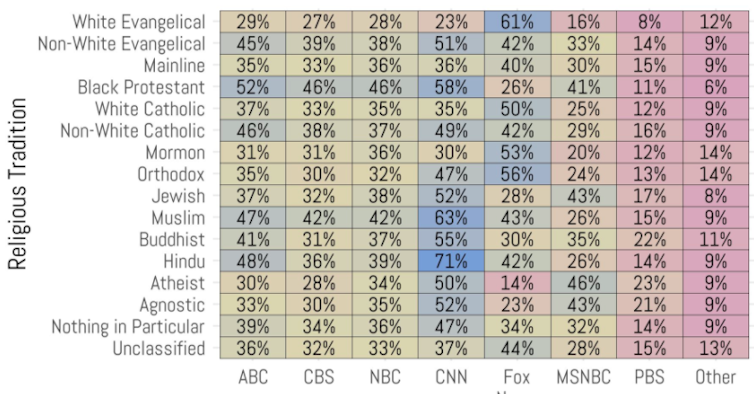
Some very interesting patterns emerged across religious traditions – and the nonreligious – and the type of media being consumed. For instance, of the the big three legacy news operations – ABC, CBS and NBC – there was no strong base of viewership in any tradition.
In most cases, about a third of people from each religious tradition said that they watched one of those legacy networks in the last 24 hours. PBS scored very low among every tradition. In most cases fewer than 15% of respondents reported watching PBS in the time frame.
graf]
however, the numbers for the three major cable news networks – CNN, Fox News and MSNBC – were much higher across the board. In eight of the 16 religious and nonreligious traditions categorized in the poll, CNN viewership was at least 50% of the sample. This was led by 71% of Hindus who watched CNN and 63% of Muslims.
The least likely group to watch CNN was clearly white evangelicals, at just 23%. In comparison, MSNBC scored lower nearly across the board. In fact, in none of the 16 classification groups was viewership of MSNBC greater than it was for CNN.
Fox News viewership was higher than that of MSNBC, but was not as widely dispersed as it is for CNN. It's no surprise, given its reputation as a conservative news outlet, that 61% of white evangelicals say that they watch Fox News – in the last election, around 80% of white evangelicals voted for Republican candidate Donald Trump. The other three traditions where viewership was at least 50% are white Catholics, Mormons and members of the Eastern Orthodox Church. It should come as no surprise, as those are three groups that consistently vote for the Republican Party. Just 14% of atheists watched Fox, which is just about in line with the share of white evangelicals who watch MSNBC.
Fracturing right-wing media
But with the fracturing of conservative media sources seeing more competitors vying for viewers among the right, Fox News could see a drop in viewership from the religious right.
In the wake of the 2020 presidential election, Fox News viewership plunged as many Trump supporters believed that the network was not being loyal to their standard-bearer of the GOP.
Given the vast number of news options that people of faith have and the increase in political polarization in the United States, the pressure for networks to deliver the news that people want to hear will only increase as time passes.
Ryan Burge, Assistant Professor of Political Science, Eastern Illinois University
This article is republished from The Conversation under a Creative Commons license. Read the original article.
FROM YOUR SITE ARTICLES
- Rep. Matt Gaetz is trying to take Fox News' Tucker Carlson down ... ›
- Jen Psaki torches Fox News' Peter Doocy: Trying to 'disprove a ... ›
- Watch: Joe Biden cracks up the room with his response to a Fox ... ›
---
---
https://www.alternet.org/2020/09/this-is-how-you-normalize-a-madman-scholars-and-press-watchdogs-urge-corporate-media-to-treat-trump-like-the-authoritarian-threat-he-is/
no lnx twt pix
This is how you normalize a madman': Scholars and press watchdogs urge corporate media to treat Trump like the authoritarian threat he is
Lisa Newcomb and Common Dreams September 25, 2020
Major news outlets failed the American people, critics say, when they chose to bury coverage of President Donald Trump's Wednesday comment that he would not commit to a peaceful transition of power—a statement watchdogs say demanded above-the-fold, front-page headlines that simply did not materialize.
"Newsroom leaders made a considered, intentional decision not to panic after Trump was elected," Dan Froomkin, editor of PressWatchers.org, wrote in a scathing rebuke of corporate media's apparent nonchalant attitude towards the president's rhetoric. "This was an epic, obvious mistake, and everything that has happened since was in some sense entirely predictable."
Froomkin continued, "They should have gone on a war footing—and by that I don't mean a partisan war against Trump, I mean a journalistic war against lies, ignorance, and intolerance."
Critics weighed in on the relative non-importance corporate news outlets assigned—in print and online—to Trump's latest suggestion that he may not cede the office of the presidency should he lose in November:
Some observers balked when Peter Baker, chief White House correspondent for the New York Times, attempted to explain away the Times' decision to bury the news by citing print publication deadlines. One pointed to the late-evening news of Supreme Court Justice Ruth Bader Ginsburg's death last week, which was an above-the-fold feature in the next day's Times print edition.
Broadcast media also drew rebukes for its lack of emphasis on Trump's veiled threat at the democratic process.
"Wednesday's network evening newscasts on ABC, CBS, and NBC were no better," Eric Boehlert, founder and editor of PressRun wrote. "Not only did none of them lead with Trump's stunning proclamation, none of the broadcasts even reported on Trump's comments. This is how you normalize a madman. (CNN and MSNBC did a much better job covering the transfer-of-power story.)"
At PressWatchers.org, Froomkin explained how the dynamics in corporate newsrooms have led to complacency among journalists tasked with reporting on Trump's presidency:
One overarching problem is that our major newsrooms have simply gotten so corporate and even-keeled that our top editors value unflappability as a signal virtue. (OK, I admit I take this one a little personally, being a flappable person. A top Washington Post editor once called me "hysterical.") Flappable people don't rise through the ranks. Corporate people do.
Journalism to me is about crusading for the truth. But the notion that a serious, major news organization would pursue a crusade on behalf of its community is considered hippy shit by the people in charge these days. So is consistently standing up to a lawless con man. They've gotten used to printing lies. They barely squawk when Trump calls them the "enemy of the people." They have their algorithms, and they won't give them up no matter what. They just continue to "do the work."
So yeah, their news souls are dead. There, I said it.
Lawmakers and progressive advocates called out the dangerous threat to democracy uttered by the commander-in-chief—and the corporate media for treating it like any other day in Trump's scandal-laden presidency.
"Great (not) to watch journalists reporting Trump's latest direct attacks on the republic as if it's all just a regular press conference," longtime journalist Dan Gillmortweeted Wednesday. "Historians will see Big Journalism's business as usual in this emergency as one of the proximate causes of the American republic's death."
Sen. Bernie Sanders (I-Vt.) gave a speech Thursday denouncing Trump's declared refusal to commit to a peaceful transition of power, saying: "This is not just an election between Donald Trump and Joe Biden. This is an election between Donald Trump and democracy—and democracy must win."
Sanders also outlined steps necessary to prepare the American public and lawmakers for chaos of election night and beyond, calling on the news media specifically to "prepare the American people to understand there is no longer a single election day and that it is very possible that we may not know the results on November 3."
Froomkin pointed out that corporate media's opinion pages are more accurately depicting the real danger of Trump's recent rhetoric than front-page headlines.
"But as usual, to capture the real drama of what's going on, you have to go to the opinion writers—and the editorial cartoonists," he wrote, sharing a link to an op-ed by Washington Post columnist Greg Sargent.
"What really matters here is that Trump is making an actual declaration of intent," Sargent wrote, "not just to refuse to respect the outcome, but rather to try to cancel and override it, if he is able to get away with it."
Boehlert issued a more dire warning:
Trump isn't running for re-election in the sense he's hoping to accumulate more voter support than Biden. (His campaign keeps taking down ads in swing states.)Trump's running to maintain power. He's signaling that he'll refuse to give it up and will not accept his defeat as being legitimate. He's trying to steal an election. In reality, he doesn't care what the results are—he has no intention of abiding by the nation's will, and thinks he can count on the corrupt support of the GOP, the Department of Justice, and the United States Supreme Court to win his lawless battle in the days and weeks after the election.
"Our democracy is at stake," Boehlert concluded. "Trump is trying to steal an election, and the press should say so, every day until Election Day."
==
===
wikipedia
In 1979 the U.S. Supreme Court sided against the FCC in the case FCC v. Midwest Video Corp., 440 U.S. 689 (1979), determining that the FCC's new requirements exceeded the agency's statutory powers as granted to them by Congress. The Supreme Court explicitly rejected the notion that cable companies were "common carriers", meaning that all persons must be provided carriage. Instead, the Supreme Court took the stance that cable companies were private persons under the law with First Amendment to the United States Constitution rights, and that the requirement for public-access television was in fact a burden on these free speech rights.
Congress acted to save Public Educational & Government TV from the result of the Supreme Court Midwest Video decision. However, the legislative imperatives of compromise between the demands of the people and the demands of the cable industry yielded a law with only small benefits for consumers and public-access television advocates.
The 1984 Cable Franchise Policy and Communications Act written by Senator Barry Goldwater, said,
"A franchising authority ... may require as part of a cable operator's proposal for a franchise renewal ... that channel capacity be designated for public, educational, or governmental use." -- 47 USC § 531(a)[12][13](emph. added)
This appeared to be a law which creates new rights, allowing local communities to require PEG channels, however, it in fact had the opposite effect. Since the franchise agreement is a license between the cable operator and the municipality, the municipality could always stipulate a PEG channel requirement, and the contracts clause of the United States Constitution prevents Congress from interfering. So while the intent may have been to correct the omission which led to the Midwest Video decision, and make PEG mandatory, the result was a law which allowed the municipality to opt out of PEG requirements, and keep 100% of the cable television franchise fees for their general fund, while providing no PEG facilities or television channel capacity. Since 1984, many public-access television centers have closed around the country as more municipalities take the opt-out provision.
However, the Cable Communications Act of 1984 did contain some benefits for PEG, as it barred cable operators from exercising editorial control over content of programs carried on PEG channels, and absolved them from liability for that content.
Congress passed the Cable Television Protection and Competition Act of 1992, which gave the FCC authority to create rules requiring cable operators to prohibit certain shows. The Alliance for Community Media (ACM) and others brought suit. The U.S. Supreme Court, in Denver Area Educational Telecommunications Consortium v. FCC, 95-124 (1996) held the law unconstitutional, in part because it required cable operators to act on behalf of the federal government to control expression based on content.
Currently the ACM and others are focusing on operational challenges after new deregulation rules in various states are directly threatening PEG access.
---
AN
Scientists at the United Nations’ intergovernmental body focusing on biodiversity sounded alarms earlier this month with its report on the looming potential extinction of one million species—but few heard their calls, according to a German newspaper report.
Deutsche Welle reported Thursday that partially because the Intergovernmental Science-Policy Platform on Biodiversity and Ecosystem Services (IPBES) released its report on what it called nature’s “unprecedented” decline on the same day that the Duke and Duchess of Sussex had their first child, news reports on the study’s grave implications were few and far between.
While some international and progressive outlets—including Common Dreams—published high-profile stories on the report when it was released, just two of Britain’s national newspapers included any reporting about biodiversity on their front pages on May 7, the day after the royal baby was born to Meghan Markle and Prince Harry.< ABC, NBC, and MSNBC did not air a single prime-time mention of the major new U.N. biodiversity report warning of ecosystem collapse. The new royal baby got airtime, though. By @theodorejay. https://t.co/EQPe2qnNJx #CoverClimate#CoveringClimate #ClimateCoverage #EndClimateSilence
— Lisa Hymas (@lisahymas) May 8, 2019
Deutsche Welle’sreport was mirrored by revelations in a Media Matters report published earlier this week which showed that ABC News devoted more time to covering the royal baby’s birth in the week after the child was born than it had to stories about the climate crisis in all of 2018—even as organizers like 16-year-old Greta Thunberg led worldwide climate strikes.
“Where [is] the breaking news?” tweeted Thunberg the day after IPBES released its report. “The extra news broadcasts? The front pages? Where are the emergency meetings? The crisis summits? What could be more important?
...
---
https://www.alternet.org/2019/04/new-report-details-failure-of-cable-and-network-outlets-to-accurately-describe-climate-emergency-call-it-a-crisis/
no lnx twt
Name and shame.
That’s the dual directive from a new report that calls on news organizations to use appropriate language when discussing the climate crisis—even as the report calls them out for inaction.
The report—titled “‘Call It a Crisis’: The Role of U.S. Network News in Communicating the Urency of Climate Change” (pdf)—analyzed the coverage of ABC, NBC, CBS, CNN, MSNBC, and Fox News to determine just how much urgency the influential outlets bring to their reporting.
https://www.citizen.org/wp-content/uploads/public-citizen-call-it-a-crisis-report-april-29-2019.pdf
According to David Arkush, managing director of Public Citizen’s Climate Program, the specific words that journalists and news anchors use—or choose not to use—matters.
“The words we use to characterize an issue make a difference in how it is perceived and prioritized politically,” said Arkush.
When outlets with massive nightly audiences like the ones the report studied “consistently fail to use language that conveys that climate change is a crisis or emergency,” Arkush added, “they unwittingly put a heavy thumb on the scale in favor of complacency and inaction.”
Fox News was the worst offender,with the use of “climate crisis” coming in for only five mentions during the coverage period—all of which, as Public Citizen noted, were efforts to “minimize the issue with false logic, mockery or misinformation.” But other news networks weren’t much better than the conservative channel.
The only network to use the term in double digits was CNN,and only 16 of the 26 mentions were by a host. Van Jones, whose eponymous show ran every other Sunday during the survey period, accounted for six of those mentions.
Public Citizen
?
@Public_Citizen
NEW REPORT: In 2018, only 50 of 1,429 national TV news segments used the word “crisis” or “emergency" when discussing climate change. That's a measly 3.5 percent.
Here's how the networks stack up:
MSNBC: 7%
NBC: 6%
CNN: 3%
CBS: 3%
ABC: 2%
Fox: 2%
http://pubc.it/2XTXQEE
55
12:23 PM - Apr 29, 2019
50 people are talking about this
Twitter Ads info and privacy
Networks should name the problem clearly to avoid confusion, said Allison Fisher, outreach director for Public Citizen’s Energy Program.
“Climate coverage on broadcast and cable television news is still at best spotty and at worst riddled with misinformation,” Fisher said. “Calling it a crisis indicates that the stakes are high and that the issue is urgent. Most of all it signals to viewers that the time to act on climate is now.”
How to report on the climate crisis has long been an issue for news organizations. In July 2018, MSNBC host Chris Hayes said on Twitter that while he was personally invested in the story, the topic was “a palpable ratings killer.”
“So the incentives are not great,” said Hayes.
Chris Hayes
?
@chrislhayes
Replying to @elongreen
almost without exception. every single time we've covered it's been a palpable ratings killer. so the incentives are not great.
526
7:08 AM - Jul 24, 2018
---
ref
https://www.citizen.org/wp-content/uploads/public-citizen-call-it-a-crisis-report-april-29-2019.pdf
---
Introduction
“Climate change.” “Global warming.” “Greenhouse effect.”
Each term is used to describe and communicate to the public the impacts of pumping massive
amounts of carbon pollution into the atmosphere.
But each term is limiting. And in some ways, all are outdated. They were appropriate at a time when
severe impacts of burning fossil fuels were further off and we had more time to respond.
Now, the science on current and near-term climate harms, and the need for fast, assertive,
unprecedented action to stave off catastrophe, is abundant and alarming. And many of those
communicating the science are no longer mincing words. The most recent report by the United
Nations Intergovernmental Panel on Climate Change (IPCC), released in October 2018, was described
by one UN official as “a deafening, piercing smoke alarm going off in the kitchen.”
It’s clear the scientific community is alarmed.
By contrast, only 29 percent of Americans say they are
“very worried” about climate change. The media can and must help bridge that divide. At present,
though, reporting still lags far behind reality. As David Wallace-Wells, author of The Uninhabitable
Earth: Life After Warming, reminds us,
as climate change has been dawning more fully into view over the past several
decades, all the cognitive biases that push us toward complacency have been abetted
by our storytelling about warming—by journalism defined by caution in describing
the scale and speed of the threat.
There is no real debate that we now face an emergency on climate change. But by and large, broadcast
and cable television news networks are not conveying that message explicitly. This omission deeply
disserves television audiences. It gives them a false impression regarding one of the most critical
problems of our time, thereby stunting public debate and leaving both the public and policymakers
ill-prepared to respond in a manner commensurate with the urgency and gravity of the threat.
This review examines the extent to which national broadcast and cable television news outlets are
using the words “crisis” or “emergency” when reporting on climate change or global warming. It
includes climate coverage for all of 2018 through April 24 of 2019.
Key Findings
? In 2018, only 50 of 1,429 segments (3.5 percent) that mentioned climate change
referred to it as a crisis or emergency. Excluding Fox News, the number is still just 3.7 percent.
? CNN had the most mentions in absolute terms (26), but trailed MSNBC and NBC in the
rate of mentions.
Public Citizen Call It a Crisis
April 29, 2019 2
? MSNBC used the terms crisis or emergency in 7 percent of segments; NBC in 6 percent; and
CNN in 3 percent.
? ABC only once identified climate change or global warming as a crisis or emergency in 2018.
? Fox News and CBS each had five mentions. However, all of Fox’s mentions were intended
to mock the idea that climate change is a crisis or emergency.
? In 2018, across all networks except for Fox News, guests used the language of crisis or
emergency slightly more than hosts (24 segments to 22 segments). Only CNN hosts used the
terms more than their guests.
? Notably, of CNN’s 16 host mentions, six (38 percent) were by Van Jones on his eponymous
show. Even more remarkable is that his program airs every other Saturday, far less frequently
than those of many of his CNN colleagues.
? Of the 24 guest mentions in 2018, eight (32 percent) were by Sen. Bernie Sanders.
? The first quarter of 2019 saw a huge spike in results due to President Trump’s declaration of
a national emergency at the southern U.S. border. One hundred and forty-one segments
referred to climate as an emergency or crisis from January 1, 2019 to April 24, 2019. That is
almost triple the number for all of 2018.
? Sixty-three percent of those mentions reference the hypothetical designation of climate
change as a national emergency by a Democratic president.
? Even excluding mentions related to the president’s national emergency declaration, there
were more uses of crisis and emergency when referring to climate change (52) in the
first quarter of 2019 than in all of 2018 (50).
? Thirty-seven percent of the non-national emergency mentions were by presidential
candidates.
---
OMFG khj cdv
..President Trump is better at commanding the agenda than he is at any other single thing that he as a communicator does. The press has been an accomplice in the process of ceding agenda control to him by virtue of his tweeting -- and having the press respond immediately, as if every tweet is presumed to be newsworthy. Donald Trump has thecapacity to get whatever he wants the public to focus on by directing the cable news agenda.We really should ask: Aren't there other things we ought to be paying more attention to? How often are we being distracted from something that Trump does not want us to pay attention to? Being distracted by his effective use of tweets to set an alternative agenda.
Fox News is de facto Trump's state-sponsored media. How does this impact American political culture?
We are increasingly going into ideological enclaves to get our news. To the extent that people find the news compatible with what they already believe, that means they are not being exposed to alternative interpretations of reality and alternative points of view. What is unprecedented about the relationship between Fox News and the president of the United States is the extent to which what is said and shown on Fox News appears to influence what is said and featured by the president of the United States. Thetraditional model of agenda-setting is that the president sets the agenda and the news media follows. This _{reversal }_with Donald Trump and Fox News is something new.
....
==
===
A U.K.-based media watchdog group is criticizing U.S. media outlets for the coverage of Donald Trump, saying the outlets have aided the rise of his presidential campaign and the acceptance of his xenophobic rhetoric. The Ethical Journalism Network says the three major U.S. cable news outlets devoted twice as much airtime to Donald Trump than to any other Republican candidate and that the majority of this coverage did not fact-check his false claims or push back against his "unapologetically xenophobic anti-immigration rhetoric."
DN
===
Why have some states put these restrictions on municipal broadband networks?
The cable lobby and some conservatives believe that the business of Internet service should stay in the private sector. Last week, Nebraska Sen. Deb Fischer called Obama's plan "a new federal takeover of state laws governing broadband and the Internet." Telecom industry groups such as the National Cable & Telecommunications Association have argued that these networks are risky investments that could drive cities into debt. Telecom companies have donated millions of dollars to state and federal politicians on both sides of the aisle. Besides contributions, the cable lobby has directly submitted legislation to restrict municipal broadband networks and taken fledgling networks to court. Last year, according to a report by Ars Technica, the Kansas Legislature squashed a bill to limit municipal broadband networks that was drafted and submitted by the Kansas Cable Telecommunications Association. When Lafayette Utilities System in Louisiana announced its intention to build a municipal broadband network, they faced three years of court battles with two incumbent Internet providers, costing them $4 million, according to a report from the Center for Public Integrity.
How is Obama going to get around these restrictions to expand municipal broadband?
The Obama administration is urging the FCC "to ensure that communities have the tools necessary to satisfy their citizens' demand for broadband." Section 706 of the 1996 Telecommunications Act charges the commission with encouraging "the deployment on a reasonable and timely basis of advanced telecommunications capability to all Americans." In its letter to the FCC, the administration argues that "where private investment has not resulted in adequate broadband infrastructure, communities can and should play a leading role in expanding broadband access." In addition, the U.S. Department of Agriculture will revamp its broadband loan program to offer financing to eligible high-speed broadband carriers in unserved and underserved rural areas. The Department of Commerce will launch a new initiative to provide online and in-person technical assistance to communities that will help them address challenges in planning and implementing broadband networks.
===
see msnbc on palestinian fired, thou shalt not crit ?
==
http://www.alternet.org/corporate-accountability-and-workplace/comcasts-worst-nightmare-how-tennessee-could-save-americas
==
Science or Spin?: Assessing the Accuracy of Cable News Coverage of Climate Science
Accuracy varies significantly across major cable news outlets. All of them can take steps to improve their coverage of climate science.
DOWNLOAD: Science or Spin? Assessing the Accuracy of Cable News Coverage of Climate Science (2014)
CNN, Fox News, and MSNBC are the most widely watched cable news networks in the U.S. Their coverage of climate change is an influential source of information for the public and policy makers alike.
To gauge how accurately these networks inform their audiences about climate change, UCS analyzed the networks' climate science coverage in 2013 and found that each network treated climate science very differently.
Fox News was the least accurate; 72 percent of its 2013 climate science-related segments contained misleading statements. CNN was in the middle, with about a third of segments featuring misleading statements. MSNBC was the most accurate, with only eight percent of segments containing misleading statements.
The public deserves climate coverage that gets the science right. Media outlets can do more to foster a fact-based conversation about climate change and policies designed to address it, rather than contributing to a broken and inaccurate debate about the established facts of climate science.
---
}:
}:
}:
}: