Trump, The Donald
==
see trump 2, tag trmp
for profit, dci
see stats on massive press coverage vs eg sanders, free media,
jrnlism fail
==
5/20 an
https://www.alternet.org/2020/05/heres-a-non-exhaustive-list-of-people-who-paved-the-way-for-trump
...While certainly not an exhaustive list, I thought it would be helpful to briefly summarize some of the people who paved the way for where we are today.
**Lee Atwater**: Along with others in the Nixon White House, implemented the Republican’s Southern Strategy (the early 1970s).
**Paul Weyrich**: Formed a coalition between Goldwater conservatives and Christian nationalists that became the base of the Republican Party (1980).
**Ronald Reagan**: Proclaimed, “Government is not the solution to our problem, government is the problem” (1981).
**Newt Gingrich**: Turned partisan battles into a bloodsport and wrecked Congress (the 1990s).
**Rupert Murdoch**: Launched Fox News (1996).
**Grover Norquist**: Not only invented the anti-tax pledge but became the father of obstruction when he forecast that if a Democrat won the White House, Republicans would make it so that they couldn’t govern as a Democrat (2003).
**Mitch McConnell**: Implemented Norquist’s plan of total obstruction and broke the Senate (2009-present).
**Supreme Court**: In the Citizens United case, ruled that corporations and other outside groups can spend unlimited money on elections (2010).
That is how the GOP became the party of racists and Christian nationalists funded by the one percent with the goal of undermining the government. It is also what eventually put Donald Trump in the White House.
Democrats haven’t been all that successful in combating these moves. As the party that embraces both pluralism and the role of government in solving problems, simply adopting these GOP strategies is not an option.
During Barack Obama’s second term, he gave an entire speech in Springfield, Illinois, focused on the steps we need to take as citizens to develop “a better politics.” His ideas are nothing new, but worth highlighting in this context.
- “First is to take, or at least reduce, some of the corrosive influence of money in our politics.”....
==
see Linda McMahon gop sen cand 2x
RAW = WAR = authentic
==
...
Competition with a (more or less) predetermined outcome. The skill of the wrestlers, and the entertainment value of the “sport,” was, at least for me, no less diminished by that fact.
Professional wrestlers use various means to make themselves bleed during a match. Some will cut themselves with a carefully hidden razor blade. Others will allow a more experienced competitor to hit them hard enough to break the skin above the eye or on the scalp. Of course, a person can be busted open “the hard way” when they accidentally hit the turnbuckle, a pole, the stairs, a table, or some other hard object. In some situations, a wrestler would fill up a condom with his own blood, place it in a bucket of warm water, and then later put it in his mouth. Once the condom was bitten into, it would produce copious amounts of blood from the mouth and nose.
The blood in a professional wrestling match is an integral part of the drama that takes place inside the ring. It excites the audience; the blood can earn a wrestler either sympathy or disdain from the crowd. Ultimately, the blood of a wrestler is almost a ritualistic offering from the competitors to the crowd.
Donald Trump is a political performance artist whose repertoire is inspired by professional wrestling.
He has not (yet) cut his forehead open with a razor to elicit awe, wonder, and sympathy from his followers. But given the violence at his rallies, who knows what the future holds?
...
Trump has been involved with professional wrestling for several decades. He is friends with Vince McMahon, the owner of the World Wrestling Federation. Trump’s hotels and casinos have hosted the annual Wrestlemania event—the Super Bowl of pro wrestling. Trump has even appeared at Wrestlemania, where in a “hair versus hair” match, he shaved the head of Vince McMahon. World Wrestling Entertainment acknowledged Trump’s many years of association by inducting him into their hall of fame in 2013.
And now Trump has taken the lessons he learned from those experiences and deftly applied them to his presidential primary campaign.
Professional wrestling is a type of classic storytelling that revolves around heroes and villains. In the language of professional wrestling, the hero is the “face” and the villain is the “heel.” While the boundaries of these archetypes have changed over time, there are certain norms that have remained relatively constant. The “face” wants the sympathy and respect of the audience. He or she has a code of honor. They also, for the most part, do not cheat to win. The “heel” has no such limitations. The heel will lie, cheat, dissemble, and do anything to win a match. The heel also insults and condescends both to the wrestling audience and his rivals. Ultimately, he only cares about obtaining the object of his personal desire—this could be money, power, sex, glory, fame, the championship, or in some cases, just playing the role of a chaotic spoiler who lives to humiliate and brutalize the “good guys.”
A great heel also plays the victim:he or she was not really “pinned” in the ring; there is a conspiracy; “winning” was never the point anyway as there is a greater goal to be achieved.
There are different versions of the “heel” persona. Vince McMahon plays the cruel and manipulative corporate CEO and robber baron who cares about nothing but maintaining and expanding his power. During the 1980s and 1990s, the (then) World Wrestling Federation’s “Million Dollar Man” Ted DiBiase would humiliate the fans, mocking them as poor and working-class “slobs.” Nick Bockwinkel and Ric Flair were playboy millionaire villains who dressed better than their rivals, had more money and success than anyone else, and the charisma and confidence to get anything they wanted out of life. In today’s World Wrestling Entertainment, Kevin Owens is a heel who plays the role of a schoolyard bully.
Trump borrows from all those “heel” personas. He insults women by calling them “ugly” and implying that their menstrual cycles make them irrational. Trump has questioned the masculinity and character of his Republican rivals. Marco Rubio is “Little Rubio.” Ted Cruz is “Lyin’ Ted.” Trump boasts about the size of his penis and the beauty of his wife Melania. In true “heel” form, Trump is “great” and “amazing.” His rivals are not “real men.” They are “low energy” “losers.”
He also wins over the support of his fans by decrying “political correctness” and urging them to beat up and otherwise abuse anyone who disagrees with his agenda. Trump is also a professional victim, who claims that both he and his supporters are being treated “unfairly” by the news media, protesters, the Republican Party, and any other group that has earned his ire.
Trump’s speech and cadence borrow from professional wrestling. And as Jim Ross, one of the most respected and accomplished announcers in the history of professional wrestling recently observed, Trump’s stage presence is heavily influenced by his affiliation with the sport:
The manner in which The Donald works—works up?—his audiences while stumping is vintage WWE. Watch the mannerisms. Walk to the mic, and the crowd quiets. Walk away, and the decibel level rises. Step back to the podium, step away, all the while pumping up a throng that is ready to hang on every word and thought. Everything plays out the way it would if the event were happening from a wrestling ring on Monday Night Raw. And with good reason: Trump was enmeshed on WWE TV in one of the most successful storylines in company history.
Trump also uses emotional appeals communicated in extemporaneous speeches that are delivered at a fourth-grade level, which are designed to manipulate the most base passions of his public. For example, Trump uses slogans and tag lines about America’s “greatness” and how “big” and “wonderful” his ideas are. As a heel, Trump is also duplicitous and contradictory: he makes claims and promises that he then denies or evades when they are no longer of use.
Trump is a perfect presidential candidate for our “post truth” era. During the 1960 presidential election, Richard Nixon was defeated by John F. Kennedy because, in part, he had not mastered the optics of television. But Trump is a reality TV show character turned GOP frontrunner. He is winning because his outlandish behavior has given him billions of dollars in free publicity from a corporate news media that is desperate for ratings. Moreover, Trump’s professional wrestling persona allows him to effectively communicate with his aggrieved, angry, racist, and alienated white “working class” and low-information public in a way that establishment Republican candidates cannot.Trump literally and figuratively speaks the language of the Republican base and is a hero (while simultaneously being a villain for the rest of the American public) who they can live through by proxy.
==-
==
http://grist.org/article/what-future-president-trump-thinks-of-climate-change/
Senator Ted Cruz dropped out of the presidential race on Tuesday, making it almost certain that Donald Trump will win the GOP nomination and face Hillary Clinton or Bernie Sanders in November. For those who’ve been in denial that this day could ever come, we figured a refresher course on the real estate developer’s musings about climate and energy might be in order.
On the basic science: “I am not a great believer in man-made climate change,” Trump told the Washington Post editorial board in March. “If you look, they had global cooling in the 1920s and now they have global warming, although now they don’t know if they have global warming.”
The concept of global warming was created by and for the Chinese in order to make U.S. manufacturing non-competitive.
—
Donald J. Trump (@realDonaldTrump) November 06, 2012
This very expensive GLOBAL WARMING bullshit has got to stop. Our planet is freezing, record low temps,and our GW scientists are stuck in ice
—
Donald J. Trump (@realDonaldTrump) January 02, 2014
A panel of scientists ranked all of the then-presidential candidates’ public remarks on climate for the Associated Press last November. Trump got 15 points — out of 100.
On climate vs. weather: When it was “really cold outside” last October, Trump tweeted that we “could use a big fat dose of global warming!”
On the kind of climate change he is worried about: “I think our biggest form of climate change we should worry about is nuclear weapons.” Interpretation: unclear.
On the Environmental Protection Agency: “We’re going to get rid of so many different things,” Trump said in a February debate. “Environmental protection — we waste all of this money. We’re going to bring that back to the states.” But only if he can figure out what the EPA is. Trump said he would eliminate some agency called “Department of Environmental. I mean, the DEP is killing us environmentally, it’s just killing our businesses.”
On clean energy:
Not only are wind farms disgusting looking, but even worse they are bad for people's health http://bit.ly/I9Dl8k (cont) http://tl.gd/h46200
—
Donald J. Trump (@realDonaldTrump) April 23, 2012
Wind turbines are a scourge to communities and wildlife. They are environmental disasters.
—
Donald J. Trump (@realDonaldTrump) August 23, 2012
On clean energy when campaigning in clean energy-heavy states: Trump told an Iowa voter that he’s OK with wind subsidies. “It’s an amazing thing when you think — you know, where they can, out of nowhere, out of the wind, they make energy.”
On the Paris climate accord signed by 175 countries:“One of the dumbest things I’ve ever heard in politics — in the history of politics as I know it.”
On his hair: “You have showers where I can’t wash my hair properly, it’s a disaster!” Thanks to the EPA, Trump told a crowd in December, showerheads “have restrictors put in. The problem is you stay under the shower for five times as long.”
==
primary voters on agw
http://www.motherjones.com/environment/2016/04/northeast-primary-climate-change
==
gop CA called rove dumbest alive
=
After another night of primary victories, in March Donald Trump took to the stage in the ballroom of his Mar-a-Lago resort. Instead of holding a victory rally, he took questions from the media.
All but one of the queries was about the horse race: Could he win the general? Could he bring the party together? Trump tried to cut off the only policy-related question from CNN's Jeremy Diamond, saying, "Nobody is listening to you, Jeremy."
This one campaign moment was a snapshot of media failure in a primary season that is unlike anything we've ever seen. Entertaining? You bet. But vetting candidates for one of the most powerful positions in the world is serious business, and for that we need serious journalism.
mojo
Early on, the cable networks discovered that airing Trump's ranting and raving was a boon for ratings. Each time he said something outrageous, he received more coverage, and he and the networks won a bigger audience—ad infinitum. Meanwhile, many in the media ignored Bernie Sanders early in the campaign; they didn't think there was a big audience for his "political revolution."
CBS president and CEO Les Moonves explained it like this: "[It] may not be good for America, but it's damn good for CBS...It's a terrible thing to say, but bring it on, Donald, go ahead, keep going."
==
http://thinkprogress.org/climate/2016/03/24/3762641/donald-trump-bad-climate-denial
When it comes to climate science, Donald Trump doesn’t even know what he doesn’t know. But when it comes to classical rhetoric — what Plato called “the art of winning the soul by discourse” — Trump is a master.
Donald Trump comes across as a clown to many intellectuals, and especially to comedians likeSeth Myers and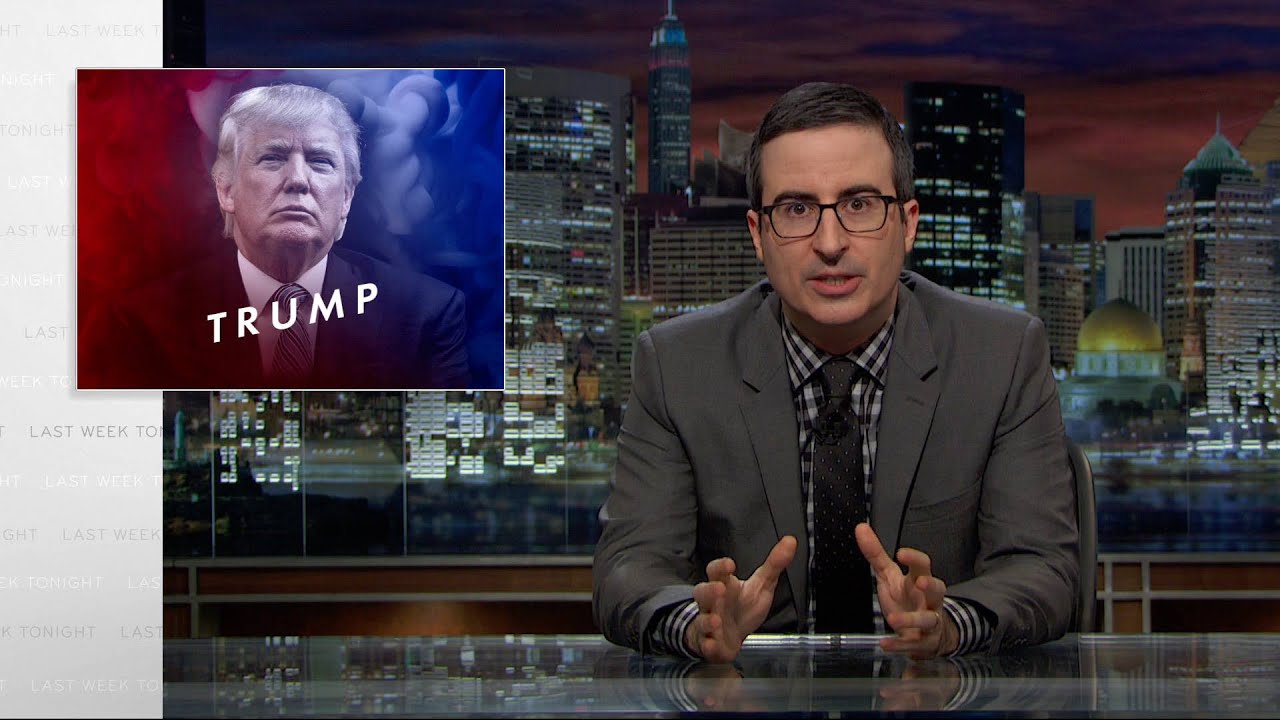 , to cite two hilarious takedowns. And yet at the same time, Trump is one of the most effective practitioners of classical rhetoric the political world has seen in a long time. As opposed to the negative connotation that rhetoric has today, the Greeks, Romans, and Elizabethans viewed it as the epitome of persuasive speech.
Trump’s success can’t be understood without appreciating his mastery of the figures. After all, modern social science has confirmed what the best politicians, orators, and speech-writers have always known — that the figures of speech are the key to being both memorable and persuasive, which is the central point of my 2012 book, “Language Intelligence: Lessons on persuasion from Jesus, Shakespeare, Lincoln, and Lady Gaga.” Indeed, how many current politicians can you name who have been intentionally using key figures of speech for 40 years? Donald Trump has, as we will see in Part 2.
In this post, however, I will focus on Trump’s climate science denial, specifically at his failed attempts to use standard denier talking points. Climate Progress has detailed Trump’s denial many times (see “It Snowed Once And Other Things Donald Trump Thinks Prove Global Warming Is A Hoax” and, more recently, “This One Chart Shows How Crazy Trump’s Climate Positions Are”).
But it is Trump’s recent interview with the Washington Post editorial board that underscores how even in his anti-scientific ignorance, Trump is uninformed. In the final seconds of his hour-long interview (when else?), Fred Hiatt, the editorial page editor, asked the New York tycoon, “You think climate change is a real thing? Is there human-caused climate change?” Trump replied:
I think there’s a change in weather. I am not a great believer in man-made climate change. I’m not a great believer. There is certainly a change in weather that goes — if you look, they had global cooling in the 1920s and now they have global warming, although now they don’t know if they have global warming. They call it all sorts of different things; now they’re using “extreme weather” I guess more than any other phrase. I am not — I know it hurts me with this room, and I know it’s probably a killer with this room — but I am not a believer. Perhaps there’s a minor effect, but I’m not a big believer in man-made climate change.
Obviously Trump is (repeatedly) wrong about man-made climate change here. It isn’t about being a believer, it’s about the overwhelming scientific evidence acknowledged by every major scientific society and every major government in the world. Trump could have as easily said, “I am not a great believer that cigarette smoking is harmful to people” — since scientists have the same kind of super-high confidence in both dangers. But of course denying the dangers of smoking would subject one to ridicule, whereas denying the dangers of climate change is the central position of a major political party.
But I’m going to set aside Trump’s everyday wrongness about climate change to focus on how he is even wrong in the context of his wrongness.
Does Trump Know What Weather Is?
First Trump starts, “I think there’s a change in weather,” and then repeats “There is certainly a change in weather.” Apparently he is unaware of the fact that the weather changes all the time, sometimes in a matter of hours, and indeed that is a defining characteristic of weather. One day it rains, the next day it is sunny. You’d have to be a total know-nothing to think that “a change in the weather” was in the least bit noteworthy in the climate debate.
What Trump was grasping for is the standard denier talking point that starts with agreement “Yes, I think there’s a change in the climate” but quickly adds “but the climate is always changing.” At least that talking point, though well debunked, has an internal logic to it in the climate debate.
After all, the climate is supposed to be relatively unchanging. The climate of a region is the statistical average of its weather conditions over a long period of time, typically decades. Is it a tropic climate or a polar climate? Is it a rainforest or a desert? The long-term average, again by definition, shouldn’t change much.
And in fact, the climate has been relatively unchanging for most of human civilization, as the most comprehensive analysis of the past 11,000 years makes clear:
==
Even though Donald Trump has previously cited himself as his top adviser on foreign policy issues, he has now released a list of some other experts that he leans on.
The Republican presidential front-runner said during a "Morning Joe" interview last week that he consults with himself on foreign policy issues "because I have a very good brain," but today he released the names of other members of the team.
During a meeting with The Washington Post editorial board, Trump reportedly shared the names of five of his go-to experts.
.RedXDefense
Former Lt. Gen. Keith Kellogg is seen here in this undated file photo.
Gen. Keith Kellogg
After an extensive military career, Kellogg has been working in the private sector.
Kellogg had a "decorated 32-year career" in the Army, according to a press release announcing his joining a consulting company, and was the chief operating officer of the Coalition Provisional Authority in Baghdad, Iraq, for five months from the end of 2003 into the spring of 2004.
"He played a key role in the effort to rebuild Iraq and bridge the link between security and critical infrastructure," the press release states.
Kellogg was awarded the Defense Medal for Distinguished Public Service, which is considered the highest award that the Secretary of Defense can give a private citizen, according to the press release.
Carter Page
Trump isn't the only one consulting Page on world issues, as he is a member of the Council on Foreign Relations and has previously covered issues relating to energy development in the Caspian Sea region.
He is also an adjunct associate professor at New York University and a fellow at the Center for National Policy.
George Papadopoulos
Another energy expert on Trump's list was Papdopoulos, who reportedly focused his work at a conservative think tank in D.C. on energy security.
Papadopoulos is a 2009 graduate of DePaul University and has a master's degree from University College London, according to his LinkedIn page.
Walid Phares
Phares, who is originally from Lebanon, is a professor at the National Defense University in D.C. and Trump described him as "a counter-terrorism expert."
He is the author of 11 books, covering a variety of topics relating to the Middle East, jihadism and Lebanese politics.
Joseph Schmitz
Schmitz is the second member of the group to have served in the armed forces. He graduated from the Naval Academy and served in the Navy before pursuing a legal career and then federal career.
He was nominated to the role of Inspector General of the Defense Department by former President George W. Bush in 2001 before resigning four years later. He then held an executive role at Blackwater, a private military contractor.
He comes from a well-known family, as his father John Schmitz was a member of the House of Representatives, and his sister Mary Kay Letourneau gained infamy after having a sexual relationship with her 12-year-old student, to whom she is now married.
==
:{==
}:
But that was just the beginning of Trump’s big day in D.C. After his “hands on” interview with the Post. he headed over to a private meeting with some current and former members of Congress, including Senator Tom Cotton, the audacious Arkansas freshman who wrote the embarrassing “Iran letter,” Senator Jeff Sessions, former Senator Jim DeMint, disgraced former congressmen Newt Gingrich and Bob Livingston, Calista Gingrich and a small number of backbench Representatives. No one is quite sure what it was all about, but Trump had a press conference afterwards and seemed to believe it was a very, very impressive group.
==
http://www.alternet.org/election-2016/5-reasons-why-human-species-deep-trouble-if-trump-becomes-president-according-noam
nazi salute?
:{==
}:
media matters
Trump And White Nationalism
Donald Trump's campaign gave press credentials for a rally to a white nationalist radio host and having Donald Trump Jr. participate in an interview with him. After that revelation, the campaign furiously backpedaled and tried to shift the blame. But the white nationalist program's syndicator soon threatened to release emails showing that the Trump camp was lying. Meanwhile, CNN's Trump apologist tried to blame the left for the KKK and white nationalists, but he was harshly corrected first by another CNN contributor and later by Trevor Noah. Relatedly, David Duke and other white nationalist anti-Semites were rallying for Trump on Super Tuesday, while another group of white nationalists was reportedly instigating violence at a Trump rally. Finally, white nationalists are descending on the nation's capitol this weekend to hold a pro-Trump conference led by someone who has advocated for "peaceful" ethnic cleansing.
:{==
}:
http://www.alternet.org/trump-gives-supporters-permission-be-violent-protesters-if-you-hurt-them-ill-defend-you-court
:{==
}:
New Documents Reveal How Donald Trump’s Racist Dad Inspired Woody Guthrie’s Most Bitter Writings
Trump, Sr. would be investigated by a U.S. Senate committee in 1954 for profiteering off of public contracts.
By Will Kaufman / The Conversation
January 22, 2016
In December 1950, Woody Guthrie signed his name to the lease of a new apartment in Brooklyn. Even now, over half a century later, that uninspiring document prompts a double-take.
Below all the legal jargon is the signature of the man who had composed “This Land Is Your Land,” the most resounding appeal to an equal share for all in America. Below that is the signature of Donald Trump’s father, Fred. No pairing could appear more unlikely.
Guthrie’s two-year tenancy in one of Fred Trump’s buildings and his relationship with the real estate mogul of New York’s outer boroughs produced some of Guthrie’s most bitter writings, which I discovered on a recent trip to the Woody Guthrie Archives in Tulsa. These writings have never before been published; they should be, for they clearly pit America’s national balladeer against the racist foundations of the Trump real estate empire.
:{==
}:
A U.K.-based media watchdog group is criticizing U.S. media outlets for the coverage of Donald Trump, saying the outlets have aided the rise of his presidential campaign and the acceptance of his xenophobic rhetoric. The Ethical Journalism Network says the three major U.S. cable news outlets devoted twice as much airtime to Donald Trump than to any other Republican candidate and that the majority of this coverage did not fact-check his false claims or push back against his "unapologetically xenophobic anti-immigration rhetoric." dn
==
ivana said in 90's read:
Donald Trump is an apparent fan of Adolph Hitler’s speeches.
That stunning but not entirely surprising revelation comes from his ex-wife Ivana, who told [3] Vanity Fair in a 1990 interview [4] that “from time to time her husband reads a book of Hitler’s collected speeches, My New Order, which he keeps in a cabinet by his bed.” The magazine said Trump confirmed he got it from a film industry friend, Marty Davis. “I thought he would find it interesting,” Davis said. “I am his friend, but I’m not Jewish.”
Adolph Hitler’s My New Order is not just any book. It came after Hitler’s two volumes of Mein Kampf, which is German for “My Struggle” and came out in 1925 and 1926 before the Nazis rise to national power and World War II. It is not just a collection of excerpts from speeches Hitler made between 1918 and 1941; it is profusely indexed and filled with details about the speeches’ impact on the media and political establishment.
Kirkus Review, the American literary magazine founded in 1933, puts [5] it this way: “Paralleling actual quotations from Hitler’s own utterances, he [the editor of the English edition] includes corresponding data showing the effect on the world press, and his own commentary relating the statements to doctrines previously presented in Mein Kampf… Section after section follows pattern-background, speech, press.”
Ivana Trump told [4] Vanity Fair that her ex-husband occasionally read it, which supports the rest of the magazine's profile of a tycoon who loved to live in the public eye and manipulate media coverage. Trump, of course, after confirming that he had the book, later told [4] the reporter, “If I had these speeches, and I am not saying that I do, I would never read them.”
Nobody can know what Trump reads or does not read—or if he even reads. But it more than appears that one way or another, much of the content in My New Order about how Hitler says propaganda works, and how he structures his speaking style, and how Hitler targets the lowest-common denominator as his intended audience, has seeped into Trump: the way he speaks, argues, rages and responds in public. This goes beyond what has been reported in the New York Times [6], which analyzed 95,000 words from five months of speeches and concluded that Trump shares an style with the 20th century's biggest demagogues.
Trump’s speeches are filled with simplistic racist attacks, first against Mexicans [7] and now Muslims [8]. He belittles and insults competitors [9] for the 2016 Republican presidential nomination. He attacks Democrats’ political “correctness [10]” as weak. He’s mocks women [11] and disabled [12] people. He threatens to obliterate the enemies [13] he names. He doesn’t care about facts [14] or inconsistencies [15], and plays to his followers’ fears and prejudices.
All of these tactics—from the repetitive style of his speeches, to believing whatever he says is true, to his excessive and unrivaled view in his leadership—are pre-figured by Hitler in My New Order, according to a psychological profile [16] of the book in the September 2013 issue of the scholarly journal, Psychiatric Quarterly.
“The elements of a delusional system are there,” it states. “This is not simply to say that the man is mad and so has plunged the world into chaos; but it is to say that there is overwhelming evidence in 19 years of his speeches that Hitler himself firmly believes many of his most absurd declarations, including some which are contradictory.”
What is really stunning—whether or not he carefully read My New Order—is that Trump is channeling the very tenets about how propaganda works laid out by Hitler in his books. In addition to the collection of speeches and their impact, Mein Kampf has a chapter on the hows and whys of political propaganda. Look at these six excerpts from Ralph Manheim’s 1943 translation that have been put into a “Teachers Guide To The Holocaust [17]” produced by the University of South Florida. Hitler wrote:
• “The function of propaganda does not lie in the scientific training of the individual, but in calling the masses’ attention to certain facts, processes, necessities, etc., whose significance is thus for the first time placed within their field of vision.”
• “All propaganda must be popular and its intellectual level must be adjusted to the most limited intelligence among those it is addressed to. Consequently, the greater the mass it is intended to reach, the lower its purely intellectual level will have to be.”
• “The more modest its intellectual ballast, the more exclusively it takes into consideration the emotions of the masses, the more effective it will be. And this is the best proof of the soundness or unsoundness of a propaganda campaign, and not success pleasing a few scholars or young aesthetes.”
• Once understood how necessary it is for propaganda in be adjusted to the broad mass, the following rule results: It is a mistake to make propaganda many-sided, like scientific instruction, for instance.”
• “In consequence of these facts, all effective propaganda must be limited to a very few points and must harp on these in slogans until the last member of the public understands what you want him to understand by your slogan.”
• “The function of propaganda is, for example, not to weigh and ponder the rights of different people, but exclusively to emphasize the one right which it has set out to argue for. Its task is not to make an objective study of the truth… its task is to serve our own right, always and unflinchingly.”
==
actually jumped in but no pprwork sp could bail again 2016
hired actors thru extras temp agy? some thot mad max audition? (npr joke?)
http://www.alternet.org/news-amp-politics/surprise-donald-trumps-father-was-probably-ku-klux-klan
==
http://ecowatch.com/2015/08/21/trump-keystone-xl
http://www.scribd.com/doc/272297762/Donald-Trump-s-Financial-Disclosures
===
Rupert Murdoch’s Donald Trump Nightmare: He Can’t Control the Monster Fox News Created
Even the powerful mogul can’t stop his biggest media asset from acting as Trump’s biggest booster.
By Sophia Tesfaye / Salon July 22, 2015
If there seems to be a split in the way Rupert Murdoch-owned media outlets are covering the presidential campaign of Donald Trump that’s because one of Murdoch’s holdings is reportedly out of control — Murdoch can’t get Fox News to stop positively covering The Donald.
According to New York Magazine’s Gabriel Sherman, the conservative media mogul has been unsuccessful in his attempt to wield influence over the editorial decisions of Fox News CEO Roger Ailes. Sherman reports that Ailes has pushed Fox’s on-air personalities to defend Trump’s controversial comments in recent weeks, boasting that the conservative network was covering the Trump campaign to his personal specifications. For his part, Murdoch appears to be dead set against a Trump candidacy, publicly blasting the Republican’s incendiary rhetoric:
Trump, who has a longstanding relationship with Fox News, met with Ailes for an extended lunch around the time of his announcement and has called the cable news executive “one of the great geniuses in television history.” During the month of June, Trump appeared on Fox 10 times, amounting to 1 hour and 48 minutes of free airtime from the network and it’s become evident that there is little Murdoch can do to stop it. According to Sherman, Murdoch, whose 21st Century Fox is the parent company of Fox News, recently called Ailes to ask him to “back off the Trump coverage.” Trump was back on “Fox & Friends“, a show where he held weekly appearances before entering the presidential race, this morning to push-back against all of the negative scrutiny his stunt giving out Lindsey Graham’s personal cell number generated. Per usual, the host provided Trump his softball interview. And as Sherman points out, “yesterday, at a campaign event in South Carolina where he gave out Lindsey Graham’s personal cell-phone number, Trump heaped praise on Fox & Friends’ Doocy, Brian Kilmeade, and Elisabeth and Hasselbeck, ‘They’re great people.’” Sherman, a veteran Fox News observer, describes “Fox & Friends” as “a show that is used by Ailes to inject his point of view into debates.”
And as the New York Times explains, there is little Murdoch can do to wrangle editorial control over the network from Ailes: “As the creator of the highest-rated cable news channel in the country (even surpassing ESPN in total viewers on some nights) and one of the most profitable assets in Mr. Murdoch’s film and television company, 21st Century Fox, Mr. Ailes has been given the freedom to operate largely outside the purview of Mr. Murdoch.”
So, for now, Murdoch’s control is relegated to the front page of the NY Post, the editorial page of the Wall Street Journal and his personal Twitter account. But the head of one of the most powerful media conglomerates in the world can’t stop his biggest media asset from acting as Trump’s biggest booster, as the carnival barker marches his campaign to the first Republican debate stage — on Fox News
===
http://www.alternet.org/election-2016/how-did-monster-get-created-decades-gop-lies-brought-us-donald-trump
ow did America get to such a place that someone like Donald Trump can command a lead in the Republican primaries? Trump is the product of a deliberate Republican strategy, adopted by Richard Nixon’s people in 1968, to attract voters with an apocalyptic redemption story rather than reasoned argument. It has taken almost 50 years, but we have finally arrived at the culmination of postmodern politics in which Republican leaders use words to create their own reality.
After World War II, President Dwight Eisenhower and men like New York Gov. Nelson Rockefeller led the Republican Party with policies based in reasoned argument. They used the government to regulate the economy and to promote social welfare, much as Democrats did, although with a philosophy that emphasized social unity rather than class conflict. The policies of these “Me Too” Republicans infuriated Movement Conservatives on the far right, who insisted that all government activism was communism. In 1964, Movement Conservative spokesman Arizona Sen. Barry Goldwater won the Republican nomination when Rockefeller’s womanizing spectacularly imploded his candidacy. Movement Conservatives used their hero’s nomination to advance a new kind of politics.
America’s moderate consensus was enormously popular, but Phyllis Schlafly,the president of the Illinois Federation of Republican Women, flat-out denied that reality. In her famous book “A Choice Not an Echo,” she insisted that studies showing that voters opposed Goldwater’s extremism were part of a “propaganda machine” that used fake polls, radio and newspapers to destroy anyone but the chosen candidates of an elite cabal. She explained that all government activism outside of military buildup was a conspiracy to bankrupt regular Americans. Financiers and banking interests fed off expensive policies pushed by an educated Eastern elite, and together these men were dragging America into the web of communism.
The world was really quite simple, Schlafly insisted, and it could be understood without any fancy education. It was divided in two, black and white, Communism and Freedom. Eggheads complained that Goldwater “had one-sentence solutions” for complicated problems, she wrote, but simple solutions were the answer. What should America do about communism? Stop it! The very fact that establishment Republicans opposed Goldwater’s nomination proved that he was the right man for the job. He was the “grass roots” candidate, the candidate for the little guy who voted his principles, not because he wanted a payoff.
Goldwater’s candidacy crashed and burned, leaving Republicans in trouble in 1968. To candidate Richard Nixon was left the task of pulling together mainstream Eisenhower Republicans and upstart Movement Conservatives. How could his team attract support for an unlikable candidate who needed to bridge a fundamental ideological gulf? Nixon’s handlers used new media to play to Schlafly’s script. They ignored people’s brains and went for their guts.
“Voters are basically lazy,” one Nixon media adviser wrote. “Reason requires a high degree of discipline, of concentration; impression is easier. Reason pushes the viewer back, it assaults him, it demands that he agree or disagree; impression can envelop him, invite him in, without making an intellectual demand…. When we argue with him, we… seek to engage his intellect…. The emotions are more easily roused, closer to the surface, more malleable….” Nixon’s people hired advertising executive Harry Treleaven, who believed the new medium of television had changed the nature of politics. For him, politicians were no longer policy wonks; they were actors with a narrative.
Under Treleaven, Nixon’s people ignored policy positions and instead used television to create a candidate with a simple message: America was on the brink of disaster, and only Nixon could save it. They hired a brilliant young photographer to put together a series of television ads from stock photographs strung together to create a sense of doom; at the end a voice intoned “Nixon” over an iconic image of the nation. At the end of every ad ran the words: “Vote like your whole world depended on it.”
The campaign also hired a young television producer named Roger Ailes to stage “town hall” events for the candidate. Ailes hand-picked “regular” people to question Nixon in carefully managed shows from which the press was excluded. Ailes arranged applause, the set, Nixon’s answers, the camera angles, the crowd cheering the candidate, the careful shading of Nixon’s makeup. “Let’s face it,” he said. “A lot of people think Nixon is dull. Think he’s a bore, a pain in the ass.” But carefully managed television could “make them forget all that.”
It did. And so, after 1968, Republicans increasingly relied on their apocalyptic redemption story. America was in terrible trouble, because grasping minorities, women and workers wanted government policies that would suck tax dollars from hardworking white people. Democrats backed those policies because they would do anything to buy votes. It was up to Republicans to restore America to its former glory. In a time of dramatic economic and social upheaval, this story reassured voters left behind in the new conditions that the answers to their problems were simple, and that coming up with those answers required no great education or thought. It simply required the right principles.
The Movement Conservative story was never based in reality. Facts repeatedly gave way to the narrative that America was on the ropes because of Democratic social welfare policies that sucked tax dollars and threatened the nation’s safety. Ronald Reagan’s Welfare Queen represented the misuse of tax dollars for lazy African-Americans, for example, but he also incorrectly insisted that President Carter had slashed the nation’s military budget, and warned in his inaugural address that the nation was in a crisis that rivaled the Great Depression, a crisis created by government activism.
To avoid niggling fact-checkers, in 1987, President Reagan’s FCC abandoned the Fairness Doctrine,a decision that meant that public broadcasters were no longer required to provide their audience with opposing viewpoints. Within a year, talk radio had taken off, with hosts like Rush Limbaugh hammering home the vision of a nation gone to ruin, awaiting redemption from the latest Movement Conservative candidate. In 1992, Limbaugh began to broadcast a television show, produced by Roger Ailes, to take the story to viewers. By 1994, the show was carried by 225 television stations. Two years later, Ailes would become the CEO of a new media channel, Fox News, which used the same formula—albeit updated—that Ailes had used to package Nixon’s story almost 30 years before.
By the time of the George W. Bush administration, the Movement Conservatives had erased the line between image and reality. In 2004, a senior adviser [WHO?] to Bush famously dismissed “the reality-based community” to journalist Ron Suskind. Gone were the days when politicians could find solutions based on their observations of the careful study of discernible reality. “That’s not the way the world really works anymore…. When we act, we create our own reality…. We’re history’s actors… and you, all of you, will be left to just study what we do,” he said.
This disregard for fact in favor of narrative appears to have become so accepted in the Republican Party that it is now openly driving Republican presidential candidates. Trump’s celebrity candidacy follows the formula. According to him, America is in free fall, with GDP below zero, unemployment at 18-20 percent, and the country overrun by minorities—his venom reserved primarily for Mexicans who, he says, are drug dealers, criminals and rapists.
“Our enemies are getting stronger and stronger by the day and we as a country are getting weaker.” Politicians can’t “make America great again” because they are “controlled fully by the lobbyists, by the donors, and by the special interests.” Trump promises to be a “great leader” who has simple answers: He will bring back jobs, make sure Iran doesn’t get nuclear weapons, reduce the debt, in short, find a way to do everything fast and well. “Sadly,” he says, “the American dream is dead. But if I get elected president I will bring it back bigger and better and stronger than ever before.”
Trump is the most cartoonish of the Republican candidates, but he is far from being the only one to bend reality to image. Wisconsin Gov. Scott Walker told a group of Republican donors that British Prime Minister David Cameron had said he had no faith in President Obama’s leadership, a claim Cameron categorically denied. Louisiana Gov. Bobby Jindal insists he has slashed spending 26 percent, a claim professor Robert Mann has eviscerated. Journalist Tom Moran at the Newark Star-Ledger says simply of New Jersey Gov. Chris Christie, “he lies.”
Perhaps most disturbing is that Kentucky Sen. Rand Paul, Scott Walker and surgeon Ben Carson, Republican candidates all, have taken to attributing false quotations to the Founding Fathers. They deny the reality of America’s founding principles and claim instead that America was conceived in the image that they have constructed, the same image that has given us Donald Trump as a leading candidate for the presidency.
Heather Cox Richardson teaches nineteenth-century American history at Boston College.
==-
NY AG
In August 2013, Schneiderman filed a $40 million civil lawsuit against Donald Trump for his "Trump University", alleging it to be an "unlicensed university"[18] and calling it a "bait-and-switch scheme."[19] Trump responded publicly calling Schneiderman a "political hack" and claimed that the school has a 98% approval rating among students.[20] In October 2014 a New York judge found Trump personally liable for the institution's violation of state education laws.[21]
==
http://www.opensecrets.org/news/2015/06/the-dark-money-man-behind-the-donald/
:{
}:
eal estate mogul Donald Trump has toyed around with running for president many times before, only to decide later on that he wouldn’t do so. Earlier this week, however, “The Donald” — a man who constantly flaunts his wealth and in recent years made a habit out of questioning the validity of President Barack Obama’s birth certificate — finally took the plunge and announced that he will indeed be running for president this time around.
While Trump is not an unfamiliar figure to many political, media and finance observers — the man behind Trump’s presidential operation has not garnered nearly as much coverage. That would be Corey Lewandowski, Trump’s campaign manager, who has been a senior political adviser at The Trump Organization since January, according to his LinkedIn page.
Prior to his stint with Trump, however, Lewandowski served as New Hampshire state director, followed by east coast regional director, and subsequently as national director of voter registration at the Koch brothers-backed Americans for Prosperity (AFP) — among the biggest of the dark money groups that do not disclose their donors.
For the 2008 election cycle (and the year in which Lewandowski arrived at AFP), the group spent $462,291 on electioneering communications in federal races. That number increased to over $1.3 million for the 2010 cycle. Lewandowski did have success during that cycle, as both New Hampshire Democrats Ann Mclane Kusterand Carol Shea-Porter lost their respective races (though Kuster was victorious in 2012, and Shea-Porter has experienced alternating victories and defeats since 2008).
AFP’s spending ballooned in the 2012 cycle to almost $37 million — almost all of it used for a vain effort to keep President Obama from being re-elected.
In the 2014 cycle, when Lewandowski became director of voter registration and AFP’s election spending totaled nearly $2.8 million, the group had numeroussuccesses — with election victories for all races in which the organization spent six figure amounts, including the defeats of Democratic Sens. Mary Landrieu (La.), Mark Pryor (Ark.) and Mark Begich (Alaska).
During many of Lewandowski’s years at AFP, he also served as director of public affairs at Schwartz Communications starting in 2004 (known as Schwartz MSL Group since being acquired by Publicis Groupe in 2011), a firm currently specializing in the technology, healthcare and energy sectors. A frequent client of Lewandowski’s was Passport Systems Inc. — a technology company specializing in nuclear resonance fluorescence technology.
Correction, 6/18: Due to an editing error, this post originally said AFP made independent expenditures in 2008. The money was actually used for electioneering communications.
Categories: Presidential Presidential Election
Tags: 2016 election, alex lazar, Americans for Prosperity, Ann Mclane Kuster, Barack Obama, Carol Shea-Porter, Charles Koch, corey lewandowski, David Koch, Donald Trump, linkedin, Mark Begich, Mark Pryor, Mary Landrieu, New Hampshire, passport systems inc, president 2016, publicis groupe, schwartz msl group, WH16
===
stone
There was an ominous detail, picked up only in “Swindle” by Ames, that the positioning of Johnson as a vote splitter was part of a long term project of a faction on the right. “Our America Initiative”, Johnson’s election organization, was registered in March 2010, and it was registered by Maureen Otis, who specializes in far right groups and causes. She was the legal contact for the anti-immigrant Declaration Alliance, whose website delcared “the United States of America is under relentless attack by foreign invaders who neither obey our laws nor honor our institutions”, she was the legal contact for Californians for Population Stabilization, a group opposed to legal immigration to California, she was the legal contact for True the Vote, a ballot security group that was almost entirely white, which operated in black and latino voting precincts in 2012. All these and other details I already wrote about in a post also spurred on by the NSFW Corp piece, “Maureen Otis: A Mystery Inside a Mystery”, about Otis and the unreported shadow money so ubiquitous in politics now. When I wrote that, however, there were a few subtle details I missed. Maureen Otis is the legal contact for the 60 Plus Association and USA Next, two grassroots senior advocacy groups that are nothing of the kind, getting almost all of their funding from big pharma and industry. They may be the only seniors organizations to fight against price caps on medication for seniors. They might be the only seniors organizations to advocate for burial of nuclear waste in Nevada, and offshore oil drilling, thanks to donations from the respective industries. Those details I did not miss, and gave mention in “Mystery Inside a Mystery”. What I missed is that United Seniors Association was founded by Richard Viguerie and re-organized by J. Curtis Herge. That J. Curtis Herge also incorporated the 60 Plus Association. J. Curtis Herge, the same man who incorporated the New York Institute for Law and Society, which attacked theMohawks as drug dealers and human traffickers in newspaper ads, a smear campaign which Trump and Stone had to apologize for (see “Roger Stone: Pretty Reckless Is Going Straight To Hell Part Five”). J. Curtis Herge, who gets a mention in Stone’s memoir: “In 1972 I was assigned to work for J. Curtis Herge, an affable and capable attorney from Nixon, Mudge, Rose, Gutherie and Alexander, Nixon’s starchy Wall Street firm. Herge had done advance work for Nixon in 1968 and 1970.” I missed that nuance, and I missed another one. I first came across the excellent piece, “National Women’s History Museum Makes Little Progress After 16 Years”, because I was looking up the various organizations for which Maureen Otis is the legal representative. In 2008, Maureen Otis was the legal contact listed for the National Women’s History Museum219(http://italkyoubored.wordpress.com/2014/02/15/roger-stone-pretty-reckless-is-going-straight-to-hell-part-eight/#ftnote219).
===
THE WELL DRESSED MAN PART FIVE: LICENSE TO ILL / THE INSIDE MAN
If you’re going to write about Roger Stone, you have to give mention to his most prominent longtime client, Donald Trump. “The Ego Behind the Ego in a Trump Gamble,” by Jan Hoffman, written when Trump made a half-hearted attempt to lead the Reform party for the 2000 election, would point out the shared traits of the two men. A thin skin. Enormous egos. An aversion to shake hands; on the part of Trump, it’s due to an aversion to germs, while Stone avoids it out of an aversion to suffering fools. In 1999, Trump had been Stone’s client for nineteen years, longer than either of their first marriages, or Trump’s second marriage to Marla Maples, the woman who’d broken up his first marriage. It was afterattending Stone’s wedding to Nydia Bertran in Las Vegas, that Trump provided one of the endless moments of crass hysteria that make up his life. “I’ll never marry you,” Maples would shout to the pretend billionaire. “I don’t care how much money you make,” she said before flinging a seven karat ring at Trump. They had just done a limo tour of Vegas monuments and watched a Maples appearance on something called “P.S.I. Love You” (the episode “Where There’s a Will, There’s a Dani”). With someone like Trump, you couldn’t help but wonder if they’d had an actual argument, or if it was all to demonstrate that Trump could still buy a seven karat ring. Two years later they were married. Eight years later, when Trump was once again announcing that he was thinking about running for president, they were divorced103(http://italkyoubored.wordpress.com/2014/02/05/roger-stone-pretty-reckless-is-going-straight-to-hell-part-five/#ftnote103).
The point of interest in Stone’s association with Trump was not Trump himself, but the area in which Stone always worked as a lobbyist for Trump, and that was gambling. Though fascinating, this is a subject barely touched on by either the Labash or Toobin profiles. Toobin: “He developed a specialty in ballot initiatives, especially about gaming,” and that’s all. Labash manages to bring up one of the more inflammatory moments in Stone’s career, while at the same time, consciously or unconsciously, to muffle it, making it part of a larger point on how Stone’s actions are moved more by revenge than self-interest:
For instance, after Trump, [this would be his gig consulting for Donald Trump during his try for the Reform Party ticket] he went on to advise the gubernatorial campaign of New York billionaire Tom Golisano. It can be regarded as a revenge fantasy against George Pataki who Stone considers a counterfeit conservative, and whose lobbying commission dinged Stone and Trump for a $250,000 settlement–Trump paid–the largest in state history, for not filing lobbying reports about radio ads attacking the expansion of Indian casino interests. It chafes Stone to this day. He is adamant that the settlement contained no admission of wrongdoing, and says it wasn’t his call, joking that Trump settled because “he’s a pussy.”
Labash, more than a little negligently, does not go into detail about the advertising which provoked the fine, and thereby settles for the usual Roger Stone “colorful drama” rather than the heart of the matter. Trump is a man who makes part of his money through casinos, which puts him in conflict with indian tribes, whose casinos are often in competition with those of any that Trump might want to build, and this conflict between Indian gaming interests and non-Indian gaming interests is one of the more fascinating, and almost entirely unreported, conflicts of the past twenty years.
In 2000, the St. RegisMohawks of the Catskills, New York, had signed a contract with Park Place Entertainment to build a casino on their territory. A state bill approving the contract was going through the legislature with intensive lobbying on both sides. An excerpt from *Enduring Legacies: Native American Treaties and Contemporary Controversies*, edited by Bruce Elliott Johansen, gives a good sense of what happened next:
During the lobbying efforts, an advertising campaign accused the St. Regis Mohawks (at Akwesasne) of drug smuggling, money laundering, trafficking in illegal immigrants, and violence. The advertising campaign was conducted under the aegis of the New York Institute for Law and Society. The text of the advertising campaign read, in part: “Are these [St. Regis Mohawks] the kind of neighbors we want? The St. Regis Mohawk record of criminal activity is well documented”
It would soon be discovered that Trump had funneled a hundred and fifty thousand dollars into the previously unknown Institute. A casino in New York state would be competition for Trump’s casinos in Atlantic City, New Jersey. The Institute was headed by a self-described conservative activist, Tom Hunter. Messages left at by the New York Post the Institute’s phone number went unreturned, though a “Joe Smith” who answered the phone said he’d given Hunter the messages. The Institute had been incorporated in Virginia earlier in the year by a man namedJ. Curtis Herge. Herge had represented Stone affiliated organizations in the past104(http://italkyoubored.wordpress.com/2014/02/05/roger-stone-pretty-reckless-is-going-straight-to-hell-part-five/#ftnote104). Herge had met Stone when he was on CREEP, and he shows up briefly in Stone’s memoir: “In 1972 I was assigned to work for J. Curtis Herge, an affable and capable attorney from Nixon, Mudge, Rose, Gutherie and Alexander, Nixon’s starchy Wall Street firm. Herge had done advance work for Nixon in 1968 and 1970.”105(http://italkyoubored.wordpress.com/2014/02/05/roger-stone-pretty-reckless-is-going-straight-to-hell-part-five/#ftnote105) The New York Daily News would report that Roger Stone had developed the Institute’s ads. When you spend over $2000 to lobby legislation, you must register as a lobbyist, which Trump would have to do, if he spent one hundred and fifty thousand dollars on an anti-gambling group. Trump had not registered. He would pay a fine of a quarter of a million dollars to avoid a public hearing. He would publish the following apology as well: “Donald Trump, Roger Stone, Thomas Hunter, on behalf of Trump Hotels and Casino Resorts, Ikon Public Affairs and the New York Institute for Law and Society, respectfully apologize if anyone was misled concerning the production and funding of the lobbying effort.”106(http://italkyoubored.wordpress.com/2014/02/05/roger-stone-pretty-reckless-is-going-straight-to-hell-part-five/#ftnote106) Ikon Public Affairs was the lobbying group founded by Roger Stone after he left BMS&K. It might be asked, if Roger Stone believes this settlement contained no admission of wrongdoing and that it wasn’t his call, why is there an ad that respectfully apologizes for giving offense, and why is Roger Stone’s name on the apology?
Trump already had a controversial and very visible argument with native tribes, and it was about casinos then as well. In December 1993, Trump would testify before Congress on issues related to Indian gaming. “I had a long and boring speech,” he said, “it was politically correct and something that would have gotten me into no trouble whatsoever,” he said, discarding his seven page prepared speech and indulging the world with his remarks. Look, he said, “nobody likes Indians as much as Donald Trump,” but Indian casinos are being infiltrated by gangsters. “There is no way Indians are going to protect themselves from the mob,” he warned. “This is gonna blow.” Yes, he had more to say. “It will be the biggest scandal ever,” Trump went on, “the biggest since Al Capone…An Indian chief is going to tell Joey Killer to please get off his reservation? It’s unbelievable to me.” Finally: “Connecticut is a total disaster over Indian gaming.” His main issue was the massive Foxwoods casino in Connecticut, owned by the Mashantucket Pequots. “They don’t look like Indians to me,” said Trump, of the Pequots. “They don’t look like Indians to Indians.” What, someone asked, do Indians look like? “You know,” he said. “You know.” His appearance was well-received. “In my 19 years here, I don’t know that I’ve heard more irresponsible testimony,” said George Miller, head of the committee conducting the hearing. “Free speech reigns,” Neil Abercrombie, Democratic congressman of Hawaii, would sight. “no matter how idiotic.” The Pequots were represented by lobby shop Patton Boggs & Blow. Trump had, of course, BMS&K, with the S very visible in the room107(http://italkyoubored.wordpress.com/2014/02/05/roger-stone-pretty-reckless-is-going-straight-to-hell-part-five/#ftnote107).
A not uncommon approach when talking about politics is to ask about a person’s principles, and whether their actions are consistent with their principles. This, I think, is a mistake, especially when talking about people like Trump and Stone. There are only interests. A Connecticut casino was against those interests, but Trump had to express his opposition in terms of the general interest, that Foxwoods would become infiltrated with crime. The same method was used against the St. Regis Mohawks, who didn’t need to be infiltrated by hardcore criminals, they would be painted as hardcore criminals: drug dealers and human traffickers. After the ’93 hearing, and before his opposition of the St. Regis Mohawks, Trump would briefly take an entirely different approach.
In a hearing in 2004 before the House Government Reform Committee, Jeff Benedict, a writer of several books dealing with the problem of sexual assault among professional athletes as well as*Without Reservation: How a Controversial Indian Tribe Rose to Power and Built the World’s Largest Casino*, a critical look at the Pequots and the Foxwoods casino, would describe what took place next. As with every person and group involved with Indian gaming, you wonder if there’s anyone behind Benedict – but his criticism comes across as sincere, passionate, and all-encompassing. He takes issue with Trump, with the Pequots, with Foxwood, with both the Bush and Clinton administrations, with the Indian Gaming Regulatory Act (IGRA) itself, a law “that was supposed to aid Indian tribes has the shameful distinction of instead being a boon to non-Indian millionaires and casino moguls,” rather than impoverished Indian tribes.
From Benedict’s opening statement to the Committee, “Hearing on Transparency in BIA Acknowledgement Process,” a transcript now hosted on Benedict’s own site:
The Bureau of Indian Affairs – the agency with a trust responsibility to aid and look out for the welfare of tribes – has been the enabling partner to the non-Indian financiers and investors that have cashed in on Indian gambling. Initially, casino moguls like Donald Trump attacked the rise of Indian casinos as a fraud. He even testified before the United States Senate and suggested that the Mashantucket Pequots, which operate Foxwoods, the world’s largest casino, may not be true Indians. But Trump and other casino entrepreneurs recognized the writing on the wall and adopted an ‘If you can’t beat them, join them’ approach.
Instead of railing against Foxwoods and the Mashantucket Pequots who operate it, Trump went out and found another group calling itself Pequots. According to court documents, on March 11, 1997, Trump entered into a Memorandum of Understanding to finance the Paucatuck Eastern Pequot Tribal Nation’s bid for federal recognition. The contract between Trump and the Paucatucks states that the two parties would work jointly “to obtain federal recognition for the Paucatucks and to secure the legal rights of the Paucatucks and Trump to operate a tribal gaming facility in the State of Connecticut” that would be managed by Trump. In a five-year-span between 1997 and August 31, 2002, court papers indicate that Trump advanced the Paucatucks $9,192,807.
Put simply, instead of viewing Indian casinos as a threat, the casino industry began to recognize them as an opportunity. Casino operators and those who invest in them realized that IGRA offered them a vehicle to crack into markets across the country that had previously been off limits to casinos. The key was finding a tribal group to sponsor or finance. Suddenly, federal tribal acknowledgment became a bankable proposition for investors.
The Paucatuck Eastern Pequots, a separate tribe from the Mashantucket Pequots who owned Foxwoods, required federal recognition as a tribe in order to get a casino, and Trump was loaning money for this effort. There was another Connecticut tribe, the Schaghticokes, that was attempting the same thing, and this involved an old colleague of Roger Stone’s, the kind of happy cameo of the infamous that makes my heart skip. From Benedict’s testimony before the Committee:
The Schaghticokes have spent more than $500,000 on lobbyists since 1998. But apparently, that does not include monies paid toPaul J. Manafort, who is not registered as a lobbyist for the tribe. He is helping the Schaghticokes and has been described by one of the group’s lobbying firms as someone retained by the investors to provide “valuable strategic advice and counsel.” After Manafort came on board, the BIA reversed its earlier recommendation to deny the Schaghticokes tribal recognition; instead determining that the group should be recognized despite failing to meet the mandatory criteria for recognition.
Manafort’s role remains a mystery, along with any payments, benefits or incentives he may have received for his services. Manafort’s former partner Roger Stone has lobbied for Donald Trump. After assisting the 2000 Bush recount operation in Florida, Stone was selected by President Bush’s transition team to help staff the Interior Department’s BIA [Bureau of Indian Affairs]. Since then he has issued a prospectus to tribes seeking approval from the BIA to build casinos. “We believe that based on our superior political contacts we could win all necessary approvals in a time between 8 and 16 months,” it reads. Reportedly, Stone is projected to receive between $8 million and $13 million from agreements with tribal casino interests.
The name would come up again, under questioning from representative Doug Ose of California. From the “Hearing before the Committee of Government Reform (Serial No. 108-198)”:
Mr. Ose. Now, you mentioned two names. You mentioned a Randall Kaufman and a Paul—-
It wasn’t Randall Kaufman, but Ron Kaufman, and like Stone, he was a veteran of Reagan’s ’80 campaign, the ’84 campaign, and Bush’s ’88 campaign108(http://italkyoubored.wordpress.com/2014/02/05/roger-stone-pretty-reckless-is-going-straight-to-hell-part-five/#ftnote108). Back to the “Hearing before the Committee of Government Reform (Serial No. 108-198)”:
:{Mr. Benedict. Manafort.
Mr. Ose. How do you spell that?
Mr. Benedict. M-A-N-A-F-O-R-T.
Mr. Ose. Manafort. Is that Charles Manafort? Are Kaufman and Manafort lobbyists?
Mr. Benedict. That is a word you could use, but—-
Mr. Ose. Well, what word would you use?
Mr. Benedict. Power brokers.
Mr. Ose. Based here in Washington?
Mr. Benedict. Based here in Washington.
Mr. Ose. OK. Now, they are power brokers in what sense?
Mr. Benedict. Well, I guess in the crudest sense. There are reasons that one individual can attract a fee of $600,000 to monitor legislation. That is a lot of money to look at what is in the pipeline. I do that for our organization, and I get paid $75,000 a year, and have many other things. And I think what is going on here, Representative Ose, and let us be clear, this is not new to this administration.}:
There were the Mashantucket Pequots, who owned Foxwoods, and the Eastern Pequots fighting for federal recognition as a tribe whose efforts were funded by Trump and who had Kaufman as an adviser. There was also the Schaghticokes, fighting for federal recognition with Paul Manafort as an adviser and backed with money from tycoon Fred DeLuca, founder of Subway109(http://italkyoubored.wordpress.com/2014/02/05/roger-stone-pretty-reckless-is-going-straight-to-hell-part-five/#ftnote109). This was all taking place in Connecticut, and there were other fights in California. Here is where we might introduce what Roger Stone got in return for his work for Bush in Florida during the 2000 election.
The articles critical in describing what took place are “A Dirty Trickster’s Bush Bonanza” and “Inside Bush’s Indian Bureau” by Wayne Barrett. After the 2000 election, Stone circulated a prospectus, “Indian Gaming Opportunities,” which emphasized Baker asking him for help in Florida. It would say that Stone “was involved in selecting appointees for that department for the present administration.” It made clear Stone’s degree of influence in the Bureau of Indian Affairs: “We believe that based on our superior political contacts we could win all necessary approvals in a time between 8 and 16 months.” One contentious area on which the Bureau of Indian Affairs (BIA) would be dealing was the Buena Vista Miwoks in California. In 2000, the state had passed Proposition 1A, granting a monopoly on casino gambling to the state’s federally recognized tribes, such as the Miwoks. Six months after passage of 1A, Donnamarie Potts, leader of the Buena Vista Miwoks, announced that she was teaming up with Cascade Entertainment Group to build a $100 million dollar casino. Rhonda Morningstar Pope objected to the plan, arguing that it would desecrate a cemetery on the land. Pope believed that she’d been unlawfully excluded from the tribal government, and that she, and not Potts, should be negotiating for the tribe, since she was a Buena Vista Miwok by blood, while Potts is one only by marriage. Donald Trump, in the speech before Congress where he said the Mashantucket Pequots didn’t look Indian, had also mocked the fact that there were only three to four hundred people in the tribe. The Buena Vista Miwoks were made up of six adults and six children. The BIA regional office would rule in Pope’s favor, removing Potts from control, and a few months later construction on the casino was halted. Potts put together a team to contest the decision, a team that included Scott Reed, someone who’d worked on the ’96 Dole campaign, and Reed’s associate, Roger Stone110(http://italkyoubored.wordpress.com/2014/02/05/roger-stone-pretty-reckless-is-going-straight-to-hell-part-five/#ftnote110).
Potts and her team lobbied to have the decision on leadership go straight to Washington, rather than being settled by the regional office. Wayne Smith was deputy director of the BIA, in charge of gaming, and the question was his of whether this decision should stay regional or he should decide it. He asked the head of the Bureau, Neal McCaleb, if he should intervene and McCaleb told him, no, let it stay regional. Scott Reed invited Smith to lunch. Smith said he wouldn’t be getting involved. Smith had once been a partner of Philip Bersinger, as a consultant for non-tribal card rooms. Reed now showed Smith a letter written by Bersinger, on stationary with the letterhead of the old consulting firm, “Bersinger & Smith”. “As for the Bureau of Indian Affairs, no one is better connected than me,” the letter went. The letter also mentioned that Bersinger went on vacations with Smith, and that when Smith was at Sacramento, he stayed at Bersinger’s house. “I could go on and on, but I think you get the picture,” the letter went. These letters, said Reed, could be embarrassing to the Secretary of the Interior. They, said Reed, could be embarrassing to the White House. The preceding is Smith’s version of events; Reed’s version does not differ by much. Smith told him that the Buena Vista leadership issue would be decided in Washington, not regionally. And the warning about the letters, Reed said, was friendly advice. Smith would call Bersinger to tell him that selling their friendship was inappropriate. But: Bersinger was already in contact with the Potts team111(http://italkyoubored.wordpress.com/2014/02/05/roger-stone-pretty-reckless-is-going-straight-to-hell-part-five/#ftnote111).
Bersinger would have two meetings with the Potts team in which he mentioned his closeness to Smith and gave his fee, $25,000 per month, plus expenses. A lawyer for the Potts team asked him to put it in writing. This is all according to a public relations consultant who worked for Cascade Entertainment Group, the gaming company that wanted to build a casino on Buena Vista Miwok land. Bersinger, the consultant said, told them that “only he could solve the problem at the BIA. It was a heavy lift. And worth a lot of money.” The Los Angeles Times obtained a copy of the letter Bersinger wrote to the Potts group. The letter did not mention Smith or fees. It was on his personal stationary, not the stationary of Bersinger & Smith. Bersinger’s services would include advice and “when appropriate, representation before administrative agencies.” Bersinger, through a lawyer, categorically denied what the Potts team alleged he had said. Michael Copperthite, an advisor to members of the Ione tribe, who also had issues pending before the BIA, would get copies of the Bersinger letters, the ones bragging about his friendship with Smith and the “Bersinger & Smith” letterhead. Wayne Smith is “a bad guy”, Stone said to Copperthite. Stone asked Copperthite to get the letters out to the press. Time magazine would do a story on the friendship of Bersinger and Smith: “The Man to See On Indian Affairs?” by Michael Weisskopf. The regional bureau would uphold the decision granting leadership to Pope. That meant the decision could go on to Washington for appeal. Soon after, Wayne Smith, deputy director of the BIA with authority over gambling, would be fired from the Bureau, without official reason112(http://italkyoubored.wordpress.com/2014/02/05/roger-stone-pretty-reckless-is-going-straight-to-hell-part-five/#ftnote112).
It appeared that Stone had taken out Smith. It also appeared that Stone had helped get Neal McCaleb the top spot. His top competitor for the position was an Indian leader named Tim Martin, who would suddenly receive an endorsement letter from Donald Trump. The letter arrived after stories had appeared about Trump secretly funding the ads which accused the St. Regis Mohawks of drug dealing, money laundering, and human trafficking. “I don’t know why Trump did that,” said Martin of the letter, who has never spoken to Trump. “I don’t think he and I have ever been in the same city at the same time.” In 1972, as already said, the candidate most feared to face off in the general election was Edmund Muskie. In New Hampshire, in the time right before the primary, people started getting calls in the middle of the night from a “Harlem for Muskie Committee.” In 1968, Roger Stone would contribute $200 to Democratic candidate Pete McCloskey in the name of the Young Socialist Alliance. He “most certainly did” the Trump letter, Stone would admit. Stone sent notes on Bush-Cheney Presidential Transition Foundation letterhead to tribal leaders, asking that they support McCaleb as head of the BIA113(http://italkyoubored.wordpress.com/2014/02/05/roger-stone-pretty-reckless-is-going-straight-to-hell-part-five/#ftnote113).
Stone’s pick for the three-member National Indian Gaming Commission was Chuck Chomey, and Chomey got on. Scott Reed, Stone’s associate, pressed for Aurene Martin in the No.3 position at BIA, and Martin got it. When Smith was terminated, Martin moved up to deputy. Stone would admit to having a piece in at least three casino deals. His contract with the Miwoks of Buena Vista, whose leadership was disputed between Rhonda Morningstar Pope and Donnamarie Potts,entitled him to a quarter million dollar retainer and seven and a half percent slice from the annual gaming revenue of the future $150 million dollar casino to be built there. Stone had a cut in the future casino of the Enterprise Rancheria. He had a cut in the future casinos of the Lytton Band of Pomo Indians, also in California. Stone allegedly told associates that he would earn four to seven million from the Lytton deal. On August 18th, 2004, governor Arnold Schwarzenegger okayed the San Pablo casino of the Pomo Indians, which, when built, would be the third biggest casino in the United States, with more slot machines than any casino in Vegas114(http://italkyoubored.wordpress.com/2014/02/05/roger-stone-pretty-reckless-is-going-straight-to-hell-part-five/#ftnote114). Roger Stone had just helped elect a president. He was about to become obscenely rich. It would be great if we had some melodramatic twist at this point, and I think we do: things go wrong, bad wrong, really wrong. The brakelines have been cut, and the joyride is now a screaming death dream. The suitcases were somehow switched at the train station, and this one isn’t full of cash. It’s completely empty.
ROGER STONE:
PRETTY RECKLESS IS GOING STRAIGHT TO HELL
===
http://etwasluft.blogspot.com.au/2013/12/trump-fails-to-notice-infographic.html
Trump Fails to Notice Infographic Disproves Point He's Trying to Make; Hilarity Ensues
:{Donald Trump seriously hates wind turbines. Cynics might attribute this to the legal action he'scommenced against an offshore wind farm planned near his proposed luxury golf resort in Scotland, a resort plagued by opposition from the local community. Sheath your suspicion, friends. His fury is utterly selfless.
}:
"Please understand that I am not fighting this proposal merely for the benefit of Trump International Golf Links. Instead I am fighting for the benefit of Scotland"
Trump's effort to shield Scotland from the apocalyptic scourge of electrical energy captured from atmospheric movement has drawn him to place an ad comparing wind farms to terrorism, and (allegedly) place another ad offering to pay people $20 USD to “stand next to or behind the... elected officials/celebrities that will be speaking at the [anti-wind] rally”.
==
...The man in the ad is Alex Salmond, First Minister of Scotland. Salmond is backing his country’s wind power initiative.
Trump’s ads (part of a second one, below), which started running in Scottish newspapers last December, point out that Salmond “is the same mind that backed the release of terrorist (Abdelbaset Ali Mohmed) al-Megrahi…after he ruthlessly killed 270 people on Pan-Am flight 103 over Lockerbie (the mid-air bombing happened in 1988).
:{The Advertising Standards Authority has received 21 complaints so far about the ads. Tomorrow, they will deliver their ruling, which will state that the claim tourism would suffer “could not be substantiated,” while the picture of California wind farms was “misleading.” On both counts Trump has broken advertising rules, and the ASA has banned the adverts from appearing again.
It told Trump “not to make claims unless they could be substantiated with robust evidence and not to use misleading imagery.”}:
It’s a moot point, as The Donald has since lost his battle with the wind farm project — which he says will ruin the golfers’ views of the North Sea.
===
http://thinkprogress.org/climate/2012/04/25/471248/donald-trump-monstrous-wind-turbines-will-make-scotland-go-broke/
===
While most political observers were focused on the debate surrounding the budget deficit and entitlement reform, purported billionaire Donald Trump was busy stirring the Tea Party into a frenzy.
With the help of his consigliere, WorldNetDaily founder Joseph Farah, Trump has managed to rise to the top of the GOP field in just a few short weeks.
And though many people doubt that he'll actually make a run for the White House, should he choose to do so, Trump will be able to count on the strong support of "the blacks" to help him put President Obama in his place.
As nutty as that sounds, it doesn't take a super-genius like Bill Ayers to recognize that Obama has every reason to be scared of the prospect.