Greenspan, A
---
with gramms brought us gt recession, he found a flaw for 15 min
austrian hayek mises? milton friedman?
enron collapse was proof we do not need more regs, they worked?!
---
---
see great recession
---
6 26 dead at 100
ALAN GREENSPAN HAGIOGRAPHY MSNBC WIFE ANDREa mitchell; ~ dn goodman ayn rand , caused 2008 gt recession
from-enron-to-the-financial-crisis-with-alan-greenspan-in-between
us news world rept
Enron was only a prelude to the current market meltdown.In the wake of the Enron bankruptcy—which was briefly the biggest failure in U.S. history—two key lessons were obvious: Financial regulators needed lots more funding and personnel, and derivatives markets that were allowed to operate without proper regulatory oversight and reporting paved the way for financial engineers to privatize profits and socialize costs.Today, less than seven years after Ken Lay and his accomplices drove their once solid company into the ground, the United States is facing a financial disaster that makes Enron look quaint.
The bankruptcy of Lehman Brothers Holdings, America's fourth-largest investment bank, involves a whopping $613 billion in debt. When Enron failed, it claimed assets of just over $63 billion.The implosion of Lehman—along with the federal takeovers of mortgage giants Fannie Mae and Freddie Mac and insurance behemoth AIG—is symptomatic of the same lack of oversight that existed in December 2001 when Enron failed. And that lack of oversight can most easily be understood by looking at the budget of America's single most important financial regulator, the Securities and Exchange Commission, which oversees financial markets worth tens of trillions of dollars.
In 2001, the SEC's budget was $437.9 million. In March 2002, the General Accountability Office issued a report that said that the shortage of money and manpower at the SEC had forced the agency to "be selective in its enforcement activities and...lengthened the time required to complete certain enforcement investigations." So what has happened since then? Precious little. Yes, the agency has a substantially larger budget today than it did during the Enron era. For this year, its spending authority is $906 million. And for 2009, the agency's budget is projected to increase slightly, to $913 million.But here's the howler: The number of enforcement personnel, the people who go after the financial engineers, is expected to decline.
That's right. Despite the trillion-dollar meltdown now underway, the number of SEC enforcement personnel will decline from 1,209 this year to 1,177 in 2009. In all, the SEC expects to have 3,771 employees next year. For comparison, the Smithsonian Institution budget for 2009 includes funding for 4,324 employees.That's not meant as a slap at the Smithsonian. It houses a myriad of the nation's most treasured objects. But the SEC actually guards the nation's treasure. And yet, Congress treats it like a bastard stepchild. Indeed, Congress doles out more than five times as much money for corn subsidies ($4.9 billion in 2006, the most recent year for which data are available) as it does for the SEC.
Those pitiful numbers lead us to the innumerable problems posed by derivatives, the same financial instruments that led to the chaos at Enron, which before it failed operated a huge—and almost completely unregulated—derivatives exchange business. According to the Bank for International Settlements, the global derivatives market is now worth some $676.5 trillion. That's $676,500,000,000,000. That's a fivefold increase over the value of derivatives that were traded in 2003. Further, that $676.5 trillion is 51 times America's current gross domestic product.In 2002, the world's smartest investor (and my pick for president this year), Omaha billionaire Warren Buffett, issued his annual letter to the shareholders of Berkshire Hathaway. In it, he called derivatives "financial weapons of mass destruction, carrying dangers that, while now latent, are potentially lethal."
Few people heeded Buffett's warning. In fact, some of America's most important financial players dismissed him out of hand. In September 2002, Federal Reserve Chairman Alan Greenspan, Treasury Secretary Paul O'Neill, Securities and Exchange Commission Chairman Harvey Pitt, and James Newsome, chairman of the Commodity Futures Trading Commission, sent a letter to a pair of U.S. senators in which they declared that financial derivatives were not a danger. Instead, they said that derivatives "have been a major contributor to our economy's ability to respond to the stresses and challenges of the last two years."
Further, they declared that a then pending Senate proposal to regulate derivatives could increase "the vulnerability of our economy to potential future stresses."In June 2003, Greenspan again defended derivatives. In another letter to members of the Senate, Greenspan—this time bolstered by Treasury Secretary John Snow and Securities and Exchange Commission Chairman William Donaldson as well as Newsome—declared:
Businesses, financial institutions, and investors throughout the economy rely upon derivatives to protect themselves from market volatility triggered by unexpected economic events. This ability to manage risks makes the economy more resilient, and its importance cannot be underestimated. In our judgment, the ability of private counterparty surveillance to effectively regulate these markets can be undermined by inappropriate extensions of government regulation.
Back in 2002, in *Pipe Dreams*, my book on the Enron disaster, I wrote that reforms were needed to deal with derivatives. I quoted one financial analyst who called derivatives "Wall Street's dirty secret." I recommended that "derivatives dealers should be required to post agreed-upon amounts of capital to collateralize their trading positions" and that "the derivatives marketplace must be made more uniform, with policing by regulators who can establish price limits, listing requirements, and other trading parameters.
"I don't repeat that to brag about any foresight on my part. Many other people were arguing for the same types of reforms. The point is that the warning signs left by the Enron mess could not have been more clear. The derivatives mess created by Bear Stearns, Lehman Brothers, and the others occurred because of a regulatory vacuum where none of the players were required to post collateral to back up their positions or to disclose to investors the size of their huge derivatives positions. That lack of oversight has spawned a financial crisis that will reverberate through the global economy for years to come.
.Thousands of people are losing their homes. Thousands more are losing their jobs. Taxpayer money is being used to bail out private companies that were headed by corporate bosses who routinely helped themselves to multimillion-dollar pay packages. And all of it is happening because the Bush administration and Congress refused to heed the lessons of Enron.
Robert Bryces latest book is Gusher of Lies: The Dangerous Delusions of "Energy Independence."*
Tags: Treasury Department, Federal Reserve, Wall Street, Enron, Alan Greenspan
===
==
https://www.alternet.org/wrong-lesson-we-learned-enron-led-directly-2008-crash
benke HNN
Recently Jeffrey Skilling, the former CEO the infamous Texas energy company Enron, was quietly released from prison and placed into a halfway house. To some, the news might offer a satisfying conclusion to the Enron story. The details of the company’s 2001 collapse, involving a massive accounting fraud, were so outlandish that Skilling’s prison term seemed as if justice had been served. After all, many Enron employees lost their retirements when the company went under. The problems with Enron, though, are bigger than the few people who went to jail as a result. The company’s collapse was ultimately enabled by a number of business trends that developed during the late twentieth century and which are still with us today. Indeed, Enron was a warning sign about the dangers of the very financial derivatives that threatened the entire global economy ten years ago.
Skilling’s time at Enron reveals how the influence of Wall Street transformed U.S. business at the end of the twentieth century. In the late 1990s, Enron was celebrated in the business press for pioneering a new style of business. This success was largely attributed to Skilling, who had first come into contact with Enron when he was a consultant for McKinsey. As part of his work for the Texas energy company Skilling created a new business model for the natural gas pipeline company through the creative application of financial derivatives.
At the time, the gas industry was in desperate need of a new approach to business. In the mid-1980s, natural gas deregulation ushered in sweeping changes for the industry. While in the past there had been strict rules that determined both the price of gas and how companies could operate, after deregulation, any company could contract with a pipeline to transport natural gas and, significantly, gas prices were no longer set by regulators. For gas pipeline companies such as Enron, this meant finding entirely new ways to operate. Skilling helped solve this problem by drawing inspiration from the innovations taking place on Wall Street. By offering a range of different derivatives deals, Enron’s customers were able to secure gas supplies at fixed and predictable prices. This, of course, was welcome news to industrial buyers of natural gas.
Skilling’s early work for Enron was enormously successful. Now at Enron fulltime and convinced that this business model could be applied to a range of different industries, Skilling pushed the company into areas beyond natural gas. Offering a comparison to the art world, Skilling told interviewers for a business school case study that Enron’s “paint” and “brush stroke” were now being applied to a larger “canvas.” Indeed, that Enron had just introduced financial derivatives related to changes in the weather reveals just how big that “canvas” was that Skilling had in mind. The influence of Wall Street could also be felt inside the company.
Skilling changed job titles inside the company to match those found inside large investment banks. As a glowing Fortune magazine feature noted, the new job titles implied that each employee was “part of a portfolio” which would allow Enron’s leadership to tinker with employee assignments just as bankers did with stocks and bonds. With Enron, the financialization of the American economy seemed to have reached its pinnacle.
Ironically, Skilling’s early success with adopting banking practices also contained the seeds of Enron’s eventual ruin. Despite his belief that his business strategy could be applied to many different industries, Enron had trouble repeating its early success with derivatives. However, through the combination of complicated derivatives deals (often with strange names like “Nighthawk” and “Osprey”) and “mark-to-market” accounting – a method that was typically used for banking - Enron was able to hide losses on many of these new businesses. When the company did finally unravel at the end of 2001, there was widespread public outrage.
Enron’s bankruptcy, then the largest in American history, meant a swift reversal of Skilling’s public image. No longer seen as a business visionary, Enron’s CEO now seemed to be nothing more than a con man. On Capitol Hill, an impulse towards reform followed Enron’s failure. Sarbanes-Oxley, the major piece of legislation that emerged from the Enron scandal, focused more on accounting transparency than systemic change. Michael Oxley, the late congressman who coauthored the law, worried that the Enron scandal sent the message that “somehow the game is rigged against the average investor” and that the government needed to act in order to “restore confidence in the markets.” When President Bush signed Sarbanes-Oxley into law, Washington largely declared the affair over. Prison sentences for many, including Skilling, were handed down over the next several years. This spectacle of handcuffed executives, as some have ruefully noted, was missing after the 2008 crash.
However, neither congressional action nor criminal prosecution slowed the financialization of the American economy. On the contrary, the lack of any widespread economic disruption after Enron’s failure provided some with a false sense of comfort. While doing business with the doomed company, New York investment banks had taken out credit default swaps in case the company collapsed. To at least some policymakers, it seemed as though these new derivatives had worked. In particular, Alan Greenspan argued that Enron’s collapse was proof that “the combination of deregulation and innovation in the financial sector” had created a more fundamentally sound and secure economy. There was no need, in his estimation, to regulate credit default swaps because banks had been free to develop flexible strategies for managing risk.
Greenspan’s conclusion is one of the more tragic ironies of Enron’s history. Indeed, the next scandal brought about by financial derivatives would have much bigger consequences. That a post-Enron crisis caused by financial derivatives threatened the entire global economy should be a stern warning that have we did not learn the broader lessons of the Houston company’s collapse. Stopping the next crisis will require more than punishing bad actors. Rather, what we need now is a sustained conversation about the power and influence finance has over much of the economy.
==
jj comm dr
https://www.alternet.org/reagan-2659475294/
In 1983, just before signing legislation that cut Social Security benefits, then-President Ronald Reagan declared that "we're entering an age when average Americans will live longer and live more productive lives."
But Reagan's assumption of ever-rising life expectancy in the U.S. turned out to be false, according to a new analysis, a fact with painful consequences for those who saw their Social Security benefits pared back thanks to the 1983 law's gradual increase of the full retirement age—the age at which one is eligible for unreduced Social Security payments.
As Conor Smyth wrote Monday for the People's Policy Project, a left-wing think tank, theSocial Security Amendments of 1983hiked the full retirement age "from 65 in 2000 to 67 at the end of 2022."
"What this actually meant was not that the age at which people could retire and start drawing Social Security benefits changed—that remained at 62," Smyth explained. "Instead, by raising what's called the full retirement age (FRA) by two years, the law effectively cut benefit levels across the board, regardless of the age that any particular individual began claiming Social Security benefits. The result is that those retiring at 62 today face a 50% greater penalty for retiring before the change than they would have before 2000."
The 1983 law was an outgrowth of a special presidential commission headed by Alan Greenspan, a right-wing economist who would go on to serve as chair of the Federal Reserve for nearly two decades.
Smyth noted that before final passage of the measure—which cleared the House and Senate with bipartisan support, including from then-Sen. Joe Biden—"a popular argument for raising the retirement age was that life expectancy had increased, so people should work for longer."
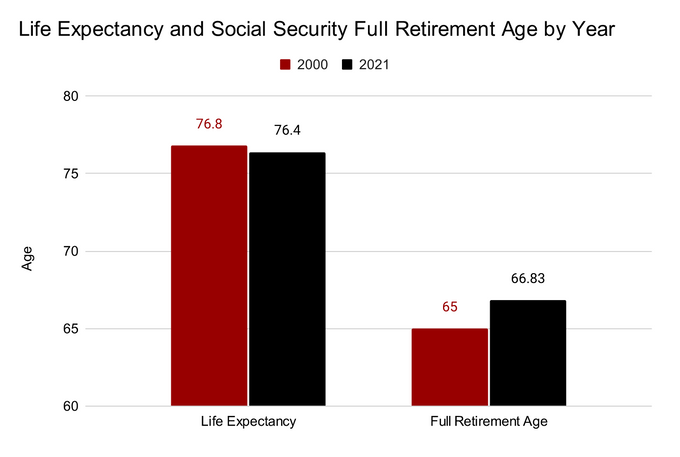
"The presumption was that the increase in life expectancy since Social Security's implementation would continue as the retirement age rose. But, in reality, something peculiar happened," Smyth wrote. "Over the same period during which the 1983 law forced the retirement age up from 65 to 67, life expectancy in the U.S. actuallydeclined. In 2000, U.S. life expectancy was 76.8 years. According to data released last December, life expectancy in 2021 was 76.4 years. This was the second consecutive year of significant life expectancy decline."
"That's a drop of 0.4 years over a time span when the FRA rose by nearly two years," Smyth observed. "So not only have Americans seen their benefits cut by an increase in the FRA, they now also face a particularly morbid version of a benefit cut in the form of shorter lives."
(Image: People's Policy Project)
The new analysis comes as some congressional Republicans are openly advocating further increases in the retirement age, with one GOP lawmaker recently declaring that people "actually want to work longer."
In a policy agenda released last year, theHouse Republican Study Committee (RSC) echoed Reagan-era arguments in favor of raising the full retirement age to 70—a change that would cut Social Security benefits across the board at a time when many retirees are struggling to afford basic necessities.
The RSC agenda states that Republican legislation known as the Social Security Reform Act would "continue the gradual increase of the normal retirement age that current law has set in motion at a rate of three months per year until it is increased by three years for those reaching age 62 in 2040, 18 years from now."
"This adjustment," the document claims, "would begin to realign the Social Security full retirement age to account for increases in life expectancy since the program's creation."
President Biden and congressional Democrats have pledged to reject any proposed cuts to Social Security, which Republicans have threatened to pursue in exchange for a deal to raise the debt ceiling.
In addition to urging Biden and Democratic lawmakers to stand firm against Social Security cuts, advocates are calling on the president to embrace a Social Security expansion plan such as the one recently proposed by Sens. Bernie Sanders of Vermont and Elizabeth Warren of Massachusetts, which would fund benefit increases by raising the payroll tax cap so that wealthier Americans contribute a more equal share to the program.
"President Biden campaigned on a promise to expand Social Security's modest benefits, while dedicating more revenue to it. Most Democratic senators and members of the House support that as well. Yet the mainstream media fails to take those proposals seriously," Nancy Altman, president of the advocacy group Social Security Works, wrote in an op-ed for Common Dreams last week.
"If the Biden administration championed an expansion plan, unveiled at a White House event with major stakeholders in attendance," Altman added, "that could not be ignored."
matt t says greenspan prediction record terrible (pundit zombie pension plan); ayn rand groupie, paul ryan ...
the other has orcs
thom 822
...
Sociopaths of the world, unite!
Rand, like Trump, lived a largely joyless life. She mercilessly manipulated people, particularly her husband and Alan Greenspan (who brought a dollar-sign-shaped floral arrangement to her funeral), and, like Trump, surrounded herself with cult-like followers who were only on the inside so long as they gave her total, unhesitating loyalty.
Like Trump, McConnell, Stefanik and their billionaire backers, Rand believed that a government working to help out working-class “looters,” instead of solely looking out for rich capitalist “producers,” was throwing its “best people” under the bus.
In Rand’s universe, theproducershad no obligations to thelooters. Providing welfare or sacrificing one nickel of your own money to help a “looter” on welfare, unemployment, or Social Security — particularly if it was “taken at the barrel of a gun” (taxes) — was morally reprehensible.
Like Trump saying, “My whole life I’ve been greedy,” for Rand looking out for numero uno was the singular name of the game — selfishness was next to godliness.
Later in Rand’s life, in 1959, as she gained more notoriety for the moral philosophy of selfishness that she named “Objectivism” and that is today at the core of libertarianism and the GOP, she sat down for an interview with of60 Minutes.
Suggesting that selfishnessunderminesmost truly American values, Wallace bluntly challenged Rand....
==
10/30/16 kpfa greenspan testfied model worked 40 yearts but ignored enron and savings and loan; he was hired as lobbyist by keating?! 10:30 am philip muldery
https://kpfa.org/episode/sunday-show-october-30-2016/
In the first hour Mainstreaming the Alt-Right with Ruth Conniff,
editor and chief of The Progressive, progressive.org, and Chip Berlet, Independent Investigative Journalist, researchforprogress.us. In the second hour Merger at AT&T and Time Warner with William Black, Assoc. Professor of Economics and Law at Univ. of Missouri Kansas City and former E.D. of the Federal Home Loan Bank Board.
...The reason it’s important to understand this is that the people most responsible for what happened don’t want you to. Take Alan Greenspan, who as chairman of the Federal Reserve during the bubble’s heyday possessed the most economic power of any single human being on earth, and could have punctured it with one strong speech.
In 2010, when Greenspan claimed on Bloomberg TV that “everybody missed it, academia, the Federal Reserve, all regulators,” he was specifically asked about the people featured in the book version of The Big Shortwho saw it all coming. Greenspan answered: “You have to ask yourself why would they make that judgment. The problem that you’re raising is a statistical illusion. … If you took 1,000 people and you split them into two and you had them toss coins against each other, when you get down to the last two guys, tell them that they don’t know how to toss coins.”
The second part of what Greenspan said was completely true — that is, correctly calling the timing of a bubble’s collapse is largely luck, and it’s unlikely anyone in The Big Short will be able to do it again as well with anything else.
But for Greenspan, that was also completely irrelevant. As Fed chair, he didn’t need to know precisely when the bubble would deflate, something that was essentially impossible. He only needed to know that it existed, something that could be figured out by anyone with a subscription to *The Economist*.
And this is funny: After Greenspan “missed” the housing bubble and caused the greatest economic catastrophe since the Great Depression, he was hired by John Paulson, a hedge fund manager who personally made over $3 billion off of it. As an additional demonstration of Paulson’s gratitude, he also took a tiny fraction of his winnings and endowed the Alan Greenspan Chair in Economics at New York University. Ha ha.
That said, there certainly were people who genuinely had no idea what was going on. In 2005 I interviewed Greg Mankiw, a schmancy Harvard professor who had just finished two years as chairman of George W. Bush’s Council of Economic Advisers. When I asked whether he believed we were in the middle of a housing bubble, he became extremely agitated by the idea that mere humans could believe they knew more than the all-seeing market.
• The people who shorted the housing market weren’t the good guys
The Big Short does a great job depicting the mixed motives of the characters played by Steve Carell and Christian Bale (and its other stars, Ryan Gosling and Brad Pitt), but it’s impossible not to root for them as they call bullshit on the entire financial industry. Moreover, in theory people who short markets perform a valuable function, making bubbles less likely by forcing prices of financial securities to stick tighter to their actual value.
But in practice, that’s only true in heavily regulated, publicly traded areas like the stock market. The characters of The Big Short were shorting housing via bespoke insurance from largely unregulated insurers like AIG Financial Products, which weren’t required to have enough money to pay out on any significant claims. Instead, AIG FP’s business model assumed that it would mostly just collect premiums. It was like a fire insurance company that was incredibly profitable as long as nothing ever burned down.
We know what happened to AIG when the fire began: Everyone who’d bought insurance from AIG FP showed up to collect their claims, making all of AIG instantly bankrupt — until the Treasury Department and the Fed joined forces to provide a $182 billion bailout. So all the money pocketed by the protagonists of The Big Short came ultimately from us. Without us, all their cleverly engineered credit default swaps would have been worth as much as a pile of Enron stock.
• For regular people, Wall Street’s nonsense was largely an irrelevant sideshow
First Wall Street exploded in late 2008 like a . Then everybody you know was laid off and hasn’t been able to find anything that pays as well since. So it certainly seems logical that the first thing caused the second — and that as maddening as the Wall Street bailout was, if things were this bad with it, without it there would have been a second Great Depression.
Except our own great recession actually began in late 2007. And the people telling us Wall Street’s collapse caused the whole economy to fall apart are the same ones who used to tell us that you could never go wrong by investing in real estate. Maybe it would behoove us, like it did the subjects ofThe Big Short, to look more closely at their story.
Dean Baker, mentioned above, probably got more right about the housing bubble and its effect on the real economy than anyone else. He makes a strong case that what mattered to ordinary people was simply that the housing bubble deflated, not the intricacies of how bankers inflated it in the first place and subsequently destroyed themselves.
As Baker explains it, our economic catastrophe was straightforward: At its peak, the housing bubble added $1.2-1.4 trillion in annual private sector demand to the economy, or around 10 percent of GDP. Part of this was extra homes being built employing extra construction workers, and part was that homeowners believed they were richer than they were and hence were more willing to spend money.
There was no easy way for the private sector to replace that demand,whether Wall Street had gotten a well-designed bailout that punished wrongdoers and cut banks down to size, the horribly designed bailout that we did get, or no bailout at all. (Moreover, the high-pressure sales job on the bailout relied on claims that without it we’d all be murdered by something called the commercial paper market. Even Treasury officials from that period have admitted that was almost certainly a fairytale.)
But there was a solution available: The federal government just had to spend a gigantic amount of money to replace that $1.2-1.4 trillion in annual demand. But Obama was never willing to ask Congress for enough, and Congress might never have provided it even if he had. Instead we got $300 billion of stimulus in 2009 and 2010, and then dribbles afterward. It shouldn’t be any surprise that everyone under 30 is still living in their parents’ spare bedroom.
This is the true cost of the housing bubble and Wall Street’s looting of our country. You often hear that the financial crisis destroyed, say, $14 trillion in housing and stock market wealth. This is wrong. By itself, the financial crisis destroyed little wealth. The $8 trillion in extra housing bubble “wealth” never existed in the first place; the crisis simply revealed that reality. And the stock market recovered fairly quickly, because that wealth was (mostly) real.
The actual price we’ve paid is that the U.S. economy has been operating far under capacity for eight years. The total value of the goods and services we could have produced but have not is over $7 trillion. That’s more than enough — about $90,000 for every family of four in the country — and as long as the economy remains depressed, it will keep accumulating, along with millions of broken lives.
Thus the real criminals are exactly who you think they are: Wall Street, plus the Republicans and Democrats who execute their orders. But the biggest crime they committed isn’t their spectacularly creative financial fraud. It’s been their absolute refusal afterward to allow us to use our own government to fix the disaster they created.
...
https://theintercept.com/2015/12/14/go-see-the-big-short-right-now-and-then-read-this/
==
==
http://www.theawl.com/2011/04/when-alan-met-ayn-atlas-shrugged-and-our-tanked-economy
OBJECT LESSONS
When Alan Met Ayn: "Atlas Shrugged" And Our Tanked Economy
by Maria Bustillos April 12, 2011
That pill-popping, boy-crazy nincompoop Ayn Rand has got a lot to answer for. Indeed, it’s not too much of a stretch to say that we owe at least part of the recent economic crisis to her and her philosophy of Objectivism, since former Fed chief Alan Greenspan was a lifelong disciple of both.
The two first met in the ’50s. Back then, a gang of acolytes, calling themselves the Collective, used to gather at Rand’s apartment on East 36th Street every Saturday night so they could tell each other how smart they all were. Along came Greenspan one evening, shy and somber.
It took a while for Greenspan and Rand to warm to one another. She nicknamed him “the undertaker,” owing to his dark clothes and mournful air, and he, a self-avowed logical positivist, required a certain amount of wooing on the philosophical side. But in time he became fiercely devoted to Rand, one of her most trusted confidants; he taught her something of the economics she shoehorned into Atlas Shrugged. He wrote for The Objectivist magazine, and stayed a close friend until her death in 1982.
Though the schemes of both these idealists crashed mightily and catastrophically to earth, both steadfastly refused ever to regret or repudiate the follies of Objectivism. The shocking thing is that despite all the evidence—which could not possibly be more damning—many on Wall Street and on the right continue to insist that Ayn Rand is a genius and that Objectivism is the answer to all mankind’s problems.
If that were so, doesn’t it stand to reason that the top genius’s own life would demonstrate at least a few of the benefits of being an Objectivist? Which, sadly, it really, really does not.
Greenspan’s tenure of nearly two decades as the chairman of the Federal Reserve is the second longest in history. Shouldn’t he have bestowed on a grateful public a legacy demonstrating the wisdom of Objectivist laissez-faire policies? We know how that turned out, too.
There’s about to be a movie, ostensibly the first of a trilogy, of Atlas Shrugged, Rand’s magnum opus. The trailer is absurd but mesmerizing, and it quickly gained over a million views on YouTube. Paul Johansson, an actor and neophyte director best known for his work on “One Tree Hill,” seems to have done a fine job with a tiny budget of somewhere between $15 and $25 million; the production looks terrific, sparkling with evening gowns and champagne, like a hopped-up version of Dynasty (which, come to think of it, Atlas Shrugged really does kind of resemble.) “If you double-cross me, I will destroy you,” the sleek blonde in the business suit informs her foe, with less conviction than an ordinary person would employ in ordering a salad. If the trailer is to be believed, this movie has a lot of campy pleasure in it. I kind of can’t wait!
Atlas Shrugged is about the tender love of a beautiful girl for her railroad, and also for a heap of powerful, visionary men. Nietzsche meets Harlequin, basically. It is also intended as a manifesto and rallying-cry for Objectivism: an XXL-sized political pamphlet.
Okay, so what is Objectivism, exactly?
In 1959, Mike Wallace asked Rand to “capsulize” her philosophy, which she proceeded to do, in a Boris Badenov accent and a comically self-satisfied manner.
I am primarily the creator of a new code of morality which has so far been believed impossible, namely a morality not based on faith, not on arbitrary whim, not on emotion, not on arbitrary edict, mystical or social, but on reason; a morality that can be proved by means of logic which can be demonstrated to be true and necessary.
Now may I define what my morality is? [I guess.] Since man’s mind is his basic means of survival […] he has to hold reason as an absolute, by which I mean that he has to hold reason as his only guide to action, and that he must live by the independent judgment of his own mind; thathis highest moral purpose is the achievement of his own happiness […] that each man must live as an end in himself, and follow his own rational self-interest.
Mike Wallace could scarcely believe his ears. His pop-eyed astonishment is a big part of what made this interview such great television.
Nietzsche Was Her Homeboy
Rand’s commitment to egoism as the basis for morality began as a reaction against the “collectivist” impulses she reckoned to be responsible for the collapse of Russia, where she was born in 1905. Her family’s wealth had been grabbed in the Revolution, so it’s no surprise that Rand would be anti-Communist. What is a surprise is that she would suppose as she did that the “altruistic” motives of Communism were to blame for everything that went wrong in her native country.
Objectivism is 100% pro-individualism and anti-altruism. Rand believed that altruism is literally wrong, that it weakens the all-important Individual and his chances of finding happiness. She took most of her shtick (enthronement of the Will, super-individualism, exaltation of “artists,” atheism, the Übermensch who is superior to the regular kind, etc. etc.) straight from Nietzsche, although she later denied his influence, claiming only Aristotle (!) as a philosophical forebear. But according to Rand biographer Jennifer Burns (whose book Goddess of the Market: Ayn Randand the American Right is really good), Rand’s early notebooks and journals all but feature little hearts drawn around Nietzsche’s name: “Nietzsche and I think,” “as Nietzsche says,” and so on.
The possibility that the unfettered egoism of guys like Stalin was the main problem with the Russian government, rather than too much altruism, escaped Rand entirely. As someone whose family likewise hails from a Communist country, I find it bizarre that this was not obvious to her. When all the big houses, all the money and privileges in a society accrue to just one class of people, it is safe to conclude that those people are acting out of self-interest and not altruism or whatever other bogus virtues they are ascribing to themselves. Just watch who gets richer, if you want to know what the real motivation is. Not to put too fine a point on it, Stalin was probably about the greatest Objectivist who ever lived, with a few possible exceptions like Mao Tse-Tung, Hitler and Pol Pot.
After the 1929 crash, many in the West believed that some form of Communism was inevitable in the developed world. For a long time American (and Knifecrime Island) intellectuals generally believed that Stalin was a fine man who was just trying to do the best he could for his people; that enraged Rand, who’d arrived in the U.S. in 1926 and knew the score. It wasn’t until the Non-Aggression Pact between Stalin and Hitler became public in 1939 that Americans really turned conclusively and permanently against Communism.
The Fountainhead, Rand’s first real go at a manifesto, was published in 1943. Though reviews were mixed, the book was a runaway success both as a publishing phenomenon and as a calling card for Objectivism. A movie was made in 1949, directed by King Vidor and starring Patricia Neal and Gary Cooper. Rand was at the zenith of her success with the public, celebrated and admired in New York, Ginger Rogers and Ira Levin wrote her fan letters, and the Collective began to collect around her.
Atlas Heaves into View
Into this milieu came Greenspan, age 26, dragged along by his first wife, Joan Mitchell.
Although very young, Greenspan was already a successful economic analyst whose consulting firm, Townsend-Greenspan & Co., Inc., was paid hefty sums to figure out what the hell was being said in government reports and things. Unlike most of the other Collectivists, who were students, Greenspan had something concrete to contribute to Rand’s work. She asked him all sorts of questions about the steel and railroad industries relating to her new novel. He, for his part, thought she was the smartest person ever, saying, “talking to Rand was like starting a game of chess thinking I was good, and suddenly finding myself in checkmate.”
The Collective was convinced that all mankind would rush to become Objectivists the moment Rand’s next novel was published. It was called Atlas Shrugged, and for once the words “eagerly awaited” were for real. A gap of 14 years separated the first blockbuster and the second. But there was an anger, contempt and malevolence toward the common man in the second book that had not been present in the first one. This time the reviews were scathing.
In Atlas Shrugged Rand creates a world where there are people who deserve to live because they are “intelligent” and “creative,” and those who do not. The former set out to rid themselves of the latter. These “men of the mind,” whom their author clearly worships, go “on strike” and refuse to be creative any more, which means that everybody else must perish. And because it’s a work of fantasy entirely under Rand’s control, they all go ahead and obediently perish. (IRL, people were not quite so obedient, as we shall see.)
For those who are inclined to find such ideas ludicrous, the book will fail, and utterly; its premises betray a bottomless ignorance of the deep interconnectedness of humankind, and the needs—economic, social, emotional, intellectual—of one human being for another. In the real world, someone is growing lettuce, someone else is writing a book or feeding a baby, yet another is designing the rails of a high-speed train. Someone else is teaching six-year-olds to read. All of us benefit from all of these activities—sometimes directly, sometimes indirectly. Each life can and does touch many thousands of others. The idea of the Nietszchean Superman who acts against his fellows (whom Rand called “the mob” and “looters” and whatnot) is consequently fatally flawed. Not even the Superest Superman can grow all his own food, make all his own paper, design and build his own cars and airplanes, etc. (Hadn’t Rand ever read Robinson Crusoe?) Humanity is a collaborative project, as well as a project of individuals.
This is to say nothing of the flatness of the book’s characters, its clanking exposition, its interminable speechifying or the woodenness of its dialogue. On the upside, there is a character named Francisco Domingo Carlos Andres Sebastian d’Anconia. Not even Baroness Orczy had that kind of nerve.
Atlas Shrugged burst onto the scene in 1957 and was promptly and categorically reviled from both right and left, as it has continued to be. It also sold like hotcakes, as it still does.
Whittaker Chambers’s famous takedown of Atlas Shrugged, “Big Sister is Watching You” appeared in The National Review in December of 1957. Rand claimed never to have read it (mmmhmm) but refused to let anyone so much as mention Chambers in her presence.
He wrote, “Out of a lifetime of reading I can recall no other book in which a tone of overriding arrogance was so implacably sustained. Its shrillness is without reprieve. Its dogmatism is without appeal. In addition, the mind which finds this tone natural to it shares other characteristics of its type. 1) It consistently mistakes raw force for strength, and the rawer the force, the more reverent the posture of the mind before it. 2) It supposes itself to be the bringer of a final revelation.”
This essay and its message stood between many on the far right and a potentially fervent embrace of Objectivism. After all, Chambers was the pumpkin-growing former Communist who became a bona fide ferreter-out of real live Communists In Our Midst, having been responsible for sending Alger Hiss to jail; and if there is anything a hard-right conservative used to love more than putting Communists in jail, it was a former lefty who’d come over to the other side, like Ronald Reagan. That is, after all, what they hope is going to happen to all the lefties.
Other reviews were not so much negative as incendiary. In Esquire, Gore Vidal wrote that Objectivism was “nearly perfect in its immorality.” Time’s reviewer asked, “Is it a novel? Is it a nightmare?”
So the loyal Alan Greenspan, then around thirty years old and already a big shot in financial circles, wrote to the New York Times to defend the book as follows: “‘Atlas Shrugged’ is a celebration of life and happiness. Justice is unrelenting. Creative individuals and undeviating purpose and rationality achieve joy and fulfillment. Parasites who persistently avoid either purpose or reason perish as they should.”
Note how human fulfillment is distributed here in Randian terms, to the “deserving”, whereas the “parasites” are going to go up in flames “as they should.” It is a little chilling to hear a grown man say that sort of stuff, particularly a grown man who will come to have that much influence over the fortunes of so many.
Greed Is So, So Good
So why have so many loved (and still love) this book so very much?
In addition to praising people for being selfish and money-worshiping, Atlas Shrugged has a second rare virtue—a real one, this time—a genuine fascination with business. Few novels of the twentieth century provide a halfway credible or interesting take on business, largely because the arcane details that go into running one are hard to dramatize well. (There are exceptions, of course. James Clavell is great at this, and so is Eric Ambler. Best of all, maybe, is Nevil Shute, whose A Town Like Alice is the novel Ayn Rand or anyone else should have wished she could write. It has got business, suspense, romance, exoticism and adventure, and is a pure delight to read.)
Even today, financial and business types are drawn to Atlas Shrugged for its unusual preoccupation with industry and economics. Plus, it’s not just that literature does not ordinarily occupy itself much with business; literary sophistication is not a prized quality on Wall Street or in business circles generally. Across the table from you, a VC or Wall Street guy will wax all lyrical about Atlas Shrugged and you’ll say wow, you read novels? If you ask what other books they like, though, they might mention The Art of War, which has been a big deal with them since the ’80s, or maybeThe Big Short, or a biography of Warren Buffett. (But not Griftopia! Heh.)
Then there’s the matter of egoism, which is where the Libertarian or far-right angle comes in. Rand is all about the Self-Sufficiency. This is why there are no children in her books. In a Rand novel, no one ever helps anyone or even concerns himself much with anyone else. Pitilessness is the highest virtue there is, it signifies Will and Strength and stuff. The weak are “lice” and “parasites”. Atlas Shrugged is almost a caricature of social Darwinism. Gore Vidal explained it this way: “She has a great attraction for simple people who are puzzled by organized society, who object to paying taxes, who dislike the welfare state, who feel guilt at the thought of the suffering of others but who would like to harden their hearts.”
But the self-interest thing really has a nice ring to it, recalling as it does the elegance of Satanism’s single commandment: “Do as thou wilt shall be the whole of the law.” Rand’s books have sold nonstop from the moment they were published because people love hearing how not only can they get away with being totally selfish, it’s absolutely the right way to be. The best way to be, as in, morally the best. EST and the Prosperity Gospel have much the same appeal. And sure, that all sounds fine when you are home reading a book, by yourself, but just go out there and try it. As Rand herself did.
Love Is An Objectivism Battlefield
1968 was the year of doom for the Objectivist cult’s first wave. Rand had been having an on-again, off-again affair for over a decade with her prime minister and heir, the handsome wacko Nathaniel Branden (born Nathan Blumenthal), 25 years her junior.
Both of them were married when the affair began—he, 24; she, 49—but they rounded up the spouses and talked all four together about how Branden and Rand were going to be lovers, because, yeah, that always works out so well.
Fourteen years into the affair and Branden, now 38, was done with the whole thing. But every time he tried to break up with Rand, she would fly into torrents of rage and yell at him that he had “no right to sex with some inferior woman!” “The man to whom I dedicated Atlas Shrugged would never want anything less than me!” she shrieked. This went on for ages.
Meanwhile, Rand’s husband, Frank O’Connor, was off drinking himself into a stupor, and Branden’s wife Barbara was slowly losing what was left of her marbles.
Finally, unable to put up with any more scenes, Branden informed Rand by letter that their age difference “now made sex with her impossible” for him. She was devastated. But there was worse to come, because Branden had decided not to mention a secret affair he was having with one of his students, a beautiful young model named Patrecia Gullison. Because even though Branden was an Objectivist expressing his Highest Moral Purpose by Achieving his Own Happiness and all, he was also terrified of what would happen when Rand found out about it.
And for very good reason. When Rand did find out about it, she hit the ceiling and summoned Branden to her apartment and fired him and called the spouses in for another group powwow and screamed and slapped Branden’s face multiple times, in the foyer, because she wouldn’t let him in the living room. This, even though Branden had been Mr. Objectivism for years and years, and the Nathaniel Branden Institute had grown into a huge organization for the spread of Objectivism.
Reason, you would think, demanded restraint, and Rand had for decades styled herself the high priestess of Reason. There were relationships, reputations and institutions to protect on all sides, a thriving business, as well as the propagation of a mankind-saving philosophy to see to.
So what! She was a woman scorned.
Which meant that no sensible, rational considerations prevented Rand from publishing a letter addressed “To Whom It May Concern” in The Objectivist that accused Branden and his wife of deception, and (falsely, it appears) of financial hi-jinks—and of generally being bad Objectivists. “I repudiate both of them, totally and permanently,” she wrote, “as spokesmen for me or Objectivism.” A few prominent Objectivists signed this incoherent breakup letter along with Rand, among them—yes!—Alan Greenspan, the future Fed chairman.
The scandal caused lasting damage to Rand’s reputation, and to her organization. Nathaniel Branden would eventually move to California, found new organizations and therapeutic practices, and marry three times more; the beautiful Patrecia, sadly, drowned in a swimming pool after suffering an epileptic seizure in 1977. (Branden’s memoir My Years with Ayn Rand is hot as a pistol, absolutely riveting and danged scary, btw.)
Greenspan Frees The Market
Although the Collective never really recovered from the events of 1968, Alan Greenspan never broke with Ayn Rand. In his 2008 memoir, The Age of Turbulence, he writes, “[o]f all my teachers, Arthur Burns and Ayn Rand had the greatest impact on my life… Ayn Rand expanded my intellectual horizons, challenging me to look beyond economics to understand the behavior of individuals and societies.” He speaks warmly of her throughout the book, even knowing all that he did about her skeleton-packed closet; his loyalty elicits both sympathy and exasperation.
In his own way, Greenspan had inherited in toto Rand’s short-sightedness, egocentrism and complete lack of understanding of “the behavior of individuals and societies.” Though he would play his delusions out in a very different arena and not, so far as is generally known, be going around slapping anybody in the foyer. His big scene would come forty years later, in a Congressional hearing room.
Greenspan was no mere theorist when it came to Objectivism and was, in time, in a position to put its theories into practice on a massive scale. He believed fervently that business should not be regulated by us parasitic consumers, and had written to that effect from the ’60s onward. In 1987, he became Fed Chairman, succeeding the towering (and wholly unobjectivist) Paul Volcker. The results of his Objectivist convictions, made manifest in that role, were far-reaching. It has been argued in many quarters that Greenspan’s rock-ribbed laissez-faire policies resulted in a succession of bubbles—first in the dot-com boom, then in real estate and credit—that led directly to the 2008 crisis.
Part of the blame lies in his attitude toward derivatives. The efforts of the CFTC’s Brooksley Born to compel the regulation of derivatives trading began in 1994, but came to nothing owing largely to Greenspan’s objections. After the Enron debacle, which, thanks to “the smartest guys in the room,” left California holding the bag on about $9 billion of natural gas bills, Senator Diane Feinstein made herself very busy pestering Greenspan about the need to regulate derivatives. In 2004,Alan shrugged: he wrote to Congress in response to Senator Feinstein in what had by then become the signature Greenspan style of floaty, oracular, narcoleptic polysyllables:
Businesses, financial institutions, and investors throughout the economy rely upon derivatives to protect themselves from market volatility triggered by unexpected economic events. This ability to manage risks makes the economy more resilient and its importance cannot be underestimated. In our judgment, the ability of private counterparty surveillance to effectively regulate these markets can be undermined by inappropriate extensions of government regulations.
If the Enron disaster had not already made the hollowness of this argument horribly apparent, the financial crisis four years later could leave no doubt. And so it was that in October 2008, the mother of all Objectivist reckonings came to pass: The Span had to defend his disastrous policies to Congress one Thursday afternoon and explain why the U.S. economy, for decades under his stewardship, had gone kablooey. Here is what he said to that mob of furious congressmen who made up the House Committee on Oversight and Government Reform.
“I made a mistake in presuming that the self-interests of organizations, specifically banks and others, were such as that they were best capable of protecting their own shareholders and their equity in the firms […]
“Those of us who have looked to the self-interest of lending institutions to protect shareholders’ equity, myself included, are in a state of shocked disbelief.”
Never mind that for years Greenspan had had a bunch of regulators and congressmen all but coming after him with baseball bats trying to get him to see that “the self-interest of lending institutions” was no match for the greed of unscrupulous individuals.
For Communist “altruism,” read “SEC regulation.” For Stalin, read Lloyd Blankfein et so many al. Just follow the money. How much does it cost such guys to pay lip service to the glories of the free market, Communism, whatever, while they grab everything that isn’t nailed down for themselves? Not too much, if all you care about is your own, um. Individualism.
“You had the authority to prevent irresponsible lending practices that led to the subprime mortgage crisis. You were advised to do so by many others,” said Representative Henry A. Waxman of California, chairman of the committee. “Do you feel that your ideology pushed you to make decisions that you wish you had not made?”
Mr. Greenspan conceded: “Yes, I’ve found a flaw. I don’t know how significant or permanent it is. But I’ve been very distressed by that fact.”
He found a flaw! I bet Diane Feinstein popped an aneurysm right then and there.
If Alan Greenspan had had a lick of sense he would have known that the jig was up and it was time for him to say, Ayn Rand was the biggest dope on record, except for me, because I listened to her. But guys like Greenspan don’t ever seem to say that sort of thing. I suspect that it’s because they have gotten so completely used to thinking of themselves as the “elite” who needn’t reckon with the “weak” objections of lesser men.
So Greenspan maintained his convictions to the last. Even in 2008 with the shit engulfing the fan, he was still trying to prevent more stringent securities regulation. Why?
“Whatever regulatory changes are made, they will pale in comparison to the change already evident in today’s markets,” he said. “Those markets for an indefinite future will be far more restrained than would any currently contemplated new regulatory regime.”
Using the exact same reasoning he’d just admitted to be erroneous, he was still claiming that the market would take care of itself. He found a flaw and then he lost it again pretty much instantly. The remains of the market are sitting right in front of him in a smoking ruin and what is his prescription? More of the same!
And what is the result, three years later? The markets in unregulated derivatives, Warren Buffett’s “financial weapons of mass destruction,” were never outlawed and are alive and well. Nobody went to jail or even really had his hand slapped, except for Bernie Madoff. Nearly all the destructive forces Greenspan set in motion came roaring right back, along with Wall Street bonuses, despite his claims of the enormous restraint certain to follow the debacle of 2008, for “an indefinite future” that didn’t last for even one year.
So here we return to the “looters” who don’t create anything, and the policy of cherchez l’argent. Greenspan and all these free marketers and bankers and Wall Street guys who generally just love Ayn Rand, self-sufficiency and individualism, and so they would never see themselves as the looters. But the question is just so there, because while the financial services sector provides some valuable services to a society, it is very questionable indeed whether those services are worth 12% of GDP, which is, by the way, about what we’re all paying now, or roughly triple what they used to cost before the publication of Atlas Shrugged.
The real parasites, it turns out, are not the looting masses but the Objectivist elites (what is it that these hedge fund managers “create” again?), rabidly pursuing their own “happiness” at the cost of our social safety net, our environment and the prosperity and well-being of the world’s people. So much for the triumph of individualism.
Maria Bustillos is the author of Dorkismo and Act Like A Gentleman, Think Like A Woman..
raj patel commonwealth 2010 oversight greenspan flaw in the model of how world works
https://www.youtube.com/watch?v=Z4oLqOGnSMs 14 min
==
https://en.wikipedia.org/wiki/Alan_Greenspan
Alan Greenspan (/:{ˈælɨn:(style="border-bottom-width:1px;border-bottom-style:dotted"):}: :{ˈɡriːnspæn:(style="border-bottom-width:1px;border-bottom-style:dotted"):}:/; born March 6, 1926) is an American economist who served as Chairman of the Federal Reserve of the United States from 1987 to 2006. He currently works as a private adviser and provides consulting for firms through his company, Greenspan Associates LLC. First appointed Federal Reserve chairman by PresidentRonald Reagan in August 1987, he was reappointed at successive four-year intervals until retiring on January 31, 2006, after the second-longest tenure in the position (behind William McChesney Martin).[1]
Greenspan came to the Federal Reserve Board from a successful consulting career. Although he was subdued in his public appearances, favorable media coverage raised his profile to a point that several observers likened him to a "rock star".[2][3][4] Democratic leaders of Congress criticized him for politicizing his office because of his support for Social Security privatization[5] and tax cuts, which they felt would increase the deficit.[6] The easy-money policies of the Fed during Greenspan's tenure have been suggested by some to be a leading cause of the subprime mortgage crisis, which occurred within months of his departure from the Fed, and have, said the Wall Street Journal, "tarnished his reputation" despite his warnings of "irrational exuberance".[7] Yale economist Robert Shiller argues that "once stocks fell, real estate became the primary outlet for the speculative frenzy that the stock market had unleashed."[8]
Contents
- 1 Early life and education
- 2 Career
- 3 Objectivism
- 4 Reception
- 5 Personal life
- 6 Honors
- 7 See also
- 8 References
- 9 Further reading
- 10 External links
...
Housing bubble:{:(style="margin-right:0.25em"):}:[edit:{]}:
In the wake of the subprime mortgage and credit crisis in 2007, Greenspan stated that there was a bubble in the U.S. housing market, warning in 2007 of "large double digit declines" in home values "larger than most people expect".[62] Greenspan also noted, however, "I really didn't get it until very late in 2005 and 2006."[63]
Greenspan stated that the housing bubble was "fundamentally engendered by the decline in real long-term interest rates",[64] though he also claims that long-term interest rates are beyond the control of central banks because "the market value of global long-term securities is approaching $100 trillion" and thus these and other asset markets are large enough that they "now swamp the resources of central banks".[65]
After the September 11, 2001 attacks, the Federal Open Market Committee voted to reduce the federal funds rate from 3.5% to 3.0%.[66] Then, after the accounting scandals of 2002, the Fed dropped the federal funds rate from then current 1.25% to 1.00%.[67] Greenspan stated that this drop in rates would have the effect of leading to a surge in home sales and refinancing, adding that "Besides sustaining the demand for new construction, mortgage markets have also been a powerful stabilizing force over the past two years of economic distress by facilitating the extraction of some of the equity that homeowners have built up over the years".[67]
According to some, however, Greenspan's policies of adjusting interest rates to historic lows contributed to a housing bubble in the United States.[68] The Federal Reserve acknowledged the connection between lower interest rates, higher home values, and the increased liquidity the higher home values bring to the overall economy: "Like other asset prices, house prices are influenced by interest rates, and in some countries, the housing market is a key channel of monetary policy transmission".[69]
In a February 2004 speech,[70] Greenspan suggested that more homeowners should consider taking out adjustable-rate mortgages (ARMs) where the interest rate adjusts itself to the current interest in the market.[71] The Fed own funds rate was at a then all-time-low of 1%. A few months after his recommendation, Greenspan began raising interest rates, in a series of rate hikes that would bring the funds rate to 5.25% about two years later.[72] A triggering factor in the 2007 subprime mortgage financial crisis is believed to be the many subprime ARMs that reset at much higher interest rates than what the borrower paid during the first few years of the mortgage.
In 2008, Greenspan expressed great frustration that the speech he made on February 23, 2004, was used to criticize him on ARMs and the subprime mortgage crisis, and stated that he had made countervailing comments eight days after it that praised traditional fixed-rate mortgages.[73] In that speech, Greenspan had suggested that lenders should offer to home purchasers a greater variety of "mortgage product alternatives" other than traditional fixed-rate mortgages.[70] Greenspan also praised the rise of the subprime mortgage industry and its tools for assessing credit-worthiness:
Innovation has brought about a multitude of new products, such as subprime loans and niche credit programs for immigrants. Such developments are representative of the market responses that have driven the financial services industry throughout the history of our country ... With these advances in technology, lenders have taken advantage of credit-scoring models and other techniques for efficiently extending credit to a broader spectrum of consumers. ... Where once more-marginal applicants would simply have been denied credit, lenders are now able to quite efficiently judge the risk posed by individual applicants and to price that risk appropriately. These improvements have led to rapid growth in subprime mortgage lending; indeed, today subprime mortgages account for roughly 10 percent of the number of all mortgages outstanding, up from just 1 or 2 percent in the early 1990s.[74]
The subprime mortgage industry collapsed in March 2007, with many of the largest lenders filing for bankruptcy protection in the face of spiraling foreclosure rates. For these reasons, Greenspan has been criticized for his role in the rise of the housing bubble and the subsequent problems in the mortgage industry,[75][76] as well as "engineering" the housing bubble itself.
In 2004 Businessweek magazine analysts argued: "It was the Federal Reserve-engineered decline in rates that inflated the housing bubble...the most troublesome aspect of the price runup is that many recent buyers are squeezing into houses that they can barely afford by taking advantage of the lower rates available from adjustable-rate mortgages. That leaves them fully exposed to rising rates.[77]
In September 2008 Joseph Stiglitz stated that Greenspan "didn't really believe in regulation; when the excesses of the financial system were noted, (he and others) called for self-regulation—an oxymoron".[78] Greenspan, according to the New York Times, says he himself is blameless.[79] On April 6, 2005, Greenspan called for a substantial increase in the regulation of Fannie Mae and Freddie Mac: "Appearing before the Senate Banking Committee, the Fed chairman, Alan Greenspan, said the enormous portfolios of the companies—nearly a quarter of the home-mortgage market—posed significant risks to the nation's financial system should either company face significant problems."[80] Despite this, Greenspan still claims to be a firm believer in free markets, although in his 2007 biography he wrote, "History has not dealt kindly with the aftermath of protracted periods of low risk premiums" as seen before the credit crisis of 2008.
In 2009 Robert Reich wrote that "Greenspan's worst move was to contribute to the giant housing bubble and the worst worldwide crash since the Great Depression. In 2004 he lowered interest rates to 1%, enabling banks to borrow money for free, adjusted for inflation. Naturally, the banks wanted to borrow as much as they possibly could, then lend it out, earning nice profits. The situation screamed for government oversight of lending institutions, lest the banks lend to unfit borrowers. He refused, trusting the market to weed out bad credit risks. It did not."[81]
In congressional testimony on October 23, 2008, Greenspan finally conceded error on regulation. The New York Times wrote, "a humbled Mr. Greenspan admitted that he had put too much faith in the self-correcting power of free markets and had failed to anticipate the self-destructive power of wanton mortgage lending...Mr. Greenspan refused to accept blame for the crisis but acknowledged that his belief in deregulation had been shaken". Although many Republican lawmakers tried to blame the housing bubble on Fannie Mae and Freddie Mac, Greenspan placed far more blame on Wall Street for bundling subprime mortgages into securities.[82]
Late 2000s recession:{:(style="margin-right:0.25em"):}:[edit:{]}:
In March 2008, Greenspan wrote an article for the Financial Times' Economists' Forum in which he said that the 2008-financial crisis in the United States is likely to be judged as the most wrenching since the end of World War II. In it he argued: "We will never be able to anticipate all discontinuities in financial markets." He concluded: "It is important, indeed crucial, that any reforms in, and adjustments to, the structure of markets and regulation not inhibit our most reliable and effective safeguards against cumulative economic failure: market flexibility and open competition." The article attracted a number of critical responses from forum contributors, who, finding causation between Greenspan's policies and the discontinuities in financial markets that followed, criticized Greenspan mainly for what many believed to be his unbalanced and immovable ideological suppositions about global capitalism and free competitive markets. Notable critics included J. Bradford DeLong, Paul Krugman,Alice Rivlin, Michael Hudson, and Willem Buiter.[83]
Greenspan responded to his critics in a follow-up article in which he defended his ideology as applied to his conceptual and policy framework, which, among other things, prohibited him from exerting real pressure against the burgeoning housing bubble or, in his words, "leaning against the wind". Greenspan argued, "My view of the range of dispersion of outcomes has been shaken, but not my judgment that free competitive markets are by far the unrivaled way to organize economies". He concluded: "We have tried regulation ranging from heavy to central planning. None meaningfully worked. Do we wish to retest the evidence?"[84] Financial Timesassociate editor and chief economics commentator Martin Wolf defended Greenspan primarily as a scapegoat for the market turmoil. Several notable contributors in defense of Greenspan included Stephen S. Roach, Allan Meltzer, and Robert Brusca.[85]
An October 15, 2008, article in the Washington Post analyzing the origins of the economic crisis claims that Greenspan vehemently opposed any regulation ofderivatives, and actively sought to undermine the office of the Commodity Futures Trading Commission when the Commission sought to initiate regulation of derivatives. Meanwhile, Greenspan recommended improving mark-to-market regulations to avoid having derivatives or other complex assets marked to a distressed or illiquid market during times of material adverse conditions seen during the late 2000s credit crisis.[86]
Greenspan was not alone in his opposition to derivatives regulation. In a 1999 government report that was a key driver in the passage of the Commodity Futures Modernization Act of 2000—legislation that clarified that most over-the-counter derivatives were outside the regulatory authority of any government agency—Greenspan was joined by Treasury Secretary Lawrence Summers, Securities and Exchange Commission Chairman Arthur Levitt, and Commodity Futures Trading Commission Chairman William Ranier in concluding that "under many circumstances, the trading of financial derivatives by eligible swap participants should be excluded from the CEA" (Commodity Exchange Act). Other government agencies also supported that view.[87]
In Congressional testimony on October 23, 2008, Greenspan acknowledged that he was "partially" wrong in opposing regulation and stated "Those of us who have looked to the self-interest of lending institutions to protect shareholder's equity—myself especially—are in a state of shocked disbelief."[59] Referring to his free-market ideology, Greenspan said: "I have found a flaw. I don't know how significant or permanent it is. But I have been very distressed by that fact." When RepresentativeHenry Waxman (D-CA) pressed him to clarify his words. "In other words, you found that your view of the world, your ideology, was not right, it was not working," Waxman said. "Absolutely, precisely," Greenspan replied. "You know, that's precisely the reason I was shocked, because I have been going for 40 years or more with very considerable evidence that it was working exceptionally well."[88] Greenspan admitted fault[89] in opposing regulation of derivatives and acknowledged that financial institutions didn't protect shareholders and investments as well as he expected.
Matt Taibbi described the Greenspan put and its bad consequences saying: "every time the banks blew up a speculative bubble, they could go back to the Fed and borrow money at zero or one or two percent, and then start the game all over", thereby making it "almost impossible" for the banks to lose money.[90] He also called Greenspan a "classic con man" who, through political savvy, "flattered and bullshitted his way up the Matterhorn of American power and...jacked himself off to the attention of Wall Street for 20 consecutive years".[91]
In the documentary film Inside Job Greenspan is cited as one of the persons responsible for the financial crisis of 2007–08. He is also named in Time Magazine as one of the "25 People to Blame for the Financial Crisis".[92]
Political views and alleged politicization of office:{:(style="margin-right:0.25em"):}:[edit:{]}:
Greenspan describes himself as a "lifelong libertarian Republican".[51]
In March 2005, in reaction to Greenspan's support of President Bush's plan to partially privatize Social Security, Democratic Senate Minority Leader Harry Reid attacked Greenspan as "one of the biggest political hacks we have in Washington"[5] and criticized him for supporting Bush's 2001 tax cut plan.[6] Then-Democratic House Minority Leader Nancy Pelosi added that there were serious questions about the Fed's independence as a result of Greenspan's public statements.[93] Greenspan also received criticism from Democratic Congressman Barney Frank and others for supporting Bush's Social Security plans favoring private accounts.[94][95][96] Greenspan had said Bush's model has "the seeds of developing full funding by its very nature. As I've said before, I've always supported moves to full funding in the context of a private account".[97]
Others, like Republican Senator Mitch McConnell, disagreed that Greenspan was too deferential to Bush, stating that Greenspan "has been an independent player at the Fed for a long time under both parties and made an enormous positive contribution".[98]
Economist Paul Krugman wrote that Greenspan was a "three-card maestro" with a "lack of sincerity" who, "by repeatedly shilling for whatever the Bush administration wants, has betrayed the trust placed in the Fed chairman".[99]
Republican Senator Jim Bunning, who opposed Greenspan's fifth reconfirmation, charged that Greenspan should comment only on monetary policy, not fiscal policy.[100] Greenspan had used his position as Fed Chairman to comment upon fiscal policy as early as 1993, however, when he supported President Clinton's deficit reduction plan, which included tax increases and budget cuts.[101]
In an October 2011 lecture addressing the Occupy movement,[102] Noam Chomsky characterized portions of Greenspan's February 1997 testimony to the U.S. Senate as an example of the self-serving attitudes of the so-called 1%. In that testimony, Greenspan had stated that growing worker insecurity is a significant factor keeping inflation and inflation expectation low, thereby promoting long-term investment.
Personal life:{:(style="margin-right:0.25em"):}:[edit:{]}:
Greenspan has married twice. His first marriage was to an artist named Joan Mitchell in 1952; the marriage ended in annulment less than a year later.[103] He dated newswoman Barbara Walters in the late 1970s.[46] In 1984, Greenspan began dating journalist Andrea Mitchell. Greenspan at the time was 58; Mitchell is 20 years younger. In 1997, they were married by Supreme Court Justice Ruth Bader Ginsburg.[104][105]
Honors:{:(style="margin-right:0.25em"):}:[edit:{]}:
[ ](https://en.wikipedia.org/wiki/File:Greenspan,_Alan_%28Whitehouse%29.jpg)
PresidentGeorge W. Bush presents the Presidential Medal of Freedom to Alan Greenspan, on November 9, 2005, in the East Room of the White House.

- [
 ](https://en.wikipedia.org/wiki/File:Presidential_Medal_of_Freedom_with_Distinction_%28ribbon%29.PNG) Presidential Medal of Freedom The highest civilian award in the United States, by President George W. Bush in November 2005.[106]
==
But the Enron loophole was small potatoes compared to the devastation that unregulated swaps would unleash. Credit default swapsare essentially insurance policies covering the losses on securities in the event of a default. Financial institutions buy them to protect themselves if an investment they hold goes south. It's like bookies trading bets, with banks and hedge funds gambling on whether an investment (say, a pile of subprime mortgages bundled into a security) will succeed or fail. Because of the swap-related provisions of Gramm's bill—which were supported by Fed chairman Alan Greenspan and Treasury secretary Larry Summers—a $62 trillion market (nearly four times the size of the entire US stock market) remained utterly unregulated, meaning no one made sure the banks and hedge funds had the assets to cover the losses they guaranteed.
In essence, Wall Street's biggest players (which, thanks to Gramm's earlier banking deregulation efforts, now incorporated everything from your checking account to your pension fund) ran a secret casino. "Tens of trillions of dollars of transactions were done in the dark," says University of San Diego law professor Frank Partnoy, an expert on financial markets and derivatives. "No one had a picture of where the risks were flowing." Betting on the risk of any given transaction became more important—and more lucrative—than the transactions themselves, Partnoy notes: "So there was more betting on the riskiest subprime mortgages than there were actual mortgages." Banks and hedge funds, notes Michael Greenberger, who directed the cftc's division of trading and markets in the late 1990s, "were betting the subprimes would pay off and they would not need the capital to support their bets."
These unregulated swaps have been at "the heart of the subprime meltdown," says Greenberger. "I happen to think Gramm did not know what he was doing. I don't think a member in Congress had read the 262-page bill or had thought of the cataclysm it would cause." In 1998, Greenberger's division at the cftc proposed applying regulations to the burgeoning derivatives market. But, he says, "all hell broke loose. The lobbyists for major commercial banks and investment banks and hedge funds went wild. They all wanted to be trading without the government looking over their shoulder."
Chairman and President of Townsend-Greenspan & Co.(1954-1974, 1977-1987); Chairman of the National Commission on Social Security Reform (1981-1983); nominated to the Board of Governors of the Federal Reserve System to fill an unexpired term (1987). Chairman of the Board of Governors of the Federal Reserve System. Greenspan also serves as Chairman of the Federal Open Market Committee (FOMC), the Fed's principal monetary policymaking body. Knight Commander of the Order of the British Empire 2002. Member of the Council on Foreign Relations. Member of the Trilateral Commission
ch 2
intern at Brown Bros H (precott partner)
rand "Collective" p 38 hero galt (guilt/ geld?) 75 p on self-ishness
charity is immoral; impact was license graft b/c we have integrity 43
AG excommunicates her boytoy for cheating
predictions often really really wrong: eg backed Keating
helped RR do invisibler tax hike in Soc Sec then $ siphned off 1.5 trillion w/ T $ 53
said "irrationa exhub' but took no action; but worried about y2k
Sandy Weill did illegal citibank deal, then got law changed? 65 ok'd by Rubin & AG
B Born CFTC tried to avert crisis 67 odd that passed so soon after LTCM collapse
cheerleader for adj rate mortgage
oct 2008 "found a flaw" 76 "partially" [then recanted?]
Alan Greenspan, an Ayn Rand acolyte, is described as the major enabler of the bubble economy and financial crisis. Taibbi catalogues his string of economic prognostications that were "awful at best". He holds him accountable for fueling economic bubbles during his watch at the Federal Reserve by pushing money and abandoning traditional evaluations when advocating that "ideas" (not financial results) had become the new paradigm of financial evaluation. Greenspan is criticized for advising the public to use adjustable-rate mortgages (ARMs) in preference to fixed–rate mortgages shortly before his raising of interest rates. Taibbi accuses Greenspan of turning the Federal Reserve into a permanent bail-out system for the super-rich. griftopia