Commodity Fut Trading Comm cftc
===
wendy gramm evil
see enron loophole corrupt
reg capture
koch
jill sommers mike API
===
===
aha see newsletters How to benefit from the coming crash hits both greed and fear emotion, Sr cits and gop sensitive to threat, this allows concrete action to mitigate
===
---
AN 3 26
After a series of suspiciously timed, highly lucrative bets, federal prosecutors have begun exploring whether insider trading laws are being broken via prediction markets. A handful of users have been making big money off the apps Polymarket and Kashi, and a growing number of critics warn that they must have received insider information pertaining to TV show finales, elections and President Donald Trump’s decisions regarding the war on Iran.
Prediction markets have exploded in popularity in recent years, allowing users to gamble on a vast range of yes-or-no questions. Sometimes the bets are on low-stakes matters like the outcome of a television series, but lately, a number of high payout bets tied to major geopolitical events have been in the news, such as a $400,000 win off a bet made just hours before Trump’s surprise raid and arrest of ex-Venezuelan President Nicolas Maduro, or several waves of bets linked to Trump’s statements regarding the war on Iran.
The timing of these bets has investigators looking into whether insider trading occurred, and whether such laws are applicable to prediction markets in the first place. Currently, it is largely up to prediction apps to police themselves — which different companies have done to different degrees with varying success — but some federal prosecutors are now saying these regulations should be formalized.
Democrats agree. Last week, over 40 House and Senate Democrats signed a letter to Trump Administration officials urging action on such insider trading.
“Given the exponential growth in prediction market trading, rising evidence suggesting possible governmental insider trading in prediction markets, and potential confusion surrounding existing law in this area,” the Democratic letter asked relevant agencies to “issue guidance reminding federal employees of their existing legal obligation to refrain from using their insider governmental information to profit from prediction market trades.”
So far, attempts to ban election-related betting have failed, which has led to an explosion of such gambling over the past two years. Now when it comes to addressing insider trading, some experts are skeptical that action will be taken.
“I think it will be difficult. You can’t criminally prosecute someone if the law is vague,” said Aitan Goelman, a criminal defense lawyer who previously served as the director of enforcement at the Commodity Futures Trading Commission, which theoretically oversees prediction markets. “Prosecutors would have to show not only that someone was trading in possession of material nonpublic information, but they were doing it in violation of some kind of fiduciary duty or duty of trust. But all this is untested.”
Then there is also the question of the Trump family’s involvement in prediction markets and their regulation. President Trump’s administration is notoriously anti-regulation and has already expressed a desire to expand prediction market access. At the same time, Donald Trump Jr. is on the advisory board at Polymarket, and the wider Trump organization has leaned into investing and profiting off such platforms.
This, warn critics, sets up a dynamic in which neither the fairness of prediction markets nor those tasked with regulating them can be trusted.
“It’s not fair for anyone, especially federal officials, to use inside information when betting on prediction markets,” said Senator Elizabeth Warren (D-MA). “Donald Trump’s CFTC shouldn’t let public officials get away with rigging prediction markets against working people.”
---
---
mma
Kalshi is aggressively advertising on TikTok, seemingly targeting young people while promising a “money hack”
Leading expert on gambling behavior tells Media Matters: “The younger you are when you start and the more frequent you do these activities, that’s where the likelihood of addiction and harm go up”
Written by Olivia Little
Updated 03/30/26
Update (3/30/26): Following publication of this article, Kalshi spokesperson Elisabeth Diana notified Media Matters that the company no longer works with any of the influencers in the advertisements featured below. Diana added: “We don't 'skirt regulation' — we're federally regulated by the CFTC. On Kalshi, unlike with sportsbooks and casinos, there is no 'house,' which means our revenue doesn't come from incentivizing people to lose. It's fairer and less predatory than gambling.”*
Kalshi has been flooding TikTok with advertisements seemingly targeting young people. The ads, which often promote using the platform regularly as a type of “side hustle,” set off alarm bells for a leading expert, who tells Media Matters that they could increase the likelihood of gambling addiction.
Kalshi is a prediction market platform that allows users to buy positions on the outcome of nearly any “economically relevant event.” Like Polymarket, the other major player in prediction markets, Kalshi is regulated by the Commodity Futures Trading Commission as a derivatives exchange listing futures contracts, which were traditionally reserved for major commodities, stock indexes, or interest rates. On Kalshi, prediction options range from the innocuous — who will win Survivor 50 — to more politically charged and morally dubious subjects — like how many deportations will occur this year.
Prediction markets have entered a “hypergrowth phase,” generating nearly $64 billion in trading volume last year — an increase of more than 400% from 2024. Sporting event contracts accounted for more than 80% of prediction market activity in 2025, though Kalshi fervently denies that trading on sports is the same as gambling.
Sports gambling is primarily regulated at the state level, and in most states the minimum legal age to gamble is 21. However, prediction market platforms have skirted these regulations by offering sports event contract trading to any user 18 years or older, even in states where sports gambling is illegal.
Dr. Timothy Fong, a clinical professor of psychiatry and co-director of the UCLA Gambling Studies Program who has worked in the field for more than 20 years, told Media Matters that there is functionally very little difference between Kalshi and traditional gambling — and sometimes no difference at all.
“So I know when I download Kalshi and I want to put money on the Super Bowl — Kalshi gives me the option, I put my own real money on an event of uncertain outcome in the hopes of winning a larger reward at the expense of potentially losing my initial expense — that’s gambling,” said Fong. “It feels like gambling, it smells like gambling, and I think for some of the contract events it is identical.”
Now, TikTok users are being bombarded with ads suggesting Kalshi is a “money hack” that will enable them to make hundreds or even thousands of dollars from their phone.
Kalshi is flooding TikTok with ads that seem to target young people
Media Matters manually retrieved and documented Kalshi advertisements on TikTok because, unlike in the EU where TikTok is required to provide advertising repositories, the United States has no transparency mandates. It is impossible to know the full extent of Kalshi’s TikTok campaign, but our research helps piece together a glimpse into its advertising strategies. (This particular research focuses on TikTok, although Kalshi’s advertising wave has also hit other major social media platforms such as Instagram, Reddit, and YouTube.)
First, it is significant to note that Kalshi’s advertisements appear to predominantly feature and target young people. “We made a pact in this world where we said gambling is a 21-and-over activity, and yet these [ads] are clearly geared toward under-21 or right at that 21 level,” said Fong.
Nearly every advertisement we found features a young man or woman hyping up Kalshi’s platform and services. Often young men are featured in videos promoting sports trading and young women are featured in videos promoting Kalshi’s culture market.
:{Video
According to Fong, normalizing frequent engagement at a young age is a key contributor to future addiction. “When you borrow from the other lanes of addiction, the whole idea that this isn’t really harmful is what leads to early engagement and frequent engagement. And why that matters is that the younger you are when you start and the more frequent you do these activities, that’s where the likelihood of addiction and harm go up.”
Cait Huble, director of public affairs at the National Council on Problem Gambling, reviewed Kalshi advertisements documented by Media Matters and expressed concern about their framing. “In terms of some of the language that they’re using — if this was a regulated gambling operator, this would never pass a regulator’s test,” explained Huble. “The way they are positioning the expectation that you’re going to win, that there’s no clear explanation of the odds, things like what kind of skill it is.”
“This is functionally gambling,” Huble said.
One advertisement described Kalshi as a “money hack” and seemed to be trying to drive young people to its service by exploiting a sense of FOMO, or fear of missing out. “I don’t know why more people aren’t doing this, like, I literally made $761 and 7 cents last night,” a woman claimed. “I woke up this morning and it paid out. Why aren’t you guys doing this? It felt stupidly easy.”
:{Video
“The implication is that if you don’t bet on these things, you are missing out,” said Fong. “If you don't bet on this thing, you’re slow to uptake, you’re not cool. There’s kind of a Joe Camel kind of thing, with the smoking, where by association if you don’t do it you’re being left off the train.”
Another advertisement framed making weather predictions on Kalshi as a “side hustle” users can participate in from the comfort of their own home. The video shows a young woman on a couch lounging under a blanket, with on-screen text claiming to have “made $270 this week from my bed.”
:{Video
Of course, trading on Kalshi is fundamentally different from actual employment. “The side gig and the hustle [are] obviously very concerning — this is not a job,” said Fong. “That’s false advertising. The idea that, oh, there’s all this magic and partying and spectacular financial success, that this is a roadmap for you to have freedom financially is completely false.”
That doesn’t stop Kalshi’s advertisements from promising an easy way to earn money. “Trying to explain to myself how i just made $170 this week doing literally nothing but checking if it would rain (2026 is different),” read one, adding that the platform is “legal in all 50 states.”
But Kalshi is facing mounting legal challenges, particularly around allegations of sports betting. Arizona’s attorney general recently filed criminal charges against the platform over “illegal gambling,” a Massachusetts judge last month banned Kalshi from offering sports contracts without a state gaming license, and Nevada won a temporary restraining order on March 20 preventing Kalshi from offering event contracts related to sports, elections, and entertainment.
On March 23, Sens. Adam Schiff (D-CA) and John Curtis (R-UT) introduced a bipartisan bill that would ban prediction markets from accepting or listing sports events and casino-style games. “Sports prediction contracts are sports bets — just with a different name,” said Schiff. “These contracts are currently offered in all fifty states in clear violation of state and federal law.”
And the industry’s controversies don’t end with sports gambling. Prediction market users placing suspicious bets on the capture of Venezuelan President Nicolás Maduro and the start of the war in Iran have heightened scrutiny about the possibility of insider trading, leading the company to announce new efforts to crack down on market manipulation.
Meanwhile, Kalshi has a partnership “to incorporate real-time prediction data into CNBC’s editorial coverage,” a data integration agreement with CNN featuring “a new Kalshi-powered real-time news ticker that will run during segments that feature Kalshi data,” and a deal with The Associated Press ahead of this year’s midterms to “help campaigns and everyday citizens track market expectations for election outcomes.”
---
REFTHOM 3 3 26
https://popular.info/p/days-after-5m-donation-trump-administration
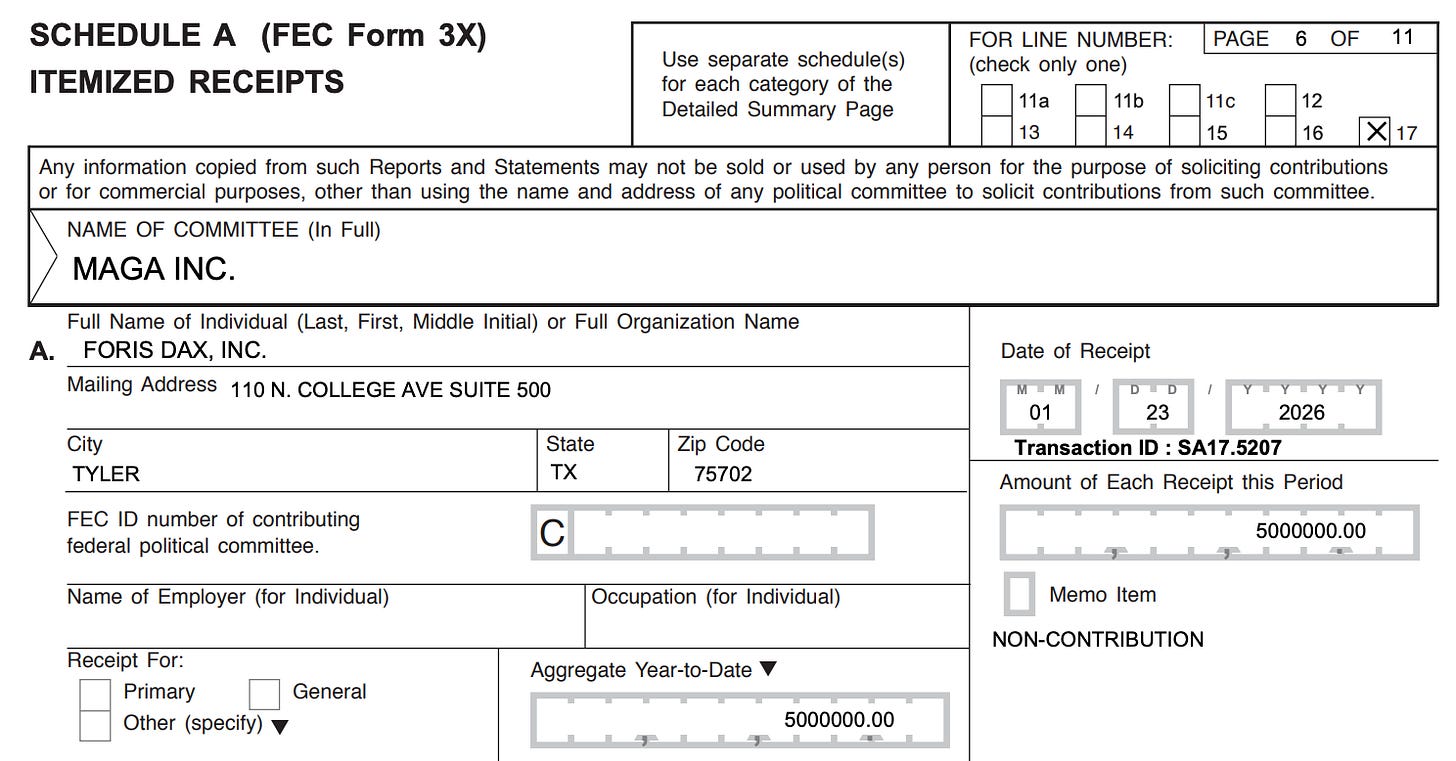
In a document quietly filed with the Federal Election Commission on Friday night, MAGA Inc., the primary Super PAC supporting President Trump, revealed that it received a $5 million donation from Crypto.com on January 23, 2026. The donation was made in the name of Crypto.com’s parent company, Foris Dax, Inc.1
[ ](https://substackcdn.com/image/fetch/$s_!-wdV!,f_auto,q_auto:good,fl_progressive:steep/https%3A%2F%2Fsubstack-post-media.s3.amazonaws.com%2Fpublic%2Fimages%2F21ce65d6-4c52-4c62-8b01-42836f6e0187_1488x778.png)
25 days later, on February 17, the Trump administration’s Commodities Futures Trading Commission (CFTC), intervened on Crypto.com’s behalf in high-stakes lawsuit in federal court.
Last year, Crypto.com sued the Nevada Gaming Control Board, arguing that it has the right to offer “prediction markets” on the outcome of sporting events without obtaining a Nevada gaming license. In October 2025, a federal court denied Crypto.com an injunction, and the company is now appealing the decision.
In addition to filing a formal amicus brief in support of Crypto.com’s appeal, CFTC chairman Mike Selig published an op-ed supporting Crypto.com’s position in the Wall Street Journal and posted a video supporting Crypto.com on X.
The timing of CFTC’s intervention raises serious ethical questions.
Selig, during his November 2025 confirmation hearing, was asked whether he believed it was legal for prediction markets to offer contracts on sporting events without complying with state law. Selig testified that the issue is “working its way through the courts, and so I will respect the decisions of those courts.”
He was also asked directly if he considered placing a bet on the outcome of a football game to be “gambling,” which would place it outside the jurisdiction of the CFTC:
Senator SCHIFF. Well, I mean, let me just ask—maybe even break it down more simply. If you and I bet on who wins the Bills game tomorrow, would you consider that gambling?
Mr. SELIG. Senator, on this issue, I would look to the courts, so I would look to what the courts say about that issue.
In a matter of weeks, Selig went from telling Senators under oath that he would defer to the courts on the issue to arguing on behalf of Crypto.com that the courts have erred.
He publicly announced he was considering intervening in the case during a public appearance on January 29 — less than a week after Crypto.com’s $5 million contribution to MAGA Inc. “I’ve directed CFTC staff to reassess the commission’s participation in matters currently pending before the federal district and circuit courts,” Selig said during his first public remarks as CFTC chairman.
On February 5, Selig explicitly stated that he believed it was legal for prediction markets to offer bets on sports, regardless of whether the company complied with state law.
[Mike Selig@MichaelSelig Strong Disagree.
Chris Christie @GovChristie
I believe Prediction Markets are violating the law. In 40 states we have regulated betting that can’t market to teenagers, pays state taxes, protects game integrity & reports suspicious activity to law enforcement. Prediction markets do none of that at all https://t.co/3dMAnS44Ex
2:06 PM · Feb 5, 2026 · 237K Views
114 Replies · 87 Reposts · 645 Likes](https://x.com/MichaelSelig/status/2019533204068393280?s=20)
Few companies have spent more money to ingratiate themselves politically with Trump than Crypto.com. Including the $5 million in January, Crypto.com has donated a total of $35 million to MAGA Inc. since 2025. It is the Super PAC’s largest donor, accounting for more than 10% of total funds.
Prior to its support for MAGA Inc, Crypto.com’s only political giving was a $1 million donation to Trump’s second inauguration in 2025.
Crypto.com has also formed an extensive partnership with Trump Media and Technology Group (TMTG), Trump’s money-losing media conglomerate that has recently pivoted into cryptocurrency and nuclear fusion. Among other integrations, Crypto.com and TMTG announced in October that Crypto.com would integrate its prediction market with Truth Social, TMTG’s social network. The joint venture will be called Truth Predict. President Trump is TMTG’s largest shareholder.
Crypto.com’s thin legal argument
Crypto.com and other prediction markets — and now the CFTC — argue that creating markets for sporting events is fundamentally different than sports gambling. In practice, however, it looks identical.
[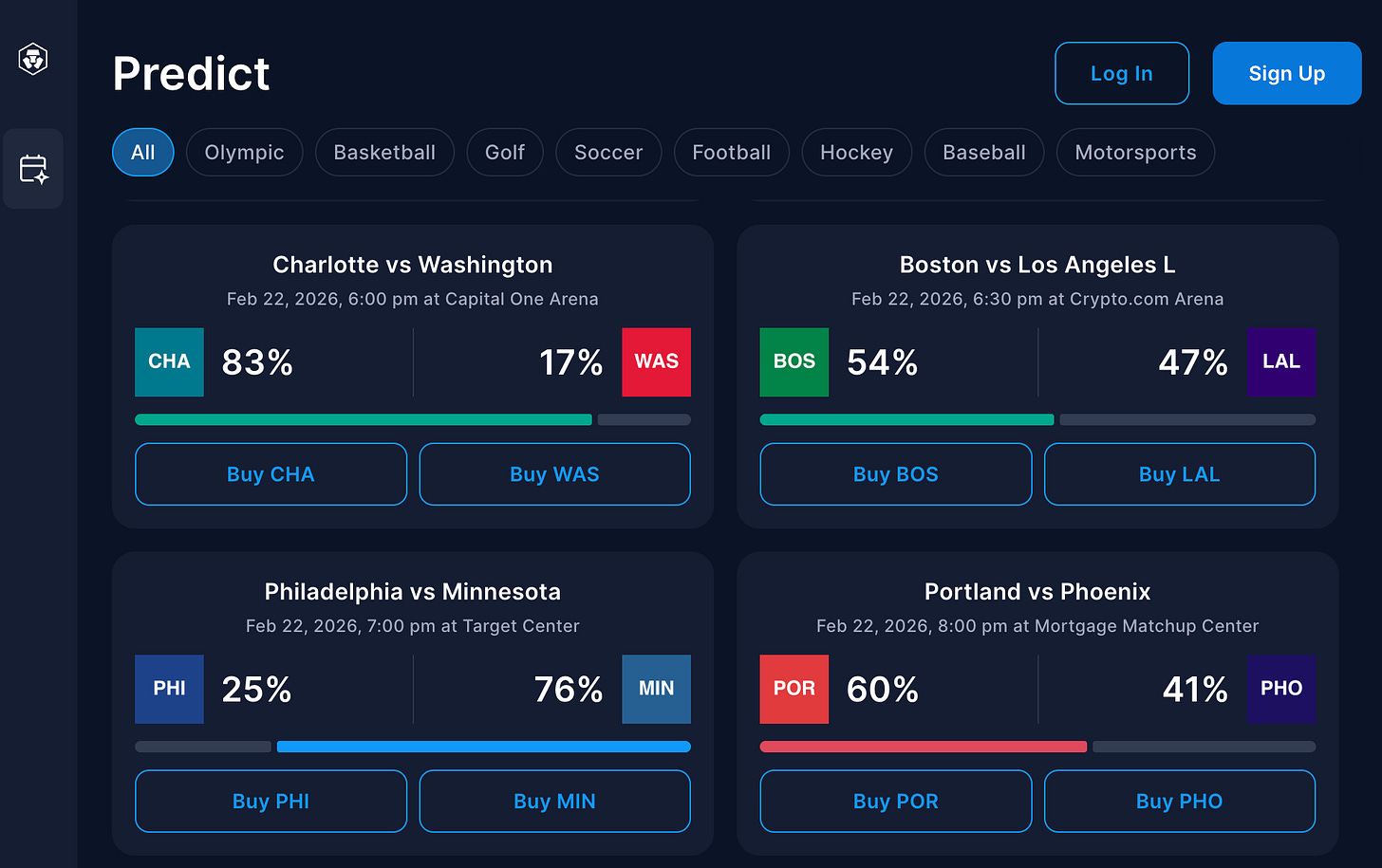 ](https://substackcdn.com/image/fetch/$s_!4ZwJ!,f_auto,q_auto:good,fl_progressive:steep/https%3A%2F%2Fsubstack-post-media.s3.amazonaws.com%2Fpublic%2Fimages%2F39b482a5-9a7e-475a-8dfa-353636dc271f_1926x1210.png)A screenshot from Crypto.com’s prediction market.
The CFTC has jurisdiction over event-related contracts or “swaps” that provide “for any purchase, sale, payment, or delivery… that is dependent on the occurrence, nonoccurrence, or the extent of the occurrence of an event or contingency associated with a potential financial, economic, or commercial consequence.” (Emphasis added.)
The traditional example of this is a contract to buy corn at a certain price in the future. This serves as an economic hedge against price fluctuations that can affect producers of tortilla chips, for example.
There are theoretical arguments that betting on the outcome of a sporting event could serve as an economic hedge. The CFTC, in its brief in support of Crypto.com, tries to make this argument:
Broadly speaking, sporting events are economic enterprises that generate billions of dollars in economic activity and materially affect both regional and national markets… For these reasons, hotels likely adjust pricing models, restaurants expand staffing to accommodate increased demand, vendors increase supply orders, and cities allocate resources to accommodate projected crowds. All of these decisions pose economic risk, which is precisely the type of economic exposure that derivatives markets are designed to mitigate.
Of course, this is not how prediction markets on sporting events are used. No one is wagering on a basketball game to hedge against hotels raising prices. They are used by people who want to gamble on sports, particularly in states where sports gambling is not currently legal. On popular prediction markets like Kalshi, sports betting accounts for over 90% of all trading volume.
Utah Governor Spencer Cox (R) mocked Selig’s position on X. “I don’t remember the CFTC having authority over the ‘derivative market’ of LeBron James rebounds,” Cox wrote. “These prediction markets you are breathlessly defending are gambling—pure and simple.”
The district court noted that, under Crypto.com’s interpretation, if every bet on a sporting event qualified as a “swap” subject to the exclusive jurisdiction of the CFTC. That would mean it would no longer be permissible for people to place sports bets in casinos. “Had Congress intended such a sea change in the regulatory landscape, it surely would have said so,” the district court wrote.
The designation of the $5 million from Foris Dax as a “NON-CONTRIBUTION” in the image refers to the fact that it is a donation to a Super PAC, which is not subject to FEC contribution limits or the prohibition on corporate contributions.
---
===
file:///C:/Users/patmc/Downloads/Partnoy.pdf
ENRON : CORPORATE FIASCOS AND THEIR IMPLICATION
Enron and the Derivatives World
Frank Partnoy* 1
I am submitting testimony in response to this Committee’s request that I address
potential problems associated with the unregulated status of derivatives used by Enron
Corporation.
I am a law professor at the University of San Diego School of Law. I teach and do
research in the areas of financial market regulation, derivatives, and structured finance.
During the mid-1990s, I worked on Wall Street structuring and selling financial in-
struments and investment vehicles similar to those used by Enron. As a lawyer, I have
represented clients with problems similar to Enron’s, but on a much smaller scale. I
have never received any payment from Enron or from any Enron officer or employee.
I. INTRODUCTION AND OVERVIEW
Enron has been compared to Long-Term Capital Management, the Greenwich,
Connecticut, hedge fund that lost $4.6 billion on more than $1 trillion of derivatives
and was rescued in September 1998 in a private bailout engineered by the New York
Federal Reserve. For the past several weeks, I have conducted my own investigation
into Enron, and I believe the comparison is inapt. Yes, there are similarities in both
firms’ use and abuse of financial derivatives. But the scope of Enron’s problems and
their effects on its investors and employees are far more sweeping.
According to Enron’s most recent annual report, the firm made more money trad-
ing derivatives in the year 2000 alone than Long-Term Capital Management made in
its entire history. Long-Term Capital Management generated losses of a few billion
dollars; by contrast, Enron not only wiped out over $70 billion of shareholder value,
but also defaulted on tens of billions of dollars of debts. Long-Term Capital Management employed only 200 people worldwide, many of whom simply went on to start
new hedge funds after the bailout, while Enron employed 20,000 people, many of
whom have been fired, and many more of whom lost their life savings as Enron’s stock
plummeted last fall. In short, Enron makes Long-Term Capital Management look like
a lemonade stand.
It will surprise many investors to learn that Enron was, at its core, a derivatives
trading firm. Nothing made this more clear than the layout of Enron’s extravagant new
building in which the top executives’ offices on the seventh floor were designed to
overlook the crown jewel of Enron’s empire: a cavernous derivatives trading pit on the
sixth floor.
I believe there are two answers to the question of why Enron collapsed, and both
involve derivatives. One relates to the use of derivatives “outside” Enron, in transac-
tions with some now-infamous special purpose entities. The other—which has not
been publicized at all—relates to the use of derivatives “inside” Enron.
What are derivatives? They are complex financial instruments whose value is based
on one or more underlying variables, such as the price of a stock or the cost of natural
gas. Derivatives can be traded in two ways: on regulated exchanges or in unregulated
over-the-counter (“OTC”) markets. My testimony involves the OTC derivatives mar-
kets, the focus of Enron’s activities.
Sometimes OTC derivatives can seem too esoteric to be relevant to average inves-
tors. Even the well-publicized OTC derivatives fiascos of a few years ago—Procter &
Gamble or Orange County, for example—seem ages away. But the OTC derivatives
markets are too important to ignore, and are critical to understanding Enron. The size
of derivatives markets typically is measured in terms of the notional values of con-
tracts.
Recent estimates of the size of the exchange-traded derivatives market, which
includes all contracts traded on the major options and futures exchanges, are in the
range of $13 to $14 trillion in notional amount. By contrast, the estimated notional
amount of outstanding OTC derivatives as of year-end 2000 was $95.2 trillion. And
that estimate is most likely an understatement. In other words, OTC derivatives markets, which for the most part did not exist twenty (or, in some cases, even ten) years
ago, now comprise about 90 percent of the aggregate derivatives market, with trillions
of dollars at risk every day. By those measures, OTC derivatives markets are bigger
than the markets for U.S. stocks.
Enron may have been just an energy company when it was created in 1985, but by
the end it had become a full-blown OTC derivatives trading firm. Its OTC deriva-
tives-related assets and liabilities increased more than five-fold during 2000 alone.
:{And, let me repeat, the OTC derivatives markets are largely unregulated.}: Enron’s
trading operations were not regulated, or even recently audited, by U.S. securities
regulators, and the OTC derivatives it traded are not deemed securities. OTC deriva-
tives trading is beyond the purview of organized, regulated exchanges. Thus, Enron—
like many firms that trade OTC derivatives—fell into a regulatory black hole.
After 360 customers lost $11.4 billion on derivatives during the decade ending in
March 1997, the Commodity Futures Trading Commission began considering whether to regulate OTC derivatives. But its proposals were rejected, and in December 2000
Congress made the deregulated status of derivatives clear when it passed the Com-
modity Futures Modernization Act. As a result, the OTC derivatives markets have
become a ticking time bomb, which Congress thus far has chosen not to defuse.
Many parties are to blame for Enron’s collapse. But as this Committee and others
take a hard look at Enron and its officers, directors, accountants, lawyers, bankers, and
analysts, Congress also should take a hard look at the current state of OTC derivatives
regulation. (In the remainder of this testimony, when I refer generally to “derivatives,”
I am referring to these OTC derivatives markets.)
===
https://www.thedailybeast.com/steve-bannons-dodgy-nonprofit-teamed-up-with-company-linked-to-gold-scammers
no lnx db teads
Steve Bannon’s Dodgy Nonprofit Teamed Up With Company Linked to Accused Gold Scammers
DIGGING DEEPER
Platinum Advertising, which worked for Bannon’s Citizens of the American Republic, tied to firm accused of defrauding seniors of $185 million.
William Bredderman
Researcher
Published Sep. 27, 2020
When former White House chief strategist Steve Bannon’s nonprofit sought to restore an American golden age, it turned to a company with connections to a consortium that allegedly strip-mined the retirement accounts of elderly conservatives, The Daily Beast has discovered.
Bannon’s “economic nationalist” group Citizens of the American Republic hired the Wyoming-based firm Platinum Advertising Corporation in 2018 to handle its “websites/social media,” Internal Revenue Service records show. A tangle of corporate and legal documents ties Platinum Advertising to TMTE Inc.—a precious metal dealer accused on Friday of fraudulently extracting $185 million from senior citizens by selling them overpriced bullion.
The massive joint action the federal Commodity Futures Trading Commission and 30 states announced against TMTE alleged that the Los Angeles-based company had suckered 1,600 mostly silver-haired victims into sinking their life savings into precious metals sold at up to 300 percent of their market value. The charges are familiar to anybody who has followed the long trail of news reports and regulatory actions describing how TMTE—which has variously used the monikers Access Unlimited, TEM, Chase Metals, and Metals.com—cashed in on the right-wing paranoia of the Trump era.
Even prior to the CFTC-led case on Friday, a dozen states, including Alabama and Kentucky, had accused TMTE of posing as an investment adviser and bilking senior citizens of their assets. Articles in Quartz last year detailed how the company used a combination of politically themed Facebook ads, talk radio spots, misleading websites, and high-pressure telephone sales tactics to target right-leaning, Fox News-viewing retirees and convince them to purchase gold and silver at hugely inflated rates. These efforts often involved overt biblical appeals, or echoed the rhetoric of President Donald Trump and Republican pundits by invoking the threat “liberals” and the “Deep State” supposedly posed to the economy and to the victims’ personal finances.
“Metals[.com] reached potential investors through advertisements on Facebook, conservative talk radio show, and conservative-leaning financial newsletters,” Colorado Securities Commissioner Tung Chan told The Daily Beast. “They targeted these ads at potential investors at or near retirement age with conservative political leanings.”
These echo findings in Missouri, Arkansas, and Nevada that TMTE relied on ominous advertising, “scare tactics,” and “misstatements and omitted information” to sell marked-up coins to vulnerable people aged 60 and up. Despite signing multiple cease-and-desist deals and disgorging millions of dollars, TMTE has publicly denied ever committing fraud.
Citizens of the American Republic’s bank-shot association with TMTE, which has never before been revealed, is just the latest problematic partnership for Bannon, who was caught up in a two-count federal indictment alleging fraud at a separate nonprofit, We Build the Wall, Inc. But the ties between the former Breitbart chairman and TMTE are less direct and more complex than his relationship to the alleged private border wall grifting operation.
The most recent tax forms Citizens of the American Republic filed with the Internal Revenue Service show it paid Platinum Advertising Corporation $143,655 in 2018 to shape its web presence. Platinum Advertising’s filings in Wyoming reveal little, beyond that the company registered in that jurisdiction in 2018. Gerald Pitts was listed as its secretary and director. Pitts runs Wyoming Corporate Services, which has filed paperwork in the notoriously opaque state for dozens of clients, including TMTE.
But Platinum Advertising—named for one of the priciest precious metals on Earth—also registered an affiliate in March of this year in California, where TMTE operates. And the registration statement bears the name and distinctive signature of Conor O’Reilly, whose LinkedIn profile shows he was employed full-time during that period as in-house counsel and compliance officer to Metals.com. Among his listed responsibilities were “reviewing, revising, and approving any legal work done on behalf of the company” and “the formation of various entities.”
O’Reilly’s signature also marks the cease-and-desist and rescission agreements that TMTE and its affiliates agreed to in Colorado and Texas in 2019. In May 2020, two months after registering Platinum Advertising in the Golden State, he Docusigned a consent order with the Missouri secretary of state, again identifying himself as TMTE’s counsel and compliance officer.
TMTE’s attorney, Charles Harder—who has also recently represented Trump and his family—initially denied any link between TMTE and Platinum Advertising, even going so far as to suggest the latter company may not be real.
“Today is the first day that TMTE has ever heard of the existence of ‘Platinum Advertising Corp.’ (assuming that it exists),” he wrote in an email. “TMTE knows nothing about it and, again, is not in any way affiliated with it.”
Confronted with the evidence of O’Reilly’s involvement in Platinum, Harder asserted that the lawyer “was not exclusive to TMTE—he also did legal work separate from, and completely unaffiliated with, TMTE.”
This claim contradicts all publicly available evidence regarding O’Reilly, who did not reply to calls or emails from The Daily Beast. His LinkedIn profile characterizes his employment arrangement with Metals.com as “full-time” and “in-house,” and does not list any other work as an attorney. O’Reilly was admitted to the bar in December 2018, just one month before he began his job at Metals.com, and he is the only person by that name licensed to practice law in California.
During negotiations with the Texas State Securities Board in 2019, O’Reilly presented himself as an important official at TMTE.
“He represented that he had the authority to contractually bind the company,” said Enforcement Division Director Joseph Rotunda. “We are not talking about a low-level employee.”
Rotunda told The Daily Beast he was familiar with Platinum Advertising, but could not say whether it was involved in any criminal scheme, due to the ongoing legal actions.
[Steve Bannon Is Behind Bogus Study That China Created COVID https://www.thedailybeast.com/steve-bannon-linked-groups-push-study-claiming-china-manufactured-covid
STUDY BUDDY
Adam Rawnsley,
Lachlan Markay]
Further, all other legal documents bearing O’Reilly’s name or signature are traceable to TMTE or one or more of its principals. The only corporate entity besides Platinum Advertising he has registered at the state level is USA Marketing Inc., another California affiliate of a Wyoming company originally incorporated by Pitts. USA Marketing uses the same Golden State address, inside Los Angeles’s Century Plaza Towers complex, as Platinum Advertising.
Wyomingfilings from late 2019 list Graham Norris, a Utah-based lawyer, as USA Marketing’s “director.” Norris, who frequently works with Pitts, was listed as TMTE’s CEO, CFO, and secretary in a 2018 filing in California. A 2019 lawsuit brought by former executive vice president of sales at Chase Metals identified Norris as one of that company’s three principals.
In May this year O’Reilly applied for a trademark on behalf of another Wyoming-based precious metals-slinging company called Capital Today, Inc.
Capital Today’s state-level corporate filings are highly similar to Platinum Advertising’s. In Wyoming, both initially usedGerald Pitts as their registration agent, then switched to the Cloud Peak Law Group. In California, both firms used the exact same Wyoming address, the exact same California address, and the exact same agent for service of process—an Ethan D. Kirschner of Culver City, who did not respond to requests for comment.
Finally, the trademark application O’Reilly filed for Capital Today, which operates USAMint.com, used the address 8383 Wilshire Boulevard, Suite 700, in Beverly Hills. Metals.com identified this location as one of its two in its correspondence with the Missouri secretary of state’s Securities Division, and the aforementioned lawsuit brought by the ex-sales executive described the Wilshire Boulevard suite as Chase Metals’ “principal business location.”
This also happens to be the address of Tower Equity—the investment firm founded by Norris’s fellow TMTE principals Lucas Asher and Simon Batashvili, which was also named and seized in the joint federal-state action on TMTE on Friday. All of this strongly indicates a nexus between Platinum Inc. and firms tied to TMTE—strongly enough that, when confronted with this evidence, a representative for TMTE walked back part of Harder’s statement in part.
The representative admitted that O’Reilly in fact had registered Platinum Advertising on the metal dealer’s behalf. However, they insisted that TMTE had only acquired the company as a “shelf entity” for future use in 2020, and that it was unaware of Platinum Advertising’s work for Bannon before and that the firm has not done any work with him since. Platinum Advertising, they maintained, currently has no assets, no employees, and has never had any business dealings during the time TMTE owned it. In fact, they asserted that the principals of TMTE had never even heard of Platinum Advertising before The Daily Beast inquired about it.
The TMTE representative declined to provide any documentation or on-the-record statements to substantiate these claims, and even suggested that Bannon might have hired another Platinum Advertising based in Wyoming. However, the state’s business records show only one entity of that name—the same one O’Reilly signed for in California.
In the TMTE representative’s version of events—at least, the version that lines up with the available documentary evidence—Bannon contracted Platinum Advertising to handle web and social media outreach for his conservative nonprofit. Then, sometime afterward,TMTE—which sells precious metals, including platinum, by targeting conservative voters on the web and through social media—happened to purchase the same company completely unaware of its history. Despite being completely empty and inactive, Platinum was somehow known to the Texas State Securities Board even when it was unknown to TMTE’s principals.
A representative for Bannon, who has pleaded not guilty to the charges against him, did not answer repeated requests for comment.
Bannon has picked up a number of unsavory associates since his unceremonious exit from the White House in 2017. The Daily Beast revealed in June that the distributor of his podcast War Room is a longtime white-collar criminal. The former Goldman Sachs banker and Hollywood producer also launched several ventures with Guo Wengui, a billionaire Chinese national accused of an array of crimes in his home country, all of which he denies. Two of these entities have recently funded and promoted a dubious study asserting COVID-19 originated in a government lab in Wuhan.
It was on Wengui’s yacht that federal authorities arrested Bannon on fraud charges related to We Build the Wall Inc., itself a joint project with disabled war veteran, conservative activist, and serial entrepreneur Brian Kolfage—who has also been accused of misappropriating funds.
===
===
https://www.alternet.org/2020/02/big-banks-ticking-time-bomb-could-cause-the-next-recession/
no lnx
Big banks’ ticking time bomb could cause the next recession
Written by Maureen Nevin Duffy / DC Report February 12,2020
The art of hiding multi-trillions of dollars of debt has found an eager accomplice, the businessman who once proudly proclaimed, “I love debt”: Donald J. Trump.
The King of Debt is now in control of an obscure federal watchdog agency intended to prevent derivatives—complicate financial instruments that billionaire businessman Warren Buffett once described as “Weapons of Mass Destruction”—from causing the Great Recession of 2008. Intended is the keyword. The agency, the Commodity Futures Trading Commission (CFTC), was hog-tied by big money interests long before the first whiff of bank failure could drift from Wall Street’s canyons.
This December, Trump’s hand-picked CFTC members marked a decade of financial recovery by voting 3-2 in favor of leaving a giant hole in the regulatory framework known as Dodd-Frank. The vote leaves the Big Four—Too Big to Fail—U.S. banks free to slip the riskiest of their debt-deferring derivative trades through that defensive wall at will. And, this sleight of hand pushes an unsuspecting public onto the firing line of another possible multi-trillion-dollar U.S. taxpayer bailout.
As in the 2008 meltdown, the weapon of choice for manipulating and moving piles of bank-owned debt around the world is a type of derivative called a “swap.” A swap can be as simple as a contract between two parties or a contingency laden nightmare, such as a “naked” credit default swap (CDS) for trading unfunded payment obligations, some of which are used as “insurance” guarantees. That guarantee is what banks can continue now to switch on and off at will.
The Usual Suspects
Instead of home mortgages, this time consumer debt holds our fate. Outstanding balances keep ballooning for car and tuition loans and credit cards—greatly enlarged by exotic trading on the debt itself. During 2016, banks opened 110 million new credit card accounts about 50% more than in 2010. Citigroup, JPMorgan Chase, Bank of America and Wells Fargo reported a combined loss of $12.5 billion from credit card loans in 2017. In June that same year, the Federal Reserve valued outstanding credit card loans at $1.02 trillion. Yet banks continue to shower subprime borrowers with fresh lines of credit.
Despite the efforts of a severely hobbled CFTC, the swaps markets continue to grow and without the depth of transparency promised. Consider that the four big U.S. bank holding company swaps dealers: Citibank, JPMorgan Chase, Goldman Sachs and Bank of America handle close to 90% of U.S. swaps trades, representing a combined notional value of $300 trillion, while consumers stagger under debt and defaults mount higher than pre-2008. The big picture reveals “a financial infrastructure that mimics the failed financial engineering created in the mortgage markets leading up to the 2008 financial crash,” says Professor Michael Greenberger, former deputy to the Clinton-era CFTC Chair Brooksley Born.
‘Dark Swaps’
Greenberger, a former director of the Division of Trading and Markets, and current law school professor at the University of Maryland Carey School of Law, contends that “dealers have engineered a way to evade Dodd-Frank,by helping banks transfer trillions of dollars in liability in risky unfunded trading, by turning the regulations off at will.” The world’s debt burden is being “financialized,” he says, as were mortgages in 2007.The tool this time is “dark swaps”‘ sold by the banks’ foreign subsidiaries, into increasingly complex instruments. These are the very exposures from which the CFTC and Dodd-Frank were charged with protecting us.
“The CFTC is totally controlled by Trump,” Greenberger tells DCReport.org. Until another administration takes office the only recourse may be a state by state solution. Greenberger means the state attorneys general, “since the president can’t fire them,” he says. Short of that, since a chain of attempts to plug the loophole have been tried, undermined or overturned, Greenberger’s last hope is the new administration, whose CFTC board could vote to close the loophole and spare the world another multi-trillion meltdown the U.S. taxpayer will suffer to pay.
===
https://theintercept.com/2019/12/03/wall-street-house-democrats-financial-regulations-cftc/
dodd frank achilles heel
==
==
good: a Trump appointee bucks the administration’s policy of climate denial
- One member of a powerful federal financial commission is setting himself up for a head-to-head confrontation with the Trump administration over climate change.
- Rostin Behnam, a Trump appointee to the Commodity Futures Trading Commission, told a New York Times reporter on Monday that “it’s abundantly clear that climate change poses financial risk to the stability of the financial system.”
- Benham is kicking off an investigation by the commission on how growing climate instability may harm different sectors of the U.S. economy, including agriculture, the mortgage and insurance industries, and more.
- The report will probably be ready just as Trump hits the 2020 campaign trail in farm country.
- Benham’s seat on the commission must by law be given to a Democrat, an “unusual status [that gives] him a measure of political protection” from reprisal by Trump or his other appointees. He thinks.
==
matt t says snaked thru at xmas, w sketchy pardons https://www.govtrack.us/congress/bills/106/hr4541/text
===
trump:
The same day as Donovan, Trump announced the nomination of David Malpass as treasury undersecretary for international affairs. Malpass was the chief economist for Bear Stearns right before the investment bank imploded. He literally wrote an opinion piece called “Don’t Panic About Credit Markets” for the Wall Street Journal in August 2007, noting, “Housing and debt markets are not that big a part of the U.S. economy.”
But it’s not just the presence of ex-bank executives that matters; it’s the policy menu oriented to Wall Street’s wishes.
After dalliances with unorthodox proposals for a Republican, Trump has settled into an agenda of tax cuts and deregulation — particularly for the financial industry. Cohn laid out the new paradigm in an interview with the Wall Street Journal last month, promising lighter supervision and even lower capital requirements for the financial sector. J. Christopher Giancarlo,Trump’s choice to run the Commodity Futures Trading Commission, which handles derivatives regulations, hijacked a federal advisory panel to recommend abandoning limits on commodity speculation, of the kind pursued by big banks like Goldman Sachs.
Donovan is expected to play a major role in tax policy, which will be overwhelmingly tilted to benefiting the wealthy, despite claims from Mnuchin that the rich will see “no absolute tax cut.” Even Trump’s flailing health care proposal is really little more than a large tax cut for the wealthiest Americans, financed by cuts to the low-income Medicaid program.
==
The Women Who Were Right About the Economy
bigthink
Who could have saved us from the global financial crisis? In a word, women. The release of the Federal Reserve’s transcripts of policymaking meetings up to 2007 has shed new light on the machinations inside the central bank as the Great Recession dawned. One member of the Board of Governors cast in a positive light is Janet Yellen, the vice-chair, who saw the potential for trouble in the shadow banking system. She isn’t the only woman who might have done a better job than the man who outranked her:
Brooksley Born. The former chair of the Commodities Futures Trading Commission warned that the Commodities Futures Modernization Act of 2000 could lead to excesses in the derivatives markets. The act eliminated most monitoring and regulation of the over-the-counter derivatives market where the subprime loan crisis exploded. But Born was overruled by Larry Summers, the Treasury secretary, and President Bill Clinton signed it into law.
Alice Rivlin. As vice-chair of the Board of Governors and a possible successor to Alan Greenspan as chair, her resignation in 1999, just as the Fed began to raise interest rates for the first time in four years, came as a surprise. Her view of monetary policy the late 1990s suggests she correctly perceived the global economy as more fragile than Greenspan did; the markets’ crash in 2000 soon forced him to reverse course. She latercriticized Greenspan for endorsing the 2001 Bush tax cuts, which ended up casting the nation into deep deficits.
Sheila Bair. She chaired the Federal Deposit Insurance Corporation before, during, and after the financial crisis. A strong believer in aiding consumers more and big banks less, she dissented from Treasury Secretary Timothy Geithner’s view that bailing out big banks – some of which she said didn’t need the help – was the best way to get the economy back on its feet. She argued for more accountability, but she lost; the big banks got their money, with few strings attached.
Christina Romer. The first chair of President Barak Obama’s Council of Economic Advisers wanted a much bigger stimulus package than the one he eventually proposed to Congress in 2009 - $1.8 trillion rather than about $900 billion. But before Obama even saw the plan, Summers, who was director of the National Economic Council, persuaded her to water it down to $1.2 trillion. The shortcomings of the initial package led Obama to pursue additional stimulus, an effort largely stymied by the Republicans in the Congress.
Would we be better off today if these women had held the top jobs in economic policy rather than the men who steamrolled them? There’s no way to know for sure, but my guess is that, in at least a few cases, the answer is yes.
===
The CFTC
The Commodity Futures Trading Commission is flexing new muscles gained from the Dodd-Frank financial reform. According to the Wall Street Journal, they are subpoenaing internal bank emails to determine if JPMorgan officials made deceptive statements — something that could constitute fraud or manipulation of derivatives market. The CFTC has never brought charges under the new rules, which went into effect last yea
===
wendy gramm dereg
===
The Kochs and the Global Economy
Consider, for instance, the Kochs' role in the financial business. You thought Koch Industries was just a high-polluting oil-and-gas-based conglomerate? Add in the part played on Wall Street by Koch Supply & Trading, and the depth of the Koch imprint on the economy is revealed. From Carrk's report:
First, the Koch brothers fought efforts to give the Commodity Futures Trading Commission more oversight over speculative trading, whereby companies can artificially inflate prices on things such as oil, during the Wall Street reform debate. One of the Koch companies—Koch Supply & Trading—takes part in oil and derivatives trading. We should point out that oil speculation has reached an all-time high at the same time gas prices continue to skyrocket.
Then look at a recent position pushed by Americans for Prosperity, the Tea Party-allied astroturf group founded and funded by David Koch (and whose sibling organization, the Americans for Prosperity Foundation, he chairs):
Similarly, Americans for Prosperity supports the House continuing resolution that cuts spending by $61 billion. Those cuts would reduce the budget for the CFTC by one-third. Make no mistake: Gutting the CFTC or limiting its authority would be a boon to Wall Street businesses that use complex financial instruments. But while the result is more profits for oil companies, it means everyone else pays more at the pump.
Okay, now have a look at the Kochs' recent direct contributions to political candidates:
The Kochs donated directly to 62 of the 87 members of the House GOP freshman class...and to 12 of the new members of the U.S. Senate.
=
===
BO
J. Christopher Giancarlo - Wikipedia
J. Christopher Giancarlo (born May 12, 1959) is an American attorney and former business executive who served as 13th chairman of the United States Commodity Futures Trading Commission (CFTC). Giancarlo was sworn in as a CFTC commissioner on June 16, 2014, for a term expiring on April 13, 2019. Starting on January 20, 2017, with President Donald Trump's inauguration, Giancarlo began serving as acting chair of the CFTC. In March 2017, the president nominated Giancarlo to be full-time chair of the commission. Giancarlo was confirmed as chairman of the commission by the United States Senate on August 3, 2017.
Early life and education
Giancarlo was born on May 12, 1959, in Jersey City, New Jersey to a family of physicians, nurses, and small business owners. He has four brothers, including Charles Giancarlo, an entrepreneur, investor, and former senior executive of Cisco Systems and board chairman of Avaya.
Giancarlo received primary and secondary education at the Dwight-Englewood School in Englewood, New Jersey from 1970 to 1977. He attended Skidmore College in Saratoga Springs, New York, where he graduated with college and Government Department Honors. At Skidmore, Giancarlo was a member of Phi Beta Kappa, of the Winter Term Scholarship Committee and a contributing editor to Politea magazine. In 1984, he received a Juris Doctor degree from the Vanderbilt University School of Law[1] where he was an associate research editor at the Vanderbilt Journal of Transnational Law and President of the Law School's International Law Society. Since 1985, Giancarlo has been a member of the Bar of the State of New York.
Career
Business
From 2001 to 2014, Giancarlo served as the executive vice president of GFI Group Inc., an intermediary in the global over-the-counter and listed markets that offers trading technologies and products to financial market participants(NYSE: GFIG).[2] Giancarlo was responsible for GFI's strategic transactions and relationships, including mergers and acquisitions, equity finance, investment banking, strategy development, analyst and investor communications and government relations. During his tenure, Giancarlo directed GFI's initial public offering in 2005 and led the acquisition strategies of Trayport Limited and Amerex Brokers LLC.
Prior to joining GFI, Giancarlo was executive vice president and U.S. legal counsel of Fenics Software.[3] From September 1997 to April 2000, Giancarlo was a corporate partner in the New York law firm of Brown Raysman Millstein Felder and Steiner, where he advised technology businesses on corporate and finance transactions. He joined Brown Raysman from Giancarlo & Gleiberman, a law practice founded by Giancarlo in 1992 following his return from several years practicing law in London with the international firm of Curtis, Mallet-Prevost, Colt & Mosle.
Giancarlo was a founding board member and former chairman of the Wholesale Markets Brokers Association (Americas), and served as chair of three annual conferences on Swap Execution Facilities, SEFCON I [4] October 4, 2010, SEFCON II [5] October 3, 2011 and SEFCON III[6] November 13, 2012 where he delivered opening and closing remarks.
He was a member of the Leadership Board of the Center for Capital Markets Competitiveness of the United States Chamber of Commerce.[7] He was also a founding co-editor-in-chief of eSecurities, Trading and Regulation on the Internet, (Leader Publications) and has written and spoken extensively on public policy, legal and other matters concerning technology and the financial markets.
In February 2011, Giancarlo testified before the U.S. House Financial Services Committee of the U.S. Congress on implementation of the Dodd-Frank Wall Street Reform and Consumer Protection Act ("Dodd-Frank Act").[8] In October of that same year, Giancarlo also testified before the House Committee on Agriculture on Legislative Proposals Amending Title VII of the Dodd-Frank Act.[9] In December 2012, he testified once more, this time before the House Financial Services Subcommittee on Capital Markets and Government Sponsored Enterprises on "Challenges Facing the U.S. Capital Markets to Effectively Implement Title VII of the Dodd-Frank Act".[10]
Government service
[
Giancarlo was nominated by President Barack Obama on August 1, 2013, to serve as a Commissioner of the Commodity Futures Trading Commission (CFTC).[11][12][13] On March 6, 2014, Giancarlo testified on his nomination before the U.S. Senate Committee on Agriculture, Nutrition, and Forestry, which approved the nomination on April 8, 2014. The U.S. Senate confirmed his nomination by unanimous consent on June 3, 2014, for a term expiring April 13, 2019.
On April 14, 2015, Giancarlo testified before the U.S. House of Representatives, Committee on Agriculture Subcommittee on Commodity Exchanges, Energy, and Credit regarding commercial end-user concerns, derivatives trading position limits, CFTC swaps trading rules and the cross-border impact of U.S. derivatives regulation.[14]
Having served as acting CFTC chair since President Trump's inauguration on January 20, 2017, Giancarlo was nominated by the president to be full-time chair of the commission on March 14, 2017, subject to confirmation by the Senate.[15] He was confirmed by the U.S. Senate on August 3, 2017. His successor as commissioner and chairman, Heath Tarbert was confirmed by the Senate on June 5, 2019.
Cryptocurrency
Following service in the US government, Giancarlo took on several roles: senior counsel to the law firm Willkie Farr & Gallagher,[16] chairman of the board of Common Securitization Solutions LLC,[17] a joint venture between Fannie Mae and Freddie Mac, Senior Advisor of social trading company eToro,[18] and a member of the advisory board of the Chamber of Digital Commerce.[19] He's also director of the American Financial Exchange (AFX) and senior adviser to capital markets technology provider Baton Systems.[20]
Giancarlo is a blockchain technology advocate and contributor to the global discourse on cryptocurrencies and digital assets.[21][22] Mr. Giancarlo is the founder of the Digital Dollar Project, to "advance exploration of a United States Central Bank Digital Currency,"[23] and former director of financial service company BlockFi.[24][20]
===
Commodities Futures Modernization Act
http://en.wikipedia.org/wiki/Commodity_Futures_Modernization_Act_of_2000
Commodity Futures Modernization Act of 2000 (CFMA) is United States federal legislation that officially ensured the deregulation of financial products known as over-the-counter derivatives. It was signed into law on December 21, 2000 by President Bill Clinton. It clarified the law so that most over-the-counter (OTC) derivatives transactions between “sophisticated parties” would not be regulated as “futures” under the Commodity Exchange Act of 1936 (CEA) or as “securities” under the federal securities laws. Instead, the major dealers of those products (banks and securities firms) would continue to have their dealings in OTC derivatives supervised by their federal regulators under general “safety and soundness” standards.
The Commodity Futures Trading Commission's (CFTC) desire to have “Functional regulation” of the market was also rejected. Instead, the CFTC would continue to do “entity-based supervision of OTC derivatives dealers.” [1] These derivatives, including thecredit default swap, are a few of the many causes of the financial crisis of 2008 and the subsequent 2008–2012 global recession.[]
Introduction[
Before and after the CFMA, federal banking regulators imposed capital and other requirements on banks that entered into OTC derivatives.[2] The United States Securities and Exchange Commission (SEC) and CFTC had limited “risk assessment” authority over OTC derivatives dealers affiliated with securities or commodities brokers and also jointly administered a voluntary program under which the largest securities and commodities firms reported additional information about derivative activities, management controls, risk and capital management, and counterparty exposure policies that were similar to, but more limited than, the requirements for banks.[3]
Banks and securities firms were the dominant dealers in the market, with commercial bank dealers holding by far the largest share.[4] To the extent insurance company affiliates acted as dealers of OTC derivatives rather than as counterparties to transactions with banks or security firm affiliates, they had no such federal “safety and soundness” regulation of those activities and typically conducted the activities through London-based affiliates.[5]
The CFMA continued an existing 1992 preemption of state laws that prevented any such law from treating eligible OTC derivatives transactions as gambling or otherwise illegal. It also extended that preemption to security-based derivatives that had previously been excluded from the CEA and its preemption of state law.[6]
The CFMA, as enacted by President Clinton, went beyond the recommendations of a Presidential Working Group on Financial Markets (PWG) Report titled “Over-the Counter Derivatives and the Commodity Exchange Act.” (the “PWG Report[7] ”).
President's Working Group on Financial Markets, November 1999:
- Lawrence :{Summers:(style="background-color:#ffff66;"):}:, Treasury
- Alan Greenspan, Fed
- Arthur Levitt, SEC
- William J Rainer, CFTC
Although hailed by the PWG on the day of congressional passage as “important legislation” to allow “the United States to maintain its competitive position in the over-the-counter derivative markets”, by 2001 the collapse of Enron brought public attention to the CFMA’s treatment of energy derivatives in the “Enron Loophole.” Following the Federal Reserve’s emergency loans to “rescue” American International Group (AIG) in September, 2008, the CFMA has received even more widespread criticism for its treatment of credit default swaps and other OTC derivatives.[8]
In 2008 the “Close the Enron Loophole Act” was enacted into law to regulate more extensively “energy trading facilities.”[9] On August 11, 2009, the Treasury Department sent Congress draft legislation to implement its proposal to amend the CFMA and other laws to provide “comprehensive regulation of all over-the counter derivatives.” This proposal was revised in the House and, in that revised form, passed by the House on December 11, 2009, as part of H.R. 4173 (Wall Street Reform and Consumer Protection Act of 2009). Separate, but similar, proposed legislation was introduced in the Senate and still awaiting Senate action at the time of the House action.[10]
Background to the CFMA[
OTC derivatives regulation before the CFMA[]
The exchange trading requirement[
The PWG Report was directed at ending controversy over how swaps and other OTC derivatives related to the CEA. A derivative is a financial contract or instrument that “derives” its value from the price or other characteristic of an underlying “thing” (or “commodity”). A farmer might enter into a “derivative contract” under which the farmer would sell from next summer’s harvest a specified number of bushels of wheat at a specified price per bushel. If this contract were executed on a commodity exchange, it would be a “futures contract.”[11]
Before 1974, the CEA only applied to agricultural commodities. “Future delivery” contracts in agricultural commodities listed in the CEA were required to be traded on regulated exchanges such as the Chicago Board of Trade.[12]
The Commodity Futures Trading Commission Act of 1974 created the CFTC as the new regulator of commodity exchanges. It also expanded the scope of the CEA to cover the previously listed agricultural products and “all other goods and articles, except onions, and all services, rights, and interests in which contracts for future delivery are presently or in the future dealt in.” Existing non-exchange traded financial “commodity” derivatives markets (mostly “interbank” markets) in foreign currencies, government securities, and other specified instruments were excluded from the CEA through the “Treasury Amendment”, to the extent transactions in such markets remained off a “board of trade.” The expanded CEA, however, did not generally exclude financial derivatives.[13]
After the 1974 law change, the CEA continued to require that all “future delivery” contracts in commodities covered by the law be executed on a regulated exchange. This meant any “future delivery” contract entered into by parties off a regulated exchange would be illegal and unenforceable. The term “future delivery” was not defined in the CEA. Its meaning evolved through CFTC actions and court rulings.[14]
Not all derivative contracts are “future delivery” contracts. The CEA always excluded “forward delivery” contracts under which, for example, a farmer might set today the price at which the farmer would deliver to a grain elevator or other buyer a certain number of bushels of wheat to be harvested next summer. By the early 1980s a market in interest rate and currency “swaps” had emerged in which banks and their customers would typically agree to exchange interest or currency amounts based on one party paying a fixed interest rate amount (or an amount in a specified currency) and the other paying a floating interest rate amount (or an amount in a different currency). These transactions were similar to “forward delivery” contracts under which “commercial users” of a commodity contracted for future deliveries of that commodity at an agreed upon price.[15]
Based on the similarities between swaps and “forward delivery” contracts, the swap market grew rapidly in the United States during the 1980s. Nevertheless, as a 2006 Congressional Research Service report explained in describing the status of OTC derivatives in the 1980s: “if a court had ruled that a swap was in fact an illegal, off-exchange futures contract, trillions of dollars in outstanding swaps could have been invalidated. This might have caused chaos in financial markets, as swaps users would suddenly be exposed to the risks they had used derivatives to avoid.”[16]
”Legal certainty” through regulatory exemptions[
To eliminate this risk, the CFTC and the Congress acted to give “legal certainty” to swaps and, more generally, to the OTC derivatives market activities of “sophisticated parties.”
First, the CFTC issued “policy statements” and “statutory interpretations” that swaps, “hybrid instruments” (i.e., securities or deposits with a derivative component), and certain “forward transactions” were not covered by the CEA. The CFTC issued the forward transactions “statutory interpretation” in response to a court ruling that a “Brent” (i.e., North Sea) oil “forward delivery” contract was, in fact, a “future delivery” contract, which could cause it to be illegal and unenforceable under the CEA. This, along with a court ruling in the United Kingdom that swaps entered into by a local UK government unit were illegal, elevated concerns with “legal certainty.”[17]
Second, in response to this concern about “legal certainty”, Congress (through the Futures Trading Practices Act of 1992 (FTPA)) gave the CFTC authority to exempt transactions from the exchange trading requirement and other provisions of the CEA. The CFTC used that authority (as Congress contemplated or “instructed”) to exempt the same three categories of transactions for which it had previously issued policy statements or statutory interpretations. The FTPA also provided that such CFTC exemptions preempted any state law that would otherwise make such transactions illegal as gambling or otherwise. To preserve the 1982 Shad-Johnson Accord,[18] which prohibited futures on “non-exempt securities”, the FTPA prohibited the CFTC from granting an exemption from that prohibition. This would later lead to concerns about the “legal certainty” of swaps and other OTC derivatives related to “securities.”[19]
Similar to the existing statutory exclusion for “forward delivery” contracts, the 1989 “policy statement” on swaps had required that swaps covered by the “policy statement” be privately negotiated transactions between sophisticated parties covering (or “hedging”) risks arising from their business (including investment and financing) activities. The new “swaps exemption” dropped the “hedging” requirement. It continued to require the swap be entered into by “sophisticated parties” (i.e., “eligible swap participants”) in private transactions.[20]
Although OTC derivatives were subject to criticism in the 1990s and bills were introduced in Congress to regulate aspects of the market, the 1993 exemptions remained in place. Bank regulators issued guidelines and requirements for bank OTC derivatives activities that responded to many of the concerns raised by Congress, the General Accounting Office (GAO), and others. Securities firms agreed with the Securities and Exchange Commission (SEC) and CFTC to establish a Derivatives Policy Group through which six large securities firms conducting the great majority of securities firm OTC derivatives activities reported to the CFTC and SEC about their activities and adopted voluntary principles similar to those applicable to banks. Insurance companies, which represented a much smaller part of the market, remained outside any federal oversight of their OTC derivatives activities.[21]
CFTC/SEC dispute and PWG Report as basis for the CFMA[
The dispute[
In 1997 and 1998 a conflict developed between the CFTC and the SEC over an SEC proposal to ease its broker-dealer regulations for securities firm affiliates that engaged in OTC derivatives activities. The SEC had long been frustrated that those activities were conducted outside the regulated broker-dealer affiliates of securities firms, often outside the United States in London or elsewhere. To bring the activities into broker-dealer supervision, the SEC proposed relaxed net capital and other rules (known as “Broker-Dealer Lite”) for OTC derivatives dealers. The CFTC objected that some activities that would be authorized by this proposal were not permitted under the CEA. The CFTC also issued a “concept release” requesting comments on whether the OTC derivatives market was properly regulated under the existing CEA exemptions and on whether market developments required regulatory changes.[23]

Robert Rubin, Treasury Secretary, Jan 1995-Jul 1999
The CFTC’s actions were widely viewed as a response to the SEC’s Broker-Dealer Lite proposal and, at least by Professor John C. Coffee, as perhaps an attempt to force the SEC to withdraw the proposal. The CFTC expressed dismay over the Broker-Dealer Lite proposal and the manner in which it was issued, but also noted it was 18 months into a “comprehensive regulatory reform effort.”
The same day the CFTC issued its “concept release” Treasury Secretary Robert Rubin, Federal Reserve Board Chair Alan Greenspan, and SEC Chair Arthur Levitt (who, along withCFTC Chair Brooksley Born,were the members of the PWG) issued a letter asking Congress to prevent the CFTC from changing its existing treatment of OTC derivatives. They argued that, by calling into question whether swaps and other OTC derivatives were “futures”, the CFTC was calling into question the legality of security related OTC derivatives for which the CFTC could not grant exemptions (as described in Section 1.1.2 above) and, more broadly, undermining an “implicit agreement” not to raise the question of the CEA’s coverage of swaps and other established OTC derivatives.[24]
In the ensuing Congressional hearings, the three members of the PWG dissenting from the CFTC’s “unilateral” actions argued the CFTC was not the proper body, and the CEA was not the proper statute, to regulate OTC derivatives activities. Banks and securities firms dominated the OTC derivatives market. Their regulators needed to be involved in any regulation of the market. Bank regulators and the SEC already monitored and regulated bank and broker-dealer OTC Derivatives activities. The dissenting PWG members explained that any effort to regulate those activities through the CEA would only lead to the activities moving outside the United States. In the 1980s banks had used offshore branches to book transactions potentially covered by the CEA. Securities firms were still using London and other foreign offices to book at least securities related derivatives transactions. Any change in regulation of OTC derivatives should only occur after a full study of the issue by the entire PWG.[25]
CFTC Chair Brooksley Born replied that the CFTC had exclusive authority over “futures” under the CEA and could not allow the other PWG members to dictate the CFTC’s authority under that statute. She pointed out the “concept release” did not propose, nor presuppose the need for, any change in the regulatory treatment of OTC derivatives. She noted, however, that changes in the OTC derivatives market had made that market more similar to futures markets.[26]
Congress passed a law preventing the CFTC from changing its treatment of OTC derivatives through March 1999. CFTC Chair Born lost control of the issueat the CFTC when three of her four fellow Commissioners announced they supported the legislation and would temporarily not vote to take any action concerning OTC derivatives. CFTCChair Born resigned effective June 1999. Her successor, William Rainer, was CFTC Chair when the PWG Report was issued in November 1999.[27]
Other background events[
While the dispute between the SEC and CFTC over OTC derivatives jurisdiction was at the core of pre-2008 narrations of the events leading to the CFMA, two other noteworthy background events occurred. First, in early 1997 CFTC Chairperson Born testified forcefully to Congress against a Senate bill that would have authorized futures exchanges to establish “professional markets” exempt from many regulatory requirements in a manner similar to the “regulatory relief” ultimately provided for an “exempt board of trade” under the CFMA. In her testimony to the Senate Agriculture Committee and in several subsequent speeches during the first half of 1997, Chairperson Born argued OTC derivatives did not create the same “concentration of financial risk” as exchange traded futures and did not perform the “unique price discovery” function of exchange traded contracts. She argued these differences justified different regulatory treatment.[28]
Chairperson Born’s 1997 testimony on the difference between exchange and OTC markets was consistent with her first speech as CFTC Chair, on October 24, 1996, in which she stated her belief that regulation of the OTC derivatives market should be limited to fraud and manipulation. While her 1997 testimony opposed the Senate bill’s provision to codify in law the existing CFTC regulatory exemptions for OTC derivatives, she also stated the CFTC was “watching” the OTC derivatives market with the PWG and had no plans to modify the existing CFTC exemptions for that market.[29]
The futures exchanges argued they needed permission to operate “professional markets” free of “regulatory burdens” in order to compete with foreign exchanges and the OTC derivatives market that catered to the same professionals. 1997 news reports attributed the failure of the “professional markets” legislation to disagreements concerning equity derivatives between the Chicago Board of Trade and the OTC derivatives dealers, on the one side, and the Chicago Mercantile Exchange and others futures exchanges, on the other.[30]
Second, after the 1998 CFTC “concept release” controversy arose, Long-Term Capital Management (LTCM) became headline news with the near collapse of a hedge fund it managed.The near collapse was widely attributed to OTC derivatives transactions. At an October 1, 1998, hearing before the House Banking Committee, Chairperson Born received complements from some members of the Committee for having raised important issues in the May “concept release.” The hearing, however, focused on issues with regulatory oversight of the banks and security firms that had given the LTCM fund high leverage through both loans and OTC derivative transactions.[31]
The 1999 GAO Report that analyzed the LTCM experience criticized federal regulators for not coordinating their oversight of LTCM’s activities with banks and securities firms.The Report also recommended “consideration of” legislation to grant the SEC and CFTC consolidated supervision authority for securities and commodities firms in order to supervise the OTC derivatives activities of those consolidated entities in a manner similar to the Federal Reserve’s authority over bank holding companies. The GAO Report did not consider, and did not recommend, CFTC regulation of OTC derivatives.[32]
An effect of the LTCM experience was that the conference committee report adopting the six-month moratorium on CFTC action affecting OTC derivative regulation included a statement that “the conferees strongly urge” the PWG to study OTC derivatives transactions of hedge funds and others. Although Chairperson Born had explained at the October 1, 1998, House Banking Committee hearing that the CFTC’s supervisory authority over the LTCM fund as a “commodity pool operator” was limited to monitoring its exchange trading activities, the CFTC’s possession of financial statements for the fund received negative news coverage in November 1998 based on the fact the CFTC was the only federal regulator to receive such reports directly from LTCM and had not shared the information with other members of the PWG.[33] When the LTCM matter was investigated at a December 16, 1998, Senate Agriculture Committee hearing, the three CFTC Commissioners that had supported the Congressional moratorium, as described in Section 1.2.1 above, reiterated their support and their position that the entire PWG should study the OTC derivatives market and the issues raised in the CFTC’s “concept release.”[34]
The President's Working Group Report[
The PWG Report recommended: (1) the codification into the CEA, as an “exclusion”, of existing regulatory exemptions for OTC financial derivatives, revised to permit electronic trading between “eligible swaps participants” (acting as “principals”) and to even allow standardized (i.e. “fungible”) contracts subject to “regulated” clearing; (2) continuation of the existing CFTC authority to exempt other non-agricultural commodities (such as energy products) from provisions of the CEA; (3) continuation of existing exemptions for “hybrid instruments” expanded to cover the Shad-Johnson Accord (thereby exempting from the CEA any hybrid that could be viewed as a future on a “non-exempt security”), and a prohibition on the CFTC changing the exemption without the agreement of the other members of the PWG; (4) continuation of the preemption of state laws that might otherwise make any “excluded” or “exempted” transactions illegal as gambling or otherwise; (5) as previously recommended by the PWG in its report on hedge funds, the expansion of SEC and CFTC “risk assessment” oversight of affiliates of securities firms and commodity firms engaged in OTC derivatives activities to ensure they did not endanger affiliated broker-dealers or futures commission merchants; (6) encouraging the CFTC to grant broad “deregulation” of existing exchange trading to reflect differences in (A) the susceptibility of commodities to price manipulation and (B) the “sophistication” and financial strength of the parties permitted to trade on the exchange; and (7) permission for single stock and narrow index stock futures on terms to be agreed between the CFTC and SEC.[35]
In 1998 the CFTC had disagreed with the other members of the PWG about the scope and purposes of the CEA. Whereas the CFTC saw broad purposes in protecting “fair access” to markets, “financial integrity”, “price discovery and transparency”, “fitness standards,” and protection of “market participants from fraud and other abuses,” other members of the PWG (particularly the Federal Reserve through Alan Greenspan) found the more limited purposes of (1) preventing price manipulation and (2) protecting retail investors.[36]
The PWG Report ended that disagreement by analyzing only four issues in deciding not to apply the CEA to OTC derivatives. By finding (1) the sophisticated parties participating in the OTC derivatives markets did not require CEA protections, (2) the activities of most OTC derivatives dealers were already subject to direct or indirect federal oversight, (3) manipulation of financial markets through financial OTC derivatives had not occurred and was highly unlikely, and (4) the OTC derivatives market performed no significant “price discovery” function, the PWG concluded “there is no compelling evidence of problems involving bilateral swap agreements that would warrant regulation under the CEA.” By essentially adopting the views of the other members of the PWG concerning the scope and application of the CEA, the CFTC permitted a “remarkable” agreement “on a redrawing of the regulatory lines.”[37]
Rather than treat the “convergence’ of OTC derivatives and futures markets as a basis for CFTC regulation of OTC derivatives, the PWG Report acknowledged and encouraged the growth in similarities between the OTC derivatives market and the regulated exchange traded futures market. Standardized terms and centralized clearing were to be encouraged, not prohibited. Price information could be broadly disseminated through “electronic trading facilities.” The PWG hoped these features would (1) increase “transparency” and liquidity in the OTC derivatives market by increasing the circulation of information about market pricing and (2) reduce “systemic risk” by reducing credit exposures between parties to OTC derivatives transactions.[38]
The PWG Report also emphasized the desire to “maintain U.S. leadership in these rapidly developing markets” by discouraging the movement of such transactions “offshore.” In the 1998 Congressional hearings concerning the CFTC “concept release” Representative James A. Leach (R-IA) had tied the controversy to “systemic risk” by arguing the movement of transactions to jurisdictions outside the United States would replace U.S. regulation with laxer foreign supervision.[39]
It can be argued that the PWG Report recommendations and the CFMA as enacted did not change the “regulation” of OTC derivatives because there was no existing regulation under the CEA or securities laws. The change to the CEA, however, would be the elimination of existing criteria for distinguishing OTC derivatives from “futures.”[40]
The CFMA as implementation and expansion of the PWG Report[
Title I of the CFMA adopted recommendations of the PWG Report by broadly excluding from the CEA transactions in financial derivatives (i.e. “excluded commodities”) between “eligible contract participants.” The definition of “eligible contract participant” covered the same types of “sophisticated” parties as the existing “swaps exemption” in its definition of “eligible swap participants”, but was broader, particularly by adding permission for individuals with assets of $5 million rather than $10 million, if the transaction related to managing asset or liability “risk.” The PWG had recommended “considering” an increase in this threshold to $25 million, not a reduction for actual hedging.[41]
Such “eligible contract participants” could enter into transactions on or off “electronic trading facilities” without being subject to any of the regulatory oversight applicable to futures. The only exception was that the transactions would be subject to the rules for the new “Derivative Clearing Organizations” authorized by the CFMA, if the transaction used such a clearing facility. The CFMA did not require that standardized transaction use a clearing facility. It only authorized their existence, subject to regulatory oversight. The PWG Report had recommended permitting “standardized” contracts, so long as they were subject to regulated clearing.[42]
Title I’s biggest departure from the PWG Report recommendations was in extending most of the same exclusions to non-financial commodities that were not agricultural. These “exempt commodities” were, in practice, mostly energy and metal commodities. As discussed below in Section 4, these transactions were subject to the “anti-fraud” and “anti-manipulation” provisions of the CEA in some, but not all, circumstances. The PWG Report had recommended that exemptions for such transactions remain in the control of the CFTC, although it had recommended the continuation of those regulatory exemptions.[43]
Title I also resolved the issue of “hybrid instruments” by defining when such an instrument would be considered a “security” subject to security laws and excluded from the CEA even though it had a “commodity component.” Equivalent treatment of bank products was provided in Title IV.[44]
Title I retained the CEA’s existing preemption of state gambling and other laws that could render a CFTC exempted transaction illegal. It made that preemption applicable to all exempted or excluded transactions.[45]
Title I also created a new system under which three different types of exchanges could be established based on the types of commodities and participants on such exchanges.[46]
Title II of the CFMA repealed the 1982 Shad-Johnson Accord that had prohibited single stock and narrow stock index futures and replaced that with a joint CFTC and SEC regulated “security futures” system.[47]
Title III established a framework for SEC regulation of “security-based swaps.” The PWG Report had not addressed this issue.[48]
Title IV established a framework for CFTC regulation of “bank products.” This included coverage of deposit based “hybrid instruments”, but went further. The PWG Report had not dealt with these issues beyond how Title IV overlapped with Title I.[49]
The CFMA did not provide the CFTC or SEC the broader “risk assessment” authority over affiliates of futures commission merchants or broker-dealers that the PWG Report had recommended.[50]
Legislative history of the CFMA[
H.R. 4541 and S.2697[
H.R. 4541 was introduced in the House of Representatives on May 25, 2000, as the Commodities Futures Modernization Act of 2000. Three separate House Committees held hearings on the bill. Each Committee reported out a different amended version of H.R. 4541 by September 6, 2000.[51][52]
Another Commodity Futures Modernization Act of 2000 was introduced in the Senate on June 8, 2000, as S. 2697. A joint hearing of the Senate Agriculture and Banking Committees was held to consider that bill. The Senate Agriculture Committee reported out an amended version of S. 2697 on August 25, 2000.[53]
During the House and Senate committee hearings on these bills, Committee Chairs and Ranking Members described a tight legislative schedule for the bills because of the election year’s short Congressional schedule. Sponsors had delayed introduction of the bills as they vainly awaited agreement between the CFTC and SEC on how to regulate the single stock futures contemplated by the PWG Report. That issue dominated the hearings.[54]
On September 14, 2000, the SEC and CFTC announced they had agreed on a joint regulation approach for “security futures.” Senior Treasury Department officials hailed the “historic agreement” as eliminating “the major obstacles to forming a consensus bill.” [55]:{ At the same time, Senator Phil Gramm (R-TX), the Chair of the Senate Banking Committee,was quoted as insisting that any bill brought to the Senate Floor would need to be expanded to include prohibitions on SEC regulation of the swaps market}::{.}:[56]
Democratic members of Congress later described a period in late September through early October during which they were excluded from negotiations over reconciling the three committee versions of H.R. 4541, followed by involvement in reaching an acceptable compromise that left some Republicans unhappy with the final version of the bill and some Democrats upset over the “process”, particularly the involvement of Sen. Gramm and House Republican leadership in the negotiations.[57] Despite indications no agreement would be reached, on October 19, 2000, the [BUSH 43] White House announced its “strong support” for the version of H.R. 4541 scheduled to reach the House Floor that day.[58] The House approved H.R. 4541 in a 377-4 vote.[59]
As so passed by the House, H.R. 4541 contained, in Title I, the language concerning OTC derivatives that became the source for Title I of the CFMA and, in Title II, the language regulating “security futures” that became the source for Title II of the CFMA. Titles III and IV would be added when the CFMA was enacted into law two months later.[60]
From H.R. 4541 to the CFMA[
When Congress returned into session for two days in mid-November, the sponsor of H.R. 4541, Representative Thomas Ewing (R-IL), describedSenator Gramm as the “one man” blocking Senate passage of H.R. 4541.[63] Senator Richard G. Lugar (R-IN), the sponsor of S. 2697, was reported to be considering forcing H.R. 4541 to the Senate Floor against Senator Gramm’s objections.[64]After the House passed H.R. 4541, press reports indicated Sen. Gramm was blocking Senate action based on his continued insistence that the bill be expanded to prevent the SEC from regulating swaps, and the desire to broaden the protections against CFTC regulation for “bank products.”[61] Nevertheless, with Congress adjourned for the 2000 elections, but scheduled to return for a “lame duck” session, Treasury Secretary Summers “urged” Congress to move forward with legislation on OTC derivatives based on the “extraordinary bipartisan consensus this year on these very complex issues.”.[62]
After Congress returned into session on December 4, 2000, there were reports Senator Gramm and the Treasury Department were exchanging proposed language to deal with the issues raised by Sen. Gramm, followed by a report those negotiations had reached an impasse.[65] On December 14, however, the Treasury Department announced agreement had been reached the night before and urged Congress to enact into law the agreed upon language.[66]
The “compromise language” was introduced in the House on December 14, 2000, as H.R. 5660.[67] The same language was introduced in the Senate on December 15, 2000 as S. 3283.[68] The Senate and House conference that was called to reconcile differences in H.R. 4577 appropriations adopted the “compromise language” by incorporating H.R. 5660 (the “CFMA”) into H.R. 4577, which was titled “Consolidated Appropriations Act for FY 2001”.[69] The House passed the Conference Report and, therefore, H.R. 4577 in a vote of 292-60.[70]
Over "objection" by Senators James Inhofe (R-OK) and Paul Wellstone (D-MN), the Senate passed the Conference Report, and therefore H.R. 4577, by “unanimous consent.”[71] The Chairs and Ranking members of each of the five Congressional Committees that considered H.R. 4541 or S. 2697 supported, or entered into the Congressional Record statements in support of, the CFMA. The PWG issued letters expressing the unanimous support of each of its four members for the CFMA.[72] H.R. 4577, including H.R. 5660, was signed into law, as CFMA, on December 21, 2000.[73]
The “Enron Loophole”[
The section 2(h) “loophole”[
The first provision of the CFMA to receive widespread popular attention was the “Enron Loophole".[74] In most accounts, this “loophole” was the CEA’s new section 2(h). Section 2(h) created two exemptions from the CEA for “exempt commodities” such as oil and other “energy” products.[75]
First, any transaction in exempt commodities not executed on a “trading facility” between “eligible contract participants” (acting as principals) was exempted from most CEA provisions (other than fraud and anti-manipulation provisions). This exemption in Section 2(h)(1) of the CEA covered the “bilateral swaps market” for exempt "trading facilities."[76]
Second, any transaction in exempt commodities executed on an “electronic trading facility” between “eligible commercial entities” (acting as principals) was also exempted from most CEA provisions(other than those dealing with fraud and manipulation). The “trading facility”, however, was required to file with the CFTC certain information and certifications and to provide trading and other information to the CFTC upon any “special call.” This exemption in Section 2(h)(2) of the CEA covered the “commercial entities” for exempt "electronic trading facilities.” [77]
While the language of Section 2(h) was in H.R. 4541 as passed by the House, the portion of Section 2(h) dealing with the exempt commercial market had been deleted from S. 2697 when the Senate Agriculture Committee reported out an amended version of that bill. H.R. 4541 served as the basis for Titles I and II of the CFMA. The Senate Agriculture Committee’s removal of the Section 2(h) language from S. 2697, however, served as the basis for later Senate concern over the origins of Section 2(h).[78]
In 2008 Congress enacted into law over President Bush’s veto an Omnibus Farm Bill that contained the “Close the Enron Loophole Act.” This added to CEA Section 2(h)(2) a new definition of “electronic trading facility” and imposed on such facilities requirements applicable to fully regulated exchanges (i.e. “designated contract markets”) such as the NYMEX. The legislation did not change Section 2(h)(1) exemption for the “bilateral swaps market” in exempt commodities.[79]
The section 2(g) “loophole”[
Section 2(g) of the CEA is also sometimes called the “Enron Loophole”. It is a broader exclusion from the CEA than the Section 2(h)(1) exemption for the “bilateral swaps market” in exempt commodities. It excludes from even the fraud and manipulation provisions of the CEA any “individually negotiated” transaction in a non-agricultural commodity between “eligible contract participants” not executed on a “trading facility.” Thus, the exclusion from provisions of the CEA for “eligible contract participants” is broader than the Section 2(h)(1) exemption for “bilateral swaps” of energy commodities. The criteria for this exclusion, however, are narrower in requiring “individual negotiation.”[80]
This exclusion was not contained in either H.R. 4541 or S. 2697 as introduced in Congress. The House Banking and Financial Services Committee added this provision to the amended H.R. 4541 it reported to the House. That language was included in H.R. 4541 as passed by the House. Its final version was modified to conform to the Gramm-Leach-Bliley Act definition of “swap agreement.” That definition requires that the swap be “individually negotiated.” H.R. 4541 had required that each “material economic term” be individually negotiated.[81]
2002 Senate hearings indicated CEA Section 2(h)(2) was not the “Enron Loophole” used by EnronOnline. That facility was not required to qualify as an “electronic trading facility” under Section 2(h)(2) of the CEA because Enron Online was only used to enter into transactions with Enron affiliates. There were not “multiple participants” on both the buy and sell sides of the trades. Whether such Enron-only trades were covered by the Section 2(h)(1) “bilateral swaps market” exemption for energy products or the broader Section 2(g) exclusion for swaps generally depended whether there was “individual negotiation.”[82]
Credit default swaps
With the 2008 emergence of widespread concerns about credit default swaps, the CFMA’s treatment of those instruments has become controversial. Title I of the CFMA broadly excludes from the CEA financial derivatives, including specifically any index or measure tied to a “credit risk or measure.” In 2000, Title I’s exclusion of financial derivatives from the CEA was not controversial in Congress. Instead, it was widely hailed for bringing “legal certainty” to this “important market” permitting “the United States to retain its leadership in the financial markets”, as recommended by the PWG Report.[83]
The insurance law issue[
The CFMA’s treatment of credit default swaps has received the most attention for two issues. First, former New York Insurance Superintendent Eric Dinallo has argued credit default swaps should have been regulated as insurance and that the CFMA removed a valuable legal tool by preempting state “bucket shop” and gaming laws that could have been used to attack credit default swaps as illegal. In 1992, the FTPA had preempted those state laws for financial derivatives covered by the CFTC’s “swaps exemption.” As described in Section 1.1.2 above, however, a “gap” in the CFTC’s powers prohibited it from exempting futures on “non-exempt securities.” This “loophole” (which was intended to preserve the Shad-Johnson Accord’s prohibition on single stock futures) meant that, before the CFMA, the CEA’s preemption of state gaming and “bucket shop” laws would not have protected a credit default swap on a “non-exempt security” (i.e. an equity security or a “non-exempt” debt obligation that qualified as a “security”). As before 1992, the application of such state laws to a credit default swap (or any other swap) would depend upon a court finding the swap was a gambling, “bucket shop”, or otherwise illegal transaction. As described in Section 1.2.1 above, legal uncertainty for security-based swaps was an important issue in the events that led to the PWG Report. The PWG Report recommended eliminating that uncertainty by excluding credit default swaps and all security-based swaps from the CEA and by adding to the “hybrid instrument” exemption an exclusion from the Shad-Johnson Accord.[84]
Former Superintendent Dinallo has written that the CFMA was enacted in part to avoid having OTC derivatives transactions move offshore. He has not, however, addressed whether that could have been avoided if the CFMA had not been enacted. AIG (the insurance company addressed by Mr. Dinallo’s commentary) located its controversial derivatives dealer (AIG Financial Products) in London and conducted its “regulatory CDS” transactions through a French bank (Banque AIG) because of the bank regulatory capital provision that banks (not AAA rated parties) received a reduced credit risk “weighting” for their obligations, including CDS, owed to other banks. General Re, the other insurance company with a very active derivatives dealer affiliate, similarly established that dealer in London.[85]
The securities law issue[
Second, Title II of the CFMA treated credit default swaps tied to “securities” as “security-related swaps” for which the SEC was granted limited authority to enforce “insider trading”, fraud, and anti-manipulation provisions of the securities laws. Before the CFMA, it was generally agreed most swaps were not securities, but the SEC had always maintained that swaps tied to securities were securities, particularly when such swaps could reproduce the attributes of owning the underlying security. In granting the SEC authority over “security-related swaps”, the CFMA specifically prohibited applying any “prophylactic” anti-fraud or anti-manipulation measures. The SEC has complained this has prevented it from collecting information, and requiring disclosures, regarding credit default positions of investors. The SEC has argued this handicaps its ability to monitor possible manipulations of security markets through credit default swaps.[86]
Centralized clearing[
The SEC, the PWG, and others have also expressed concern about the “systemic risk” created by a lack of centralized clearing of credit default swaps. Although (as noted in Section 2 above) the CFMA created the possibility of centralized clearing by removing the pre-CFMA requirements that OTC derivatives not be subject to centralized clearing, the CFMA did not require such clearing, even for “standardized” transactions.[87]
2009 Treasury Department proposed OTC derivatives legislation[
On August 11, 2009, the Treasury Department sent to Congress proposed legislation titled the “Over-the-Counter Derivatives Markets Act of 2009.” The Treasury Department stated that under this proposed legislation “the OTC derivative markets will be comprehensively regulated for the first time.” [88]
To accomplish this “comprehensive regulation”, the proposed legislation would repeal many of the provisions of the CFMA, including all of the exclusions and exemptions discussed in Sections 4 above that have been identified as the “Enron Loophole.” While the proposed legislation would generally retain the “legal certainty” provisions of the CFMA, it would establish new requirements for parties dealing in non-“standardized” OTC derivatives and would require that “standardized” OTC derivatives be traded through a regulated trading facility and cleared through regulated central clearing. The proposed legislation would also repeal the CFMA’s limits on SEC authority over “security-based swaps.”[89]
On December 11, 2009, the House passed H.R. 4173, the so-called Wall Street Reform and Consumer Protection Act of 2009, which included a revised version of the Treasury Department’s proposed legislation that would repeal the same provisions of the CFMA noted above. At that time, similar legislation was pending in the Senate.[90]
In late April, 2010, debate began on the floor of the Senate over their version of the reform legislation.[91]
Controversies[
The “Enron Loophole”[
The section 2(h) “loophole”[
The first provision of the CFMA to receive widespread popular attention was the “Enron Loophole".[74] In most accounts, this “loophole” was the CEA’s new section 2(h). Section 2(h) created two exemptions from the CEA for “exempt commodities” such as oil and other “energy” products.[75]
First, any transaction in exempt commodities not executed on a “trading facility” between “eligible contract participants” (acting as principals) was exempted from most CEA provisions (other than fraud and anti-manipulation provisions). This exemption in Section 2(h)(1) of the CEA covered the “bilateral swaps market” for exempt "trading facilities."[76]
Second, any transaction in exempt commodities executed on an “electronic trading facility” between “eligible commercial entities” (acting as principals) was also exempted from most CEA provisions (other than those dealing with fraud and manipulation). The “trading facility”, however, was required to file with the CFTC certain information and certifications and to provide trading and other information to the CFTC upon any “special call.” This exemption in Section 2(h)(2) of the CEA covered the “commercial entities” for exempt "electronic trading facilities.” [77]
While the language of Section 2(h) was in H.R. 4541 as passed by the House, the portion of Section 2(h) dealing with the exempt commercial market had been deleted from S. 2697 when the Senate Agriculture Committee reported out an amended version of that bill. H.R. 4541 served as the basis for Titles I and II of the CFMA. The Senate Agriculture Committee’s removal of the Section 2(h) language from S. 2697, however, served as the basis for later Senate concern over the origins of Section 2(h).[92]
In 2008 Congress enacted into law over President Bush’s veto an Omnibus Farm Bill that contained the “Close the Enron Loophole Act.” This added to CEA Section 2(h)(2) a new definition of “electronic trading facility” and imposed on such facilities requirements applicable to fully regulated exchanges (i.e. “designated contract markets”) such as the NYMEX. The legislation did not change Section 2(h)(1) exemption for the “bilateral swaps market” in exempt commodities.[79]
The section 2(g) “loophole”[
Section 2(g) of the CEA is also sometimes called the “Enron Loophole”. It is a broader exclusion from the CEA than the Section 2(h)(1) exemption for the “bilateral swaps market” in exempt commodities. It excludes from even the fraud and manipulation provisions of the CEA any “individually negotiated” transaction in a non-agricultural commodity between “eligible contract participants” not executed on a “trading facility.” Thus, the exclusion from provisions of the CEA for “eligible contract participants” is broader than the Section 2(h)(1) exemption for “bilateral swaps” of energy commodities. The criteria for this exclusion, however, are narrower in requiring “individual negotiation.”[80]
This exclusion was not contained in either H.R. 4541 or S. 2697 as introduced in Congress. The House Banking and Financial Services Committee added this provision to the amended H.R. 4541 it reported to the House. That language was included in H.R. 4541 as passed by the House. Its final version was modified to conform to the Gramm-Leach-Bliley Act definition of “swap agreement.” That definition requires that the swap be “individually negotiated.” H.R. 4541 had required that each “material economic term” be individually negotiated.[81]
2002 Senate hearings indicated CEA Section 2(h)(2) was not the“Enron Loophole” used by EnronOnline. That facility was not required to qualify as an “electronic trading facility” under Section 2(h)(2) of the CEA because Enron Online was only used to enter into transactions with Enron affiliates. There were not “multiple participants” on both the buy and sell sides of the trades. Whether such Enron-only trades were covered by the Section 2(h)(1) “bilateral swaps market” exemption for energy products or the broader Section 2(g) exclusion for swaps generally depended whether there was “individual negotiation.”[82]
Food prices[
Institutions such as hedge funds, pension funds and investment banks[93] have been instrumental in pushing up world food prices in the last five years, with investment in food solely as a commodity rising from $65bn to $126bn (£41bn to £79bn) between 2007 and 2012, contributing to 30-year highs. Financial institutions now make up 61% of all investment in wheat futures.
According to Olivier De Schutter, the UN special rapporteur on food, there was a rush by institutions to enter the food market following the Commodity Futures Modernization Act.[93] De Schutter told the Independent in March 2012: "What we are seeing now is that these financial markets have developed massively with the arrival of these new financial investors, who are purely interested in the short-term monetary gain and are not really interested in the physical thing – they never actually buy the ton of wheat or maize; they only buy a promise to buy or to sell.
The result of this financialisation of the commodities market is that the prices of the products respond increasingly to a purely speculative logic. This explains why in very short periods of time we see prices spiking or bubbles exploding, because prices are less and less determined by the real match between supply and demand."[93]In 2011, 450 economists from around the world called on the G20 to regulate the commodities market more.[93] Rising food prices over recent years have been linked with social unrest around the world, including rioting in Bangladesh and Mexico,[93] and the Arab Spring.
notes
- For the quoted language see PWG December 15, 2000, letters to Senator Thomas Harkin, Ranking Member of Senate Agriculture Committee[11] and to Senator Paul Sarbanes, Ranking Member of Senate Banking Committee.[12] These letters were issued jointly by the four members of the PWG on December 15, 2000, for use in the Senate consideration that day of H.R. 5660 as part of H.R. 4577. While no such letters were introduced in the House during its debate of H.R. 4577, as described in note 69 below, Representative Charles Stenholm (D-TX) stated H.R. 5660 was "broadly supported" by the Administration and the PWG and Representative Sheila Jackson-Lee (D-TX) confirmed that H.R. 5660 was "acceptable" to the United States Treasury Department, CFTC, and SEC. Despite this, as described in note 70 below, the narrative has been widely circulated that a single Senator, Senator Phil Gramm (R-TX), somehow "slipped in" or "sneaked in" to H.R. 4577 the CFMA.
note 70
- CRS 2003 CFMA Report at 6 ("identical bills H.R. 5660 and S. 3282 [sic] were introduced"). Thomas LOC All Congressional Actions Page for S. 3283 Archived 2016-07-05 at the Wayback Machine Sen. Lugar's introduction of the bill at S11924-6 of the December 15, 2000, Senate bill introductions in Congressional Record, S11918-11930, December 15, 2000 states (at S11924) H.R. 5660 would be the legislation "which will be enacted as part of the final appropriations package today."
- Sen. Gramm states (at S11926) "We are introducing the bill today as the finished product of years of work involving half a dozen committees in both Houses of Congress, and as many agencies of the Federal government. This bill is identical to, and is the Senate companion to, H.R. 5660, introduced yesterday in the House and which will be approved by the House and the Senate today. We introduce this bill in the Senate to demonstrate the bicameral authorship and support for this important legislation.")