mayes, Kris SoS
---
---
AN 7 26
Democratic Arizona AG Kris Mayes walked into office all but declaring war on President Donald Trump and his policies. But apparently, she’s done more than declare war — she’s killing it.
“The Democrat has filed 43 lawsuits against the Trump administration since he took office one year ago,” reports the Phoenix New Times. “She’s been a frequent filer since … Trump took office in January, pushing back on his attempts to systematically change the entire U.S. government.”
The Times reports Trump used the Department of Government Efficiency as a “machete” to slash grants, lay-off thousands of employees and dismantled entire government agencies. And while “a Republican-controlled Congress has essentially stood by and let it happen,” Democratic state attorneys general — including Mayes — have picked up the slack.
“Arizona has filed several lawsuits over the Trump administration’s attempt to freeze federal funding, much of which is previously allocated in Arizona. [Mayes] has also filed suit to protect the personal data of Arizona residents and successfully sued to stop the Trump administration’s attempt to rewrite birthright citizenship, which is enshrined in the Constitution,” the Times reports.
And “every other day, it seems, Mayes is announcing another lawsuit against Trump,” said the Times, with Mayes claiming her office’s “success rate is 80 percent, with wins, temporary restraining orders, permanent injunctions or the government dropping the change entirely.”
Most recently, Mayes helped beat back Trump’s bid to end birthright citizenship, having joined four other blue states in trouncing his plan this week.
In a separate case involving Trump’s attempt to block federal funding, on March 2026, the U.S. Court of Appeals largely affirmed a lower court’s decision to grant Mayes’ preliminary injunction to block the administration’s policy to freeze funding while the case plays out. As of now, nearly $1.4 billion in federal funding remains unfrozen for several Arizona state agencies.
In a separate bid to protect Social Security numbers and veteran benefits from DOGE snoops, a district judge granted a preliminary injunction in February to block Musk and employees from accessing sensitive personal information.
Trump also moved to cut “indirect cost” reimbursements that cover medical and public health research at universities and research institutions. But Mayes argued in court that the cuts would cause Arizona students and universities to “miss out on millions of dollars in critical funding and research support” that is “owed to Arizonans by law.” In January, the Court of Appeals affirmed a lower court’s ruling to permanently prevent the Trump administration from cutting NIH grants, preventing Trump from slicing $35 million in NIH grants in Arizona.
Trump and his cohorts also worked to dismantle the federal Department of Education, but guess who jumped up to be a nuisance? Mayes filed her lawsuit to stop the dismantling in March of 2025, and In May 2025, the district judge hearing the case granted Mayes and other plaintiffs’ request for a preliminary injunction. That decision alone prevents the government from firing department staff while the case plays out.
The administration must also reinstate employees and “restore the Department to the status quo,” reports the Times. That case is still moving toward trial.
One of Mayes’ cases that infuriated Trump the most was a Supreme Court order upholding a lower court’s decision to strike down Trump’s use of the International Emergency Economic Powers Act to impose his widely panned tariffs.
---
4 26
PHOENIX(AP) — The Republican leader of Arizona's state Senate said Monday he has handed over records related to the 2020 presidential election to the FBI in the latest sign that the Trump administration is acting on the president's longstanding falsehoods about a race he lost to Democrat Joe Biden.
Senate President Warren Petersen said in a social media post that he complied “late last week” with a federal grand jury subpoena for records related to a controversial audit of the election in Maricopa County that had been ordered by legislative Republicans.
“The FBI has the records,” Petersen said.
He did not immediately respond to requests for additional comment, and a spokesperson for Senate Republicans said in an email that Petersen “does not have anything to add outside of his X post at this time.” The FBI office in Phoenix did not immediately respond to a request for comment.
It marks the second time this year that the FBI has obtained records related to the 2020 election from the most populous county in a presidential battleground state, both of which Trump lost as he sought reelection. In January, the FBI seized ballots and other records from Georgia's Fulton County, which includes Atlanta, after the Justice Department sought a search warrant from a judge. The search warrant affidavit showed that the request relied on years-old claims, many of which had been thoroughly investigated and found to have no connection to widespread fraud.
Arizona Attorney General Kris Mayes, a Democrat, issued a scathing statement in response to Petersen's post, noting that multiple audits, independent investigations and legal challenges related to the 2020 presidential election found no evidence of widespread fraud that could have affected the outcome.
“Warren Petersen knows all of this. He has known it for years. He spread false stories of election fraud in 2020, and he remains an unrepentant election denier,” Mayes said. “What the Trump administration appears to be pursuing now is not a legitimate law enforcement inquiry. It is the weaponization of federal law enforcement in service of crackpots and lies.”
A firm hired by Republican lawmakers spent six months in 2021 searching for evidence of fraud in the previous year's presidential election, a process experts said was marred by bias and a flawed methodology. It explored outlandish conspiracy theories, such as dedicating time to checking for bamboo fibers on ballots to see if they were secretly shipped in from Asia.
The audit ended without producing proof to support former President Donald Trump’s false claims of a stolen election — and in fact found that Biden received 360 more votes than stated in the certified results for Maricopa County, which includes Phoenix.
The firm, Cyber Ninjas, also acknowledged that there were “no substantial differences” between its hand count of the ballots and the official count.
Previous reviews of the 2.1 million ballots by nonpartisan professionals who followed state law found no significant problem with the 2020 election in Maricopa County, which was run by Republicans then and now. Biden won the county by 45,000 votes and went on to win Arizona by 10,500 votes.
Federal officials took different routes to obtain election records in the two states. The Georgia case involved a judicially-approved search warrant that required the FBI to articulate grounds that probable cause exists to believe a crime was committed. In Arizona, the FBI relied on subpoenas, a law enforcement maneuver that does not require judicial sign-off or for prosecutors to assert that there’s probable cause of a crime.
The investigations into the 2020 election come as the Justice Department has clashed with a number of states, including some controlled by Republicans, over access to detailed voter data that includes names, dates of birth, addresses and partial Social Security numbers. Election officials have expressed concerns that providing the information would violate both state and federal data privacy laws, and that it could be used to remove people from state voter rolls.
Arizona is among the states the Justice Department has sued to obtain the voter information. Secretary of State Adrian Fontes, a Democrat, suggested that at least some Maricopa County voter files could be among the records Petersen gave the FBI. In a statement Monday, Fontes said his office was considering legal options “to secure personal voter information in the 2020 data that was shared.”
Calli Jones, a secretary of state spokesperson, said the office is assessing what was released to the FBI.
“This could be an end run by the Department of Justice to obtain unredacted voter files,” she said.
Associated Press writer Eric Tucker in Washington contributed to this report.
616-ac5c5d2b-c37f-402d-971c-ed8437d91456
---
Case against Arizona's fake electors plows ahead— despite Trump's intervention
Jerod Macdonald-Evoy, Arizona Mirror
President Donald Trump pardoned Arizona’s “fake electors” over the weekend along with a number of other high-profile supporters who spread election misinformation and attempted to help the President overturn the results of the 2020 election.
Last year, the fake electors were indicted by a grand jury for signing bogus documents claiming that Donald Trump won the 2020 election, after Trump’s campaign allegedly urged them to do so.
Trump is identified in the indictment as “unindicted co-conspirator 1.”
In April 2024, an Arizona grand jury indicted 18 people for their involvement in efforts to fraudulently overturn the results of the 2020 presidential election after Democrat Joe Biden won the state by around 10,000 votes.
All of the fake electors involved in the scheme were indicted, including Arizona Sen. Jake Hoffman, leader of the Arizona Freedom Caucus, former Arizona Sen. Anthony Kern, member of the Arizona Freedom Caucus and Tyler Bowyer, Turning Point Action USA COO.
In May, Maricopa County Superior Court Judge Sam Myers agreed with arguments from attorneys representing the fake electors that prosecutors had failed to disclose the full text of the Electoral Count Act to the members of the grand jury prior to the indictment. Myers ruled that Mayes would have to convene a new grand jury and share the text of the act in its entirety if she wanted to move forward with the case. An appeals court didn’t take up the matter.
Trump pardoned Hoffman, Kern and Bowyer, along with others involved along with others involved with similar schemes in other states. However, the pardon only applies to federal charges, so the Arizona indictment brought by Attorney General Kris Mayes would not be impacted.
Both Wisconsin and Nevada still have similar ongoing cases.
A spokesperson for Mayes said the pardon will “have no impact on the state’s case” and declined to comment further.
Those indicted for being fake electors in the scheme and named in the pardon are:
- Kelli Ward, former AZGOP chairman
- Arizona Sen. Jake Hoffman, leader of the Arizona Freedom Caucus
- Former Arizona Sen. Anthony Kern
- Tyler Bowyer, Turning Point Action USA CEO
- Michael Ward, husband of Kelli Ward
- Nancy Cottle, a Republican who’s been active in local politics for a decade
- James Lamon, a failed 2022 U.S. Senate candidate
- Robert Montgomery, former chairman of the Cochise County Republican Committee
- Samuel Moorhead, former chairman of Gila County Republican Party
- Lorraine Pellegrino, former president of the Ahwatukee Republican Women
- Gregory Safsten, former executive director of the AZGOP
The case brought by Mayes is facing an upcoming deadline on Nov. 21 where the Democratic AG can choose to either allow the case to be dismissed or revive it. Mayes indicated to local NBC affiliate 12News over the weekend that she may drop the case.
Each of the 11 Trump electors was charged with nine felonies related to trying to subvert the election, including conspiracy, fraud and forgery. All of the defendants pleaded not guilty.
Attempts to reach those named in the pardon went unanswered or declined to comment due to the nature of the on-going case.
The indictments also included other people who worked for the Trump campaign or alongside it to facilitate the fake electors’ work:
- Rudy Giuliani, an attorney for Trump and one of the main points of contact for the Trump campaign as it sought to overturn the 2020 election and ensure Trump would serve a second term
- Mark Meadows, who was Trump’s chief of staff in 2020
- Christina Bobb, the Republican National Committee’s senior counsel for election integrity and a former attorney for the Trump campaign who was accused in the indictment of making “false claims of widespread election fraud in Arizona and in six other states.”
- John Eastman, a former Trump lawyer who is facing possible disbarment in California for his attempts to overturn the results of the 2020 election.
- Boris Epshteyn, a former Trump aide who is still one of the former president’s advisors.
- Jenna Ellis, a former attorney for the Trump campaign and a conservative media personality who was censuredfor making false statements about the 2020 election, and who pleaded guilty in October to a felony charge in Georgia for her attempts to overturn the election results.
- Michael Roman, a former Trump campaign aide who was also indicted in the Georgia case.
Giuliani, Meadows, Bobb, Eastman, Epshteyn and Ellis are also included in the same pardon. In total, Trump pardoned 77 people involved in efforts to overturn the 2020 election results.
Sean Morales-Doyle, Director of Voting Rights and Elections at the Brennan Center for Justice, told the Arizona Mirror that the pardon sends a message to those who may try to subvert future elections that they’ll have the backing of the president, much like his pardon of those involved in the January 6 insurrection sent a similar message.
“I think (the pardon) is a shift in the environment in which people are acting and people who might be tempted to try to challenge legitimate outcomes and subvert the outcomes of elections have to think about the consequences of doing that and this changes the set of outcomes they may face,” Morales-Doyle said, noting that Trump’s pardon will not impact state or local charges. “Unequivocally, the president has no authority over state criminal prosecutions.”
Despite that, Trump and his allies have been attempting to push the boundaries of his federal powers. In March, Trump issued an executive order aimed at voting, seeking to add a requirement to show a passport or similar proof of citizenship to vote, but the courts placed a permanent injunction on it on Halloween, citing that the president has no authority over elections because the Constitution plainly gives that power to states and Congress.
While Trump may have the ability to pardon his allies, Morales-Doyle noted that states and local governments still have the ability to enforce their own laws that Trump cannot issue pardons for, creating additional checks and balances.
However, it is all part of a “broader trend” that has Morales-Doyle worried.
“It is a shame, but it is true that our federal law enforcement, our system of federal law enforcement, has become increasingly politicized under this administration,” Morales-Doyle said.
This politicization is part of a “broader strategy to undermine our elections” where federal law enforcement is used to pursue bogus election fraud claims along with other efforts to undermine the election, Morales-Doyle said.
---
---
an 4 26
Arizona’s legislative leaders can’t dismantle a new national monument near the Grand Canyon that they claimed would harm both the state and local governments, a federal appeals court ruled Wednesday.
In the memorandum ruling, a three-judge panel on the 9th U.S. Circuit Court of Appeals unanimously agreed with a lower court ruling made more than a year ago. Both courts ruled that Republican legislative leaders lacked standing to bring the lawsuit because all of the harms they claimed the monument would cause were speculative.
Republicans in the Arizona Legislature have criticized the creation of the Baaj Nwaavjo I’tah Kukveni — Ancestral Footprints of the Grand Canyon National Monument since President Joe Biden designated it in 2023. That designation effectively barred mining on the roughly one million acres of land near Grand Canyon National Park that make up the monument.
Mining on the land within the monument is already barred until at least 2032, but the new designation will ban it indefinitely.
Senate President Warren Petersen and former House Speaker Ben Toma, both Republicans, filed a lawsuit in 2024, asking the court to declare the creation of the monument unlawful and to set aside its designation.
Joining in the suit were State Treasurer Kimberly Yee, who is also a Republican, Mohave County, Colorado City and the town of Fredonia.
Arizona Attorney General Kris Mayes, alongside Gov. Katie Hobbs, both Democrats, intervened in the lawsuit to argue for the preservation of the monument.
Mayes celebrated the win on Wednesday.
“Today’s ruling is a victory for the people of Arizona and for the Indigenous communities whose ancestral homelands are protected by this monument,” Mayes said in a statement. “The court rejected every argument Senate President Warren Petersen, Speaker of the House Steve Montenegro, and Treasurer Kimberly Yee put forward. I am proud to have stood up to defend these sacred and important lands.”
Biden created the monument in response to advocacy from the Native American communities whose ancestral homelands are located in and near the Grand Canyon and who still rely on the canyon for natural and cultural resources that are significant and sacred to their communities.
In the unsigned memorandum, Judges Consuelo Callahan, John Owens and Michelle Friedland wrote that the Arizona Legislature couldn’t base its arguments for dismantling the monument on its “fears of hypothetical future harm.”
Callahan was appointed to the Ninth Circuit by President George W. Bush, while Owens and Friedland were appointed by President Barack Obama.
“It’s sad to see the Ninth Circuit kicked the can down the road,” Petersen said in a statement to the Arizona Mirror.
Petersen said he was disappointed that the court decided the challenge “came too soon” and failed to address the legislature’s claim that Biden lacked the authority to create the monument in the first place.
“Arizona families should not have to wait years while our land and economic opportunities remain locked up,” he said. “We will continue fighting to protect Arizona’s economy, jobs, and state sovereignty from this expansive federal land lock-up, including through any available avenues at the federal level. We are actively working with the Trump administration to undo this illegal land grab.”
In the challenge, the Arizona Legislature argued that the Antiquities Act of 1906, which Biden used to designate the monument, didn’t actually give him the power to do so.
Instead of addressing that claim, the courts ruled that none of the entities that brought the challenge could establish a concrete injury upon which they could base their case.
“Their alleged loss of future tax revenue depends on uranium prices being sufficiently high in 2032 (or whenever the pre-existing protections expire) such that third-party companies would choose to begin mining,” the appellate judges wrote. “But it is speculative whether the right economic conditions and incentives for uranium mining will exist so far into the future.”
The courts agreed that claims from the government entities that the creation of the monument was losing them tax revenue on geothermal and mineral leasing were also speculative.
“Plaintiffs fail to allege that any entity has ever sought to engage in ‘mineral or geothermal leasing,’ or that the monument land even contains those resources,” the judges wrote.
The Ninth Circuit found Colorado City’s argument that the creation of the monument endangered its future water supply equally unconvincing. Colorado City claimed that because its water was supplied from an aquifer beneath the monument, the federal government might decide to restrict access to that water in the future.
The judges wrote that Biden’s proclamation doesn’t alter existing water rights and “there is otherwise no reason to speculate that the federal government will ‘reduce Colorado City’s water supply,’ as Colorado City fears.”
The Ninth Circuit also disagreed with the Arizona Legislature’s claim that the creation of the monument strips it of its power to sell, lease and set royalty rates for state land surrounded by the monument. The judges wrote that the legislature could “continue to manage and dispose of state land as it sees fit.”
The court similarly shot down the Arizona Legislature’s claim that the monument designation harmed the state by forcing it to channel time and money to “passing laws, holding hearings, and publicly commenting” on issues caused by the monument.
“A plaintiff may not ‘manufacture’ an injury by ‘simply choosing to spend money,’” the Ninth Circuit wrote.
The judges wrote that the legislature had failed to show that it would have suffered any harm if it hadn’t passed laws, held hearings or made public comments relating to the monument.
The judges also dismissed the legislature’s claim that it, and the other plaintiffs, might lose money in the future due to increases in energy prices caused by the ban on uranium mining within the monument.
“Future energy prices depend on many unknown variables and the ‘unfettered choices’ of innumerable third parties,” the judges wrote. “Any future economic harm from higher energy prices caused by the Proclamation is accordingly far too speculative to support standing.”
The tribal nations with ancestral lands within the monument include the Havasupai Tribe, Hopi Tribe, Hualapai Tribe, Kaibab Band of Paiute Indians, Las Vegas Paiute Tribe, Moapa Band of Paiutes, Paiute Indian Tribe of Utah, Navajo Nation, San Juan Southern Paiute Tribe, Yavapai-Apache Nation, Pueblo of Zuni, and the Colorado River Indian Tribes.
---
---
an 3 26
As allies of President Donald Trump are rumored to be urging him to issue an executive order seizing control of elections ahead of the midterm elections, Arizona’s top attorney and election administrator both say doing so would be blatantly unconstitutional and unlikely to happen.
“No president has the constitutional authority to ‘take control’ of elections,” Attorney General Kris Mayes told the Arizona Mirror in a statement. “Elections in this country are administered by states. It is a deliberate feature of our constitutional system designed to prevent the federal government from seizing power over how Americans choose their leaders.”
On Friday, the Washington Post reported that a proposed executive order, written and supported by conspiracy theorists, has been passed around the White House with the goal of Trump formally issuing it. It would declare an emergency over alleged Chinese interference in the 2020 election, which Trump lost to Joe Biden, and use that as the basis to wrest control of elections from states and make sweeping changes to how Americans register to vote and cast their ballots, and how those votes are then counted.
Mayes said the entire exercise is based on fanciful claims of election fraud that are not backed by any evidence, many of which were rejected by the courts in 2020.
“Arizona’s 2020 election results were investigated, audited, litigated, and certified, even by members of the president’s own party,” Mayes added. “There is nothing to relitigate, and debunked conspiracy theories are not a legal basis for seizing control of American elections.”
Arizona Secretary of State Adrian Fontes said in a statement to the Mirror that his main concern is focusing on elections in Arizona, not Trump’s actions.
“I don’t have time to be distracted by noise from Washington DC. IF a new (executive order) is forthcoming, and it purports to violate the Constitution like the last one, we will challenge it in Court,” Fontes said. “For now, local and state elections officials in Arizona will stay focused on the task at hand: continuing to provide high quality elections for our voters, as we’ve done for decades.”
The draft executive order that is being shopped to the Trump administration was published by Democracy Docket, a digital news site about elections, and is said to be written by Peter Ticktin, a Trump ally and Florida-based lawyer who represents former Mesa County clerk and election denier Tina Peters.
When asked about the order by reporters on Friday morning, Trump said he had “never heard of it.”
The proposed executive order, an earlier version of which was published in April 2025 by a group led by Trump ally and election denier Cleta Mitchell, includes a number of proposals that have been on the wishlists of election conspiracy theorists for years.
It would require every voter to re-register in 2026; eliminate the use of ballot tabulation machines and force every ballot to be counted by hand; allow anyone to challenge the eligibility of voters; require all races be counted by midnight on Election Day; and create a national voter registration database.
The proposal also would have each ballot require a unique identifier, and each voter would need a unique PIN, which some have noted would erase the secret ballot requirement by Arizona law.
“First Trump said he’d impose new voting rules ‘whether approved by Congress or not’ and now extremists are pushing him to use emergency powers to control our elections,” U.S. Sen. Mark Kelly said on X. “That’s not how things work in our country, and a federal takeover of our elections violates our Constitution and the law. The American people will not stand by and let their voting rights be undermined.”
Trump and his allies have been pushing for the passage of the Safeguard American Voter Eligibility Act, more commonly known as the SAVE Act, with Department of Homeland Security Secretary Kristi Noem making a stop in Arizona to stump for it and fueling more baseless election conspiracy theories along the way.
She called Arizona’s elections an “absolute disaster” and made the false claim that there is widespread voter fraud by illegal immigrants. But when pressed by reporters to provide examples, Noem could not provide even a single one.
The proposed executive order is based around many of those baseless conspiracy theories, alluding to interference by foreign actors in machines and claims of widespread noncitizen voting, both of which have been found to be baseless.
The SAVE Act has passed out of the U.S. House of Representatives but faces a roadblock in the U.S. Senate because the GOP majority doesn’t have enough support to get around the filibuster. Trump has said that if it does not pass, he would look for alternative ways to enact it.
---
an 925
The Arizona Court of Appeals on Monday declined to take up Attorney General Kris Mayes’ appeal of a lower court’s decision to send the Arizona fake electors case back to a grand jury.
In the order, signed by Chief Judge Kent Cattani, the court said the decision was made based on the judges’ discretion.
In April 2024, an Arizona grand jury indicted 18 people for their involvement in efforts to fraudulently overturn the results of the 2020 presidential election after Democrat Joe Biden won the state by around 10,000 votes.
All of the fake electors involved in the scheme were indicted, including Arizona Sen. Jake Hoffman, leader of the Arizona Freedom Caucus, former Arizona Sen. Anthony Kern, member of the Arizona Freedom Caucus and Tyler Bowyer, Turning Point USA CEO.
But in May, Maricopa County Superior Court Judge Sam Myers agreed with arguments from attorneys representing the fake electors that prosecutors had failed to disclose the full text of the Electoral Count Act to the members of the grand jury prior to the indictment. Myers ruled that Mayes would have to convene a new grand jury and share the text of the act in its entirety if she wanted to move forward with the case.
Instead, Mayes appealed the decision to the Arizona Court of Appeals. Now that the appellate court has declined the case, Mayes’ next steps are either to petition the Arizona Supreme Court to reverse the trial court’s decision or to take the case back to a grand jury.
In response to the Appeals Court’s decision, the Arizona Republican Party issued a statement reiterating a claim from many of the indicted that the case was politically motivated.
“Arizona families deserve an Attorney General who prosecutes criminals, not political opponents,” AZGOP Chairwoman Gina Swoboda said in the statement. “Five years later, Kris Mayes is still fixated on 2020 while violent crime, fentanyl trafficking, and border chaos threaten our communities every single day. This obsession is not justice — it’s politics.”
Also among the indicted were Kelli Ward, who led the AZGOP at the time, Gregory Safsten, who was the AZGOP’s executive director, and former Trump staffers and campaign members including Rudy Giuliani, Mark Meadows and Christina Bobb.
---
an 11 24
Arizona AG says she has a plan to protect state from ‘unacceptable’ Trump policies
---
---
an 11 24
this article was originally published by Votebeat, a nonprofit news organization covering local election administration and voting access.
WILLCOX, Ariz. — Peggy Judd knew exactly what she needed to do.
Judd, a Republican on the board of supervisors in Cochise County, Arizona, had to vote yes Wednesday on whether to certify the county’s presidential election results. If she didn’t, she would be not only breaking the law, but also violating the terms of her plea agreement.
That’s because, two years ago, after the 2022 midterms, she made a different choice. She and another Republican supervisor voted to delay the certification of that election past the legal deadline.
That decision made her one of a handful of local Republican officials around the country who unsuccessfully tried to halt or delay certification of an election. It also upended Judd’s life.
As she prepares to leave public office at the end of the year, she’s still reckoning with the consequences. And the county, a rural region in the southeastern corner of the state along the Mexican border, is still working through the distrust, turmoil, and national attention that came with Judd’s vote.
After the vote to delay, State Attorney General Kris Mayes launched an investigation into Judd and fellow Supervisor Tom Crosby. A grand jury later charged them with two felonies — conspiracy and interference with an election officer.
Judd initially fought the charges, and amassed $70,000 in legal bills, she told Votebeat in an interview Tuesday. She collected contributions to help pay the tab, including, she acknowledged for the first time, $5,000 wired from the Legal Offense Fund of MyPillow CEO Mike Lindell, who has promoted false theories about elections.
But despite promises from GOP activists and leaders to help anyone who bucked the system, most of the burden fell on her.
Judd, 62, signed a plea agreement last month admitting that she failed to certify the election as required by law. She was sentenced to 90 days of unsupervised probation.
That means that if she didn’t certify this election on time, she could be jailed.
Crosby, for his part, has pleaded not guilty, and his trial is scheduled for January.
Feeling betrayed: ‘I don’t want to be a Republican anymore’
Judd, a former state representative, is preparing to sell her house to her daughter, mostly because she needs money to pay her legal bills. Judd moved in with her mother this summer.
She said the local Republican Party she had helped nurture since the Tea Party movement began in 2008 has turned against her. She doesn’t feel welcome at the local GOP meetings now, she said, and has faced criticism for not going all the way on the effort to hand-count ballots and block certification. She said she plans to unregister as a Republican “soon.”
“When I was behaving, they were very kind to me,” she said. “But the minute I was saying ‘No, wait, whoa,’ then they hated me, like immediately. And that’s why I don’t want to be a Republican anymore.”...
later met, mayes kind]
===
an 11 24
On Thursday night, former President Donald Trump made a comment about former Rep. Liz Cheney (R-Wyoming) staring down multiple rifle barrels during a conversation with far-right pundit Tucker Carlson. That comment could result in a criminal indictment.
Phoenix-based NBC affiliate KPNX is now reporting that Arizona Attorney General Kris Mayes (D) has opened a criminal investigation into whether the ex-president's remarks could be classified as a death threat. Mayes told local reporters that her office is taking Trump's comment seriously.
"I have already asked my criminal division chief to start looking at that statement, analyzing it for whether it qualifies as a death threat under Arizona's laws," Mayes said on Friday. "I'm not prepared now to say whether it was or it wasn't, but it is not helpful as we prepare for our election and as we try to make sure that we keep the peace at our polling places and in our state."
READ MORE:**'How dictators destroy free nations': Trump slammed for suggesting firing squad for Liz Cheney**
Arizona's state statute on death threats stipulates that anyone who "threatens or intimidates by word or conduct" can be prosecuted for a Class 1 misdemeanor or Class 6 felony. The former can carry a maximum fine of $2,500 and/or up to six months in prison. The latter can carry a sentence of anywhere from four months to 5.75 years in prison, along with fines and/or probation.
While speaking to Carlson in Glendale, Trump called Cheney a "radical war hawk," and envisioned a scenario in which the former House Republican Conference chair was being shot at.
"Let's put her with a rifle standing there with nine barrels shooting at her, OK?" Trump said. "Let's see how she feels about it, you know, when the guns are trained on her face."
The ex-president's supporters have insisted that his comments should be interpreted as a signal that he would embrace an anti-war agenda in a second term, and that he was criticizing Cheney's foreign policy stances. But CNN host Jim Acosta countered that narrative on Friday, saying the former president was plainly expressing an "execution fantasy."
READ MORE:**'Execution fantasy': CNN host debunks GOP spin on Trump's violent anti-Cheney rhetoric**
"Donald Trump talking about executing Liz Cheney — and let's just be clear: when you talk about nine barrels, I'm sorry for all the folks out there who want to dance on the head of a pin, that is what he is talking about. An execution fantasy," Acosta said.
Cheney was voted out of office in 2022 following her public role in the January 6 Select Committee on the January 6 Attack. She has since become one of Vice President Kamala Harris' top Republican campaign surrogates. Despite her support of the Democratic nominee, Cheney was long considered to be one of the most conservative members of Congress, with FiveThirtyEight finding that she voted in line with Trump's policy positions nearly 93% of the time.
Click here to read KPNX's article in full.
READ MORE:**Ex-GOP Rep Liz Cheney sounds alarm on 'depravity' of Trump as she endorses Harris**
===
---
an 8 24
After reaching a plea deal with Fulton County, Georgia District Attorney Fani Willis in her election interference case, former Donald Trump attorney Jenna Ellis has also flipped in a separate election interference case being prosecuted by Arizona Attorney General Kris Mayes.
Law professor and former federal prosecutor Joyce White Vance, known for her frequent appearances on MSNBC, offers legal analysis of Ellis' latest agreement with prosecutors in her Civil Discourse blog.
Vance described this agreement as a "sweetheart deal," noting that "all charges against" Ellis "will be dismissed" and laying out some reasons why this development could prove to be "a big deal."
READ MORE:**'It does confuse me': Fox News host fact-checks pundit claiming stock market better under Trump**
"A defendant who enters into a cooperation deal like this makes themself very vulnerable," Vance wrote. "The decision about whether a defendant has failed to uphold their end of the bargain is left to the 'sole discretion' of prosecutors. If they believe Ellis has double-crossed them, she will be in serious trouble, facing not just the original charges, but anything else prosecutors have on her."
Vance added, "It's this feature of the deal that is often helpful in convincing a jury to believe a cooperator's testimony — the witness' only path forward is telling the truth."
The former federal prosecutor also wrote, "If Ellis lies or withholds anything material, her deal is off, and the (Arizona) attorney general can reinstate the old charges and file new, additional ones."
Newsweek's Sean O'Driscoll notes that Ellis "may be called to testify against" other defendants in Mayes' case, including former New York Mayor Rudy Giuliani and former White House Chief of Staff Mark Meadows.
READ MORE:[Trump's newest policy proposal would be 'huge tax increase' for the middle class: analysis
Giuliani and Meadows are also defendants in Willis' case in Georgia. But a major difference between the Georgia and Arizona cases is that Donald Trump is not indicted in Arizona, although some legal analysts have predicted that he will be.
During a Tuesday, August 6 appearance on MSNBC's "Morning Joe," legal expert Lisa Rubin said of Ellis' deal in Arizona, "I think it could affect the presidential campaign.... depending on what Jenna Ellis says."
Rubin added, however, that she doesn't think the Arizona case will go to trial before the November election.
---
---
fake electors indicted
===
see miller 3 afl vs mayes gates etc
wiki 7 24
Jennifer Wright is an American lawyer and politician who served as an assistant Arizona attorney general from 2019 to 2023. She headed the attorney general's election integrity unit.
Career
Wright did computer programing work for the city of Phoenix, Arizona and served as the director of a financial corporation.[1] She conducted policy research for the Goldwater Institute and the Institute for Justice.[1] In 2010, she worked for U.S. representative J. D. Hayworth.[2]
Wright was a Republican and Tea Party-affiliated candidate in the 2011 Phoenix mayoral election.[3][4] Her candidacy was backed by the Arizona Freedom Alliance.[1] She garnered 16,739 votes (11.85%) and fundraised approximately US$54,000 (equivalent to $73,140 in 2023).[5] During the 2012 election, Wright was a ballot security supervisor and she co-chaired Verify the Vote Arizona which is associated with True the Vote.[6] In 2014, she managed election day operations.[6]
In August 2019, Wright joined the Attorney General's office as the assistant Arizona attorney general.[6] She headed the appeals and constitutional integrity section.[6][7] Her tweets during the 2022 Arizona elections generated controversy.[7] Wright's resignation letter was received on December 31, 2022, and she was removed from office on January 4, 2023.[8] On July 5, 2023, she submitted a US$2 million claim against the Attorney General's office and Kris Mayes.[9]
7 abc15
Nov 30, 2022
PHOENIX — The head of Arizona's Election Integrity Unity is facing scrutiny over tweets she made immediately following the election.
In the early morning hours of November 9th, the day after the election, Jennifer Wright started taking aim at the Maricopa County Elections Department.
Read More
She tweeted from her private account, "Incompetence on top of Incompetence". In another tweet, Wright wrote, "In all my years doing election work, it has never taken Maricopa this long to report election day results. Never. Never. Ever."
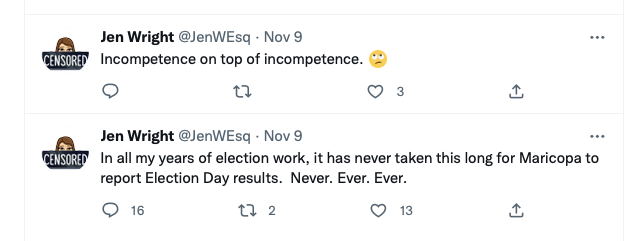
Ten days later, in her capacity as an assistant attorney general, Wright sent a letter to Thomas Liddy, the Civil Division Chief at the Maricopa County Attorney's Office.
Wright wanted an explanation of Maricopa's Election Day problems before the county certified its results.
Election Law and legal ethics expert Thomas Ryan believes at a minimum Wright should have recused herself from the investigation because her tweets amount to a conflict of interest. "It is highly inappropriate and unethical for such a person to be criticizing the county before they've been given a chance to respond to questions," Ryan said.
Then on November 25, Wright tweeted that her comments were out of frustration that no day-of votes were released in the hours after the polls closed.
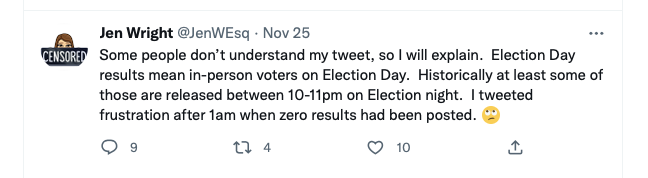
"It's hard to condone a prosecutor's action when they tip their hand when they're supposed to be close to impartial as you can get," said former Arizona Attorney General Terry Goddard.
Goddard doesn't believe politics is determining what the Attorney General's Office chooses to investigate related to the 2022 election. But Goddard and former Maricopa County Attorney Rick Romley felt compelled to send a letter to Attorney General Mark Brnovich and Wright requesting they launch an investigation of Cochise County Supervisors Peggy Judd and Thomas Crosby.
Both refused to certify the county election results by the November 28 deadline as required by state law. "They don't have any wiggle room this is not the opportunity to have a factual hearing on whether or not there are election problems. they have other venues where they can do that. but this is not that and so they broke the law," Goddard said.
Goddard says the Attorney General's Office has not yet responded to the request to investigate the Cochise County Supervisors.
Katie Connor, the spokesperson for the Arizona Attorney General's Office did not respond to whether Wright should recuse herself from investigating the Maricopa County Election.
Connor did say, "General Brnovich insists all Attorney General employees perform their duties in a professional and ethical manner. He respects their first amendment rights that do not end just because they work for a government agency."
===
an 4 24
Reps. Andy Biggs (R-AZ) and Paul Gosar (R-AZ) have been subpoenaed by Arizona investigators to testify for a grand jury in connection to their efforts to overturn the 2020 election, Politico exclusively reports.
Politico notes as far-right Freedom Caucus chair at the time, Biggs, along "with Gosar were among the most vocal congressional supporters of Trump’s efforts to overturn Biden’s victory in Arizona," and both GOP lawmakers sought "to challenge the state’s presidential electors on Jan. 6, 2021, when Congress met to certify the results of the Electoral College."
The news outlet adds, "Gosar was mounting that challenge at the same moment a pro-Trump mob broke into the Capitol and halted proceedings."
READ MORE:['We have to worry about physical violence': AZ elections chief preps for threats from MAGA
Although there's no proof Arizona Attorney General Kris Mayes will bring criminal charges against the pair, "the subpoenas themselves — in conjunction with a series of other aggressive recent moves — show that Mayes, a Democrat, has cast a far wider net in her probe than previously understood," Politico notes.
"Getting a subpoena to testify in front of a grand jury is kind of rare," American Civil Liberties Union of Arizona Legal Director Jared Keenan said. "And that’s why I think no one has challenged the secrecy law."
Some of the Arizona lawmakers' attempt to overturn the election according to investigators, includes Gosar's ongoing "relationships with activists organizing 'Stop the Steal' protests targeting Congress’ Jan. 6 session."
Regarding Biggs' actions, Politico reports, "text messages obtained by the Jan. 6 committee" show that "Biggs quickly contacted Trump’s White House chief of staff, Mark Meadows, after Election Day 2020 to push for state legislatures to overrule the results in multiple states Biden won."
READ MORE:['Resigning as Lake requested': AZ GOP chair quits amid threat of more leaks from Kari Lake
Additionally, "Biggs also told Meadows that Trump should not concede the election and reportedly worked with other Arizona Republicans to advance the fake elector effort."
*Politico's full report is available here.
---
an 4 24
although Democrats have been struggling in Florida, they have gained a lot of ground in Arizona, Georgia and Virginia — all of which were once deep red but have evolved into full-fledged swing states. Arizona was once synonymous with the conservatism of Sen. Barry Goldwater and his successor, Sen. John McCain; now, it has a Democratic governor (Katie Hobbs), two non-GOP U.S. senators (Democrat Mark Kelly and ex-Democrat turned independent Kyrsten Sinema), and a Democratic state attorney general — who has been leading a thorough criminal investigation of MAGA efforts to overturn the state's 2020 presidential election results.
One of 2020's political bombshells came when now-President Joe Biden defeated Donald Trump in Arizona. Although Trump falsely claimed that he won the state, meticulous recounts thoroughly debunked that claim.
According to Politico, Democratic Arizona AG Kris Mayes has subpoenaed two far-right MAGA congressmen who were major promoters of the Big Lie: Andy Biggs and Paul Gosar.
READ MORE:[CNN sues for recordings of President Biden’s interview in classified docs probe: report
Politico reporters Betsy Woodruff Swan and Kyle Cheney note that although "there is no indication that" Mayes "is considering bringing criminal charges against either lawmaker," the subpoenas "show that Mayes…. has cast a far wider net in her probe than previously understood."
"Mayes appears to be nearing a decision on whether to ask the grand jury to issue indictments in the case," Swan and Cheney report in an article published on April 4. "If she does, she will become the fourth state or local prosecutor to bring criminal charges over the efforts by Trump and his allies to submit fake electors in states that Joe Biden won."
The Politico journalists add, "In recent weeks, Mayes' office has sent out a wave of grand jury subpoenas. She also has required Arizona Republicans who falsely claimed to be the state's presidential electors to assert their Fifth Amendment rights in front of the grand jury — an unusual step that has generated criticism from some former prosecutors."
Swan and Cheney note that Arizona "was one of seven states won by Biden where Trump's allies organized slates of so-called alternate electors."
READ MORE:['Wrong!' AOC schools Ted Cruz on RICO laws
"Prosecutors in Georgia, Michigan and Nevada have brought criminal charges against false electors in those states, and special counsel Jack Smith has called the scheme a central element of Trump's bid to subvert the election," according to the Politico reporters. "Subpoenas to members of Congress in criminal investigations are rare, in part because lawmakers enjoy robust constitutional protections from criminal proceedings connected to their official business."
Swan and Cheney add, "But Biggs and Gosar are not the first lawmakers to face scrutiny from criminal investigators probing Trump's efforts to fight the 2020 election results. In 2022, the FBI seized the phone of Rep. Scott Perry (R-PA) as part of the Justice Department's election-subversion probe."
Legal journalist Luke Johnson, in response to the subpoenas, notes the connection between them and far-right MAGA conspiracy theorist Ali Alexander Akbar.
On X, formerly Twitter, Johnson posted, "More to the Story: Ali Alexander Akbar BRAGGED that Paul Gosar & Andy Biggs were his partners on the #StopTheSteal rallies that led to the #Jan6 violent riots. They all must be held accountable, they've laughed it off for years."
The Daily Beast notes that in 2022, the January 6 Select Committee "found that both Biggs and Gosar attended a White House meeting with Trump on December 21, 2020, to strategize on ways that then-Vice President Mike Pence could block the certification of the election results."
READ MORE:[Fani Willis fights back against House GOP efforts to derail Trump RICO case
*Read Politico's full report at this link
https://www.youtube.com/watch?v=NAC_4rtXJ8E
---
raw 3 24
arizona lawmakers may be on the brink of slapping multiple people linked to Donald Trump's 2020 campaign with criminal charges, according to a new report.
Grand jury subpoenas sent out in recent weeks suggest Attorney General Kris Mayes could soon decide whether to pursue a criminal case against Trump's fake electors in Arizona, Politico reported Wednesday.
The subpoenas constitute "a sharp acceleration of their criminal investigation into efforts to overturn Joe Biden’s victory in the state," according to the report, based on six anonymous sources.
The Attorney General's office declined to comment.
READ MORE:Fresh scrutiny for Marjorie Taylor Greene after election violation
"It was not clear whether Mayes is considering charges against people close to Trump’s national campaign," wrote reporters Betsy Woodruff Swan and Kyle Cheney, "or whether her investigation remains focused on the Arizona GOP officials and activists who aided Trump’s bid to overturn the state’s presidential results."
Prominent Arizona Republicans tied to Trump’s post-election efforts include former state GOP chairwoman Kelli Ward as well as state Sens. Jake Hoffman and Anthony Kern, both of whom served as fake electors, Politico notes.
News broke in August that Mayes' office would investigate the Trump campaign's post-election actions in Arizona, one of seven lost states Trump tried to reclaim with slates of electors told to submit his name.
Similar efforts in Georgia spurred Fulton County District Attorney Fani Willis to charge Trump and more than a dozen others with election racketeering.
Trump pleaded not guilty.
CBS AUG
Arizona Attorney General Kris Mayes' office is conducting an ongoing investigation of an alleged attempt to use alternate electors after the 2020 presidential election to benefit former President Donald Trump, a spokesperson for the attorney general confirmed.
Arizona is one of seven states that Trump lost in 2020 but where the former president's allies allegedly attempted to create a fraudulent slate of electors. How long the investigation has been underway, its status, and its scope, are not clear. Mayes, a Democrat, made her first public comments about the investigation on Wednesday.
"We are taking this investigation very seriously, very solemnly," Mayes told local media this week, adding "we're going to do it on our timetable as justice demands."
The Arizona probe takes place as Trump and 18 of his associates face charges of racketeering, election fraud and other charges in Fulton County, Georgia, over an alleged effort to overturn the 2020 presidential election, including the alternate elector scheme. The indictment alleged that some of the defendants solicited legislators to appoint new electors not only in Georgia, but also in states including Arizona, Pennsylvania and Michigan.
Last week, the former president was indicted by a federal grand jury over alleged efforts to overturn the 2020 presidential election. That indictment cited a memo outlining a strategy for Trump supporters to serve as fake electors.
The former president has denied all wrongdoing in both of those cases. He has been charged in two other cases. One involves federal counts related to alleged mishandling of classified documents. The other, in state court in New York, involves allegedly falsifying business records. He has denied wrongdoing in those cases as well.
Last year, Mayes narrowly defeated a Republican who denied the 2020 presidential election results. Mayes pledged to investigate the alleged fake electors scheme.
Multiple GOP candidates in Arizona, a longtime swing state, who ran in 2022 insisted that President Biden did not rightfully win the 2020 election. Failed GOP gubernatorial candidate Kari Lake became perhaps the most prominent of those so-called election deniers. She lost the election to Democratic Gov. Katie Hobbs.
In Michigan, 16 alleged fake electors have pleaded not guilty as they face charges in an alleged plot to give Michigan's electoral votes to Trump.
aha these are norms now backed by law
an 2 23 maya
Election officials, legislators and advocates across the country, who are mostly Democrats, are fighting "the wave of misinformation and mistrust of elections" fueled by election deniers in preparation for the 2024 presidential election, The Washington Post reported on Wednesday.
Inspired by former President Donald Trump's false claims of election fraud during the 2020 election, election deniers have forced election officials and administrators to adhere to "demands that go beyond their official powers — to stop using electronic voting equipment, to hand-count all ballots, to end mail voting or to refuse to certify results."
Per The Post, this "pressure and abuse" has caused "hundreds" of officials to step down from their roles.
READ MORE: 'Corporate America' is now funding the election deniers it once condemned: report'
:{Now, many Democratic officials are implementing practices to fight against the :(style="background-color:#ffff66;"):}:"election denialism" plaguing many GOP supporters and officials, which will likely persist in the coming year.
The Post reported:
When the new Arizona attorney general took office last month, she repurposed a unit once exclusively devoted to rooting out election fraud to focus on voting rights and ballot access.
In North Carolinaon Tuesday, the State Board of Elections began proceedings that could end with the removal of a county election officer who had refused to certify the 2022 results even as he acknowledged the lack of evidence of irregularities.
And later this week, a group of secretaries of state will showcase a 'Democracy Playbook' that includes stronger protections for election workers and penalties for those who spread misinformation.
READ MORE: Koch group throws support behind two election deniers after dumping Trump
"We want to protect the people who protect democracy," said Michigan Secretary of State Jocelyn Benson (D). "Individuals who intentionally spread misinformation that then leads to threats or worse targeting election officials are just as culpable and should be held culpable just as those who are actually exercising the threats themselves."
Regarding heightened violence from election deniers, Arizona Attorney General Kris Mayes (D) said, "We're facing a new world in which elections officials are experiencing death threats, in which voters are being intimidated by people showing up at the ballot box, at voting centers, wearing body armor and carrying guns, and in which the Republican Party is trying to undermine vote-by-mail. Those are all things that I think this unit can and should now be focused on."
AlterNet previously reported Solomon Peña, an ex-GOP candidate was arrested after he conspired a series of drive-by shootings targeting Democratic lawmakers, claiming his election was "rigged."
Benson is collaborating with Lansing, Michigan legislators to hike up punishments for those who "threaten election officials or releasing private information about them," and taking steps to propose a law that would legislation that would make spreading election misinformation illegal, according to The Post.
NPRreports Pennsylvania is "still grappling with the aftermath of the 2020 election," as the state continues to be "a hotbed for election deniers and misinformation."
William Martin, an election official in suburban Philadelphia said, "I am profoundly offended to listen to baseless allegations of fraud against me and against other county workers. It's time to put up or shut up. If you think there is fraud, sue me. Sue me! Sue me personally. Because then when it gets thrown out, I'll sue you for abuse of process. Sue me!"
Executive director of the County Commissioners Association of Pennsylvania, Lisa Schaefer, contends "Those counties are dealing with people who, over and over, no matter how many times they've seen the evidence of the integrity of the election, continue to come and yell and be insulting."
Canton, Michigan Township Clerk Michael Siegrist reiterated the need to enforce penalties for all forms of election denialism.
READ MORE: 'Loser, loser, loser, loser': Chris Christie dings Donald Trump's list of failed election deniers
"Someone’s going to have to bring some charges against some folks," Siegrist told The Post. "This notion of, 'I'm going to come in and try to re-litigate an election afterwards in the court of public opinion,' especially if it relates to a scheme to overturn the validity of an election — that stuff just needs to have consequences."
The Washington Post's full report is available at this link. NPR's can be viewed here.
Kris Mayes (Democratic Party) is the Attorney General of Arizona. She assumed office on January 2, 2023. Her current term ends on January 4, 2027.
Mayes (Democratic Party) ran for election for Attorney General of Arizona. She won in the general election on November 8, 2022.
Mayes completed Ballotpedia's Candidate Connection survey in 2022. Click here to read the survey answers.
Mayes served on the Arizona Corporation Commission as a Republican from 2003 to 2011 .[1][2]
Biography
Kris Mayes was born in Prescott, Arizona. She earned a high school diploma from Prescott High School. She earned a bachelor's degree in 1994 and a law degree in 2003, both from Arizona State University. Her career experience includes working as an attorney. [1]
Elections
duck 2 23
:{Recount confirms Democrat Kris Mayes won Arizona attorney general race ...:(style="margin:0px;padding:0px;border:0px;font-style:inherit;font-variant:inherit;font-weight:inherit;font-stretch:inherit;vertical-align:top;display:inline-block;max-width:100%;overflow:hidden;text-overflow:ellipsis;white-space:nowrap"):}:
Dec 30, 2022Democrat Kris Mayes won the Arizona attorney general race, an automatic recount confirmed. ... Turning Point USA's "AmFest 2022" began its all-day"General Sessions" on Sunday, Dec. 18. 2022 in ...
:{Kris Mayes for Arizona Attorney General:(style="margin:0px;padding:0px;border:0px;font-style:inherit;font-variant:inherit;font-weight:inherit;font-stretch:inherit;vertical-align:top;display:inline-block;max-width:100%;overflow:hidden;text-overflow:ellipsis;white-space:nowrap"):}:
Kris is the only Democratic candidate for Arizona Attorney General. Support our legal fund and recount observer team. Though there is currently a state-mandated recount, Ms. Mayes is proactively preparing for her transition to step into the AG role in early January of 2023 to serve Arizonans as the Lawyer for the People.
:{Kris Mayes - Ballotpedia:(style="margin:0px;padding:0px;border:0px;font-style:inherit;font-variant:inherit;font-weight:inherit;font-stretch:inherit;vertical-align:top;display:inline-block;max-width:100%;overflow:hidden;text-overflow:ellipsis;white-space:nowrap"):}:
Nov 8, 2022Kris Mayes ( Democratic Party) is the Attorney General of Arizona. She assumed office on January 2, 2023. Her current term ends on January 4, 2027. Mayes ( Democratic Party) ran for election for Attorney General of Arizona. She won in the general election on November 8, 2022. Mayes completed Ballotpedia's Candidate Connection survey in 2022.
:{Arizona Attorney General-Elect, Kris Mayes:(style="margin:0px;padding:0px;border:0px;font-style:inherit;font-variant:inherit;font-weight:inherit;font-stretch:inherit;vertical-align:top;display:inline-block;max-width:100%;overflow:hidden;text-overflow:ellipsis;white-space:nowrap"):}:
Arizona Attorney General-Elect, Kris Mayes On December 5th, Kris Mayes was certified as the winner in the 2022 election for Arizona Attorney General. Learn more about Ms. Mayes, her top priorities and her campaign here.