Lawrence Krauss asu
---
vlimate adam
yt 3 26
---
ggl 3 26AI Overview
Based on the search results, there are two distinct individuals with the surname Krause/Krauss associated with Arizona State University (ASU) and climate-related topics:
1. Lawrence Krauss (Former ASU Professor)
- Climate Views: Lawrence Krauss, a theoretical physicist and former director of the Origins Project at ASU, has argued that cutting carbon emissions is insufficient to address climate change. He advocates for active methods to remove and sequester

directly from the atmosphere.
- Publications: He authored the book "The Physics of Climate Change".
- ASU Status: Krauss left ASU in 2019 following misconduct allegations and investigations.
 Wikipedia +3
2. Stephen Krause (ASU Faculty)
- Role: Stephen Krause is a faculty member in the School for Engineering of Matter, Transport and Energy at ASU.
- Research: His work includes materials science and engineering education, with research interests in educational methods for engineering concepts.
 Arizona State University (ASU) +3
Related ASU Climate Research (Klaus Lackner)
The search results frequently reference Klaus Lackner at ASU, who is the director of the Center for Negative Carbon Emissions. He is a prominent figure at the university for developing "MechanicalTree" technology for direct air capture to combat global warming.
 YouTube +2
---
quite a bit of talk, mostly about why origin cut asu
also
Krauss has now authored three books published through Post Hill Press, known for self-help, business and pop topics, not for science or scholarship. The conservative Christian imprint is the company that printed Sgt Jonathan Mattingly's egregious book defending his actions in the killing of Breonna Taylor, forcing Simon and Schuster in 2021 to drop the distribution deal they had with Post Hill Press.[1][2][3] The imprint is famous for its controversial conservative Christian political authors such as Josh Hawley and Mike Pence.[4]
These days, they don't flaunt their conservative Christian foundation. In 2018, their website said that they "focus on the categories of pop culture, business, self-help, health, current events, Christian, and conservative political books". They deleted the controversial parts recently, changing "Christian, and conservative" to "memoirs". But it's the same company, publishing crap like this.
Why would Krauss choose this hypocritical publisher and not one known for its dedication to science and truth? Binksternet (talk) 23:33, 1 March 2025 (UTC)
Don't BLP rules also apply on the talk page? How about OR and SYNTH? If some RS is shaming Krauss for his publisher, you could cite them. Otherwise, mentioning the name of the publisher, with a link to its article, is as far as you should go in a BLP toward sharing your POV here. HouseOfChange (talk) HouseOfChange (talk) 02:39, 2 March 2025 (UTC)
Lawrence Maxwell Krauss (born May 27, 1954) is a Canadian-American theoretical physicist and cosmologist who taught at Arizona State University (ASU), Yale University, and Case Western Reserve University. He founded ASU's Origins Project in 2008 to investigate fundamental questions about the universe and served as the project's director.
Krauss is an advocate for public understanding of science. An anti-theist, Krauss seeks to reduce the influence of what he regards as superstition and religious dogma in popular culture.[2] Krauss is the author of several bestselling books, including The Physics of Star Trek (1995) and A Universe from Nothing (2012), and chaired the Bulletin of the Atomic Scientists Board of Sponsors.[3][4]
Upon investigating allegations about sexual misconduct by Krauss, ASU determined that Krauss had violated university policy, and did not renew his directorship of ASU's Origins Project for a third term in July 2018.[5] Krauss retired as a professor at ASU in May 2019, at the end of the following academic year. As of 2022,[6] he was listed as Principal Officer of The Origins Project Foundation, Inc. (a new organization, founded in 2019[7]).[8] Krauss hosts The Origins Podcast with Lawrence Krauss[9] and publishes a blog titled Critical Mass.[10]
Krauss has faced scrutiny for his association with child sex offender Jeffrey Epstein. He organized a 2006 physics conference funded by an Epstein foundation and received funding from Epstein for an academic project. He also publicly defended Epstein after his 2008 conviction and maintained correspondence and social contact with him over many years.[11]
...
---
ggl 3 26
context
Arizona State University’s Center for the Study of Economic Liberty,for example, has received $3.5 million from theCharles Koch Charitable Foundation.The other freedom schools are the Center for Political Thought and Leadership at Arizona State University and Center for the Philosophy of Freedom at the University of Arizona.
---
ggl 3 26
krause climate epstein resign metoo
[### effrey Epstein, climate change doubter

Yale Climate Connections
https://yaleclimateconnections.org › 2025/11 › jeffrey-e...](https://yaleclimateconnections.org/2025/11/jeffrey-epstein-climate-change-doubter/
Nov 19, 2025 — Newly released emails show Epstein peddling climate denial myths to scientist Lawrence Krauss while Trump's first term was getting underway.
CLimate scientists overwhelmingly agree that modern-day climate change is real, mostly bad, and caused by people. But according to newly released emails, deceased child predator Jeffrey Epstein doubted that consensus.
A heads up: In addition to references to climate-related misinformation, this article mentions allegations of sexual misconduct and crimes.
Last Wednesday, the U.S. House Oversight Committee released more than 20,000 documents from the Epstein estate, including thousands of his emails. Epstein died in jail in 2019 while awaiting trial on charges of sex trafficking minors.
The newly released documents show that in late 2016 and early 2017, after Donald Trump was elected to his first term, Epstein exchanged emails with celebrity physicist Lawrence Krauss, who at the time was the director of the Origins Project at Arizona State University. Epstein was a major donor to the Origins Project.
In the emails, which contain numerous typos and grammatical errors, Epstein pressed Krauss – who himself left Arizona State University in 2019 amid allegations of sexual misconduct – about several common claims by climate deniers. In each exchange, Krauss politely pushed back.
“i liked the argument that more co2 is good for plants?” Epstein wrote.
“yes, freeman dyson says that too,” Krauss replied, referring to a prominent climate denier. “He has cherry picked data, the typical act of those who believe the answer before they ask the question.”
In his next email, Epstein raised another myth: “is the south pole getting colder and more ice?” He added, “I m here with the trump peopl in palm and when asked i say i dont have any idea if this global warming is a threat that can be reduced.”
“I was in antarctica,” Krauss wrote. “The west antarctic ice sheet is melting at an unprecedented rate.”
A few months later, Krauss wrote to Epstein with a reaction to the Trump administration’s authorization of funding for NASA.
“This is not supporting science,” Krauss said. “It is all about the size of the rocket for him. All this will do is give him glory and not contribute to science.”
“you told me you were worried about space and i told you not to worry, he will decimate climate change. and support, verifiable projects,” Epstein replied.
Reached for comment by Yale Climate Connections, Krauss said he hoped he’d had an impact on Epstein’s perspective.
“I like to think I dispelled some myths, and provided him data to help do so,” Krauss wrote by email.
Trump echoes Epstein’s misinformation
Trump, another regular topic in Epstein’s email inbox, returned to power this year. Photographs and documents suggest that Trump and Epstein were close for years before reportedly parting ways. Trump has denied any involvement in Epstein’s crimes and has said he wasn’t a “fan” of the man.
“Well, I knew him like everybody in Palm Beach knew him,” Trump said in 2019. “I mean, people in Palm Beach knew him. He was a fixture in Palm Beach. I had a falling out with him a long time ago.”
Still, climate change denial was a common interest of the two men. The president has called climate change a hoax, and his administration has revived the misleading claim that carbon dioxide benefits crops.
*Read: Fact-checking a Trump administration claim about climate change and crops
More significant is each man’s enormous wealth and personal or political power – and how they wielded both at the expense of many others.
One Epstein victim said recently that about 1,000 women had survived his abuse. As for Trump, his pro-fossil-fuel policies will lead to up to 1.3 million additional temperature-related deaths around the world in the coming decades, according to a new analysis by ProPublica and the Guardian.
Last summer, journalist Kate Aronoff described the parallels between climate denial and Trump’s efforts to deny his association with Epstein.
“Besides its rhetorical flourishes, the throughline between climate denial and Epstein denial is that the underlying harms at issue – catastrophic global warming, and decades of sexual abuse – are straightforwardly horrific. It boggles the mind to imagine that so many of the country’s most powerful people, Democrats and Republicans alike, spent decades either aware of or involved in crimes of that magnitude, looking the other way as victims continued to accumulate.”
“Monied interests’ efforts to deny and downplay the reality of the climate crisis – and their own products’ role in fueling it – are just as scandalous.”
---
[### Lawrence Krauss

Wikipedia
https://en.wikipedia.org › wiki › Lawrence_Krauss](https://en.wikipedia.org/wiki/Lawrence_Krauss)
"Former ASU professor Lawrence Krauss received $250,000 from Jeffrey Epstein". ... "Lawrence Krauss to Retire From Arizona State After Sexual Misconduct ...Read more

[### Former CWRU professor Krauss appears in Epstein files

Case Western Reserve University
https://observer.case.edu › former-cwru-professor-kraus...](https://observer.case.edu/former-cwru-professor-krauss-appears-in-epstein-files/)
Nov 21, 2025 — Krauss was removed from his position as the director of ASU's Origins Project in August. He resigned in May 2019. The Observer reached out to ...Read more

[### Epstein tracked #MeToo fallout and advised accused men ...

Yahoo
https://www.yahoo.com › news › articles › epstein-track...](https://www.yahoo.com/news/articles/epstein-tracked-metoo-fallout-advised-202602978.html)
Feb 4, 2026 — Krauss, who had been on paid leave for months, eventually reached an agreement to retire from the university. He continued to send Epstein draft ...Read more
Missing: krause resign
[### The Professors Who Stayed Close With Epstein

The New York Times
https://www.nytimes.com › 2025/11/21 › professors-jef...](https://www.nytimes.com/2025/11/21/us/professors-jeffrey-epstein-relationships.html)
Nov 24, 2025 — Krauss, who announced his retirement from Arizona State in 2018, said that Mr. Epstein, who did not graduate from college, “was fascinated by ...Read more
Missing: climate | Show results with: climate
[### Lawrence Krauss and the Legacy of Harassment in Science

The Atlantic
https://www.theatlantic.com › archive › 2018/10 › lawr...](
https://www.theatlantic.com/science/archive/2018/10/lawrence-krauss-sexual-misconduct-me-too-arizona-state/573844/
Oct 24, 2018 — Arizona State removed Krauss as leader at the Origins project. But the school not fire Krauss from his role as professor, even though the ...Read more
In April, a theoretical physicist showed up at conference in California about the search for extraterrestrial life in the universe.
In one way, his presence was likely. Lawrence Krauss is a prominent scientist, author of several best-selling books, and a prolific lecturer known for his lively and engaging style. He’s not a household name like Neil deGrasse Tyson and Bill Nye, but he starred in a documentary alongside fellow atheist-scientist Richard Dawkins, and his lectures on cosmology regularly rack up thousands of views on YouTube—no easy feat for a physicist trying to popularize science.
In another way, it was surprising. Two months before the conference, several women had accused Krauss of sexual misconduct, describing behavior that went unchecked for over a decade. By the time Krauss stepped foot on Stanford’s campus for the gathering, he had been banned from three universities, removed from multiple speaking events, and was under a formal investigation by Arizona State University, his primary affiliation. But Krauss had denied the allegations, and refused to withdraw from public life. “He chatted with peers. He ate with prestigious scientists. In the conference hall, he sat in front, where there were two rows of cloth-covered tables for VIPs,” Jason Davis, a science writer who was there, reported. “He even challenged a NASA engineer after one talk, declaring a proposed propulsion drive to be based on bunk physics.”
Some attendees were flabbergasted by Krauss’s appearance, and chastised the Breakthrough Initiative, the host of the conference, for admitting an alleged harasser in the midst of an investigation of inappropriate behavior in a professional setting. Breakthrough later told Krauss to avoid its events until the investigation was over.
NOT SHILLENBERGER
That investigation concluded this week. According to BuzzFeed News, which first reported on Krauss’s alleged sexual misconduct in February, Arizona State found evidence to support several allegations: that Krauss grabbed a woman’s breast at a meeting; that he groped another’s thigh; that he told an employee he would buy her birth control so she wouldn’t inconvenience him with...
[### Prominent physicist asked for Epstein's advice when he ...

AOL.com
https://www.aol.com › articles › prominent-physicist-as...](https://www.aol.com/articles/prominent-physicist-asked-epsteins-advice-190733885.html)
A spokesperson for ASU said Krauss “chose to retire in 2019 while the review was in progress.” By the time of his contentious retirement from ASU, Krauss ...Read more
Missing: krause climate
[### Epstein emails include messages with ex-ASU professor ...

The Arizona Republic
https://www.azcentral.com › news › arizona › 2025/11/17](https://www.azcentral.com/story/news/politics/arizona/2025/11/17/epstein-emails-include-messages-with-ex-asu-professor-lawrence-krauss/87286023007/)
Nov 17, 2025 — Krauss retired from ASU in 2019 after the university found the sexual misconduct allegation from an event in Australia to be credible. Two ...Read more

[### Arizona professor put on leave amid misconduct allegations

The Seattle Times
https://www.seattletimes.com › nation-world › arizona-...](https://www.seattletimes.com/nation-world/arizona-professor-put-on-leave-amid-misconduct-allegations/)
Mar 7, 2018 — But the fallout of the allegations led Krauss to give up one position on Tuesday, when he resigned as chairman from the Board of Sponsors at the ...Read more

[### Lawrence Krauss to Retire From Arizona State After Sexual ...

Reddit · r/Physics
170+ comments · 7 years ago](https://www.reddit.com/r/Physics/comments/9qrff2/lawrence_krauss_to_retire_from_arizona_state/)
ASU placed Krauss on paid administrative leave on 6 March, two weeks after BuzzFeed published an exposé describing multiple sexual harassment allegations ...Read more
Physicist Lawrence *Krauss*: "The current *climate* of ...
326 posts
Sep 20, 2020
Influential Canadian physicist sought *Epstein's* advice ...
17 posts
Nov 14, 2025
More results from www.reddit.com
People also search for
As of early 2026, Lawrence Krauss is based in the Phoenix, Arizona area, operating as the President of The Origins Project Foundation (founded 2019). He hosts The Origins Podcast, writes the Critical Mass Substack, and serves as chair of the Free Speech Union of Canada. He retired from Arizona State University in 2019.
 Wikipedia +4
Current Activities & Role:
- Origins Project Foundation: He continues public outreach, organizing events and trips through this independent foundation.
- Media & Publishing: Krauss produces The Origins Podcast, featuring conversations with scientists and cultural figures
. He also publishes a blog, Critical Mass, on Substack.
- Advocacy: He is active in defending free speech in science, notably serving as the chair of the Free Speech Union of Canada.
- Background: After leaving Arizona State University in 2019 following allegations of sexual misconduct—which he has denied—he shifted his focus to independent media and projects.
 Wikipedia +5
- Lawrence Krauss - Wikipedia
Upon investigating allegations about sexual misconduct by Krauss, ASU determined that Krauss had violated university policy, and d...

Wikipedia

- Lawrence M. Krauss (@LKrauss1) / Posts / X - Twitter
Theoretical physicist. Best-selling author. Science & public policy advocate. President of @OriginsProject & Host of Origins Podca...

X

- Epstein used his ties to Nobel laureate scientists to try to rebuild ...
He maintained an almost 15-year friendship with Epstein and later retired from Arizona State University in 2019 amid multiple sexu...

KUOW

[### Lawrence Krauss

Wikipedia
https://en.wikipedia.org › wiki › Lawrence_Krauss](https://en.wikipedia.org/wiki/Lawrence_Krauss)
Krauss retired as a professor at ASU in May 2019, at the end of the following academic year. As of 2022, he was listed as Principal Officer of The Origins ...Read more

Lawrence Krauss speaks about his war on woke science

YouTube · The Washington Examiner
250+ views · 4 months ago](https://www.youtube.com/watch?v=7kt5y_yQYxE)
35:53
Washington Examiner In Focus editor Pater Laffin joins theoretical physicist Lawrence Krauss to discuss free speech in the scientific world ...

4 key moments in this video
[### Lawrence Krauss - Origins Project Foundation

LinkedIn · Lawrence Krauss
2.8K+ followers](https://www.linkedin.com/in/lawrence-krauss-787735a)
United States · Origins Project Foundation
Experience: Origins Project Foundation · Location: United States · 500+ connections on LinkedIn. View Lawrence Krauss' profile on LinkedIn, a professional ...[### Lawrence Krauss speaks about his war on woke science

YouTube · The Washington Examiner
250+ views · 4 months ago](https://www.youtube.com/watch?v=7kt5y_yQYxE)
35:53
Washington Examiner In Focus editor Pater Laffin joins theoretical physicist Lawrence Krauss to discuss free speech in the scientific world ...

4 key moments in this video
---
Wars on Science, Real and Otherwise
Wars on Science, Real and Otherwise
"The War on Science," ed. Lawrence Krauss, documents an imaginary war on science from the left in order to justify an entirely real war on science from the right.
Nathan Oseroff-Spicer
REVIEW
:{The War on Science: Thirty-Nine Renowned Scientists and Scholars Speak Out About Current Threats to Free Speech, Open Inquiry, and the Scientific Process*(2025), edited by Lawrence Krauss, was dead on arrival.
The book’s thesis is that academia is under assault from a horde of left-wing academics spreading ‘gender theory’ and ‘critical race studies’. Allegedly, trans people and Black academics are oppressing the simultaneously iconoclastic (but also common-sense) ideas that trans people cannot, by definition, exist, and therefore are undeserving of legal protections and medical care, and Black people are, on the whole, naturally intellectually inferior to white people, and therefore undeserving of their position. For some of the contributors, another threat to free speech and open inquiry is their research institutions ruling their conduct towards their students unprofessional. The broad unstated conclusion is academia must be reconstructed in the image of a lost, halcyon past.}:
Wars on academia are not without precedent. Consider for a moment Moritz Schlick, the founder of logical positivism and the Vienna Circle, a loose network of left-wing academics, many Jewish. Some were social democrats. Others were socialists and communists. In 1936, on the steps of the University of Vienna, Schlick was shot four times in the chest at close range by a fascist ex-student. The man who assassinated Schlick defended himself on the grounds that he acted out of antisemitic fervour (it did not matter that Schlick was Protestant). He was convicted and imprisoned. Two years later, after the Nazis had secured power in Vienna, he appealed his conviction on the same grounds: murdering Schlick was due to his ‘strong national motives and explicit anti-Semitism’. He was immediately paroled. Most of the Circle—and many other European academics that survived the Nazis—fled to the United Kingdom and United States.
Katy Fulfer is, as of this writing, associate professor of philosophy at the University of Waterloo. She writes on refugees, feminist philosophy, and bioethics. In 2023, while in her classroom during her instruction of Philosophy 201, a module exploring gender theory, she was stabbed once in the face and across her body. She survived, as did the two philosophy students that were also stabbed by the attacker. The attempted murderer was an ex-student of the university. During the police interview following his attempted murder, he told the officer he ‘just wanted to protect the freedom of academia’; during the trial, he said universities were ‘forcing ideology’ on people—the ideology of ‘gender’. In the months after she was attacked, Fulfer received hate mail and threats against her life.
Modern-day examples of the state’s assault on the university include Orbán’s expulsion of Open University from Hungary, Modi’s sustained attack on Indian universities, or Trump’s more recent extortion racket on American universities. ‘Freedom of speech’ and ‘academic freedom’, rather than twin concerns of the university’s ability to self-govern and faculty and students’ to act without state interference, are twisted for the ends of the state. The UK’s Office for Students, for example, imposed more than a half million pounds in fines on University of Sussex for an unenforced anti-discrimination policy on the grounds that its existence suppressed the free speech of academics that hold bigoted views about trans people.
The War on Science does not include any substantive history of any recognised war on science. It also does not include any history of academic freedom or freedom of speech—of Black Friday, McCarthyism, COINTELPRO, the House Un-American Activities Committee’s attacks on Antioch College, or soldiers indiscriminately shooting students at Kent State. It does not mention Moritz Schlick or Katy Fulfer or any other human being like them. Rather, The War on Science is a paradigm example of Anton Jäger’s concept of ‘hyperpolitics’: a heightened emotional response to momentary moral panics, fads, ‘a form of politicisation without any clear political consequences’. These are the compact, individualised stories that dominate our modes of thinking. In other words, the ‘culture wars’.
Contributors repeatedly attempt to wring out tears over stories about the aggressors and the aggrieved. One contribution, by Dorian Abbot, is a series of admitted fantasies of the imaginings of a ‘Mr. Woke (he/they)’ drinking a venti soy latte, ‘Ms. Oppressed’ winning an award, and ‘Professor Left’ in disputation with ‘Professor Right’. The aggressors are always left-wing academics, bureaucrats and students, who have somehow harmed the aggrieved; the aggrieved are occasionally named, but their views are barely sketched, as with Sally Satel’s article about a lecture she gave in 2021 that received unspecified pushback. She does not explain precisely what she said, but her colleagues’ critique may have to do with her decades-long work speaking out in favour of Purdue’s OxyContin, her employer receiving a substantial amount of funding from Purdue, and her history of sharing drafts of articles supporting prescribing opioids with Purdue officials for comment in advance of publication in major news outlets.
Jäger writes, ‘[hyperpolitics is] a grin without a cat: a politics with only weak policy influence or institutional ties’. The book is, effectively, at war with phantasms and ghosts, and itself an artifact of hyperpolitics. Contributors endlessly complain about filling out ‘DEI’ funding form boxes. In a brief moment of clarity by one author, Geoff Horsman, acknowledges it to be nothing but bureaucratic box-checking. He says, ‘While 2.5 percent [of applications being rejected for failure to properly fill out a box] isn’t huge, it’s still concerning that any grant would be rejected on ideological grounds’. Now Horsman’s specific concerns about 'DEI’ are gone under Trump, along with it tens of millions of dollars in science funding, and innumerable grants rejected or revoked on expressly ideological grounds.
Many of the essays in The War on Science mention (but do not elaborate on) universities forcing an ‘ideology’ on students, the ideology of ‘gender’, the same words used by the man that attacked Fulfer and her two students. This is the same spectre of ‘ideology’ raised by Samuel Alito during oral argument in Chiles v. Salazar, a Supreme Court case about whether state-licensed mental health professionals have a First Amendment right to disregard medical consensus and engage in ‘conversion therapy’, a practice using techniques on queer and trans children that has been compared by the International Rehabilitation Council for Torture Victims to torture. ‘The medical consensus is usually very reasonable and it’s very important. But have there been times when the medical consensus has been politicised, has been taken over by ideology?’ said Alito. This form of argument is routinely employed in this book: the expert consensus could be ‘taken over by ideology’, therefore it is taken over by ‘ideology’, therefore the volume’s contributors are like David facing Goliath, or Galileo against the Church, or even Sparta’s three-hundred facing a nameless horde of invaders. Never talk about the concrete issues; always move to a higher level of abstraction about ‘free speech’, ‘debate’ or possible ‘cancellation’.
Once you notice the elisions, you cannot help but see where the authors have dutifully cut around their own positions. Sometimes the scissors slip and we get a sliver of the missing picture, as when Gad Saad says, ‘universities are the progenitors of all the parasitic idea pathogens that have sent the West into a death spiral within the abyss of irrational darkness’ and ‘Academics should be trained to be intellectual Navy SEALs who boldly venture into uncharted territory rather than being meek invertebrate castrati deeply concerned about adhering to the prevailing orthodoxy’, and ‘if the silent majority, all of whom despise these idea pathogens, were to speak out in unison, we would return our universities and, more generally, our societies to their former glory’. This outline takes the general shape of infantile palingenetic ultranationalism.
Another outline is revealed in Alessandro Struma’s essay defending himself against alleged charges of misogyny and racism. He starts with ‘The term “cultural Marxism” remains controversial’, before delving into a niche antisemitic conspiracy theory about ‘postmodernism’ as the product of a secret cabal of Marxists academics ‘gradually occupying institutions to subvert them from within’, creating Marxist concepts such as ‘gender’, ‘critical race theory’, and ‘decolonialism’. ‘Crime spread, and some US towns became no-go areas’, he says. ‘We can say that somebody is taller or somebody is smarter without being attacked by academic mobs. … However, we cannot say that, consequently, genetic drift can result in related differences at the group level… The gender gap is politically correct. The race gap is an unsayable taboo’. You simply cannot say these things anymore, it’s too taboo. The empty space remains: the author’s alleged and obliquely referred-to racist and misogynist comments were unfairly criticised by a secret cabal of Marxists infiltrating academia. Never apologise; always double down.
Richard Dawkins’ essay starts with a thought-experiment: he imagines a race of aliens interested only in the hard sciences. He concludes they would not have ‘their own Foucault or Derrida, their own Judith Butler or “Ibram X. Kendi”’. (Dawkins gives no explanation for why Ibram X. Kendi’s name is in quotation marks.) Since by Dawkins’ stipulation, these fictitious aliens do not analyse or critique their own culture or history, they treat this as ‘beneath their notice: as trivial, as meaningless, as futile as the proverbial angels pirouetting on a pinhead’. Dawkins concludes all social theory is meaningless. This is insipid.
Dawkins provides fourteen examples of apparent hard and fast distinctions between animals categorised as males and females. Unexplored by Dawkins, every example includes the words ‘nearly always’, ‘far more common’ or ‘usually’. Scientists explore the exceptions to the rule, since their very existence—like the black swan swimming by your rowboat—refutes the general theory (e.g. ‘all swans are white’). Dawkins then works backwards from his idiosyncratic definitions to assert intersex people do not—cannot—exist. On the contrary, since intersex people do exist, by modus tollendo tollens, Dawkins is wrong.
Dawkins then compares the existence of trans people to Lysenkoism under Soviet rule. This is not the first time this comparison is made in the volume. Upending reality a second time, Dawkins claims trans people are ‘a politically powerful lobby’ and ‘it is hoped that, in America, it will soon go the way of McCarthyism’ and concludes ‘perhaps the only good thing [Donald Trump] has ever done’ is passing an executive order declaring by fiat that trans people do not exist.
Dawkins concludes that, as with intersex people, trans people cannot exist because biologists categorise animals into two sets ‘based on gamete size’. The relative size of a microscopic part of some cells has never been a determining factor in our self-conception or the categorisation of other humans into different sexes. I know this because we do not perceive the relative sizes of our or anybody else’s gametes. Dawkins obsesses over this irrelevant point for one reason only: how can there be legal protections, mutual respect, or medical care for trans and intersex people if they don’t exist? He defines them out of existence.
Alan Sokal extends Dawkins’ line of attack in ‘How Ideology Threatens to Corrupt Science’. The ‘ideology’ is that the natural sciences must be kept free from racist pseudoscience. But Sokal does not tackle this head-on. Instead, he couches his criticism in second-order critiques of the Terms of Service of the scientific journal, Nature, that permit editors ‘request modifications’ to, ‘refuse publication’, or ‘retract post-publication’ articles that express bigotry.Sokal denies the parsimonious explanation that Terms of Service are written vaguely precisely to deal with edge cases, instead asserting, ‘the editors of Nature have arrogated themselves the right to suppress valid scientific work—work that is both correct and important’.
Let’s unpack this: Nature’s Terms of Service permit editors to remove bigoted content from articles. Sokal concludes that fictitiousarticles that he imagines are retracted in virtue of including bigoted content are ‘both correct and important’. Sokal’s argument is, in reality, an argumentative shell game for why racist articles must be published in scientific journals. Sokal first entices the liberal, saying, ‘if you really care about the truth, you ought to be open to hearing arguments against your current opinions’. The switch occurs between the general principle (listening to criticism from others is good!) and the content of that criticism (sotto voce: did you know bigotry is ‘correct and important’?). Sokal’s tell is obvious: he begins to approvingly reference fringe race scientist and white identitarian Bo Winegard, now executive editor of Aporia, an overtly eugenicist magazine run by the Human Diversity Foundation (HDF) (previously run under the name The Pioneer Fund, itself an {infamous Nazi-affiliated eugenics organisation). Hope Not Hate provided an }_{exposé}_ on the Pioneer Fund’s rebranding as HDF, as well as HDF’s new leadership, modern sources of funding and recent ties to the German far-right party, Alternative für Deutschland. As Hope Not Hate reports, Winegard now says, ‘Without white identity, European culture, the unique manifestation of the European temperament, will decay’.
Niall Ferguson’s essay compares European and American intellectuals to academics that colluded with the Nazis, turning Julien Benda’s essay on its head and openly stealing its title: ‘The Treason of the Intellectuals'. The charge? ‘That hostility to Israeli policy in Gaza regularly slides into antisemitism is now impossible to deny’. Ferguson knows this because ‘the son of a Jewish friend’ was subjected to an antisemitic slur. If this evidence feels slight to you, don’t worry, ‘there are too many to mention’. We are not privy to this evidence.
Ferguson’s argumentative chicanery continues through multiple stages of equivocation: a single instance of antisemitism becomes many unspecified instances of antisemitism, which arrives at the core, unstated premise of his article: is there a left-wing academic that opposes Israel’s genocide of Palestianians that isn’t antisemitic? Ferguson’s opaque answer, in an unbearable, circumlocutory passage: ‘It might be thought extraordinary that the most prestigious universities in the world should have been infected so rapidly with a politics imbued with antisemitism’. An antisemitic slur directed at his Jewish friend’s son is transformed into a rapid infection spreading throughout the ivory tower. You see the workings of the trick when you look where he doesn’t want you to: why does Ferguson focus on only comparing left-wing academics to Nazi collaborators? We already know antisemitism is ubiquitous within Western society. If we applied his argument by way of equivocation, why not ‘The Treason of Western Civilisation’?
If we are interested in more apt, specific comparisons of academics colluding with fascists or pushing fascist propaganda, we may consider as candidates the very contributors of this volume that have personally collaborated with the Trump administration (as one contributor, Alex Byrne, {was discovered to have secretly done), promulgated far-right antisemitic conspiracy theories (Struma’s secret cabal of Marxists infiltrating academia lifts heavily from }Paul Weyrich and William Lind’s version), or cited modern-day eugenicists and white identitarians (Sokal’s reliance on Bo Winegard and other eugenicist contributors to Aporia is but one instance in this volume).
Ferguson concludes, ‘it will take a lot more than a few high-profile resignations to reform the culture of America’s elite universities. It is too much entrenched in multiple departments, all dominated by tenured faculty’. The unstated conclusion: academia requires a mass purge.
What forms of speech must be suppressed? Gad Saad rails against ‘postmodernists, radical feminists, cultural relativists, and social constructivists’. Their ideas are a ‘parasite’ on the body politic for their ‘biophobia (fear of using biology to explain human behaviour)’. He blames his lack of success and low enrolment in his classes on an insidious academic elite and a conspiring student body. He lists his accomplishments, which include writing an ‘international bestseller’ that repeats the same charge of parasitic ideas ad nauseam, and receiving ‘a personal commendation letter’ from the Prime Minister of India, Narendra Modi, as well as ‘Elon Musk’s appreciation of support’. He says, ‘The idea that the pursuit of some knowledge should be forbidden on ideological grounds is anathema to the mission of a university’.
What is this forbidden knowledge of ‘biophobia’? Evolutionary psychologists Jerry Coyne and Luana Maroja are on the case. They condemn ‘ideologues that have cut off whole lines of inquiry’, which are: our categories of sex/gender are innate and natural; ‘many genes for external appearance (color, facial structure, hair texture)—the very genes that give phenotypic information about ethnicity—are physically linked to other genes, including those for educational attainment’. They allege, ‘Without such knowledge, we’re left with “social constructs” as the sole source of our behaviours’.
Evolutionary psychology’s ur-myth is there are two positions on human nature: either human nature is, as the empiricists like David Hume once argued, like an empty bucket, and filled up by experience; or human nature is transcendent, based on innate capacities. The former position could be seen in a rough reading of Foucault, who focused on the historically contingent structures that determined our lives; the latter seen in Steven Pinker and other evolutionary psychologists. These thinkers argue there is no ‘blank slate’, ‘evolution does not stop at the neck’, and instead naturalise social structures ranging from capitalism to racism.
But Pinker et al.’s position was never in conversation with Foucault or Hume. Instead, Hume and Foucault were in conversation with Kant and Chomsky, respectively, and their thesis was far different from Pinker’s: we all have an innate capacity to learn from experience, develop language, and make quick heuristics and judgements, but since all humans experience different, contingent histories, even with a common starting-point, there will be infinite variation.
Pinker and the evolutionary psychologists have, instead, followed the cuckoo’s strategy and kicked evolutionary biology out of the nest. Their constant mantra, ‘evolution doesn’t stop at the neck’, asserts alleged differences in evolutionary pressures on brains is the ultimate explanation for social difference. This pretender asserts there exists a natural typology of ‘race’, or ‘class’, and concludes that since, by assertion, these categories cannot be socially determined, therefore these categories must be due to differences in intelligence.
With this false dilemma established, the argument runs its course: the lower classes must be intellectually inferior, otherwise they would be in the upper class; race exists, since why do so many Black people live in poverty? Here comes the pièce de résistance: as another contributor of this volume, Amy Wax, has said in several public venues, ’our country will be better off with more whites and fewer nonwhites’, women are ‘less intellectual than men’, ‘the United States is better off with fewer Asians’, it is ‘rational to be afraid of Black men in elevators’, and ‘Blacks’ and ‘non-Western groups’ harbour ‘resentment, shame and envy’ against Westerners for their ‘outsized achievements and contributions’.
Once upon a time, the huckster would don a lab coat and sell an elixir to an ignorant crowd that yearned for a cure-all. The huckster then absconded with the petty cash. The novel development is now there’s no need to sell a product that will regrow your lost hair and increase your virility. The new product is resentment and reaction.The problem is simple: liberalism has ruined your life. Krauss claims, ‘with rare exceptions, no longer are white men shown in public photographs representing the field’ of science. What good does it do anyone to say this is an obvious lie and clearly refuted by experience? And even if Krauss were remotely accurate, who cares? Why is this a problem? Krauss does not elaborate, leaving this claim floating on thin air. To those that bought both the disease and cure, the danger of non-white women in the sciences is obvious.
However, reality casts its dark shadow over the book: the Trump administration slashing science budgets, smothering essential scientific and technological programs in the crib, extorting millions from United States universities, ending vaccination and cancer research programs that would save countless lives, RFK Jr’s. systemic undermining of public health. Krauss’s views on Trump? ‘Executive orders issued [under Trump] require funding agencies to remove numerous extraneous DEI-related programs as well as requirements for grant proposals. This is a very welcome change’. In a hastily-inserted paragraph near the ending of his introduction, Krauss appears to change his mind, now saying, ‘much of the current US infrastructure supporting advanced scientific research may be under siege’. Krauss pulls back before acknowledging how this singular fact refutes the entirety of this book, concluding ‘these new perceived threats, unlike the ones outlined in this book, are largely external’. The extent of disagreement in the volume ranges from Krauss to Strumia, who welcomes this siege, saying in his own addendum, the Trump regime will ‘reclaim America’s educational institutions from the radical left…removing all Marxist DEI bureaucrats’.
This is a failure of basic proportionality. You might think this is due to hypocrisy, but it is not: this volume is a work of political propaganda. It is for radicalising young men and providing the veneer of intellectual legitimacy for the state’s boot on academia’s neck. On the latter front, its existence as a totem may be a political success for its authors, even if most copies end up in the bargain bin before the rest are remaindered.
It was, presumably, a deliberate choice of Krauss et al. to avoid any reputable academic publisher. Instead Krauss found a home in Post Hill Press, a little-known right-wing publisher, known for such titles as United In Hate: The Left’s Romance with Tyranny, Terror, and Hamas; Melania Trump: Elegance in the White House (2nd Edition); and One Nation Under God: 40 Devotions for Patriotic Women. The volume does not include the usual acknowledgements section of peer reviewers and editors seen in reputable academic presses. The obvious conclusion is there were none.
The edition I hold in my hand is not a review copy, but for public consumption, and arrived late from the UK publisher, Forum, which is billed as ‘a space for free debate and bold ideas’. It publishes the exact same types of books as Post Hill Press. The UK edition does not include thirty-nine contributors, as stated in its US edition’s subtitle; it includes twenty-two.Krauss does not explain the decision to eliminate so many contributors. One possibility is Forum wanted to save money on printing costs. It was not to save face in light of the several contributors’ connections to Trump’s close friend and infamous serial child rapist Jeffrey Epstein. Their essays remain untouched in the UK edition. There is no index and bibliography, the bare minimum for any professional collected volume. Instead, you can scan a QR code on the last page of the book to download a PDF. The PDF is disorganised and follows different idiosyncratic citation styles. Many of the references are to fringe race scientists affiliated with Aporia or long-discredited anti-trans studies.
Krauss claims to ‘have at most lightly edited the pieces’, most of which were previously published on personal blogs and in right-wing media outlets. It shows. Even with so many essays removed, the repetition is exhausting. None of the one-sided stories of alleged attacks by leftist cabals carry an internal logic. They do not reflect how most normal people respond to stimuli. The essays are generally self-serving, conspiratorial and paranoid. Out of the few that I have been able to look up in detail are misrepresented to a degree that verges on the criminal. The YouTuber documenting the factual misrepresentations in this volume totals more than four hours. Consequently, the UK’s far more strict libel laws may also explain why the UK edition has excised so many essays, especially those that excuse these contributors’ alleged sexual harassment of their students.
Peeling back the layers of resentment and second-order debates about ‘controversial ideas’ we have the core: a set of bigoted pseudoscientific theories that were ultimately killed, gutted, and tossed onto the rubbish heap of history long ago. The simplistic categories of ‘race’ and ‘sex’, once declared to be on par with natural kinds were, due to the diligent work of real academics, revealed to be historically contingent and socially constructed—as real as a dollar bill or a border—even if they were the products of the multiplication and diversification of expressions of our common human nature. These ideas are real enough to someone sleeping rough or a migrant, but real only insofar as other people make them matter.
One question remains: why is academia a discipline that, when contrasted to other areas of work, treats the unscholarly statements of a crank as worthy of unique protection and our collective attention? Don’t fall for their misdirection. Billions of other workers across the globe are obscured. This usual behaviour of repeatedly expressing reprehensible views, if conducted in any other setting, would usually lead to dismissal for misconduct. I suppose, by successfully directing our attention away from the struggles we all share to focus on their petty, imagined grievances in hyperreality, they make the case for why they are worthy of our attention. It’s an incredible trick.
Exploring what radicalised these individuals into contributing to this volume is as informative as asking an iron filling why it responds to a magnet. In reality, these individuals are fungible, both in academia and within the right-wing influencer shadow economy. Their shift to reaction isn’t explained through reason and evidence (this volume demonstrates they lack both), but economic incentives, social pressures, and an ossified brain structure facing recalcitrant evidence. In the words of Principal Skinner, ‘Am I so out of touch? No, it is the children who are wrong.’
Credit must go to Krauss et al. for helping legitimate the Trump regime’s carnage. Congratulations, you got exactly what you wanted. Unfortunately, by doing so, they reduce themselves to the first step in the short radicalisation pipeline of a generation of young men now joining ICE, or for younger generations, perhaps on their gradual journey to shooting up a school. One young boy listening to their fancy rhetoric might even kill the next Schlick or Fulfer. The contributors to this volume function to feed resentment, and it grows. Watch it grow. But this is a small price to be paid. There’s gold in them thar hills.
---
[### Lawrence Krauss - Origins Project Foundation

LinkedIn · Lawrence Krauss
2.8K+ followers](https://www.linkedin.com/in/lawrence-krauss-787735a)
United States · Origins Project Foundation
Experience: Origins Project Foundation · Location: United States · 500+ connections on LinkedIn. View Lawrence Krauss' profile on LinkedIn, a professional ...
---
ggl ai 3 26
The Free Speech Union of Canada (FSU Canada) is a newly formed, non-profit, non-partisan membership organization designed to defend free speech rights in Canada, with Dr. Lawrence Krauss serving as the inaugural chair of the board. The organization aims to counteract what it considers a "climate of censorship," particularly focusing on defending individuals against perceived overreach in legislation, such as Bill C-63 (Online Harms Act), and supporting academic freedom.
 Substack +3
Lawrence Krauss and the FSU Canada
- Formation: Announced in early 2025 by physicist Dr. Lawrence Krauss, with a board including Toby Young, Lisa Bildy (executive director), and lawyers Marko Vesely and Bruce Pardy.
- Goal: To lobby against anti-free speech legislation, provide legal assistance, and promote public discussions, responding to a perceived "chilling effect" on expression in Canadian society, particularly in universities.
- Perspective on Science: Krauss has expressed concerns regarding the "War on Science" in Canada and the U.S., focusing on the ideological policing of academic and scientific discourse.
Climate Debate and Free Speech in Canada
While the search results do not show the FSU Canada taking a direct, explicit stance on denying climate change, the union focuses on defending the freedom to debate controversial topics and opposing "ideological policing" of science.
ok +1
- The Debate Context: Climate change discussions in Canada have faced scrutiny, with some arguing that restricting discourse—including opposing views—violates free expression.
- Concerns over Censorship: Critics of legislation like Bill C-372 (which aims to ban fossil fuel advertising) argue that it is a tool for the government to suppress speech on climate-related policies.
- Legal Challenges: Concerns have been raised regarding the "chilling" of discussions, such as when Elections Canada warned environmental groups that discussing climate change could be deemed "partisan activity".
 Canada Climate Law Initiative +3
Vivian Krause
- Background: Vivian Krause is a Canadian researcher known for investigating the funding of environmental groups in Canada. She has argued that U.S. foundations have funded Canadian environmental campaigns to hinder the development of Canadian oil and gas, particularly the oil sands.
- Role in Debate: Her work has been lauded by critics of environmental activism but not officially linked as a primary focus or spokesperson for the Free Speech Union of Canada, which was established much later.
 The Narwhal +2
The FSU Canada aims to provide a platform for open inquiry, focusing heavily on challenging government regulation of online speech and ideological conformity in institutions.
 National Post +3
---
ggl 3 26
[### Free Speech Union of Canada

FSU Canada
https://fsucanada.ca](https://fsucanada.ca/)
FSU Canada is solely dedicated to defending free speech. We aim to complement other civil liberties organisations in Canada by offering a distinctive ...Read more
[### About FSU Canada

FSU Canada
https://fsucanada.ca › about](https://fsucanada.ca/about/)
The Free Speech Union of Canada stands for freedom of speech and intellectual inquiry. We regard these as the essential pillars of a free society.Read more
[### The Free Speech Union: Home

Free Speech Union
https://freespeechunion.org](https://freespeechunion.org/)
The Free Speech Union is a non-partisan membership body defending freedom of speech. Join over 40000 members and let us stand up for your speech rights.
[### FSU Canada (@fsucanada)

Instagram · fsucanada
120+ followers](https://www.instagram.com/fsucanada/)
123 followers · 48 following · 52 posts · @fsucanada: “Free speech. Free minds. Free society. ✍️ Become a member today!”
[### The Free Speech Union of Canada - by Lawrence M. Krauss

Substack · Critical Mass
30+ likes · 1 year ago](https://lawrencekrauss.substack.com/p/the-free-speech-union-of-canada)
The union is a non-partisan, non-profit membership organization dedicated to the defence of free speech in Canada.Read more

People also ask
Who runs the Free Speech Union?
Does Canada have restrictions on freedom of speech?
Where does Canada rank in freedom of speech?
[### Introducing Free Speech Union Canada Lisa BILDY, FSU ...

YouTube · Society for Academic Freedom and Scholarship
110+ views · 7 months ago](https://www.youtube.com/watch?v=vFOHvb41ENY)
Lisa Bildy talks about the foundation of the Free Speech Union in Canada and its goals and objectives. v3.
[### Free Speech Union of Canada (@FSU_Canada) / Posts / X

X · FSU_Canada
5K+ followers](https://x.com/FSU_Canada)
BREAKING: Free Speech Union of Canada launches Petition to Abolish Human Rights Tribunals in Canada Bold political action is necessary to begin to ...Read more
[### The Free Speech Union of Canada

LinkedIn · The Free Speech Union of Canada
70+ followers](https://www.linkedin.com/company/the-free-speech-union-of-canada)
The Free Speech Union of Canada. Civic and Social Organizations. Protecting and promoting freedom of expression in Canada. Follow.Read more
---
[### A Chilly Climate for Free Speech This Election Season - CCLA

ccla.org
https://ccla.org › ... › Democratic Rights](https://ccla.org/fundamental-freedoms/democratic-rights/a-chilly-climate-for-free-speech-this-election-season/)
Aug 20, 2019 — Elections Canada has done just that by chilling Canadian charities from talking about climate change. It's a blunderous misinterpretation of the law.Read more
Missing: Union global
[### Canada's Slow Death of Free Speech

Independent Institute
https://www.independent.org › News Article](https://www.independent.org/article/2025/09/01/canada-death-free-speech/)
Sep 1, 2025 — Canada considers itself a society built on tolerance, diversity, and free expression. There is a great deal of tolerance as long as opinions ...Read more
bs
canada considers itself a society built on tolerance, diversity, and free expression. There is a great deal of tolerance as long as opinions are deemed non-offensive, and while the population is diverse, there is little diversity of thought. When it comes to free speech, it is slowly dying. If George Orwell were alive today, he would be writing 1984 to incorporate how the Canadian government has enacted a significant number of laws to control the flow of information and force people to self-censor.
Controlling free speech is intertwined with several laws, such as Bill C-11, which regulates what can be said online, and Bill C-18, which aims to extract hundreds of millions of dollars from companies like Google and Meta, and also invites the government to decide which news outlets receive funding. Additionally, the Online Harms Act, which was stalled when the Trudeau Liberals prorogued government, is expected to make a comeback in the fall when Parliament resumes its activities. The Online Harms Act is a draconian piece of anti-free speech legislation that gives the Canadian Human Rights Commission the power to punish thought crimes and preemptively arrest anyone who may say something deemed offensive about another person. Toby Young, founder of the Free Speech Union,
: it as “even more sinister than the UK’s Online Safety Act.”
The government maintains ideological control by providing hundreds of millions in subsidies to legacy media and its state broadcaster, the CBC. The industry relies on taxpayer money for its survival, clinging to outdated business models that thrived when TV and newspapers had a mass audience. The media has stopped innovating and demands even more subsidies, arguing that support is essential for sustaining democracy. The impact is significantly more detrimental to democracy, as journalistic objectivity has disappeared, causing newspapers to publish stories that align with the government’s narrative.
In total, the Liberal government spends $1.7 billion more annually, funding the media, than it spends supporting people with disabilities. The CBC receives $1.4 billion of that amount, while its ratings continue to decline, management rewards itself with bonuses, and it has lost the public’s trust. One recent example of how sloppy its journalism has become involved its chief political correspondent, Rosemary Barton, who commented following a federal campaign debate, “Yes, there have been remains of Indigenous children found in various places across the country,” amplifying the serious issue of the residential school investigations of dead children in unmarked graves. However, no evidence of buried children or genocide has ever been corroborated, and the CBC was forced to issue a retraction.
At the city level, politicians are just as intolerant. In the City of Hamilton, a billboard by the Christian Heritage Party of Canada featuring a photo of a woman with bold print stating “An Adult Female” was banned. According to the city, the messaging was of concern as it appears to support “a traditional and biologically determined definition of gender in line with conservative values.” While real crime increases, a billboard of a normal-looking woman is deemed to make the transit system feel unsafe.
The country’s largest city, Toronto, has recently enacted a bylaw called Access to Social Infrastructure, which establishes a 50-meter buffer zone around places of worship, schools, and childcare centers. Within the designated area, officers can issue large fines and prohibit any protests. The city of Calgary passed a similar bylaw that sets out geographical “access zones” which ban protests within 100 meters of public libraries and recreation centers. These seemingly harmless bylaws are spreading rapidly, raising the question: What is the purpose of democracy if protests are increasingly limited and, in an age of safe spaces, those bubble zones will likely expand? Protesting is important because it attracts attention, allows people to express their emotions, and motivates governments to focus on critical issues such as war.
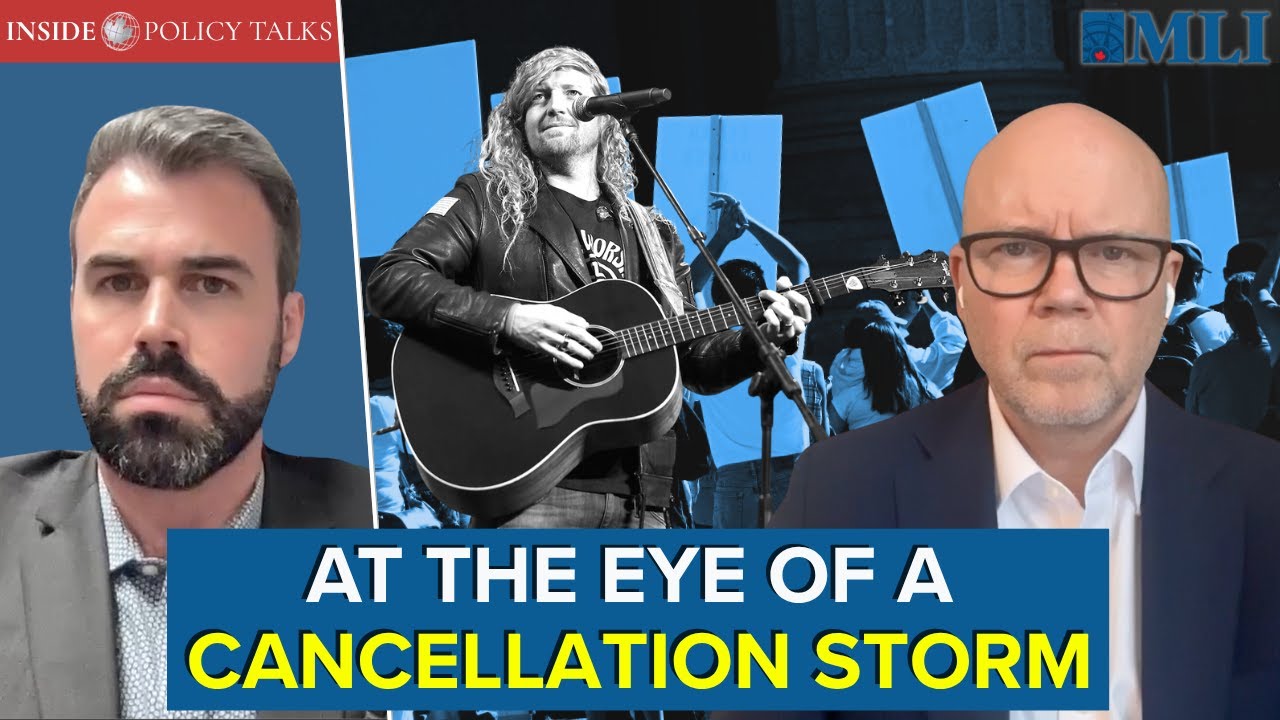
The cancellation of American Christian worship leader Sean Feucht’s concerts highlights the ongoing assault on free speech. Feucht has been a preacher for over 20 years, has been critical of abortion rights, during the pandemic held outdoor public gatherings called the Let Us Worship Tour, and is a supporter of Trump. He performed in Montreal, and the church he performed in was fined $2,500. A spokesperson for the city’s mayor, Valerie Plante, issued a statement saying, “This show runs counter to the values of inclusion, solidarity, and respect that are championed in Montreal. Freedom of expression is one of our fundamental values, but hateful and discriminatory speech is not acceptable in Montreal.” Former CRTC Vice Chair Peter Menzies has spoken about how ideological creep has entered the country’s cultural institutions, and with Parks Canada banning Feucht’s concerts, he said, “When did government agencies start having values? Pick up the garbage. Don’t litter. That should be the end of it. Now we have values weaponized.”
Protesting in China is allowed as long as it does not challenge the Communist Party. When President Xi imposed COVID-zero restrictions, protests surfaced across the country, and dissent was quickly quashed. The Canadian government took similar actions, suppressing trucker protests in Ottawa during COVID by invoking its emergency powers. Today, the Crown is putting the screws on Chris Barber and Tamara Lich, who organized the convoy protests. Barber is facing a prison sentence of 8 years, while Lich is facing 7 years for their involvement in mischief. But they were not convicted of assault, nor did they storm any buildings or incite riots; instead, they encouraged Canadians to continue protesting COVID mandates. The government’s message is loud and clear: if one protests and challenges the state, one will be crushed. Conservative leader Pierre Poilievre summed it up best when he said, “Violent offenders get released in hours. The Crown wants 7 years for mischief?”
According to a survey on free expression in universities, a majority of undergraduate students fear speaking their minds. A majority of students are reluctant to discuss the Israel-Palestine conflict, and 45 percent don’t want to talk about politics on campus. However, 70 percent of students felt comfortable discussing climate change and DEI. This is a sad reflection on society when young people, who are meant to be future leaders, are afraid to engage in discussions about politics in a university setting, where the primary purpose is learning. Free speech in Canada is on its deathbed, and after 100 days in office, Prime Minister Carney has demonstrated that he is a fresh face on the same old liberal policies, with a touch of pragmatism. During the 2022 Freedom Convoy protests, Carney described the protesters as guilty of “blatant treachery” and declared the protest “sedition.”
The Trump administration is pressuring the Carney government to drop its Online Streaming Act, and with ongoing trade negotiations, anything is possible. Without significant changes, the final nails in the free speech coffin will likely be driven in the fall when the Online Harms Act is passed, making Big Brother a permanent feature of Canadian society.
is a York University graduate with an honors B.A in political science with a business career background as an IT executive and photojournalist. He currently blogs about politics and economics.
[### Conservative delegates reject adding 'climate change is ...

CBC
https://www.cbc.ca › news › politics › conservative-dele...](https://www.cbc.ca/news/politics/conservative-delegates-reject-climate-change-is-real-1.5957739)
Mar 20, 2021 — Conservative delegates at the party's policy convention have voted to reject adding green-friendly statements to the policy book — including ...
Missing: Union | Show results with: Union
---
tim ball...
Nearly 50 individuals and organizations associated with the conference had received a total of $470 million in donations from ExxonMobil and the Koch family.
Scholarly Freedom at Risk
In February 2013, the prestigious psychology journal Frontiers in Psychology published a research paper by scientist Stephan Lewandowsky and his colleagues. The paper was titled “Recursive Fury: Conspiracist Ideation in the Blogosphere in Response to Research on Conspiracist Ideation.” It argued that people who reject climate science are more likely to believe in conspiracy theories. The authors had reached this conclusion through a detailed survey and analysis of statements made on climate-skeptic blogs.
After Recursive Fury was published, Frontiers received threats of multiple lawsuits. The journal removed the paper from its website (although it remained available on the University of Western Australia’s website). The paper was then re-examined and found to be scientifically and ethically sound, with no errors. Nonetheless, out of fear of legal complications, Frontiers permanently withdrew it from their website on March 31, 2014. This incident became a striking example of how scientific research can be undermined by the threat of lawsuits.
In its statement, Frontierssaid: after receiving several complaints, the journal conducted a thorough review of the academic, ethical, and legal aspects of the paper and found no faults in any of those areas. Even so, they claimed the legal situation was not sufficiently clear and chose to retract the published article. The researchers involved expressed regret over the legal obstacles to exercising scholarly freedom.
The decision by Frontiers regarding Recursive Fury sparked intense criticism in the scientific community. Many scientists who had submitted papers to the journal sent strongly worded emails, demanding assurances that their work would not be withdrawn under similar circumstances. Some questioned Frontiers’ commitment and judgment in upholding scholarly freedom. The controversy caused significant upheaval in academic circles.
Greenpeace’s Sting Operation
In 2015, in order to highlight the negative aspects of the Paris Climate Agreement, Greenpeace — posing as representatives of a Middle Eastern oil and gas company and an Indonesian coal company — contacted Princeton University physics professor William Happer via email, requesting him to write a report on the benefits of increasing carbon emissions.
William Happer is a prominent U.S. climate change skeptic. He was an energy adviser to former President George H. W. Bush, chairman of the George C. Marshall Institute in the United States, and an adviser to Britain’s Global Warming Policy Foundation. He was invited to testify before a congressional hearing called by Republican presidential candidate and Senate Science Committee chairman Ted Cruz on “climate fanaticism.” For years, he has argued that increasing carbon emissions will ultimately benefit humanity.
Happer agreed to write the report for a fee, but he requested Greenpeace to make the payment not to him directly, but to the CO₂ Coalition — an organization founded in 2015 to shift debate away from fossil fuel criticism. Earlier, for testimony he gave at a Minnesota hearing on the effects of carbon dioxide, he had donated the $8,000 he received from the PBD Energy company to the CO₂ Coalition. In an email, he stated that his fee was $250 per hour, and for four days’ work, $8,000.
He also admitted that his report would likely not pass review in a peer-reviewed scientific journal. He wrote: “Icould submit the paper to a peer-reviewed journal, but publication might take a long time, and reviewers and editors might push for changes so that the message becomes that carbon dioxide is a pollutant and not beneficial to human society — which is not what I want to say, nor is it what your client wants.” As an alternative, he suggested using selected reviewers of their own choosing to approve it, although “purists” might object that the process would not qualify as genuine peer review.
Naomi Oreskes, a science historian at Harvard University and co-author of the book Merchants of Doubt — which examines climate change denial movements — told The Guardian: “Happer has been making this claim for about 20 years, that carbon dioxide is good for agriculture, and it has been proven false. Happer’s profile matches exactly the kind of people we wrote about in Merchants of Doubt.”
Alongside Happer, Greenpeace also contacted retired Pennsylvania State University sociologist Frank Clemente, asking him to prepare a report defending coal in response to a study on the high rate of premature deaths caused by coal pollution in Indonesia. He demanded $15,000 for an 8–10 page research paper and $6,000 for writing an opinion piece for a newspaper.
In both cases, the professors also discussed ways to obscure the fact that they were being paid for the reports. Clemente told The Guardian that he had worked as a consultant for many industries that improved people’s living standards. He said he was proud of his research and believed that clean coal technology was a pathway to reliable and affordable electricity, as well as a way to reduce global energy poverty and improve the environment. PBD Energy frequently cited his research to argue that expanding coal use in developing countries would help alleviate global poverty — a claim even the World Bank has rejected.
The Greenpeace sting operation revealed that it is possible to get professors from prestigious universities to write reports sowing doubt about climate change while concealing fossil fuel company sponsorship. Such reports, funded by various fossil fuel companies, are used to plant doubt in the public mind, influence public opinion on climate change, and block the possibility of strong measures to combat global warming.
Climate change deniers have repeatedly shifted their stance — at times claiming, “Climate change isn’t happening,” then saying, “It’s happening, but not because of human activity,” and later, “It’s happening, but there’s no need to worry.” Smearing scientists as corrupt, branding activists as anti-progress, calling journalists liars, launching personal attacks on experts, and tarnishing reputations by leaking emails — all are key tactics in the climate change denial playbook.
Protecting the Fossil Fuel Industry
The Ploys of the Climate Deniers – Janata Weekly
---
---