Saad Gad
6 26
The Crisis of Empathy: Gad Saad on Why Good Intentions Create Bad Outcomes | The Brief
183,122 views Premiered Jun 20, 2026 The Brief
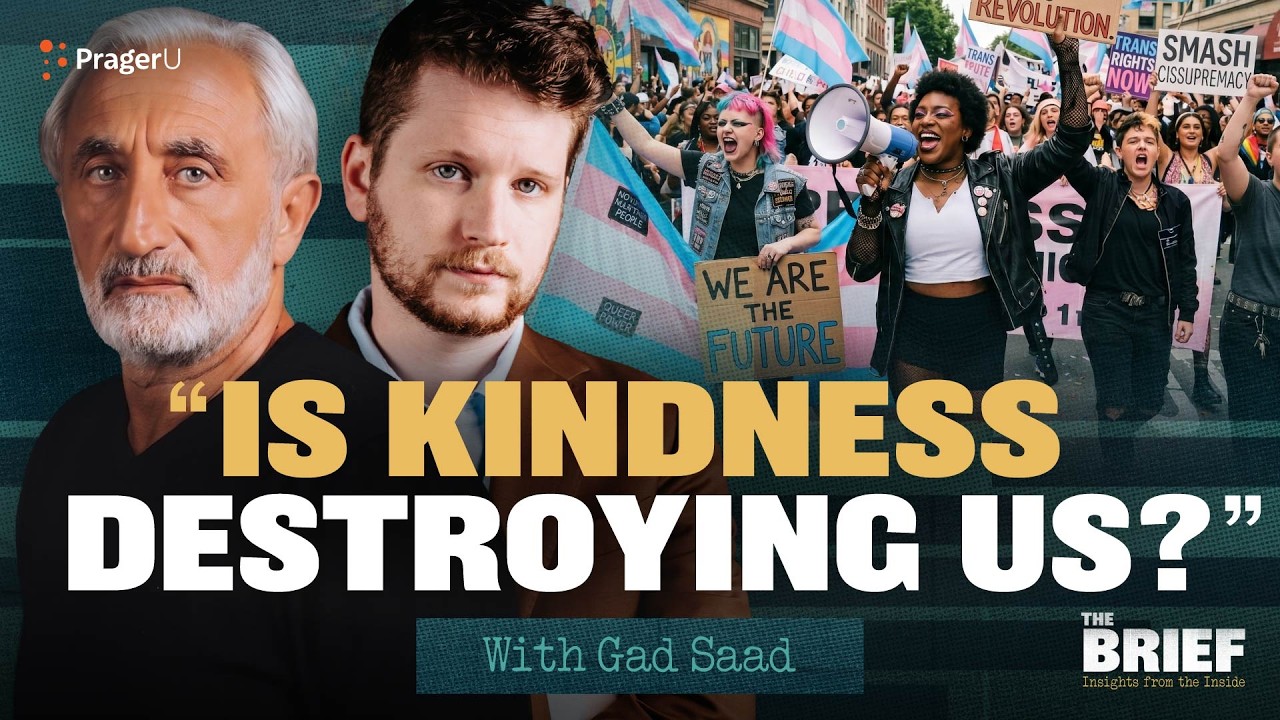
What is “suicidal empathy” and can good intentions actually destroy a civilization? In this episode of The Brief: Insights From The Inside, host Shabbos Kestenbaum sits down with Professor Gad Saad, evolutionary psychologist and New York Times bestselling author of Suicidal Empathy: Dying to Be Kind, to unpack how victimhood culture, open borders, soft-on-crime policies, censorship, and misplaced compassion can produce devastating real-world consequences. Saad explains why empathy is not inherently bad — but becomes dangerous when it “hyper fires” toward the wrong targets and overrides reason, judgment, and self-preservation. The conversation covers open borders, free speech, Canada’s MAID laws, anti-Semitism, civilizational decline, and whether the West still has the will to correct course. If you’ve ever asked: • Why does victimhood culture dominate politics? • Are open borders a threat to Western civilization? • Can free speech survive modern censorship? • Is the West collapsing from within? This episode is Gad Saad’s blunt answer.#politics #news #podcast #ShabbosKestenbaum
---
bezos on tax rich?
an 5 26
The terms "toxic empathy" and "suicidal empathy" have become a popular insult in the MAGA movement, from evangelical Christian nationalists to Tesla/SpaceX leader Elon Musk. The idea is that "empathy" is a sign of weakness and is harmful to Christianity. But not everyone on the right embraces the "toxic empathy" concept, which Never Trump conservative David French is vehemently critical of. And in The Bulwark, libertarian/Never Trump conservative Cathy Young offers a biting critique of a new book she describes as a cliched litany of MAGA "grievances."
The book is "Suicidal Empathy: Dying to Be Kind" by psychologist Gad Saad, who is originally from Lebanon but has spent most of his life in a country where U.S. President Donald Trump is wildly unpopular: Canada. The 61-year-old Saad is known for his anti-Islam views, and his anti-empathy argument has made him a popular figure among MAGA Republicans in the United States.
Young argues that while "Suicidal Empathy" has some valid points, most of the book uses shallow "pop psychology" to promote "familiar" MAGA "grievances." And he makes some of his points "bizarrely," according to the libertarian journalist.
"The thing is, Saad's concept — empathy is a good and necessary trait, but can be bad and self-damaging when taken too far — is one few people would dispute," Young explains in the conservative Bulwark. "Obvious examples include being trapped in an abusive relationship or a toxic friendship because you're afraid to hurt the other person by ending it — a concern exploitative people can easily manipulate. On a larger scale, it is self-evidently true that empathy alone is usually not a reliable guide to policy or collective action: refusing, on compassionate grounds, to forcibly hospitalize people experiencing certain acute mental health crises can result in grave harm not only to other people, but to the patients themselves."
But according to Young, one of the book's main flaws is that it uses "suicidal empathy" as "strictly a culture-war concept." Moreover, Young stresses, Saad makes huge generalizations — for example, blaming Muslims in general for acts of Islamist terrorism.
"In his framework," Young argues, "the term refers to ostensibly compassionate political views he considers misguided: support for migrants and refugees, Muslim immigrants in particular; excessive concern with the rights and wellbeing of criminals and/or homeless people; high taxes to pay for social programs; defense of transgender identities; an #IBelieveHer stance toward women who accuse men of sexual misconduct — unless, of course, the alleged perps are migrants or Muslims or both, in which case insufficient support for the victims is a sign of suicidal empathy for those groups. This isn't to say that Saad is always wrong. Progressive policies on crime, homelessness, immigration, etc. sometimes really are flawed in ways that can be described as arising from misplaced empathy."
Young continues, "But much of the time, Saad can't help taking his argument to the other extreme: If progressives can downplay Islamist radicalism, he treats the Taliban as representative of Islam and asserts that Muslim public prayers in western countries are 'a signal of dominance.' When residents of a small Italian town insist that they have no problem with Muslim refugees despite one refugee man's arrest for the rape of an underage girl, Saad can only throw up his hands at what he sees as liberal brain rot; he's unwilling or unable to concede that the townsfolk might not wish to judge the whole group by the one case."
The book, Young writes, includes "some extremely shoddy analysis."
"If you're starting to suspect that much of 'Suicidal Empathy' boils down to a catalogue of familiar right-wing grievances," Young says, "you're not wrong."
---
KRAUSS REV
...
Once you notice the elisions, you cannot help but see where the authors have dutifully cut around their own positions. Sometimes the scissors slip and we get a sliver of the missing picture, as when Gad Saad says, ‘universities are the progenitors of all the parasitic idea pathogens that have sent the West into a death spiral within the abyss of irrational darkness’ and ‘Academics should be trained to be intellectual Navy SEALs who boldly venture into uncharted territory rather than being meek invertebrate castrati deeply concerned about adhering to the prevailing orthodoxy’, and ‘if the silent majority, all of whom despise these idea pathogens, were to speak out in unison, we would return our universities and, more generally, our societies to their former glory’. This outline takes the general shape of infantile palingenetic ultranationalism.
...Ferguson concludes, ‘it will take a lot more than a few high-profile resignations to reform the culture of America’s elite universities. It is too much entrenched in multiple departments, all dominated by tenured faculty’. The unstated conclusion: academia requires a mass purge.
What forms of speech must be suppressed? Gad Saad rails against ‘postmodernists, radical feminists, cultural relativists, and social constructivists’. Their ideas are a ‘parasite’ on the body politic for their ‘biophobia (fear of using biology to explain human behaviour)’. He blames his lack of success and low enrolment in his classes on an insidious academic elite and a conspiring student body. He lists his accomplishments, which include writing an ‘international bestseller’ that repeats the same charge of parasitic ideas ad nauseam, and receiving ‘a personal commendation letter’ from the Prime Minister of India, Narendra Modi, as well as ‘Elon Musk’s appreciation of support’. He says, ‘The idea that the pursuit of some knowledge should be forbidden on ideological grounds is anathema to the mission of a university’.
---
an salon 12 25
amanda b rek
When former President George W. Bush described himself as a "compassionate conservative" during his eight years in the White House, some far-fight pundits objected to the "compassionate" part. Bush, they argued, was hurting conservatism when he called himself "compassionate," and they believed the right needed to purge itself of "compassion sickness."
The term "compassion sickness" isn't as popular in right-wing media as it was during the 2000s, but the concept is alive and well. Tesla/SpaceX/X.com leader Elon Musk considers "suicidal empathy" a major threat to the United States' wellbeing.
That term is closely identified with Musk. But in an article published on December 1, Salon's Amanda Marcotte stresses that the far right's use of "empathy" as an insult originated with evangelical Christian fundamentalist podcaster Allie Beth Stuckey.
"As with much of the asinine ponderings coming from the Silicon Valley billionaire class," Marcotte explains, "there's a pseudo-intellectual rationale to prop up this nonsense. Musk got this 'suicidal empathy' language from Gad Saad, a Canadian college professor who falsely presents himself as an 'evolutionary behavioral scientist'… But I'm not here to debate Musk and Saad's self-serving delusions. More interesting is that while they have tried to frame this anti-empathy discourse in faux-scientific and masculinized rhetoric, the right's modern war on empathy really began with a woman."
Marcotte continues, "Unlike Saad and Musk, fundamentalist Christian influencer Allie Beth Stuckey doesn't see empathy as a failure of evolution. As a creationist who denies the scientific reality of prehistoric dinosaurs, she doesn't even believe in evolution. And even though she believes the Bible forbids women from being pastors, Stuckey has made it her mission to rewrite the teachings of Jesus so that her savior is a harsh disciplinarian whose 'love' has little to do with empathy."
"Phyllis Schlafly knock-off" Stuckey, according to Marcotte, has been railing against "empathy" for at least three years on her "Relatable" podcast.
"Stuckey's book 'Toxic Empathy: How Progressives Exploit Christian Compassion' came out in late 2024," Marcotte observes, "but the idea for it appears to have originated on a 2022 episode of her popular podcast 'Relatable.' She hadn't yet come up with the catchphrase 'toxic empathy' — which, in true trolling style, appropriates the progressive use of the term 'toxic' to describe unhealthy and cruel behavior — but her basic argument is right there…. In a sense, she is simply reworking a longstanding argument from the Christian Right that kindness and compassion are not what Jesus meant by 'love.'"
Marcotte adds, "To the contrary, true Christian love is what looks, to most people, like beating someone into submission…. This line of thought has always been the paper-thin rationale for bigotry and abuse. But Stuckey's sinister genius was in using her gender to make these tired gambits seem fresh and modern."
:{---