woody johnson ny jets
---
MERRI OK
TRUMP DONOR TRANS
PLUM
---
11 24
The megadonors who fueled Trump and the Republican Party and what they may want in the next 4 years
By
Daniel Klaidman
Updated on: November 14, 2024 / / CBS News
More than $20 billion flooded into the 2024 presidential campaign, shattering the record for political spending in a single election. In an accelerating trend in American politics, Donald Trump, Kamala Harris and their allies raised colossal sums of money from billionaires.
A majority of these megadonors were Republicans, according to Open Secrets, the nonpartisan watchdog organization that tracks the influence of money on politics. And with Trump's decisive victory, they hit the jackpot.
So, who are these high rollers and what do they want in return for their generosity?
Often, megadonors get lumped together in a single basket as plutocrats whose largesse is mostly about increasing their wealth with government contracts, tax breaks and regulatory relief, corrupting the democratic process along the way, according to critics of the U.S.' campaign finance system. There's certainly truth to that, but the story is more complicated.
The super wealthy titans of tech and industry don't always share the same motivations and goals. Some aresingle-minded about bankrolling candidates as a way to bolster their bottom lines. But others are more ideologically driven, passionate about pet policies or reforming the way the government operates. Still others are driven by the scale of their ambitions or they crave the contact high of proximity to power.
In some ways political giving defies neat categories, and some megadonors may have overlapping interests. Some donors' primary motivation may be an ideological commitment to unleashing the power of free markets, but that may also benefit their personal business interests.
Others may be more transactional, fending off government investigations into their businesses or securing lucrative contracts, although that might coincide with their political beliefs.
"Megadonors can have a variety of financial, ideological or personal motivations for pouring millions into politics," said Brendan Fischer, deputy executive director of Documented, an investigative watchdog group. "These motivations can operate on a spectrum or as a Venn diagram."
But either way, with so much money flooding into American politics, it is helpful to be aware of the agendas and interests behind the torrent of cash gushing into the system. What follows is a taxonomy of the Republican donor class in the wake of a momentous election that has many wondering where the country is headed and who stands to benefit from the money that is driving the change.
The Oligarch
One dictionary definition of an oligarch is a "very wealthy business leader who helps to run the government." That would seem to fit Elon Musk, the world's richest man, who personally gave more than $130 million (and his super PAC gave $200 million) to help Trump win back the White House. Musk has wasted no time taking advantage of his election dividend.
He's been in on key staffing decisions, has been named to head up (along with Vivek Ramaswamy) a commission on government efficiency and, according to Axios, even joined a call that Trump had with Ukrainian President Volodymyr Zelensky last week. Musk also traveled with Trump to Washington Wednesday for meetings with President Biden and with congressional Republicans.
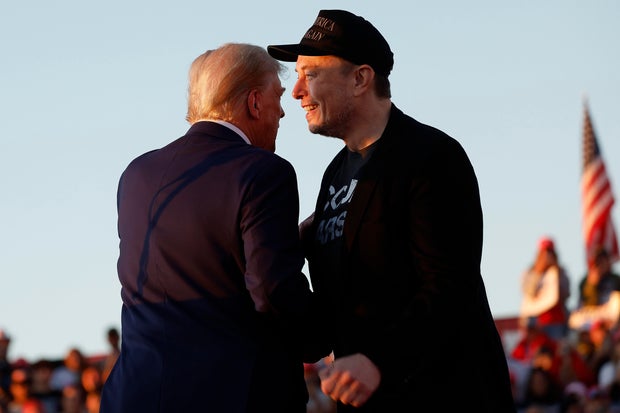 File: Elon Musk embraces Republican presidential nominee, former President Donald Trump during a campaign rally at the Butler Farm Show fairgrounds on October 05, 2024 in Butler, Pennsylvania. Anna Moneymaker / Getty Images
Musk stands to benefit financially from that clout he has with the incoming administration. His companies are mammoth players across some of the most powerful sectors of the economy, from electric vehicles to rocketry and space exploration, from satellite-powered internet technology to artificial intelligence. According to the New York Times, Musk has at least 100 different contracts with the federal government with 17 different agencies. His SpaceX rocket company already has tens of billions of dollars in government contracts and stands to gain billions more during a Trump presidency.
And Musk has carefully cultivated key government regulators who could bring him a financial windfall after Trump takes office. One, according to Politico, is FCC Commissioner Brendan Carr, who Trump is expected to name as the agency's chairman. Carr has been critical of his fellow commissioners for cutting Musk's Starlink satellite company out of the Biden administration's rural broadband program, denying him hundreds of millions or even potentially billions in subsidies.
Meanwhile look for Musk to influence SEC and other regulatory appointments that could stop investigations into his businesses. But what makes Musk unique is that his influence far transcends U.S. policies that could benefit his own businesses. Musk, through his global business empire, has the power to affect geopolitics on a scale perhaps greater than any person outside of government in history.
His personal wealth, estimated at $314 billion dollars (it jumped about $70 billion since Trump was elected), is greater than the GDP of multiple countries combined and the defense budgets of many industrialized Western countries. Musk's Starlink owns at least half of the satellites currently in orbit. Through Starlink, Musk has the power to alter the course of wars, since the communications constellation he controls is often the primary way governments can get internet access in combat zones. His ambitions seem boundless — he even hopes to be at the forefront of colonizing space.
And none of that even takes into account his ownership of X, the social media platform he bought for $44 billion in 2022 and positioned as a MAGA megaphone to help Trump.
"All oligarchs have wealth power at their disposal, but not all are positioned in the same way," said Jeffrey Winters, a professor at Northwestern who is an expert on oligarchs. "Some sell candy bars everyone eats. Others are engaged in space, high tech, own major media or have defense contracts. This takes their power to another level."
The Pragmatist
These are the megadonors who are laser-focused on influencing policy and legislation on behalf of their business interests. They may be hard-edged conservatives, but they are pragmatic about how their political giving can help their bottom line and the American economy. A quintessential example would be Ken Griffin, the billionaire founder of the Citadel hedge fund, who gave $100,000,000 in the 2024 cycle, putting him at No. 5 on the list of top contributors, according to Open Secrets.
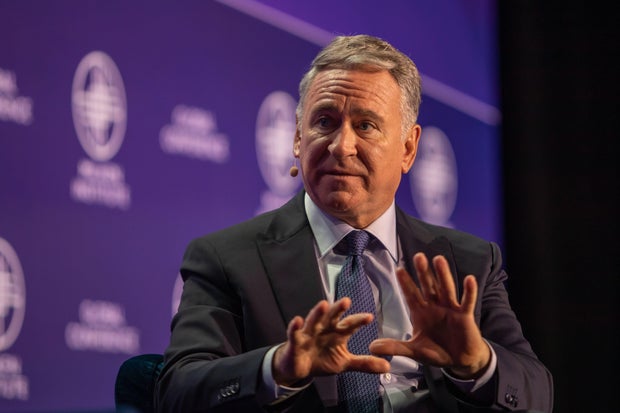 File: Ken Griffin, founder and CEO of the hedge fund Citadel LLC, speaks at the Milken Institute's Global Conference on May 6, 2024, in Beverly Hills, California. Apu Gomes / Getty Images
A self-described "Reagan Republican," Griffin has long given to more establishment-oriented Super PACs like the Senate Leadership Fund and its counterpart in the lower chamber, the Congressional Leadership Fund. He has not donated to Trump. Nor has he given money to political causes closely associated with Trump's America First agenda. Instead, he has been tactical in his giving, focusing often on Republican candidates in down-ballot races who have business experience or are military veterans and can give Congress a more business-oriented complexion.
"Griffin is more of an establishment Republican more aligned with the traditional goals of the party, rather than the Trumpy wing," says Anna Massoglia, a campaign finance expert.
Griffin said in a statement to CBS News, "I'm grateful for our country and for all those who've come before us. Going forward, we all share a duty to further strengthen our nation and improve the lives of our fellow citizens. As such, I support solution-oriented leaders who share my commitment to individual rights and freedom, economic policies encouraging prosperity and upward mobility, access to high-quality education for all children and young adults, safe communities, and a strong national defense."
A more cutting-edge example of the pragmatists are donors who back the crypto-currency industry. Crypto Super PACs such as Fairshake and Defend American Jobs have been determined in their contributions to help elect pro-crypto candidates.
Defend America Jobs poured in $40 million to help elect Bernie Moreno, the crypto-friendly candidate who defeated long-time Democratic incumbent Sherrod Brown in the Ohio Senate race. Among those boosters of crypto and other digital currencies who gave heavily during the 2024 cycle were Marc Andreessen and Ben Horowitz, whose venture capital firm Andreessen Horowitz ponied up $45.2 million to pro-crypto super PACs. CBS News was not able to reach Andreesen Horowitz for comment.
Winklevoss Capital Management, the firm run by twin brothers Cameron and Tyler Winklevoss, chipped in another $5 million. "The crypto army is striking!" Tyler Winklevoss posted on X on Election NIght, hailing Brown's defeat. But bucking the trend toward purely partisan contributions, the crypto industry gives to Republicans and Democrats alike, so long as they commit to keeping their industry unshackled by government regulations.
The Ideologue
These megadonors are more driven by personal causes that are not directly tied to their business interests. A representative example is Miriam Adelson, who along with her now-deceased husband Sheldon Adelson has been a casino magnate and major supporter of Jewish and Israel causes. In 2024, Miriam Adelson contributed more than $132 million to help Trump's election effort. Adelson knows that her largesse drives results.
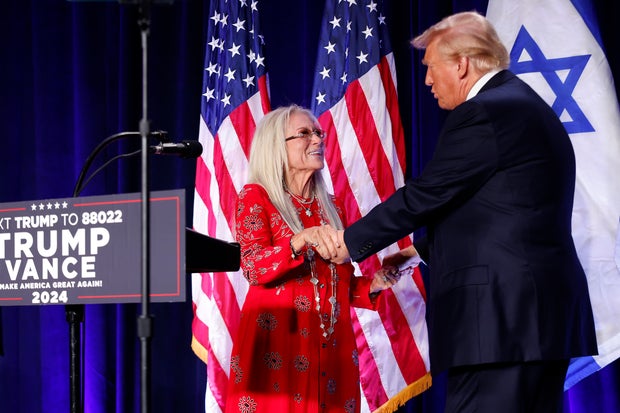 File: Miriam Adelson, widow of billionaire casino magnate Sheldon Adelson, welcomes Donald Trump to the stage to speak before prominent Jewish donors at an event titled "Fighting Anti-Semitism in America" on Sept. 19, 2024 in Washington, D.C. Chip Somodevilla / Getty Images
After the Adelsons donated tens of millions of dollars to help Trump win the White House in 2016, the new president announced the U.S. government would recognize Jerusalem as Israel's capital and said he would move the American embassy from Tel Aviv to Jerusalem. The Adelsons even offered to pay for the construction of the new embassy. Miriam Adelson has not responded to a request for comment.
"These are passion projects, not attempts to feather the nest," says one Republican who knows Adelson but asked not to be named in discussing her donations.
Another high-profile example of ideological givers are the billionaire shipping supply magnates Richard and Elizabeth Uihlein. The Wisconsin-based manufacturers of cardboard boxes and other packaging supplies, the Uihleins' business skyrocketed in sales in 2020 when the COVID-19 pandemic ignited an e-commerce boom. The Uihleins did not respond to a request for comment.
During the 2024 campaign cycle, they were among the top five political donors, contributing more than $133 million to conservative causes. While much of their money went to Trump's election, they also gave generously to other MAGA-allied causes. They've given to so-called election integrity groups that questioned the results of the 2020 election, as well as organizations like Moms for Liberty, which advocates against public school curricula that mention LGBTQ rights or critical race theory and supports book bans.
The Enigma
Some megadonors are so discreet about their political giving that it is hard to know what category they belong in. One example is Tim Mellon, the reclusive railroad magnate and heir to the Gilded Age Mellon fortune who happens to have given more money to Trump's election (at least $197 million) than any other donor.
Mellon doesn't go on cable TV or hobnob with politicos at party conventions, but he has written a memoir and penned some opinion pieces that offer some clues. Early in his adult life, he held liberal views on race, the problem of income equality and the environment. But as Mellon's business career evolved, he developed a strong antipathy for what he viewed as intrusive government regulations on business, which seems to have strongly shaped his political views.
One defining episode for Mellon occurred after he bought an airport in Connecticut in the late 1990s. He cut down 340 trees, arguing that they posed a danger to pilots landing their planes. But state environmental regulators ultimately sued him and won. He was ordered to pay tens of thousands of dollars in damages. Did that experience fuel his desire to influence politics with his vast fortune? Perhaps, but it is also the case that Mellon has contributed to causes that would seem to have little to do with his particular business interests.
In the 2024 cycle he also gave $25 million to support Robert F. Kennedy Jr.'s presidential run. Some speculated that Mellon was trying to be a spoiler to help Trump, whom he was also backing financially. But last August, he wrote an article in the American Spectator explaining his support for Kennedy. Mellon, it turns out, is a COVID-19 vaccine skeptic. "I could not fathom how a 'vaccine' could be foisted on the general public with so little (if any) adequate testing."
He began giving to Kennedy's Children's Health Defense, which promotes false information about vaccines — and later to the Super PAC supporting Kennedy. None of that would seem to help Mellon's personal business interests. Mellon did not respond to a request for comment.
---
Robert Wood Johnson IV, a billionaire and heir to the Johnson & Johnson fortune, was one of the donors to Donald Trump's transition fund, along with his wife, Suzanne Johnson. They were part of a group of wealthy individuals who contributed to Trump's $13.7 million transition effort. The Daily Beast
 Wikipedia
DUCK 11 25
Daily Beast
https://www.thedailybeast.com › top-billionaires-of-donald-trumps-transition-fund-revealed
Top Billionaires of Trump's Transition Fund Revealed
TodayA Connecticut hedge fund manager named Robert Bishop was an early donor to Trump's Great America PAC in 2016, Politico reported.
The New Republic
https://newrepublic.com › post › 203740 › list-billionaires-bankrolled-trump-transition
Here Are the Billionaires Who Bankrolled Trump's Transition
TodayPresident Trump has finally released the names of 46 wealthy donors who bankrolled his transition into office. The list predictably consists of billionaires, lobbyists, and people Trump appointed ...
Forbes
https://www.forbes.com › sites › leokamin › 2024 › 08 › 14 › here-are-trumps-top-billionaire-donors
Here Are Trump's Top Billionaire Donors
Aug 14, 2024The former president has plenty of rich friends, who are handing over a fortune to put him back in the White House—even though he is giving nothing.
Business Insider
https://www.businessinsider.com › which-billionaires-support-donald-trump-campaign?op=1
40 of Trump's Richest Backers: Elon Musk, Steve Schwarzman, Marc ...
Oct 28, 2024Former president Donald Trump has gained support from a number of billionaires throughout the campaign.
New York Times
https://www.nytimes.com › 2025 › 11 › 26 › us › politics › trump-transition-donors.html
Donors to Trump's Transition Revealed a Year Later
TodayA Year Later, Donors to Trump's Transition Come to Light A 46-person list includes billionaires and people he went on to appoint to positions of power.
- [
New York Post
https://nypost.com › 2023 › 08 › 06 › meet-the-billionaires-powering-the-2024-gop-candidates
Meet the billionaires powering the 2024 GOP candidates | New York Post
Robert "Woody" Johnson ($3.7 billion) — Trump's former ambassador to the United Kingdom and the co-owner of the New York Jets donated $1 million to the MAGA PAC in April.
ABC News
These are the 37 donors helping pay for Trump's $300 million White ...
Nov 12, 2025The White House's list of 37 donors to President Donald Trump's $300 million ballroom project includes crypto billionaires, powerful financiers, tobacco companies, tech giants, media companies ...
OpenSecrets
https://www.opensecrets.org › donor-lookup
Donor Lookup - OpenSecrets
Donor Lookup This database contains millions of records, so try to be as specific as possible when submitting a query as it will significantly reduce the time it takes to receive your results.
MSN
Big Tech, billionaire donors at Trump's inauguration - MSN
Linda McMahon's net worth is roughly $3.1 billion, according to Forbes. Robert "Woody" Johnson, owner of the New York Jets, gifted $2.7 million to pro-Trump groups during the 2024 election.
CBS News
https://www.cbsnews.com › news › trump-megadonors-2024-election
The megadonors who fueled Trump and the Republican Party and what they ...
Nov 14, 2024Who are the high rollers who bankrolled Trump and Republicans in the 2024 election, and what do they want in return for their generosity?
---
golf tourney trump club
https://www.alternet.org/2020/07/trump-donor-woody-johnson-has-turned-americas-uk-embassy-into-chaos-report/
---
https://www.alternet.org/2019/11/selling-americas-ambassadorships/
no lnx
Selling America’s ambassadorships
Written by Washington Monthly November 8, 2019
A few years ago, I wrote an open letter to the executive producer of the popular day-time television drama The Bold and the Beautiful. I asked for a job as an actor. My acting credentials? Zero. Any show biz experience? Zilch. A soap opera fan? Nope. But I told Bradley Bell, whose wife was also a producer: “After reading about your wife Colleen being named by President Obama to be our next ambassador to Hungary, I thought, I too can realize one of my wildest dreams: become a soap opera matinée idol.” Colleen Bell had as many credentials to be an ambassador as I did of being an actor. Yet she got the position, instead, by donating more than $2 million to Obama’s campaigns.
The Bold and the Beautiful has turned out to be a veritable incubator of diplomatic talent. President Trump’s envoy to Denmark, Carla Sands, was an actress on B&B (her character slept with her girlfriend’s fiancé). What presaged her diplomatic posting? It was $350,000 in political contributions to Trump.
For all the political squalor inherent in Ukrainegate, there is one silver lining: the sterling reputations of the U.S. diplomats testifying before Congress—in defiance of White House orders—stand in stark contrast to Trump’s cynical and clownish political appointees. Take Gordon Sondland, for instance. He was a hotel chain owner, devoid of any diplomatic or government experience, who essentially purchased his position as U.S. ambassador to the European Union for a cold $1 million donation to the president’s inaugural committee.
There’s also George Glass, an Oregon real estate developer who donated more than $100,000 to Trump’s campaign. In return, he was named U.S. ambassador to Portugal. Glass is an avid propagator of the QAnon conspiracy line about a “Deep State” attempting to destroy Trump’s presidency and a cabal of Satan-worshiping Democrats who run a child sex cult. He speaks no Portuguese. Then there is former ambassador to Ukraine, Marie Yovanovitch, who Trump ousted. Yovanovitch is a three-time ambassador with 33 years in the Foreign Service and is multilingual.
In other words, our experienced diplomats are locked out of key policy jobs while whoever was willing to write a check is representing our nation overseas. In too many cases, they are unworthy of that privilege and responsibility. Trump’s ambassador to South Africa, Lana Marks, is a handbag designer and Mar-a-Lago member who faced more than a dozen lawsuits by former lawyers, landlords, and contractors alleging fraud. She and her husband, moreover, were fined $360,641 by the IRS for failing to pay back taxes. Had she been a regular job applicant, she would have been denied a security clearance.
Selling ambassadorships is a unique form of legal American corruption, practiced by presidents of both parties. In the 18th and 19th centuries, presidents similarly used to award military officer commissions to unqualified hacks as well—until the bloody cost of incompetent “political generals” during the Civil War led to a popular outcry and legislation to abolish the practice. Auctioning off diplomatic positions, however, has remained untouched.
Pre-Trump, the percentage of “political ambassadors” traditionally hovered around 30 percent, overwhelmingly to the most desirable posts, mainly in Europe. Now, that figure is at a historical record of 45 percent, according to the American Foreign Service Association. Before Trump, research shows thatcampaign donations between “$650,000 and $700,000 generated a 90 percent probability of appointment to a [wealthy developed country] for personal and bundled campaign contributorsrespectively.”
Trump-appointed ambassadors have averaged $96,927.98 in political contributions, exceeding the previous record of $60,721.83 set by George W. Bush’s ambassadors, according to research by Marquette University law professor Ryan M. Scoville, who also has found that Trump’s picks are “less qualified” than those of prior presidents.
But, as in the case of Sondland, donations can easily exceed a million dollars. New York Jets owner Robert Wood Johnson IV was awarded the coveted ambassadorship to the United Kingdom after donating nearly $1.5 million to Trump’s campaign and inaugural committee. A million bucks seems to have gotten financier Douglas Manchester a cushy if low ranking posting in the Bahamas.
The consequences for our national security can be dire. Handbag designers and hoteliers versus veteran trained diplomats in charge of foreign policy can potentially mean the difference between war and peace. Only six of 29 U.S. ambassadors to NATO countries are career diplomats.
All of Russia’s ambassadors to NATO member states, by contrast, are, in fact, career diplomats. My research of Russian versus American NATO ambassadors during the Obama administration revealed that Russia’s envoys possessed 960 years of diplomatic experience, averaging 34 years per incumbent, in contrast to America’s ambassadors having 331 cumulative years, averaging twelve years per individual. Those embarrassing figures are even more skewed now.
Putting ambassadorships on the political auction block need not be taken as a given. One presidential candidate has promised to end it. In her plan to “rebuild the State Department,” Elizabeth Warren pledges “to put America’s national interests ahead of campaign donations and end the corrupt practice of selling cushy diplomatic posts to wealthy donors?—?and I call on everyone running for President to do the same. I won’t give ambassadorial posts to wealthy donors or bundlers?—?period.”
While the Ukraine scandal may or may not end Trump’s corruption-ridden presidency, it should nonetheless bring about an end to the disgraceful peddling of the nation’s highest diplomatic offices to wealthy dilettantes, a practice that makes the United States a global laughing stock.
In the meantime, I’m taking acting lessons.
James Bruno is a writer and former U.S. diplomat. Read his blog, DIPLO DENIZEN, and follow him on Twitter @JamesLBruno. The opinions and characterizations in this article are those of the author, and do not necessarily represent official positions of the U.S. government.
---
==
Although the Mercers had initially been persuaded to back Texas senator Ted Cruz in the Republican primary, Bannon preferred Trump, and by the time of the Republican National Convention the Mercers were with him. Rebekah made her move last August, at a fundraiser at theEast Hampton estate of Woody Johnson, the owner of the New York Jets. According to two sources, one who strategized with the Mercers and another who worked closely with Trump, Rebekah insisted on a 30-minute face-to-face meeting with Trump, in which she informed him that his campaign was a disaster. (Her family had pledged $2 million to the effort about a month earlier, so she felt comfortable being frank.) Trump, who knew her slightly, was willing to listen. He had been disturbed by recent stories detailing disorganization in his campaign and alleging ties between Trump's campaign manager, Paul Manafort, and pro-Russia officials in Ukraine. Rebekah knew of this and arrived at her meeting with “props,” says the source who strategized with the Mercers: printouts of news articles about Manafort and Russia that she brandished as evidence that he had to go. And she also had a solution in mind:Trump should put Bannon in charge of the campaign and hire the pollster Kellyanne Conway.[3]
3.
...
==
trump inaug slush fund: 1 mill
CEO of THE JOHNSON COMPANY, INC. is corporation filed with the New York State Department of State (NYSDOS). The DOS ID is 911687. The business entity is incorporated in New York County. The entity type is DOMESTIC BUSINESS CORPORATION. The initial DOS filing date is 04/24/1984. Woody Johnson, Owner New York Jets
https://www.bloomberg.com/research/stocks/private/person.asp?personId=4883121&privcapId=31018145
==
https://movetoamend.org/corporate-rule-examples-4
Big Pharmaceutical Corporation Makes Billions Lying about Drug's Safety to Children and the Elderly
Over the course of 20 years, Johnson & Johnson Corporation created a powerful drug, promoted it illegally to children and the elderly, covered up the side effects, and made billions of dollars.
In February 2015 a jury found the Johnson & Johnson Corporation responsible for causing bodily deformation of an Alabama boy after Risperdal sales reps encouraged his doctor to prescribe the drug without warning of its risks.1^ Austin Pledger, who suffers from severe autism, started growing breasts when he was 12 that eventually measured 46DD. Austin took Risperdal for five years, when it was only approved by the FDA for schizophrenic adults. The Pledgers were never informed by their doctor that breast development was a known side-effect in children, first discovering the truth about Risperdal through an attorney’s TV ad.
“I went into it very naively,” Austin’s mom, Benita Pledger said. “[T]he part that upset me the most, [was that] Johnson & Johnson knew what they were doing to my child. They don’t care about Austin Pledger. … It was just a game to them. He doesn’t know there was a case. He doesn’t know he was the victim of a crime. … I can’t put him through the surgery it takes to repair [his chest] because he’s not a typical child who understands what that requires.”
Johnson & Johnson, Inc. is appealing the decision.
In 1994 the pharmaceutical company, Janssen, a subsidiary of Johnson & Johnson, premiered its new anti-psychotic drug, Risperdal. The FDA approved Risperdal to treat schizophrenia in adults and prohibited its use in children and the elderly, fearing side effects such as weight gain, hormonal disorders and diabetes in children; and strokes, diabetes and other ailments in the elderly. Yet by the time young Austin started to grow breasts, more than half of Risperdal sales were for prescriptions written to children and the elderly to alleviate a multitude of “behavioral issues.” Thousands of our most vulnerable patients were put at risk and suffered harm so that Johnson & Johnson, Inc. could continue profiting.
...