TRUMP FUNDER
10 24 belated? most here are 2020?
MERRI OK
see musk 2 26
SEE CORRUPT FF 1B$ ETP SUBSIDY
see crypto-currency dark money
SEE MAGA INC SUPERPAC
see crony capt’l corruption PLUTO
SEE ALLIGATOR ALCATRAZ
SEE PIC PRISON IND COMPLEX
see plum, also cabinet
SEE 2025
---
ref 2 brennan Fossil Fuel Industry Donors See Major Returns in Trump’s Policies
owen b
fossil fuel interests donated heavily to President Trump’s 2024 reelection bid. Months after his victory, oil and gas moguls have continued to pump money into his political coffers. Now, as promised by Trump during the campaign, his administration is embracing their policy agenda and governing in a way that is netting the industry billions.
Part of
Corruption in America**
More on
Trump asked oil and gas executives in 2024 to raise $1 billion for his campaign and told them he’d grant their policy wish list if he won. The investment, he said, would be a “deal” given the taxes and regulation they would avoid under his presidency. He also offered to help fast-track fossil fuel industry mergers and acquisitions if he won.
The industry responded by spending lavishly to elect Trump, giving at least $75 million to his campaign and affiliated PACs, thereby making them a top corporate backer of his reelection bid and a crucial source of funding.
Several oil tycoons gave millions on their own and hosted fundraisers with Trump and his associates. Some oil and gas executives who hadn’t given Trump money during previous cycles made major donations after attending fundraisers where he pledged to start acting on the industry’s policy priorities as soon as he retook the White House.
That’s just the spending we know about. The 2024 election saw record levels of “dark money” spending, where wealthy interests keep their role secret by funneling money through groups that do not disclose their donors. The fossil fuel industry has a history of deploying dark money tactics, and any such spending in 2024 would inherently be obscured.
Even after Trump’s victory in 2024, oil and gas interests have continued to pour money into his political operation. They gave $11.8 million to his inauguration fund, and even though Trump cannot run for a third term, his main super PAC has raked in millions more from the industry since he took office — including $25 million from oil producer Energy Transfer Partners and its CEO, Kelcy Warren.
As promised, Trump is rewarding the industry by adopting its policy agenda as his own. His signature legislative package — which one executive deemed “positive for us across all of our top priorities” — gives oil and gas firms $18 billion in tax incentives while rolling back incentives for clean energy alternatives. He’s placed fossil fuel allies in charge of the agencies that oversee the industry and fast-tracked drilling projects on public lands. In just his first 100 days back in office, Trump took at least 145 actions to undo environmental rules — more than he reversed during his entire first term as president. Before Trump even reentered the White House, the industry was reportedly pre-drafting executive orders for him to issue.
The profits are already rolling in for the industry. Take Warren and Energy Transfer Partners. Trump ended a Biden-era pause on liquefied natural gas exports and cleared the way for Energy Transfer Partners (which extracts liquefied natural gas) to extend a major project. Warren’s personal wealth grew nearly 10 percent after the administration greenlit the project as Energy Transfer Partners reported a boost in profits.
There’s also Occidental Petroleum, which donated $1 million to Trump’s inaugural committee, and whose CEO cohosted a major fundraiser for Trump in May 2024. Occidental is especially well positioned to see boosted profits from the sprawling array of favorable subsidies and tax incentives in his signature bill, passed into law this summer.
Now the Trump administration is taking its biggest swing yet for fossil fuel interests: repealing the “endangerment finding,” the federal government’s formal acknowledgement that global warming from greenhouse gases, produced by burning fossil fuels, endangers the public. The finding gives the government legal authority to set clean air rules, and it’s long been the subject of the fossil fuel lobby’s ire, surviving more than 100 challenges in court. Revoking the finding would erase scores of clean air rules that the industry opposes.
The fossil fuel industry is reaping major returns on its investment in the Trump administration. But what about the costs? Extreme weather events such as flooding, wildfires, and severe storms — which overwhelming scientific consensus has concluded are driven by global warming from fossil fuel usage — are becoming increasingly common, inflicting billions of dollars of damage on American communities and costing thousands of people their lives and livelihoods each year. Life-threatening summer heat affected more than 255 million Americans this year alone. It does not appear that these concerns are having any major impact on government policy, and instead, the administration fired hundreds of scientists tasked with tracking these issues.
Trump is far from the first president to use the office in ways that reward wealthy donors. Decades of harmful Supreme Court decisions, decaying anticorruption and campaign finance guardrails, and inadequate enforcement of existing rules around money in politics have enabled an unprecedented concentration of wealth and political power. So while Trump’s embrace of the fossil fuel industry’s agenda isn’t breaking entirely new ground, it offers yet another stark example of how wealthy interests are shaping policies that affect the lives of all Americans.
-=-=
---
Trump, DeSantis Donors Are Contractors on ‘Alligator Alcatraz’
Cruel and Lucrative
Republican Donors Cash In on ‘Alligator Alcatraz’ Immigrant Camp
Trump and DeSantis donors reportedly helped build out the new immigrant detention camp in “Alligator Alley”
By Andrew Perez, Nikki McCann Ramirez
July 1, 2025
Florida Gov. Ron DeSantis, President Donald Trump, and Homeland Security Secretary Kristi Noem tour "Alligator Alcatraz," on July 1, 2025. (Photo by ANDREW CABALLERO-REYNOLDS/AFP via Getty Images)
Florida Gov. Ron DeSantis, President Donald Trump, and Homeland Security Secretary Kristi Noem tour "Alligator Alcatraz" on July 1, 2025.
Andrew Caballero-Reynolds/AFP/Getty Images
President Donald Trump traveled to Florida on Tuesday to tour what Republicans have dubbed “Alligator Alcatraz,” a 5,000-bed immigration detention center built in a remote, hot, and disgustingly humid corner of the Everglades. The facility — a collection of plastic tents outfitted with bunk beds in literal cages — was built almost overnight on top of an abandoned airstrip in an area known as Alligator Alley.
Republicans have emphasized the amount of deadly wildlife surrounding the camp and the danger alligators and pythons might pose to any detained migrants who may attempt to escape. The state GOP is even selling disturbing, swamp-themed merchandise touting the project, and Trump on Tuesday said, “I guess that’s the concept,” to a question about whether undocumented immigrants will be eaten by alligators if they try to escape.
But so far, little has been said about how exactly the facility came to be.
As it turns out, two contractors who worked to quickly build out Alligator Alcatraz, which Florida Gov. Ron DeSantis (R) has called a “one-stop shop” for detention, adjudication, and deportation of migrants, have been significant donors to DeSantis and Trump.
Trump and DeSantis, who were bitter rivals in the 2024 Republican presidential primary, toured Alligator Alcatraz together on Tuesday alongside Kristi Noem, who leads Trump’s Department of Homeland Security (DHS). “Ron worked beautifully with Kristi and all of the people at Homeland Security and got it done in how many days, Ron?” Trump marveled.
Earlier Tuesday, Bloomberg News identified several contractors working on Alligator Alcatraz — a group of disaster relief firms selected by Florida’s Division of Emergency Management, which is part of DeSantis’ administration.
Among the contractors is CDR Companies, which Bloomberg reported “will run medical services and did some site preparation.” CDR’s president Carlos Duart and businesses affiliated with his firm have made significant donations to DeSantis and Trump, as well as Health and Human Services Secretary Robert F. Kennedy Jr.
CDR Enterprises donated $1 million in December 2023 to Fight Right Inc., a super PAC that supported DeSantis’ presidential campaign. Late last year, DeSantis announced he was appointing Duart to the board of trustees at Florida International University, and named his wife, Tina Vidal-Duart, to the Florida Atlantic University Board of Trustees.
Last June, CDR Maguire Inc. donated $400,000 to Right for America, a pro-Trump Super PAC. Duart donated $500,000 to the Trump 47 Committee in October. He also gave $148,000 in December to the Kennedy Victory Fund, helping RFK Jr. clear some of his campaign debt.
In January, CDR Enterprises contributed $500,000 to Trump’s inaugural committee.
Bloomberg reported that SLSCO Ltd., a construction company in Galveston, Texas, is also involved with Alligator Alcatraz, noting that the business had helped build parts of Trump’s border wall during his first term as president.
The firm is affiliated with brothers John, Todd, and William Sullivan. A company tied to the brothers, Sullivan Brothers Investments, donated $30,000 in 2022 to DeSantis’ state-level Super PAC, state records show.
CDR Companies and SLSCO did not immediately respond to requests for comment from Rolling Stone.
According to documents reviewed by Bloomberg, the contractors were selected from an existing pool of vendors already approved by Florida’s Division of Emergency Management — a move that allowed the state to bypass competitive bidding requirements. A heavily redacted planning document for the detention center obtained by Bloomberg indicated a desire to petition DHS to waive Immigration and Customs Enforcement detention standards to “streamline the setup of detention facilities.”
“We believe that the nature and vast scope of the illegal alien presence deserves a rethinking of detention processes and standards,” the document said.
It seems like DHS has embraced the idea. During Trump’s visit to the camp, Noem lauded the “unique” model Alligator Alcatraz could pioneer.
“Florida was unique in what they presented to us, and I would ask every other governor to do the exact same thing,” she said.
Trump is separately pushing to rebuild and reopen the original, infamous Alcatraz prison in San Francisco Bay. On Tuesday, the president posted on Truth Social that he wants Alcatraz to serve as “something representative” to scare migrants.
He explained, “I saw a picture of ALCATRAZ looking so foreboding, and I said, ‘We’re going to look into renovating and rebuilding the famous ALCATRAZ Prison sitting high on the Bay, surrounded by sharks. What a symbol it is, and will be!’”
In this article: Donald Trump, Florida, immigrants, Ron Desantis
---
---
AN 2 26
Donald Trump is losing support from almost every voting bloc there is as his second term wears on, but according to a new analysis from Thomas Edsall, the richest Americans are sticking by him. These "superrich" donors are now fueling a "Republican financial juggernaut," and they want favors in return.
"Determined to get a piece of the action, the very wealthy are lining up in droves," Edsall wrote in his latest New York Times column. "Despite Trump’s having lost ground in almost every demographic during his second term, one group stands firmly in the president’s camp: the superrich who have their wallets open."
These superrich voters, Edsall explained, are standing by with Trump thanks to his economic policies, which "have reinforced and, in some cases, intensified trends toward the increasing concentration of wealth and income at the highest levels." Citing data from the Federal Reserve, he noted that by the third quarter of last year — months into Trump's second term and right around the time he signed the "One Big Beautiful Bill" — the richest 0.1 percent's share of all the wealth in the U.S. had grown to 14.4 percent, up from 8.6 percent in 1989, while the share for the rest of the richest 1 percent grew to 17.3 from 14.2 percent.
Edsall further broke down how these superrich voters made a striking shift towards overt support for Republicans in the 2024 election. In years prior, the split between donations they made to Republicans and Democrats was closer to even, though the GOP held the edge. Citing data from the Washington Post, Edsall demonstrated just how much they made a rightward shift in 2024.
"Then that pattern abruptly shifted," Edsalld wrote. "Contributions by the very rich to Republicans grew from roughly $300 million in 2022 to just under a billion in 2024, while donations to Democrats fell from roughly $300 million to less than $200 million."
The Post's original report noted that "more than 80 percent of the federal campaign spending by the 100 wealthiest Americans in 2024 went to Republicans." Reporting from OpenSecrets found that one-time Trump ally Elon Musk was the biggest contributor that year, donating nearly $300 million.
By way of contributions to Trump's MAGA Inc. super PAC, the wealthy have continued to flood Trump with more money. The committee currently boasts over $300 million in cash-on-hand, with 90 percent of that amount coming in donations over $1 million. Edsall cited another report from the New York Times earlier this month, which found that the GOP overall has "an unheard-of edge of more than $550 million" over Democrats.
"The wealthy have created what amounts to a Republican financial juggernaut," Edsall wrote.
That level of fundraising around a president like Trump, who has no legal path to running for a third term, seems odd on the surface. However, Edsall observed, these donors are backing Trump in exchange for preferential treatment, including regulatory changes and investments, and favors, such as pardons.
"Evidence of the pervasive corruption is endemic, in the presidential pardons to donors and the well connected, in the regulatory favoritism found at key agencies, in the flow of special interest and foreign investments into the Trump family’s cryptocurrencybusinesses."
===
---
August 4, 2025
Trump’s MAGA Inc. SuperPAC Donor List is Littered with Corporate and Billionaire Influence Buyers
WASHINGTON D.C. — President Trump’s MAGA Inc. SuperPAC received $1 million or more from 58 donors since January, according to the SuperPAC’s most recent campaign finance disclosure filed last week.
The million-dollar donor list includes numerous corporate and billionaire donors with interests in influencing the Trump administration, including two crypto companies that were facing SEC investigations that have since been dropped and a seller of “skin substitute” products that benefited from the delay of a Biden-era Medicare rule to limit spending on their products.
“The real question this mega-donor list raises is not ‘how much,’ but ‘who from?’” said Jon Golinger, democracy advocate for Public Citizen. “By taking contributions from wealthy individuals and industries who want something from government, Trump’s SuperPAC has used pay-to-play to raise big money from special interests like a legalized shakedown.”
Public Citizen analyzed the new MAGA Inc. SuperPAC filing with the Federal Election Commission, covering the period of January 1 – June 30, 2025, and found the following:
- Corporations gave $73.2 million
- Billionaires gave $49.2 million
- Cryptocurrency corporations, executives, and investors gave $41.7 million
- Fossil fuel corporations and executives gave $26.8 million
- Healthcare corporations and executives gave $12 million
- Donations of $1 million or more from corporations and billionaires included:
- $25 million (combined) from Energy Transfer LP and CEO Kelcy Warren. Energy Transfer is suing the Pipeline and Hazardous Materials Safety Administration, asking a judge to declare the agency’s in-house enforcement system unconstitutional.
- $16 million from Jeff Yass, a billionaire who owns a stake in TikTok’s parent company. TikTok is facing a Department of Justice lawsuit alleging violations of the Children’s Online Privacy Protection Act.
- $10 million in February 2025 from Foris Dax, Inc., which operates Crypto.com. Crypto.com was under investigation by the SEC over allegations of allegedly trading unregistered securities. The SEC investigation was reportedly dropped in March 2025.
- $5 million from the “skin substitute” company Extremity Care. In April 2025, the Trump Administration postponed implementation of a Biden-era rule that would limit Medicare spending on skin substitute products.
- $1 million (combined) in January 2025 from Gemini Trust Company (DBA Gemini) co-founders Cameron and Tyler Winklevoss. At that time, Gemini was under investigation by the SEC for allegedly trading unregistered securities. The SEC investigation was reportedly dropped in February 2025.
---
---
an 2 26
Donald Trump's threats against a bridge connecting the U.S. and Canada flummoxed some of the leaders involved with its creation, but according to a New York Times report, the president's turn may be connected to the influence of a wealthy donor.
On Monday, Trump took to Truth Social with a threat to block the opening of the Gordie Howe International Bridge, a $4.7 billion project connecting Windsor, Ontario, and Detroit, which had been set to open soon. Trump claimed, falsely, that Canada would control both ends of the bridge and that it had been constructed using no American materials. Canadian Prime Minister Mark Carneytold reporters on Tuesday that he has called Trump and is working to resolve the matter.
“I explained that Canada paid for the construction of the bridge," Carney said. "That the ownership is shared between the state of Michiganand the government of Canada, and that in the construction of the bridge, obviously there’s Canadian steel and Canadian workers, but also US steel, US workers that were involved. This is a great example of cooperation between our countries.”
On Wednesday, the New York Times cited two anonymous administration sources who said that Trump's bridge outburst came only hours after Matthew Moroun, a Michigan-based billionaire and transportation magnate whose family owns the Ambassador Bridge, which also connects Windsor and Detroit. Moroun, the sources claimed, met with Trump's Commerce Secretary Howard Lutnick at the White House, with Lutnick later taking a call with the president shortly before his Truth Social post.
Moroun has been a prolific donor to Trump's political campaigns, and his business has long opposed the construction of the Gordie Howe International Bridge. Once opened, it will serve as a competitor to his family's own bridge and divert toll revenue away from it.
The new bridge, named for a late Detroit Red Wings hockey legend, was first proposed in the early 2000s and received approvals in the early 2010s, with construction finally commencing in the summer of 2018, during Trump's first term. As opposed to the Ambassador Bridge, the Gordie Howe is publicly owned. All throughout that time, the Moroun family, led by Matthew's father, Manuel Moroun, vigorously fought against it, alleging at one point that it violated the exclusive rights of his own bridge.
"The Moroun family has for decades mounted legal challenges to block or delay the competing project," the Times explained. "One of the challenges reached the Canadian Supreme Court, while the family has also lobbied extensively against it."
---
---
an 2 26
Democrats are poised to take back at least one chamber of Congress after this November's midterm elections according to the latest polls. But Republicans are hoping their significant fundraising advantage can give them a critical edge this fall.
That's according to a Tuesday article by the New York Times' Shane Goldmacher and Theodore Schleifer, who reported that the GOP is going into the midterm race with a cash haul significantly larger than the opposition. According to the Times, President Donald Trump's main super PAC is sitting in more than $304 million, and other well-funded super PACs affiliated with the cryptocurrency and artificial intelligence are expected to write big checks to Republicans this cycle.
Goldmacher and Schleifer also found that between Republicans' three main campaign arms, along with the the two GOP super PACs aligned with House and Senate Republicans, the majority party is heading into the midterms "with more than double the cash of the equivalent Democratic groups." GOP groups have a combined $320 million to spend, while Democratic-affiliated super PACs have just $137.2 million between them.
"Any Democrat who isn’t concerned isn’t serious," American Bridge super PAC co-founder Bradley Beychok told the Times. "Yes, Democrats have momentum on our side and a wide opportunity map, but we have a glaring disadvantage in overall money."
The Times additionally reported that despite his previous falling out with Trump and brief flirtations with starting a third party, Tesla and SpaceX CEO Elon Musk has donated "tens of millions of dollars" to Republicans in recent months. Musk also made an appearance at Mar-a-Lago to attend the wedding of a Trump staffer. All told, Republicans have more than $550 million to enter the 2026 cycle when counting Trump's super PAC and a smattering of other federal campaign accounts.
"Donald Trump has 99 problems going into the midterms," Democratic strategist Jesse Ferguson said. "But money ain't one."
A money advantage doesn't necessary guarantee electoral success. In 2024, Democratic nominee Kamala Harris raised a whopping $2 billion while Trump and the Republican National Committee brought in just $1.2 billion. Harris still ended up losing all seven swing states, in addition to the national popular vote.
And despite the disparity in party fundraising, individual Democratic candidates have been vastly out-raising their Republican opponents in a few marquee races. The Times reported that in the Alaska, Georgia, North Carolina and Ohio Senate races, Democrats Mary Peltola, Jon Ossoff, Roy Cooper and Sherrod Brown, respectively, are "running fund-raising laps around Republicans, driven mostly by liberal enthusiasm and small online donations," per the *Times.
:{:{---}:
---
the hill
wASHINGTON (AP) — President Donald Trump took office in January pledging to “make America the crypto capital of the world.” He has since harnessed wide swaths of the federal government to bolster the industry — all while raking in huge sums of money for his family’s business.
By some estimates, crypto ventures now account for nearly 40% of the Trump Organization’s $2.9 billion net worth. But the Republican president’s championing of the industry has been just as big a boon for many of the industry’s top names.
Many have seen their profits and political standing soar, while investigations of potential wrongdoing and other legal entanglements led by the administration of Trump’s predecessor, Democratic President Joe Biden, have largely fallen away.
Here’s a look at some of the crypto industry’s top leaders and their ties to Trump:
Justin Sun
A Chinese-born crypto entrepreneur and founder of the cryptocurrency platform Tron, Sun is best known for buying a piece of conceptual art consisting of a banana duct-taped to a wall for $6.2 million and subsequently eating the banana.
Ties to Trump: Sun was the top investor in Trump’s meme coin, $Trump, and secured the top spot at the president’s recent crypto dinner, which was held at Trump’s golf course just outside Washington. Sun posted a professionally produced video of himself receiving a $100,000 gold watch that Trump’s meme coin awarded to the top four investors. Sun also recently bragged about his close ties to the White House, posting in Chinese on X “It’s all true” over a series of posts listing his links to the president and his meme coin. Sun was sued by the Securities and Exchange Commission under Biden for working to artificially inflate the price of crypto, an investigation that has been paused since Trump took office. Sun was an early and important investor in World Liberty Financial, a crypto venture Trump and his sons Eric and Donald Jr. launched in September. The president’s most recent financial disclosure report reveals he made more than $57 million last year from World Liberty Financial, which has launched USD1, a stablecoin pegged at a 1-to-1 ratio to the U.S. dollar.
Michael Saylor
The co-founder and chair of Strategy, formerly known as MicroStrategy, Saylor is one of bitcoin’s most prominent and outspoken evangelists. He owns a yacht once featured on “Entourage,” and his is the most high-profile bitcoin treasury company, which is a type of firm primarily focused on buying and holding bitcoin as its business model. Strategy currently holds more than 2% of all outstanding bitcoins in circulation and is constantly buying more.
Ties to Trump: Trump Media, the parent company of the president’s social media platform, Truth Social, has announced it will raise $2.5 billion from institutional investors to buy bitcoin in an attempt to build up a cryptocurrency reserve, similar to what Saylor’s company is best known for. Saylor met in January with Eric Trump at the president’s Mar-a-Lago resort in Palm Beach, Florida, and the president’s son has spoken publicly about how he and Saylor were friends who knew each other in New York two decades ago. Saylor also attended the president’s first crypto summit at the White House in March. “All of us owe him a tremendous debt of gratitude,” Eric Trump said of Saylor, praising him at the recent annual bitcoin conference in Las Vegas as an effective spokesperson for the crypto community.
Changpeng Zhao
Known universally as CZ, Zhao is founder and former CEO of Binance, the world’s largest cryptocurrency exchange. He was sentenced last year to four months in prison for failing to stop criminals from using the platform to move money connected to child sex abuse, drug trafficking and terrorism. Zhao was released in September.
Ties to Trump: World Liberty Financial recently announced that an investment fund in the United Arab Emirates would be using $2 billion worth of USD1 to purchase a stake in Binance. Zhao also has publicly said that he’s asked Trump for a pardon that could nullify his conviction.
Brian Armstrong
Co-founder and CEO of Coinbase, a major cryptocurrency exchange, Armstrong has been a key figure in the crypto industry’s push into politics.
Ties to Trump: Armstrong and Coinbase were major donors to a political action committee that helped Trump and other pro-crypto candidates. He met with Trump weeks after Election Day and attended the White House crypto summit. Coinbase hired Trump’s former campaign manager, Chris LaCivita, to its Global Advisory Council. Trump also addressed, via prerecorded video message, Coinbase’s State of Crypto Summit this month.
The Winklevoss Twins
Tyler and Cameron Winklevoss founded the Gemini cryptocurrency exchange and are most famous to the general public for suing Mark Zuckerberg over the creation of Facebook, an important plot point in the movie “The Social Network.” In 2023, Biden’s SEC sued Gemini for selling unregistered securities, another case that’s been paused since Trump took office.
Ties to Trump: The twins each pledged $1 million donations to the Trump campaign, as well as lavish donations to Elon Musk’s political group – though some of the donations to Trump’s campaign were returned because the Winklevoss brothers had violated federal limits. They were invited to Trump’s crypto summit and praised the president’s approach to the sector then. Addressing the crypto conference in Las Vegas, Vice President JD Vance said the brothers “really helped break the dam” and persuade tech sector leaders to support Trump’s campaign. “I think they were some of the first big names in Silicon Valley to take that step, and a whole host of people followed them,” Vance said.
David Bailey
Bailey is the CEO of BTC Inc., an influential holding company with ventures throughout the crypto industry including Bitcoin Magazine. He recently raised $300 million to launch Nakamoto, a publicly traded bitcoin investment company.
Ties to Trump: Baily served as a crypto adviser to Trump’s campaign. Vance also saluted Bailey at the Las Vegas conference, saying he was “grateful for everything you’ve done for the bitcoin community.”
Associated Press writer Alan Suderman contributed to this report.
---
---
AN 11 25
A little over a year since he was reelected,the New York Times reports that the list of donors for President Donald Trump's transition efforts has finally seen the light of day. The list is notable for the presence of various billionaires, lobbyists, and future administration appointees, with one expert summing it up as a rundown of "who is buying the government."
In the past, prior incoming presidential administrations, including Trump's first, signed an agreement pledging to disclose their list of transition donors within 30 days of their inauguration in exchange for $7 million in federal funding and support from the General Services Administration. The second time around, however, Trump refused to sign the agreement, leaving the list shrouded in secrecy.
The agreement would have also capped donations at $5,000 and blocked donors from foreign countries. At the time, Trump's chief of staff Susie Wiles said the decision to forgo the agreement was made to “save taxpayers’ hard-earned money," while also pledging to release the list at a later date and ensure that no non-citizen donations were accepted.
On Wednesday, the New YorkTimesreleased a report finally delving into the 46 names now disclosed by the Trump administration, roughly 10 months after the inauguration. The report highlighted two notable billionaires included in the list, Jeff Yass and Paul Singer. Yass is the co-founder of the trading firm Susquehanna International Group and an investor in TikTok. He has been credited with convincing Trump to soften his stance on a ban of TikTok in the U.S. Singer is a venture capitalist who founded Elliott Management, where he works as co-CEO.
Elsewhere on the list are numerous names of individuals who went on to receive appointments to key positions in the Trump administration. This includes former WWE executive and first-term cabinet member Linda McMahon, who now serves as Secretary of Education, leading the charge to try and disband the Department of Education altogether. There is also Howard Lutnick, who now serves as Trump's secretary of commerce.
"Steve Witkoff, Mr. Trump’s special envoy to the Middle East, donated, as did Stanley Woodward Jr., the third-ranking official in the Justice Department," the Times report explained. "Dominick Gerace II, who was sworn in as the U.S. attorney for the Southern District of Ohio in August, is also listed as a donor."
The report also noted several names on the list that match those of known lobbyists, but could not reach them to confirm.
“They claimed they were saving taxpayers money, but what they were doing was hiding the ball about who is buying the government,” Max Stier, the president of the nonprofit watchdog group Partnership for Public Service, said in a statement about the list to the Times.
---
---
11 24
The megadonors who fueled Trump and the Republican Party and what they may want in the next 4 years
By
Daniel Klaidman
Updated on: November 14, 2024 / / CBS News
More than $20 billion flooded into the 2024 presidential campaign, shattering the record for political spending in a single election. In an accelerating trend in American politics, Donald Trump, Kamala Harris and their allies raised colossal sums of money from billionaires.
A majority of these megadonors were Republicans, according to Open Secrets, the nonpartisan watchdog organization that tracks the influence of money on politics. And with Trump's decisive victory, they hit the jackpot.
So, who are these high rollers and what do they want in return for their generosity?
Often, megadonors get lumped together in a single basket as plutocrats whose largesse is mostly about increasing their wealth with government contracts, tax breaks and regulatory relief, corrupting the democratic process along the way, according to critics of the U.S.' campaign finance system. There's certainly truth to that, but the story is more complicated.
The super wealthy titans of tech and industry don't always share the same motivations and goals. Some aresingle-minded about bankrolling candidates as a way to bolster their bottom lines. But others are more ideologically driven, passionate about pet policies or reforming the way the government operates. Still others are driven by the scale of their ambitions or they crave the contact high of proximity to power.
In some ways political giving defies neat categories, and some megadonors may have overlapping interests. Some donors' primary motivation may be an ideological commitment to unleashing the power of free markets, but that may also benefit their personal business interests.
Others may be more transactional, fending off government investigations into their businesses or securing lucrative contracts, although that might coincide with their political beliefs.
"Megadonors can have a variety of financial, ideological or personal motivations for pouring millions into politics," said Brendan Fischer, deputy executive director of Documented, an investigative watchdog group. "These motivations can operate on a spectrum or as a Venn diagram."
But either way, with so much money flooding into American politics, it is helpful to be aware of the agendas and interests behind the torrent of cash gushing into the system. What follows is a taxonomy of the Republican donor class in the wake of a momentous election that has many wondering where the country is headed and who stands to benefit from the money that is driving the change.
The Oligarch
One dictionary definition of an oligarch is a "very wealthy business leader who helps to run the government." That would seem to fit Elon Musk, the world's richest man, who personally gave more than $130 million (and his super PAC gave $200 million) to help Trump win back the White House. Musk has wasted no time taking advantage of his election dividend.
He's been in on key staffing decisions, has been named to head up (along with Vivek Ramaswamy) a commission on government efficiency and, according to Axios, even joined a call that Trump had with Ukrainian President Volodymyr Zelensky last week. Musk also traveled with Trump to Washington Wednesday for meetings with President Biden and with congressional Republicans.
File: Elon Musk embraces Republican presidential nominee, former President Donald Trump during a campaign rally at the Butler Farm Show fairgrounds on October 05, 2024 in Butler, Pennsylvania. Anna Moneymaker / Getty Images
Musk stands to benefit financially from that clout he has with the incoming administration. His companies are mammoth players across some of the most powerful sectors of the economy, from electric vehicles to rocketry and space exploration, from satellite-powered internet technology to artificial intelligence. According to the New York Times, Musk has at least 100 different contracts with the federal government with 17 different agencies. His SpaceX rocket company already has tens of billions of dollars in government contracts and stands to gain billions more during a Trump presidency.
And Musk has carefully cultivated key government regulators who could bring him a financial windfall after Trump takes office. One, according to Politico, is FCC Commissioner Brendan Carr, who Trump is expected to name as the agency's chairman. Carr has been critical of his fellow commissioners for cutting Musk's Starlink satellite company out of the Biden administration's rural broadband program, denying him hundreds of millions or even potentially billions in subsidies.
Meanwhile look for Musk to influence SEC and other regulatory appointments that could stop investigations into his businesses. But what makes Musk unique is that his influence far transcends U.S. policies that could benefit his own businesses. Musk, through his global business empire, has the power to affect geopolitics on a scale perhaps greater than any person outside of government in history.
His personal wealth, estimated at $314 billion dollars (it jumped about $70 billion since Trump was elected), is greater than the GDP of multiple countries combined and the defense budgets of many industrialized Western countries. Musk's Starlink owns at least half of the satellites currently in orbit. Through Starlink, Musk has the power to alter the course of wars, since the communications constellation he controls is often the primary way governments can get internet access in combat zones. His ambitions seem boundless — he even hopes to be at the forefront of colonizing space.
And none of that even takes into account his ownership of X, the social media platform he bought for $44 billion in 2022 and positioned as a MAGA megaphone to help Trump.
"All oligarchs have wealth power at their disposal, but not all are positioned in the same way," said Jeffrey Winters, a professor at Northwestern who is an expert on oligarchs. "Some sell candy bars everyone eats. Others are engaged in space, high tech, own major media or have defense contracts. This takes their power to another level."
The Pragmatist
These are the megadonors who are laser-focused on influencing policy and legislation on behalf of their business interests. They may be hard-edged conservatives, but they are pragmatic about how their political giving can help their bottom line and the American economy. A quintessential example would be Ken Griffin, the billionaire founder of the Citadel hedge fund, who gave $100,000,000 in the 2024 cycle, putting him at No. 5 on the list of top contributors, according to Open Secrets.
File: Ken Griffin, founder and CEO of the hedge fund Citadel LLC, speaks at the Milken Institute's Global Conference on May 6, 2024, in Beverly Hills, California. Apu Gomes / Getty Images.
A self-described "Reagan Republican," Griffin has long given to more establishment-oriented Super PACs like the Senate Leadership Fund and its counterpart in the lower chamber, the Congressional Leadership Fund. He has not donated to Trump. Nor has he given money to political causes closely associated with Trump's America First agenda. Instead, he has been tactical in his giving, focusing often on Republican candidates in down-ballot races who have business experience or are military veterans and can give Congress a more business-oriented complexion.
"Griffin is more of an establishment Republican more aligned with the traditional goals of the party, rather than the Trumpy wing," says Anna Massoglia, a campaign finance expert.
Griffin said in a statement to CBS News, "I'm grateful for our country and for all those who've come before us. Going forward, we all share a duty to further strengthen our nation and improve the lives of our fellow citizens. As such, I support solution-oriented leaders who share my commitment to individual rights and freedom, economic policies encouraging prosperity and upward mobility, access to high-quality education for all children and young adults, safe communities, and a strong national defense."
A more cutting-edge example of the pragmatists are donors who back the crypto-currency industry. Crypto Super PACs such as Fairshake and Defend American Jobs have been determined in their contributions to help elect pro-crypto candidates.
Defend America Jobs poured in $40 million to help elect Bernie Moreno, the crypto-friendly candidate who defeated long-time Democratic incumbent Sherrod Brown in the Ohio Senate race. Among those boosters of crypto and other digital currencies who gave heavily during the 2024 cycle were Marc Andreessen and Ben Horowitz, whose venture capital firm Andreessen Horowitz ponied up $45.2 million to pro-crypto super PACs. CBS News was not able to reach Andreesen Horowitz for comment.
Winklevoss Capital Management, the firm run by twin brothers Cameron and Tyler Winklevoss, chipped in another $5 million. "The crypto army is striking!" Tyler Winklevoss posted on X on Election NIght, hailing Brown's defeat. But bucking the trend toward purely partisan contributions, the crypto industry gives to Republicans and Democrats alike, so long as they commit to keeping their industry unshackled by government regulations.
The Ideologue
These megadonors are more driven by personal causes that are not directly tied to their business interests. A representative example is Miriam Adelson, who along with her now-deceased husband Sheldon Adelson has been a casino magnate and major supporter of Jewish and Israel causes. In 2024, Miriam Adelson contributed more than $132 million to help Trump's election effort. Adelson knows that her largesse drives results.
File: Miriam Adelson, widow of billionaire casino magnate Sheldon Adelson, welcomes Donald Trump to the stage to speak before prominent Jewish donors at an event titled "Fighting Anti-Semitism in America" on Sept. 19, 2024 in Washington, D.C. Chip Somodevilla / Getty Images
After the Adelsons donated tens of millions of dollars to help Trump win the White House in 2016, the new president announced the U.S. government would recognize Jerusalem as Israel's capital and said he would move the American embassy from Tel Aviv to Jerusalem. The Adelsons even offered to pay for the construction of the new embassy. Miriam Adelson has not responded to a request for comment.
"These are passion projects, not attempts to feather the nest," says one Republican who knows Adelson but asked not to be named in discussing her donations.
Another high-profile example of ideological givers are the billionaire shipping supply magnates Richard and Elizabeth Uihlein. The Wisconsin-based manufacturers of cardboard boxes and other packaging supplies, the Uihleins' business skyrocketed in sales in 2020 when the COVID-19 pandemic ignited an e-commerce boom. The Uihleins did not respond to a request for comment.
During the 2024 campaign cycle, they were among the top five political donors, contributing more than $133 million to conservative causes. While much of their money went to Trump's election, they also gave generously to other MAGA-allied causes. They've given to so-called election integrity groups that questioned the results of the 2020 election, as well as organizations like Moms for Liberty, which advocates against public school curricula that mention LGBTQ rights or critical race theory and supports book bans.
The Enigma
Some megadonors are so discreet about their political giving that it is hard to know what category they belong in. One example is Tim Mellon, the reclusive railroad magnate and heir to the Gilded Age Mellon fortune who happens to have given more money to Trump's election (at least $197 million) than any other donor.
Mellon doesn't go on cable TV or hobnob with politicos at party conventions, but he has written a memoir and penned some opinion pieces that offer some clues. Early in his adult life, he held liberal views on race, the problem of income equality and the environment. But as Mellon's business career evolved, he developed a strong antipathy for what he viewed as intrusive government regulations on business, which seems to have strongly shaped his political views.
One defining episode for Mellon occurred after he bought an airport in Connecticut in the late 1990s. He cut down 340 trees, arguing that they posed a danger to pilots landing their planes. But state environmental regulators ultimately sued him and won. He was ordered to pay tens of thousands of dollars in damages. Did that experience fuel his desire to influence politics with his vast fortune? Perhaps, but it is also the case that Mellon has contributed to causes that would seem to have little to do with his particular business interests.
In the 2024 cycle he also gave $25 million to support Robert F. Kennedy Jr.'s presidential run. Some speculated that Mellon was trying to be a spoiler to help Trump, whom he was also backing financially. But last August, he wrote an article in the American Spectator explaining his support for Kennedy. Mellon, it turns out, is a COVID-19 vaccine skeptic. "I could not fathom how a 'vaccine' could be foisted on the general public with so little (if any) adequate testing."
He began giving to Kennedy's Children's Health Defense, which promotes false information about vaccines — and later to the Super PAC supporting Kennedy. None of that would seem to help Mellon's personal business interests. Mellon did not respond to a request for comment.
---
---
ballroom list huffpo
All The Donors Financing Trump’s Ballroom As He Demolishes The White House | HuffPost Latest News
wASHINGTON ― The White House on Thursday released a list of all the private donors who have agreed to pay for the construction of President Donald Trump’s 90,000-square-foot, $300 million ballroom ― and the entire demolition of the East Wing, which is now complete.
Donors on the list include CEOs, real estate moguls, lots of corporations, and otherwise just really rich people. Defense contractors like Lockheed Martin and Booz Allen Hamilton are kicking in money for the president’s project, as are telecommunications companies like Comcast, and tobacco industry companies like Reynolds American. Tech companies like Amazon and Apple are in the mix, along with crypto companies.
Here’s the full list, provided by a White House official:
- Altria Group, Inc.
- Amazon
- Apple
- Booz Allen Hamilton
- Caterpillar, Inc.
- Coinbase
- Comcast Corporation
- Pepe and Emilia Fanjul
- Hard Rock International
- HP Inc.
- Lockheed Martin
- Meta Platforms
- Micron Technology
- Microsoft
- NextEra Energy, Inc.
- Palantir Technologies Inc.
- Ripple
- Reynolds American
- T-Mobile
- Tether America
- Union Pacific Railroad
- Adelson Family Foundation
- Stefan E. Brodie
- Betty Wold Johnson Foundation
- Charles and Marissa Cascarilla
- Edward and Shari Glazer
- Harold Hamm
- Benjamin Leon Jr.
- The Lutnick Family
- The Laura & Isaac Perlmutter Foundation
- Stephen A. Schwarzman
- Konstantin Sokolov
- Kelly Loeffler and Jeff Sprecher
- Paolo Tiramani
- Cameron Winklevoss
- Tyler Winklevoss
Trump has boasted about his ballroom being funded entirely by private donors and his own money, not public dollars. But the White House hasn’t shared how much money each of these companies and people have pledged to give him – or what they’re expecting in return.
Some donors were reportedly given the option of having their names permanently etched in the White House ballroom’s brick or stone.
The only individual donation that’s been made public is tied to Google’s parent company, Alphabet, which is contributing $22 million to Trump’s ballroom. That money is coming from a recent legal settlement the company reached with Trump after he was banned from YouTube, owned by Alphabet, after he incited the Jan. 6, 2021, insurrection.
Trump has demolished the entire East Wing of the White House to make way for his 90,000-square-foot, $300 million ballroom.
Bloomberg via Getty Images
HuffPost reached out to all of the companies on the list, and as many of the individuals as we were able to track down, with the same two questions: How much are they donating to Trump’s ballroom, and if they have any comment about Trump destroying the East Wing ― and American history in the process ― to make way for his project.
Most didn’t respond immediately to requests for comment, but a few did.
“I can confirm that Microsoft contributed to the ballroom, as has been publicly reported,” company spokesperson Kaitlin Haskins said in an email. “That’s all I have at the moment, but if anything changes, I will circle back.”
T-Mobile confirmed it gave money to the Trust for the National Mall, the nonprofit overseeing the donations to fund Trump’s ballroom. But beyond that, a spokesperson said the company didn’t have any say on how those dollars were spent.
“Ahead of America’s 250th Anniversary, T-Mobile donated to the Trust for the National Mall, which partners with the National Park Service to restore and enrich the historic landmarks that define our nation’s capital, such as the White House ballroom,” the T-Mobile spokesperson said in an emailed statement.
“T-Mobile has no role in the use of those funds or decisions related to the construction of the ballroom,” they said. They did not share how much money T-Mobile donated.
A Betty Wold Johnson Foundation employee who returned a phone call to HuffPost said she was “not authorized to discuss the donation.”
The woman, whose name we didn’t catch, seemed like she wished maybe she hadn’t called us back.
“I have a lot of activity happening today and a lot of phone calls to return,” she said. “I wasn’t really aware of the nature of this call.”
Asked if the foundation’s president, former U.S. Ambassador Woody Johnson, was aware that the East Wing of the White House had been completely demolished Thursday to make way for Trump’s ballroom, the woman said he doesn’t “generally discuss his philanthropy.”
Johnson, whom Trump tapped to be his ambassador to the United Kingdom in his first term, is also the owner of the New York Jets.
“I don’t know how familiar he is with the nature of the details of the construction,” she said before we hung up.
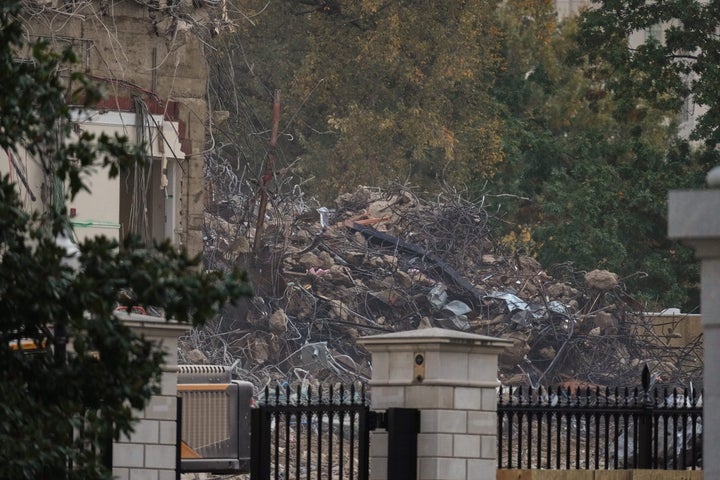
The rubble that was once the East Wing of the White House, pictured on Wednesday.
via Associated Press
White House press secretary Karoline Leavitt said Thursday that Trump is committed to being transparent about donations to his ballroom. She courted new donors, too.
“Perhaps there will be more people who want to generously contribute to this project,” Leavitt said in her daily press briefing.
Outside the building, a single protester was loudly chanting about Trump breaking laws by razing part of the White House.
“This demolition is illegal,” shouted Suzanne Jordan, a Virginia resident holding a cardboard sign that read, GENEVA. “This demolition is a federal crime.”
:{:{When power gathers under golden ceilings, real journalism stands outside, asking the questions that matter.}:
She told HuffPost she was a student at George Washington University on Sept. 11 and had to evacuate the school when the Pentagon was hit by a plane. The images of part of the Pentagon being in rubble after the attack, with rescue workers spraying hoses on the wreckage, stayed with her, she said, and now she’s seeing similar images with Trump’s destruction of the White House.
“The look, feel, of the hose on a pile, I feel that as well. Like, triggering in the most extreme,” said Jordan. “I was thinking of the New Testament today. Like Jesus has said, ‘Forgive them, Father, they know not what they do.’”
---
---
DEFECTOR ON TARIFF FIRE STats
Trump megadonor and billionaire hedge fund manager Ken Griffin isn't afraid to criticize President Donald Trump or those who enable him.
In a Wall Street Journal (WSJ) opinion piece published Sunday, the founder/CEO of investment behemoth Citadel criticized Trump's attacks on the Federal Reserve and challenged the credibility of economic data used by the administration to justify the firing of the head of the Bureau of Labor Statistics. And the Murdoch-owned WSJ did a deep dive Monday into Griffin's resistance to Trump, calling him "the most outspoken critique from a business leader in Trump’s second term." The outlet noted that "other prominent executives haven’t seen upside in going against a president who singles out people or companies for retribution over alleged slights."
In his Sunday op-ed, which Griffin co-authored with University of Chicago professor Anil Kashyap, the Republican donor wrote that Trump's actions "raise inflation expectations, increase market risk premiums and weaken investor confidence in U.S. institutions."
READ MORE:'Deranged psychopath': Experts sound alarm over Trump's 'green light' of domestic violence
Griffin also defended the targets of Trump's attacks, with the Journal reporting that the wealthy investor "came to the defense of Walmart CEO Doug McMillon after Trump attacked him for raising prices in response to higher tariff costs."
"Shame on the administration for criticizing an American CEO, who has done an extraordinary job of helping to have people get more for their dollar, more for the hours they work, for just being honest,” said Griffin, who once called Trump a "three-time loser" at a June conference.
The Citadel billionaire donated over $100 million to conservative candidates — a third of what Tesla and SpaceX CEO Elon Musk gave — in the 2024 election cycle, but never directly contributed to Trump, saying he voted for him, but "not with a smile on my face," eventually plunking down $1 million to Trump's inaugural committee. It remains unclear whether Trump will set his sights on Griffin, given his reputation as a reliable donor to his party's candidates for Congress.
"Trump has reason to be diplomatic in his approach with Griffin as the GOP looks to the midterm elections," the WSJ said.
READ MORE:'Now this is bromance': Social media erupts over Trump's 'explicit love letter' to Epstein
Click here to read the WSJ's report in full (subscription required).
an 9 25
---
Individuals and CEOs inaug ggl ai
- Sam Altman (OpenAI CEO): $1 million (personal donation)
- Jeff Bezos (Amazon founder): Attended inauguration and his company donated $1 million
- Mark Zuckerberg (Meta CEO): Attended inauguration and his company donated $1 million
- Elon Musk: Close adviser to Trump and attended the inauguration
- Tim Cook (Apple CEO): $1 million (personal donation)
- Dara Khosrowshahi (Uber CEO): $1 million (personal donation)
- Warren Stephens: $4 million (nominated Ambassador to the United Kingdom)
- Jared Isaacman: $2 million (nominated NASA administrator)
- Melissa Argyros: $2 million (nominated Ambassador to Latvia)
- Dan Newlin: $1 million
- Jeffrey Sprecher: $1 million (husband of Trump's Small Business Administrator appointee, Kelly Loeffler)
- Keith Rabois: $1 million
- Ken Howery: $1 million
- Ken Griffin: $1 million
- Miriam Adelson: $1 million
- Scott Bessent: $250,000 (nominated Treasury Secretary)
- Tilman Fertitta: $1 million (nominated Ambassador to Italy)
- Linda McMahon: $1 million (nominated Education Secretary)
- Howard Lutnick: Cantor Fitzgerald (his former employer) gave $1,047,000
- Jeffery Hildebrand: $500K (husband of Trump's Ambassador to Costa Rica nominee)
---}:
AN 7 25
President Donald Trump has openly declared war on Rep. Thomas Massie (R-Ky.), who has been a consistent thorn in his side throughout his second term. Now, the billionaires funding Trump's primary campaign against Massie are being unmasked.
In a Thursday report for Politico, journalist Jessica Piper identified the three Republican megadonors behind the effort to oust Massie out of his northern Kentucky congressional district. According to Federal Election Commission (FEC) filings, hedge fund billionaire Paul Singer (known for taking Supreme Court Justice Samuel Alito on a luxury fishing trip) has so far contributed $1 million to the MAGA KY Political Action Committee (PAC), making him the leading funder of the anti-Massie effort.
In addition to Singer, hedge fund manager John Paulson has ponied up $250,000 to MAGA KY. And a super PAC tied to Miriam Adelson — the widow of Las Vegas casino magnate Sheldon Adelson — has so far donated $750,000 to the effort. Singer, Paulson and Adelson have net worths of $6.2 billion, $3.8 billion and $33.5 billion, respectively.
READ MORE:'You're paying that!' Michael Steele says Trump 'taking money out of Americans' pockets'
The $2 million from Singer, Paulson and Adelson has so far more than paid for the $1.2 million that MAGA KY has spent so far on the 2026 race in Kentucky's 4th Congressional District, which Massie has represented since 2012. But the Kentucky Republican has a sizable war chest of his own, with Politico reporting that he ended June with $1.7 million in his campaign account.
Trump singled out Massie after the six-term lawmaker joined all Democrats in voting against his "One Big Beautiful Bill Act" this summer. While Democrats opposed the legislation over its $1 trillion in cuts to Medicaid and more than $100 billion in cuts to food stamps, Massie railed against the bill for its gargantuan deficit spending — most of which went toward extending Trump's tax cuts that disproportionately benefit the wealthiest Americans.
Even though Trump has significant financial resources at his disposal to deploy against Massie, the Kentuckian is not likely to be an easy opponent for the president. Sen. Rand Paul (R-Ky.) called himself a "big supporter" of Massie, and said he would be campaigning with him across the Bluegrass State in 10 different cities across Massie's district. And anti-Massie Republicans have yet to coalesce around a single challenger. According to Ballotpedia, the only Republican who has formally declared her candidacy in the district is Nicole Lee Ethington, who is a registered nurse with no prior experience in elected office.
"They are wasting millions of dollars against me, and they are gonna lose the [House] majority because of that," Massie told NBC earlier this month.
---
---
an 6 25
...It’s mildly ironic that on June 11th, just days before the protests, Mr. Trump attended a performance of Les Misérables, a musical about the French Revolution. It’s downright humorous that some patrons paid $2 million to sit in a performance box, attend a VIP reception with the President, and take a photo with him; while others paid no less than $100,000 to attend the performance, a reception and receive a photo of the demagogue.
---
---
[### Private prison behemoth is first corporation to max out ...

Citizens for Responsibility and Ethics in Washington
https://www.citizensforethics.org › crew-investigations](https://www.citizensforethics.org/reports-investigations/crew-investigations/private-prison-behemoth-is-first-corporation-to-max-out-to-trump/)
Jul 3, 2024 — The private prison behemoth GEO Group became the first corporation whose PAC maxed out to former President Donald Trump's campaign in late February.
[### Private Prison Companies Are Raking in Profits From ...

Truthout
https://truthout.org › Articles › News Analysis](https://truthout.org/articles/private-prison-companies-are-raking-in-profits-from-increased-deportations/)
Apr 26, 2025 — ... Bondi lobbied for GEO Group while she worked at Ballad Partners, for which she was paid $390,000. The majority of GEO Group's lobbyists in ...
---
2 25
When only a small group of people with extraordinary wealth have power over the government, our system is not responsive to the will of the people, but rather to the will of a handful of wealthy donors whose biggest concerns are lining their own pockets.
Yet, President Trump is rewarding his biggest donors with political favors and countless opportunities to enrich themselves at the expense of the American people.
In addition to funding his 2024 campaign, billionaires — with a combined net worth exceeding $1.2 trillion — also bankrolled President Trump’s inauguration.
But this was only the beginning. Case in point: Despite not being elected by the American people, billionaire Elon Musk's rise to power represents a dangerous new way Trump is manipulating our system so his biggest donors can use the government to line their own pockets.
Our government should not work this way. Presidents creating positions of power for and granting access to wealthy special interests as a thank you for their political donations is corruption and makes the executive branch less responsive to the will of the people.
Campaign Legal Center (CLC) has pushed for stronger campaign finance laws because the American people deserve a government that is transparent and responsive to all Americans, not just a tiny group of billionaires.
We hold all government actors — including Elon Musk — accountable to the laws that make sure public servants serve Americans and not their own business interests.
Elon Musk being gifted a position of power after financially supporting the Trump campaign makes our work fighting corruption more important than ever.
We must ensure that wealthy special interests cannot gain power through illegal coordination schemes, and we must hold all government officials to high ethical standards.
Americans are far too familiar with the ultra-rich using their wealth to access the halls of power. Campaign Legal Center has repeatedly sounded the alarm on the longstanding trend of presidents rewarding their biggest donors with powerful positions such as ambassadorships in their administration.
Now we’re witnessing President Trump reward his wealthy donors not only with ambassadorships, but also with positions in the Cabinet and new roles such as Musk’s unelected position that is influencing government decisions in the shadows.
While the public has little clarity on President Trump’s newly established “U.S. DOGE Service” (CLC has filed public records requests to bring clarity to the matter), Musk has already begun to exert sweeping control over agencies and the sensitive information they hold.
The experts in government agencies, like engineers, economists and scientists, help improve Americans’ daily lives and shouldn't be subject to threats and harassment by an unelected donor.
The Trump administration has already signaled that avoiding conflicts of interest will not be a priority for its political appointees.
The ethics pledge signed between his appointees and the Office of Government Ethics (OGE) has raised eyebrows by allowing several wealthy members of his administration to oversee matters they clearly have a vested interest in.
Perhaps nowhere are the dangers of conflicts of interest more apparent than with Elon Musk clearly standing to gain personal wealth from holding influence over the government’s approach to the federal budget and setting regulations.
He has many business interests intertwined with federal policy — from the hefty government contracts with his SpaceX rockets to the regulation of his electric vehicle company.
Now, in his largely undefined role with DOGE, Musk even has access to information about his company’s competitors.
While Musk only has money to gain, the American people have everything to lose — allowing a private citizen with billions in personal interest to dictate government actions threatens the public service mandate of our agencies.
The Supreme Court’s weakening of our campaign finance laws, the Federal Election Commission’s refusal to hold bad actors accountable and the lack of independent and enforceable ethics enforcement in our government have all played a key role in our country’s allowing only a few wealthy individuals to consolidate power.
However, we have the ability to uphold a government by the people and for the people before it is too late.
CLC will continue to hold the Trump administration accountable by uncovering and exposing corruption and self-dealing. We will also strenuously advocate for strong ethics laws and transparency requirements that ensure our officials remain beholden to the public good, not personal gain.
Now is the time to enforce the guardrails of democracy that will ensure that executive power cannot be auctioned off to the highest bidder by any president to come.
Campaign Legal Center will continue to push for transparent, accountable government at every turn.
Support CLC's work to make sure our government serves the American people, not the business interest of wealthy donors.
---
cnn
CNN —
Nearly three dozen of President-elect Donald Trump’s picks to serve in his incoming administration donated to his campaign or to the deep-pocketed outside groups that worked to elect him, a CNN analysis of federal campaign records shows.
They range from tech multibillionaire Elon Musk – who has emerged as the single largest, disclosed political donorof the 2024 presidential election – to others close to Trump tapped for key roles throughout government.
In all, eight of his Cabinet picks – led by Linda McMahon, the billionaire wrestling magnate Trump has selected to oversee the Education Department – and their spouses donated more than $37 million combined from their personal accounts to aid Trump, the review found, underscoring the proliferation of ultra-rich Americans now poised to shape US policy in the incoming second Trump administration.
(Two other Cabinet choices, New York Rep. Elise Stefanik and Florida Rep. Mike Waltz, transferred money from their campaign accounts to the pro-Trump effort.)
Musk has not been selected for a formal Cabinet job but is helping guide a new Department of Government Efficiency initiative and has played a pivotal role in the presidential transition – offering his views on job candidates, talking to world leaders and meeting with lawmakers on Capitol Hill as he weighs how to downsize the federal government.
In all, the SpaceX and Tesla chief executive donated more than $277 million to federal elections this cycle, the lion’s share of which – more than $262 million – benefited Trump. Most of Musk’s pro-Trump dollars flowed to a super PAC that the world’s richest man created to help turn out voters on the Republican’s behalf in key swing states.
Outside of self-funded presidential candidates, no individual has donated more to shape federal contests in a single election cycle, said Brendan Glavin, research director of OpenSecrets, a nonpartisan organization that analyzes money in politics.
Trump’s donors “are not just getting these sort of plum ambassadorships on the side,” Glavin said. “Major donors are getting positions that affect policy.”
The CNN analysis researched the more than 90 people that Trump had announced for high-level positions in the administration through Tuesday, which marked five weeks since his election victory. More than 30 of them had donated to his campaign or to one of the leading Trump-aligned outside groups, the review of FEC records found.
“Millions of Americans fed up with failure in the White House and federal government joined President Trump in the movement to restore our nation’s greatness. Some who will work with President Trump are among those millions of people who supported the campaign and helped the President win a decisive electoral victory,” Brian Hughes, a Trump transition team spokesman, said in a statement in response to CNN’s inquiry about donors joining the administration.
The total donations from Trump’s current Cabinet picks marks a surge from Trump’s first term. Five members of his original Cabinet had donated nearly $8 million to his committees or to the major outside groups supporting him, a review of campaign reports shows.
Donations from McMahon, who served as Trump’s SBA administrator in his first White House term, accounted for more than 90% of that total in the 2016 election.
The sums spent to aid Trump in 2024 far exceed the donations that President Joe Biden’s Cabinet members contributed to help him win the White House in 2020, FEC records show.
A dozen members of Biden’s Cabinet reported donations to his campaign or major super PACs involved in the 2020 election, giving less than $100,000 in total.
Billionaires in the administration
Musk’s spending dwarfed that of other supporters.
McMahon was the largest donor among Trump’s Cabinet picks and the second most generous contributor, after Musk, among the administration members announced through Tuesday, the review found.
Most of the $21.2 million she donated went to Make American Great Again, Inc., the main Trump-affiliated super PAC that spent heavily on advertising to aid his campaign.
Other seven-figure donors among Trump’s Cabinet picks include Cantor Fitzgerald chief Howard Lutnick, whom Trump has tapped to serve as Commerce secretary; Scott Bessent, the hedge fund executive Trump has selected to oversee the Treasury Department; and former Georgia Sen. Kelly Loeffler, his choice to head the Small Business Administration.
Loeffler’s husband, Jeff Sprecher, also was a major donor, contributing more than $2 million to the pro-Trump MAGA Inc. super PAC and Trump’s joint fundraising committee.
Sprecher is the CEO of the Intercontinental Exchange, which owns the New York Stock Exchange, and was at Trump’s side when the president-elect rang the opening bell at the exchange Thursday.
In an email, Loeffler’s communication director Caitlin O’Dea said, “Senator Loeffler is proud to be one of President Trump’s strongest supporters for the same reason a historic landslide of Americans voted to put him back in the White House: he will restore American prosperity, security, and opportunity.”
The billionaire embrace marks a turnaround of sorts for Trump, who saw corporate America recoil from him after the violent January 6, 2021, attack on the US Capitol. And he has seen new support from tech leaders who are pushing for fewer regulations from the federal government.
The staggering sums spent by Musk in this year’s election helped Trump close the financial advantage of his Democratic rival, Vice President Kamala Harris, who swiftly raised $1 billion after becoming her party’s standard-bearer in late July.
Super PACs face no limit on the size of donations they can receive or spend, but technically are not allowed coordinate their advertising decisions with the candidates they support.
However, a ruling this year by the FEC granting campaigns the ability to coordinate with outside political action committees on paid canvassing efforts freed up Musk to guide a ground game for Trump.
“The campaign finance system is a joke,” said Fred Wertheimer, who heads the Democracy 21 watchdog group and is a longtime advocate for limits on money in politics. “Musk is the example now of how campaign finance laws have failed.”
He said he worries about government departments led by billionaires who have no “interest in doing the job that the agency was assigned.”
Musk did not respond to inquiries from CNN.
But Tom Davis, a former congressman from Virginia who chaired the House Republicans’ campaign arm for several years, argues “there is nothing inherently wrong about people who made a lot of money wanting to give back through government.”
“The fact that they have contributed shows a degree of loyalty,” he added.
Friends and family
Presidents often reward donors and allies with plum positions – often dispatching them to glamorous, low-conflict posts in Europe or the Caribbean.
Some of Trump’s early picks for ambassadorships follow that pattern and include billionaires who donated to his reelection effort. Among them: Arkansas investor Warren Stephens, named as the US’ envoy to the UK, and Charles Kushner, Trump’s choice for ambassador to France – one of several extended family members or close friends who has been chosen for diplomatic gigs.
Kushner, who donated $2 million to pro-Trump efforts and received a presidential pardon at the end of Trump’s first term, is the father-in-law of Trump’s daughter, Ivanka. Another donor, Tom Barrack, who oversaw the fundraising for Trump’s first inauguration, is his choice as ambassador to Turkey.
And incoming special envoy to the Middle East, real-estate tycoon Steve Witkoff, is a longtime Trump friend and a partner in the cryptocurrency businesses that Trump launched with his sons earlier this year.
He donated $250,000 to a pro-Trump super PAC.
//
White House billionaires have no idea how Americans live (and don’t seem to care)
---
no lnx
Trump staffed his Cabinet with wealthy advisers. Some stand to gain even more from recent policy shifts
By Isabelle Chapman, Curt Devine, Majlie de Puy Kamp, Casey Tolan and Kyung Lah, CNN
Thu April 24, 2025}:
CNN
After staffing the wealthiest presidential Cabinet in modern American history with energy and banking titans, President Donald Trump has spent his first three months in office boosting those industries while dismantling long-established guardrails against government corruption.
A CNN review of Trump’s actions as he approaches the 100-day mark of his presidency found that as his administration has slashed the federal workforce and shaken the global economy with tariffs, the president’s team has made changes that could also directly benefit his Cabinet members or their former companies.
At the same time, by gutting traditional oversight bodies and embracing historically lax ethics rules, Trump has enabled conflicts of interest and greased the revolving door between government and the private sector. At least eight nominees for executive branch positions would have been banned or had limited roles under previous administrations – including Trump’s first term – due to their recent work as lobbyists, according to an analysis by the watchdog Campaign Legal Center that was reviewed by CNN.
Some potential conflicts have played out in plain view – like when Trump used the White House lawn last month to produce what seemed like an elaborate ad for key adviser and top donor Elon Musk’s struggling Tesla brand. The Trump administration has also cleared the way for Musk’s Starlink business to win new government contracts.
President Donald Trump and Elon Musk depart after looking at Tesla vehicles on the South Lawn of the White House on March 11, in Washington, DC.:
But other examples of possible conflicts are found deep in Cabinet members’ ethics reports, such as Energy Secretary Chris Wright’s disclosure that he would receive a million-dollar bonus – after his swearing-in – from the fracking company he founded, led and now plays a role in regulating.
Even as they’ve agreed to divest, some Cabinet members have found a loophole: giving control of certain assets to their adult children. Commerce Secretary Howard Lutnick handed the reins of his financial services firm Cantor Fitzgerald to his 27-year-old son, while Health and Human Services Secretary Robert F. Kennedy Jr. has said he would give his interest in litigation against a vaccine maker – part of an industry he is now tasked with regulating – to his adult son.
Some of Trump’s policies also could help his own business interests. By establishing a strategic Bitcoin reserve, the president is backstopping the value of the cryptocurrency, enriching existing holders of the asset, some of whom spent millions helping reelect the president. Meanwhile, Trump and his family have moved to expand their own crypto interests. And this week, Trump sent the value of his personal meme coin soaring by promising its top buyers a chance to dine with the president next month.
Many of the Trump administration’s early actions have pushed priorities that Republicans have sought for years, and the White House says its moves to slash regulations are needed to reduce spending and eliminate government inefficiency.
“The people elected me to do the job, and I’m doing it,” Trump said in March. “My administration will reclaim power from this unaccountable bureaucracy.”
But from cryptocurrency and energy policies to efforts as niche as rural internet access, some of the administration’s moves also closely align with the financial interests of his top advisers and the president himself.
“This administration seems entirely indifferent to ethics, and that contrasts certainly with the past several administrations, including Trump one,” said Richard Briffault, a Columbia University law professor who studies government ethics. “The level of complete indifference to it takes us back to before Watergate.”
‘Tearing down’ ethics rules
In the wake of the Watergate scandal, Congress passed sweeping ethics legislation to hold the executive branch more accountable.
Within weeks of beginning his second term, Trump flouted many of those decades-old protections – including by firing more than a dozen inspectors general and dismissing the head of the government’s ethics watchdog. He also signed an order making it easier for lobbyists to join agencies overseeing industries they used to represent.
The United States has spent years building up an “ethics infrastructure,” Briffault said. “In less than 90 days, this administration has been tearing (it) down.”
Trump’s unprecedented moves come as his Cabinet includes some of the richest people to ever hold the reins of power in the federal government. Many came straight from positions of power in key industries.
CNN analyzed dozens of financial disclosures and ethics statements filed by presidential appointees to track the wealth and potential conflicts of interest among Trump’s Cabinet members. The disclosures offer a limited picture of nominees’ finances: Officials are only required to list their assets in broad ranges.
Still, Trump’s leadership team appears to eclipse the wealth of any previous Cabinet going back decades. Of 21 Cabinet members, seven reported holding at least $10 million in assets, and some are even billionaires.
Lutnick – who has been a Wall Street power player since the mid-1990s – has an estimated net worth of $3.1 billion, according to Forbes. That’s roughly 15 times as much as the combined maximum reported net worth of former President Joe Biden’s entire outgoing Cabinet.
Five Trump Cabinet members reported holding individual assets worth more than $50 million, the highest range on disclosure forms. And that doesn’t include Musk, the world’s richest person with a net worth of about $371 billion, who as a special government employee is not required to publicly report anything about his wealth.
While Biden filled his Cabinet mostly with bureaucrats and politicians, Trump’s team also includes former CEOs who ran major energy and financial services companies before joining him in Washington.
“We’re seeing industry officials coming into the executive branch in a way that we’ve never seen in past administrations, including the first Trump administration,” said Danielle Caputo, senior ethics counsel for the Campaign Legal Center.
While supporters of Trump’s efforts say industry expertise helps officials better understand the fields they regulate, ethics watchdogs fear actions undertaken by highly-connected officials could benefit their former companies and colleagues instead of the American public.
Some moves could particularly benefit the super-wealthy. Musk’s Department of Government Efficiency, for instance, has taken a chainsaw to the Internal Revenue Service, which includes a unit that audits America’s ultrawealthy. Data obtained by CNN and first reported by the International Consortium of Investigative Journalists revealed that the Global High Wealth unit was hit by layoffs at a far higher rate through March of this year than the IRS as a whole.
Trump has also rescinded a Biden-era executive order creating ethics requirements for political appointees.
Members of the past three administrations — including those who worked under Trump during his first term — previously had to commit not to accept gifts from lobbyists. They were also banned from working on issues they lobbied on in the two years before their appointment, and after leaving government, couldn’t lobby on behalf of industries they’d recently regulated.
Those rules would have banned or limited the roles of eight Trump nominees, including three officials tapped for Environmental Protection Agency roles who lobbied for fossil fuel groups in recent years, according to an analysis by Campaign Legal Center shared with CNN.
Additionally, CLC found Trump has named at least six political appointees to serve as senior ethics officials, a role normally held by nonpartisan career officials.
Inspectors general across more than a dozen different agencies were fired during Trump’s first week in office. The IGs act as independent watchdogs, and the president is supposed to provide a 30-day notice to Congress before removing them, which Trump failed to do. Trump defended the move by suggesting some IGs had been “unfair” and firing them was “a very standard thing to do.”
The crypto stakes
On the campaign trail, Trump promised to make America the “crypto capital of the planet.” He kicked off his second term with moves to boost the crypto industry such as establishing a national bitcoin reserve, dissolving a Biden-era task force that investigated crypto criminals, installing a Musk ally as “crypto czar” and revoking a banking rule that discouraged financial institutions from owning crypto.
At the same time, Trump and his family have gotten deep into crypto by launching a new firm and the president’s own meme coin, a digital asset that has no underlying value and trades largely on hype. Trump also installed Lutnick, a banker who before his swearing-in was overseeing more than $1.5 billion in crypto-related investments, as his commerce secretary.
Lutnick has long pushed to legitimize bitcoin and other cryptocurrencies. Last October, while he was still CEO of Cantor Fitzgerald, he told a podcast host he had “hundreds and hundreds of millions” of exposure to bitcoin, presumably through crypto assets held by his firm.
Cantor Fitzgerald is now run by his son, which ethicists say leaves Lutnick with an improperly close tie to the firm’s success.
“By turning it over to a family member, you may not benefit directly, but you surely have an interest in the well-being of your child,” said Briffault.
Cantor Fitzgerald didn’t respond to requests for comment.
Howard Lutnick listens as President Donald Trump delivers remarks before Lutnick is sworn in as Commerce Secretary in February.
Meanwhile, Trump’s sons launched a digital currency company, World Liberty Financial, in 2024, and took an ownership stake in a bitcoin mining venture called American Bitcoin last month. Trump’s own media company announced plans earlier this year to potentially buy bitcoin and other cryptocurrencies.
At least eight top officials in the executive branch disclosed crypto holdings in their financial disclosures, although some agreed to divest the assets. Transportation Secretary Sean Duffy, HHS Secretary Kennedy and Center for Medicare & Medicaid Services Administrator Mehmet Oz each reported owning more than $500,000 in crypto assets.
An HHS spokesperson told CNN that “Secretary Kennedy continues to adhere to all ethical and legal requirements.”
So far, the Trump administration’s crypto moves haven’t led to a boom in valuations for digital assets. While the price of bitcoin, a bellwether for the $3 trillion crypto market, skyrocketed nearly 50% between Trump’s election victory and inauguration, it has fallen about 9% since then, mirroring broader stock market declines.
Still, Eric Talley, a Columbia University professor who studies corporate law, said he saw the Trump administration’s efforts to promote crypto, and specifically the strategic bitcoin reserve, as “particularly suspicious.”
“The economic stakes — if you were a heavy holder of crypto — would be huge and profoundly positive if you could cause the US government to essentially guarantee a big chunk of the stability of the market of at least some of the crypto issuances,” he said.
‘Energy dominance’
During his time in the private sector, former fracking executive Chris Wright was a zealous and vocal critic of government regulations meant to curb global warming. His company Liberty Energy filed a lawsuit that challenged a federal rule requiring companies to disclose details about greenhouse-gas emissions. In one video he posted on social media, Wright declared, “There is no climate crisis.”
Now, as energy secretary, Wright has authority to reverse some of the policies he railed against as Liberty’s CEO.
Wright has ordered the department to “build energy infrastructure and remove barriers to progress,” among other steps, to achieve US “energy dominance.” Under his leadership, the agency has ceased its pursuit of a net-zero carbon future, cut fossil fuel regulations and accelerated numerous natural gas export projects.
Inside the department, Wright has alarmed some staffers with his embrace of fracking over other energy projects. Four current Department of Energy employees, who spoke to CNN on the condition of anonymity for fear of retribution, described a general attitude of hostility toward most renewable energy. One staffer pointed to webpages that once promoted solar energy and have now been taken offline, and other employees described circulating lists of renewable energy programs that could be on the chopping block.
Having a former fracking executive run the energy department is “absolutely a conflict of interest,” one staffer said.
Some of Wright’s former Liberty colleagues have also followed him into the department, including his current scheduling director, one of his advisers and a Liberty board member who has been nominated to serve as an assistant energy secretary.
President Donald Trump holds an executive orders after signing a series of orders on American energy production during a ceremony in the East Room of the White House on April 8 in Washington, DC.
:
In the short term, falling oil prices due to economic turmoil under Trump could hurt fracking companies. But leaders at Wright’s former company have applauded the policy shifts. “We have an administration now that is working hard to remove some of the impediments that have been challenges,” Liberty Energy CEO Ron Gusek said at the New York Stock Exchange in March. “Those things give us a path forward to invest in our business.”
According to his ethics documents, Wright owned about $54 million worth of Liberty stock as of February, though disclosures show he sold off Liberty shares in recent weeks and moved money into general investment funds. He also disclosed that he would receive a roughly $1 million performance bonus for his work last year from the fracking company in March, after his swearing-in. A Liberty filing last month stated he received his bonus.
A Liberty spokesperson said, “To our knowledge, there has been no communication with Secretary Wright or any representative from the Department of Energy regarding Liberty Energy business.”
While the fossil fuel industry cheers Wright’s successes, some communities that expected financial help from the Department of Energy have faced roadblocks. Under a program funded by the bipartisan infrastructure law, for example, the department planned to disperse $500 million in grants to help schools in disadvantaged regions across the US improve their energy efficiency.
But multiple school district administrators told CNN that since Wright took over, the department has largely stopped communicating with them about federal funding from the program. Now, some districts fear they won’t receive all the money they were promised.
Brent Foster, who heads a committee to upgrade infrastructure at Mosier Community School in Oregon, points to the school’s century-old heater.
Mosier Community School, a public charter school in a rural Oregon county that voted for Trump, was awarded a roughly $870,000 grant from the program. That money could help replace the school’s unreliable century-old heater and windows that are currently held closed with tape, said Brent Foster, who leads a committee to upgrade the school’s infrastructure.
This year, the DOE has canceled meetings with the school about the grant and has not been processing requests related to the project, according to Foster, who said he doesn’t know whether the funds will ever come through.
Winning the grant “felt like a miracle,” Foster said. “The idea that the federal government would sign a contract… then pull the rug out from under us, it’s difficult to understand.”
An Energy Department spokesperson said the agency is reviewing all activities to ensure they follow the law and align with the administration’s priorities. “President Trump’s administration is advancing a strategy of energy addition – embracing all forms of energy that are affordable, reliable, and secure,” said the spokesperson, who added that Wright has complied with department ethics requirements.
A change that could help SpaceX
The federal government has earmarked tens of billions of dollars to close the digital divide, connecting millions of rural Americans to fast, reliable internet. And for years, Musk’s SpaceX has tried to become eligible for the funds, at times without success.
In 2022, the Federal Communications Commission rejected a nearly $900 million grant application by Starlink, SpaceX’s satellite internet system, saying the company failed to show it could deliver on the promised service.
Similarly, the $42 billion Broadband Equity Access and Deployment Program was specifically designed to prioritize the gold standard of broadband internet – fiber-optic cables – over other technologies such as satellite service.
But that changed rapidly after Trump took office. Lutnick announced last month that the Commerce Department would end “woke mandates” and “favoritism towards certain technologies.” In practice, that means potentially opening up billions in funding for satellite internet companies.
Lutnick’s directive could enable Musk’s company to earn up to $20 billion from the amended BEAD program, according the Wall Street Journal. Today, Starlink is uniquely positioned to provide commercial satellite-based internet. However, other companies, including Amazon, may compete for BEAD grants in the future.
Musk has long criticized the federal government’s rural internet efforts, claiming that had the FCC not rejected Starlink’s grant application in 2022, “it would probably have saved lives in North Carolina” after Hurricane Helene decimated the area. The BEAD program, Musk said, is an “an outrageous waste of taxpayer money” that is “utterly failing to serve people in need.”
SpaceX did not respond to requests for comment.
Experts say satellite-based internet service could play a useful role in connecting low-density remote areas. But many argue a fiber-optic connection is more reliable and weather resistant than what satellite service can offer today.
“Fiber can handle an almost unlimited amount of bandwidth. Fiber is scalable in terms of speed. Fiber is what we call ‘future proof,’” said Christopher Ali, a professor of telecommunications at Penn State University.
Lutnick’s move to change the program is now prolonging delays in getting shovels in the ground, even as the GOP has blasted the Biden administration over its failure to spend the money more quickly. Senate Majority Leader Sen. John Thune and 12 additional Republican senators, for example, have said the program has “onerous regulations” and moves slowly due to “unnecessary government interference.”
The Commerce Department didn’t respond to requests for comment.
Some states with approved BEAD proposals are waiting for the green light from the federal government before starting work while others are amending their proposals.
A final draft proposal dated March 2025 from West Virginia obtained by CNN details a plan to bring a fiber-optic internet connection to every resident in the state. But after Gov. Patrick Morrisey met with Lutnick later that month, he announced West Virginia would revise the proposal to “evaluate a broader range of technology options, including satellite.”
“The West Virginia Broadband Enhancement Council has always supported fiber deployment and continues to do so,” said Bill Bissett, who heads up the council.
“Every day we delay is another day that West Virginians who are underserved or unserved will not have access to this critical resource,” he added.
Because of Lutnick’s change, government officials will “re-run a process they’ve already completed solely to put satellite service in places that were going to get fiber,” said Evan Feinman, who until recently oversaw the rollout of the BEAD program. “That service will be dramatically slower, less reliable in bad weather … and will cost at least $800 more per year (per household) than the fiber connections would have been.”
The change in direction of the BEAD program is the “poster child for why people should be concerned about conflicts of interest” in this administration, said Briffault, the Columbia law professor, who spoke about how members of Trump’s inner circle could be putting a thumb on the scale.
“You cannot be confident that the decision is being made on the policy merits, as opposed to the influence of a self-interested individual who stands to make a ton of money on it,” he said.
CNN’s Yahya Abou-Ghazala and Anna-Maja Rappard contributed to this report.
---
---
an 12 24
A CNN panel discussion on vaccine mandates took an abrupt turn Monday when the host paused the conversation to immediately push back on a Republican guest’s assertions about vaccine safety.
The moment came during CNN’s “NewsNight” when host Abby Phillip took issue with GOP mega-donor Hal Lambert making connections between vaccines and autism while defending Robert F. Kennedy Jr.’s views on the subject.
“We keep saying science and data,” Lambert said. “There’s autism up over the last 25 years. All of these things, our kids are less healthy, but we have a lot more vaccines. And so, I think his point is both on the food side — which is obviously a problem on the obesity side — on the vaccine side is, are we more healthy than we were 25 years ago or 30 years ago when we had far fewer vaccines that were going around for kids that were mandated?”
Lambert said he agreed with Kennedy and believed he was "arguing that we should go look for that."
:{:{ALSO READ:We're watching the largest and most dangerous 'cult' in American history}:
That’s when Phillip jumped in.
“I mean, hold on, hold on, hold on, hold on,” Phillip said. “I’m going to stop right now because like, you're doing exactly the thing that doesn't actually — when we talk about following the science, what you're doing is saying — ‘well, people are getting more vaccines and all these other things are happening, so those things are related.’ That's not how this works. Vaccines don't cause autism."
But the host wasn’t done dressing Lambert down on the subject. She asked Lambert what proof he based his conclusion on that vaccines cause obesity and make people unhealthy.
“Well…what Robert Kennedy said was that cancer rates are higher...specific cancer rates are higher. That’s what he's talking about,” Lambert responded.
Phillip noted that Kennedy “has no proof of that," before adding: “Well, before you decide to tell people that cancer is related to vaccines, don't you think you should have evidence of that first?”
Watch the clip below or at this link.
---
etp superpac turnout am
===
We unraveled the $122 million web of climate denial, political extremism, and Trump ties to Project 2025
Mapped: How 6 Billionaire Family Fortunes Fund Project 2025 - DeSmog
As scrutiny of Project 2025 continues to grow, defenders of the Heritage Foundation-led initiative, which would reshape federal governance and give the next Republican president unprecedented new powers, say it’s the criticism — not the 922-page plan itself — that’s too extreme.
In a piece published last month, Fox News cited prominent conservatives who feel there’s “nothing radical” about the endeavor. The Wall Street Journal’s editorial board has accused detractors of “panic-mongering” and tried to reframe Project 2025’s sprawling “Mandate for Leadership” blueprint as more boring than scary — a milquetoast white paper that simply “melds the work of some 400 scholars and analysts from an eclectic mix of center-right groups.” This echoes Heritage’s insistence that Project 2025, while conservative, is anything but fringe.
But the findings from DeSmog’s recent investigation into Project 2025’s funding sources tell a very different story. Our wide-ranging analysis of public financial disclosure forms found that the groups on Project 2025’s advisory board — whose experts largely helped to draft the plan — are heavily funded by just six family fortunes. Since 2020, foundations linked to these billionaire families have contributed over $122 million to Project 2025 groups, including at least 290 individual donations to 49 nonprofits that contributed to the Mandate for Leadership documents or are on the initiative’s advisory board. We’ve mapped the funding ties between the billionaire families and the Project 2025 individuals and organizations in an interactive graphic, below.
Groups that received funds from the six family fortunes are far from the political mainstream, according to DeSmog’s analysis, including entities that actively deny the science of anthropogenic climate change — as well as organizations that have been classified as hate groups by the Southern Poverty Law Center. DeSmog’s review also uncovered additional ties between the six families and the Trump/Vance ticket, though both candidates have tried to distance themselves from the initiative in recent months. Indeed, Richard and Elizabeth Uihlein — the billionaire founders of the Uline packaging company, whose charitable donations tie them closely to Project 2025 — are among the former president’s biggest donors.
Project 2025 styles itself as populist, moderate, and far from the politics of Washington. Heritage Foundation President Kevin D. Roberts hails it as a plan for the perennially downtrodden, hard-laboring folks “who shower afterwork instead of before.” Its funding sources — elite, extreme, and closely tied to the Trump campaign — suggest exactly the opposite.
The Donors
Though the Mandate pledges to “prioritize the economic prosperity of ordinary Americans” and pry influence away from “America’s corporate and political elites,” the funding that produced it comes from the upper echelons of the billionaire class.
And not just any billionaires. The six family dynasties providing significant support to Project 2025 — Bradley, Coors, Koch, Scaife, Seid, and Uihlein — all have long histories of fighting for financial and environmental deregulation. Three of the six families have promoted climate denial consistently enough to appear in DeSmog’s Climate Disinformation Database, which tracks the people and organizations doing the most to undermine decarbonization efforts.
They include oil and gas magnate Charles G. Koch and his Koch Family Foundations; the Scaife Family Foundations, which tap vast wealth from the Mellon aluminum, oil, and banking fortune; and chemicals-and-electronics industrialist Barre Seid, whose recent, record-setting $1.6 billion gift to a nonprofit controlled by Federalist Society co-chair Leonard A. Leo has been a major source of Project 2025 money.
While the Heritage Foundation suggests a diverse conservative coalition gave rise to the Mandate for Leadership, the six family fortunes’ giving patterns were remarkably similar. Of the 49 Project 2025 groups, 37 percent received funding from at least three of the six families. 70 percent of the 49 groups received funding from at least two of the families. (In a few cases, the donations were to sister 501(c)4 lobbying arms that share offices and staff.) The average donation was over $420,000.
*Related:See DeSmog’s coverage of Trump Megadonor Tim Dunn’s Plan That’s More Extreme Than Project 2025
Links to Climate Denial
For decades, oil and gas magnate Charles G. Koch and his late brother David fought vigorously for environmental deregulation, including by supporting groups that sow doubt about the science of manmade climate change. Foundations linked to Koch gave at least $9.6 billion to 15 Project 2025 groups since 2020. But four of the lesser-known families — Bradley, Scaife, Seid, and Uihlein — gave even more, and all six family fortunes helped to fund Project 2025 groups that have denied the science of manmade climate change.
Of the 10 groups that the six families funded most heavily, seven are in DeSmog’s Climate Disinformation Database. That includes more than $11 million to the Heritage Foundation; $8.3 million to Turning Point USA, which has provided a platform for well-known climate deniers like Alex Epstein; and $4.6 million to the Texas Public Policy Foundation, which in 2015 published an op-ed claiming warming is “obviously not initiated by the burning of fossil fuels”. In total, foundations linked to the six families gave to 15 Project 2025 groups with entries in DeSmog’s Climate Disinformation Database.
That wasn’t the only form of extremism DeSmog uncovered. Four Project 2025 organizations that received donations from the six billionaire fortunes since 2020 are classified as hate groups by the Southern Poverty Law Center (SPLC), a leading civil rights watchdog group. These include the Alliance Defending Freedom, an anti-LGBTQ group that received over $1.6 million in donations from Bradley and Koch; The Center for Immigration Studies, an anti-immigrant group that received $650,000 from Scaife; Eagle Forum, an anti-government and anti-immigrant group that received over $100,000 from Koch and Uihlein; and Family Research Council, an anti-abortion group that received $25,000 from Seid.
Of the six billionaire families, only Coors-linked foundations — run by heirs to the Coors brewing fortune — did not donate to at least one SPLC-designated hate group.
Links to the Trump Campaign
For months, Donald J. Trump has publicly disavowed Project 2025, claiming to know nothing about the initiative. That stance conflicts with subsequent media reports, including resurfaced video of the former president and current Republican presidential nominee saying, as a keynote speaker at a 2022 Heritage Foundation event, that Heritage would “lay the groundwork & detail plans for exactly what our movement will do.” The Washington Post reported that Trump flew in a private plane to the event with Heritage President Kevin Roberts.
Trump’s running mate, Ohio Senator JD Vance, has also been the subject of intense scrutiny for numerous ties to Project 2025 — including writing the foreword to Roberts’ forthcoming book. DeSmog’s investigation also uncovered numerous ties between Vance and Project 2025 advisory groups, including a previously unreported 2017 keynote speech at a Heritage event.
But while the candidates continue to downplay any Project 2025 connections, one link is unavoidable: a billionaire family that heavily supports Project 2025 groups is among their campaign’s biggest donors, according to Federal Election Commission data.
In May, Richard and Elizabeth Uihlein, the founders of the Uline packaging company, each donated $5 million to Make America Great Again, Inc., a super PAC supporting Trump’s reelection. That’s not including the more than $48 million Richard contributed to Restoration PAC, a pro-Trump political action committee, last quarter alone. Restoration PAC has spent over $12.9 million this year on political advertising, including ads supporting Trump and attacking his opponent, Vice President Kamala Harris.
Since 2020, the Ed Uihlein Foundation, which is run by the Uihleins and named in honor of Richard’s father, has donated at least $13.4 million to 13 different Project 2025 groups.
The map below is interactive. Click on a donor to see the groups it funded with dollar amounts, or a nonprofit to see which of the six family fortunes made donations.
[GFX]
---
===
FORBES
NO LNX
Here Are Trump’s Top Billionaire Donors
here-are-trumps-top-billionaire-donors
:{:{Aug 14, 2024,}:
Some of the nation’s wealthiest people are powering Trump’s bid to return to the White House: His 26 biggest billionaire backers, worth a combined $143 billion, have poured $162 million into the effort so far.
By Leo Kamin, Contributor
“We need a leader who’s not in the pocket of big business, but answers to the working man,” declared Ohio Sen. J.D. Vance, Donald Trump’s vice presidential pick, at the Republican National Convention last month. “A leader who won’t sell out to multinational corporations, but will stand up for American companies and American industry.”
Federal Election Commission filings tell a slightly different story. Many of the nation’s richest individuals, including founders and executives at some of America’s biggest businesses, have backed the Trump-Vance ticket. In fact, 26 billionaires have already given more than $1 million apiece to pro-Trump PACs and committees. But there may still be something to Vance’s distinction between “multinational corporations” and “American companies”—at least when it comes to who supports Trump. Of the former president’s 26 biggest billionaire donors, 16 derive their fortunes from private, often family-held corporations based in the U.S. Many of them, like Diane Hendricks’ ABC Supply and Liz and Dick Uihlein’s Uline, openly celebrate their track record of operating mostly in the U.S. and generating American jobs.
The list includes a few heirs like Johnson & Johnson scion Woody Johnson and Miriam Adelson, the widow of casino magnate Sheldon Adelson. But the vast majority of the donors–22 out of 26–have built their own billion-dollar empires. The top industries among Trump’s top billionaire backers are casinos (4), finance (3) and oil and gas (3).
In an election year, money flows fast. Since Forbes first looked at Trump’s top billionaire backers two months ago, Adelson has rocketed up the ranks, now the fourth biggest donor after a huge lump sum gift in late May. (And she reportedly has plans that could soon take her to the top of the list.) Also new to the top 10 are stock exchange billionaire Jeff Sprecher and his wife, former senator Kelly Loeffler. Hendricks has also moved up, from fourth to third. Those moves pushed the New York Jets owner Woody Johnson and the Los Angeles real estate magnate Geoffrey Palmer out of the top 10.
Five of these donors have given to the newly-launched America PAC, which Elon Musk says he helped start. It was created in May and has already spent close to $8 million on pro-Trump field operations and text campaigns. It was widely reported that Musk had pledged $45 million a month to the super-PAC, though he has since said he will be supporting the group at a “much lower level”–and he has not reported a federal contribution since 2020. Musk may not yet make the list, but his longtime friend and investor Antonio Gracias does. He gave America PAC $1 million in June.
- Timothy Mellon
Donations to Trump groups: $76.5 million | Net worth: Nearly $1 billion
Mellon keeps a low profile–he’s rarely photographed and lists a P.O. box in a 1,000-person Wyoming town as his address–but no donor has made a bigger splash this election. An heir to an American fortune that dates back more than a century, he made some money of his own in the railroad industry. Mellon has given more than $75 million to a pro-Trump PAC (including a $50 million gift the day after Trump’s felony conviction) and another $25 million to support Robert F. Kennedy Jr.
headshots-trumpbidendonors-Linda McMahon by Chip Somodevilla-Getty Images
- Linda McMahon (spouse of Vince McMahon)
Donations to Trump groups: $16 million | Net worth: $3.1 billion
McMahon and her husband Vince (now disgraced by sexual misconduct allegations that he denies) built World Wrestling Entertainment into a billion-dollar entertainment juggernaut. She has been involved in politics for years, running unsuccessfully for Senate in Connecticut in 2010 and 2012 and then serving as head of the Small Business Administration under Trump. She’s still close to the center of the MAGA orbit, chairing the pro-Trump nonprofit America First Policy Institute, serving on the board of Truth Social’s parent company, Trump Media and Technology Group and having contributed more than $15 million to Trump’s PACs.
- Diane Hendricks
Donations to Trump groups: $6.3 million | Net worth: $20.9 billion
On the stage at the Republican National Convention in her home state of Wisconsin last month, Hendricks celebrated her title of America’s richest self-made woman, spoke about her pro-life views and accused the Biden-Harris administration of stifling entrepreneurship. A former Playboy bunny, her building materials company ABC Supply now does $20 billion in yearly revenue. “I know how hard it is to build a company from nothing,” she said. “And we need a president who understands that too.” She clearly believes Trump fits the bill: she has already poured more than $6 million into groups that support him.
- Miriam Adelson
Donations to Trump groups: $5.8 million | Net worth: $27.8 billion
A medical doctor and the widow of casino magnate and longtime Republican megadonor Sheldon Adelson, Israeli-born Miriam Adelson now owns a majority stake in the Las Vegas Sands casino empire and the NBA’s Dallas Mavericks. The Adelsons gave an eye-popping $220 million to Republican causes in 2020, and Miriam is continuing to give big sums in the wake of Sheldon’s death in 2021. She has spent more than $20 million this cycle, almost all of which came on a single day in May. According to a New York Times report, Adelson plans to spend more than $90 million to support Trump (she’s given $5.8 million so far), but she has a few requests: “Be less bombastic” and “speak more directly about the economy.” She may not follow through on the full amount though–over the weekend, the Times reported that she and Trump recently exchanged a series of angry texts, during which the former president said her PAC was run by “Republicans in name only.”
- Kelcy Warren
Donations to Trump groups: $5.8 million | Net worth: $6.2 billion
Warren’s publicly-listed Energy Transfer is best known for the highly controversial Dakota Access Pipeline, which Trump helped expedite in one of his first acts in office. Warren had given $100,000 to help elect him in 2016, then dropped more than $11 million in 2020. He’s shelled out close to $6 million this time around, though he also gave some money to Florida Gov. and Trump primary challenger Ron DeSantis last year.
- Timothy Dunn
Donations to Trump groups: $5 million | Net worth: $2.2 billion
Trump reportedly pushed for $1 billion in contributions from oil executives during a May meeting, but Dunn is among those who didn’t need any asking–he cut a $5 million check to Trump’s super-PAC back in December. Dunn’s West Texas-based well operator CrownQuest is one of the country’s largest private oil companies. He wasn’t on the Trump train in 2016, but he started donating in 2020 and has scaled up his giving to Trump and other Republicans this cycle.
- Elizabeth Uihlein
Donations to Trump groups: $5 million | Net worth: $6 billion
- Richard Uihlein
Donations to Trump groups: $5 million | Net worth: $6 billion
Liz and Dick Uihlein are among the GOP’s most generous donors, giving tens of millions per cycle. They started the packaging-materials company Uline from their basement in 1980. Now it does more than $6 billion per year in sales and the catalog–which ran to more than 800 pages this year–often includes political messages from Liz, the company’s president. In 2021, the catalog celebrated Trump’s “America First” trade policies and called out publicly-held companies for being “too concerned about their stock share price.” The Uihleins, meanwhile, own 100% of their company and can broadcast their political views and pour millions of dollars–$75 million so far this cycle–into Republican campaigns without worrying about what shareholders might think.
- Jeff Sprecher and Kelly Loeffler
Donations to Trump groups: $4.9 million | Net worth: $1.1 billion
Loeffler knows how expensive campaigns can be: She raised $92 million running for Senate in Georgia in 2020 but still lost to Raphael Warnock. Loeffler has been a donor longer than she has been a politician–she was briefly appointed to Georgia’s Senate seat in 2020, but she has been giving big sums to Republicans for over a decade. Her husband Jeff Sprecher is the founder of Intercontinental Exchange, which owns the New York Stock Exchange, and where Loeffler once served as an executive. Together, they’ve given nearly $5 million to back Trump. A spokesperson for Loeffler told Forbes that the couple also gave $1 million to help put on the Republican National Convention last month, which they consider to be a gift in support of Trump. And they plan to give more. Just this past weekend, the couple contributed another $170,000 to one of Trump’s committees at a fundraiser in Colorado.
- Phil Ruffin
Donations to Trump groups: $3.3 million | Net worth: $2.6 billion
Ruffin is a major Trump donor, but he is also a business partner and close friend. The two co-own the Trump International Hotel in Las Vegas, and Ruffin married his wife Oleksandra at Mar-a-Lago, where Trump served as his best man. Ruffin has stood behind Trump since 2016, but he upped the ante for 2024. His $3.3 million in gifts to Trump’s PACs and committees so far this cycle are more than his donations in the last two elections combined.
- Jimmy John Liautaud
Donations to Trump groups: $3.1 million | Net worth: $2.4 billion
Jimmy John turned the sandwich chain that he started in an Illinois garage into a 2,600-location empire, cashing out in 2016 when he sold the majority of his business to a private equity firm. Since then, he has gotten more involved in politics, as has his wife Leslie. She backed Trump in 2016 and 2020, but her husband hadn’t joined her until now. Jimmy John has wasted no time, giving $2.8 million to Trump groups so far, and Leslie has thrown in another $250,000.
- Geoffrey Palmer
Donations to Trump groups: $3 million | Net worth: $3.1 billion
Palmer’s real estate company owns more than 11,000 apartments in the Los Angeles area, making him one of the city’s largest landlords. He’s also perhaps the most controversial: Palmer has been involved in politics–in California and beyond–for decades, and he ran afoul of state campaign finance laws in the ’90s. He need not worry about that on the federal level, where super-PACs can accept unlimited sums. He gave more than $6 million to Trump-aligned PACs between 2016 and 2020, and he’s up to $3 million in 2024.
- Bernard Marcus
Donations to Trump groups: $2.7 million | Net worth: $9.9 billion
Marcus, 95, cofounded Home Depot with Arthur Blank in 1978. Over the years, the cofounders have gone to battle in federal elections, with Blank giving millions to Democrats while Marcus pours millions into the GOP. Marcus got into the MAGA movement early, donating more than $5 million to Trump-supporting super PACs in 2016 and another $10 million in 2020. An Atlanta resident, he has also spent big on the recent and highly pivotal Senate races in Georgia. Together with his wife Billi, Marcus has contributed $2.7 million to help elect Trump in 2024.
- Robert “Woody” Johnson
Donations to Trump groups: $2.7 million | Net worth: $3.3 billion
An heir to the Johnson & Johnson fortune and the owner of the New York Jets, Johnson served as Trump’s ambassador to the United Kingdom. While in office Trump reportedly asked him to help secure the British Open for his Scotland golf resort. The former ambassador couldn’t do that, but he’s proven a trusty fundraiser, giving $2.7 million, along with his wife Suzanne, and helping to court Republican megadonors who left the fold after Jan. 6, according to CNBC. After a Trump fundraiser in Palm Beach in April, he talked to Fox News about the state of the GOP donor class: “everybody’s back.”
- Kenny Troutt
Donations to Trump groups: $2.2 million | Net worth: $1.7 billion
Two things Troutt has been plowing his telecom fortune into: horses and Republican politicians. In 2018, he and his wife Lisa gave $1.3 million to the GOP’s midterm efforts–and his horse Justify became just the second to win the Triple Crown in the 21st century, bringing in almost $4 million in earnings. The couple have been Trump donors since 2016, though they gave some money to DeSantis during the primaries. Make no mistake, though: They’re firmly back on the Trump train, having now given more than $2 million to help return him to the White House.
- George Bishop
Donation to Trump groups: $2 million | Net worth: $3.2 billion
The 86-year-old started oil-and-gas producer GeoSouthern Energy in 1981, then cashed out, selling $6 billion in assets to Devon Energy in 2013. Bishop has been giving to Republican causes consistently since 2012, making six-figure donations to Trump in 2016 and 2020, before adding another comma to his contributions this cycle, with $1.5 million flowing into Trump’s PACs and committees. His wife Kathy chipped in with $500,000 of her own. The couple clearly have a lot to give. In 2023, they established a $100 million scholarship fund at George’s alma mater, Mississippi State University.
- J. Joe Ricketts
Donation to Trump groups: $2 million | Net worth: $3.6 billion
Ricketts, whose family owns the Chicago Cubs, capitalized on the online trading revolution to grow his small brokerage firm into the financial service giant TD Ameritrade, now a subsidiary of Charles Schwab. He and his wife Marlene–who poured $3 million into a Republican anti-Trump group back in 2016–have given a combined $2 million to Trump groups so far this cycle. But the TD Ameritrade fortune flows to both sides of the aisle: their daughter Laura, the first openly lesbian owner of a major sports franchise, has recently emerged as a prominent Democratic donor. “The free enterprise system and individualism have been at the heart of American prosperity,” J.Joe Ricketts said in a statement to Forbes explaining his support for Trump. “I support candidates who are committed to preserving those core American values.”
- Andrew Beal
Donations to Trump groups: $1.8 million | Net worth: $12.2 billion
Beal has made a fortune buying up distressed assets–including during the savings and loan crisis and in the wake of the great recession–and has made headlines for his high-stakes poker games and interest in math: In 1997, he established a $1 million prize for the first person to prove or disprove a conjecture he formulated based on Fermat’s Last Theorem. Lately, he’s increasingly bet big on Republican politics. Beal gave more than $4 million Trump committees and other GOP groups in 2020, and he has now put $1.8 million behind Trump’s 2024 bid.
- Cameron Winklevoss
Donations to Trump groups: $1.3 million | Net worth: $2.7 billion
headshots-trumpbidendonors-Tyler (r) Winklevoss by Michael Prince for Forbes_COMP_RGB-SL
Michael Prince for Forbes
- Tyler Winklevoss
Donations to Trump groups: $1.3 million | Net worth: $2.7 billion
The identical twins–jokingly referred to in “The Social Network” as the “Winklevii”—are best known for claiming that Mark Zuckerberg stole their idea for Facebook. They received $65 million in a 2008 settlement, which they plowed into timely investments in bitcoin and ethereum. The twins seem to do everything together. They rowed at Harvard and Oxford and at the 2008 Beijing Olympics and cofounded the Gemini crypto exchange (which, earlier this year, was forced by regulators to return $1.1 billion to customers after a fund it allowed users to lend their crypto to went bust). And they have made nearly identical contributions to pro-Trump groups this cycle: $1.3 million each. The youngest donors on the list, at 42, and newcomers to the MAGA fold, they represent a new wave of crypto enthusiast and tech founder Trump donors. Some of their contributions went to America PAC, a pro-Trump super-PAC that Elon Musk says he helped start.
- Don Ahern
Donations to Trump groups: $1.1 million | Net worth: $1 billion
Don Ahern owes much of his estimated $1 billion fortune to renting construction equipment. He also owns an off-the-strip Vegas hotel that has become a popular site for conservative gatherings–especially during the pandemic, when Ahern was willing to eat government fines for breaking social-distancing rules. He is a true Trump loyalist. Unlike some megadonors, Ahern didn’t throw any cash toward Trump’s primary challengers, and he has been giving to the 2024 effort for almost three years, with his total now up to $1.1 million.
:}:
- Roger Penske
Donations to Trump groups: $1.1 million | Net worth: $6.3 billion
The legendary race car driver built a multibillion-dollar auto business empire and expanded his racing legend as the owner of Team Penske, which has won the Indianapolis 500 20 times. For years, Penske wasn’t among the largest Republican donors, and he gave to Republican groups that opposed Trump during the 2016 primaries. But in 2019, the former president honored him with the Presidential Medal of Freedom, not long after Penske cut his first check to support Trump’s reelection. He’s back in for $1.1 million so far in 2024.
- Steve Wynn
Donations to Trump groups: $1.1 million | Net worth: $3.4 billion
Wynn’s last name is plastered on the sweeping facades of casinos in Vegas and Macau, but his ex-wife now controls the empire. He stepped down in the wake of sexual assault allegations he has denied in 2018, but that has not stopped his political giving. Wynn has donated more than $1 million to groups that support Trump this cycle. His wife Andrea also likes to cut huge checks to the GOP, though she is yet to back Trump.
- Richard Kurtz
Donations to Trump groups: $1 million | Net worth: $1 billion
In 2022, Forbes discovered that a series of anonymous donations to Dr. Mehmet Oz’s Senate campaign had come from Kurtz, a real estate tycoon, who, it turned out, was a billionaire. He no longer seems afraid to sign his checks with his own name. While he only really got started as a donor in 2022, he has made up for lost time, giving over $1 million to Trump’s 2024 effort. He was also one of the largest donors to vice presidential nominee J.D. Vance’s 2022 Senate bid. “I personally recommended [Vance] at a private dinner with President Trump,” he told Forbes. “I thought J.D. Vance would be an outstanding Vice President.”
25 (tie). Antonio Gracias
Donations to Trump groups: $1 million | Net worth: $1.2 billion
Gracias, who has his own private equity firm, built his fortune by making an early bet on Tesla. A friend of Elon Musk, he has been deeply involved in the car manufacturer’s operations, serving on the firm’s board for years and at times sleeping in Tesla plants while scrambling to fix supply chain issues. He also served on the board of SpaceX, another Musk enterprise where Gracias has a stake. Gracias’ campaign finance disclosures show a rapid political transformation–perhaps a parallel to Musk’s highly public shift toward the right. Just four years ago, Gracias was a major Biden donor, giving $360,000 to one of his fundraising committees. In 2024, he has given exclusively Republicans, including a $1 million check to the Musk-linked, pro-Trump America PAC.
:
25 (tie). Douglas Leone
Donations to Trump groups: $1 million | Net worth: $7.9 billion
Unlike many others on Silicon Valley’s right wing who have embraced the GOP more recently, Leone has been giving to Republican candidates for years. He ran the legendary VC firm Sequoia Capital, which helped him amass an estimated $7.8 billion fortune. Fellow Sequoia billionaire Michael Moritz is one of the top donors to the Harris (formerly Biden) campaign, but Leone is with Trump. He gave $1 million to America PAC in June, though he also gave $2 million to support DeSantis’ primary effort last year.
---
---