GAVIN MCINNES 3
2 HAS BAK OF 1 BUT LONG YELP
===
---
RWW
05/13/2026
by
- Michelle Boorstein, Laura Meckler and Natalie Allison @ The Washington Post: White House to host 9-hour prayer festival focused on Christian roots of U.S.
Pete Hegseth, Marco Rubio and Mike Johnson will speak at the event, which centers on the idea that the founders wanted the U.S. to be explicitly Christian.
- Andrew Duehren and Alan Feuer @ The New York Times: Justice Dept. Officials Consider Settling Trump Suit Against I.R.S.
One of the settlement terms under review is for the I.R.S. to drop any audits of the president, his family members and businesses.
- Phil Williams @ Hate Comes To Main Street: Far-Right Grudge Match: 'Unite the Right' Organizer Sues Proud Boys Founder
Proud Boys founder Gavin McInnes had suggested that Unite the Right organizer Jason Kessler may have been on the payroll of the Southern Poverty Law Center.
- Anthony DeBarros and Annie Linskey @ The Wall Street Journal: The Late-Night Truth Social Storms That Offer a Window Into the President’s Mind
A WSJ analysis of thousands of posts found that the president uses the social-media platform to spread conspiracy theories and attack his adversaries.
- Jose Pagliery @ NOTUS: FBI Created ‘Payback Squad’ to Handle Political Cases, Sources Say
Investigators are eyeing cases similar to the recent criminal prosecution of former FBI Director James Comey, one current government official told NOTUS.
---
---
RWW
10/22/2025
by
- Elijah Schaffer says that women serving as pastors is "the infantalization of God": "I don't understand how you can be a lesbian pastor. I understand how you can be a lesbian: you just get molested when you're younger."
- Doug Billings declares that former President Barack Obama sought to "fundamentally transform America away from the divine providence of God and the intent of the Founding Fathers": "That was the most anti-American sentiment that any president has ever uttered."
- Lana Lokteff is thrilled that "white girls are saying ni**er on the internet."
- Nate Schatzline is using his new podcast to spread right-wing disinformation.
---
===
GUK OCT
The founder of the Proud Boys, the far-right group that played a major role in the January 6 riot at the US Capitol and was memorably instructed by Donald Trump to “stand back and stand by”, told the makers of a Trump documentary that his group wasn’t responsible for what happened that day.
In the film, Gavin McInnes, the UK-born British Canadian citizen who co-founded Vice magazine and was influential in the New York hipster scene of the early 2000s before becoming a far-right militia figure, says: “It was you. If anyone should apologise … it should be the corrupt leftwing media, and I’ll accept your apology now if you want to do it.”
McInnes was quoted in the documentary, which has aired on the BBC’s Panorama strand, as saying: “We want to make America hate again.”
Trump: A Second Chance? review – why his rise, and his return, make total sense Read more
The program – Trump: A Second Chance? – talks to ardent Trump supporters about their enduring support for the New York property developer and reality TV show figure who faced two impeachment inquiries during four years in office and has been indicted in four separate criminal cases since, including being found guilty of 34 felony counts.
Pollssuggest an exceptionally tight US presidential race, with the final few days of campaigning before next week’s vote characterized by Democrats’ claims that a second Trump term would plunge the US into a period of neo-fascism.
At a packed Trump rally in New York’s Madison Square Garden on Sunday, the speakers rotated between patriotism and grievance, including a podcaster who called the unincorporated US territory of Puerto Rico a “floating island of garbage”, made lewd comments about Latinos, depicted Jews as cheap and Palestinians as rock-throwers.
McInnes, described by Vanity Fair as “one of our era’s most troubling extremists”, was not at the January 6 protest. But about 50 members of the Proud Boy group – designated a “terrorist entity” by the Canadian government – faced charges for their part in the insurrection, which was staged to prevent the certification of the 2020 election.
The Proud Boys chair, Henry “Enrique” Tarrio, 39, of Miami, Florida, was sentenced to 22 years in prison last year after being convicted of seditious conspiracy and other charges.
The US attorney general, Merrick Garland, said the sentences that the Proud Boy members received reflected “the danger their crimes pose to our democracy” and Tarrio had “learned that the consequence of conspiring to oppose by force the lawful transfer of presidential power”.
McInnes resigned from the Proud Boys in November 2018 after 10 members were charged in connection with a brawl on the Upper East Side of Manhattan. But in 2022, he was pictured in a black hoodie embroidered with the gold Proud Boy logo.
McInnes said on his Get Off My Lawn podcast that he was wearing the Proud Boy regalia “as an homage to our brothers behind bars”.
Last month, McInnes was scheduled to speak at dinner hosted by Uncensored America, a student organization at the University of South Carolina. The invitation misspelled Kamala Harris’s first name in a sexually suggestive way, the news station WIS 10 reported.
McInnes’s planned appearance at the event sparked controversy over free speech on campus. A petition protesting against the event argued it contributed to “overall negative environment that the university continues to allow”.
In response, McInnes said he would not be the one bringing hate to the event, and repeated the sentiment he offered to Panorama.
“If you’re looking for violence you’re looking on the wrong side of the political spectrum. The left are the violent ones. They burnt down this country for two years straight. We had one riot on January 6,” he said.
He said the dinner, a “roast” in colloquial terms, was set to “make fun of what could be the worst president in American history”, referring to Harris’s candidacy.
The impending election is predicted in polls to fall along gender lines. Polls show men are more likely to say efforts to promote gender equality have gone too far and plan to vote for Trump. Women are more apt to say those efforts haven’t gone far enough, and plan to vote for Harris. The margins for each are split roughly 60-40.
This article was amended on 29 October 2024. An earlier version said that Gavin McInnes had said to BBC Panorama: “We want to make America hate again”; in fact this was from 2016 archival footage included in the documentary. Also McInnes is not designated a “terrorist entity” by the Canadian government – that reference was meant to relate to the Proud Boys.
===
Gavin McInnes, founder of far-right “Western chauvinist” group the Proud Boys, told a BBC documentary that “the corrupt leftwing media” was responsible for the January 6 riot at the US Capitol, it emerged this week. The documentary also showed him saying he wants to “make America hate again”.
“The left are the violent ones”, McInnes told documentary makers. “We had one riot on January 6.” Last year, Henry “Enrique” Tarrio, the Proud Boys’ former national chairman, was sentenced to 22 years in prison for his part in the Capitol attack. Attorney-General Merrick Garland said the group “played a central role”.
Jewish Australian journalist and documentary-maker John Safran met with McInnes in New York while researching his new book, Squat, which uses Kanye West’s antisemitism as an entry to a range of topics.
In October 2022, West posted an antisemitic message on X, the social media platform previously known as Twitter:
I’m a bit sleepy tonight but when I wake up I’m going death con 3 on JEWISH PEOPLE.
McInnes “was not a fan of transgender people, feminists or Muslims,” Safran writes, “but he said he loved Jews. So much so that he met up with Kanye and tried to talk him out of promoting Hitler.”
 Gavin McInnes told Safran he ‘loved Jews’ and met up with Kanye to try to talk him out of promoting Hitler. Marcio Jose Sanchez/AAP.
The central premise of this at times barely believable (but, as Safran maintains, absolutely true) book is Safran – who has a history of performing outlandish, occasionally shocking stunts – breaking into one of West’s houses and squatting there for a week.
Safran employs his trademark mix of irreverence and sharp social commentary to create an entertaining — if sometimes frustratingly digressive — exploration of identity, religious hatred, conspiratorial thinking, and the toxicity of fame and celebrity culture.
Breaking Kanye’s bubble
Dead of night. Rain pelting down. A solitary, slightly bedraggled figure laden with camping gear emerges from the thicket. He takes stock of his surroundings and sets off:
I don’t need to scale a fence or wall to gain access. Instead, I need to jump down onto the brick patio. The drop is about my height if my head was sawn off.
Safran is describing the moment he broke into Kanye West’s house.
Sneaking inside, our intrepid trespasser discovers most of the interiors are painted the same shade of blue. He spends a week squatting there illegally, sleeping in the rapper’s bed, rummaging through his cupboards and eating his pasta.

The house was actually a mansion — one of many properties owned by the eccentric recording artist now legally known as Ye. Located in Calabasas, one of the richest neighbourhoods in Los Angeles, it was totally abandoned. Weirdly, it was also wrapped in white plastic.
A disgruntled neighbour told Safran he thought the award-winning artist and trailblazing record producer wanted to fashion himself an enormous protective bubble.
Safran is unnerved by the scene. The rain striking the plastic sheets, the deserted rooms, the biblical scripture scrawled on the walls, and the vast, empty property all contribute to a feeling that something — or someone — might still be lurking nearby. But he rallies and decides to approach the eerie setting as an unexpected opportunity — a strange kind of writer’s residency.
He builds a makeshift workstation, sits down and starts to write.
‘A swastika on a sneaker’
Safran spent his adolescence listening to hip hop. As he wryly acknowledges, he “was possibly more into Public Enemy than the members of Public Enemy”. However, by the time West released his debut album, The College Dropout, in 2004, Safran’s musical palate had broadened.
He didn’t pay much attention to West, who has a track record when it comes to provocative and offensive behaviour, until he started making antisemitic statements in public.
West’s behaviour did not go down well with his business associates. In October 2022, the same month he made his inflammatory X statement, fashion house Balenciaga severed its ties with West, and Adidas ended the lucrative partnership that had played a pivotal role in elevating him to billionaire status.
 Adidas severed its ties with West after his October 2022 antisemitic social media posts. Seth Wenig/AAP.
As Safran recounts, it later emerged that during his decade-long collaboration with the German sporting giant, West “had allegedly drawn a swastika on a sneaker in a meeting with them and told a Jewish executive to kiss a picture of Adolf Hitler”.
Now, Safran writes, West
wanted to get things off his chest publicly. He pushed the notion that Jews were cunning with money and greedier than non-Jews, tropes going back thousands of years.
Things came to a head in December 2022, when West was interviewed on Infowars, the conspiracy theory platform hosted by Alex Jones. Wearing a black, eyeless balaclava with a bible on the desk, West began, as Safran says, “philosophising to millions”.
Over the course of three hours, West made a series of disturbing remarks about the Nazis and the Holocaust. Even Jones — himself no stranger to performative outrage and antisemitic rhetoric — seemed genuinely taken aback.
In West’s estimation, the “Germans had a really cool leader one time”. That leader, he clarifies, was Adolf Hitler. He went on to assert that Jewish media outlets have “made us feel like the Nazis and Hitler have never offered anything of value to the world”. West was unequivocal on this point. “Every human being has brought something of value. Especially Hitler.”
 Even Alex Jones ‘seemed genuinely taken aback’ by Kanye West’s remarks about Hitler and the Holocaust. David J. Phillip/AAP
Curious about Kanye’s Nazi flirtation
Safran’s grandparents left Poland, fleeing the Nazis, and settled in Melbourne soon after his mother was born in Uzbekistan. His previous books have covered racial violence (Murder in Mississippi, 2013) and political extremism (Depends What You Mean by Extremist, 2017).
So it’s not surprising that West’s statements piqued Safran’s curiosity. He is also worried about the possible implications:
I mean, I dig his tunes, I like his lols and trolls, but he is still painting the Jews as maniacal. Some of his fans are going to take that and run with it.
This explains why he booked a flight to Los Angeles. Safran’s vague idea was to somehow track West down and,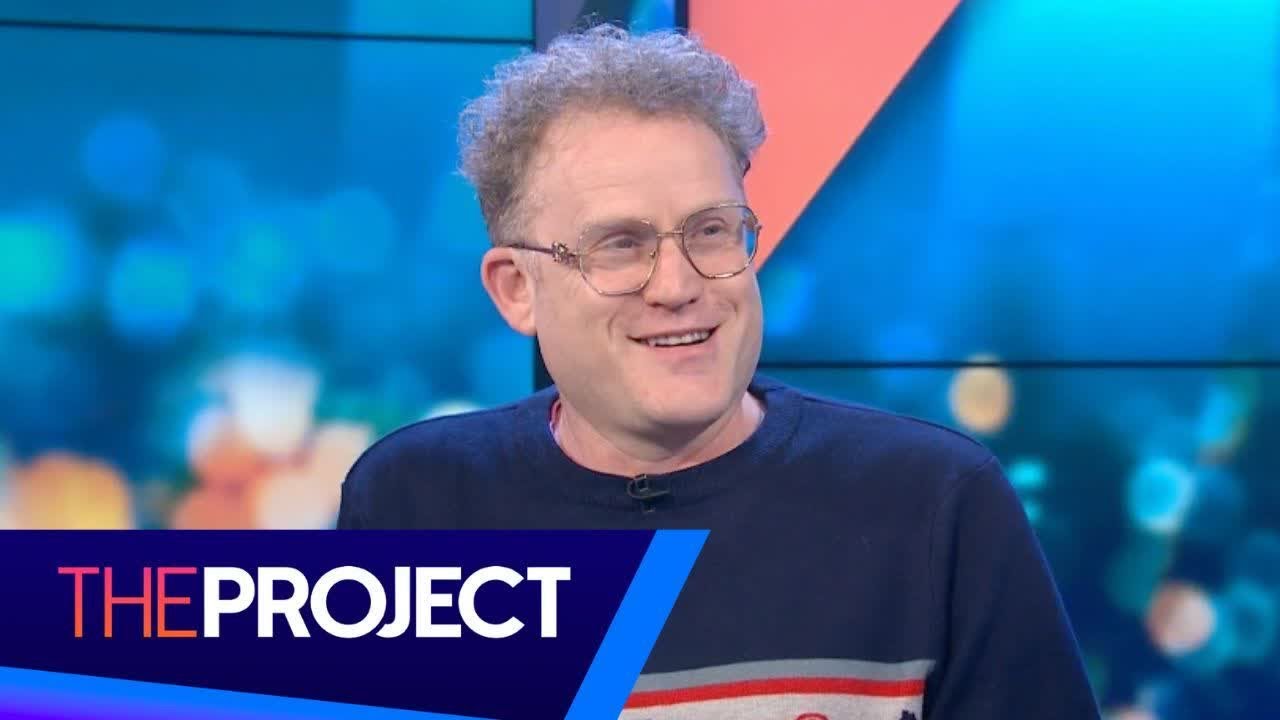 , “suss out what was going on”. Specifically, he hoped to confront West and “start a conversation” about his antisemitism and admiration for genocidal maniacs.
Safran admits to being curious about West’s true intentions:
Was Kanye’s flirtation with Nazism actually Nazism? Or was it more a creative impulse, like painting Hitler on your nails because you thought it would be funny?
Ultimately, those questions go unanswered. Try as he might, Safran never actually manages to bag a meeting with West. But he does get the chance to talk to several members of his extended entourage, each offering their own insights and perspectives on the controversial artist.
Celebrity culture and extremist ideologies
McInnes tells Safran racism no longer exists in the United States – even though he lives in a country where a presidential candidate accuses Haitian immigrants of eating pets and a comedian jokes at that candidate’s event about Puerto Rico being a “floating island of garbage”. McInnes also tells him he “agrees with Kanye that Jews controlled the levers of power, but, unlike Kanye, he thought that was a good thing”.
Safran is perplexed. Encounters like this – and there are several – let him reflect on West’s potential motives and patterns of behaviour. They also invite him to consider how broader cultural, economic and political forces and attitudes have contributed to a resurgence in antisemitism – and other, similarly repellent forms of racial hatred in contemporary society.
Through his interactions, Safran begins to piece together the ways these forces intersect with celebrity culture and extremist ideologies, offering an glimpse into how such noxious views have gained renewed traction in our digitally mediated dumpster fire of a world.
Significantly, Squat opens on the steps of the Sydney Opera House on October 8 2023, the scene of a contentious pro-Palestine rally. It offers insightful observations about antisemitism and conspiratorial extremism, which are much needed at this precise historical and geopolitical moment.
Yet Safran’s style and tone – by turns circuitous and irreverent – at times jar and detract from the substance of the book. This is a pity, given the need for a serious, focused discussion of such matters at this historical and political juncture.
---
October 31, 2024
The Proud Boys founder counselled Kanye West about Hitler. John Safran has the lowdown
Alexander Howard, University of Sydney
In his new book, John Safran considers how broader cultural, economic and political forces and attitudes have contributed to a resurgence in antisemitism – through the lens of Kanye West.
September 20, 2023
How local police could help prevent another January 6th-style insurrection
Matthew Valasik, University of Alabama and Shannon Reid, University of North Carolina – Charlotte
The Proud Boys are more of a loosely affiliated street gang than they are a unified right-wing militia, researchers say. But police ignore the threats from these groups, and their threats grow.
February 11, 2021
Proud Boys terrorist group designation may deter new recruits and fundraising
Garth Davies, Simon Fraser University and Edith Wu, Simon Fraser University
Designating the Proud Boys and other right-wing extremist groups as terrorists will make it more difficult for them to fundraise, but it won’t necessarily stop the spread of hatred.
April 28, 2020
Why are white supremacists protesting to ‘reopen’ the US economy?
Shannon Reid, University of North Carolina – Charlotte and Matthew Valasik, Louisiana State University
Militant far-right groups are always looking to appear legitimate and to recruit more Americans to their causes.
November 29, 2018
How believers in ‘white genocide’ are spreading their hate-filled message in Australia
Kaz Ross, University of Tasmania
The belief in so-called ‘white genocide’, once an extreme-right view of neo-Nazis, is starting to gain ground in Australia and influence the rhetoric of politicians.
November 19, 2018
What I learned at a People’s Party of Canada rally
Brian Budd, University of Guelph
Maxime Bernier’s new political party may be able to swipe some votes from the Conservatives. But it’s going nowhere if he allows it to remain a conduit for xenophobia, nativism and white supremacy.
October 30, 2018
Why Australia should be wary of the Proud Boys and their violent, alt-right views
Kaz Ross, University of Tasmania
Gavin McInnes will be the latest in a string of provocative, right-wing speakers to visit Australia. Each tour pushes the public debate further to the right, with more scope for conflict.
===
WIKI 12 24 ALL
Gavin Miles McInnes (/məˈkɪnɪs/; born 17 July 1970) is a Canadian writer, podcaster, far-right commentator and founder of the Proud Boys. He is the host of Get Off My Lawn with Gavin McInnes on his website Censored.TV.[1] He co-founded Vice magazine in 1994 at the age of 24 and relocated to the United States in 2001. In 2016 he founded the Proud Boys, an American far-right militant organization[2] which was designated a terrorist group in Canada[3][4] and New Zealand after he left the group.[5]
McInnes has been described as promoting violence against political opponents[6] but has argued that he has only supported political violence in self-defense and that he is not far-right or a supporter of fascism, instead identifying as "a fiscal conservative and libertarian".[7]
Born to Scottish parents in Hertfordshire, England, McInnes emigrated to Canada as a child. He graduated from Carleton University in Ottawa before moving to Montreal and co-founding Vice with Suroosh Alvi and Shane Smith.[8] He relocated with Vice Media to New York City in 2001.[9][10] During his time at Vice, McInnes was called a leading figure in the New York hipster subculture.[11] He holds both Canadian and British citizenship and lives in Larchmont, New York.[8]
In 2018, McInnes was fired from Blaze Media[12] and was banned from Twitter, Facebook, and Instagram for violating terms of use related to promoting violent extremist groups and hate speech.[13][14] In June 2020, McInnes's account was suspended from YouTube for violating YouTube's policies concerning hate speech by posting content that was "glorifying [and] inciting violence against another person or group of people."[15]
Early life
Gavin Miles McInnes[16] was born on 17 July 1970[17] in Hitchin, Hertfordshire, England,[18] the son of Scottish parents James McInnes, who later became the Vice-President of Operations at Gallium Visual Systems Inc. – a Canadian defence company – and Loraine McInnes, a retired business teacher.[19] His family migrated to Canada when McInnes was four,[citation needed] settling in Ottawa, Ontario.[20] He attended Ottawa's Earl of March Secondary School.[21] As a teen, McInnes played in an Ottawa punk band called Anal Chinook.[22] He graduated from Carleton University.[19]
Career
Vice Media (1994–2007)
McInnes co-founded *Vice* in 1994 with Shane Smith and Suroosh Alvi.[23] The magazine was launched as the Voice of Montreal with government funding. The intention of the founders was to provide work and a community service.[24] When the editors later sought to dissolve their commitments with the original publisher Alix Laurent, they bought him out and changed the name to Vice in 1996.[25] Richard Szalwinski, a Canadian software millionaire, acquired the magazine and relocated the operation to New York City in the late 1990s.[26][27]
During McInnes's tenure he was described as the "godfather" of hipsterdom by WNBC[28] and as "one of hipsterdom's primary architects" by AdBusters.[29] He occasionally contributed articles to Vice, including "The VICE Guide to Happiness"[30] and "The VICE Guide to Picking Up Chicks",[31] and co-authored two Vice books: The Vice Guide to Sex and Drugs and Rock and Roll,[32] and Vice Dos and Don'ts: 10 Years of VICE Magazine's Street Fashion Critiques.[33]
In an interview in the New York Press in 2002, McInnes said that he was pleased that most Williamsburg hipsters were white.[34][35] McInnes later wrote in a letter to Gawker that the interview was done as a prank intended to ridicule "baby boomer media like The Times".[36] After he became the focus of a letter-writing campaign by a black reader, Vice apologized for McInnes's comments.[35] McInnes was featured in a 2003 New York Times article about Vice magazine; McInnes' political views were described by the Times as "closer to a white supremacist's."[35]
In 2006, he was featured in The Vice Guide to Travel with actor and comedian David Cross in China.[37] He left Vice in 2008 due to what he described as "creative differences".[9] In a 2013 interview with The New Yorker, McInnes said his split with Vice was about the increasing influence of corporate advertising on Vice's content, stating that "Marketing and editorial being enemies had been the business plan".[38]
After Vice (2008–2018)
 McInnes at SXSW 2008
After leaving Vice in 2008, McInnes became increasingly known for far-right political views.[7]
In 2008, McInnes created the website StreetCarnage.com. He also co-founded an advertising agency called Rooster where he served as creative director.[39]
McInnes was featured in season 3 of the Canadian reality TV show Kenny vs. Spenny, as a judge in the "Who is Cooler?" episode. In 2010, McInnes was approached by Adult Swim and asked to play the part of Mick, an anthropomorphic Scottish soccer ball, in the short-lived Aqua Teen Hunger Force spin-off Soul Quest Overdrive.[40] After losing a 2010 pilot contest to Cheyenne Cinnamon and the Fantabulous Unicorn of Sugar Town Candy Fudge, six episodes of Soul Quest Overdrive were ordered, with four airing in Adult Swim's 4 AM DVR Theater block on 25 May 2011 before quickly being cancelled. McInnes jokingly blamed the show's cancellation on the other cast members (Kristen Schaal, David Cross, and H. Jon Benjamin) not being "as funny" as him.[41]
McInnes wrote a column for Taki's Magazine, beginning around 2011, that made casual use of racial and anti-gay slurs, as described by the Southern Poverty Law Center (SPLC).[42]
In 2012, McInnes wrote a memoir book called How to Piss in Public.[43] In 2013 he directed The Brotherhood of the Traveling Rants, a documentary on his tour as an occasional standup comedian.[44] For the film, he faked a serious car accident. Also that year, McInnes starred in the independent film How to Be a Man, which premiered at Sundance Next Weekend.[45] He has also played supporting roles in other films including Soul Quest Overdrive (2010), Creative Control (2015) and One More Time (2015).
In August 2014, McInnes was asked to take an indefinite leave of absence as chief creative officer of Rooster, following online publication at Thought Catalog of an essay about transphobia titled "Transphobia is Perfectly Natural"[46] that sparked a call to boycott the company. In response, Rooster issued a statement, saying in part: "We are extremely disappointed with his actions and have asked that he take a leave of absence while we determine the most appropriate course of action."[47]
In June 2015, broadcaster Anthony Cumia announced that McInnes would be hosting a show on his network, therefore retiring the Free Speech podcast that he had started in March. The Gavin McInnes Show premiered on Compound Media on 15 June. McInnes is a former contributor to Canadian far-right portal The Rebel Media[48] and a regular on conspiracy theorist media platform Infowars' The Alex Jones Show, and Fox News' Red Eye, The Greg Gutfeld Show, and The Sean Hannity Show.
In 2016, he founded the Proud Boys, a neo-fascist,[49][50][51] men's rights and male-only organisation classified as a "general hate" organization by the SPLC.[52] He has rejected this classification, claiming that the group is "not an extremist group and [does] not have ties with white nationalists".[53]
McInnes left Rebel News in August 2017, declaring that he was going to be "a multi-media Howard Stern-meets-Tucker Carlson".[54] He later joined CRTV, an online television network launched by Conservative Review. The debut episode of his new show Get Off My Lawn aired on 22 September 2017.[55][56]
Events in 2018
On 10 August 2018, McInnes' Twitter account, as well as the account for the Proud Boys, was permanently suspended by Twitter due to their rules against violent extremist groups. The suspension was ahead of the first anniversary of the Unite the Right rally in Charlottesville, Virginia, and the small Unite the Right 2 Washington protest in August 2018 in which the Proud Boys participated.[57][58][59]
On 12 October 2018, at the Metropolitan Republican Club, McInnes participated in a reenactment of the 1960 assassination of socialist politician Inejiro Asanuma by 17-year-old right-wing ultranationalist Otoya Yamaguchi during a televised debate. After the event, a contingent of Proud Boys were caught on tape beating a protester outside the venue,[60] after a leftist protester threw a plastic bottle at them.[61]
On 21 November 2018, shortly after news broke that the FBI had reportedly classified the Proud Boys as an extremist group with ties to white nationalists, McInnes said that his lawyers had advised him that quitting might help the nine members being prosecuted for the incidents in October and he said "this is 100% a legal gesture, and it is 100% about alleviating sentencing", and said it was a "'stepping down gesture', in quotation marks".[53][62] Two weeks later the Special Agent in Charge of the FBI's Oregon office said that it had not been their intent to label the entire group as "extremist",[63] only to characterize the possible threat from certain members of the group that way.[64]
Later that month, McInnes was planning on travelling to Australia for a speaking tour with Milo Yiannopoulos and Tommy Robinson (Stephen Yaxley-Lennon's pseudonym), but was informed by Australian immigration authorities that "he was judged to be of bad character" and would be denied a visa to enter the country. Issuing a visa to McInnes was opposed by an online campaign called "#BanGavin", which collected 81,000 signatures.[65][66]
On 3 December 2018, Conservative Review Television (CRTV), on which McInnes had hosted the Get Off My Lawn program, merged with BlazeTV, the television arm of Glenn Beck's TheBlaze, to become Blaze Media. McInnes was expected to host his program for the new company, whose co-president called McInnes "a comedian and provocateur, one of the many varied voices and viewpoints on Blaze Media platforms." Less than a week later, on 8 December, it was announced that McInnes was no longer associated with Blaze Media, with no details given as to why.[67][68]
Two days later, on 10 December, McInnes, who had previously been banned by Amazon, PayPal, Twitter, and Facebook, was banned from YouTube for "multiple third-party claims of copyright infringement."[69] Asked to comment about his firing and bannings, McInnes said that he had been victimized by "lies and propaganda", and that "there has been a concerted effort to de-platform me."
In his e-mail to Huffington Post, McInnes stated that "Someone very powerful decided long ago that I shouldn't have a voice ... I'm finally out of platforms and unable to defend myself. ... We are no longer living in a free country."[70]
McInnes also indicated some personal responsibility for the situation in an interview on the ABC News program Nightline, saying. "I'm not guilt free in this. There's culpability there. I shouldn't have said, you know, violence solves everything or something like that without making the context clear and I regret saying things like that." McInnes stopped short of apologizing or actually retracting his past statements, saying, "That ship has sailed."[71][72]
Larchmont lawn sign controversy
In reaction to the Proud Boys fight in October 2018, residents of the suburban Westchester community of Larchmont, where McInnes lives, began a "Hate Has No Home Here" campaign, which involved displaying that slogan on lawn signs around the community. One resident said "We stand together as a community, and violence and hate are not tolerated here." Several days after the signs began appearing, McInnes' wife sent emails to their neighbours saying that the media had misrepresented McInnes.[73]
Amy Siskind, an activist and writer who lives in nearby Mamaroneck, posted on Facebook that she was planning an anti-hate vigil. After a local newspaper ran a story about it, McInnes and his family appeared at Siskind's door without invitation or forewarning; she called the police.[73]
At the end of December, with the lawn sign campaign still ongoing, McInnes wrote a letter which was dropped off at the homes of his neighbours. In it, he asked them to take down their signs, and described himself as "a pro-gay, pro-Israel, virulently anti-racist libertarian," saying that there was nothing "hateful, racist, homophobic, anti-Semitic or intolerant" in "any of my expressions of my worldview," contrary to his past remarks, such as saying he was "becoming anti-Semitic" after a trip to Israel, or referring to transgender people as "gender niggers".
McInnes said that the Proud Boys was a "drinking club [he] started several years ago as a joke". Despite the letter's formality, in a podcast on 4 January 2019, McInnes called the neighbours "assholes", described their behaviour as "cunty" and said "If you have that sign on your lawn, you're a fucking retard."[73]
One Larchmont resident said about him: "I don't care what Gavin says, I've done my research ... He incites violence. He spouts divisive, racist language. And while he may try to say he disowns his followers, he's a part of the problem. So when I read his letter, I was like, yeah, right, this is ridiculous."[74]
Several days after the letter was sent out, HuffPost reported that they had viewed evidence provided by some neighbours that McInnes' wife, Emily – who identifies as a liberal Democrat – had harassed and intimidated them, including with the threat of legal action. Her threats were such that several neighbours notified the police.[73]
Lawsuit against the SPLC
Although McInnes cut ties with the Proud Boys publicly in November 2018, stepping down as chairman,[53][62] in February 2019 he filed suit against the Southern Poverty Law Center over their designation of the Proud Boys as a "general hate" group. The defamation suit was filed in federal court in Alabama. In the papers filed, McInnes claimed that the hate group designation is false and motivated by fund-raising concerns, and that his career has been damaged by it. He claimed that SPLC contributed to his or the Proud Boys' being deplatformed by Twitter, PayPal, Mailchimp, and iTunes.[75][76]
The SPLC says on its website that "McInnes plays a duplicitous rhetorical game: rejecting white nationalism and, in particular, the term 'alt-right' while espousing some of its central tenets," and that the group's "rank-and-file [members] and leaders regularly spout white nationalist memes and maintain affiliations with known extremists.
They are known for anti-Muslim and misogynistic rhetoric. Proud Boys have appeared alongside other hate groups at extremist gatherings like the 'Unite the Right' rally in Charlottesville."[52][76]
In response to the suit, Richard Cohen, the president of SPLC, wrote "Gavin McInnes has a history of making inflammatory statements about Muslims, women, and the transgender community. The fact that he's upset with SPLC tells us that we're doing our job exposing hate and extremism."[76]
Censored.TV and other ventures (2019-present)
Censored.TV and Get Off My Lawn launch
In 2019, McInnes launched Censored.TV, an online video platform. The platform was originally named FreeSpeech.TV, but was changed to its current title for copyright purposes. The platform features McInnes' primary show, Get Off My Lawn (GOML). GOML is a pre-recorded, daily show which airs on weekdays with Thursdays as an exception, in which the show airs live under the alternative title Get Off My Lawn Live.[citation needed]
In May 2021, Milo Yiannopoulos wrote on Telegram that Censored.TV is "laying off all its staff" and lacked enough funding to sustain production of Yiannopoulous' show on the platform.[77] McInnes later dismissed these allegation whilst announcing the arrival of several new shows on his platform.[78][third-party ^source needed]
On August 27, 2022, McInnes faked his own arrest during a live broadcast of Censored.TV. In the recording, McInnes appeared to look off past the camera, before saying ""We're shooting a show, can we do this another time?" adding "I didn't let you in." McInnes then walked off the set. It was widely speculated that McInnes had been arrested, until former McInnes-ally Owen Benjamin outed McInnes by posting text messages between the two of them. "Prank. Don't tell," McInnes wrote to Benjamin. Benjamin responded, "U gonna reveal its a prank? Cuz I have friends writing blogs about it." McInnes replied "Never," adding that he "never said" the FBI had raided his studio. After being outed by Benjamin, McInnes returned to the public on September 6, 2022.[79][80]
In December 2022, McInnes interviewed Kanye West and white nationalist Nick Fuentes. In the interview, McInnes claimed to be trying to save West from his own antisemitism; McInnes faulted not Jews but "liberal elites of all races", while West said Jews should forgive Adolf Hitler and predicted that antisemitism would be "awesome for a presidential campaign".[81][82][83]
New York trial of Proud Boys
Although McInnes was not a defendant in the August 2019 trial of members of the Proud Boys for their part in the violence that occurred after a meeting of the Metropolitan Republican Club in October 2018, prosecutors repeatedly invoked his name, his words and his views in their questioning of the defendants, after testimony by the defendants and other Proud Boys opened the door to that line of questioning. During closing arguments, a prosecutor said that "Gavin McInnes is not a harmless satirist. He is a hatemonger," while the defense said that McInnes was being "demonized."[84]
Views
McInnes describes himself as "a fiscal conservative and libertarian"[7] and part of the New Right, a term that he prefers rather than alt-right.[85] The New York Times has described McInnes as a far-right provocateur.[86] He has referred to himself as a "western chauvinist" and started a men's organization called Proud Boys who swear their allegiance to this cause.[87]
In November 2018 it was reported on the basis of an internal memo of the Clark County, Washington Sheriff's Office – based on an FBI briefing – that the Bureau classified the Proud Boys "an extremist group with ties to white nationalism".[88] Two weeks later, the Special Agent in Charge of the FBI's Oregon office denied that the FBI had made that designation about the entire group, ascribing it to a misunderstanding on the part of the Sheriff's Office.[63]
The SAIC, Renn Cannon, said that their intent was simply to characterize the possible threat from certain members of the group, not to classify the entire group.[64] The Southern Poverty Law Center classifies them as a "general hate group".[52] McInnes has said his group is not a white nationalist group.[88]
In 2003, McInnes said, "I love being white and I think it's something to be very proud of. I don't want our culture diluted. We need to close the borders now and let everyone assimilate to a Western, white, English-speaking way of life."[89]
Violence
In a speech given at New York University in February 2017, after a clash between the Proud Boys and antifa protestors, McInnes said: "Violence doesn't feel good, justified violence feels great, and fighting solves everything. ... I want violence. I want punching in the face."[72] He says that he has only advocated for acting in self-defense.[90][91]
Race and ethnicity
McInnes has been accused of racism[92] and of promoting white supremacist rhetoric.[86] He has used racial slurs against Susan Rice and Jada Pinkett Smith,[93][94] and more widely against Palestinians and Asians.[95][96] In September 2004, he told a reporter for the Chicago Reader at a party that he "wanted to fuck the shit out of [a young Asian lady] until she started talking." The reporter, Liz Armstrong, wrote: "He went on to posit that since Asians' eyes don't work so good in terms of facial expressions they have no choice but to emote with their mouths."[97]
McInnes has said that there is a "mass conformity that black people push on each other".[98] He is also listed as a contributor to the 2016 book Black Lies Matter which criticizes the Black Lives Matter movement. He said that New Jersey U.S. Senator Cory Booker, who is Black, is "kind of like Sambo."[99]
Religion
Judaism
In March 2017, a group of Rebel Media hosts, including McInnes, spent a week touring Israel. On the trip, McInnes made a non-Rebel video in which he defended Holocaust deniers, blamed Jews for the Treaty of Versailles, and said he was "becoming anti-Semitic".[100][101][102][103][104] The Times of Israel said he was "apparently drunk" in the video.[100][102] *Israel National News* called it a "faux rant" and "intentionally offensive".[104] He later said that his comments were taken out of context.[105] McInnes also produced a comedic video for Rebel called "Ten Things I Hate about Jews", later retitled "Ten Things I Hate About Israel".[103][101]
After his statements were promoted by white supremacists (in contrast to other videos from the Rebel Media tour), McInnes publicly declined their support.[104] Upon McInnes' return to America, Rebel Media produced a video of McInnes in which he said, "I've got tons of Nazi friends. David Duke and all the Nazis totally think I rock... No offence, Nazis, I don't want to hurt your feelings, but I don't like you. I like Jews."[101][102]
Rebel Media's owner, Ezra Levant, who is Jewish-Canadian, defended McInnes.[104] In a December 2022 interview for Censored.TV with Kanye West and the white nationalist Nick Fuentes, he claimed to be trying to save West from antisemitism and said that "every individual I meet starts off with a clean slate".[81][82][106]
Islam
McInnes is anti-Islam,[93][107] once stating that "Muslims are stupid... the only thing they really respect is violence and being tough."[108] He also has equated Islam with fascism, stating "Nazis are not a thing. Islam is a thing."[109] In April 2018, McInnes labelled a significant section of Muslims as both mentally ill and incestuous, claiming that "Muslims have a problem with inbreeding. They tend to marry their first cousins... and that is a major problem [in the U.S.] because when you have mentally damaged inbreds – which not all Muslims are, but a disproportionate number are – and you have a hate book called the Koran [sic]... you end up with a perfect recipe for mass murder."[52][110]
Gender
McInnes has described himself as "an Archie Bunker sexist",[86] and has said that "95 percent of women would be happier at home".[72] On the topic of female police officers, he said, "I understand [women] are good for domestics, but I don't understand why there are so many female police officers. They're not strong, they're like super fat police officers. It doesn't make any sense to me."[111]
In 2003, Vanessa Grigoriadis in The New York Times quoted McInnes saying, "'No means no' is puritanism. I think Steinem-era feminism did women a lot of injustices, but one of the worst ones was convincing all these indie norts that women don't want to be dominated."[89] McInnes has been accused of sexism by various media outlets including Chicago Sun-Times,[112] Independent Journal Review,[113] Salon,[114] Jezebel,[115] The Hollywood Reporter,[116] and Slate.[117] In October 2013, McInnes said during a panel interview that "people would be happier if women would stop pretending to be men" and that feminism "has made women less happy".[118] He said, "We've trivialized childbirth and being domestic so much that women are forced to pretend to be men. They're feigning this toughness, they're miserable."[119] A heated argument ensued with University of Miami School of Law professor Mary Anne Franks.[120]
White genocide
McInnes has espoused the white genocide conspiracy theory, saying that white women having abortions[121] and immigration is "leading to white genocide in the West".[122] In 2018, regarding South African farm attacks and land reform proposals, he said that black South Africans were not "trying to get their land back – they never had that land", instead stating there were "ethnic cleansing" efforts against white South Africans.[123]
Filmography
Film
- How to Be a Man (2013) – as Mark McCarthy
- Creative Control (2015) – as Scott
- One More Time (2015) – as Record Producer
- White Noise (2020) – as Himself
Television
- Kenny vs Spenny: "Who is Cooler" episode (2006) – as himself (guest judge)
- Soul Quest Overdrive (2010, 2011) – as Mick (voice)
- Vice Guide to Travel (2006) – as himself (host)
Personal life
In 2005, he married Manhattan-based publicist and consultant Emily Jendrisak, the daughter of Native American activist Christine Whiterabbit Jendrisak[19][124] who describes herself as a liberal Democrat.[72] About his wife's ethnicity and their children together, McInnes said, "I've made my views on Indians very clear. I like them. I actually like them so much, I made three."[125] They live in Larchmont, New York.[126]
In his 2020 documentary White Noise, and in a follow up article about alt-right activist Lauren Southern, Daniel Lombroso, a journalist for The Atlantic, reported that McInnes sexually propositioned Southern after an appearance on his show in June 2018. McInnes denied having done so.[127][128]
McInnes is a permanent resident of the United States.[8]
References
===
PAYWALL
The Secret History of Gavin McInnes | Vanity Fair
Original Sins
July/August 2021 Adam Leith Gollner
Original Sins
In the ’90s, Gavin McInnes played punk rock and helped create Vice magazine. Five years ago, he founded a very different organization: the Proud Boys, the far-right group that came to personify the vilest tendencies of Trump’s America. ADAM LEITH GOLLNER interviews one of our era’s most troubling extremists
July/August 2021 Adam Leith Gollner
On election night in 2016, four years before the January 6 storming of the U.S. Capitol, the Proud Boys threw a party. That November evening, Proud Boys founder Gavin McInnes—my former boss—summoned his followers to the Gaslight Lounge in New York’s Meatpacking District to watch the returns. “Tonight we either take back the country or we lose the country to the establishment,” he told the attendees, a mixture of Trumpist trolls, frat bros, and the sort of amped-up nationalist types who call themselves “Western chauvinists.”
McInnes had just created his gang months before. But as someone who’d always predicted trends, he could see where this would lead. “If Donnie wins,” he bellowed into a distorting microphone, the Proud Boys will “own America. We’ll just walk into the White House.” They began chanting “USA! USA! USA!” the same way the Proud Boys would when breaching the Capitol complex in January. Few back in 2016 realized how far the group would go—soon establishing chapters in 45 states, with members eventually indicted on charges ranging from civil disorder to conspiracy in the Washington, D.C., rampage. McInnes had founded what would become, according to the Canadian government, a “terrorist entity.”
At 2:40 a.m., when Fox News decreed that Donald Trump had won, the crowd in the Gaslight erupted. Howling men in MAGA caps hoisted an ebullient McInnes into the air, crowd-surfing him across the throng. But life hadn’t been so joyous in the eight years since he’d left Vice, the Montreal magazine cum media conglomerate he’d cofounded in 1994 at age 24.
He’d lost so much in the intervening years: friends, fistfights, the respect of peers, a stake in Vice Media Group’s future profits, presumably countless brain cells. In his departure letter from Vice, he’d vowed his ideas would one day “blossom into fruition like a hundred humid vaginas in the presence of God’s boner.” Now, here he was—a legal immigrant from Canada, living in the States on a green card—surrounded by 100 sweaty dudes, some waving cocktail-napkin-size U.S. flags.
McInnes didn’t simply feel vindicated; he believed he was at the pinnacle of a new world. “I feel like Clark Kent,” he tweeted. “I’m just a guy in a suit but if you have a problem, I’d be happy to punch through your face.” Interviewed today for this story, he told me that Trump’s victory party was “one of the greatest nights in my life.”
In the 1990s, McInnes was hardly a far-right menace. He was a tree-planting vegetarian, a druggy anarchist, and a self-described “dogmatic feminist.” Some people who knew him then still regard him as one of the funniest people they’ve ever met. He counted comedians such as David Cross and Sarah Silverman as friends, both of whom contributed articles to Vice. (Neither agreed to interview requests.) But over time McInnes accelerated his drift to the political fringe.
In 2003, when Vice was largely an extension of McInnes’s psyche, Jimmy Kimmel told The New York Times that its “brand of humor is what I would do if there were no ‘standards and practices’ on TV.” The whole Vice gestalt was so laced with sarcasm that The Village Voice called it “brilliant hipster self-parody.” McInnes’s early provocations were widely perceived as a commentary on hate rather than hate itself.
When his stance began to grow more blatantly xenophobic, he turned to stand-up, a medium that allowed him to claim he was only “joking around.” Just kidding had long been his default position. But couching his beliefs in humor didn’t hide the deadly serious nature of his politics. His true intentions were tattooed right on his back—in a tableau depicting a jellyfish with Chiang Kai-shek and Fidel Castro, “two immigrants,” he once proclaimed, “that came into a country, wiped out the previous cultures and started new, prosperous ones.... The days of the West are numbered, and I will be the impetus that destroys it. I am turning America inside out from the outside in.”
By 2016, his unseemly pronouncements had become a part of American political discourse. He made an overt statement on his webcast: “Can you call for violence generally? ’Cause I am.” He also declared, in a textbook example of hate speech, bordering on incitement: “Fighting solves everything—we need more violence from the Trump people. Trump supporters: Choke a motherfucker”—going on to use derogatory terms about trans people and women—“Get your fingers around the windpipe.”
The expletive-laden comment was among the reasons he would ultimately get deplatformed from Facebook, Instagram, YouTube, and Twitter. In November 2018, he reluctantly stepped down as leader of the Proud Boys. But by then he’d already lit the match and passed the torch. A peer-reviewed Bard College study this year determined that, based on an analysis of his public statements, “the rhetoric spouted by McInnes is actually fascist political action.”
No longer the make-believe insurgent he’d been in his punk days, the Canadian originator of the Proud Boys had become—at 50, his beard specked with gray—a fever-dream incarnate of the tattoo on his back. Not unlike his “good friend” Roger Stone, the Trump crony—and, not incidentally, pardoned felon—who has Nixon’s face emblazoned between his shoulder blades, McInnes wanted to subvert things. He wanted to cause chaos. He wanted to break America—and remake it in his imaginings.
This account, based on my firsthand observations and interviews with McInnes’s friends and former colleagues—as well as McInnes himself—is the forgotten backstory of how a wisecracking media maverick became a well-known and influential “hatemonger,” to quote the Manhattan district attorney's office.
I WORKED ALONGSIDE McInnes at the start of Vice in 1994, becoming the magazine's editor shortly after it moved from Montreal to New York in 1999. Though McInnes immediately struck me as someone to avoid outside of work, nothing then indicated he would hatch an organization as vitriolic and violence-prone as the street-brawling Proud Boys.
He and I were never friends. Founding editor Suroosh Alvi—who remains at Vice Media with the title of founder—brought me on board as a writer at the same time as McInnes. And when I stepped down in early 2001, it was largely because of McInnes’s toxic attitude. (By then his title was cofounder.)
Vice’s third cofounder, Shane Smith, was integral to the arc of McInnes’s life. He was—before their very public falling out—McInnes’s bandmate, roommate, rival, and best friend. Close since the age of 12, they shared everything from mescaline (then the Canadian name for PCP or horse tranquilizer) to lovers. How tight were they? A 2002 book they coauthored, The Vice Guide to Sex and Drugs and Rock and Roll, claims that McInnes once unwittingly squeezed his penis into the same condom as Smith’s during a threesome.
Smith today serves as executive chairman of Vice Media. He is considered an internet-age pioneer, having expanded an indie magazine into a global powerhouse. He is sometimes referred to as “Citizen Shane” among certain ex-colleagues, as much for his Hearst-like legacy as a media baron, huckster, and former purveyor of yellow journalism as for his Xanadu-like home in Santa Monica. In April, Smith’s wife, Tamyka, filed for divorce, and the mansion was sold for $48.7 million—the approximate amount, according to The Wall Street Journal, that Vice Media lost in 2019. Smith declined to be interviewed for this story.
The company provided the following statement to Vanity Fair: “VICE and Gavin parted ways in 2008—many years before Gavin founded the Proud Boys. VICE unequivocally condemns white supremacy, racism and any form of hate, has shone a fearless, bright light of award-winning journalism on extremism, the alt-right and hate groups around the world, and has created one of the most inclusive, diverse and equitable companies in media. Our respective records of the last decade and a half speak for themselves.”
Vice News, in fact, has been unflinching in its extensive and clear-eyed coverage of the Proud Boys. (Media executive Nancy Dubuc took up the role of CEO in 2018 after Vice Media began to buckle in the #MeToo era, triggered in part by a New York Times sexual harassment exposé in which the founders apologized for the company’s “detrimental ‘boy’s club’ culture.”)
Though neither Smith nor McInnes typically comment on each other—due to the terms of a separation agreement—the latter recently told CNN that he still haunts Smith’s company “like Banquo’s ghost.” Lies, betrayal, greed: There’s a Macbethian whiff to the entangled narratives of McInnes and Smith. But even though Banquo gets sacrificed to the vaulting ambition of Macbeth, his former brother-in-arms, McInnes would seem to have more in common with Coriolanus, a violence-for-violence’s-sake fame-lord whose opportunism outweighs genuine political convictions. Shakespearean or not, McInnes started both Vice magazine and the Proud Boys, and one metastasized out of the other.
GAVIN MILES MCINNES was born in England to Scottish parents in 1970. His family immigrated to Ontario when he was five, settling in suburban Ottawa. In high school, he formed a gang called the Monks with guys nicknamed Pig Al and Pukey Stallion. Among the dozen-odd outcasts in the crew were McInnes’s two best friends, Eric Digras and Steve Durand. As kids, they said, McInnes’s predominant characteristic was his recklessness. “A super-radical shit disturber,” Durand told me. “Anything to provoke an extreme reaction.”
Was there any foreshadowing that he would go on to form a group as extreme as the Proud Boys? “Gavin was really into making rules that you had to abide by,” recalled Digras, explaining that one rule McInnes devised as a teenager has since become codified as a Proud Boys bylaw. The clan’s second-degree initiation rite—for “adrenaline control”—involves naming five breakfast cereals while being punched in the arms. The Monks did the same thing: “We’d all beat the shit out of you until you could say five breakfast cereals,” Digras said. “The culture of our gang was that if you were ever earnest or vulnerable, you lost all credibility.”
McInnes and his Monks were Stoner freaks, on a different planet entirely than the Carpies, rural farm lads from up Carp River. “Nobody wanted us to show up at their party because we were the guys who started doing drugs and we’d always fuck shit up a little bit,” said Digras, then nicknamed Dogboy. Moving on from bongs, some of the Monks, by age 15, were dropping acid and huffing Pam cooking spray.
In 1986, a police officer came to their school to screen a PSA about the dangers of drunk driving. As McInnes relates in his 2012 autobiography, the students at Earl of March Secondary School watched the sobering account of a young woman paralyzed in an accident. During the Q&A that followed, McInnes took the microphone. “Why do you consider being in a wheelchair so horrible?” he asked the officer. “My mother is in a chair and has been her whole life, and our family certainly doesn’t see her as some kind of tragedy.” This was a lie, but it already revealed his affinity for darkly unfunny identity-based jokes. Even at that early age, he was both a class clown and “a very natural manipulator,” Digras explained.
McInnes, Digras added, would use him and Durand as “the fall guys” for his jokes when girls were around. “We called ourselves ‘the cardboard guys’ because we were just these cutouts that he would use as props for his show.” Later in life, several people who became close with McInnes would come to understand a similar dynamic, most notably his two partners at Vice, Smith and Alvi.
THE ORIGINS OF Vice can be traced to a rehab facility 30 minutes south of Montreal. In 1994, Alvi was 25 and had been shooting heroin for five years. Having OD’d multiple times, he was thieving where he could, pawning gold or cameras to cop his fix. He’d tried getting clean many times. Nothing worked. Blaming Montreal—“It’s too decadent of a city”—he moved away, to Minnesota, Vancouver, even Slovakia. But wherever he went, after the dope sickness wore off, he’d kick, get clean for a little while, and turn to Valium until he could find a dealer; then he’d get strung back out.
That spring, Alvi checked into the Foster Addiction Rehabilitation Centre, a clinic overlooking a cemetery in Saint-Philippe, Quebec, “If you keep using,” they told him, pointing at the tombstones, “that's where you’ll end up.” Two years ago, I drove out to Foster with Alvi, where, sitting in a grassy ditch at the graveyard’s edge, he recounted the story of Vice’s beginnings.
Days before entering rehab, Alvi had gone with his family to the mosque to celebrate Eid. As a Pakistani-Canadian, Alvi was raised Muslim but had never been observant. On that day in the prayer hall, however, he got down on his knees and begged for mercy: “If there’s an Allah up there,” he prayed, “I need your help now.” He felt a sense of surrender, of submission to Islam.
Everything after that started changing, quickly. During treatment, the therapists asked the inpatients to do a career exercise: Write down their ideal job, imagining a time when they would be sober and try to reintegrate themselves into society. Alvi described himself working for a magazine somehow—even though he couldn’t imagine any media company ever giving him a job.
After rehab, he attended a Narcotics Anonymous meeting where a stranger named Walter walked up to him, offering to become his sponsor. Walter asked if he was interested in writing. Alvi nodded, adding that he’d never written before. It didn’t matter; the next day, Walter introduced him to two Haitian publishers who were starting a cultural newspaper called Voice of Montreal. The job was part of a government program that supplemented regular welfare checks. Alvi, already on welfare, was hired on the spot.
The exercise from rehab had come true. “I wrote that, and Allah made it happen,” as he put it. “If I hadn’t been a heroin addict, Vice wouldn’t exist.” He felt that it had all been preordained, that heaven-sent grace was coming his way. He would think things and they would happen, he told me. While vacuuming at his parents’ house one day, he found himself thinking about a song by Hüsker Dü, the first punk band he’d loved. Knocking the remote with the vacuum cleaner, he accidentally turned on the TV and the video for that exact song came on. Hüsker Dü had broken up but the band’s frontman, Bob Mould, would soon be performing live in Montreal. Alvi knew his magazine would cover it. He just needed to find someone to review the concert—which is how I ended up writing for volume one, issue one, of Voice of Montreal.
AT UNIVERSITY IN Ottawa, McInnes took women’s studies courses and got a ♀ tattoo with an E for equality. He started aligning himself with socially conscious groups. “He did it for social currency—as a fashion statement—rather than because he really believed in the ideology,” claimed Digras. Around that time, McInnes started a punk band called Leatherassbuttfuk with his grade school friend Shane Smith. McInnes sang songs like “You Can’t Rape a .38” as Smith, attired in leather chaps, banged away at a flying V guitar. “They had this weird bondage element,” said Durand, who saw them perform live. “There was blood involved.... Their shtick was being half naked, falling-down drunk. It was fucking gnarly.”
After university, both McInnes and Smith bummed around Europe. Smith relocated to Budapest, where he became, as he’s described it, “a criminal” involved in arbitrage (money trading). McInnes stayed in squats and attended a fascist skinhead rally in Germany. “They look great,” he wrote, shortly thereafter, of the skinheads. “Why is it the bad guys always look cool?”
Asked today about that experience, he grew agitated. “Are you implying that I somehow became enamored with Nazi skinheads at that rally?”
“Not enamored,” I replied. “But there was a fascination?”
“That’s a terrible angle,” he argued. “Skinheads have always been the bad guys.” He vehemently denied any links between skinheads and the Proud Boys, even though Fred Perry polo shirts are worn by both groups, and members of 211 Bootboys, described by the Southern Poverty Law Center (SPLC)—the watchdog organization that monitors extremist and hate groups—as “an ultranationalist far-right skinhead crew,” fought alongside members of the Proud Boys after a McInnes speech in New York City in 2018, singling out left-wing protesters and assaulting them.
“It’s more of the media’s desperate need for Nazis,” he insisted over the phone. “We don’t allow any Nazis or any kind of racism.... We take in these people and we say, ‘We don’t care what race you are—as long as you think the West is the best.’”
He kept saying we instead of they. “Gavin,” I interjected, “are you still part of Proud Boys?”
“No, sorry,” he replied. “They do this. They do this.”
Watching the CAPITOL RIOT on TV, McInnes thought, What the fuck have you IMBECILES done now? They’re not the BRIGHTEST BULBS in the tree. They’re not exactly sophisticated.
After Europe, McInnes moved to Montreal to become a comics illustrator. The city in 1994 was suffering an economic downturn, and cheap rent led to a thriving arts scene as well as a strong underground comics movement. McInnes started making his own zine—a photocopied mini-comic called Pervert—about some of his life experiences. I tracked down back issues at Arcmtl, a nonprofit that preserves independent Montreal cultural artifacts. (Their archival team was debating what to do with works by McInnes, whom one of them described as “the embodiment of smoldering ratshit.”)
When other publications wrote negatively of Pervert, McInnes sent reviewers threatening letters splattered in his blood. Contemporaries in the comics community tried to reason with him. “You need to learn that there is a fine line between humor and offensiveness,” explained Ariel Bordeaux, of Deep Girl, encouraging him to “grow up.”
Even so, Pervert brought McInnes to Voice of Montreal’s attention. Alvi had started recruiting contributors. Local scenester Rufus Raxlonovitch thought McInnes could help curate a comics page for the paper. “I introduced Suroosh to Gavin, unfortunately,” Raxlonovitch told me from his home in Texas. “I knew people who [Suroosh] bought drugs with.” He emphasized that ’90s McInnes had little in common with the person he’s become: “But even back then, Gavin made an art out of getting on people’s nerves. He got off on it.”
One respected cartoonist from that circle described the Montreal McInnes as already going out of his way to be mean or disruptive: “That’s why he’d always get punched in the face.” He recounted one episode in particular. Standing at a busy intersection at rush hour, the cartoonist noticed McInnes across the boulevard. “All of a sudden, to make his friends laugh, he pulls his jacket completely over his head, hockey-fight style, and runs blindly into the traffic. Cars in both directions go screech, screech! I thought for sure I’m gonna see this guy get hit. Luckily, the drivers braked in time and swerved, honking and screaming. His friends were doubled over laughing.”
“That rings a bell,” McInnes commented when I asked him about it. “You’re not committed to the joke unless you’re willing to die to make people laugh.”
I MET ALVI JUST after turning 18. He was looking for contributors, and when he learned that I wrote for my college paper, he asked me to bring clips to the office. My published output consisted of a political think piece on fascist tendencies in Quebec’s separatist party and music reviews, including a write-up of a new album by Hüsker Dü’s frontman. At our meeting, Alvi asked if I’d cover his upcoming concert. He couldn’t pay for the review—but he could get me in for free, and he offered a token amount to stick around after the show and hand out flyers for Voice of Montreal’s launch party.
On the night of the performance, I filled my backpack with the rocket-shaped leaflets. Outside the auditorium, a friend told me he’d gotten me a gift to celebrate my first writing assignment.
“Close your eyes and open your mouth,” he said. He then placed a tab of LSD on my tongue. I’d never done acid.
I started peaking during the band’s set. The only notes I took were about a made-up song they didn’t play called “A.C.I.D.” During the encore, I felt something land on my head. Looking up, I saw what looked like thousands of starry birds fluttering through the concert hall. I soon realized: The origami sparrows twirling from the rafters were actually the fliers from my backpack. Someone had opened it—the friend who’d dosed me?—and tossed the contents into the air. The fliers got swept up and dispersed over the crowd.
It seemed appropriate; after all, what does a rocket ship do? But as high as I was, I never imagined that Alvi’s zine would one day take off too. Afterward, he said it hadn’t been a bad way to promote the party—as if God had handed out the fliers. He suggested I write about all of this in my review.
It ran in issue one, November 1994, as did a feature on LGBTQ+ cinema; a writeup of a playwright exploring immigrant experiences; and an essay on white privilege which noted that, though advances had been made in multiculturalism, “the potential for more insidious racism is nipping at our collective nose.” The cover story consisted of a Black perspective on the use of the N-word in hip-hop. Over half the issue’s writers were women or people of color.
At its inception, this was not the “lad mag” it would one day morph into. Instead, the publication had a clear emphasis on diversity and inclusion. And only one editor was listed on the masthead of the debut issue: Suroosh Alvi. For his part, McInnes contributed cartoons and a record review. “I couldn’t write,” McInnes told me. “I didn’t know what writing was; I’d never done it before.” Still, Alvi soon hired him as assistant editor. To qualify, McInnes too had to be on welfare.
Shane Smith didn’t join the team until 1995, around the time he wrote a screed celebrating the violence of war: “War is the shit; as addictive and consuming as heroin. War is an invitation to the greatest party of all.” The story’s moral seemed to hint at things to come: “You should fear this. This is the heat of a conflict that burns everything it touches.”
He’d come to Montreal at the urging of McInnes—they needed help selling advertising, and “Bullshitter Shane,” as McInnes was known to call him, seemed like a solution. In Ottawa, Smith had been a waiter in a fancy restaurant. “He was always a great hustler,” McInnes told me. “He was either broke or he’d have like 3,000 bucks from tips.”
The night he was introduced to Alvi, at a local dive bar, Smith dropped LSD. He kept trying to tell Alvi that they were “going to take over the world,” but he was tripping so hard that the words would only come out garbled: “I was going, ‘I can’t get it out, I can’t get it out.’” On acid, Smith could already see how their magazine would lift off—the vision for global domination was clear—he just couldn’t articulate it yet.
UPON SMITH’S ARRIVAL, they shortened the magazine’s name to Voice in order to sell ads in other Canadian cities. The masthead soon listed Alvi as editor in chief, McInnes as office manager, and Smith as business manager. The three were running things self-sufficiently, so they decided to cut ties with their Haitian publishers, changing the magazine’s name yet again by dropping the o.
The name Vice didn’t simply mirror its creators’ appetites. It also got them press. The founders made up a tale that they’d been forced to switch names because The Village Voice had threatened to sue. The story got picked up by Canadian media. “We were in every local paper, every national paper,” McInnes has written. “The lie just snowballed.... Lying became part of who we were.” Though they were still essentially a culture zine, Smith brought a focus on “good story-telling ability (i.e., being able to lie through your teeth),” as one early feature story formulated it. “We were all about making up shocking stories,” Smith would later explain.
It’s hard to unravel the truth of Smith’s own backstory. He has said, for example, that he grew up “dirt poor,” but both his and McInnes’s father worked at Computing Devices of Canada, a military engineering firm. Their dads helped design a ballistic computer for the M1 Abrams tank used by the U.S. Army. “The truth of it is I always thought I was going to die, because when I was young I was in a kind of quasi-gang,” Smith remarked in an interview with filmmaker Spike Jonze, then the creative director of Vice. “There [were] 12 of us, and then by the time I was 18, nine had died.”
This much is certain: Smith attended one of Ottawa’s top-ranked high schools, Lisgar Collegiate Institute, as did the late news anchor Peter Jennings and actor Matthew Perry. Smith was already blurring things then: In the school yearbook, he described himself as a “real real rum-cullie.” (Rumcully is an arcane pirate word for “a rich fool.”)
Smith started enlisting Alvi and McInnes to help with ad sales. He did the same with me. (Alongside writing pieces and selling space and distributing the magazine, I also played guitar in Smith’s swamp-rock band, Ultraviolet Booze Catastrophe.) An immense amount of work went into producing each issue, but there was a DIY spirit, with everybody pitching in.
In 1997, Vice took on a new editor: Robbie Dillon, a bank robber and loan shark who had just been released from Bordeaux Prison for drug trafficking. He was enrolled in journalism night classes, where he wrote an article called “How to Survive in Prison,” which got him the editor gig. Even Dillon was taken aback by Vice’s journalistic standards, as he told me recently: “Gavin might have been making stuff up, but Shane was making up the rules. I’d say, ‘Shane, you can’t write an article about smuggling guns into Ireland—you were never in Ireland. You can’t say that this guy said this—he’s not even a guy.’ He’d go, ‘Well, can we be sued?’ I’d go, ‘Not if it’s not a real guy.’ And he’d go, ‘Okay, we’ll do it!’”
Despite his criminal background, Dillon was a solicitous editor who wanted verifiable stories that took readers inside places they wouldn’t otherwise be able to access. In McInnes’s words, Dillon “wrote the only serious content in our magazine for months.” The publication became a blend of outright fabrication and almost confessional sincerity—“Whatever bile oozes from the hissing bag of snakes inside my skull,” as Dillon wrote in one editorial. They started to find their voice by doing, as they often said, stupid stories in a smart way and smart stories in a stupid way. An interview with a piece of pasta, for example, might explore the philosophical realities of inanimate objects; an article purporting to help readers “get laid” would be written in binary code.
While McInnes and a small coterie wrote the lion’s share of the pieces, an array of contributors shaped it, including Amy Kellner, Bruce LaBruce, Lesley Arfin, Derrick Beckles, Lisa Gabriele, Thomas Morton, and photographer Ryan McGinley (who shoots on occasion for Vanity Fair). Their combined voice was a combustible mix. “I thought of it as like a hyperintelligent teenaged Valley Girl from the ’80s who’s read Michel Foucault,” explained Jesse Pearson, a former Vice editor. “There was a lot of, like, barf-me-out kinda slang but also a certain intelligence hiding behind it.”
There was also something else hiding behind it. And that duplicity is what got them to New York when, in 1999, McInnes, Smith, and Alvi pulled off their biggest con to date. During a Montreal newspaper interview, they claimed that a local multimillionaire software entrepreneur named Richard Szalwinski wanted to buy Vice. As they tell it, he read the ensuing article and ended up investing $1 million for 25 percent of the company.
THEN CAME THE THUNDER, McInnes told me. Two years after relocating to Manhattan, he was standing on his roof on the Lower East Side when he saw the second plane hit the south tower of the World Trade Center. That moment, he said, changed everything for him: “9/11 made me a nationalist and made me a Western chauvinist.” Until then, he claimed, he hadn’t really cared about politics. But the idea of pinning some newfound chauvinism on 9/11 is inaccurate. He’d already been churning out provocative, race-baiting content before the attacks, even if there was a marked shift in his approach soon after he moved to the U.S.
Looking back on his output from that pre-9/11 period, two articles stand out as harbingers. The first is a photo shoot from the fall of 1999, shortly before I became the editor, that shows a multicultural array of male and female models hugging a man in a KKK robe. The section, which billed itself as “a nine page fashion shoot that single-handedly stops all racism forever,” was intended to troll readers—it “lampooned racism,” McInnes told me—but the concept behind it stemmed from a supposed weakness that McInnes immediately detected in his new homeland: America’s sensitivity around race. Just as he had done with the Monks, he set out to mock what he perceived as a vulnerability, prodding at it in hopes of creating laughs or havoc.
The second piece dropped the following year. Written by McInnes, a recent immigrant, it called for closing the borders of the U.S. With lines like “Everything from deformed frogs to the allergy epidemic can be attributed to overpopulation,” it may have seemed like another one of his freaky jokes—but there was nothing funny about it. (He had inserted it into the magazine without me having seen it; I was the editor then, but he made many of the final decisions about the magazine’s content.) Asked about that story today, he claimed that his anti-immigration stance then came “from an environmental perspective.”
In retrospect, none of us, including myself, were innocent bystanders. Some were even enablers. Smith, for his part, would tell Wired in 2007, a year before McInnes’s departure: “Gavin liked to push buttons, and he got a lot of personal notoriety for dealing with race issues. This is not what we’re about, it’s never what we’ve been about.” Though the organization’s complicity during McInnes’s tenure can’t simply be waved aside, there’s also no way that Vice’s management and staff could have seen all that was coming.
Part of the failure may be that nobody understood his tactics, even if his politics were hiding in plain sight. In that regard, the circle of people who worked with McInnes—and avidly read Vice in that era—might be compared to, say, the parts of the culture that long celebrated Woody Allen or Louis C.K., two humorists who achieved fame and fortune even as they openly told us, through their work, who they were all along. (In McInnes’s case, he also told us through the work of Vice’s contributors, whose words he sometimes changed freely, adding entire paragraphs to writers’ articles, according to several sources.) He was my boss and the de facto editor in chief; looking back now, I deeply regret not pushing back, especially during my year at the helm.
Until that point, McInnes had been, above all, a trickster—“a mean clown,” as two former associates put it. But with 9/11, many culture critics began to assert that irony was in retreat, and irony, after all, had been Vice’s primary register. A change came over the magazine. McInnes too became more hawkish. “Politically correct words are the result of liberals trying to shape fear and guilt into meaningless syntax,” McInnes wrote in 2002. In an unhinged New York Press interview that same year, he uttered homophobic and racist slurs, using the N-word and denigrating Puerto Ricans. Regarding Williamsburg’s gentrifiers, he said, “At least they’re white.”
With his partners busy expanding the brand—and seeking wealth (“I was willing to sacrifice happiness for greed,” Alvi admitted in 2002)—McInnes became increasingly influenced by the writings of Jim Goad, author of The Redneck Manifesto. “The greatest writer of our generation,” McInnes has said of him. (Goad attended the Proud Boys’ election night party in 2016; the organization’s now-defunct website described a book of his as “Proud Boy Holy scripture.”)
Another writer who made a lasting impression on McInnes was paleoconservative Pat Buchanan, from whose book he has often read aloud at Proud Boys events. In January 2003, Vice did a “The West is the Best” issue, inspired by Buchanan’s The Death of the West. In that issue, McInnes ran an interview entitled “The Merits of War” with Scott McConnell, executive editor of Buchanan’s magazine, The American Conservative. That August, McInnes himself published an AmCon piece about his efforts to convert Vice readers to conservatism: “I felt like Dr. Frankenstein,” he wrote, of his red-pilling campaign. “‘IT’S ALIVE!’”
When other media outlets confronted him about the monster he was creating, he brushed it off—“I did it for a laugh”—telling Gawker that he’d fabricated facts and nobody had caught on. The New York Times ran a feature describing McInnes’s views as “closer to a white supremacist’s”—a characterization he bridles at today. “I love being white.... It’s something to be very proud of,” it quoted him as saying. “I don’t want our culture diluted. We need to close the borders now and let everyone assimilate to a Western, white, English-speaking way of life.”
I remember how upset Alvi was whenever we spoke about that article. For him, the son of Pakistani immigrants, the situation seemed particularly noxious. Smith too was allegedly furious. Even so, it would take five more years for his partners to cut ties with McInnes—which is when things got truly Shakespearean.
ON MEETING THE three witches, Banquo wonders whether he has consumed some “insane root/That takes the reason prisoner.” McInnes certainly took a prodigious amount of drugs, especially cocaine, as he’s often bragged. Under his leadership, the magazine openly discussed ways to “max out your coke high.” But the intensification of his far-right views coincides with the time that he started taking another psychotropic drug: Adderall, an amphetamine-based stimulant that helps with focus and is prescribed for ADHD. It can be taken recreationally or to boost productivity—but there are serious consequences if abused. (Donald Trump, it is worth noting, has himself weathered unproven allegations of hearty Adderall use.)
McInnes, who has spoken publicly about taking Adderall to help him write, has dated his use of the drug back to the early 2000s. “I didn’t take more or less than anyone else,” he wrote in an email, “and NO it did not effect [sic] my writing.” But those around him took notice. “Adderall is a really big part of the story,” alleges a former colleague. “He was using a lot of Adderall—a lot lot... We know what the side effects are: It can lead to grandiosity, to feeling like you are right and the world is wrong. It can include elements of paranoia. And all those psychological phenomena are wrapped up in Gavin’s transformation.”
In one episode of his podcast, Mclnnes has described procuring Adderall from a Park Avenue doctor. He continued taking the drug after having children with his wife, Emily Jendrisak, whom he married in 2005. The way he describes his stag party, held in upstate New York, gives a sense of how altered his worldview had seemingly become. As relayed in his autobiography, he got upset at his father “for not doing cocaine with us.” Then, he claims, 10 of his friends dressed up as Klansmen, “hoods and all,” as they burned a 15-foot wooden cross. (Nobody I spoke to would confirm whether this actually happened; McInnes insists in the memoir that its contents are true.) By that point, McInnes, still at Vice, was also contributing to VDARE.com, a site that promoted “the work of white supremacists,” according to the SPLC.
Smith attended the wedding. “I remember him standing there, surveying,” Eric Digras recalled. Smith, according to former Vice employees, seemed to know that something, somehow, would need to change. “There was a kind of rivalry there that I think was mainly coming from Shane,” said Jesse Pearson, the editor at the time. “That’s when it became like a Shakespeare play: These two power-hungry lords fighting for the kingdom.” Added another colleague from this period, “The defining aspect of the relationship was their rivalry. They were two trashy dudes in spandex trying to out-guitar-solo each other every night.”
A decisive turning point came five months after the wedding, when McInnes attended the 2006 American Renaissance Conference, a “racial realist” meetup that attracted hundreds of white nationalists. As its website explains, “attendees are united by a common belief in black intellectual inferiority, opposition to non-white immigration and ardor for maintaining America’s white majority.” While there, McInnes noticed former KKK leader David Duke at the bar. “I texted my friends: Just hanging out with my old pal David Duke,” he explained in our interview. “That became like, I’m at a Klan rally.... I think some people used it as an excuse”—meaning a reason to link McInnes to the KKK and, perhaps, get rid of him.
Though he never actually wrote about the gathering, he characterized it as a reporting assignment. “It was just me doing my job,” he claimed. Those around him weren’t so sure. This was, after all, the same McInnes who’d written in 2002 that a liberal spotted at a strip club “would either deny it was happening or claim it was some sort of research project.” However one chooses to interpret McInnes’s presence at the conference, it pretty much ended his relationship with Vice. “That became the moment,” noted Pearson. “That forcing-out-of-the-company thing.”
The separation with McInnes took time, a period during which he and his wife had their first child. “One day,” McInnes recalled, “corporate built a closed office for the top brass and I was not in it.” His desk, instead, was in the bullpen, from which he worked—as well as working remotely—until he and the company parted ways. Lesley Arfin, a magazine contributor at that stage, who went on to be a writer on Brooklyn Nine-Nine and Girls as well as cocreator of Love, believes that McInnes, to this day, may be “stuck in trauma” over what happened. “I don’t think that he ever recovered from that humiliation,” she insisted. “You lose your best friend and your job, that is like your entire fucking personality—and you just had a baby, like boom! Three life-changing things right in the same [stretch of time].” (“I was not fired,” McInnes clarified. “We split because I wanted to keep it offensive and they wanted to get serious.”)
Following McInnes’s departure (the company completed its separation agreement with him in 2008), Vice started to experience phenomenal growth. By then, the company had pivoted toward online video, which would become one of the main sources of its success. In time, Vice Media, led by Smith and serving a lucrative millennial audience, would launch new digital video platforms and expand into film, music, and news, joining forces with partners such as MTV, HBO, Showtime, and Snap Inc, while attracting investors ranging from 21st Century Fox to Disney to George Soros. The office environment, however, was marred by allegations of sexual misconduct and bullying behavior as well as outright sexism. (Two years ago, the company agreed to a $1.87 million payout to women employees who had been compensated less than their male counterparts. A heavily female leadership team is now in charge, with women currently accounting for more than half of Vice Media’s global workforce.)
MCINNES’S DEEPENING RADICALISM can be tracked online in a weekly column he wrote from 2008 to 2017 in Taki’s Magazine, the at times far-right-fomenting webzine published by the Greek journalist and socialite Taki Theodoracopulos, cofounder of The American Conservative. Sample titles: “The Myth of White Terrorism,” “Rioting: The Unbeatable High,” and “What’s the Matter With Blackface?” McInnes was recruited to write there by Richard Spencer, who has since become one of the country’s most reviled anti-Semites.
“People change and movements evolve,” McInnes told me in one email. “Richard Spencer said ‘Hail Trump’ at that conference and the whole thing went careening off a Nazi cliff.... Spencer was a cool guy. He got me my job at Takimag in 2008 after I left Vice. Back then, he was just some paleoconservative who was obsessed with the founding fathers. The Spencer of today has nothing to do with the guy I knew 10 years ago.”
For his part, the McInnes of today describes his position as “basic dad politics.” He sent me a list outlining his views, saying, “They’re the same views as any rational person.” It included his thoughts on subjects such as “Racism is not a thing,” “America was not built on slavery,” and “Gay marriage is a scam.” His views were openly Islamophobic, transphobic, anti-feminist, and discriminatory toward a variety of groups.
One through line: his underlying preoccupation with other people’s bodies, identities, and their realities or personal decisions. When I asked him why he dwelled on that theme, he deflected, as usual: “Proud Boys are unique Americans in the sense that they eschew identity politics.” But as described by the SPLC, “McInnes plays a duplicitous rhetorical game: claiming to reject white nationalism while espousing a laundered version of popular white nationalist tropes.”
McInnes is someone who apparently concluded long ago that white male privilege was imperiled. Come 9/11, believing that his reality was literally under attack, he’d embraced the notion that conservatism was essentially about upholding the status quo for those in power, meaning white men like himself. By 2016, in founding the Proud Boys, he tried to turn his ideologies into political action. Beyond that, McInnes’s overarching philosophy seemed to be that free speech included hate speech. “When you hate someone,” as he once said, “it’s because you recognize something that you hate about yourself.”
“I always thought he was a narcissist,” Arfin mused.
“He’s definitely profoundly narcissistic,” Eric Digras stated, while other members of his inner circle didn’t hesitate in using stricter diagnostic labels. Regardless, Digras still maintains ties with McInnes as an old friend in hopes of keeping him “tethered to his humanity.”
In terms of my own reportorial interactions with McInnes, when I contacted him after a break of two decades in our communication, he offered to “just jump ahead of all” my questions and essentially interview himself so that I wouldn’t need to interrupt with cardboard-people words of my own. Among his concerns: that nothing he’d said be linked with Nazism. “Everyone keeps coming back to, ‘Are you a Nazi?’” he huffed. Nothing could be further from the truth, he insisted.
“I can only imagine it just seems like an unfortunate misunderstanding?”
“It’s not a misunderstanding,” he retorted. “It’s a weapon that people use to try to silence someone else.”
Why, then, did he think that he’s perceived to be the founder of a hate group? “I am the most misunderstood person in America,” he emphasized in a follow-up email, again deflecting—and sounding not unlike one of his icons to whom he owes his recent notoriety: Trump. “At no time in history has someone this reasonable been this misrepresented.”
He believed his predicament stemmed from the fact that in 2018 the SPLC classified the Proud Boys as a hate group, based on group members’ violent conduct, “their associations with white nationalist and neo-Nazi organizations, and statements disparaging women, minorities, and other marginalized groups.”
To date, he claimed, he has spent $200,000 after raising it to sue the SPLC for defamation. “The left set out to destroy my reputation and they did a great job,” he said. His latest opponent is the Canadian government, which has listed the Proud Boys as a terrorist neo-fascist entity; McInnes’s association with the group could render him inadmissible if he attempts to return to the country.
Although he served as its leader during its first two years while the group became more formalized and militarized, he may have stepped down just in time. In Trump’s America, the idea of the Proud Boys caught on and “very quickly accelerated out of control,” explained Jared Holt, resident fellow at the Atlantic Council’s Digital Forensic Research Lab in Washington. “It went from a gaggle of street brawlers into something able to earn the buy-in and the respect of massive portions of the GOP base.” Holt, who has been monitoring the group since the start, told me, “It’s really just a few steps removed from white genocide conspiracy theories.”
Throughout our conversation, McInnes came across as unwilling to take full responsibility for his situation. In his words, he’d simply wanted to “fuck shit up.” He didn’t appear to recognize that statements he has made outlining his ideology are at the root of his troubles.
McInnes’s views have affected his home life. In 2018, ABC’s Nightline interviewed him and his wife, Emily, at their house in New York’s Westchester County, where residents put up signs vilifying him. On ABC, McInnes drank beer as his wife told him, “Your politics having evolved this way in the last few years has been a challenge.” He looked away. Asked whether he was willing to apologize for what he’d created, he said no, firmly. Would he take any of it back if possible? He thought about it, stroking his face roughly. “Yes, I guess, well.... I don’t know.” Then he made a final, dismissive wave. “Nah,” he said, as conclusively as he could muster. It was too late for all that.
“IT’S A VERY chillax day,” McInnes said when I called him around midday on a Friday in March. “Trying to avoid the bar for as long as possible. If you go there at noon, you’re kinda fucked for the day. At night, you’re slurring.”
Mclnnes, an avid boozer, has consistently maintained that he started the Proud Boys as an outlet for harmless fun: an Animal House–style drinking club for male buddies. But even he could see that what began as an extension of his brand had spiraled into something much more nefarious. He’d watched the Capitol riot on TV like everyone else. “I thought, What the fuck have you imbeciles done now?” he said. “They’re not the brightest bulbs in the tree. They’re not exactly sophisticated.”
At one point he mentioned that he had warned his cohorts, “You’re gonna get shot; someone’s going to die; do not go”—insisting a march on Washington was an “obvious trap,” just as he had cautioned marchers attending the deadly 2017 white supremacist rally in Charlottesville, Virginia, which was organized by a then Proud Boy.
Of all the pro-Trump outfits that broke into the houses of Congress, more Proud Boys have been arrested than those affiliated with other groups, such as the Oath Keepers or Three Percenters. Even so, McInnes contended that the group is being demonized. “The media wanted it to be a Proud Boys event so badly,” he argued in March. “There were 30,000 people there that day, 250 arrested for storming the Capitol.” Only a handful, he said, “happened to be members.” (More than 100 Proud Boys from across America traveled to Washington for the riot. To date over two dozen purported members have been charged; prosecutors also allege that some of them coordinated their efforts with Oath Keepers.)
At the same time that FBI indictments of Proud Boys were being released publicly, a number of reports described McInnes’s former company, Vice Media, as seeking to close a deal with a special-purpose acquisition company at around half its peak valuation of $5.7 billion four years ago. (It wasn’t clear, given Vice’s outstanding debt and investors, where this would leave Smith, the company’s biggest individual shareholder.)
Through the years, McInnes seemed to have adhered to the first half of his magazine’s principles, by living the stupid young part of his life smartly. Now well into his Gen X dotage, his current reality is another question. Either way, Vice alum Arfin noted, “Vice will always be tied to this alt-right shit, and Gavin will always have this hipster-liberal phantom cell phone vibration buzzing in the back pocket of his khakis.”
In our conversation, McInnes struck a genial tone. He said he hadn’t changed much since the time I knew him: “I hated the government; I still hate the government. I want to burn it to the ground.” I asked if he thought the government has him under surveillance. “Oh, they absolutely do,” he replied. “This call’s being listened to right now by the feds. The FBI and the NYPD monitor all my calls and follow all my texts. I’m banned from all social media.... I’ve been de-personed.”
He had a theory on how he’d ended up this way; it went back to eighth grade. “They put me in a special class, even though my grades were okay, because I was just a lot to handle,” he confided. “Eventually, if you keep being provocative, they’ll try to separate you from the rest of the students. And that’s what’s happened on a much grander scale: I’m in the special class right now. That’s the fate of someone who keeps being a class clown.”
I wondered whether he could see the difference between being a clown and inciting violence. Did he know that his actions led him here, that the words he’d uttered had consequences? “I»m not going to deny any culpability here,” he admitted. “I’ve always wanted to kick the hornet’s nest and keep things exciting. But the most recent developments are insane. I didn’t know the hornets would be doing that.”
Some sources I interviewed wondered if McInnes, instead of playing the victim, might take this opportunity to repent or reverse course, no matter how cynically. He did neither. Others were curious if perhaps his parents and loved ones were in a position to help put him on a better path. But when I called his father, Jim McInnes, he was adamant that everything his son had done was a joke, that the media simply didn’t get it. In fact, he said, he’d been writing a book about the whole thing. He even had a title. He was calling it Proud of My Boy.
July/August 2021 | Vanity Fair
===
SPLC
Alex Jones’ Texts Highlight Infowars Overlap with Proud Boys
February 02, 2023
Michael Edison Hayden and Megan Squire
Alex Jones’ texts reinforce how closely connected the Infowars host is to members of the Proud Boys – the violent, ultranationalist hate group that rose to prominence during the presidency of Donald Trump.
Roger Stone, a flamboyant political activist and adviser to far-right politicians, has taken the Proud Boys’ “oath” and has used members of that hate group as part of his personal security detail. Stone, who like Jones pushed lies about the 2020 election in the run-up to the attack on the Capitol on Jan. 6, 2021, has repeatedly appeared on Infowars as a guest for the last eight years. In the messages Hatewatch reviewed, Jones texts Stone a suggestive photo of his wife, Erika Wulff Jones, dressed only in underwear.
Jones converses with several prominent Proud Boys in the texts, including Infowars contributor Joe Biggs, who is currently standing trial on charges of seditious conspiracy for his role in the pro-Trump insurrection. He texts Jacob Engels, a gay reactionary with close ties to Roger Stone, who harasses other men at Pride events; and Bobby “Pickles” Piccirillo, who accompanied the group to a series of “Stop the Steal” rallies in Washington, D.C., including the one on Jan. 6, 2021.
Jones also chats with Proud Boys founder Gavin McInnes in the texts. The men work to build a career as a radical-right influencer for Rex Jones, Jones’ son. McInnes then records an interview with the then-17-year-old where he tells him that most women who report being raped are lying.
Roger Stone, center, departs federal court in Washington, Thursday, Feb. 20, 2020. (AP Photo/Alex Brandon)
Zac Drucker, who worked for Jones for six years and leaked video of him drinking vodka around the office, told Hatewatch in a phone conversation that former FBI informant and Proud Boys leader Enrique Tarrio used Infowars to build up the Proud Boys brand. Tarrio does not appear in the texts, but he has popped up as an Infowars guest many times over the years. In 2021, Reuters revealed that Tarrio served as an informant for local and federal law enforcement for years before taking a leadership role with the Proud Boys.
“Enrique Tarrio talked to Alex like he needed something out of him all the time,” Drucker recalled to Hatewatch. “I always thought that Enrique Tarrio was an informant for the government the entire time. Just because of his demeanor, the way that he projected himself. The way that he would be in a conversation … he would always do these prepper conversations where he’s just getting you in the narrative he wants to present [before] he starts talking to you. And I always found that manipulative.”
Drucker said that the Proud Boys and Tarrio stroked Jones’ ego in order to access his Infowars audience. Hatewatch attempted to reach a phone number associated with Tarrio but received no response.
“Part of me feels like everyone was using Alex for his notoriety,” Drucker said. “Enrique was trying to promote the Proud Boys through us. It was definitely exploitative.”
Jones did not respond to multiple requests for comment sent by email and text. He appears to have blocked the number of the Hatewatch reporter seeking comment.
Alex Jones stayed close to Joe Biggs after domestic violence tweets
Biggs, the Capitol rioter and accused seditionist, once served as an Infowars “reporter,” and his texts with Jones underscore how close the Infowars host is to people who engage in politically motivated violence. Jones would certainly know of Biggs’ reputation. Drucker said Jones fired Biggs in 2017 due to comments he made on Twitter endorsing violence against women.
“Call me old fashion, but something about clubbing a bitch over the back of the head before sex really sets the mood right,” Biggs tweeted in 2012, along with many other similar statements over the years.
Drucker told Hatewatch that Biggs would casually endorse domestic violence in conversations with people at Infowars.
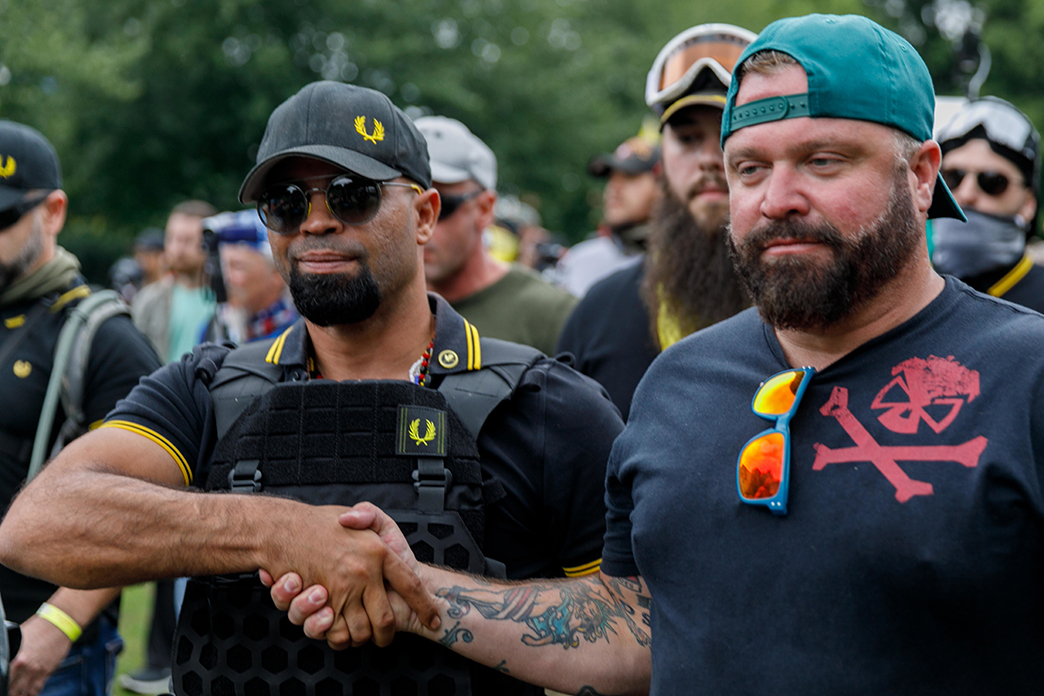
Leader of the Proud Boys Enrique Tarrio (L) and rally organizer Joe Biggs (R) congratulate each other as they return to the march starting-point over the Hawthorn Bridge as a rally concludes on August 17, 2019 in Portland, Oregon. (Photo by John Rudoff / AFP) (Photo by JOHN RUDOFF/AFP via Getty Images)
“He couldn’t keep [talk of hitting women] away. He couldn’t stop talking about it or making it a vocal thing. Because he’s that terrible of a person,” Drucker said.
Drucker recalled that after Jones fired Biggs, Jones gradually started to work Biggs back onto the air along with Tarrio.
“The moment Biggs got in with Enrique Tarrio everything changed. That was like 2018 or '19. All of sudden I saw Joe Biggs back on screen sitting alongside of Enrique Tarrio of the Proud Boys,” Drucker said.
Jones and Biggs talk about formally reuniting through Infowars in the texts Hatewatch reviewed. In addition to the talk of beating women, Biggs helped set up an event in Portland that drew street brawls between radical right groups including the Proud Boys and left-wing protesters in August 2019. One month later, on Sept. 12, Jones nevertheless entertained reuniting with Biggs, the texts show.
*Joe Biggs to Alex Jones, 4:19.08 p.m.:
Well I was thinking maybe one or two shows a week to start off at a set rate.
If that’s something doable down the road*
*Joe Biggs to Alex Jones, 8:58.31 p.m.:
That would give me opportunity to get sponsors to bring money in*
*Alex Jones to Joe Biggs, 9:28.20 p.m.:
Let’s talk about it.*
Jones and Biggs also chat about COVID-19 on the night of March 21, 2020, as the gravity of the moment appears to dawn on them.
*Joe Biggs to Alex Jones, 8:58.19 p.m.:
Gun sales have stopped*
*Joe Biggs to Alex Jones, 8:58.31 p.m.:
They are shutting it down nation wide*
*Alex Jones to Joe Biggs, 9:28.20 p.m.:
Yes*
*Joe Biggs to Alex Jones, 9:30.03 p.m.:
Shits getting real*
Josh Owens, another former Infowars employee, who left the company in 2017, told Hatewatch that Jones separated from Biggs not because of his statements about women but because of more superficial reasons.
“Jones got angry after Biggs continuously promoted, on Infowars, a clothing company he’d started on the side,” Owens recalled over text to Hatewatch. “Biggs began receiving more attention in right-wing circles creating a sense of competition, which I think Jones had a problem with.”
Biggs is not the only Proud Boys member charged with sedition to find an audience on Infowars. Ethan Nordean aka “Rufio Panman” boosted his profile through interviews with Alex Jones. Viral video of Nordean punching an antifascist protester in the face served as a recruitment tool for the Proud Boys in 2018. Hatewatch reached out to Biggs by phone, but did not receive a response.
Drucker, who worked with Jones as he elevated Proud Boys propaganda and stayed with his company until 2022, told Hatewatch that he felt surprised to see Joe Biggs return to Infowars as a guest after the firing.
“The whole script flipped,” Drucker said. “[Biggs] went from being persona non grata to … sitting in front of this, like, three-wheeled supercar in Enrique Tarrio’s driveway in Florida and all of a sudden everyone’s buddy-buddy … I also think that’s where Roger Stone and this dude Jacob Engels are tied into it.”
Roger Stone: ‘For big brother who is always watching our communications’
Jones initiates a conversation with Stone on the morning of Jan. 23, 2020 by sending him a link to a story about a development in Stone's trial for lying to Congress, obstruction and witness tampering. Judge Amy Berman Jackson sentenced Stone to 40 months in federal prison and a levied $20,000 fine for his crimes on Feb. 20, 2020. Hatewatch reached out to Stone for comment via email, text and a phone call, but received no response.
Following a vocal campaign from radical-right influencers, the-President Donald Trump commuted Stone's sentence in July 2020, just before the former Richard Nixon adviser was anticipated to start his prison sentence. Trump issued Stone a full pardon on Dec. 23, 2020, at a time when both men pushed lies about a stolen election.
*Alex Jones to Roger Stone, 6:52.56 a.m.:
Hope you are well!*
*Roger Stone to Alex Jones, 7:38.23 a.m.:
You have no idea how much I miss you and your crew,*
*Roger Stone to Alex Jones, 8:37.27 a.m.:
Everything you have said will come to pass. In the short term Tyler Nixon is available. You can talk all you want about my plight on your own volition but you can never say “Roger said.......or “Roger told me ...”*
*Roger Stone to Alex Jones, 8:37.45 a.m.:
BTW - I love the Tank*
Stone’s reference to a “tank” likely refers to an armored vehicle Jones sometimes drives to events. When Jones has driven the tank to events in recent years, footage of it has gone viral on social media. Jones drove his tank to a pro-gun rally on Jan. 20, 2020, three days before Stone referenced it in the texts.
*Alex Jones to Roger Stone, 8:38.00 a.m.:
Thanks*
*Alex Jones to Roger Stone, 8:38.03 a.m.:
Got it*
Stone then messages Jones suggesting that “Big Brother” was watching their texts.
*Roger Stone to Alex Jones, 9:13.38 a.m.:
So just to be clear for big brother who is always watching our communications is off the record and I am not directing or suggesting that you say or do or post anything and any decisions you make in that regard are completely of your own volition. On a personal basis needless to say I appreciate your support*
*Alex Jones to Roger Stone, 9:18.50 a.m.:
I understand*
Alex Jones to Roger Stone, 9:18.53 a.m. *:
Thanks*
A minute later, Jones sends the sexually suggestive photo of his wife to Stone. Stone does not respond to him. Jones picks up the thread again three weeks later on Feb. 13, 2020 and appears to imply that he wants Stone to return as an Infowars contributor.
Alex Jones to Roger Stone, 7:14.47 a.m.*:
It’s clear you are getting a pardon.*
Alex Jones to Roger Stone, 7:15.30 a.m. *:
We need to start talking about you getting your old job back.*
In August 2022, several news outlets, including The Guardian, The Independent, and Insider, reported that Jones sent a "nude" photo of Erika Wulff Jones to Stone, which did not technically happen, as far as Hatewatch could tell from the texts. The Daily Beast reported that during an Infowars broadcast Jones confirmed the "nude" photo but also denied that there were photos of his own genitalia in the text message cache. Jones nevertheless played into the idea of Erika Wulff Jones being naked.
"Sorry, I mean, there was a photo I sent my wife of her naked. Okay, they got that. So, my wife looks pretty good. The point is, there is one naked picture of my wife in there, so that’s what they got! No dick pics, no nothing," Jones said.
Jones describes a federal judge: ‘That cunt is in on the ropes’
Jones messages Stone on Feb. 14, 2020, asking him if he plans on attending the upcoming Conservative Political Action Conference or CPAC. Then he transitions to disparaging the judge in Stone’s case, Amy Berman Jackson.
*Alex Jones to Roger Stone, 9:58.33 a.m.:
You guys should not e running scared but telling that judge to fuck off*
*Alex Jones to Roger Stone, 9:58.47 a.m.:
That cunt is on the ropes*
Jones sends a series of three messages to Stone on Feb. 19, 2020, the eve of his sentencing. Each message is marked with a red exclamation point, suggesting that they failed to reach Stone.
*Alex Jones to Roger Stone, 8:42.20 p.m.:
Good luck [shamrock emoji] tomorrow!*
*Alex Jones to Roger Stone, 8:42.49 p.m.:
You are a winner!*
*Alex Jones to Roger Stone, 8:43.07 p.m.:
The man in the arena!!!*
Jackson sentenced Stone to 40 months in federal prison the next day, Feb. 20, 2020, and issued him a $20,000 fine for his crimes. Trump then commuted Stone's sentence and issued him a full pardon.
Jones chats with other Proud Boys about Judge Jackson in the texts. He lists Bobby “Pickles” Piccirillo in his phone under the name “T Guy Roger,” which appears to reference Piccirillo’s marketing of T-shirts and a connection to Stone. On the afternoon of March 4, 2020, Piccirillo sends Jones a photo of a black T-shirt with Jackson’s face on it. The words “#DirtyJudge Amy Berman Jackson'' are printed around her picture. Piccirillo asks Jones if he wants one of the shirts.
“Please large,” Jones responds.
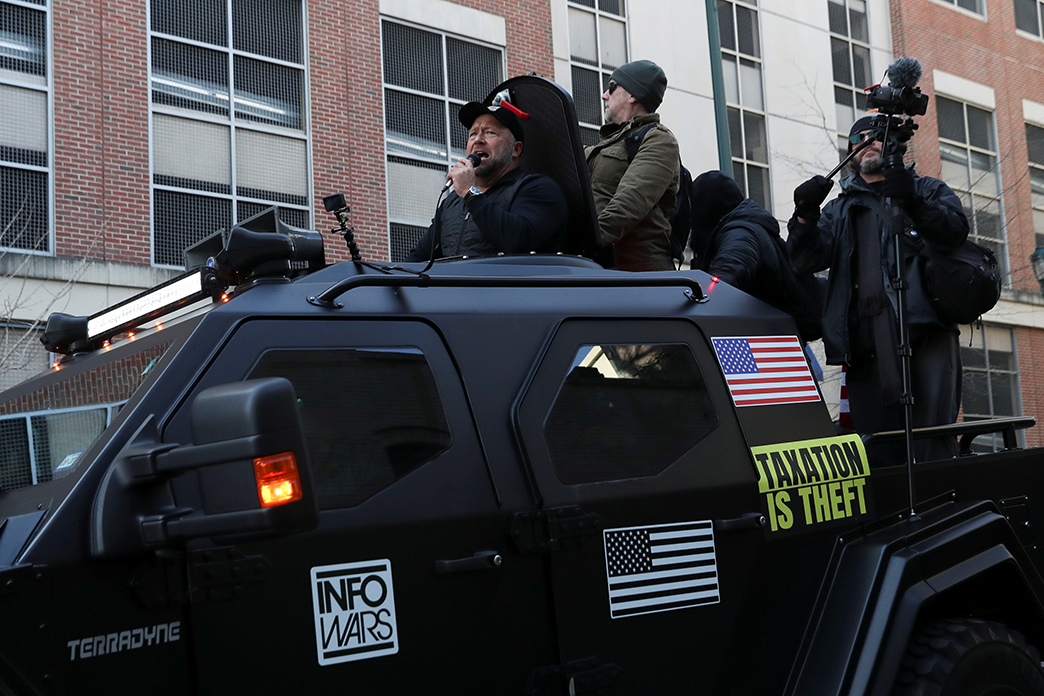
Alex Jones with the "tank" Roger Stone admired, at the Virginia State Capitol building, in Richmond, Virginia, on Jan. 20, 2020. (REUTERS/Leah Millis)
Three weeks later, Piccirillo sends three photos of a T-shirt design with a caricature of Bernie Sanders on it. The words “PLEASE THROW ME FROM A HELICOPTER,” are printed around Sanders’ face, which refers to the method by which Chilean dictator Augusto Pinochet killed some of his political opponents. Piccirillo asks Jones whether he wants one, but the Infowars host doesn’t respond. Piccirillo did not respond to requests for comment.
Engels, an openly gay reactionary, sends Jones a link to a post he authored on the far-right junk news website Gateway Pundit on Feb. 27, 2020. The post focuses on Jones confronting Judge Jackson “in the streets of DC.” Engels calls Jackson “the demonic judge” in the body of the Gateway Pundit post. Engels texted Jones a few times about Jackson in advance of publishing the post about her.
“I wanna rip this judge bad!” Engels texted on Feb. 16, 2020.
When reached for comment, Engels denied any official association with the Proud Boys. About his friendship with Roger Stone, Engels said, "Roger Stone has been beaten down time and again and keeps getting back up. That is a remarkable and admirable trait in any human being."
Engels addressed revelations about Alex Jones' personal life that appeared in Part I of this series, saying, "I don't think there's anything wrong with being a red blooded American male. That's what Alex is." About how he navigates the far right as a gay man, Engels said, "I try to live my life very quietly when it comes to my sexuality. I try to keep that to myself and not hoist that upon others."
Gavin McInnes appears to have taken mentorship role with Alex Jones’ son
Proud Boys founder Gavin McInnes initiated Alex Jones into the hate group sometime in 2018, based upon when clips of the incident surfaced on YouTube. McInnes is a regular guest on Infowars, and the pair continue to collaborate today. Hatewatch reached out to McInnes for comment by text and email, and left a voicemail, but received no response.
McInnes and Jones exchanged messages on Dec. 14, 2019, about setting up a regular spot for Jones' son, Rex Jones, on McInnes’s website, that appears to have never happened. Rex Jones, who had been an on-camera performer at Infowars since at least 2015, when he was just 12 years old, appeared on McInnes’s website on Nov. 7, 2019. He had just turned 17 at the time his father spoke with McInnes about him in the texts.
*Gavin McInnes to Alex Jones, 1:27.50 p.m.:
Got your message. Sounds good. One issue: we have Loomer and a couple of other shows coming at the same time as Rex. In order to differentiate who is bringing what, we should attach a code to each show. So, “Sign up now and use the code REX for 10% off.” That way, we have an exact number of people who signed up for Rex’s show.*
"Loomer" refers to racist, anti-Muslim internet performer Laura Loomer. McInnes appeared on an obscure internet talk show hosted by Rex Jones days after he sent that text. Rex Jones talks about battling an addiction to pornography in it. His father disparages pornography on Infowars and also shares links to explicit sites in the texts Hatewatch reviewed. Hatewatch tried three different phone numbers associated with Rex Jones in an attempt to reach him, but all the numbers were out of service.
“I had a problem. I really did. I quit,” Rex Jones tells McInnes. “That shit is addictive, and it ruins your social life.”
Rex Jones then turns the conversation to what he describes as “false rape accusations.” McInnes, who has a history of promoting a male supremacist and virulently misogynist worldview to young men, then tells the boy that women fabricate rape accusations in the clip.
“Being my age, anyone 21 to 15 will understand this problem. We live in Fallujah. We live in a war zone. You have to be so careful now. With all the false rape accusations? There’s no punishment for it,” Rex Jones says.
“The word rape has been ruined,” McInnes explains to the teenager. “Rape used to mean there’s a guy in a ski mask, and he jumps out of the bushes and has a knife, and he puts his penis in you. Now it can be … ‘A year later I decided I didn’t enjoy that.’”
McInnes tells an anecdote from the point of view of a New York City police officer, claiming that the overwhelming majority of women invent their accusations against men because they are mad at them. Repeatedly, studies show the exact opposite is true, and that such cases are rare.
"I’m not saying this is a fact or a pattern, it's just what one cop told me," McInnes tells the boy. "[The cop with] the NYPD, he said, 'What I do with these girls is I would sort of sit them alone. And I’d say look, here’s the deal. If that guy raped you, then this is what I’m here for. This is what I signed up to be a cop. We don’t want women getting raped, so we throw them in jail. But if he didn’t rape you, I want you to know that that’s illegal. You’d be committing a crime, and you’re about to put a man in a cage for something he didn’t do. I want you to think really hard about your next move because if he’s guilty, we’re going to punish him. But if he’s not guilty and you say he is, we could be ruining a man’s life,'" McInnes says.
McInnes continues, citing a fake statistic.
"You know what he said to me? He said 95% of the time the girls just say, ‘you know what? fuck it I was just mad,'" McInnes concludes.
Vice Media co-founder and right-wing speaker Gavin McInnes reads a speech written by Ann Coulter to a crowd during a conservative rally in Berkeley, California on April 27, 2017. (Photo credit JOSH EDELSON/AFP via Getty Images)
"Jesus," Rex Jones says.
"95%," McInnes says, citing the false statistic again. "How many guys are in jail right now? Look, I know domestic abuse exists, and maybe I’m too middle class, but I’ve never come across it in my life or known anyone who has known anyone who said, ‘Where the fuck’s my dinner, bitch?'" McInnes says before pantomiming a man hitting a woman.
While false sexual assault reports are rare, police dismissing legitimate reports is extremely common. In one high-profile case, police in Lynwood, Washington, even pressured a young woman into recanting her report of a violent break-in and sexual assault, then charged her for filing a false report. Years later, two detectives in Colorado caught the perpetrator, a serial rapist.
In the texts, McInnes later appears to respond to a disagreement with the elder Jones that is never explained. He sent the following message on Jan. 24, 2020.
*Gavin McInnes to Alex Jones, 3:52.19 p.m.:
Hey man, let’s not throw this all away because a kid made a silly mistake. We can build a media empire together. There will be hiccups and they won’t thwart us.*
Jones ignores McInnes. Instead, Jones begins texting with a source claiming to have information on James Alefantis, the owner of a Washington, D.C., pizza restaurant that was the center of the "Pizzagate" conspiracy theory. In 2017, Jones apologized to Alefantis for using his show to spread false rumors that the restaurant was a front for a child sex trafficking operation run by the Democratic party. Jones issued the apology on the same day a North Carolina man, Edgar Maddison Welch, pleaded guilty to illegally transporting firearms over state lines and assault with a dangerous weapon after entering the pizza restaurant with an AR-15 in order to "self-investigate" the false rumors that Jones promoted.
*From Brian Clark to Alex Jones, 7:38.40 p.m.:
So Alex do you think we're in a place to. Drop those Alefantis messages?*
*From Brian Clark to Alex Jones, 7:38.59 p.m.:
Within the context of a story that contextualizes them*
Jones replies, "Lets talk tomorrow."
Rex Jones’s career as a radical right influencer never took off. Drucker, the former Infowars employee, told Hatewatch that Rex Jones stopped appearing on Infowars in 2020 at the end of “a constant fight” with his father.
"I think [Alex Jones] is too large for anyone to be his successor," Drucker said of how Jones tried to bring his son into the business. "There’s no one in that place that could be Alex Jones’ successor in Alex Jones’ mind."
*Cassie Miller and Rachel Janik contributed to this reporting.
*This story is Part II of a series. Hatewatch will continue this investigation in Part III on Feb. 7.
===
SPLC
Proud Boys
Extremist Group
Tucker Carlson
Extremist Profile
Hate Group’s Anti-Muslim Rhetoric Reflects Anti-LGBTQ+ Conspiracy Theories
Hatewatch August 29, 2024
August 29, 2024
Hatewatch Staff
Between July 30 and Aug. 10, Jaimee Michell, the founder and current president of the anti-LGBTQ+ hate group Gays Against Groomers, posted a series of comments on X, formerly Twitter, equating Islam with pedophilia, characterizing Muslim faith as “a cancer on this world” and sharing content from an account that claims Europe is being invaded by immigrants and Muslims.
The comments, which are similar to the anti-LGBTQ+ “groomer” rhetoric the group is known for, show the adaptability of false conspiracy theories that generally claim white cisgender children are under threat. Both the “groomer” conspiracy theory, which has historical roots in anti-Black, antisemitic and anti-LGBTQ+ campaigns, and “great replacement”-style rhetoric are derived from white nationalist beliefs that white people and culture are being intentionally eradicated, often at the direction of Jewish people.
Michell’s comments came after the July 29 stabbing deaths of three children at a dance workshop in Southport, England. Following the attacks, racist violence targeting immigrants and Muslims erupted in London and other cities in the U.K., spurred by far-right activists spreading disinformation about the attacker online, according to the BBC.
Recirculating hateful content
The series of tweets included a video featuring Proud Boys founder Gavin McInnes sharing racist pseudoscientific claims about Southeast Asian and Arab people on a 2017 episode of Joe Rogan’s podcast. The episode was one of dozens of episodes that were deleted from Spotify’s streaming library in 2022, according to Rolling Stone.
In the clip, Rogan and McInnes discuss a 2010 pseudoscientific article from PJ Media that relies on ableist and racist tropes about Southeast Asian people, Arab people and Islam to ultimately advocate barring Muslims from immigrating to Europe. According to PJ Media, which was purchased by the right-wing Salem Media Group in 2019, information in the article was derived from an interview between the author and the founder of the anti-Muslim hate group Glazov Gang Productions.
Michell’s repost of the clip uses alternating capital letters – which implies a mocking tone in internet memes – to suggest that the “culture” of Southeast Asian people, Arab people and Muslims is not “equal” to other cultures. Other far-right figures, including Matt Walsh, recirculated the clip on their social media accounts.
In a July 30 post, Michell asked, “How much longer must the West suffer before enough people realize Islam is incompatible with civilized society?” The post concluded, “It [Islam] is a cancer on this world.”
GAG’s connections to hate groups
Gays Against Groomers (GAG) has previously received support from McInnes and one of the leading figures of the far right in the U.K., Tommy Robinson, whose real name is Stephen Yaxley-Lennon. Robinson has been convicted in the U.K. of numerous crimes related to his political agitation, including assault, fraud, stalking and contempt of court.
In a Sept. 27, 2023, post, GAG shared a video featuring Robinson and McInnes praising the group for its tactics. GAG perpetuates the anti-LGBTQ+ myth that transgender people and their allies are grooming children. In the video, Robinson thanked GAG for “driv[ing] that big wedge for the world to see between the gay community and this mad sexualization of children.”
The Southern Poverty Law Center has previously reported that GAG’s former director of chapters appeared at events with Proud Boys members, carrying a sign with the group’s logo.
...
McInnes, Molyneux, and 4chan: Investigating pathways to the alt-right
Hatewatch April 19, 2018
McInnes, Molyneux, and 4chan: Investigating pathways to the alt-right
Publication April 19, 2018
Alex Jones’ Texts Highlight Infowars Overlap with Proud Boys
Hatewatch February 02, 2023
Far-right Student Organization Brings Extremists McInnes, Doyle to Penn State and Tennessee
Hatewatch October 20, 2022
Protesters Maced at Canceled Far-right ‘Comedy’ Event at Penn State
Hatewatch October 25, 2022
Proud Boys founder Gavin McInnes has been using the same anti-gay slur hurled in the NYC attack for at least 15 years
Hatewatch October 19, 2018
SPLC Applauds Seditious Conspiracy Conviction of Proud Boys
Press Release May 04, 2023
Why are the Proud Boys so violent? Ask Gavin McInnes
Hatewatch October 18, 2018
Hard Times Comin' Through: Gavin McInnes and the Charlottesville "Racism War"
Hatewatch August 22, 2017
Far-right skinheads join Proud Boys in assaulting protesters in New York City following Gavin McInnes event
Hatewatch October 14, 2018
Idaho Lawmaker Tammy Nichols Pals With Extremists
Hatewatch March 15, 2023
Weekend Read: Violence and hate, that's the Proud Boys in a nutshell
Features and Stories October 18, 2018
Presumed Proud Boys Attack Protesters Outside White Nationalist Conference
Hatewatch November 20, 2022
New Alt-Right “Fight Club” Ready for Street Violence
Intelligence Report August 08, 2017
Hatewatch Headlines 10/19/2018
Hatewatch October 19, 2018
Skinhead 'Irv' among five charged in Proud Boys' New York City assault
Hatewatch October 22, 2018
Law Firm Tied to Far-Right Fringe Registers Stop the Steal LLC in Alabama
Hatewatch December 18, 2020
1 2 3 4 5 next › last »
===