tina peters
===
PRIMARY TRACTION FUCKERY
2ND 7 26 OF GOP STEAL ELECTION
SEE VOTING MACHINES
NO MERRI
---
-=-=
=- =-=
...Key findings:
Figures most frequently claiming to have the ear of Trump and his staff: Ten people made nearly half of the 123 total claims: Tina Peters (10), Wayne Allyn Root (7), Glenn Beck (6), Sean Hannity (5), Buck Sexton (5), Clay Travis (5), Trey Yingst (5), Bill O’Reilly (5), Peter Ticktin (5), and Jack Posobiec (5).
Election denial activists’ claims to be in touch with the White House increased as midterms approached: Twelve election denial figures account for 30% (or 37) of the total claims. In June they had just 2 claims and none in May, but the claims jumped to 16 in July and have remained significant since.
These interactions could be influencing policy: Nearly two-thirds of the claims about these interactions (80 out of 123) mentioned influential policy discussions, including relations with China, the Iran war, and election integrity efforts.
...
-=-=
-=-=
RWW
- Dion Nissenbaum @ Talking Points Memo: From Martial Law to Banning Voting Machines, Election Skeptics Urge Trump to Take Extreme Action
Since being released early from prison in June, former Colorado election clerk Tina Peters has been granted extraordinary access to the halls of power in Washington.
-=-=
mma 10 26
-=-=
MMA
Tina Peters allegedly met with Trump to discuss election plans. Here's what that could mean for the midterms.
Written by Kayla Gogarty & John Whitehouse
Research contributions from Alex Kaplan & John Knefel
Published 10/06/26
Former Mesa County, Colorado, clerk Tina Peters, who was released from prison on June 1 after being sentenced to nearly nine years for actions related to tampering with voting machines following the 2020 election, allegedly met with President Donald Trump on October 5 to discuss the midterm elections.
Tina Peters allegedly met with President Trump – again.
- Speaking on Eric Bolling’s Real America’s Voice show, former Trump Justice Department official Ed Martin said that Peters was “in the Oval Office meeting with the president on election integrity” hours earlier.
- Video
- Share
- Citation
- From the October 5, 2026, edition of Real America's Voice's Bolling!
- ED MARTIN (GUEST): Well, let me break some news. This is a big deal, Eric, and I'm — you're the first person that knows. I'm going to say something — just hours ago, maybe two hours ago. Tina Peters, you know, from Colorado, was in the Oval Office meeting with the president on election integrity, and they were talking about the plans.
- And the one thing that they know is that Secretary Mullin of the Department of Homeland Security came out in late August and conceded and said, as a matter of law, a finding that there is — the machines for voting, the election voting machines use parts from China and Russia and foreign places and are therefore compromised. That's what Mullin said. That finding, when he finished that finding, he then said, and I have a billion dollars to help you states to do something other than use machines that are compromised. And, again, my point is this.
- You talk about local. It is a local election. I ran the election board in St. Louis. There is local control. However, the laws that govern the system, like safety and national security, are federal laws.
- And so when Tina Peters, you know, famous Colorado clerk, was in the Oval Office today just two hours ago talking about this question, the president's taking it seriously. If the Congress won't pass the SAVE America Act, and they won't, then the president's going to have to do what he's going to do. And it is not a local issue when it's national security, and it's clearly national security. So we'll see how it plays out.
- Peters has claimed to regularly be in contact with Trump administration officials, including by text, and said in late August that she has been to the White House six times. She also has thanked White House staff for facilitating her release from prison. In July, Peters claimed that Trump ordered his staff to do what she recommended, saying on a livestream, “Yesterday, when I was with the president, he talked — and I can’t get into the plan — but we talked, he basically said to his lead counsel to do what I was asking.”
- Peters has also recently claimed to have been in contact with White House chief of staff Susie Wiles, Commerce Secretary Howard Lutnick, Attorney General Todd Blanche’s deputy chief of staff Shane Hedges, and Assistant Attorney General for Civil Rights Harmeet Dhillon.
- Martin recently left Trump’s DOJ to — at least according to the president in a Truth Social post — “fight Legal Battles” related to the midterms. Martin and Peters have a history together. In 2025, Martin told Steve Bannon that he had been working for two months to find “a path” to her release. He also reportedly “discussed election security issues last year” with Peters’ associates and forwarded their pitch for a ban on voting machines to another senior Justice Department official.
What is Tina Peters’ plan for the election?
- Peters has been vocal in far-right circles about her election plan. As Media Matters’ Alex Kaplan documented in late July:
- The new proposal, dated July 22 and called the “100-Day Risk Mitigation Election Plan” and “Operational Guidance for the November Federal Election – 2026,” urges the Cybersecurity and Infrastructure Security Agency — an agency housed under the Department of Homeland Security that is “one of the main federal partners for states on election security, sharing intelligence on potential threats to voting infrastructure and providing quick regional support,” per MS NOW — to “concentrate on six achievable measures,” including “transition[ing] the general electorate away from ballot-marking devices (BMD) to hand-marked paper ballots” and “insisting that the official count can only be certified after a full hand-count of every ballot.”
- It also lays out an implementation framework that would involve classifying all counties based on current election processes and their ability to transition ahead of the midterms and then providing each county with implementation plans. During a podcast interview discussing the plan, Peters acknowledged that “CISA is not a forceful body that they can make people do things, but they can actually make recommendations,” and suggested that DHS could use a recently announced grant for states “that comply with certain things like paper ballots and so on and so forth” as an “incentive.”
- …
- Peters released the new proposal, which she called a “practical election-security plan,” on her website along with a July 24 letter to the acting director of the Cybersecurity and Infrastructure Security Agency thanking him “for meeting with us … and for giving us the opportunity to present our concerns and proposed path forward for the 2026 federal election.”
- Peters’ plan also requires that jurisdictions must “apply the ‘Bank-Teller Method’: independently hand-count every ballot for federal contests before certification and reconcile that count with the tabulator result.”
- As the midterms approach, Peters has continued to promote versions of her plan and give additional details, such as arguing that Trump already has the power to involve DHS and the Commerce Department through an executive order on critical infrastructure. Election deniers like Peter Ticktin, Jerome Corsi, Cleta Mitchell, and Wayne Allyn Root have made similar arguments about Trump already having authority.
- Video
- Citation
- From a video uploaded on Tina Peters' website on August 26, 2026
- TINA PETERS: Mr. President, it is time to treat America’s elections like the critical infrastructure that they are. We do not have months. We have days. Mr. President, our own government and your administration has documented vulnerabilities in election systems and identified foreign adversary threats. Voter databases, poll books, election networks, and voting technology are all at risk.
- The authority already exists. The national emergency under Executive Order 13873 is already in place. What is needed now is cabinet-level direction, direction of DHS, CISA, the EAC, FEMA, the intelligence community, and Commerce to immediately execute the 2026 mitigation plan.
- ...
- The goal is simple and absolutely achievable, Mr. President: Secure and reduce electronic dependence, wherever possible, preserve physical paper evidence, and independently verify electronic results before certification. CISA should issue immediate cybersecurity guidance and assistance to transition all counties to handmark paper ballots, and make sure every electronic tabulation is human verified. FEMA should identify available funding for securing the elections.
- High-risk jurisdictions should receive rapid technical assistance, and Commerce should begin a foreign adversary election technology review. Please, Mr. President, set September 8 as the first deadline and make every electronic result independently checkable.
- This is a known national security issue. The complete risk mitigation plan is available.
- ...
- We still have time to act, but the clock is running. Please direct your cabinet to move now. Our team stands ready to help.
- God bless you, Mr. President. This plan — I’m confident — will save our country.
What has Peters said about the president having authority to intervene in the midterms?
- Peters has been vocal that the president has the power to intervene in the midterms through executive power. (Experts have harshly criticized this analysis.)
- Peters said during a June 14 stream following her release from prison that she had spoken with the president and she believes “Trump could sign an executive order to get rid of the machines and say that they are — that a vendor cannot have that much influence over our elections.” She also said on June 25 that “we’ve got to get rid of the machines” and “mail-in ballots,” and Trump “needs to sign an executive order ... saying it’s unconstitutional that these things are allowed to be done.” Election denial activist Jerome Corsi has claimed that Peters will “play a major role in one of the key factors in Trump ultimately declaring the need for the elections to be supervised by the federal government.”
- Similar to what Martin told Eric Bolling on October 5, Peters has grounded her election rhetoric in terms of foreign interference and national security, saying, “There’s no security threshold when you have foreign agents that have proprietary authority, power, over the things that are used for our most sacred right, which is to vote who we want to represent us.”
- She has also claimed that Trump should take action against voting machines because some of the parts are “made in China.” Notably, Peters has also urged the military to get involved, saying: “It's very important to — for the Department of War — now I'm saying the Department of War because this is an international event that is going on with stealing our elections. Pete Hegseth needs to go in and demand to have these machines in their custody, and also the Mesa County machines. They're still out there.”
-=-=
-=-=
MMA
MS NOW explores the relationship between election denier Tina Peters and the Trump administration and her calls to “get rid of voting machines”
Peter Baker: President Trump has “expressed a willingness to do things that we’ve never seen in this country be done before in order to alter the results of an election”
Written by Media Matters Staff
Published 10/06/26
Video
Citation
From the October 6, 2026, edition of MS NOW's On the Line With Alicia Menendez
ALICIA MENENDEZ (MS NOW ANCHOR): I have a million questions, Let's start with this one. Peter, Why won't the White House just say that they didn't meet with Tina Peters?
PETER BAKER (NEW YORK TIMES CHIEF WHITE HOUSE CORRESPONDENT): It's a really good question. When they say they don't confirm private meetings, of course they confirm private meetings when it suits their interests. It's in this case, obviously, they feel some degree of concern that it will cause, you know, backlash, right? I mean, to Laura's point, you know, it's remarkable that the people who manage to use these machines to rig the 2020 election forgot to do it in 2024, right? This is an election that the president won, doesn't complain that that one was rigged, same machines, same voting structures, same, you know, system that he is now saying is unfair and was unfair in 2020, perfectly fair two years ago when he happened to win.
So, you know, we'll see. But I think the point of the machines is really interesting because remember back in 2020, after the election, before January 6 in the Oval Office, the president of the United States, hosted a number of advisers, outside advisers, including Mike Flynn, who had been his national security advisor and later convicted, and eventually pardoned. Mike Flynn, a retired three star general, told the president of the United States at that point, that he should order the National Guard to seize voting machines in six states that Trump lost and then rerun the election so that therefore he could theoretically win, again.
The president didn't do it that time. But when my colleagues went and interviewed President Trump in January of this year, he said he regretted not taking that advice. He regretted not using the military to seize voting machines and rerunning elections with no legal basis whatsoever until he could get a win. And so, when we say, you know, what's she doing there? I think it's reasonable to ask that question, given that he himself has expressed a willingness to do things that we've never seen in this country be done before in order to alter the results of an election.
//
10/06/26 11:43 AM EDT
10/01/26 9:33 AM EDT
09/30/26
-=-=
AN 8 26 VID
President Donald Trump's loyalist and election denier, Tina Peters, is on a roadshow. Peters managed to score a commutation from a Democratic governor after her conviction for state crimes around the 2020 election. She was slated to be in jail for nine years. She only served 20 months.
The new election conspiracy roadshow drew the attention of CNN reporter Marshall Cohen, who spoke with host Dana Bash on Friday. Bash questioned whether Peters has able to do much since she's "preaching to the converted." Cohen explained it's all about access.
Peters has met with the White House, the Commerce and the Justice Departments.
"The question of influence is something we're going to find out as we get closer and closer to the midterms and see if the president enacts some of these very extreme and aggressive ideas and proposals that Tina Peters is pitching," Cohen warned. "You just saw on your screen photos of her meetings this week in Washington, D.C.. She sat down with Harmeet Dhillon, who is the chief of the Justice Department's civil rights division."
Dhillon has been pushing her own election changes while at the DOJ.
Peters also met with Commerce Secretary Howard Lutnick, which prompted questions on Lutnick's role in elections.
"The Commerce Department is home to the Census Bureau [which] put out a report claiming that there were tons of non-citizens voting in elections," Cohen explained. "It suggests that the office is also trying to play in this space, which is why it's notable that Tina Peters is meeting with him."
He said he spoke with Peters' lawyer Peter Ticktin, "who is also pushing for some very aggressive moves before the election."
According to his comments, Peters "has a plan."
"And I don't know whether, you know, she'll get the support to make sure her plan gets implemented. Her plan differs from mine greatly. It's still going to need an emergency order in order to have it happen," Ticktin said.
The idea of declaring a national emergency so the president can take over the 2026 midterm elections isn't a "hypothetical situation," said Stateline.
Nick Brown, Washington state’s Democratic attorney general, said that they're already preparing for Trump's attempts to nationalize the election.
Last week, when asked about nationalizing the election, Trump told a conservative commentator, "Stranger things have happened, OK? I’ll leave it at that.”
Trump has yet to hit the "nuclear option," said Cohen. He also noted all of this is coming, again, because Democratic Gov. Jared Polis (Co.) commuted Peters' sentence, releasing her early.
"He said, it's the right thing to do, but he's disappointed in what she's up to in Washington," said the reporter.
The other thing that is making officials "lose their mind," Cohen said, is that Peters could be appointed to a post to consult on election security for the state of California. The post was offered by the Shasta County election official, who is a 2020 election denier.
-=-=
RWW
08/20/2026
by
- Lauren Lumpkin @ The Washington Post: Florida school board at the center of culture wars loses conservative majority
Democrats say the flip indicates voters want education to move on from political fights over social issues, while conservatives point to their wins.
- Troy Farah @ Salon: Mike Lindell refuses to accept he’s an election loser
On Wednesday, he offered to fund a recount in the Minnesota governor primary.
- Brian Kaylor @ Public Witness: Southern Baptist Preacher Tells Pentagon Worship Service that God Will ‘Fight Their Battles’
An influential Southern Baptist pastor stood Wednesday (Aug. 19) in the headquarters of the world’s largest military and, with no sense of irony, preached a message of hope for Pentagon leaders by pointing to multiple biblical passages where God miraculously delivered people by defeating a large imperial military.
- Alex Bollinger @ LGBTQ Nation: Lindsey Graham’s sister uses trans kids to excuse her terrible debate performance
It’s unclear why anyone would be concerned about trans kids in sports in a state that banned them four years ago.
- Phil Williams @ Confront The Hate: As Local News Dies, White Nationalists See Opening
At an invitation-only gathering in Italy, far-right leaders mapped out strategies to target rural America while local press coverage vanishes.
- J. David Goodman, Lauren McGaughy, Jesus Jiménez and Ruth Graham @ The New York Times: Islamophobia’s Rise in Texas: ‘I Won’t Rest Until Every Muslim Is Gone’
Muslim communities have been growing for decades, particularly around Dallas. Now, conservatives want to roll up the welcome mat.
- Matt Cohen @ Democracy Docket: Conservative activist Scott Presler accused of violating Pennsylvania campaign finance laws
Presler’s recent efforts to influence voters in a high-stakes Pennsylvania Supreme Court retention election last year may have run afoul of state campaign finance laws, according to a complaint filed by the nonprofit consumer advocacy organization Public Citizen.
- David Gilbert @ Wired: A MAGA County’s Top Election Official Wants to Hire Election Denial Superstar Tina Peters
Tina Peters was convicted of seven counts related to election interference in 2024. Now, she’s fielding an offer from a county that’s become a hotbed of voting-related conspiracy theories.
-=-=
mma
08/10/26
-=-=
MMA
07/30/26
Multiple figures behind the proposal have also urged Trump to declare a “national emergency” over the midterm elections
Written by Alex Kaplan
Published 07/30/26
A group of activists in the election denial community — including Tina Peters, a former Colorado election official convicted of charges related to the 2020 election, and Clay Parikh, who has served as a “special government employee” for the Trump administration — claim they presented a key government agency responsible for protecting elections with “operational guidance” for the midterms in the form of a “risk mitigation” and “practical election-security plan” to implement in the 100 days before the elections. The proposal appears to be the latest attempt to push the Trump administration to take over election processes ahead of the midterms.
The new proposal, dated July 22 and called the “100-Day Risk Mitigation Election Plan” and “Operational Guidance for the November Federal Election – 2026,” urges the Cybersecurity and Infrastructure Security Agency — an agency housed under the Department of Homeland Security that is “one of the main federal partners for states on election security, sharing intelligence on potential threats to voting infrastructure and providing quick regional support,” per MS NOW — to “concentrate on six achievable measures,” including “transition[ing] the general electorate away from ballot-marking devices (BMD) to hand-marked paper ballots” and “insisting that the official count can only be certified after a full hand-count of every ballot.”
It also lays out an implementation framework that would involve classifying all counties based on current election processes and their ability to transition ahead of the midterms and then providing each county with implementation plans. During a podcast interview discussing the plan, Peters acknowledged that “CISA is not a forceful body that they can make people do things, but they can actually make recommendations,” and suggested that DHS could use a recently announced grant for states “that comply with certain things like paper ballots and so on and so forth” as an “incentive.”
Voting machines and tabulators have been the target of election conspiracy theories for years, sparking campaigns to replace them with full hand-counts. As experts have explained, a system of hand-counted paper ballots would be less accurate, more expensive, impractical, and “potentially riskier than the current system of machines with auditable paper trails that almost all cities and states use.” Studies have actually shown that “hand-counting ballots produces more errors than machine tabulation,” and as the Brennan Center for Justice has explained, “Many checks exist to ensure that voting machines count ballots correctly and produce accurate election results.”
Peters released the new proposal, which she called a “practical election-security plan,” on her website along with a July 24 letter to the acting director of the Cybersecurity and Infrastructure Security Agency thanking him “for meeting with us … and for giving us the opportunity to present our concerns and proposed path forward for the 2026 federal election.”
These are the figures who signed the letter to CISA:
Peters, who publicly released the plan, is the former county clerk of Mesa County, Colorado, and was “convicted in 2024 for her role in a brazen plot to examine voting machines under her control after the 2020 election” before Democratic Colorado Gov. Jared Polis commuted her sentence. She met with Trump at the Oval Office in late June, later claiming that she told him, “If we don’t fix these machines, if we don’t get rid of these machines, we’re going to lose the next election.”
Parikh, who has served as a “special government employee” in the Trump administration and who was cited in the FBI’s warrant for its raid of a Fulton County, Georgia, election facility. Parikh was also involved in Kari Lake’s unsuccessful legal effort to claim fraud was involved in her 2022 Arizona gubernatorial election defeat and has reportedly “served as a witness in other cases … challenging the use of voting machines.”
Conrad Reynolds, a podcast host who reportedly ”thinks Arkansas voting machines could be flipping votes” and who was involved with Restore Election Integrity Arkansas and its push for an amendment “aimed at requiring all elections in Arkansas to be conducted with paper ballots and removing language in the Arkansas Constitution that permits elections to be conducted by voting machines.” Reynolds has also run the Arkansas Voter Integrity Initiative, which has aimed for “getting rid of voting machines” in favor of paper ballots.
Will Huff, who often co-hosts Reynolds’ podcast and has pushed election-related conspiracy theories about “dirty voter rolls” and “the mail-in ballot scheme.” Huff has also been involved with Restore Election Integrity Arkansas and the Arkansas Voter Integrity Initiative.
Peters also explained the proposal during a July 27 podcast appearance, claiming that Trump's July 16 speech indicated “a lot has come out about the vulnerabilities of our election infrastructure.”
Video
Citation
From the July 27, 2026, edition of America, Can We Talk?, streamed on Rumble
TINA PETERS (GUEST): Now, so — and that’s in that 14-page memo to CISA. But here’s what you can do. If we cannot physically get rid of the machines before November, then having — you know, taking the preliminary count that comes from the machines, but not certifying the election until — and however long it takes — until finishing up the hand-count. Then, if those two things don’t meet, then then you know.
So it’s a way if you’re — if you use that as your preliminary results and then you have — I’m going to say it again — then you have an actual hand-count, however long it takes to get it done, and then you have the certification. The thing of it is is that a lot of the judges that are put in the place to certify the results are taking the word of an electronic device. They can't actually see that, yes, we had a group of people, Democrat and Republican, that have checked this out.
It’s just like, you would always check your bank ledger, right? You just, you know, check, make sure everything is, you know, before you realize that it’s valid. That’s what we need. And if it take — right now, they’re taking how many weeks to finish an election anyway, right?
Additionally, Peters said on the podcast that she had urged Trump during their Oval Office meeting to fire members of the Election Assistance Commission — which Trump subsequently did.
Trump has taken actions to expand his control over election processes, and election deniers have been proposing policies for even more power ahead of the midterms
In recent months, Trump and his right-wing media allies have advocated for passage of the SAVE America Act and other policies to increase federal control of the midterms. As USA Today reported, “Trump is working to gain unprecedented control of the 2026 U.S. midterm elections” with “a series of new assertions of presidential power.”
These actions have included firing key leaders of the federal Election Assistance Commission, putting election deniers in administration positions that oversee elections, and issuing executive orders that would tighten rules for mail-in voting and create a federal list of U.S. citizens eligible to vote.
ProPublica also noted that Trump “eviscerat[ed] CISA” at the start of his second term, replaced career election specialists at the Department of Homeland Security with his allies, including some who have ties to the election denial movement, and “discarded or diminished other federal initiatives with roles in protecting election integrity or blocking foreign interference.”
Right-wing media and election deniers have called for the president to further expand his power by issuing a national emergency executive order that would supposedly give Trump “essentially king-like powers” over the midterms. Two of the signatories of the letter to CISA — Reynolds and Huff — have called for the declaration of such a “national emergency,” and Peters has said she believes “Trump could sign an executive order to get rid of the machines and say that they are — that a vendor cannot have that much influence over our elections.”
As part of those calls, election deniers reportedly circulated a draft of a proposed executive order within the administration, and right-wing media figures appear to be weaving together a narrative about foreign interference in American elections by countries like China and Venezuela that could be used as a “predicate” for a national emergency.
The new proposal to CISA from Peters and the others in the election denial community appears to be the latest attempt to control election processes for the midterms.
//
06/30/26 10:00 AM EDT
The plot to subvert the midterms is getting stranger and more dangerous
07/02/26 10:05 AM EDT
02/26/26
-=-=-=
REF CISA LTR
https://cloudfront.mediamatters.org/static/D8File/2026/07/30/CISA-Cover-Letter-Reynolds-Peters-Parikh-Huff-2026-07-24.pdf
July 24, 2026 Nicholas M. Andersen, Acting Director Cybersecurity and Infrastructure Security Agency Department of Homeland Security Thank you for meeting with us on Monday and for giving us the opportunity to present our concerns and proposed path forward for the 2026 federal election
The November election is rapidly approaching, there is little time for solutions that require years of study, wholesale replacement of existing infrastructure, or complicated changes that state and local election officials cannot realistically implement before Election Day. A practical risk-mitigation plan must be executed quickly—one that meaningfully improves election security while recognizing the political, legal, logistical, and operational realities on the ground. With that objective in mind, we have developed the enclosed “2026 Risk Mitigation Election Plan (RMEP).” RMEP is designed as a politically practical and operationally achievable approach that will work within a short-timeframe.
It does not assume that every electronic component of the current election system can be eliminated before November. Instead, it focuses on reducing unnecessary electronic dependence, moving voters to hand-marked paper ballots wherever possible, strengthening ballot reconciliation and chain of custody, maintaining resilient paper voter records, improving the cybersecurity of systems that must remain in use, and independently verifying electronic tabulation through a full human count before certification. The objective is clear: reduce the opportunity for cheating. We do this by insisting the steps outlined in this plan are enacted by every state. Acting quickly, will give states more time to make the transition as manageable as possible for the local officials who must carry it out.
Also included in this packet are three separate letters from three of the most knowledgable cybersecurity professionals in America: Dr. Andrew W. Appel, Eugene Higgins Professor Emeritus & Senior Research Scientist, and Dr. Philip B. Stark, Distinguished Professor of Statistics, University of California, Berkeley and a former Election Assistance Commission Advisor, and lastly from Dr. J. Alex Halderman, Professor of Computer Science and Engineering at the University of Michigan and Director of Michigan’s Center for Computer Security and Society. All three letters are independent, stand-alone communications and were not written as endorsements of, or in support of, the enclosed RMEP. They should be considered entirely on their own merits.
However, the technical concerns and recommendations raised independently by their authors reinforce several of the same underlying risks that the RMEP is intended to address— particularly the use of ballot-marking devices (BMDs) and the limitations of relying on a fixed-percentage manual audit as the primary verification of electronic election results. We believe the remaining time before the 2026 election should be treated as an opportunity for immediate, practical risk reduction.
Not every long-term election-security issue can be resolved before November, but significant improvements can still be made if action begins now. Our hope is that the enclosed plan provides CISA with a clear, workable framework that can be quickly evaluated, refined where necessary, and translated into guidance and assistance for state and local election officials. Time is of the essence - we stand ready to assist you and your staff any way possible.
Respectfully, Colonel Conrad Reynolds (USA Ret.), Ms. Tina Peters, Mr. Clay Parikh, Mr. Will Huff
-=-=-
REF2 MSNOW
Jul. 22, 2026,
By Laura Barrón-López and David Rohde
President Donald Trump says he is worried about foreign interference in U.S. elections. That was the reason he gave when he released declassified intelligence documents last week that ended up undercutting his own baseless claims about rigged elections.
In his primetime address on July 16, Trump said the U.S. “must take urgent action” to protect voting infrastructure against foreign actors. But shortly after taking office last year, Trump gutted a key agency designed to protect America’s elections from exactly that.
It’s called the Cybersecurity and Infrastructure Security Agency — an office created during Trump’s first term. CISA is one of the main federal partners for states on election security, sharing intelligence on potential threats to voting infrastructure and providing quick regional support.
After Trump returned to office, the cyber agency housed under the Department of Homeland Security took a major hit. Elon Musk’s DOGE fired more than 100 workers, including election security advisers. More than 600 others were placed on administrative leave, were reassigned or took buyouts.
Now the Trump administration is telling states they will only receive resources if they hand over voter rolls to be screened through a new federal database that a judge recently deemed unlawful in its current form.
That database is known as the Systematic Alien Verification for Entitlements, or SAVE, which experts and a federal judge are concerned has a high error rate that could disenfranchise voters.
Homeland Security Secretary Markwayne Mullin said CISA will release an “election infrastructure plan” in the next 30 days — barely three months out from the midterms, which will determine which party controls Congress.
“If they participate in the SAVE program, we’ll provide the resources and training to support state election integrity,” Mullin said last week. “We’re not trying to change the outcome.”
‘They’re flying blind’
Multiple current and former senior election and national security officials told MS NOW that they could not recall a time when the federal government held back resources and money meant to secure America’s elections.
And multiple state election officials have said they are not receiving any briefings on possible foreign threats to election security from the federal government. Such briefings were once a regular occurrence, they said.
“They’re flying blind,” said a former senior national security official, who served during Trump’s first administration and was granted anonymity given the sensitivity of the subject. “It is late July and there is no CISA election security plan for the 2026 midterms.”
During the first Trump administration, “we were collaborative — carrots rather than sticks,” said the former official. The second Trump administration is “very much focused on sticks.”
One election official in a swing state said the difference from 2024 is stark, saying that “it’s every state for themselves.” The official spoke on the condition of anonymity over concerns about retaliation from federal officials. During the last cycle, the state official said they had a regional federal cybersecurity expert “on speed dial” who could “see the whole puzzle.”
That doesn’t exist anymore, and without it, the state election official said, “we’re less informed on the pattern of the attackers and are slower to respond.”
“I’ve literally never heard anybody effectively say ‘to keep you safe, you have to give me what I want,’” said the swing state election official, referring to DHS threats to withhold resources if states don’t hand over sensitive voter data.
The risks compound at the local level, they added: “Does [a clerk’s] laptop have the IT infrastructure to defend against an attack from Iran? That’s what keeps me up at night.”
Cait Conley, a West Point graduate and combat veteran who served as the senior adviser to the director of CISA during the Biden administration, accused Trump of gutting the agency and sowing doubt about the security of U.S. elections in his speech last week.
“If Donald Trump were truly concerned about election security, he would not have fired hundreds of federal workers whose jobs were to secure our elections,” she said. Conley is now running for Congress in New York as a Democrat.
“His lies and misrepresentations are very clearly trying to lay the groundwork for calling this November’s election results into question when his party loses,” she said.
When asked about election officials telling MS NOW that they have received no intelligence briefings on possible foreign threats to election security, and have no access to regional cybersecurity advisers, DHS did not respond. DHS also did not respond directly to questions about the agency withholding resources unless states hand over voter data.
Instead, they provided a statement from acting CISA Director Nick Andersen, which said CISA “works with critical infrastructure owners and operators to assist them in securing both the physical security and cybersecurity of the systems and assets that support the nation’s elections.”
Recommended
What Americans should take away from Trump’s speech on election interference
News
Declassified documents undercut Trump’s ‘rigged’ election claim
Laura Barrón-López, Vaughn Hillyard
When an election infrastructure plan is done in the next 30 days, it will “offer to states the cyber resources they need, including information about available no-cost voluntary services such as the sharing of threat information, technical expertise, vulnerability scanning, and other risk mitigation support,” Andersen said.
Under Trump, CISA halted its funding of the Election Infrastructure Information Sharing and Analysis Center, which provides local governments with free access to election security operations centers, election security training, technical support and threat monitoring.
Tim Harper, who leads the elections team at the nonpartisan Center for Democracy and Technology, said teams across the FBI, the State Department and the Justice Department that worked on countering foreign influence have also been eliminated or sidelined.
But CISA was key to sharing and compiling intelligence across the federal government.
Parts of CISA’s election work, Harper explained, included granting security clearances to state election officials to give them real-time information to stop threats before they spread. His organization has direct knowledge of officials receiving no response when they have asked the federal government to provide assistance on cyber and physical security.
“Expecting local election officials to handle nation-state cyberattacks without federal support isn’t commonsense policy,” Harper said. “It’s a national security failure.”
States are trying to fill the gap with outside vendors and networks of cyber experts.
“It has taken a lot of work, and it shouldn’t have to be this hard, but the states are ensuring the 2026 election is secure despite federal withdrawal,” said David Becker, executive director of the Center for Election Innovation and Research, which works with elections officials from both parties on ways to build trust with voters in election results.
Becker said that the Trump administration’s near-weekly threats to arrest election officials have “become a running joke among election officials,” adding that they find it “laughable.”
Protecting elections
Established in 2018 during Trump’s first administration, CISA initially enjoyed sweeping bipartisan support. But Trump attacked the agency after Chris Krebs, then the director, said the 2020 election was “the most secure in American history.” Trump, who lost the election, immediately fired Krebs.
After Trump returned to office in 2025, his administration proposed a 17% cut — roughly $500 million — to CISA’s budget. It also proposed mass layoffs that would cut CISA staff nearly 30%, eliminating 1,083 of its 3,732 staffers. The plan was paused after almost 600 people accepted a buyout offer from the administration, Politico reported at the time.
Trump and members of his new administration have also accused CISA of undermining democracy instead of defending it. As DHS secretary, Kristi Noem, in a surprise keynote speech at a major cybersecurity conference last year, said CISA’s efforts to counter the spread of misinformation from America’s enemies, such as Russia and China, was an infringement on free speech.
“They were deciding what was truth and what was not,” she said of CISA. “And it’s not the job of CISA to be the Ministry of Truth.”
Former CISA officials called those claims patently false. And they warned that tech firms were hiring top CISA leaders, as well as CISA staffers, for their cybersecurity skills, and that the agency was being gutted.
“I’ve personally seen how CISA has lost its very best,” Jack Cable, a former CISA employee who left the agency in January, told lawmakers in a June hearing. “In the face of increasing threats, we can’t undermine the capacity of America’s cyber defense agency and its ability to attract and retain the best technical talent.”

Laura Barrón-López covers the White House for MS NOW.

David Rohde is the senior national security reporter for MS NOW and a two-time winner of the Pulitzer Prize for International Reporting. Previously he was the senior executive editor for national security and law for NBC News.
-=-=-=
14 PP PLAN
Date: July 22, 2026 Subject: Proposed DHS/CISA Operational Guidance for the November Federal Election – 2026. Bottom-Line: Given President Trump’s recent revelation that our elections are insecure and subject to manipulation, quick action is necessary. The recently declassified documents highlight the problems with electronic voting machines. That coupled with the political realities on the ground and time constraints before the November Mid-Term elections, we propose the immediate adoption of this 100-Day Risk Mitigation Election Plan (RMEP). The immediate nationalsecurity objective should not be to replace every piece of election equipment before November. It is to enhance the security of the vote by reducing the chances/consequences of any electronic manipulation, component failures, compromises, misconfigurations, or malware that could produce an incorrect result.
The simplest operational model for elections is: • Voters hand-mark a pre-printed paper ballot. • Tabulators are used to execute the first count on election night. • Humans execute a follow-on independent hand count of ballots. • The election is reconciled before certification. With 100 days remaining until November 3, DHS and CISA should concentrate on six achievable measures: 1. Transition the general electorate away from ballot-marking devices (BMD) to hand-marked paper ballots wherever operationally possible. 2. Utilize existing tabulators for speed during the initial “unofficial” election night count. For security reasons, Tabulators shall only be used after the polls close on election night. 3. Mandate strict ballot chain of custody throughout the election process. 4. Implement the “Bank-Teller” method: an independent human count before certification. Insisting that the official count can only be certified after a full hand-count of every ballot. 5. Establish paper poll books with a signature line beside each voter’s name as a resilient check-in and participation record. 6. Create and fund a rapid local election-worker recruitment and training program specifically for ballot counting.
The strategy is simple: to quickly employ a commonsense process that is both simple and easy to administer that will minimize the risk that electronic voting machines currently pose to our election process. I. THE NATIONAL-SECURITY PROBLEM
...
- Election Infrastructure 2026 Risk Mitigation Advisory: The national-security basis and six operating principles. 2. BMD-to-Hand-Marked-Paper Transition Guide: A rapid county assessment and implementation checklist. 3. Bank-Teller Method Manual: No more than 10 pages, with standardized forms. 4. Paper Poll Book and Reconciliation Guide: Including a simple signature format and contingency procedures. 5. Election Worker Surge Toolkit: Recruitment, staffing calculator, training, and mockcount materials. THE CORE MESSAGE The attached CISA findings establish that complex election software can contain vulnerabilities, patching can be delayed, local networks may not provide the isolation assumed by vendors and even supposed air gaps cannot simply be taken on faith. The near-term solution does not have to be complicated. That gives DHS and CISA a defensible national-security posture for November: Reduce electronic dependence where it can be reduced now. Isolate the electronics that must remain. Preserve physical evidence. Independently verify the count before the result becomes final. ENDIT
MMA
Tina Peters' right-wing media tour: Endless conspiracy theories about voter fraud and boasts about advising Trump on how to fix it
Peters' complaints, including about “foreign agents,” appear to be linked to a broader plot to subvert the midterms by manufacturing a pretext for Trump to declare a national emergency and seize control of voting systems
Written by John Knefel
Research contributions from Alex Kaplan & Sophie Lawton
Published 07/10/26
Following her release from prison last month, former Colorado election official Tina Peters has hit the ground running with more than 17 appearances in right-wing media. During her media tour, Peters has spread numerous conspiracy theories about supposed voter fraud and foreign interference in elections, while repeatedly boasting about advising President Donald Trump on how to fix the purported problem.
Peters — who was released following commutation of her sentence on charges related to 2020 election conspiracy theories — has claimed that she urged Trump to issue executive orders that could severely curtail voting rights during a White House meeting and argued that Trump should unilaterally ban the use of voting machines and mail-in ballots, actions that would almost certainly be challenged in court.
Peters and her lawyer, Peter Ticktin, met with Trump on June 30, seemingly as part of an emerging plot to subvert the midterm elections. According to CNN, Ticktin, who also claims to be the president’s childhood best friend, is pressing Trump to issue “an executive order to effectively seize federal control of the upcoming midterms by declaring a national emergency based on alleged foreign interference through electronic voting machines,” and is involved in drafting a proposed EO toward that end.
Former Trump adviser Steve Bannon, a vocal supporter of Peters, and others on his War Room podcast have spent weeks calling for Trump to take those exact actions.
Peters’ right-wing media tour: “Get rid of the machines”
Peters, a former Mesa County clerk, looms large among MAGA media figures who deny the results of the 2020 election. Following a pressure campaign by Trump, Colorado’s Democratic Gov. Jared Polis commuted Peters’ nine-year sentence, ostensibly on free speech grounds, a decision publicly opposed by two members of the commutation board. (Polis then fired them for speaking out.)
Media Matters found Peters has made at least 17 appearances in right-wing media programs or events since her release on June 1, including an interview that day on Bannon’s show.
During a June 24 fundraiser for herself, Peters said that “Trump called me the other day,” and later added: “I believe Trump could sign an executive order to get rid of the machines.”
On an appearance the same day on The Alex Jones Show, Peters reiterated that Trump “called me” and again argued that the president “should do an executive order to ban electronic voting machines across the nation.” She also alleged that “there were parts made in China” in the equipment she’d seen. (There is no public evidence of foreign interference in the 2020 election.)
The next day, Peters appeared on the Joel Oltmann Untamed podcast, where she repeated and broadened her recommendation to Trump. “We’ve got to get rid of the machines,” Peters said. “President Trump needs to sign an executive order —”
“And the mail-in ballots,” host Joel Oltmann interjected.
“And the mail-in ballots,” Peters agreed, “Saying it’s unconstitutional that these things are allowed to be done. There’s no security threshold when you have foreign agents that have proprietary authority, power, over the things that are used for our most sacred right, which is to vote who we want to represent us.” Peters also said Trump asked her to “get me the info.”
On a June 28 appearance on Faith & Freedom, Peters said that “we have to get rid of the machines. The machines don’t have any transparency; they are flipping votes.”
Then on July 2, Peters went on a livestream and described her White House meeting with Trump. “We are, right now, you know, with meeting the president yesterday, giving him a real solution to how to stop what’s happening.”
“There is a plan,” Peters said. “Yesterday, when I was with the president, he talked — and I can’t get into the plan — but we talked, he basically said to his lead counsel to do what I was asking.”
Peters repeated that read out of her meeting on July 5 in an interview on The Roger Stone Show.
“I just met with President Trump, and I told him, I said, sir, Mr. President, we have four months … We are going to lose the election if we don’t get rid of the machines,” Peters said. She added: “We have a plan going forward, I spoke to the president about it, and I’m hopeful that something can be done.”
What exactly that “something” is remains to be seen, but the last few weeks have provided some clues, and it looks a lot like what Peters’ own lawyer is advocating.
The plot to declare a national emergency and seize voting systems
Peters’ comments fit into a larger MAGA campaign to undermine the midterms that stretches from fringe media shows to the highest reaches of the administration. Although some aspects of the scheme aren’t publicly clear, Bannon and those in his orbit have laid out the basics.
First, a White House “task force” that includes right-wing media figure John Solomon — who previously laundered false allegations about the Biden family’s connection with Ukraine — would likely release documents purporting to show that China had interfered, or is planning to interfere, with U.S. elections. Judging by Bannon’s recent rhetoric, acting Director of National Intelligence Bill Pulte, a Trump attack dog, and Pulte’s chief of staff Christina Norton, who has ties to the election denial movement, appear to be key players in this aspect of the operation.
Last month, NBC News reported that FBI Director Kash Patel “promoted” an “unsubstantiated claim” that “asserts that the Chinese mass-produced driver's licenses to be used in a mail-in ballot scheme,” and that Patel “linked to an article written by John Solomon.”
Next, Trump would use the declassified documents — potentially presented out of context — as a “predicate” to declare a national emergency, thereby granting himself “king-like powers” over elections, in the words of the scheme’s supporters.
Trump would then issue an executive order attempting to curtail voting rights along the lines of the SAVE America Act, which could force voters to show proof of citizenship when registering, and — if Peters’ recommendations hold sway — ban the use of machines and mail-in voting. The executive order could serve as a back door to enact the voter suppression legislation, which has stalled in Congress and doesn’t appear to have a clear path toward becoming law.
As a guest on Bannon’s show described it: “Stop talking about the SAVE Act and do a national security emergency for elections, which is the SAVE Act, which contains everything that's in the SAVE Act, Steve, and more and more.” The guest, Wayne Allyn Root, also claimed that he texted Trump about a national emergency executive order.
After Media Matters reported on the Bannon-Pulte-Solomon operation, Bannon confirmed its existence. “I want to give the devil his due,” Bannon said on July 2.
“This is about this effort we're doing to make sure that we get official details and facts on the 2020 election, and then layer on top of that, a national security emergency, and layer on top of that, an executive order that is Save America,” Bannon said, adding: “Fantastic.”
Top Colorado Democrats and democracy advocates were among those outraged and puzzled Friday after Democratic Gov. Jared Polis commuted the sentence of Tina Peters, a former county clerk and 2020 election denier who aided Trump in his scheme to derail the 2020 election. Those critics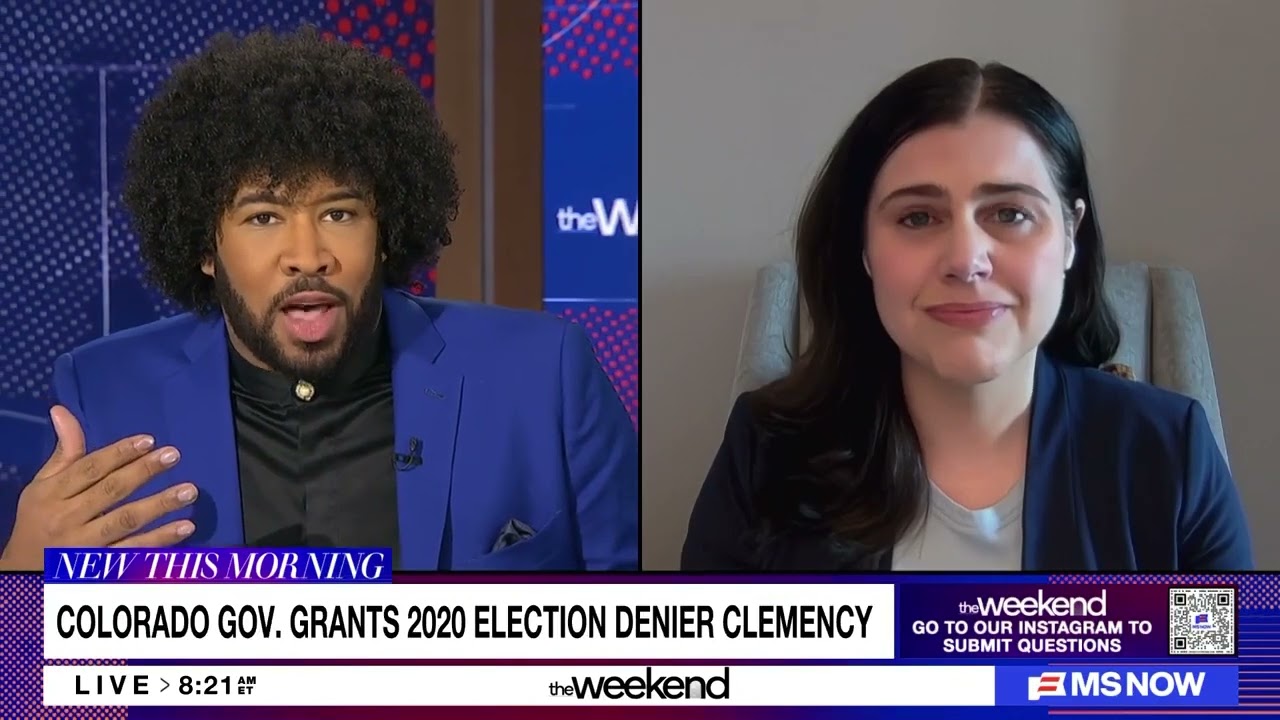 Colorado’s own state secretary Jenna Griswold, who spoke to MS NOW’s “Weekend” panel in terms of treachery.
“Tina Peters was no political prisoner,” said Griswold. “She compromised her voting equipment, trying to prove Trump's big lie. Her actions, and then her lies and conspiracies about her actions were used to further destabilize our elections and increase the threat level to election officials. So, the fact that she is going to be released early, in what I view is special treatment is just ridiculous.”
Griswold, who worked with state legislators to pass a new election insider threat law making it a felony to compromise voting equipment, added that the clemency sends a message to Trump's followers that if they break the law, they may get off on federal and state charges: “It will embolden the election denialism movement in this country at a time that is quite dangerous with our upcoming elections.”
MS NOW anchors replayed headlines revealing Trump’s open war against the state of Colorado since returning to the White House last year. These include headlines declaring the administration’s move to “dissolve national climate research lab in Colorado: last December, his veto of a bipartisan bill to fund clean water pipeline in southeastern Colorado, and Trump’s freeze on aid for low-income Colorado families in January. Trump also rejected — for a second time — the state’s plea for disaster aid in April.
“I believe that the retribution has something to do with it,” Griswold said. “Trump has been obsessed with Tina Peters. She is one of or was one of the last people in the entire nation facing accountability for attacking American elections … so he really wanted her out. He tried to unlawfully pardon her himself. That didn't work. Tried to get her moved into federal custody in the federal prison system. That didn't work, tried over and over to pressure the governor to pardon.”
“Look, I know it's really tough to have federal aid cut,” added Griswold. “… But if we placate this lawless president who tries to bully his way into getting people to follow his lawless orders, democracy can fall.”
MSNBC VID]
---
SENT TO 9 YEARS, JUDGE SOUNDED LIKE HE WAS TALKING TO TRUMP
---
OMG AN 3 26
President Donald Trump is a Republican and Colorado Governor Jared Polis is a Democrat, but it looks like Polis is bending to Trump’s pressure that Polis commute the sentence of an election denier — and members of both parties are furious at Polis
"Justice in Colorado and America needs to be applied evenly, you never know when you might need to depend on the rule of law," Polis wrote on the social platform X about the possibility of pardoning or commuting the sentence of former Mesa County Clerk Tina Peters. "This is the context I am using as I consider cases like this that have sentencing disparities."
Polis argued in his post that Peters’ sentence is analogous to that of a former state lawmaker recently sentenced to probation and community service after being convicted of one of the same crimes. Yet as journalist Jordan Rubin pointed out at MS NOW, those two cases were very different in important ways.
“Jaquez Lewis was convicted of one count of attempting to influence a public servant and three counts of forgery,” Rubin wrote, explaining that Lewis forged letters to refute allegations she was mistreating her staff and expressed remorse. By contrast, Peters has never expressed remorse for much more serious crimes — per the state conviction, “While serving as the Clerk and Recorder of Mesa County, Ms. Peters deceived county employees to obtain credentials that allowed an unauthorized person to access Mesa County’s voting system after the 2020 election.” He added “even after her conviction, she reaffirmed her position that her conduct was justified by her conspiracy theories about the 2020 election.”
Judge Matthew Barrett, who sentenced Peters, said “this case was about your corrupt conduct and how no one is above the law.” He added, “I consider deterrence in sentencing that is both general and specific that the sentence I impose must deter Ms. Peters from engaging in similar conduct in the future, but it also must deter others generally from engaging in this type of conduct.”
Peters was convicted of three counts of attempting to influence a public servant and one count each of conspiracy to commit criminal impersonation, official misconduct, violation of duty and failing to comply with requirements of Colorado’s secretary of state. She allowed QAnon conspiracy theorists to access sensitive voter information in the hope to find evidence of voter fraud, which whenever produced.
“The suggestion that everyone convicted under the same statute should receive the same sentence overlooks why the legislature created a [sentencing] range in the first place: no two crimes and no two defendants are the same,” said Dan Rubinstein, the Republican prosecutor who worked to convict Peters. He added that modifying her sentence “would be a gross injustice to the affected citizens I represent.” In addition to being tried by a Republican prosecutor, Peters is in a county that Trump won by 28 percentage points.
Rubin himself wrote, “Still, as with another of Trump’s pardons for 2020 election–related crimes, the legally limp move sent a strong signal that the president supports the subversive behavior taken on his behalf and, as importantly, that he’ll continue to support such behavior in the future however he can.”
Sen. Michael Bennet, a Colorado Democrat, said on Thursday that he shares Rubin’s concern.
“Tina Peters knowingly broke the law, undermined our elections, and was rightfully convicted by a jury of her peers,” Bennet said. “At a moment like this, we can’t capitulate to a lawless Administration.”
By contrast Peters’ lawyer Peter Ticktin insists that “(Peters) has been made to stay in prison because people are afraid of what she would say.” He also described her as a “political prisoner.”
===
AN 12 25
President Donald Trump signed a formal pardon for Tina Peters, according to Peter Ticktin, her Florida-based attorney, who shared the pardon document with Newsline on Friday.
The document, which appears to be dated Dec. 5, says it grants “a full and unconditional pardon” for “those offenses she has or may have committed or taken part in related to election integrity and security during the period January 1, 2020 through December 31, 2021.”
The pardon applies to Peters’ conviction on state charges, Ticktin said. The charges related to Peters’ role in a 2021 security breach when she was the Mesa County clerk.
Presidential pardons have universally been understood to apply only to federal crimes, not state crimes. Reports about Trump’s claim to have pardoned Peters, announced on social media Thursday, characterized it as empty or “symbolic.”
“Trump’s pardon has no legal impact on her state conviction and incarceration,” according to CNN.
But Ticktin says the pardon is the tool he needs to compel Colorado to free Peters.
“She didn’t commit any federal offenses,” Ticktin said in an interview with Newsline. “The only thing that she could be pardoned on are state offenses, because that’s all that are out there.”
Peters, 70, is incarcerated at La Vista Correctional Facility in Pueblo. The Republican was convicted by a Mesa County jury for her role in a security breach of her own election equipment that was part of an effort to find evidence that the 2020 presidential election was stolen. She was sentenced in October 2024.
Claims that the election was fraudulent or compromised have been debunked by elections officials, experts, media investigations, law enforcement, the courts and Trump’s own campaign and administration officials.
Ticktin applied to the Trump administration last month for a pardon. He followed up last week with a letter to Trump in which he detailed his argument that Trump has the power to pardon Peters. He says the Constitution’s references to the United States apply to the individual states as well as the country as a whole, concluding that the president “has the power to grant a pardon in any of the states of the United States.”
Colorado Gov. Jared Polis, a Democrat, said Thursday the state will abide by whatever courts order concerning the pardon. But he said Trump lacks pardon power in Peters’ case.
“Tina Peters was convicted by a jury of her peers, prosecuted by a Republican District Attorney, and found guilty of violating Colorado state laws, including criminal impersonation,” he said in a statement. “No President has jurisdiction over state law nor the power to pardon a person for state convictions.”
Ticktin expects the Trump administration to submit the pardon to the Colorado Department of Corrections, which is likely to refuse to release Peters, he said. The pardon then might have bearing in the Colorado Court of Appeals, where Peters has appealed her conviction.
“If the pardon counts, the appeal has to stop,” Ticktin said. “The appeal’s over. It becomes moot.”
Ultimately he expects the matter to reach the U.S. Supreme Court, where a 6-3 conservative majority has sided with Trump at an unusually high rate.
---
an 12 25
On Thursday, President Donald Trump claimed to have pardoned an ally serving a prison sentence related to his efforts to contest the 2020 election results, in a move Colorado Democrats called "meaningless" due to his lack of authority. Now, her lawyer has backed the use of military forces to help get his client out of prison, per a report from The Independent.
Tina Peters, 70, is a former Colorado election official currently serving out a 9-year prison sentence on state-level charges, having been convicted by a Mesa County jury in August 2024. Peters was found guilty of facilitating a security breach after she let prominent election denier and MyPillow salesman, Mike Lindell, enter a secure room and download data containing Colorado's 2020 election results, as part of his effort to find evidence of fraud and contest Joe Biden's defeat of Trump.
Following a series of federal pardons and dropped cases, Peters is now the only person serving prison time for actions related to Trump's denial of the 2020 election results. Despite Trump claiming to have pardoned her this week, the president is only capable of commuting federal charges, and Colorado officials have dismissed the possibility of releasing Peters from custody at his command. Appearing on Steve Bannon's War Room podcast, her lawyer, Peter Ticktin, agreed with Bannon's assertion that Trump should dispatch the 101st Airborne Division to free Peters from prison.
“Do I think it should be done? For who I am, yeah – I’d love to see that happen," Ticktin said.
Ticktin had previously issued pleas for Trump to pardon his client, despite the president lacking the necessary authority. In response to the earlier pleas, Phil Weiser, the Democratic Attorney General for Colorado, said any attempt by Trump to pardon Peters “will not hold up.”
“One of the most basic principles of our constitution is that states have independent sovereignty and manage our own criminal justice systems without interference from the federal government,” Weiser said.
Shad Murib, chair of the Colorado Democratic Party, also said that Trump “has no legal authority” to facilitate Peters' release from prison, and called the notion of a pardon from him "meaningless."
“We’re not surprised by President Trump shouting into the wind and issuing a meaningless pardon for his friend and fellow election denier Tina Peters,” Murib said.
Though some state governors lack complete pardon powers for state-level charges, Colorado Gov. Jared Polis, a Democrat, does have complete pardon power, and has not indicated that he has any intention to pardon Peters.
---
AN SN 11 25
When the Trump administration requested that Colorado transfer custody of Tina Peters from the state to the federal government, there was only one plausible response: Not in a million years.
But Gov. Jared Polis seems to have a different idea.
For some mysterious reason, he appears to think there might be some merit to the request. No matter how he comes down on the matter, he has already undermined the rule of law and insulted every local official who helps manage honest elections in the face of right-wing extremist threats.
Peters is serving time in state prison, and for good reason: The Republican former Mesa County clerk was the linchpin in a plan to breach the security of her own election equipment to prove the “big lie” that the 2020 election was stolen. She was convicted in state court of multiple counts related to the scheme, including four felonies, and sentenced to almost nine years behind bars.
The local district attorney who prosecuted the case was a Republican in a county that favored Trump by 28 percentage points, and there is no credible reason to think the conviction was unjust or compromised by politics.
But in MAGA America, what matters more than anything is personal loyalty to President Donald Trump, which Peters offers in ample measure. That’s why the president has repeatedly demanded that she be released, claiming preposterously that “she did nothing wrong, except catching the Democrats cheat in the Election” and promising “harsh measures” if Colorado fails to comply.
In March, J. Bishop Grewell, then the acting U.S. attorney for Colorado, and Peter McNeilly, then an assistant U.S. attorney for Colorado, were among three Justice Department officials who told a federal judge in Colorado they were reviewing the state’s prosecution of Peters. This month, Trump’s Bureau of Prisons formally made a request to the Colorado Department of Corrections to transfer her to federal custody.
The request is corrupt and deserves no consideration. Trump wants to aid a criminal ally, as he’s already done so many times since January.
“One is only left to assume that either the Trump administration wants her moved to federal custody so that they could somehow then release her outside of the jurisdiction of Colorado, which would be a blockbuster obstruction of justice by the U.S. government against a lawful state criminal order, or they want to put her in federal custody to give her some improved conditions,” lawyer Marc Elias, founder of Democracy Docket, said during an with podcaster Brian Tyler Cohen.
Yet more than a week after the Trump administration sent its request to the state, Polis’ office in a statement to Newsline said he was still “reviewing” the request.
There’s nothing to review. As stated by Phil Weiser, the Democratic Colorado attorney general, and Dan Rubinstein, the Republican district attorney who prosecuted Peters, in a joint letter last week imploring Polis to deny the administration’s request, Trump “has no legal basis to interfere with the sentence in this case,” and the request is an attempt “to circumvent Colorado’s sovereignty.”
Even if Polis ultimately decides to deny the request, his long silence in the face of such brazen lawlessness has already made him look weak, and it has done real damage. During a Tuesday press conference, when a bipartisan group of local election officials from around the state exhorted Polis to deny the request, county clerks said they have experienced an “immediate uptick in concerns about safety” in relation to the Peters case.
The clerks said they have yet to even hear from Polis, even though they sent him a letter last week requesting a meeting with him about Peters.
This is hardly the first time Polis has appeared to accommodate Trump or fully sided with team MAGA. His administration has been all too eager to supply sensitive information about Colorado residents to ICE as part of Trump’s inhumane mass deportation program.
In the Peters case, he risks undermining the rule of law and fueling doubts about voting in a state where brave Democratic and Republican officials have done so much to defend free and fair elections.
He owes it to anyone who hopes systems of justice can withstand authoritarian attacks to quickly, forcefully and publicly tell the Trump administration that Peters isn’t going anywhere.
---
// big lie gaslight? // j6 pardon?
rww 525 trump says communists, free her
===
wapo no lnx
Former County Clerk Gets 9 Years in Prison for Tampering With Voting Machines
Tina Peters, the former clerk of Mesa County, Colo., had tried to prove that the machines had been used to rig the 2020 election against former President Donald J. Trump.
Tina Peters, wearing a red jacket, speaks at a Trump rally in Casper, Wyo., in 2022.
Tina Peters, the former clerk of Mesa County, Colo., was scolded by the judge for repeatedly advancing false claims about former President Donald J. Trump’s defeat in the 2020 election.Credit...Natalie Behring for The New York Times
By Alan Feuer
Oct. 3, 2024
Tina Peters, the former clerk of Mesa County, Colo., was sentenced on Thursday to nine years in prison after being found guilty in August of tampering with voting machines under her control in a failed attempt to prove that they had been used to rig the 2020 election against former President Donald J. Trump.
At a hearing in Grand Junction, Colo., Judge Matthew D. Barrett scolded Ms. Peters sternly from the bench, telling her he had imposed the severe penalty because she had repeatedly advanced false claims about Mr. Trump’s defeat and in so doing become a celebrity among those who denied that he lost the race.
“But you are no hero, you abused your position and you are a charlatan,” Judge Barrett said, adding, “You cannot help but lie as easy as you breathe.”
The sentence was the first to be handed down against a local election official found liable for security breaches of voting machines made by Dominion Voting Systems. After Mr. Trump’s defeat to Joseph R. Biden Jr., pro-Trump activists across the country sought to gain access to Dominion machines, hoping to prove they had been used in a plot to flip votes from Mr. Trump to Mr. Biden.
But all of those efforts failed, and local officials in many cases opened investigations like the one into Ms. Peters.
Before Judge Barrett imposed her sentence, Ms. Peters apologized for the seven criminal charges that a jury found her guilty of but also sought to press her case that Dominion’s machines had been used to cheat Mr. Trump out of a victory.
She then went on a muddled tangent about how the district attorney who had filed the charges against her was somehow implicated in a plot to get her ailing husband to divorce her before Judge Barrett, in a burst of annoyance, cut her off.
“I’m convinced you would do it again if you could,” Judge Barrett told her at one point. “You’re as defiant a defendant as I’ve ever seen.”
At trial, Ms. Peters was convicted of helping an outsider — Conan Hayes, a former professional surfer turned technology wizard — to gain unauthorized access to one of Mesa County’s Dominion machines in May 2021.
Once Mr. Hayes got into the machine, he was able to capture county passwords and sensitive data about Dominion’s proprietary software that showed up three months later at an event questioning the results of the election hosted by Mike Lindell, the founder of the bedding company MyPillow, who is a prolific purveyor of election lies.
Alan Feuer covers extremism and political violence for The Times, focusing on the criminal cases involving the Jan. 6 attack on the Capitol and against former President Donald J. Trump. More about Alan Feuer
See more on: Tina Peters, Donald Trump, President Joe Biden, Dominion Voting Systems Corp
AP
A judge ripped into a Colorado county clerk for her crimes and lies before sentencing her Thursday to nine years behind bars for a data-breach scheme spawned from the rampant false claims about voting machine fraud in the 2020 presidential race.
District Judge Matthew Barrett told former Mesa County Clerk Tina Peters — after earlier sparring with her for continuing to press discredited claims about rigged voting machines — that she never took her job seriously.
“I am convinced you would do it all over again if you could. You’re as defiant as any defendant this court has ever seen,” Barrett told her in handing down the sentence. “You are no hero. You abused your position and you’re a charlatan.”
Jurors found Peters guilty in August for allowing a man to misuse a security card to access to the Mesa County election system and for being deceptive about that person’s identity.
AP AUDIO: Former Colorado county clerk Tina Peters sentenced to 9 years for voting data scheme
AP correspondent Norman Hall reports a former Colorado county clerk has been sentenced to 9 years in a voting data scheme.
The man was affiliated with My Pillow chief executive Mike Lindell, a prominent promoter of false claims that voting machines were manipulated to steal the election from former President Donald Trump. The discredited claims trace back to Trump himself, whose supporters attacked the U.S. Capitol because of them and who still hints at them in his third run for president.
At trial, prosecutors said Peters, a Republican, was seeking fame and became “fixated” on voting problems after becoming involved with those who had questioned the accuracy of the presidential election results.
A one-time hero to election deniers, Peters has been unapologetic about what happened.
Before being sentenced, Peters insisted that everything she did to try to unroot what she believed was fraud was for the greater good.
“I’ve never done anything with malice to break the law. I’ve only wanted to serve the people of Mesa County,” she told the court.
When Peters pressed on with claims no legal authority has corroborated about “wireless devices” and fraud software in voting machines, however, she drew the judge’s exasperation. Ballot recounts showed no discrepancies, he pointed out.
“I’ve let you go on enough about this,” Judge Barrett said. “The votes are the votes.”
Later, the judge noted that Peters has kept up public appearances in broadcasts to sympathetic audiences for her own benefit.
“It’s just more lies. No objective person believes them. No, at the end of the day, you cared about the jets, the podcasts and people fawning over you,” Barrett said.
Peters had the right to be defiant, he noted, but it was “certainly not helpful for her lot today.”
The breach led by Peters heightened concerns that rogue election workers sympathetic to partisan lies could use their access and knowledge to attack voting processes from within.
It’s impossible to overestimate the damage Peters has done to other election workers in Colorado and elsewhere, Colorado County Clerks Association director Matt Crane told the court.
“In a real and specific way, her actions have led directly to death threats and general threats to the lives and the families of the people who work in our elections,” Crane said. “She has willingly aided individuals in our country who believe that violence is a way to make a point. She has knowingly fueled a fire within others who choose threats as a means to get their way.”
He, his wife and his children have been among those threatened, Crane said.
===
// bb
---
Arizona election denial group leader uses QAnon-affiliated channel to urge viewers to flood election officials with spurious records requests
Inundating election officials with records requests is a tactic increasingly popular in the election denial movement
WRITTEN BY ALEX KAPLAN
PUBLISHED 01/11/24
An Arizona county Republican Party official who also leads an election denial organization in the state used a recent appearance on a QAnon-affiliated Rumble channel to encourage viewers to inundate election administration officials with public records requests — a tactic increasingly popular in the election denial movement.
During a January 8 appearance on The Tina Peters Show, Shelby Busch, a vice chair of the Maricopa County Republican Committee and co-founder of the election denial organization We the People AZ Alliance, told viewers to “be demanding” of election officials.
“Ask questions and start requesting records,” advised Busch, whose organization is primarily funded by fellow election denier and QAnon-connected figure Patrick Byrne. “Remind them that this is the people’s election.”
Badlands Media’s The Tina Peters Show and its eponymous host, Tina Peters, have ample ties to the QAnon movement and election denialism. Peters is a former Mesa County, Colorado, clerk who was indicted in 2022 by a grand jury for allegedly facilitating a security breach of her county’s election infrastructure. Peters has associated with a number of QAnon figures and has invoked QAnon terminology on her show. The Badlands Media Rumble channel was founded by QAnon influencers and largely dedicates its programming to covering QAnon and its related conspiracy theories.
During the interview, Peters and Busch rehashed supposed instances of election fraud in Arizona during the 2020 presidential election. At one point, Peters asked Busch to “tell people what they can do in their Maricopa … to make change” regarding elections.
In response, Busch, who also appeared on Peters’ show last April, told viewers to “learn how to do” public records requests to election administration officials regarding possible election fraud. Flooding election officials with such requests has become an increasingly common tactic used by the election denial movement.
Busch also offered to help Peters’ viewers put together their own records requests. She provided viewers with her email address and said, “If you don’t know how to do them, email me … or reach out to us through our website.”
“I will be happy to send you a template and walk you through it,” she added.
Peters also promoted Busch’s We the People AZ Alliance email address in an on-screen graphic during the show and urged viewers to contact Busch for help with their records requests.
Video
CitationFrom the January 8, 2024, edition of Badlands Media's The Tina Peters Show, streamed on Rumble
TINA PETERS (HOST): OK, so Shelby, tell the people — so you mentioned about your volunteers and the people that are working so hard. Tell people what they can do in their Maricopa, what they can do in their counties to make change.
SHELBY BUSCH (CO-FOUNDER OF WE THE PEOPLE AZ ALLIANCE): Absolutely. So number one, public records requests. Learn how to do them. And if you don’t know how to do them, email me at … or reach out to us through our website, and I will be happy to send you a template and walk you through it. Start asking questions. Be demanding of these election officials. Ask questions and start requesting records. Remind them that this is the people’s election. So that’s a first and foremost — you should really, really just start holding your government accountable. And if you don’t know how or what to do, get with somebody who does and learn. So it’s number one.
Number two, get involved with grassroots organizations in your community that are working on stuff like this and see where you can serve. Our voter rolls in every state are a mess. So it’s a great place to start, is learning how to look at voter rolls, knocking on neighbors’ doors, and just making sure that we have legitimate voters in our own neighborhoods. So that’s a really — another thing that you can do. It’s really easy.
But if none of that works for you, if you don’t have time for public records requests or to learn a new challenge, or you’re not comfortable knocking on doors, or maybe you can’t get out of the house, you can pray, because this is a spiritual battle beyond all, and you can show up on Election Day and cast your ballot, and you can stand up for election workers and election officials like Tina, who are putting everything on the line to expose this to the world. Support people who are trying to do the right thing, stand by their side, and encourage them. But most importantly, start developing relationships in your own community with your legislators and your elected officials. Because this is all we have is our voice. And make sure that you know how to use it.
PETERS: Yes. Thank you so much. And I put in the ticker at the bottom of the screen, “learn how to do public record requests at … .” You can — you can email Shelby, and she will send you or give you information how you can do that.
I think that’s so good. I — you know, I’ve had people on too, Shelby, about doing grand jury, you know, just — people have to get involved. They need to learn how to do pro se filings. You don’t always need to have an attorney. You can learn how to pro se, and the judge actually gives you more leniency if you’re not an attorney in how to do that. So I believe everybody can stand up. Everybody can do something. I always say there’s more of us than there are of them. They can’t get us all.
Busch’s use of Peters’ show marks yet another connection between the election denial and QAnon movements, with the former repeatedly using the latter for their efforts.
---
grift?
https://www.alternet.org/2022/07/tina-peters-2657779863/
an 9 22 colo
...Tina Peters, Mesa County’s Clerk, was not a cultish election denier immediately before or after 2020’s presidential election. She did not make any accusations that her voting system’s computers had been secretly sabotaged when Sandra Brown, Mesa County’s back-office election manager, mistakenly double-counted 20,000 ballots in late October 2020—a procedural error during preprocessing ballots that Brown repeated in Mesa County’s municipal elections in April 2021.
But soon after April 2021’s elections, where a slate of conservatives who skipped a candidate forum all lost, the first of what became a parade of pro-Donald Trump, self-proclaimed election IT experts began telling Peters about anomalies with her county’s voting system computers. The anomalies were the same clichés about illegal voters and forged totals that had been put forth by Trump diehards in other states. Except the allegations were dressed up as statistics and technicalities. Peters, a businesswoman turned public official, was more than impressed.
As March 2022 indictments by Mesa County District Attorney Daniel Rubenstein, a Republican, and a recent New Yorker profile recount, Peters used a standard update of election software in late April 2021 to make unauthorized copies of her election system’s hard drives, software, and data. The apparent goal was gathering intelligence to show that the technology—made by Dominion Voting Systems—could not be trusted to produce accurate vote counts.
Trump’s lawyers and partisan IT specialists had made copies of computer drives, software and data in December 2020 in Antrim County, Michigan, after a former state GOP leader turned state judge allowed it. The copies, of another Dominion system, were not to be shared. But they were soon leaked in Trump circles.
That effort, nonetheless, produced no evidence for any of Trump’s failed post-election lawsuits. Still, one day after January 6, 2021’s pro-Trump insurrection, some of the same data miners went to Coffee County, Georgia. There, an election official let them copy their Dominion system’s drives, software and 2020 data. Members of this loose cadre of IT experts showed up in Mesa County in late April—several weeks after back-office manager Brown again erred in using a computer as it was compiling vote subtotals in its municipal elections.
What happened next in Mesa County gets complex. It also reveals how a rare but recurring trend among a handful of local election officials—mistakes with setting up or using their system’s computers—can be exploited by partisans who claim that invisible forces are secretly stealing votes if their candidates lose.
In every cycle, there are some election officials who do not properly set up or use these computers—errors that usually are caught and corrected, but initially produce incorrect election results. This trend has been overlooked in the press coverage of the interstate plot by Trump’s IT gurus to steal election software and 2020 data.
The operational problems, however, are among the findings by the Independent Media Institute’s Voting Booth project, which has co-written a forthcoming guide about how election systems work. The co-author is Duncan Buell, a computer scientist who has studied voting systems, software, and data for more than a decade, and was an election official in Richland County, South Carolina, home to the state’s capital, Columbia. These errors recurred in each cycle that he studied.
In 2020’s general election, the programming, and operational mistakes were few and far between. Nonetheless, the errors that Trump’s IT squads seized upon—errors that were corroborated by post-election inquiries by other government bodies—helped fuel the lie that the presidential election was stolen.
Moreover, some of the election workers who made these mistakes—such as Mesa County’s Brown—and their elected superior—such as Peters—then fell under the spell of Trump’s conspiratorial IT squad—producing fodder for more false claims.
These trends—mistakes with programming or using election computers and rogue officials who abuse the public trust by making unfounded claims—offer warnings before 2022’s general election. Many 2020 election-deniers are candidates seeking state and federal office this fall. A few already have shown in their primaries that they will attack the process and technology if they fear they may lose.
Before 2020’s election, virtually all of the members of Trump’s IT squads did not know much about voting system computers or election administration safeguards. But they eagerly presented their credentials and claimed, that election computers had been hijacked, and, moreover, that no Dominion system should be trusted. Their unproven accusations became, and remain, fixtures in Trump circles.
“It wasn’t just Colorado,” said Walter Daugherity, a recently retired University of Texas lecturer in computer science and engineering, on an August 22 televised panel sponsored and hosted by Mike Lindell, a Trump ally who has spent millions to promote the stolen election fiction and whose actions are under investigation by federal authorities. “Everywhere across the country that had a Dominion trusted build [software] upgrade had the same thing happen.”
Daugherity was one analyst who received Mesa County’s pilfered data. He and Jeff O’Donnell, an IT analyst whose moniker in Trump circles is “the Lone Raccoon,” co-wrote a series of reports concluding that Mesa County’s computers mysteriously allowed 20,346 presidential ballots to be counted twice. The double counting was not the fault of election officials, specifically back-office election manager Brown, they wrote, positing that an “external trigger,” “signal,” “software algorithm” or “pre-programming” had caused “unexpected voting patterns.”
Their speculation was one of many similar pronouncements in Trump circles. They accused Dominion of complicity in a scheme that would be illegal, if it were true.
“The report made claims which, if true, would indicate a crime was committed related to election fraud,” Mesa County District Attorney Rubenstein said via email on August 25. “I stand by the investigation that we conducted and am confident that there is no evidence of a crime being committed.”
Inside One Disinformation Bubble
Mesa County was among a handful of counties across America’s 8,000-plus election jurisdictions where Trump allies discovered glitches in administering the 2020 election. The glitches, which produced incorrect initial vote counts, were signs that Trump lost due to a vast conspiracy, they asserted.
That narrative, which continues today, ignores the banalest explanation of what happened in Mesa County and in jurisdictions such as Antrim County, Michigan. In both locales, county election officials erred with setting up or using their voting system’s computers, mistakes that initially were not noticed but were later caught and corrected.
The operational errors were recorded by the system’s computers, which keeps logs of every action—from ballot paper jams to vote counts. The errors were confirmed by other evidence, such as, in Mesa County, police investigators reconstructing the mistakes on the same equipment, parsing video footage from security cameras in the room where they occurred and interviewing witnesses. But conspiracy-minded Trumpers, including O’Donnell and Daugherity, went looking for incongruities in computer logs and vote count databases, which, they said, masked programming that reassigned votes from Trump to other presidential candidates.
“The findings in this report were prepared by the authors as consultants to the legal team representing Tina Peters, the Mesa County Clerk,” the executive summary of their March 19, 2022 report said. “The findings provide evidence of unauthorized and illegal manipulation of tabulated vote data during the 2020 General Election and 2021 Grand Junction Municipal Election. Because of this evidence, which led to the vote totals for those elections being impossible to verify, the results and integrity of Mesa County’s 2020 General Election and the 2021 Grand Junction Municipal Election are in question.”
Among the incongruities they cited are batches of ballots that were not sequentially numbered in a results database. That can occur, several election experts explained, when batches of ballots with sloppy ink marks (made by voters) are detected by the software and set aside until the voter’s intent is determined. That process, called adjudication, is done in Colorado in the presence of political party observers. The batches are added to the database after the voter intent issues are resolved. (It was at this step where Brown failed to correctly use the system’s computers).
The Mesa County prosecutor took the duo’s report seriously and investigated. On May 19, 2022, Rubenstein sent a 24-page letter to Mesa County Commissioners and the Grand Junction City Council summarizing the investigation and debunking the vote-padding claims in the most pedestrian way. Two initial miscounts had occurred. The first was in 2020’s general election. The second was in municipal elections in April 2021. Both were “caused by direct action of the former Back Office Election Manager Sandra Brown.”
Investigators found that Brown had stopped and then restarted the computer during the adjudication process, including replacing one computer—without resetting the system. Brown did not call the vendor for assistance, the county prosecutor’s letter said. She was confused, tried to fix things, and erred—essentially double-counting votes at this stage in the process. Election judges from political parties witnessed this, as did an overhead video camera.
“No evidence exists that would indicate that Ms. Brown had any nefarious or criminal motive in those actions, but rather appears to have been trouble-shooting problems in the flow of the adjudication process,” Rubenstein wrote.
Human error in configuring and running election computers also sparked stolen election allegations in Antrim County, Michigan. There, the initial results in the conservative northern Michigan county were incorrect because one contest had been omitted on the ballots when configuring the system’s computers. Nobody caught the error until suspicious vote totals surfaced on Election Night. (Because one race was left out, votes were assigned to the wrong candidate in a tabulation spreadsheet, essentially bumping Trump votes down one line, where they were assigned to Joe Biden.)
In both counties, Trump supporters said that the entire state’s election apparatus was corrupt and demanded that the state’s certified results be thrown out. Beyond such hyperbole, a key observation emerges. Trump’s self-declared election experts were not looking at, nor may not even be aware of, the array of data sets, election records and administrative protocols that catch and correct the errors that occur. In Mesa County, for example, the district attorney’s report made this point.
“These actions were verified to have been done by her [Brown] through video evidence, corroboration of records, audit of randomly selected ballot images [created by ballot scanners], interviews with witnesses and experts, and recreation of certain scenarios using a test environment and prove that the conclusions of Report 3 [O’Donnell’s and Daugherity’s report] are incorrect claims of what may have occurred,” Rubenstein said. “At this time, no evidence suggests that these actions negatively impacted the election.”
In contrast, what the pro-Trump duo used as the basis for their inquiry—analyses built on Peters’ pilfered computer drives—is a thinner evidence base.
The pair, who were reached by email after their August 22 presentation at Mike Lindell’s “Moment of Truth Summit,” sent a rebuttal to Rubenstein’s summary where they rejected numerous assertions and questioned the district attorney’s expertise, evidence, and methods. (Rubenstein also noted they had lied about interviewing 11 people who had been in the room when Brown messed up.)
When asked by this reporter why they did not mention the DA’s review in their presentation at Lindell’s August 2022 forum—where O’Donnell said, “There is still no evidence that this was ever or even could have been something that was done by the clerk at the time”—O’Donnell replied that the DA’s investigation was a sham and said that my questions were “insulting.”
“We did not mention the DA’s report because it is such a sloppy ‘investigation’ that it deserves no recognition other than derision,” the “Lone Raccoon” said. “It is sad to me that somebody who is a ‘national political reporter’ would blindly fall fort the propaganda put by a small-time DA instead of actually doing their own research. However, that seems to be the rule these days.”
“Doing Their Own Research”
Perhaps my e-mail was too blunt when asking the pair if they were aware of other evidence that explained Brown’s incompetence (she was fired and faces charges related to the data breach); and what was their response to the D.A. saying they lied when they said they had talked to the party observers present (who spoke to police investigators) when Brown erred?
But I had done my “own research.” When reporting on the Cyber Ninjas’ review in Arizona in 2021, I had repeatedly seen the disinformation dynamic that I saw here. Partisans with forgone conclusions started to parse election records. Lacking prior experience in studying election systems, they did not understand where what they were seeing in the electronic records related to wider contexts and protocols. That didn’t stop them from putting forth doubts about the results. And I’d also heard about the duo’s missteps from a lifelong Republican and credible election data analyst.
Benny White, a former fighter pilot and lawyer who lives in Tucson, Arizona, has been an election observer and data analyst for the Arizona Republican party for years. He became a persona non-grata in Trump circles for analyses in early 2021 that found tens of thousands of ballots cast by otherwise loyal Republicans in the greater Phoenix area had not voted to re-elect Trump. (The voting patterns were found in the final spreadsheet of every vote cast in every race.)
Reached by phone, White said that the duo called him as they were parsing Mesa County’s tabulation-related databases. White recalled that he told them where their assumptions were mistaken, and what they were not considering because they were not familiar with election administration and safeguards that find and fix errors.
“These folks have no understanding or appreciation of election administration,” he said. “They’re looking at everything from a sterile, mechanistic perspective. There are problems that can be caused because of human interface in the system design where operators can make mistakes. And for that reason, I am always an advocate of having an independent body, whether it’s a knowledgeable person or a bipartisan group of overseers, that is present at all times to watch what’s going on and ask, ‘Why are you doing that?’”
For example, White recalled that the duo claimed that the county’s voting system “had done something nefarious because these ballots [during adjudication] weren’t all tabulated in sequence.” But that circumstance occurs if the voter’s intent on a ballot is in question, White said, in which case Dominion’s software “will hold that batch [of 1,000 ballots from] being included in the aggregate results… That was another thing that it seemed to me that Daugherity failed to understand.”
“He bases a lot of his conclusions on statistics, statistical analysis,” White said of Daugherity. “There have been single instances where he would tell me something, and I would say, ‘Walter, you’re not considering this other facet of what was going on in that particular election… You have to know more before you reach these conclusions.’”
Election administration is not simple. It takes years to understand election law, varieties in state rules and procedures, the voting system technology and all of the subsets of data created and compiled that add up to winners and losers. Trump’s IT squad might be forgiven for misunderstanding and misinterpreting what they saw, if they had been more humble and fair-minded. But they weren’t.
Their mindset is to create chaos and doubt, while claiming they are seeking the truth. The clearest evidence of that mindset is how they exploited human errors by election officials by not accurately contextualizing those mistakes, but repeatedly overclaiming that an entire jurisdiction’s votes were suspect, and that the same election technology deployed nationwide must be rejected.
With scores of 2020 election-denying candidates running for state and federal office in 2022’s general election, this deceitful pattern is likely to recur.
Author Bio: Steven Rosenfeld is the editor and chief correspondent of Voting Booth, a project of the Independent Media Institute. He has reported for National Public Radio, Marketplace, and Christian Science Monitor Radio, as well as a wide range of progressive publications including Salon, AlterNet, the American Prospect, and many others.
mma 8 22 no vid
two additional right-wing activists who have been implicated in a wide-ranging scheme to breach election data appeared on Steve Bannon’s War Room podcast from late 2020 to mid-2021 to discuss their efforts to overturn the results of the election. The resurfaced video provides a contemporary account of what the two men were saying in their own words during the period now under scrutiny.
The two right-wing figures are former Michigan state senator and election fraud conspiracy theorist Patrick Colbeck and Matthew DePerno, a conservative Michigan lawyer and Trump-endorsed Republican nominee for state attorney general. Both have been active in efforts in Michigan to overturn the results of the election, often describing their work in real time on Bannon’s podcast. A new investigation from The Washington Post partially reveals each of their roles in accessing sensitive electoral data.
DePerno is a frequent guest on War Room – a supposed authority on purported security flaws in Dominion voting systems and other discredited election denialism. Following former President Donald Trump’s loss, DePerno hired a forensics firm called SullivanStrickler to obtain election data from Dominion Voting Systems as part of a lawsuit he had brought seeking to overturn the results of the 2020 election, according to the Post. After a judge granted DePerno limited access to the machines in December 2020, he and Trump lawyer Sidney Powell instructed SullivanStrickler to carry out a forensic examination of Dominion’s voting systems, which was successful in gaining access to the data.
Colbeck appears to have downloaded some of data that SullivanStrickler collected as part of the DePerno investigation. An account tied to Colbeck “downloaded six files from the same folder on Jan. 5, 2021, according to the records, including files labeled ‘election management server’ and ‘ThumbDrives,’” according to the Post. The Post also reported that DePerno couldn’t remember if he’d given access to the files to Colbeck and the other election denialists who accessed the data.
Colbeck and DePerno – who is now facing criminal investigation for conspiracy to tamper with voting machines across three counties in Michigan – are two of several election denial activists who have appeared on War Room and subsequently been implicated in the data breach scheme. Brian Kennedy, a senior fellow at a Trump-aligned think tank, also appeared on War Room in late 2020 to discuss his involvement in the failed recount campaign following Trump’s loss, as previously reported by Media Matters. Kennedy was named in an earlier Post investigation as having been in communication with the forensics firm that obtained the data for DePerno. The latest Post story says former War Room guest and right-wing commentator Joe Oltmann also accessed the data.
Matthew DePerno on War Room
On May 5, 2021, DePerno appeared on Bannon’s show to talk about his ongoing lawsuit in Antrim Countyand what he claimed were Dominion security flaws. (The lawsuit was eventually dismissed.) In that interview, he referenced Dominion’s “election management system,” a phrase very similar to the name of one of the files Colbeck allegedly downloaded.
[vid]
We’re the only case in the country that’s been able to look at actual forensic images,” DePerno said. “December 6, 2020, we went into Antrim County and actually collected forensic images of their election management system.” DePerno then claimed that through this work, his team had been able to “just manipulate any database we want.”
Earlier in the interview, he’d claimed that his access to Dominion systems had given his team the capacity, in general, to change the outcome of any election on a hypothetical ballot.
“Looking at this data, looking at the forensic images and conducting our own tests with ballots and the Dominion system, we put out a video this week that shows that we can flip votes in any race, in any election, up ballot, down ballot, from the president's race, all the way down to any school board race,” DePerno said. “We can select certain races to keep clean. We can select certain races to flip votes in from one candidate to another.”
In June, DePerno again referenced Dominion’s election management system on War Room.
“We’ve proved now that there was direct access to the Antrim County election management system,” DePerno said. “We show that on November 5, we can see it in the forensic images, that an anonymous user logged onto the EMS remotely with escalated privileges and made changes to the database when they were trying to retabulate the election.”
Colbeck’s interest in the “election management server” file may have been tied to DePerno’s repeated claims about what access to that system allowed a user to do.
There is no evidence that any votes tabulated by Dominion were changed in the 2020 election. Still, cybersecurity researchers have warned that distributing the kind of data that DePerno and Colbeck had access to could potentially be used in the future to exploit security flaws and engage in precisely the type of activities that Trump supporters are falsely alleging happened in 2020.
Patrick Colbeck on War Room
Colbeck made several appearances on Bannon’s show immediately after Trump’s loss to discuss his efforts to challenge the Michigan election results.
On November 19, 2020, Colbeck described himself as a “bit of a tech geek,” and explained that he wanted to get involved in the recount effort so he could investigate the system’s software.
“I went in there wanting to understand the stuff that people weren't physically seeing or on the ballot,” Colbeck said. “So I wanted to understand the electronic chain of command between vote tallies and and the communications of vote tallies.”
Later the same day, Colbeck again appeared on War Room and falsely claimed that vote counts were not reliable because tabulators had been connected to the internet.
“Then you get to the basics of a vote tally, which is not – there's no chain of custody around that, particularly around paper chain of custody and electronic chain of custody,” Colbeck said. “When you've got the tabulator, it's connected to the internet, there is zero chain of custody around the vote tally.”
“So is it any wonder why we had strange vote flipping happening in the middle of the night?” he added.
[vid]
the following week, Colbeck returned to War Room to again claim, incorrectly, that “the tabulator computers and the adjudicator computers and the local data center … were all networked to each other” and connected to “a cable that connected to the internet.”
“And you could see the proof that they were all connected to the internet,” Colbeck continued. “If you go look in the bottom right hand corner of all your Windows 10-based PCs and you see the little window on the bottom, there is a little icon that if you roll the mouse over there, it says, connected to the internet. But all the Detroit elected officials that I contacted that night refused – they said specifically that it was not connected to the internet. And from my background, I know differently.”
In fact, an audit and report from Michigan Republicans in 2021 found that although some of the machines had been connected to a local area network (LAN), there is no evidence that the tabulators were connected to any outside networks or that any purported internet connection had been exploited to alter any votes. The LAN connection, “which would create the same icon on a computer screen indicating a network connection as is shown by an internet accessible network,” may have accounted for Colbeck’s confusion.
Tracy Wimmer of the Michigan Department of State had previously debunked Colbeck’s false claims as well.
“No ballot tabulation machines were connected to the internet at Detroit’s counting board,” Wimmer told The Associated Press in December 2020. “The machines were networked locally to each other and the adjudication machines by ethernet cable, and so some people suggested they were online. They were not.”
Although it’s not publicly known precisely what information the account linked to Colbeck downloaded, the name of one of the other files he allegedly accessed – “ThumbDrives” – offers a possible clue. In Michigan, when voting is over, officials transfer the final tally generated by the tabulators, which Colbeck incorrectly said were connected to the internet, to the clerk’s office via flash drives. The data Colbeck received could be related to those final vote tallies or other information related to transferring the vote totals.
It’s not clear from the Post’s reporting whether Colbeck or any of the other election deniers who downloaded the Michigan data could face legal exposure. In general, breaching an election system and distributing the data is a serious crime. Colorado county clerk Tina Peters, a hero and repeat guest on War Room: Pandemic, is facing felony charges for allegedly tampering with election equipment and for obstruction following Trump’s loss.
8 22
https://en.wikipedia.org/wiki/America_First_Secretary_of_State_Coalition
America First Secretary of State Coalition ("America First SOS Coalition") is an American conservative coalition formed to support a slate of candidates in the 2022 United States secretary of state elections. The coalition's president is Jim Marchant, a Republican candidate for Nevada Secretary of State, and is headquartered in Las Vegas.[1][2]
Candidates supported by the coalition have advocated former President Donald Trump's baseless claims that the 2020 election was stolen. The coalition has endorsed over a dozen candidates for state secretary of state, as well as Pennsylvania gubernatorial candidate Doug Mastriano.[3] The coalition is financially supported by the affiliated Conservatives for Election Integrity PAC (CFEI PAC).[4][5]
- :{1:(style="display:table-cell;padding-left:0px;padding-right:0.5em"):}::{History and foundation:(style="display:table-cell"):}:
- :{2:(style="display:table-cell;padding-left:0px;padding-right:0.5em"):}::{Policy goals and support:(style="display:table-cell"):}:
- :{3:(style="display:table-cell;padding-left:0px;padding-right:0.5em"):}::{Candidates:(style="display:table-cell"):}:
- :{4:(style="display:table-cell;padding-left:0px;padding-right:0.5em"):}::{See also:(style="display:table-cell"):}:
- :{5:(style="display:table-cell;padding-left:0px;padding-right:0.5em"):}::{References:(style="display:table-cell"):}:
History and foundation
The existence of the coalition was first disclosed by Marchant during a conversation on Steve Bannon's podcast, War Room.[6] Marchant has been described as the leading organizer of the coalition.[7][8]
The coalition reportedly formed following a meeting in May 2021 involving Marchant, QAnon conspiracy theorist Wayne Willott, and other conservative activists and fundraisers.[9] Mike Lindell, founder and CEO of My Pillow, Inc., is reportedly a backer of the coalition.[10]
Initial candidates supported by the coalition include Mark Finchem (Arizona), Kristina Karamo (Michigan), and Jody Hice (Georgia), each of whom have been endorsed by former President Donald Trump.[11] As of February 2022, Marchant is working to recruit candidates running for secretary of state in both Wisconsin and Minnesota.[12]
Conservatives for Election Integrity PAC (CFEI PAC)
An affiliated political action committee (PAC), the Conservatives for Election Integrity PAC (CFEI PAC), was founded by Marchant with the goal of fundraising for candidates for secretary of state. According to the Brennan Center, the PAC has raised $110,000 as of May 2022. The America Project, founded by former Overstock.com CEO Patrick M. Byrne, is a prominent contributor to the PAC.[4]
Policy goals and support
According to The New York Times, the coalition supports eliminating alleged voter fraud through "eliminating mail-in ballots, requiring single-day voting and committing to “aggressive voter roll cleanup,” measures that could suppress thousands of Democratic votes."[13]
Candidates
The list of candidates are provided from the America First SOS website.[14]
| Candidate | State | Primary Date | Primary Result |
|---|---|---|---|
| Audrey Trujillo |  New Mexico | June 7, 2022[3][a] |  Nominated |
| Doug Mastriano |  Pennsylvania (Governor) | May 17, 2022[15] | Nominated |
| Kristina Karamo |  Michigan | April 9, 2022[16][b] | Nominated |
| Mark Finchem |  Arizona | August 3, 2022[17] | Nominated |
| Michael Brown |  Kansas | August 2, 2022[18] |  Lost primary |
| **Tina Peters** |  Colorado | June 28, 2022[19] | Lost primary |
| Jim Zeigler |  Alabama | June 21, 2022[20][c] | Lost runoff |
| Diego Morales |  Indiana | June 18, 2022[21][d] | Nominated |
| Jim Marchant |  Nevada | June 14, 2022[22] | Nominated |
| Keith Blanford |  South Carolina | June 14, 2022[23] | Lost primary |
| Rachel Hamm |  California | June 7, 2022[24] | Lost primary |
| Jody Hice | [ ](https://en.wikipedia.org/wiki/Georgia_%28U.S._state%29 "Georgia (U.S. state)") Georgia | May 24, 2022[25] | Lost primary |
| Dorothy Moon |  Idaho | May 17, 2022[26] | Lost primary |
| Robert Borer |  Nebraska | May 10, 2022[27] | Lost primary |
See also
- 2022 United States secretary of state elections
- America First (policy)
- Attempts to overturn the 2020 United States presidential election
- QAnon
References
...
- Far-right organizations in the United States
- Conservative organizations in the United States
- QAnon
- Organizations established in 2021
an 7 22
An indicted clerk in Mesa County, Colo., is wanted for arrest again after allegedly violating certain conditions of her previous bond.
According to The Daily Sentinel, Tina Peters is said to have violated her bond when she "included Director of Elections Brandi Bantz in an email she sent in the wee hours of the morning Wednesday to counties across the state in an attempt to get them to conduct a recount of her loss in the June primary race to be the GOP nominee for secretary of state."
On Thursday, July 21, another warrant was signed for her second arrest.
READ MORE: FBI raids homes of Colorado MAGA county clerk and Lauren Boebert’s former campaign manager: report
Per the news outlet, Peters was prohibited from contacting anyone in the clerk's office as a result of being charged with nearly a dozen felony and misdemeanor counts. Peters is facing a total of 10 counts for "tampering with election equipment and misconduct."
The bond also includes specifications on who Peters was supposed to distance from. Bantz, who was appointed to Peters' previous role, was reportedly one of those people.
The outlet reported: "In her email, Peters was attempting to circumvent the Colorado Secretary of State’s Office, which had already rejected her request for a recount last week because Peters didn’t pay the $236,297 cost for it as required by law because her election results were nowhere near the one half of 1% threshold that calls for an automatic recount."
In response to Peters' email, Dwight Shellman, the county's regulation and support manager in its Election Division issued a statement.
READ MORE: MAGA-supporting election clerk named in Colorado data breach
“There is no statutory authority for Ms. Peters to request a recount of the secretary of state race on the Republican Party ballot ‘in selected counties,’ or to attempt to arrange a recount directly with clerks and records of some or all counties, or to dictate that an improperly requested recount be conducted by hand,” Shellman said.
“Ms. Peters’ efforts to arrange hand recounts in selected counties by circumventing the statutory recount process and the responsible election official is completely improper and should be disregarded,” he added. “If you feel obligated to respond to Ms. Peters’ early morning email, please advise her that her request is improper.”