ACS Am Const Soc
---
see yass conf 2/3 --> 3/5 amend
trello says will not endorse mta acuna
---
4/24
FB 2021? 100057350892561
active Stanford Law School | ACS
---
---
an 2 26
Back in 1982, the Federalist Society was founded with the goal of pushing U.S. courts to the right. And their efforts have been successful: Although Democrats have won the popular vote in seven of the United States' last nine presidential elections, six of the U.S. Supreme Court's justices are GOP appointees. Three of them — Justices Brett Kavanaugh, Neil Gorsuch and Amy Coney Barrett — were championed by the Federalist Society and appointed by Donald Trump during his first presidency.
Not all of the conservatives who have been active in the Federalist Society over the years, however, are pro-MAGA. Attorney George Conway and retired Judge J. Michael Luttig are on the right but very much in the Never Trump camp.
Meanwhile, the American Constitution Society (ACS), founded at Georgetown University in Washington, DC in 2001, was modeled after the Federalist Society, but with the goal of moving the U.S. courts in a more liberal/progressive direction.
In an op-ed/essay published by the New York Times on February 16, legal expert Jeffrey Toobin stresses that the "new leadership" at ACS has "a new goal: to expand the use of the courts to oppose President Trump's agenda."
New ACS President Phil Brest, Toobin notes, helped former President Joe Biden "nominate and win confirmation of 235 federal judges."
"Those judges — and others appointed by Democratic presidents — have proved that the most effective resistance to Mr. Trump has come not from Democratic politicians, but rather, from federal judges," Toobin explains. "In the last several weeks alone, these judges, many of them Biden appointees, have ordered the release from immigration custody of five-year-old Liam Ramos and his father and their return to their home in Minnesota; blocked the Trump Administration from ending temporary protections from deportation that had been granted to thousands of Ethiopians living in the United States; and directed the Trump Administration to allow members of Congress to make unannounced visits to ICE detention facilities."
Toobin adds, "According to a Times analysis of federal appeals court rulings in 2025, judges nominated by Mr. Biden ruled in support of Mr. Trump’s policies 25 percent of the time, while those appointed by Mr. Trump supported him 92 percent of the time.
Toobin notes that when the Federalist Society was created in 1982, the "liberalism of the Warren Court era still influenced the Supreme Court." Chief Justice Earl Warren was a Republican nominee of President Dwight D. Eisenhower, yet many decisions applauded by liberal and progressives — from New York Times v. Sullivan to Griswold v. Connecticut to Stanley v. Georgia — came from the Warren Court.
In 2026, Toobin argues, Democrats need to understand what worked for the Federalist Society and use their methods to move the federal courts to the left.
"The members of the Federalist Society took the risk that Democratic legal thinkers have so far avoided," Toobin observes. "Though the Federalist Society does not as a group take formal positions on issues, the Federalists gave a platform for their clear agenda and absorbed the criticism that came with it. But when they won elections and thus seats on the Supreme Court, they knew what they wanted to do and why, and they changed the face of American law. Democrats can do the same, but first they have to try."
---
ref
Billionaires Are Bankrolling Judges’ Luxury Travel
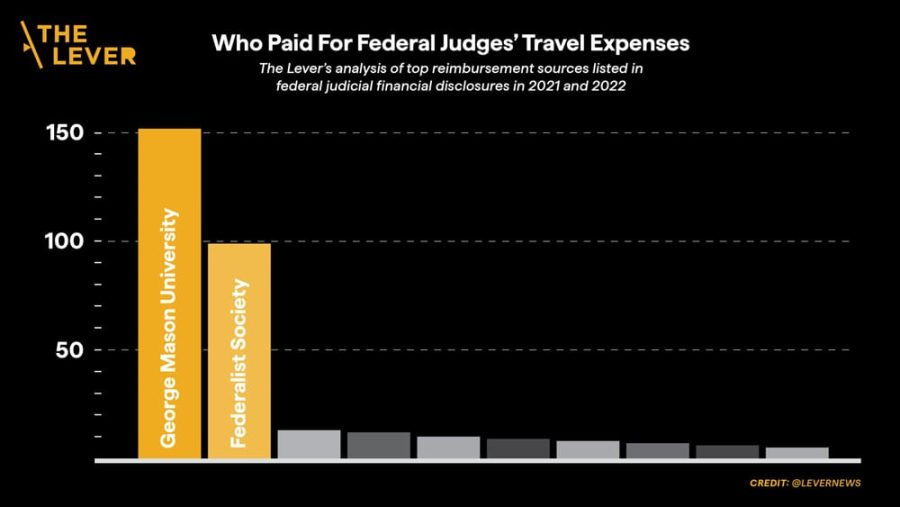
In 2021 and 2022, two conservative, billionaire-funded legal interests sent more than 100 federal judges on 251 trips to conferences and seminars in cushy locations around the country and overseas, according to a Lever review of hundreds of federal financial disclosure forms.
billionaire-Backed Conservative Legal Groups Are Paying for Judges’ Luxury Vacations
Right-wing legal interests funded by the megawealthy are routinely feting lower-court judges and treating them to all-expenses-paid trips, which effectively function as a reward system for judges who espouse and maintain hard-line conservative legal views.
Guests in the audience during the Federalist Society Executive Branch Review Conference at the Mayflower Hotel, April 25, 2023 in Washington, DC. (Drew Angerer / Getty Images)
In 2021 and 2022, two conservative, billionaire-funded legal interests sent more than one hundred federal judges on 251 trips to conferences and seminars in cushy locations around the country and overseas, according to a Lever review of hundreds of federal financial disclosure forms.
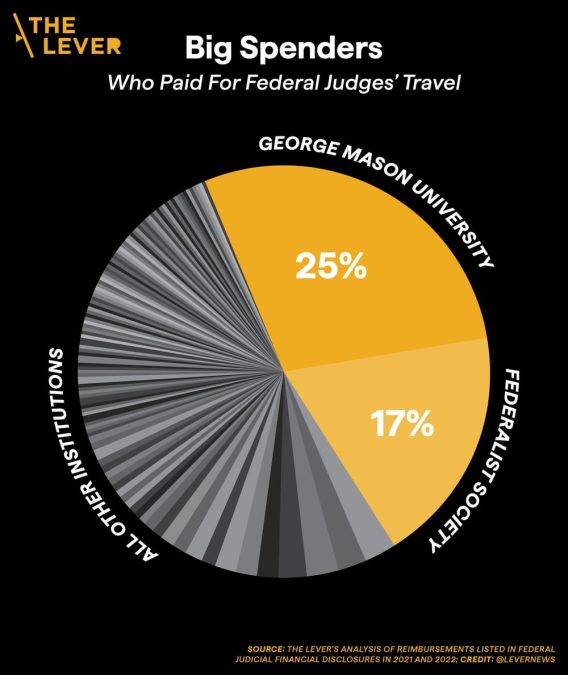
In all, George Mason University (GMU) and the Federalist Society, a conservative lawyers network, funded more than 40 percent of travel-related payments reported by federal judges in those years, far more than any other group.
The staggering number of junkets indicate that, as conservative Supreme Court justices face scrutiny for failing to disclose private luxury travel supplied by billionaire donors, right-wing legal interests funded by the megawealthy are routinely feting lower-court judges and treating them to all-expenses-paid trips to far-flung locales. As with the gifts to Supreme Court justices, the trips effectively function as a reward system for judges who espouse and maintain hard-line conservative legal views.
GMU — a Virginia-based public research university that’s home to the conservative Antonin Scalia Law School and its pro-business, anti-regulation Law and Economics program — paid for federal judges’ transportation, meals, or lodging at least 152 times from 2021–22. The Washington-based Federalist Society covered travel or food-related expenses on at least ninety-nine occasions during the same time period. The judges are not required to disclose how much the excursions cost.
The Federalist Society and GMU are both closely tied to the conservative legal movement and billionaire donors who have a financial interest in how the federal judiciary interprets laws. Both institutions also accept corporate donations.
“The data is really compelling,” said Caroline Fredrickson, a distinguished visiting professor from practice at Georgetown Law. “It confirms what we all knew intuitively: The Federalist Society and George Mason have a deep reach into the federal judiciary, and are using it to ensure that a very particular point of view about legal analysis is conveyed to judges and is done in luxury accommodations, so that judges are much more likely to attend.”
TheLever reviewed electronically available financial disclosure forms filed by more than 1,300 federal judges in 2021 and 2022, and identified at least 595 instances of judges disclosing reimbursements for travel-related expenses.
GMU and the Federalist Society were far and away the top sources of such payments, together accounting for 42 percent of all reimbursements listed by the federal judges. No other organizations came anywhere close to matching their generosity: The third-most common sources on the list — Notre Dame, Georgetown, and George Washington University — accounted for thirteen reimbursements apiece.
The Federalist Society is cochaired by former Donald Trump judicial adviser Leonard Leo, best known as the architect of the Supreme Court’s conservative supermajority, and the organization receives significant funding from his dark money network. Last year, the Supreme Court that Leo helped build overturned decades of precedent and eliminated federal protections for abortion rights.
Leo, the beneficiary of a historic $1.6 billion dark money donation in 2021, previously brokered a $20 million anonymous gift to rename GMU’s law school after the late Supreme Court justice Antonin Scalia in 2016. As theLever and ProPublica have reported, that gift to GMU was apparently made by Barre Seid, a little-known Chicago industrialist who converted his electrical surge protector empire into funding for Leo’s unprecedented dark money operation.
GMU has separately received tens of millions in donations from foundations affiliated with the billionaire oil and gas titan Charles Koch, a libertarian activist and longtime opponent of environmental regulations. That included a $10 million contribution in support of renaming the law school. Koch’s foundations have also supported the Federalist Society.
“Right-wing efforts to legislate through our courts — led and bankrolled by conservative kingpin Leonard Leo — have seeped into all levels of the federal judiciary,” said Caroline Ciccone, president of the progressive watchdog group Accountable.US. “It’s no surprise that Leo’s Federalist Society and Scalia Law School are now key hubs for conservative judges to score free luxury trips and unusual perks, undermining judicial integrity and contributing to plummeting public trust in our courts.”
Spokespeople for Leo, Koch’s charitable foundation, GMU’s Antonin Scalia Law School, and the Federalist Society did not respond to theLever’s requests for comment.
“Study Time”
The forty-nine-year-old Law and Economics Center, which promotes a pro-business, anti-regulatory legal perspective, has been housed at GMU since 1986. As the center noted in an event agenda last year, its purpose is to pull together “timely, relevant, and unassailable research on public policy issues” and share it with “those who are directly shaping our country’s public policy discussions.”
“With research divisions devoted to top-quality legal policy analysis and educational outreach to judges, attorneys general, and other policymakers, the [Law and Economics Center] is uniquely equipped to positively affect national policy outcomes,” the center wrote.
A 2022 review of rulings by judges who participated in an early version of this Law and Economics program decades ago by researchers at Columbia University, ETH Zurich, and the Toulouse School of Economics suggests that the core mission of the project has been highly successful.
“Economics-trained judges significantly shift legal outcomes in U.S. courts,” wrote the researchers. “They use economic analysis in their written opinions, render conservative votes and verdicts, rule against regulation, are somewhat more permissive on antitrust, and mete out harsher criminal sentences. When ideas move from economics into law, there are important policy consequences.”
The Law and Economics Center’s judicial educational programs tend to take place at uber-ritzy junkets. Between 2021 and 2022, GMU brought federal judges to destinations including the university’s homebase of Arlington, Virginia; the beaches of Naples and Destin, Florida, and Maui, Hawaii; the mountains of Colorado and Montana; and the United Kingdom and Italy. The program also hosted an event in Leo’s adopted home of Bar Harbor, Maine, right around the time that the Supreme Court overturned its landmark Roe v. Wade abortion rights decision.
“Mostly these George Mason things are not held in, you know, Arlington, Virginia,” said Fredrickson, the Georgetown law professor. “They’re held in the Rockies or at Florida resorts, or in some other place where the judge doesn’t have to pay their own way, and it’s pretty nice to get a free ride like that.”
She continued, “If you look at their agendas, they work for an hour or two a day, and then they have ‘study time,’ where in the afternoon, they get to go and ‘study’ — while they also, no doubt, are hitting golf balls. . . . It ends up being a very slanted educational program, it’s the only one that’s going, and it’s awfully nice to hang out on the beach and think about antitrust law.”
Indeed, the agenda for an upcoming, weeklong “Economics Institute for Federal Judges & State Supreme Court Justices,” scheduled to be held in March next year at the Henderson Beach and Spa Resort in Destin, Florida, features ample “study time,” “afternoon breaks,” and free time. Educational programming effectively concludes at 12:15 p.m. each day.
“There’s nobody else who does this,” Fredrickson said of GMU’s Law and Economics program. “They are the ones who got in the business of offering these judicial educational seminars early on, and there’s been nobody with deep pockets who has stepped up to do the same. . . . The major donations that have come in from Barre Seid and from the Koch Brothers into George Mason have enabled them to put on these programs.”
The Federalist Society’s judicial reimbursements don’t sound quite as posh — or so conspicuously like vacations. Generally, the judges are there to give lectures or speak to local lawyers or law students.
Still, the group is constantly shipping judges all over the country. In 2021–22, the Federalist Society reimbursed judges’ travel to Arizona, California, Florida, Illinois, Indiana, Iowa, Kansas, Kentucky, Massachusetts, Michigan, Nevada, New York, North Carolina, Pennsylvania, Tennessee, Texas, Utah, Virginia, Washington state, and Washington, DC.
“The whole thing is really troubling,” said Fredrickson, who previously served as the president of the American Constitution Society (ACS), the much smaller, liberal counterweight to the Federalist Society.
While Fredrickson noted that ACS doesn’t have the budgetary resources for similar events, she said, “I don’t think that organizations like the Federalist Society — or maybe even like ACS, which is definitely less hard-edged than the Federalist Society — [should] be offering these kinds of junkets to judges. It’s not appropriate for the role that they are supposed to play in our judicial system.”
“When Do They Have Time to Be Judges?”
The federal judicial reimbursement data reviewed by theLever shows more than one hundred federal judges accepted paid travel-related expenses from GMU or the Federalist Society between 2021 and 2022.
Some judges stand out for the frequency with which they are traveling on those institutions’ dime — specifically, judges on the United States Court of Appeals for the Sixth Circuit. These judges disclosed receiving at least fifty-four reimbursements provided by the Federalist Society or GMU.
Chief Judge Jeffrey Sutton, appointed by George W. Bush, listed forty-two reimbursements in 2021 and 2022, more than any other federal judge whose financial disclosure forms were available online. GMU and the Federalist Society accounted for twenty of Sutton’s reimbursements.
Last year, the records show, the National Security Institute at GMU’s Antonin Scalia Law School sent Sutton to Padua, Italy, to teach and meet with students, according to his annual disclosure. The Federalist Society sent Sutton to Alabama, Arizona, California, Illinois, Kansas, Michigan, Utah, Virginia, and Washington, DC, to present lectures and participate in conference panels.
Judge Chad Readler, who was appointed by Trump in 2019, listed twenty-four reimbursements, twenty of which were provided by GMU and the Federalist Society.
Judge Amul Thapar, appointed by Trump in 2017, listed 14 reimbursements in 2021. Eight of those travel-related expenses were paid by the Federalist Society. Thapar and Sutton are both known as top “feeder judges”; many of their law clerks go on to work for Supreme Court justices.
Asked about the judges’ travel, Fredrickson joked: “Sounds pretty nice. When do they have time to be judges?”
The Sixth Circuit did not respond to an emailed request for comment.
Earlier this year, Sutton issued an opinion striking down a buffer zone law designed to prohibit antiabortion activists from harassing patients and blocking the sidewalk in front of an abortion clinic in Louisville, Kentucky.
This fall, Sutton and Thapar issued a decision allowing Tennessee and Kentucky to enforce laws banning gender-affirming care for minors, meaning that doctors must stop using puberty blockers, hormones, and surgeries to treat transgender youths. The ruling acceded to the demands from Tennessee’s Republican attorney general and twenty-one other GOP state attorneys general who filed an amicus brief in the case.
Leo’s dark money network has long been the top financier of the Republican Attorneys General Association, which elects GOP law enforcement chiefs and helps coordinate their efforts to influence policy and shape judicial decisions. The Leo network donated $1 million to the association earlier this year and $6.5 million in the 2022 election cycle, according to data from Political MoneyLine.
The Sixth Circuit case on gender-affirming care could soon come before the Supreme Court and its conservative supermajority, as the families and physician involved in the case have petitioned justices to review the lower court’s decision.
You can subscribe to David Sirota’s investigative journalism project, theLever, here.
----
santa clara 4 24 Santa Clara University School of Law | ACS
FACULTY ADVISORS
Margaret Russell - Faculty Advisor
LEADERS
Molly Karasick - Co-President
Helena Laskey - Co-President
Kaylen Anderson - External VP
Ajit Bhullar - Social Media & Publicity Chair
11 21
https://www.acslaw.org/about-us/leadership/
https://www.acslaw.org/person/mark-califano/
https://www.acslaw.org/person:{/russ-feingold/}:
lief, gibson (aa jones cory booker, feinstein lwahy]dentons
==
artl 5 convention feingold
https://www.acslaw.org/projects/article-v/
Overview
Article V of the U.S. Constitution provides two avenues for amending the Constitution. One of those avenues – an Article V Convention – has never before been used, in part because it could put the entire Constitution on the chopping block. Factions of the far Right, however, are now actively working to orchestrate such a convention, with the goal of radically rewriting the U.S. Constitution to achieve partisan outcomes. If the outcomes of a mock convention held by factions of the Right in 2016 are any indication, an Article V Convention could see amendments aimed at disassembling modern government and the century-old New Deal consensus, returning the country to the troubling, splintered times when the federal government could do little to provide for national welfare or defense. This could include amendments to repeal the federal income tax, to require onerous supermajorities akin to the filibuster to raise other taxes, and to enable state legislatures to nullify federal laws and regulations. Given current political dynamics, it’s easy to also imagine amendments to ban abortion and enshrine extreme interpretations of the 2nd Amendment. ACS is actively educating the public about the dangers of this radical effort and the potential for it to send this country into a constitutional crisis even more dire than January 6th.
Publications
The Constitution in Jeopardy: An Unprecedented Effort to Rewrite Our Fundamental Law and What We Can Do About It
by Russ Feingold and Peter Prindiville
Over the last two decades, a fringe plan to call a convention under the Constitution’s amendment mechanism—the nation’s first ever—has inched through statehouses. Delegates, like those in Philadelphia two centuries ago, would exercise nearly unlimited authority to draft changes to our fundamental law, potentially altering anything from voting and free speech rights to regulatory and foreign policy powers. Such a watershed moment would present great danger, and for some, great power.
In this important book, Feingold and Prindiville distill extensive legal and historical research and examine the grave risks inherent in this effort. But they also consider the role of constitutional amendment in modern life. Though many focus solely on judicial and electoral avenues for change, such an approach is at odds with a cornerstone ideal of the Founding: that the People make constitutional law, directly. In an era defined by faction and rejection of long-held norms, The Constitution in Jeopardy examines the nature of constitutional change and asks urgent questions about what American democracy is, and should be.
In the News
The New York Times: A Second Constitutional Convention? Some Republicans Want to Force One
September 4, 2022
The Guardian: Ruling the US supreme court isn’t enough. The right wants to amend the constitution
September 19, 2022
Audio
Broken Law Podcast
Episode 68: The Constitution Is In Jeopardy
Twitter Space
Twitter Space: The Constitution in Jeopardy w/Russ Feingold and Peter Prindiville
American Constitution Society Podcasts · Twitter Space: The Constitution in Jeopardy w/Russ Feingold and Peter Prindiville
Recent Events
NOVEMBER 2, 2022
Conversation with ACS President Russ Feingold on “The Constitution in Jeopardy: An Unprecedented Effort to Rewrite Our Fundamental Law and What We Can Do about It”
4:30 PM – 5:30 PM, Eastern Time
Barrister’s Hall, Boston, Massachusetts
OCTOBER 11, 2022
ACS Philadelphia: The Constitution In Jeopardy with Russ Feingold and Peter Prindiville
12:30 – 1:30 PM, Eastern Time
Head House Books, Philadelphia, PA
OCTOBER 3, 2022
American Constitution Society Presents: A Conversation with Senator Feingold
12:15 – 1:20 PM, Central Time
University of Chicago Law School, Chicago, IL
---
~ soc med regs
https://www.acslaw.org/expertforum/liability-for-amplification-of-disinformation-a-law-of-unintended-consequences/
---
https://www.alternet.org/2020/02/how-conservatives-rigged-our-politics-republicans-are-beating-democrats-at-a-game-they-dont-even-know-theyre-playing
no lnx review/ summary
How conservatives rigged our politics: Republicans are beating Democrats at a game they don’t even know they’re playing
Written by David Edward Burke / Washington Monthly February 26, 2020
According to Gallup polling, more Americans identify as Democrats than Republicans. On average, roughly 29 percent of Americans identify as Democrats, 27 percent as Republicans, and 41 percent as independent. It’s close, but the edge is enough that one would expect our legislatures, courts, and governorships to reflect that advantage.
They don’t. Despite being the less popular party, Republicans have controlled the majority of our state legislatures and governorships for the past decade. In twenty-two states, Republicans control both branches of government, compared with only sixteen for Democrats. A majority of Supreme Court justices have also been appointed by Republican presidents. And Donald Trump won the presidency despite losing to Hillary Clinton by almost three million votes. How have Republicans pulled this off?
In The Democracy Fix, Caroline Fredrickson, president of the American Constitution Society (and a regular writer for this magazine), gives a detailed and often demoralizing account of how Republicans seized political power that vastly exceeds the public support for their ideas.Tracing the origin story back to Lewis Powell’s memo—in which the then corporate attorney who would later become a Supreme Court justice outlined a plan for conservative dominance of public policymaking—Fredrickson shows how the GOP used gerrymandering, voter suppression, dubious scholarship, and dangerous media outlets to rig the system in their favor. And although she offers a plan for Democrats to fight back, it feels like Republicans have already won a game Democrats didn’t realize they were playing.
Cynical gamesmanship—like Mitch McConnell denying a confirmation hearing to President Obama’s Supreme Court nominee Merrick Garland—has allowed Republicans to gain control of our democratic institutions in unseemly ways. Fredrickson’s book weaves a fascinating tapestry that shows the different pieces that fit together as part of Powell’s devious master plan.
In his 1971 memo, Powell created an ingenious road map for pro-business interests to gain control of legislatures, the courts, and the media. The plan, as Fredrickson notes, was to “fund a broad array of institutions that would exert control over the instrumentalities of power.” And they did: Wealthy conservatives like John M. Olin, the Coors family, Richard Scaife, and Charles and David Koch supported a web of think-tanks, media outlets, lobbying groups, and other organizations that have helped fulfill Powell’s vision.
At the same time, gerrymandered districts have given Republicans the means to win legislatures even when Democrats win the majority of votes. For example, in 2012, Democratic statehouse candidates in Pennsylvania won 51 percent of votes, but ended up with just 28 percent of legislative seats. The practice of drawing legislative districts to favor one political party over another dates to at least the 1700s. But it has arguably never been done more aggressively than it was by Republicans in the late 2000s.
Before the 2010 census, Karl Rove proposed a plan called REDMAP to help Republicans gain control of state legislative seats so that the party would have control over the new maps. Republicans spent more than $30 million in key states and were able to flip control of the General Assembly in states like Pennsylvania, Wisconsin, and Ohio, giving themselves a significant electoral advantage. By the time Republican legislators were drawing districts in their favor, other pieces were in place to ensure GOP success. President George W. Bush’s Supreme Court appointee, John Roberts was instrumental in weakening the Voting Rights Act through cases like Shelby County v. Holder, in which the Court removed the requirement that states get federal approval before changing their election laws.
But gerrymandering was just one piece of the puzzle. Republicans further stacked the deck in their favor through voter suppression tactics largely formulated by the American Legislative Exchange Council (ALEC), with funding from Scaife and Koch.
ALEC is not your run-of-the-mill lobbying group. It recruits candidates, drafts model legislation, pays for legislators to come to their conferences, where ALEC feeds them ideas and talking points for how to enact a conservative agenda. Through this model, ALEC has pushed voter ID laws to make it more difficult for younger voters, poorer voters, and people of color to cast their ballots. Years ago, courts could be counted on to strike down such laws as unconstitutional. But Republican executives have filled courts with conservative judges, thereby entrenching those law and fulfilling Powell’s overarching strategy.
Then there’s the Federalist Society, founded in 1982and funded in large part by Scaife and Koch money. It was a breeding groundfor conservative academics in the mold of Robert Bork and Antonin Scalia to elevate their judicial careers. Similar groups soon began to emerge, like Judicial Crisis Network (JCN), which ran targeted campaigns to support conservative judges and attack more liberal nominees. The JCN spent more than $10 million to help get Neil Gorsuch on the Supreme Court.
Right-wing think tanks and media outlets have strengthened the conservative operation even more. “Experts” from the Heritage Foundation appear on Fox News to advance conservative ideas and give them a façade of credibility.
All in all, Frederickson expertly unpacks the the reason Republicans have successfully seized political power from Democrats: They understood that “power precedes policy and not the other way around.” In other words, while Democrats were trying to beat Republicans with superior policy proposals on a level playing-field, Republicans were changing the rules of the game.
Fredrickson believes Democrats need to catch up, but in a more ethical fashion. They need to unrig the system. Rather than going back and forth with Republicans on gerrymandering, Democrats in power, she argues, should install nonpartisan redistricting commissions that cannot be manipulated by either party.
She champions other critical solutions, like pushing for clean-money campaigns to diminish the impact of PACs and Super PACs that emerged after the Supreme Court’s Citizens United decision, as well as instituting strong protections for voting rights, and making it easier to vote.
Fredrickson also emphasizes that the left needs to match the Federalist Society’s pipeline of judges to get more progressives on the bench, through increased support for organizations like her own: the American Constitution Society. What’s more, Democrats need to put much more money and effort into winning state and local elections for legislators and judges alike
Although Fredrickson proposes clear, essential solutions as an answer to Powell’s memo, The Democracy Fix is less clear about how to enact them. More specifically, it does not explain how an average person, who isn’t a wealthy donor or leader of a large organization, can realistically play a significant role in reversing the damage Republicans have done.
For example, Fredrickson argues that progressive donors need to better coordinate funding to provide “a major and undivided focus on elections … on the courts, on core legislative priorities, and on an effective communications infrastructure.” She calls for a “robust analog” to the JCN. While all of those are worthy goal, there is little that even a die-hard political activist can do to advance them.
At times, The Democracy Fix gives the impression that, even in a country of more than 300 million people, the struggle for political power is a chess match between a handful of elites. Perhaps that is truer than we would like to admit. Still, it is dispiriting to learn how a relatively small group of conservative funders and thinkers constructed the apparatuses that led to right-wing dominance. Equally disconcerting is the sense that only a small group of better organized liberal funders and thinkers can balance the scales.
Nonetheless, Fredrickson’s central thesis holds strong. Democrats need their own Powell memo. More importantly, they need the will and infrastructure to follow through.
David Edward Burke is the founder of Citizens Take Action, a nonprofit organization that advocates for political reform.
===
{{Yass men?
FOR IMMEDIATE RELEASE
Contact: Annie Stone, 703-217-1169
astone@constitutioncenter.org
Philadelphia, PA (September 19, 2022) - Through the National Constitution Center’s (NCC) Constitution Drafting Project, teams of conservative, libertarian, and progressive scholars today revealed five proposed constitutional amendments they debated and drafted during a virtual constitutional convention held this past summer. At an event hosted by the NCC, Caroline Fredrickson, senior fellow at the Brennan Center for Justice leading team progressive, Ilan Wurman, associate professor at the Sandra Day O'Connor College of Law at Arizona State University, leading team conservative, and Ilya Shapiro, senior fellow and director of constitutional studies at the Manhattan Institute, leading team libertarian, presented their proposed amendments, which include granting veto abilities to Congress, changing the impeachment process, and imposing term limits for Supreme Court justices. A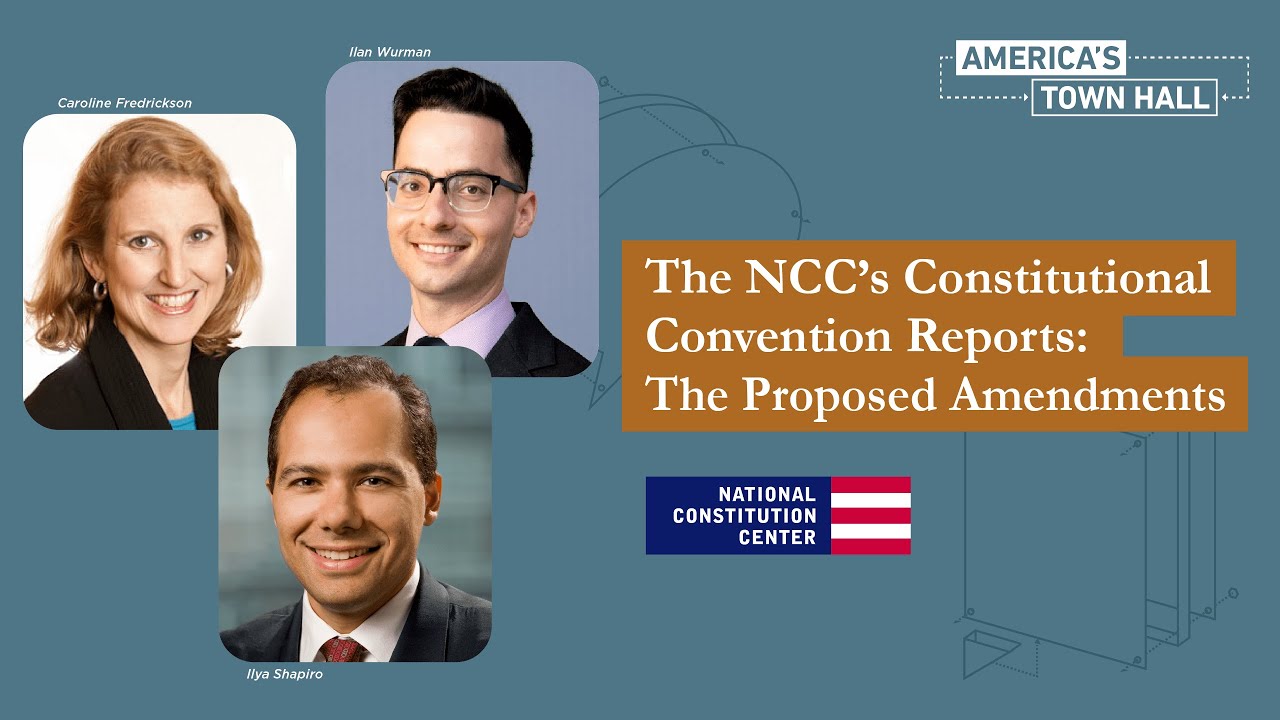 is available on the Center’s YouTube channel, and the amendments are available on the Center’s website.
Below is a brief summary of each proposed amendment:
- Amendment XXVIII: Eliminates the natural-born citizen requirement by stating that a president does not have to be born in the United States but must be a citizen having resided in the United States for at least 14 years. elon musk?!
- Amendment XXIX: Creates a legislative veto, whereby Congress can veto executive actions with majority votes in both the House and the Senate.
- Amendment XXX: Amends the current impeachment process by raising the standard for impeachment in the House but lowering it for conviction in the Senate; and clarifies that, in the six months after leaving office, a former officer can be impeached, and that the bar against future officeholding applies to both the presidency and vice presidency.
- Amendment XXXI: Imposes term limits on Supreme Court justices, fixes the number of justices at nine, and makes appointments automatic if the Senate does not act within three months to approve or disapprove.
- Amendment XXXII: Revises the process for proposing and adopting new constitutional amendments, making it easier by lowering the threshold for ratification from the current two-thirds of Congress and three-quarters of the states to three-fifths of Congress and two-thirds of the states.
The teams convened via Zoom over two days this August, to debate and deliberate various proposals, agreeing on the five resulting amendments. Earlier this year, the same three teams had drafted and presented their ideal constitutions.
“It’s so meaningful that three teams of scholars of different perspectives were able to agree on five proposed amendments to the Constitution,” said Jeffrey Rosen, president and CEO of the National Constitution Center. “The surprising consensus of the NCC’s virtual Constitutional Convention is a tribute to the possibilities for Madisonian deliberation and compromise in a polarized age.”
As part of the Constitution Drafting Project, team conservative includes Ilan Wurman, Robert P. George of Princeton University, Michael McConnell of Stanford Law School, and Colleen A. Sheehan of Arizona State University. Team libertarian includes Ilya Shapiro, Timothy Sandefur of the Goldwater Institute, and Christina Mulligan of Brooklyn Law School; and team progressive includes Caroline Fredrickson, Jamal Greene of Columbia Law School, and Melissa Murray of New York University School of Law.
The Constitution Drafting Project was generously launched with support from Jeff Yass.
---
report
https://papers.ssrn.com/sol3/papers.cfm?abstract_id=4224768
---
https://www.law.columbia.edu/news/archive/jamal-greene-shows-how-rights-go-wrong
psycho anx vs will of ppl?!
Where Rights Went Wrong grew out of Greene’s longstanding interest in “founder worship,” the propensity of Americans to lionize the Constitution’s framers, and in the “anticanon,” the term referring to decisions now viewed as wrongly decided, such as Dred Scott v. Sanford, Plessy v. Ferguson,Korematsu v. United States,and Lochner v. New York, which in 1905 allowed a business’s “right to contract” to overrule a state law setting maximum working hours for bakers.
The book also reflects Greene’s expertise in comparative constitutional law. In other countries, when judges confront questions about rights, “not only are they not focused on [their] founders, they’re not even focused on rights disputes as a matter of lawyerly interpretation of text.”
Greene, who joined the Columbia Law faculty in 2008, served as a clerk for U.S. Supreme Court Justice John Paul Stevens. Outside of the academy, he confronts free speech controversies as co-chair of the Oversight Board, an independent body set up to review content moderation decisions on Facebook and Instagram.
---
https://www.acslaw.org/?post_type=podcast&p=63672
American Constitution Society
ACS > Media > Broken Law Podcast
MAY 23, 2019
ACS Research and the Post Exposé: Dark Money Reshaping Judiciary
ACS President Caroline Fredrickson,Lisa Graves, and Jamal Greene discuss the new exposé by The Washington Post, which documents a well-financed network of wealthy donors who install judges sympathetic to a far-right agenda. The Post’s reporting builds on research supported by ACS; contributing researchers and experts will discuss the implications of the far-right’s strategy on the courts and for future nominations fights, and how to defend our courts from attacks to core freedoms and principles.
Featuring:
Caroline Fredrickson, ACS President
Lisa Graves, co-founder, Documented Investigations
Jamal Greene, Dwight Professor of Law, Columbia Law School
Resources on Dark Money
Court Capture: The Right-Wing Takeover of the Judiciary
The Democracy Fix: How to Win the Fight for Fair Rules, Fair Courts, and Fair Elections by Caroline Fredrickson
A Conservative Activist’s Behind-The-Scenes Campaign to Remake the Nation’s Courts by Robert O’Harrow Jr. and Shawn Boburg
ACS In Brief: Trump Continues to Reshape Judiciary at Breakneck Speed
ACS Issue Brief: A Right-Wing Rout: What the “Roberts Five” Decisions Tell Us About the Integrity of Today’s Supreme Court by Senator Sheldon Whitehouse
Listen }}:
---
khan academy NCC legit pro ukraine?
Yass Foundation for Education commits $9 million to free civics course
News Itempublished November 7, 2022
---
==
impeach jud comm
Who Is Pamela Karlan? Legal Leader Committed to ...
https://www.nytimes.com › 2019/12/04 › politics › pamela-karlan
4 hours ago - Ms. Karlan is the chairwoman of the board of directors for the left-leaning American Constitution Society. And in December 2016, she and other ...
==
https://www.c-span.org/video/?460185-1/the-democracy-fix
6/19
The Democracy Fix
Caroline Fredrickson, American Constitution Society president and former special assistant for legislative affairs to President Bill Clinton, offers her thoughts on how the political left can regain power.
==
2015 acs conv
A Conversation between U.S. Supreme Court Justice Ruth Bader Ginsburg and California Supreme Court Associate Justice Goodwin Liu
On Saturday, June 13, Supreme Court Justice Ruth Bader Ginsburg discussed her career, celebrity status, and time on the Supreme Court with her former clerk and current California Associate Justice Goodwin Liu.
---
http://eelegal.org/2016/02/11/schnare-combatting-climate-change-in-the-courts/
On February 10th, the American Constitution Society for Law and Policy (“ACS”) hosted a panel discussion on legal approaches and activities associated with “combatting” climate change through legal action. Topics covered were RICO prosecutions, climate torts and the Supreme Court’s stay of the Clean Power Plan. The session was organized and moderated by Lisa Heinzerling, the attorney who was brought into EPA to manage the legal analysis of how to extend the agency’s powers beyond the limits of the Clean Air Act in order to implement the environmental activists’ climate agenda, and who had previously won the Massachusetts v. EPA case enabling EPA to regulate carbon dioxide. The discussion panel consisted of Richard E. Ayres, Founding Partner, Ayres Law Group, LLP; Co-Founder, Natural Resources Defense Council; Sharon Eubanks, Partner, Bordas & Bordas, PLLC; lead counsel for the United States in United States v. Phillip Morris, et al. (the RICO tobacco case); Matthew F. Pawa, President, Pawa Law Group, P.C., who has failed repeatedly in his civil climate change tort claims against hydrocarbon companies; and the obligatory “other side of the argument” panelist, Roger R. Martella, Jr., Partner, Sidley Austin, LLP; former General Counsel, Environmental Protection Agency and representing parties opposing EPA’s Clean Power Plan. In addition, Senator Sheldon Whitehouse (D-RI) offered remarks.
...
http://news.heartland.org/newspaper-article/2016/05/18/green-activists-and-state-ags-collude-against-climate-dissenters
BS schnare
--
Contact Information
ebixby@stanford.edu
559 Nathan Abbott Way
Stanford, CA 94305
Chapter Leadership
Jeff Fisher - Faculty Advisor, jlfisher@law.stanford.edu
Pamela Karlan - Faculty Advisor, karlan@stanford.edu
Lisa Bixby - Co-President, ebixby@stanford.edu
Elizabeth Vissers - Co-President, evissers@stanford.edu
Rylee Sommers-Flanagan - Chapter Advisor, rksf2@stanford.edu
Deepa Kannappan - Chapter Advisor, deepak2@stanford.edu
Other Chapters in California
Student Chapters
Chapman University School of Law
University of California, Hastings College of the Law
University of California, Irvine School of Law
Santa Clara University School of Law
University of the Pacific McGeorge School of Law
University of California, Berkeley School of Law
California Western School of Law
University of La Verne College of Law
Pepperdine University School of Law
Southwestern Law School
Golden Gate University School of Law
Thomas Jefferson School of Law
University of California, Davis School of Law
University of California, Los Angeles School of Law
University of San Diego School of Law
University of San Francisco School of Law
University of Southern California Gould School of Law
Loyola Law School, Los Angeles
https://www.acslaw.org/chapters/ca/stanford-law-school
---
not at mofo? was 2009
James Pooley
Morrison & Foerster LLP
755 Page Mill Road
Palo Alto, CA 94304-1018
650-813-5710 tel 650-494-0792 fax
jpooley@mofo.com
---
Ideas with Consequences
The Federalist Society and the Conservative Counterrevolution
By: Amanda Hollis-Brusky
by Amanda Hollis-Brusky, professor of political science at Pomona College
---
judith ww 146 so 14th
---
recover for ggl
MTA FORUM RESEARCH by patrick 7/15
==
"Two-and-a-Half Cheers for Bush v. Gore," 68 U. Chi. L. Rev. 657 (2001), reprinted in Cass R. Sunstein & Richard A. Epstein, The Vote: Bush, Gore & the Supreme Court (U. Chi. Press 2001).
Roe v. Wade at 25: Still Illegitimate
http://www.wsj.com/articles/SB122704335139038479
---
=
corp harm doc view:
https://docs.google.com/document/d/1JoADLDc6p0BcnVxf6jWld7nHafn3LxXyFP3UQIKeRA8/edit?usp=sharing
https://www.acslaw.org/about
The American Constitution Society
National Board of Directors
Debo P. Adegbile
Elise Boddie
David M. Brodsky, Chair
Timothy W. Burns
Elizabeth J. Cabraser FUNDER?
Mark Califano
Erwin Chemerinsky
Peter B. Edelman
Michael J. Faris
Rebecca Favret, Student Board Member, University of Richmond School of Law
Julie Fernandes
David C. Frederick
Caroline Fredrickson, ACS President
Nancy Gertner
Linda Greenhouse
Reuben A. Guttman
Dennis J. Herrera
Dawn Johnsen
Brad S. Karp
Sophie Kim, Student Board Member, Harvard Law School
William P. Marshall
Robert Raben
Judith Scott
Reva Siegel
Cliff Sloan
Dawn L. Smalls
Paul M. Smith
David A. Strauss
Harry Susman
Christine A. Varney
Adam Winkler
Board of Advisors
Brooksley E. Born
Myron M. Cherry
Drew S. Days III
Walter E. Dellinger III
Christopher Edley, Jr.
Jay W. Eisenhofer
Faith E. Gay
Shirley M. Hufstedler
Frank I. Michelman
Abner Mikva
William A. Norris
James T. O'Hara
Janet Reno
Stephen D. Susman
---
SF
Chapter Leadership
Adelina Acuña - Chair, adelinaa@gmail.com
Maxwell Pritt - Vice Chair, mpritt@BSFLLP.com
Adam Hofmann - Outreach Co-Chair, ahofmann@hansonbridgett.com
Palak Sheth - Outreach Co-Chair, palakbsheth@gmail.com
Bryan Heckenlively - Programming Co-Chair, bryan.heckenlively@mto.com
Michael Vargas - Programming Co-Chair, michael.vargas@rimonlaw.com
--
Board of Directors
Adelina Acuña - Chair
California Department of Justice
Maxwell Pritt - Vice Chair
Boies, Schiller & Flexner LLP
Adam Hofmann - Outreach Co-Chair
Hanson Bridgett LLP
Palak Sheth - Outreach Co-Chair
Office of the San Francisco City Attorney
Bryan Heckenlively - Programming Co-Chair
Munger, Tolles & Olson LLP
Michael Vargas - Programming Co-Chair
Rimon Law Firm
Ben Berkowitz
Keker & Van Nest LLP
Eric Brown
Altshuler Berzon HOST
Sara Eisenberg
Office of the San Francisco City Attorney
Brian Goldman
Orrick, Herrington & Sutcliffe LLP
Seth Grossman
University of California, Office of the President
***
http://www.sccgov.org/sites/cco/areas/Pages/impact-hansen.aspx
Greta Hansen
Santa Clara County Counsel's Office
Anne Irwin Conger
Ajay Krishnan
Keker & Van Nest
Alex Lilien
San Francisco Public Defender's Office
Bethany Lobo
Cooley LLP
Jose Lopez
Gunderson Dettmer
Jennifer Lynch
Electronic Frontier Foundation
Araceli Martinez-Olguin
ACLU Immigrants' Rights Project
Nayantara Mehta
Alliance for Justice
Melissa Murray
UC Berkeley Law School
Rei Onishi
California Department of Justice
Nicky Ozer
ACLU of Northern California
Diana Reddy
California Teacher's Association
Kathryn Ross
Law Office of Kathryn Ross
Dan Roth
Law Office of Dan Roth
Christine Sun
ACLU of Northern California
Laura Trice
Altshuler Berzon LLP
Board of Advisors
Jeff Adachi
San Francisco Public Defender's Office
Stephen Berzon
Altshuler Berzon LLP
Jeffrey L. Bleich
Munger, Tolles & Olson, LLP
Dan Bromberg
Quinn Emanuel Urquhart & Sullivan, LLP
James J. Brosnahan
Morrison & Foerster LLP
James J. Brosnahan – Senior Trial Counsel
Download Professional Summary
James J. Brosnahan is named among the top 30 trial lawyers in the United States, according to the Legal 500 US. A lion of the trial bar, James J. Brosnahan is one of the most respected and recognized trial lawyers in the United States. Mr. Brosnahan has more than 50 years of experience in both civil and criminal trial work. He regularly undertakes complex cases that are about to go to trial. He has tried, to conclusion, 150 cases. The cases have ranged from anti-trust to wire fraud and from patent litigation to white collar crime and murder.
Mr. Brosnahan has received numerous awards and recognition throughout his distinguished career. In 1996, he was inducted into the State Bar of California's "Trial Lawyers Hall of Fame" and was awarded the Samuel E. Gates Award by the American College of Trial Lawyers in 2000 for his "significant, exceptional lasting contribution to the improvement of the litigation process." In 2001, Mr. Brosnahan was named "Trial Lawyer of the Year" by the American Board of Trial Advocates, and the following year, the San Francisco Lawyers' Club honored Mr. Brosnahan with its "Legend of the Law" award. In 2006, he was named one of America's most influential trial lawyers by the National Law Journal. In 2007, he received the American Inns of Court Lewis F. Powell Award for Professionalism and Ethics to recognize a "lifetime devoted to the highest standards of ethical practice, competence, and professionalism." In 2011, he received the Judge Learned Hand Award from the American Jewish Committee. He was recently recognized as a 2012 Lifetime Achiever by The American Lawyer which recognizes outstanding professional success and a devotion to public service. He was also a National Institute of Trial Advocacy (NITA) Teacher of the Year.
Mr. Brosnahan has been recommended as a leading lawyer by Chambers USAevery year since its launch. He is also ranked by PLC Which Lawyer?, The Best Lawyers in America, The Legal 500 US, Benchmark Litigation, The Lawdragon Top 3000, The Best of the Best USA Litigation, Euromoney’s Expert Guides, and the top ten in Northern California Super Lawyers since its launch in 2004.
Mr. Brosnahan is active in professional activities and is a past president of the Bar Association of San Francisco, whose Volunteer Lawyers Service Program he founded. He was also a National Institute of Trial Advocacy (NITA) Teacher of the Year.
Mr. Brosnahan has served as special counsel to the California Legislature's Joint Subcommittee on Crude Oil Pricing, the lawyer representative to the Ninth Circuit Judicial Conference and Chairman of the Delegation. Mr. Brosnahan also serves as Master Advocate on the faculty and member of the Board of Trustees of the National Institute for Trial Advocacy.
Mr. Brosnahan authored the "Trial Handbook for California Lawyers."
Selected Press Coverage:
"Lifetime Achievers," The American Lawyer, September 2012.
"Lions of the Trial Bar," ABA Journal, March 2009.
"Brosnahan Still Fighting After 50 Years: Veteran Trial Lawyer and MoFo senior partner has lost only 11 of 142 trials, is as busy as ever," Daily Journal, 6/25/09.
"Top 10 Northern California Super Lawyers 2009," Super Lawyers, 2009.
"The Right to Counsel in Civil Cases: If Not Now, When?", The Recorder, 4/18/2008.
"The Man Who Hates Injustice," Super Lawyers, 2006.
"The One That Got Away," California Lawyer, January 1993.
"End Game" originally published in the January 1993 issue of California Lawyer.
Reprinted with permission. © 2010 Daily Journal Corporation, San Francisco, CA.
"Who Gets the High-Profile cases?", California Lawyer, 2007.
"Labor Woes Going Global," The Recorder, 2005.
Recipient of:
2012 Lifetime Achiever by The American Lawyer
BASF Award of Merit on behalf of the Civil Gideon Task Force
AJC Learned Hand Award
American Inns of Court Lewis F. Powell Award for Professionalism and Ethics
Champion of Justice award from the Civil Justice Program at the Loyola Law School
University of Virginia Justice William Brennan Award
Lawyers Club of San Francisco inaugural "Legends of the Law" award
California ABOTA "Trial Lawyer of the Year"
American College of Trial Lawyers, Samuel E. Gates Award
The Wiley E. Manuel Foundation's Community Service Award
National Institute for Trial Advocacy Faculty Award (1991)
National Jewish Fund, Tree of Life Award (1991)
National Institute for Trial Advocate Award (1990)
William O. Douglas Award (1988)
Father Moriarty Central American Refugee Recognition (1987)
American Bar Association Pro Bono Publico Award
Mexican American Legal Defense and Education Legal Services Award (1985)
Release for Innocent Man
Obtained the release of a man wrongly convicted of arson and murder seventeen years ago.
Large Verdict for Hospital
January 2013 - Obtained a $32M decision for the Marin General Hospital against Sutter Health.
Defense of Technology Company
Successful defense of a former chairman of the board and technology company charged with securities civil fraud allegations after a 6 week jury trial in Los Angeles Superior Court. Achieved a complete defense verdict with jury out 3 hours.
Criminal Defense
Successful defense of Laotian American charged with the attempted overthrow of the Laotian government.
Patricia Dunn
Dismissal of all charges against Patricia Dunn, former chairperson of the board of Hewlett Packard Corporation.
Defense of Altera Corporation
Successful defense of the Altera Corporation in a patent case involving reprogrammable computer chips. Federal District Court, San Jose.
Defense of 3M in Breast Implant Litigation
Successfully defended a highly respected innovative product manufacturer in the first breast implant product liability jury trial in California. The plaintiff's science was excluded on motion and a non-suit was granted at the end of plaintiff's opening statement.
Representation of El Paso in California Energy Litigation
Lead counsel and chief negotiator in defense of the El Paso Corporation in all of its California litigation during the energy crisis.
Iran-Contra Prosecution
Associate member of Office of Independent Counsel: Iran-Contra. Lead prosecutor in U.S. v. Caspar Weinberger.
Oakland Raiders v. Oakland-Alameda County Coliseum
Successfully defended the City of Oakland and County of Alameda in the Oakland Raiders litigation and lead defense counsel for the Oakland Alameda County Coliseum and an individual defendant in a five-month jury trial.
Defense of John Walker Lindh
(USDC, Eastern District of Virginia) Obtained dismissal of all terrorism-related charges against John Walker Lindh in a leading case regarding the United States legal war on terrorism.
Edward Pressman, civil and criminal litigation
Obtained successful result in civil and criminal cases for producers of the movie,The Crow.
USA v Steven Elias Psinakis
Successful defense of Steve Psinakis on charges of Interstate transportation of explosive materials.
California Supreme Court Argument for Redistricting Commission
February 2012 - Obtained successful unanimous opinion in the California Supreme Court on behalf of the California Citizens Redistricting Commission establishing all of the congressional, senate and assembly districts in the state.
John Burris
Law Offices of John L. Burris
Elizabeth Cabraser
Lieff, Cabraser, Heimann & Bernstein
http://www.lieffcabraser.com/Attorneys/Elizabeth-J-Cabraser.shtml
Under Elizabeth J. Cabraser's leadership, Lieff Cabraser has become one of the country's largest law firms serving clients seeking redress for financial and consumer fraud, anti-competitive practices, harmful drugs and products, and illegal employment practices. For over three decades, Elizabeth has made sure that our firm remains dedicated to its core values.
Possessing unparalleled expertise in complex civil litigation, Elizabeth has served as court-appointed lead, co-lead, or class counsel in scores of federal multi-district and state coordinated proceedings. These cases include multi-state tobacco, the Exxon Valdez disaster,Breast Implants, Fen-Phen (Diet Drugs), Vioxx, Toyota sudden acceleration, numerous securities/investment fraud cases, and Holocaust litigation. Today, Elizabeth serves in court-appointed leadership positions in several of the nation's highest profile civil cases: the BP Gulf Oil Spill, GM ignition switch defect, and Takata defective airbag litigation.
A Pillar of the Plaintiffs' Bar
Elizabeth has been repeatedly recognized as one of the foremost litigators in our nation, including being selected an unprecedented four times as one of the 100 Most Influential Lawyers in America by the National Law Journal, which has called her "a pillar of the plaintiffs' bar." In 2015, the National Law Journal named her as one of the 75 outstanding women lawyers in America. She has been named repeatedly to the Lawdragon 500, The Top 100 California Lawyers, and as a SuperLawyer in multiple fields.
The Daily Journal has described Elizabeth as
"a commanding attorney and a role model for other
litigators, especially fellow female lawyers."
Law360 noted in a profile of Elizabeth that
"Her reputation among defense attorneys is that
of a formidable opponent who comes to cases
thoroughly prepared and can win a Judge's ear.
Commitment to Advancing the Legal Profession and Society
Elizabeth serves on the Executive Committee of the Council of the American Law Institute (ALI) and is an advisor to several ALI projects, including Aggregate Litigation, the Restatement Third, Torts: Liability for Economic Harm. Since 2011, she has served on the Federal Civil Rules Advisory Committee.
Elizabeth has written and spoken extensively on substantive legal issues as well as ones related to the advancement of women in the profession, including last year for Trial magazine, published by the American Association for Justice, a commentary entitled "Where are all the women in the courtroom?"
In 2010, the American Bar Association Commission on Women in the Profession honored Elizabeth with its Margaret Brent Women Lawyers of Achievement Award. The award recognizes the accomplishments of women lawyers who have excelled in their field and have paved the way to success for other women lawyers. It is regarded by many as the highest honor in the legal profession for women lawyers.
Elizabeth is also a fellow of the American Academy of Arts and Sciences. Many of our nation’s most accomplished leaders from academia, the social sciences, the study and practice of law, business, public affairs, the humanities, and the arts are members of the Academy.
Barbara J. Chisholm
Altshuler Berzon LLP
Nanci Clarence
Clarence, Dyer & Cohen LLP
Maggie Crosby
ACLU of Northern California
James Finberg
Altshuler Berzon LLP
Lucas Guttentag
American Civil Liberties Union
Joan Haratani
Morgan, Lewis & Bockius LLP
Dennis Herrera
San Francisco City Attorney's Office
Kate Kendell
National Center for Lesbian Rights
Loren Kieve
Law Offices of Loren Kieve
Shauna Marshall
University of California Hastings College of the Law
Eva Paterson
Equal Justice Society
Ismail Ramsey
Ramsey & Ehrlich LLP
Robert Rubin
Margaret Russell
Santa Clara University School of Law
Jahan C. Sagafi
Outten & Golden LLP
Doron Weinberg
Law Offices of Doron Weinberg
==
Bay Area Lawyer Chapter: Lawyer Die-In at the California Supreme Court
Friday, January 16, 2015
8:45 AM
Event Location:
Outside the Supreme Court of California
350 McAllister Street at Civic Center
San Francisco, CA
--
Jeffrey D. Clements
Author, Corporations Are Not People: Reclaiming Democracy from Big Money and Global Corporations; President, Free Speech for People; Member, ACS Boston Lawyer Chapter Board of Advisors
Bay Area Lawyer Chapter:
Citizens United At 5 - Inspiring a Grassroots Movement To Amend the Constitution
Tuesday, February 24, 2015
12:00 PM - 1:30 PM
Event Location:
Altshuler Berzon LLP
177 Post Street, Suite 300
San Francisco, CA
Presented by ACS Chapter(s):
CA - Bay Area
The American Constitution Society is a State Bar of California approved CLE provider.
---
corppersonharm415
view https://docs.google.com/document/d/1JoADLDc6p0BcnVxf6jWld7nHafn3LxXyFP3UQIKeRA8/edit?usp=sharing
--
Free Speech For People organization mailing address:
505 West 38th Street
Unit A4
Austin, TX 78705