rao, neomi
see TWO
stumbled on, pix of djt cutting red ribbon next to huge sack of docs/regs}:
GINNI? CLARENCE RIVKIN
ANDY OLDHAM SCOTUS SHORT LIST
FLYNN
API
CBG
html invitation only
---
SLUDGE NO LNX
:{:{===}:
AN 9 26
President Donald Trump — who has vowed and so far successfully managed to ban critical news outlets like MS NOW, CNN and Politico from the White House — suffered a major legal blow in that anti-free press crusade.
"A federal appeals court ruling Tuesday on demonstrators’ access to the steps of the Capitol could bode poorly for President Donald Trump’s attempt to ban three media organizations from the White House," Politico's Kyle Cheney and Josh Gerstein wrote on Tuesday. "The majority opinion, written by Trump appointee Neomi Rao, concluded that the East Steps of the Capitol are a 'nonpublic forum' — just like most areas of the White House grounds, including the press facilities."
Cheney and Gerstein added, "While the government may impose restrictions on access to those nonpublic areas, the limits must be 'viewpoint neutral,' apply 'objective, workable standards' and not permit officials to exercise 'unbridled discretion over a forum’s use,' the D.C. Circuit Court of Appeals panel concluded."
They continued, "'A regulation that grants the government arbitrary control over who may speak invites the suppression of disfavored viewpoints and undermines the First Amendment’s core protections,' wrote Rao, who was joined in the majority by Judge Karen Henderson, a George H.W. Bush appointee."
Trump, meanwhile, posted on Truth Social on Monday that he has imposed the bans explicitly because he dislikes how those outlets cover him.
"Fake News people and publications that only write negatively, and who violate our National Security by writing false and defamatory stories with unknown ‘sources,’ shouldn’t be allowed access to the most important Office anywhere in the World," Trump posted on his own social media platform.
In addition to trying to ban outlets that say things he does not like, Trump also recently launched his own 24/7 news network, Trump TV, which he describes as a live-streaming YouTube channel that includes "the Trump Administration's biggest moments all in one place."
Writing for The i Paper on Sunday, columnist James Ball argued that Trump is also trying to stimulate his own base in addition to stifling media critics.
"It is typical of Trump, when things aren’t going his way, to lash out," Ball argued. "Sometimes, this is savvy: Trump’s followers have historically liked it when he gets into a fight with the mainstream media, and at the moment they are far less enthusiastic about Trump than once they were. On paper, this could be an effort to pick a fight that would cheer up the MAGA base."
---
DC Circuit restores Trump's expedited deportation policy | Courthouse News Service
WASHINGTON (CN) — A D.C. Circuit panel on Tuesday reversed a federal judge’s order blocking the Trump administration from expanding expedited removal procedures to immigrants who have been in the country under two years.
In a 2-1 decision, the appeals court determined that the Department of Homeland Security’s revival of an identical 2019 policy, which allows the department to exercise its removal power to the “maximum extent allowed by Congress,” does not violate immigrants’ due process.
On Jan. 21, 2025, acting Secretary of Homeland Security Benjamin Huffman authorized expedited removals and expanded their range to immigrants encountered within 100 miles of the southern border.
Make the Road New York filed suit the next day, arguing the revived policy would expand “fast-track deportations” and give President Donald Trump “a cheat code to circumvent due process and the Constitution.”
U.S. District Judge Jia Cobb, a Joe Biden appointee, granted a stay in August 2025 after finding the policy likely violated the immigrants’ due process rights, as they had a significant liberty interest in remaining in the country and faced a substantial risk of that right being wrongfully denied under the Huffman policy.
U.S. Circuit Judge Justin Walker, joined by U.S. Circuit Judge Neomi Rao, wrote in the court’s opinion that immigrant rights group Make the Road New York could not show the expedited removals denied immigrants notice and the opportunity to be heard.
“There is no evidence that the designation or Huffman memorandum secretly restricts the right to notice and an opportunity to respond, that the command officers to withhold information, that they prohibit aliens from raising continuous presence or any other defense, or that they limit the time or opportunity afforded to aliens after a removal order issues,” the Donald Trump appointee wrote. “If any of those things are happening, they are not the result of the designation or Huffman memorandum. Those directives are silent on these matters — and a directive’s silence cannot command, authorize or structurally ensure a constitutional violation.”
Walker said Cobb used the incorrect due process standard — from the 1976 Supreme Court case Matthews v. Eldridge — when she froze implementation of the policy in August 2025.
“Even assuming for the sake of argument that the affected aliens have due-process rights, the due process claim should be evaluated under the less demanding standard in Mullane v. Central Hanover Bank & Trust Co,” Walker wrote, citing a 1950 case.
He pointed to the Supreme Court’s decisions in Trump v. J.G.G. and A.A.R.P. v. Trump — two shadow docket decisions that Rao cited at oral arguments to suggest immigrants “don’t have a liberty interest to remain because they’re here unlawfully” — where the justices applied Mullane’s standard.
The case’s test requires a court otherwise determine if a removal notice was “reasonably calculated” to inform either party and afford them an opportunity to raise any objections, Walker said. In A.A.R.P., the high court found such notice is adequate as long as an immigrant has sufficient time to contact an attorney, file a petition and pursue relief.
The record in the case shows several immigrants have been wrongfully subjected to expedited removal, despite having been present in the country over two years, but Walker blamed individual immigration officials rather than agency policy.
“Is that because they were denied an opportunity to prove continuous presence?” Walker wrote. “If so, that’s illegal. But the cause there would be individual officers’ failure to follow the law — not defects in the written directives under review or the procedures they incorporate.”
U.S. Circuit Judge Robert Wilkins, a Barack Obama appointee, issued a dissent and said Make the Road New York was entitled to a stay because they adequately showed the new policy violated due process.
The fact that several immigrants had already been wrongfully deported, despite their continuous presence in the country, makes clear that the government’s procedures did not afford immigrants a meaningful opportunity to contest their expedited removal, Wilkins said.
The record shows procedures do not require immigration officers to ask an individual when they entered the country or to advise them that expedited removal only applies to those present for less than two years.
“A procedure that can result in persons being deported pursuant to the expedited removal statute without even being asked how long they have been in the country might satisfy due process for persons encountered at the border, but it is woefully inadequate for persons encountered in the interior of the country,” Wilkins wrote.
Rao, also a Trump appointee, wrote her own concurring opinion to note that Make the Road New York’s lawsuit should have been immediately dismissed because Congress left expedited removal policies to the executive branch’s discretion and courts could not review those decisions.
---
SLUDGE
Former law professor Neomi Rao is facing headwinds in her judicial nomination, so Charles Koch’s Americans for Prosperity is stepping in.
:{:{Billionaire manufacturing magnate Charles Koch has for decades used his enormous wealth and political power to install elected officials (https://readsludge.com/2018/10/19/koch-and-adelson-come-to-the-rescue-of-trump-devotee-ron-desantis-in-florida/),}:
government administrators (https://www.salon.com/2016/06/19/big_men_on_campus_the_koch_brothers_university_donations_are_a_veiled_political_weapon/), and regulators (https://readsludge.com/2018/10/04/koch-backed-sec-commissioner-claims-corporate-law-is-in-the-public-interest/) who will keep the business interests of Koch Industries and other giant, heavily polluting companies in mind.}:
But Koch is also dipping into the judicial arena. One of his protegés has been nominated by President Trump and is poised to join the second-most powerful court in the United States, and Koch’s premier political spending group wants to make sure it happens.
In 2016, the Charles Koch Foundation (CKF) and a mystery donor combined to give $30 million to the George Mason University (GMU) law school, renaming it after the late, conservative Supreme Court Justice Antonin Scalia. Koch’s foundation put in $10 million, and the remaining $20 million, it was later discovered, was administered by Federalist Society officials through a 501(c)(4) nonprofit, BH Fund.
:{:{The grant established 12 new law professorships—nearly all the hires had ties to the conservative Federalist Society (https://legacy.tyt.com/2018/05/18/after-donation-administered-by-federalist-society-leaders-gmu-hired-professors-tied-to-the-federalist-society/)—}:
and founded two ideological law school centers (https://ia601201.us.archive.org/24/items/GMUASSLawMOU2016/GMU%20ASSLaw%20MOU%202016.pdf#page=6),
the Center for Liberty and Law and the Center for the Study of the Administrative State. The founder and director of the latter center was Neomi Rao (https://www.law.gmu.edu/assets/files/faculty/cv/rao.pdf), who had been a law professor at GMU since 2012. She previously clerked for the most conservative Supreme Court justice, Clarence Thomas, and was associate counsel and special advisor to President George W. Bush. She has never been a judge.}:
Rao took a leave of absence from George Mason in 2017 when President Donald Trump appointed her as director of the White House Office of Information and Regulatory Affairs (OIRA), Trump’s “regulation czar.”
:{:{The dean of the GMU law school told another donor to her center, corporate lobbyist and longtime Koch ally C. Boyden Gray (https://www.desmogblog.com/c-boyden-gray), that he hoped to lure her back to GMU with a $1.5-million professorship, funded by Gray, according to an email unearthed by GMU alumna Allison Pienta (}:
:{:{http://www.unkochmycampus.org/dec-20-2018-donor-control-at-gmu-update?rq=boyden%20gray).}:
“This chair would help me to entice Neomi to return home to Scalia Law after she dismantles the administrative state (https://www.documentcloud.org/documents/5750669-Antonin-Scalia-Law-School-Grant-Agreement.html#document/p2/a484188)
while serving at OIRA,” he wrote in a May 2017 letter to Gray. Gray gave another $3 million to the center, and it was renamed in his honor.}:}:
Dismantling the administrative state (p. 2) (https://www.documentcloud.org/documents/5750669-Antonin-Scalia-Law-School-Grant-Agreement.html#document/p2/a484234)
IFrame Content (https://www.documentcloud.org/documents/5750669-Antonin-Scalia-Law-School-Grant-Agreement/annotations/484234.html?embed=true&maxheight=750&maxwidth=500)
View entire document on DocumentCloud (https://www.documentcloud.org/documents/5750669-Antonin-Scalia-Law-School-Grant-Agreement.html#document/p2/a484234)
But instead of returning to the law school, Rao may be headed to the powerful D.C. Circuit Court of Appeals to fill the seat vacated by the newest Trump-appointed Supreme Court justice, Brett Kavanaugh. Rao’s GMU center hosted a conference (https://administrativestate.gmu.edu/rethinking-judicial-deference/) in 2016 that featured Kavanaugh, a fellow Federalist Society member, as keynote speaker.
Rao’s judgeship nomination is perhaps the crowning achievement of the Antonin Scalia Law School’s initiative to reshape the federal judiciary. In 2017, the law school’s Law and Economics Center, which CKF had been funding for years, drew up a funding proposal (https://www.documentcloud.org/documents/5751080-GMU-Law-and-Economics-Center-Federal-Judges-and.html) for the center’s “Federal Judges and Attorneys General Initiatives.”
‘Reshaping’ the Federal Bench
“The election of Donald Trump presents a historic opportunity for a new president to reshape the federal judiciary, reform the regulatory state, promote economic growth, and restore constitutional federalism,” reads the proposal.
The program educates newly appointed judges on economics and other issues so they will “be more likely to make sound decisions that support the rule of law and the free enterprise system.” The new Federal Judges Initiative will “cover topics expected to be highly relevant to the current presidential administration’s policy agenda, such as the economics of health care and health financing, financial services regulation, environmental and energy regulation, health and safety regulation, privacy, labor and employment law, and telecommunications regulation.”
As of 2017, over 5,000 judges and 700 state attorneys general had participated in at least one Law and Economics Center program. In the 2018 fiscal year, the Law and Economic Center requested over $1.7 million for its Judicial Education Budget.
“Rao’s transition from the Koch-funded Antonin Scalia School of Law to her nomination to the second-highest court in the country is exemplary of Koch’s successful strategy of leveraging George Mason University to exert influence on the judicial branch for decades to come,” Samantha Parsons, a GMU graduate and director of campaigns at the activist group UnKoch My Campus, told Sludge. “Her nomination should serve as a warning of the anti-democratic agenda we can expect throughout our nation’s judicial system should George Mason University succeed in its goals to facilitate the education and placement of hundreds of new federal judges under Trump’s presidency.”
:{:{In December, when Trump nominated Rao, Koch’s most prominent political advocacy organization, Americans for Prosperity, endorsed (https://americansforprosperity.org/afp-endorses-slate-of-highly-qualified-judicial-nominees/) her for the judgeship.}:
But Rao has since encountered some bumps in the road. Republican Missouri Sen. Josh Hawley said he has “deep concerns (https://www.axios.com/neomi-rao-dc-circuit-nominee-josh-hawley-concerns-228fe428-7944-430a-bc5c-71a50278ec38.html?utm_source=twitter&utm_medium=twsocialshare&utm_campaign=organic),” telling Axios that she may not be sufficiently anti-abortion.}:
At a recent Senate committee hearing, Iowa Republican Sen. Joni Ernst expressed concerns over Rao’s 1994 essay on date rape (https://www.washingtonpost.com/local/legal-issues/neomi-rao-pressed-on-past-writings-on-date-rape-at-hearing-on-her-judicial-nomination/2019/02/05/156b4784-28b4-11e9-b2fc-721718903bfc_story.html?utm_term=.e68dab1a1db9), which alleged that women who are raped while drunk are partially to blame for being raped. Rao’s OIRA has stalled issuing an employer guidance on sexual harassment for 15 months (https://theintercept.com/2019/02/04/neomi-rao-hearing-oira-brett-kavanaugh/), a process that normally takes no longer than 90 days, as David Dayen reported for The Intercept.
:{:{Americans for Prosperity will fund digital advertising and grassroots efforts (https://www.axios.com/neomi-rao-dc-circuit-nominee-josh-hawley-concerns-228fe428-7944-430a-bc5c-71a50278ec38.html?utm_source=twitter&utm_medium=twsocialshare&utm_campaign=organic)}:
in an attempt to sway public opinion in favor of Rao this week, according to Axios. On Tuesday morning, the Facebook ad archive (https://www.facebook.com/ads/archive/?active_status=all&ad_type=political_and_issue_ads&country=US&q=americans%20for%20prosperity) listed six AFP ads in favor of Rao, which began running on Monday. Each ad targets one Republican senator, including Ernst and Hawley, urgin Facebook users to tell their senator to vote for Rao’s D.C. Circuit Court nomination. Additional targeted senators are Ted Cruz (Texas), Marsha Blackburn (Tenn.), James Lankford (Okla.), and Ben Sasse (Neb.). The Google ad archive did not list any recent AFP purchases.}:
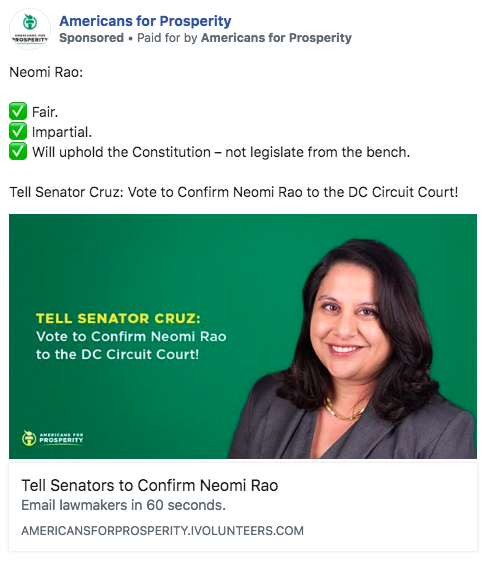 One of Americans for Prosperity’s Facebook ads supporting Neomi RaoFacebook Ad Archive
Americans for Prosperity did not reply to Sludge’s request for comment.
‘Regulatory Obstruction’
The American Constitution Society says OIRA, which is part of the Office of Management and Budget, “has embraced politicized regulatory obstruction (https://www.acslaw.org/acsblog/a-lesson-in-failure-oira-neomi-rao-and-deregulation-at-any-cost/) as its raison dêtre” under Rao. In OIRA’s 2018 report (https://www.whitehouse.gov/wp-content/uploads/2018/10/2018-Unified-Agenda-Cutting-the-Red-Tape.pdf), entitled “Cutting the Red Tape,” Rao writes, “we are working to push back the expansion of the administrative state, which has placed undue burdens on the public and impeded economic growth.”
Under Rao’s leadership, OIRA, has approved sweeping environmental deregulation by the EPA. Koch Industries, which Charles Koch runs, is a giant manufacturing conglomerate with subsidiaries that refine and transport oil, create paper products, and produce chemicals. The company is among the country’s biggest air and water polluters and has paid hundreds of millions of dollars for environmental violations. Koch and his brother David are lifelong libertarians who have fought taxes and regulations for decades.
“Rao has never seen a regulation she didn’t hate, and as a judge would dismantle 40 years of environmental and social progress,” Brett Hartl, government affairs director at the Center for Biological Diversity, said (https://www.buzzfeednews.com/article/zoetillman/trump-nominates-neomi-rao-brett-kavanaugh-seat) in a statement to Buzzfeed News. “Her confirmation would be the most damaging and regressive yet by Trump after Kavanaugh and Gorsuch.”
GMU is by far the biggest recipient of grants from the Charles Koch Foundation (CKF), which gives tens of millions of dollars each year to free-market higher education programs. Since 2005, CKF and the Charles Koch Institute have donated nearly $129 million to GMU, including over $34 million for the free-market Mercatus Center, according to Sludge’s analysis. Another free-market-focused GMU center, the Institute for Human Studies, has received $8.7 million.
The university has come under fire for allowing the CKF to impact hiring decisions (https://www.insidehighered.com/news/2018/05/01/koch-agreements-george-mason-gave-foundation-role-faculty-hiring-and-oversight). In the case of Florida State University, CKF was even allowed to control economics curricula (https://publicintegrity.org/federal-politics/koch-foundation-proposal-to-college-teach-our-curriculum-get-millions/).
AFP isn’t the only Koch-linked group to spend money to influence the judiciary. The Center for Media and Democracy reports that Donors Trust, a donor-advised fund that wealthy conservatives including Koch use to score tax deductions and potentially anonymize their donations to nonprofits, has bankrolled right-wing groups (https://www.prwatch.org/news/2019/02/13449/donorstrust-bankrolled-right-wing-judicial-appointments-trumps-acting-ag-and) such as the Judicial Crisis Network and its sister organization, the Judicial Education Project, which spent millions of dollars on ads supporting the Supreme Court confirmation of Neil Gorsuch. Donors Trust also funds the Federalist Society and, as Sludge recently reported, several Southern Poverty Law Center-designated hate groups (https://readsludge.com/2019/02/19/americas-biggest-charities-are-funneling-millions-to-hate-groups-from-anonymous-donors/).
Related:
Charles Koch Is Funding Rightwing, Pro-Trump Media, New Disclosure Reveals (https://readsludge.com/2018/11/21/charles-koch-is-funding-rightwing-pro-trump-media-new-disclosure-reveals/)
Koch Brothers Continue to Influence Tax Policy After Huge Cuts Last Year (https://readsludge.com/2018/06/18/koch-brothers-continue-to-influence-tax-policy-after-huge-cuts-last-year/)
Koch-Backed SEC Commissioner Claims Corporate Law is in the Public Interest (https://readsludge.com/2018/10/04/koch-backed-sec-commissioner-claims-corporate-law-is-in-the-public-interest/)
Author profile](https://readsludge.com/author/alex/)
Alex Kotch (https://readsludge.com/author/alex/)
Alex is a reporter at Sludge and a contributor to The Young Turks. He was previously part of the award-winning investigative team at International Business Times, and his other work has appeared in T
---
Balls and Strikes
Neomi Rao Understands What It Means to Be a Trump Judge
For judges like Neomi Rao, nothing is more important than reminding the president what you are willing to do for him.
.
5 days ago
The Presidential Prayer Team
Judge Neomi Rao, D.C. Circuit U.S. Court of Appeals
Neomi Jehangir Rao was born in March 1973 in Bloomfield Hills, Michigan. She attended Yale University and then the University of Chicago Law...
.
6 days ago
PBS
Appeals court orders judge to end contempt investigation of deportation flights
A federal judge must end his contempt investigation of the Trump administration for failing to comply with an order over flights carrying...
.
1 week ago
New York Post
If anti-Trump judges don’t get the message soon, the country’s in big trouble
Wednesday saw the comeuppance of obsessive anti-Trump Judge James Boasberg, the DC Circuit Court judge who'd repeatedly arrogated to himself...
.
4 days ago
Courthouse News
Judge ordered to end contempt probe over deportation flights
The majority found the Trump administration had violated neither the bench order nor the written order by U.S. District Judge James Boasberg...
.
1 week ago
Politico
Appeals court again blocks Boasberg contempt probe into Alien Enemies Act deportations
The ruling is a win for the administration against a judge whom the president has sought to fashion into an adversary.
.
1 week ago
Al Jazeera
US appeals court blocks contempt case over Trump deportation flights
The Trump administration had faced a contempt probe over its decision to proceed with two deportation flights in 2025.
.
1 week ago
The Hill
White House ballroom construction can continue, federal appeals court says
A U.S. Court of Appeals on Saturday said that construction of the White House ballroom can carry on temporarily after a judge halted...
.
1 week ago
The New York Times
Appeals Court Ends Contempt Inquiry Into Deportation Flights
A federal judge's nearly yearlong effort to investigate whether the Trump administration had violated his order had become a point of...
.
1 week ago
WVTM
Appeals court orders judge to end contempt investigation of Trump administration deportation flights
A federal judge must end his “intrusive” contempt investigation of the Trump administration for failing to comply with an order to turn...
---
Everywhere you turn in Trumpland, you’ll find a slew of Thomas’ former clerks in high places. They are serving in the White House counsel’s office (Greg Katsas, John Eisenberg, David Morrell); awaiting appointment to the federal judiciary (Allison H. Eid, David Stras); leading the departments of the Treasury (Heath P. Tarbert, Sigal Mandelker) and Transportation (Steven G. Bradbury); defending the travel ban in court (Jeffrey Wall); and heading the White House Office of Information and Regulatory Affairs (Neomi Rao). Thomas clerks are also working with dark money groups to execute Trump’s agenda (Carrie Severino) and boosting him in the far-right media (Laura Ingraham).
[Jeffrey Wall
Former Thomas clerk Jeffrey Wall is now Trump’s acting solicitor general. Department of Justice
In an era in which former clerks seem, on balance, to be drifting away from Washington jobs, a whole lot of members of the old Thomas crew are moving back home. It’s near impossible to count every former Supreme Court clerk who is now playing a role in the sprawling executive branch, but it’s easy to see that an enormous number of Thomas protégés are stepping into positions of immense power. Every expert we spoke to, among them the New Yorker’s Jeffrey Toobin, agreed the Trump administration has brought on a striking number of Thomas clerks.
To be sure, a number of clerks who trained under Antonin Scalia, Anthony Kennedy, and other conservative justices have taken jobs with the government. But Stephen Vladeck, who teaches law at the University of Texas and serves as a Supreme Court analyst for CNN, says it’s instructive to compare the career paths of clerks who worked for Thomas and those who served under Scalia. The latter, Vladeck says, have gravitated more toward the conservative establishment—institutions like law schools and legal foundations. The Thomas clerks, who have “a bit more of a libertarian or populist streak,” are a more logical fit for the key legal jobs serving the Trump White House. It is the Thomas alums that have risen to prominence in the past six months, and they are working zealously to put their mentor’s ideas into action.
Consider Wall, Trump’s acting solicitor general, who left his law firm, Sullivan & Cromwell, to join the administration. Wall is the attorney who, back in May, so adroitly argued the travel ban case before the lower federal appeals courts and aggressively litigated the case in pleadings this summer at the Supreme Court. It was Wall who insisted on the “presumption of regularity” in the litigation, cautioning the judges to focus on the long tradition of deference to executive authority—especially in the realm of national security—and to ignore Trump’s incendiary tweets and campaign statements.
Wall has said that the judges for whom he has clerked are still his “close friends.” Perhaps most significantly, at an event last year celebrating Thomas’ 25th anniversary on the court, Wall defended the justice’s singular relevance and influence, rejecting any criticism that Thomas hasn’t had a profound impact on the court as “pernicious and wrongheaded.” (He’s quite right about that; liberals consistently underestimate Thomas’ influence.) Describing his former boss as an “intellectual catalyst,” Wall said that Thomas “is content to sow ideas that result later in changes in the law.”
That’s precisely the influence we are now seeing at work across the federal government. In arguing the travel ban cases, Wall insisted that limiting Muslim immigrants’ access to the United States does not amount to unlawful animus, that the president must have near-total authority to control the nation’s borders, and that his decisions must not be second-guessed by the courts. These are classic Thomas principles, and the justice himself embraced them in a partial dissent when the court allowed only part of the ban to take effect.
Thomas’ influence can also be seen in the work of Neomi Rao, whom the Senate recently confirmed to lead the Office of Information and Regulatory Affairs. Until her appointment as Trump’s regulatory czar, Rao served as a professor at George Mason University’s law school—an institution that, at Rao’s urging, was recently renamed in honor of Antonin Scalia. Rao has devoted her academic career to criticizing the administrative state—the web of agencies and committees that promulgate federal regulations. Her attacks on the government sit at the intersection of two quintessential Thomas principles: an aversion to regulations (especially labor and environmental rules) and a hostility toward limits on executive authority.
[Neomi Rao
Former Thomas clerk Neomi Rao is set to lead the White House Office of Information and Regulatory Affairs. Screenshot via YouTube
Rao believes, for instance, that independent agencies are unconstitutional. These commissions—which include the Securities and Exchange Commission, the Consumer Financial Protection Bureau, the Federal Communications Commission, the Equal Employment Opportunity Commission, and the Federal Reserve—flourish in part because they are removed from political pressures. Rao would like to change that. She believes that since these agencies are part of the executive branch, the president must be empowered to fire and replace their leaders.
Thomas sees his clerks as trainees in a very specific ideological program.
It seems extremely likely that Rao has been placed in her perch at OIRA not only to bust traditional agency regulations but also to bring independent agency rules under her purview. While her office does not currently review rules by independent agencies, she has argued that it should. Thomas has strongly suggested that all agencies within the executive branch, independent or not, must ultimately be accountable to the president. If Rao gives herself veto power over these agencies’ rules, she will bring Thomas’ vision a step closer to the reality. In the process, she could nullify whatever vestiges of liberalism are still lingering from the Obama era. For example, the EEOC recently took the position that federal law protects gay employees, directly contradicting Trump’s Justice Department. If Rao’s view wins out, Trump could fire as many EEOC commissioners as he needs to in order to reverse the agency’s position. Thomas, who takes a dim view of nondiscrimination law and gay rights, would be doubly proud.
The justice must already be delighted at the work of his former clerk Allison Eid, whom Trump has nominated to the 10th U.S. Circuit Court of Appeals. Eid currently serves on the Colorado Supreme Court, where she established her conservative bona fides by dissenting from a ruling that prohibited the state from sending public funds to private religious schools. The court’s decision was compelled by the Colorado Constitution, which bars the government from spending “any public fund or moneys … to help support or sustain any school … controlled by any church or sectarian denomination.”But according to Eid, this constitutional bar on public funding of parochial schools was likely motivated by unconstitutional animus toward religion—even though its plain text indicates nothing more than a desire to observe the separation of church and state.
Eid’s dissent, which she wrote in 2015, maps neatly onto Thomas’ own concurrence in 2017’s Trinity Lutheran v. Comer. In Trinity, the court ruled that Missouri could not deny a grant to a Christian school solely on account of its “religious character.” (A day after the court decided Trinity, it vacated the Colorado Supreme Court’s decision on parochial schools, effectively vindicating Eid’s dissent.) Thomas asserted that the court had not gone far enough in Trinity: He wrote that the government may never “discriminate against religion” by refusing to subsidize houses of worship and sectarian programs. Thomas, like Eid, appears to believe that when a state declines to fund religious activity—even out of respect for the Establishment Clause—it engages in unconstitutional discrimination. When Eid is confirmed, he will gain a critical ally in his fight for ever-more entanglement between church and state. And she will be the first of many Trump picks who are as immutable in their views as their former bosses. This is a movement and a cause, not just constitutional theory.
[Allison H. Eid
Trump has nominated former Thomas clerk Allison H. Eid to the 10th Circuit. Joe Amon/The Denver Post via Getty Images]
Thomas, who has described his clerks as his “little family,” sees them as trainees in a very specific ideological program.He famously invites them to watch The Fountainhead at his home each yearand has taken them on annual trips to Gettysburg to reflect on what he views as the conservative lessons of the Civil War. He also tutors his clerks on his judicial philosophy, instilling in them a profound reverence for his own vision of the rule of law.
It’s no surprise that so many of Thomas’ clerks share a belief system with their former boss, and with each other. Thomas is known to be ideologically rigid when it comes to hiring (and in everything else). Prior to 2013, every clerk he’d brought on during his Supreme Court tenure had first served under an appellate-level judge who’d been appointed by a Republican president.* Even Scalia occasionally hired “counter-clerks,” liberal-leaning men and women who had clerked for Democratic appointees on lower courts. Thomas has expressed no interest in this kind of ideological diversity. (To his credit, he does value educational diversity, intentionally hiring clerks from lower-ranked schools. Compare that with Scalia, who was openly biased against schools outside the T14.)
[Trump’s reactionary view of conservatism is causing a schism at the Supreme Court.
Like all justices, Thomas tends to get his clerks from a handful of feeder judges. Thomas’ chief feeders are J. Michael Luttig and J. Harvie Wilkinson of the U.S. Court of Appeals for the 4th Circuit, Laurence Silberman and David Sentelle of the D.C. Circuit, Edith Jones of the 5th Circuit, and William Pryor of the 11th Circuit—all rock-ribbed conservatives except for Wilkinson, who has recently drifted to the center. By drawing from this pool, Thomas ensures he won’t hear many progressive counterpoints to his conservative instincts. And that’s OK with him. Thomas has said that picking clerks is like “selecting mates in a foxhole,”explaining: “I won’t hire clerks who have profound disagreements with me. It’s like trying to train a pig. It wastes your time, and it aggravates the pig.”
---
https://www.americanoversight.org/ginni-thomas-republican-connections-raise-ethics-concerns-for-scotus
The activism of prominent conservative Ginni Thomas, the wife of Supreme Court Justice Clarence Thomas, has for years raised questions about partisan influence on the judicial system and ethics in the Supreme Court. American Oversight is actively investigating Ginni Thomas’ connections and influence in right-wing networks and their potential impact on Justice Thomas’ ethics decisions. Records we have obtained through public records requests reveal Ginni Thomas’ ties to the Trump administration as well as evidence of Justice Thomas’ contact with Florida Gov. Ron DeSantis.
As detailed in a recent update, emails between Ginni Thomas and DeSantis, obtained by American Oversight and reported on by Politico, suggest that Justice Thomas may have been in regular contact with the Republican governor. On June 10, 2021, Ginni Thomas reached out to DeSantis’ scheduling office to invite him to speak to a “coalition” of “conservative patriots.” Thomas explained that the governor would know her because her “husband has been in contact with him … on various things of late.”
Ginni Thomas said the “cone of silence coalition” of “about 83 national leaders” was formerly known asGroundswelland included former White House Chief of Staff Mark Meadows among its attendees. The group, now called the Third Century Group (TC Group), was focused on “the greatest threats and opportunities to constitutional governance,” Thomas wrote in her email, “and admittedly we are weary about the GOP divisions, lack of courage and lack of leadership.” Thomas also wrote that the group met “through the help of [conservative organization] Judicial Watch.”
DeSantis was eventually scheduled to present during the group’s July 21 virtual meeting. According to an email from a vice president at the Heritage Foundation who was planning to introduce the governor at the meeting, DeSantis was invited to speak “about whatever is on his mind in terms of national politics” and the attendees were “very concerned about [critical race theory], election integrity and immigration.”
:{:{The Coalition Formerly Known as Groundswell}:
Formerly known as Groundswell, TC Group is a secretive right-wing strategy group led by Ginni Thomas and others, which has been bringing together conservative activists for nearly a decade. Members have included former Trump chief strategistStephen Bannon and former Trump National Security Adviser John Bolton, among others. The network was well-connected to the Trump administration — in 2019, Thomas and others compiled lists of anti-Trump officials in executive agencies for the administration to dismiss and replace with Trump allies.}:
Public records obtained by American Oversight show the degree of access Thomas and her coalition had in the Trump administration. A calendar entry from March 5, 2020, showsRuss Vought, then the deputy director of the Office of Management and Budget, was scheduled to have “Breakfast with Ginni Thomas.”
On Dec. 10, 2018, Thomas, on behalf of her lobbying firm Liberty Consulting,invited a Department of Health and Human Services official — likely Steven Wagner, the director of the Administration for Children and Families — to a “Conversation and Strategic Discussion” with conservative commentatorJordan Peterson. The invitation noted that the event would be “closed to press and off the record” and that “a primary goal of this meeting is to determine specific action steps/solutions for winning back the next generation.” The reception was hosted by Thomas along with conservative Christian activist Bill Dallas and the Heritage Foundation’s Bridgett Wagner. The list of participants included prominent conservatives.
On Aug. 22, 2018, Neomi Rao, then the administrator of OMB’s Office of Information and Regulatory Affairs, was scheduled to have a “Groundswell Mtg.” It is not confirmed whether this is Ginni Thomas’ Groundswell. Early in her career, Rao served as a law clerk for Justice Thomas on the Supreme Court, and in 2019, she was appointed by Trump to serve as federal judge in Washington, D.C.
:{:{Thomas’ Activism Raises Judicial Ethics Questions}:
Ginni Thomas’ career as a prominent conservative activist, more heavily involved in politics than any other spouse of a Supreme Court justice in history, has for years raised concerns among legal experts who note that justices typically avoid even being seen as partisan. Through her activism, Ginni Thomas has taken stances on issues that have come before the Supreme Court, such as on abortion, gun rights, and the Affordable Care Act, and recently took on major role in challenging Joe Biden’s victory in the 2020 election. Justice Thomas’ repeated failure to recuse himself on multiple matters relevant to his wife’s advocacy, especially as the court hears increasingly politically polarized cases, has been the subject of scrutiny. }:
Recently, Ginni Thomas was among the conservatives who signed a letter criticizing the House committee investigating the Jan. 6 attack on the U.S. Capitol. A month later, Justice Thomas was the only Supreme Court justice to support Trump’s request to block that committee from accessing White House records.
Ginni Thomas also played a role in challenging the 2020 election results as a leader of the conservative Council for National Policy (CNP), according to the New York Times. Following the November 2020 election, CNP directed its members to spread misinformation about the election and pressured Republican lawmakers in Arizona, Georgia, and Pennsylvania to challenge the election results by awarding their states’ electoral votes to Trump. In a newsletter, CNP’s political advocacy arm advised, “There is historical, legal precedent for Congress to count a slate of electors different from that certified by the Governor of the state.” Fake electoral certificates submitted by Trump allies in swing states to Congress to dispute Biden’s victory were obtained by American Oversight last year.
American Oversight continues to investigate Ginni Thomas’ connections and influence. We have filed records requests seeking communications between Thomas and federal agencies during the Trump administration, and in January 2022, we submitted public records requests to attorneys generals and governors across the country for communications with both Ginni Thomas and Justice Thomas.
===
---
PENSION?!
The New York Times
Supreme Court Seems Ready to Back Ted Cruz on Campaign Finance
Judge Neomi Rao, who ordinarily sits on the U.S. Court of Appeals for the District of Columbia Circuit, wrote for a unanimous panel that the...
.
2 weeks ago
Law.com
Presidents Are Too Reliant on Executive Power, Judge Neomi ...
Neomi Rao testifies before the Senate Judiciary Committee during her confirmation hearing to be U.S. Circuit Judge for the District of...
.
Oct 1, 2021
Law360
Biden Has Chance To Push DC Circuit Further Left
"Donald Trump would have been able to capture the D.C Circuit and put on more people like Justin Walker and Neomi Rao," Goldberg said,...
.
1 month ago
The Washington Post
Former White House official Neomi Rao formally sworn in as ...
Former White House official Neomi Rao was formally sworn in Friday as the newest judge on the federal appeals court in Washington in a...
.
Sep 13, 2019
NPR
Neomi Rao, Picked For D.C. Circuit Court, Faces Scrutiny ...
Neomi Rao currently leads the Office of Information and Regulatory Affairs, a position that's been described as the Trump administration's "...
.
Feb 5, 2019
The Leadership Conference on Civil and Human Rights
Oppose the Confirmation of Neomi Rao to the US Court of ...
Ms. Rao currently serves as President Trump's Administrator of the Office of Management and Budget's Office of Information and Regulatory Affairs (OIRA), where...
.
Feb 8, 2019
Vox
Judge Neomi Rao has an aggressive plan to block House oversight of Trump
Rao is both a former Trump White House official and a former law clerk to Supreme Court Justice Clarence Thomas. And her name is well-known to...
.
Mar 11, 2020
Vox
The Michael Flynn court ruling by Judge Neomi Rao is astonishingly bad
The court decision dismissing charges against Michael Flynn is astonishingly bad. Neomi Rao rides again. By Ian Millhiser Jun 24, 2020, 3:10pm...
.
Jun 24, 2020
CNN
Senate confirms Neomi Rao, controversial judicial nominee, to fill Brett Kavanaugh's former seat
The Senate voted Wednesday to confirm Neomi Rao, a judicial nominee who faced intense opposition over her writings in college,...
.
Mar 13, 2019
BuzzFeed News
Trump’s DC Circuit Nominee — And Reported Supreme Court Contender — Wrote Inflammatory Op-Eds In College
Rao has led the Trump administration's deregulation push; the Senate confirmed her as head of the Office of Information and Regulatory Affairs...
.
Jan 14, 2019
no lnx
Trump’s DC Circuit Nominee — And Reported Supreme Court Contender — Wrote Inflammatory Op-Eds In College
Neomi Rao is nominated for Justice Brett Kavanaugh’s former seat on the DC Circuit.
by Zoe Tillman
BuzzFeed News Reporter
Map of Washington, DC
Reporting From
Washington, DC
Posted on January 14, 2019,
Abaca Press / Sipa USA via AP
Neomi Rao at a White House event on Nov. 13, 2018, when President Donald Trump announced her nomination to the US Court of Appeals for the DC Circuit.
WASHINGTON — Neomi Rao — President Donald Trump’s pick for a powerful federal judgeship and a reported US Supreme Court contender — wrote a string of op-eds in college and just after she graduated, at times using inflammatory language to discuss race, date rape, and LGBT rights.
:{:{}:
}:
In pieces reviewed by BuzzFeed News that Rao wrote between 1994 and 1996 — she graduated from Yale University in 1995 — she described race as a “hot, money-making issue,” affirmative action as the “anointed dragon of liberal excess,” welfare as being for “for the indigent and lazy,” and LGBT issues as part of “trendy” political movements. On date rape, Rao wrote that if a woman “drinks to the point where she can no longer choose, well, getting to that point was part of her choice.”
Rao is nominated for Supreme Court Justice Brett Kavanaugh’s former seat on the US Court of Appeals for the DC Circuit. It's an influential court sometimes referred to as the second most important court both because of the cases it hears — it’s the main forum for big fights over government and executive power — and the fact that a number of alumni have landed on the US Supreme Court. Liberal advocacy groups denounced Rao’s nomination the moment Trump announced it in November, pointing to her conservative record. Politico reported last week that Rao had been added to the administration’s list of potential Supreme Court nominees.
Rao has never been a judge, and absent any record on the bench, her writings as a student and later as a prominent law professor, which she submitted to the Senate Judiciary Committee, are expected to feature prominently in the fight over her nomination.
Nan Aron, president of the liberal advocacy group Alliance for Justice, which first highlighted Rao’s college writings to BuzzFeed News, said Rao’s columns were “consistent with the administration’s support of candidates who make racially insensitive statements and comments hostile to sexual assault survivors.”
“She shouldn't be awarded a seat on what many view as the second highest court in the country, which is often a stepping stone to the Supreme Court,” Aron said.
Rao currently serves in the Trump administration as head of the Office of Information and Regulatory Affairs. Justice Department spokesperson Kerri Kupec said in a statement to BuzzFeed News that Rao's writings were “intentionally provocative.”
“Neomi Rao is a renowned constitutional and administrative law expert.That is why the President nominated her to the D.C. Circuit. The views she expressed a quarter century ago as a college student writing for her student newspaper were intentionally provocative, designed to raise questions and push back against liberal elitism that dominated her campus at the time,” Kupec said. “More than two decades later, her views can be found in her numerous academic articles and speeches. We are confident Ms. Rao will make an exemplary judge on the D.C Circuit.”
---
---
https://www.americanoversight.org/ginni-thomas-republican-connections-raise-ethics-concerns-for-scotus
The activism of prominent conservative Ginni Thomas, the wife of Supreme Court Justice Clarence Thomas, has for years raised questions about partisan influence on the judicial system and ethics in the Supreme Court. American Oversight is actively investigating Ginni Thomas’ connections and influence in right-wing networks and their potential impact on Justice Thomas’ ethics decisions. Records we have obtained through public records requests reveal Ginni Thomas’ ties to the Trump administration as well as evidence of Justice Thomas’ contact with Florida Gov. Ron DeSantis.
As detailed in a recent update, emails between Ginni Thomas and DeSantis, obtained by American Oversight and reported on by Politico, suggest that Justice Thomas may have been in regular contact with the Republican governor. On June 10, 2021, Ginni Thomas reached out to DeSantis’ scheduling office to invite him to speak to a “coalition” of “conservative patriots.” Thomas explained that the governor would know her because her “husband has been in contact with him … on various things of late.”
Ginni Thomas said the “cone of silence coalition” of “about 83 national leaders” was formerly known asGroundswelland included former White House Chief of Staff Mark Meadows among its attendees. The group, now called the Third Century Group (TC Group), was focused on “the greatest threats and opportunities to constitutional governance,” Thomas wrote in her email, “and admittedly we are weary about the GOP divisions, lack of courage and lack of leadership.” Thomas also wrote that the group met “through the help of [conservative organization] Judicial Watch.”
DeSantis was eventually scheduled to present during the group’s July 21 virtual meeting. According to an email from a vice president at the Heritage Foundation who was planning to introduce the governor at the meeting, DeSantis was invited to speak “about whatever is on his mind in terms of national politics” and the attendees were “very concerned about [critical race theory], election integrity and immigration.”
:{:{The Coalition Formerly Known as Groundswell}:
Formerly known as Groundswell, TC Group is a secretive right-wing strategy group led by Ginni Thomas and others, which has been bringing together conservative activists for nearly a decade. Members have included former Trump chief strategist Stephen Bannon and former Trump National Security Adviser John Bolton, among others. The network was well-connected to the Trump administration — in 2019, Thomas and others compiled lists of anti-Trump officials in executive agencies for the administration to dismiss and replace with Trump allies.}:
Public records obtained by American Oversight show the degree of access Thomas and her coalition had in the Trump administration. A calendar entry from March 5, 2020, shows Russ Vought, then the deputy director of the Office of Management and Budget, was scheduled to have “Breakfast with Ginni Thomas.”
On Dec. 10, 2018, Thomas, on behalf of her lobbying firm Liberty Consulting, invited a Department of Health and Human Services official — likely Steven Wagner, the director of the Administration for Children and Families — to a “Conversation and Strategic Discussion” with conservative commentatorJordan Peterson. The invitation noted that the event would be “closed to press and off the record” and that “a primary goal of this meeting is to determine specific action steps/solutions for winning back the next generation.” The reception was hosted by Thomas along with conservative Christian activist Bill Dallas and the Heritage Foundation’s Bridgett Wagner. The list of participants included prominent conservatives.
On Aug. 22, 2018, Neomi Rao, then the administrator of OMB’s Office of Information and Regulatory Affairs, was scheduled to have a “Groundswell Mtg.” It is not confirmed whether this is Ginni Thomas’ Groundswell. Early in her career, Rao served as a law clerk for Justice Thomas on the Supreme Court, and in 2019, she was appointed by Trump to serve as federal judge in Washington, D.C.
:{:{Thomas’ Activism Raises Judicial Ethics Questions}:
Ginni Thomas’ career as a prominent conservative activist, more heavily involved in politics than any other spouse of a Supreme Court justice in history, has for years raised concerns among legal experts who note that justices typically avoid even being seen as partisan. Through her activism, Ginni Thomas has taken stances on issues that have come before the Supreme Court, such as on abortion, gun rights, and the Affordable Care Act, and recently took on major role in challenging Joe Biden’s victory in the 2020 election. Justice Thomas’ repeated failure to recuse himself on multiple matters relevant to his wife’s advocacy, especially as the court hears increasingly politically polarized cases, has been the subject of scrutiny. }:
Recently, Ginni Thomas was among the conservatives who signed a letter criticizing the House committee investigating the Jan. 6 attack on the U.S. Capitol. A month later, Justice Thomas was the only Supreme Court justice to support Trump’s request to block that committee from accessing White House records.
Ginni Thomas also played a role in challenging the 2020 election results as a leader of the conservative Council for National Policy (CNP), according to the New York Times. Following the November 2020 election, CNP directed its members to spread misinformation about the election and pressured Republican lawmakers in Arizona, Georgia, and Pennsylvania to challenge the election results by awarding their states’ electoral votes to Trump. In a newsletter, CNP’s political advocacy arm advised, “There is historical, legal precedent for Congress to count a slate of electors different from that certified by the Governor of the state.” Fake electoral certificates submitted by Trump allies in swing states to Congress to dispute Biden’s victory were obtained by American Oversight last year.
American Oversight continues to investigate Ginni Thomas’ connections and influence. We have filed records requests seeking communications between Thomas and federal agencies during the Trump administration, and in January 2022, we submitted public records requests to attorneys generals and governors across the country for communications with both Ginni Thomas and Justice Thomas.
===
---
https://apps.publicintegrity.org/united-states-of-petroleum/century-of-influence/
no lnx many ? 1 graf
A CENTURY OF INFLUENCE
The unlikely partnership between Big Oil and the White House
How the industry stalled action on climate change from the inside and sold America on fossil fuels
Illustration by Robert Fresson
by Jie Jenny Zou
Chris Young, Rachel Leven contributed reporting
December 12, 2017
A version of this article was co-published with Guardian US.
When Rick Perry was interrupted by climate-change protesters during his address to the National Petroleum Council in late September, the energy secretary was ready with a retort.
“You want to talk about something that saves lives? It’s the access to energy around the globe,” Perry said, countering a woman worried about deadly hurricanes and a man whose hometown is being submerged by the rising Philippine Sea. “I am proud to be a part of this industry. I am proud to be an American."
It was an opportunity for the former Texas governor to champion an industry he’d long embraced by showing fealty to the petroleum council, an arcane federal advisory committee dominated by energy executives. Picking up on Perry’s message was Interior Secretary Ryan Zinke, who has pledged to fast-track drilling and open more areas to fossil-fuel development.
The two took turns reassuring the council’s nearly 200 members during a meeting at the opulent Hay-Adams hotel in Washington, D.C., that the White House would be a friend, not foe, to Big Oil. “We’re now in the business of being partners, rather than adversaries,” Zinke said. “If I were in the industry, I’d be pretty happy.”
It wasn’t the first time that global warming had been cast aside by the Energy Department’s petroleum council, successor to a wartime body created by President Harry Truman. In 1972, the council buried the industry’s own climate research with the help oftop executives at the American Petroleum Institute (API), a longtime ally that once shared a building with the council.
API has gone far beyond the lobbying typical of trade associations, helping spawn permanent substructures within the executive branch that ensure its voice is heard. These government entities, which include the petroleum council and an obscure but powerful White House office, have for decades worked in tandem with API to fortify the oil and gas industry, its critics say, often at the public’s expense.
Excerpt from a transcript of API’s 1959 “Energy and Man” symposium at Columbia University in New York. The Hagley Museum]
API’s history on climate issues goes back farther than most realize. As early as 1959, it grappled with global warming, hosting a conference where the looming, manmade catastrophe was discussed. As the environmental movement was blossoming, API — with the government’s support — was working behind the scenes to undermine it by distorting projections of regulatory costs. An enduring false narrative was constructed: the economy or the environment.
For nearly a century, API has enjoyed special access to the executive branch,furtively shaping policy from the inside. Now, under Donald Trump, the industry smells victory on multiple fronts with a White House that openly detests regulation as much as it does. Days before Trump’s inauguration, API President Jack Gerard heralded the “once-in-a-generation opportunity” to reshape energy policy.
Fifty-two environmental rules have since been overturned or are in the process of being rolled back. API has publicly supported at least 23 of these actions. In May, the institute also sent a 25-page wish list to the U.S. Environmental Protection Agency. Among the items it wants reconsidered: tougher standards for ozone — the main ingredient in smog — and regulation of methane, a greenhouse gas that is far more potent than carbon dioxide.
API officials did not respond to interview requests from the Center for Public Integrity. On its website, the institute says, "We negotiate with regulatory agencies, represent the industry in legal proceedings, participate in coalitions and work in partnership with other associations to achieve our members’ public policy goals."
:{:{}:
}:
Neomi Rao at a congressional hearing for her 2017 appointment to the Office of Information and Regulatory Affairs, a division of the White House Office of Management and Budget.
U.S. Senate]
‘Regulate the regulators’
“I asked my staff for a joke, but it’s still going through cost-benefit analysis,” Neomi Rao said from a podium in October, drawing hearty laughs from a mostly male crowd of lobbyists, lawyers and policy analysts at the Heritage Foundation — a libertarian think tank based in Washington.
It was a tongue-in-cheek nod to the little-known agency Rao has led since July — the Office of Information and Regulatory Affairs,which she called a “small but mighty” division of the White House Office of Management and Budget. Her staff of roughly 50 reviews the costs and benefits of all major federal rules, providing the stamp of approval needed to turn proposals into regulations — or spiking them.
“If you are a very pro-regulatory administration, then you are not going to appreciate the work that OIRA does,” Rao warned the audience, likening her office to a “roadblock” against burdensome policies that hurt the economy. “The pace and scope of deregulation that’s occurred is truly unprecedented, and we’re just getting started.”
“The pace and scope of deregulation that’s occurred is truly unprecedented, and we’re just getting started.”
Rao — a constitutional scholar who clerked for conservative Supreme Court Justice Clarence Thomas and often shared pizza with the late Antonin Scalia — has embraced her role as “regulatory czar,” pledging to surpass a Trump executive order to eliminate two existing regulations for each one created. Though she is an ardent supporter of leaner and more restrained government, she plans to staff up OIRA and broaden its powers.
How, exactly, she’ll do this is a mystery — much like the inner workings of OIRA itself.The agency has routinely come up short of basic transparency guidelines recommended by the Government Accountability Office, garnering a reputation on Capitol Hill as a black box that heavily edits or kills regulations with little explanation in Republican and Democratic administrations alike. Cass Sunstein, who led the office during the Obama administration, has since defended the practice of derailing particular rules by putting them on a “shit list.”
While OIRA has resisted public scrutiny, it has held its doors open for industry. Since April 2014, 35 of OIRA’s 712 meetings on proposed EPA regulations have been with API representatives — including a 2015 conference call with institute President Gerard over ozone. The institute, along with the American Chemistry Council and ExxonMobil, ranked among the top 10 groups that met with OIRA from 2001 to 2011. Such encounters carry weight: A 2015 study by University of Wisconsin-Madison researchers found the agency was more likely to edit rules when lobbied by industry than by public-interest groups. Rao’s office did not respond to requests for comment, but OIRA notes on its website that it will meet with “any party interested in discussing issues on a rule under review.”
The office’s bias toward industry can be traced to its founding. Though OIRA was created in 1980, its roots date to the EPA’s formation in 1970. As a counterweight, President Richard Nixon established the National Industrial Pollution Control Council, an advisory committee within the Commerce Department made up entirely of industry executives.
Frank N. Ikard, former API president]
“Virtually no major move is made in environmental policy without drawing on your advice and criticism,” Secretary of Commerce (and, later, Nixon campaign adviser and Watergate figure) Maurice Stans told the committee in 1971. Members regularly reviewed and commented on draft regulations before they were released to the public, weighing in on matters such as leaded gasoline and the Clean Air Act.
Stans took special interest in the pollution committee’s oil and gas subgroup led by Standard Oil Chairman J.K. Jamieson, who regularly invited API President Frank Ikard and API public-affairs executive P.M. Gammelgard to its meetings. Staff from the National Petroleum Council were also on hand. Together the men coordinated a public-relations effort emphasizing the enormous costs the oil industry claimed it was absorbing to improve the environment.
Excerpt from the National Petroleum Council’s 1971 summary report to the White House National Archives and Records Administration]
In February 1971, the pollution committee advised Nixon aides to prioritize costs. The White House budget office obliged that October by creating a new program called “Quality of Life Review,” which would assess major environmental, health and safety regulations. Tapped to lead the agency was bureaucrat Jim Tozzi, who had shown a passion for deregulation at the U.S. Army Corps of Engineers.
Jim Tozzi describes himself as the father of the Office of Information and Regulatory Affairs
Administrative Conference of the United States
“Quality of Life” became all about reining in the EPA, Tozzi explained during an interview with the Center for Public Integrity. Occupying a floor of the Executive Office Building next to the White House, his office quickly went to work on the EPA’s proposed Clean Air Act guidelines. “I was like a little despot,” Tozzi said. “Somebody needed to regulate the regulators.”
Under Jimmy Carter, the “Quality of Life” program became OIRA in 1980, with Tozzi as deputy administrator. In 1983, Tozzi left the agency to join a law firm headed by William Ruckelshaus — the EPA’s first administrator, a Nixon appointee and an early champion of cost-benefit analysis. Tozzi now runs the Center for Regulatory Effectiveness, a think tank he founded and staffed with former OIRA employees that assesses regulations.
Tozzi said his plan for policing the EPA — and every other federal agency — has survived nine consecutive administrations and looks bright under Rao. “The Trump administration,” he said admiringly, “has gotten the number of regulations going out to a trickle.”
‘Virtually indistinguishable’
As Nixon’s pollution control committee quietly lobbied on industry’s behalf, the National Petroleum Council was doing its part to paint Big Oil as a linchpin of the U.S. economy.
Council members had grudgingly agreed to an Interior Department request to assess the industry’s environmental track record and plans following a 1969 oil spill off Santa Barbara, California. The disaster sent an estimated three million gallons of crude gushing into the Pacific Ocean; television broadcasts showed shorelines littered with tarred birds and dolphins.
The 1969 Santa Barbara oil spill in California became a pivotal point in the environmental movement.]
But the petroleum council’s ensuing two-volume report in 1972 was anything but apologetic. Totaling more than 500 pages, it defiantly cast the Santa Barbara spill as an anomaly and urged the government to continue fostering oil and gas development. Echoing economic arguments made by Nixon’s pollution committee, the council’s report cautioned against regulation that would dampen industry’s bottom line.
Among the report’s authors were Union Oil President Fred Hartley, whose company was responsible for the spill, and Standard Oil Chairman Jamieson of Nixon’s cost-obsessed pollution committee.
Citing research by API, the report also played down climate change. “Carbon dioxide concentrations do appear to be increasing for reasons not well understood,” the council wrote, adding that scientists would have to wait until the year 2000 to determine “whether or not a serious problem exists.” Even if the gas were having an effect, controlling such a ubiquitous pollutant could “impose impossible administrative and enforcement burdens,” the report said.
But things weren’t as ambiguous as the council made them sound. API papers on atmospheric pollutants in 1968 and 1969 made it clear that rising carbon dioxide levels came from the burning of fossil fuels and that warming was inevitable. The 1968 paper warned that there could be “melting of the Antarctic ice cap, a rise in sea levels [and] warming of the oceans,” while the 1969 paper noted that carbon dioxide levels would rise “as our combustion economy continues to consume increasing amounts of fossil fuel.” Several authors of the petroleum council’s report likely knew this, given that they were top API officials – including President Ikard and public-affairs executive Gammelgard.
Excerpt from a 1969 API scientific study on atmospheric pollutants. API]
The council and API occupied the same K Street building in Washington during the 1940s. Ikard — so close to Nixon that the president wrote thank-you notes to Ikard’s wife for homemade fruitcake and get-well messages — maintained an office there. In 1972, Ikard traveled to Sweden at the White House’s behest to represent the United States at the United Nations Conference on the Human Environment — the first international meeting of its kind. There Ikard would have been in a position to spread the word about global warming. There is no documentation to suggest he did.
API’s research during the 1960s makes the case “compellingly that the science is really sound,” said Carroll Muffett, president of the Center for International Environmental Law, an advocacy group that tracked down the climate studies. Muffett claims the petroleum council’s report is proof that high-level API executives were aware of the grave threats of warming and worked to hide the revelations. Climate-change doubters followed suit, mischaracterizing API’s early research as evidence that warming was a hoax.
Digging through archives, Stanford University researcher Ben Franta found what he believes is API’s earliest public reckoning with climate change: a November 1959 conference it hosted at Columbia University where a renowned scientist posited the emerging threat before 300 “government officials, economists, historians, scientists and executives.”
Within years, API was feverishly commissioning air-pollution research that resulted in the 1968 and 1969 papers. “API had this long-running awareness of climate change and climate science, and in that history the message they were getting from scientists was that climate change was real,” said Franta, who is writing his dissertation on the trade group’s activities. “If they wanted to head off that threat, they were going to have to think about acting then."
API leaders have played key roles at the National Petroleum Council, a federal body chartered in 1946 whose reports claim to be nonpartisan and in the national interest. The council was founded during World War II as a quasi-government agency that aided the war effort. It later became an adviser to the Interior Department and is now attached to the Energy Department, which did not respond to requests for comment. Members of the privately funded council are prohibited from lobbying and self-dealing but a review of its secretive, 71-year history shows it has long carried water for industry, minimizing environmental concerns while promoting deeper and riskier drilling.
While the council insists it’s not a trade association, its structure is similar to API’s. Both are organized as nonprofit business leagues funded privately by annual member dues. Though the council has a spare staff of under a dozen, it took in more than $5 million in 2015 donations.
Executive Director Marshall Warfield Nichols, who began working for the council in 1971, received compensation topping $840,000 in 2015, records show. The same year, the council spent $325,000 on a contract with FTI Consulting, the same K Street firm retained by API to lobby for favorable trade policies and aggressively rebut negative press on the oil and gas industry.
When a Center for Public Integrity reporter visited the council’s office in August, staff members refused to discuss a federal law that requires the council to make the bulk of its records publicly available. It subsequently released transcripts of some of its annual public meetings but did so unevenly, with some transcripts incomplete or heavily edited in handwriting. Some were missing.
The council has refused to provide the Center with any of its subcommittee records, and declined to provide all documents prior to 1973 — including records underlying its 1972 environmental report. Executive director Nichols declined to be interviewed, writing in an email that “it is not our practice to comment in public on matters between the Secretary of Energy and the Council or its members.” Nichols, however, shared records denied the Center with three private researchers who authored a sponsored history of the council in 2004. One of the writers had been previously hired by API to author the trade group’s own history.
The council’s composition and views have been fodder for complaints from those outside of industry. Its leaders have been the biggest, loudest voices in oil; until February, former ExxonMobil CEO and current Secretary of State Rex Tillerson was council chairman. Halliburton CEO Dick Cheney led the group before he became vice president in 2001.
In 2000, Fred Krupp of the Environmental Defense Fund resigned from the council, taking issue with an oil-refining report that criticized an EPA plan to curb sulfur in diesel, citing high costs to industry. In a letter to then-Energy Secretary Bill Richardson, Krupp wrote that he disagreed with the council’s recommendation to “delay and weaken … programs that are necessary for cleaner, healthier air quality.”
Of the council’s 170 members at the time, only Krupp represented an environmental nonprofit. He encouraged Richardson to diversify the body’s membership to include public-health advocates and regulators. Otherwise, he wrote, its perspectives would continue to be “virtually indistinguishable from the views of the refining trade organizations.”
Peter Lehner, then with the Natural Resources Defense Council, resigned from the council’s advisory committee about seven years ago after just a few months as a member, writing that his “goals were fundamentally distinct from the members of the petroleum industry whose perspectives continue to dominate the [council].”
Things haven’t changed much since Krupp and Lehner left. Of 192 members on the council’s roster, 144 come from the oil and gas industry. Over its lifetime, the council claims, almost a third of its 2,800 recommendations have been “fully implemented.”
These recommendations — to open more of the Arctic to drilling, for example — stand a good chance of being embraced by the Trump administration. At the petroleum council’s meeting in September, energy secretary Perry put his audience at ease. “The government’s not going to be in your way,” he said.
---
---
Judge Neomi Rao has an aggressive plan to block House ...
www.vox.com › trump-judge-neomi-rao-mueller-grand-jury-dc-circuit
1.
Rao Tries to Block House Democrats From Mueller Grand Jury ...
www.pfaw.org › blog-posts › rao-tries-to-block-house-democrats-fro...
1.
Liberal judge and conservative judge outvote Trump judge in ...
slate.com › news-and-politics › 2020/03 › liberal-conservative-trump-...
1.
Neomi Rao's absurd dissent in the Donald Trump Mazars ...
slate.com › 2019/10 › trump-subpoena-mazars-neomi-rao
1.
liSTEN: Trump judge asks House why they can’t send Sergeant at Arms into the DOJ with a gun for documents
Neomi Rao (Screen Capture)
Written by Bob Brigham / Raw Story January 4, 2020
A strange exchange erupted between the U.S. House counsel and a federal judge appointed by Donald Trump Friday over the subpoenaed documents from special counsel Robert Mueller’s investigation and the convened grand jury.
Trump has demanded none of his staff or appointees comply with Congressional subpoenas on impeachment and refuse to give documents requested by the committees. Understandably, the House took the case to court, appearing before Trump appointee Judge Neomi Rao.
Republicans have complained that Democrats are not following the procedure by holding an impeachment vote before the case can move through the courts to subpoena first-hand witnesses that Trump has blocked. Yet, Trump’s judge asked Congress why they were coming to the Judicial branch when they had other avenues of getting Trump to comply with the subpoenas.
The last available option to Congress, House General Counsel Doug Letter said, would be to dispatch the Sergeant at Arms to march into the Justice Department with guns blazing.
Letter: “That’s stunning. That’s just stunning. If this court rules that the House is entitled to this material, the Attorney General is going to say — no?”
Judge Rao: “I’m asking a hypothetical.”
Letter: “I guess what we would do is we would use the main remedy that the House has had from the beginning. We’ll send the Sergeant at Arms over to the Justice Department. I cannot imagine that anybody at the Justice Department is going to interfere with him doing his duty as an officer to the House. And he will pick up the grand jury materials, and he will bring them to the House.”
Judge Rao: “So you do have some methods of self-help that don’t require this court to intervein?”
Letter: “Absolutely. We can send the Sergeant at Arms, and he can go have a gun battle with –”
Judge Rao: “Why not avail yourself of that remedy?”
Letter: “The reason is obvious.”
Judge Rao: “Why is it obvious?”
“When was the last time that was done?” another voice can be heard asking but isn’t identified.
Letter: “That’s why — again, this was discussed in the first case — that’s why we don’t do that anymore. We don’t have the Sergeant at Arms go out and arrest people and have a gun battle with Mr. Barr’s FBI security detail. Instead, we go to court.”
Former federal prosecutor Glenn Kirschner was in the courtroom for the exchange and explained that it isn’t often that discussion of two branches of government facing off in a gun battle is considered “light-hearted.”
“I don’t think it was intended to be serious, and it was really down in the weeds of a legal issue,” he explained. “If the court decided that these grand jury materials from the Mueller case can be sort of unsealed and available, that’s different from the court ordering the Department of Justice to turn them over. They seem like a difference without a distinction, but they are different things. So, I do think that Mr. Letter was surprised by the question because you have to believe if a federal appellate court orders that, ‘Yes, the House is entitled to these Mueller materials,’ then naturally the Department of Justice headed up by Bill Barr will simply turn them over.”
Kirschner said that given what Barr has done in the past, he’s not sure “it wasn’t actually a question with some consequences.”
Listen to the audio of the court discussion and the analysis by MSNBC in the video below:
https://www.rawstory.com/2019/10/trump-appointed-judge-shredded-for-deeply-embarrassing-dissent-in-financial-records-case/
judge Neomi Rao, who was appointed by President Donald Trump to the United States District Court for the District of Columbia, dissented from her colleagues when she ruled that the president’s accounting firm should not have to comply with a subpoena of his financial records.
:{:{}:
}:
In a case involving a Congressional Oversight Committee subpoena of the president’s financial records, the court’s majority affirmed a lower court ruling that denied Trump attorneys’ request for a permanent injunction against a the subpoena.
Judge Rao, however, wrote a dissenting opinion that Slate legal writer Mark Joseph Stern is describing as “deeply embarrassing,” as he believes it shows the entire goal of her ruling is to protect the president.
“The thrust of Rao’s dissent is that the House has to invoke its *impeachment power* to investigate the president,” Stern writes on Twitter. “It cannot investigate him pursuant to its legislative authority. Which is just not true! Congress passes legislation governing the executive branch all the time!”
He then goes on to argue that the ramifications of Rao’s ruling would be to essentially render presidents almost completely unaccountable to any authority.
“If taken seriously, Rao’s argument would insulate the president from congressional investigations into his illegal conduct *unless* (1) the House invoked impeachment and (2) the courts found the allegations to be within ‘the scope of impeachable offenses,'” he writes. “What?!”
Read the whole thread below.
...
---
https://www.alternet.org/2019/09/here-are-the-most-extreme-far-right-judges-pushed-through-by-the-trump-administration/
no lnx
Here are the most extreme far-right judges pushed through by the Trump administration
Written by Alex Henderson September 18, 2019
President Donald Trump has not only appointed two justices to the U.S. Supreme Court — Justice Neil Gorsuch in 2017 and Justice Brett Kavanaugh in 2018 — he has also appointed a long list of federal appeals court and district court judges. And Jennifer Bendery, in an in-depth report for HuffPost, outlines who some of the worst ones are.
In addition to his U.S. Supreme Court appointments, Bendery notes, Trump has nominated“a record-breaking 43 appeals court judges and 99 district court judges” — and he clearly has a preference for those on the far right.
Carl Tobias, a law professor at the University of Richmond, explained to HuffPost why these nominations are so consequential: “It is important for the public to appreciate that appeals court appointees serve on courts that are the courts of last resort for 99.9% of cases in their regions of the U.S. on issues like capital punishment, abortion, same-sex marriage, immigration, etc. The key is: they resolve 50,000 cases per year, and the Supreme Court resolves 100.”
In her article, Bendery cites some Trump-appointed judges who “have records of being anti-LGBTQ, anti-abortion” or “anti-voting rights.” One of them is Judge Leonard Steven Grasz, who thanks to Trump, now sits on the U.S. Court of Appeals for the 8th Circuit and has a “record of opposing LGBTQ and abortion rights.” Other Trump-appointed extremists Bendery discusses in her piece include, among many others, Judge Jonathan Kobes on the U.S. Court of Appeals for the 8th Circuit, Judge Neomi Rao on the U.S. Court of Appeals for the District of Columbia Circuit, Judge Amy Coney Barrett on the U.S. Court of Appeals for the 7th Circuit, Judge Eric Murphy on the U.S. Court of Appeals for the 6th Circuit, and Judge John Bush on the U.S. Court of Appeals for the 6th Circuit.
Bush, Bendery notes, has compared abortion to slavery, while Rao has criticized “special treatment for minority students.” Barrett, who was mentioned as a possible U.S. Supreme Court nominee in 2018 before Trump decided to nominate Kavanaugh, has been with an extreme Christianist group called People of Praise and described the Affordable Care Act’s birth control benefit as an “attack on religious liberty.”
Another extremist Bendery discusses is Judge Kyle Duncan on the U.S. Court of Appeals for the 5th Circuit. Duncan, she observes, has been avigorous defender of voter suppression.And Judge Kenneth Lee, a Trump nominee who now sits on the U.S. Court of Appeals for the 9th Circuit, has described multiculturalism as a “malodorous sickness” and asserted that gays are more promiscuous than heterosexuals.
Bendery’s article not only makes a strong case for voting Trump out of office in 2020 but also, for Democrats retaking the U.S. Senate: she stresses that Senate Republicans voted in lockstep to confirm the extremist judges Trump nominated.
==
---
https://www.alternet.org/2019/05/us-senate-poised-to-confirm-3-trump-judicial-nominees-who-wont-say-if-they-support-landmark-scotus-civil-rights-case/
The Republican-majority Senate this week is poised to confirm three Trump judicial nominees who refuse to say they support a landmark U.S. Supreme Court case on which critical modern-day civil rights are based.
The case: 1954’s Brown v. Board of Education, which essentially codified that “separate but equal” is not equal. Brown strengthened the 14th Amendment, allowing it to become a key tool for civil rights advocates.
Brown v. Board of Education led to the end of legal segregation, or, as the NAACP’s Sherrilyn Ifill in The Washington Post writes, “legal apartheid in this country.”
(Meanwhile, on Friday, Vox reported: “65 years after Brown v. Board of Education, school segregation is getting worse.)
Another landmark Supreme Court ruling, 2015’s Obergefell v. Hodges, which found that same-sex couples have the same rights and responsibilities to marriage as different-sex couples, is based in part of the 14th Amendment, strengthened by Brown v Board of Education.
==
ref wapo no lnx
Opinions
If judicial nominees don’t support ‘Brown v. Board,’ they don’t support the rule of law
Neomi Rao appears before the Senate Judiciary Committee in February. (J. Scott Applewhite/AP)
By Sherrilyn Ifill May 12 at 4:21 PM
Sherrilyn Ifill is president and director-counsel of the NAACP Legal Defense and Educational Fund.
Since April 2018, more than two dozen executive and judicial nominees have declined to endorse the Supreme Court’s unanimous decision in Brown v. Board of Education. This week — one that marks the 65th anniversary of the landmark ruling that struck down legal apartheid in this country — the Senate is poised to confirm three of those judicial nominees to lifetime seats on the federal bench.
That is simply unacceptable.
Few of us — no matter our race, color or creed — would recognize our democracy or legal system without the changes touched off by this momentous civil rights case. For nearly 65 years, the legal consensus around Brown was unequivocal. With its transformational opinion eviscerating segregation and codifying the modern contours of equal justice, Brown remained above partisanship, ideology and everything else.
Even the most conservative judges affirmed its centrality to our nation’s democratic character. At his 2005 confirmation hearing, Chief Justice John G. Roberts Jr. repeatedly affirmed his agreement with Brown. That same year, Justice Samuel A. Alito Jr. explained that Brown “vindicated what the equal protection clause of the 14th Amendment was supposed to mean, which was to guarantee equal rights to people of all races.” Just last year, Justice Brett M. Kavanaugh described Brown as the “single greatest moment in Supreme Court history.”
But in April 2018, Trump judicial nominee Wendy Vitterbucked more than a half-century of unanimity by failing to offer support for the Brown decision. In response to Sen. Richard Blumenthal’s (D-Conn.) request for her position, Vitter said, “I don’t mean to be coy, but I think I get into a difficult area when I start commenting on Supreme Court decisions, which are correctly decided and which I may disagree with.”Judicial nominees such as Andrew Oldham, Neomi Rao and Michael Park followed Vitter’s lead.
This response simply doesn’t pass muster. The reluctance to speak about Brown cannot be explained by the rationale frequently offered by nominees who refuse to answer questions about Citizens United, for instance, namely that the case is one that might come back before the court. But no serious legal analyst thinks the issue of segregation will be relitigated ever again. In 2005, Roberts deemed Brown as unlikely to come back before the court as Marbury v. Madison, the 1803 case that established the principle of Supreme Court judicial review.
More recently, and more perplexingly, President Trump’s nominee for deputy attorney general also refused to answer the question. This is unprecedented territory for a Justice Department nominee during the Trump administration, and it appears to be new ground for a Justice Department nominee in any administration since the watershed decision. Jeffrey Rosen said he could not be expected to go through “thousands of Supreme Court opinions and say which ones are right and which ones are wrong.” But the deputy attorney general oversees the Justice Department’s Civil Rights Division, whose mandate is to enforce the nation’s civil rights laws and precedent, including Brown. We do, in fact, have a right to know his position.
So, what’s the real reason these executive and judicial nominees are suddenly demurring on Brown? The ugly truth is that declining to offer approval of Brown signals a willingness to question the project of democracy that Brown created — one in which African Americans and other marginalized groups compelled the federal courts to honor the spirit of equal justice embodied in the words of the 14th Amendment. And this isn’t just deeply troubling; it’s also downright dangerous.
Once positioned near the center of the canon of Supreme Court jurisprudence, it’s hard not to conclude that a move is afoot to move Brown to the margins. If distancing oneself from Brown becomes an accepted marker of conservative legal bona fides, something monumental will have shifted in American legal thinking and values.
But there has been little public outrage about this clearly orchestrated response by Trump nominees. That is a colossal mistake. Perhaps we have blown past so many norms and guardrails over the past two years that we have become numb to the onslaught. But we must awaken from this paralysis. This year, when so much is at stake, we must reclaim Brown. We must demand that all nominees to the federal bench offer their support of this central feature of the rule of law in the United States.
If we are to pass down to our children a system that will protect their rights for decades to come, we must reject nominees who reduce Brown to merely one among “thousands of Supreme Court opinions” rather than as a seminal case that anchors our very conception of modern American democracy.
Support for Brown should be regarded as a low bar to clear for any judicial or Justice Department nominee. That scores of Trump nominees have been confirmed despite a refusal to even approach this simple question is a shameful reminder of how far we have moved away from principles that once enjoyed broad consensus in this “new normal.” Nominees either support Brown, the rule of law and equality under the law, or they do not. And if they do not, they put our very democracy at risk.
==
---
https://www.alternet.org/2019/03/justice-clarence-thomas-has-been-secretly-lobbying-senators-to-get-controversial-trump-judicial-nominee-confirmed/
In a rare move Supreme Court Justice Clarence Thomas has been secretly lobbying Republican Senators to urge them to vote to confirm President Donald Trump‘s highly controversial judicial nominee, Neomi Rao.
Justice Thomas “is working behind the scenes to boost the prospects of his former law clerk, Neomi Rao, to serve on a powerful federal appeals court in Washington,” The Washington Post reports Thursday.
The United States Court of Appeals for the District of Columbia is a small but highly powerful appellate court that has the power to hear cases brought by or against the federal government. It “tends to have exclusive jurisdiction over matters that are likely to have a national effect,” and its judges are considered prime candidates to become Supreme Court justices.
Most recently, Judge, and now Justice Brett Kavanaugh sat on the D.C. Court of Appeals. Neomi Rao, whose rulings and stated beliefs are considered far out of the mainstream and by some entirely inappropriate for any judge sitting on the federal bench, is President Trump’s nominee to replace Kavanaugh now that he has been elevated to the nation’s top court. Four of the nation’s current sitting Supreme Court justices came directly from the U.S. Court of Appeals for the District of Columbia.
Justice Thomas is not the only lobbyist in his family. His wife, far right wing Tea Party activist Ginni Thomas, a professional lobbyist, was recently in the news after it was discovered she has been lobbying President Trump inside the White House, disparaging transgender troops and women serving in the U.S. Armed Forces.
Thomas’ husband, Justice Thomas, likely will hear at least one case on the constitutionally of banning troops because they are transgender.
Meanwhile, Republicans opposed to Rao believes she is not extreme enough to overturn Roe v. Wade, the top target of the religious right and many conservative groups. Others, including some Democrats, point to her refusal to say if she believes same-sex relationships are a sin.
Other critics of Rao point to her college-era writings “about date rape, sexual assault and the responsibility of those involved. At times, she placed the onus on women to ‘accept responsibility,'” NBC News reported during her confirmation hearing.
“She was asked repeatedly about one article in the Yale Herald, headlined, ‘Shades of Gray,’in which she posited that sexual assaults at college parties might be avoided if women didn’t drink too much. She wrote that ‘a good way to avoid a potential date rape is to stay reasonably sober.'”
Rao has expressed regret about some of her earlier writings, “but she also said some of what she wrote amounted to ‘common sense observations’ that would make women less likely to be a victim of assault.”
==
==
~ HCFC kid killer
trump rao GMU
https://thehill.com/regulation/administration/327912-trump-nominates-regulatory-chief
Trump appointed a new regulatory czar Friday.
Neomi Rao, an associate law professor at George Mason University, was nominated to run the White House’s Office of Information and Regulatory Affairs (OIRA).
OIRA will play a central role in Trump’s regulatory reform agenda. This obscure agency, which is buried inside the White House’s Office of Management and Budget (OMB), reviews regulations from federal agencies and has the power to reject rules that do not fall in line with the president’s goals.
As the OIRA administrator, Rao will play a key role in overseeing Trump’s plan to eliminate 75 percent of federal regulations.
Rao, an expert in constitutional and administrative law, has split her career between the courtroom and the classroom.
Former OIRA Administrator Susan Dudley said Rao has a “sharp legal mind” who will be able to “manage the competing demands of regulatory policy.”
“Professor Neomi Rao is an excellent choice to lead OIRA,” said Dudley, who served at OIRA during the Bush administration, and now runs the George Washington University Regulatory Studies Center.
“Not only is she is a respected legal scholar focusing on administrative and constitutional law, but she has experience in all three branches of government,” Dudley said. “In addition to a sharp legal mind, she brings an openness to different perspectives and an ability to manage the competing demands of regulatory policy.”
---
==
off bs
LEAVES OUT GMU SCALIA SCHOOL
AND "rofessor Rao frequently speaks at academic and professional conferences, briefs congressional staff, and comments in print and broadcast media. She has testified before Congress on matters including the Dodd-Frank Act, Revisiting Chevron Deference, and the nomination of Sonia Sotomayor to be an Associate Justice of the Supreme Court. Professor Rao received her JD with high honors from the University of Chicago Law School and her BA from Yale University. Professor Rao is a member of the Virginia State Bar and a Qualified Solicitor of England and Wales."
Leadership
The OIRA Administrator leads the office and is nominated by the President and confirmed by the Senate
OIRA ADMINISTRATOR – NEOMI RAO
Neomi Rao is a former professor of structural constitutional law, administrative law, and legislation and statutory interpretation at the Antonin Scalia Law School at George Mason University. Administrator Rao founded the Law School’s Center for the Study of the Administrative Stateand focused her scholarship on the political and constitutional accountability of administrative agencies and the role of Congress. Additionally, Administrator Rao’s comparative analysis of the use of dignity in constitutional law has been widely cited in the United States and abroad. She also served as a Member of the Administrative Conference of the United States and on the Governing Council of the ABA Section of Administrative Law and Regulatory Practice.[NO NAME? HATCH]
Prior to joining the Law School, Administrator Rao served in all three branches of government. She served as Associate Counsel and Special Assistant to President George W. Bush. Administrator Rao also served as counsel to the U.S. Senate Committee on the Judiciary, where she was responsible for judicial nominations and constitutional law issues.
In between government service, Administrator Rao practiced in the London office of Clifford Chance LLP, specializing in international law and commercial arbitration. After receiving a B.A. from Yale University and Juris Doctorate from the University of Chicago, Administrator Rao clerked for Judge J. Harvie Wilkinson III on the U.S. Court of Appeals for the Fourth Circuit and forJustice Clarence Thomas on the U.S. Supreme Court.
---
- Foreign Law
Recently, Senator Jeff Sessions (R-AL) gave a floor speech claiming — falsely — that some judges believe that foreign court decisions should govern U.S. law. No one, including Judge Sotomayor, believes this. Nevertheless, the witness list includes Neomi Rao, Nick Rosenkranz and John McGinnis, all right-wing international law professors who are likely to share Sessions’ delusion. David Rivkin, an advocate of limitless executive power, may also testify on the subject of foreign law.
==
A Defense to Government ‘Guidance’
These are dark times for so-called “guidance” from federal agencies.
Falling short of a full-fledged rules, guidance has long been bemoaned by business interests for giving agencies an avenue to regulate without going through a more plodding notice-and-comment process. In November, U.S. Attorney General Jeff Sessions said the Justice Department would end“regulation by guidance.” Then-Associate Attorney General Rachel Brand followed up with a new policy prohibiting the department from using civil enforcement authority to convert agency guidance documents into binding rules.
Meanwhile, Congress has taken aim at the Consumer Financial Protection Bureau’s regulatory guidance for auto lenders, just as the Trump-appointed interim director of the agency solicits comments on the bureau’s guidance activities.
Inside the Office of Information and Regulatory Affairs, the federal government’s veritable nerve center for regulatory review, Neomi Rao likes what she’s seeing. As the administrator of that office—known to many in D.C. as the most powerful office you’ve never heard of— she has played a key role in the Trump administration’s deregulatory drive.
Speaking Tuesday at a Federalist Society event, Rao said the administration has “slowed the imposition of costly new regulations and guidance documents and shifted away from the inertia that favors a steady expansion of the regulatory state.”
“We’ve made tremendous progress in a short period of time,” she said.
Kirkland & Ellis partner Neil Eggleston, the White House counsel in the final three years of the Obama administration, had a message for the largely conservative crowd: “For some reason guidance seems to have taken on a pejorative tone,” Eggleston, a panelist with Rao, said.
More from Eggleston: “I will tell you—again, as someone who spends a fair amount of time representing large companies—that one thing large companies like is certainty. They’d like to know what enforcement priorities are, they like to know how agencies are going to interpret their various different mandates.”
And the kicker: “And in that sense, I think guidance is useful and helpful.”
But Eggleston offered this caveat: Guidance “should not take the place of a statute, it should not take the place of a regulation and should not impose new obligations or new duties on the regulated community.”
https://www.law.com/2018/04/17/compliance-hot-spots-defending-agency-guidance-a-record-wells-fargo-settlement/?slreturn=20180602195309
---
---
Office of Information and Regulatory Affairs - WhiteHouse.gov
https://www.whitehouse.gov/omb/information-regulatory-affairs/
1.
Regulatory Review for Independent Agencies, by Neomi Rao | Notice ...
yalejreg.com/nc/regulatory-review-for-independent-agencies-by-neomi-rao/
2.
Missing: government's veritable nerve
Compliance Hot Spots: Defending Agency 'Guidance' | A Record Wells ...
https://www.law.com/.../compliance-hot-spots-defending-agency-guidance-a-record-w...
1.
[PDF]
National Security Law Journal (NSLJ) - Volume 1 - Issue 1 - Spring 2013
https://www.nslj.org/pdfs/NSLJ_Vol1_Iss1_Spring2013.pdf
1.
Welcome to the C. Boyden Gray Center for the Study of the Administrative State.
The first of its kind, the C. Boyden Gray Center for the Study of the Administrative State will examine the administrative state as a whole, its constitutional foundations and its political and economic impacts.
Problems of administrative accountability occur in all three branches of the federal government.
- Congress often delegates open-ended authority to agencies, but manages waivers and exemptions for its favored groups.
- Executive Agencies often seize broad authority from open-ended statutes, regulating through informal mechanisms, and imposing requirements through consent decrees and litigation threats.
- The Judiciary has posed few barriers to this expansion, because current judicial doctrines require significant deference to agency interpretations.
Administration increasingly occurs in informal and unorthodox ways, allowing for the growth of the federal government outside the checks and balances of the Constitution. In practice, compliance with regulatory requirements imposes heavy economic, political, and social costs on individuals and businesses.
The Center will respond to these developments by studying the modern administrative state from a variety of perspectives. Scholars will examine the constitutional structure for administrative action, the review of administrative action in the courts, and the law and economics of agency policies. The Center will coordinate, promote, and fund top quality research and link that research to litigation challenges and to public policy debates about the administrative state.
We look forward to developing research and scholarship and engaging in debate with scholars, public policy officials, and practitioners on these important issues. Please join us for our upcoming events.
Adam White
Director
:{:{}:
The C. Boyden Gray Center for the Study of the Administrative State
}:
---
Upcoming Events
September 14, 2018: Public Policy Conference – Religion and the Administrative State
September 26, 2018: Law Review Symposium: Agency Adjudication and Adjudicators
September 28, 2018: Research Roundtable – New Normals? The Trump Administration and Administrative Law (So Far) (invitation only)