dude ranch hon
disambiguation
merri ok
see orientations, some new here
gave way to gmu? scalia law school
===
---
an pro pub 9 24
Federal Judge Aileen M. Cannon, the controversial jurist who tossed out the classified documents criminal case against Donald Trump in July, failed to disclose her attendance at a May 2023 banquet funded by a conservative law school.
Cannon went to an event in Arlington, Va. honoring the late Supreme Court Justice Antonin Scalia, according to documents obtained from the Law and Economics Center at George Mason University. At a lecture and private dinner, she sat among members of Scalia’s family, fellow Federalist Society members and more than 30 conservative federal judges. Organizers billed the event as “an excellent opportunity to connect with judicial colleagues.”
A 2006 rule, intended to shine a light on judges’ attendance at paid seminars that could pose conflicts or influence decisions, requires them to file disclosure forms for such trips within 30 days and make them public on the court’s website.
It’s not the first time she has failed to fully comply with the rule.
In 2021 and 2022, Cannon took weeklong trips to the luxurious Sage Lodge in Pray, Montana, for legal colloquiums sponsored by George Mason, which named its law school for Scalia thanks to $30 million in gifts that conservative judicial kingmaker Leonard Leo helped organize.
Current rates for standard rooms at Sage Lodge can exceed $1,000 per night, depending on the season. With both Montana trips, Cannon’s required seminar disclosures were not posted until NPR reporters asked about the omissions this year as part of a broader national investigation of gaps in judicial disclosures.
Cannon did not respond to repeated requests for comment.
In response to questions from ProPublica, the clerk in the Southern District of Florida wrote in an email that Cannon had filed the Sage Lodge trips with the federal judiciary’s administrative office but had “inadvertently” not taken the second step of posting them on the court’s website. She explained that “Judges often do not realize they must input the information twice.”
The clerk said she had no information about the May 2023 banquet.
“Judges administer the law, and we have a right to expect every judge to comply with the law,” said Virginia Canter, chief ethics counsel for the watchdog group Citizens for Responsibility and Ethics in Washington.
Cannon’s husband, Joshua Lorence, a restaurant executive, accompanied her to the 2021 and 2022 colloquiums, which featured noted conservative jurists, lawyers and professors as well as lengthy “afternoon study breaks,” according to records obtained by ProPublica. Cannon emailed university staff to submit airport parking expenses and inquire about rental car reimbursement.
The rule for paid seminars is among the policies set by the Judicial Conference. Federal judges are also required by law to file annual financial disclosures, listing items such as assets, outside income and gifts.
Cannon’s annual disclosure form for 2023, which was due in May and offers another chance to report gifts and reimbursements from outside parties, has yet to be posted. (Cannon reported the two Montana trips on her annual disclosure forms, but the required 30-day privately funded seminar reports had not been posted. In 2021, Cannon incorrectly listed the school as “George Madison University.”)
The court’s administrative office declined to say if she requested a one-time extension to give her until Aug. 13 to file. A spokesperson would not discuss whether she met the deadline or the status of her disclosure, which must be reviewed internally.
Cannon’s performance during almost four years of a lifetime appointment has drawn criticism from lawyers, former federal judges and courtroom observers who told ProPublica that she doesn’t render timely decisions and has made unpredictable rulings in both civil and criminal matters. On July 15, she threw out the case brought by Special Counsel Jack Smith that alleges Trump mishandled classified documents at his Mar-a-Lago residence; Cannon called Smith’s appointment unconstitutional since he was not nominated by the president and approved by the Senate.
Smith is appealing to the 11th U.S. Circuit Court of Appeals, and Citizens for Responsibility and Ethics in Washington has asked the court to remand her decision and replace her.
By contrast, Trump, who appointed Cannon in 2020 to the Fort Pierce courthouse, has praised her brilliance, and Federalist Society founder Steven Calabresi called her a heroine for throwing out the criminal case against Trump.
For decades, judicial education programs sponsored by George Mason’s Law and Economics Center have drawn in 5,000 state and federal judges and four current Supreme Court justices, according to its website. The school says its programs strive for balance and intellectual rigor. But conference agendas and speaker lists that the university must file with the courts detail lectures and panel discussions built around Federalist Society principles that are associated with conservative legal movements.
Ken Turchi, associate dean for external affairs, said the law school plays no role in judicial disclosures. “Judges’ decisions to submit (or not submit) disclosure forms are theirs alone — it’s a self-reporting process,” he said.
The guest list for the May 2023 Scalia Forum included William H. Pryor Jr., chief judge of the 11th Circuit, which is now hearing Smith’s appeal. Pryor and dinner speaker Kyle Duncan, a 5th Circuit judge, did file their required disclosures for the Scalia dinner.
Pryor’s court has overruled Cannon twice in the Trump case. It sided with the government in September 2022 on a motion for a stay and found that it “had established a substantial likelihood of success on the merits.” In December 2022, it ruled that she erred in naming a special master to examine classified documents seized from Mar-a-Lago. After that decision, Cannon had to dismantle an expensive operation set up by her special master, a senior federal judge in New York.
Gabe Roth, who directs Fix the Court, a nonprofit judicial reform group, said compliance with the privately funded seminar rule has improved in some circuits since his group pressed for compliance with the Administrative Office of the Courts.
“They’re a more effective way for litigants and the public to get a sense of what types of individuals and groups a judge might be hanging out with and learning from,” he said.
Records show that Cannon submitted minor reimbursement requests related to the Scalia Forum trip after she returned, including the 158 miles she drove round trip to the airport. She inquired with George Mason staff about details for an Alaska excursion recommended by a former lawyer in the Trump-era White House Counsel’s Office.
Cannon registered for George Mason’s Hill Country Colloquium at a Texas resort in December 2023 but had to back out for scheduling reasons.
“I hope to join that event, and others, in future years,” she wrote.
If you have information about Judge Aileen M. Cannon, please contact Marilyn W. Thompson at marilyn.thompson@propublica.org.
---
---
an 5 24
in recent years, Supreme Court Associate Justice Clarence Thomas has been in hot water over his failure to disclose luxury junkets paid for by far-right billionaire donors. But a new report shows that federal judges across the country are effectively doing the same thing, with little to no accountability.
A Wednesday report by National Public Radio (NPR) found that dozens of federal district and circuit court judges — appointed by both Democratic and Republican presidents — are routinely failing to file timely financial disclosure reports as required by law. Ethics experts say that the timely filing of financial disclosure reports is important for plaintiffs and civil defendants, who may want to request a judge recuse themselves if they see that judge attended an event paid for by a special interest group with a case before the court. Those disclosure forms are then posted to every federal court's website.
"It also matters to the public, even if someone never shows up in a courtroom, to believe in the integrity of our judiciary and to trust in the decisions that are issued by judges," University of Houston Law Center professor Renee Knake Jefferson told NPR. "Having disclosures of judicial financial interests goes directly to the public having confidence in the outcomes of the decisions — that they are free of any bias or influence."
"The public has a right to know whether or not its top legal officials have any potential conflicts going into hearing cases," said Gabe Roth of the nonprofit group Fix the Court. "Sometimes they're small bore, but a lot of the times they have major national impact."
NPR's Tom Dreisbach and Carrie Johnson reported that despite judges being expected to file a public report disclosing any events they attended in which their costs of participation were covered by an outside entity, many jurists have failed to do so for months or even years.
"That information loses most of its value if it's a year and a half later," said Kedric Payne, who is the senior director of ethics at the anti-corruption watchdog group Campaign Legal Center. "It's just too distant from the potential conflict of interest."
One of the more notable members of the federal judiciary who failed to file timely disclosure reports is U.S. District Judge Aileen Cannon of the Southern District of Florida, whom former President Donald Trump appointed to the bench in 2020. Cannon — who is overseeing Department of Justice special counsel Jack Smith's prosecution of Trump in the Mar-a-Lago classified documents case — attended several seminars at a luxury resort in Montana, but didn't post her disclosure forms online until NPR's inquiry. Clerk Angela Noble attributed the late disclosure to "technical issues."
READ MORE:**Experts: Judge Cannon 'running out the clock' for Trump after denying Jack Smith motion**
"Any omissions to the website are completely inadvertent," Noble said.
Many of the seminars judges attend are funded by well-heeled far-right groups with extreme ideological agendas. NPR reported that "dozens" of federal judges attended a 2022 event at George Mason University's Antonin Scalia Law School — named for the Ronald Reagan-appointed Supreme Court justice — featuring a speech by European Parliament member Gunnar Beck. Beck is with the anti-immigrant Alternative für Deutschland (Alternative for Germany, or AfD) party, which has called for the mass deportation of migrants and refugees.
Millions of Germans have been protesting AfD for months, criticizing the party as a rebirth of the Nazi movement. NPR noted that Beck posted photos of Black families in a social media post he has since deleted, condemning the "Afrikanisierung" ("Africanization") of Germany. He also lamented that Germany's welcoming of immigrants means the country "has no future as an industrial and cultural nation, but it does have a future as a welfare office."
Click here to read NPR's full report.
Many judges fail to fully disclose free luxury trips, NPR finds : NPR
Dozens of federal judges failed to fully disclose free luxury travel to judicial conferences around the world, as required byinternal judiciary rules and federal ethics law, an NPR investigation has found. As a result, the public remained in the dark about potential conflicts of interest for some of the United States' top legal officials.
Federal judges — occasionally with family members or even their dog in tow — traveled to luxury resorts in locations as far-flung as London; Palm Beach, Fla.; Bar Harbor, Maine; and the outskirts of Yellowstone National Park for weeklong seminars. The judges received free rooms, free meals and free money toward travel expenses, together worth a few thousand dollars.
Victims of harassment by federal judges often find the judiciary is above the law
At one event, a far-right German politician with a history of racially inflammatory and anti-immigrant statements made a presentation to dozens of judges. At others, judges heard from an advocacy group that uses lawsuits in federal court to change environmental policy, as well as from corporate CEOs in the oil and pharmaceutical industries.
For almost two decades, the federal judiciary has recognized that the combination of apparent luxury and ideological content can present the appearance of undue influence on the courts. In response, the judiciary has required more transparency in the form of public disclosure.
An NPR investigation found that the disclosure systems often fail to give the public timely information about the outside benefits that judges receive and from whom.
As a result, judicial ethics experts say, people with cases before these judges lack important information about a judge's potential biases. That information, if received in time, could be used to request that a judge recuse from a particular case.
"It also matters to the public, even if someone never shows up in a courtroom, to believe in the integrity of our judiciary and to trust in the decisions that are issued by judges," said Renee Knake Jefferson, a professor at the University of Houston Law Center. "Having disclosures of judicial financial interests goes directly to the public having confidence in the outcomes of the decisions — that they are free of any bias or influence."
Many judges defend these events as helpful forums to discuss important issues, and they reject criticism that a stay at a fancy hotel could influence their decisions. Critics call them "junkets" and glorified vacations that reward ideological allies.
Both sides agree that disclosure is needed.
There are two primary ways the public can view information about judicial education events and see which judges attended: One disclosure is filed soon after the event, and the other is submitted much later.
First, within 30 days of an event, judges are required to file a form that details the host of the event and the entities that provided funding, as well as the speakers and topics of discussion. This form, called a "Privately Funded Seminar Disclosure Report," is posted on every federal court's website.
Second, federal law requires that judges report the reimbursements they received for the events on an annual financial disclosure report. That report also includes information like alternate sources of income (such as a book deal or teaching job) and what stocks a judge might own. Those reports are eventually posted on a centralized online database maintained by the Administrative Office of the U.S. Courts.
By closely examining the portion of these events subject to public records laws, NPR identified problems with both systems.
In nearly 40 instances, judges attended events at luxury resorts but failed to properly file a report within 30 days. In fact, the forms were uploaded months or even years late and only after NPR began asking questions.
In 13 cases, NPR found that judges failed to declare the benefits they received on their annual financial disclosure forms.
NPR contacted all those judges for comment.
And in another dozen cases, judges' financial disclosures for 2021 or 2022 were simply unavailable to the public. By all accounts, judges are filing those annual disclosure reports on time. The Administrative Office of the U.S. Courts bears responsibility for posting those reports online and has acknowledged delays in getting the system up to date.
There is no indication that the judges intentionally withheld information in order to deceive the public. And the office that administers the annual financial disclosure website told NPR that it struggles to work through a backlog of reports, as well as requests for redactions to protect judges' safety, but is making progress.
Ethics experts said delays and omissions in these reports undermine the entire purpose of the transparency rules.
"That information loses most of its value if it's a year and a half later," said Kedric Payne, the senior director of ethics at the nonprofit watchdog Campaign Legal Center. "It's just too distant from the potential conflict of interest."
Regardless of intention, the result is that the public is kept in the dark. And NPR's findings likely represent an undercount of the larger problem.
Events with ideological presentations and a side of luxury
Nonprofits, legal organizations and private universities all host judicial education events around the world. But those groups are generally not subject to public records laws. As a result, their full attendee lists are shielded from public scrutiny.
When it comes to the hosts of these events, George Mason University in Fairfax, Va., is exceptional in two ways.
George Mason University's campus in Fairfax, Va., in 2018.
Education Images/Universal Images Group via Getty Images
For one, GMU — particularly the university's conservative-leaning Law & Economics Center — has long stood out as one of the most prolific hosts of judicial education events. Collectively, hundreds of judges have attended the university's events at luxury resorts over the years. GMU is quick to point out that the events are paid for by private donors. The Law & Economics Center's website lists donors that include major corporations like Amazon, Pfizer, Google and Facebook, as well as the business lobby group the U.S. Chamber of Commerce. According to the New York Times, conservative activist Leonard Leo helped gather $30 million in donations to rename the law school after late Supreme Court Justice Antonin Scalia.
GMU is a public university in Virginia, which means it is subject to the state's Freedom of Information Act. NPR requested attendee lists for eight of its judicial education events from 2021 to 2023. By comparing attendee lists with the publicly available records, NPR was able to identify dozens of missing disclosures.
That missing information may be relevant to both the public at large and people with cases in front of these judges.
For example, dozens of judges took part in a 2022 event that featured a speaker from the far-right Alternative für Deutschland (Alternative for Germany) political party. Germany has been rocked by massive protests in recent months over revelations about AfD's ties to right-wing extremism. A regional AfD leader is facing charges in Germany for allegedly using Nazi slogans, which he denies.
Gunnar Beck, a member of the European Parliament and an AfD member, spoke to the group of American federal judges about "European Jurisprudence." Beck has a history of anti-immigrant and racially inflammatory statements.
In 2021 — the year before his presentation to the judges — Beck took multiple photos of Black families, including young children in strollers, and posted them on social media. In one of the posts, he used the photo to criticize what he called the Afrikanisierung(Africanization) of Germany. (This post was deleted after NPR contacted Beck.) In another, Beck wrote that due to immigration, "Germany has no future as an industrial and cultural nation, but it does have a future as a welfare office."
Beck told NPR in an email that "each country and its people have a right to control their border with a view to safeguarding their maintenance of their national culture and identity" and that "I do not think these views are either fascist or racist."
The GMU events have also featured presentations from a nonprofit that says it uses lawsuits to promote a pro-market, as opposed to pro-regulation, approach to environmental policy; the CEO of a U.K.-based pharmaceutical company; and the CEO of an energy company that is currently suing the federal government over financial regulations.
One recent event included a reading assignment on the "worst decisions ever handed down by the Supreme Court" as defined by conservative and libertarian legal scholars.Roe v. Wade, which established a constitutional right to abortion, was No. 2. Landmark cases establishing rights to same-sex marriage and the use of birth control also appeared among the top 10 "worst" decisions.
Given the power of judges to affect Americans' lives on issues from guns to abortion, the environment and crime, transparency about these events is critical, said Gabe Roth of the nonprofit watchdog group Fix the Court.
"The public has a right to know whether or not its top legal officials have any potential conflicts going into hearing cases," said Roth. "Sometimes they're small bore, but a lot of the times they have major national impact."
The agendas for the GMU events showed that the event programming often ended around noon, followed by a five- or six-hour "study break." In some instances, the agendas leave days completely free.
It's unclear exactly how judges spent that time. But attendees had the opportunity to enjoy the Ritz-Carlton's clay tennis courts, the Alyeska Resort's Nordic Spa or the short walk to Buckingham Palace from the May Fair Hotel in London. The agenda for GMU's 2022 Bar Harbor Colloquium in Maine reserved 90 minutes for a wine tasting.
The Alyeska Resort in Girdwood, Alaska, in 2009.
John Greim/LightRocket via Getty Images
A spokesperson for GMU did not respond to NPR's specific questions for this story.
"Topics are selected based on foundational concepts in the economic analysis of law relevant to judges and other areas of interest to the judiciary," wrote Ken Turchi, associate dean of GMU's Antonin Scalia Law School, in an email. "Every judge who attends has the option to complete and submit a disclosure form detailing expenses incurred and reimbursed."
Which judges have disclosure problems?
Problems plagued the paperwork for judges appointed by presidents of both major parties going back decades, including Presidents Ronald Reagan, George H.W. Bush, Bill Clinton, George W. Bush, Barack Obama and Donald Trump.
And the judges who failed to fully comply with the disclosure requirements include some notable names.
In this screenshot, Aileen Cannon speaks during a Senate Judiciary Committee nomination hearing to be a U.S. district judge for the Southern District of Florida on July 29, 2020. She was appointed to the position later that year.
U.S. Senate via AP
Judge Aileen Cannon of the Southern District of Florida is presiding over former President Donald Trump's criminal trial for allegedly mishandling classified documents. Cannon, herself a Trump appointee, attended two seminars at a luxury resort in Montana, but the privately funded seminar disclosures for both events were not posted online until NPR began making inquiries. Clerk of court Angela Noble told NPR in an email that the absence of the disclosures was due to technical issues and that "Any omissions to the website are completely inadvertent."
Judge Robert Conrad is the director of the Administrative Office of the U.S. Courts.
U.S. Courts
Judge Robert Conrad is the current director of the Administrative Office of the U.S. Courts, which implements the policies of the federal judiciary. Conrad, who was appointed by George W. Bush to the Western District of North Carolina, attended three privately funded seminars from 2021 to 2023. He later included the events on his annual financial disclosure but did not file a publicly available disclosure for any of those events within the required 30-day time limit. "He inadvertently did not make the additional disclosure in the separate system for private seminar attendance," said Peter Kaplan, a spokesperson for the Administrative Office. "Judge Conrad appreciates your bringing this oversight to his attention."
Judge Leslie Gardner of the Middle District of Georgia, who is the sister of prominent Georgia Democrat Stacey Abrams, also failed to file a privately funded seminar disclosure on time. Additionally, NPR found that Gardner omitted the reimbursements she received for lodging, meals and travel on her annual financial disclosure. In a phone call to NPR, clerk of court David Bunt said that Gardner, an Obama appointee, was updating her annual financial disclosure and privately funded seminar disclosure, which were incomplete due to an "oversight."
"I don't have really an excuse for it, and I'm going to correct it"
Judges contacted by NPR largely described the issues with their disclosures as the result of an "inadvertent oversight" or an "accident." In a handful of cases, court clerks blamed technical issues with the online system for uploading paperwork. One judge appeared to be unaware of the requirement to file a disclosure report within 30 days. Several judges thanked NPR for contacting them and prompting them to update their disclosure reports.
"It looks like we blew it," said Judge Philip Gutierrez of the Central District of California in a phone call to NPR. Gutierrez failed to file a disclosure within 30 days of attending a judicial seminar at The Breakers, a resort in Palm Beach, Fla., in 2021. "I apologize. It's important. I'm embarrassed."
Gutierrez immediately uploaded the missing disclosure.
Judge Gary Fenner of the Western District of Missouri attended the same GMU 2021 seminar in Palm Beach but failed to file a privately funded seminar disclosure and omitted the event from his annual financial disclosure that year.
"I am really surprised that I did not report that," said Fenner, an appointee of Bill Clinton, in a phone message to NPR. "I'm going to rectify it. I'm embarrassed about the fact that somehow that was overlooked by me. But I don't have really an excuse for it, and I'm going to correct it."
Judge Keith Starrett of the Southern District of Mississippi, a George W. Bush appointee, said he had thought he marked his attendance at GMU's seminar at the Park Hyatt Beaver Creek Resort and Spa in Colorado in 2021 on his annual financial disclosure. He acknowledged that it was missing from the forms due to an "oversight."
"I'm going to do whatever I need to do to get it right," he said by phone.
In the District Court for the Southern District of Texas, NPR found three judges — Jeffrey Brown, Andrew Edison and Charles Eskridge — who had not filed the required privately funded seminar disclosure forms. After NPR contacted the court, the judges uploaded the forms, and clerk of court Nathan Ochsner said in an email, "At the direction of Chief Judge Randy Crane, my office will routinely remind all [Southern District of Texas] judges of this reporting requirement."
Meanwhile, the delays in getting access to annual financial disclosure reports appear to be the result of the time limits built into the transparency laws, as well as a combination of long processing times for redactions requested by judges and, in some cases, security concerns.
The law requires that judges file their annual financial disclosure reports for the previous year on May 15. Many judges request and receive a 90-day extension, pushing that deadline to mid-August. Judges can then request that the judiciary redact "personal or sensitive information that could directly or indirectly endanger" the judge or the judge's family, but then a committee has to review the request.
"So if you're a judge that asked for a 90-day extension and then, on top of that, you're asking for redactions," said Roth, of Fix the Court, the public release of the annual disclosure is "already well into the following year."
Former federal Judge Jeremy Fogel, who is now the executive director of the Berkeley Judicial Institute, evaluated some of these redaction requests when he served on the judiciary's Committee on Financial Disclosure.
"I don't think that the problem you described is one where the judiciary doesn't want to share the information," said Fogel. "I think the problem is that they have not been able to put the resources in place to get the information online and available to the public in a timely manner."
The Thurgood Marshall Federal Judiciary Building in Washington, D.C., houses the Administrative Office of the U.S. Courts.
Andrew Harnik/AP
NPR sent a list of judges to the Administrative Office of the U.S. Courts and asked why their annual financial disclosures for 2021 or 2022 were still unavailable. Kaplan, the Administrative Office spokesperson, said he "could not comment on specific judges' filings." In general, Kaplan blamed missing disclosures on backlogs in the system and reviews of filings for possible security issues.
"Currently, nearly all filings from 2021 and more than 80% of the filings from 2022 are available on the database," said Kaplan. "We are continuing to cut into the backlog of reports."
An ongoing debate over judges and luxury trips
Even if judges universally filed their disclosure reports on time and if the federal judiciary sped up the release of information, it would likely not end the ongoing debate over judges getting thousands of dollars in free perks, especially at ideologically slanted conferences.
Fogel said that in his time as a judge, he tended to avoid events that might be perceived as ideological.
"I wouldn't go so far as to say that it's unethical," said Fogel. "But I think it's better — it's a best practice — for judges to avoid programs that have a particular philosophical or ideological viewpoint."
Judge Starrett, of the Southern District of Mississippi, has attended five GMU legal events in the last three years and even brought his German shepherd to one of them.
He rejected the idea that his views could be swayed by a certain speaker's agenda or free perks.
"I've been called a liberal judge. I've been called a conservative judge. I've been called a son of a bitch. That comes with the territory," said Starrett. "I pay close attention to speakers that are politically biased one way or another. I listen to them, and I challenge some of them. I ask pointed questions."
Judge Gutierrez, of the Central District of California, has attended three GMU events in the last three years.
"Certainly, I think people have a slant. But for the most part, I found them to be interesting and educational," he said. He added that a group of federal judges will always tend to ask tough questions and get into spirited debates — whether in court or in a legal seminar.
"We want our judges out in the world learning and teaching. And we want our judges to have friendships. We want our judges to be able to travel," said Jefferson, the legal ethics expert at the University of Houston Law Center. "It's the disclosure that matters."
Nick McMillan and Hilary Fung contributed reporting and visuals, with graphic editing by Alyson Hurt.* *This story was edited by Barrie Hardymon with research by Barbara Van Woerkom.
ref
Billionaires Are Bankrolling Judges’ Luxury Travel
In 2021 and 2022, two conservative, billionaire-funded legal interests sent more than 100 federal judges on 251 trips to conferences and seminars in cushy locations around the country and overseas, according to a Lever review of hundreds of federal financial disclosure forms.
billionaire-Backed Conservative Legal Groups Are Paying for Judges’ Luxury Vacations
Right-wing legal interests funded by the megawealthy are routinely feting lower-court judges and treating them to all-expenses-paid trips, which effectively function as a reward system for judges who espouse and maintain hard-line conservative legal views.
Guests in the audience during the Federalist Society Executive Branch Review Conference at the Mayflower Hotel, April 25, 2023 in Washington, DC. (Drew Angerer / Getty Images)
In 2021 and 2022, two conservative, billionaire-funded legal interests sent more than one hundred federal judges on 251 trips to conferences and seminars in cushy locations around the country and overseas, according to a Lever review of hundreds of federal financial disclosure forms.
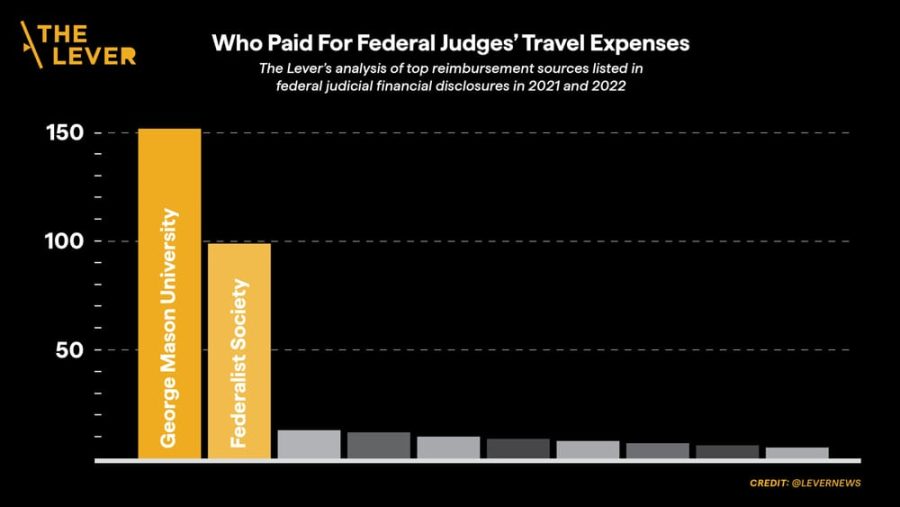
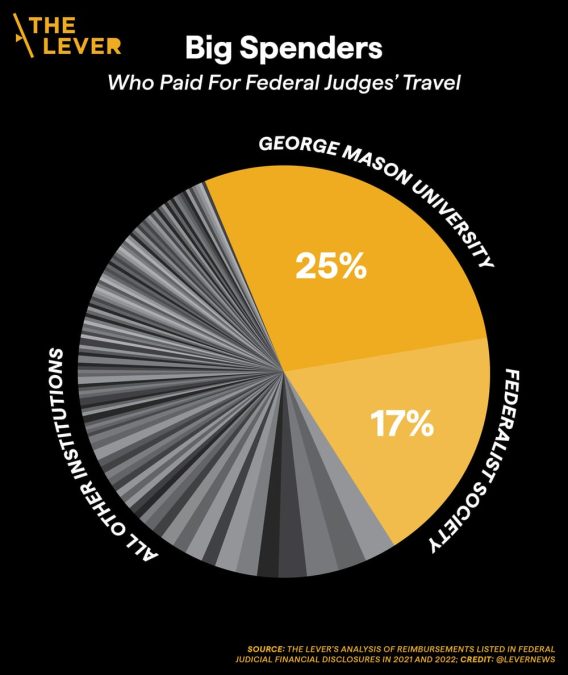
In all, George Mason University (GMU) and the Federalist Society, a conservative lawyers network, funded more than 40 percent of travel-related payments reported by federal judges in those years, far more than any other group.
The staggering number of junkets indicate that, as conservative Supreme Court justices face scrutiny for failing to disclose private luxury travel supplied by billionaire donors, right-wing legal interests funded by the megawealthy are routinely feting lower-court judges and treating them to all-expenses-paid trips to far-flung locales. As with the gifts to Supreme Court justices, the trips effectively function as a reward system for judges who espouse and maintain hard-line conservative legal views.
GMU — a Virginia-based public research university that’s home to the conservative Antonin Scalia Law School and its pro-business, anti-regulation Law and Economics program — paid for federal judges’ transportation, meals, or lodging at least 152 times from 2021–22. The Washington-based Federalist Society covered travel or food-related expenses on at least ninety-nine occasions during the same time period. The judges are not required to disclose how much the excursions cost.
The Federalist Society and GMU are both closely tied to the conservative legal movement and billionaire donors who have a financial interest in how the federal judiciary interprets laws. Both institutions also accept corporate donations.
“The data is really compelling,” said Caroline Fredrickson, a distinguished visiting professor from practice at Georgetown Law. “It confirms what we all knew intuitively: The Federalist Society and George Mason have a deep reach into the federal judiciary, and are using it to ensure that a very particular point of view about legal analysis is conveyed to judges and is done in luxury accommodations, so that judges are much more likely to attend.”
TheLever reviewed electronically available financial disclosure forms filed by more than 1,300 federal judges in 2021 and 2022, and identified at least 595 instances of judges disclosing reimbursements for travel-related expenses.
GMU and the Federalist Society were far and away the top sources of such payments, together accounting for 42 percent of all reimbursements listed by the federal judges. No other organizations came anywhere close to matching their generosity: The third-most common sources on the list — Notre Dame, Georgetown, and George Washington University — accounted for thirteen reimbursements apiece.
The Federalist Society is cochaired by former Donald Trump judicial adviser Leonard Leo, best known as the architect of the Supreme Court’s conservative supermajority, and the organization receives significant funding from his dark money network. Last year, the Supreme Court that Leo helped build overturned decades of precedent and eliminated federal protections for abortion rights.
Leo, the beneficiary of a historic $1.6 billion dark money donation in 2021, previously brokered a $20 million anonymous gift to rename GMU’s law school after the late Supreme Court justice Antonin Scalia in 2016. As theLever and ProPublica have reported, that gift to GMU was apparently made by Barre Seid, a little-known Chicago industrialist who converted his electrical surge protector empire into funding for Leo’s unprecedented dark money operation.
GMU has separately received tens of millions in donations from foundations affiliated with the billionaire oil and gas titan Charles Koch, a libertarian activist and longtime opponent of environmental regulations. That included a $10 million contribution in support of renaming the law school. Koch’s foundations have also supported the Federalist Society.
“Right-wing efforts to legislate through our courts — led and bankrolled by conservative kingpin Leonard Leo — have seeped into all levels of the federal judiciary,” said Caroline Ciccone, president of the progressive watchdog group Accountable.US. “It’s no surprise that Leo’s Federalist Society and Scalia Law School are now key hubs for conservative judges to score free luxury trips and unusual perks, undermining judicial integrity and contributing to plummeting public trust in our courts.”
Spokespeople for Leo, Koch’s charitable foundation, GMU’s Antonin Scalia Law School, and the Federalist Society did not respond to theLever’s requests for comment.
“Study Time”
The forty-nine-year-old Law and Economics Center, which promotes a pro-business, anti-regulatory legal perspective, has been housed at GMU since 1986. As the center noted in an event agenda last year, its purpose is to pull together “timely, relevant, and unassailable research on public policy issues” and share it with “those who are directly shaping our country’s public policy discussions.”
“With research divisions devoted to top-quality legal policy analysis and educational outreach to judges, attorneys general, and other policymakers, the [Law and Economics Center] is uniquely equipped to positively affect national policy outcomes,” the center wrote.
A 2022 review of rulings by judges who participated in an early version of this Law and Economics program decades ago by researchers at Columbia University, ETH Zurich, and the Toulouse School of Economics suggests that the core mission of the project has been highly successful.
“Economics-trained judges significantly shift legal outcomes in U.S. courts,” wrote the researchers. “They use economic analysis in their written opinions, render conservative votes and verdicts, rule against regulation, are somewhat more permissive on antitrust, and mete out harsher criminal sentences. When ideas move from economics into law, there are important policy consequences.”
The Law and Economics Center’s judicial educational programs tend to take place at uber-ritzy junkets. Between 2021 and 2022, GMU brought federal judges to destinations including the university’s homebase of Arlington, Virginia; the beaches of Naples and Destin, Florida, and Maui, Hawaii; the mountains of Colorado and Montana; and the United Kingdom and Italy. The program also hosted an event in Leo’s adopted home of Bar Harbor, Maine, right around the time that the Supreme Court overturned its landmark Roe v. Wade abortion rights decision.
“Mostly these George Mason things are not held in, you know, Arlington, Virginia,” said Fredrickson, the Georgetown law professor. “They’re held in the Rockies or at Florida resorts, or in some other place where the judge doesn’t have to pay their own way, and it’s pretty nice to get a free ride like that.”
She continued, “If you look at their agendas, they work for an hour or two a day, and then they have ‘study time,’ where in the afternoon, they get to go and ‘study’ — while they also, no doubt, are hitting golf balls. . . . It ends up being a very slanted educational program, it’s the only one that’s going, and it’s awfully nice to hang out on the beach and think about antitrust law.”
Indeed, the agenda for an upcoming, weeklong “Economics Institute for Federal Judges & State Supreme Court Justices,” scheduled to be held in March next year at the Henderson Beach and Spa Resort in Destin, Florida, features ample “study time,” “afternoon breaks,” and free time. Educational programming effectively concludes at 12:15 p.m. each day.
“There’s nobody else who does this,” Fredrickson said of GMU’s Law and Economics program. “They are the ones who got in the business of offering these judicial educational seminars early on, and there’s been nobody with deep pockets who has stepped up to do the same. . . . The major donations that have come in from Barre Seid and from the Koch Brothers into George Mason have enabled them to put on these programs.”
The Federalist Society’s judicial reimbursements don’t sound quite as posh — or so conspicuously like vacations. Generally, the judges are there to give lectures or speak to local lawyers or law students.
Still, the group is constantly shipping judges all over the country. In 2021–22, the Federalist Society reimbursed judges’ travel to Arizona, California, Florida, Illinois, Indiana, Iowa, Kansas, Kentucky, Massachusetts, Michigan, Nevada, New York, North Carolina, Pennsylvania, Tennessee, Texas, Utah, Virginia, Washington state, and Washington, DC.
“The whole thing is really troubling,” said Fredrickson, who previously served as the president of the American Constitution Society (ACS), the much smaller, liberal counterweight to the Federalist Society.
While Fredrickson noted that ACS doesn’t have the budgetary resources for similar events, she said, “I don’t think that organizations like the Federalist Society — or maybe even like ACS, which is definitely less hard-edged than the Federalist Society — [should] be offering these kinds of junkets to judges. It’s not appropriate for the role that they are supposed to play in our judicial system.”
“When Do They Have Time to Be Judges?”
The federal judicial reimbursement data reviewed by theLever shows more than one hundred federal judges accepted paid travel-related expenses from GMU or the Federalist Society between 2021 and 2022.
Some judges stand out for the frequency with which they are traveling on those institutions’ dime — specifically, judges on the United States Court of Appeals for the Sixth Circuit. These judges disclosed receiving at least fifty-four reimbursements provided by the Federalist Society or GMU.
Chief Judge Jeffrey Sutton, appointed by George W. Bush, listed forty-two reimbursements in 2021 and 2022, more than any other federal judge whose financial disclosure forms were available online. GMU and the Federalist Society accounted for twenty of Sutton’s reimbursements.
Last year, the records show, the National Security Institute at GMU’s Antonin Scalia Law School sent Sutton to Padua, Italy, to teach and meet with students, according to his annual disclosure. The Federalist Society sent Sutton to Alabama, Arizona, California, Illinois, Kansas, Michigan, Utah, Virginia, and Washington, DC, to present lectures and participate in conference panels.
Judge Chad Readler, who was appointed by Trump in 2019, listed twenty-four reimbursements, twenty of which were provided by GMU and the Federalist Society.
Judge Amul Thapar, appointed by Trump in 2017, listed 14 reimbursements in 2021. Eight of those travel-related expenses were paid by the Federalist Society. Thapar and Sutton are both known as top “feeder judges”; many of their law clerks go on to work for Supreme Court justices.
Asked about the judges’ travel, Fredrickson joked: “Sounds pretty nice. When do they have time to be judges?”
The Sixth Circuit did not respond to an emailed request for comment.
Earlier this year, Sutton issued an opinion striking down a buffer zone law designed to prohibit antiabortion activists from harassing patients and blocking the sidewalk in front of an abortion clinic in Louisville, Kentucky.
This fall, Sutton and Thapar issued a decision allowing Tennessee and Kentucky to enforce laws banning gender-affirming care for minors, meaning that doctors must stop using puberty blockers, hormones, and surgeries to treat transgender youths. The ruling acceded to the demands from Tennessee’s Republican attorney general and twenty-one other GOP state attorneys general who filed an amicus brief in the case.
Leo’s dark money network has long been the top financier of the Republican Attorneys General Association, which elects GOP law enforcement chiefs and helps coordinate their efforts to influence policy and shape judicial decisions. The Leo network donated $1 million to the association earlier this year and $6.5 million in the 2022 election cycle, according to data from Political MoneyLine.
The Sixth Circuit case on gender-affirming care could soon come before the Supreme Court and its conservative supermajority, as the families and physician involved in the case have petitioned justices to review the lower court’s decision.
You can subscribe to David Sirota’s investigative journalism project, theLever, here.
----
CPI
https://publicintegrity.org/politics/corporations-pro-business-nonprofits-foot-bill-for-judicial-seminars/
ref 2013
Key Findings
- Between July 2008 and 2012, about 185 federal judges attended more than 100 judicial education seminars, sponsored by conservative foundations and multinational corporations like ExxonMobil, Pfizer and BP.
- The Center identified instances where judges who attended seminars underwritten by certain firms and trade groups later issued rulings in the funders’ favor.
- George Mason University’s Law & Economics Center and Northwestern University’s Judicial Education Program hosted more judicial conferences than any other organization or university.
- The Koch Foundation and The Searle Freedom Trust, both major supporters of conservative causes, were sponsors for most of the conferences organized by the two schools.
- The person who spoke at more judicial conferences than any other was Henry Butler, a professor and prominent conservative formerly of Northwestern and now executive director of George Mason’s Law & Economics Center.
Judicial seminar backed by ex-president of Bolivia
By Michael Beckel and Chris Young
March 28, 2013
GMU center accepted funds from firm headed by former Bolivian president accused of human rights violations.
Secret court judge attended expenses-paid terrorism seminar
By Chris Young
June 7, 2013
Microsoft heavily funding ‘small business’ lobby
By Adam Wollner
July 15, 2013
Koch brothers, major corporations sponsor pension reform seminar for judges
By Chris Young
April 25, 2014
Judge who stopped Wisconsin campaign finance probe tied to Koch-funded junkets
By Chris Young
May 27, 2014
Conservative foundations, multinational oil companies and a prescription drug maker were the most frequent sponsors of more than 100 expense-paid educational seminars attended by federal judges over a 4 1/2-year period, according to a Center for Public Integrity investigation.
Among the seminar titles were “The Moral Foundations of Capitalism,” “Corporations and the Limits of Criminal Law” and “Terrorism, Climate & Central Planning: Challenges to Liberty & the Rule of Law.”
Leading the list of sponsors of the 109 seminars identified by the Center were the conservative Charles G. Koch Charitable Foundation, The Searle Freedom Trust, also a supporter of conservative causes, ExxonMobil Corp., Shell Oil Co., pharmaceutical giant Pfizer Inc. and State Farm Insurance Cos. Each were sponsors of 54 seminars.
Other top sponsors included the conservative Lynde and Harry Bradley Foundation (51), Dow Chemical Co. (47), AT&T Inc. (45) and the U.S. Chamber of Commerce (46), according to the Center’s analysis.
Sponsors pick up the cost of judges’ expenses, which often include air fare, hotel stays and meals. The seminars in the Center’s investigation took place from July 2008 through 2012.
The Center identified 185 federal district and appeals court judges who reported attending one or more of the seminars over the period, according to disclosure forms, or about 11 percent of the more than 1,700 federal judges in the United States.
Two schools — George Mason University, located in Virginia just outside Washington, D.C., and Northwestern University based in Evanston, Ill., — hosted more than two-thirds of the seminars.
Roughly three-fourths of the more than 800 sponsors listed in documents were individuals, including a number of judges who took trips, raising the possibility that they may have offset the cost of the sponsorships with their donations. Most of the remaining underwriters were companies and foundations.
Determining exactly how much was paid by which sponsor is difficult to determine — amounts are not required to be reported under the disclosure rules.
Judicial conferences are billed as educational retreats intended to improve judges’ understanding of the law and economics. Judges and seminar hosts say the conferences, which feature lectures and panel discussions, provide helpful information that refines their legal expertise.
But they’ve long drawn scrutiny for how they are funded and organized.
Since the 1990s, critics have complained that many of the privately funded conferences serve state and federal judges a steady dose of free-market, anti-regulation lectures that could influence judges’ rulings from the bench.
Those concerns quieted in 2007, when the Judicial Conference of the United States, a group of senior circuit judges who oversee the U.S. Courts, implemented a policy requiring judges and seminar hosts to disclose information about the conferences.
Well-traveled jurists
The most-traveled judges, according to reports filed online by the judges, were U.S. District Judge Charles R. Wolle of the Southern District of Iowa and Chief Judge Thomas B. Bennett of the Northern District of Alabama Bankruptcy Court. Each reported attending nine seminars.
Wolle is a “senior status” judge, meaning he is semi-retired. He did not respond to requests for comment.
The next-most-traveled judges were:
- U.S. District Judge Manuel L. Real of the Central District of California and Judge Diarmuid F. O’Scannlain of the U.S. Court of Appeals 9th Circuit, covering the Western states, who each took eight trips;
- E. Grady Jolly, a federal appeals court judge for the 5th Circuit which includes Texas, Louisiana and Mississippi, and U.S. Bankruptcy Judge Michael B. Kaplan of the District of New Jersey, who each took six trips;
- U.S. District Judge Kenneth M. Hoyt of the Southern District of Texas, Chief Magistrate Judge Thomas J. Shields of the Southern District of Iowa and senior-status U.S. District Judge Frederic Block of the Eastern District of New York, each of whom took five trips.
O’Scannlain declined to comment for this story. In an email, Kaplan wrote that the “seminars offer a valuable opportunity for new judicial appointees to enhance their knowledge and skills in complex areas of the law,” including economics.
Wolle, Real and O’Scannlain are all listed as seminar sponsors, though records do not indicate how much they contributed.
The Center identified instances where judges who attended seminars underwritten by certain firms and trade groups later issued rulings in the funders’ favor.
EPA loses case
In April 2009, for example, Jolly traveled to Northwestern University to attend the “Criminalization of Corporate Conduct” seminar sponsored by the American Petroleum Institute, the U.S. Chamber of Commerce and 13 other funders.
Last August, Jolly wrote the majority 2-1 opinion declaring that the Environmental Protection Agency broke the law when it rejected a Texas emissions cap generally supported by the fossil fuels industry.
Jolly, who did not respond to requests for comment, sided with two of the petitioners in the suit — the American Petroleum Institute and the U.S. Chamber.
Charles Geyh, an Indiana University law professor who specializes in judicial ethics, is skeptical that rulings are directly influenced by corporate sponsors of seminars, but noted, “in a cynic’s view that would smack of corruption.”
“Even if it has no effect in terms of the decisions judges make, the perception of influence matters a great deal,” he says. “It looks as if [corporations] are buying influence, even if it’s not true.”
Another attendee of the 2009 “Criminalization of Corporate Conduct” seminar was U.S. District Judge Carl J. Barbier, the Eastern District of Louisiana jurist presiding over a high-profile BP civil trial, which is being held without a jury in New Orleans.
Barbier is in charge of considering whether BP owes billions of dollars in fines for gross negligence leading to the 2010 Deepwater Horizon oil platform explosion and spill. The disaster killed 11 people and contaminated a large swath of the Gulf Coast.
In 2011, Barbier dismissed a wrongful-death claim in a suit brought against ExxonMobil and Chevron USA by the widow of a worker who was exposed to radioactive materials found on the companies’ equipment.
Barbier’s ruling in favor of the oil companies came two years after he attended the corporate conduct seminar, funded in part by ExxonMobil and the American Petroleum Institute, according to documents. The judge did not respond to requests for comment.
George Mason University School of Law in Arlington, Va.
Sarah Whitmire/Center for Public Integrity
Free ‘Consider the Source’ e-book
Throughout the 2012 election season, reporters for the Center for Public Integrity’s Consider the Source project provided continuous coverage on the mystery groups that poured nearly $1 billion into state and federal races.
We authored more than a dozen investigative stories, profiled the top 25 “super donors” to the election spending groups known as super PACs and explained the complexity behind the U.S. Supreme Court decision that made it such an unusually expensive election.
We have gathered the best of our election coverage into an e-book, complete with links, just for you.
**Click here to download your free copy today!**
Corporate U?
George Mason University’s Law & Economics Center hosted 45 seminars while Northwestern University’s Judicial Education Program hosted 29. A total of 136 federal judges reported attending conferences conducted by the schools during the 4 1/2-year period analyzed by the Center for Public Integrity.
The remaining top five conference hosts, including The Sedona Conference and the Foundation for Research on Economics and the Environment (FREE), collectively organized 28 conferences.
The Koch Foundation and The Searle Freedom Trust supported most of the conferences organized by George Mason and Northwestern. The energy industry was a sponsor in roughly three-fourths of the conferences hosted by Northwestern.
Billionaire brothers Charles and David Koch, major supporters of conservative causes, and their foundations have given millions to George Mason University. As the Center recently reported, the George Mason University Foundation received $4.4 million in 2011 from the Charles Koch Foundation, making up 15 percent of its revenue that year.
The school is the top recipient of Koch foundation money since 1985. George Mason also houses several free market and libertarian research centers, including the Institute for Humane Studies, which received $3.7 million from the Koch foundations, and the Mercatus Center, whose board of directors includes Charles Koch.
Officials from the Charles G. Koch Charitable Foundation did not return phone calls seeking comment for this report.
The Judicial Conference disclosure policy doesn’t require seminar hosts to reveal how much donors contribute to conferences. But corporate-giving reports and nonprofit tax records shed some light on the costs.
Oil industry support
In 2011, for example, ExxonMobil reported giving $20,000 to George Mason specifically for its judicial training program. The oil company gave an additional $30,000 to the university’s Law & Economics Center, which hosts the conferences. Between 2003 and 2007, the ExxonMobil Foundation gave the think tank $150,000.
ExxonMobil officials did not respond to requests for comment.
Another seminar funder, Donors Trust, gave George Mason’s Law & Economics Center nearly $450,000 in general support in 2010. As the Center reported, Donors Trust helps conservative foundations and individuals give money anonymously to nonprofits that may take controversial positions.
A representative of Donors Trust declined to comment for this story.
The Searle Freedom Trust, a foundation advocating “economic liberty” which regularly donates to conservative groups like the Cato Institute and the American Enterprise Institute, contributed a combined $400,000 to George Mason’s judicial education programs in 2010 and 2011.
The school conducted conferences on antitrust law as well as “Corporations and the Limits of Criminal Law,” both funded by AT&T, BB&T, BP America, Cigna, Coca-Cola, Dow Chemical, FedEx Corp. and others.
“The Moral Foundations of Capitalism” was funded by the same group, and was the most popular George Mason conference, drawing at least 10 federal judges.
BP spokesman Scott Dean says the company has no record of ever directly contributing to the seminars but he did say BP gave the law school and the Law & Economics Center more than $37,000 between 2001 and 2008.
Seminars at Northwestern are hosted by the school’s Searle Center on Law, Regulation, and Economic Growth. The think tank, according to its website, was founded in 2006 thanks to a “generous grant” from Daniel C. Searle, the late pharmaceutical industry executive.
In 2009, the foundation gave $200,000 to Northwestern’s Searle Center for its judicial education program.
Another Northwestern seminar funder, The Lynde and Harry Bradley Foundation — a major supporter of conservative organizations, including the Heritage Foundation — gave $210,000 to the Searle Center between 2008 and 2010.
Records show corporate sponsorship at Northwestern was highest from 2008 through 2010, when a man named Henry Butler — now in charge of George Mason University’s Law & Economics Center — ran the Searle Center.
Daniel Rodriguez, dean of Northwestern University’s School of Law, says corporate sponsorships at the school “ended the moment Butler left.” Rodriguez, who became the dean of Northwestern’s law school last year, says the school recently decided to terminate the programs. He says he’s against corporate sponsorship of judicial seminars.
“These programs should be free from any real or perceived conflict of interest,” he says.
Find a judge
Sort judges by name and location and match them to seminars, funders and more. Scroll down to view results. Note that only seminars attended by federal judges are included. Other sponsored judicial seminars occur in which only state judges have attended.
By Visible Government Online
Judges often ignore trip disclosure rules
By Chris Young and John Dunbar
March 28, 2013
Reports of privately funded trips and seminars made by federal judges are often difficult to find, incomplete or missing.
Some history
In the late 1990s and early 2000s, advocacy groups and raised concerns about judges attending privately funded conferences conducted in vacation destinations like Arizona, Montana and Florida.
Critics claimed that the undisclosed trips created conflicts of interest and cast doubt on the ability of judges to decide cases without bias.
Seminars hosted by the Foundation for Research on Economics and the Environment (FREE) attracted the most attention.
FREE, a Montana-based think tank championing “free-market environmentalism,” drew criticism for its ideologically conservative seminars. In 2011, for example, FREE hosted “Terrorism, Climate & Central Planning: Challenges to Liberty & the Rule of Law.”
Critics complained that judges spent their free time golfing, fishing and horseback riding at the conference’s Montana resort location. They worried that judges were being wined, dined and entertained by FREE’s funders, which included Koch Industries and Texaco Inc. (now part of Chevron Corp.).
Media scrutiny prompted members of Congress in 2000 to introduce legislation that would prohibit judges from accepting “anything of value in connection with a seminar.” The bill, which died in committee, was opposed by the Judicial Conference, which claimed it restricted judges’ free speech rights.
Similar legislation failed again in 2003.
In 2007, the Judicial Conference implemented a policy designed to provide “greater transparency” by setting up disclosure requirements for both judges and seminar hosts.
“Instead of banning anything,” says Geyh, the policy “was a way to mollify those who recognized the perception problem without causing the ones who treat [the conferences] as a First Amendment issue to go ballistic.”
Buying influence?
Even with the new policy, the seminars still have critics.
“These seminars are taking place because large corporate interests are hoping to influence the outcome of cases involving themselves or likeminded entities,” says Nan Aron, president of the Alliance for Justice, a liberal organization that first raised concerns about judicial education conferences in a 1993 report titled “Justice for Sale.”
Russell Wheeler, former deputy director of the Federal Judicial Center, an education and research agency for the federal courts, says it’s possible that funders could be truly dedicated to improving judges’ understanding of the law.
But, he says, “You’ve got to be pretty naïve to believe that.”
“It’s the funders that create the problem,” says Stephen Gillers, a New York University law professor who specializes in legal ethics. “The money comes from interests that have matters before the courts, and they’d like to have those matters settled in their favor.”
Many of the seminars are conservative in nature, especially those hosted by George Mason. But there are a few exceptions. A June 2010 conference sponsored by the Open Society Institute, a foundation founded by liberal investor George Soros, focused mainly on human rights law.
(The Center for Public Integrity has received funding from Soros’ Open Society Foundations.)
Events hosted by the Sedona Conference, a nonprofit whose seminars address legal issues like antitrust law and intellectual property, have been funded primarily by law firms.
Speaking from the right
According to The Center for Public Integrity’s analysis, the person who spoke at more judicial conferences than any other was Butler, a professor and prominent conservative formerly of Northwestern and now executive director of George Mason’s Law & Economics Center.
He has taught judicial seminar courses with titles like “Economic Thinking” and “Economics of Insurance.” A former Republican candidate for Congress — he lost a 1992 bid — Butler was a “Koch Distinguished Professor of Law and Economics” at the University of Kansas.
Butler’s resume cites his “professional affiliations” with the conservative Federalist Society and the Mont Pelerin Society, which decries society’s loss of freedoms “fostered by a decline of belief in private property and the competitive market.”
Butler declined to be interviewed for this story. In response to emailed questions about George Mason’s judicial seminars, he wrote, “You seem to have a well-established theme to your story, accordingly we don’t see any advantage in collaborating with you.”
Daniel Polsby, dean of the George Mason University School of Law, also declined to answer questions for this story other than to say: “We’re very proud of the activities and programs of the Law & Economics Center” via email.
Another frequent seminar instructor is Terry L. Anderson, president of the Property and Environment Research Center, a conservative think tank “dedicated to improving environmental quality through property rights and markets.”
Anderson, a senior fellow at the conservative Hoover Institution, has regularly led “Free Market Environmentalism” lectures at conferences hosted by both George Mason and Northwestern.
Green energy’s ‘false promise’
In January 2011, Anderson was one of four lecturers who spoke at George Mason’s “Advanced Institute on Environmental Economics” conference, which was funded in part by ExxonMobil, BP America and Shell Oil.
The other three speakers were Andrew Morriss, co-author of the book “The False Promise of Green Energy”; Robert K. Fleck, an economics professor who has received thousands of dollars in research grants from the Charles G. Koch Charitable Foundation; and Jason Johnston, a former fellow with the Koch-funded, Anderson-led Property and Environment Research Center and a critic of efforts to reduce greenhouse gas emissions.
“I don’t express views” during lectures, says Anderson. He says his talks are based strictly on economic analysis. “None of my lectures are aimed at changing any judge’s opinion” about a case before them in court.
George Mason law professor Todd J. Zywicki, another regular judicial program speaker, has taught judges about issues like mortgage markets and consumer credit.
He is a senior scholar at the school’s conservative Mercatus Center, and has ties to the Goldwater Institute, a libertarian think tank, and the Competitive Enterprise Institute, which is “dedicated to advancing the principles of limited government, free enterprise, and individual liberty.” Zywicki did not respond to a request for comment.
George Mason “is known to stage conferences that have a conservative economic perspective,” says Gillers, the NYU law professor.
One frequent attendee of George Mason’s judicial seminars, Judge Bennett of Alabama bankruptcy court, told the Center “I’m not going to be snowed by anybody’s presentation.” He said he finds the seminars “infinitely invaluable.”
“You can accumulate information much more quickly than if you sit in your office and read stuff,” he says.
Bennett dismisses criticism of George Mason’s judicial conferences — even though he acknowledges that they often feature conservative voices.
“I believe they put on a fairly balanced program,” he says, noting that he doesn’t pay attention to who funds the conferences. “I’ve been to George Mason seminars where they’ve had people who are not conservative. It’s all in the eye of the beholder.”
Methodology
For the Center for Public Integrity’s investigation of privately funded judicial seminars, we first collected information from a list of the events maintained by the Administrative Office of the U.S. Courts.
According to a 2007 policy, conference hosts that plan to pay for or reimburse federal judges for expenses related to their attendance at educational seminars must report to the U.S. Courts information including program dates, speakers and funders.
We then downloaded judges’ individual filings reporting their attendance at the privately funded seminars. Once we gathered and entered information from both sources, we combined them into one relational database.
Within 30 days of a seminar’s conclusion, federal judges must report their dates of attendance, the name of the program provider and the name of the educational program. Judges’ seminar disclosure reports must remain online for a three-year period, after which they may be taken down.
Consequently, most forms older than three years can no longer be verified.
All forms were entered into a database, cleaned, and verified if possible against original filings and analyzed for patterns and trends from July 2008 through the end of 2012.
Stacked panels?
Northwestern’s 2009 seminar titled “Criminalization of Corporate Conduct” included a speaker panel that was very corporate-friendly — something George Mason’s Henry Butler openly acknowledged during his presentation summing up the day’s events.
Butler noted “a question can be raised” about the panels’ balance and “do we have enough people here that are representing the prosecutor’s perspective.” (His remarks are posted on
“On the other hand,” he continued, “I have to explain to you that we’ve had difficulty in the past getting the U.S. attorneys to participate in these programs.”
The December 2010 “Climate Change Litigation” session hosted by George Mason’s Law & Economics Center was sponsored in part by BP America, ExxonMobil and Shell Oil and featured four speakers.
Two were attorneys who have represented corporate clients like Koch Industries and ExxonMobil. A third speaker, Johnston, the former Property and Environment Research Center fellow, spent part of his presentation criticizing the American civil courts system for making American companies less competitive on the international stage.
Butler, who moderated the panel, acknowledged the imbalance as he introduced a last-minute replacement for the fourth panelist.
“Eric Mayer is going to be pro-public nuisance, climate-change litigation cases, and the other three are basically going to express some skepticism,” Butler said in his introduction, identifying Mayer, a lawyer who has represented plaintiffs as well as corporate defendants.
The announcement drew laughs from panelists and audience members.
“This may seem unbalanced,” Butler continued, “but Eric is not daunted by this challenge at all.”
Donor names disappear
The “transparency” policy regarding judicial trips may be weak, but the names of the corporations, foundations and individuals that pay for the conferences at least are available to the public.
Now, even that bit of sunshine is clouding over.
In 2012, George Mason’s Law & Economics Center began listing “xyz corp.,” as a sponsor before listing itself as the only donor on official disclosure documents. However, the think tank does provide a list of donors on its website.
The 2007 Judicial Conference policy allows such reporting if the support comes from general revenues or from endowments or gifts “not raised for the particular educational program or for the purpose of educating judges.”
Geyh, the Indiana University law professor, says the policy enables conference hosts to shield their donors and make it tough for judges to identify potential conflicts before attending seminars.
“It does raise transparency issues,” he says. “It strikes me as some semantic game-playing with the rules.”
John Dunbar contributed to this report.
no pix]
*Related
===
DOUG GINSBURG 2021
...
Session 8: Judicial Imposed Limits on Antitrust | Kobayashi Reading Assignment: Brunswick Corp. v. Pueblo Bowl-O-Mat, Inc., 429 US 477 (1977). US Department of Justice and The Federal Trade Commission. Vertical Merger Guidelines, 2020. Aspen Skiing Co. v. Aspen Highlands Skiing Corp., 472 US 585 (1985). Verizon Communications Inc. v. Law Offices of Curtis V. Trinko, LLP, 540 US 398 (2004). Part III, IV. 9:30 – 10:45 am Session 9: Economic Growth, Income Inequality, and the Rule of Law Sanjai Bhagat, Provost Professor of Finance, Leeds School of Business University of Colorado, Boulder Reading Assignment: Bhagat, Sanjai, "Economic Growth, Income Inequality, and the Rule of Law." Harvard Business Law Review, (November 2020). 11:00 am – 12:15 pm Session 10: The Purpose of the Modern Corporation | Bhagat Reading Assignment: Bhagat, Sanjai and R. Glenn Hubbard, "Should the Mordern Corporation Maximize Shareholder Value?" AEI Economic Perspectives, (September 2020). 12:15 – 5:45 pm Afternoon Study Break 6:00 – 7:00 pm Session 11: Fireside Chat on Corporate Environmental, Social, Governance (ESG): Henry N. Butler interviews Chris Wright, Billiards
==
READ MORE:[Expert: Clarence Thomas could face 'criminal prosecution' by not paying taxes on gifts
READ MORE:[Expert: Clarence Thomas could face 'criminal prosecution' by not paying taxes on gifts
===
below ref to 1993 report:
http://web.archive.org/web/20210506031644/https://www.afj.org/assets/resources/resources2/Justice-for-Sale.pdf
===
http://web.archive.org/web/20190305232930/https://publicintegrity.org/federal-politics/corporations-pro-business-nonprofits-foot-bill-for-judicial-seminars/
NO LNX MANY
JUSTICE OBSCURED
Published — March 28, 2013
Updated — May 27, 2014
CORPORATIONS, PRO-BUSINESS NONPROFITS FOOT BILL FOR JUDICIAL SEMINARS
conservative foundations, multinational oil companies and a prescription drug maker were the most frequent sponsors of more than 100 expense-paid educational seminars attended by federal judges over a 4 1/2-year period, according to a Center for Public Integrity investigation.
Among the seminar titles were “TheMoral Foundations of Capitalism,” “Corporations and the Limits of Criminal Law” and “Terrorism, Climate & Central Planning: Challenges to Liberty & the Rule of Law.”
Leading the list of sponsors of the 109 seminars identified by the Center were the conservative Charles G. Koch Charitable Foundation, The Searle Freedom Trust, also a supporter of conservative causes, ExxonMobil Corp., Shell Oil Co., pharmaceutical giant Pfizer Inc. and State Farm Insurance Cos. Each were sponsors of 54 seminars.
Other top sponsors included the conservative Lynde and HarryBradley Foundation (51), Dow Chemical Co. (47), AT&T Inc. (45) and the U.S. Chamber of Commerce (46), according to the Center’s analysis.
Sponsors pick up the cost of judges’ expenses, which often include air fare, hotel stays and meals. The seminars in the Center’s investigation took place from July 2008 through 2012.
The Center identified 185 federal district and appeals court judges who reported attending one or more of the seminars over the period, according to disclosure forms, or about 11 percent of the more than 1,700 federal judges in the United States.
Two schools — George Mason University, located in Virginia just outside Washington, D.C., and Northwestern University based in Evanston, Ill., — hosted more than two-thirds of the seminars.
Roughly three-fourths of the more than 800 sponsors listed in documents were individuals, including a number of judges who took trips, raising the possibility that they may have offset the cost of the sponsorships with their donations. Most of the remaining underwriters were companies and foundations.
Determining exactly how much was paid by which sponsor is difficult to determine — amounts are not required to be reported under the disclosure rules.
Judicial conferences are billed as educational retreats intended to improve judges’ understanding of the law and economics. Judges and seminar hosts say the conferences, which feature lectures and panel discussions, provide helpful information that refines their legal expertise.
But they’ve long drawn scrutiny for how they are funded and organized.
Since the 1990s, critics have complained that many of the privately funded conferences serve state and federal judges a steady dose of free-market, anti-regulation lectures that could influence judges’ rulings from the bench.
Those concerns quieted in 2007, when the Judicial Conference of the United States, a group of senior circuit judges who oversee the U.S. Courts, implemented a policy requiring judges and seminar hosts to disclose information about the conferences.
Well-traveled jurists
The most-traveled judges, according to reports filed online by the judges, were U.S. District Judge Charles R. Wolle of the Southern District of Iowa and Chief Judge Thomas B. Bennett of the Northern District of Alabama Bankruptcy Court. Each reported attending nine seminars.
Wolle is a “senior status” judge, meaning he is semi-retired. He did not respond to requests for comment.
The next-most-traveled judges were:
U.S. District Judge Manuel L. Real of the Central District of California and Judge Diarmuid F. O’Scannlain of the U.S. Court of Appeals 9th Circuit, covering the Western states, who each took eight trips;
E. Grady Jolly, a federal appeals court judge for the 5th Circuitwhich includes Texas, Louisiana and Mississippi, and U.S. Bankruptcy Judge Michael B. Kaplan of the District of New Jersey, who each took six trips;
U.S. District Judge Kenneth M. Hoyt of the Southern District of Texas, Chief Magistrate Judge Thomas J. Shields of the Southern District of Iowa and senior-status U.S. District Judge Frederic Block of the Eastern District of New York, each of whom took five trips.
O’Scannlain declined to comment for this story. In an email, Kaplan wrote that the “seminars offer a valuable opportunity for new judicial appointees to enhance their knowledge and skills in complex areas of the law,” including economics.
Wolle, Real and O’Scannlain are all listed as seminar sponsors, though records do not indicate how much they contributed.
The Center identified instances where judges who attended seminars underwritten by certain firms and trade groups later issued rulings in the funders’ favor.
EPA loses case
In April 2009, for example, Jolly traveled to Northwestern University to attend the “Criminalization of Corporate Conduct” seminar sponsored by the American Petroleum Institute, the U.S. Chamber of Commerce and 13 other funders.
Last August, Jolly wrote the majority 2-1 opinion declaring that the Environmental Protection Agency broke the law when it rejected a Texas emissions cap generally supported by the fossil fuels industry.
Jolly, who did not respond to requests for comment, sided with two of the petitioners in the suit — the American Petroleum Institute and the U.S. Chamber.
Charles Geyh, an Indiana University law professor who specializes in judicial ethics, is skeptical that rulings are directly influenced by corporate sponsors of seminars, but noted, “in a cynic’s view that would smack of corruption.”
“Even if it has no effect in terms of the decisions judges make, the perception of influence matters a great deal,” he says. “It looks as if [corporations] are buying influence, even if it’s not true.”
Another attendee of the 2009 “Criminalization of Corporate Conduct” seminar was U.S. District Judge Carl J. Barbier, the Eastern District of Louisiana jurist presiding over a high-profile BP civil trial, which is being held without a jury in New Orleans.
Barbier is in charge of considering whether BP owes billions of dollars in fines for gross negligence leading to the 2010 Deepwater Horizon oil platform explosion and spill. The disaster killed 11 people and contaminated a large swath of the Gulf Coast.
In 2011, Barbier dismissed a wrongful-death claim in a suit brought against ExxonMobil and Chevron USA by the widow of a worker who was exposed to radioactive materials found on the companies’ equipment.
Barbier’s ruling in favor of the oil companies came two years after he attended the corporate conduct seminar, funded in part by ExxonMobil and the American Petroleum Institute, according to documents. The judge did not respond to requests for comment.
[Free ‘Consider the Source’ e-book]
Throughout the 2012 election season, reporters for the Center for Public Integrity’s Consider the Source project provided continuous coverage on the mystery groups that poured nearly $1 billion into state and federal races.
We authored more than a dozen investigative stories, profiled the top 25 “super donors” to the election spending groups known as super PACs and explained the complexity behind the U.S. Supreme Court decision that made it such an unusually expensive election.
We have gathered the best of our election coverage into an e-book, complete with links, just for you.]
Corporate U?
George Mason University’s Law & Economics Center hosted 45 seminars while Northwestern University’s Judicial Education Program hosted 29. A total of 136 federal judges reported attending conferences conducted by the schools during the 4 1/2-year period analyzed by the Center for Public Integrity.
The remaining top five conference hosts, including The Sedona Conference and theFoundation for Research on Economics and the Environment (FREE), collectively organized 28 conferences.
The Koch Foundation and The Searle Freedom Trust supported most of the conferences organized by George Mason and Northwestern. The energy industry was a sponsor in roughly three-fourths of the conferences hosted by Northwestern.
Billionaire brothers Charles and David Koch, major supporters of conservative causes, and their foundations have given millions to George Mason University. As the Center recently reported, the George Mason University Foundation received $4.4 million in 2011 from the Charles Koch Foundation, making up 15 percent of its revenue that year.
The school is the top recipient of Koch foundation money since 1985. George Mason also houses several free market and libertarian research centers, including the Institute for Humane Studies, which received $3.7 million from the Koch foundations, and the Mercatus Center, whose board of directors includes Charles Koch.
Officials from the Charles G. Koch Charitable Foundation did not return phone calls seeking comment for this report.
The Judicial Conference disclosure policy doesn’t require seminar hosts to reveal how much donors contribute to conferences. But corporate-giving reports and nonprofit tax records shed some light on the costs.
Oil industry support
In 2011, for example, ExxonMobil reported giving $20,000 to George Mason specifically for its judicial training program. The oil company gave an additional $30,000 to the university’s Law & Economics Center, which hosts the conferences. Between 2003 and 2007, the ExxonMobil Foundation gave the think tank $150,000.
ExxonMobil officials did not respond to requests for comment.
Another seminar funder, Donors Trust, gave George Mason’s Law & Economics Center nearly $450,000 in general support in 2010. As the Center reported, Donors Trust helps conservative foundations and individuals give money anonymously to nonprofits that may take controversial positions.
A representative of Donors Trust declined to comment for this story.
The Searle Freedom Trust, a foundation advocating “economic liberty” which regularly donates to conservative groups like the Cato Institute and the American Enterprise Institute, contributed a combined $400,000 to George Mason’s judicial education programs in 2010 and 2011.
The school conducted conferences onantitrust law as well as “Corporations and the Limits of Criminal Law,” both funded by AT&T, BB&T, BP America, Cigna, Coca-Cola, Dow Chemical, FedEx Corp. and others.
“The Moral Foundations of Capitalism” was funded by the same group, and was the most popular George Mason conference, drawing at least 10 federal judges.
BP spokesman Scott Dean says the company has no record of ever directly contributing to the seminars but he did say BP gave the law school and the Law & Economics Center more than $37,000 between 2001 and 2008.
Seminars at Northwestern are hosted by the school’s Searle Center on Law, Regulation, and Economic Growth.The think tank, according to its website, was founded in 2006 thanks to a “generous grant” from Daniel C. Searle, the late pharmaceutical industry executive.
In 2009, the foundation gave $200,000 to Northwestern’s Searle Center for its judicial education program.
Another Northwestern seminar funder, The Lynde and Harry Bradley Foundation — a major supporter of conservative organizations, including the Heritage Foundation — gave $210,000 to the Searle Center between 2008 and 2010.
Records show corporate sponsorship at Northwestern was highest from 2008 through 2010, when a man named Henry Butler — now in charge of George Mason University’s Law & Economics Center — ran the Searle Center.
Daniel Rodriguez, dean of Northwestern University’s School of Law, says corporate sponsorships at the school “ended the moment Butler left.” Rodriguez, who became the dean of Northwestern’s law school last year, says the school recently decided to terminate the programs. He says he’s against corporate sponsorship of judicial seminars.
“These programs should be free from any real or perceived conflict of interest,” he says.
[Find a judge
Sort judges by name and location and match them to seminars, funders and more. Scroll down to view results. Note that only seminars attended by federal judges are included. Other sponsored judicial seminars occur in which only state judges have attended.
By Visible Government Online]
Judges often ignore trip disclosure rules
By Chris Young and John Dunbar
March 28, 2013
Reports of privately funded trips and seminars made by federal judges are often difficult to find, incomplete or missing.
Some history
In the late 1990s and early 2000s, advocacy groups and media outlets raised concerns about judges attending privately funded conferences conducted in vacation destinations like Arizona, Montana and Florida.
Critics claimed that the undisclosed trips created conflicts of interest and cast doubt on the ability of judges to decide cases without bias.
Seminars hosted by the Foundation for Research on Economics and the Environment (FREE) attracted the most attention.
FREE, a Montana-based think tank championing “free-market environmentalism,” drew criticism for its ideologically conservative seminars. In 2011, for example, FREE hosted “Terrorism, Climate & Central Planning: Challenges to Liberty & the Rule of Law.”
Critics complained that judges spent their free time golfing, fishing and horseback riding at the conference’s Montana resort location. They worried that judges were being wined, dined and entertained by FREE’s funders, which included Koch Industries and Texaco Inc. (now part of Chevron Corp.).
Media scrutiny prompted members of Congress in 2000 to introduce legislation that would prohibit judges from accepting “anything of value in connection with a seminar.” The bill, which died in committee, was opposed by the Judicial Conference, which claimed it restricted judges’ free speech rights.
Similar legislation failed again in 2003.
In 2007, the Judicial Conference implemented a policy designed to provide “greater transparency” by setting up disclosure requirements for both judges and seminar hosts.
“Instead of banning anything,” says Geyh, the policy “was a way to mollify those who recognized the perception problem without causing the ones who treat [the conferences] as a First Amendment issue to go ballistic.”
Buying influence?
Even with the new policy, the seminars still have critics.
“These seminars are taking place because large corporate interests are hoping to influence the outcome of cases involving themselves or likeminded entities,” says Nan Aron, president of the Alliance for Justice, a liberal organization that first raised concerns about judicial education conferences in a 1993 report titled “Justice for Sale.”
Russell Wheeler, former deputy director of the Federal Judicial Center, an education and research agency for the federal courts, says it’s possible that funders could be truly dedicated to improving judges’ understanding of the law.
But, he says, “You’ve got to be pretty naïve to believe that.”
“It’s the funders that create the problem,” says Stephen Gillers, a New York University law professor who specializes in legal ethics. “The money comes from interests that have matters before the courts, and they’d like to have those matters settled in their favor.”
Many of the seminars are conservative in nature, especially those hosted by George Mason. But there are a few exceptions. A June 2010 conference sponsored by the Open Society Institute, a foundation founded by liberal investor George Soros, focused mainly on human rights law.
(The Center for Public Integrity has received funding from Soros’ Open Society Foundations.)
Events hosted by the Sedona Conference, a nonprofit whose seminars address legal issues like antitrust law and intellectual property, have been funded primarily by law firms.
Speaking from the right
According to The Center for Public Integrity’s analysis, the person who spoke at more judicial conferences than any other wasButler,a professor and prominent conservative formerly of Northwestern and now executive director of George Mason’s Law & Economics Center.
:{
}:
He has taught judicial seminar courses with titles like “Economic Thinking” and “Economics of Insurance.” A former Republican candidate for Congress — he lost a 1992 bid — Butler was a “Koch Distinguished Professor of Law and Economics” at the University of Kansas.
:{
}:
Butler’s resume cites his “professional affiliations” with the conservative Federalist Society and the Mont Pelerin Society, which decries society’s loss of freedoms “fostered by a decline of belief in private property and the competitive market.”
:{
}:
Butler declined to be interviewed for this story. In response to emailed questions about George Mason’s judicial seminars, he wrote, “You seem to have a well-established theme to your story, accordingly we don’t see any advantage in collaborating with you.”
Daniel Polsby, dean of the George Mason University School of Law, also declined to answer questions for this story other than to say: “We’re very proud of the activities and programs of the Law & Economics Center” via email.
Another frequent seminar instructor is Terry L. Anderson, president of the Property and Environment Research Center, a conservative think tank “dedicated to improving environmental quality through property rights and markets.”
Anderson, a senior fellow at the conservative Hoover Institution, has regularly led “Free Market Environmentalism” lectures at conferences hosted by both George Mason and Northwestern.
Green energy’s ‘false promise’
In January 2011, Anderson was one of four lecturers who spoke at George Mason’s “Advanced Institute on Environmental Economics” conference, which was funded in part by ExxonMobil, BP America and Shell Oil.
The other three speakers wereAndrew Morriss, co-author of the book “The False Promise of Green Energy”; Robert K. Fleck, an economics professor who has received thousands of dollars in research grants from the Charles G. Koch Charitable Foundation; and Jason Johnston, a former fellow with the Koch-funded, Anderson-led Property and Environment Research Center and a critic of efforts to reduce greenhouse gas emissions.
“I don’t express views” during lectures, says Anderson. He says his talks are based strictly on economic analysis. “None of my lectures are aimed at changing any judge’s opinion” about a case before them in court.
George Mason law professor Todd J. Zywicki, another regular judicial program speaker, has taught judges about issues like mortgage markets and consumer credit.
He is a senior scholar at the school’s conservative Mercatus Center, and has ties to the Goldwater Institute, a libertarian think tank, and the Competitive Enterprise Institute, which is “dedicated to advancing the principles of limited government, free enterprise, and individual liberty.” Zywicki did not respond to a request for comment.
George Mason “is known to stage conferences that have a conservative economic perspective,” says Gillers, the NYU law professor.
One frequent attendee of George Mason’s judicial seminars, Judge Bennett of Alabama bankruptcy court, told the Center “I’m not going to be snowed by anybody’s presentation.” He said he finds the seminars “infinitely invaluable.”
“You can accumulate information much more quickly than if you sit in your office and read stuff,” he says.
Bennett dismisses criticism of George Mason’s judicial conferences — even though he acknowledges that they often feature conservative voices.
“I believe they put on a fairly balanced program,” he says, noting that he doesn’t pay attention to who funds the conferences. “I’ve been to George Mason seminars where they’ve had people who are not conservative. It’s all in the eye of the beholder.”
[Methodology
For the Center for Public Integrity’s investigation of privately funded judicial seminars, we first collected information from a list of the events maintained by the Administrative Office of the U.S. Courts.
According to a 2007 policy, conference hosts that plan to pay for or reimburse federal judges for expenses related to their attendance at educational seminars must report to the U.S. Courts information including program dates, speakers and funders.
We then downloaded judges’ individual filings reporting their attendance at the privately funded seminars. Once we gathered and entered information from both sources, we combined them into one relational database.
Within 30 days of a seminar’s conclusion, federal judges must report their dates of attendance, the name of the program provider and the name of the educational program. Judges’ seminar disclosure reports must remain online for a three-year period, after which they may be taken down.
Consequently, most forms older than three years can no longer be verified.
All forms were entered into a database, cleaned, and verified if possible against original filings and analyzed for patterns and trends from July 2008 through the end of 2012.]
Stacked panels?
Northwestern’s 2009 seminar titled “Criminalization of Corporate Conduct” included a speaker panel that was very corporate-friendly — somethingGeorge Mason’s Henry Butleropenly acknowledged during his presentation summing up the day’s events.
Butler noted “a question can be raised” about the panels’ balance and “do we have enough people here that are representing the prosecutor’s perspective.” (His remarks are posted on YouTube.) “And I certainly can plead guilty to that accusation.”
“On the other hand,” he continued, “I have to explain to you that we’ve had difficulty in the past getting the U.S. attorneys to participate in these programs.”
The December 2010 “Climate Change Litigation” session hosted by George Mason’s Law & Economics Center was sponsored in part by BP America, ExxonMobil and Shell Oil and featured four speakers.
Two were attorneys who have represented corporate clients like Koch Industries and ExxonMobil. A third speaker, Johnston, the former Property and Environment Research Center fellow, spent part of his presentation criticizing the American civil courts system for making American companies less competitive on the international stage.
Butler, who moderated the panel, acknowledged the imbalance as he introduced a last-minute replacement for the fourth panelist.
“Eric Mayer is going to be pro-public nuisance, climate-change litigation cases, and the other three are basically going to express some skepticism,” Butler said in his introduction, identifying Mayer, a lawyer who has represented plaintiffs as well as corporate defendants.
The announcement drew laughs from panelists and audience members.
“This may seem unbalanced,” Butler continued, “but Eric is not daunted by this challenge at all.”
Donor names disappear
The “transparency” policy regarding judicial trips may be weak, but the names of the corporations, foundations and individuals that pay for the conferences at least are available to the public.
Now, even that bit of sunshine is clouding over.
In 2012, George Mason’s Law & Economics Center began listing “xyz corp.,” as a sponsor before listing itself as the only donor on official disclosure documents. However, the think tank does provide a list of donors on its website.
The 2007 Judicial Conference policy allows such reporting if the support comes from general revenues or from endowments or gifts “not raised for the particular educational program or for the purpose of educating judges.”
Geyh, the Indiana University law professor, says the policy enables conference hosts to shield their donors and make it tough for judges to identify potential conflicts before attending seminars.
“It does raise transparency issues,” he says. “It strikes me as some semantic game-playing with the rules.”
John Dunbar contributed to this report.
Read more in Federal Politics
===
===
https://www.dailykos.com/stories/2019/8/2/1876168/-The-Origins-of-the-Koch-Network-s-Disinformation-Playbook
we’ve written more than a few times about how the Koch network operates and its success in stopping action to combat climate change. In fact, it's been so successful in doing so that other groups are now using the Koch strategy to advance similar aims.
But even the Koch network was once new to the game. A new book by Christopher Leonard excerpted in Politico gives us a glimpse into the origins of the Koch network’s political strategy.
leonard explains that Charles Koch felt that the company was being targeted because it was “politically unimportant.” Before this, Charles Koch didn’t play much in the political sphere, as he thought government was fundamentally bad. However, this investigation made him think it would be advantageous to be more politically involved, so “he went to build a political influence machine.”
And so began the Koch network’s first foray into a coordinated, political misinformation campaign.
First, shortly after the investigation began, Koch Industries president Bill Hanna sent an internal memo emphasizing to employees the importance of keeping internal records secret and instructing them to destroy documents that “would be useful to our competitors.” One employee admitted he was asked to destroy his evaluations of oil gaugers. Later on, when investigators asked for certain documents that would help determine if Koch Industries had committed theft, the company said they had been destroyed.
The next step was to undermine the public narrative that Koch Industries had stolen. The company sent a team to the Osage tribe in Oklahoma, where it did its own “independent” audit. Eventually, Koch claimed it had actually overreported the amount of oil they took, and therefore the tribe owed the company $22,000. At the time, Osage Chief Charles O. Tillman had no way to verify the company’s claims, and considering the Koch Brothers weren’t then synonymous with political corruption, he had little reason to doubt its conclusions. Tillman went on to speak out in favor of the company to the media--something he later regretted after seeing evidence that showed Koch Industries had in fact stole from the tribe.
At the same time, Koch Industries became more involved in the political sphere, ramping up campaign donations to Kansas Senator Bob Dole. Dole, in turn, publicly pushed back on the findings of the Senate committee, helping to “delegitimize the issue of oil theft.”
But their biggest move, Leonard explains, was to start developing their now well-known campaign to influence the courts. Ron Howell, a former Koch Industries employee who the company hired to help combat the oil theft story, started a nonprofit called “Oklahomans for Judicial Excellence.” Leonard explains how the group graded judges based on “their fealty to free-market economic theory” and published those scores in op-eds in local papers to try and embarrass the judges. The Koch network then paid for judges to attend seminars at luxury resorts that emphasized the importance of free-market ideas and warned about the use of “junk science.”
Today, the Koch network operates the Law and Economics center at George Mason, which hosts similar seminars for state and federal judges from across the country.
Now, thanks to a civil suit filed by Bill Koch, the estranged brother of David and Charles, Koch Industries did eventually admit they earned up to $10 million annually from the practice of oil theft, and ended up paying an undisclosed amount of money to settle.
However, the company arguably gained something much more powerful from this experience: a playbook for spreading misinformation and a strategy for controlling the political and judicial sphere. One that the Kochs have successfully used for years to protect their own fossil fuel interests.
===
===
https://apps.publicintegrity.org/united-states-of-petroleum/venue-of-last-resort/
no lnx many
VENUE OF LAST RESORT [pun?]
Wave of climate lawsuits threatens the future of Big Oil
Fossil-fuel interests are working to seed the courts, long viewed as apolitical
Illustration by Robert Fresson
by Jie Jenny Zou, Chris Young
December 12, 2017
In early October, 22 state and federal judges hailing from Honolulu to Albany got a crash course in scientific literacy and economics.The three-day symposium was billed as a way to help the judges better scrutinize evidence used to defend government regulations.
But the all-expenses-paid event hosted by George Mason University’s Law & Economics Center in Arlington, Virginia, served another purpose: It was the first of several seminars designed to promote “skepticism” of scientific evidence among likely candidates for the 140-plus federal judgeships President Trump will fill over the next four years.
Louis Anthony “Tony” Cox Jr.
Robert Fresson
Read more about how air quality is the new frontier for climate-change skeptics long tied to API »
The lone science instructor was Louis Anthony Cox Jr., a risk analyst with deep industry ties whose recent appointment as chair of the U.S. Environmental Protection Agency’s Clean Air Scientific Advisory Committee drew condemnation in public-health circles. Since 1988, Cox has consulted for the American Petroleum Institute, a lobby group that spent millions to dispute the cancer-causing properties of benzene, an ingredient in gasoline, and is now working to discredit the science on smog-causing ozone. He’s also testified on behalf of the chemical industry and done research for tobacco giant Philip Morris.
For a $4,000 honorarium, Cox delivered two closed-door lectures at George Mason: “a primer on the scientific method,” followed by a session aimed at “understanding what science can and cannot do.” Included in his presentation were slides urging judges to be wary of EPA science on fine particles — a pollutant he has been researching for API.
The symposium included a “mandatory” dinner at Capitol Hill’s upscale Charlie Palmer Steak, whose website says it “moves the political power meetings out of the back room and into private dining spaces.” Events such as the symposium are one way Big Oil is trying to impart free-market values to judges and attorneys general as the industry gears up for legal battles on multiple fronts.
Based in George Mason’s Antonin Scalia Law School,the Law & Economics Center espouses a free-market approach to policy. A 2013 investigation by the Center for Public Integrity found that the libertarian think tank hosted more judicial conferences than any other university program in the nation, fueled by conservative and big-business donors. Over the past two years, roughly $4.5 million of $18.6 million in contributions to the Law & Economics Center came from oil and gas interests, including Koch Industries, ConocoPhillips, ExxonMobil and API, which represents more than 650 corporations.
The center claims to have trained more than 5,000 state and federal judges, including three sitting Supreme Court justices. Almost 1,000 state attorneys general and their staff attorneys have attended its programs. Its advisory board includes three judges on the U.S. Court of Appeals for the District of Columbia Circuit, widely considered the nation’s second-most powerful court and, often, the final arbiter for federal administrative law cases.
In a White House riven by discord and staff departures, judicial appointments have been a bright spot. Senate Republicans have embraced the chance to fill a glut of vacancies, helping Trump install more conservative judges and potentially transform the legal landscape for decades to come. Once confirmed, a federal judge can serve for life, presiding over an average of 500 to 600 cases a year.
A Washington trade group with 300-plus employees, APIhas spent more than $40 million to lobby Congress since 2013. But the courts have also been a focal point for API, which has spent the better part of a century helping the oil and gas industry pivot from being a prime antitrust target to being a proactive litigation force. The institute, along with other free-market trade groups, has routinely injected itself into cases in an attempt to shape policy or stall government initiatives. API officials did not grant interview requests from the Center for Public Integrity.
“Time is on industry’s side.”
With a new era of environmental deregulation under way, issues ranging from the Obama administration’s Clean Power Plan to offshore drilling in the Arctic are landing in the courts for final say. The stakes are enormous for the industry, which is simultaneously confronting a wave of lawsuits that seek billions of dollars in damages for climate-change impacts. Among the defendants areAPI members such as ExxonMobil.
Unlike government and the public, industry can afford to wait. “In many of these matters, litigation goes on decades and decades,” said Michael Gerrard, director of Columbia University’s Sabin Center for Climate Change Law. “Time is on industry’s side.”
American Petroleum Institute, et al.
Time has worked to API’s advantage. The institute was founded in 1919 amid congressional demands to nationalize the oil industry during World War I, forcing competing companies to band together for survival. In the near-century since, API has helped thwart regulations by tying them up in court.
An exterior shot of the Lenexa Federal Records Center, an annex of the National Archives and Records Administration.
Center for Land Use Interpretation (licensed CC NC-SA)
Archives at the Lenexa Federal Records Center are located 60 feet below ground in limestone caves.
NARA
Buried in limestone caves 60 feet below Lenexa, Kansas, is an esoteric slice of API history. Yellowing records at the National Archives annex there are all that remain of a 1940 lawsuit so expansive that three pages of the complaint simply list defendants — all 379 of them.
United States of America v. American Petroleum Institute, et al. alleged widescale collusion and price-fixing by 22 major oil companies and their 300-plus affiliates, which controlled a total of $9 billion in assets (the equivalent of $160 billion today). The U.S. Department of Justice charged that the industry was unlawfully consolidating — with the institute’s help — and vowed to take the antitrust case all the way to the Supreme Court.
“The industry is dominated and controlled by the 22 defendant majors who transact more than 85 percent of the total business of the industry,” the Justice Department wrote in its complaint. “Where normal competition once flourished, the rapid development of the completely integrated defendants has substantially destroyed competition.”
Read more about Big Oil's unlikely alliance with the White House ]
American Petroleum Institute, et al. never made it to trial.The case was neutered early on by 11 oil executives working closely with the White House to ensure an Allied victory in World War II. The executives — nine of whom were affiliated with defendant companies — asked the attorney general to strike from the complaint a provision that would have forced companies to divest assets such as pipelines. This, the men warned, could hamper the war effort and “becloud relationships between the government and industry.”
After languishing in the courts for years, the lawsuit was dismissed in 1951 by the Justice Department, which found it to be a logistical nightmare. Gone, too, was the government’s interest in dissolving API as a monopolistic tool of industry. This year, API wriggled out of public scrutiny once more. In yet another potentially landmark case, lawyers suing the U.S. government for inaction on climate change tried to compel the institute to turn over decades of internal records. API had joined the case to help defend the government but dropped out rather than reveal what it knew about global warming, and when.
“They're a highly sophisticated, integrated political operation,” said Bob Brulle, an environmental sociologist at Drexel University. API’s effectiveness, Brulle said, lies in its partnerships with like-minded groups such as the American Chemistry Council, the National Association of Manufacturers and the U.S. Chamber of Commerce — amplifying its message “in a very directed, coordinated way.” In 2016, the institute absorbed its only real competitor, America’s Natural Gas Alliance.
With ample resources at their disposal, groups such as API — which employs a full-time legal staff and can also tap into the legal teams of its member companies — can quickly blunt federal regulatory efforts or simply wait for the political winds to change.
On November 30, 1999, for example, representatives of more than 20 lobby groups met at the institute’s Washington, D.C., headquarters to muster opposition to an EPA plan to regulate greenhouse gases under the Clean Air Act. Leading the meeting was API lobbyist Phil Cooney. In a memo, the institute offered to coordinate on the alliance’s behalf, pushing out the message to politicians and the news media. But by 2001, the political climate had changed. Cooney had become head of environmental policy for George W. Bush’s White House, where he altered federal reports to sow doubt on climate change. Under Bush, the EPA retreated from its earlier position, claiming it didn’t have the authority to regulate greenhouse gases after all. Cooney could not be located for comment.
The issue came to a head in 2003 when 12 states sued the EPA to force its hand. Coming to the agency’s defense was the CO2 Litigation Group, a newly formed coalition of 14 trade associations — including API. The coalition represented a spectrum of fossil-fuel companies, which argued that the EPA had “oversimplified” and overstated the certainty of climate change’s effects.
The case, Massachusetts v. EPA, was decided in the states’ favor by the Supreme Court in 2007. But the matter continued to be tied up in the courts and the EPA bureaucracy, and it wasn’t until 2011 that the agency finally began regulating greenhouse gases. This gave rise to Obama’s 2015 Clean Power Plan, which targeted carbon dioxide emissions and became mired in litigation before the Trump administration marked it for extinction.
‘Irreparably harmed’
The back-and-forth of politics can be dispiriting. For that reason, James Hansen has staked his family's future — and the planet’s — on the courts. His granddaughter, Sophie Kivlehan, is one of 21 child and teenage plaintiffs in Juliana v. United States, a 2015 lawsuit that faults the government for failing to address climate change over half a century.
Dr. James Hansen, Columbia University
YouTube
Sophie Kivlehan, granddaughter of James Hansen
YouTube
“What we want is a plan — just for the government to have a plan,” said Hansen, a former NASA scientist who now directs the Earth Institute at Columbia University and is acting as a scientific expert in the case. Last year, industry groups including API became parties to the case.
It was Hansen’s congressional testimony as director of NASA’s Goddard Institute for Space Studies in the sweltering summer of 1988 that elevated global warming from simmering concern to boiling reality. With “99-percent” certainty, Hansen explained that the trend was a side effect of fossil-fuel combustion that would worsen without swift action. Months later, a group that would come to include 170 scientists from 25 countries united to confront what it called “the greatest global environmental challenge facing mankind.”
When Hansen returned to Capitol Hill in 1989, he found his testimony heavily edited by the White House Office of Management and Budget under President George H.W. Bush. The office softened his conclusions, tacked on a paragraph qualifying his findings and otherwise stirred uncertainty about man-made causes of climate change.
While many have focused on what, and when, companies such as ExxonMobil knew about climate change, Julia Olson — a lawyer with Our Children’s Trust, a legal aid group representing the Juliana plaintiffs — is making a case for government complicity.
After years of litigating environmental cases, Olson realized she was dealing with symptoms of a disease, not the disease itself. “We were just playing a game of Whac-a-mole. One new part of our fossil fuel energy system would pop up, and we’d challenge it, and then it’d pop up somewhere else.”
She turned her attention to the government, which “chooses the winners and losers” and has long abetted fossil fuels, she said, allowing the industry to drill, mine and build. “Everyone wants Exxon to be the enemy,” Olson said, but, “every administration has made that decision to perpetuate fossil fuels.”
After digging through presidential archives, her researchers found what they believe is the earliest White House reference to climate change: a 1961 letter from Sen. Clinton Anderson of New Mexico to President John F. Kennedy, recounting a meeting a day earlier at which they discussed a Fortune article warning of sea-level rise from a warming climate.
Lyndon B. Johnson was the first president to publicly acknowledge such warming. In a speech in January 1965, he described how “a steady increase in carbon dioxide from the burning of fossil fuels” was permanently altering the planet. By year’s end, his science advisory board had delivered a detailed report on the “invisible pollutant” capable of melting ice caps and raising sea levels.
Despite these early warnings, little has been done, Olson said. Since Hansen’s 1988 testimony, there have been more excessively hot years than at any other time on record. Two international accords tackling climate change have been brokered, with the United States conspicuously absent on both.
Though not named in Juliana, API , the National Association of Manufacturers and the American Fuel & Petrochemical Manufacturers quickly intervened in the lawsuit,asserting their right to protect their members’ economic interests. The move awkwardly put the fossil-fuel groups on the same side as the Obama administration.
Their involvement in Juliana was short-lived. In late February, plaintiffs filed a detailed 21-page discovery request for API alone, seeking decades of internal communications, policies and reports related to climate change. By late June, all three trade groups had exited a case they had voluntarily joined. A judge allowed them to drop out after they were unable to agree on the causes and effects of greenhouse gases. Sen. Sheldon Whitehouse, D-R.I., suspects the groups “fled to avoid having to make the disclosures.” A vocal supporter of the Juliana action, Whitehouse believes the courts will hold industry accountable. “You have a judge and you have sanctions for not telling the truth, and that is a combination that for decades the fossil fuel industry has sought to avoid like Kryptonite."
Other climate-related lawsuits have followed Juliana, which is set for trial in 2018. Last summer, three California coastal communities filed suit against 37 fossil-fuel companies, blaming their greenhouse-gas emissions for rising sea levels. In September, San Francisco and Oakland became the first major U.S. cities to sue oil companies to cover past and future flood damage. In November, a Pennsylvania lawsuit alleged that the Trump administration is using “junk science” to roll back climate policies. A lawsuit pitting Portuguese schoolchildren against 47 European nations for failing to act on climate is in the works.
George Mason University’s Law & Economics Center is located in this Arlington, Va., building.
Ron Cogswell (licensed CC BY)
‘Unwarranted and exaggerated’
WhenGregory Conkobegan organizing the October judges’ symposium at George Mason University, he wanted to ensure that participants left knowing science’s limitations. “Even good science cannot always answer the questions regulatory agencies ask,” he wrote to Louis “Tony” Cox, the risk analyst, in a May email obtained by the Center for Public Integrity through a records request. “Even the best science is not capable of yielding normative judgments about whether something is necessarily good or bad, safe or dangerous, etc."
Conko headed the Competitive Enterprise Institute — a libertarian think tank known for fostering climate-change denial — before joining Mason’s Law & Economics Center last winter. Before Conko settled on Cox to lead the seminar, Nancy Beck, a former policy director for the American Chemistry Council who is now the EPA’s top official on toxic chemicals, was a candidate, emails show. So was Michael Gough, a toxicologistwith ties to the tobacco industry and oil-backed climate-change denial groups. Conko declined requests for an interview.
“Even good science cannot always answer the questions regulatory agencies ask.”
Like Beck and Gough, Cox has championed narratives amenable to industry’s bottom line but not supported by mainstream science. In 2015, Cox said that “no detectable public health benefits” would result from a stricter EPA ozone limit. His testimony was cited in an op-ed by API President Jack Gerard, who ended the column with a warning: “Economic recovery is far from complete, and saddling the nation’s job creators with burdensome new restrictions threatens to deal another blow to the middle-class economy.”
What Gerard didn’t mention was Cox’s history with the institute, which spans decades. At the time the column was published, Cox was receiving funding from both the institute and the American Chemistry Council, which also represents petrochemical companies.
In an interview, Cox denied that industry funding influences his findings. He criticized EPA science as flawed, saying it assumes links that haven’t been proven.
“I see a tremendous lack of clarity when agencies say there’s reason to believe X causes Y,” Cox said. “The proposition that the science is settled — ‘We don’t need to look at this’ — it’s a bad proposition.”
Cox holds a doctorate in electrical engineering and computer science and a master’s degree in operations research, which focuses on decision-making — both from MIT.
Asked about his involvement in the George Mason symposium, Cox said that “judges in particular should have a healthy skepticism, especially about claims of causality.”
Fellow risk analyst and friend Adam Finkel counts Cox among an elite few who have the credentials for risk analysis, an amalgam of health sciences, economics, policy-making and statistics. But their views on what should or shouldn’t be regulated couldn’t be further apart.
A former director of health standards programs at the U.S. Department of Labor’s Occupational Safety and Health Administration, Finkel has spent his career trying to strengthen worker protections against toxic substances. “It’s disappointing to me that someone as smart as he is can make such a stupid mistake,” Finkel, a senior fellow at the University of Pennsylvania Law School and a professor of environmental health sciences at the University of Michigan, said of Cox. “I don’t ascribe evil intent to him; he’s just lost his way.”
The weight of evidence, Finkel said, isn’t on Cox’s side. “He’s not just saying, ‘We should wait for the right answer.’ He’s saying, ‘We should be more protective of the economy than of human health.’”
==
OMG JANE M CHE
By 1986, Bruce Ackerman, then a professor at Columbia Law School, called Law and Economics "the most important thing in legal education since the birth of Harvard Law School." Teles, in his 2008 book, The Rise of the Conservative Legal Movement, described Law and Economics as "the most successful intellectual movement in the law of the past 30 years, having rapidly moved from insurgency to hegemony."
As Law and Economics spread, underwritten at each step by the Olin foundation and other conservative backers including the Kochs and Scaife, liberal critics grew alarmed.The Alliance for Justice, a liberal nonprofit in Washington, published a critical report in 1993 warning that "a small wealthy group" was trying to "fundamentally alter the way that justice is dispensed in our society." It revealed that the Olin foundation was paying students thousands of dollars to take classes in Law and Economics at Georgetown Law School and to attend workshops on the subject at Columbia Law School.
Despite this ethically dubious situation, only one law school, at the University of California at Los Angeles, turned the Olin funds away, arguing that by plying students with grant money, the foundation was "taking advantage of students' financial need to indoctrinate them with a particular ideology."
More controversial still were Law and Economics seminars that the Olin foundation funded for judges. The seminars were initiated by Henry Manne, who had become dean of the George Mason University School of Law, which he was trying to transform into a hub of libertarian jurisprudence. The seminars treated judges to two-week-long, all-expenses-paid immersion training in Law and Economics, usually in luxurious settings like the Ocean Reef Club in Key Largo, Fla.
They soon became popular free vacations for the judges, a cross between Maoist cultural re-education camps and Club Med. After a few hours of learning why environmental and labor laws were anathema, or why, as Manne argued, insider-trading laws did more harm than good, the judges broke for golf, swimming, and delightful dinners with their hosts. Within a few years, 660 judges had gone on these junkets, some, like the U.S. Court of Appeals judge and unconfirmed Supreme Court nominee Douglas Ginsburg, many times. By one count, 40 percent of the federal judiciary had participated, including the future Supreme Court justices Ruth Bader Ginsburg and Clarence Thomas.
A variety of major corporations eagerly joined Olin and other conservative foundations in footing the bills. A study by the nonpartisan Center for Public Integrity found that between 2008 and 2012 close to 185 federal judges attended judicial seminars sponsored by conservative interests, several of which had cases before the courts. The lead underwriters were the Charles Koch Foundation, the Searle Freedom Trust, ExxonMobil, Shell Oil, the pharmaceutical giant Pfizer, and State Farm, the insurance company. Topics ranged from "The Moral Foundations of Capitalism" to "Terrorism, Climate, and Central Planning: Challenges to Liberty and the Rule of Law."
Simultaneously, the Olin foundation provided crucial start-up funds for the Federalist Society, an organization for conservative law students founded in 1982. With $5.5 million from the Olin foundation, as well as large donations from foundations tied to Scaife, the Kochs, and other conservative legacies, the Federalist Society grew from a pipe dream shared by three ragtag law students into a powerful professional network of 42,000 right-leaning lawyers, with 150 law-school campus chapters and about 75 lawyers' groups nationally. All of the conservative justices on the Supreme Court are members, as are former vice president Dick Cheney, the former attorneys general Edwin Meese and John Ashcroft, and numerous members of the federal bench. Its president, Eugene B. Meyer, son of a founding editor of National Review, acknowledged that without Olin funding "it possibly wouldn't exist at all." Looking back, the Olin foundation's staff described it as "one of the best investments" the foundation ever made.
The Olin foundation also backed what came to be known as the Collegiate Network, privately financing a string of right-wing newspapers on America's college campuses. Among them was The Dartmouth Review, which infamously published an editorial in Ebonics proclaiming, "Now we be cornin' to Dartmut' and be up over our 'fros in studies, but we still be not graduatin' Phi Beta Kappa."...
==
==
Another seminar funder, Donors Trust, gave George Mason’s Law & Economics Center nearly $450,000 in general support in 2010. As the Center reported, Donors Trust helps conservative foundations and individuals give money anonymously to nonprofits that may take controversial positions.
A representative of Donors Trust declined to comment for this story.
The Searle Freedom Trust, a foundation advocating “economic liberty” that regularly donates to conservative groups like the Cato Institute and the American Enterprise Institute, contributed a combined $400,000 to George Mason’s judicial education programs in 2010 and 2011.
The school conducted conferences on antitrust law as well as “Corporations and the Limits of Criminal Law,” both funded by AT&T, BB&T, BP America, Cigna, Coca-Cola, Dow Chemical, FedEx Corp. and others.
“The Moral Foundations of Capitalism”was funded by the same group, and was the most popular George Mason conference, drawing at least 10 federal judges.
BP spokesman Scott Dean says the company has no record of ever directly contributing to the seminars but he did say BP gave the law school and the Law & Economics Center more than $37,000 between 2001 and 2008.
Seminars at Northwestern are hosted by the school’s Searle Center on Law, Regulation, and Economic Growth. The think tank, according to its website, was founded in 2006 thanks to a “generous grant” from Daniel C. Searle, the late pharmaceutical industry executive.
In 2009, the foundation gave $200,000 to Northwestern’s Searle Center for its judicial education program.
Another Northwestern seminar funder, The Lynde and HarryBradley Foundation — a major supporter of conservative organizations, including the Heritage Foundation — gave $210,000 to the Searle Center between 2008 and 2010.
Records show corporate sponsorship at Northwestern was highest from 2008 through 2010, when a man named Henry Butler — now in charge of George Mason University’s Law & Economics Center — ran the Searle Center.
Daniel Rodriguez, dean of Northwestern University’s School of Law, says corporate sponsorships at the school “ended the moment Butler left.” Rodriguez, who became the dean of Northwestern’s law school last year, says the school recently decided to terminate the programs. He says he’s against corporate sponsorship of judicial seminars.
“These programs should be free from any real or perceived conflict of interest,” he says.
Related: Find a judge
Related story: Judges often ignore trip disclosure rules
Related: Methodology
Some history
In the late 1990s and early 2000s, advocacy groups and raised concerns about judges attending privately funded conferences conducted in vacation destinations like Arizona, Montana and Florida.
Critics claimed that the undisclosed trips created conflicts of interest and cast doubt on the ability of judges to decide cases without bias.
Seminars hosted by the Foundation for Research on Economics and the Environment (FREE) attracted the most attention.
FREE, a Montana-based think tank championing “free-market environmentalism,” drew criticism for its ideologically conservative seminars. In 2011, for example, FREE hosted “Terrorism, Climate & Central Planning: Challenges to Liberty & the Rule of Law.”
Critics complained that judges spent their free time golfing, fishing and horseback riding at the conference’s Montana resort location. They worried that judges were being wined, dined and entertained byFREE’s funders, which included Koch Industries and Texaco Inc. (now part of Chevron Corp.).
Media scrutiny prompted members of Congress in 2000 to introduce legislation that would prohibit judges from accepting “anything of value in connection with a seminar.” The bill, which died in committee, was opposed by the Judicial Conference, which claimed it restricted judges’ free speech rights.
Similar legislation failed again in 2003.
In 2007, the Judicial Conference implemented a policy designed to provide “greater transparency” by setting up disclosure requirements for both judges and seminar hosts.
“Instead of banning anything,” says Geyh, the policy “was a way to mollify those who recognized the perception problem without causing the ones who treat [the conferences] as a First Amendment issue to go ballistic.”
Buying influence?
Even with the new policy, the seminars still have critics.
“These seminars are taking place because large corporate interests are hoping to influence the outcome of cases involving themselves or likeminded entities,” says Nan Aron, president of the Alliance for Justice, a liberal organization that first raised concerns about judicial education conferences in a 1993 report titled “Justice for Sale.”
Russell Wheeler, former deputy director of the Federal Judicial Center, an education and research agency for the federal courts, says it’s possible that funders could be truly dedicated to improving judges’ understanding of the law.
But, he says, “You’ve got to be pretty naïve to believe that.”
“It’s the funders that create the problem,” says Stephen Gillers, a New York University law professor who specializes in legal ethics. “The money comes from interests that have matters before the courts, and they’d like to have those matters settled in their favor.”
“I’m not going to be snowed by anybody’s presentation.” — Chief Judge Thomas B. Bennett of the Northern District of Alabama Bankruptcy Court
Many of the seminars are conservative in nature, especially those hosted by George Mason. But there are a few exceptions. A June 2010 conference sponsored by the Open Society Institute, a foundation founded by liberal investor George Soros, focused mainly onhuman rights law. (The Center for Public Integrity and The Lens have received funding from Soros’ Open Society Foundations.)
Events hosted by the Sedona Conference, a nonprofit whose seminars address legal issues like antitrust law and intellectual property, have been funded primarily by law firms.
Speaking from the right
According to The Center for Public Integrity’s analysis, the person who spoke at more judicial conferences than any other was Butler, a professor and prominent conservative formerly of Northwestern and now executive director of George Mason’s Law & Economics Center.
He has taught judicial seminar courses with titles like “Economic Thinking” and “Economics of Insurance.” A former Republican candidate for Congress — he lost a 1992 bid — Butler was a “Koch Distinguished Professor of Law and Economics” at the University of Kansas.
Butler’s resume cites his “professional affiliations” with the conservative Federalist Society and the Mont Pelerin Society, which decries society’s loss of freedoms “fostered by a decline of belief in private property and the competitive market.”
Butler declined to be interviewed for this story. In response to emailed questions about George Mason’s judicial seminars, he wrote, “You seem to have a well-established theme to your story, accordingly we don’t see any advantage in collaborating with you.”
Daniel Polsby, dean of the George Mason University School of Law, also declined to answer questions for this story other than to say via email: “We’re very proud of the activities and programs of the Law & Economics Center.”
Another frequent seminar instructor is Terry L. Anderson, president of the Property and Environment Research Center, a conservative think tank “dedicated to improving environmental quality through property rights and markets.”
Anderson, a senior fellow at the conservative Hoover Institution, has regularly led “Free Market Environmentalism” lectures at conferences hosted by both George Mason and Northwestern.
Green energy’s ‘false promise’
In January 2011, Anderson was one of four lecturers who spoke at George Mason’s “Advanced Institute on Environmental Economics” conference, which was funded in part by ExxonMobil, BP America and Shell Oil.
The other three speakers were Andrew Morriss, co-author of the book “The False Promise of Green Energy”; Robert K. Fleck, an economics professor who has received thousands of dollars in research grants from the Charles G. Koch Charitable Foundation; and Jason Johnston, a former fellow with the Koch-funded, Anderson-led Property and Environment Research Center and a critic of efforts to reduce greenhouse gas emissions.
“I don’t express views” during lectures, says Anderson. He says his talks are based strictly on economic analysis. “None of my lectures are aimed at changing any judge’s opinion” about a case before them in court.
George Mason law professor Todd J. Zywicki, another regular judicial program speaker, has taught judges about issues like mortgage markets and consumer credit.
He is a senior scholar at the school’s conservative Mercatus Center, and has ties to the Goldwater Institute, a libertarian think tank, and the Competitive Enterprise Institute, which is “dedicated to advancing the principles of limited government, free enterprise, and individual liberty.” Zywicki did not respond to a request for comment.
George Mason “is known to stage conferences that have a conservative economic perspective,” says Gillers, the NYU law professor.
One frequent attendee of George Mason’s judicial seminars, Judge Bennett of Alabama bankruptcy court, told the Center “I’m not going to be snowed by anybody’s presentation.” He said he finds the seminars “infinitely invaluable.”
“You can accumulate information much more quickly than if you sit in your office and read stuff,” he says.
Bennett dismisses criticism of George Mason’s judicial conferences — even though he acknowledges that they often feature conservative voices.
“I believe they put on a fairly balanced program,” he says, noting that he doesn’t pay attention to who funds the conferences. “I’ve been to George Mason seminars where they’ve had people who are not conservative. It’s all in the eye of the beholder.”
Stacked panels?
Northwestern’s 2009 seminar titled “Criminalization of Corporate Conduct” included a speaker panel that was very corporate-friendly — something George Mason’s Henry Butler openly acknowledged during his presentation summing up the day’s events.
Butler noted “a question can be raised” about the panels’ balance and “do we have enough people here that are representing the prosecutor’s perspective.” (His remarks are posted on
“On the other hand,” he continued, “I have to explain to you that we’ve had difficulty in the past getting the U.S. attorneys to participate in these programs.”
The December 2010 “Climate Change Litigation” session hosted by George Mason’s Law & Economics Center was sponsored in part by BP America, ExxonMobil and Shell Oil, and featured four speakers.
Two were attorneys who have represented corporate clients like Koch Industries and ExxonMobil. A third speaker,Johnston, the former Property and Environment Research Center fellow,spent part of his presentation criticizing the American civil courts system for making American companies less competitive on the international stage.
Butler, who moderated the panel, acknowledged the imbalance as he introduced a last-minute replacement for the fourth panelist.
“Eric Mayer is going to be pro-public nuisance, climate-change litigation cases, and the other three are basically going to express some skepticism,” Butler said in his introduction, identifying Mayer, a lawyer who has represented plaintiffs as well as corporate defendants.
The announcement drew laughs from panelists and audience members.
“This may seem unbalanced,” Butler continued, “but Eric is not daunted by this challenge at all.”
Donor names disappear
The “transparency” policy regarding judicial trips may be weak, but the names of the corporations, foundations and individuals that pay for the conferences at least are available to the public.
Now, even that bit of sunshine is clouding over.
In 2012, George Mason’s Law & Economics Center began listing “xyz corp.,” as a sponsor before listing itself as the only donor on official disclosure documents. However, the think tank does provide a list of donors on its website.
The 2007 Judicial Conference policy allows such reporting if the support comes from general revenues or from endowments or gifts “not raised for the particular educational program or for the purpose of educating judges.”
Geyh, the Indiana University law professor, says the policy enables conference hosts to shield their donors and make it tough for judges to identify potential conflicts before attending seminars.
“It does raise transparency issues,” he says. “It strikes me as some semantic game-playing with the rules.”
This story was originally published by The Center for Public Integrity, which is a nonprofit, nonpartisan investigative news organization in Washington, D.C. It was reported and written by Chris Young, Reity O’Brien and Andrea Fuller; John Dunbar contributed.
Copyright 2013 The Center for Public Integrity
===
===