Mondale, Walter
oddly? blank 619
1984 v RR ailes debate zinger; down by 7 pts ?knew it was over?
---
1984 United States presidential election - Wikipedia
Presidential elections were held in the United States on November 6, 1984. Incumbent Republican president Ronald Reagan and his running mate, incumbent vice president George H. W. Bush, were reelected to a second term in a landslide. They defeated the Democratic ticket of former vice president Walter Mondale and Congresswoman Geraldine Ferraro.
Reagan and Bush faced only token opposition in their bid for re-nomination. Mondale faced a competitive field in his bid, defeating Colorado senator Gary Hart, activist Jesse Jackson, and several other candidates in the Democratic primaries. He eventually chose New York representative Geraldine Ferraro as his running mate, the first woman to be on a major party's presidential ticket.
Reagan touted a strong economic recovery from the 1970s stagflation and the 1981–1982 recession, and the widespread perception that his presidency had overseen a revival of national confidence and prestige.[2] At 73, Reagan was the oldest person to be nominated by a major party for president, a record that stood until 2020. The Reagan campaign produced effective television advertising and deftly neutralized concerns regarding Reagan's age. Mondale criticized Reagan's supply-side economics and budget deficits. He called for the reduction of U.S. public debt, a nuclear freeze, and ratification of the Equal Rights Amendment.
Reagan won re-election in a landslide victory, carrying 525 electoral votes, 49 states, and 58.8% of the popular vote. Mondale won 13 electoral votes: 10 from his home state of Minnesota, which he won by a narrow margin of 0.18% (3,761 votes), and 3 from the District of Columbia, which has always voted overwhelmingly for the Democratic candidate.[3] Reagan won the second-largest share of the Electoral College since 1820 (second only to Franklin D. Roosevelt in 1936 and the largest for a Republican), and the most raw electoral votes ever received by a candidate. As of 2025, Reagan is the last Republican to sweep all of New England, and this is the last time any candidate won the popular vote by double digits and more than 500 electoral votes.[4]
Background
Ronald Reagan entered the presidency with an unemployment rate of 7.3% and it peaked at 10.6% in December 1982. The United States had a negative gross domestic product growth in 1982.[5] The Republicans performed poorly in the 1982 elections. Dwight D. Eisenhower, John F. Kennedy, Richard Nixon, and Jimmy Carter lost an average of 12 seats in the United States House of Representatives in their first midterm. The Republicans lost 26 seats in the House elections. The Republicans lost seven governorships as well.[6] Reagan's approval rating fell to 35% by January 1983. Polling showed him losing to Democratic candidates, including Walter Mondale and John Glenn;[6] however, unemployment fell to 7.7% by March 1984,[5] and Reagan's approval rating was at 54% in January 1984. His approval rating was aided by the 1983 Beirut barracks bombings and the invasion of Grenada.[7] Polling by CBS News and The New York Times in January 1984 showed him leading Mondale by 16%.[8]
...
Hart, from Colorado, was a more serious threat to Mondale, and after winning several early primaries it looked as if he might take the nomination away from Mondale. Hart finished a surprising second in the Iowa caucuses, with 16.5% of the vote. This established him as the main rival to Mondale, effectively eliminating John Glenn, Ernest Hollings and Alan Cranston as alternatives.[28] Hart criticized Mondale as an "old-fashioned" Great Society Democrat who symbolized "failed policies" of the past. Hart positioned himself (just as Bill Clinton would eight years later) as a younger, fresher, and more moderate Democrat who could appeal to younger voters. He emerged as a formidable candidate, winning the key New Hampshire, Ohio, and California primaries as well as several others, especially in the West. However, Hart could not overcome Mondale's financial and organizational advantages, especially among labor union leaders in the Midwest and industrial Northeast.
Hart was also badly hurt in a televised debate with Mondale during the primaries, when the former vice president used a popular television commercial slogan to ridicule Hart's vague "New Ideas" platform. Turning to Hart on camera, Mondale told Hart that whenever he heard Hart talk about his "New Ideas", he was reminded of the Wendy's fast-food slogan "Where's the beef?" The remark drew loud laughter and applause from the viewing audience and caught Hart off-guard. Hart never fully recovered from Mondale's charge that his "New Ideas" were shallow and lacking in specifics.
[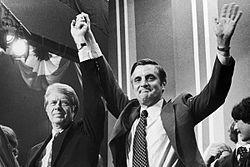 ](https://en.wikipedia.org/wiki/File:Carter_and_Mondale_celebrate_primary_victories_in_Minneapolis,_MN._3-13-84..jpg)Mondale celebrates several victories in March 13 primaries with Jimmy Carter (under whom Mondale had previously served as vice president) at his campaign headquarters.
At a roundtable debate between the three remaining Democratic candidates moderated by Phil Donahue, Mondale and Hart got into such a heated argument over the issue of U.S. policy in Central America that Jackson had to tap his water glass on the table to help get them to stop.
Mondale gradually pulled away from Hart in the delegate count, but, as Time reported in late May, "Mondale ... has a wide lead in total delegates (1,564 to 941) ... because of his victories in the big industrial states, his support from the Democratic Establishment and the arcane provisions of delegate-selection rules that his vanguard helped draft two years ago."[29] After the final primary in California, on June 5, which Hart won, Mondale was about 40 delegates short of the total he needed for the nomination.[30] However, at the Democratic National Convention in San Francisco on July 16, Mondale received the overwhelming support of the unelected superdelegates from the party establishment to win the nomination.
...
Hart had received endorsements from:
United States House of Representatives
- Representative Patricia Schroeder of Colorado[44]
- Representative Chuck Schumer of New York[45]
- Representative and 1976 Democratic presidential candidate Mo Udall of Arizona[46]
- Representative Henry A. Waxman of California[47]
Celebrities, political activists, and political commentators
- Actor and director Warren Beatty[48]
==
aha, why so many fewer dems than gop? tho tony coelho got dems in game:
grimm bk
we have ppl --> AOC
https://kpfa.org/episode/letters-and-politics-june-17-2019/
1976 carter kinda central, fix rep by post-prez
1978 newt g shellacking, longtime senators, lions like frank church, birch bayh
roger stone et al tactics, 1976 scotus camp fin reform [buckely valeo?], political consultant, pol ops, oppo, 30 sec ads TV, corp $ (TV and corp money // rose as factors together: we have opposite now, TV decline coupled with online small $ raising?))
dccc a backwater, tony c goes to corps and sez we have house 40 yrs (still have dixiecrats) so you need to fund us; win big in 1982? said to be b/c of Reagan recession, but grimm sez dem $ ctr; then dems pick Mondale, defiicit hawk, but was painted as liberal, landslide loss; dens say oh liberal is loser, so leads to clinton triangulation?
pelosi endorse by widow, beat DSA britt pro gay cand (so when she says i understand the SF left, she means i have beaten them); she thinks usa basically conservative in RR era, so she still fears backlash cf clinton impeachment.
==
From the beginning, the NRTWC had a focus on influencing U.S. elections. The NRTWC has spent millions in dark money electoral ads, including $7 million during the 2012 election. Although a leading group on the right, the NRTWC has also attacked Republicans such as John Boehner and Bob Dole for not adhering to their extreme policy agenda.
The NRTWC's long history of pushing the line in campaign finance and electoral activity as a nonprofit led to an FEC case against it at the U.S. Supreme Court in 1982, in which the court ruled against the NRTWC for illegally raising money for electoral activities. The NRTWC continued to engage in controversial campaign-related activities, and evidence suggests that the National Right to Work Committee spent $100,000 on private detectives in 1984 to infiltrate the AFL-CIO, NEA, and Walter Mondale's presidential campaign.By the time that case was brought to court, the statute of limitations had expired.