Carter, J Pres
===
primary 4 22 on hartman nat'lize, ANTI-FORK
CDC cancelled conf on climate, gore and JC rebooted at carter ctr atlanta?
MERRI OK
NO BAK
How Democrats Embraced Neoliberalism | Robert Kuttner | TMR
MAJ REPT 7 26 AM PROSPECT KUTTNER
JC CONSERVATIVE DEM NOT NEW DEALER
16:18
assignment of going to the press club for uh, Carter's announcement. I'm the
16:25
only national reporter there and his name recognition, not his support but
16:31
his name recognition is 2%. Okay. So in the course of a year and a half,
16:38
[clears throat] he wages the ultimate outsider campaign and um and after Nixon is
16:47
and the the the so-called Watergate class uh comes into office in January of 75.
16:56
They're all process liberals. They're all let's let's clean up the um you know
17:03
the ills that allowed Watergate to happen. And uh it's also a very weak
17:09
field in in 1976. And so people read their hopes on to
17:16
Carter. He's an outsider. He's a peanut farmer. He's a [clears throat] southerner. And he's an interesting
17:22
character in that he represents the new south. He's a liberal on race and
17:28
Atlanta's the city that's too busy to hate. Remember that slogan. And um so
17:34
he's going to merge economic development and being a liberal on race and being a
17:40
moderate on everything else and he's going to get the community on his the business community on his side. And
17:46
that's the recipe that um he commenced to the country. And with the exception
17:52
of uh of of Ramsay Clark, who we didn't quite realize how radical Ramsy Clark
17:58
would turn out to be, and Ray Marshall, his labor secretary, his whole cabinet was fairly conservative.
18:05
And um even so, if if it hadn't been for two things, he might have gotten
18:10
reelected. I mean, he got very unlucky on the inflation, the OPEC inflation of the 70s, and he got even more unlucky
18:17
with the with the Iranian hostage crisis, which still comes back to haunt us. But but his failure then opens the
18:24
door to to Reagan. And I want to come back to why we founded the prospect and EPI. So if you think about what was
ads atl mo
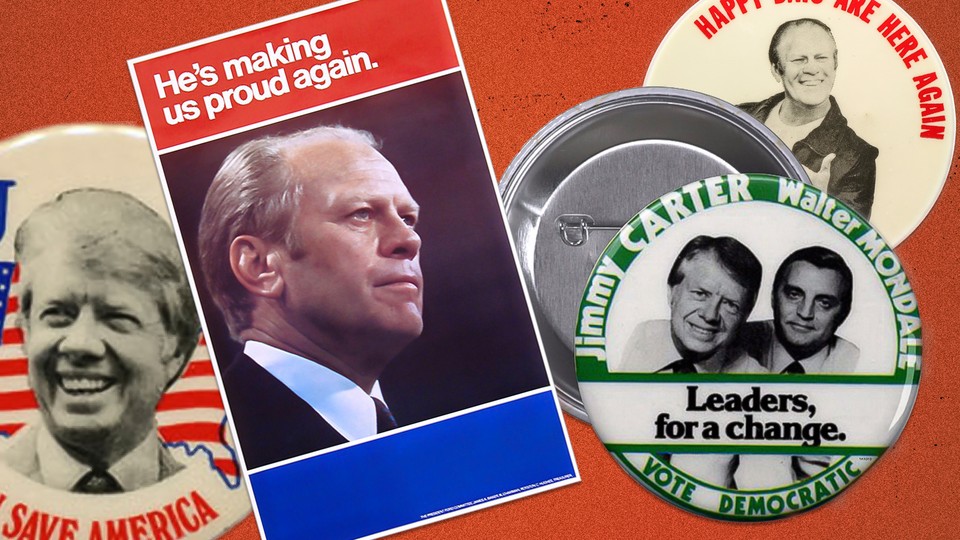
The Year Political Advertising Turned Positive
American campaigns embraced the spirit of 1976, stressing the virtues of candidates to a nation weary of war and Watergate.
The Atlantic
June 9, 2015
“Advertising agencies have tried openly to sell presidents since 1952,” writes Joe McGinnis in The Selling of the President 1968, a chronicle of the attempts to package Richard Nixon to make him more palatable to the American people. Typically, that process of promoting candidates has included a dual-pronged approach: bolstering a politician’s image while also tearing down the character and record of his or her opponents. But with the arrival of the 1970s, the tenor of political advertising suddenly shifted, in no small part thanks to Nixon himself. The Watergate scandal did more than end the Nixon presidency. It made the 70s notable as a decade in which political advertising became overwhelmingly positive. The great paradox of one of the worst presidential scandals of the 20th century was that it forced candidates to stop attacking each other and start persuading the nation that they could be trusted.
Before Watergate, campaign ads often had a hard edge. Nixon, for one, employed a 27-year-old media consultant named Roger Ailes to organize his television strategy, while his campaign crafted a series of jarring attack ads directed by Eugene Jones....
The Jones ads, which featured discordant music and disturbing scenes of bloodshed, and cited alarming statistics including a crime rate that was escalating “nine times as fast as population,” helped secure the election for Nixon. By contrast, ads for Humphrey—including one endorsement recorded by an unenthused Frank Sinatra—seemed to fall flat.
The political ads of the 1970s, by contrast, are notable for their general sense of optimism. Forget fearmongering, or vitriolic attack ads. Instead, politicians just wanted to prove they were regular, true-blue Americans who wanted to put the country back on the right path. “Watergate’s biggest impact actually came in 1974,” says Larry Sabato, a political scientist, and the director of the Center for Politics at the University of Virginia. “The most oft-heard words were ‘honesty’ and ‘integrity.’ Candidates stressed their normalcy. Younger Democratic politicians bragged about their lack of experience in the Washington cesspool, and promised a revolution in DC.” ...
...
---
alternet-no lnx
Home | Republicans have been lying to their voters for years — and now those same voters are dying
Thom Hartmann June 14, 2024
This is a climate change story that fossil fuel billionaires and their GOP lackeys would rather you didn’t know.
As more and more people are killed by extraordinarily severe weather in places where it used to be unusual it’s going to get harder and harder to keep Red State citizens from finding out how badly they’ve been screwed by the unholy alliance between Republicans and oil barons.
Severe weather in the United States is not only getting worse, it’s moving.
POLL: Should Trump be allowed to run for office?
There’s a reason L. Frank Baum placed his 1901 novel The Wizard of Oz in Kansas: the worst and most frequent tornado activity in the world at that time was in the American Great Plains states — particularly Kansas.
Now that’s changing, as weather extremes are moving to the Midwest and the South. Recently, deadly tornadoes — some with wind velocities in excess of 200 mph — have ravaged Kentucky, Arkansas, Tennessee, Missouri, Illinois, Georgia, Ohio and Indiana.
This new burst of unusually extreme weather is driven by global warming and its impact on the Arctic, our oceans, and the Gulf of Mexico.
And it’s going to be America’s new normal, although in all probability this is just the beginning and over time it will get a lot worse.
America has always had the most extreme weather of anyplace else on Earth, according to Susan Cutter, director of the Hazards Vulnerability and Resilience Institute at the University of South Carolina.
China has more people and a larger landmass than we do, but, Cutter told ABC News, “they don't have the same kind of clash of air masses as much as you do in the U.S. that is producing a lot of the severe weather.”
The severity of America’s Great Plains states’ historically extreme weather was the result of geography.
While there’s a massive amount of land on either side of the European/Asian land mass, the United States is bracketed by two giant bodies of water, the Pacific and Atlantic oceans. We also have a huge mountain range — the Rockies — that helps determine where turbulent air from the west ends up, particularly as it encounters colder air from the north and warmer air from over the Gulf of Mexico.
As North Carolina state climatologist Kathie Dello told ABC News, it’s because of “where we are on the globe,” adding, “It’s truly a little bit ... unlucky.”
But now, as the Gulf of Mexico is heating up faster than the oceans on either side of us, combined with “bomb cyclone” cold weather coming down from Canada because melting ice in the Arctic is making the Jet Stream less stable, that severe weather is moving to the Midwest and South.
This appears to be one of the most consequential outcomes of climate change, severe weather-wise, for the United States.
As Victor Gensini, associate professor in the Earth, Atmosphere and Environment Department at Northern Illinois University, told The Chicago Tribune, the Midwest and South are replacing the Plains states as the epicenter of severe weather.
“That’s a really, really big deal for human exposure and vulnerability,” Gensini told Ezra Maille. “A tornado that goes through a wheat field in Kansas is not a big deal, but a tornado that goes through southern Cook County is a huge deal.”
He added that the Great Plains will probably continue to experience more and more severe drought while tornado activity is shifting toward the East and South.
The fossil fuel industry has known with a high level of certainty how severe weather was a probable outcome of America’s dependence on their products ever since the 1970s.
Yet for the fifty years since then — and continuing to this day — they fund phony “science” and shills to deny climate change or try to spin it as a positive, all while pouring hundreds of millions of dollars into the campaign coffers and personal bank accounts of mostly Republican politicians.
We’re at least 40 years behind where we should be in dealing with the fossil fuel/global warming crisis because giant oil companies have run massive disinformation campaigns while funding the political careers of hacks in Congress willing to lie to the public for them.
President Jimmy Carter declared a national crisis in 1979 and proposed legislation to create “this nation’s first solar bank, which will help us achieve the crucial goal of 20 percent of our energy coming from solar power by the year 2000.”
FDR had sold bonds to the public to fund a government corporation that would develop synthetic rubber for fighter plane tires back in the day, and Carter wanted to do the same to end our dependence on fossil fuels:
“Just as a similar synthetic rubber corporation helped us win World War II,” Carter said, “so will we mobilize American determination and ability to win the energy war.”
In that same July 15, 1979 speech, he proposed the government issue bonds that would fund:
“[T]he creation of an energy security corporation to lead this effort to replace 2-1/2 million barrels of imported oil per day by 1990. The corporation will issue up to $5 billion in energy bonds, and I especially want them to be in small denominations so that average Americans can invest directly in America’s energy security.”
But it all came crashing down 43 years ago when the fossil fuel industry’s candidate, Ronald Reagan, replaced Carter, killed the solar bank and the bond program, and even took Carter’s solar panels off the roof of the White House.
The big question now is how long the GOP will be able to keep up their climate change denial in the Red states currently being hammered by extreme weather before their citizens catch on to what’s happening and demand action to reduce our carbon emissions.
As Dr. Michael Mann, Presidential Distinguished Professor in the Department of Earth and Environmental Science at the University of Pennsylvania and director of the Penn Center for Science, Sustainability, and the Media (PCSSM), told me yesterday:
“It is rather ironic that many of the states that are seeing the worst climate change impacts—Texas, Florida, Louisiana, Mississippi, Alabama, and Florida—are red states, with governors and legislatures that are far more interested in doing the bidding of polluters than representing the people they’re supposed to be representing.
“Unsurprisingly, these states are all among the lowest when it comes to per capita spending on public education. The alliance of rightwing politicians and polluters prefers a poorly educated electorate, ignorant of the environmental health damage being done to them.”
So, what can be done other than offering subsidies for electric cars?
Number one on the list is to put a price on carbon, which will bend market incentives toward green and renewable energy as a replacement for fossil fuels.
According to the World Bank, there are currently 70 carbon pricing programs in place around the world, covering a bit over 23 percent of all emissions. Some are outright carbon taxes, typically with a rebate program to low- and average-income consumers, and some are cap-and-trade type programs (like President George HW Bush put into place to deal with sulfur dioxide emissions).
Canada’s carbon tax, which they put into place in 2019, is working so well that they actually sped up the process of implementation this year.
The original plan called for the initial $10/ton carbon tax to go up $10 every year until it hit $170/ton. The money collected is then recycled back to low- and average-income consumers to compensate them for the extra costs they’ll incur driving and heating their homes. But the program has been such a success that Canada’s government announced this week they’re raising the carbon tax by a full $15 this year.
They can pull this off because the rebates represent, for most Canadians, far more money in their pockets than the cost of the carbon tax. The brunt of the tax is instead borne by Canadian businesses, which is the group that's been designed to push toward green -- and tax-free or even green-subsidized -- energy sources.
An average taxpayer in Alberta province, for example, now gets a $386 check or bank deposit from their government every three months. It’s $340 quarterly in Saskatchewan, $328 in Newfoundland, $248 in Nova Scotia, and $264 in Manitoba.
This is a system that could work very well here in the US, if only there was the political will to make it happen. And, as we cut emissions and figure out new and better ways to pull existing carbon out of the air and oceans, we may be able to dial back on the increasing severity of storms that are ravaging Red states.
The obstacle to pricing carbon in the US is widespread ignorance of how severe our problem is and its origins in fossil fuel emissions. Fully 58% of Republican and Republican-leaning voters say climate change is “not an important concern” and a mere 17% believe human activities like burning fossil fuels “contribute a great deal to climate change.”
Hopefully the deadly disasters sweeping Red states now will wake up Republican voters and motivate them to demand their Republican politicians stop taking money from fossil fuel billionaires and do something now to stop climate change from getting any worse.
===
===
3 23
|
| They sabotaged Carter, too |
| From Reagan to Trump, treason is optional. |
|
| I said Friday the best way to understand Donald Trump’s relationship with Vladimir Putin is to think of the former as the leader of a totally made up confederacy and the latter as the leader in a totally made up presidency, who are together in league against the real America. |
| Trump’s confederacy of the mind and spirit is what I call Realamerica, not to be confused with the real America. Realamericans live there according to God’s law, which demands that white Christian men be on top of society. In Realamerica, the US Constitution was handed down by God, and the real America should stay the same as it was at its founding. The goal of Realamericans is the domination or sabotage of the real America in which their makebelieve confederacy exists. |
| Most of us believe that the possibility of the indictment of a former president would be the exception to the rule. But what is the rule when Realamericans reserve the right to commit treason when the real America (a democratic majority) denies their right to rule? |
| For Putin, the best way of winning the war in Ukraine is for a Trump victory in 2024. For Trump, the best way to win the presidency of the real America, and therefore escape criminal accountability, is to keep partnering with Putin in an attempted repeat of the 2016 election. I called this pact the Russo-Realamerican alliance. A hostile foreign government hopes to destabilize the real America from the inside, for the purpose of destabilizing European democracies, and the leader of an imaginary confederacy inside that real country wants to help. |
| Since Friday, two things have occurred to underscore my thesis. One, the International Criminal Court issued a warrant for Putin’s arrest on charges of war crimes related to his country’s invasion of democratic Ukraine. Two, Trump said Sunday he expected to be arrested in connection with a hush-money investigation involving Stormy Daniels. Trump called for mass “protests,” as he did on January 6, 2021. |
| Not only do these men hold illegitimate power. Not only do they use that illegitimate power to attack, erode and undermine legitimate national governments, like the one in Ukraine and like the one here in the real America. They are outside generally accepted boundaries of the law. They are inauthentic. They are lawless. They are criminal. |
| Yet we face the prospect of another Trump candidacy. You’d think the Republicans, as rah rah as they are, would have a problem with a candidate openly in league with a hostile foreign government. You’d think they’d reject Trump as the 2024 nominee. But all things being equal, though he may be indicted for crimes committed in New York state, Donald Trump will likely win the Republican nomination. |
| I put it like this, because for mostpeople, it’s difficult to understand how a former president could ever side with Vladimir Putin, who has gone to war with a fellow democratic state (Ukraine) and who threatens the long enlightened project of the European Union. |
| By thinking of Donald Trump as the leader of a makebelieve confederacy, which exhibits nearly all the same attributes of the former Confederate States of America, we overcome the disbelief that’s associated with a former president siding with the enemy. |
| Trump was illegitimate then, as the president of a real country (America). He’s illegitimate now, as the president of a fake country (Realamerica). In neither does Trump ask for the consent of the government for the purpose of governing in their name. In both, he, like Putin, expects loyalty to him above all, even the rule of law. |
| There’s another reason why I say this confederacy of the mind and spirit is a “nation” inside a real nation – so that normal people can see the United States is not a united nation, never has been, and the United States, in a very real sense, is as fictional as Trump’s confederacy of the mind and spirit. The United States did not emerge organically. They were imagined into being. The difference is that the confederacy is illegal and unmade, the union is legal and made. |
| The difference is mostpeople chose the latter over the former. |
| Somepeople, which is to say the inhabitants of Realamerica, will never accept the real America. It would be the end for them if they did. To them, truth, justice, equality and liberty for everyone means robbing them of the same. As long as the real America plays by the rules of Realamerica, all is well. But if the real America does not obey, then Realamericans are free to take the law into their own hands. They are free to sabotage, even destroy, what they cannot control. |
| Most of us believe that the possibility of the indictment of a former president would be the exception to the rule. But what is the rule when Realamericans reserve the right to commit treason when the real America (that is, a democratic majority) denies their right to rule? What is an exception when for somepeople treason is optional? |
| The Times reported over the weekend that Jimmy Carter’s reelection campaign was sabotaged by a group of Texas Republicans. Carter struggled, right up to Election Day, with a crisis involving American hostages in Iran. These Realamericans, as I’d call them, went to Iran to say that a Republican president would offer them a better deal. The hostages were released, but only after Ronald Reagan’s victory. |
| The Times report has one source, a witness to the conspiracy, whose story was corroborated by others not involved. Whether the trip made the difference for Carter is hard to say. That the trip happened at all, however, illustrates my point – that there exists an imaginary “nation” inside this real nation. Its inhabitants are dedicated to the cause of domination and control. If they can’t control, they destroy. |
| It’s God’s law. |
| Which happens to be whatever Realamericans say. |
===
4 22 an
If you want to trigger a conservative, just suggest nationalizing the US gas and oil industry. “Venezuela!” they’ll scream hysterically, perhaps adding a few, “Iran!” squeals. (Somehow, they always forget to yell about Norway…)
Within minutes they’ll be croaking about that time back in 2008 when Maxine Waters — a Black woman with power and therefore the most terrifying thing Republicans can imagine — threatened oil industry CEOs who were giving Congress deliberately deceptive and incomplete answers with “socializing… taking over and the government running all your companies.”
Immediately, Fox “News” was all over it, as were dozens of rightwing sites.
In that, they’ve completely ignored (or never knew) the long American history of taking over industries during a time of national crisis.
And, as we re-enter a cold war with Russia and face unprecedented human death and property damage from climate change, it’s hard to claim we’re not in the midst of a national crisis that has fossil fuels at its foundation.
We’re at least 40 years behind where we should be in dealing with the fossil fuel/global warming crisis because giant oil companies have run massive disinformation campaigns while funding the political careers of hacks in Congress willing to lie to the public for them.
President Jimmy Carter,for example, declared a national crisis in 1979and proposed legislation to create “thisnation's first solar bank,which will help us achieve the crucial goal of 20 percent of our energy coming from solar power by the year 2000.”
FDR had sold bonds to the public to fund a government corporation that would develop synthetic rubber for fighter jet tires back in the day, and Carter wanted to do the same to end our dependence on fossil fuels:
'Just as a similar synthetic rubber corporation helped us win World War II,' Carter said, 'so will we mobilize American determination and ability to win the energy war.'
In that same July 15, 1979 speech, he proposed thegovernment issue bondsthat would fund:
[T]he creation of an energy security corporation to lead this effort to replace 2-1/2 million barrels of imported oil per day by 1990. The corporation will issue up to $5 billion in energy bonds, and I especially want them to be in small denominations so that average Americans can invest directly in America’s energy security.
It all came crashing down 42 years ago this coming January when the fossil fuel industry’s candidate, Ronald Reagan, replaced Carter, killed the solar bank and the bond program, and even took Carter’s solar panels off the roof of the White House.
If ever there was an industry that merited nationalization, the fossil fuel industry is it. They manipulate prices to both enhance profits and swing elections, bribe their way through the halls of Congress, and pump out a steady stream of lies about climate change. All while pouring hundreds of billions into the money bins of their morbidly rich CEOs, shareholders, and senior executives.
America has a long and proud history of taking on companies that put profits over the public good during a time of crisis. And we could acquire controlling interest of the nation’s three largest fossil fuel players — ExxonMobil, Chevron, and ConocoPhillips — for, according to Robert Pollin writing atThe American Prospect, fewer than a half-trillion dollars.
For less than a quarter of the cost of Trump’s billionaire tax cuts we could rapidly move a long way toward saving our nation and the world from climate destruction. But is it even possible? Turns out that history says an emphatic, “Yes!”
During the crisis of World War I, President Woodrow Wilson nationalized the country’s railroads, phone companies, and telegraph operators. He did the same with the nation’s radio networks and radio stations. All were returned to private ownership after the war, but that temporary nationalization helped get America through the crisis.
President Franklin D. Roosevelt did the same during World War II, nationalizing airplane manufacturers, gun manufacturers, over 3,300 mines, the nation’s railroads, dozens of oil companies, Western Electric Co., Hughes Tool Co., Goodyear Tire and Rubber, and even one of the nation’s largest retail outlets, Montgomery Ward. He also nationalized 17 foreign companies doing business in the US.
After FDR died, President Harry Truman continued seizing companies that were using the war as an excuse to jack up profits to the detriment of the nation. He nationalized meatpacking facilities across the country, the Monongahela Railroad Company, the nation’s steel mills, and hundreds of railroad companies.
Like with Wilson’s nationalizations, nearly all were returned to the private sector after the war was over, although it took until 1965 before all were privatized. Many had had their boards of directors and senior management replaced with people who’d put the interests of the nation ahead of their greed for profits.
In the 1970s, in the wake of the collapse of the Penn Central Railroad, President Richard Nixon oversaw the voluntary nationalization and transfer of 20 railroads into the newly created National Rail Passenger Corporation,now known as Amtrak.
In 1974 Congress created another nationalized entity to deal with freight rail, the Consolidated Rail Corporation (Conrail), which absorbed dozens of failing rail companies.Conrail was government-held until 1987, when it was privatized in the then-largest IPO in American history.
In 1984, when the Continental Illinois National Bank and Trust Company was in a crisis, President Ronald Reagan’s administration oversaw the FDIC nationalizing it by acquiring an 80 percent ownership share in the company; it wasn’t re-privatized until 1991, and was bought by Bank of America in 1994.
Also in the 1980s, after Reagan recklessly deregulated the Savings & Loan industry, bankers made off with billions leaving the wreckage of crushed S&Ls all across the nation.
When the government agency that insured them, FSLIC, went bankrupt itself in 1987, Reagan and Congress created an umbrella agency — the Resolution Trust Corporation (RTC) — to nationalize 747 of America’s S&Ls with assets of over $400 billion. Their assets were sold back into the private market in 1995 as the RTC shut itself down, havingaverted a 1929-style banking crisis through temporary nationalization.
When George W. Bush was handed the White House by five Republican appointees on the Supreme Court, the nation’s airline security system was entirely in private hands.
They failed miserably on 9/11, so Bush didn’t even bother with the normal acquisition process that would protect the hundreds of small contractors running security at airports across the nation: he simply nationalized the entire system and created a government agency, the Transportation Security Administration (TSA) to take over airport and airline security.
President Bush also partially nationalized the nation’s airlines, creating the Air Transportation Stabilization Board that traded around $10 billion in loans to airlines in crisis (air traffic collapsed after 9/11) in exchange for company stock. We (through our government) ended up holding 7.64 million shares in US Airways, 18.7 million shares of America West Airlines, 3.45 million shares in Frontier Airlines, 1.47 million shares in American TransAir, and 2.38 million shares in World Airways.
Congress had deregulated the nation’s banks in 1999 when Republicans pushed through an end to the Glass-Steagall Act and Bill Clinton signed it into law. The resulting banking system crash in 2008 forced the Bush administration to nationalize the country’s two largest mortgage lenders (they held about 40% of all US mortgages), Freddie Mac and Fannie Mae.
The Bush administration then additionally nationalized a 77.9% share in AIG, a 36% share of Citigroup, and a 73.5% share of GMAC, forcing out GM’s CEO Rick Wagoner, who’d been a particularly terrible manager of that company and was actively lobbying against what Bush thought were America’s interests.
As President Barack Obama came into office in 2009, GM and Chrysler were on the brink of collapse. His administration created a new company, NGMCO, Inc., that nationalized the assets of GM and was 60.8% owned by the federal government.
GM was finally fully re-privatized by the Obama administration in 2013. Chrysler went through a similar process, although both the UAW and the Canadian government were part owners when it was temporarily nationalized.
Thomas M. Hanna, Director of Research at The Democracy Collaborative and author of Our Common Wealth: The Return of Public Ownership in the United States, compiled most of the data above in a brilliant paper titled “A History of Nationalization in the United States 1917-2009.”
Toward its end, he summarizes brilliantly the case for nationalizing — perhaps only temporarily — America’s largest oil and gas companies:
In such times of political and economic crisis, policymakers of all ideological persuasions in the United States have never been hesitant to use one of the most powerful tools at their disposal: nationalization of private enterprises and assets.
This included the Democrat Woodrow Wilson, who nationalized railroads, and the telephone, telegraph, and radio industries (among others), and the Republican Ronald Reagan, who nationalized a major national bank; the Democrat Franklin D. Roosevelt, who nationalized dozens of mining and manufacturing facilities, and the Republican George W. Bush, who nationalized airport security and various major financial institutions; the Democrat Barack Obama, who nationalized auto manufacturers, and the Republican Richard Nixon, who nationalized all passenger rail service.
Today’s climate crisis dwarfs the threat of Nazism in the 1940s, Bin Laden’s 9/11 attack, or the massive bank robberies that took place during the Reagan and Bush administrations. It literally threatens all life on Earth.
Yet the fossil fuel industry continues to fund climate denial and lobby against any meaningful solutions, as we saw when every Republican in the Senate along with Joe Manchin killed the $500 billion investment in clean energy the Biden administration proposed in their Build Back Better legislation.
Squeals of “socialism!” and “Venezuela!” aside, we know how to nationalize industries that are working against our nation’s interests and have done it before, repeatedly.
This time it’s not just about saving our banks or fighting a war. This time, it’s about saving the world.
Nationalize the fossil fuel industry!
===
===
slate 2019 story 1 vs 2
The speech reflected the president’s broader approach. Carter had been committed to alternative energy(at least, alternatives to oil and gas; he supported nuclear and coal) right from the start. At his inauguration in 1977, the reviewing stand was heated by approximately 1,000 square meters of solar thermal panels. Later, he became the first president to install solar panels on the White House (these first ones provided hot water for the cafeteria, the laundry, and the family quarters).
His administration vastly increased the budget for energy technology research and development to levels not equaled for another 30 years, until Barack Obama’s stimulus bill. He instituted the first tax credits for installing wind turbines and solar power, and set the goal of deriving 20 percent of U.S. energy needs from renewables by the millennium (so far we’ve made it to 9.4 percent)....
===
8/14
https://thehill.com/policy/energy-environment/215027-carter-nutcases-are-stopping-climate-action
Former President Carter says climate skeptics are the "biggest handicap" for the U.S. when it comes to acting on global warming.
“I would say the biggest handicap we have right now is some nutcases in our country that don’t believe in global warming,” Carter said Tuesday during the American Renewable Energy Day summit in Aspen, Colo.
“I think they are going to change their position because of pressure from individuals, because the evidence of the ravages of global warming is already there," he added.
The 39th president expressed frustration with the administration and Congress on their lack of efforts to mitigate climate change, arguing that the U.S. is lagging behind other countries on the issue, the Aspen Times reports.
“I was a bit disappointed he took a wait and see approach during his first five or six years in office, but he’s moving now,” Carter said of President Obama.
Despite the administration's actions, Carter said, the U.S. is "right at the bottom."
“We still only have about 10 percent of our energy from renewables," he said. "So we have a tremendous opportunity to do what other countries have done that we haven’t tapped yet."
Carter said the U.S. should be a leader on climate change in the same way it is militarily, claiming aggressive leadership on global warming would put the country in the position of a real superpower.
“I think that we’re going to begin to realize that being a major superpower on Earth is not just who dominates economics and military,” he said. “I would say that one of the characteristics of a superpower is to take leadership on issues that could afflict the rest of the world, and I say climate change is one of those symbolic, but very tangibly important issues that would put the United States in the role of a true superpower.”
Carter also called for a tax on carbon pollution, which he says is "the only reasonable approach."
===
https://www.alternet.org/2019/09/why-jimmy-carter-was-actually-one-of-the-most-consequential-presidents-in-modern-history/
===
icn exxon knew:
CARTER
Shaw heard these conclusions in October 1977 at a meeting in Atlanta organized by scientists and officials from the Carter administration who had formed a "study group on global environmental effects of carbon dioxide," he told Exxon colleagues in a memo two weeks later. starts w/ D? Not Gary hart congress
https://insideclimatenews.org/sites/default/files/documents/Government%20Meeting%20Memo%20%281977%29.pdf
chair alvin weinberg NOAA phillips oil; how much buffer in ocean and forest; malone met w. met office U, world leader; jim schels and frank press shd be briefed to then breif JC
===
https://slate.com/technology/2019/09/jimmy-carter-climate-change-malaise-speech-1980-backlash.html
"Human identity is no longer defined by what one does, but by what one owns,”the president said. “But we’ve discovered that owning things and consuming things does not satisfy our longing for meaning. We’ve learned that piling up material goods cannot fill the emptiness of lives which have no confidence or purpose.” No, this is not Alexandria Ocasio-Cortez’s 2032 inaugural address. It’s President Jimmy Carter speaking in 1980.
Carter used the same speech to announce “an extra $10 billion over the next decade to strengthen our public transportation systems. And I’m asking you, for your good and for your nation’s security, to take no unnecessary trips, to use carpools or public transportation whenever you can … and to set your thermostats to save fuel. Every act of energy conservation like this is more than just common sense, I tell you it is an act of patriotism.”
This address, which became known as the “Malaise” speech, was cited by 1980s champions of hyperconsumption as a key reason for Carter’s political demise. But it was well-received at the time—Carter’s approval ratings went up by 12 percentage points, with 61 percent of the public saying the speech inspired confidence.
The speech reflected the president’s broader approach. Carter had been committed to alternative energy (at least, alternatives to oil and gas; he supported nuclear and coal) right from the start. At his inauguration in 1977, the reviewing stand was heated by approximately 1,000 square meters of solar thermal panels. Later, he became the first president to install solar panels on the White House (these first ones provided hot water for the cafeteria, the laundry, and the family quarters).
His administration vastly increased the budget for energy technology research and development to levels not equaled for another 30 years, until Barack Obama’s stimulus bill. He instituted the first tax credits for installing wind turbines and solar power, and set the goal of deriving 20 percent of U.S. energy needs from renewables by the millennium (so far we’ve made it to 9.4 percent).
Carter was not striking off in a bold new direction with any of these initiatives. He was reflecting the political mainstreaming of a movement that had been gathering momentum throughout the ’70s. The early part of the decade saw a raft of environmental legislation enacted during the Nixon administration: There was 1969’s National Environmental Policy Act, the Environmental Protection Agency was created in 1970, and the Clean Air, Clean Water, and Endangered Species acts all passed over the next few years. Several states introduced container deposit bills to encourage recycling. All of this was relatively uncontroversial: There was still such a thing as moderate Republicans, and conservatism encompassed conservation.
The idea that the clock was ticking on the chance to avert a climate emergency was already part of the scientific consensus. Carter’s speech was greatly influenced by a 1972 report from the Club of Rome, a transnational think tank (members have included Al Gore, Bill Gates, Ted Turner, and, er, Marianne Williamson) called “The Limits to Growth.” It warned of “exponential” population growth and the potential collapse of civilization as we know it around 2100 due to resource exhaustion.The CoR has gone on to publish more than 40 subsequent reports on environmental issues, many of them climate-focused.
Just as scorching heat waves and unprecedented wildfires have made global warming more urgent in the wider public’s mind today, so two events in the ’70s moved the needle by illustrating the effects of resource scarcity on people’s actual lives. Between 1970 and 1973, U.S. oil imports more than doubled thanks to decreasing domestic production and increasing consumer demand. Then, in 1973, the oil-producing Arab nations imposed an oil embargo on the United States in retaliation for U.S. support for Israel during the Yom Kippur War. Gas prices soared and new phenomena appeared: long lines at gas stations (and, needless to say, fights), gas tank cover locks to prevent siphoning, consumers deserting their giant American cars in favor of the recently introducedless thirsty Japanese imports. As a conservation measure, Congress instituted a 55 mph speed limit on federal highways, prompting widespread protests including a Sammy Hagar song that declared, “Take my license, all that jive/ I can’t drive 55!” Stories surfaced of drivers of Japanese models being run off the road in oil-producing states like Texas.
The other pivotal event was the California drought of 1976–77, the state’s most severe water shortage of the 20th century, which prompted the public service message to “save water, shower with a friend.” (Newly elected Gov. Jerry Brown was even more committed to renewables than Carter: His tightening up of refrigerator regulations increased energy efficiency by a factor of one nuclear power plant, and he also offered 55 percent tax credits on wind, solar, geothermal, and biomass.)
The response to these events was increased awareness of environmental limitation. Greenpeace’s long campaign of direct action had just started—the organization was founded in 1971. There was also a social movement. California was the epicenter of the “back to the land” wing of the zeitgeist, an aspect of the hippie counterculture that channeled suspicion of the System into adopting a self-sufficient lifestyle (like survivalists, without the guns and paranoia). Some adventurous souls moved to communes to pool resources and share consumer durables like washing machines and cars. Their numbers were never large, but making your own clothes, wearing vintage, or recycling Goodwill finds were in fashion. Frances Moore Lappé’s bestselling 1971 Diet for a Small Planet popularized a diet based on vegetables, grains, and legumes, so the world’s grain supply would go toward relieving food poverty over feeding cattle.
A backlash was inevitable. Americans don’t like limits, speed or otherwise. Ronald Reagan promised them they didn’t have to have any. His “morning in America” framing assured the public that nothing needed to change and was presented as an alternative to Carter’s gloomy warnings. And, sure enough, under Reagan it was back to living as though resources were infinite. The research and development budgets for renewable energy at the recently established Department of Energy was gutted by nearly 90 percent, and tax breaks for wind and solar technologies were eliminated. A study underway at Carter’s Solar Energy Research Institute, later the National Renewable Energy Laboratory, to provide a blueprint for a renewables-powered energy future was defunded, and the institute closed down.In a symbolic gesture, Reagan dismantled and junked the solar water heater Carter had installed on the roof of the White House.
Fossil fuels, steak dinners, and conspicuous consumption were once again unquestioned norms. Instead of “living lightly on the earth,” the decade’s guiding principle was, as a popular bumper sticker declared, “Whoever Dies with the Most Toys Wins.” Despite numerous attempts to veer back toward Carter’s vision, we’ve never really returned. One thing is certain: Whatever road we’re on, we’re running out of it.
===
https://time.com/5894179/jimmy-carter-climate-change/
SEPTEMBER 29, 2020
This year’s wildfires and hurricanes leave no doubt that climate change is a key issue in November’s election, but 2020 is hardly the first time the environment has been on the ballot. In fact, the future of the planet was at stake in the presidential contest as early as 40 years ago—but no one knew it at the time.
In 1980, President Jimmy Carter was running for reelection against former California Governor Ronald Reagan. The environment was a campaign issue, in part because Reagan had been quoted saying that more than 80% of nitrogen oxide air pollution is “caused by trees and vegetation.” (Reagan, the Sierra Club responded, was “just plain wrong.”) Carter, meanwhile, had signed 14 major pieces of environmental legislation, including the first funding of alternative energy, the first federal toxic waste cleanup (the Super Fund), the first fuel economy standards and important new laws to fight air, water and other forms of pollution. He also protected California’s redwood forest and 100 million acres in the Alaska Lands bill, which doubled the size of the National Park Service.
But there was one big environmental issue he didn’t have time to confront—a challenge that was unknown then outside the scientific community but would eventually become of critical importance around the world.
Carter had been a nuclear engineer in the Navy and—while other politicians played golf—he spent his spare time reading scientific publications. In 1972, when he was governor of Georgia, he underlined path-breaking articles in the journal Nature about carbon dioxide in the atmosphere.
When he became President, Carter was the first global leader to recognize the problem of climate change. In 1977, scratching his itch as a planner and steward of the earth, he commissioned the Global 2000 Report to the President, an ambitious effort to explore environmental challenges and the prospects of “sustainable development” (a new phrase) over the next 20 years. As part of that process, the White House Council on Environmental Quality (CEQ) issued three reports contending with global warming, the last of which—issued the week before Carter left office—was devoted entirely to the long-term threat of what a handful of scientists then called “carbon dioxide pollution.”
The report, written by Gus Speth, Carter’s top aide on the environment, urged “immediate action” and included calculations on CO2 emissions in the next decades that proved surprisingly accurate. The large-scale burning of oil, coal and other fossil fuels could lead to “widespread and pervasive changes in global climatic, economic, social, and agricultural patterns,” the CEQ report concluded with great prescience.
One recommendation—covered in the very last paragraph of a New York Times story that ran on page A13—encouraged industrialized nations to reach agreement on the safe maximum level of carbon dioxide released into the atmosphere. The CEQ report suggested trying to limit global average temperature to 2°C above preindustrial levels—precisely the standard agreed to by the nations of the world 35 years later in the Paris Climate Agreement that has now been abandoned by President Trump.
With these facts in hand, Reagan’s landslide victory over Carter in the 1980 election takes on a tragic dimension: Carter had acted on every other CEQ report issued in the previous four years with aggressive legislation and executive orders. He almost certainly would have done so on this one, too, had he been reelected. Gains made under Carter’s presidential leadership in the early 1980s might have bought the planet precious time. Instead, for the next 12 years, under Reagan and George H.W. Bush, the U.S. government would view global warming as largely unworthy of study, much less action. Then came 25 years of stop-and-start efforts under administrations of both parties, followed by a return to denial under Trump.
There are lessons here for the present. Carter was a political failure—confronted with a bad economy, the Iran hostage crisis, a divided Democratic Party and a talented challenger in Reagan—but he was a substantive and visionary success.
It took a while for public opinion to catch up to him. After being burned in effigy in Alaska, he received only 26% of the statewide vote in the 1980 presidential election. But by 2000, a billion-dollar tourism industry had blossomed there, and polls showed residents favored Carter’s landmark achievement. When he visited that year, his speech was interrupted five times for standing ovations.
In 1979, Carter placed solar panels on the roof of the West Wing of the White House. After Reagan came to office, he cut funding for green energy and his chief of staff, Donald T. Regan, describing the panels as “just a joke,” took them down. It wasn’t until 2010 that President Obama put up a new generation of solar units. Now, solar is the fastest-growing source of electricity in the United States.
Joe Biden was the first senator to endorse Carter for president in 1976, when Carter ran a campaign based on “healing” after the Watergate scandal and promised not to lie. Biden is running on similar themes and has introduced an ambitious program to combat climate change and create millions of green jobs. Trump, on the other hand, has described climate change as a “hoax.”
Jimmy Carter’s example suggests that looking over the horizon might light our path to a better future—but also that, without political victory, the chance to realize that future can easily slip away.
===
hmn blog
, I received a link to some files from the Jimmy Carter Presidential Library and Museum. It’s a daily log or similar, and starts with a response to someone named Frank Press who had written to Carter raising concerns about CO2 emissions and global warming. The advice given to Carter was as follows:
The issue raised by Press is not new. The experts all agree that more information is needed. The energy plan indicates that nearly $3 million was being requested for ERDA to study the long-term effects of co2. (James) Schlesinger feels that the policy implications of the issue are still too uncertain to warrant presidential involvement or policy initiatives. Schlesinger is examining the issue in the preparation of the FY 79 budget, and will, at that time, have the full report of the NAS study and further results from ERDA.
===
wow
https://www.alternet.org/2019/06/jimmy-carter-flatly-says-trump-is-not-a-legitimate-president-he-was-put-into-office-because-the-russians-interfered/
==
~ voter dis
http://www.alternet.org/news-amp-politics/how-jimmy-carter-revealed-gops-dark-id-four-decades-ago
===
http://www.alternet.org/jimmy-carter-american-democracy-has-been-subverted-oligarchy-unlimited-political-bribery
Jimmy Carter: American Democracy Has Been Subverted into an 'Oligarchy' with 'Unlimited Political Bribery'
"The incumbents, Democrats, and Republicans, look upon this unlimited money as a great benefit to themselves."
By Thom Hartmann / AlterNet August 1, 2015
The Merriam-Webster online dictionary defines an 'oligarchy' as: "A government in which a small group exercises control especially for corrupt and selfish purposes."
Former President Jimmy Carter had some choice words for our form of government, post-Citizen's United, on my radio program this week.. When I asked him his thoughts on the state of American politics since five right-wing justices on the US Supreme Court opened the doors to "unlimited money" in our political discourse via Citizens United, Carter was blunt and to the point.
“It violates the essence of what made America a great country in its political system. Now it’s just an oligarchy, with unlimited political bribery being the essence of getting the nominations for president or to elect the president. And the same thing applies to governors, and U.S. senators and congress members.
"So now we’ve just seen a complete subversion of our political system as a payoff to major contributors, who want and expect and sometimes get favors for themselves after the election’s over."
I asked him then what might change things, and he said it would take a “horrible, disgraceful” corruption scandal (think Nixon) that would "turn the public against it [Citizens United], and maybe even the Congress and the Supreme Court."
Carter added, "The incumbents, Democrats, and Republicans, look upon this unlimited money as a great benefit to themselves. Somebody who’s already in Congress has a lot more to sell to an avid contributor than somebody who’s just a challenger, so it benefits both parties.”
Carter's observations validate Justice John Paul Stevens' dissent in the Citizens United case (Ginsberg, Bryer, and Sotomayor concurring), when Stevens wrote about what he foresaw as the future of American politics because of the Citizens United decision that was handed down that day:
"In addition to this immediate drowning out of noncorporate voices, there may be deleterious effects that follow soon thereafter [this decision]. Corporate ‘domination’ of electioneering can generate the impression that corporations dominate our democracy.
"When citizens turn on their televisions and radios before an election and hear only corporate electioneering, they may lose faith in their capacity, as citizens, to influence public policy. A Government captured by corporate interests, they may come to believe, will be neither responsive to their needs nor willing to give their views a fair hearing.
"The predictable result is cynicism and disenchantment: an increased perception that large spenders ‘call the tune’ and a reduced ‘willingness of voters to take part in democratic governance.’ To the extent that corporations are allowed to exert undue influence in electoral races, the speech of the eventual winners of those races may also be chilled.
"Politicians who fear that a certain corporation can make or break their reelection chances may be cowed into silence about that corporation. On a variety of levels, unregulated corporate electioneering might diminish the ability of citizens to 'hold officials accountable to the people,’ and disserve the goal of a public debate that is 'uninhibited, robust, and wide-open.' At the least, I stress again, a legislature is entitled to credit these concerns and to take tailored measures in response."
President Carter is right. Corporate interests (oil companies, for example, are why Republicans and a few bought-out Democrats deny climate change) and the billionaires who got rich off their corporations have seized control of most of our government.
One solution is a simple constitutional amendment that makes it clear that corporations are not, and don’t have the rights of, human persons; and that reverses the 1976 Buckley decision by saying explicitly that spending money on politics is a behavior that can be regulated, not a form of “speech” with broad immunity under the First Amendment.
Politicians are catching on. Senator Bernie Sanders, who aspires to President Carter’s old job, has not only endorsed such an amendment (he’s alone in this among all presidential candidates) but has even introduced a version of it several times into Congress.
Thom Hartmann is an author and nationally syndicated daily talk show host. His newest book is "The Crash of 2016: The Plot to Destroy America — and What We Can Do to Stop It."
===
President Carter became the first U.S. president to publicly voice opposition to Keystone XL, a decision that our own State Department just punted — again. Then, on Wednesday, President Carter came out swinging at big money in politics, climate change misinformation campaigns, and the kings of climate denial: the Koch brothers.
While the dark money behind climate denial is well documented, few politicians are willing to stick their necks out and hold misinformers like the Kochs accountable. Now we’ve got the opportunity to point to President Jimmy Carter — a living portrait of the leadership we need on climate — and embolden other progressive leaders to follow suit.
While speaking at a university in Paris this week, President Carter expressed his disgust with campaigns that set out to spread false information on climate change and deceive the public. He alluded to misinformation from a range of front groups, such as the Heartland Institute and Americans for Prosperity — but it was the Koch brothers who got an extra-specific takedown, courtesy of the 39th president of the United States
===
climate criminals
http://www.tomdispatch.com/post/175703/tomgram%3A_engelhardt,_the_biggest_criminal_enterprise_in_history/
...
The Alternatives That Weren’t
It didn’t have to be this way.
On July 15, 1979, at a time when gas lines, sometimes blocks long, were a disturbing fixture of American life, President Jimmy Carter spoke directly [45] to the American people on television for 32 minutes, calling for a concerted effort to end the country’s oil dependence on the Middle East. “To give us energy security,” he announced,
“I am asking for the most massive peacetime commitment of funds and resources in our nation's history to develop America's own alternative sources of fuel -- from coal, from oil shale, from plant products for gasohol, from unconventional gas, from the sun... Just as a similar synthetic rubber corporation helped us win World War II, so will we mobilize American determination and ability to win the energy war. Moreover, I will soon submit legislation to Congress calling for the creation of this nation's first solar bank, which will help us achieve the crucial goal of 20% of our energy coming from solar power by the year 2000.”
It’s true that, at a time when the science of climate change was in its infancy, Carter wouldn’t have known about the possibility of an overheating world, and his vision of “alternative energy” wasn’t exactly a fossil-fuel-free one. Even then, shades of today or possibly tomorrow, he was talking about having “more oil in our shale alone than several Saudi Arabias.” Still, it was a remarkably forward-looking speech.
Had we invested massively in alternative energy R&D back then, who knows where we might be today? Instead, the media dubbed it the “malaise speech,” though the president never actually used that word, speaking instead of an American “crisis of confidence.” While the initial public reaction seemed positive [46], it didn’t last long. In the end, the president's energy proposals were essentially laughed out of the room and ignored for decades.
As a symbolic gesture, Carter had 32 solar panels installed [47] on the White House. (“A generation from now, this solar heater can either be a curiosity, a museum piece, an example of a road not taken, or it can be a small part of one of the greatest and most exciting adventures ever undertaken by the American people: harnessing the power of the sun to enrich our lives as we move away from our crippling dependence on foreign oil.”) As it turned out, “a road not taken” was the accurate description. On entering the Oval Office in 1981, Ronald Reagan caught the mood of the era perfectly. One of his first acts was to order the removal of those panels and none were reinstalled for three decades, until Barack Obama was president.
Carter would, in fact, make his mark on U.S. energy policy, just not quite in the way he had imagined. Six months later, on January 23, 1980, in his last State of the Union Address [48], he would proclaim what came to be known as the Carter Doctrine: “Let our position be absolutely clear,” he said. “An attempt by any outside force to gain control of the Persian Gulf region will be regarded as an assault on the vital interests of the United States of America, and such an assault will be repelled by any means necessary, including military force.”
No one would laugh him out of the room for that. Instead, the Pentagon would fatefully begin organizing itself to protect U.S. (and oil) interests in the Persian Gulf on a new scale and America’s oil wars would follow soon enough. Not long after that address, it would start building up a Rapid Deployment Force in the Gulf that would in the end become U.S. Central Command. More than three decades later, ironies abound: thanks in part to those oil wars, whole swaths of the energy-rich Middle East are in crisis, if not chaos, while the big energy companies have put time and money into a staggeringly fossil-fuel version of Carter’s “alternative” North America. They’ve focused on shale oil, and on shale gas as well, and with new production methods, they are reputedly on the brink of turning the United States [49] into a “new Saudi Arabia [50].”
If true, this would be the worst, not the best, of news. In a world where what used to pass for good news increasingly guarantees [51] a nightmarish future, energy “independence” of this sort means the extraction of ever more extreme energy, ever more carbon dioxide heading skyward, and ever more planetary damage in our collective future. This was not the only path available to us, or even to Big Oil.
With their staggering profits, they could have decided anywhere along the line that the future they were ensuring was beyond dangerous. They could themselves have led the way with massive investments in genuine alternative energies (solar, wind, tidal, geothermal, algal, and who knows what else), instead of the exceedingly small-scale ones they made, often for publicity purposes. They could have backed a widespread effort to search for other ways that might, in the decades to come, have offered something close to the energy levels fossil fuels now give us. They could have worked to keep the extreme-energy reserves that turn out to be surprisingly commonplace deep in the Earth.
And we might have had a different world (from which, by the way, they would undoubtedly have profited handsomely). Instead, what we’ve got is the equivalent of a tobacco company situation, but on a planetary scale. To complete the analogy, imagine for a moment that they were planning to produce even more prodigious quantities not of fossil fuels but of cigarettes, knowing what damage they would do to our health. Then imagine that, without exception, everyone on Earth was forced to smoke several packs of them a day.
If that isn’t a terrorist -- or terrarist -- attack of an almost unimaginable sort, what is? If the oil execs aren’t terrarists, then who is? And if that doesn’t make the big energy companies criminal enterprises, then how would you define that term?
To destroy our planet with malice aforethought, with only the most immediate profits on the brain, with only your own comfort and wellbeing (and those of your shareholders) in mind: Isn’t that the ultimate crime? Isn’t that terracide?
See more stories tagged with:
exxonmobil [52],
chevron [53],
bp [54],
shell [55],
global warming [56]
---
Source URL: http://www.alternet.org/environment/feet-fire-time-hold-big-energy-villains-who-kill-earth-while-making-killing-accountable
Links:
[1] http://www.tomdispatch.com/
[2] http://www.alternet.org/authors/tom-engelhardt
[3] http://tomdispatch.us2.list-manage.com/subscribe?u=6cb39ff0b1f670c349f828c73&id=1e41682ade
[4] http://www.tomdispatch.com/post/118775/engelhardt_9/11_in_a_movie-made_world
[5] http://articles.washingtonpost.com/2012-03-06/business/35450163_1_oil-spill-bob-dudley-tony-hayward
[6] http://www.huffingtonpost.com/2008/07/31/oil-profits-shatter-recor_n_116022.html
[7] http://usatoday30.usatoday.com/money/companies/earnings/2008-08-01-big-oil-company-earnings_N.htm
[8] http://money.cnn.com/magazines/fortune/fortune500/2012/full_list/
[9] http://money.cnn.com/2012/07/26/news/companies/exxon-profit/index.htm
[10] http://www.sfgate.com/business/article/Chevron-posts-record-high-profit-2752969.php
[11] http://thinkprogress.org/climate/2012/01/25/411601/conocophillips-q4-profits/
[12] http://www.time.com/time/business/article/0,8599,1735821,00.html
[13] http://online.wsj.com/article/SB10001424052748704330404576291350999515650.html
[14] http://blogs.discovermagazine.com/imageo/2013/03/06/carbon-dioxide-rise-in-2012-second-highest-in-modern-record/#.UZeffYIVmHk
[15] http://articles.washingtonpost.com/2013-05-10/national/39164136_1_carbon-dioxide-pieter-tans-charles-david-keeling
[16] http://planetark.org/enviro-news/item/68671
[17] http://news.discovery.com/earth/global-warming/world-bank-warns-4-degree-warming-121119.htm
[18] http://www.guardian.co.uk/environment/2013/may/19/heatwave-deaths-new-york-city-rise
[19] http://www.washingtonpost.com/blogs/wonkblog/wp/2013/04/02/nasas-most-famous-climate-scientist-is-retiring-heres-a-look-back-at-his-work/
[20] http://image.guardian.co.uk/sys-files/Environment/documents/2008/06/23/ClimateChangeHearing1988.pdf
[21] http://www.exxonsecrets.org/maps.php
[22] http://www.guardian.co.uk/environment/2013/feb/14/funding-climate-change-denial-thinktanks-network
[23] http://www.time.com/time/health/article/0,8599,2096055,00.html
[24] http://www.amazon.com/dp/1608193942/ref=nosim/?tag=tomdispatch-20
[25] http://www.dailykos.com/story/2013/01/26/1182365/-Dollars-for-Deniers-Big-Oil-Funds-Climate-Science-Denialism
[26] http://www.opensecrets.org/industries/lobbying.php?cycle=2012&ind=E
[27] http://www.opensecrets.org/industries/indus.php?Ind=E
[28] http://thinkprogress.org/climate/2012/10/26/1094541/chevron-election-republicans/
[29] http://thinkprogress.org/climate/2013/04/26/1926091/chevron-earned-62-billion-in-q1-will-use-profits-to-undercut-climate-action/
[30] http://www.tomdispatch.com/blog/175695/ellen_cantarow_big_energy_means_big_pollution
[31] http://www.tomdispatch.com/blog/175264/michael_klare_energy_nightmares_to_come
[32] http://www.tomdispatch.com/blog/175648/michael_klare_keystoneXL
[33] http://www.tomdispatch.com/post/175249/michael_klare_relentless_pursuit_of_extreme_energy
[34] http://thinkprogress.org/climate/2011/09/10/316176/exxon-climate-change-deniers/
[35] http://www.economist.com/node/21556798
[36] http://www.canada.com/topics/news/national/story.html?id=6d05bd93-3b65-42f5-818e-7190d513a8e2
[37] http://www.guardian.co.uk/environment/earth-insight/2013/may/17/obama-arctic-energy-security-climate
[38] http://www.tomdispatch.com/post/175577/
[39] http://www.mcclatchydc.com/2013/03/27/187123/justice-department-is-investigating.html#.UZgEZIIVmHk
[40] http://www.commondreams.org/view/2013/05/18
[41] http://www.tomdispatch.com/blog/175693/rosner_markowitz_you_are_a_guinea_pig
[42] http://billmoyers.com/segment/david-rosner-and-gerald-markowitz-on-toxic-disinformation/
[43] http://med.stanford.edu/biostatistics/abstract/RobertProctor_paper1.pdf
[44] http://www.nytimes.com/2008/10/07/business/media/07adco.html
[45] http://www.pbs.org/wgbh/americanexperience/features/primary-resources/carter-crisis/
[46] http://www.npr.org/templates/story/story.php?storyId=106508243
[47] http://usgovinfo.about.com/od/thepresidentandcabinet/tp/History-of-White-House-Solar-Panels.htm
[48] http://www.jimmycarterlibrary.gov/documents/speeches/su80jec.phtml
[49] http://www.tomdispatch.com/blog/175523/michael_klare_welcome_to_the_new_third_world
[50] http://www.usnews.com/news/articles/2012/11/12/is-the-united-states-the-next-saudi-arabia
[51] http://www.tomdispatch.com/post/175696/tomgram%3A_engelhardt,_the_last_empire/
[52] http://www.alternet.org/tags/exxonmobil
[53] http://www.alternet.org/tags/chevron
[54] http://www.alternet.org/tags/bp
[55] http://www.alternet.org/tags/shell-0
[56] http://www.alternet.org/tags/global-warming
[57] http://www.alternet.org/%2Bnew_src%2B