Kid Cancer Child
---
Tax Relief for American Families and Workers Act of 2024
OG BS START DEC 17
richard a stern jan 29 2024
inflationary
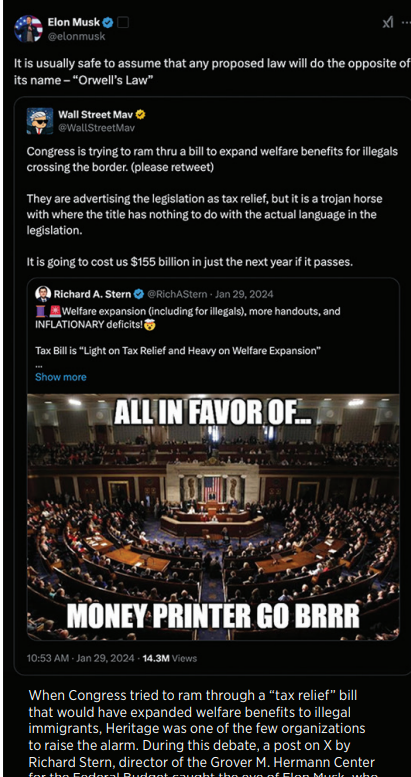
When Congress tried to ram through a “tax relief” bill that would have expanded welfare benefits to illegal immigrants, Heritage was one of the few organizations to raise the alarm. During this debate, a post on X by Richard Stern, director of the Grover M. Hermann Center for the Federal Budget caught the eye of Elon Musk, who reposted it to his massive following. Heritage’s research and messaging was widely credited for stopping this massive spending bill from reaching President Biden’s desk.
AI Overview
In December 2024, Elon Musk heavily pressured Congressional Republicans to strip over a half-dozen pediatric cancer provisions from a major government funding bill, pushing for massive cuts in the name of government efficiency. The excised provisions included vital research authorizations like the Mikaela Naylon Give Kids a Chance Act and the Gabriella Miller Kids First Research Act. [1, 2, 3]
Following the initial scuttling of the bill, the dramatic political maneuvering sparked massive public outcry. The battle over this funding sparked intense debate regarding Congressional priorities. [1, 2, 3]
For a deeper look into the timeline of the legislation and the broader political fallout, you can explore the following perspectives:
- The Bulwark: Details on the initial scuttling of the bipartisan budget deal and the immediate collateral damage to children's medical research. [1, 2]
- Yahoo: An overview of how Musk's public pressure led to Republicans stripping down the massive funding package.
- Reddit: Community discussions aggregating news, sentiment, and the varying opinions on the status of the pediatric cancer research battles. [1]
- Rolling Stone: Context on the immediate fallout and the chaotic scuffle to pass the stripped-down version of the funding resolution. [1]
- The Latin Times: Reports detailing the removal of pediatric cancer research funds earmarked through 2033. [1]


---
:{:{Tax Relief for American Families and Workers Act of 2024}:}
Tax Relief for American Families and Workers Act - Wikipedia:
ggl
The standalone Tax Relief for American Families and Workers Act of 2024 (H.R. 7024) ultimately failed to pass the Senate. However, the legislation's core family and business tax provisions were largely absorbed into newer major legislation, such as the subsequent Working Families Tax Cuts Act tom barret grassley and the One Big Beautiful Bill Act. [1, 2, 3, 4, 5]
Key Tax Overhauls & Current Status
- Child Tax Credit (CTC): The CTC was expanded and permanently increased under the One Big Beautiful Bill framework. [1]
- Worker & Senior Relief: The new tax policies delivered an average tax cut of several thousand dollars per filer. They include additional deductions for seniors and exemptions from tax on certain overtime pay. [1, 2, 3]
- Business Incentives: Crucial capital investment provisions, including 100% bonus depreciation and Research & Development (R&D) expensing, were restored and extended. [1]
Wealth Tax & Billionaire Taxation
The fact that Elon Musk became the first trillionaire has reignited legislative debates. Lawmakers like Senator Elizabeth Warren and Senator Bernie Sanders have renewed their calls for a wealth tax aimed directly at the nation's billionaires. [1, 2]
ggl 6 26
AI Overview
Elon Musk made headlines by vehemently criticizing President Trump's major tax and spending legislation. Labeling it a "disgusting abomination" and a "debt slavery bill," Musk targeted the legislation for massively increasing the federal budget deficit by trillions of dollars. [1, 2, 3, 4]
Regarding the January 29, 2024, date and "inflationary tax bill" query:
- January 29, 2024: This relates to the timeframe immediately following the House Ways and Means Committee's approval of the Tax Relief for American Families and Workers Act of 2024. [1]
- Inflationary Tax Bill Debate: Conservative organizations, including The Heritage Foundation, analyzed the 2024 tax packages (as well as prior legislation) by arguing that extending temporary credits or retroactive business relief without proper funding or spending cuts fuels inflation. [1]
For further review, you can examine the full analysis in the 2024 Annual Report - The Heritage Foundation.
killed in senate? jason Put some corp bene in later bill
in January 2025, Ways and Means Chair Jason Smith (R‑MO 8th), the lead negotiator of the Tax Relief for American Families and Workers Act of 2024, implied that most corporate tax provisions in the bill would be included in the upcoming reconciliation package in the 119th Congress.[15] BIG UGLY BILL?
Tax Relief for American Families and Workers Act - Wikipedia
---
ggl 6 26
AI Overview
The House Ways and Means Committee approved the Tax Relief for American Families and Workers Act of 2024 (H.R. 7024) by an overwhelming bipartisan vote of 40-3 on January 19, 2024. The roughly $79 billion package was subsequently passed by the full House of Representatives. [1, 2, 3]
The bipartisan tax framework—spearheaded by Ways and Means Committee Chairman Jason Smith and Senate Finance Committee Chairman Ron Wyden—included several key provisions: [1, 2]
- Child Tax Credit (CTC): Expanded the child tax credit to benefit families with lower incomes, modifying the phase-in to apply to each child individually and increasing the maximum refundable amount. [1]
- Business Deductions: Allowed businesses to immediately deduct domestic research and experimentation (R&D) expenses rather than amortizing them over multiple years. [1, 2]
- Depreciation & Expensing: Extended 100% bonus depreciation for businesses investing in machinery and equipment. [1, 2, 3, 4]
- Housing and Disaster Relief: Increased the allocation for the Low-Income Housing Tax Credit and provided tax relief for victims of federally declared disasters. [1, 2]
- Employee Retention Credit (ERC): Imposed stricter rules and higher penalties to end fraudulent Employee Retention Credit claims to help pay for the package. [1]
You can track the full legislative history, committee reports, and detailed bill text on Congress.gov. [1, 2, 3]
---
off bsBULWARK
THE DECISION BY REPUBLICAN LEADERSHIP to scuttle a bipartisan funding deal on Thursday night has left lawmakers scrambling and others anxiously bracing for a government shutdown.
For a host of issue advocates, however, the prevailing mood in Washington, D.C. was one not of chaos but utter devastation.
The initial deal that congressional leaders had agreed to included a number of key priorities that, in the course of hours, were jettisoned by GOP leaders looking to calm Elon Musk’s pique and satisfy Donald Trump’s demands. And though the slimmed-down bill that Trump endorsed in its place failed to pass the House, few people expected that the initial deal would make a comeback—meaning that many of its components were likely gone for good.
The list of provisions left in the dust heap was lengthy. The initial compromise bill included language to ensure that providers of internet service to rural areas weren’t ripping off customers, to protect consumers from hidden hotel fees, to secure semiconductor supply chains, to restrict U.S. outbound investment in China, even to prohibit deepfake pornography. All those were all gone in the successor bill.
CR ORIG
But some of the hardest cuts to swallow involved medical research. In particular, advocates say, the revised funding bill delivered a devastating blow to the fight against pediatric cancer.
The slimmed-down version was stripped of language that would have allowed children with relapsed cancer to undergo treatments with a combination of cancer drugs and therapies. (Currently the Food and Drug Administration is only authorized to direct pediatric cancer trials of single drugs.) The bill also didn’t include an extension of a program that gave financial lifelines, in the form of vouchers, to small pharmaceutical companies working on rare pediatric diseases. It was also missing earlier provisions that would have allowed for kids on Medicaid or CHIP—that is, poor children—to access medically complex care across state lines.
For political veterans, however, the most striking absence in the revised bill was the language that would have extended funding for the Gabriella Miller Kids First Research Program.
The program, named after a 10-year-old Virginia girl who died from an inoperable brain tumor in 2013, was something of a miracle to begin with. When it passed in 2014, the Obama administration and congressional Republicans had been at a standstill over federal spending. Sequestration cuts had taken a big bite out of the budget of the National Institutes of Health. The $126 million that the bill authorized over a ten-year period to help fund pediatric cancer research was minor compared to the $1.55 billion the NIH had lost in appropriations. But it was also the product of painstaking negotiations, with then-House Majority Leader Eric Cantor (R-Va.) expending significant political capital to ensure that the law got passed.
When it did, it resembled a rare moment of serenity in an increasingly bitter and divided capital. Gabriella Miller’s family, who started the Smashing Walnuts Foundation, attended the signing ceremony.
“It was a turning point in pediatric cancer research and I’ve never been prouder of the entire Congress for rallying behind it,” recalled Rory Cooper, a former Cantor aide.
But the funding needed to be extended. And the bill that the current crop of congressional leaders agreed to earlier this week did just that, devoting an estimated $190 million to the program through 2033.
The presumption among the compromise bill’s authors and advocates was that it would sail through. Rep. Jennifer Wexton and Sen. Tim Kaine, both from the Miller family’s home state of Virginia, put out a press release applauding its inclusion in the continuing resolution. The Facebook page for the Smashing Walnuts Foundation put up a post declaring that the “Gabriella Miller Kids First 2.0” had passed “and will be signed into law!” It was signed by Gabriella’s mother, Ellyn Miller. “From the bottom of my heart,” it read, “THANK YOU!”
That was December 17. By December 19, the provision had been axed from the bill, after Musk went on an X rampage, tweeting that the bill was a Christmas tree that was antithetical to conservative, small-government ambitions and threatening the primary lawmakers who supported it.
Nancy Goodman, the founder and executive director of Kids v. Cancer, called it “a completely heart-wrenching outcome.” Like Ellyn Miller, her child died of cancer (succumbing at the age of 10 to medulloblastoma). And like Ellyn Miller, Goodman had turned her grief into advocacy. She spent four years working on the Give Kids a Chance Act, which would have allowed FDA authorization of combination cancer treatments.
“We spent a lot of time putting together policies with broad bipartisan support to help kids seriously ill,” she said in an interview with The Bulwark. “How can it be that our society is not thinking about the most vulnerable children and doing everything they can to help them? How can we cut this out in the name of efficiency? How does that make sense?”
Goodman said she began to fear for the worst on Wednesday when she got calls from several staffers relaying that House Republican leadership was worried about the fate of the compromise bill and was trying to whip support for it. Those staffers suggested that she and others put together a letter from doctors and advocates and anyone in the pediatric cancer leadership community urging that it remain in the bill. They got more than 740 people to sign on.
“A vote for the funding bill is a vote for children with cancer,” it read.
But then, Musk began posting.
“I started following [Punchbowl’s] Jake Sherman on Twitter. And then I started following him every three minutes,” said Goodman. “And suddenly I saw these tweets from Elon Musk and then just thought, ‘Oh my God, it’s done.’ His tweets were so damning.”
ON THURSDAY EVENING, after even the slimmed-down government funding bill failed, conservatives and Republicans on Capitol Hill suggested that lawmakers try an even slimmer version. Some proposed letting the government simply shut down. As for all the provisions that were in the initial bill, they offered that those could and even should be considered as standalone pieces of legislation when the next Congress convenes. Continuing resolutions, they noted, are not meant to be vehicles to move important pieces of legislation; Congress can craft budgets for that through regular order.
But that hasn’t been the reality in Washington for a while. And Goodman isn’t holding out much hope that things will change. It’s not just that the process will be incredibly laborious—each individual bill will now have to pass each congressional chamber before finding its way to Donald Trump’s desk—it’s that lawmakers may very well have other priorities they feel the need to address.
“The biggest challenge all these bills face is not opposition,” she noted. “It’s apathy.”
---
YAHOO
President-elect Donald Trump hasn't yet been sworn in, but his advisor and major financial backer Elon Musk has already killed a bipartisan bill that would have provided money for pediatric cancer research.
As political journalist Sam Stein reports for*The Bulwark*, Congressional GOP leadership has kowtowed to Musk's pressure and kiboshed the budget proposal meant to keep the government open and fund essential functions.
In a barrage of posts — including a 4:15 AM tweet on Wednesday morning — the X-formerly-Twitter owner insisted that the bill "should not pass." By that night, Republicans had shot down the budget proposal — and with it any hope that Musk and Vivek Ramaswamy's Department of Government Efficiency (abbreviated, annoyingly, as DOGE) would be a mere vanity project for the billionaire.
415

This bill should not pass

Currently reading the 1,547-page bill to fund the government through mid-March. Expecting every U.S. Congressman & Senator to do the same.
9:15 AM · Dec 18, 202442.1MViews
Soon after the initial bill failed to pass, Trump endorsed a revised (read: much more limited) version that also failed to pass the House of Representatives, leading to a potential government shutdown.
As Stein points out, the spending bill that Musk murdered contained a veritable conservative wishlist, including money to bolster semiconductor supply chains, protections for rural consumers ripped off by the internet service providers, and restrictions on American investment in China.
Eliminating those provisions — as well as the whole "keeping the government open" thing — is a huge deal. But a bit involving pediatric cancer research is a particularly bad look.
In its original form, the budget proposal would have extended funding for the National Institutes of Health's Gabriella Miller Kids First Research Program, which passed during a similarly gridlocked Congressional session in 2014. Named for a 10-year-old girl who died from a brain tumor the year prior, that program funded a decade of research into causes and cures for childhood cancers like the one that killed Miller — and now, it's unclear what will happen to it now that it's been eliminated from the budget.
In an interview with The Bulwark, Nancy Goodman, the founder of the Kids vs. Cancer nonprofit and mother to a child who died of cancer at just 10 years old, said the exclusion of the Kids First program is a "completely heart-wrenching outcome."
"We spent a lot of time putting together policies with broad bipartisan support to help kids seriously ill," Goodman said. "How can it be that our society is not thinking about the most vulnerable children and doing everything they can to help them? How can we cut this out in the name of efficiency? How does that make sense?"
That kind of pained questioning seems, unfortunately, to be par for the course with this incoming administration — and Trump hasn't even officially taken office yet.
More on Musk: *Elon Musk's Drug Use Means He Isn't Allowed to Enter Certain SpaceX Buildings
REF SAM STEIN
Kill Bill
The federal government is on the verge of a shutdown — and practically at the behest of Elon Musk.
Republican and Democrat representatives had negotiated a stopgap spending bill, proposed by House Speaker Mike Johnson (R-Louisiana), that would fund the government for the next three months, as well as providing over $100 billion in disaster relief and other urgent provisions.
But with a Friday deadline looming, the bill, known as a continuing resolution, is now practically dead on arrival. On Wednesday, president-elect Donald Trump commanded Republicans to kill support for the bill, blowing up the fragile bipartisan agreement.
Someone had been whispering in Trump's ear, though: Musk, a man who's recently made it his life's mission to gut government bureaucracy and slash federal expenditures. A full twelve hours before Trump weighed in, Musk began posting non-stop on his website X, formerly Twitter, disparaging the bill — and calling for the heads of any Republicans that supported it.

Any member of the House or Senate who votes for this outrageous spending bill deserves to be voted out in 2 years!
6:17 PM · Dec 18, 202450MViews
13K
38K
269K
2.9K
"This bill should not pass," he posted at 4:15 am [VIVEK] on Wednesday to his over 200 million followers. By the end of the day, he had posted over 100 times, leveraging his enormous popularity to put pressure against the bill.
"Stop the steal of your tax dollars!" Musk posted that afternoon. "Call your elected representatives now. They are trying to railroad this thing through today!"

Stop the steal of your tax dollars! Call your elected representatives now. They are trying to railroad this thing through today!


🇺🇸WTF IS AN OMNIBUS, AND WHY IS CONGRESS USING IT TO RUIN CHRISTMAS? An omnibus bill is Congress’s sneaky way of bundling a ton of unrelated stuff into one giant package. It’s like cramming all your holiday leftovers—good and
Shalt Not Pass
The episode is a testament to Musk's outsized political influence, even though he doesn't have a formal executive role in the incoming Trump administration.
"Our constituents, the people who elected us, are listening to Elon Musk," Rep. Andy Barr (R-Kentucky), told*The Wall Street Journal*. "My phone was ringing off the hook today."
It's not an exaggeration to say that one very rich man's all-day Twitter spree has helped determine the very functioning of government — namely, that it should barely function at all until lawmakers capitulate to his and Trump's demands.
Musk's threats of ousting any Republican that doesn't toe the line aren't to be taken lightly, either. If he was willing to spend $200 million to elect Trump, he could certainly afford to spend smaller sums to replace pesky representatives with more servile challengers.
And if Musk further has it his way, he'd keep the government shut down for an entire month.
"No bills should be passed Congress until Jan 20, when [Donald Trump] takes office," he posted during his X-spree. "None. Zero."

No bills should be passed Congress until Jan 20, when @realDonaldTrump takes office. None. Zero.
7:13 PM · Dec 18, 202464.4MViews
25K
58K
430K
5.1K
DOGEs of War
Yet this is just a preview of what Musk will be able to carry out now that he's in Trump's inner circle.
Musk will co-chair the so-called Department of Government Efficiency, or DOGE, with fellow billionaire and biotech entrepreneur Vivek Ramaswamy, which will be an advisory body — not a position in Trump's cabinet.
Still, if Musk's online tirades are anything to go by, it's apparent that DOGE's real power will reside in essentially being a propaganda arm for the administration, bolstered with the legitimacy of sounding like it's a real department.
He's already hailing the moribund state of the bill as a major victory.
"Your elected representatives have heard you and now the terrible bill is dead," Musk tweeted. "The voice of the people has triumphed! VOX POPULI VOX DEI."

Your elected representatives have heard you and now the terrible bill is dead. The voice of the people has triumphed! VOX POPULI VOX DEI
8:58 PM · Dec 18, 202456.6MViews
15K
46K
355K
5.9K
More on Elon Musk:*Elon Musk Being Investigated for Violating Terms of "Top Secret" Clearance
---
MADDOW
Some, but not all, funding for cancer research survived federal spending deal chaos
It looked like funding for the Gabriella Miller Kids First Research Program wasn't going to make it — until something unusual and unexpected happened.

Dec. 27, 2024,
By Steve Benen
By now, the basic elements of last week’s drama on Capitol Hill are widely known. House Speaker Mike Johnson reached a bipartisan agreement to prevent a government shutdown; Elon Musk and a variety of Republican officials balked; GOP officials started stripping measures from the legislation; and eventually a package worked its way to the White House before the deadline.
Of particular interest, however, were the federal investments in cancer research that Republicans removed from the agreement. Because we discussed this last week, it’s important to emphasize that one of the measures that was eliminated ended up becoming law anyway. The New York Times reported:
After a tumultuous few days, President Biden on Saturday signed into law a spending bill that had been heavily trimmed down to 120 pages from 1,547. It had lost provisions targeting hidden fees on concert tickets and criminalizing the publication of some deepfake pornography. But two of the measures that had been dropped from the final bill … were salvaged as separate bills and passed by the Senate.
This gets a little complicated, but bear with me.
There were several measures related to cancer research that House Republicans scrapped, including efforts to make it easier for low-income families to cross state lines for medically complex pediatric cancer treatments, as well as bills intended to encourage production of new pediatric cancer treatments.
The Bulwark’s Sam Stein, an MSNBC contributor, also reported that GOP lawmakers ended funding for the Gabriella Miller Kids First Research Program — named after a 10-year-old Virginia girl who died from an inoperable brain tumor in 2013 — that helped to fund pediatric cancer research. The policy had long enjoyed bipartisan support, and since it was up for reauthorization this year, no one was especially surprised when it was included in the stopgap bill, ensuring that the program would continue for another decade.
When House Republicans took out their editing pens, however, the program was removed, too.
The bad news for health advocates is that nearly all of the measures related to cancer research could not be rescued before lawmakers wrapped up their work. The good news for health advocates is that Senate Democrats, taking advantage of the fact that the Gabriella Miller Kids First Research Program passed the House months earlier as a freestanding bill, successfully sought unanimous consent to save the policy and keep the initiative in place through 2031.
At this point, some readers are probably asking a good question: If the legislation already passed the lower chamber months earlier, why didn’t the Senate Democratic majority bring it to the floor earlier? Why blame House Republicans for killing a bill related to pediatric cancer research if the GOP-led House already advanced the program?
Cancer nearly left my kids without a mom. Funding cuts may halt the science that saved me.

News
The federal government has shut down — for now
I’m afraid this is the complicated part. Because of the way the Senate operates, and the time it takes to pass anything through the upper chamber, the Senate generally avoids taking up relatively small, standalone policies. The calendar just won’t allow it. Members instead wait for larger spending packages and simply attach the smaller bills.
To be sure, we can have a discussion about whether Capitol Hill should work this way, but there can be no doubt that this is how the modern congressional process works.
It’s precisely why House Republicans were blamed last week for eliminating the program: GOP members understood that by taking the items related to cancer research out of the continuing resolution, they were necessarily putting the programs in real jeopardy.
Fortunately, Democratic Sen. Tim Kaine of Virginia stepped up and rescued the Gabriella Miller Kids First Research Program, so this element of the larger effort survived the Republican editing process.
The same cannot be said of the other cancer-related measures — efforts to make it easier for low-income families to cross state lines for medically complex pediatric cancer treatments, as well as bills intended to encourage production of new pediatric cancer treatments — that were supposed to be a part of the spending package, but didn’t make the final package after being removed by House GOP leaders.
*:{This post updates ourrelated earlier coverage
---
7 sites
- Pediatric cancer research cut from spending legislation at last minute
Jan 10, 2025 — The bills were jettisoned following Elon Musk's demands to cut frivolous expenditure for the sake of “government efficiency.” The ...


The Cancer Letter
- GOP spending bill cut kids cancer research, drawing sharp backlash
Dec 20, 2024 — But Congress did not pass other pediatric cancer research measures that had been stripped from the government-funding bill. Prior ...


www.statnews.com
- The Awkward Truth About Trump, Musk, and Kids With Cancer - Yahoo
Mar 5, 2025 — She added: “It's not like the most rigorous advocacy you've ever witnessed in your life, but what could be stronger? The bill gets...


This is for informational purposes only. For medical advice or diagnosis, consult a professional. AI responses may include mistakes. Learn more
Web results
[### Elon Killed the Budget Deal. Cancer Research for Kids ...

The Bulwark
https://www.thebulwark.com › elon-musk-killed-budget...
Highly cited](https://www.thebulwark.com/p/elon-musk-killed-budget-deal-children-cancer-funding-collateral-damage)
Dec 19, 2024 — “A vote for the funding bill is a vote for children with cancer,” it read. But then, Musk began posting. “I started following [Punchbowl's] Jake ...Read more
Missing: DEFEAT | Show results with: DEFEAT
[### Elon Musk Bullies Congress Into Cutting Funding for Child ...

Yahoo
https://www.yahoo.com › news › elon-musk-bullies-co...](https://www.yahoo.com/news/elon-musk-bullies-congress-cutting-194156995.html)
Dec 20, 2024 — Elon Musk has already killed a bipartisan bill that would have provided money for pediatric cancer research.Read more
Cites The Bulwark
Missing: DEFEAT | Show results with: DEFEAT
[### 6 policies stripped from GOP bill after Trump, Musk rebellion

The Washington Post
https://www.washingtonpost.com › ... › Economic Policy](https://www.washingtonpost.com/business/2024/12/20/musk-trump-children-health-debt/)
Dec 21, 2024 — Two other items — funds for pediatric cancer research and the transfer of RFK Stadium in Washington, D.C., to the District government — were cut ...Read more
Missing: KILL | Show results with: KILL
[### What Happened to Pediatric Cancer Research and ...

First Focus on Children
https://firstfocus.org › Updates](https://firstfocus.org/update/what-happened-to-pediatric-cancer-research-and-treatment-in-congresss-recent-tragic-political-drama/)
Jan 2, 2025 — Despite bipartisan agreement on measures to address pediatric cancer, Congress largely failed to act and left behind critical legislation aimed at saving young ...Read more
Missing: DEFEAT | Show results with: DEFEAT
People also ask
Did the pediatric cancer bill pass?
Did Doge cut pediatric cancer funding?
Web results
[### Fox Host Demolishes Musk Over New Spending Bill's Child ...

The Daily Beast
https://www.thedailybeast.com › fox-host-demolishes-mu...](https://www.thedailybeast.com/fox-host-demolishes-musk-over-new-spending-bills-child-cancer-research-cuts/)
Dec 20, 2024 — Fox Host Demolishes Musk After New Spending Bill Cuts Child Cancer Research ... “It's a drop in the bucket,” Jessica Tarlov said of the program's ...Read more
Missing: KILL | Show results with: KILL
[### Republicans Quietly Remove Child Cancer Research ...

Latin Times
https://www.latintimes.com › ... › Elon Musk](https://www.latintimes.com/republicans-quietly-remove-child-cancer-research-funds-budget-after-elon-push-kill-government-569876)
Dec 20, 2024 — Republicans quietly removed a bill that would have funded pediatric cancer research through 2033, according to a report.Read more
Cites The Bulwark
[### How an unelected, billionaire killed crucial government ...

YouTube · MS NOW
84.4K+ views · 1 year ago](https://www.youtube.com/watch?v=P5r6Y7mZX40)

... Musk tanked a bi-partisan agreement in ... How an unelected, billionaire killed crucial government funding for children's cancer research.
Missing: BILL | Show results with: BILL
[### GOP Cuts Child Cancer Research From Funding Bill After ...

Rolling Stone
https://www.rollingstone.com › politics › politics-news](https://www.rollingstone.com/politics/politics-news/gop-cuts-child-cancer-research-funding-bill-musk-1235212295/)
Dec 19, 2024 — Republicans removed funding for child cancer research from a new version of a bill to fund the government after Elon Musk torpedoed the ...
Some, but not all, funding for cancer research survived ...}:

MS NOW
https://www.ms.now › maddowblog ›](https://www.ms.now/rachel-maddow-show/maddowblog/-not-funding-cancer-research-survived-federal-spending-deal-chaos-rcna185582)
Dec 27, 2024 — Why blame House Republicans for killing a bill related to pediatric cancer research if the GOP-led House already advanced the program?Read more
Missing: DEFEAT | Show results with: DEFEAT
[### What's going on with Elon Musk and cancelling cancer ...

Reddit · r/OutOfTheLoop
430+ comments · 1 year ago](https://www.reddit.com/r/OutOfTheLoop/comments/1hk876a/whats_going_on_with_elon_musk_and_cancelling/)
https://www.msnbc.com/deadline-white-house/watch/how-an-unelected-billionaire-killed-crucial-government-funding-for-children-s-cancer-research-227618885597
438 answers · Top answer: Answer: cutting Government spending is popular ...
---
---
herit bs CONTEXT
:{:{A mericans have witnessed the effects of public policy that isn’t grounded in sound economics, from runaway deficits, sky-high inflation, falling real wages, and sagging economic optimism. But in today’s woke academic world, economists who want to conduct research on the benefits of limited government and the free exchange of goods and services are at a severe disadvantage—not only in numbers but in the ability to get financial support for their research from existing institutions.}:
In 2024, Heritage embarked on another bold plan: to establish the Institute for Research Economics (IRE). The goal of the IRE is to build a community of scholars, create opportunities for new scholars and those pursuing doctorates, extend our reach into academia, enhance Heritage’s reputation for superior policy research, and create a vital new hub for scientific excellence in the shadow of Capitol Hill. Heritage enlisted esteemed economists Robert Barro and Charles Calomiris to ...}:
Heritage enlisted esteemed economists Robert Barro and Charles Calomiris to oversee the project. When fully up and running, IRE will feature a regular stable of full- and part-time scholars, host regular seminars, and publish a regular working paper series, including a blog edited by Barro and Calomiris. As part of Heritage’s commitment to academic excellence, IRE scholars will be free to follow the paths dictated by objective scientific inquiry.
---
EJ Antoni, research fellow with the Grover M. Hermann Center for the Federal Budget, joined the Kevin Roberts Show to talk about Bidenomics and how to restore the American dream.
:{:{REVERSING THE GROWTH OF REGULATIONS, SPENDING, AND INFLATION I n the past year, the national debt skyrocketed by more than $2 trillion, interest on the debt topped defense spending for the first time in history, and regulatory costs exploded. At the same time, families struggled to make ends meet, and real wages remained well below where they were at the start of 2021. As bad as these numbers are, they would have been far worse had your support not provided the resources for Heritage to stand against the Uniparty in Washington.}:
Even in a hostile political environment, you provided our experts the resources they needed to uncover the worst spending abuses, fight against the BidenHarris administration’s regulatory onslaught, and expose the truth about jobs and wages that the corrupt mainstream media wanted to keep hidden. For example, our educational work detailing the serious flaws in a bill that would have expanded welfare and business subsidies proved instrumental in its demise. Our experts provided ammunition to lawmakers to hold discretionary spending growth below GDP growth and to rein in unaccountable taxpayer money being thrown at the Ukraine war.
At the same time, Heritage scholars attacked BidenHarris administration regulations by filing dozens of substantive comments in response to proposed rules to delay and eliminate bureaucratic overreach. These efforts paid off. For example, after Heritage filed a detailed comment on a proposed labor rule that would hamstring franchises—calling the regulation “arbitrary and capricious”—a federal }:
---
musk
richard a stern jan 29 2024
inflationary
When Congress tried to ram through a “tax relief” bill that would have expanded welfare benefits to illegal immigrants, Heritage was one of the few organizations to raise the alarm. During this debate, a post on X by Richard Stern, director of the Grover M. Hermann Center for the Federal Budget caught the eye of Elon Musk, who reposted it to his massive following. Heritage’s research and messaging was widely credited for stopping this massive spending bill from reaching President Biden’s desk.
---
11 25
MAHA Slams “Corporate Capture” While Trump Strips Regulations
between frenzied claims about Tylenol and disparaging remarks about autism, the voices of the “Make America Healthy Again” movement empowered by President Donald Trump have directed criticism at the country’s massive food, pharmaceutical, and chemical industries — still-too-rare targets for the leaders of either political party in the U.S.
When the White House unveiled its comprehensive report on how to “Make Our Children Healthy Again” in May, it slammed “corporate capture” of regulatory bodies and argued that companies responsible for making children less healthy wield undue influence in Washington. A subsequent strategy report, released last month, called to “protect public health from corporate influence.”
“It was one of the first times I saw the federal government actually call out corporate capture and how chemical companies influence regulation,” said Darya Minovi, a senior analyst for the Center for Science and Democracy.
But the Trump administration’s political marriage of unbridled crony capitalism and fringe health conspiracism is not without its contradictions.
While the “Make America Healthy Again,” or MAHA, movement preaches a healthy utopia for the nation’s children free of real and imagined toxins, public health experts say the Trump administration has pursued an aggressive deregulation campaign that has opened the floodgates for toxic chemicals in our food, water, and air — while also defunding vital medical research and spreading dangerous medical misinformation.
“There’s a lot of rhetoric about problems that they’re solving,” Minovi said. “But when I’m looking at the actual actions that the administration is taking, largely, these actions are not making any kids or families healthier.”
A glaring tension between the MAHA movement’s purported goals and the Trump administration’s aggressive deregulatory strategy is the issue of environmental toxins, particularly PFAS, also known as forever chemicals, found in many household items.
These chemicals, which can disrupt liver, kidney, and thyroid functioning, are especially harmful to children.
[
Related
Trump EPA’s Next Move: Making It Harder to Sue for Getting Cancer from Roundup
https://theintercept.com/2025/03/21/trump-epa-monsanto-roundup-bayer-cancer-chemicals/)
The strategy report, drafted by the Make America Healthy commission led by Health and Human Services Secretary Robert F. Kennedy Jr., laid out a series of recommendations to “end chronic childhood disease,” which included studying the cumulative effect of chemicals in the environment. But in May, the Environmental Protection Agency announced that it was rolling back restrictions on the acceptable levels of these forever chemicals within drinking water, which were put in place during the Biden administration. And in the spring, the agency ended a grant to research children’s exposure to chemicals from soil and dust, accordingto the KFF Health News.
“When it comes to actually taking action, we’re not really seeing policies that are getting ahead of corporate capture and holding the chemical industry responsible,” Minovi said.
Over the coming months, the EPA has announced it will take 31 separate deregulatory actions, including loosening restrictions on power plants that emit air pollution and eliminating safeguards put in place during the Biden administration for petrochemical accidents.
Most Read
[
YouTube Quietly Erased More Than 700 Videos Documenting Israeli Human Rights Violations
Nikita Mazurov, Jonah Valdez](https://theintercept.com/2025/11/04/youtube-google-israel-palestine-human-rights-censorship/)
[
A Journalist Asked Why Israel Isn’t Paying to Rebuild Gaza. It Cost Him His Job.
Arthur Neslen](https://theintercept.com/2025/11/04/journalist-israel-gaza-nova-gabriele-nunziati/)
[
Man Jailed for Facebook Meme Is Freed in Tennessee
Liliana Segura](https://theintercept.com/2025/10/30/larry-bushart-tennessee-free-speech-charlie-kirk-meme/)
Alongside pursuing a deregulatory strategy that experts predict will introduce more chemicals into the air, water, and food supply, the administration has also moved aggressively to cut research, including on childhood diseases.
For example,in August, the Trump administration announced it was cutting federal funding to a network researching pediatric brain cancer.
White House spokesperson Kush Desai denied cutting cancer research funding, saying HHS canceled grants supporting “DEI and other ideological pet projects,” and that the money was reallocated.
“President Trump made a pledge to Make America Healthy Again by restoring accountability, transparency, and Gold Standard Science in public health decision-making,” wrote Desai. “The President and White House maintain complete confidence in Secretary Kennedy and the rest of the HHS team to deliver on this pledge.”
The Department of Health and Human Services and the EPA did not respond to The Intercept’s request for comment.
Food assistance and educational programs have also come under fire during the Trump administration. Earlier this year, Republicans enacted the most significant cut to the Supplemental Nutrition Assistance Programin history. The program provided food assistance to roughly 1 in every 5 children in the United States, as well as nutrition education.
“A lot of this movement is designed to benefit privileged people who have the resources to access certain healthier foods or a community with clean air,” said Minovi, as opposed to “everyday people who might actually depend on public policies to ensure they have healthy food, clean air, clean water in their community.”
“A lot of this movement is designed to benefit privileged people who have the resources to access certain healthier foods or a community with clean air.”
The recommendations emerging from HHS and the MAHA movement about vaccines and autism are particularly troubling, said Jill Rosenthal, director of public health policy at the Center for American Progress. “It’s a matter of promoting a personal agenda that RFK has rather than following decades of good science,” she said.
Riddled throughout the MAHA strategy and separate report are concerns over vaccines and the vaccine schedule, which is used to determine the timing for childhood vaccinations.
Both RFK Jr. and Trump have peddled pseudoscientific conclusions connecting autism to vaccination, suggesting that the vaccine schedule needs to change. During the press conference last week, Trump advised against vaccinating children for Hepatitis B until they’re 12 years old, which runs at odds with medical guidelines.
“They’re making it more difficult for children to get routine childhood vaccinations. We know that vaccination has saved millions of lives, and so any efforts that make it harder for children to access vaccines are really, really jeopardizing kids’ health,” said Rosenthal. “Instead of following the science and believing what evidence we already have, we’re just creating a lot of distrust and making it harder for people to keep their kids healthy.”
The recent recommendations that pregnant women avoid Tylenol also carry risk for pregnant people and their future children.
“In the near term, I think that pregnant patients are going to be worried enough that they seek alternate forms of medication to treat their pain,” said Dr. Mariana Montes, a former pediatrician and obstetric anesthesiologist. “That’s extremely concerning, because there is nothing that’s been proven safe for pregnancy except for acetaminophen.”
Ibuprofen, the active ingredient in Advil, has been known to lower amniotic fluid — the liquid in utero that surrounds and protects the fetus — and can have negative effects on kidney and heart development, said Montes.
“Patients might choose to take ibuprofen without knowing the effects, and then unknowingly actually harm a healthy pregnancy because they’re so worried about taking Tylenol,” she said.
[
Related
RFK Jr. Talks About Public Health, but He’s Joining an Administration That’ll Make Us Sicker Than Ever
https://theintercept.com/2024/11/14/rfk-jr-health-human-services-water-air-project-2025/)
Left with fewer options they believe are safe, Rosenthal warns that pregnant people might forgo medication altogether, even when they have a fever. “If women avoid taking Tylenol, for instance, when they have a fever, it can increase the risk of birth defects,” she said. “So by scaring women away from taking needed medication, it can actually impact their health and the health of their developing babies.”
The stigma these types of pronouncements cause for people with autism is also a serious concern.
“It’s necessary to point out the ableist language in this whole autism debacle,” said Minovi. “Of course, it’s a condition that needs to be understood and studied, and obviously impacts families significantly, but the way in which the administration, particularly RFK, talks about it is dismissive and negative about people’s lived experiences.”
Republicans, who once denounced former First Lady Michelle Obama for attempting to make school lunches moderately healthier, now inhabit a coalition whose purported goals would have instantly launched “nanny state” accusations just a few years prior.
But the MAHA movement has been so successful despite its inherent contradictions, Rosenthal said, because there’s a “kernel of truth” to what it’s preaching.
“For instance, ultra-processed food is not the first choice for how we want to take care of our bodies,” Rosenthal said, “but at the same time, is that the best way to use limited resources and protect or promote child health? Not when we have kids who don’t have enough to eat, right?”
Minovi said it’s understandable that people are drawn to this movement — which only heightens culpability for people like RFK Jr. and Trump.
“These are families that are just trying to do right by their kids, and the concerns that folks are raising are valid,” said Minovi. “The behavior of the leaders in this movement is nothing short of predatory.”
---
---