vivek ramaswamy DRLL
---
see LEO teneo esg trifecta
SEE DOGE MUSK TRUMP ADMIN MTG
JOK interview
shillenberger
libtard hayek
qanon? soros davos
SEE FLYNN 4 AM PROJECT ELECTION INTEGRITY BS 2024
renta? his niche is racism; someone said he just reverse engr RW BS than that's him
some neglect?
rww Tag: Vivek Ramaswamy
===
rww
10/22/2026
- Alex Griffing @ Mediaite: ‘It’s So Good!’ Trump Goes All In On Widely Panned Ramaswamy Attack Ad
President Donald Trump fully endorsed Vivek Ramaswamy’s highly controversial attack ad against Amy Acton Thursday, despite bipartisan backlash to the ad.
- Will Sommer @ The Bulwark: MAGA Media Learns to Love Vile Vivek Ramaswamy Ad
For these supposed moral authorities, the only question is whether it works.
- David Masciotra @ Washington Monthly: The Rhetorical Triumph of the Neo-Nazis
Amid discussions of whether America has become authoritarian, the lingua franca of Neo-Nazis has crept into our discourse.
- Frank Langfitt @ NPR: Trump merchandise stores are closing: 'He has peaked'
Trump stores first emerged during the 2016 campaign. But with the president now in his second and final term, store owners say there isn't as much to fire up the consumer fan base and sales have softened.
- Kate Riga and Khaya Himmelman @ Talking Points Memo: Missouri Republicans Try To Trick Voters Out of Abortion Rights
In Missouri, where Republicans just can’t get enough of siphoning off their constituents’ power, the GOP is trying to swindle voters into repealing the abortion rights they passed — and enshrined in the state Constitution — just two years ago. They’re calling the legislature-passed initiative on the ballot this cycle Amendment 3 again — the same as the last vote — but this time a “no” vote means keeping abortion rights, the opposite of the last time.
- Media Matters: Allie Beth Stuckey warns of “demonic influence and spiritual warfare,” saying Christians shouldn’t fully participate in Halloween or consume true crime podcasts, scary movies, Law & Order SVU, and more
Stuckey: “So it’s not just the one costume. It’s not just the one skeleton in your yard. It’s about what it really represents. The demonic is real. And to dismiss that or minimize that is actually exactly what Satan wants.”
-=-=
neg ad fuckery driven bc repeat fail eg doge or bad polls 10 26?
mma
Here are the right-wing media figures endorsing “despicable” ad from Ohio Republican gubernatorial nominee Vivek Ramaswamy
The ad features Democratic nominee Amy Acton’s estranged mother, who defended her husband’s reported sexual assault of Acton when she was a child
Written by Zachary Pleat
Research contributions from Gideon Taaffe
Published 10/21/26
Multiple right-wing media figures are promoting an ad released this week by Ohio Republican gubernatorial nominee Vivek Ramaswamy’s campaign targeting his Democratic opponent, Amy Acton, featuring her mother calling her a liar. However, Acton has been estranged from her parent since the age of 12 in 1978, when her mother defended the candidate’s stepfather against accusations he had sexually assaulted Acton for two years, then fled the state with him as he became a fugitive from charges of child sexual abuse.
In Ramaswamy’s ad, which right-wing media personalities praised as “brilliant” and “absolutely hilarious,” Acton’s estranged mother accused her of lying about her past. But court records accessed by ABC affiliate News 5 Cleveland back up Acton’s story, with the outlet reporting, “Mahoning County Court records we obtained show that Cledith Arthur was arrested and charged with sexually abusing Acton, then 12 years old. The abuse went from ages 10-12, she said.” The article continued: “After pleading not guilty, he posted bond and fled, becoming a fugitive of the state until his death in 2004. Police tried to find him for numerous years, documents state. He and Acton's mother moved to Pennsylvania, according to public records.”
Acton’s brother, Philip Stearns, issued a statement following the Ramaswamy ad’s release, saying, “It’s not surprising that Vivek Ramaswamy has stooped to such a despicable low as to attempt to turn the sexual abuse Amy endured at twelve years old from our birth mother’s husband into a political talking point. … After he was arrested and Amy and I were removed from their custody, our birth mother stayed married to Amy’s rapist until he died.”
Yet some right-wing media personalities are celebrating the ad, which Ramaswamy campaign manager Jonathan Ewing said “is a campaign-ending moment for Amy Acton.” Ramaswamy also shared commentary on the ad and Acton more generally from right-wing podcaster Megyn Kelly.
Daily Wire host Michael Knowles praised Ramaswamy’s ad as “brilliant, brilliant.” Knowles added: “I think it's a very, very effective ad. It's brutal.” [The Daily Wire, The Michael Knowles Show, 10/20/26]
Newsmax host Greg Kelly: “Everybody in Ohio and the country should be listening to Amy Acton's mom.” Kelly repeatedly praised Acton’s mother, saying, “The mother speaks with love here. I believe the mother loves Amy.” He continued: “And she seems like a very nice lady, actually.” Kelly concluded: “Wow, that's some — the mother, I believe her.” [Newsmax, The Greg Kelly Show, 10/20/26]
Video
Citation
From the October 20, 2026, edition of Newsmax's Greg Kelly Reports
Podcaster and former FBI deputy director Dan Bongino said of Ramaswamy’s ad: “This is the most destructive political ad I have ever seen.” Bongino added: “How do you vote for this lady? It's her mom. That's mom dukes. Ma, mommy, mom, ma. My kid goes, Ma. How do you vote?” [Rumble, The Dan Bongino Show, 10/20/26]
Trump political operative Roger Stone used the ad to smear Acton, saying, “Turns out she’s been lying for personal gain.” Stone claimed that Stearn’s statement “seems like a poor explanation.” [Red Apple Audio Network, The Stone Zone, 10/20/26]
Gateway Pundit’s Wayne Allyn Root called the ad “absolutely hilarious.” Root used the ad to say, “The more you meet these Democrat candidates, they’re all crazy. They’re all covering up for the fact that they’ve had mental illness their whole life. They’re crazy, whacked-out people.” [The Gateway Pundit, War Zone with Wayne Allyn Root, 10/20/26]
10/21/26 8:56 AM EDT
10/21/26 9:00 AM EDT
10/21/26
-=-=
KID CANCER BILL
YAHOO
President-elect Donald Trump hasn't yet been sworn in, but his advisor and major financial backer Elon Musk has already killed a bipartisan bill that would have provided money for pediatric cancer research.
As political journalist Sam Stein reports for*The Bulwark*, Congressional GOP leadership has kowtowed to Musk's pressure and kiboshed the budget proposal meant to keep the government open and fund essential functions.
In a barrage of posts — including a 4:15 AM tweet on Wednesday morning — the X-formerly-Twitter owner insisted that the bill "should not pass." By that night, Republicans had shot down the budget proposal — and with it any hope that Musk and Vivek Ramaswamy's Department of Government Efficiency (abbreviated, annoyingly, as DOGE) would be a mere vanity project for the billionaire.....
415

This bill should not pass

Currently reading the 1,547-page bill to fund the government through mid-March. Expecting every U.S. Congressman & Senator to do the same.
9:15 AM · Dec 18, 202442.1MViews
---
-=-=
10 26 rww ==>
Ramaswamy Campaigned With Pastor Who Says ‘Satan’ Is Using Islam to Launch ‘War’ Against America
-=-=
AM PROS
FOur and a half years ago, Department of Government Efficiency co-czar Brad Smith stumbled on a counterintuitive revelation: The most effective way to slash federal health care spending involved drastically raising Medicare and Medicaid reimbursement rates for hospital care.
:{At the time, Smith was running something called the Center for Medicare and Medicaid Innovation, an obscure off-the-books laboratory created by the Affordable Care Act for experimenting with “alternative payment models”—neoliberal for “larger sums with less accountability.” In its ten years of operation, CMMI had spent more than $10 billion testing various methods of tweaking reimbursement standards in (theoretical) hopes of improving health care outcomes for lower costs:{. They had worked with UnitedHealth, Aetna, Molina,}: and other insurers in 13 states to reward primary care physicians who administered more preventative care and collected more specific data on their patients.
They’d worked with more than 100 hospitals and mega-practices to bundle payments for complex patients, in hopes of lowering the ultimate cost of treating chronic illnesses. CMMI had spent some $10 billion testing out dozens more schemes, nearly all of which subscribed to an ideology called “value-based care,” in which the central flaw of American health care is “volume-based” fee-for-service compensation schemes that incentivize “overutilization” of the health care system, and so the natural “solution” involves the government paying health care providers and various intermediaries to take steps designed to decrease said “utilization.”}:
Value-based care grew especially important during the Obama years, because the ACA mandated that insurance companies spend a minimum of 85 percent of patients’ premium dollars on “care,” wiping out profit drivers like the mandatory insurance policies UnitedHealth sold to college students that often boasted medical loss ratios as low as 10 percent. Insurers in turn began to focus their energies around their highest-revenue patients: seniors with a lot of complex health issues who were enrolled in the private Medicare offerings known as Medicare Advantage. They would soon buy up the medical practices, home health agencies, and surgery centers that treated these patients, in a move that enabled them to at once “align incentives” (i.e., control more of the medical decisions they were paying for), park the excess profit margins they weren’t allowed to report on their insurance sides, and find more Medicare patients to convert to MA plans.
Brad Smith was a value-based guy. He’d gotten in on the ground floor of the craze during the first term of the Obama administration, while helming the education reform foundation of former Senate Majority Leader Bill Frist (R-TN), whose billionaire brother Tom Frist founded the hospital behemoth HCA, whose long history of unnecessary overtreatment of Medicare patients perhaps ironically gave birth to the value-based revolution. Together, the two had built a home health care business with more than 650 employees that they had just sold for $440 million to health insurer Anthem.
Smith had been working as the chief operating officer of Anthem’s value-based business when he’d been tapped for the CMMI gig by one Adam Boehler, another value-based evangelist who often talked about how he wanted to “blow up” the “volume-based” ancien régime. Still, doctors, especially the types of doctors who complained about Obamacare and voted for Trump, hated value-based care, because it required spending way too much money on software and far more hours doing paperwork than the incentive payments could justify. Smith’s boss, Centers for Medicare & Medicaid Services (CMS) head Seema Verma, was value-based skeptical, and wanted to know whether CMMI’s programs were actually working as “intended.” So Smith ordered his staff to conduct a financial analysis of all 54 programs CMMI had bankrolled to test out the new approach to health care.
Smith and a 24-year-old deputy from his Nashville VC firm are said to be building the vision of what will replace everything that DOGE has eradicated.
The verdict was unambiguous: Value-based care was a bust. For two of its biggest programs, CMMI had spent $7 billion more than it had saved, just from compensating all the various intermediaries that had administered the trials. The reasons for this were twofold, say two individuals who worked on value-based care policy for the Obama administration: One, CMMI and CMS invariably outsourced the management of the trials to “venture capital or private equity firms or nonprofits where the CEO is making millions of dollars” that typically alienated and underpaid the clinicians they were ostensibly seeking to incentivize; and two, most of the policymakers involved were too preoccupied with “how they were going to monetize their expertise” to design programs that might actually save CMS money.
Lending credibility to that analysis, the shining star of the small agency’s roster of reform measures was the “Maryland All-Payer Model,” a state-operated system originally devised in the early 1970s by which an independent commission fixed flat hospital prices for the state that every payer—from Blue Cross to Medicaid—is expected to pay. The Maryland Model, which was modified in 2014 and discarded in favor of a more complex, almost European-style “global budgeting” system in 2018, is a rabbit hole with its own unique advantages and disadvantages, but it is decisively notvalue-based care, and sources familiar with CMMI said its affiliation with the initiative was something of a fluke, especially given that Medicare conclusively pays far higher rates for medical care in Maryland than anywhere else (though yearly per capita expenditures are higher in Florida). And yet the Maryland system saved CMS $1 billion over just five years tracked by CMMI, likely in large part by lacking the administrative middlemen and arbitrageurs in the system and the waste and fraud that tend to accompany them.
This analysis might have made for an embarrassing news cycle for CMMI and all the affiliated grifters who had cashed in on the value-based boom, like Smith’s predecessor Boehler, a college roommate of Jared Kushner’s who would soon sell his home health agency for $3.5 billion to UnitedHealth, or CMMI founding director Patrick Conway, who’d left the agency a few years earlier to become the richly remunerated CEO of Blue Cross in North Carolina, where he had rolled out a mandatory value-based care regime in conjunction with the CMMI-friendly healthtech Aledade, and recently been charged with driving under the influence after crashing his car with his two elementary school–aged daughters inside.
Instead, they were all saved by the pandemic, during which Smith was detailed to the Trump inner circle for assistance with various pandemic response efforts, and ended up becoming close to Kushner himself, according to The New York Times. By the time he returned to CMMI to write up the results of his staff’s analysis in The New England Journal of Medicine, CMS had rained down hundreds of billions of bailout dollars on the health care system, and no one even bothered making hay of the news that the agency had wasted $10 billion testing out cost-cutting ideas that didn’t pan out.
In one of his last acts at the agency, Smith introduced a new program called the Geographic Direct Contracting Model, or “Geo,” by which all remaining traditional Medicare beneficiaries were slated to be automatically assigned on the basis of their residence to a value-based care organization to which CMS would pay a flat annual fee to assume their health care “risk.” Geo contractors would be virtually unregulated, though they would be held to a medical loss ratio minimum requiring them to spend at least 60 percent of their revenues on care. The Biden administration scrapped Geo in early 2021, but kept a slightly less radical Smith plan with a similar goal of stealth total privatization after renaming it ACO REACH, for “Accountable Care Organization Realizing Equity, Access, and Community Health.”
Smith moved back to Nashville and took the helm at two new value-based care upstarts, a Medicaid home health intermediary called CareBridge and a rural Medicare Advantage play called Main Street Health. In late October, he sold the former to Elevance, the new name of the insurer to whom he’d sold his first home health company, Aspire. This time, the head count was lower—fewer than 500 employees—but the price tag was much, much bigger, at $2.7 billion.
A putative class action lawsuit filed last month in Florida by a “clinical assessor” for CareBridge alleges that she and other low-level employees were required to work 45 hours a week for only 40 hours’ pay, and dozens of negative reviews on job sites suggest assessors work as many as 20 extra hours without pay. Worse, employees say the job mostly consists of “managers … demanding that you drastically cut caregiver hours for people who desperately need someone in their home.”
“This is a greed-driven company that is preying on our nation’s most vulnerable and poorest people. If you can sleep at night and live with yourself while harming the poor and disabled during the day, this job is for you,” reads one review on Glassdoor. “If CareBridge is the future of healthcare then we heading to a sad state of affairs,” reads another.
Just months after the CareBridge deal, Smith was reported to be hanging around Mar-a-Lago with Steve Davis, the longtime Elon Musk loyalist who ran the hostile takeover of Twitter. Underneath Musk and Vivek Ramaswamy, who would soon depart, Smith and Davis are said to be the real operating leaders of DOGE, with the latter playing the bad cop masterminding the scorched-earth shutdowns and cuts, while Smith and a 24-year-old deputy from his Nashville VC firm are said to be building the vision of what will replace everything that DOGE has eradicated, according to a source familiar with his recruiting efforts. CMMI, a highly unusual agency with a ten-year, self-renewing budget outside the appropriations process and an extraordinary ability to grant waivers from the statutes governing CMS, including fraud and kickback statutes, is said to be a model for how Musk wants DOGE to reimagine the federal government.
As further evidence of that, Smith’s predecessor as CMMI director, Boehler, whose brand-new venture capital firm Rubicon Founders last spring raised more than a billion dollars for its latest fund and also groomed Trump’s newest CMMI director, 33 year-old Abe Sutton, is currently working as Trump’s special presidential envoy for hostage affairs. Boehler got his start in the health care business as a medical debt collector, first at a firm called MedeFinance and then with a shadowy empire called Accretive, which was banned from the state of Minnesota in 2012 after an employee left a laptop in a taxi that revealed the company had essentially seized the operations of a Minneapolis nonprofit hospital system and was using confidential health records, collected under the guise of value-based care modeling, to manipulate patients into coughing up large cash payments for hospital services to “embedded” collection agents, sometimes while under the influence of powerful anesthesia.
The obscure agency Boehler launched after leaving CMMI, the U.S. International Development Finance Corporation—best known for its failures to do much of anything with its nine-figure budget for bolstering supply chains during the pandemic after an ill-fated $765 million loan it made to Eastman Kodak was shelved after revelations of insider trading—was reported on Wednesday to be DOGE’s designated “replacement” for the U.S. Agency for International Development, under the leadership of venture capitalist Joe Lonsdale and Ben Black. The latter is the son of disgraced billionaire Leon Black, an accused sexual predator who was forced to leave the private equity juggernaut after revelations that he had wired nearly $200 million to Jeffrey Epstein, whom he considered his best friend, in the years before Epstein’s death. A January Substack post by Lonsdale and Black on their plans for “disrupting” the $43 billion USAID budget is light on specifics but advocates defunding nongovernmental organizations to pursue an “investment-driven model focused on strategic project finance initiatives.”
Foreign aid, of course, is a rounding error compared to the multitrillion-dollar health care budget, in which the *Prospect estimates a team of forensic accountants might easily find as much as a half-trillion dollars in waste annually, roughly $100 billion of that in Medicare Advantage overpayments alone. (Obama had the chance to clamp down on the obvious MA grift, but abruptly reversed course in 2014.) In a 2021 Zoom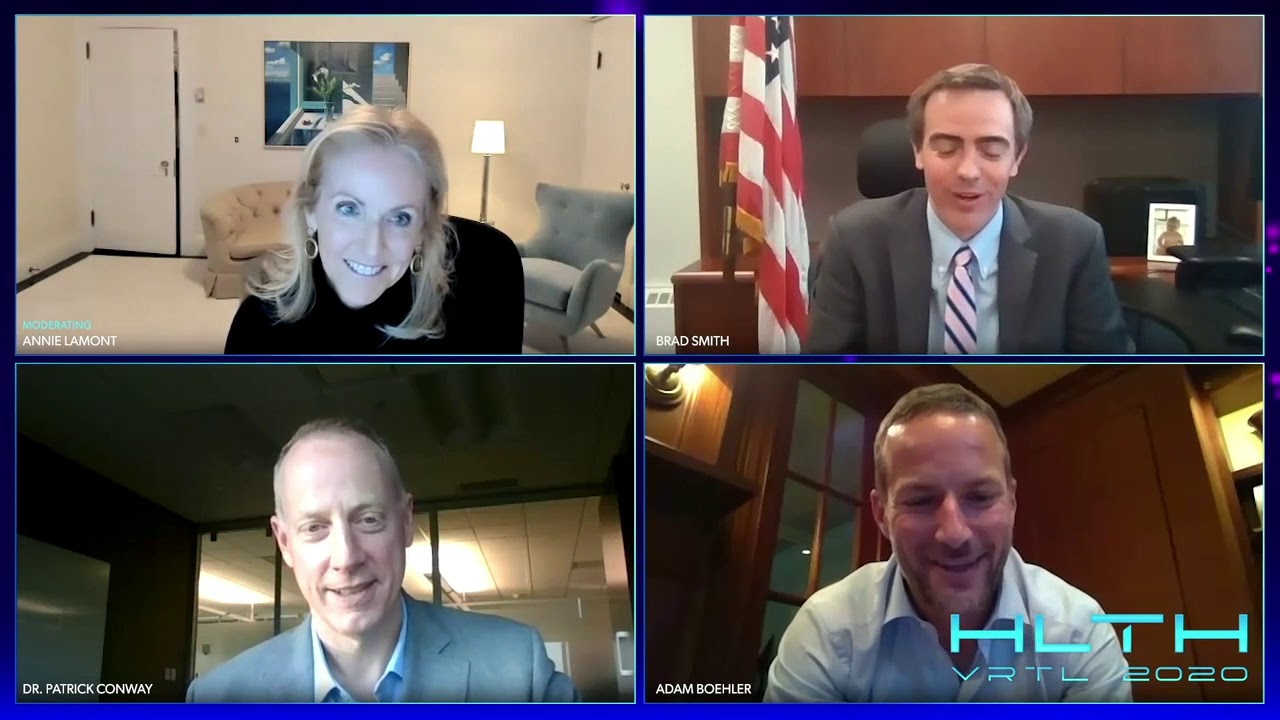 on the tenth anniversary of the agency and the future of “value-based care” moderated by ubiquitous value-based care venture capitalist Ann Lamont, Smith, Boehler, and CMMI founder Conway, now the CEO of UnitedHealth’s OptumRx division, held forth almost giddily on the rosy “future of value-based care,” with Boehler jokingly describing Conway as the agency’s “Adam Neumann,” the self-aggrandizing WeWork founder who burned some $20 billion in venture capital funding. At one point, Smith brought up his analysis, commending the agency for making “value-based care” such an inescapable industry buzzword but acknowledging that only five of the group’s 54 experiments had delivered any cost savings whatsoever. Lamont quickly changed the subject. “Imagine in a few years, we receive 90 percent of payments in value-based commitments. How do we get there?”
This probably wasn’t how any of them imagined it going down, but with Smith running the rogue operation that is apparently running the country, it seems likely we’ll get there.
Tags
Health & Social Policy CMS Medicare health insurance Affordable Care Act Obama Administration privatization federal government DOGE Elon Musk Donald Trump Trump transition
Maureen Tkacik is investigations editor at the Prospect and a senior fellow at the American Economic Liberties Project.
---
===
only trump gets to put down USA?
an 1 25
Originally, Donald Trump had two people in mind to lead the Department of Government Efficiency (DOGE), an advisory board he has proposed: Tesla/SpaceX CEO Elon Musk and MAGA businessman Vivek Ramaswamy, who ran in the 2024 GOP presidential primary but gave Trump an enthusiastic endorsement after dropping out of the race.
But according to Politico reporters Adam Wren and Holly Otterbein, the 39-year-old Ramaswamy won't be part of DOGE after all — and was, sources say, pushed out in part because of Musk.
"Musk, the tech tycoon and Donald Trump confidant, made it known that he wanted Ramaswamy out of DOGE in recent days, according to three people familiar with Musk's preferences who, like others for this article, were granted anonymity to discuss them," Wren and Otterbein explain in an article published after Trump's return to the White House. "An ill-received holiday rant on X by Ramaswamy about H-1B visas apparently hastened his demise."
READ MORE: Trump Inauguration dubbed 'a coronation of our country's descent into oligarchy'
A GOP strategist told Politico that Ramaswamy "just burned through the bridges, and he finally burned Elon." The strategist added, "Everyone wants him out of Mar-a-Lago, out of D.C."
Cincinnati native Ramaswamy, according to Politico sources, now plans to run for governor of Ohio — a position presently held by conservative Republican Mike DeWine.
Wren and Otterbein report, "One main reason for some Republicans' frustration with Ramaswamy was a post he made on X during a discussion of H-1B visas. In late December, Ramaswamy criticized American culture, saying that tech companies hire foreign workers in part because of a mindset in the country that has 'venerated mediocrity over excellence.'"
According to one of Politico's GOP sources, "They wanted him out before the tweet — but kicked him to the curb when that came out."
===
an 12 24
no lnx
alternet-
Vivek Ramaswamy may be right about one thing
Vivek Ramaswamy, one of the leaders of U.S. President-elect Donald Trump's proposed new Department of Government Efficiency, walks on the day of his meeting with members of Congress on Capitol Hill in Washington, U.S. December 5, 2024. REUTERS/Evelyn Hockstein
Vivek Ramaswamy, one of the leaders of U.S. President-elect Donald Trump's proposed new Department of Government Efficiency, walks on the day of his meeting with members of Congress on Capitol Hill in Washington, U.S. December 5, 2024. REUTERS/Evelyn Hockstein
John A. Tures December 27, 2024
The New Republic recently blasted an ex-GOP candidate and co-leader of that “Department of Government Efficiency” (DOGE) outfit with the headline “Vivek Ramaswamy Dragged After Wild Rant On How American Workers Suck,” by Malcolm Ferguson. Ramaswamy is getting crushed by liberals and conservatives alike for his caustic comments.
While I think some of what Ramaswamy tweeted is right, I disagree with the notion that American workers suck. What Vivek needs to realize is that America is a little more pro-nerd than he thinks, and that some of our nerds do some of what he says we need less of.
This started when Ramaswamy took to Twitter to explain why he thinks tech companies prefer foreign-born workers over Americans. BTW, Elon Musk says we need more immigrant workers.
“A culture that celebrates the prom queen over the math olympiad champ, or the jock over the valedictorian, will not produce the best engineers. A culture that venerates Cory from ]Boy Meets World,’ or Zach & Slater over Screech in ‘Saved by the Bell,’ or ‘Stefan’ over Steve Urkel in ‘Family Matters,’ will not produce the best engineers,” Ramaswamy wrote in a lengthy post on X,” as reported by Ferguson, as well as plenty of other outlets.
“More movies like Whiplash, fewer reruns of ‘Friends.’ More math tutoring, fewer sleepovers. More weekend science competitions, fewer Saturday morning cartoons. More books, less TV. More creating, less ‘chillin.’ More extracurriculars, less ‘hanging out at the mall.’…..A culture that once again prioritizes achievement over normalcy; excellence over mediocrity; nerdiness over conformity; hard work over laziness. That’s the work we have cut out for us, rather than wallowing in victimhood & just wishing (or legislating) alternative hiring practices into existence,” he notes in Ferguson’s story (wonder what he means by alternative hiring practices).
Here’s where I agree with Ramaswamy. We should value math Olympiad champs, valedictorians, math tutoring, weekend science competition books, creating, extracurriculars, achievement, excellence, nerdiness, and hard work. We could also be a little more pro-teacher.
Here’s where I think Vivek could do better. We do value nerd culture. And it also doesn’t mean we shouldn’t value prom queens, jocks, cartoons, TV, and being chill sometimes.
In our political science program, we have Homecoming Queens and Kings, as well as jocks (male and female), who love crunching numbers. They work statistics into papers even when you don’t require it. One softball player got her engineering degree and then double-majored in political science. Our college gave the biggest science nerd I’ve ever taught in political science a top alumni award. She is currently in Antarctica installing a comm link, while working on her Ph.D. in aeronautical engineering. We have football-playing Ph.Ds in political science and math, as well as basketball players with public health degrees, with all races and genders included among them. These aren’t exceptions among those I teach. These are my students!
Ramaswamy’s pop culture examples seem to be frozen in the amber of the era of Jurassic Park (which came out in 1993). Even non-science nerds today are totally into “Big Bang Theory,” “Young Sheldon,” “Star Trek,” “Oppenheimer,” “Mythbusters,” “Doctor Who,” and their reruns. They know who Neil DeGrasse Tyson and “Bill Nye The Science Guy” are. Science is cool in the USA, and it’s been that way going back to the days of Benjamin Franklin.
As my mum always says, you catch more flies with honey than vinegar. Vivek could mend fences with the MAGA folks as well as liberals. He should realize that while he’s right that we can always use more nerds, some American nerds can do the cool kid things too. The U.S. shows more love to the wonderful science geeks than he realizes, especially when we respect the hard work our teachers do to make our students great. If he and other political elites who lecture Americans on education and parenting want more nerds, they need to learn that in the USA, you don’t have to force a kid to choose to be a nerd or be a non-nerd! Our students can do both.
NOW READ: How George Orwell was right — and Steve Jobs was wrong
John A. Tures is a professor of political science at LaGrange College in LaGrange, Georgia. His views are his own. He can be reached at jtures@lagrange.edu. His “X” account is JohnTures2.
===
an 11 24
The two right-wing billionaires President-elect Donald Trump has tasked with spearheading a new "government efficiency" commission outlined their vision Wednesday for the mass firing of federal employees, large-scale deregulation, and major spending cuts that could impact antipoverty programs, drug research and development, and more.
For the first time since Trump announced plans to create the Department on Government Efficiency (DOGE)—which, despite its name, would be an advisory commission rather than an actual federal department—Tesla CEO Elon Musk and biotech entrepreneur Vivek Ramaswamy offered a detailed look at how they plan to achieve their stated objective of taking a "chainsaw" to federal operations.
"We are assisting the Trump transition team to identify and hire a lean team of small-government crusaders, including some of the sharpest technical and legal minds in America," the pair wrote in an op-ed in The Wall Street Journal. "The two of us will advise DOGE at every step to pursue three major kinds of reform: regulatory rescissions, administrative reductions, and cost savings. We will focus particularly on driving change through executive action based on existing legislation rather than by passing new laws."
Decrying rules crafted by "unelected bureaucrats," Musk and Ramaswamy—unelected outside advisers—wrote that they intend to present to Trump "a list of regulations" they believe should be eliminated. The culling of regulations would, they argued, provide the justification for "mass headcount reductions"—corporate-speak for sweeping firings—across federal agencies, a plan the two wrote would not be deterred by civil service protections.
Watchdogs have noted that the regulatory cuts envisioned by the commission's co-leaders would likely benefit Musk's companies, at least three of which are currently under scrutiny from nine federal agencies.
"Based on Elon Musk's comments, the so-called Department of Government Efficiency is poised to make far-reaching recommendations that could have a devastating impact on Americans and enormously benefit insiders, starting with Musk himself," Public Citizen co-president Robert Weissman said Wednesday.
"A second Trump term will undoubtedly see a multipronged attack on any institution that seeks to constrain big business, and DOGE will lead the charge."
Musk and Ramaswamy also laid out a plan under which Trump would evade existing federal statutes such as the Impoundment Control Act to cut spending already allocated by Congress.
"DOGE will help end federal overspending by taking aim at the $500 billion-plus in annual federal expenditures that are unauthorized by Congress or being used in ways that Congress never intended, from $535 million a year to the Corporation for Public Broadcasting and $1.5 billion for grants to international organizations to nearly $300 million to progressive groups like Planned Parenthood," they wrote.
As The Washington Post's Jacob Bogage recently observed, the federal programs "without separate spending authorization" that Musk and Ramaswamy are targeting "represent more than $516 billion" and encompass key areas including veterans' healthcare, education spending, housing assistance, childcare aid, student loan programs, Head Start, opioid addiction treatment, and NASA.
Musk, a megadonor to Trump's 2024 presidential bid, claimed on the campaign trail that he would be able to identify "at least $2 trillion" in possible cuts to federal spending.
Casey Wetherbee, an Argentina-based writer, warned Wednesday that "Musk and Ramaswamy's admiration of Argentine president Javier Milei offers us a glimpse into their ideal end state."
"Ramaswamy tweeted on November 18: 'A reasonable formula to fix the U.S. government: Milei-style cuts, on steroids,'" Wetherbee wrote for Jacobin. "When Milei assumed office last year, he declared that conditions would worsen before things would get better; Musk similarly warned that DOGE’s recommendations may cause 'temporary hardship.' Meanwhile, in Argentina, Milei's austerity measures have targeted the country's social safety net, causing the poverty rate to skyrocket while only lowering taxes for the country's wealthiest citizens, a troubling outlook for a second Trump administration if DOGE's advice is ever implemented."
"A second Trump term will undoubtedly see a multipronged attack on any institution that seeks to constrain big business, and DOGE will lead the charge," Wetherbee added. "After all, in DOGE's public call for collaborators, it seeks 'super high-IQ small-government revolutionaries'; that's how they see themselves. We can only hope that, by virtue of how evidently insufferable they are, DOGE's relationship with the Trump adm
---
an 11 24
Democrats on the House Budget Committee said Friday that the plan Elon Musk and Vivek Ramaswamy outlined to eliminate spending already appropriated by the U.S. Congress would run afoul of a federal law enacted in response to former President Richard Nixon's impoundment of funds for programs he opposed.
In a Wall Street Journalop-ed published earlier this week, Musk and Ramaswamy specifically mentioned the 1974 Congressional Budget and Impoundment Control Act (ICA) only to wave it away, arguing it would not hinder their effort to enact sweeping spending cuts as part of the "government efficiency" commission President-elect Donald Trump appointed them to lead.
But House Budget Committee Democrats said Friday that the Nixon-era law and subsequent Supreme Court rulings make clear that "the power of the purse rests solely with Congress."
"Fifty years after the ICA became law, Congress once again confronts a threat attempting to push past the long-recognized boundaries of executive budgetary power," the lawmakers wrote in a fact sheet. "During his first administration, President Trump illegally impounded crucial security assistance funding for Ukraine in an effort to benefit his reelection campaign. Now, Donald Trump and his far-right extremist allies are pushing dangerous legal theories to dismantle that system."
"They want to give the president unchecked power to slash funding for programs like food assistance, public education, healthcare, and federal law enforcement—all without congressional approval," the Democrats continued. "American families would be forced to pay more for basic necessities, investment in infrastructure and jobs would decline, and our communities would become less safe. Instead of working within the democratic process, Trump and his allies want to sidestep Congress entirely. But the Constitution is clear: only Congress, elected by the people, controls how taxpayer dollars are spent."
"House Democrats are ready to fight back against any illegal attempt to gut the programs that keep American families safe and help them make ends meet."
The fact sheet was released days after Musk and Ramaswamy, both billionaires, offered for the first time a detailed explanation of their plan to pursue large-scale cuts to federal regulations and spending, as well as mass firings of federal employees, in their role as co-heads of the Department of Government Efficiency (DOGE).
The pair noted that Trump "has previously suggested" the ICA is unconstitutional and expressed the view that "the current Supreme Court would likely side with him on this question." The former president appointed half of the court's right-wing supermajority.
"But even without relying on that view, DOGE will help end federal overspending by taking aim at the $500 billion-plus in annual federal expenditures that are unauthorized by Congress or being used in ways that Congress never intended, from $535 million a year to the Corporation for Public Broadcasting and $1.5 billion for grants to international organizations to nearly $300 million to progressive groups like Planned Parenthood."
Other programs that would be vulnerable if Musk, Ramaswamy, Trump, and Rep. Marjorie Taylor Greene (R-Ga.)—who's set to lead a new related House subcommittee—get their way are veterans' healthcare, Head Start, housing assistance, and childcare aid, according toThe Washington Post.
Rep. Brendan Boyle (D-Pa.), the top Democrat on the House Budget Committee, said in a statement Friday that "the legal theories being pushed by Elon Musk and Vivek Ramaswamy are as idiotic as they are dangerous."
"Unilaterally slashing funds that have been lawfully appropriated by the people's elected representatives in Congress would be a devastating power grab that undermines our economy and puts families and communities at risk," said Boyle. "House Democrats are ready to fight back against any illegal attempt to gut the programs that keep American families safe and help them make ends meet."
---
Vivek, Trump and the Puppet Master Trope: MAGA’s Soros Obsession Inflames Raging Antisemitism on the Right
 By Peter Montgomery | September 30, 2024 rww
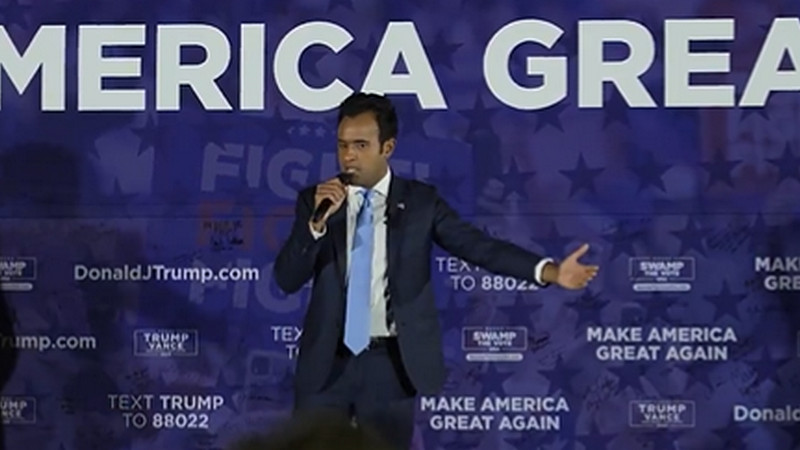 Vivek Ramaswamy stumping for Donald Trump. (Image from video posted on X)
Former presidential candidate Vivek Ramaswamy, now a Fox Nation host and cheerleader for Donald Trump’s campaign, used his account on the social media site X (formerly Twitter) to spread a dangerous antisemitic trope among his 2.6 million followers last week.
After philanthropist Alex Soros posted a photo of himself with Democratic vice-presidential candidate Gov. Tim Walz, Ramaswamy reposted it with the comment, “If you squint, you can see the strings on the marionette.”
Alex Soros is the son of philanthropist George Soros, a longtime funder of progressive and pro-democracy causes. As Media Matters noted, “The ‘puppet master’ imagery is a classic antisemitic trope, and right-wing media and have used it for years to smear George Soros.”
It is so recognizably antisemitic, in fact, that three years ago Fox News deleted social-media posts with a cartoon portraying Soros as a “puppet master” after critics called them out.
But that hasn’t stopped MAGA activists. Last year, when a podcaster asked Ramaswamy about having received a scholarship funded by George Soros’s late brother Paul, Ramaswamy said, “I think the big question that comes up is who’s the bogey man pulling the strings. I have no tie to George Soros other than criticizing him.” Ramaswamy later said he was unaware of the podcast host’s record of peddling tropes about Jews owning “almost everything.”
Trump himself has used the “puppet master” trope to rile his followers and motivate them to send him money. Last year, Trump sent a fundraising email that attacked Manhattan District Attorney Alvin Bragg as a “bought-and-paid-for Soros prosecutor” carrying out his “puppet master’s plot to put me in JAIL for committing NO CRIME.”
Trump and other right-wing leaders revere Hungary’s “illiberal” leader Viktor Orbán, who deployed antisemitism in forcing a university funded by George Soros to leave the country where he was born, and has continued to use antisemitic narratives—more recently targeting Alex Soros—to maintain his grip on power. Orbán’s heavy-handed moves to impose ideological control over the judiciary, media, education, and culture have made him a hero to U.S. right-wing leaders like Heritage Foundation President Kevin Roberts, who views Orbán as the model for the kind of strongman they would like Trump to be in his second term.
Often the promotion of antisemitism is more coded than overt. While Ramaswamy has publicly criticized antisemitism as “morally outrageous” and “a symptom of something that is broken in our society,” he has also participated in the MAGA movement’s embrace of antisemitic conspiracy theories. Last year, when Ramaswamy was running for president, The Atlantic’s Adam Serwer dubbed him “The new face of the ‘great replacement.’”
The BBC describes “great replacement” as “the far-right idea that a cabal of people—often named as ‘globalists,’ ‘elites,’ or Jews—is deliberately plotting to change the demographic of Western countries,” and “a version of the ‘white genocide’ conspiracy theory that there is a plot to entirely ‘eliminate’ white people.” Proponents of this theory—including Trump and Carlson—sometimes blame George Soros directly for this imagined scheme.
As Right Wing Watch has noted, “the theory that global elites are out to ‘replace’ white people motivated mass murderers who killed Muslims in New Zealand, Jews in Pittsburgh and San Diego, and Latinos in El Paso, Texas. It also inspired organizers of the deadly Unite the Right protest in Charlottesville, Virginia in 2017, where protesters chanted, ‘You will not replace us’ and ‘Jews will not replace us.’”
But none of that has stopped right-wing pundits like Tucker Carlson or far-right openly antisemitic figures like white nationalist Nick Fuentes from promoting great replacement rhetoric.
The poison is spreading within the MAGA movement. Trash-talking commentator Candace Owens Tucker Carlson in 2021 that George Soros’s philanthropy was designed to “undo American civilization.” Owens, who lost her job at the Daily Wire earlier this year, has veered into antisemitic territory that is uncomfortably close to what is spewed by Fuentes.
Owens’ antisemitic rhetoric was called out by some conservatives. Yet two months after Owens’ highly publicized departure from the Daily Wire, Ramaswamy was urging BuzzFeed, where he had just bought a significant stake, to hire her. Owens is still promoted on the Turning Point USA site, whose founder Charlie Kirk is touring colleges with Ramaswamy this fall.
Carlson, meanwhile, recently hosted Holocaust revisionist Darryl Cooper on his online show—a top-rated podcast—and Cooper followed up with a social media post saying that Hitler had tried to “work with the other powers to reach an acceptable solution to the Jewish problem.”
The Atlantic’s Yair Rosenberg cited the episode in his recent article, “The Anti-Semitic Revolution on the American Right,” which noted that Carlson was given a prime-time speaking slot at the 2024 Republican National Convention. “Anti-Semitism has always existed on the political extremes, but it began to migrate into the mainstream of the Republican coalition during the Trump administration,” Rosenberg writes.
Rosenberg notes that the MAGA movement’s angry anti-elite populism “readily maps onto the ancient anti-Semitic canard that clandestine string-pulling Jews are the source of society’s problems.” That brings us back to Ramaswamy and other MAGA insiders. “Trump fundamentally refuses to repudiate anyone who supports him,” notes Rosenberg, who cites a conservative columnist who told him last year, “What you’re actually worried about is not Trump being Hitler. What you’re worried about is Trump incentivizing anti-Semites” in a way that brings them real political power.
There are other strains within the right wing of American politics that threaten to foster the marginalization of American Jews.
Among the “illiberal” and “post-liberal” thinkers that J.D. Vance pals around with is Yoram Hazony, whose Edmund Burke Foundation sponsors the National Conservatism conference at which Vance has spoken repeatedly in the past few years. Hazony believes that in a Christian majority country, “public life should be rooted in Christianity and its moral vision, which should be honored by the state and other institutions both public and private.” When journalist Katherine Stewart asked about minorities in such a society having outsider status, Hazony said, “That simply is reality,” adding that minorities would not get the same treatment as the majority, but “should be grateful for the fact that you’re not persecuted as minorities often have been in history.”
Like Trump, American religious-right groups loudly declare their support for Israel’s government and love for the Jewish people. But some of the movement’s increasingly aggressive, exclusionary, and dominionist Christian nationalist leaders declare that the U.S. is meant to be a Christian nation, with certain kinds of Christians ordained to rule. Some claim that the U.S. was founded with a national mission to advance the Christian faith. Some assert that Christian beliefs should be amended into the Constitution and that public officials should be required to be Christian. One has called for public worship by non-Christians to be banned.
Religious-right groups have also attacked Soros’s philanthropic support for progressive religious groups, calling it “evil.”A letter circulated among right-wing evangelicals several years ago portrayed George Soros as a global schemer whose goal may be “the imposition of a global monoculture” but is “at least the destruction of our national identity through demoralization, open borders, drugs, crime, law-fare and media propaganda — the ‘fundamental transformation’ (weakening) of American civil society for the leveraged power of global ‘elites.’” Signers included broadcaster Eric Metaxas, anti-LGBTQ activist and New Apostolic Reformation figure Jim Garlow, and the Family Research Council’s Jerry Boykin.
Trump himself has inflamed antisemitism on the right since his 2016 campaign rhetoric electrified white nationalists. He has routinely disparaged American Jewish voters for not supporting him more widely based on his support for Israel’s far-right government. And Trump recently threatened to blame American Jews if he loses the election. What could be more calculated to inflame the antisemitism already surging through his conspiracy-embracing MAGA movement?
===
September 25, 2024, edition of Fox News' The Ingraham Angle
LAURA INGRAHAM (HOST): You got Alex Soros meeting with Tim Walz. You have the global establishment, the World Economic Forum types, Oprah, Taylor Swift, you know, these are the billionaires, not that Trump doesn't have a few billionaires, but most of the billionaires are for Kamala Harris. What do they want to preserve, Vivek, so the viewers out there tonight fully understand what's at stake?
VIVEK RAMASWAMY (GUEST): So, look, I have no objection to being a billionaire, speaking of somebody who has lived the American dream myself. But what I do have an objection to is the kind of puppet-tearing that you see now in the Democratic Party. Look at those images of Alex Soros standing next to Tim Walz. Looks like if you squint really closely, you can even see the puppet master pulling the strings right there.
---
QUIT ENDOSE TRUMP RALLY nh WITH SCOTT
---
see teneo esg
A recent Teneo fundraising email laid out how the group can bring its members' influence together in service of a cause.
To “confront” what he dubbed “woke capitalism,”Jonathan Bunch, a longtime Leo deputy and now Teneo board member, wrote that the group had brought together a coalition of Teneans “working with (or serving as) state attorneys general, state financial officers, state legislators, journalists, media executives and best-in-class public affairs professionals” to launch investigations, hold hearings, pull state investment funds and publish op-eds and news stories in response to so-called environmental, social and governance, or ESG, policies at the corporate level.
“Our members were in the rooms where it happened,” Bunch wrote.
Another project underway, Baehr explained in a 2020 presentation, was a “surreptitious and exciting” effort to map key institutions in major cities — private schools, country clubs, newspapers, Rotary and so on — and find ways to get Teneo members inside those institutions and help members connect with each other. The initiative has begun by mapping Atlanta and several cities in Texas.
---=
an 6 24
wikiLeaks founder Julian Assange has been released from a U.K. prison after reaching a plea deal with the U.S. Department of Justice (DOJ). Assange, according to NBC News, will avoid incarceration in the U.S. by pleading guilty to a conspiracy charge.
MAGA businessman Vivek Ramaswamy, who ran against Donald Trump in the 2024 GOP presidential primary but endorsed the presumptive nominee after dropping out of the race, used Assange's release to attack President Joe Biden in a June 25 post on X, formerly Twitter. But Ramaswamy got a fact-check from Semafor's David Weigel.
Ramaswamy posted, "It's great that Julian Assange will finally be released (in what smells like a desperate Biden gambit for libertarian votes), but it's shameful that he had to spend years rotting in a foreign prison for doing what other reporters do regularly, while the government employee who leaked to him - Chelsea Manning - had her sentence commuted by Obama because she's a member of a favored political class (transgender)."
READ MORE: Ramaswamy acquires 'activist stake' in BuzzFeed: 'Attractive investment opportunity'
The far-right MAGA Republican added, "Julian Assange deserves a pardon & it's long past overdue to restore one standard of law again in America."
After seeing Ramaswamy's tweet, Weigel briefly explained why his premise was misleading.
Weigel tweeted, "He was indicted by Bill Barr’s DOJ!" And the Semafor journalist linked to a May 23, 2019 DOJ press release headlined, "WikiLeaks Founder Julian Assange Charged in 18-Count Superseding Indictment."
The DOJ press release read, "A federal grand jury returned an 18-count superseding indictment today charging Julian P. Assange, 47, the founder of WikiLeaks, with offenses that relate to Assange's alleged role in one of the largest compromises of classified information in the history of the United States…. The superseding indictment alleges that Assange was complicit with Chelsea Manning, a former intelligence analyst in the U.S. Army, in unlawfully obtaining and disclosing classified documents related to the national defense."
READ MORE: Vivek Ramaswamy rouses Michigan GOP with claim there is 'a war in this country'
---
4 24 WIRED
Another training webinar called “We the People” was also hosted last month by the America Project and its offshoot, Vote Your Vision. Broadcasted online to hundreds of attendees, the webinar featured a lineup of election conspiracists, Republican lawmakers, a guy who wrote a book about fifth-generation warfare, and former GOP presidential candidate Vivek Ramaswamy.
The webinar, the group’s website said, was designed to give people “the secrets to reclaiming our power and reshaping history” by using “state-of-the-art election tools,” including those involving artificial intelligence technology. While the details of exactly what these tools will look like and how they will be used are unclear, the America Project has already scheduled more training sessions in the coming weeks to give supporters more information. The group also did not reply to requests for comment.
The America Project was cofounded by disgraced former national security adviser Michael Flynn and former Overstock.com CEO and conspiracist Patrick Byrne, who also funds part of the organization. Both Flynn and Byrne reportedly attended a White House meeting in late 2020 to urge Trump to essentially declare martial law and seize voting machines.
nasty in debate 12 23
---
Jake Tapper slams Vivek Ramaswamy over 'frankly, unhinged' Federal Reserve theory - Alternet.org
ramaswamy-stoops-to-q-nut-idiocy-to-please-maga-base
---
11 23
---
mediaite
vivek Ramaswamy lost his composure and seemed to grow irritated when MSNBC’s Andrea Mitchell pressed him on recent foreign policy criticisms from his GOP primary rival Nikki Haley.
Ramaswamy joined Mitchell Tuesday for an interview that quickly grew confrontational as the MSNBC anchor pressed the Republican presidential candidate on his criticism of **Mike Pence, remarks on climate change, and his widely–panned foreign policy stances. The discussion eventually reached a point where Mitchell prepared to air a video of Haley commenting on Ramaswamy’s Taiwan views, and he disputed the characterizations before grumbling, “You can play Nikki Haley’s lies. Sure. Yep.”
Mitchell and Ramaswamy continued to clash as they spoke over each other while discussing the candidate’s controversial Taiwan policy. When Mitchell again tried to tee up Haley’s criticism of Ramaswamy, he responded, “It’s a lie. Go ahead and play it. Yep.”
The show proceeded to air Haley’s criticism of Ramaswamy’s past comments where he suggested reducing U.S. funding to Israel by 2028. The two have been at each others’ throats ever since the Milwaukee primary debate where Haley, a former ambassador to the UN, bashed Ramaswamy as a foreign policy neophyte.
Here’s how Ramaswamy reacted to the Haley clip:
With due respect, my concern is that our steps and NATO’s steps right now are marching us closer to world war by driving Russia further into China’s hands at a time when we have no visibility into what Russia’s red lines are. And further, at a moment when Russia has a larger nuclear stockpile and super EMP capabilities and hypersonic missile capabilities ahead of that of the U.S.
What I’ve said is I would end that war, but on terms that end the Russia/China partnership. That’s how we deter Xi Jinping from going after Taiwan. Right now, Xi Jinping’s bet is that the U.S. will not want to go for two different allied nuclear superpowers at the same time. But if Russia is no longer in China’s camp, then Xi Jinping is going to have to think twice before going after Taiwan. I’m the only presidential candidate who has affirmatively said we will defend Taiwan, because we have greater national interests there than we do in Ukraine.
---
August 30, 2023
Jennifer Bowers Bahney @ Mediaite: ‘I Don’t Want To Have To Draw My Rifle’: MAGA Lawmaker Suggests Trump Prosecution Could Lead To Civil War.
Molly Olmstead @ Slate: How Vivek Ramaswamy, a Hindu, Is Aligning Himself With Christian Nationalists.
David Badash @ The New Civil Rights Movement: News CPAC’s Matt and Mercedes Schlapp Attack ‘Satan’s Publication’ After Report Adds More Details on Sexual Battery Lawsuit.
Erik Maulbetsch @ The Colorado Times Recorder: Colo GOP Leadership’s ‘Top Priority:’ Supporting Jan. 6 Prisoners.
Emine Yücel @ Talking Point Memo: Judge Rules Giuliani Is Liable For Defaming Georgia Election Workers.
Tags: Colton Moore Matt Schlapp Mercedes Schlapp Rudy Giuliani Vivek Ramaswamy Round-Up
---
gmail no lnx 8 23 no grf
How Vivek Ramaswamy makes money from climate denial
At Wednesday's debate, Ramaswamy said he was the "only candidate who's not bought and paid for." That couldn't be further from the truth.
EMILY ATKIN
AUG 29
Vivek Ramaswamy calls climate change a "religion.” He also co-founded a fossil fuel investment fund focused on pushing for more drilling. Source: Maddie McGarvey/Washington Post via Getty Images
At the first Republican presidential debate last week, most of the candidates struggled to explain their position on human-caused climate change.
But 38-year-old Vivek Ramaswamy came prepared.
“I'm the only candidate on stage who isn't bought and paid for, so I can say this: The climate change agenda is a hoax,” he said.
“The anti-carbon agenda is the wet blanket on the economy,” he added. “And so the reality is, more people are dying of bad climate change policies than they are of actual climate change.”
These claims were, of course, baseless. As both The New York Times and Washington Post pointed out in fact checks, there is no data showing that people are dying from the transition to a renewable energy economy. (Asked by The New York Times to provide evidence for the claim, Ramaswamy sent a 2022 opinion article by prominent climate denier John Stossel.)
I’m not here today, though, to debunk Ramaswamy’s climate rhetoric. It is essentially just repackaged fossil fuel industry boosterism, which is a more sophisticated form of climate denial.
I’m here to tell you why Ramaswamy is promoting fossil fuel boosterism. He’s hoping it will make him, and his billionaire friends, even more rich.
Ramaswamy’s push to end climate-conscious investing
Over the years, Ramaswamy has been known for many things: founding a biotech company called Roivant Sciences; becoming a near-billionaire; and performing libertarian-themed rap songs under the stage name "Da Vek."
But recently, he’s become best known as “the right’s most prominent crusader against climate-conscious investing.” His latest mission: ensure Republican-led states pull their money from big investment firms like BlackRock that are trying (or at least claiming) to make more climate-friendly decisions, and reallocate that money to his firm, Strive Asset Management, which explicitly promises not to invest with the climate in mind.
The fossil fuel industry has wanted someone to do this for many years. As we’ve previously reported, the anti-ESG movement—which pushes corporations to reject environmentally and socially conscious investing principles—was originally created by fossil fuel industry operatives to try to delay the renewable energy transition.
The movement fizzled in the early 2000s. But it was revived in 2022, when Ramaswamy launched Strive with the help of billionaire investors Peter Thiel and Bill Ackman, as well as the same fossil fuel industry-connected group that spearheaded the original movement.
Ramaswamy has reported more than $50 million in holdings in Strive, which to date, is mostly a fund to promote fossil fuel development. As Semafor reports, the largest fund at Strive—called DRLL—“ invests in U.S. energy companies and urges them to keep drilling for oil so long as it’s profitable.”
lnc:
But recently, he’s become best known as “the right’s most prominent crusader against climate-conscious investing.” His latest mission: ensure Republican-led states pull their money from big investment firms like BlackRock that are trying (or at least claiming) to make more climate-friendly decisions, and reallocate that money to his firm, Strive Asset Management, which explicitly promises not to invest with the climate in mind.
The fossil fuel industry has wanted someone to do this for many years. As we’ve previously reported, the anti-ESG movement—which pushes corporations to reject environmentally and socially conscious investing principles—was originally created by fossil fuel industry operatives to try to delay the renewable energy transition.
The movement fizzled in the early 2000s. But it was revived in 2022, when Ramaswamy launched Strive with the help of billionaire investors Peter Thiel and Bill Ackman, as well as the same fossil fuel industry-connected group that spearheaded the original movement.
Ramaswamy has reported more than $50 million in holdings in Strive, which to date, is mostly a fund to promote fossil fuel development. As Semafor reports, the largest fund at Strive—called DRLL—“ invests in U.S. energy companies and urges them to keep drilling for oil so long as it’s profitable.”
A chart shows the portion of fossil fuel assets in Strive’s ETFs. Source: Semafor
although Semafor describes DRLL’s holdings as “energy,” the vast majority are fossil fuels. According to Strive’s own description, 93.6 percent of DRLL’s investments are in oil, gas, and pipeline companies. These companies rank among the world’s top climate polluters.
Strive’s DRLL fund is composed mostly of oil, gas, and pipelines. Source: Strive Asset Management
People would not invest in these companies—much less push them to drill as much oil as humanly profitable—if they accepted the science of climate change. They would not invest if they accepted that fossil fuels are causing catastrophic planetary damage. They would not invest if they accepted that this damage cannot be stemmed without rapidly transitioning away from fossil fuels.
That’s why Ramaswamy pushes rejection of the “climate change agenda.” He says it’s because he’s not “bought and paid for.”
The reality is the complete opposite.
As of Tuesday, Vivek Ramaswamy’s post-debate tweet claiming he’s not “bought and paid for” has more than 1.5 million views. Source: Twitter
Denying the need for fossil fuel reduction is climate denial
Ramaswamy’s style of fossil fuel boosterism, as described by the New Republic, is on the rise in Republican circles. So as we continue to hear it, it’s important to remember two things:
If someone says climate change does not pose a massive threat to human life, economies, and ecosystems, then they are denying the science of climate change.
If someone says climate change can be effectively managed without reducing the use of fossil fuels, then they are denying the science of climate change.
Ramaswamy didn’t flat-out say that climate change is a hoax. But in the debate and in follow-up interviews, Ramaswamy made clear he doesn’t believe climate change poses a massive threat to human life, and doesn’t believe that transitioning away from fossil fuels will help.
This is an opinion he is allowed to have. But it is a rejection of the vast majority of climate science. It should be characterized as such.
Related reading: Averting dangerous warming requires “a substantial reduction in overall fossil fuel use," world’s leading climate scientists say.
no lnx an 8 23
'Feeding their denial like a servant': Ramaswamy slammed by scholar he called 'modern KKK' wizard
Maya Boddie August 29, 2023
Biotech entrepreneur and 2024 GOP candidate Vivek Ramaswamy, during a recent Iowa appearance, referred to author, historian and scholar Dr. Ibram X. Kendi as a modern-day KKK grand wizard.
According to NBC News, the Republican candidate quoted Kendi's bestselling book "How To Be Anti-Racist," saying, "Here's what it says. Opening lines: 'The remedy to past discrimination is present discrimination. The remedy to present discrimination is future discrimination."
Ramaswamy went on to say, "These are the words of the modern grand wizards of the modern KKK."
During Monday's episode of MSNBC's The Reid Out, host Joy Reid interviewed Kendi, saying, Ramaswamy is "basically saying anti-racism is the reason for racist incidents. He named you. Your thoughts?"
Kendi replied, "It is a very old white supremacist talking point. White supremacists have been saying for decades that anti racist's code for anti white. What is also ironic is the only reason why we're even talking about him, the only reason why he even has political standing is because he has brown skin, he's attacking black people. That is really his job. It is the job of Republican candidates of color to go out to white republicans and say they are not racist and the real racists are the people who are challenging them. so, he is doing his job. He's feeding their denial like a servant."
United States Representative Ayanna Presley (D-MA), who Reid interviewed along with Kendi, was also criticized by Ramaswamy during the same Iowa appearance.
READ MORE: 'Blatant fanboying': Why the GOP base is 'eating up' Vivek Ramaswamy’s 'showmanship'
When a voter asked the GOP hopeful whether "critics would blame him for white supremacy or call him part of white supremacy," NBC notes, Ramaswamy replied, "Ayanna Pressley, she's in the Congress today. She's a member of 'the squad.' Her words, not mine: 'We don't want any more black faces that don't want to be a black voice. We don't want any more brown faces that don't want to be a brown voice.'"
According to The Hill, Presley spoke with Reverend Al Sharpton earlier this week, saying, "The verbal assault lobbied against myself and Dr. Kendi is shameful. It is deeply offensive. And it is dangerous. It is not that long ago that we were besieged by images of white supremacists carrying tiki torches in Charlottesville. It was not that long ago that a white supremacist mob seized the Capitol, waving Confederate flags and erecting nooses on the West Lawn of the Capitol."
Watch the video below or at this link.
The Reid Out (8.28.2023) Dr. Ibram X. Kendi slams Vivek Ramaswamy for calling him 'modern KKK'
www.youtube.com
READ MORE: Pardoning Trump will 'move our country forward': Vivek Ramaswamy
NBC's full report is available at this link. The Hill's report is here.
https://www.alternet.org/vivek-ramaswamy-appoint-elon-musk/
maybe he's running for twit vp ;)
https://www.alternet.org/vivek-ramalwamy-hunter-biden-ukraine/
https://www.alternet.org/vivek-ramalwamy-hunter-biden-ukraine
during a Saturday Iowa appearance, 2024 Republican presidential candidate Vivek Ramaswamy alleged that President Joe Biden's son Hunter Biden is the reasonfor the United States' aid to Ukraine, NBC reports.
The GOP hopeful made his remarks as "Rep. James Comer (R-Kentucky) and his colleagues have been alleging that President Joe Biden took a bribe from the Ukrainian energy company Burisma, which Hunter Biden represented as a lobbyist."
NBC notes:
Russia invaded Ukraine in the winter of 2022, years after Biden left Burisma’s board. Since the invasion, the Biden administration and Congress have given billions of dollars of aid to Ukraine despite polls that show the American people are split on sending more funding.
READ MORE:**House Republicans' Biden 'bombshell' keeps failing to materialize: analysis**
"The purpose of the U.S. military [is] to advance American interests, to protect the homeland. Not to aimlessly fight some random war that's arguably a repayment for a private bribe that a family member of the United States received, $5 million from Burisma," Ramaswamy said. "Was the payment to Hunter Biden corrupt? Absolutely it was. Do I think that it has some relationship towards our posture toward Ukraine? I think it's likely that it does."
Washington Postcolumnist Phillip Bump wrote in a recent column "despite Comer's claim," his allegation against the Biden family "is not becoming more credible every day," noting, "there has been no evidence tying Joe Biden to Hunter Biden's work" for Burisma "in any concrete way."
READ MORE: 'It's like a soap opera': These Republicans are weary of their colleagues' Hunter Biden obsession
pbs newshr 7 23 long/ interview no sys racism AA dei, all single moms
https://www.triplepundit.com/story/2022/anti-esg-office-holders/761261
the anti-ESG movement and the “woke capitalism” canard has many U.S. political observers scratching their heads. Instead of the traditional Republican Party support for big business, a growing number of Republican office holders are leveraging their legislative power against corporate efforts to align with ESG (environmental, social and governance) principles. Nevertheless, the pieces of the puzzle are beginning to come together.
The usual suspects: Fossil energy lobbyists
The anti-ESG movement focuses primarily, though not exclusively, on stemming the flow of investor dollars to the renewable firms that that are involved in clean energy and related fields.It’s no surprise, then, to find the Heartland Institute front and center in the anti-ESG movement, which it also calls “anti-woke.” The organization is well known for developing media and legislative playbooks in support of the fossil energy and tobacco industries. The organization is apparently applying the same methodology to stem the flow of investment dollars to renewable energy.
Last June, Heartland catalogued its anti-ESG playbook in a long-form article under the title, “Woke Investing Gets Well-Deserved Pushback.”
“The Heartland Institute has written extensively and testified about the dangers of government agencies mandating banks, companies, and portfolio funds adopt and report on Environment, Social, and Governance (ESG) standards,” noted the article’s author, H. Sterling Burnett.
“Heartland has also provided detailed critiques of efforts by a cabal of large, multinational banks and gigantic financial companies to force every business to adopt ESG goals,” Burnett continued.
The use of the word “cabal” is not a one-off. Burnett continues to deploy coded words that evoke the anti-Jewish canard of an all-powerful financial cult that pulls the strings of the global economy.
Editor's note: Be sure to [subscribe to our Brands Taking Stands newsletter, which comes out every Wednesday.
“The woke, billionaire corporate elites who run these corporations do this by threatening to withdraw banking or financial services or by applying pressure through their control over large amounts of a company’s stock,” he added.
Burnett also emphasized that Heartland can take partial credit for the growing number of states that have proposed or enacted anti-ESG legislation. “In a joint effort with likeminded nonprofit organizations, The Heartland Institute’s government relations professionals have pushed back against this by working with legislators in various states to shape and adopt model legislation blocking use of ESG scoring in deciding whether to offer banking and investment services. These efforts have borne fruit,” he wrote.
The other usual suspects: Trump supporters
It’s also no surprise to find investor, former Facebook board member and political kingmaker Peter Thiel involved in the anti-ESG movement. He was instrumental in former U.S. President Donald Trump’s 2016 campaign for office. He also publicly backed two candidates for U.S. Senate this year, both of whom deployed anti-ESG rhetoric during their campaigns.
In addition, Thiel has launched a new financial venture that is apparently aimed at providing an outlet for anti-ESG investors.
Reporters Liz Hoffman and Charley Grant picked up that thread for the Wall Street Journal last May in an article titled, “Woke, Inc.’ Author’s Startup to Take On BlackRock” and subtitled, “Backed by Peter Thiel and Bill Ackman, Vivek Ramaswamy’s Strive will tell CEOs to stay out of politics.”
“An upstart financial firm backed by Peter Thiel and Bill Ackman has a message for American corporations: Focus on making money, not taking stands,” they observed. “Mr. Thiel invested both personally and through his Founders Fund, joined by Palantir Technologies Inc.”
“Vivek Ramaswamy, who made his fortune in pharmaceutical startups before writing a book last year called ‘Woke, Inc.,’ says he has raised $20 million to start a fund manager that would urge companies not to wade into hot-button social or environmental issues,” they added.
The idea seems to be catching on. Last August, reporters Katherine Greifeld and Elaine Chaim of Bloomberg noted that the firm filed for four more equity ETFs. “The filings land just two weeks after the Strive US Energy ETF (ticker DRLL) launched, which has already accumulated nearly$250 million in assets,” they wrote.
The anti-ESG movement embraces Elon Musk and the religious right
Another leading element in the anti-ESG movement that has recently come to light is the nonprofit organization State Financial Officers Foundation. The group reportedly claims that it is not involved in advocating for elected officials. However, its financial “team” is staffed exclusively with Republicans, many of whom hold elected office, according to research by David Armiak of the Center for Media and Democracy. At least four members of the group are elected officials in Texas, West Virginia, Arizona and Kentucky who are known for promoting anti-ESG policies.
Nonpartisan or not, the Foundation has advocated on behalf of the fossil energy industry, as expressed in a public letter to President Joe Biden last April. It has also publicly aligned itself with high-profile personalities and organizations in the anti-ESG movement.
On Tuesday, for example, the organization’s home page featured a tweet from newly minted Twitter owner Elon Musk that read, “ESG is the devil.”The brief message is of a piece with Musk’s earlier anti-ESG pronouncements, as reported by the New York Times.
The day before that, the Foundation's home page highlighted a tweet from the Washington Stand, a publication of the Family Research Council, an evangelical activist group. The tweet linked to an unattributed commentary that described a Foundation conference in November, in which “conservative leaders made it clear that, moving forward, they plan to be woke capital’s worst nightmare,” the Family Research Council wrote.
As with other anti-ESG manifests, the piece leveraged anti-Jewish sentiment by repeatedly focusing attention on the financial firm BlackRock and its Jewish CEO.
Advertisers are already bailing from Twitter on account of Musk’s tolerance for hate speech on his platform. Issues related to his other business ventures may also come into play. Now that the anti-ESG movement has embraced his rhetoric, the likelihood of additional advertisers fleeing from Twitter has grown.
As for the State Financial Officers Foundation, its embrace of Musk’s “free speech” policy should be a red flag to any remaining corporate sponsors and donors that continue to support the organization, and a clear signal that business leaders can no longer count on the safe haven of Republican policy-making to support their interests.
an 5 23 no lnx
'Right of Trump': Longshot GOP presidential hopeful wants to abolish the FBI, the IRS and the Education Dept.
Alex HendersonMay 12, 2023
The 2024 GOP presidential field continues to grow. Although former President Donald Trump remains the clear frontrunner, he has his share of challengers — including Nikki Haley (former U.S. ambassador to the United Nations and ex-governor of South Carolina), former Arkansas Gov. Asa Hutchinson, and radio host Larry Elder. Florida Gov. Ron DeSantis appears to be gearing up for a presidential run, and Sen. Tim Scott (R-South Carolina) launched a presidential exploratory committee in April.
Another longshot GOP presidential candidate is far-right 37-year-old tech entrepreneur Vivek Ramaswamy, who has been drawing headlines by calling for the United States to raise its national voting age from 18 to 25 — a move that critics say is designed to hurt Democrats, as the GOP's policies are generally unpopular among Generation Z. But Ramaswamy has many other extreme positions as well.
:{
}:
Ramaswamy, according to the New York Times, also wants to abolish the FBI, the IRS and the U.S. Department of Education. If elected president, he wouldhalt affirmative action by executive order. Ramaswamy would use the U.S. military against drug cartels in Mexico, and he told The Tennessee Star that he wants to fire "at least half the federal workforce."
READ MORE: 'Am I hallucinating?': Twitter swiftly reminds Trump 2024 GOP opponent of his party’s 'lock her up' chant
In an article published by Axios on May 12, journalist Alexi McCammond reports that Ramaswamy is "running to the right of Trump" with "hyper-Trumpian positions on the border, voting, culture wars and more."
Ramaswamy told Axios, "We can take the America First agenda even further than Trump because we will do it from a moral foundation."
McCammond stresses, however, that Ramaswamy has so far offered only mild criticism of Trump — for example, criticizing him for not debating fellow Republicans. And Trump is not attacking Ramaswamy the way he has been attacking DeSantis.
In a May 5 post on his Truth Social platform, Trump wrote, "I am pleased to see that Vivek Ramaswamy is doing so well in the most recent Republican Primary Poll, CBS YouGov. He is tied with Mike Pence, and seems to be on his way to catching Ron DeSanctimonious. The thing I like about Vivek is that he only has good things to say about 'President Trump,' and all that the Trump Administration has so successfully done— this is the reason he is doing so well. In any event, good luck to all of them, they will need it!"
READ MORE: Fringe GOP presidential candidate wants to unconstitutionally raise voting age to 25
One of Ramaswamy's critics on the right is Never Trump conservative Sarah Longwell, founder of the Republican Accountability Project (formerly Republican Voters Against Trump) and publisher of The Bulwark. The conservative strategist, who endorsed President Joe Biden over Trump in 2020, described Ramaswamy as the type of "purebred culture warrior" who now typifies the GOP.
:{
}:
Longwell told Axios, "Vivek is just much closer to the actual id of Trump than these other candidates. Actual governing experience means you do things like compromise and work with people."
READ MORE: 'Another anaphylactic response': GOP presidential candidates unfazed by Trump sexual assault verdict
FROM YOUR SITE ARTICLES
'A bit cringe': These young Republicans think their older counterparts are saying 'woke' too much ›
Asa Hutchinson to challenge 'sideshow' Donald Trump for 2024 GOP presidential nomination ›
Donald Trump just called for another coup — and hardly anyone noticed ›
RELATED ARTICLES AROUND THE WEB
Vivek Ramaswamy, a Wealthy 'Anti-Woke' Activist, Joins the 2024 ... ›
GOP 2024 hopeful Vivek Ramaswamy proposes raising the voting ... ›
Who Is Vivek Ramaswamy: Anti-Woke Entrepreneur Taking on ... ›
mma 1 2 23
https://www.mediamatters.org/fox-news/fox-news-creates-fake-presidential-campaign-vivek-ramaswamy
https://www.mediamatters.org/fox-news/vivek-ramaswamy-fox-news-shiny-new-object-his-comments-decrying-climate-religion-have-lot
On the February 21 edition of Fox News’Tucker Carlson Tonight, multimillionaire former biotech executive Vivek Ramaswamy announced his run for president as a Republican candidate.
Ramaswamy has been no stranger to Fox: Since January 2022, he has appeared in Fox News weekday programming roughly 77 times. It’s not a stretch to say that his presidential run has been at least partially manufactured by Fox News.
One of the reasons for his popularity on Fox is his constant drumbeat against climate policies. In addition to railing against corporations promoting environmental, social, and governance principles (ESG) and stating that climate change has nothing to do with the climate and is just a front in order to “punish people & exercise power,” Ramaswamy has made it a point to mention “climate religion” in his Fox appearances.
These comments fit perfectly into Fox’s long-running campaign of amplifying climate misinformation and delaying climate action.
Ramaswamy's “climate religion” comments are a staple of his Fox interviews
In Ramaswamy’s aforementioned Tucker Carlson Tonight appearance, he said “climate religion … is completely shackling the American economy” and called it a “sacred cow” that we need to “take to the slaughterhouse.” And in recent interviews, he made sure to get this point across to the Fox audience.
On the March 1 edition of Fox Business’ Mornings with Maria, he said “ending climate religion” is one of his campaign planks, while on the February 26 edition of Fox News’ The Next Revolution with Steve Hilton, he stated that “climatism” is a form of “scientism rather than science. That is a religion.” And on the February 23 edition of Hannity, he noted that he is “dismantling this climate religion. We have been addicted to a climate religion that shackles the United States while leaving China untouched.”
On the February 22 edition of Fox News’ Fox & Friends, he stated that he wants to focus on problems like “the rise of secular religions like wokeness and climatism.” On this same day, he also referenced dismantling “climate religion” on Fox Business’ Varney and Co. A clip of this was played later that day on Fox Business’ The Big Money Show.
He also compared climate change to a religion during a February 10 Tucker Carlson Tonight appearance. He referred to the “environmental and ESG movement and related climate religion” as just a “Trojan horse for global equity.”
Fox has long sown the seeds of Ramaswamy’s “climate religion” comments
Ramaswamy could have easily just copied and pasted his “climate religion” comments from other Fox segments. Fox has long belittled those concerned about climate change by painting them as part of a radical extremist movement, one that is detached from reality and one that has lost traditional values like faith and morality. Even recently, Fox’s most-watched shows have been hammering this point.
Look no further than the February 28 edition of Tucker Carlson Tonight. Tucker Carlson lamented the decline of traditional organized religion in America, noting that we need to accept the “fact that we are not God.” He then stated that “ignoring that fact leads to insanity. Or in the case of modern America, it leads to the trans agenda and climate theology.”
Before interviewing Ramaswamy on February 10, Carlson went on a rant about how climate change is like a religion, insinuating that those who care about climate change are “referring back to the primitive religions that dominated this Earth until pretty recently.” And on the February 9 edition:{, Carlson played a clip of an interview where former Carl’s Jr. CEO } :{ stated, “We're facing a group think on the left that’s really metastasized almost into a religion. And they use things like climate change.”}:
On December 12, Carlson offered a climate denial-filled opening monologue that included mocking Transportation Secretary Pete Buttigieg for saying that Christians should care about climate issues and be good stewards of the Earth. He described his comments like so: “Climate, declared Father Buttigieg, is a moral issue — not a meteorological matter, not even a policy topic. It’s a moral issue. Climate is a question that bears directly on the fate of your mortal soul. When you mistreat the climate, you risk damnation. … OK, Rev. Pete.” On October 27, he hosted Sen. Josh Hawley (R-MO) to claim that “the climate agenda is a religion to them.”
On October 17, Laura Ingraham hostedcontrarian grifter Michael Shellenbergerto discuss how, as Ingraham put it, “apocalyptic greens are in the grips of a bad religion.” On September 28, Sean Hannity hosted Mike Huckabee to claim that “for the people on the far left, this whole idea of the climate and climate change, it's not a political issue. This is their religion.” The September 14 edition of Special Report aired a clip of Sen. John Barrasso (R-WY) saying that “the religion today of the Democrat Party is a religion of climate. They worship the sun god, the wind god, and the god of wishful thinking.”
Even several years ago, Fox employees and guests were complaining that people were too alarmist about climate change. One of the network’s employees, Pete Hegseth, consistently makes it a point to mock climate action and link it to religion. They’ve also colorfully discussed how climate action can be compared to ancient human sacrifices.
Fox now has a Republican presidential candidate who makes decrying “climate religion” a central plank of his campaign
People have every right to be concerned about climate change — the crisis is worsening in front of our eyes and world leaders are doing very little to solve it. By disparaging climate activists and policies as alarmist or part of a religious cult, Fox is creating an alternate reality for their viewers, one where climate change is not a serious problem and the real problem is actually the people calling for action.
This is exactly the point of the network’s promotion of Ramaswamy. Fox and Ramaswamy want to protect the status quo, and this includes boosting the wealthy fossil fuel companies whose products are imperiling the planet. By consistently painting climate activists as cultists and nut jobs who want to destroy the traditional ways of American life, they can whip their viewers into a frenzy and get them to ignore how the climate crisis is a real and serious threat to their lives.
Fox has spent years either dismissing the seriousness of climate change or outright denying it. It’s because of this disinformation campaign that climate change is a divisive political issue among the U.S. public. Even the smallest things now, like an option in Xbox controllers that makes them more carbon friendly, are enough to spur a Fox freakout,because the network knows it will galvanize viewers into continuing to treat climate change as a divisive issue.
Thus, Vivek Ramaswamy’s invocations of the problem of “climate religion” are a perfect gift to Fox. They give the network more ammunition to treat climate change as part of the broader culture war and help Fox shape its platform for the Republican presidential candidates in 2024.
Expect to see Ramaswamy on the network a lot more in the coming weeks and months.
10 22 mail
new trend is sweeping conservative America. It’s called the anti-ESG movement, or anti-”woke capitalism” movement, and it’s one of the biggest emerging barriers to corporate action on climate change.
Anti-ESG proponents want to stop corporations from following environmentally and socially conscious investing principles, commonly referred to as Environment, Social and Governance (ESG) principles. They say companies are prioritizing “left-wing” goals over the financial interests of businesses and their employees, and should be prevented by law from doing so.
This movement has gained a massive following in the last six months. Elon Musk supports it, as do billionaire investors Peter Thiel and Bill Ackman, who are are backing a new financial firm dedicated to anti-ESG investing. Banning “woke investing” is also one of the biggest recent priorities of Leonard A. Leo, the prominent conservative legal activist who runs one of the “best-funded and most sophisticated operations in American politics,” according to a New York Times investigation published Wednesday. In the past year, 17 states have proposed or adopted legislation seeking to bar state investments in “woke” companies [twt]
the anti-ESG movement frames itself as a strictly financial enterprise. Its proponents insist it’s not political movement. They’re simply trying to get politics out of the financial system so people can make the most money as possible.
But the anti-ESG movement is, at its core, a lobbying effort created by climate deniers to make money for fossil fuel companies. It did not originate with financial experts or economists, but with two prominent industry operatives who’ve spent decades spreading disinformation about the human health risks of fossil fuels and cigarettes.
These former coal and tobacco operatives first started their movement to ban socially conscious investing in 2004. Only now, nearly two decades later, have they been able to get mainstream conservative America on board.
The anti-ESG movement is the climate denial movement
Before the anti-ESG movement was the anti-ESG movement, it was the anti-CSR movement, the acronym standing for Corporate Social Responsibility. The two leaders of the anti-CSR movement were Steve Milloy and Tom Borelli.
Milloy is a former coal company executive and paid advocate for Phillip Morris and ExxonMobil. His career focus is developing communication strategies to deny or downplay the risks of tobacco and fossil fuel pollution. He is among the most prominent people “clouding the climate change debate,” according to the*The Washington Post*.
Borelli is “one of the best-known of the science corrupters who worked for the tobacco industry,” according to The Center for Media and Democracy. In the 90s, while working for Phillip Morris, he led the tobacco industry’s efforts to team up with other polluting industries—like coal and chemicals—to promote anti-science rhetoric. “The climate denial movement is a direct result of these coalitions,” according to CMD. (He now promotes climate denial).
In 2004, Milloy and Borelli formed a non-profit called the Free Enterprise Education Institute. The non-profit’s purpose, according to its tax forms, was to “educate the public about the American system of free enterprise” by “maintaining a website about its research.”
The website they launched was called CSRwatch.com, and was marketed as a news destination for anyone opposed to “corporate social responsibility.” CSRwatch primarily aggregated news articles attacking corporations that had climate change and other socially conscious policies, like refusing to invest in child labor.
 |
A February 16, 2006 screenshot of CSRwatch.com. Source: Wayback Machine.
One article posted to CSRwatch in 2006, for example, slammed corporations that refuse to invest in overseas sweatshops, saying they deprive children in developing countries of good paying jobs. "They try to shut down so-called sweatshops as though no jobs [are] better than what they consider to be low quality jobs, as though working as a 12-year-old beggar, thief or prostitute is better than working in a garment or shoe factory,” it read.
The article also slammed pro-indigenous corporate policies. "I would love to meet just one corporate social responsibility activist … who's willing to go native for even one month and live in a state-of-the-art mud hut in malaria-infested rural Africa under the indigenous conditions they extol and perpetuate,"it read.
CSRWatch was directly funded by the fossil fuel industry. From 2004 to 2005, ExxonMobil gave the Free Enterprise Education Institute $80,000. The non-profit also received grants from a Koch family charity foundation, DonorsTrust, and The Randolph Foundation, all conservative groups with ties to fossil fuels.
The original anti-ESG investing movement was not so great at investing
CSRWatch was not Borelli and Milloy’s only effort to push back against ESG investing in the mid-2000s. They also set up a mutual fund called the The Free Enterprise Action Fund, designed to show that being anti-woke was also good business.
The fund sought to achieve long-term investment returns “while aggressively challenging CEOs who use shareholder assets to advance the liberal political agenda.” But, perhaps because neither Borelli nor Milloy had any experience managing money professionally, the fund didn’t do very well, according to a 2006 Slate piece:
Judging by the early returns, these free-marketers are failing the test of the marketplace. The fund has attracted a paltry $5.2 million in assets as of March 31. Returns have lagged the S&P 500 badly. In its first 10 months in business, the fund returned 2.32 percent while the S&P 500 rose 4.72 percent.
Of course, the fund’s poor performance could also simply have been explained by the fact that it’s bad business to ignore environmental and social risk factors. Indeed, this is why the bulk of the financial and corporate worlds don’t agree with the anti-ESG movement. They know that ESG investing, particularly investing with climate change risk in mind, is not ideological. It’s merely the smartest long-term financial decision.
The anti-ESG movement doesn’t agree with this assessment for one reason, and one reason only: They’re climate deniers. And the fact that they’re climate deniers is not a coincidence. That is what the fossil fuel industry intended.
The new anti-ESG movement: same folks, different face
The original anti-ESG movement eventually appeared to fizzle. CSRwatch.com stopped being updated in late 2007 and the domain expired in 2008. Shortly after, The Free Enterprise Action Fund was merged into a separate mutual fund that had nothing to do with anti-ESG advocacy.
The Free Enterprise Education Institute was then acquired by the National Center for Public Policy Research, a much larger right-wing think tank funded by some of the similar players, including ExxonMobil. The NCPPR announced that Milloy and Borelli would remain at the head of the project, which would from then on be called the Free Enterprise Project.
At the time, Borelli said the merger would “significantly enhance our ability to educate the public on emerging threats to our free enterprise system.” And though it took about 14 years, it appears Borelli was correct.
The new anti-ESG financial firm backed by Peter Thiel and Bill Ackman, Strive Asset Management, is being led by Justin Danhof, the former executive Vice President of the NCPPR. In a recent interview with the Capitol Account newsletter,Danhof explained his qualifications: “I ran a program called the Free Enterprise Project,” he said. “We were really at the beginning of what you would call any sort of pushback against ESG, woke capital — before it was even a term.”
It may be more sophisticated today, but the anti-ESG movement is the same as it ever was: a political effort to delay climate action led by fossil fuel industry propagandists. It follows the classic playbook of climate disinformationby trying to “both sides” the idea of climate risk. But Witold Henisz, the director of the Wharton School’s ESG program, put it best: “Climate risk is investment risk. There is no credible other side, only an ideological opposition cynically seeking a wedge issue for upcoming political campaigns.”
“Proponents of climate science and more sustainable investing need to plan and execute their counterattack,” he added. “Silence in the face of such an attack is complicity. Which side are you on?”
Further reading
How to Confront the Anti-ESG Campaign. Wharton School of the University of Pennsylvania, August 2022.
Banks and Business Leaders Who Use ESG Aren’t ‘Woke.’ They’re Protecting Their Bottom Lines.Fortune, September 2022.
The Republican War on “Woke Capitalism” Is Really Just a War on Capitalism.Slate, June 2022.
https://www.newyorker.com/magazine/2022/12/19/the-ceo-of-anti-woke-inc
The C.E.O. of Anti-Woke, Inc.
By mocking corporate virtue-signalling on climate change and racial justice, the biotech founder Vivek Ramaswamy is becoming a right-wing star.
By Sheelah Kolhatkar
December 12, 2022
Ramaswamy, a Fox News fixture, calls affirmative action “the single biggest form of institutionalized racism in America.”
Published in the December 19, 2022 Issue
In June, as the sun set on Dublin, Ohio, a well-to-do suburb of Columbus, several dozen people dressed in golf shirts and floral shifts filed into a small auditorium to listen to a talk by a new neighbor. Vivek Ramaswamy, a thirty-seven-year-old entrepreneur, had settled in the area with his wife and toddler son after making a large fortune as the founder of a biotech company. Now, thanks to dozens of appearances on Fox News to criticize “cultural totalitarianism” enforced by liberal élites, he was closing in on fame as a conservative pundit. In the past year, he had cast aspersions on Black Lives Matter and “the death of merit”; mask mandates and U.S.-border protection; public-school curricula and the actor Jussie Smollett. All the flame-throwing had established him, in the words of one anchor, as the network’s “woke and cancel-culture guru.”
Ramaswamy has perfect-looking teeth, a high forehead, and a thick shock of hair that rises into a swirl at his crown. Out on the sidewalk, he’d hastily replaced his flip-flops with sneakers, in a nod to formality. At the front of the auditorium, perched on a stool, he spoke into his microphone with a showman’s brio, as if addressing a far larger crowd. He enjoyed forums like this, “where there’s no agenda, there’s no objective, other than to create spaces for open conversation, for people to be free to say, and feel free to say, the kinds of things that they might have wanted to say behind closed doors,” he said, smiling brightly. The true test of the strength of a democracy was not, he argued, how many people voted. It was “the percentage of people who feel free to say what they actually think, in public.”
One of the opinions he wished to air to those assembled was that “woke-ism”—a belief system that Ramaswamy sees as an insidious secular creed—has overtaken religious faith, patriotism, and the work ethic as a key American value. Corporate virtue-signalling and hypocrisy are everywhere, he told the audience. “Let’s muse about the racially disparate impact of climate change as you fly on a private jet to Davos,” he said, to laughter from the nearly all-white crowd. C.E.O.s were recruiting “token” people of color for their boards in the name of diversity while refusing to seek out diverse points of view. The Walt Disney Company was self-righteously protesting Florida’s “Don’t Say Gay” law after cutting deals with the repressive Chinese government to film footage for “Mulan” in Xinjiang.
To Ramaswamy, such corporate do-gooderism—and especially environmental, social, and governance investing, known as E.S.G.—is a smoke screen designed to distract from the less virtuous things that companies do to make money. Amazon donates to organizations that aid Black communities while firing workers trying to unionize. Nike produces advertisements with the civil-rights activist and former N.F.L. quarterback Colin Kaepernick while exploiting workers in Asia. Many such companies, he intimated to the audience, were building tacit alliances with the Democratic élite.
That corporations are given to hypocrisy is hardly a novel observation. But Ramaswamy’s twist on the familiar critique, which he laid out last year in a book entitled “Woke, Inc.: Inside Corporate America’s Social Justice Scam,” is to place E.S.G. investing at asset-management firms like BlackRock, Vanguard, and State Street at the center of what ails American life. He calls this kind of socially conscious investing—not political corruption or dark money, not election denialism, not disinformation—the gravest danger that American democracy faces today. E.S.G., he told his audience, lets the private sector “do through the back door what our government couldn’t directly get done through the front door.”
The three top asset-management firms collectively hold more than twenty trillion dollars in retirement funds and other capital, about the same as the national gross domestic product. And the stocks that the firms control give them extraordinary influence over almost every public company in the world. “It’s not a right-leaning issue, it’s not a left-leaning issue,” he said. Private-sector attempts to address climate change are not only laughably insincere, he argued; they’re encroaching on work that should be done by the government—and only if the citizens agree.
Ramaswamy’s crusade against E.S.G. is based on a pair of seemingly contradictory ideas: that attempts by companies to address societal problems are cynical and ineffective, and that those attempts also pose an existential threat to the democratic process. But such inconsistencies are often obscured by Ramaswamy’s frictionless oratorical style—a brisk patter, peppered with references to Hobbes and Hayek, that wends toward well-modulated moments of outrage. In Dublin, his words had gray and blond heads bobbing in agreement.
Ramaswamy’s mother worked as a geriatric psychiatrist; his father was an engineer and a patent lawyer at General Electric. They came to the U.S. from South India before Vivek was born, in 1985. Growing up in the Cincinnati area, Vivek established himself as an overachiever: an accomplished pianist, a nationally ranked tennis player, and the valedictorian of his Jesuit high school. He graduated from Harvard College and Yale Law School, worked at a hedge fund, then started a pharmaceutical company, Roivant Sciences, where he made hundreds of millions of dollars. That a chunk of this wealth derived from a failed effort to bring an Alzheimer’s drug to market is something he doesn’t dwell on in speeches.
After Ramaswamy emerged from that failure, his cutting one-liners, which he deployed in “Woke, Inc.” and on Twitter, attracted notice at Fox News, and last year he left his pharmaceutical venture behind. His mother, Geetha, had never heard of Tucker Carlson or watched Fox News before her son started showing up on the network. “I wish he could be on other channels as well,” she told me. But, to her chagrin (and to his, though he’s slower to admit it), other networks weren’t biting.
In recent years, Ramaswamy has contemplated a move into politics—something he discussed with afriend from law school, J. D. Vance, a venture capitalist who was just elected to the U.S. Senate in Ohio. But if the event in Dublin, organized by a marketing executive, felt vaguely like a campaign stop, Ramaswamy was there to promote more than policy ideas. Although he’d begun his talk by saying “there’s no agenda,” it eventually turned into a sales pitch for an investment company he’d just started. The company, Strive Asset Management, had the financial backing of the billionaire Peter Thiel, Vance’s V.C. firm, and other investors, and intended to compete with BlackRock and its peers. Although Ramaswamy was still hiring and searching for office space, he told the audience that Strive would soon offer investment funds, at fees competitive with BlackRock’s, that wouldn’t ask the companies it invested in to “push political agendas.” It would ask them only to deliver quality products and services and to make money for shareholders.
As the talk concluded, anti-woke investing didn’t appear to be foremost on attendees’ minds. Two women descended on Ramaswamy with smiles as broad as his own. They’d founded their own K-12 school after criticizing what was being taught at their children’s private school. They planned to center virtue and patriotism in their new curriculum. Would Ramaswamy like to meet with them to discuss it further? (He would.) Two more women approached: would he attend their “Freedom Rally”? (He was supportive but noncommittal.) A man with a thick and bristly mustache pulled in close, stared him in the eyes, and asked, “When’s the last time you read ‘The Art of War’?” (“Uh, high school?”) Ramaswamy turned away to relieve his wife, Apoorva, a doctor who was eight and a half months pregnant, of their restless two-year-old son. By the time he turned back, a woman in a bright-red top was confiding that she, too, was concerned about the local schools. As Ramaswamy’s son dipped his hand in a cup of water and appeared ready to burst into tears, the woman said, “We’ve worked so hard to get rid of the gender-identity stuff. Now we want to . . .”
A shadow flickered across Ramaswamy’s face. “Don’t talk about that so much,” he told her while also signalling to his wife and a body man who was travelling with him that it was time to move on. “Talk about what you want to replace it with instead—civic education, American history, patriotism.”
The term “woke,” which dates back nearly a century, was initially used in Black communities to describe a raising of consciousness and has since become a catchall denoting awareness of a range of social-justice issues. In recent years, “wokeness” has also become, in conservative circles, a subject of suspicion and ridicule: shorthand for performative righteousness, like “political correctness” before it. Opposition to woke principles has become a business opportunity, too. A former Green Beret has found success with a “patriotic” coffee brand, Black Rifle, based in Salt Lake City. The conservative commentator Sara Gonzales founded American Beauty, a cosmetics company “for women who love America.” (Lipstick shades include Freedom Fighter and Triggered.) Vanessa Santos, who runs a right-leaning public-relations firm called Red Renegade PR, told me that the market for anti-woke goods is niche but ardent. “People want to buy something that’s patriotic,” Santos told me, and “they want to know the kind of person who’s behind the product.”
Ramaswamy’s Strive isn’t even the only “anti-woke” asset-management firm to launch in the past few years. In 2020, the money managers William Flaig and Tom Carter started the American Conservative Values E.T.F., a fund that boycotts companies deemed to be supporting a liberal agenda. 2ndVote Funds, which offers two products and emphasizes conservative and faith-based values, appeared the same year. Last month, Strive surpassed both outfits in size, announcing that it had more than five hundred million dollars in investment assets after its first three months.
Published in the December 19, 2022 Issue]
What Strive sells are E.T.F.s—exchange-traded funds, which consist of a basket of stocks or bonds, similar to a mutual fund. The first E.T.F. that the firm introduced invests in energy companies. It was soon followed by an E.T.F. that focusses on the semiconductor industry. Strive also began a publicity campaign targeting seven companies—Amazon, Apple, Chevron, Citigroup, Disney, ExxonMobil, and Home Depot—that Ramaswamy claims would be more profitable if they abandoned their E.S.G. goals.
The creation of firms like Ramaswamy’s represents a countermovement to a phenomenon that itself was a countermovement. E.S.G. investing arose in part as a response to the concept of shareholder primacy, which Milton Friedman famously articulated in a 1970 essay in the Times.Corporations should not be concerned with the public interest, such as reducing discrimination and pollution, he argued. Managers’ only duty was to maximize the profits of shareholders, the company’s true owners—an idea that, for obvious reasons, was instantly appealing to many investors.
The opposing argument, which came to be known as stakeholder capitalism, contended that when companies made decisions they had a responsibility—financial as well as ethical—to everyone affected by their dealings. As such, they might weigh factors other than profit, such as environmental impacts and the well-being of workers and communities. The term “E.S.G.” was first formally proposed in a 2004 U. N. Global Compact report. Specific ways of measuring a company’s E.S.G. performance have since been refined into a scoring system. Pension-fund managers, for example, might use the scores to evaluate long-term risks such as climate change and demographic shifts, to avoid squandering the money of workers who would depend on their retirement funds in the future. Some companies game their E.S.G. scores and exaggerate their “responsible” choices as a cynical marketing strategy. But even companies that take the goals seriously aren’t motivated primarily by virtue. Rebecca Henderson, a Harvard Business School professor who consults with companies on sustainability, said, “I promise you, these companies want to make money.” But, she added, executives are also eager to stay viable in a future in which carbon might be taxed and more employees and consumers will avoid companies that pollute heedlessly or mistreat their workers.
Larry Fink, BlackRock’s C.E.O. and a proponent of E.S.G. investing, is a favorite target of Ramaswamy. As a shepherd of aroundeight trillion dollars in investor money,Fink has urged companies to adopt plans to become carbon neutral and ultimately transition to a post-carbon economy. Ramaswamy contends, without citing specific evidence, that Fink is collaborating with political élites on such matters: promoting environmental policies that they have failed to push through Congress. He has attacked Fink’s supposed liberal agenda so assiduously that a newcomer to U.S. politics might, after imbibing conservative media, mistake the BlackRock C.E.O.—one of the most powerful men on Wall Street—for a darling of the American left.
BlackRock’s business is more complicated than Ramaswamy suggests. For instance, not all of its funds are E.S.G.-based. (A company spokesperson notes that less than six per cent of its assets under management are in “dedicated sustainable investing strategies.”) Last year, BlackRock announced that it would allow investors in some of its funds to participate in company shareholder votes on matters such as executive compensation and climate policies, rather than BlackRock voting on their behalf.
Some skeptics of Ramaswamy speculate that, for all his insinuations about Fink’s alliances, he’s part of a well-established campaign that is guided by right-wing mega-donors and is intent on sabotaging climate-change measures. Ramaswamy dismisses such notions; he’s down, he says, with the “grassroots” people—conservative patriots who are fuelling anti-E.S.G. backlash that has reached Republican-controlled legislatures from Texas to West Virginia. In October, Louisiana announced that it would withdraw nearly eight hundred million dollars from BlackRock. Similarly, Florida later declared that it would divest two billion dollars from the company.
Bill Ackman, the founder of Pershing Square Capital, a fifteen-billion-dollar hedge fund, was, behind Thiel and his affiliates, the second-biggest seed investor in Strive. Still, he told me,he disagrees with much of what Ramaswamy says: “My experience, at least with the companies we know, is that being thoughtful with everything from packaging to environmental considerations is generally something that’s good for business.If Exxon were smarter, they probably should have made some earlier-stage investments. They should have put up capital in the first round of Tesla.” Nonetheless, Ackman appreciates Ramaswamy’s emphasis on what he thinks is an unhealthy concentration of capital in the asset-management industry. “A world in which three fund managers are controlling corporate America is not a world that’s good for America,” Ackman said. Because BlackRock and its competitors make most of their money through fees, he said, and don’t own the stock they control on behalf of their investors, they have little at stake in the outcome of policies that they’re promoting.
Tariq Fancy, who until 2019 worked as BlackRock’s global chief investment officer for sustainable investing, has doubts about both Ramaswamy and E.S.G. He has concluded that sustainable investing, at least as BlackRock was practicing it, is counterproductive. E.S.G. creates an illusion of progress that allows people to avoid harder, more meaningful ways of addressing climate change and other problems. He said that most E.S.G. investing (which he differentiated from corporations trying to make themselves “greener”) takes the form of divestment—choosing not to put money in, say, fossil-fuel companies. Such discrete redirections of resources, he suggests, are unlikely to build into movements powerful enough to provoke broad policy change. “Look at the Middle East,” Fancy said. “They’d talk about not having investments in alcohol, but they never thought that it would stop people in France from drinking wine.” He also noted that Ramaswamy and other conservatives say that the government, not people like Larry Fink, should address climate change, but fail to acknowledge that the political and regulatory process has been distorted by corporate interests. “If they were serious, they would follow the argument to its natural conclusion,” he said. “You would want to get money out of politics. ” The more likely reality, Fancy believes, is that the Ramaswamys and Thiels of the world would prefer to see little to no government action on climate change, labor practices, diversity in boardrooms, or other issues.
When I asked Ramaswamy why he ignores how money in politics compromises the regulatory and legislative process, the issue seemed to bore him. People had been fretting about getting money out of politics for years, he said.His Larry-Fink-as-left-wing-bogeyman theory, by contrast, felt fresh.
But didn’t the enormous concentration of wealth in the hands of a few pose a serious threat to democracy? Not necessarily, he replied. “You can buy your yachts, you can buy your houses, you can buy your nice cars, but you shouldn’t be able to buy a greater share of voice as a citizen,” he said. The ultra-wealthy did buy more of a voice, I pointed out, by influencing the political process at every level, from choosing the President and hiring lobbyists who write legislation to pouring money into school-board elections. He picked up his phone, as if to seek out a more interesting conversation. “I just don’t think that’s the biggest problem.”
Shortly after Ramaswamy was born, his family commissioned his horoscope, which predicted that he was destined for greatness. He would later say that his family bestowed on him, their firstborn, a sense of “deep-seated superiority” and an expectation that he would outperform the “average mediocre Joes” with whom he went to school. Geetha told me that she and her husband, known as V. G., believed that Vivek and his younger brother, Shankar, as children of immigrants, would have to work harder to succeed than the children of American-born parents. “There are a lot of things we didn’t know, being from India,” she said.
In eighth grade, at a large and economically diverse public school, Vivek was “roughed up” and pushed down the stairs by a Black student. An injured hip required surgery, and his parents decided to enroll him in a private preparatory school. When I first asked Ramaswamy if that incident influenced his views on race, he seemed not to have thought much about it. But some days afterward he wondered aloud if the experience had precipitated his doubt that members of one underrepresented group had a unique claim on being discriminated against: “All human beings can be on both the giving and receiving end of that.”
A strain of animus toward Black Americans runs through much of Ramaswamy’s public commentary.After a foundation that has been linked to Black Lives Matter was discovered to have spent donations on high-end real estate, he started to quip that B.L.M. should stand for “Big Lavish Mansions.” In our conversations, he could be similarly antagonistic, as when he discussed how today’s civil-rights activists—a group he defined as comprising Al Sharpton, Jesse Jackson, and Ibram X. Kendi—had “sold out” to corporate America. He couldn’t say exactly how Kendi had sold out, but he believed that Jackson, the Baptist minister and former Presidential candidate, who is now in his eighties, had profiteered on his standing as a civil-rights leader. Ramaswamy likened this to extortion, but later clarified that theextortion attempts he meant to criticize were racial-equity audits conducted by the former Attorneys General Eric Holder and Loretta Lynch and their law firms. Corporations such as Starbucks and Verizon, he said, felt that to avoid accusations of racism they had to hire the firms, often at great expense, to assess their diversity policies.
:{
}:
“I definitely find the idea of systemic racism revolting,” Ramaswamy told me. He allowed that it had existed in the U.S. at moments in the past, offering the era of slavery as one example. But racism was atrophying, he said, so societal goods should not be unevenly distributed on racial grounds. He mentioned a white, heavyset conservative male classmate at Harvard who was considered uncool, and argued that the social pecking order was stacked against him “more than some athletic Black kid who came and got a place on the basketball team.” Ramaswamy blamed affirmative action and similar policies for forcing élite institutions to lower their standards, and said that the current narrative of systemic racism creates more racism than would otherwise exist. “Affirmative action is the single biggest form of institutionalized racism in America today,” he concluded.
Ramaswamy’s political awakening began not at home but in the company of a conservative-Christian piano teacher with whom he took private lessons from elementary through high school. As he worked his way from the easy Bach preludes to Mozart’s “Rondo Alla Turca,” the teacher, who became something of a godmother, railed against Hillary Clinton and extolled the virtues of free speech, patriotism, and Ronald Reagan.
A conservatism that puts its faith in unfettered markets would come to inform even Ramaswamy’s understanding of caste relations in the Indian state of Kerala, where he spent summers with his family. Ramaswamy’s family is Brahmin, the highest caste in the Hindu hierarchy. In “Woke, Inc.,” he maintains that “American-style capitalism” is repairing the damage of that pernicious system, writing approvingly that a “lower-caste guy” in India can now deliver Domino’s pizza and “my family tips him to show their appreciation.”
At Harvard, where he majored in biology, Ramaswamy joined the South Asian Association but was more interested in American politics. Identifying as a libertarian, he became president of the Harvard Political Union. He also performed Eminem covers and original free-market-themed rap songs as a kind of alter ego called Da Vek. Paul Davis, who lived in a dorm with Ramaswamy and later worked with him at his pharmaceutical company, said, “He knows his views and style rubbed some people the wrong way, but he didn’t care.”
At the time, Ramaswamy was irritated by what he saw as groupthink all around him. One of his classmates’ campaigns, a push to raise wages for janitors on campus, prompted him to lash out in the Harvard Crimson. The article was an early demonstration of his glee at puncturing what he sees as liberal pieties. Those supporting a wage increase, he wrote, had inadvertently linked the “fundamental human worth” of the workers they were championing to the paychecks they received. True, a bigger paycheck might give the janitors more financial stability. But the higher pay—more than “the laws of supply and demand would require,” he claimed—would signify that Harvard students felt sorry for the janitors. This would harm the janitors in other ways, as “a condescending strain of sympathy subtly yet naturally replaces the mutual human respect that otherwise would have existed.”
The summer after Ramaswamy’s sophomore year, he took an internship at a nine-billion-dollar hedge fund called Amaranth Advisors. He thought that working in the firm’s biotech division, where a team of doctors and scientists evaluated stocks for the firm to invest in, might be more exciting than working in a lab. “Woke, Inc.” records his disillusionment with the experience. He recalls Amaranth’s founder, Nicholas Maounis, explaining to the summer interns that the purpose of a hedge fund was “to turn a pile of money into an even bigger pile of money.” Ramaswamy joined a company-sponsored cruise, where he says he came to the attention of the firm’s big traders by winning a poker tournament. After that, they began taking him to extravagant restaurants and clubs with bottle service—indulgences subsidized by investor fees. “Even at the age of nineteen, it struck me as, like, this is not the way a company should be,” he said.The next year, after one of the firm’s traders reportedly lost several billion dollars in a week betting on natural-gas futures, Amaranth collapsed. (Maounis, through legal counsel at his new firm, Verition Fund Management, said that he recollected neither Ramaswamy nor the events he related.)
Ramaswamy’s next summer internship, another disappointment, was at Goldman Sachs.He describes the inner workings of the firm as a charade, with jaded bankers in hand-tailored dress shirts doing little while making a show of how busy they were. He was especially struck by what was often called Service Day, when employees engaged in volunteer projects around the city. One day, he recalled, he and some co-workers gathered at a park in Harlem for a tree-planting session. A Goldman boss showed up in Gucci boots, told the employees to take photographs to document their presence, and then split. The group reconvened shortly afterward at a bar. (A former Goldman executive who participated in the volunteer program for nearly two decades told me that, although the flavor of the episode seemed credible, it was hard to imagine an entire group abandoning a project before starting.)
When Ramaswamy remarked to a colleague that it should be called Social Day, not Service Day, the colleague asked him if he’d ever heard of the Golden Rule. To treat others as one wished to be treated, Ramaswamy offered. “No,” the colleague told him. “He who has the gold makes the rules.”
After graduating from Harvard, Ramaswamy took a job as a biotech-stock analyst at QVT, a hedge fund in New York City led by physicists he considered brilliant. He learned about financial engineering and how to evaluate investment opportunities, but after a couple of years he got restless. In 2010, he spent a day auditing classes at Yale Law School, where he’d previously deferred enrollment. Sitting in on a criminal-law course taught by Jed Rubenfeld, Ramaswamy was mesmerized.
“I am inherently interested in questions of justice,” he told me. “It was a disciplined way to explore and figure out what I believed about things. I thought, I have to do this.” While continuing to work at QVT, he enrolled at the law school. In the years he was there, he said, he made around ten million dollars. At Yale, he established important connections: with Vance, a fellow Cincinnati Bengals fan; Thiel, who hosted an intimate lunch seminar for select students, and who later staked him on a venture helping senior citizens access Medicare; and his future wife, Apoorva, who lived across the way from him while attending medical school.
Ramaswamy stayed at the hedge-fund job after getting his law degree, and also took a standup-comedy class. The course was “traumatizing,” he said—he wasn’t any good. But he did learn a trick that stuck: carrying around a notebook to capture passing thoughts or jokes as soon as they arose. While researching biotech companies for QVT, he began filling the notebook with ideas and with impressions of executives he met. In 2014, these scribblings became the basis for Roivant, his pharmaceutical venture. It was a fine time to start a company. Venture-capital investors were flush with cash and searching for ambitious young men with startups that they could invest in.
The pharmaceutical-development process, which involves moving drugs through rounds of testing and approvals, is slow, and drugs are often abandoned along the way. Sometimes a drug doesn’t work. Other times, the decision to drop a product is economic: executives determine that the drug, no matter how effective, won’t be profitable, or won’t align with their business strategy. Ramaswamy’s idea was that Roivant could license drugs that had been left languishing, take them through the rest of the development process, and share the proceeds with the original manufacturer.
Ramaswamy had no experience running a company. Nonetheless, he’d soon declare that Roivant would be the “Berkshire Hathaway of drug development.” He raised approximately ninety-three million dollars from investors, among them QVT. Roivant had around ten employees at the start, including Ramaswamy’s mother and brother, and was organized in the spirit of a hedge fund, with subsidiaries that each specialized in a single medical issue, such as women’s health or urology. Scientists and pharmaceutical experts hired for a subsidiary were offered equity in the company as an incentive to leave jobs at more established drugmakers. Ramaswamy’s advisory board included several well-known Democrats, including Tom Daschle, the former Senate Majority Leader; Kathleen Sebelius, the former Secretary of Health and Human Services under President Barack Obama; and Donald Berwick, the former administrator of the Centers for Medicare and Medicaid Services.
Berwick was attracted to Roivant, he told me, because of its commitment to improving access to critical medicines. “I thought he had latched on to an important problem in that there are important drugs that don’t get developed because they don’t fit in the business model of the company, so these assets stay on the shelf,” Berwick said. “His idea was to get them off the shelf by making them attractive. ” In discussions with Ramaswamy, “politics never came up,” Berwick said. What the founder did talk about was pricing drugs reasonably so that they’d be accessible to patients who needed them.
At the end of 2014, Roivant acquired one of its first drugs, an experimental Alzheimer’s medication, from GlaxoSmithKline, for five million dollars up front. There is no effective treatment for Alzheimer’s, and drug companies have spent billions of dollars trying to develop one. Geetha Ramaswamy had worked for pharmaceutical companies that were developing treatments for Alzheimer’s and other cognitive disorders, and had clinical expertise that would be valuable to her son’s company. The drug that Roivant bought, known as SB-742457, had been shelved even though in early trial phases it had shown signs of reversing mental decline when paired with an older drug called Aricept. Ramaswamy’s company would owe G.S.K. a 12.5-per-cent royalty on net sales and other possible payments should it manage to bring SB-742457 to market.
In 2015, the biotech industry was in the midst of a boom—or, some might say, a bubble. Stock prices had been skyrocketing in an environment full of hype. Ramaswamy took advantage of the moment. He created a subsidiary in Bermuda to own the drug, and prepared to sell shares to the public before the medication, in combination with Aricept, began the pivotal Phase III clinical trial.
That June, the subsidiary, Axovant, raised more than three hundred million dollars through an initial public offering—a remarkable amount given that the subsidiary’s value was based solely on the potential of one untested drug. As the drug, since renamed intepirdine, proceeded through the clinical trial, with around thirteen hundred patients, Forbes put Ramaswamy on its cover and called him “The 30-Year-Old CEO Conjuring Drug Companies from Thin Air.” In the accompanying article, Ramaswamy declared, “This will be the highest return on investment endeavor ever taken up in the pharmaceutical industry.” The following year, Forbes named him one of the richest entrepreneurs in America under the age of forty. But in September, 2017, with Axovant reportedly valued at around $2.6 billion,Ramaswamy received an unpleasant phone call. Intepirdine was a bust. It had failed to meaningfully improve the health or cognition of the patients in the clinical trial.
“It felt humiliating,” Ramaswamy told me. Roivant had acquired another promising drug, to treat prostate cancer, that, when used in combination with a second drug, seemed to ease symptoms of uterine fibroids and endometriosis. But the prostate medication was years away from coming to market. “I’d let people down. I took it hard,” he said. Even now, he says, the wounds from the fiasco aren’t fully healed. However, he’s come up with a positive spin on it: “My latitude for being willing to fail big is a lot higher than it was then.”
In the summer of 2019, the Business Roundtable, an association of more than two hundred C.E.O.s of the largest companies in the country, issued a new statement of corporate responsibility,saying that businesses should aim to operate ethically in addition to delivering profits to their shareholders. The statement was not binding for members, but it reflected anxieties about wealth inequality and about the declining financial security of the middle class. Around that time, individual companies, from Airbnb to Citigroup, issued their own statements on moral obligations. In January, 2020, at the World Economic Forum in Davos, David Solomon, the C.E.O. of Goldman Sachs, announced that the firm, in its U.S. and Western European markets, would no longer underwrite initial public offerings for companies whose boards lacked at least one “diverse” member. (That number is now two.)
Ramaswamy’s notebook began filling up again. “Everyone was saying the exact same thing at the exact same time, and it got under my skin,” he said. He submitted an op-ed to the Wall Street Journal in which he denounced “stakeholder capitalism” for advising powerful companies “to implement the social goals that their CEOs want to push.” These were issues that should be decided by the citizenry, he wrote, through voting and policymaking. After the article ran, Ramaswamy relished the impact that he seemed to be having. “It wasn’t like being at a dinner party, where I’m just sharing my opinions,” he told me. “If I wasn’t the one making that argument, I wasn’t sure if anyone else would be taking that on. That was enjoyable, but it also came with some sense of responsibility. ”
A book seemed like a natural next step. Seeking advice, he turned to Rubenfeld and his wife, Amy Chua, who is also a professor at Yale Law School and whose book “Battle Hymn of the Tiger Mother,” about spurring her two daughters to become overachievers, had been a best-seller. (Chua had also mentored Vance at Yale and advised him on the writing of his memoir, “Hillbilly Elegy.”) Around the time they met, Rubenfeld was under investigation by Yale for sexual harassment—a charge that he denies and which led to a two-year suspension from the faculty. He heard out Ramaswamy’s somewhat scattered ideas and suggested a tauter study of capitalism, democracy, and the changing culture of the American workplace. Rubenfeld said of Ramaswamy, “He is one of the most skilled people I know in terms of listening to criticism and learning from it.” Ramaswamy accepted the advice, began writing trenchantly about his experiences in the Ivy League and the corporate world, and eventually took his proposal to a publisher of conservative authors, Center Street.
In May, 2020, as he was working on the manuscript, George Floyd was murdered by a police officer in Minneapolis, and cities across the country erupted with protests. Corporate executives began issuing statements expressing sympathy and support for racial justice. (A photo circulated of Jamie Dimon, the C.E.O. of JPMorgan Chase, kneeling in apparent solidarity.) Ramaswamy, unsurprisingly, was annoyed. “The murder of George Floyd was tragic,” he wrote in “Woke, Inc.,” “but it was also tragic that thousands of people of all races died of diseases every day that could be better treated by a broken health-care system.” Employees at Roivant, too, wanted Ramaswamy to issue a statement of support for Black Lives Matter. Instead, he sent a company-wide e-mail that acknowledged the “painful” week and the protests, and advised his staff to “stay safe.” This did not go over well. A colleague accused him of being “tone-deaf,” and many of the young people Roivant had recruited demanded to know how the company was addressing systemic racism in its subsidiaries. He later wrote, “There was something curious to me about corporate America’s fixation on the BLM movement, even as other obvious injustices continued to abound. I was personally appalled by China’s persecution of its Uighur population.” But, he went on, “none of my employees or directors expressed concern to me about these human rights violations.”
In the aftermath of the January 6th attack on the Capitol by supporters of President Donald Trump, Ramaswamy co-authored a Wall Street Journal op-ed with Rubenfeld. They called the assault on the Capitol “disgraceful,” but sounded more exercised that Twitter, Facebook, and other tech companies had suspended Trump’s accounts on the ground that he had incited violence. The op-ed contended that the tech companies’ decisions about whom to ban were politically motivated.
Members of Roivant’s advisory board were following Ramaswamy’s new career as a cultural critic, and some were distressed. In Berwick’s view, Tucker Carlson and Fox News were toying with American democracy. Moreover, Berwick thought, Ramaswamy’s regular public statements about how corporations did not exist to deliver social benefits ran counter to Roivant’s original mission—to bring reasonably priced medicines to people who needed them.
The day after the Journal piece appeared online, Berwick resigned from Roivant’s advisory board. Daschle and Sebelius quit, too. Ramaswamy was startled by the departures, particularly Berwick’s, but he was unrepentant. A week and a half later, he went on Carlson’s show to call on President Joe Biden to pressure Twitter to reinstate Trump.
“To me, he’s assuming a status quo that does not exist,” Berwick said. “Democracy is so under the gun right now. And the very forces that he’s talking about, these moneyed forces, are part of the reason. His view is they should get out of the political scene entirely, and my view is they’re in it—the money’s there.”
Just a few weeks after January 6th, Ramaswamy announced that he would step down from the business he’d founded to focus full time on his writing and political interests. Roivant had recovered from its Alzheimer’s-drug failure, and he told me he realized that he “couldn’t be a free-speaking citizen without hurting the company.” He was also mulling a run for the Senate seat in Ohio held by Rob Portman, who said that he would not seek reëlection, in large part because of the polarization in Washington.
The Republican Party was perennially in need of candidates of color to diversify its ranks—especially those with stage presence and a good origin story. Ramaswamy was invited to a dinner attended by Kevin McCarthy, the House Minority Leader, and took the opportunity to raise the subject of his political future. He recalls McCarthy saying that he could do more good as a thought leader for the Party than as a junior member of Congress. Others he consulted suggested that a life in politics would be a source of misery and frustration.
Ramaswamy was also casting about for another business to start—maybe an anti-woke shoe company to compete with Nike, or an anti-woke beverage company to take on Coca-Cola. But conditions seemed more propitious for an “anti-BlackRock”—something much bigger than the anti-E.S.G. companies that had already formed.
At the time, a wave of anti-E.S.G sentiment was taking hold at the local level. States including Oklahoma, Kentucky, and Texas passed bills that allowed their officials to restrict the activities of financial institutions if they were determined to be limiting their dealings with the fossil-fuel or firearm industries. The lobbying arm of the Heritage Foundation, which has received funding from the billionaire Koch brothers and other allies of the fossil-fuel industry, is an enthusiastic supporter of such anti-E.S.G. endeavors. (Ramaswamy has appeared frequently at Heritage functions.)Heritage also has ties to the State Financial Officers Foundation,a group that includes conservative state treasurers and has promoted anti-E.S.G. efforts. Ramaswamy spoke to a gathering of the group this past February. A few months later, he was collaborating with one of its rising stars, Riley Moore, the West Virginia state treasurer, on a Wall Street Journal op-ed.The piece criticized the disproportionate power of the “big three” asset managers over public companies.
Moore told me that, after he took office in January, 2021, he heard that coal, gas, and oil companies with operations in his state were struggling because some banks had made it more difficult for them to borrow money. (He declined to name any of the companies.) “I immediately started to dig in and wonder about how we could push back,” Moore said. West Virginia was one of the country’s largest energy producers, with some seventy-two thousand workers in the sector, and the industry generated millions of dollars in revenue for the state. Moore wrote to Goldman Sachs, JPMorgan, Wells Fargo, Morgan Stanley, BlackRock, and U.S. Bank, warning that they might lose state contracts should they be found to be boycotting fossil fuels.
“Everybody talks about climate change, and I get what they’re saying—maybe the climate is changing,” Moore said. “But it misses what’s measurably changing drastically in this country, and that is the question of human flourishing. We see people’s life expectancy dropping, drug addiction, people generationally doing worse than their grandparents or parents were doing. That is a huge problem, one that has to be addressed more immediately than the question of the climate changing. Here in West Virginia, that is a rich man’s problem.”
:{
}:
Moore added that today some West Virginia coal miners make ninety thousand dollars a year. Meanwhile, small towns and local businesses have been “gutted” by Walmart. “If they take our coal-mining jobs away in certain parts of this state, the only jobs we have left are in Walmarts,” he said. “And that’s not living.”
Some states that pass anti-E.S.G. legislation could face a new set of economic difficulties, according to a recent study by Daniel Garrett, an assistant professor of finance at Wharton, and Ivan Ivanov, a senior economist with the Federal Reserve Bank of Chicago. They found that in Texas five banks paused or halted their underwriting of municipal bonds after anti-E.S.G. laws were adopted in September, 2021. The experts’ estimate suggests that a loss of competition in the market cost Texas municipalities an additional three to five hundred million dollars in interest on bonds in the first eight months.
Earlier this month, the anti-E.S.G. movement gained ground in unexpected territory. Vanguard withdrew from a large climate-finance alliance, the Net Zero Asset Managers Initiative, which aims to encourage fund companies to reach net-zero carbon targets by 2050. The company, which had been under pressure from Republican politicians, stated that it would track its own climate progress instead. Critics immediately accused the company of giving in to the anti-woke movement. Ramaswamy filed the news away as another victory.
He was also gratified, this fall, by the response to a public letter he’d sent the C.E.O. of Chevron, urging him to reject calls by BlackRock and other institutional shareholders to reduce carbon emissions and to increase investments in renewable energy. When I met Ramaswamy for dinner one night in Manhattan at his favorite Mexican restaurant, he told me he’d be meeting later that evening with Chevron’s C.F.O. Ramaswamy seemed exhilarated by the thought that he, like Larry Fink, could start telling business leaders what to do.
He’d been on a round of speaking engagements and was in the city with his body man to promote, among other things, a new book with a self-explanatory title: “Nation of Victims: Identity Politics, the Death of Merit, and the Path Back to Excellence.” As he tore into a plate of quesadillas with huitlacoche, I asked Ramaswamy if his burgeoning reputation as a conservative firebrand had taken a personal toll. He chose his words carefully. A family member no longer spoke to him, and he’d been ghosted by a close friend. Although he’d forged new relationships with conservatives, none of the connections had turned into friendships. “I feel like the public advocacy, or whatever you call what I’ve been doing in the last couple of years, has eroded more friendships than new friendships made up for it,” he said.
Although Ramaswamy delights in the visibility that his Fox News appearances bring, he wonders about the opportunities foreclosed.“I feel like I recoil when I see someone describe me as a conservative,” Ramaswamy said. “Not that there’s anything wrong with being a conservative. It’s just not how I would describe myself.”
Fear of the label did not stop Ramaswamy from travelling to Washington, D.C., a few weeks later to receive the Gentleman of Distinction Award at the annual gala of a right-leaning organization called the Independent Women’s Forum. The unofficial theme of the event, which took place in the great hall of a museum, seemed to be outrage about transgender athletes in women’s sports. Still, the mood in the room was exuberant. The midterms were imminent, and Republicans were anticipating big gains.
Ramaswamy had flown in from an investment conference in Las Vegas, where he had been interviewed alongside Mike Pompeo, the former Secretary of State, at an event entitled “ESG for Thee, China for Me.” Somewhere along the way, he had upgraded his footwear to black brogues, and when he took the stage he delivered a speech less folksy than the one he’d tried out months earlier, in Dublin. He shared his child-of-immigrants story; quoted Abraham Lincoln and Martin Luther King, Jr.; slammed E.S.G. and tech censorship; and then got to the self-mythologizing portion of the narrative—that he had stepped down from his company, where he’d been working to develop a cancer drug, to fight a new kind of cancer afflicting our culture.
“That is this new secular religion in America that says that your identity is based on your race, your gender, and your sexual orientation, full stop,” he said. “That America is a systemically racist nation. That if you’re Black you’re inherently disadvantaged. That if you’re white you’re inherently privileged.”
The following month, the Republicans’ disappointing performance in the midterms led to furious intraparty debate over whether to remain loyal to Trump or to move on. But a point of consensus seemed to be that the quality of the Party’s candidates mattered. After people started suggesting that Ramaswamy run for President, he found it hard to shake off the idea. Maybe he was the right person to unify the country around shared values—values that, at the D.C. gala, he underlined in a pounding conclusion.
“The idea that no matter who you are, or where you came from, or what your skin color is, that you can achieve anything you ever want in this country, with your own hard work, your own commitment, and your own dedication—that,” he said, his voice soaring, “is the American Dream.”
Moments later, he was engulfed by admirers. Frank Coleman, of the Cigar Association of America, who claimed that the F.D.A. was “trying to kill the industry” by threatening to ban flavored cigars, had never heard of Ramaswamy before, but said, “It was a tremendous speech.” Tulsi Gabbard, the former congresswoman and 2020 Presidential candidate who’d recently announced that she was leaving the Democratic Party, called Ramaswamy courageous. Mark Meadows, Trump’s former chief of staff, used the same word. An hour later, Ramaswamy was still fielding well-wishers when he realized that he needed to get to the airport. It was wheels-up soon, and he had places to go.
Published in the print edition of the December 19, 2022, issue, with the headline “Anti-Woke, Inc..”
alex k
the Center for Media and Democracy (CMD) investigation has identified more than two dozen major U.S. companies that are publicly committed to environmental, social, and governance (ESG) principles yet have recently donated large amounts of campaign cash to a group of Republican state attorneys general that is hyper-focused on eroding air and water regulations, promoting fossil fuel companies, and using state governments to punish companies that try to limit their climate-related risks by divesting from oil, gas, and coal.
Republican attorneys general, along with fellow GOP governors and state financial officers, are weaponizing their public offices to prevent action on climate change. Their latest efforts seek to bar companies that divest from fossil fuels or employ other ESG principles from receiving government contracts.
And yet large U.S. companies such as AT&T, Cigna, Citigroup, Lowe’s, Pfizer, T-Mobile, and UPS—all of which publicly promote their commitment to ESG—have recently funded the political prosperity of these Republican AGs.
Contradictory Takes on Climate Change
“Climate change is one of the most pressing global challenges,” the multinational brewing company Anheuser-Busch InBev (AB InBev) acknowledges in its 2021 ESG report for investors. “Our evolved understanding of potential climate-related risks and opportunities across our value chain continues to inform our long-term strategy.”
AB InBev has set an ambitious climate goal for 2025, aiming to reduce its carbon emissions by 25% and purchase 100% of its electricity from renewable sources by then. In joining the international RE100 initiative to switch to 100% renewables, the company intends to achieve net zero greenhouse gas emissions by 2040.
But the beer giant is one of the largest corporate funders of the Republican Attorneys General Association (RAGA), a group of powerful state officials that has long attacked environmental regulations in the U.S. Members of RAGA—which receives substantial funding from fossil fuel companies to support the reelection campaigns of these AGs—have filed legal challenges against Obama-era air and water pollution regulations. Former Oklahoma AG Scott Pruitt is among those who have worked directly with fossil fuel lobbyists to challenge these laws.
Numerous other corporations have given large sums to RAGA for this year’s elections while publicly committing to ESG principles and, in many cases, to direct climate action.
RAGA recently scored a big win in :{West Virginia v. EPA:(style="box-sizing:inherit"):}: when the right-wing justices who now dominate the Supreme Court ruled against the agency, preventing the Biden administration from regulating greenhouse gas emissions under the Clean Air Act without going back to Congress for explicit authorization.
Retaliating Against “Energy Discrimination”
As the Right gets more extreme in the U.S., climate-denying Republicans have added a new weapon to their arsenal: attacking financial firms that decrease their investments in fossil fuels.
GOP attorneys general and financial officers are joining state lawmakers in penalizing investment firms that divest from fossil fuel companies. Although they are members of a political party ostensibly committed to a free market, these GOP officials are meddling in corporate decision-making by trying to prevent executives from limiting the enormous financial risk posed by the effects of climate change—likely the biggest economic challenge of the century.
As with their outcry about critical race theory supposedly being taught in American schools, GOP politicians are attempting to cast climate action as a culture war issue, branding routine practices such as ESG disclosures to investors and divesting from a waning fossil fuel industry as “woke.”
In 2021, Texas enacted a law to root out alleged “energy discrimination,” seeking to prevent investment firms that decrease their stakes in oil, gas, and coal from managing the state’s pension and other funds. After the law passed, the energy task force of the ultra-conservative, corporate-funded American Legislative Exchange Council (ALEC) approved a model bill with similar language, directing state treasurers or comptrollers to maintain a list of firms that have divested from fossil fuels and to only issue government contracts to businesses with more than 10 employees that verify their allegiance to fossil fuels.
In the past year or so, similar legislation has been introduced in at least 15 states and has already passed in four. On Aug. 24, Texas released its first list of firms that allegedly “boycott energy companies,” including BlackRock, Credit Suisse, and UBS.
Dubious Claims
On Aug. 4, 19 GOP attorneys general sent a letterto BlackRock CEO Larry Finkaccusing his firm of making ESG investments that “force the phase-out of fossil fuels, increase energy prices, drive inflation, and weaken the national security of the United States.”
Claims like this are histrionic and often baseless. For example, BlackRock has invested more than $108 billion in Texas-based energy companies, and this year it plans to support proportionally fewer ESG shareholder resolutions than it did last year. And while Texas Attorney General Ken Paxton (R) and his allies from other states claim that ESG investing hurts their pension funds, academic studies like a recent one undertaken by researchers at the University of Pennsylvania and the Federal Reserve Bank of Chicago refute this. In fact, since Texas passed its anti-ESG law last year, the UPenn/Fed study indicates that it has already cost the state between $303 and $532 million, as Kate Aronoff points out in The New Republic.
Other evaluations of ESG investing are mixed, but when researchers from the New York University Stern Center for Sustainable Business and Rockefeller Asset Management analyzed over 1,000 relevant research papers from 2015–20, they found that a majority of the studies indicated ESG investing leads to either neutral or improved financial performance. The meta-analysis points out that “improved financial performance due to ESG becomes more marked over longer time horizons.”
Despite these findings, Republican state AGs and other officials have accelerated their attacks on climate action—a central tenet of ESG investing—in the past few years.
In August, Florida’s Gov. Ron DeSantis (R) and the trustees of the State Board of Administration voted to ban its investment managersfrom using ESG considerations in managing its portfolio of roughly $245 billion, primarily from the Florida Retirement System Pension Plan. Florida’s AG Ashley Moody (R) joined the governor in supporting the move.
In May, Kentucky’s AG Daniel Cameron(R) issued an opinion barring investment managers doing government business from employing ESG principles. On Sept. 1, Indiana’s AG Todd Rokita (R) did the same.
Meanwhile, right-wing entrepreneur Vivek Ramaswamy is cashing in on the GOP’s anti-ESG and anti-woke craze, as CMD recently reported. His firm Strive Asset Management (DRLL) is trying to pull business away from the Big Three asset managers in red states. It recently announced that it hasraised $250 million thanks to large investments from far-right tech mogul Peter Thiel and his affiliated groups.
Not only are GOP AGs targeting asset managers that reduce fossil fuel investments, but they’re going after regulators and ratings agencies as well.
In June, Paxton spearheaded a letterfrom a group of 12 Republican AGs to the Securities and Exchange Commission (SEC)opposing its proposed corporate disclosure requirements around sustainability. The rule would require firms to back up their claims of purportedly green or socially aware investments. Twenty-one GOP AGs sent another letter of opposition to the SEC on Aug. 16.
“The woke left is going full throttle in their mission to change every facet of American life… and erode our democratic institutions to suit their liberal agenda,” said West Virginia’s AG Patrick Morrisey (R).
In late July, Missouri’s AG Eric Schmitt (R) launched an investigation into whether Morningstar, a financial research and rating company, violated a state consumer-protection law by evaluating ESG issues. A few weeks later, 18 other AGs joined the probe. Schmitt and 16 other attorneys general are also trying to block California from setting its own vehicle emissions standards.
At the same time, the nonprofit State Financial Officers Foundation (SFOF) and its members are doing all they can to prop up fossil fuel companies and punish firms that divest from oil, gas, and coal. In West Virginia, state Treasurer Riley Mooretold five financial companies—the banks Goldman Sachs, JPMorgan, Morgan Stanley, and Wells Fargo, as well as BlackRock—that they would no longer be eligible for state contracts because they have reduced financing for coal projects.
Corporate Code of Silence ...
no lnx many
https://newrepublic.com/article/167550/desantis-anti-esg-movement
Kate Aronoff
August 29, 2022
CRT —> ESG?
The Deranged Demands of the “Anti-ESG” Movement
Florida Governor Ron DeSantis is the latest Republican to claim woke capitalists are discriminating against fossil fuels.
Making good on a long-promised threat, Texas State Comptroller Glenn Hegar last week announced a list of 10 financial institutions and more than 300 funds his office deems to be “boycotting energy companies,” a.k.a. fossil fuels. Accordingly, state entities—including pension funds for teachers and government workers—will be required to divest from these financial institutions as the state moves to implement Senate Bill 13, which Governor Greg Abbott signed into law last year. Under the same bill, Texas has since September required any financial company entering into new contracts or renewing contracts with state entities to affirm they do not and will not “boycott energy companies.”
Since the Texas “energy discrimination elimination” law passed last year, similar efforts to fight what’s known as “environmental, social, and governance,” or ESG, criteria in investing have cropped up in at least 15 other state legislatures and passed in four. Republicans have begun to embrace the fight as an election issue, as well, turning “ESG” into a base-rallying bogeyman much like CRT, or “critical race theory.” The conservative argument in each case, as I’ve previously reported, is that any decrease in investment in oil, gas, and coal is a form of discrimination.
“You’ve seen a rise of something called ESG—environment, social, governance—where they will grade different companies based on how they’re performing on those metrics,” Florida Governor Ron DeSantis says over ominous music in a recent video, warning that “masters of the universe” are using their “economic power to impose policies on the country that they could not … at the ballot box.” The State Board of Administration that DeSantis serves on moved this week to ban that body from considering “social, political, or ideological interests” in decision-making about Florida pensions. As the anti-ESG movement racks up state-level wins, its biggest payoff may come at the national level: kneecapping U.S. financial regulators’ ability to respond to the climate crisis.
Officials from several of the same Republican-controlled states where anti-ESG efforts have taken root are rallying to stop a proposed Securities and Exchange Commission rule that would require publicly listed companies to disclose their greenhouse gas emissions. The comment period for the rule has just ended, but not before Republican attorneys general from 21 states filed their opposition, claiming the rule oversteps the SEC’s authority and runs afoul of the Supreme Court’s recent ruling in West Virginia v. EPA.
The attorneys general claim specifically that requiring publicly listed companies to disclose emissions would violate the “major questions doctrine,” the novel legal concept that the court’s right-wing majority, in its West Virginia v. EPA opinion, more or less invited litigants to use in challenging the administrative state. This doctrine holds that the court should review the executive branch’s interpretation of congressional statutes when such interpretations constitute questions of serious political or economic significance.
Unsurprisingly, then, the attorneys general’s rhetoric about the proposed rule has been noticeably hyperbolic, suggesting a rule merely requiring companies to disclose information to the SEC, as they do regularly, is nothing less than all-out war on American identity. “The woke left is going full throttle in their mission to change every facet of American life,” West Virginia Attorney General Patrick Morrisey said, “and erode our democratic institutions to suit their liberal agenda. The Biden administration wants to radically transform the SEC and other agencies run by unelected bureaucrats and make them champions of climate change.”
The comment sets the stage for a legal battle that could thwart the SEC’s and potentially other agencies’ ability to reckon with physical reality as temperatures rise. “The door may close on that before anyone realizes what’s going on,” says Sarah Haan, a law professor at Washington & Lee University. In addition to the major questions doctrine, the new rule is also likely challenged on First Amendment grounds. Republican attorneys general raised the possibility in their comment as well. If so, Haan says, it could open a “Pandora’s box” of constitutional challenges to securities regulation in general.
There are a number of ways to insulate climate-related financial regulations from legal challenges. “The SEC should be really clear about the purpose of the rule,” Haan argues, and—per its mandate—articulate emissions disclosures as protecting the interests of both investors and the public. “The climate risk rule is a continuation of long-standing securities regulation,” she adds. “It’s not radical or new, it’s just a continuation of the kinds of security regulation that we’ve always had,” including corporate disclosures that cover the many other sorts of risks investors might face. Madison Condon, a professor at Boston University School of Law, adds that using the protections around systemic risk established by Dodd-Frank—in some ways a more natural fit for evaluating climate change’s impact on the financial system—could provide additional protections for prospective new rules at the Treasury and Federal Reserve.
Time may be running out to get those up and running, though. Should Republicans take Congress and the White House come 2024, they could both tear up regulations enacted at the end of the Biden administration and prevent the federal government from issuing rules that are “substantially similar” in the future. The Trump administration did exactly that. Within his first year in office, Republicans used the Clinton-era statute to target 130 executive orders, Cabinet-level agency decisions, Congressional Review Acts, and even bills that would impact older laws. Seventy of those nixed rules related to the environment.
Fossil fuel companies and dark-money groups have funded the recent attacks on ESG, as well as those on other efforts to regulate polluters.The Republican Attorneys General Association has accepted millions of dollars from fossil fuel interests, including a $100,000 donation last year from the American Petroleum Institute. The Texas Public Policy Foundationhas taken plenty of fossil fuel cash, too, and has heartily backed the S.B. 13 push while working to export it as a model for other states. Funders for the lesser-known State Financial Officers Foundation—a network of state treasurers that’s been pushing anti-ESG measures around the country and opposed former Deputy Treasury Secretary Sarah Bloom Raskin’s nomination to the Federal Reserve—include a hodgepodge of financial institutions, including some targeted by the Texas bill and whose websites extoll their commitment to ESG principles.
Enterprising grifters are also cashing in on the trend. “Anti-woke” money manager Strive ($DRLL), which launched this year with backing from Peter Thiel, recently announced it has $250 million in assets under management, building on a $20 million seed funding round in May.As Alex Kotch pointed out for the Center for Media and Democracy, which first reported anti-ESG efforts late last year, Hegar introduced Strive founder Vivek Ramaswamey at the American Legislative Exchange Council’s annual conferencein July, where he talked about his book Woke Inc: Inside Corporate America’s Social Justice Scam.
The battle over ESG is on some level one between different arms of capital with different political leanings; the fossil fuel companies helping back anti-ESG efforts inordinately lean right and have an obvious interest in wanting to keep as much investor cash as possible parked in their industry. Banks and asset managers tend to vote blue and take a longer-term view of fiduciary responsibility, looking to insulate returns on their broad portfolios from the considerable financial risks posed by climate change.
Condon also sees it as bigger than that. Asset managers’ prominence, she explained, is a relatively recent development. After the financial crisis, low interest rates sent institutional investors searching for the kinds of steady yields they were used to getting from U.S. Treasury securities. Asset managers—with affordable passive investment funds—were ready and eager to provide. Blackrocknow controls a whopping $10 trillion of assets, up from just $1 trillion in 2009. Altogether, the Big Three asset managers (Blackrock, Vanguard, and State Street) own roughly 20 percent of the average company listed on the S&P 500. Those shares give a small handful of companies considerable sway over a broad swath of corporate America—and can in practice allow them to override the decisions of the executives who manage firms. “This has really become a fight, also, between the CEO class and the asset manager class,” Condon said. It’s the CEOs, Haan notes, who control where corporations spend their lobbying efforts. “They stand in a position to say to candidates and party officials, ‘It’s really important for us to kill ESG.’ We’re starting to see politicians stepping up on a multipronged assault on ESG from all angles,” she said.
The purpose of laws like S.B. 13 and their copycats is to prevent companies like Blackrock from using their sizable share positions to enforce a “woke” green agenda, mainly through their votes on shareholder resolutions. That’s why Texas officials have accused Blackrock of “boycotting energy companies,” despite the $108 billion the company has invested in Texan energy companies, which would seem to disqualify it.
Jason Isaac, director of the Texas Public Policy Project’s Life:Powered Initiative, who’s led the group’s anti-ESG work, says Blackrock is “using that investment muscle to make that board adopt resolutions that are contrary to the best interest of their business” and “is more concerned about stakeholders than shareholders, and that’s not capitalism.” While they tend to behave similarly, Blackrock’s main competitors—Vanguard and State Street—were not included on the comptroller’s list. Asked why, a representative from Hegar’s office said the companies “must have responded” to their questionnaire, “and they must have succeeded in asserting an ordinary business purpose,” as opposed to an ideological one.
Blackrock has criticized the list, calling it “anti-competitive.” In an emailed statement, a Blackrock representative said that “elected and appointed public officials have a duty to act in the best interests of the people they serve. Politicizing state pension funds, restricting access to investments, and impacting the financial returns of retirees is not consistent with that duty.”
Ironically, the Texas comptroller’s office did not evaluate how firms actually voted in shareholder meetings when compiling its list, due “to the amount of voting data required to be reviewed.” If it had, it might have found that Blackrock backed fewer than half of environmental and social shareholder resolutions last year and plans to support “proportionately fewer” this year, according to a recent commentary the company published on its investment stewardship approach, “as we do not consider them to be consistent with our clients’ long-term financial interests.”
Anti-ESG efforts have also taken aim at a number of investor-led climate initiatives, including Climate 100 and the Glasgow Financial Alliance for Net Zero, comprising the Net Zero Banking Alliance and Net Zero Asset Managers Initiative. In Arizona, Attorney General Mark Brnovich has launched an investigation into whether Climate 100 violates antitrust rules. “Wall Street banks and money managers are bragging about their coordinated efforts to choke off investment in energy,” he wrote this March in The Wall Street Journal.
For climate advocates critical of the often vague label of ESG, all of this is profoundly ironic: Banks and asset managers continue to pour prodigious amounts of money into fossil fuel companies. One-third of the climate-themed funds analyzed by the U.K. think-tank Common Wealth in 2020 held oil- and gas-producing companies. As European regulators are in the midst of trying to crack down on what financial products can use the ESG label, nearly a quarter may not qualify, according to the research firm Morningstar. The German headquarters of Deutsche Bank and that of its asset management arm were recently raided by authorities for misleading investors about how “green” various investment products they offer really are.
Anti-ESG measures stateside may well come back to bite the states passing them. Texas’s law barring public contracts with blacklisted companies is already estimated to have cost the state between $303 and $532 million, according to a recent study by Daniel Garrett and Ivan Ivanov, of the University of Pennsylvania and the Federal Reserve Board, respectively. That figure, they explain, accounts for just one way in which the contracting bill has cost taxpayers: big municipal bond underwriters fleeing the state. Because no state entity can enter into new contracts with firms that don’t sign a fossil fuel loyalty pledge, cities and school districts looking to raise funds on the municipal bond markets—for things like new schools or upgrading water systems—have had to seek out new partners and underwriters, generally smaller firms that can’t offer rates that are competitive and may be struggling to take on new business from the companies that walked away from Texas as a result of the bill. On average, Ivanov and Garrett find that the law saddles state entities with paying interest rates some 15 basis points higher than they would otherwise. As of the start of this year, Blackrock managed $10 billion worth of bonds issued by the state of Texas and its various municipalities, which won’t be impacted by S.B. 13 since those contracts already exist. (Hegar’s office declined to comment on the study.)
Other impacts could be far greater, leaving pensioners exposed to the many ways climate change will hit the economy—and potentially their own retirement savings—in years to come. “I think it’s already having a chilling effect,” Condon says of financial institutions’ willingness to address climate issues. Among the criteria Hegar’s office considered in compiling its blacklist was the “extent of engagement of the board of directors on perceived climate risk.” Firms that even consider the effect devastating droughts, wildfires, and storms might have on their portfolio, that is, could stand to lose business just for looking into it. “This is definitely one of the many disincentives for Blackrock or more actively managed funds to take climate change seriously,” Condon says. “You cannot look at our economy and think we’re prepared for climate change.”
Kate Aronoff @KateAronoff