Pres Claudia Sheinbaum Mex
===
auto target resist trump tariffs retaliate // cda after columbia sorta caved
misogyny anti-sem
rww 2 25
[Christian nationalist Sean Feucht says that citizens of Canada and Mexico should pray about the tariffs imposed by Trump because they are part of God's plan to save their nations from "Marxist demonic leaders."]
02/03/2025
by
- Adele M. Stan @ The New Republic: Trump’s Pick for Federal Prosecutor in D.C. Gives Hacks a Bad Name
Now it appears that [Ed] Martin is positioning himself to “investigate the investigators,” as Trump and his minions have promised, perhaps looking for words in charging documents that he can twist into a false narrative of prosecutorial malfeasance on the part of the government lawyers who charged the insurrectionists.
- Vittoria Elliott @ Wired: The Young, Inexperienced Engineers Aiding Elon Musk’s Government Takeover
Engineers between 19 and 24, most linked to Musk’s companies, are playing a key role as he seizes control of federal infrastructure.
- Jacob Kornbluh @ Forward: Former Trump staffer fired for attending white nationalist conference tapped for top State Dept. position
The ADL has condemned appointing Darren Beattie, who invoked the antisemitic trope that George Soros orchestrated efforts to oust President Trump
- Angry White Men: Stew Peters Denies Being A ‘White Supremacist’ Before Interviewing ‘Living Legend’ David Duke
At his confirmation hearing, Kash Patel — President Trump’s nominee to lead the FBI — was grilled over his association with Holocaust denier and Nazi sympathizer Stew Peters. On a Friday livestream, Peters denied being a white supremacist, shortly before introducing former Klan leader David Duke as a “living legend.”
- Brian Kaylor @ A Public Witness: Lutherans Hammer Against Misinformation by Michael Flynn & Elon Musk
We might need to update that famous saying by German Lutheran theologian Martin Niemöller. First they came for the Episcopalians … then they came for the Catholics … then they came for the Lutherans.
- Mark Silk @ Religion News Service: Idaho goes after same-sex marriage
This week, the Idaho House of Representatives passed a “joint memorial” (i.e. resolution) of the Legislature calling on the U.S. Supreme Court to reverse Obergefell v. Hodges, the landmark decision that in 2015 established a constitutional right to marry for same-sex couples and insisting that “the issue of marriage and enforcement of all laws pertaining to marriage” be returned to the states. The state Senate is expected to take up the memorial shortly.
- Rob Port @ The Grand Folks Herald: Port: North Dakota lawmaker suggests overthrow of 'Jew' Mexican president
"Isn't she Jewish?" an unapologetic state Rep. Nico Rios asked when reached by phone. "Why is it wrong that I state a fact?"
benny j 2 25 menopause ----- mma
2 25
Claudia Sheinbaum Pardo[a] (born 24 June 1962) is a Mexican politician, scientist, and academic who is serving as the 66th president of Mexico since 1 October 2024, the first woman to hold the office.[2][3][4] She previously served as Head of Government of Mexico City from 2018 to 2023.
A scientist by profession, Sheinbaum received her Doctor of Philosophy in energy engineering from the National Autonomous University of Mexico (UNAM). She has authored over 100 articles and two books on energy, the environment, and sustainable development. She contributed to the Intergovernmental Panel on Climate Change and, in 2018, was named one of BBC's *100 Women*.[5]
In 1989, Sheinbaum joined the Party of the Democratic Revolution (PRD). From 2000 to 2006, Sheinbaum served as secretary of the environment in Mexico City under Andrés Manuel López Obrador, who was then head of government. In 2014, she left the PRD and joined López Obrador's splinter movement, Morena. She was mayor of the Tlalpan borough from 2015 to 2017. She was elected head of government of Mexico City in the 2018 election, where she ran a campaign that emphasized curbing crime and enforcing zoning laws.[6]
In June 2023, Sheinbaum resigned from her position as head of the city government to seek Morena's presidential nomination in the 2024 election. In September 2023, she secured the party's nomination over her closest opponent, former foreign secretary Marcelo Ebrard.[7] In June 2024, Sheinbaum won the general election in a landslide against the National Action Party (PAN) candidate Xóchitl Gálvez. She assumed office on 1 October 2024.[8] In December 2024, Forbes classified her as the fourth most powerful woman in the world.[9]
Early life and family
Claudia Sheinbaum Pardo was born on 24 June 1962, in Mexico City, within a secular Jewish family.[10][11] She is the second child of the marriage between chemist Carlos Sheinbaum Yoselevitz and biologist Annie Pardo Cemo.[12][13]
Carlos Sheinbaum was of Ashkenazi Jewish descent. His father had emigrated from Lithuania in 1928, becoming a jewelry merchant and a member of the Mexican Communist Party. Annie Pardo is from a Sephardi Jewish family who arrived in Mexico in 1942, fleeing from the persecution of Jews in Bulgaria during World War II.[14] Pardo became the first Sephardic woman in the Mexican academic world.[15]
Sheinbaum's parents were actively involved in Mexican left-wing circles during the 1960s, participating in protests, workers' movements, and student uprisings.[16]
Sheinbaum has two siblings. Her older brother, Julio, is a physicist[17] and physical oceanography researcher at CICESE.[18] Her younger sister, Adriana, is a teacher[19] who lives in the United States and is married to director Rodrigo García Barcha.[20]
Academic career
Sheinbaum earned an undergraduate degree in physics at UNAM in 1989, a master's degree in 1994, and a Ph.D. in energy engineering in 1995.[21][17][22]
Sheinbaum completed the work for her Ph.D. thesis between 1991 and 1994 at the Lawrence Berkeley National Laboratory in California. While working for the laboratory, she analyzed energy use in the Mexican transportation sector and published studies on the trends in Mexican building energy use.[23][24][25]
In 1995, she joined the faculty of the Institute of Engineering at UNAM.[17] In 1999, she received the prize for being the best UNAM young researcher in engineering and technological innovation.[26]
In 2006, Sheinbaum returned to UNAM after a period in government and began publishing articles in scientific journals.[17]
In 2007, she contributed to the "Industry" chapter of the WG3 (Mitigation) report of the Intergovernmental Panel on Climate Change 4AR[27] and, in 2013, a lead author for the chapter in the IPCC Fifth Assessment Report.[28]
Early political career
During her time as a student at UNAM, Sheinbaum was a member of the University Student Council (Consejo Estudiantil Universitario),[29] a group of students that would become the founding youth movement of the Party of the Democratic Revolution (PRD).[30]
[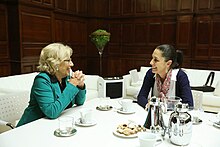 ](https://en.wikipedia.org/wiki/File:Madrid_y_Ciudad_de_M%C3%A9xico,_dispuestas_a_reforzar_su_mutua_colaboraci%C3%B3n_01.jpg)Madrid mayor Manuela Carmena meets with Sheinbaum at the Cibeles Palace.
Sheinbaum served as the Secretary of the Environment of Mexico City from 5 December 2000 to 15 May 2006, appointed on 20 November 2000 to the cabinet of the Head of Government of the Federal District, Andrés Manuel López Obrador.[31] During her term, which concluded in May 2006, she was responsible for constructing an electronic vehicle registration center for Mexico City.[26][32] She also oversaw the introduction of the Metrobús, a bus rapid transit system with dedicated lanes, and the construction of the second story of Mexico City's ring road, Anillo Periférico.[17]
López Obrador included Sheinbaum in his proposed cabinet for the Secretariat of Environment and Natural Resources as part of his campaign for the 2012 presidential election.[33] In 2014, she joined López Obrador's splinter movement, the National Regeneration Movement (Morena), which broke away from the mainstream left-wing party, the Party of the Democratic Revolution.[24]
Mayor of Tlalpan
In the 2015 Federal District local elections, Sheinbaum was nominated by the National Regeneration Movement (Morena) for the mayorship of Tlalpan.[34] She campaigned on a platform focused on improving public services and public spaces, reducing corruption, and implementing social programs for women and young adults.[35] She won with 29.48% of the vote, flipping the borough from the Party of the Democratic Revolution (PRD), which had governed the borough since 2000.
On 5 December 2017, Sheinbaum resigned to run for Head of Government of Mexico City as a candidate for the Juntos Haremos Historia coalition (lit.'Together We Will Make History'), composed of Morena, the Labor Party (PT), and the Social Encounter Party (PES).[36][37]
Chapel demolition
On 29 April 2016, city staff were ordered to demolish a wall that had been built illegally adjacent to a chapel (Capilla del Señor de los Trabajos) in Tlalpan's Cultura Maya neighborhood.[38][39] The workers instructed to demolish the wall also destroyed part of the chapel's structure, including its sheet metal roof, and removed religious images.[40] Juan Guillermo Blandón Pérez, the parish priest, alleged that Sheinbaum was responsible for demolishing the chapel and claimed that it was carried out without prior notification.[41]
Days after the chapel's demolition, borough authorities acknowledged their error.[42] Sheinbaum met with church representatives and proposed dividing the property in half to build a new chapel and a community art center.[40]
Enrique Rébsamen School collapse
 Earthquake damage to the Enrique Rébsamen School
The Colegio Enrique Rébsamen, a private school in Tlalpan, collapsed during the 2017 Puebla earthquake, killing 19 children and seven adults. In September 2016, the city's Institute for Administrative Verification had ruled that the school's building infringed zoning regulations and was built higher than was allowed and that the owner, Mónica García Villegas, had presented falsified documents.[43][44] Sheinbaum faced criticism for not providing a complete account of the permits for the school's land use, construction, and operation.[45] Enrique Fuentes, a lawyer representing the deceased children's parents, stated that the mayor had an obligation to take action but had failed to do so, allowing the school to continue operating.[43]
2018 campaign for the Head of Government of Mexico City
 Election results by borough in the 2018 election for the Head of Government of Mexico City
In August 2017, Sheinbaum participated in a poll by the National Regeneration Movement to determine the party's candidate for the Head of Government of Mexico City.[46] The other contenders were Martí Batres, Mario Delgado, and Ricardo Monreal. Sheinbaum secured first place with 15.9% of the vote, beating her closest opponent, Batres, by 5.8 points.[47][48] On 5 December 2017, Sheinbaum stepped down as mayor of Tlalpan to register her pre-candidacy.[49]
At her campaign launch on 1 April 2018, Sheinbaum prioritized fighting crime, stating that she would hold regular public hearings, publish reported crime statistics, and rely on the Security Council for guidance. She committed to generating 1 million jobs during her term, maintaining the universal pension for seniors, and expanding the Mexico City Metrobús system to connect the city's outskirts with the center.[6][50]
During the campaign period, Sheinbaum was accused by members of Por México al Frente of being culpable for the collapse of the Colegio Enrique Rébsamen, a private school in Tlalpan, during the 2017 Puebla earthquake.[51]
On 1 July 2018, Sheinbaum was elected to a six-year term as the Head of Government of Mexico City with 47.08% of the vote, defeating six other candidates.[52]
Head of Government of Mexico City (2018–2023)
 After taking charge as head of government, Claudia Sheinbaum went to the Teatro de la Ciudad to present her cabinet.
 Sheinbaum with president Andrés Manuel López Obrador in late 2019
On 5 December 2018, Sheinbaum was inaugurated as Mexico City's head of government. She became the first female head of government and the first to come from a Jewish background.[3][13][24]
Sheinbaum's administration was characterized by a strong relationship with the federal government and President López Obrador. However, she took distinct approaches to certain issues, such as managing the COVID-19 pandemic, where her scientific background shaped the city's response to the crisis.[53]
Sheinbaum stepped down on 16 June 2023 to contend with the internal selection process for a presidential candidate for the Morena-led coalition, Juntos Hacemos Historia. Sheinbaum recommended Martí Batres as substitute head of government,[54] a choice later ratified by the Congress of Mexico City.[55]
...
Environment
In June 2019, Sheinbaum announced a new six-year environmental plan to reduce air pollution by 30%, plant 15 million trees, ban single-use plastics and promote recycling, build a new waste separation plant, provide water service to every home, construct 100 kilometers of trolleybus and metrobús-only corridors, and construct and install solar panels and water heaters.[80]
Infrastructure
Public transportation
Sheinbaum introduced the Cablebús cable car system, becoming a new form of public transportation for the city. Construction on Lines 1 and 2 started in 2019, and both lines were inaugurated in 2021.[81][82] Line 3 was proposed by Sheinbaum in 2021, and construction began that same year.[82]
Sheinbaum continued the expansion of Line 12 towards the Observatorio metro station, a project initiated by the previous administration. In 2022, she started the modernization of Mexico City Metro Line 1 with a MX$37 billion investment, temporarily closing portions of the line to replace tracks, acquire new trains, and implement a new control system.[83][84] The Observatorio station was also closed to transform it into a mega terminal, connecting Metro Lines 1, 12, and El Insurgente.[85]
Sheinbaum expanded the Metrobús network by 33 kilometers across three of its lines.[82] She also introduced electric buses to the system, making Line 3 entirely electric,[86] and purchased low-emission vehicles for the city's Red de Transporte de Pasajeros.[82]
The use of bicycles was promoted through the construction of 200 kilometers of bike lanes, primarily on the city's outskirts, along with six bike stations and the acquisition of 2,500 new bicycles for the Ecobici system.[82]
Sheinbaum introduced a single mobility card for all public transportation systems.[87][88]
Roads and highways
Sheinbaum announced the construction of vehicular bridges to improve road connectivity. Three notable projects included the Cuemanco Bridge, which connected Periférico Oriente with Canal Nacional; a new junction linking Circuito Interior with Eje 6; and Las Adelitas Bridge, which connected Circuito Interior with Gran Canal.[89]
Criticism
Sheinbaum faced criticism for the management of the budget allocated to public transportation. Although she claimed that there were no cuts and that resources for the Metro were increased, budget data showed fluctuations in the allocation of funds for different transportation systems between 2018 and 2023.[90]
Other infrastructure projects, such as the renovation of Mexico City Metro Line 1, the extension of Mexico City Metro Line 12 to Observatorio, the construction of the Mexico-Toluca Interurban Train, and Line 3 of the Cablebús, remained incomplete at the time of her resignation to seek her party's presidential nomination.[91]
Social issues
In 2019, Sheinbaum implemented a gender-neutral uniform policy for students in state-run schools, allowing them to wear uniforms of their choice regardless of gender.[92] In 2021, Sheinbaum removed a statue of Christopher Columbus from Mexico City's Paseo de la Reforma as part of what she called a "decolonization" exercise.[93][94][95]
Crisis management
COVID-19 pandemic response
 Sheinbaum wearing a face mask during the COVID-19 pandemic on 12 August 2021
Shortly after the first COVID-19 case in Mexico City was confirmed on 28 February 2020, Sheinbaum addressed the city, emphasizing that although the risk was low, the population needed to stay informed through official sources.[96] On 19 March, Sheinbaum urged residents to stay at home to prevent the spread of infection. She also advised those with symptoms to text a hotline for guidance instead of going to hospitals to avoid overwhelming the healthcare system.[97] On 22 March, Sheinbaum announced the closure of commercial establishments, cultural venues, sports facilities, and religious spaces.[98]
López Obrador and Sheinbaum had differing views on using face masks: Sheinbaum encouraged Mexico City residents to wear face masks, while López Obrador frequently did not wear them in public.[99]
Sheinbaum was nominated by the City Mayors Foundation for the World Mayor Prize in 2021 in North America for her handling of the COVID-19 pandemic in Mexico.[100]
Collapse of Line 12 of the Mexico City Metro
Main article: Mexico City Metro overpass collapse
 Investigators at the collapse site
At around 10:22 p.m. on 3 May 2021, several girders, part of the tracks, and two wagons of Line 12 of the Mexico City Metro collapsed between the Olivos and Tezonco stations. The casualties were 26 dead, 80 injured, and five missing. Line 12 of the Metro was inaugurated on 30 October 2012 by the head of government of Mexico City, Marcelo Ebrard, and the president of Mexico, Felipe Calderón.[101]
Engineering flaws that had existed since before the line's inauguration became worse over time, necessitating maintenance repairs over the next three years, including an unprecedented closure of the line to re-shape some sections of tracks and to replace the rails; most of these improvements were carried out during the term of Miguel Ángel Mancera as Head of Government. On 4 May 2021, Ebrard, then serving as Secretary of Foreign Affairs, said that the work was definitively delivered in July 2013, after reviews carried out for seven months, and expressed his willingness to respond and collaborate in the event of any request from the authorities.[102]
Det Norske Veritas (DNV), a Norwegian company in charge of investigating the causes of the collapse of Metro Line 12, detected that one of the beams that collapsed already had structural failures since before the earthquake of 19 September 2017, a factor that had caused problems in the elevated section of the line that collapsed.[103] On 28 June 2021, Sheinbaum dismissed the general director of the Mexico City Metro, Florencia Serranía Soto [es].[104]
Some critics[who?] said Sheinbaum and other leaders should have worked harder to improve the Metro's infrastructure. Some political observers suggested that the political fallout from the disaster could harm Sheinbaum's candidacy in the 2024 presidential election.[105][106] Alejo Sánchez Cano, editor of the Mexico City daily newspaper El Financiero, opined that Sheinbaum's responsibility was unavoidable, stating that after having been in office for two and a half years, she failed to maintain the Metro system.[107]
2024 presidential campaign
Nomination
 Sheinbaum receiving a certificate confirming her as the presidential nominee for Sigamos Haciendo Historia on 19 November 2023
On 12 June 2023, Sheinbaum announced that she would resign as head of government of Mexico City on 16 June to contend in the internal selection process to select a de facto presidential candidate for Juntos Hacemos Historia, a coalition encompassing Morena, the Labor Party, and the Ecologist Green Party of Mexico.[108][109][110] Speculation regarding her nationality emerged after former president Vicente Fox referred to her as a "Bulgarian Jew". In response, Sheinbaum released her birth certificate, showing she was born in Mexico City.[111]
The coalition's internal process consisted of five polls from 28 August to 4 September. On 6 September, Sheinbaum was declared the winner, securing 39.38% of the vote and defeating her closest opponent, former foreign secretary Marcelo Ebrard, by around 13 points.[7] On 19 November 2023, Sheinbaum registered as the sole precandidate of Sigamos Haciendo Historia, the successor coalition to Juntos Hacemos Historia.[112] Sheinbaum formally registered her candidacy at the National Electoral Institute (INE) on 18 February 2024.[113]
General election
Main article: 2024 Mexican general election
 Sheinbaum at the start of her campaign in the Zócalo of Mexico City on 1 March 2024
On 1 March 2024, Sheinbaum launched her campaign at the Zócalo, outlining her proposals and emphasizing her commitment to continuing President López Obrador's Fourth Transformation policies.[114] She pledged to pass "Plan C," a package of eighteen constitutional amendments proposed by López Obrador earlier that year, which include increasing the minimum wage above inflation, elevating social programs to constitutional law, and electing judiciary members by popular vote.[115][116] She also proposed replicating her Mexico City security strategy nationwide, introducing a constitutional amendment to prevent reelection for any popularly elected position, and implementing new social programs for students from preschool to secondary education and women aged 60 to 64.[117]
During debates and the campaign, Sheinbaum was accused by Xóchitl Gálvez, the candidate from the opposition coalition Fuerza y Corazón por México, of being responsible for the collapse of the Colegio Rébsamen during the 2017 Puebla earthquake, the Mexico City Metro overpass collapse, and the excess deaths during the COVID-19 pandemic in Mexico City.[118]
 Sheinbaum during her victory speech on 2 June 2024
Polls consistently indicated that Sheinbaum held a substantial lead over her main opponent, Xóchitl Gálvez.[119] During the three presidential debates, many commentators praised her calm demeanor during provocations from Gálvez.[120][121]
The election took place on 2 June 2024, with Sheinbaum being projected the winner by the INE's quick count at 11:50 CST, making her the virtual president-elect.[122] On 6 June, district tallies confirmed that Sheinbaum won a landslide victory.[123] She received the highest number of votes ever recorded for a candidate in Mexican history, carried 31 out of 32 states, and achieved the highest vote percentage since free and fair elections began in Mexico.[124]
Presidential transition
 Sheinbaum during an event to celebrate her declaration as president-elect of Mexico on 15 August 2024
Following her victory, Sheinbaum met with President López Obrador to outline the presidential transition and her legislative agenda for the early months of her administration.[125] She detailed that her priorities included new social programs for primary school students and women aged 60 to 64, modifications to the pension system for government employees, and a ban on reelection for any popularly elected position.[126] While Sheinbaum voiced support for López Obrador's judicial reform, she agreed to open nine discussion forums to address its most controversial aspects.[127][128]
Sheinbaum rolled out her cabinet appointments in phases, beginning with the first announcements on 20 June.[129] In early August, she met with governors and governors-elect to outline key projects for her 2025 budget.[130][131] Sheinbaum also pledged to continue López Obrador's morning press conferences, known as mañaneras, at 7:00 AM CST.[132]
After the LXVI Legislature was sworn in on 1 September, several of her campaign promises that stemmed from López Obrador's "Plan C" were either fully or partially passed by Congress. The judicial reform and the transfer of the National Guard to the Secretariat of National Defense were passed by both chambers,[133][134] while the increases in the minimum wage above inflation and the elevation of certain social programs to constitutional status were approved solely by the Chamber of Deputies.[135][136]
Presidency (2024–present)
Main article: Presidency of Claudia Sheinbaum
Inauguration
[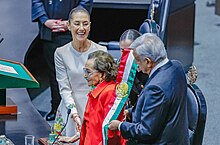 ](https://en.wikipedia.org/wiki/File:01.10.2024_-_Cerim%C3%B4nia_de_transmiss%C3%A3o_do_Poder_Executivo_Federal_%2854034977462%29.jpg)Andrés Manuel López Obrador hands the presidential sash to Ifigenia Martínez, who then presents it to Sheinbaum during her inauguration on 1 October 2024.
Sheinbaum was sworn in as president on 1 October 2024, becoming the first woman, as well as the first person of predominantly Jewish heritage,[b] to hold the office.[138][139][140] The presidential sash was handed to her by Ifigenia Martínez, the president of the Congress of the Union and a prominent figure for the Mexican left.[141][142] In her address to Congress, Sheinbaum thanked her predecessor, highlighted her historic election as the first woman to the presidency, pledged responsible fiscal policies, and reassured foreign investors.[143]
Her inauguration was attended by 105 representatives from various countries, including 16 heads of state and 23 delegates from international organizations.[144] Notable attendees included Brazilian President Lula da Silva, Chilean President Gabriel Boric, Colombian President Gustavo Petro, former German President Christian Wulff, and US First Lady Jill Biden.[145] King Felipe VI of Spain was controversially not invited, with Sheinbaum citing his failure to respond to López Obrador's 2019 letter requesting an apology for the abuses committed during the Spanish conquest.[146][147] This prompted a boycott by the Spanish government.[148]
Domestic policy
 Sheinbaum during a morning press briefing on 11 October 2024
Sheinbaum continued her predecessor's practice of holding "mañaneras", regular press briefings in the morning.[149]
On 2 October 2024, the anniversary of the Tlatelolco massacre, Sheinbaum issued a decree acknowledging the State's responsibility for the killings.[150] The decree included a public apology, which was delivered by Secretary of the Interior Rosa Icela Rodríguez.[151][152]
Crime and the drug war
Sheinbaum announced a data-driven strategy to combat crime, focusing on improved policing, intelligence, and addressing root causes through increased social spending, mirroring her approach as Head of Government of Mexico City.[153][154] She appointed Omar García Harfuch to head the Secretariat of Security and Civilian Protection's (SSCP), a role he previously held in her Mexico City cabinet, where he was credited with halving the city's homicide rate.[155] On 31 December 2024, she published a bill that expanded the SSCP's powers, enabling greater collaboration with the Attorney General's Office and improving intelligence gathering across all levels of government.[156][157]
During her first weeks in office, Sheinbaum's administration adopted a more hard-handed approach toward organized crime, marking a departure from Andrés Manuel López Obrador's "hugs, not bullets" strategy.[158][159][160] Confrontations between government forces and organized crime increased, resulting in the capture of high-ranking cartel figures but occasionally causing accidental civilian casualties.[158] Sheinbaum defended operations with lopsided death tolls, such as a shootout where the military remained unharmed while killing 19 cartel members, as acts of self-defense.[161][162] By her first 100 days in office, the government reported the arrest of 7,720 individuals, the seizure of 66 tons of drugs, and the dismantling of 115 methamphetamine laboratories.[163]
In response to infighting within the Sinaloa Cartel, Sheinbaum dispatched a task force composed of Mexican Army soldiers, National Guard members, and agents from the National Intelligence Center to address the violence.[164][165] She also launched a nationwide gun buyback program called Sí al Desarme, Sí a la Paz (lit.'Yes to Disarmament, Yes to Peace'), similar to her approach in Mexico City.[166]
Energy
On 30 October 2024, Sheinbaum published a constitutional amendment reestablishing the Federal Electricity Commission (CFE) and Pemex as public entities, effectively reversing much of the 2013 energy reform. The amendment mandates that the CFE maintain a 54% share of electricity generation, with the remaining 46% managed by private companies under regulated conditions to prioritize public needs over profit.[167]
Government reform
Amidst the release of a Supreme Court draft opinion proposing to partially overturn the judicial reform bill passed by Andrés Manuel López Obrador in his final weeks as president, Sheinbaum asserted that the judicial branch lacked authority over constitutional amendments.[168][169] In response, on 31 October 2024, she published a bill enshrining constitutional supremacy, limiting legal challenges to constitutional amendments strictly to procedural grounds.[170]
On 20 December 2024, Sheinbaum signed a bill that dissolved autonomous bodies overseeing telecommunications, economic competition, and transparency, as part of an effort to simplify government functions.[171] This followed an earlier bill she signed that restructured several cabinet positions to absorb the responsibilities of these entities.[172][173] Among these changes, the Secretariat of the Civil Service was transformed into the Secretariat of Anticorruption and Good Governance, taking over the duties and authority of the National Institute of Transparency for Access to Information and Personal Data Protection (INAI). Three new cabinet positions were also added: the Secretariat of Women (replacing the National Institute for Women [es]), the Secretariat of Science, Humanities, Technology, and Innovation (replacing CONAHCYT), and the Digital Transformation and Telecommunications Agency.
Infrastructure and passenger rail
Sheinbaum committed to further expanding Mexico's passenger rail network,[174] publishing a constitutional amendment that restored the Mexican State's authority to use railway lines for passenger transport services.[175] In late 2024, she inaugurated the final sections of the Tren Maya and announced plans to integrate freight services into the train's operations while extending the network toward Progreso, Yucatán.[176][177][178] She also outlined her goal to construct approximately 3,000 kilometers of railroad, comprising the Mexico–Pachuca, Mexico–Nuevo Laredo, and Mexico–Nogales lines, to be completed in four phases.[179]
In 2024, Sheinbaum announced a MX$33 billion investment to modernize six ports across Mexico: Ensenada, Baja California; Manzanillo, Colima; Lázaro Cárdenas, Michoacán; Acapulco, Guerrero; Veracruz, Veracruz; and Progreso, Yucatán.[180]
Sheinbaum has continued her predecessor's practice of employing SEDENA's Military Engineers Corps. to build government infrastructure projects.[181]
Welfare
During the early months of her tenure, Sheinbaum introduced the Women's Wellbeing Pension (Pensión Mujeres Bienestar), providing bimonthly financial assistance to senior women aged 60 to 64,[182][183][184] and launched the House to House Health (Salud Casa a Casa) program, offering medical care to the elderly and people with disabilities.[185] She also renamed the Benito Juárez Scholarship (Beca Benito Juárez) to the Rita Cetina Gutiérrez Universal Scholarship (Beca Universal Rita Cetina Gutiérrez), expanding it to provide bimonthly financial aid to all families with children enrolled in the public basic educational system.[186] On 2 December 2024, Sheinbaum elevated several social programs to constitutional law.[187]
On 22 October 2024, Sheinbaum announced the fusion of SEGALMEX and DICONSA into Food for Wellbeing (Alimentación para el Bienestar) to support small local producers, offer quality products at affordable prices, and contribute to food self-sufficiency.[188] With the fusion, the over 24,500 DICONSA stores, present in 90% of the municipalities of the country, will be reorganized, rehabilitated, and rebranded to Wellbeing Stores to Generate Happiness (Tiendas del Bienestar para Generar Felicidad).[189]
Foreign policy
 Sheinbaum and US President Joe Biden in November 2024[
 ](https://en.wikipedia.org/wiki/File:R%C3%ADo_de_Janeiro_Reuni%C3%B3n_de_Jefes_de_Estados_de_Colombia,_Brasil,_M%C3%A9xico_y_Chile.jpg)Sheinbaum with Colombian President Gustavo Petro, Brazilian President Luiz Inácio Lula da Silva and Chilean President Gabriel Boric in November 2024
In November 2024, Sheinbaum took her first trip abroad as president to attend the G20 summit. At the summit, she proposed allocating 1% of global military spending to reforestation efforts and advocated for expanding the United Nations Security Council to include seats for Africa, Latin America, the Caribbean, and small island nations.[190][191] Sheinbaum also held bilateral meetings with U.S. President Joe Biden, Canadian Prime Minister Justin Trudeau, Chinese President Xi Jinping, French President Emmanuel Macron, and the leaders of MIKTA member states.[192]
Israel–Palestine conflict
On 12 October 2024, Sheinbaum expressed support for the two-state solution in the ongoing Israel–Palestine conflict, emphasising that recognising both Israel and Palestine was necessary for achieving peace in the Middle East. She also condemned the October 7 Hamas-led attack on Israel, the subsequent violence against Gaza, and other acts of aggression in the region. Like her predecessor, Sheinbaum maintained a stance of neutrality, calling for a more proactive role from the United Nations.[193][194]
United States
In October 2024, diplomatic relations with the U.S. ambassador to Mexico, Ken Salazar, resumed, which had been suspended due to U.S. criticism of Mexico's judicial reforms.[195] Sheinbaum outlined new diplomatic protocols requiring Salazar to communicate with the Secretariat of Foreign Affairs to engage with the federal government, noting that previously, the ambassador had spoken directly with members of the Mexican cabinet.[196][197]
On 6 November 2024, Sheinbaum congratulated Donald Trump on his victory in the 2024 United States presidential election.[198] Following Trump's threats of a 25% tariff on Mexican imports, she sent him a letter warning that "one tariff will follow another in response and so on, until we put our common businesses at risk."[199][200][201] She also repeatedly raised concerns over the flow of firearms from the United States to criminal groups in Mexico, citing a U.S. Department of Justice report that found 74% of firearms used by cartels originated in the United States.[202] On 1 February 2025, following Trump’s executive order implementing the tariffs, Sheinbaum threatened both tariff and non-tariff retaliation.[203] Two days later, the two leaders reached an agreement to suspend the tariffs for one month, with Sheinbaum committing to deploy 10,000 National Guard troops to the border and Trump pledging to take action against weapons trafficking to Mexico.[204][205]
Political views
Social issues
Sheinbaum is a self-described feminist, aligning her beliefs and actions with the principles of gender equality and women's rights.[206] She advocates for the legalization of abortion, aligning her stance with broader movements aimed at promoting reproductive rights and autonomy for women.[207] During her leadership in Mexico City, Sheinbaum implemented a gender-neutral policy regarding school uniforms in state-run schools and championed LGBT rights.[208] In 2022, she became the first Head of Government of Mexico City to attend the city's gay pride march.[209]
Economy
Sheinbaum has criticized the neoliberal economic policies of past presidents of Mexico, arguing that they have contributed to inequality in the country.[210] She has promised to expand welfare under her presidency[211] and intends to continue programs started by López Obrador, such as universal pension.[212]
Environment
Sheinbaum has a background in environmental policy, having served as Minister of the Environment for Mexico City and worked on the Intergovernmental Panel on Climate Change (IPCC),[213] which would go on to win the panel a Nobel Peace Prize.[214] In her tenure as Minister of the Environment, she saw a marked reduction in air pollution and created community ecological reserves.[215] She has both spoken in favor of clean energy and support of oil, praising PEMEX (the nation's state-owned oil company).[216]
Personal life
In 1986, Sheinbaum met Carlos Ímaz Gispert, who later became a prominent political figure in the PRD during his tenure at Stanford University. They married in 1987 and divorced in 2016.[217] They have a daughter, Mariana Ímaz Sheinbaum,[217] born in 1988. Through the marriage, Sheinbaum became the stepmother to Ímaz's son from a previous marriage, Rodrigo Ímaz,[217] whom she raised.[218]
In 2016, she began dating Jesús María Tarriba Unger, a financial risk analyst for the Bank of Mexico, whom she had known as a university student.[219][217] In November 2023, Sheinbaum announced her marriage to Tarriba via social media.[219] The two married in a small civil ceremony.[217]
Awards and honours
mex and cda retaliate
AN 2 25
NO LNX
On Monday afternoon, February 3 — two weeks after President Donald Trump started his nonconsecutive second term — he spoke to reporters inside the White House. And Trump forcefully defended his new tariffs, which include 25 percent across-the-board tariffs on any goods coming into the United States from Canada or Mexico. For goods coming from Mainland China, Trump imposed a 10 percent tariff.
Following the press conference, CNN's Daniel Dale gave Trump a comprehensive fact-check — pointing out Trump's ability to build on his own exaggerations and false claims.
Dale told CNN hosts Brianna Keilar and Boris Sanchez, "There's a concept I think of as Trumpflation, where he makes a false claim — and then, it keeps getting falser and falser over time. The numbers keep rising."
READ MORE: 'Congratulations, America!' Trump mocked over his response to WSJ’s scathing tariff rebuke
Sanchez noted that Trump previously claimed that the United States, under former President Joe Biden, was sending $50 million to Gaza to buy condoms for members of Hamas — a number Trump increased to $100 million during the presser.
Sanchez told Dale and Keilar, "Trump actually exaggerated his own made-up, exaggerated claim during this. He doubled it." And Keilar added that the $100 million figure "is doubly incorrect."
Dale, during the fact-check, pushed back against Trump's claim that Canada and the European Union (EU) aren't buying as many U.S. exports as they should be buying.
Dale told his CNN colleagues, "He said, when talking about Canada: They don't take our agricultural products, for the most part. In fact, Canada is the third largest export market for U.S. agriculture: about $28 billion in purchases in 2023. There is a dispute about milk exports that he referred to, but in terms of agriculture as a whole, it's not true."
READ MORE: Donald Trump’s tariff wallop demonstrates the brute power of an imperial presidency
Dale continued, "He said that the European Union doesn't take our farm products. The European Union is the fourth largest export market, about 12 billion per year. He said we have about a $350 billion trade deficit with the EU — another gross exaggeration. It's about 125 billion. And he repeated this claim about aid to Ukraine that he repeatedly makes: He said that the EU provides way less aid to Ukraine than the U.S. does — they need to catch up and so on. In fact, according to the latest numbers we have, the EU has committed about double the aid to Ukraine during this war than the U.S. has."
READ MORE: 'Big government populist demagogue': Right-wingers slam Trump tariffs as markets plummet