Mexico
hit pretty hard covid
FEMALE PREZ AND CDA TRUDEAU SLAP BACK?
AN 2 25
NO LNX
On Monday afternoon, February 3 — two weeks after President Donald Trump started his nonconsecutive second term — he spoke to reporters inside the White House. And Trump forcefully defended his new tariffs, which include 25 percent across-the-board tariffs on any goods coming into the United States from Canada or Mexico. For goods coming from Mainland China, Trump imposed a 10 percent tariff.
Following the press conference, CNN's Daniel Dale gave Trump a comprehensive fact-check — pointing out Trump's ability to build on his own exaggerations and false claims.
Dale told CNN hosts Brianna Keilar and Boris Sanchez, "There's a concept I think of as Trumpflation, where he makes a false claim — and then, it keeps getting falser and falser over time. The numbers keep rising."
READ MORE: 'Congratulations, America!' Trump mocked over his response to WSJ’s scathing tariff rebuke
Sanchez noted that Trump previously claimed that the United States, under former President Joe Biden, was sending $50 million to Gaza to buy condoms for members of Hamas — a number Trump increased to $100 million during the presser.
Sanchez told Dale and Keilar, "Trump actually exaggerated his own made-up, exaggerated claim during this. He doubled it." And Keilar added that the $100 million figure "is doubly incorrect."
Dale, during the fact-check, pushed back against Trump's claim that Canada and the European Union (EU) aren't buying as many U.S. exports as they should be buying.
Dale told his CNN colleagues, "He said, when talking about Canada: They don't take our agricultural products, for the most part. In fact, Canada is the third largest export market for U.S. agriculture: about $28 billion in purchases in 2023. There is a dispute about milk exports that he referred to, but in terms of agriculture as a whole, it's not true."
READ MORE: Donald Trump’s tariff wallop demonstrates the brute power of an imperial presidency
Dale continued, "He said that the European Union doesn't take our farm products. The European Union is the fourth largest export market, about 12 billion per year. He said we have about a $350 billion trade deficit with the EU — another gross exaggeration. It's about 125 billion. And he repeated this claim about aid to Ukraine that he repeatedly makes: He said that the EU provides way less aid to Ukraine than the U.S. does — they need to catch up and so on. In fact, according to the latest numbers we have, the EU has committed about double the aid to Ukraine during this war than the U.S. has."
READ MORE: 'Big government populist demagogue': Right-wingers slam Trump tariffs as markets plummet
ICN 10 23
Under a 1944 treaty, Mexico must share water from the Rio Conchos and other tributaries of the Rio Grande with the United States in five-year cycles.
With the clock ticking toward an inexorable treaty deadline, the U.S. and Mexico are under pressure to find a solution without setting off a local rebellion. And climate change and drought, not to mention provocations from Texas politicians, are complicating the challenge.
Many in Chihuahua state are pleading with the Mexican federal government to find another way to comply with the treaty while saving the reservoir water for local farmers.
The government “should take a close look at the situation, at why farmers are opposed to them taking the water,” said Jaime Ramírez Carrasco, municipal president of the town of San Francisco de Conchos, an hour’s drive south of Delicias. “We can’t let life in our region be extinguished just to give life to another region.”
More of our coverage of the biggest story on the planet:
The U.S. Fish and Wildlife Service will consider tightening protections on the West Indian manatee after concluding that a petition demanding that the animal’s endangered status be restored presented substantial scientific evidence.
September’s stunning rise of the average global temperature is all but certain to make 2023 the warmest year on record, and 2024 is likely to be even hotter.
Solar projects are surging nationwide. But keeping solar cells out of the dump requires a market for recycled solar materials that is much more robust than what currently exists.
Tensions Rise in the Rio Grande Basin as Mexico Lags in Water Deliveries to the U.S.
BY MARTHA PSKOWSKI, INSIDE CLIMATE NEWS, AND PHOTOS BY OMAR ORNELAS, EL PASO TIMES
In 2020, rebellious Mexican farmers occupied a dam in parched Chihuahua state to prevent the federal government from sending its reservoir water to Texas under a 1944 treaty. With the clock ticking toward another treaty deadline, the two sides are struggling for a solution.
mma 5 23
JESSE WATTERS (HOST): So, what do you call it when a foreign power interferes in our election? Well, we used to call that election interference. Democrats used to be totally against it. They said Putin cost crooked the election. Well, now the Mexican president's on tape politicking against a Republican presidential candidate, urging Americans not to vote for him, and the media is silent.
So, what's the relationship here between Joe Biden and the Mexican president? Well, Joe Biden made the cartels more money than they've ever made in history. And the Mexican president, who's controlled by the cartels, interferes in our election on behalf of Biden. Hm. And Hunter got rich in Mexico when Biden was VP.
https://www.bbc.com/news/science-environment-58508001
no lnx pix
Record number of environmental activists murdered
By Claire Marshall
BBC Environment & Rural Affairs Correspondent
Published 13 September
image captionSouth African environmental activist Fikile Ntshangase was shot dead in her own home
A record number of activists working to protect the environment and land rights were murdered last year, according to a report by a campaign group.
227 people were killed around the world in 2020, the highest number recorded for a second consecutive year, the report from Global Witness said.
Almost a third of the murders were reportedly linked to resource exploitation - logging, mining, large-scale agribusiness, hydroelectric dams and other infrastructure.
The report called the victims "environmental defenders" killed for protecting natural resources that need to be preserved, including forests, water supplies and oceans.
Since the Paris Agreement on climate change was signed in 2015, the organisation says on average four activists have been killed each week.
It said this "shocking figure" was likely to be an underestimate because of growing restrictions on journalists and other civic freedoms.
Logging was the industry linked to the most murders with 23 cases - with attacks in Brazil, Nicaragua, Peru and the Philippines.
Indigenous peoples, most often on the frontline of climate change, accounted for a further one third of cases. Colombia had the highest recorded attacks, with 65 people killed last year.
'Unbearably heavy burden'
A senior campaigner for Global Witness, Chris Madden, called on governments to "get serious about protecting defenders." He said companies must start "putting people and planet before profit' or he warned that "both climate breakdown and the killings" would continue.
"This dataset is another stark reminder that fighting the climate crisis carries an unbearably heavy burden for some, who risk their lives to save the forests, rivers and biospheres that are essential to counteract unsustainable global warming. This must stop''.
The organisation called on governments to formally recognise the human right to a safe, healthy and sustainable environment, and ensure commitments made at November's UN climate change conference, COP26, integrate human rights protections.
In response, COP26 president Alok Sharma told the BBC he had "prioritised meeting people on the front line of climate change," to ensure the voices of all are heard."
'Shot dead in her living room'
Those murdered includedSouth African Fikile Ntshangase, 65, who was involved in a legal dispute over the extension of an opencast mine operated by Tendele Coal near Somkhele in KwaZulu-Natal province. She was shot dead in her own living room.
Her daughter, Malungelo Xhakaza, 31, said her "mother's struggle lives on." She said: "To this day no arrests have been made in the investigation into my mother's murder. There has been no accountability. It seems to me that someone wants this mine expansion and the extraction to go ahead, no matter the cost."
Petmin Limited, which owns the Somkhele mine through its subsidiary Tendele Coal Mining, told Global Witness that it "acknowledges community tensions may have been a factor in Fikile's death." The company said it "strongly condemns any form of violence or intimidation" and has offered full co-operation with the police.
Óscar Eyraud Adams
image captionÓscar Eyraud was killed in his home in Mexico in 2020
The killings also included Óscar Eyraud Adams, who was murdered in Mexico in September 2020. He was working to help the indigenous Kumiai community in Baja California have better access to water.
Global Witness said activists still under threat included communities in Guapinol in Honduras, where dozens of people have been protesting against an iron oxide mining concession that was granted by the central government in a protected area. Campaigners believe the Guapinol river, a vital water source, is threatened. The organisation says "many community members remain incarcerated."
==
https://theconversation.com/tc-energys-name-change-rebooting-canadian-pipeline-empires-132295
Canada, the recent oil price crash has distracted attention from the controversial Coastal GasLink pipeline project. Buried in that dispute is the recent history of TC Energy, Coastal GasLink’s parent firm.
TransCanada changed its name to TC Energy just after the January 2019 Unist'ot'en stand-off between the RCMP and land defenders in support of a Coastal GasLink injunction. It was also within 10 days of the Unist’ot’en house group of the Wet'suwet'en First Nation alleging violations of their territorial rights at the UN Permanent Forum on Indigenous Peoples.
TC Energy’s name change also overlapped with the renegotiation of controversial TransCanada pipeline contracts in Mexico.
While TransCanada says the change would better represent its increasing activities in Mexico and the United States, it also distanced the firm from controversial projects, among them the Keystone XL project that aimed to expand the Keystone pipeline system in Canada and the U.S.
Keystone XL a flashpoint
Keystone XL has been a key target of global environmental activism against the oilsands and, for a time, resulted in Alberta oil being labelled the Earth’s most carbon-intensive and dirtiest fossil fuel. It also turned public attention to the violation of Indigenous territorial rights in which North American pipeline projects are mired.
[pix]
tC Energy now acknowledges that Keystone XL may never be built.
As opposition to Alberta’s oilsands, associated pipelines, environmental injustice and carbon emissions have ramped up in Canada over the past 15 years, so has North American production of natural gas for energy and export. In this shift, TC Energy’s role as a conduit for U.S. natural gas to Mexico is notable.
TC Energy’s name change also dissociates the firm from Canada. In Mexico and elsewhere in Latin America, Canada’s human rights reputation has plummeted due to violence associated with Canadian mining companies.
Negative image
Canada’s negative brand image in Latin America emerges from a long history of the Canadian government backing its extractive sector at home and abroad. TC Energy’s activities across North America are heavily financed by Canadian entities, including Export Development Canada, private banks and a network of influential board members who lobby the Canadian government for financial and diplomatic support.
Read more: The role of Canadian mining in the plight of Central American migrants
Mexicohad been a net exporter of hydrocarbons to the United States for three decades. But the U.S. shale-gas boom and Mexican energy reform shifted energy trade dramatically and helped foster Mexico’s increasing dependence on American natural gas.
:{
}:
The pattern is reminiscent of Mexico’s abrupt dependence on U.S. maize following the 1994 North American Free Trade Agreement (NAFTA). Mexico shifted from being self-sufficient in this food staple to becoming dependent on imports. The same process has transpired in hydrocarbons, compromising Mexican energy sovereignty.
:{
}:
The privatization of Mexico’s energy sector, which proceeded at a slow creep for decades and accelerated drastically in 2013, has been a flashpoint for protest throughout the country due to high fuel costs.
:{
}:
Helped AMLO get elected
:{
}:
It helped elect opposition leader Andrés Manuel López Obrador to the Mexican presidency in 2018 and factored into the renegotiation of NAFTA.
Read more: Why Mexico's historic elections may bring about big change
TC Energy is among the firms facilitating the growing American and Canadian involvement in the Mexican oil and gas sector. A TransCanada representative was the co-chair of the intergovernmental Canada-Mexico Partnership’s energy sub-committee in 2016.
:{
}:
While TransCanada described a welcoming environment when it shifted activities to Mexico, this has soured with increasing opposition, including Indigenous mobilization, against pipeline projects in Mexico.
:{
}:
Shared risks across the continent
:{
}:
Shortly after López Obrador’s election in 2018, but before he took office, TransCanada suspended pipeline projects in four states due to protests. López Obrador has renegotiated terms associated with various pipeline contracts, including TC Energy, reportedly saving Mexico US$4.5 billion dollars.
:{
}:
In both Canada and Mexico the ecological and financial risks of pipeline projects are shouldered by local residents and pension holders.
:{
}:
As Canadian investment in Mexico’s energy sector has increased, the global financial hazards of locked-in hydrocarbon consumption, which are risky given their financial implications for carbon mitigation measures, have also been more broadly distributed to Mexicans.
In northeastern British Columbia, earthquakes from natural gas fracking threaten dams and pose a risk to the area’s residents, according to the Canadian Centre for Policy Alternatives. The carbon emissions from the first phase of the LNG Canada project that would receive fracked gas via Coastal GasLink are estimated at 3.45 megatonnes per year.
This is a large portion of the province’s future emissions. British Columbia has said it would cut emissions by 80 per cent by 2050, to about 13 megatonnes.
The Coastal GasLink project also poses risks to those whose pensions finance the project if the project is unable to proceed.
In December, TC Energy sold a 65 per cent interest in Coastal GasLink to a consortium involving AIMCo (Alberta Investment Management Corp.) and KKR, a private U.S. financial company operating in partnership with the National Pension Service of Korea. AIMCo manages the funds that secure future income for more than 368,000 public sector employees and pensioners in Alberta and the rest of Canada.
Read more: Coastal GasLink and Canada's pension fund colonialism
In recent years, the inter-governmental Canada-Mexico Partnership has promoted Alberta’s approach to securing “right of way from Indigenous peoples to Mexico. This entails replicating the divisive model that industry has used to get consent from Indigenous peoples in Canada in Mexico.
Given TC Energy’s trajectory over the past decade this is problematic.
TC Energy’s behaviour in Wet'suwet'en has resulted in a nationwide crisis. The Canadian government and Canadian firms should not facilitate the export of those behaviours to Mexico.
tags: Indigenous
Mexico
Keystone XL pipeline
First Nations
Andrés Manuel López Obrador
Wet'suwet'en First Nation
TransCanada
Wet'suwet'en
Coastal GasLink
Alberta oilsands
https://www.alternet.org/2020/08/president-trump-is-the-child-trafficker-in-chief/
President Donald Trump thinks of himself as a champion against human trafficking. He addressed a White House Summit on the issue in January claiming there was a “humanitarian crisis” at the border fomented by criminal organizations and that “traffickers victimize countless women and children.” He signed an executive order and diverted $400 million in funding to combat the issue, boasting in his usual manner that “we have signed more legislation on human trafficking than any other administration has ever even thought about.” But in recent months, the administration has been found to be flouting the United States’ own anti-trafficking laws by deporting thousands of children and families seeking asylum, practically delivering them into the hands of traffickers across the border in Mexico.
Dr. Amy Cohen, executive director of Every Last One, explained to me in an interview that under the Trump administration’s so-called “Remain in Mexico” program, “the United States has been essentially feeding vulnerable migrant children and families to cartel traffickers in Mexico continuously.” The program, officially known by the Orwellian-sounding title of “Migrant Protection Protocols” (MPP), sends immigrants seeking entry into the United States across the border to Mexico to await the adjudication of their cases. While the Department of Homeland Security claimed that MPP would “decrease the… ability of smugglers and traffickers to prey on vulnerable populations,” in fact it does the opposite.
Cohen elaborated on this horrific phenomenon, saying, “migrants are dropped off with nothing on the other side of the border, with no shelter, with no protection, with no food, with no money. And within minutes, they are picked up by cartel gangs that are waiting.” As a child and family psychiatrist who works closely with traumatized migrant children, she did not mince words, saying that families are, “kidnapped and used for extortion, which is a form of trafficking. Sometimes they are tortured. Sometimes they are raped. Children are compelled to watch. Sometimes children themselves are raped.”
The only way to view the outcome of this policy is that the United States is actively participating in a trafficking operation. The Trump administration cannot claim ignorance of the outcome of MPP. According to Cohen, “This is happening in cities literally all along the border. This is not a secret; this is widespread.” So extensive is the abuse that according to her, “The vast majority of asylum seekers who we’ve placed into the MPP program have at one time or another experienced at least one, sometimes multiple, episodes of what I would consider trafficking, of kidnapping, and some form of psychological or physical torture."
because of the extreme danger that the Trump administration has put families in, according to Cohen it has “forced many parents into a decision” about whether to keep their children with them or send them unaccompanied across the U.S. border.
But under cover of the coronavirus pandemic, the federal government has accelerated the expulsion of even unaccompanied children to Mexico and Central America—in violation of federal law. The Associated Press explained that “More than 2,000 unaccompanied children have been expelled since March under an emergency declaration enacted by the Trump administration, which has cited the coronavirus in refusing to provide them protections under federal anti-trafficking and asylum laws.”
Now reports have emerged of the government hiring a private security and transportation firm to move immigrant families and children into hotels in the United States before expelling them. According to the New York Times, which broke the story, the Trump administration has created “a largely unregulated shadow system of detention and swift expulsions without the safeguards that are intended to protect the most vulnerable migrants.” Children, some as young as one year old, are being cared for in hotels like Best Western and Hampton Inn by private security personnel who have no childcare training.
Cohen says advocates like her believe that “this has been a way for the United States to try to hide a number of these children who they are deporting.” Those children held in government facilities have to be registered as having entered the United States, which then triggers legal protections for them. But by holding children in hotels, effectively off the books and out of public view, “government attorneys are denying that they are actually in the custody” of the Immigration and Customs Enforcement agency, says Cohen. Bizarrely, they are claiming that the children are in the custody of the Centers for Disease Control and Prevention (CDC) over concerns of COVID-19, and thereby flouting the legal mandate known as the Flores Settlement to maintain the safety, care, and oversight of the children.
Where the children end up once they are removed from the U.S. is not known, and the Customs and Border Protection (CBP) agency will not say. According to Reuters, “Between April and June, U.S. officials arrested more than 3,300 unaccompanied children on the southwest border, but CBP has declined to say how many have been expelled under the new process or give a breakdown of arrests by nationality for that time period.” During that same time frame, out of the thousands of children apprehended, only about 160 remain in U.S. custody.
It is ironic, to say the least, that some of Trump’s most loyal followers are conspiracy theorists who label themselves QAnon claiming that the president is facing off against a “cabal of Democratic pedophiles.” So mainstream is this movement that one of its followers just won a GOP congressional primary in Georgia. QAnon is now appropriating the social media hashtag #SaveTheChildren and promoting fantastical claims of a widespread child sex trafficking ring. Its followers have even joined the anti-trafficking movement in the United States. But they have entirely ignored the very real trafficking and exploitation of children at the U.S. border that their president has unleashed.
More than two years ago, then-Attorney General Jeff Sessions claimed that the government cared about children when he officially announced Trump’s “zero tolerance” policy, saying, “If you are smuggling a child, then we will prosecute you and that child will be separated from you as required by law.” It was a thinly veiled attempt to punish those fleeing poverty and violence for a better life in America. And while mass public outrage forced Trump to back off (he signed an executive order in June 2018 to end what his own discretionary policy initiated), in truth the torture and trauma facing immigrant families did not end. It was simply moved out of our view across the border into even more dangerous conditions.
As America hurtles toward November 3 with a desperation unlike any we’ve felt for previous presidential elections, the issue of how President Trump has treated immigrant families and children has been largely off the radar. But if we care about children and about protecting them from horrific torture and abuse, Trump’s role as Child-Trafficker-in-Chief ought to be central to our election discourse.
==
==
720 ew
https://www.ecowatch.com/china-swine-flu-2020-2646296386.html
https://www.ecowatch.com/china-swine-flu-2020-2646296386.html
Scientists in China have identified a strain of H1N1 that is rapidly spreading amongst workers in the country's pig farms. They warn that the fast spreading strain of swine flu has pandemic potential, if it is not contained quickly, according to The New York Times.
An outbreak of H1N1 caused widespread fear in 2009 when it killed 285,000 people around the world. The new strain is a derivative of H1N1, according to the scientists who published a paper on it on Monday in the scientific journal Proceedings of the National Academy of Sciences (PNAS).
The disease, which researchers called the G4 virus, now shows "all the essential hallmarks of a candidate pandemic virus," said the study, as CNN reported.
The researchers say that the disease is not yet an immediate problem, but they noted that pig farm workers also showed elevated levels of the virus in their blood, and that "close monitoring in human populations, especially the workers in the swine industry, should be urgently implemented," as Reuters reported.
Angela Rasmussen, a virologist at Columbia University's public health school, urged the public to remain calm and not "freak out," according to CNN.
"Our understanding of what is a potential pandemic influenza strain is limited," she posted on Twitter. "Sure, this virus meets a lot of the basic criteria but it's not for sure going to cause a hypothetical 2020 flu pandemic, or even be a dominant strain in humans."
Chinese researchers based at several institutions, including Shandong Agricultural University and the Chinese National Influenza Center, discovered the G4 virus during a pig surveillance program, according to CNN. Over a seven-year span, from 2011 to 2018, the researchers took more than 30,000 nasal swab samples from pigs in slaughterhouses and veterinary teaching hospitals across 10 Chinese provinces.
Those samples revealed 179 swine influenza viruses, but only a fraction of them posed any concern to the researchers, as several only showed up in a single year while others declined to non-threatening levels.
The strain in question though, G4 EA H1N1, has been common on China's pig farms since 2016 and replicates efficiently in human airways, according to the study. So far, it has infected some people without causing disease, but health experts worry that means the virus is lurking and mutating into something different and a sudden change can happen without warning, according to The New York Times.
Recent evidence "indicates that G4 EA H1N1 virus is a growing problem in pig farms, and the widespread circulation of G4 viruses in pigs inevitably increases their exposure to humans," the study said.
In the last three years of the study, researchers collected blood samples from workers on various pig farms and from people in nearby households. The study found that 10.4 percent of the workers and 4.4 percent of the others tested positive for G4 EA H1N1, and that 20.5 percent of workers between the ages of 18 and 35 tested positive for the virus, as The New York Times reported.
"It may be that with further change in the virus it could become more aggressive in people much as SARS-CoV-2 has done," said Ian H. Brown, the head of the virology department at Britain's Animal and Plant Health Agency and one of two scientists who reviewed the paper before it was published, in an email to The New York Times.
The good news is that there is no evidence yet that G4 could spread from person to person, the most promising sign so far, according to Carl Bergstrom, a professor of biology at the University of Washington who spoke to CNN.
"This is not a *new* new virus; it's been very common in pigs since 2016," he wrote on Twitter. "There's no evidence that G4 is circulating in humans, despite five years of extensive exposure. That's the key context to keep in mind."
Chinese Foreign Ministry spokesman Zhao Lijian told a daily news conference on Tuesday that China was closely following developments. "We will take all necessary measures to prevent the spread and outbreak of any virus," he said, as Reuters reported.
Whether or not the virus does spread in humans remains to be seen, but it is a reminder that our animal farming practices increase our susceptibility to animal diseases.
"Pig farming is a massive industry in China and pigs can be important hosts from which novel influenza viruses may emerge," said James Wood, head of veterinary medicine at the University of Cambridge, to CNN. He added that the study was a "salutary reminder that we are constantly at risk of new emergence of zoonotic pathogens and that farmed animals, with which humans have greater contact than with wildlife, may act as the source for important pandemic viruses."
- If Factory Farm Conditions Are Unhealthy for Animals, They're Bad ... ›
- Coronavirus Pandemic Linked to Destruction of Wildlife and World's ... ›
- Jane Goodall: COVID-19 Is Result of Our Unhealthy Relationship ... ›
- The meat we get from factory farms is a pandemic risk, too - Vox ›
- Special Report: Before coronavirus, China bungled swine epidemic ... ›
- Swine fever: 'Double punch' for countries facing COVID-19 threat ... ›
viruses public health pigs china science factory farming
==
ew 220
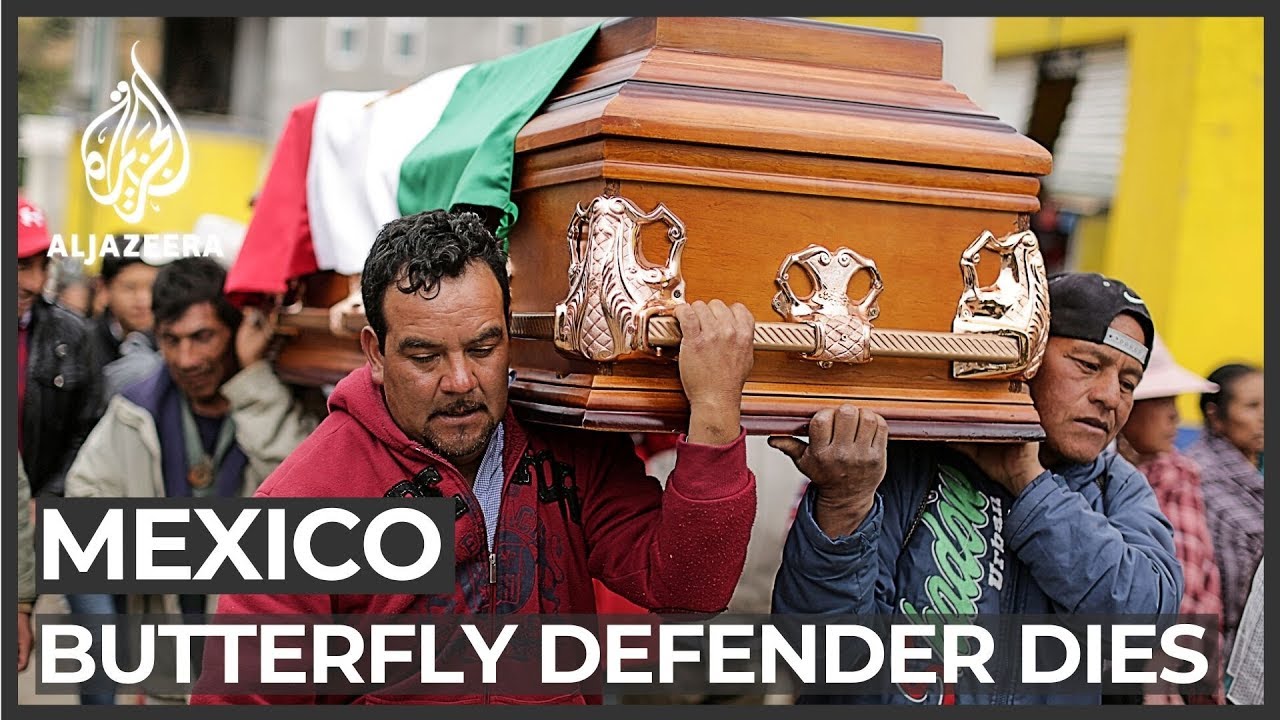
Two men connected to a famous monarch butterfly reserve in Mexico have been found dead within a week of each other, raising concerns for the safety of environmental activists in the country.
Homero Gómez González, 50, who managed a butterfly reserve in Mexico's Michoacán state and campaigned against illegal logging in the butterflies' winter habitat, was found dead in a well on Jan. 29, BBC News reported. Three days later, part-time reserve tour guide Raúl Hernández Romero, 44, was also found dead on top of a hill in the El Campanario monarch butterfly sanctuary.
"How can you protect the butterflies if Homero Gómez or other people are not protected?" poet and environmental activist Homero Aridjis asked NPR.
Gómez González managed the El Rosario sanctuary, which is part of the Monarch Butterfly Biosphere Reserve, a UNESCO World Heritage site. The site, located in forested mountains around 100 kilometers (approximately 62 miles) northwest of Mexico City, is where more than half of eastern monarch butterfly colonies spend their winters. The butterflies travel all the way to Canada each spring and then back again in the fall. Because four generations of butterflies are born and die during this time, it is unclear how they know to find their way back, but they do.
"Every autumn, millions, perhaps a billion, butterflies from wide areas of North America return to the site and cluster on small areas of the forest reserve, coloring its trees orange and literally bending their branches under their collective weight," UNESCO described.
But the butterflies' winter home is threatened by logging and the planting of avocado farms, according to NPR. Between 2005 and 2006, loggers felled 461 hectares in the area, The Washington Post reported.
Gómez González, a former logger himself, campaigned to protect the reserve and argued that tourism from the butterfly migration was worth more to the region than illegal logging. The El Rosario sanctuary he managed opened in November to help prevent logging, BBC News reported, and his family said he received threats before he disappeared Jan. 13.
His funeral on Friday was widely attended.
"I offer my condolences to Mr. Gómez González's family, his colleagues and all of those who, in Mexico and elsewhere, sometimes at the risk of their lives, work every day to protect this natural heritage which is shared by all of humanity," Director of the World Heritage Centre Mechtild Rössler said in a statement.
Gómez González was found to have received a blow to the head before drowning in a well, BBC News reported. His death was apparently not a robbery, since he was found with the equivalent of more than $500 in pesos, according to NPR.
Hernández Romero worked showing tourists around the El Rosario sanctuary, according to The Washington Post.
He was last seen Jan. 27 leaving his home, and then found dead Saturday after having been badly beaten with a sharp object.
Authorities are unclear if the deaths are connected to each other or to both men's work protecting the butterflies. However, The Guardian pointed out that there is a trend of environmental defenders being murdered in Mexico in conflicts with developers or criminal groups. Mexico's murder rate is also generally on the rise, BBC News reported. In 2019, the country saw its highest murder rate ever with 34,582 reported killed.
- Environmental Defender Murdered in Mexico Days Before Vote on ... ›
- Illegal Loggers Murder Amazon Forest Guardian - EcoWatch ›
- Homero Gómez González, Mexico's monarch butterfly defender ... ›
- Environmental Activists, Heroes, and Martyrs - Markkula Center for ... ›
- The Monarch Butterfly Crime: Who Murdered Homer Gomez and Why? ›
- 53 police investigated in disappearance of monarch butterfly activist ›
-
activismlogginginsectsanimalswildlifeconservation
==
dn 120
Mexican Butterfly Conservationist Found Dead
==
dn 120
Chinese Artist & Filmmaker Ai Weiwei on State Violence from Mexico to Hong Kong to Xinjiang
==
AN 28, 2020
Murder of Mexican Artist Isabel Cabanillas Highlights Endemic Issue of Femicide in Ciudad Juárez
==
trump threat mex if no action, including shut border 4/1/19; they are already warehousing ppl, in violation of US and int'l law?
https://www.alternet.org/2019/04/trump-accused-of-manufacturing-crisis-by-slashing-aid-to-el-salvador-honduras-and-guatemala/
In a move that was immediately denounced as “cruel” and counterproductive, the Trump State Department on Saturday confirmed that it is cutting off hundreds of millions of dollars in foreign aid to Honduras, Guatemala, and El Salvador.
“Cutting foreign aid to Central America is the absolute last thing the Trump administration should do right now,” Vicki Gass, senior policy advisor for Central America and Mexico with Oxfam America, said in a statement. “Not only is it morally wrong, it also counters efforts to address the root causes behind migration.”
“Aid cuts would be devastating to the region and would only foster the same instability that is making people flee in the first place,” Gass added.
The decision to slash around $500 million in aid to the three Central American nations comes as President Donald Trump is threatening to “close” the U.S.-Mexico border.
Critics argued that Trump’s aid cuts to El Salvador, Honduras, and Guatemala will worsen economic hardship in those nations and force more people to flee out of desperation.
“This will create more refugees. This is the exact opposite of what we should be doing,” tweeted journalist Thor Benson.
Some observers accused the president of manufacturing a crisis at the border for political gain.
“Making desperate people even more desperate and less able to stay in their own countries… It’s almost as if Trump wants more asylum seekers at the U.S. border,” Andrew Stroehlein, European media director with Human Rights Watch, tweeted on Sunday. “As if he wants more media images that he will then twist for his fear-mongering.”
...
100k this mo so border, 40% kids? deport 7 yo solo?!
==
Trump cuts aid for Central American countries, threatens border shutdown
House Democrats called the move "entirely counterproductive."
==
==
https://www.alternet.org/drugs/mexicos-cartels-have-gotten-so-big-they-act-governments
https://www.ecowatch.com/mexico-bans-fracking-2592125998.html
https://www.alternet.org/mexico-has-its-own-fake-news-crisis-and-journalists-are-fighting-back
https://www.alternet.org/new-study-refutes-trumps-climate-change-denial-and-highlights-threat-corn-crops-around-world
To hear President Trump and his former EPA administrator, Scott Pruitt, tell it, climate change is a fantasy. But many scientists and researchers disagree—and according to a new study published in the Proceedings of the National Academy of Sciences, climate change could lead to corn crop failures around the world.
Michelle Tigchelaar, a researcher at the University of Washington and lead author of the study, discussed her findings with NPR’s “Living on Earth” after it was published. According to Tigchelaar, “Increased warming leads to global crop failures because plants are not adapted to really high temperatures. Most of our crops are really well-adapted for our current climate. There is an optimum temperature at which they grow, and beyond that, their yields decline.”
The study noted that a climatic warming of only two degrees Celsius could cause corn yields to decline by 20-40% in the world’s main growing regions, while a warming of 4 degrees Celsius could result indeclines of 40-60%. Corn is the most traded crop in the world, and it is an important staple of the diet in Mexico(where it is used to make tortillas) as well in Central American countries like Guatemala, Honduras and El Salvador. But feeding people isn’t the only use of corn crops, which are also used for everything from sugar to biofuel to feeding livestock.
Tigchelaar pointed out that the majority of the world’s corn crops are grown in a handful of countries, including the U.S., Argentina, China and Brazil—and simultaneous crop failures in those countries could have devastating effects.
Farmers, according to Tigchelaar, might be able to adapt to climate change in the future—although it won’t be easy.
“Already, we see that wheat is expanding northward,” Tigchelaar explained to NPR. “So, we might be able to soon grow corn in places we couldn’t grow it before. Similarly, farmers might decide to shift their planting dates to avoid the hottest time of the year.”
Among environmentalists, the Trump administration has been criticized extensively for denying the existence of climate change and promoting fossil fuels over green energy. Scott Pruitt, who recently left his position as administrator for Environmental Protection Agency (EPA), is a climate change denier—and the U.S.’ European allies were disappointed when Trump withdrew the U.S. from the Paris Agreement on climate change, which was a big departure from the Obama administration’s environmental policies.
Merkel has stressed that Germany, unlike the U.S., has no intention of leaving the Paris Agreement.German Chancellor Angela Merkel described Trump’s decision to leave the Paris Agreement as “very regrettable,” declaring, “We know climate change isn’t a matter of faith—it’s a fact.”
“The German government,” according to Merkel, “stands fully behind the Paris climate accord because ambitious climate policies don’t just help limit the worst consequences of climate change—they also offer chances for innovation and therefore, growth and prosperity worldwide.”
Tigchelaar, during the NPR interview, noted that those most affected by global corn crop failures “would be poor, urban consumers worldwide, mainly in developing nations. That is really unfortunate because those people generally tend to be most vulnerable to climate change to begin with.”
==
==
In Mexico, new data shows violence rose sharply in 2017, making last year the deadliest year since record-keeping began more than two decades ago. The escalating violence comes in the lead-up to Mexico’s presidential election in July. Meanwhile, Mexico’s National Indigenous Congress says armed men attacked the caravan of presidential candidate María de Jesús Patricio Martínez, better known as Marichuy, on Sunday night in the state of Michoacán. The gunmen reportedly attacked the final vehicle in the caravan, which contained three journalists covering the campaign. DN
==
https://www.democracynow.org/2017/12/29/as_trump_attacks_media_with_fake
Committee to Protect Journalists has published its 25th annual survey of journalists killed and jailed around the world. This year, the list of those killed included 42 journalists and four media workers. A record 262 journalists were imprisoned around the world, with Turkey, China and Egypt topping the list for the second year in a row. Mexico reached an historic high in journalists killed this year, and the country leads the world in journalists killed in a non-conflict zone. This comes as President Donald Trump has waged a relentless campaign to discredit journalists in the United States, often with rhetoric that could potentially incite his followers to violence. We speak with María Salazar-Ferro, the director of the Emergencies Department of the Committee to Protect Journalists.
==
https://www.ecowatch.com/mexico-revokes-monsantos-permit-2512210671.html
Mexico Revokes Monsanto's Permit to Market GMO Soy in Seven States
Monsanto has lost its permit to commercialize genetically modified (GMO) soy in seven Mexican states, Reutersreported.
Mexico's agriculture sanitation authority SENASICA revoked the permit—a decision that the St. Louis-based seed giant called unjustified.
Citing a SENASICA document, Mexican newspaper Reforma reported that the permit was revoked after authorities detected Monsanto's GMO soy in unauthorized areas.
But Monsanto rejected that argument. According to a statement seen by Reuters, the company claimed that the authorities did not analyze how the soy on which their decision was based was sown.
Monsanto alleged that the permit was withdrawn on unwarranted legal and technical grounds and warned that it would take the necessary steps to safeguard its rights and those of farmers using the technology.
The permit revocation applies to the states of Tamaulipas, San Luis Potosi, Veracruz, Chiapas, Campeche, Yucatan and Quintana Roo.
Monsanto's presence in Mexico has a storied history, especially over corn, the country's staple crop. The company has long wanted to grow corn in the country but earlier this year, a Mexican court upheld a 2013 ruling that stopped even pilot plots of GMO corn over how it could affect the environment, Reuters reported then.
RECOMMENDED
Monsanto Ignored Warnings About Dicamba Risks as Far Back as 2011
Monsanto Pulls Launch of New Pesticide After Skin Rash Complaints
Report: Global Food Chain Increasingly Threatened by Corporate Consolidation
==
The New York Times is reporting that the Mexican government used an Israeli-made spy software to surveila team of international investigators who had been dispatched to Mexico to investigate the high-profile disappearance of 43 students at the Ayotzinapa teachers’ college in Guerrero in 2014. The international investigators included some of Latin America’s most prominent lawyers, who had been granted a form of diplomatic immunity to carry out their investigation. The Times has also reported the Mexican government also used the spying software called Pegasus to spy on Mexican human rights activists and journalists.
mexico
https://www.democracynow.org/2017/5/18/saying_no_to_silence_hear_murdered
==
==
http://www.alternet.org/world/mexico-threats-claim-california-and-texas-if-trump-elected
While Republican presidential candidate Donald Trump might have taken a victory lap after his meeting with Mexican President Enrique Peña Nieto, those south of the U.S. border are not.
Finance Minister Luis Videgaray resigned Wednesday, after backlash from the invitation to Trump to meet with Peña Nieto. Now, Mexican Senator Armando Rios Piter is proposing legislation that could put Mexico in conflict with the United States.
“It was a historic error for our president to invite a person like that to our country. [Mr Trump] used us as a campaign tool,” the senator told the Telegraph.
In the past, Trump has threatened to cancel the North American Free Trade Agreement (NAFTA), claiming it was bad policy that hurt the U.S. manufacturing industry. If Trump were to do this, however, Piter’s bill would trigger a review and possible cancelation of all of the bilateral agreements between Mexico and the U.S.
The bill Piter is proposing would specifically cancel the 1848 Treaty of Guadalupe Hidalgo, which ended the Mexican-American War and ceded Texas and California as well as parts of Arizona, Colorado, New Mexico, Nevada, Utah and Wyoming to the U.S. if Trump cancels NAFTA.
“The goal is to foresee and prevent any negative effects on Mexico if Trump becomes president of the United States,” he said.
If enacted, the bill would also ban public funds from being used by the finance ministry if it is “against the country’s interest.” This is perhaps in response to Videgaray, who was the individual responsible for inviting Trump to Mexico and ensuring the visit happened. It would not only prevent the country from paying for a Trump visit, but it would also prevent the country from paying for Trump’s border wall that he vehemently demands the country supply.
Another portion of the bill would require that Mexico retaliate if a “President Trump” were to specifically target Mexicans living in the US in any way economically. This is a reference to previous statements Trump has made that he would block remittance payments to Mexico if the country didn’t voluntarily pay for “the wall.” The retaliation would likely be in the form of a similar tax on the more than one million Americans who are currently living in Mexico.
He explained that he wants the U.S. to understand there is a lot to lose if they intend to attack Mexico. Furthermore, if Trump attacks Sen. Piter personally, he isn’t concerned, because “As a Mexican, I already feel attacked and outraged at Trump. That’s why we have to act.”
“We can’t take a partisan view of this,” says Sen. Piter. “All parties in the senate are in agreement that Mexico needs to stand up for itself and strengthen its relationship with the United States. We want to shut Trump’s mouth, which has been spewing this hateful speech.”
He hopes the bill will come to the floor this week.
http://ecowatch.com/2015/11/09/monsanto-mexican-court-gmos
==
http://www.alternet.org/print/environment/after-white-house-rejects-keystone-xl-battle-against-larger-texas-pipeline-intensifies
If a couple of billionaires get their way, a 143-mile-long, 42-inch high pressure natural gas transmission pipeline will be built right through the heart of Texas' starkly beautiful and remote Chihuahuan desert. Plans are currently in the works for the pipeline, which would be larger in diameter than the infamous Keystone XL.
Although it has garnered far less media attention than the Keystone XL, this West Texas project has already sparked a massive grassroots resistance movement that has unified ranchers, Tea-Partiers, artists, environmentalists and the vast majority of the residents in this sparsely populated corner of the country.
Texas billionaire Kelcy Warren, the head of the Dallas pipeline company Energy Transfer [3] Partners (ETP) which now boasts former Texas governor Rick Perry on its board of directors, andCarlos Slim of Mexico, who is reportedly the second-richest person on earth, are the core partners behind the Trans-Pecos pipeline project. The aim of the pipeline is to deliver natural gas from Texas to Mexico, where it is in high demand....
FERC
==
http://www.alternet.org/environment/transcanadas-next-move-after-keystone-xl-flood-mexico-fracked-gas-state-department-help
TransCanada, the owner of the recently-nixed northern leg of the Keystone XL tar sands pipeline, haswon a bid from Mexico's governmentto build a 155-mile pipeline carrying gas from hydraulic fracturing (“fracking”) in the United States to Mexico's electricity grid.
The company has benefited fromMexico's energy sector privatization promoted by the U.S. State Department, the same agency that denied a permit to the U.S.-Canada border-crossing Keystone XL. TransCanada said in a press release that construction on the $500 million line will begin in 2016 and it will be called the Tuxpan-Tula Pipeline.
This is not the first pipeline system TransCanada will oversee in Mexico. The company already owns four other systems, with two operational and two under construction. But it is the first pipeline the company will own during Mexico's energy sector privatization era, a policy in place due to constitutional amendments passed in 2013.
“By 2018, with the Tuxpan-Tula Pipeline, TransCanada will have five major pipeline systems, with approximately US$3 billion invested in Mexico,”TransCanada stated in a press release. “We will continue to pursue additional opportunities for new energy infrastructure projects in Mexico going forward.”
Tuxpan-Tula connects to a series of pipelines originating in Nueces, Texas and eventually crossing the U.S.-Mexico border via the Sur de Texas–Tuxpan gas pipeline, a $3.1 billion project slated to cross underwater through the Gulf of Mexico. The set of pipelines will move gas obtained from fracking in Texas' Eagle Ford Shale to Mexico's electricity grid.
The lines are part of a broader package of 12 gas pipelines and infrastructure projects worth $10 billion planned by the Mexican government, which, if all built, will total more than 3,100 miles of pipelines.
Though the Mexican government publicly denied the U.S. had any involvement in helping to usher in privatization of Mexico's energy sector, as first revealed by DeSmog, it appears the State Department has tracked gas pipeline developments in Mexico closely.
In the June 2015 edition of the State Department's Overseas Business Insights newsletter, an article titled “Mexico: Pipeline and Electricity Tenders” read:
The natural gas pipeline project tenders will enable Mexico to import more natural gas from the United States via onshore and offshore pipelines. Mexico’s current natural gas production is 6.6 billion cubic feet per day (bcf/d), while imports from the United States in 2015 average approximately 1.2 bcf/d.
The State Department also published an article about the status of Mexico's energy grid privatization efforts in the July 2015 edition of Overseas Business Insights.
Global Shale Gas Initiative
As Bloomberg explained in a November 10 article, Mexico's consumption ofU.S. fracked gas will keep the U.S. shale gas industry and fracking afloat during a time of depressed prices on the market.
“That’s the sleeper story,” Richard Ennis, head of natural resources at INGCapital LLC, told Bloomberg. “In Mexico, if you look at how much natural gas they use, it’s tiny. All these new pipelines are going to triple their daily use. It’s pretty dramatic.”
==
==
banned gmo corn?
xico Commits To Reduce Emissions 22 Percent, Peak By 2026
BY GWYNNE TARASKA - GUEST CONTRIBUTOR POSTED ON MARCH 28, 2015 UPDATED: MARCH 28, 2015
Mexico becomes the first developing nation to offer post-2020 U.N. climate goals.
==
Finally, some good news to remind us that our good state climate work isn’t going unnoticed in the rest of the world: Last week Governor Brown signed an **agreement**with Mexicothat aims to export California’s best-in-class climate policies to our neighbors to the south. It’s a partnership that makes sense, given that large parts of Mexico and California face similar climate risks: much of Mexico is also experiencing a severe drought, and the Colorado River basin, a source of drinking water to residents of both southern California and northern Mexico, has reached record lows.
And that’s it for this week! I’m off to eastern Quebec, another California partner in the fight against climate change. See you in September!