Vermeule Adrian Integralism
ethan harper schmitt fail
on BO bk list, v wrote big rev, said end too tame; not preserve community local and wait for new thing to emergr; v says no neo integralist cath in govt
NEW RT
PT 1
trump anti-intell give cover for this new rt intell bs
liberalism individualism corrosive --> yearn strong man
catholic monarchial pip pius 9 pro CSA civil war syllabus of errors
vermule pro carl schmidt
52,940 views Nov 1, 2025
The Court of History’s Sidney Blumenthal & Sean Wilentz are joined by Laura Field to explore Trump’s fascist elites—the apologists, defenders, and ideologues building the MAGA infrastructure to tear down America’s democratic institutions. Together they uncover the hidden manipulators inside Trump’s circle and behind JD Vance who are shaping an authoritarian movement from within. Furious Minds: The Making of the MAGA New Right:https://a.co/d/3Hz8WqX
INSIDE Trump's White House REVEALED as Inner Circle Gets EXPOSED - YouTube
I'm Sydney Blumenthal. This is the Court
0:02
of History. The court is now in session.
0:06
Sean, I've been reading about the New
0:08
York Young Republicans
0:10
and their astounding
0:14
remarks uh about I love Hitler and all
0:19
sorts of racist anti-semitic comments.
0:22
And then I read in the Times about a
0:27
publication, a conservative publication,
0:30
supposedly conservative at Harvard
0:31
called the Harvard Salient that's been
0:33
around for quite a while.
0:34
I I haven't heard about that. You'll
0:36
have to fil.
0:36
Yeah. And this publication uh decided to
0:39
cease publishing after years of
0:42
existence because
0:44
it it uh published an article by one of
0:48
its leading contributors in which he
0:52
basically quoted Hitler at length and um
0:56
turns out the chairman of the board of
0:58
the Harvard salient is Alex Aosta
1:01
uh who was uh
1:03
sorry I'm sorry I just can't help it.
1:06
No, because you know the Epstein files
1:08
follow us everywhere. He was the
1:10
prosecutor who made the deal with
1:12
Jeffrey Epstein. So, um, Epstein files
1:16
just are are the ghost in the machine.
1:18
They just keep popping up everywhere.
1:20
But what what are we to make of of this
1:23
these kinds of, you know, remarks that
1:27
don't seem to be erratic? They seem, you
1:31
know, they pop they don't just pop up.
1:34
Yeah, they don't. I mean it's in a way
1:36
it's kind of the the it is unleashed. Um
1:39
you know the super ego is gone. Now the
1:41
real stuff is coming out. One thing
1:43
though about the young Republicans thing
1:45
is that you know what JD Vance came out
1:47
and said well basically boys will be
1:49
boys. You shouldn't get them on you know
1:50
for in trouble for having said a few
1:53
offer things. Well in fact first of all
1:55
they're not so young. They're not all so
1:57
young. Some of them are in their their
1:58
30s. Some there's at least one office
2:00
holder in the bunch. I mean this is not
2:02
a bunch of kids playing pranks. um you
2:04
know around the locker room or
2:05
something. Um the these are people who
2:07
are talking to each other seriously. I
2:09
mean seriously in the sense that they
2:11
are using words that they probably use
2:13
off you know in everyday uh exchanges.
2:17
Um this is deeply alarming. Um the thing
2:20
is though where are they getting it
2:22
from? I mean they're getting permission
2:24
to talk about these things but where are
2:26
these getting these ideas? Where are
2:27
they coming from? There's a there's been
2:29
a whole change with the rise of MAGA,
2:32
make America great again movement and uh
2:35
the development of an infrastructure
2:37
that really needs chartering and it
2:40
raises the F-word and by the F-word I
2:44
mean the fascist word, the word fascist.
2:47
Um and
2:50
um you know something that's not
2:52
imported that's uh American and yet um
2:58
someone needs to do a whole taxonomy and
3:02
dissection and philosophical discussion
3:05
about it as and as a matter of fact they
3:07
have and uh there's a new book it's
3:11
about to be published it's called
3:13
furious minds the making of the maga new
3:16
right it's by Laura Field.
3:19
She's a scholar in residence at American
3:22
University, senior adviser with the
3:24
Illiberalism Studies Program at George
3:26
Washington University, and senior fellow
3:29
at the NISCAN Center of the Ko
3:32
Institute, Washington, D.C. She's here
3:35
with us right now. Welcome to the Court
3:38
of History, Laura.
3:40
Thank you both so much for having me.
3:42
I'm very happy to be here. Um why don't
3:45
we start with January 6.
3:48
Um and the reason I raise that Laura is
3:51
you write about how uh you discuss a
3:55
whole new group of um thinkers and
3:59
writers and um projectors as it were uh
4:04
of MAGA
4:06
um who you say reject the core of the
4:08
American political project. Uh, and many
4:11
of them many of this this new cast of
4:14
characters comes together on January 6.
4:17
There's John Eastman who develops the
4:20
strategy for Trump of Stop the Steel and
4:24
the fake elector scheme. There's Darren
4:28
Bey who you'll tell us about. There
4:31
there people who justify it like Patrick
4:34
Denine, Adrien Vermule.
4:37
Um there's there people from the
4:40
Claremont Institute. Um
4:43
uh and then there's a whole group of
4:46
there are all these different factions
4:48
in names,
4:50
you know, the post liberals, the
4:52
national conservatives, the common good
4:54
constitutionalists, the Straussians, the
4:57
integralists, the bronze age mindset
5:00
people, the Christian nationalists.
5:02
They're all in this conglomeration.
5:06
Let's start at January 6. Tell us about
5:09
this meeting of the minds here of these
5:12
people.
5:13
All right. Thank you, Sydney. Um, yeah,
5:16
I think January 6 is sort of the
5:18
centerpiece of the book because it's
5:20
this point where these people have been
5:22
getting together already through the
5:25
whole first Trump administration, right?
5:27
I'm I the book is solely focused pretty
5:29
much on the intellectual side of MAGA
5:32
and that movement started to coalesque
5:34
before January 6, but it didn't really
5:36
consolidate until after.
5:39
And some of the figures I write about
5:41
were right there at the center. I
5:42
wouldn't want to say that all of the
5:43
people you just listed were on board
5:45
with what happened on January 6th, but
5:47
some of the people that you mentioned
5:49
were instigators and were highly
5:51
involved in it directly. John Eastman
5:53
being the main person uh and then Darren
5:56
Bey and the whole leadership at the
5:58
Claremont Institute, they were sort of
5:59
fueling the flames of this um Biden coup
6:03
narrative. John Eastman wrote the legal
6:05
memos that tried to justify Vance
6:07
delaying the you know um the
6:10
confirmation of the election results.
6:12
And so so you have those people sort of
6:14
really stirring stuff up and really
6:16
pushing the envelope in terms of the
6:18
constitution and just everything you
6:20
know about uh the American political
6:22
system. And my view I thought that
6:25
probably after January 6 because they
6:29
didn't win right they Trump did have to
6:31
leave office. It wasn't especially
6:33
peaceful January 6 obviously but Biden
6:36
was inaugurated. I sort of thought the
6:37
movement, the intellectual side of
6:39
things and Trump himself would fade
6:41
away. They would take the off-ramp. It
6:43
would sort of be over. And so I had
6:46
written about the new right from 2019 on
6:49
and I thought that that would sort of be
6:51
the end of that. And then and then it
6:53
wasn't. So by 2022 they were coming
6:55
together again. They were starting up
6:57
their uh their conferences and they were
7:00
taking over critical institutions. So
7:02
the second half of the book is kind of
7:04
about that, right? all of these efforts
7:05
in the red states to to to work with,
7:09
you know, to pass new laws, the sort of
7:11
MAGA infrastructure,
7:14
these attacks on critical race theory,
7:16
Christopher Rufo, things people would
7:17
have heard of, the takeover of the
7:18
Heritage Foundation um by Kevin Roberts,
7:22
which was a real shift from what they
7:23
had been during the first Trump
7:25
administration. So it really it started
7:28
to ferment again after January 6th and
7:29
then it and then it really got
7:31
consolidated and so it became a much
7:34
more structured movement and you know
7:36
there are schisms within the movement.
7:38
There's a lot of complexity here. Not
7:40
everybody's on exactly the same page but
7:43
you know they were they were able to
7:45
come back together. They were able to
7:46
get pre president um vice president
7:49
Vance on the ticket which was a major
7:51
victory for them. And then this whole
7:52
pro the whole world of project 2025
7:55
which I know you I'm sure you both paid
7:56
a lot of attention to that's kind of
7:59
these guys you know um part of my
8:01
argument in the book is that Trump's
8:04
anti-intellectualism has given cover to
8:08
and sort of hidden all of these other
8:10
things that are going on that are kind
8:11
of hard to believe given Trump's
8:14
character.
8:15
Yeah.
8:15
Yeah. These people are very closely tied
8:18
to Vance and Vance
8:20
Vance is their advance man. It seems
8:22
he's their political conduit, is he not?
8:24
He's the man who's going to bring these
8:25
thoughts into power.
8:27
Yeah. Vance is not uh you know, Trump
8:29
may not have a clue who these people are
8:32
who, you know, are trying to create
8:35
whole world views around him, but Vance
8:38
is personally close to a lot of these
8:40
people, reads them, follows them,
8:43
listen.
8:43
Yeah. He speaks at their events and has
8:45
going back um through before he was a
8:49
senator. They helped him become senator.
8:51
Peter Teal is in these circles, right?
8:53
And he funded JD Vance's run for for the
8:55
Senate. You can spot him. I mean, I was
8:58
very shocked when they chose Vance
9:00
because I thought, "Holy smokes, this
9:01
guy." I had I was writing this book,
9:03
right? I was almost done. And and then
9:05
they selected him and I thought, "Wow,
9:07
they have I was surprised. I thought,
9:09
well, they've got clearly got more clout
9:11
than I would have thought." And and so
9:15
he because he's got his fingers in all
9:16
the different pots. You know, we can
9:18
talk about the complexity in the
9:19
different camps, but he's been there at
9:21
the Claremont Institute. He's been
9:23
honored by the Claremont Institute. They
9:25
were thrilled when he was nominated.
9:27
He's very close with Patrick Denine is
9:29
my impression. He spoke at Patrick Den's
9:31
book launch in 2022. I was there.
9:34
Tell us who Patrick Denin is and what he
9:36
believes.
9:37
Sure. Patrick Den on Vance and on this
9:41
project.
9:42
Sure.
9:43
So, Patrick Denin is a political
9:46
theorist. uh who
9:49
is a he's a professor at the University
9:51
of Notre Dame. He used to be at
9:52
Georgetown and he's kind of got this um
9:57
social
9:59
um communitarian
10:01
aspect to his thought if you kind of go
10:03
back far enough.
10:04
Mhm.
10:05
And so he's he's very critical of
10:07
capitalism and he's there's a kind of
10:09
leftist dimension. He's he's one of the
10:11
main leaders of the post-liberal faction
10:13
of the what I call the Maganu right and
10:16
so this faction is the most
10:18
intellectualized and and the most
10:20
radical and it includes others like
10:22
Adrien Vermule So Rabamari
10:25
um and a man named Gladim Papin are some
10:28
of the key figures they are they tend to
10:31
be Catholic intellectuals and so they're
10:33
drawing on Catholic critiques of
10:35
liberalism and Patrick Denin in 2018
10:37
published this smash hit book called
10:40
well for for an academic especially
10:42
called uh why liberalism failed and
10:45
Barack Obama President Obama recommended
10:47
it on his 2018 book reading list because
10:49
it really captured it offered kind of a
10:52
very um straightforward explanation for
10:56
the turmoil everybody was experiencing
10:58
and sort of the failure of the state the
11:01
nom the election of Donald Trump um it
11:04
Patrick Denine argued well the demise
11:07
that we're seeing around us the crisis
11:08
of democracy is a natural outcome of
11:12
liberalism, right? This is just an
11:13
inevitable
11:15
um this is just an this is just what
11:18
happens with liberalism because
11:19
liberalism exists on really dangerous
11:21
and shaky foundations and is kind of
11:23
self-cannibalizing because of he talks a
11:26
lot about the anthropological excuse me
11:30
the individualist anthropology of
11:32
liberalism. So the fact that liberal
11:34
democracies protect individual rights
11:36
and promote individual autonomy and
11:39
freedom for Denine that's something that
11:42
corrods at our social ties right that
11:44
corrods our social ties breaks down
11:47
traditions and hurts our communities and
11:50
he goes through in that book
11:53
um all of the different ways in which
11:55
our our economics um our economic
11:59
uh systems
12:01
become destructive. our economic world.
12:04
I I mean, excuse me, our educational
12:06
forms are destroyed by this. I mean,
12:08
it's quite a dark book, but he's saying,
12:10
well, you can't have you can't have
12:13
liberal democracy and individualism and
12:15
not expect it to kind of go in this
12:18
direction. And because it has this
12:20
solvent effect on society and on
12:22
politics and on everything, what happens
12:25
then is people start yearning for a
12:27
strong man, right, to to come in, fill
12:30
that vacuum
12:32
and and do something different. And so
12:35
his 2018 book articulated a lot of that.
12:38
A lot of other people got on board with,
12:39
you know, were thinking, "Yeah, this is
12:40
right." And that's those arguments go
12:42
back to all kind, you know, to mainly
12:45
Catholic Catholic counterrevolutionary
12:48
thinkers or
12:49
Joseph Destra. I mean, this goes back
12:52
these kind of Yeah. anti-revolution
12:55
monarchical and also, you know, it
12:57
reminds me of Pope Pius the 9th and his
13:01
syllabus of errors of 1864 in which he
13:04
explicitly denounces the United States
13:06
as an expressence of liberalism. uses
13:10
really the same rhetoric as Denine and
13:14
Adrien Vermule who is what is what he
13:18
calls
13:20
an integralist. Um and they um they also
13:24
are engaged in a uh tell us about Adrien
13:27
Vermule who teaches at Harvard Law
13:29
School and his influence and his
13:31
attempted rehabilitation
13:34
of somebody known as Carl Schmidt who
13:37
was the crown jurist of Nazi Germany.
13:44
Yeah. So I think that it's just a couple
13:47
things. I want to be clear that there
13:49
are plenty of Catholic scholars in the
13:51
American tradition who reject this way
13:53
of thinking. Absolutely.
13:54
Right. And and who think that there's
13:55
And so that's it's important to know
13:57
that just so you can see how radical
13:58
these guys are.
14:00
That's very important to state.
14:02
Yeah. Um and so when just for a bit of
14:06
background,
14:08
Denine published his book in 2018.
14:10
Adrien Vermile wrote this really
14:12
interesting review of it where he said,
14:14
"You know, this could have been a
14:15
masterpiece, but at the end of the book,
14:18
Patrick, you you got you were too tame.
14:21
You what we really need to do is sear
14:23
the liberal order with hot irons and
14:25
like and really do something far more
14:27
radical because Denine's view was at the
14:30
end of that first book or that 2018 book
14:32
was to say we need to preserve our
14:35
communities locally and just sort of buy
14:37
at our time until something new
14:38
emerges." and and Adrien Vermile said,
14:40
"No, now's the time. Like, let's get
14:42
let's get going on this new vision."
14:45
And at the time, Adrienne was also
14:47
involved in other I don't know exactly
14:50
how this if Patrick was part of this
14:52
also, but he was involved in something
14:54
called neoint neointegralism, which is
14:56
kind of a revival of Catholic
14:59
integralism.
15:01
And this is sort of an in the weeds
15:03
thing that was going on with this um a
15:07
priest in Austria and a a kind of way of
15:12
basically trying to get rid of this
15:14
separation of church and state or
15:15
reintegrate um the Catholic social
15:18
teaching and religious teaching into
15:20
state the um liberal democratic state.
15:24
And so this is very very controversial
15:27
within the church, very radical and and
15:30
um and Adrian was sort of at the
15:32
foreground of this and writing quite you
15:34
know writing on blogs about it and with
15:37
an explicit sort of anti-liberal
15:40
uh
15:42
just a very explicit anti-liberal
15:43
thrust. And so then so he was part of
15:46
that and that was a lot there was a lot
15:48
of ferment there and they went very
15:51
Trumpy too. So, so anyway, by 2022, he
15:56
had written this book called Common Good
15:58
Constitutionalism. And that was based on
16:00
an article that probably many people
16:02
have read that was in the Atlantic
16:04
called, I think, against originalism
16:06
originally. And it was this idea. It was
16:09
basically a new mode of judicial
16:11
interpretation
16:13
uh that was that he framed as sort of
16:15
the original true juristprudence and the
16:19
the classical legal tradition that he
16:21
says the American constitution and
16:24
founders and all of everybody has all
16:26
originally that's how they thought about
16:28
the law and that it's and that his his
16:32
effort was to revive that tradition
16:35
against as an alternative to originalism
16:38
and to living constitutionalism. So both
16:40
to conservative and progressive
16:43
modes of constitutional interpretation.
16:46
What's unique about common good
16:47
constitutionalism is that it sort of
16:49
provides all this substantive content to
16:53
um to legal interpretation. So
16:57
traditionally in a liberal democracy you
16:59
don't impose you don't legislate
17:00
morality. But I think one way of putting
17:02
it is that vermule says no we can.
17:05
Classical legal the classical legal
17:07
tradition says we can. Here's how we do
17:09
it. This is and and and by the way the
17:11
tradition also says you impose the
17:13
values that I think are important.
17:15
Yeah. Well this is where Carl Schmidt
17:17
comes in. I mean, you quote Vermeule
17:20
who says that the legally constituted
17:24
executive is now a historical
17:28
uh the legally uh constrained executive
17:31
is now a historical curiosity. And he
17:33
also says the Msonian separation of
17:35
powers is obsolete. and he wants to
17:38
impose his version of morality which is
17:41
also
17:42
um highly um not simply anti-feminist
17:45
but u believes that uh in a hype kind of
17:49
hyper masculinity which also Denine
17:51
believes in and all of these others um
17:55
assert it's and they talked about the
17:57
gyocray and
18:00
these guys probably don't use that
18:01
language Sydney but they're certainly
18:03
homophobic I mean they don't they they
18:05
are explicit about wanting to overturn
18:07
Turn Bergafell and I think would and are
18:09
certainly anti-feminist. I just don't
18:11
want to conflate them with some of the
18:12
other people I recommen.
18:13
Yeah. The the common you know the crude
18:16
language is really the vulgar version of
18:20
all of this.
18:21
Yeah, that's fair.
....
---
no lnx
The “weirdos” shaping Trump’s second term
Politics
The “weirdos” shaping Trump’s second term
A liberal writer explains her journey through intellectual MAGAland.
by Zack Beauchamp
Aug 14, 2025,
Key Speakers At Conservative Political Action Conference
Michael Anton, current director of policy planning at the State Department, speaking during the Conservative Political Action Conference (CPAC) in National Harbor, Maryland, on March 2, 2023. Al Drago/Bloomberg via Getty Images
Zack Beauchamp
Zack Beauchamp is a senior correspondent at Vox, where he covers ideology and challenges to democracy, both at home and abroad. His book on democracy, The Reactionary Spirit, was published 0n July 16. You can purchase it here.
If you’ve been following American politics in the Trump era, there’s a decent chance you’ve heard of “the New Right.” It’s a loose movement of radical intellectuals who share a basic hostility to American liberal democracy. They all think the system is rotten, that it needs to be fundamentally overhauled, and that Donald Trump can be a vehicle for putting something better in its place.
But why do they think that? How much influence do they really have? And what would a response to their rising prominence look like?
In an upcoming episode of Vox’s The Gray Area podcast, I spoke about all of this with Laura Field — a political theorist who spent a lot of time in the conservative intellectual world. Her book Furious Minds: The Making of the MAGA New Right is a fascinating taxonomy of the wild world of far-right thinking.
We talk about who these people are and how they replaced the “old” conservatism with something more aggressive and authoritarian. We also talk about how they are influencing the Trump administration, and why ordinary Americans should care what a handful of thinkers are putting out on obscure Substacks and YouTube channels.
Part of our conversation is transcribed below, edited and condensed for clarity. The full interview contains much more, and you can listen to it on Monday. We’ll update this link with the embed when the episode is out.
And, if you just can’t get enough of Zack and Laura content, you can come to our Vox-sponsored panel at the Liberalism in the 21st Century conference — held in DC on Friday. There’s already a waitlist, so sign up soon.
You’re someone who is liberal but found yourself as a professional academic and intellectual in conservative spaces — and that’s pretty unusual because there tends to be a lot of self-segregation away from that world. What pulled you into it and what was it like being an insider-outsider in the conservative world of ideas?
I wanted to go into medicine and be a doctor in the developing world. I was very, very liberal and sort of a save-the-world type. I had to take some required courses in political philosophy, and one was a wonderful course on ancient political philosophy and early modern thought. It was mind-blowing.
The right today uses this language of being “red-pilled,” where you see through the lies that we are told by the regime. They use this extreme language, but something sort of parallel happened to me, just reading Plato with these really great teachers.
I fell in love with these books and the tradition of political philosophy and literature that these teachers were so good at explaining. My politics didn’t change dramatically, but some of those circles were quite adjacent to the people who were the leaders of the avant-garde of defending Trumpism: the West Coast Straussians, call them the Claremont Institute people.
When that started happening, I was really quite alarmed.
You use “new right” as an umbrella term for all of these different pro-Trump factions. What makes the new Right a cogent grouping, not just a random smattering of people who all like Trump? What connects them and what differentiates them from the old right?
I’m talking about the MAGA new right, [in contrast] with the Reagan-Buckley right, or the establishment right, which is propped up by fiscal conservatism (free-market economics), social conservatism (conservative social values), and anti-communism.
The new right turns against a lot of that. Michael Anton, one of these Claremont Institute guys, says that Trumpism and the new right is all about economic nationalism — turning against the free market orientation of the establishment — as well as closed, secure borders. So that’s the anti-immigration strain and America-first foreign policy.
I think that there’s also just a hardcore social conservatism at the core of a lot of this — at least spiritually.
The new right has shared principles: preoccupation with gender, strong support for Trump, a general disinterest in the traditional norms of democratic politics, and a commitment to unremitting culture war against the left. But there are huge divisions. If you were to divide the new right into camps, what would you say the fault lines are?
I have three main camps: the Claremonters, the post-liberals, and the national conservatives. Then I talk also about the hard right, but the hard right travels alongside all three of them ideologically. The hard right is the hardcore, manosphere-fascist types. Each of these groupings are different.
The Claremonters are the West Coast Straussians that I was speaking about before. They are really committed, at least in theory, to the American founding. They have this very grandiose vision that’s beyond even your ordinary patriotism. It’s that this is the best regime of all time. They’re also at the very cutting edge of the culture war. So America is the best regime of all time, but we’ve completely lost the plot. The liberals and liberal way of thinking have taken over to such a degree that we need a counter-revolution. They’re the [type] who defended January 6.
Michael Anton, who you mentioned earlier, is now a Trump administration official, a high-ranking one. He’s one of the key leaders in that faction.
Yeah. And then there’s the national conservatives. They’re a little more vanilla, with just nationalism as their core thing. But it turns into ethno-nationalism in some cases and certainly Christian nationalism. They’re a big tent.
The tensions are clearest when we are talking about the post-liberals, who are the most highbrow of the New Right. They tend to be Catholic intellectuals: people like Adrian Vermeule at Harvard, Patrick Deneen at Notre Dame, and writer Sohrab Ahmari. These are serious Catholics who are more committed to social conservatism and really want to shape the morals of the country in a much more traditional Catholic direction. But they’re also interestingly much more sincere about the left-oriented [redistributive] economics.
The new right as a whole speaks as if they want to help the working class, and create new populist programs. But I think that the people who are closest to Trump haven’t really followed through. They’ve got the tariffs, but otherwise economically, they’re still doing the big tax cuts. They’re still beholden to donors. So that’s been a big fissure, because the post-liberals are almost open to socialism.
A lot of other fissures come in terms of how accepting they are of the hard right. Ahmari has been quite outspoken against the Proud Boys and the manosphere, Bronze Age Pervert and those guys.
I think another interesting divide, which came about just after the election, was DOGE vs. MAGA. DOGE came in and did the destructive part of getting rid of the so-called administrative state. But a big part of the new right wants to harness the state and weaponize it for their own purposes.
Why does any of this matter for our politics?
The knee-jerk reaction to think “who cares” is a natural one, because a lot of these people are bizarre — weirdos. That’s why it’s alarming to see them wield so much power, to see JD Vance have that clout.
I think they have dramatically reoriented the GOP. It’s not just JD Vance who’s some weirdo who’s gotten to the top. It also seems to matter a lot to young people. These kinds of movements can build energy, and young men are influenced by these circles.
A lot of these people I’m writing about are in the intellectual spheres. They’re pretty smart. A lot of them have PhDs, which is no marker of genius, but they have a lot of education and resources available to them. They’re experts in ways that would surprise many people. They know a whole lot. I wouldn’t want to debate some of them on the founding or other questions.
These well-learned people shape the minds of people like Joe Rogan. Ideologically, there is a trickle-down effect. The culture war has a big impact. You see the impact of someone like Christopher Rufo.
You argue that the right operates with an “ideas first” approach, believing that ideas have a tangible, causal impact on politics. Democrats, in contrast, are putting ideas last. You contrast the “coarse brazenness of [the right’s] ideologues and the tepid intellectual and cluelessness and cowardice of so many centrist and liberal leaders both within academia and beyond.”
That is a stinging indictment of the liberal intellectual class. Where are you coming from here? When you say that they’ve failed in contrast to the coarse brazenness of the new right, what do you mean?
Trump has been much more effective in his second term. The Democrats are in a difficult position. They had a very rocky electoral cycle with Biden staying in so long and Harris in this awful position of having to parachute in and not being very well prepared.
I don’t feel like there’s much of a response from the left intellectually to what’s going on. It doesn’t seem to me like the party has much to offer on the ideological front.
It is frustrating as an observer to see that Bernie and AOC were the people who went and toured the country. But I didn’t see more centrist Democrats doing very much. And I still think that’s the case. They seem very shocked and unprepared. And I think that that comes down to a failure of imagination — taking way too much for granted for a very long time. And that’s part of what got us Trump in the first place.
See More:
Politics
Most Popular
The White House has a preferred alternative to PBS. It may already be in countless classrooms.
Take a mental break with the newest Vox crossword
The 25 pieces of culture that explain the last 25 years
The Air Quality Index and how to use it, explained
The Joe Rogan Experience is a mirror for America
Today, ExplainedUnderstand the world with a daily explainer, plus the most compelling stories of the day.
===
===
RWW 9 24
*Analysis
Vice presidential candidate J.D. Vance has spent his short career in politics soaking in and promoting anti-democratic ideas. It is terrifying that he could become vice president to Donald Trump, the oldest presidential nominee in history, who is displaying his own increasingly aggressive dictatorial intentions. Americans’ freedom and our future as a democratic society are at stake.
- Vance’s leap into the U.S. Senate in his first run for elected office was funded by Peter Thiel, a billionaire who has openly expressed his contempt for democracy. Over the past few years, Vance has aligned himself with different strains of the “illiberal” right, including Christian nationalism, right-wing Catholic integralism, “National Conservatism,” anti-immigrant nativism, and, of course, “America first” Trumpism.
- While these movements and their leaders have different underlying motivations and priorities, they share a willingness—or eagerness—to sacrifice democracy and Americans’ freedom in order to impose “traditional” values and their vision of “order” and an ideal society on all Americans. For some, that vision goes back centuries, well before America’s founding. Some openly call for an American Caesar.
- Vance’s anti-feministand anti-LGBTQ allies “aim to control women’s reproductive choices and individual freedoms concerning gender, sexuality, and identity,” among other things, as journalist Molly Olmstead has noted.
- Like the authors of Project 2025, the policy roadmap for a second Trump term, right-wing factions aligned with Vance have abandoned a libertarian distrust for government power in favor of an intention to use power aggressively to reshape our country. Vance has been clearon this front, saying
 when it comes to the exercise of our power.”
VID]
- Vance “comes from an authoritarian, reactionary tradition that explicitly rejects conservatism, liberalism, and democracy,” writes political analyst Matthew Sheffield, formerly a conservative activist. “Trump wants absolute power, and Vance wants him to have it to destroy what he believes to be a decadent and corrupt society.”
* Vance has repeatedly spoken at “National Conservatism” conferences; the movement’s statement of principles declares that “in those states or subdivisions in which law and justice have been manifestly corrupted, or in which lawlessness, immorality, and dissolution reign, national government must intervene energetically to restore order.”
Vance described his outlook in a far-right podcast appearance in 2022, recounted by the Washington Post’s Dana Milbank:
Vance suggested that former president Donald Trump, once elected in 2024, should fire all civil servants and replace them with “our people,” defy court orders blocking such an illegal action, and then “do what Viktor Orban has done,” referring to the Hungarian dictator’s banson certain topics from school curricula. Vance justified such “outside-the-box” authoritarian actions by reasoning that the United States is “far gone” and not “a real constitutional republic” anymore.
Before Vance decided to run for office, he called Trump “reprehensible” and wondered whether Trump might be “America’s Hitler.” But when Vance became a candidate in the MAGA Republican Party, he flipped so hard that former Trump aide Steve Bannon suggested that Vance could be, as a reporter paraphrased, “St Paul to Trump’s Jesus—the zealous convert who spreads the gospel of Trumpism further than Trump himself ever could.”
J.D. Vance vs. Democracy and Freedom
Vance has echoed hard-right calls for “regime change” and said it is necessary to “get pretty wild, pretty far our there, and go in directions that a lot of conservatives right now are uncomfortable with.” Vance expressed a desire to “seize the administrative state for our own purposes” and ignore the Supreme Court if it objects.
Vance says if he were vice president in 2020, he would have done what Vice President Mike Pence refused to do: Vance would have abused his power, ignored the Constitution, and refused to accept the electors certified by states that Trump was contesting.
* Vance defends the illegal “fake electors” scheme that Trump strategists used to try to override the will of the voters. Vance says Trump’s efforts to overturn the 2020 election were addressing a “very legitimate grievance” and says “I can’t help but roll my eyes” at the idea that Trump threatens democracy. “I don’t believe this is about some deep principle,” he says. “This is about power.”
In a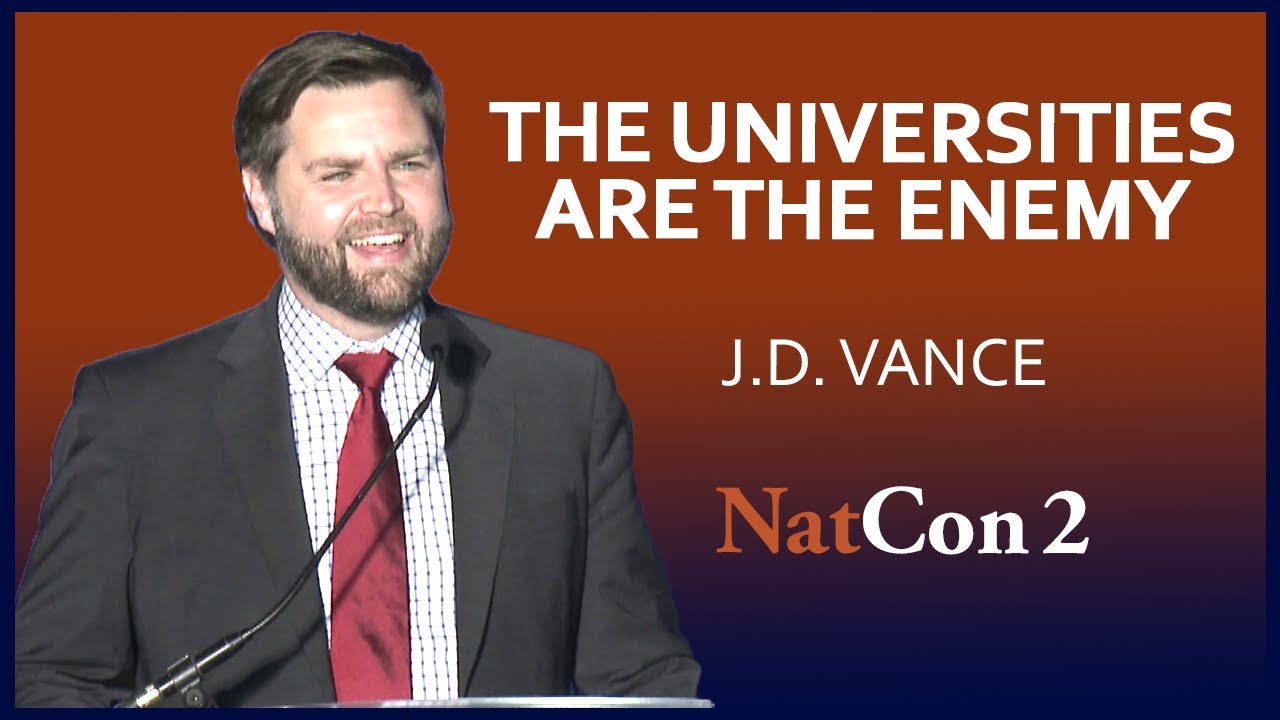
VID]at the National Conservatism conference in 2021, Vance said the movement has to “aggressively attack the universities in this country,” claiming that they “transmit deceit and lies” rather than “knowledge and truth.” Vance has praised Hungary’s dictatorial leader Viktor Orban for his “smart decisions” in seizing control of universities. Trump’s own Agenda 47 calls for seizing the endowments of top universities to fund an anti-wokeness online academy.
At this year’s National Conservatism conference, Vance said that the American nation is not an idea but “a people with a common history,” and he claimed that immigration has made western societies “poorer, less safe, less prosperous, and less advanced,” a preview of his recent willingness to spread dangerous lies about Haitian immigrants for his own political gain—despite the very clear harm it has brought to the community of Springfield, Ohio.
While Vance as VP candidate has adopted Trump’s deliberately muddled stance on access to abortion, his own opinion has been that abortion should be banned without exceptions for cases of rape and incest. In 2022 he called for a “federal response” to prevent women living in states where abortion has been banned from traveling to states where abortion remains legal. Last year he signed a letter urging the Justice Department to ban the mailing of abortion medicine, part of Project 2025’s agenda.
Vance opposed the Respect for Marriage Act, which was passed to protect legal recognition for same-sex couple’s marriages if the MAGA Supreme Court justices reverse the court’s 2015 marriage equality ruling as religious-right groups are urging them to do. Vance has defended far-right “groomer” smears. He introduced legislation that would ban higher education institutions from teaching about gender-affirming care and ban any federally subsidized insurance plans from covering it.
Vance is aligned with Christian nationalists who seek to dismantle separation of church and state. Vance is scheduled to join dominionist New Apostolic Reformation figure Lance Wallnau’s “Courage Tour” in Pennsylvania Sept. 28. In 2022, Vance told Christian-right radio host Eric Metaxas that “one of the great evils of modern liberalism is this pretense of neutrality” on religion, claiming that “if you can’t say a prayer before a public school session, then you’re not neutral, you’re explicitly anti-Christian.” Vance said the First Amendment “doesn’t mean you can’t talk about Jesus in a public school.”
Birds of a Feather: Vance’s Ideological Connections
Vance has spoken at National Conservatism conferences and events organized by “post-liberal” thinkers—who want to abandon liberal democracy—and advocates for integralism—a sort of right-wing Catholic version of Christian dominionism. At a 2023 conference at Catholic University, Vance identified as “a member of the post-liberal right.” Vance’s 2019 conversion to Catholicism was reportedly assisted by priests connected to Opus Dei, which has invested decades in building political power among and for right-wing Catholics in Washington, D.C.
Journalists and scholars like Laura Field have published quite a few detailed looks into Vance’s ideological allies, many of which are linked to in this post. Here are brief descriptions of just a few of the many far-right and antidemocratic intellectuals and institutions that Vance is associated with:
Curtis Yarvin is a self-described monarchist and founder of a school of thought called “neoreactionism.” He argues that a visionary leader should seize power and dismantle the current regime. When Vance was describing his plan to fire federal employees and defy the Supreme Court, he acknowledged Yarvin’s influence, saying, “So, there’s this guy, Curtis Yarvin, who has written about some of these things.” Vance calls Yarvin a friend; both have benefited from Peter Thiel’s support.
Patrick Deneen is a Notre Dame professor who has written books about the failure of liberal democracy and the need for “Regime Change,” the title of his latest book. To Deneen and his fellow “post-liberal” Catholic thinkers, “this means replacing the people and institutions that dominate America’s cultural, economic, and political life with a new elite willing to eschew liberal norms in service of supposedly higher ideals,” writes scholar Damon Linker. In other words, Deneen wants to put the power to govern in the hands of a conservative aristocracy. In 2023, Vance attended a speech by Deneen, praised his book, and “wrapped him in an enthusiastic hug,” Politico reported.
Adrian Vermeule is a Harvard University professor and former Supreme Court clerk who promotes a form of integralism, which he calls “common good Constitutionalism.” He says it “does not suffer from a horror of political domination and hierarchy, because it sees that law is parental, a wise teacher and an inculcator of good habits.” That means the government wielding authority “against the subjects’ own perceptions of what is best for them” and changing laws around “free speech, abortion, sexual liberties, and related matters.” Journalist Sarah Jones notes, “integralism imagines a future when the state may punish the baptized for violations of ecclesiastical law”—a frighteningly far cry from the American principle of church-state separation. Vance appeared at a conference with Deneen and Vermuele at the Franciscan University of Steubenville, Ohio, in 2022.
Rod Dreheris a blogger, author, and right-wing culture-warrior who in recent years moved further to the right and actually moved to Hungary where he functions as a sort of international p.r. agent for Orban’s authoritarian and Christian nationalist government. Dreher is a friend of Vance; in an article for a Hungarian conservative publication this summer, he compared Vance to a young Orban and said Vance “embodies” Trumpism.
Yoram Hazonychairs the Edmund Burke Foundation, which was created in 2019 to promote National Conservatism. Vance has regularly spoken at its conferences. Its statement of principles declares, “Where a Christian majority exists, public life should be rooted in Christianity and its moral vision, which should be honored by the state and other institutions both public and private.” When journalist Katherine Stewart asked about minorities in such a model being stuck with an outsider status, Hazony said, “That simply is reality,” adding that minorities would not get the same treatment as the majority, but “should be grateful for the fact that you’re not persecuted as minorities often have been in history.”
Claremont Instituteis a think tank that ramped up its attacks on multiculturalism in advance of the 2020 election; the New York Times has called it a “nerve center of the American right.” Claremont is home to Michael Anton, who called the 2016 presidential election “the flight 93 election”—referring to the flight hijacked during the 9/11 attacks in which passengers stormed the cockpit. Anton’s book called for a stop to the “ceaseless importation of Third World foreigners with no tradition of, taste for or experience in liberty.” He has suggested that an American Caesar is inevitable.
Claremont was also a center of pro-Trump activity after the 2020 election. Claremont lawyer John Eastman has defended his involvement in Trump’s efforts to stay in power by saying Trump’s presidency was necessary to save America from a left bent on its destruction. Politico reports that “Vance is “closely tied to Claremont circles,
 speaking at their events and appearing alongside their scholars.”
Two Futures: Freedom or Fascism?
Long before Donald Trump selected J.D. Vance as his running mate, there was a mountain of evidence that Trump’s election would threaten Americans’ freedom and undermine democracy: Trump’s own threats to jail his political opponents, go after universities and media outlets he doesn’t like, and carry out vast police state operations against immigrants; Project 2025 plans hatched by former Trump officials to give him virtually unchecked power; and the MAGA Supreme Court justices preemptively telling Trump he would not be held accountable for crimes committed as president.
Trump’s selection of J.D. Vance—cheered by “post-liberal” and anti-democratic leaders—is confirmation that the authoritarian threat to freedom and democracy is an urgent issue in this year’s presidential election—and that the threat will continue regardless of the outcome.
Tags: Adrian VermeuleDonald TrumpJ.D. VanceJohn EastmanMichael AntonPatrick DeneenRod DreherAuthoritarianismChristian NationalismElection 2025MAGANational ConservatismClaremont Institute
-=-=
10 26 some talk
Cornelius Adrian Comstock Vermeule (/vərˈmjuːl/,[2]^ born May 2, 1968) is an American legal scholar who is the Ralph S. Tyler Professor of Constitutional Law at Harvard Law School. An expert on constitutional and administrative law, since 2016 he has voiced support for integralism.[3]^ He has articulated this into his theory of common-good constitutionalism.
Early life and education
Cornelius Adrian Comstock Vermeule was born on May 2, 1968,[4]^ in Cambridge, Massachusetts.[5]^ His father, Cornelius Clarkson Vermeule III, was a curator of ancient and classical art at the Museum of Fine Arts, Boston. His mother, Emily Vermeule, was a professor of philology and archaeology at Harvard University. Vermeule graduated from Harvard College in 1990 with a Bachelor of Arts, summa cum laude, in East Asian languages and civilizations. He then attended Harvard Law School, graduating in 1993 with a Juris Doctor, magna cum laude.
After graduating from law school, Vermeule was a law clerk to Judge David Sentelle of the U.S. Court of Appeals for the District of Columbia Circuit from 1993 to 1994 and to Justice Antonin Scalia of the U.S. Supreme Court from 1994 to 1995.[6]^
Career
Vermeule joined the faculty of the University of Chicago Law School in 1998.[7]^ Vermeule became professor of law at Harvard Law School in 2006, was named John H. Watson Professor of Law in 2008, and was named Ralph S. Tyler Professor of Constitutional Law in 2016. He was elected to the American Academy of Arts and Sciences in 2012 at the age of 43.
Vermeule's writings focus on constitutional law, administrative law, and the theory of institutional design. He has authored or co-authored nine books.[8]^ He teaches administrative law, legislation, and constitutional law.
In 2015, Vermeule co-founded the book review magazine The New Rambler.[9]^ Vermeule became a contributing editor to Compact in 2022.[10]^
In February 2020, Vermeule sparked a controversy when he used Twtter to post an image of 26 attendees at a conferences for political conservatives with the caption: “The very first group for the camps.” He later clarified the Tweet was intended as a joke describing how far left academics might want to imprison political conservatives in concentration camps if they had the power to do so.[11]^ The Harvard Crimson wrote at the time: "The comment drew criticism from professors and Harvard alumni, who interpreted the line as a reference to Nazi concentration camps during the Holocaust."[11]^
On July 24, 2020, Vermeule was appointed to the Administrative Conference of the United States.[12]^
...
judicial interpretation, Vermeule believes:
The central question is not "How, in principle, should a text be interpreted?" The question instead should be, "How should certain institutions, with their distinctive abilities and limitations, interpret certain texts?" My conclusions are that judges acting under uncertainty should strive, above all, to minimize the costs of mistaken decisions and the costs of decision making, and to maximize the predictability of their decisions.[7]^
Vermeule is a judicial review skeptic. Jonathan Siegel has written that Vermeule's approach to the interpretation of law:
eschews, and attempts to transcend, the main elements of the long-standing debates over methods that courts should use to interpret statutes and the Constitution ... he sees no need to resolve apparently burning questions such as whether courts are bound by what legislatures write, or by what legislatures intend ... For Vermeule, everything comes down to a simple but withering cost–benefit analysis.[16]^
In 2007, Vermeule said about the United States Supreme Court that it should stay away from controversial political matters, such as abortion laws and anti-sodomy statutes and defer to Congress, as the elected representatives of the people, except in extremely obvious cases. This would require both liberals and conservatives to step back and realize that the benefits of such a court would outweigh the drawbacks for both. Vermeule was thus suggesting "a kind of arms-control agreement, a tacit deal".[17]^
Vermeule believes that legal change can only come about through cultural improvements. In an interview in 2016 after his conversion to Catholicism, Vermeule said,
I put little stock or faith in the law. It is a tool that may be put to good uses or bad. In the long run it will be no better than the polity and culture in which it is embedded. If that culture sours and curdles; so will the law; indeed that process is well underway and its tempo is accelerating. Our hope lies elsewhere.[6]^
Common-good constitutionalism
Main article: Common Good Constitutionalism
In an article in The Atlantic in March 2020, Vermeule suggests that originalism – the idea that the meaning of the American Constitution was fixed at the time of its enactment, which has been the principal legal theory of conservative judges and legal scholars for the past 50 years, but which Vermeule now characterizes as merely "a useful rhetorical and political expedient" – has outlived its usefulness and needs to be replaced by what he calls "common-good constitutionalism".
Vermeule's concept of common-good constitutionalism is:
based on the principles that government helps direct persons, associations, and society generally toward the common good, and that strong rule in the interest of attaining the common good is entirely legitimate. ... This approach should take as its starting point substantive moral principles that conduce to the common good, principles that officials (including, but by no means limited to, judges) should read into the majestic generalities and ambiguities of the written Constitution. These principles include respect for the authority of rule and of rulers; respect for the hierarchies needed for society to function; solidarity within and among families, social groups, and workers' unions, trade associations, and professions; appropriate subsidiarity, or respect for the legitimate roles of public bodies and associations at all levels of government and society; and a candid willingness to "legislate morality" –indeed, a recognition that all legislation is necessarily founded on some substantive conception of morality, and that the promotion of morality is a core and legitimate function of authority. Such principles promote the common good and make for a just and well-ordered society.[18]^
Vermeule specified that common-good constitutionalism is "not tethered to particular written instruments of civil law or the will of the legislators who created them". However, the determination of the common good made by the legislators is instrumental insofar as it embodies the background principles of the natural law.[19]^ In other words, while the legislative intent is not per se controlling, positive law always seeks to put into effect natural law principles, and the intended principles behind the positive law are controlling. In that vein, he also says that "officials (including, but by no means limited to, judges)" will need "a candid willingness to 'legislate morality'" in order to create a "just and well-ordered society."[18]^
The main aim of common-good constitutionalism:
is certainly not to maximize individual autonomy or to minimize the abuse of power (an incoherent goal in any event), but instead to ensure that the ruler has the power needed to rule well ... Just authority in rulers can be exercised for the good of subjects, if necessary even against the subjects' own perceptions of what is best for them — perceptions that may change over time anyway, as the law teaches, habituates, and re-forms them. Subjects will come to thank the ruler whose legal strictures, possibly experienced at first as coercive, encourage subjects to form more authentic desires for the individual and common goods, better habits, and beliefs that better track and promote communal well-being.[18]^
In a critique in New York, politics and economics writer Eric Levitz argued that this theory of jurisprudence "allows the religious right to impose its vision of the good on the American people, whether they like it or not."[20]^ Garrett Epps, a professor of law at the University of Baltimore, also wrote a critique in The Atlantic, linking common-good constitutionalism to integralism and arguing that Vermeule's approach represents authoritarianism and objects "not [because] it is harmful and antihuman, but simply that, in the end, it is so banal.[21]^
Responses
Vermeule's common good constitutionalism has drawn a range of responses, both positive and negative. Legal scholar Richard H. Helmholz, in a review of Common Good Constitutionalism, described it as "a serious contribution to some of the most pressing legal debates of our times... Vermeule's book has the merit of providing some of the details about how such a change might occur. It also includes some marching orders."[22]^ Jack Goldsmith praised Common Good Constitutionalism as "the most important book of American constitutional theory in many decades".[23]^
Legal scholar Conor Casey has criticized critics of common good constitutionalism as having fundamentally misunderstood it. According to Casey, common good constitutionalism "is entirely consistent with the natural law legal tradition and emphatically not an argument for authoritarianism unbound from legal and democratic constraint or concern for human rights".[24]^
According to Eric Levitz, the values Vermeule promotes are those of Catholicism and the Christian right.[20]^ Law professor Randy E. Barnett characterizes Vermeule's essay as "an argument for the temporal power of the state to be subordinated to the spiritual power of the Church".[25]^ Constitutional law professor Garrett Epps characterizes Vermeule as "an authentic Christian nationalist to whom the Constitution is only an obstacle". Vermeule's common-good constitutionalism argument is, according to Epps, really "authoritarian extremism" which "has absolutely nothing to do with the actual United States Constitution, and in many ways flatly contradicts it. ... In fact, the Constitution as such is not a binding text to Vermeule" since it must be, in Vermeule's words, "read into" in order to arrive at the results he prefers. In the end, Epps criticizes Vermeule's concept as a "banal" anti-constitutional theory akin to Falangism.[26]^ Levitz notes that Vermeule received little support from conservatives for his arguments, although some did object to characterizing him as "authoritarian".[20][18]^
In a column in The Washington Post, libertarian columnist George F. Will described Vermeule's "common-good constitutionalism" as "Christian authoritarianism — muscular paternalism, with government enforcing social solidarity for religious reasons. This is the Constitution minus the Framers' purpose: a regime respectful of individuals' diverse notions of the life worth living." About Vermeule's and some other contemporary conservative views, Will goes on to say that "... American conservatism, when severed from the Enlightenment and its finest result, the American Founding, becomes spectacularly unreasonable and literally un-American."[27]^
Elliot Kaufman, writing in the conservative magazine National Review, has described Vermeule as a "reactionary" and an "illiberal" following in the footsteps of German Nazi thinker Carl Schmitt. In Kaufman's view, Vermeule's illiberalism is "dangerous".[28]^ Law professor Rick Hills described Vermeule's recent writings as a kind of "anti-liberal chic", or "a really cheap way to signal one's willingness to offend without putting any specific cards on the table about one's own specific views about, say, the acceptability of locking up demonstrators who offend the regime in power".[29]^
Peter J. Wallison, who served as White House Counsel during the Reagan presidency, described Vermeule's book as "more an embarrassment than a legal masterpiece" and that "the political structure he devises is highly authoritarian, perhaps even totalitarian". Wallison complained that Vermeule "never successfully defines what he means by the common good or how it can be achieved" and for failing to understand the distinction between textualism and originalism.[30]^
Personal life and views
Vermeule was raised as an Episcopalian, abandoning the denomination in college, but returning to it later in life.[31]^ He announced his conversion to Catholicism in 2016.[6]^ He said in an October 2016 interview that the logic behind his Catholic beliefs is inspired by John Henry Newman, and added:
Raised a Protestant, despite all my thrashing and twisting, I eventually couldn't help but believe that the apostolic succession through Peter as the designated leader and primus inter pares is in some logical or theological sense prior to everything else – including even Scripture, whose formation was guided and completed by the apostles and their successors, themselves inspired by the Holy Spirit.[6]^
Vermeule's son, Spencer, a Notre Dame sophomore was killed in an automobile accident on March 2, 2024.[32][33]^
Scholarly works
-=-=
dck 10 26
The Federalist Society
https://fedsoc.org › bio › adrian-vermeule
Adrian Vermeule - Federalist Society
Prof. Adrian Vermeule John H. Watson Professor of Law, Harvard Law School * A person listed on this page has spoken or otherwise participated in Federalist Society events, publications, or multimedia presentations. A person's appearance on this list does not imply any other endorsement or relationship between the person and the Federalist ...
Wikipedia
https://en.wikipedia.org › wiki › Adrian_Vermeule
Adrian Vermeule - Wikipedia
Cornelius Adrian Comstock Vermeule (/ vərˈmjuːl /, [2] born May 2, 1968) is an American legal scholar who is the Ralph S. Tyler Professor of Constitutional Law at Harvard Law School. An expert on constitutional and administrative law, since 2016 he has voiced support for integralism. [3] He has articulated this into his theory of common-good constitutionalism.
The Harvard Crimson
https://www.thecrimson.com › article › 2025 › 10 › 4 › common-good-constitutionalism
The Theory, Born at Harvard, That Could Remake Right-Wing Jurisprudence
Oct 4, 2025Vermeule, despite being noted for years as a leader in conservative legal scholarship, and serving as treasurer for the Federalist Society during his second year at Harvard Law School, is an avid ...
American Affairs Journal
https://americanaffairsjournal.org › 2023 › 02 › the-living-voice-of-the-law-debates-over-common-good-constitutionalism
The Living Voice of the Law: Debates over Common Good Constitutionalism
REVIEW ESSAY Common Good Constitutionalism by Adrian Vermeule Polity, 2022, 270 pages The Federalist Society may be the one legacy institution that both old‑line conservatives and the New Right admire. And Fed Soc bears none of the unsightly blemishes of other conservative organizations, staffed as they are with incompetents, weirdos, and malcontents. In our legal republic, supposedly ...
The Federalist Society
https://fedsoc.org › commentary › fedsoc-blog › originalism-s-still-around-no-matter-what-adrian-vermeule-says
Originalism's Still Around, No Matter What Adrian Vermeule Says
I was taken aback when I read Adrian Vermeule's recent Washington Post op-ed, which alleges that the U.S. Supreme Court's West Virginia v. Environmental Protection Agency decision is unprincipled, results-oriented, and bereft of jurisprudential method. Indeed, when Professor Vermeule insists that the decision cannot be reconciled with originalism, he argues that "There is no conservative ...
Financial Times
https://www.ft.com › content › 5c615d7d-3b1a-47a2-86ab-34c7db363fe4
Adrian Vermeule's legal theories illuminate a growing rift among US ...
The Federalist Society didn't just promote originalist ideas through speeches and networking events. It also vetted judicial appointments for Republican presidents and provided financial backing ...
PressReader.com
https://www.pressreader.com › usa › the-sentinel-record › 20260927 › 281831470656975
Religious 'integralists' on the right, meet your socialist soulmates
4 days agoThe Sentinel-Record Religious 'integralists' on the right, meet your socialist soulmates 2026-09-27 - George Will Law · U.S. News · Religion · Society · United States of America · Harvard University · U.S. Supreme Court · Connecticut · William Welch · New York City · Blue · Pennsylvania · Philadelphia Phillies · NFL · JD Vance · Zohran Mamdani · John · Adrian Vermeule ...
Temple Daily Telegram
https://www.tdtnews.com › article_e788baa3-417c-4538-ac57-5af55a601606.html
Religious 'integralists' on the right, meet your socialist soulmates
6 days agoIntegralists want to integrate spiritual and temporal (government) power, subordinating the latter to the former. Harvard law professor Adrian Vermeule, the most intellectually interesting ...
thenewdigest.substack.com
https://thenewdigest.substack.com › p › a-new-paper-on-plural-tyranny
A New Paper on Plural Tyranny - by Adrian Vermeule
Nov 4, 2025Drawing upon Montesquieu's life-long obsession with ideas of plural tyranny or plural despotism, I locate the idea of a society of tyrants within the juristic tradition, explain the differing forms that plural tyranny takes in different constitutional regimes, and analyze the mechanisms that give rise to plural tyranny.
Law & Liberty
https://lawliberty.org › book-review › a-common-good-requires-a-common-people
A Common Good Requires a Common People - Jesse Merriam
Jesse Merriam reviews Adrian Vermeule's book,Common Good Constitutionalism, which fails to realize that a common good requires a common people first.
-=-=