deneen patrick N Dame
---
MERRI OK
new right?
uatx
---
gil bk jdv
===
UATX
...
A faction competing with Kanelos’ included Lonsdale and several of his allies. Their view is difficult to categorize, and no two people described the lines of division the same way. Some framed it as a battle between the conservatives and the libertarians. Others saw it as the classicists versus the tech bros. But one name came up far more often than any other: Leo Strauss.
A German-Jewish emigrant, Strauss spent most of his career at the University of Chicago. An impactful teacher and prolific writer, Strauss criticized modern liberalism for undermining the influence of religion and natural law and advocated a return to teaching the ancient Greeks, who he said had deep insights into human nature and society.

Leo Strauss, seen in New York in 1939. | Monozigote via Wikimedia Commons
Strauss isn’t a household name, but he’s deeply influential on the modern right.
One can draw a straight line from Strauss to his student Allan Bloom, author of the 1987 bestseller, The Closing of the American Mind, which sounded an early alarm against identity politics, moral relativism and the decay of the university. From there one can make a direct connection to the prominent conservative intellectual Patrick Deneen, who has argued that liberalism’s emphasis on individual rights degrades authority, community and place. Deneen, who reportedly modeled himself on Bloom, won the American Political Science Association’s Leo Strauss Award in 1995 for best dissertation in political theory. Strauss was also the subject of a symposium at UATX in early January 2026, hosted by Loren Rotner, who received his PhD from Claremont Graduate University — a key institution for fueling what was known as West Coast Straussianism.
Kanelos’ view of the academy emphasized pluralism and the individual’s search for truth. On the other side, the Straussians weren’t quite so agnostic. They had a view of the common good they wanted to assert.
This conflict came to a head for the first time in September 2023 when Rotner, then the assistant provost, and Hillel Ofek, then the vice president of communications, engaged in what was described to me by several people as “a coup attempt.” They were critical of Kanelos’ leadership and believed that UATX had been neither aggressive enough in criticizing the universities with which they were in competition nor establishing UATX’s own identity. Another former staffer, who was granted anonymity out of fear of retaliation, said, “They attempted to persuade the UATX board that everything was heading in the wrong direction.”
The rebellion failed. Ofek and Rotner left UATX. Ofek took a position as director of strategy at Lonsdale Enterprises. Rotner became director of the Cosmos Institute, a nonprofit aimed at using AI for human flourishing. UATX did not make Rotner and Ofek, who have since returned to UATX as associate provost and chief strategy officer respectively, available for interviews or to provide comments.
Kanelos survived. UATX moved forward and began recruiting its first class.
In May, 2024, they hit a bump in the road when Jonathan Yudelman, a recent hire from Arizona State University, confronted a woman in a hijab in a video that went viral. But Yudelman was mostly associated with ASU, rather than UATX. The incident was handled internally and soon blew over. Yudelman remains at the university. UATX did not offer a comment on the episode, and Yudelman did not respond to a request for comment.
On Sept. 2, 2024, UATX opened its doors, presenting a united front to the world. In the morning, Texas Gov. Greg Abbott met with the inaugural class of 92 students at the state capitol. Down the block, in the Capital Ballroom of the Royal Sonesta Hotel, the students donned dark blue robes, signed the University of Austin register and, in return, received a copy of The Odyssey. Kanelos, clad in regalia, delivered a rousing address.
“History is not a story unfolding; it is an epic being written. And its authors are those bold enough to exercise their agency in the pursuit of higher things,” he said. According to Kanelos, UATX was returning to the Platonic ideal — to the “olive grove on the fringes of Athens called the Akademia,” where students came together to ask “fundamental human questions.”
There were other schools in Greece, but Kanelos said Plato’s stood above them all. “What distinguished Plato’s Academy,” he told the students, “was doctrinal pluralism and a variety of intellectual approaches. There were no easy answers. Every discussion branched outward with ever-greater complexity.”
The pluralists had won. At least for the moment.
In a truth-is-stranger-than-fiction turn of events, UATX’s commitment to its founding principles would be tested on the school’s first day of operation by an incident of alleged sexual harassment that would dominate the campus’ freshman year.
on BO bk list
NEW RT
PT 1
trump anti-intell give cover for this new rt intell bs
liberalism individualism corrosive --> yearn strong man
catholic monarchial pip pius 9 pro CSA civil war syllabus of errors
vermule pro carl schmidt
52,940 views Nov 1, 2025
The Court of History’s Sidney Blumenthal & Sean Wilentz are joined by Laura Field to explore Trump’s fascist elites—the apologists, defenders, and ideologues building the MAGA infrastructure to tear down America’s democratic institutions. Together they uncover the hidden manipulators inside Trump’s circle and behind JD Vance who are shaping an authoritarian movement from within. Furious Minds: The Making of the MAGA New Right:https://a.co/d/3Hz8WqX

---
---
no lnx
The “weirdos” shaping Trump’s second term
Politics
The “weirdos” shaping Trump’s second term
A liberal writer explains her journey through intellectual MAGAland.
by Zack Beauchamp
Aug 14, 2025,
Key Speakers At Conservative Political Action Conference
Michael Anton, current director of policy planning at the State Department, speaking during the Conservative Political Action Conference (CPAC) in National Harbor, Maryland, on March 2, 2023. Al Drago/Bloomberg via Getty Images
Zack Beauchamp
Zack Beauchamp is a senior correspondent at Vox, where he covers ideology and challenges to democracy, both at home and abroad. His book on democracy, The Reactionary Spirit, was published 0n July 16. You can purchase it here.
If you’ve been following American politics in the Trump era, there’s a decent chance you’ve heard of “the New Right.” It’s a loose movement of radical intellectuals who share a basic hostility to American liberal democracy. They all think the system is rotten, that it needs to be fundamentally overhauled, and that Donald Trump can be a vehicle for putting something better in its place.
But why do they think that? How much influence do they really have? And what would a response to their rising prominence look like?
In an upcoming episode of Vox’s The Gray Area podcast, I spoke about all of this with Laura Field — a political theorist who spent a lot of time in the conservative intellectual world. Her book Furious Minds: The Making of the MAGA New Right is a fascinating taxonomy of the wild world of far-right thinking.
We talk about who these people are and how they replaced the “old” conservatism with something more aggressive and authoritarian. We also talk about how they are influencing the Trump administration, and why ordinary Americans should care what a handful of thinkers are putting out on obscure Substacks and YouTube channels.
Part of our conversation is transcribed below, edited and condensed for clarity. The full interview contains much more, and you can listen to it on Monday. We’ll update this link with the embed when the episode is out.
And, if you just can’t get enough of Zack and Laura content, you can come to our Vox-sponsored panel at the Liberalism in the 21st Century conference — held in DC on Friday. There’s already a waitlist, so sign up soon.
You’re someone who is liberal but found yourself as a professional academic and intellectual in conservative spaces — and that’s pretty unusual because there tends to be a lot of self-segregation away from that world. What pulled you into it and what was it like being an insider-outsider in the conservative world of ideas?
I wanted to go into medicine and be a doctor in the developing world. I was very, very liberal and sort of a save-the-world type. I had to take some required courses in political philosophy, and one was a wonderful course on ancient political philosophy and early modern thought. It was mind-blowing.
The right today uses this language of being “red-pilled,” where you see through the lies that we are told by the regime. They use this extreme language, but something sort of parallel happened to me, just reading Plato with these really great teachers.
I fell in love with these books and the tradition of political philosophy and literature that these teachers were so good at explaining. My politics didn’t change dramatically, but some of those circles were quite adjacent to the people who were the leaders of the avant-garde of defending Trumpism: the West Coast Straussians, call them the Claremont Institute people.
When that started happening, I was really quite alarmed.
You use “new right” as an umbrella term for all of these different pro-Trump factions. What makes the new Right a cogent grouping, not just a random smattering of people who all like Trump? What connects them and what differentiates them from the old right?
I’m talking about the MAGA new right, [in contrast] with the Reagan-Buckley right, or the establishment right, which is propped up by fiscal conservatism (free-market economics), social conservatism (conservative social values), and anti-communism.
The new right turns against a lot of that. Michael Anton, one of these Claremont Institute guys, says that Trumpism and the new right is all about economic nationalism — turning against the free market orientation of the establishment — as well as closed, secure borders. So that’s the anti-immigration strain and America-first foreign policy.
I think that there’s also just a hardcore social conservatism at the core of a lot of this — at least spiritually.
The new right has shared principles: preoccupation with gender, strong support for Trump, a general disinterest in the traditional norms of democratic politics, and a commitment to unremitting culture war against the left. But there are huge divisions. If you were to divide the new right into camps, what would you say the fault lines are?
I have three main camps: the Claremonters, the post-liberals, and the national conservatives. Then I talk also about the hard right, but the hard right travels alongside all three of them ideologically. The hard right is the hardcore, manosphere-fascist types. Each of these groupings are different.
The Claremonters are the West Coast Straussians that I was speaking about before. They are really committed, at least in theory, to the American founding. They have this very grandiose vision that’s beyond even your ordinary patriotism. It’s that this is the best regime of all time. They’re also at the very cutting edge of the culture war. So America is the best regime of all time, but we’ve completely lost the plot. The liberals and liberal way of thinking have taken over to such a degree that we need a counter-revolution. They’re the [type] who defended January 6.
Michael Anton, who you mentioned earlier, is now a Trump administration official, a high-ranking one. He’s one of the key leaders in that faction.
Yeah. And then there’s the national conservatives. They’re a little more vanilla, with just nationalism as their core thing. But it turns into ethno-nationalism in some cases and certainly Christian nationalism. They’re a big tent.
The tensions are clearest when we are talking about the post-liberals, who are the most highbrow of the New Right. They tend to be Catholic intellectuals: people like Adrian Vermeule at Harvard, Patrick Deneen at Notre Dame, and writer Sohrab Ahmari. These are serious Catholics who are more committed to social conservatism and really want to shape the morals of the country in a much more traditional Catholic direction. But they’re also interestingly much more sincere about the left-oriented [redistributive] economics.
The new right as a whole speaks as if they want to help the working class, and create new populist programs. But I think that the people who are closest to Trump haven’t really followed through. They’ve got the tariffs, but otherwise economically, they’re still doing the big tax cuts. They’re still beholden to donors. So that’s been a big fissure, because the post-liberals are almost open to socialism.
A lot of other fissures come in terms of how accepting they are of the hard right. Ahmari has been quite outspoken against the Proud Boys and the manosphere, Bronze Age Pervert and those guys.
I think another interesting divide, which came about just after the election, was DOGE vs. MAGA. DOGE came in and did the destructive part of getting rid of the so-called administrative state. But a big part of the new right wants to harness the state and weaponize it for their own purposes.
Why does any of this matter for our politics?
The knee-jerk reaction to think “who cares” is a natural one, because a lot of these people are bizarre — weirdos. That’s why it’s alarming to see them wield so much power, to see JD Vance have that clout.
I think they have dramatically reoriented the GOP. It’s not just JD Vance who’s some weirdo who’s gotten to the top. It also seems to matter a lot to young people. These kinds of movements can build energy, and young men are influenced by these circles.
A lot of these people I’m writing about are in the intellectual spheres. They’re pretty smart. A lot of them have PhDs, which is no marker of genius, but they have a lot of education and resources available to them. They’re experts in ways that would surprise many people. They know a whole lot. I wouldn’t want to debate some of them on the founding or other questions.
These well-learned people shape the minds of people like Joe Rogan. Ideologically, there is a trickle-down effect. The culture war has a big impact. You see the impact of someone like Christopher Rufo.
You argue that the right operates with an “ideas first” approach, believing that ideas have a tangible, causal impact on politics. Democrats, in contrast, are putting ideas last. You contrast the “coarse brazenness of [the right’s] ideologues and the tepid intellectual and cluelessness and cowardice of so many centrist and liberal leaders both within academia and beyond.”
That is a stinging indictment of the liberal intellectual class. Where are you coming from here? When you say that they’ve failed in contrast to the coarse brazenness of the new right, what do you mean?
Trump has been much more effective in his second term. The Democrats are in a difficult position. They had a very rocky electoral cycle with Biden staying in so long and Harris in this awful position of having to parachute in and not being very well prepared.
I don’t feel like there’s much of a response from the left intellectually to what’s going on. It doesn’t seem to me like the party has much to offer on the ideological front.
It is frustrating as an observer to see that Bernie and AOC were the people who went and toured the country. But I didn’t see more centrist Democrats doing very much. And I still think that’s the case. They seem very shocked and unprepared. And I think that that comes down to a failure of imagination — taking way too much for granted for a very long time. And that’s part of what got us Trump in the first place.
See More:
Politics
Most Popular
The White House has a preferred alternative to PBS. It may already be in countless classrooms.
Take a mental break with the newest Vox crossword
The 25 pieces of culture that explain the last 25 years
The Air Quality Index and how to use it, explained
The Joe Rogan Experience is a mirror for America
Today, ExplainedUnderstand the world with a daily explainer, plus the most compelling stories of the day.
===
===
RWW 9 24
*Analysis
Vice presidential candidate J.D. Vance has spent his short career in politics soaking in and promoting anti-democratic ideas. It is terrifying that he could become vice president to Donald Trump, the oldest presidential nominee in history, who is displaying his own increasingly aggressive dictatorial intentions. Americans’ freedom and our future as a democratic society are at stake.
- Vance’s leap into the U.S. Senate in his first run for elected office was funded by Peter Thiel, a billionaire who has openly expressed his contempt for democracy. Over the past few years, Vance has aligned himself with different strains of the “illiberal” right, including Christian nationalism, right-wing Catholic integralism, “National Conservatism,” anti-immigrant nativism, and, of course, “America first” Trumpism.
- While these movements and their leaders have different underlying motivations and priorities, they share a willingness—or eagerness—to sacrifice democracy and Americans’ freedom in order to impose “traditional” values and their vision of “order” and an ideal society on all Americans. For some, that vision goes back centuries, well before America’s founding. Some openly call for an American Caesar.
- Vance’s anti-feministand anti-LGBTQ allies “aim to control women’s reproductive choices and individual freedoms concerning gender, sexuality, and identity,” among other things, as journalist Molly Olmstead has noted.
- Like the authors of Project 2025, the policy roadmap for a second Trump term, right-wing factions aligned with Vance have abandoned a libertarian distrust for government power in favor of an intention to use power aggressively to reshape our country. Vance has been clearon this front, saying
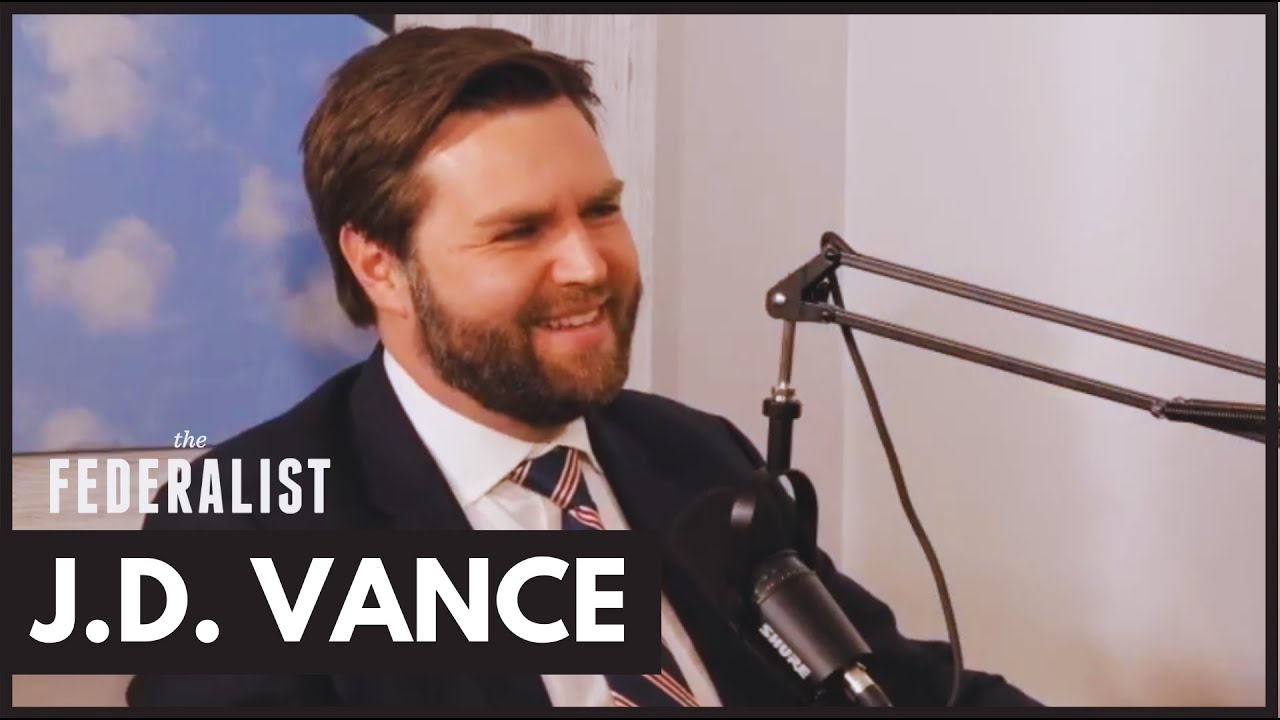 when it comes to the exercise of our power.”
VID]
- Vance “comes from an authoritarian, reactionary tradition that explicitly rejects conservatism, liberalism, and democracy,” writes political analyst Matthew Sheffield, formerly a conservative activist. “Trump wants absolute power, and Vance wants him to have it to destroy what he believes to be a decadent and corrupt society.”
* Vance has repeatedly spoken at “National Conservatism” conferences; the movement’s statement of principles declares that “in those states or subdivisions in which law and justice have been manifestly corrupted, or in which lawlessness, immorality, and dissolution reign, national government must intervene energetically to restore order.”
Vance described his outlook in a far-right podcast appearance in 2022, recounted by the Washington Post’s Dana Milbank:
Vance suggested that former president Donald Trump, once elected in 2024, should fire all civil servants and replace them with “our people,” defy court orders blocking such an illegal action, and then “do what Viktor Orban has done,” referring to the Hungarian dictator’s banson certain topics from school curricula. Vance justified such “outside-the-box” authoritarian actions by reasoning that the United States is “far gone” and not “a real constitutional republic” anymore.
Before Vance decided to run for office, he called Trump “reprehensible” and wondered whether Trump might be “America’s Hitler.” But when Vance became a candidate in the MAGA Republican Party, he flipped so hard that former Trump aide Steve Bannon suggested that Vance could be, as a reporter paraphrased, “St Paul to Trump’s Jesus—the zealous convert who spreads the gospel of Trumpism further than Trump himself ever could.”
J.D. Vance vs. Democracy and Freedom
- Vance has echoed hard-right calls for “regime change” and said it is necessary to “get pretty wild, pretty far our there, and go in directions that a lot of conservatives right now are uncomfortable with.” Vance expressed a desire to “seize the administrative state for our own purposes” and ignore the Supreme Court if it objects.
- Vance says if he were vice president in 2020, he would have done what Vice President Mike Pence refused to do: Vance would have abused his power, ignored the Constitution, and refused to accept the electors certified by states that Trump was contesting.
* Vance defends the illegal “fake electors” scheme that Trump strategists used to try to override the will of the voters. Vance says Trump’s efforts to overturn the 2020 election were addressing a “very legitimate grievance” and says “I can’t help but roll my eyes” at the idea that Trump threatens democracy. “I don’t believe this is about some deep principle,” he says. “This is about power.”
In a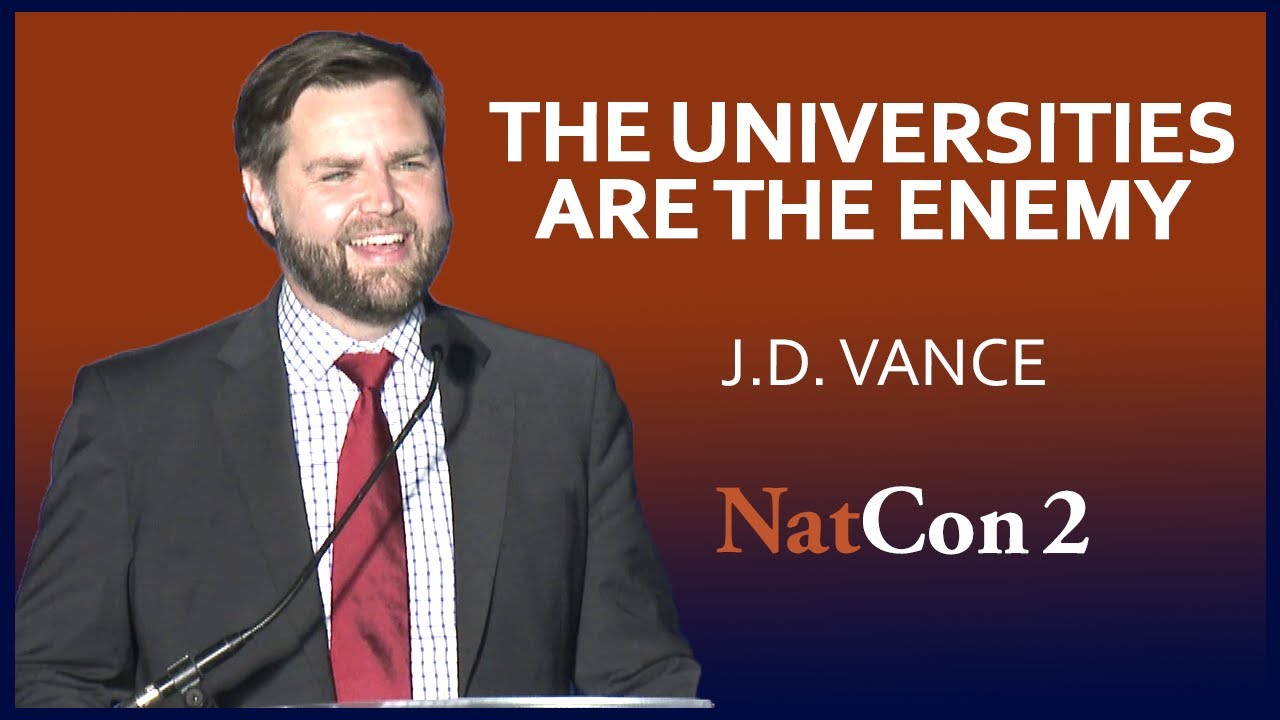
VID]at the National Conservatism conference in 2021, Vance said the movement has to “aggressively attack the universities in this country,” claiming that they “transmit deceit and lies” rather than “knowledge and truth.” Vance has praised Hungary’s dictatorial leader Viktor Orban for his “smart decisions” in seizing control of universities. Trump’s own Agenda 47 calls for seizing the endowments of top universities to fund an anti-wokeness online academy.
- At this year’s National Conservatism conference, Vance said that the American nation is not an idea but “a people with a common history,” and he claimed that immigration has made western societies “poorer, less safe, less prosperous, and less advanced,” a preview of his recent willingness to spread dangerous lies about Haitian immigrants for his own political gain—despite the very clear harm it has brought to the community of Springfield, Ohio.
- While Vance as VP candidate has adopted Trump’s deliberately muddled stance on access to abortion, his own opinion has been that abortion should be banned without exceptions for cases of rape and incest. In 2022 he called for a “federal response” to prevent women living in states where abortion has been banned from traveling to states where abortion remains legal. Last year he signed a letter urging the Justice Department to ban the mailing of abortion medicine, part of Project 2025’s agenda.
- Vance opposed the Respect for Marriage Act, which was passed to protect legal recognition for same-sex couple’s marriages if the MAGA Supreme Court justices reverse the court’s 2015 marriage equality ruling as religious-right groups are urging them to do. Vance has defended far-right “groomer” smears. He introduced legislation that would ban higher education institutions from teaching about gender-affirming care and ban any federally subsidized insurance plans from covering it.
- Vance is aligned with Christian nationalists who seek to dismantle separation of church and state. Vance is scheduled to join dominionist New Apostolic Reformation figure Lance Wallnau’s “Courage Tour” in Pennsylvania Sept. 28. In 2022, Vance told Christian-right radio host Eric Metaxas that “one of the great evils of modern liberalism is this pretense of neutrality” on religion, claiming that “if you can’t say a prayer before a public school session, then you’re not neutral, you’re explicitly anti-Christian.” Vance said the First Amendment “doesn’t mean you can’t talk about Jesus in a public school.”
Birds of a Feather: Vance’s Ideological Connections
Vance has spoken at National Conservatism conferences and events organized by “post-liberal” thinkers—who want to abandon liberal democracy—and advocates for integralism—a sort of right-wing Catholic version of Christian dominionism. At a 2023 conference at Catholic University, Vance identified as “a member of the post-liberal right.” Vance’s 2019 conversion to Catholicism was reportedly assisted by priests connected to Opus Dei, which has invested decades in building political power among and for right-wing Catholics in Washington, D.C.
Journalists and scholars like Laura Field have published quite a few detailed looks into Vance’s ideological allies, many of which are linked to in this post. Here are brief descriptions of just a few of the many far-right and antidemocratic intellectuals and institutions that Vance is associated with:
- Curtis Yarvin is a self-described monarchist and founder of a school of thought called “neoreactionism.” He argues that a visionary leader should seize power and dismantle the current regime. When Vance was describing his plan to fire federal employees and defy the Supreme Court, he acknowledged Yarvin’s influence, saying, “So, there’s this guy, Curtis Yarvin, who has written about some of these things.” Vance calls Yarvin a friend; both have benefited from Peter Thiel’s support.
- Patrick Deneen is a Notre Dame professor who has written books about the failure of liberal democracy and the need for “Regime Change,” the title of his latest book. To Deneen and his fellow “post-liberal” Catholic thinkers, “this means replacing the people and institutions that dominate America’s cultural, economic, and political life with a new elite willing to eschew liberal norms in service of supposedly higher ideals,” writes scholar Damon Linker. In other words, Deneen wants to put the power to govern in the hands of a conservative aristocracy. In 2023, Vance attended a speech by Deneen, praised his book, and “wrapped him in an enthusiastic hug,” Politico reported.
- Adrian Vermeule is a Harvard University professor and former Supreme Court clerk who promotes a form of integralism, which he calls “common good Constitutionalism.” He says it “does not suffer from a horror of political domination and hierarchy, because it sees that law is parental, a wise teacher and an inculcator of good habits.” That means the government wielding authority “against the subjects’ own perceptions of what is best for them” and changing laws around “free speech, abortion, sexual liberties, and related matters.” Journalist Sarah Jones notes, “integralism imagines a future when the state may punish the baptized for violations of ecclesiastical law”—a frighteningly far cry from the American principle of church-state separation. Vance appeared at a conference with Deneen and Vermuele at the Franciscan University of Steubenville, Ohio, in 2022.
- Rod Dreheris a blogger, author, and right-wing culture-warrior who in recent years moved further to the right and actually moved to Hungary where he functions as a sort of international p.r. agent for Orban’s authoritarian and Christian nationalist government. Dreher is a friend of Vance; in an article for a Hungarian conservative publication this summer, he compared Vance to a young Orban and said Vance “embodies” Trumpism.
- Yoram Hazonychairs the Edmund Burke Foundation, which was created in 2019 to promote National Conservatism. Vance has regularly spoken at its conferences. Its statement of principles declares, “Where a Christian majority exists, public life should be rooted in Christianity and its moral vision, which should be honored by the state and other institutions both public and private.” When journalist Katherine Stewart asked about minorities in such a model being stuck with an outsider status, Hazony said, “That simply is reality,” adding that minorities would not get the same treatment as the majority, but “should be grateful for the fact that you’re not persecuted as minorities often have been in history.”
Claremont Instituteis a think tank that ramped up its attacks on multiculturalism in advance of the 2020 election; the New York Times has called it a “nerve center of the American right.” Claremont is home to Michael Anton, who called the 2016 presidential election “the flight 93 election”—referring to the flight hijacked during the 9/11 attacks in which passengers stormed the cockpit. Anton’s book called for a stop to the “ceaseless importation of Third World foreigners with no tradition of, taste for or experience in liberty.” He has suggested that an American Caesar is inevitable.
Claremont was also a center of pro-Trump activity after the 2020 election. Claremont lawyer John Eastman has defended his involvement in Trump’s efforts to stay in power by saying Trump’s presidency was necessary to save America from a left bent on its destruction. Politico reports that “Vance is “closely tied to Claremont circles,
 speaking at their events and appearing alongside their scholars.”
Two Futures: Freedom or Fascism?
Long before Donald Trump selected J.D. Vance as his running mate, there was a mountain of evidence that Trump’s election would threaten Americans’ freedom and undermine democracy: Trump’s own threats to jail his political opponents, go after universities and media outlets he doesn’t like, and carry out vast police state operations against immigrants; Project 2025 plans hatched by former Trump officials to give him virtually unchecked power; and the MAGA Supreme Court justices preemptively telling Trump he would not be held accountable for crimes committed as president.
Trump’s selection of J.D. Vance—cheered by “post-liberal” and anti-democratic leaders—is confirmation that the authoritarian threat to freedom and democracy is an urgent issue in this year’s presidential election—and that the threat will continue regardless of the outcome.
Tags: Adrian VermeuleDonald TrumpJ.D. VanceJohn EastmanMichael AntonPatrick DeneenRod DreherAuthoritarianismChristian NationalismElection 2025MAGANational ConservatismClaremont Institute
---