Nerd Reich Gil Duran
---
2nd on bk pr 8 26
lAKOFF FAN
disruptor? pseudo-populism?
// = naomi astra fasc, xian tech trinity
NO LUCKEY?
-=-=
gil d bk out checks all fasc boxes, 2x dn? seder? kqed?
8 26
-=-
gil cmnwlth club 8 26 dogebag yarvin nyt
ca forever
---

CHANNEL
COPYRT STRIKES BY PAID CO?
-=-=
kindle
-=-=
books
The Tech Coup: How to Save Democracy from Silicon Valley, Marietje Schaake
Valley of Death: How Big Tech Is Fueling the Future of War
Elon Musk, Peter Thiel, and Alexander Karp. These tech titans are fast becoming some of the most powerful figures in the realm of national security, with enormous implications for us all. As Sharon Weinberger reveals in this gripping account, the American military and spy agencies helped to create Silicon Valley as we now know it, and some of its biggest and most valuable companies today owe much of their success to the Pentagon and CIA.
Beginning with the War on Terror and accelerating under Donald Trump, however, the old alliance between elected leaders in Washington and the unelected CEOs of Silicon Valley has grown increasingly uneasy as power has shifted to the private sector and Big Tech exerts greater and greater influence over its old patrons. Companies such as SpaceX and Palantir, along with newer entrants to the field such as Anduril, are proudly supporting—and quietly shaping—US national defense, whether by providing spies and soldiers with AI and cloud-computing tools or actual military hardware such as microwave weapons, hypersonic missiles, and advanced drones.
The implications of this historic shift are poorly understood and fraught with peril. What happens when mercurial billionaires like Elon Musk control weapons and technologies that were once the preserve of the US government? How will this new military-industrial complex affect the way wars are fought, or even which wars are fought? That is the urgent question before us today, at the dawn of this new era—and as Weinberger reveals, it is one on which our collective future might well hinge.
HAYEK’S BASTARDS: Race, Gold, IQ, and the Capitalism of the Far Right | By Quinn Slobodian | Zone Books | 279 pp. | $29.95
adam becker more everything forever
End Times Fascism: And the Fight for the Living World
Naomi Klein
4.6 out of 5 stars 53
Kindle Edition
The Rise and Fall of the Artificial State
Jill Lepore
4.3 out of 5 stars 162
Kindle Edition
#1 Best Seller
Profiles in Cowardice: A Study of Collaboration in the Trump Era
gilded rage musk sv
Jacob Weisberg
4.6 out of 5 stars 108
The Sovereign Individual: Mastering the Transition to the Information Age
James Dale Davidson
4.6 out of 5 stars 2,054
Kindle Edition
The Steal: Four Right-Wing Hard-Liners, One Republican Presidency, and the Raid on America's Courts
Alex Wagner
4.9 out of 5 stars 13
Kindle Edition
#1 Best Seller
$15.99
Cyberselfish: A Critical Romp through the Terribly Libertarian Culture of High Tech
Paulina Borsook
3.8 out of 5 stars 28
Kindle Edition
How Russia Won: Donald Trump, Vladimir Putin, and the Fight for AmericaHow Russia Won: Donald Trump, Vladimir Putin, and t…
7
Just released
Kindle Edition
$17.99
Muskism: A Guide for the PerplexedMuskism: A Guide for the Perplexed
145
Kindle Edition
$14.99
United States of Oligarchy: How America's Wealthiest Ally with Dictators, Weaken the U.S., and Destroy DemocracyUnited States of Oligarchy: How America's Wealthiest…
13
Just released
Kindle Edition
$15.99
Call It Evil: Understanding the Trump EraCall It Evil: Understanding the Trump Era
12
#1 New ReleasePhilosophy of Ethics & Morality
Kindle Edition
$25.70
Country of Lords: Neo-Aristocrats, Social Darwinists, Tech Uto…
37
Just released
Kindle Edition
$16.99
This Is The Plan: How to End America's Meltdown and Save DemocracyThis Is The Plan: How to End America's Meltdown and Save…
171
#1 New ReleasePolitical Parties
Kindle Edition
$9.40
Liar's Kingdom: How to Stop Trump's Deceit and Save America
1,128
Kindle Edition
$3.99
Israel's Lobby: America in the Grip of a Foreign PowerIsrael's Lobby: America in the Grip of a Foreign Power
50
#1 Best SellerPolitical Advocacy Books
Kindle Edition
$14.99
-=-=
book
In his final speech as president, Joe Biden warned that Silicon Valley billionaires posed an existential threat to American democracy. Sitting behind the Resolute Desk in the Oval Office on January 15, 2025, a grim-faced Biden shared his concern about “a dangerous concentration of power in the hands of a very few ultra-wealthy people, and the dangerous consequences if their abuse of power is left unchecked.” “Today, an oligarchy is taking shape in America of extreme wealth, power, and influence that literally threatens our entire democracy, our basic rights and freedoms, and a fair shot for everyone to get ahead,” said Biden. He reminded Americans that, in 1961, President Dwight D. Eisenhower had used his own farewell address to emphasize the rise of a “military-industrial complex” with “the potential for the disastrous rise of misplaced power.” Six decades later, Biden said he was “equally concerned” about an emergent “tech-industrial complex that could pose real dangers for our country as well.”
...
later, on January 20, during a speech celebrating Donald Trump’s inauguration, Elon Musk, the world’s richest man, performed a Nazi salute—twice—while standing behind a lectern affixed with the official seal of the President of the United States. Later that day, Musk officially took charge of the so-called Department of Government Efficiency (DOGE), a project aimed at dismantling key parts of the federal government from the inside. He tackled the assignment with the sociopathic glee of a schoolboy ripping the wings from a butterfly, recruiting dozens of young men with zero government experience, including one nicknamed “Big Balls,” to serve as henchmen. Musk’s shock troops quickly set about tearing apart the federal bureaucracy. They were aided in this effort by Grok, Musk’s proprietary artificial intelligence chatbot, which his team deployed to sift through sensitive government data.
The Constitution bars foreign-born individuals from the presidency, but the South Africa–born Musk found a workaround. He spent nearly $300 million to get Trump elected and buy himself a kind of co-presidency. Once deputized, he immediately began purging thousands of federal workers and dismantling the United States Agency for International Development, better known as USAID. The billionaire announced that he was tossing the agency—which provides lifesaving aid to the world’s poorest people—“into the woodchipper.” This decision alone is projected to kill up to 14 million people by 2030, many of them children. Musk was not the only tech oligarch to find himself in a position of great power under Trump. In 2025, the tech industry revealed its true face. Devoid of any moral scruples or loyalty to democratic principles, many of Silicon Valley’s
most well-known figures chose to openly ally themselves with a president who would soon, with their help, check every box in the authoritarian playbook. This shift took some observers by surprise. In the popular imagination, Silicon Valley had long been seen as a quirky West Coast bastion of liberal ideas and people, a land of future-facing billionaires who rejected the regressive politics of backward-thinking conservatives and aligned more closely with the Democratic Party. During Trump’s first term, a movement called Tech Against Trump had sprung up to challenge his extremist policies.
In 2017, over one hundred companies—including Apple, Facebook, Google, and Microsoft—had filed a legal brief challenging Trump’s ban on immigration from Muslim countries. But times had changed. In 2025, Silicon Valley was all in on Trumpism.
Instead of filing lawsuits against the administration, tech giants lavished him with money and support. As his administration carried out a shock-and-awe effort to destroy the pillars of American democracy, the most powerful and prominent figures in tech stood behind him. There would be no energetic tech resistance this time around. Even those tech moguls who had expressed opposition to Trump during his first term now learned to love him, while others honored him by remaining silent. When inaugural festivities on the National Mall in Washington had to be moved into the Capitol Rotunda due to freezing temperatures, Trump reserved the scarce seats for his new tech billionaire friends. “Some of the most exclusive seats at President Donald Trump’s inauguration on Monday were reserved for powerful tech CEOs who also happen to be among the world’s richest men,” reported the Associated Press. “That’s
a shift from tradition, especially for a president who has characterized himself as a champion of the working class. Seats so close to the president are usually reserved for the president’s family, past presidents and other honored guests.”
An iconic photo from the ceremony showed Musk, Amazon founder Jeff Bezos, Meta CEO Mark Zuckerberg, and Google CEO Sundar Pichai all seated prominently. Most of them had bent the knee to get there. Zuckerberg had banned Trump from Facebook and Instagram after the January 6 attack on the United States Capitol, then reinstated his accounts in early 2023.
After Trump won the 2024 election, Zuckerberg dined with him at Mar-a-Lago. Trump deputy Stephen Miller said Zuckerberg wanted “to support the national renewal of America under President Trump’s leadership.”
On January 7, 2025, Zuckerberg announced his decision to dismantle Meta’s fact-checking infrastructure, further enabling the kinds of disinformation and misinformation that had led to the January 6 insurrection. Bezos—owner of The Washington Post—had killed the editorial board’s planned endorsement of Kamala Harris a few weeks before the election. Subsequently, the Post’s opinion pages, once the home of Trump’s fiercest critics, morphed into a lapdog for the president who had promised to be a “dictator on day one.”
Bezos’s Amazon—along with Apple, Meta, Google, and Microsoft—donated $1 million to Trump’s inaugural fund. So did Sam Altman, the OpenAI CEO who had once compared Trump to Adolf Hitler. “Watching @potus more carefully recently has really changed my perspective on him,” wrote Altman on X on January 22, explaining his shift. “I’m not going to agree with
him on everything, but I think he will be incredible for the country in many ways.”
But none reveled in Trump’s ascension more than Musk, who during the first five months of Trump’s second term became the face of the US government. In February, one month into his tenure at DOGE, Musk celebrated his reign of destruction by waving around a chainsaw onstage at the Conservative Political Action Conference. “Techno-Fascism Comes to America,” declared The New Yorker less than one week later.
However, it was another tech billionaire who would emerge as the real power behind the throne: Peter Thiel, the venture capitalist and cofounder of well-known Silicon Valley companies like PayPal and Palantir. While Thiel did not become a special government employee or dance around with chainsaws, his influence on the Trump administration would prove more pronounced and durable than Musk’s. In March 2025, Bloomberg reported that sixteen men connected to Thiel and his companies now held positions of power in the Trump administration.
Among them: David Sacks, a longtime Thiel crony and early PayPal employee, whom Trump appointed as his AI and crypto czar; Michael Kratsios, who had worked at several Thiel companies and now served as assistant to the president for science and technology; and Jim O’Neill, former chief of staff at the Thiel Foundation, who became deputy secretary at the Department of Health and Human Services. Thiel’s master stroke was JD Vance. Trump had chosen the former senator from Ohio, who had once derided him as “America’s Hitler,” to serve as his vice president. Vance is almost entirely a creation of Thiel, who bankrolled his brief stint as a Silicon Valley venture capitalist and United States
senator. With Vance at Trump’s side, Silicon Valley had one of their own in the White House—a tech venture capitalist one heartbeat away from the presidency. The merging of tech and MAGA networks created a frenzy of open political corruption unlike anything in American history.
Trump had already become a tech CEO in 2022 after launching a social media platform called Truth Social. It flopped as a product but attracted hundreds of millions of dollars from investors, impressing upon Trump the fact that a tech company need not be commercially successful to generate massive profits. Trump, who had once called crypto a “scam,” now expanded his business interests to include his own crypto company.
Within a few months of his return to the White House, the Trump family’s net worth increased by $5 billion thanks to their crypto company World Liberty Financial, which launched a new coin called $WLFI. “The trading debut was most likely the biggest financial success for the president’s family since the inauguration,” reported The Wall Street Journal. It was a dynastic merger. Trump and his sons transformed themselves into Silicon Valley moguls while Silicon Valley transformed itself into an arm of the Trump family.
Days after the election, Donald Trump Jr. had joined 1789 Capital, a venture capital firm. The firm’s stated goal was to engage in “patriotic capitalism,” which meant creating a “parallel economy” to support Trump’s right-wing America First movement. The firm’s cofounder, Chris Buskirk, had previously cofounded the Rockbridge Network, a Thiel-funded group that promoted itself as a venture capital firm for right-wing politics. In March 2025, the president’s middle son, Eric Trump, became chief strategy officer of American Bitcoin, a Bitcoin mining company he cofounded
with Trump Jr. Both brothers became vocal proponents of pro-crypto policy. Jared Kushner, Trump’s son-in-law, who officially attained billionaire status in 2025, also cofounded an AI company, Brain Co., with tech investor Elad Gil.
As Trump’s behavior became increasingly authoritarian—openly defying laws, targeting his enemies with prosecutions, dispatching troops into Democratic cities, and turning US Immigration and Customs Enforcement (ICE) into a shock force to terrorize immigrant communities—many in Silicon Valley cashed in on the action.
Palantir, the data surveillance company cofounded by Thiel, received a $30 million contract to augment Trump’s masked ICE squads with software called ImmigrationOS, designed to identify targets for deportation. The Trump administration also turned to Palantir to expand its data platform across federal agencies, a move that The New York Times reported was “raising questions over whether he might compile a master list of personal information on Americans that could give him untold surveillance power.” In July 2025, the company received a contract worth up to $10 billion to expand AI and data tools for the US Army. Altman’s OpenAI and Musk’s xAI also received massive government contracts.
Even Marc Benioff, the Salesforce founder widely portrayed as a tech liberal in the press, became an unabashed Trump supporter as his company sought lucrative opportunities to work with ICE. When Trump threw himself a military parade in Washington, DC, to celebrate his seventy-ninth birthday in June 2025, Amazon, Coinbase, and Palantir, along with Coca-Cola and Walmart, chipped in to sponsor it. Widely circulated press photographs showed US Army tanks rumbling down Constitution Avenue, in front of a pavilion
where Trump, behind the presidential seal, watched the parade as the Palantir logo flashed on screens behind him. When Trump made the surprise decision to tear down the historic East Wing of the White House and replace it with a $400 million gilded ballroom, a slew of tech companies—Apple, Coinbase, Google, Microsoft, Meta, and Palantir—helped finance it. So did Ripple and Tether, two crypto exchanges that sell their own coins, along with Cameron and Tyler Winklevoss, twin brothers and crypto influencers best known for accusing Zuckerberg of having stolen the idea for Facebook from them. As experts on governance raised alarms about the erosion of democracy in the United States, the tech billionaires of Silicon Valley lined up to lick Trump’s loafers. It quickly became clear that these tech moguls were not mere bystanders supporting him out of respect for the presidency. Instead, they saw his return to power as the best path for achieving their goals for business and their vision for the future. To many observers, tech’s embrace of Trump seemed like a sudden reversal, an opportunistic pivot driven by tax policy or deregulation. In reality, tech’s authoritarian turn had been years in the making, and it had accelerated sharply in the 2020s. And it wasn’t just about money. “Balaji Srinivasan and the network state—let’s talk about that,” Steve Bannon, right-wing mastermind and former Trump advisor, told New York Times columnist Ross Douthat during an interview in April 2025. “They’re not weird. They’re radicals.” “All right, the network state, we can save that for next time we have you on,” said Douthat, cutting him off and changing the subject.
This was a strange choice given Bannon’s unparalleled knowledge of right-wing politics and long relationship with Trump. Why interrupt the MAGA mastermind as he tried to expose the truth behind tech’s radical turn? Bannon, an overt racist and fierce enemy of democracy, did more than almost anyone to aid Trump’s rise to power. Yet even he seemed taken aback—and, perhaps, jealous—by the degree to which Silicon Valley oligarchs had absorbed Trump and his family. Maybe he wanted to hit the tech oligarchs where it hurt, by exposing the strange ideology underlying the tech moguls’ newfound love for Trump. Bannon was right to call them radicals. But what exactly do they believe?
For decades, many described the anti-government politics of certain Silicon Valley figures as libertarian, portraying them as the eccentric beliefs of rich men who hated taxes but mostly wanted to build their companies without government interference. This framing is now dangerously obsolete. What began as libertarian-inflected fantasy among wealthy entrepreneurs and thinkers in the twentieth century has now curdled into something even more sinister: tech fascism. The sight of tech billionaires partnering enthusiastically with authoritarian regimes, providing technologies of control and surveillance while profiting from government contracts, clarifies the reality. Rather than opposing government control, they seek to enhance it. For decades, Silicon Valley had promoted libertarian fairy tales about freedom from government power. In fact, seizing that power for itself was the true goal. Thiel himself dismissed libertarianism as useless fantasy in 2009, famously declaring, “I no longer believe that freedom and democracy are compatible.” And the precursors of fascism were always present in libertarianism, which
has deep roots in eugenics-adjacent ideas of hierarchy, supremacy, and disdain for the social contract. The term “fascist” is highly charged and, according to some, overused—most likely its incidence has skyrocketed because fascism is resurgent in the twenty-first century.
But fascists excel at deflecting the accusation. “[T]he right in the United States has attempted to turn the term against itself, labeling those who oppose fascism as fascists themselves, sometimes even the ‘real’ fascists,” wrote the late David Golumbia in Cyberlibertarianism: The Right-Wing Politics of Digital Technology. The word comes from the Latin fasces, meaning a bundle of wooden rods bound together with a small axe protruding from the side.
This totem, carried by bodyguards of magistrates in ancient Rome, signaled authority and the power to punish. It also symbolized the power of unity: One stick can be snapped, but a bundle cannot be easily broken. Benito Mussolini, the dictator who invented fascism and ruled Italy from 1922 to 1943, sought to bundle every institution of society under unified state authority. Italian fascism combined religion, the military, corporations, and media under state authority.
Technofascism innovates on this model through technology, creating a system that seeks the “technicization of all aspects of government and society,” making technology the “driving force” of the authoritarian regime, historian Janis Mimura told The New Yorker in 2025. Tech fascism bundles powerful technologies—AI, crypto, defense tech, social media platforms, surveillance systems—toward authoritarian goals. These technologies are bound together under the control of a small, interconnected group of oligarchs who, simultaneously integrated into the highest levels of government, are creating an authoritarian
infrastructure with boundless power. Its goal, like MAGA’s, is to privatize the public and eliminate democracy. Few grasp the power of technology better than Trump. In 2016, he used social media to overpower the incumbent political system and become president.
Without Twitter, he would have been a joke candidate, an attention seeker hunting for cameras. His previous presidential campaign, in 2000, was a short-lived stunt and, though he flirted with another run in 2012, he decided against it because he had no chance.
But in 2016, his massive Twitter following gave the reality TV star the power to eclipse both his opponents and the media. He became the main algorithm of US politics and, to the shock of many experts, triumphed. In 2026, Trump’s regime is amplified and bolstered not only by social media, but also by artificial intelligence, crypto, surveillance, and a national media apparatus increasingly controlled by his accomplices.
Toni Morrison called fascism “marketing for power.” Fascism is nakedly aggressive and authoritarian by design, a terrifying spectacle of power for the sake of power, “recognizable by its need to purge, by the strategies it uses to purge, and by its terror of truly democratic agendas.” In addition, it “is recognizable by its determination to convert all public services to private entrepreneurship, all nonprofit organizations to profit-making ones—so that the narrow but protective chasm between governance and business disappears.”
Everything Morrison articulated has now manifested in the streets of the USA, where private corporations partner with a fascist regime to purge federal workers, immigrants, the military, and even the press. AI is being used to hollow out the federal bureaucracy as masked goons, aided by
Palantir, violently kidnap, terrorize, and kill citizens and immigrants alike. The Trump family gorges on crypto profits as the tech oligarchs gorge on government contracts in an orgy of corruption distinguished by both its unprecedented scale and its radical transparency. So certain are they of their power—so unafraid of consequences—that they are not even trying to hide their misdeeds from the public eye. And given how much they have gotten away with so far, it is not yet clear how far they will go. Trump has raised the prospect of using the federal government to interfere in elections, and if he does so, it seems likely he will have the full backing—or, at least, the silent complicity—of the tech billionaires.
“There is an alignment of interests that runs through Silicon Valley to what is now a coming autocracy,” warned veteran British tech journalist Carole Cadwalladr, who said the US was undergoing a “digital coup.” “It’s a type of power that the world has never seen before.” “America has become a digital narco-state,” declared Nobel laureate Paul Krugman.
How did this happen? This book tells the story of what Biden meant when he warned the American people of a rising “tech-industrial complex” and what Bannon tried to tell Douthat about the “network state.” It traces the origins of tech fascism, starting with an apocalyptic 1997 book which predicted that, in the twenty-first century, powerful new technologies would eliminate jobs, sow widespread poverty and chaos, and hasten the collapse of nations while enabling the rise of a new class of high-tech oligarchs with loyalty to no existing nations.
The Sovereign Individual: How to Survive and Thrive During the Collapse of the Welfare State, written by two men with a long track record of doomsaying and conspiracy theory, had a profound effect on a restless Stanford University graduate named Peter Thiel, who spent the next few decades chasing its dark prophecies. The book put him on a path to becoming a multibillionaire obsessed with escaping democracy. Over the subsequent decades, his obsession with the book’s thesis led him to cultivate and fund a cultish network of radical anti-democracy thinkers. Among them: Curtis Yarvin, a computer programmer who developed an expansive new theory for dismantling democratic governance, and Balaji Srinivasan, a tech entrepreneur who designed a blueprint for replacing nations with corporate city-states. For many years, these ideas—that nations would crumble, that democracy would become obsolete, that a tech-powered elite would rule through technology—seemed like fringe science fiction fantasy to most observers.
But they have now become the operating principles of some of the wealthiest and most powerful men in the world and have spawned a movement promoted by a rotating cast of venture capitalists, fringe philosophers, and political operatives who took these ideas from obscure blogs to the halls of power. A small network of Silicon Valley moguls has threaded this radical ideology into the governing philosophy of the Trump administration. They count the vice president of the United States as one of their own. When a nation is betrayed by its wealthiest citizens—men who believe their money and technology entitle them to rule—existential crisis follows. But the future remains unwritten. The next few years will determine the destiny of our nation, our species, and our planet. While the United States is currently the main project, tech fascism has global ambitions. All around the world, Silicon Valley oligarchs are scheming to acquire land, resources, and power. They see a...
CHAPTER 1 THE SOVEREIGN INDIVIDUAL
Peter Thiel and the Politics of Apocalypse
To understand the right-wing radicalization of Silicon Valley politics, you must understand Peter Thiel. To understand Thiel, you must understand the formative role the book The Sovereign Individual: How to Survive and Thrive During the Collapse of the Welfare State and its authors James Dale Davidson and William Rees-Mogg played in shaping his political outlook. “The democracy of the future will be unpopular with many freedom-loving Americans,” wrote Jaan vanValkenburgh of the Memphis Commercial Appeal upon the book’s release in 1997. “While the Internet continues to provide new opportunities, it will also make the mediocre middle-class expendable and the uneducated, paupers. Nations will become antiquated, and talented individuals will no longer pledge allegiance to a country.” “Power and freedom will be held by the talented few,” she continued in a book review headlined “Gifted Elite Will Run Nationless, Ruthless World, Book Claims.” The book in question was a somber futurist manifesto that predicted
--> pt proto crypto
...Thiel had good reason to be thinking deeply about the future of the internet and money. At the time, he was chairman and CEO of Confinity, a fledgling company with software called PayPal that allowed people to make digital payments. But his prescient speech went beyond promoting a new business model. Instead, he made a striking political argument. He assured his audience that this coming technology would fundamentally transform the governance of the world.
And he crowed that officials in Washington, DC, would be powerless to stop the onslaught of technological disruption in the twenty-first century. “I don’t think the big fights on this are going to be fought in Washington, DC,” he said. “The people in DC are completely backwards. They don’t understand any of the technology, and even to the extent they can, it can’t be stopped. You cannot stop things on the level of Washington, DC, in terms of shutting down these encryption protocols, things like that.” Very few people heard the speech at the time. Yet Thiel’s words, preserved for posterity on YouTube, could turn out to be among the most important orations in American history. In the decades following his speech, the German-born tech investor would become one of the most influential figures in Silicon Valley. He would amass billions of dollars in personal wealth and use his money and influence to reshape technology and politics. His tentacles of influence would encircle some of the most powerful men in the world: Tesla CEO Elon Musk, President Donald Trump, OpenAI founder Sam Altman, and Vice President JD Vance. One of his companies, the data surveillance giant Palantir, has been described as an “operation system for the entire government.”
...?
Today, Thiel possesses a level of power—spanning both the public and private sectors—that would be dangerous in the hands of any one person. But it’s especially troubling when you consider his long history of spouting anti-government ideas in public. His 1999 speech laid the groundwork for a dystopian vision he would cultivate and nurture for decades: a post-democracy world ruled by technology and its wealthy masters. “I think that it is a very exciting future,” said Thiel, concluding his speech. “I think that there are incredible technological forces pushing us in the direction of digital currency, of a world of limited government, limited tax authority and ability.” This vision, once viewed as eccentric and perhaps unserious, now shapes American public policy at the highest levels.
Once-fringe tech libertarian fantasies have morphed into a cult extremist movement fueled by influential billionaire venture capitalists who seek to capture governments, overthrow democracy, and impose a permanent system of Silicon Valley hierarchy on the world. Their ideology, camouflaged as libertarian for many years, has now merged with Donald Trump’s MAGA movement to fully reveal its true identity as an authoritarian movement: Silicon Valley fascism.
To understand the goals of tech fascism, we must trace Thiel’s political evolution back to the book that he has repeatedly cited as a major influence on his thinking. By 1999, Thiel was evangelizing digital currency as a powerful weapon to undermine governments and disrupt the future, ideas he apparently mined from The Sovereign Individual, whose jacket copy heralded the “collapse of the welfare state and death of nations worldwide” while also asserting that
the “map of the world, including the United States and Canada, will look dramatically different,” and that the “U.S. government will diminish to the size it was in the 19th century.” “If our deductions are correct, you stand at the threshold of the most sweeping revolution in history,” warned Davidson and Rees-Mogg in the book’s introduction. “Faster than all but a few now imagine, microprocessing will subvert and destroy the nation-state, creating new forms of social organization in the process. This will be far from an easy transformation.”
The impending collapse of the USA and other democratic governments was an alarming and far-out thesis to most readers in the late 1990s. But Davidson and Rees-Mogg drew their ideas from a teeming genre of dystopian thinking that had incubated in tech circles for decades. Science fiction writers had long imagined dismal futures in which the world order collapsed and people used new forms of money and technology. By the 1980s, some Silicon Valley libertarians had already started to view such outcomes as the inevitable progression of technological advancement, and so-called cypherpunks began to experiment with the idea of digital forms of currency.
But, in Thiel’s telling, it was The Sovereign Individual that marked a turning point for him. The book attempted to popularize the futuristic ideas of the cypherpunks as investment advice, pushing them from the realm of science fiction to political reality.
To do this, it laid out a dramatic thesis, hyping the arrival of an information age in which technology would upend both economics and politics, eliminating most jobs, reducing work to piecemeal gig assignments, and sparking widespread decline, chaos, and violence as tens of millions of people struggled to survive without work. This economic and social breakdown would, in turn, implode governments worldwide. Crime would surge, necessitating the widespread privatization of police and security services.
Nations like the United Kingdom and the United States—unable to fulfill their basic functions—would soon become obsolete. A new world order would arise, centered on networks of criminals and wealthy individuals who, freed from the bondage of democracy, would become “sovereign individuals” unbound by the constraints of law, regulation, and nationality.
The Sovereign Individual is written in an elliptical and easy-to-read style. Its authors, who also published an investment newsletter called Strategic Investment, use short bursts of declarative prose, frequent subheads, and deliberate repetition to drive home their points. They also make use of epigraphs and pull quotes, borrowing the voices of prophets, poets, and philosophers to frame their ideas with intellectual and spiritual authority.
The book begins in a relatively measured and conventional tone. By the end chapters, however, the reader is drawn into a deep and conspiratorial rabbit hole. What starts as a seemingly sober analysis gives way to sweeping predictions of decline, delivered with an almost messianic confidence. In multiple books, the two men regularly portrayed democratic governments as mafia enterprises designed to extort money from the rich. As such, they viewed the future downfall of nation-states as a positive development, one that would enable new forms of private governance that allowed a superior class of wealthy men—the so-called cognitive elite—to reign supreme. “An entirely new realm of economic activity that is not hostage to physical violence will emerge in cyberspace,” they
wrote. “The most obvious benefits will flow to the ‘cognitive elite,’ who will increasingly operate outside political boundaries.”
The concept of the cognitive elite was lifted from The Bell Curve: Intelligence and Class Structure in American Life, a highly controversial 1994 book by Richard Herrnstein and Charles Murray. The Bell Curve argued that intelligence was largely hereditary and that society was naturally stratifying into distinct classes based on IQ. The book was denounced by leading scientists and civil rights organizations as a work of thinly veiled pseudoscientific racism, particularly for promoting the discredited idea that racial disparities in intelligence are largely genetic.
The fixation on cognitive superiority had deeper roots in American history. In the early twentieth century, the eugenics movement had promoted the idea that intelligence could be measured, ranked, and improved through selective breeding. Pioneered by figures like English polymath Francis Galton and others during the Victorian era, eugenics was carried forward in the United States by David Starr Jordan, the president of Stanford University, a fervent racist and believer in the notion that breeding and heredity were destiny. At Stanford, he “forged a eugenic university,” according to Palo Alto: A History of California, Capitalism, and the World by Malcolm Harris. Believers in eugenics—a word coined by Galton to mean “well-born” in Greek—used flawed and unscientific methods to justify white supremacy and anti-immigrant hate, creating a movement that led to forced sterilization laws in dozens of states and fueled a broader campaign for immigration restrictions. The 1924 Immigration Act, which banned most Asians and drastically limited entry from Southern and Eastern Europe, was justified in part by the claim—later thoroughly debunked—that IQ tests proved these populations were genetically inferior.
Overt racist eugenics mostly fell out of favor in the mid-twentieth century, after the Nazis carried its ideas to their most logical and gruesome conclusion. But the underlying ideology of supremacy proved more durable. It survived on one track through white supremacist and nativist movements that never fully disappeared and are now resurgent. On another track, it thinly disguised its racism behind the equally potent idea that certain individuals were simply too intelligent and exceptional to be held back from greatness by mass democracy.
The years of the Great Depression saw the peak of a so-called technocracy movement, which asserted that democracy should be abandoned in favor of a society run by engineers and scientists. Supporters of technocracy—including Elon Musk’s maternal grandfather, Joshua Haldeman—argued that “scientific management” could optimize civilization the way it optimized factories.
Howard Scott, the leader of Technocracy Incorporated, also argued for a new monetary system based on energy usage and proposed the creation of a new government called the “technate,” in which engineers would “optimize the use of energy to assure abundance.”
The movement fizzled in the 1940s, but at its peak, Technocracy Incorporated had an estimated 500,000 supporters in California alone. “Members painted their cars ‘Official Technocracy Gray,’ wore a uniform consisting of gray double-breasted suits, and saluted Scott when they encountered him in person,” wrote Klint Finley of Wired. “At their most extreme, some members replaced their names with numbers, such as ‘1x1809x56,’
according to an essay published on, of all places, the US Social Security Administration website.”
Ayn Rand, an immigrant who fled Bolshevik Russia, came to the United States on a tourist visa, and became a Hollywood screenwriter, had a related idea. She wrote novels that celebrated the idea that individuals of superior intelligence—“men of the mind”—were the victims of an inferior, parasitic majority. In Atlas Shrugged, her most famous novel, a group of capitalist elites withdraw to a remote enclave where they stage a strike against society with the explicit aim of hastening its collapse and rebuilding it on their own terms.
Rand preached capitalism, self-interest, and anti-government radicalism not as political preferences but as moral imperatives. Her philosophy, called objectivism, would give generations of aspiring entrepreneurs the philosophical permission to be exactly as ruthless and selfish as they wanted to be.
Her books would help fuel libertarianism, a political movement that sought to slash taxes, gut regulation, dismantle the welfare state, and let the strongest survive without the constraints—or protections—of government. Rand rejected libertarians as “hippies of the right,” but despite her quibbles, her novels became their sacred texts. This mythology of exceptional individualism found fertile ground in Silicon Valley, where a generation of tech entrepreneurs absorbed libertarian ideology along with computer science. In fact, Davidson and Rees-Mogg were relative latecomers to a well-established genre of libertarian fantasy in which civilization’s collapse is a feature, not a bug—a necessary prelude to the rise of superior individuals. Rand’s novels were the ur-texts of this tradition, presenting
as utopia what amounted to dystopia for everyone except a handful of chosen elites. Decades of futurist literature, from Alvin Toffler’s Future Shock to John Naisbitt’s Megatrends, had predicted that technology would transform society and render old institutions obsolete.
The Sovereign Individual framed these transformations as developments that should be welcomed, accelerated, and exploited by a knowing class of elite investors. But tech-savvy individuals with libertarian leanings had already expanded futurism’s theories into their own theories of escape from society and its rules. In 1988, “The Crypto Anarchist Manifesto” by Timothy C. May declared that new encryption technologies would undermine government authority on a global scale.
“These developments will alter completely the nature of government regulation, the ability to tax and control economic interactions, the ability to keep information secret, and will even alter the nature of trust and reputation,” wrote May, an engineer, libertarian, and cypherpunk who cofounded something called the crypto-anarchist movement.
In the early 1990s, May and fellow cypherpunks maintained an influential mailing list where they developed and promoted cryptographic tools such as digital cash systems, anonymous remailers, and strong encryption software. They framed these as tools to help individuals protect their privacy and limit government surveillance. Cypherpunks saw cryptography as a form of political resistance, a way to redistribute power from the state to the individual by making privacy mathematically secure rather than dependent on law or trust, arguments that live on in marketing for blockchain and crypto technologies today. These ideas circulated at the highest levels of the tech establishment. The Sovereign Individual also echoes a
1994 essay called “Cyberspace and the American Dream: A Magna Carta for the Knowledge Age,” which declared that technology would hasten the decline of most centralized institutions. “Governments, including the American government, are the last great redoubt of bureaucratic power on the face of the planet, and for them the coming change will be profound and probably traumatic,” wrote the authors, a group that included right-wing activist George Gilder, tech journalist Esther Dyson, and futurist Toffler.
The essay outlined a new ideology in which freedom and the future belonged to those who could use technology to shape it. It preached decentralization of government and the weakening of geographic and bureaucratic constraints, asserting that technology would enable people to live and work from anywhere. Those sentiments found a champion in Wired magazine, which was cofounded by libertarian Louis Rossetto and his partner, Jane Metcalfe, in 1993. “There are a lot of magazines about technology,” wrote Rossetto in a manifesto in the magazine’s first issue. “WIRED is not one of them. WIRED is about the most powerful people on the planet today—the Digital Generation.
These are the people who not only foresaw how the merger of computers, telecommunications, and the media is transforming life at the cusp of the new millennium, they are making it happen.” In its early years, the magazine featured a signature blend of countercultural idealism, Silicon Valley techno-utopianism, and right-leaning libertarian values. This approach was heavily influenced by heavyweight 1960s hippie figures like Stewart Brand, a former member of Ken Kesey’s LSD-infused Merry Pranksters who went on to found the Whole Earth Catalog, as well as Grateful Dead lyricist jpb
...
In 1995, two University of Westminster academics, Richard Barbrook and Andy Cameron, labeled this the “Californian Ideology.” It was, they wrote, an “anti-statist gospel” wrapped in “a bizarre mish-mash of hippie anarchism and economic liberalism beefed up with lots of technological determinism.” As if to prove their point, Barlow—who cowrote songs like “Cassidy” and “Mexicali Blues” for the Grateful Dead—penned a sweeping manifesto in 1996. Its lofty title: “The Declaration of the Independence of Cyberspace.” “Governments of the Industrial World, you weary giants of flesh and steel, I come from Cyberspace, the new home of Mind,” read the grandiose tract, which was a viral sensation on the early internet. “On behalf of the future, I ask you of the past to leave us alone. You are not welcome among us. You have no sovereignty where we gather.” “We must declare our virtual selves immune to your sovereignty, even as we continue to consent to your rule over our bodies,” the screed concluded. “We will spread ourselves across the Planet so that no one can arrest our thoughts. We will create a civilization of the Mind in Cyberspace.”
The following year, in 1997, tech critic Langdon Winner coined a term for this emerging ideology: cyberlibertarianism. He defined this as “a collection of ideas that links ecstatic enthusiasm for electronically mediated forms of living with radical, right-wing libertarian ideas about the proper definition of freedom, social life, economics, and politics in the years to come.” “The two prongs of this statement are crucial,” David Golumbia would later write in Cyberlibertarianism of Winner’s definition. “On the one hand, ecstatic enthusiasm for digital technology itself… and on the other, right-wing
...
agents in mysterious black helicopters. Even pop culture tapped into these existential worries about the twenty-first century as the dawn of an ominous new age. “Say, say, two thousand, zero, zero, party over, oops, out of time,” sang Prince in his 1982 hit “1999,” giving voice to global anxieties about the coming of the new millennium. The Sovereign Individual consciously exploited this millenarian fever. In dire and quasi-religious tones, it sought to provide both an economic theory and moral rationale for drastic changes in human society.
Its authors, noting that “[t]he coming of the Year 2000 has haunted the Western imagination for the past thousand years,” used the momentum of these dark expectations to propel their arguments. “As the decade expires, a murderous century expires with it, and also a glorious millennium of human accomplishment,” they wrote. “All draw to a close with the year 2000. We believe that the modern phase of Western civilization will end with it. This book tells why. Like many earlier works, it is an attempt to see into a glass darkly, to sketch out the vague shapes and dimensions of a future that is still to be. In that sense, we mean our work to be apocalyptic—in the original meaning of the word. Apokalypsis means ‘unveiling’ in Greek. We believe that a new stage in history—the Information Age—is about to be ‘unveiled.’ ”
For good measure, the authors included a Bible verse, Matthew 10:26: “For there is nothing covered that shall not be revealed, neither hid that shall not be known.” Despite these religious overtones, the book’s drastic conclusions found a receptive audience among some eager would-be visionaries in Silicon Valley. The prophesied future
in which technology would fundamentally transform the world to benefit a select group of entrepreneurs had a natural appeal in the vicinity of Leland Stanford’s ranch-turned-university, where David Starr Jordan had sought to create a superior breed of men. But while the book’s admirers often portray it as a groundbreaking work, it simply tapped into a thriving anti-government vibe in Silicon Valley.
In 2000, Wired writer and tech critic Paulina Borsook published Cyberselfish: A Critical Romp Through the Terribly Libertarian Culture of High Tech, a scathing takedown of Silicon Valley’s tech libertarian culture. She portrayed the various tribes of tech libertarians—Cato Institute goons, cypherpunks, anarcho-capitalists, extropians—as disconnected narcissists hooked on Ayn Rand’s escapist fairy tales and right-wing economist Milton Friedman’s “shareholder theory of value,” which argued that the sole responsibility of a corporation is to maximize profits.
Some of these tech tribes were stranger than others. Take, for example, the extropians. Launched in the late 1980s by Oxford philosopher Max More, the extropians mixed libertarian individualism with radical futurism, promoting the idea of life extension, cryonics, and even uploading the contents of human brains to computers as ways to transcend hard biological limits. Death, they argued, was simply another challenge to be overcome through technological advancement (an idea in which Thiel would take a deep interest). Then there was bionomics, a movement based on a 1990 book, Bionomics: Economy as Ecosystem, which portrayed markets as perfect by nature and government regulation as the parasitical bane of paradisiacal capitalism. Borsook wrote that bionomics used biological metaphors “to explain economic behavior, describing the way the world works in terms of learning, adaptation, intelligences, selection and ecological niches.
It favors decentralization and trial and error and local control and simple rules and letting things be.” She dismissed it as “fake-o biology, technology, and libertarianism” that was perfect for “the top percentiles, the endlessly entrepreneurial, the happily workaholic,” but not for anyone else. (At the first annual Bionomics conference, Borsook wrote, George Gilder “labeled the homeless as true economic parasites, because they occupy some of the most expensive real estate in the world… for free.”) Borsook was early in detecting the lurking political extremism of the techno-libertarian culture, describing it as “scary” and “psychologically brittle.” “It bespeaks a lack of human connection and a discomfort with the core of what many of us consider it means to be human,” she wrote. “It’s an inability to reconcile the demands of being individual with the demands of participating in society, which coincides beautifully with a preference for, and glorification of, being the solo commander of one’s computer in lieu of any other economically viable behavior.
Computers are so much more rule-based, controllable, fixable, and comprehensible than any human will ever be. As many political schools of thought do, these technolibertarians make a philosophy out of a personality defect.” The Sovereign Individual fit perfectly with the tech libertarian zeitgeist. It also moved beyond abstract philosophy toward concrete predictions of global collapse and detailed strategies for preserving wealth in a coming era of disruptive transformation. And it wrapped them all up in a quasi-religious prophetic style, merging public anxiety
y2k
undeniable scientific consensus made it clear that human-caused climate change posed an existential danger to civilization itself. Prophets of doom have a built-in advantage because bad things happen so regularly that apocalyptic predictions often seem to come true eventually. As Cambridge scholar Norman Cohn cataloged in his classic history The Pursuit of the Millennium: Revolutionary Millenarians and Mystical Anarchists of the Middle Ages, millenarian sects in the Western world had been awaiting the apocalypse for two millennia.
History is riddled with movements inspired by prophecies of imminent collapse, and they tend to share some common characteristics. “Millenarian sects or movements always picture salvation as a) collective, in the sense that it is to be enjoyed by the faithful as a collectivity; b) terrestrial, in the sense that it is to be realized on this earth and not in some other-worldly heaven; c) imminent, in the sense that it is to come both soon and suddenly; d) total, in the sense that it is to utterly transform life on earth, so that the new dispensation will be no mere improvement on the present but perfection itself; e) miraculous, in the sense that it is to be accomplished by, or with the help of, supernatural agencies,” wrote Cohn.
The Sovereign Individual largely followed Cohn’s template. Their cognitive elites occupied the role of the chosen few who were destined to imminently create a perfect new capitalist world. Like fire-and-brimstone preachers, Davidson and Rees-Mogg promised their chosen elites a path to transcendence—the hope of becoming sovereign individuals who would “operate like the gods of myth,” commanding vast resources while remaining “beyond the reach of many forms of compulsion.” But in place
...
on ideas long popular in far-right and libertarian circles. They portrayed government-issued “fiat” currencies like the dollar as tools of totalitarian control, warned of looming economic and political upheaval, and pushed investment strategies centered on gold and other precious metals—assets presumed to retain value when government-issued paper money inevitably became worthless.
In Hayek’s Bastards: Race, Gold, IQ, and the Capitalism of the Far Right, Quinn Slobodian traces the roots of what he calls “catastrophe libertarians” and their obsession with “hard money.” Beginning in the 1970s, books with titles like How You Can Profit from the Coming Devaluation and Crisis Investing: Opportunities and Profits in the Coming Great Depression fed readers a steady diet of terrifying economic scenarios.
But the right-wing fixation with distrusting government currency goes back at least to the Civil War, when the Union issued “greenbacks,” a paper currency not backed by gold. The move triggered outrage among conservative elites and creditors, who viewed gold not just as stable money but as a moral anchor, and a defense against inflation, social decay, and federal overreach. The rage of the so-called goldbugs surged again in the 1930s when President Franklin D. Roosevelt, facing a collapsing economy and widespread bank failures, took drastic steps to stabilize the financial system and fight off the Great Depression. In 1933, he required most Americans to surrender monetary gold (with limited exceptions) and then devalued the dollar by raising the official price of gold to counter deflation and stabilize the economy. Goldbugs saw these measures as an existential threat—proof that expanding monetary discretion enabled government overreach, risked inflating away savings, and
severed the moral anchor of “hard” money, even though the dollar remained tied to gold internationally until 1971. This monetary obsession also fused with conspiracy-fueled movements in the twentieth century, like the John Birch Society. Gold came to symbolize personal sovereignty and resistance to a perceived globalist or technocratic elite. “Hard money” advocacy—and deep suspicion of government-issued currency—became a central pillar of right-wing goldbug politics. For most of US history, the dollar was backed by gold in one form or another.
That changed in 1971, when President Richard Nixon supercharged goldbug fears by ending the dollar’s convertibility to gold, effectively dismantling the so-called Bretton Woods system. Bretton Woods was a post–World War II agreement that had stabilized global currencies by pegging them to the US dollar, which was itself tied to gold. For decades, this system anchored international trade and kept monetary policy relatively restrained. Nixon’s move marked the transition away from money backed by metal, toward money backed by strong government institutions, a productive economy, and central banks entrusted to manage the money supply.
In the wake of the “Nixon shock,” gold-obsessed anti-government libertarians saw Armageddon on the horizon. One of them was Ron Paul, a Texas doctor of obstetrics and gynecology who had read The Road to Serfdom by Austrian economist Friedrich Hayek as a medical resident in the 1960s. Hayek’s book warned that even well-intentioned government efforts to centrally plan the economy and expand social welfare could erode individual liberty. The popular book made him a central figure for libertarians, who embraced a simplified version of his arguments that focused
on a defense of free markets and limited government. Paul eventually came under the influence of writers like Ludwig von Mises and Murray Rothbard, prominent theorists of the Austrian School of Economics, a radical free-market philosophy that distrusts government, opposes central banks, and casts doubt on government-issued currency. Nixon’s termination of the gold standard inspired Paul to run for office. His first campaign failed in 1974, but he won a special election to Congress in 1976, beginning a long political career. In the mid-1980s, during a hiatus from elected office, Paul and his chief of staff, a self-described anarcho-capitalist and libertarian named Lew Rockwell, produced successful newsletters with titles like the Ron Paul Investment Letter and the Ron Paul Survival Report.
While nominally focused on financial tips and gold, Paul’s newsletters also trafficked in vicious racism and political fearmongering, attacking Dr. Martin Luther King Jr. but praising Ku Klux Klan grand wizard David Duke. This was the noxious landscape in which Davidson and Rees-Mogg plied their trade, but their paths there followed different routes than Paul’s. Both men started with genuine credentials and establishment positions before they met at Oxford University and descended into cataclysmic thinking. Davidson was an ultra-conservative activist who in 1969 founded the National Taxpayers Union, an anti-government spending organization that positioned itself as a critic of federal waste and advocate for constitutional limits on taxation. Over the years, he repeatedly claimed to have been a classmate of President Bill Clinton, who attended Oxford’s University College on a Rhodes Scholarship from 1968 to 1970, but the Pembroke College Record lists Davidson as having attended in 1976. Therefore, it’s not clear how he
... rees
increasingly catastrophist politics he would articulate in his books with Davidson. In his later years, after leaving journalism, he increasingly pivoted toward a more prophetic and speculative mode. What began as high-minded commentary gradually evolved into a sweeping vision of civilizational transformation, threaded with libertarian distrust, technological determinism, and bespoke apocalypticism. His penchant for conspiratorial thinking and ominous forecasts would eventually earn him the pejorative nickname of “mystic Mogg.”
After meeting Davidson, he ventured into coauthoring scary books that warned of economic collapse, state failure, and high-level conspiracy. Davidson and Rees-Mogg—one a conservative American political activist turned full-time conspiracy theorist, the other a British establishment figure who abandoned respectability for lurid futurist fantasies—specialized in alarmist frameworks that promised readers both financial profit and political transformation. The Sovereign Individual stands as their masterpiece, but it was preceded by two other books. Both 1987’s Blood in the Streets: Investment Profits in a World Gone Mad and 1994’s The Great Reckoning: Protect Yourself in the Coming Depression coupled financial advice with the duo’s trademark theories of inevitable civilizational crash. These books extended the arguments put forth in their Strategic Investment newsletter, which pushed dire forecasts to paying subscribers. Strategic Investment was among the first and most successful products from Agora, a newsletter company specializing in right-wing propaganda as financial counsel.
...
“Clinton is going to be a one-term president… I am as sure of this as I am that the sun will rise tomorrow,” Davidson wrote in The Plague of the Black Debt: How to Survive the Coming Depression. Despite these pessimistic assurances, the US economy grew steadily in 1993, and Clinton would serve two terms, but Davidson did not relent. On January 1, 1996—just in time for Clinton’s reelection campaign—he published Who Murdered Vince Foster? And Why the Biggest Political Scandal in History Is Also the Biggest Financial Story of Our Lifetimes. This pamphlet breathlessly pushed a right-wing conspiracy theory which claimed that Foster, a Clinton aide who died by suicide, had been murdered as part of a vast financial plot.
Once again, Davidson predicted imminent financial catastrophe, this time due to Clinton’s alleged criminality and corruption. Davidson portrayed Clinton as a mix between a CIA asset and a mafia figure who, along with his wife, was complicit in everything from insider trading to drug dealing to murder. Rees-Mogg also sullied himself with the Clinton conspiracy theories, which were thoroughly disproven by five different investigations. “While the world as a whole draws back from the disturbing conclusion that the President of the United States is tainted by close association with organized crime and criminals, that is what the evidence suggests,” they wrote in the latter chapters of The Sovereign Individual. Clinton hatred was good business in the late 1990s, and both Davidson and Rees-Mogg found common cause with Christopher Ruddy, a columnist at the Pittsburgh Tribune-Review, owned by Republican billionaire and Clinton-hater extraordinaire Richard Mellon Scaife. In 1998, Ruddy founded Newsmax, a rabidly anti-Clinton media outlet
created as an even farther-right rival to Fox News. Davidson was an early investor and board member, while Rees-Mogg served as chair of the Newsmax board of directors from 2000 to 2005. The Sovereign Individual was their final book together, and the only one that would continue to find new readers in the twenty-first century. Like most conspiracy theorists and fortune tellers, the prognosticating pair often missed the mark.
The eighties and nineties passed without their prophesied economic depressions. The US dollar failed to collapse, and most banks continued to exist. Terrorist groups did not obtain loose Soviet nukes and use them to create global havoc. Clinton was not unmasked as a spy or mafia don, nor did the nation collapse during his presidency. In fact, the federal deficit shrank, the economy boomed, and Clinton left office with record-high approval ratings.
In perhaps their most embarrassing forecasting failure, they predicted the obsolescence of China, a country now poised to dominate the twenty-first century and beyond. “In all explorations of the projected future there will be misjudgements,” wrote Rees-Mogg in his memoir. But Davidson and Rees-Mogg, and fans of their work, prefer to focus on their more accurate-seeming predictions. Most notably, the two men spent years predicting the looming demise of the Soviet Union until it finally collapsed in late 1991. They also grasped the degree to which the twenty-first-century technologies like advanced computers, artificial intelligence, and digital financial assets would radically change the lives of almost every human being on the planet. Running through all their bleak economic predictions was an almost mystical faith in technology’s power to reshape civilization.
“It is hard to overestimate the powers of technology to change what is important in life,” they wrote in Blood in the Streets, emphasizing the role of technology as a chief element in social and political organization. “Technology not only helps people work and play, it affects the organization of work. Technology is a factor determining the size of firms. And the size of countries. Technology has a hidden, indirect role to play in the development of political ideologies. It helps change religion. Technology influences our perception of reality itself… Technology is still the driving force that makes history go.”
In The Sovereign Individual, they honed these ideas into a feverish thesis for the twenty-first century. “Davidson and Rees-Mogg painstakingly detail strategies for prevailing financially during the collapse of the welfare state and for adapting to the exigencies of the end of the modern phase of Western civilization,” said the jacket copy. The 400-page book ended with a list of thirty “Implications and Strategies” to help readers achieve “financial independence in the Information Age.” “Citizenship is obsolete,” they wrote, advising readers to abandon the United States and obtain passports from other countries. “Of all the nationalities on the globe, U.S. citizenship conveys the greatest liabilities and places the most hindrances in the way of becoming a Sovereign Individual.” Among the countries they recommended: New Zealand, Chile, and Argentina. They also advised readers to hire private security, seek walled enclaves to protect against increasing violence, park their assets in offshore accounts to evade taxation, and of course, to prepare for the arrival of “cybercash” or “cybercurrency”—a fact that has led some to
... 2012 bs
...
kingmaker. In 1987, he cofounded The Stanford Review, a rabidly reactionary student newspaper that portrayed Western culture at the university as under assault from diversity programs, Marxists, and political correctness. “To flip through the pages, as I did on a long day at the end of 2019, is to be continually flabbergasted that the authors managed to amass so much power in the decades that followed without suffering any apparent blowback,” wrote Max Chafkin in The Contrarian: Peter Thiel and Silicon Valley’s Pursuit of Power.
The Stanford Review, still published today, would eventually spawn a polemical book, 1995’s The Diversity Myth: Multiculturalism and Political Intolerance on Campus, which demonized campus diversity efforts and characterized date rapes as cases of “belated regret.” In many ways, the book foreshadowed today’s attacks on diversity, equity, and inclusion and gender equality.
Thiel cowrote the book with David Sacks, a South Africa–born Stanford student who served as editor in chief at The Stanford Review. Their collaboration established a pattern that would define Thiel’s career: surrounding himself with ideologically aligned allies who shared his contempt for mainstream liberal institutions. Sacks would later become a key business and political ally. After Thiel received a bachelor’s degree in philosophy, he went on to Stanford Law, graduating in 1992. He was not a software programmer or techie. His interests tended toward metaphysics and theology. René Girard, his key influence at Stanford, was a Catholic theologian known for his theories on the psychology of desire—so-called mimetics—and a focus on humankind’s tendency to use scapegoating as a tool of social order. Thiel’s early interest in philosophy
...
Max Levchin cofounded Confinity, a software company whose chief product was designed to help users of the PalmPilot—an early attempt at the smartphone—to make digital payments from the handheld devices. Though Confinity’s product targeted a very limited market of PalmPilot users, Thiel saw it as a revolutionary technology.
...
systematically in technologies and ventures that read like a checklist from the book’s main points. In the aftermath of the 9/11 terror attacks, the newly minted multimillionaire—a self-described libertarian—spotted another major opportunity, this one in government contracts. In 2003, he cofounded Palantir Technologies as a “mission-oriented” software company to “reduce terrorism while preserving civil liberties.” Silicon Valley venture capitalists largely panned the idea; Michael Moritz, a partner at the famed Sequoia Capital who had invested in PayPal, reportedly doodled through his meeting. Thiel had better luck in Washington. In-Q-Tel, the CIA’s venture capital arm, invested $2 million in the company, but “[t]he company’s $30 million start-up costs were largely bankrolled by Mr. Thiel,” according to The Wall Street Journal. Palantir, named after an all-seeing orb wielded by an evil wizard in J. R. R. Tolkien’s The Lord of the Rings, would eventually become a government surveillance giant valued at over $300 billion.
But Thiel’s most fateful bet came in 2004, when he put $500,000 into a fledgling company called Facebook. This decision would make him a billionaire when Facebook went public in 2012—the year when James Dale Davidson had erroneously predicted another financial apocalypse. Yet Thiel’s decade of astronomical financial success failed to calm his existential anxiety. Even as his wealth grew, his pessimism deepened, and he began emulating the apocalyptic tones of Davidson and Rees-Mogg. In 2007, he published an unusual twenty-five-page essay that expressed serious doubts about the future of democracy. His essay, titled “The Straussian Moment,” contended that 9/11 changed everything, and
that the liberal democratic order, with its Enlightenment assumptions about freedom and rational self-interest, would not survive the existential threats of the twenty-first century. This new reality made it necessary to rethink governance, even if it meant sacrificing cherished notions of liberty, which Thiel dismissed as “the fundamentalist civil rights mania of the American Civil Liberties Union.”
This was quite a self-serving argument for the cofounder of a major surveillance company to make, but it provided a clear glimpse of Thiel’s increasingly dour worldview. The essay justified his own trajectory from libertarian millionaire to government security state contractor and declared that the West urgently needed to adopt a harsher and more clear-eyed view of human nature and politics—to embrace a civilizational struggle against an existential enemy in a battle that would require extraordinary, and uncomfortable, moral compromises. “Today, mere self-preservation forces all of us to look at the world anew, to think strange new thoughts, and thereby to awaken from that very long and profitable period of intellectual slumber and amnesia that is so misleadingly called the Enlightenment,” he wrote.
Thiel dressed his thesis in the ideas of philosopher Leo Strauss and Nazi jurist Carl Schmitt, as well as Girard, the Stanford professor. In an odd twist, the essay spent a good deal of time pondering the idea, derived from Schmitt, that humanity faced a dire risk from an “Antichrist” that would rise to power by using all-powerful technologies and promising “peace and safety.” “By making people forget that they have souls, the Antichrist will succeed in swindling people out of them,” Thiel wrote.
...
It was a strange point for a Silicon Valley venture capitalist to make. In 2009, as the nation recovered from the Great Recession and Facebook became a global phenomenon, Thiel’s outlook seemed to grow bleaker. His disillusionment had been reinforced by his experience backing Ron Paul in the 2008 presidential campaign. Paul’s campaign took a major hit when The New Republic dug up shocking excerpts from The Ron Paul Investment Letter. Reporter James Kirchick described the newsletters as “saturated in racism,” reflecting “decades’ worth of obsession with conspiracies, sympathy for the right-wing militia movement, and deeply held bigotry.” “Given the inefficiencies of what DC laughingly calls the criminal justice system, I think we can safely assume that 95 percent of the black males in that city are semi-criminal or entirely criminal,” read one typical sentence in the newsletter. Paul denied writing the offending material, which had been published under his name, but said he took “moral responsibility” for it.
Paul’s national polling numbers never increased beyond single digits, and he dropped out of the race in June. Barack Obama won the 2008 election, driving Thiel to despair. The arc of history was apparently bending away from his far-right visions of the future. So, he declared that US democracy provided no path forward for people with his beliefs. “I remain committed to the faith of my teenage years: to authentic human freedom as a precondition for the highest good,” he wrote in an essay called “The Education of a Libertarian,” which was published in the libertarian Cato Unbound journal in early 2009. “I stand against confiscatory taxes, totalitarian collectives, and the ideology
3 domain space, ocean sea stead p 47 moldbug 48
...surimi. Most everything I have to say is available, with better writing, more detail and much more erudition, in Jouvenel, Kuehnelt-Leddihn, Leoni, Burnham, Nock, etc., etc. If you’ve never heard of any of these people, neither had I until I started the procedure. If that scares you, it should. Replacing your own ideology is a lot like do-it-yourself brain surgery. It requires patience, tolerance, a high pain threshold, and very steady hands. Whoever you are, you already have an ideology in there, and if it wanted to come out it would have done so on its own.” The writers he named all viewed mass democracy as a form of tyranny. Like earlier cyberlibertarians, Yarvin also nodded to Austrian School thinkers like Ludwig von Mises and the anarcho-capitalist Murray Rothbard. “Furthermore, I am a computer programmer who has read far too much science fiction—two major risk factors for libertarianism. So I could just say, ‘read Rothbard’ and call it a day,” he wrote, linking to a piece by Lew Rockwell—the former Ron Paul chief of staff who coauthored the radical and racist investment newsletter. Yarvin was also deeply influenced by Democracy: The God That Failed by Hans-Hermann Hoppe, a 2001 book which promoted monarchy as a superior form of “private government” and claimed the “transition from monarchy to democracy” had been a “source of civilizational decline.” In one of his earliest essays, “Patchwork: A Political System for the 21st Century,” Yarvin laid out a horrifyingly dystopian vision for the future. He imagined the government of San Francisco replaced by a totalitarian corporation called Friscorp. This corporate overlord would keep its residents under constant surveillance and exercise total power over their lives. Friscorp could even execute its residents without
patchwork ppl bio diesel muni bus cathedral pinko press p 62
p 63 2010 pt sp bitcoin RAGE old OS nick land dark enlightenment a16 occult
a16 all purpose mkt framing PR narrative, unicorn bc software, 8th partner, bitcoin mining co; pt winkelvoi sacks, sage buffet " rat poison squared"
PT rnc 2016 speech jet no fly rain
milo 2016 PT rnc speech; sri head fda jim o'neill met djt to discuss
coinbase y comb 21 mine co fail
ch 4 musk
covid a16 sri
clubhouse exit network state rufo
garry tan lifestyle coach mini musk troll pt 72$k check MS --> palantir
shill sfsicko; recall sf grow wencils
hong kong sri gray tribe, ~ NYT sulzburger keyser ida tarbell
buy twit mid virus
open ai altman y comb UBI
tech opt manif marinetti --> musso; a16 ayn galt tescreal trand hu
extrophy infin growth; agi singularity; cosmist doug rushkoff; EAlt effective acceleration
adam becker more everything forever bk
sri emerg ventures tyler cowan gmu
spenser macdonald ca forever
verdon beff jevos
conf surp guest roberts 2025 reboot brendan carr kratsios
fdn for am innovation [bulwark hit bk rev?] kratsios
ch 5 unicorn jdv 2 yrs sidley austin
barb kingsolver kty
narya ggl schmidt pt a16 james murdoch appharvest fail food
rumble
rene girard stanford cath
rockbridge buskirk rebecca mercer jdv
orban
PT cruz hawley ron paul $
ch 6 apoc musk?
epstein valar vent pt
binance ; not dk money pol contrib but bribe instrument matters
crypto winters; rely on libtard notions; pt cash out; fellow 100K buterin ethereum blockchain?
a16 silk road; pariah nations mafia; ftx
protect progress, defend am jobs fairshake armstrong
DOGE GROK AI SIGNAL CHAT
YARVIN END FOR AID
ALTMAN Y COMB OPENAI BENEFIT ALL HUMAITY MUSK PT; I PREP FOR SURVIVAL; NETWORK STATE; MUSK BAIL, 180; FIRED REHIRED SAM;
AI REQ MAX EXTRACT PPL IP RESOURCES WATER ELECT LAND
SUBSIDY STARGATE dOd
FREEDOM CITY BS, PROPERA PREZ JOH ROGER LOBBY PARDON
PRAXIS BROWN COWAN EMERG V OTHER EG DONBAS
EPSTEIN
CH7 ANTCHRIST
NAR
EVANG
LEO; KEVIN ROBERTS cIC
KATHERINE BOYLE A16 AEI TRAE STEPEHNS ACT 17 ALEX KARP ISRAEL ~ UN RAPPORTEUR ALBANESE
RED CALF --> HAMAS OCT 17
DEF FASCISt, C7C 30'S ALEX DUGIN
ch 8
olivier jutel exit thru the state $ backstop?
a16 new media fellowship --- no 1 invest substack y comb launch
tech biz pgm ntwk sri $ to challange story p 250 objection d souza ai judge
pt 1999 independent inst sp, DC to dumb to catch on
rw has longterm strats, centrism will fail --> fasc; they have unlimited $
~ pvtiz
In The Tech Coup: How to Save Democracy from Silicon Valley, Marietje Schaake
notes p 267
-=-=
an tc 9 26 bk rev
“A moment of reckoning has arrived for the West,” reads a recent recruitment ad for Palantir, a Silicon Valley firm that increasingly provides data-driven “intelligence” for intelligence, police and military agencies – as well as blue-chip corporations and non-profits. “On the factory floor, in the operating room, across the battlefield,” the ad intones, “we build to dominate.”
How do we make sense of this convergence between advanced technologies and unapologetic violence, between “rational” AI and a primordial view of the world that seems to revert to a language of blood and soil, friends and enemies, “us” and “them”? In op-eds, talk shows, and political analyses, a single word has risen to prominence: fascism.
As a term, “fascism” is highly provocative, but seemingly untimely. It conjures up powerful images of jackbooted throngs of followers repeating chants and salutes, visions of black-lettered and blood-red banners. Yet these images are typically associated with political orders from a century ago in interwar Europe, a dusty relic from a previous age where “evil” was identified and annihilated.
So what is fascism in the present? How can it help explain contemporary technological, social and political dynamics? Two recent books attempt to diagnose these conditions: End Times Fascism And the Fight for the Living World by writer Naomi Klein and filmmaker Astra Taylor, and The Nerd Reich: Silicon Valley Fascism and the War on Democracy by journalist Gil Durán.
End times fascism
For Klein and Taylor, what we see now is not a repetition but an evolution. Fascist ideologies have been injected into a broader apocalyptic vision.
“End times fascism is a fascism embedded in an understanding that something immense is ending, and it responds to this discomfiting truth with unabashed cruelty,” they write.
ALT RT IN EUR ACCEPTS AGW BUT SAYS THUS WE MUST BUNKER~ DARK HORDES?
In this vision, it is taken for granted that our economic, institutional and environmental systems are collapsing. Financial inequality is surging, with unaffordable houses and skyrocketing cost-of-living. Ecologies are crumbling, with earth systems hitting planetary limits. And that’s just a few of these stacked crises.
But an apocalyptic mindset, grounded in fundamentalist religion, stresses that crisis is not to be fixed, but fast tracked. Dysfunction and disorder are necessary to arrive at something more glorious, the labour pains to a great rebirth. Here, apocalyptic religion and political fascism agree: the current world is corrupt and cannot be saved; it must be burned to the ground and remade from scratch – or escaped altogether, for a greater paradise.
For its proponents, the end times are here — and only by embracing and accelerating this winner-takes-all transition will the chosen elite assure they can survive and even thrive.
Klein and Taylor follow this thread across three core sections.
Messianic Dreams traces the birth and rise of the Zionist dream, through to its present vision of genocidal reset in Gaza – where the glorious next stage of one society is built on the ashes of another. The authors explain these moves are not just about “righteous revenge” or “national security”, but have a distinct cosmological goal: to “move us all significantly closer to the prophesied end of times.”
Escape to the Cloud unpacks big tech’s fervent faith in AI superintelligence and the double-edged utopia or dystopia it would usher in. Here, claims of existential risk resulting from “the singularity” – where AI becomes sentient and human/machine norms break down – are essentially self-serving, directing investment and attention to tech development. They prop up the power of the already powerful.
(These claims of existential risk, which have been around for a long time, have been big news recently, with warnings from everyone from the UN High Commissioner for Human Rights to former AI staff and the “Godfather of AI”.)
And Prepper Nation steps through the push to bunker the United States against future threats and deport the alien others who are corrupting its purity. Here, elites ride out the apocalypse by establishing their own tech infrastructures, ethnostates, finance streams, and even their own (literal) bunkers.
For Klein and Taylor, fighting end times fascism starts with fighting its core premise that the world is doomed: a sinking ship beyond saving. They locate hope in embracing “hereness” and “staying”, rather than leaving. Their plea is to embrace our broken reality and engage in the slow, messy work of improving it – rather than abandoning it (and democracy) to a scorched earth authoritarian order.
Zohran Mamdani – the progressive mayor of New York City, who pulled off a remarkable grassroots campaign and embraces the city’s diverse foods, festivals and communities – is held up as a champion of this “here and now” mentality.
End Times Fascism is a thoughtful and engaging read that deftly weaves journalism into a cohesive premise about our current political condition.
The authors deserve particular praise for making careful distinctions between the distorted versions of Judeo–Christianity weaponised by fascist entrepreneurs – a blend of Holy war and culture war fought by the Chosen – and mainstream understandings of doctrine.
Indeed, as the book explains, it was longstanding Christian injunctions to love thy neighbour – including the migrant – that partially motivated Minnesota’s antifascist pushback to ICE deportations. Churches and faith organisations took part in protests, set up community kitchens and offered aid. Far-right fundamentalists, by contrast, cherry-pick the Bible passages they like, while ignoring core injunctions to “act justly, walk humbly, and love mercy” (Micah 6:8): to embrace the stranger, rather than expel them as Other.
Yet if the book represents the best of popular journalism, it also comes with its limitations. Klein and Taylor are resolutely focused on people, places and events, rather than attempting to unpack their ideologies in a more systemic way. The result is that end times fascism becomes linked to the actions of egotistical and powerful men, from politicians to tech titans. US President Donald Trump in particular is the common thread, appearing over and over again throughout.
So when Klein and Taylor suggest, at the end of the book, that end times fascism is not about Trump, and will continue when these men disappear, their claim runs against the book’s premise. Place powerful elites to one side, and end times fascism becomes difficult to envision. What does it look like when it moves off the front page and out of elite hands in everyday contexts?
Nerd Reich
In Nerd Reich, reporter Gil Durán, a longtime San Francisco resident, looks to Silicon Valley. He focuses on how “the world’s richest men are building a new political order.” Durán’s primary antagonist is Peter Thiel (who also appears in End Times Fascism), the billionaire co-founder of PayPal and Palantir: “a man fusing business, politics and religion into one terrifying bundle of power”.
For Durán and others, Thiel is the lynchpin for a new breed of Silicon Valley-driven fascism, whether concretely (through donations) or ideologically (through his books and speeches). Thiel has increasingly moved beyond the tech world to offer political diagnoses and future visions that find sympathetic ears in elite circles.
Where do these ideas come from? Durán suggests they can be traced back to the Sovereign Individual, a 1997 book of future predictions based on the transition to the information age, by former Times (UK) editor William Rees-Mogg and financial advisor James Dale Davidson. Strangely, Durán never really carries out a close reading of this book he regards as an ur-text. Instead, he chooses to highlight some key claims and its general reception.
Durán’s circle of rich fascists ranges from technologists to politicians. It includes well-known figures like Elon Musk, Vice President JD Vance and OpenAI CEO Sam Altman. But it also features lesser-known figures, like cryptocurrency entrepreneur Balaji Srinivasan, who wants Silicon Valley to carry out an “ultimate exit” from the US altogether, and venture capitalist Marc Andreessen, who elevates the acceleration of “techno-capital” and denigrates democracy.
Each of them, in their own way, has leveraged wealth from the finance and tech industry to grab political and social influence and push forward their vision of society and the state.
What exactly is fascist about these individuals and their ideas? For Durán, tech fascism “bundles powerful technologies” like AI, crypto and social media “towards authoritarian goals” that benefit a “small, interconnected group of oligarchs”. They wish to privatise what is public and “eliminate democracy”, he writes.
And yet the book lacks a deeper or more systemic unpacking of tech fascism. What are its core values? How do these technologies actually carry out authoritarian goals? And what might this mean beyond power games in a US bubble?
The closest we get to answers is two breezy paragraphs on page 240. They tell us tech fascism “updates this ideology for the AI age” by controlling “reality through algorithms” and launching the “next generation of killer robot drones”. And it’s all driven by a venture capital system that has “run out of unicorns and must now hunt Antichrists to meet its unquenchable thirst for acceleration”.
The strength and weakness of Nerd Reich, then, rests on its journalistic approach. Drawing on a decade of newsroom experience, Durán weaves in insider knowledge of Silicon Valley.
He provides a play-by-play of San Francisco City Council election manipulation, for instance, where a flood of Big Tech money aimed to flip local politics from progressive to conservative. And he serves it all up with visceral language — like “an image dripping in fascist cosplay” — that leaves no doubt as to how he views these men and their manoeuvrings.
The downside of this approach is that chapters fragment into dozens of “human interest” style vignettes, with only a gossamer-thin thread to connect them.
The reader wades through a whirlwind tour of names, dates and places. Garry Tan, CEO of venture capital incubator Y Combinator. Sam Bankman-Fried and his fraudulent FTX cryptocurrency exchange. Michelle Stephens and her Acts 17 organisation, which hosts events hoping to bridge technology and Christianity. Bryan Johnson, who believes he can live forever via products like his own bespoke “snake oil” elixir.
And Curtis Yarvin, the political blogger whose illiberal ideas have found traction in Washington.
In each case, we get titbits without a deeper throughline. How exactly does a long backstory on Yarvin — including his love life and use of psychedelics — shed light on his increasingly influential ideas about remaking the state as a startup? The reader must draw their own conclusions.
Technofascism and everyday people
In both these books, the lens could be described as the Big Man – the powerful politician, swaggering tech founder, or deep-pocketed venture capitalist who can leverage their immense resources to transform their visions into fascistic realities. This cast of strong antagonists lends itself to strong storytelling — concrete people who can be pointed to and called out.
But this focus on unsavoury elites leaves some key questions unanswered. Where did these fascist energies originate? How have they been updated? What are the grievances and desires at the heart of this ideology? And how are these values packaged, narrated and circulated in ways that make them compelling to everyday people?
Today, we are surrounded by platforms, models and algorithms that hold up a vision of reason and rationality. Yet politically, we see a return to myth, bigotry and barbarism. These twin forces are not a paradox but a program. Technofascism leverages advanced technology to bolster authoritarian ideals and regressive values that carve up the world along bloodlines, gender lines and borderlines.
But how do these twin forces prop each other up? What role does the “techno” in technofascism play? I see three core functions.
Technology augments, providing a practical outworking of fascist visions by operationalising difference and domination. Palantir’s data-driven deportation partnership with Immigration and Customs Enforcement (ICE) is a perfect recent example of transforming fascist ideals into a concrete program of platforms, software and servers that can be leased and run.
Secondly, technology alienates. It creates a vacuum of meaning that is filled by powerful mythologies that address grievances and reimpose order on the world. Meta-narratives like the Great Replacement Theory, suggesting non-white immigrants are replacing white populations, translate complex crises into tangible figures. Anti-immigration marches in Australia were a recent troubling example. They transformed a complex set of pressures — from rising costs of living to climate anxieties — into a powerful myth with a single scapegoat: the migrant.
Finally, technology manipulates. It creates environments that leverage desire while cultivating fascist ideologies over time. Manosphere influencers translate misogyny, insecurity and xenophobia into viral packages of content. Ex-radicals describe a pipeline effect where media played a key role in nudging them towards more right-wing stances. Eventually, they arrived at violent, dehumanising visions that can only be described as fascist.
Together, these books shed light on the fascistic energies that increasingly seem to permeate our present moment. This is not a problem for other places and times, but one that confronts us here and now.
As one scholar stressed after three decades of researching authoritarian personalities: “I study normal folks, not Nazis.” Grasping the core logic of this fascist phenomenon is the first step in combating and countering it.
Luke Munn, Research Fellow, Digital Cultures & Societies, The University of Queensland
This article is republished from The Conversation under a Creative Commons license. Read the original article.
-=-=
-=-=
https://www.youtube.com › watch?v=DL-kwZdkiOA
The Woman Who Predicted Tech Fascism — Paulina Borsook Was Right
Oct 21, 2025In this episode of The Nerd Reich Podcast, host Gil Duran speaks with legendary tech critic Paulina Borsook, author of Cyberselfish, the prophetic book that warned about the rise of Silicon Valley ...
Created by:The Nerd Reich with Gil Duran205K views37 min
-=-=
-=-=
banned from X; fascism
20:32
20 minutes, 32 seconds
Facebook banned people from posting links to my website. And when I finally asked about it, cuz I thought it was some kind of accident or I had done my website the wrong way and they needed to
fix it. Um, a customer service rep at Meta said that because I write about controversial topics and criticize tech figures that my work was being flagged as inappropriate, which was hilarious.
And I posted those screenshots. There was some media about that and they reversed the policy and said it was an accident and that it wasn't true.
And then as my book was nearing publication, uh, I came under attack, multiple reports every day reporting my YouTube channel, which only has like
tapper
🔴 LIVE: 'Peter Thiel Is Betting Against America' | Gil Duran NYT Best Selling Author
2:50
2 minutes, 50 seconds
who have long been described as libertarian but went on to become massive government contractors, government surveillance and military
2:58
2 minutes, 58 seconds
contractors and then seized control of the government itself. So it turns out that these guys weren't really
3:05
3 minutes, 5 seconds
anti-government so much as they were anti- any government that they don't control. And there were many writers over the years like Paulina Borsuk at
3:13
3 minutes, 13 seconds
Wired and Mother Jones in the '90s who tried to raise this issue and warned people that there was a deep anti-government strain running through
3:21
3 minutes, 21 seconds
Silicon Valley. And uh in 1995 these two English academics Cameron and Barbara wrote an essay called the Californian
3:29
3 minutes, 29 seconds
ideology about this weird anti-government idea rising up from Silicon Valley. So these academics and
3:36
3 minutes, 36 seconds
these outlier journalists were largely ignored. But it turns out they were right. And now we've seen this right-wing thought become the zeitgeist
...
11:41
11 minutes, 41 seconds
regime is faltering and they're not going to quite pull off this coup they've been obviously trying to enact here in our country. At the same time,
11:50
11 minutes, 50 seconds
it shows the degree to which he's still following this weird book, The Sovereign Individual. And in fact, in 2020, the
11:57
11 minutes, 57 seconds
book was reissued. Remember, this is a kooky, apocalyptic book. It was very poorly reviewed. Two guys who'd constantly delved in conspiracy
12:04
12 minutes, 4 seconds
theories. You may remember the whole Clinton body count conspiracy theory from the 90s that the Clintons had a bunch of people killed.
12:10
12 minutes, 10 seconds
These two guys who helped found Newsmax, by the way, were behind part of that that conspiracy theory. Anyway, in 2020, the book, The Sovereign
12:18
12 minutes, 18 seconds
Individual, was reissued and Till wrote the forward and he's really popularized this book within powerful circles in Silicon Valley. And so, that's what's
---
bk out
The Billionaire Plot to Destroy Democracy: Gil Durán on ‘The Nerd Reich’ book
Aug 21, 2026 The Nerd Reich with Gil Duran
What happens when the richest citizens of a nation decide to betray it and destroy it? In this special book launch episode of The Nerd Reich Podcast, guest host Jean Guerrero (The New York Times contributor, author of Hatemonger) sits down with Gil Durán to break down his new book, The Nerd Reich: Silicon Valley Fascism and the War on Democracy. Durán exposes how a network of extremist tech oligarchs—including Peter Thiel, Elon Musk, Marc Andreessen, Curtis Yarvin Balaji Srinivasan—are leveraging AI, crypto, DOGE, and JD Vance to execute an apocalyptic future in which nations collapse as tech power rises. From the bizarre eugenics roots of the "cognitive elite" to real-world test sites like Próspera and "Freedom Cities," this conversation unveils the real agenda hiding behind Silicon Valley's extremist beliefs. Durán says Donald Trump isn’t the mastermind of American fascism. Instead, he’s the tool Silicon Valley is using to impose it. 📖 Get the Book! The Nerd Reich: Silicon Valley Fascism and the War on Democracy is available now at your favorite local bookstore and online retailer
dn "The Nerd Reich": Author Gil Durán on Big Tech Fascism, Peter Thiel, JD Vance & the War on Democracy
kqed Do Silicon Valley Billionaires Want to End Democracy? | Political Breakdown
thiel Peter Thiel's Anti-Human Plan Is Pure Evil
FAKE COPYRT ATTACK 826
Will YouTube Ban The Nerd Reich Podcast?
NO REQ FOR STRIKES TO BE CREDIBLE
2,380 views Aug 13, 2026 The Nerd Reich with Gil Duran
YouTube is threatening to ban the Nerd Reich podcast and we'll probably be gone by the end of the week. Why? We're being flooded with a campaign of false complaints—one week before my book is published. We've been on YouTube for 1.5 years with no problems. Suddenly, we're getting multiple fake "copyright strike" complaints every day. This is clearly a coordinated effort—and it's working. YouTube's policy is "guilty until proven innocent." So the company is deleting our videos about Jeffrey Epstein's connection to Bitcoin and JD Vance's connection to Curtis Yarvin—and threatening to deplatform our entire podcast. YouTube's ridiculous bureaucracy refuses to listen to reason.
Here's how you can help: 1. Subscribe to The Nerd Reich Newsletter to keep in touch as we navigate this situation. We'll probably need to find a video platform that won't censor us for speaking out against tech fascism, and it won't be YouTube. http://www.thenerdreich.com 2. Send an email to YouTube. The company only responds to public and media pressure, so send an email to press@google.com 3. Pre-order "The Nerd Reich" book, which will be released next week. This effort to erase our channel is clearly timed for the publication of my book, which exposes the roots of Silicon Valley extremism. Available for pre-order wherever you get your books. Use this Bookshop link to support independent bookstores and this podcast: https://bookshop.org/a/109206/9781668... THANK YOU to our 26,000 YouTube subscribers for your support over the past 1.5 years. I didn't want to start a video podcast because I didn't think we'd have much of an audience. But some of our episodes got over 150,000 views, and our audience grew with every episode.
0:00
0 seconds
Bad news. YouTube is now threatening to delete the Nerd Reich channel. Here's how you can help. Someone is filing complaints against our channel, falsely
0:08
8 seconds
claiming that we're using copyrighted material owned by other people. These are fake and ridiculous complaints, but YouTube doesn't care.
0:15
15 seconds
It started with removing a video about Jeffrey Epstein's connection to Bitcoin.
0:19
19 seconds
In the case of the Epstein Bitcoin video, someone stole our thumbnail and put it on a completely unrelated video that doesn't mention Epstein or Bitcoin.
0:28
28 seconds
We sent documents to YouTube proving that we had created the thumbnail and proving that the person filing the complaint had taken it from our website,
0:35
35 seconds
but they still deleted the video for 15 days.
0:39
39 seconds
Someone made an obviously fake complaint to get our video removed from YouTube.
0:44
44 seconds
And now they followed up with more fake copyright strikes. This is ridiculous.
0:48
48 seconds
Which ones? They've taken down our videos about JD Vance's connection to Curtis Yarvin. about Gavin Newsome's connection to the billionaires trying to
0:56
56 seconds
build a new tech city in Northern California, about Palunteer founder Joe Lansdale calling for public executions.
1:02
1 minute, 2 seconds
And if we get three of these fake complaints in a short time frame, the channel ends.
1:07
1 minute, 7 seconds
And there's nothing I can do about it because YouTube's system doesn't require bad faith actors to be credible. It just requires them to file a form. This seems
1:16
1 minute, 16 seconds
to be a pattern with my work. Last year, Facebook banned me from posting there, a decision that was only reversed after media attention. In April, Elon Musk permanently banned me from posting on X.
1:27
1 minute, 27 seconds
Now, YouTube is threatening to do the same before my book is published. It's clear that criticism of tech fascism is upsetting somewhat, but these
1:35
1 minute, 35 seconds
conversations are important and we can't allow billionaire controlled platforms to silence our voices. If you want to keep watching the NerdRich podcast,
1:42
1 minute, 42 seconds
please subscribe to the NerdRich newsletter at the nerdri.com. You can also tell YouTube how you feel about this censorship by emailing their media department at press@google.com.
1:52
1 minute, 52 seconds
And remember what the tech billionaires are worried about. My book, The Nerd Reich: Silicon Valley Fascism and the War on Democracy, publishes on August
left hook 7 26 gmail
gil
While America celebrated its birthday and the World Cup, Musk spent the past week promoting*Citizen Vigilante*, a neo-Nazi’s wet dream of a movie that is so grotesque in its anti-immigrant and anti-Muslim hate that Germany banned it due to fear of inciting riots. Musk remains Trump’s most lucrative donor and, in return, was able to steal our data, punish regulators, and kill hundreds of thousands of people by defunding USAID.
Journalist Gil Duran has been following these racist, Silicon Valley sociopaths for years and has tried his best to warn America of their nihilistic end goal.In his forthcoming book,*Nerd Reich*, he connects the dots and lays out their master plan. He joins The Left Hook to discuss their latest plot against humanity.
---
gmail 4 26 walij
The Tech Journalist Banned from Twitter for Criticizing Fascism, Palantir, and the Broligarchy (https://substack.com/app-link/post?publication_id=2686450&post_id=194848037&utm_source=post-email-title&utm_campaign=email-post-title&isFreemail=true&r=1n6e6&token=eyJ1c2VyX2lkIjoyNzYwOTkwLCJwb3N0X2lkIjoxOTQ4NDgwMzcsImlhdCI6MTc3Njc0MzYyNywiZXhwIjoxNzc5MzM1NjI3LCJpc3MiOiJwdWItMjY4NjQ1MCIsInN1YiI6InBvc3QtcmVhY3Rpb24ifQ.UQqPMzCt1DGMoPRnSRpli_zlxwB1LvHF70nfnzMqObQ)
Palantir, Trump's techno-fascist surveillance company, just published a 22-part manifesto outlining its authoritarian agenda. The masks are off. It's time to purge America of these broligarchs.
Tech journalist Gil Duran (https://substack.com/redirect/518bbc39-f311-46d1-848d-7c8e295523ef?j=eyJ1IjoiMW42ZTYifQ.vyvZ_z0oLghKX6Zag1WJ71bIfqAlxqUD_SD6A_ZPsUM) is a longtime friend of The Left Hook who has spent years chronicling the fascist ideology of Silicon Valley broligarchs who have captured the White House and are now spending hundreds of millions to buy our elections.
His Twitter account was suspended on Monday.
Did he post Nazi conspiracy theories? Do a Sieg Heil? Mainstream dangerous anti-vaxx nonsense? Take money from Russia and and promote anti-American talking points?
Nope. All of that is kosher and normalized by Elon Musk and MAGA.
 (https://substack.com/redirect/ef02c465-c24a-44d2-8a20-43f0752fbee3?j=eyJ1IjoiMW42ZTYifQ.vyvZ_z0oLghKX6Zag1WJ71bIfqAlxqUD_SD6A_ZPsUM)
He did something far more controversial and extreme. He dared call out fascism. That’s it. That’s all he did.
It seems the free speech, anti-culture crowd is perfectly fine cancelling speech that it finds offensive and threatening. Free speech for me, none for thee. Safe spaces for me, none for thee. Civility for me, and cruelty for thee.
As if you needed any proof, Palantir, the mass surveillance company co-founded by Peter Thiel, took off whatever remained of its mask and proudly posted a 22-point manifesto that could easily belong in Nazi Germany. (https://substack.com/redirect/2819aab1-d258-4b76-8992-2bfba67c511e?j=eyJ1IjoiMW42ZTYifQ.vyvZ_z0oLghKX6Zag1WJ71bIfqAlxqUD_SD6A_ZPsUM)
They advocate for a “hard power,” believe Silicon Valley should play a bigger role in “addressing crime,” laments a culture that promotes pluralism and inclusivity, celebrates certain civilizations (“Western”) as more advanced than “regressive” ones, and states national service should be a universal duty.
Basically, they want to turn the United States into apartheid Israel, a country that Palantir has proudly supported and helped during its ongoing occupation and genocide.
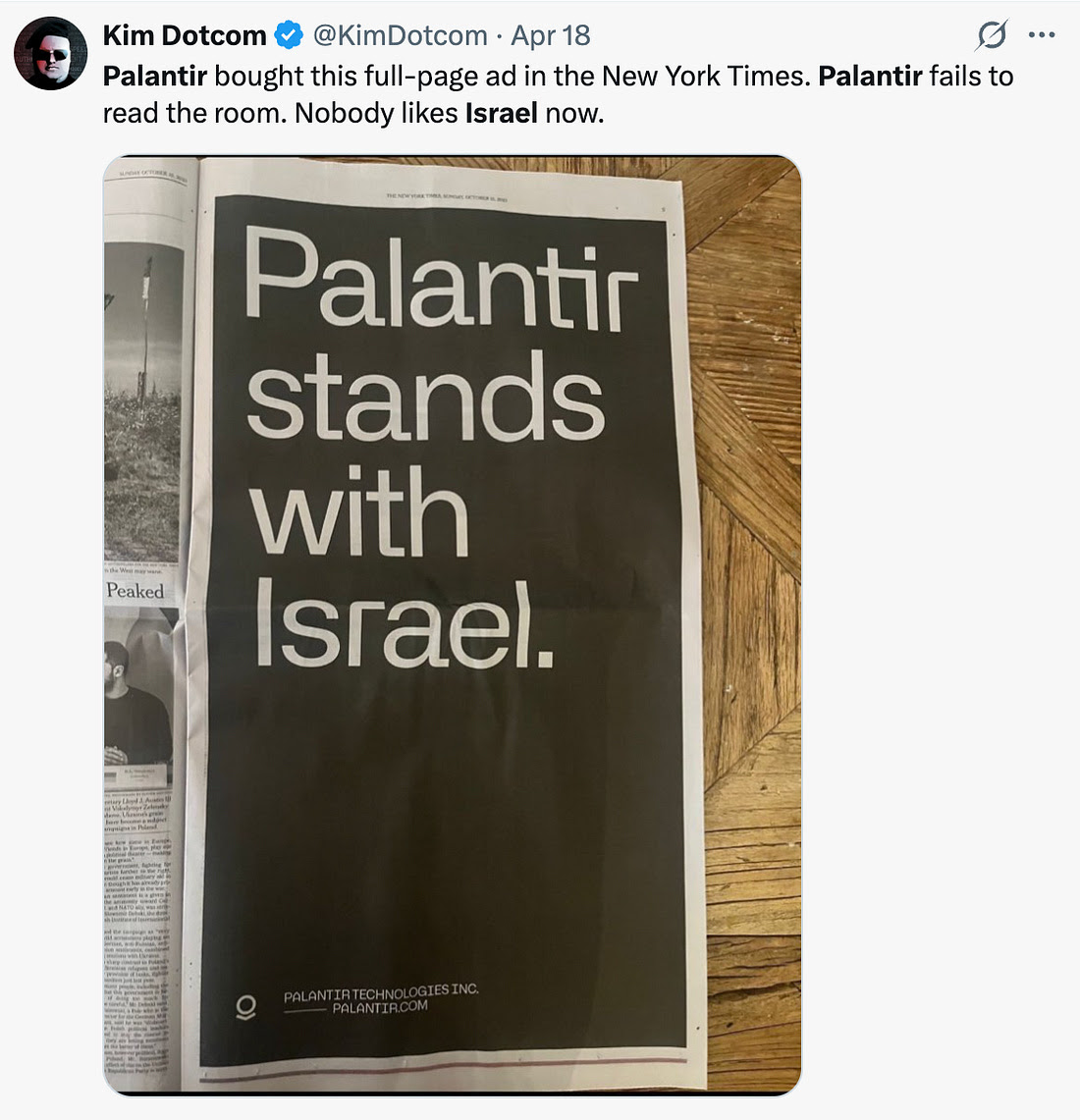 (https://substack.com/redirect/debb1dcd-0b6a-4ffd-916c-243d92641bd0?j=eyJ1IjoiMW42ZTYifQ.vyvZ_z0oLghKX6Zag1WJ71bIfqAlxqUD_SD6A_ZPsUM)
Palantir’s psychotic CEO, Alex Karp, a former progressive, has openly bragged that AI technology disproportionately harms “humanities-trained—largely Democratic—voters, and makes their economic power less. And increases the economic power of vocationally trained, working-class, often male, working-class voters.” (https://substack.com/redirect/ca8eb532-da4a-4fe0-9faa-50529aefe003?j=eyJ1IjoiMW42ZTYifQ.vyvZ_z0oLghKX6Zag1WJ71bIfqAlxqUD_SD6A_ZPsUM)
 (https://substack.com/redirect/fd87301a-b73e-4008-9773-102ae3e39a41?j=eyJ1IjoiMW42ZTYifQ.vyvZ_z0oLghKX6Zag1WJ71bIfqAlxqUD_SD6A_ZPsUM)
Palantir was co-founded by white nationalist billionaire and Epstein ally Peter Thiel, who in 2009, said, “I no longer believe that freedom and democracy are compatible.” (https://substack.com/redirect/525e0ead-4efa-4b3e-9996-25029826c531?j=eyJ1IjoiMW42ZTYifQ.vyvZ_z0oLghKX6Zag1WJ71bIfqAlxqUD_SD6A_ZPsUM) He’s part of the South African Pay Pal mafia (https://substack.com/redirect/efad732e-749d-4f46-91ba-0f9e8ee187c8?j=eyJ1IjoiMW42ZTYifQ.vyvZ_z0oLghKX6Zag1WJ71bIfqAlxqUD_SD6A_ZPsUM) which includes Elon Musk and David Sacks, who is Trump’s Czar of AI and Crypto. Thiel also groomed the political career of JD Vance and hand delivered him to the White House.
These aspiring masters of the universe are unraveling publicly in real time as the masses grow wiser to their techno-fascist machinations. Instead of dialing back their dystopian sci-fi porn, they’re doubling down and using the Trump Administration to realize their apocalyptic end game. They’re also pouring hundreds of millions to purchase the upcoming 2026 and 2028 elections, buying up both Democratic and Republican elections. (https://substack.com/redirect/b068592e-7d8e-4dcf-8f8a-55318a8568e6?j=eyJ1IjoiMW42ZTYifQ.vyvZ_z0oLghKX6Zag1WJ71bIfqAlxqUD_SD6A_ZPsUM)
It’s time to wake up, purge Palantir (https://substack.com/redirect/6c1e5bf2-b244-4ebe-92f4-3fcfa4c47ddb?j=eyJ1IjoiMW42ZTYifQ.vyvZ_z0oLghKX6Zag1WJ71bIfqAlxqUD_SD6A_ZPsUM), and call out all elected officials who continue taking AI and Crypto money....
THE LEFT HOOK with Wajahat Ali https://substack.com/@thelefthook) and Gil Duran (https://substack.com/@gilduran)
Apr 21
REF
On April 18, government surveillance giant Palantir Technologies published a fascist manifesto on X. In response, I pointed out the screed's flagrant fascism.
Among other things, it called for Silicon Valley elites to become a militant arm of the state and suggested imposing a system of compulsory military service.
Two days later, on April 20, I received notice that my X account has been permanently suspended. It was the most fascist response possible to a criticism of fascism—and on Hitler's birthday, no less. Soon, I will have more to say about Palantir's fascist manifesto, which summarized the main points of The Technological Republic, a recent book by Palantir CEO Alex Karp.
Coincidentally, today's episode of the Nerd Reich podcast focuses on Purge Palantir, a campaign to raise awareness of the need to get Palantir out of our government and our lives. Purge Palantir is working with organizers across the country to put a spotlight on the company and its abuses—and anyone can join.
I interview Jacinta Gonzalez and João Paulo Connolly, two organizers at the forefront of the struggle. They explain the reason for their campaign, how Palantir is aiding the authoritarian regime—and how you can get involved.
Please click below to watch the episode (it helps other discover the show!).
Peter Thiel's Palantir Is Watching You. Here's How to Fight Back - YouTube
purge pal campaign working partnerships usa
0:00
Palunteer, one of the most well-known tech companies in the world and one of the most hated. It's a surveillance giant named after an allseeing stone
0:09
9 seconds
wielded by an evil wizard in the Lord of the Rings. The company even called its Apollo alto office the Shire. Its
0:16
16 seconds
co-founder Peter Thiel was recently in Rome obsessed with a different mythology lecturing Catholics about the machinery
0:24
24 seconds
of the Antichrist as he called it tools that will create a global authoritarian government. In response, an adviser to
0:31
31 seconds
the Pope himself publicly accused Teal of building the very machinery he claims to warn against. It's really weird and
0:39
39 seconds
also really scary because here's the truth. Palunteer is now embedded in the Army, the NSA, the FBI, ICE, Border
0:48
48 seconds
Patrol, the Pentagon, and Britain's National Health Service. Members of Congress and Trump officials are buying Palunteer stock while handing it
0:56
56 seconds
billions in contracts. Just like the fabled allseeing eye, it's working with the White House to merge every federal database to see everything about you.
1:05
1 minute, 5 seconds
Your health records, your financial transactions, your location data,
1:09
1 minute, 9 seconds
everything into one system. In this episode of the Nerdite podcast, I speak with two organizers from the Purge Palunteer campaign. It's a drive to
---
---
GOOD BKGD ON LIBTARDS

You Don't Need Democracy If You Don't Have People: Quinn Slobodian's Warning

23.7K subscribers
6,741 views Feb 8, 2026 The Nerd Reich with Gil Duran
Will tech billionaires get rid of democracy by getting rid of people? In this episode of The Nerd Reich, Gil Duran sits down with renowned historian Quinn Slobodian (Globalists, Crack-Up Capitalism) to dissect the "ideology of exit." While the media focuses on failed "Freedom City" experiments like Prospera, Slobodian reveals a darker endgame: a shift toward automated, "post-human" infrastructure where voters are no longer part of the equation. In this episode, we explore:
The Hong Kong Blueprint: How a colonial relic became the template for 21st-century capitalism. Authoritarian Capitalism: Why Silicon Valley elites are obsessed with models of control. The Post-Human Zone: Why the future of "sovereignty" belongs to Manhattan-sized data centers, not citizens. The Octavia Butler Reality: What if future isn't about escaping the "company town," but fighting to get inside one? Connect with Quinn Slobodian: https://bsky.app/profile/quinnslobodi...New Book: Muskism: A Guide for the Perplexed (Releasing April 21, 2026): https://www.harpercollins.com/product...Must Read: Crack-Up Capitalism: Market Radicals and the Dream of a World Without Democracy: https://us.macmillan.com/books/978125...#CrackUpCapitalism #NetworkState #SiliconValley #tech #digitalfeudalism #FutureOfDemocracy
---
---
GMAIL 1 26
How Capturing Greenland and Venezuela Helps The Oligarchs Create Their Techno-Fascist State
Since 2019, the Silicon Valley broligarchs have dreamt of creating their techno-fascist "network states" in Greenland. After Trump's invasion in Venezuela, they're a big step closer to their goals.
...
Peter Thiel, the white nationalist billionaire and groomer of JD Vance, has long imagined the creation of “network states” run by tech oligarchs like himself, where “free cities” will be unbothered by anti-capitalist notions of democracy, rules-based order, and human rights.
These techno-utopias need land for them to seed and birth their fascist, decentralized nations where cryptocurrency reigns supreme, AI has replaced labor, and a surveillance state can ensure a docile, compliant population that will be grateful to be ruled by the new Gods who adhere to eugenics and white supremacy.
If all of this seems like bad, dystopian science fiction written by a horny, dorky high schooler, then clearly you haven’t been paying attention to the tech bros who have openly outlined their vision for the future. They’ve even attempted it with their “free city” Praxis, which has launched with less than successful results. They want to try to make it a reality in Greenland, and also loot the land of its resources and minerals in the process. This is something they’ve been dreaming about since 2019, even before Trump illegally invaded Venezuela, which they also want to loot, and announced he “needs” Greenland, which is not his to take.
In addition to the oil companies and war mongers who benefit from the military-industrial complex, the Silicon Valley tech bros are actively supporting Trump’s “Donroe Doctrine,” to further their supervillain plans for world domination. They want a weakened America that will allow them to carve up the world into different spheres of influence that will help them create their techno-fascist utopia before they leave Earth and repopulate humanity on Mars.
Again, all of this sounds like madness, and that’s because the world’s dumbest, most immoral people have all the money and are operating without any restraints, oversight, or accountability. Thankfully, journalists Jacob Silverman, author of Gilded Rage, and Gil Duran, editor of The Nerd Reich, have been following the oligarchs, the tech bros, and the money trail that leads directly to the Trump White House. Unfortunately, this isn’t bad science fiction. This is what’s happening in 2026 as the broligarchs are openly plotting to upend democracy and nation-states to satiate their own voracious appetites and imperialistic agendas.
Gil and Jacob join me to uncover and expose the broligarchy’s plot to use Donald Trump and MAGA to create their techno-fascist utopia.
---
12:23
Which people told you to pardon him?
12:26
Because curiously, Hernandez had spent
12:28
years cozing up to the far right in the
12:30
US and made himself a lot of friends.
12:32
According to the Wall Street Journal, he
12:34
forged a partnership with Kelsey Warren,
12:36
a Texas energy billionaire and major
12:38
Trump donor who owns a utility company
12:40
in the country. Hernandez also helped
12:42
propel the privatized city of Prosper in
12:44
the country, a project in which Trump
12:46
donors Peter Teal, Mark Andre, Sam
12:48
Alman, and CEO of Coinbase Brian
12:50
Armstrong are all heavily invested.
12:53
Hernandez was their meal ticket. As Gil
12:56
Duran writes, he championed special
12:58
economic zones where investors could set
13:00
their own tax, labor, and regulatory
13:02
rules under long-term legal guarantees.
13:05
However, when Hernandez's successor,
13:07
Samara Castro, came into office, she
13:10
rolled back the special economic zones.
13:12
That made longtime Trump fixer Roger
13:14
Stone write in January on his Substack.
13:17
Yes, even cartoon villains are on
13:19
Substack that Trump should crush
13:22
socialism and save a freedom city known
13:24
as Prosper. And indeed, it was Stone
13:27
that met with Trump at Mara Lago and
13:29
lobbyed him to pardon Hernandez. So yes,
13:32
400 tons of cocaine are a-ok okay to
13:35
enter the US. I mean, how else is
13:38
Palanteer's Alexander Karp supposed to
13:40
sit through an entire interview?
13:42
Lot of decisions when we began talking
13:44
annoying each other 10 years ago.
13:46
Hopefully I'm annoying you as much as 10
13:47
years ago. Uh or more uh when when when
13:52
Sorry, did I say sit? I meant fly. Now,...
The Bitchuation Room (with Francesca Fiorentini)
---
---
AN
COMM DR 12 25
Venture capitalist Joe Lonsdale, a co-founder of data platform company Palantir, is calling for the return of public hangings as part of a broader push to restore what he describes as “masculine leadership” to the US.
In a statement posted on X Friday, Lonsdale said that he supported changing the so-called “three strikes” anti-crime law to ensure that anyone who is convicted of three violent crimes gets publicly executed, rather than simply sent to prison for life.
“If I’m in charge later, we won’t just have a three strikes law,” he wrote. “We will quickly try and hang men after three violent crimes. And yes, we will do it in public to deter others.”
Lonsdale then added that “our society needs balance,” and said that “it’s time to bring back masculine leadership to protect our most vulnerable.”
Lonsdale’s views on public hangings being necessary to restore “masculine leadership” drew swift criticism.
Gil Durán, a journalist who documents the increasingly authoritarian politics of Silicon Valley in his newsletter “The Nerd Reich,” argued in a Saturday post that Lonsdale’s call for public hangings showed that US tech elites are “entering a more dangerous and desperate phase of radicalization.”
“For months, Peter Thiel guru Curtis Yarvin has been squawking about the need for more severe measures to cement Trump’s authoritarian rule,” Durán explained. “Peter Thiel is ranting about the Antichrist in a global tour. And now Lonsdale—a Thiel protégé—is fantasizing about a future in which he will have the power to unleash state violence at mass scale.”
Taulby Edmondson, an adjunct professor of history, religion, and culture at Virginia Tech, wrote in a post on Bluesky that the rhetoric Lonsdale uses to justify the return of public hangings has even darker intonations than calls for state-backed violence.
“A point of nuance here: ‘masculine leadership to protect our most vulnerable’ is how lynch mobs are described, not state-sanctioned executions,” he observed.
Theoretical physicist Sean Carroll argued that Lonsdale’s remarks were symbolic of a kind of performative masculinity that has infected US culture.
“Immaturity masquerading as strength is the defining personal characteristic of our age,” he wrote.
Tech entrepreneur Anil Dash warned Lonsdale that his call for public hangings could have unintended consequences for members of the Silicon Valley elite.
“Well, Joe, Mark Zuckerberg has sole control over Facebook, which directly enabled the Rohingya genocide,” he wrote. “So let’s have the conversation.”
And Columbia Journalism School professor Bill Grueskin noted that Lonsdale has been a major backer of the University of Austin, an unaccredited liberal arts college that has been pitched as an alternative to left-wing university education with the goal of preparing “thoughtful and ethical innovators, builders, leaders, public servants and citizens through open inquiry and civil discourse.”
---
FB VID]
Brian Masck
·December 5, 2025 at 10:49 AM ·
Prospera, founded with funding from tech bros Peter Thiel, Sam Altman and others, operates on a small island in Honduras previously solely populated with an Afro-indigenous population. The city-state operates almost entirely independent of the country, including its own justice system in the form of 3 retired Arizona judges who rule via zoom.
When Prospera was created, they relied on then-president Hernandez to create special zones and set up a loose oversight organization which he loaded with his allies. Now that he is out of office, the liberal government has begun asking questions about Prospera, complaining about their lack of investment in the region, and have attempted to back out of agreements that require them to pay significant fines if the community fails.
As the Honduran government turned against
Prospera, the founders spent half a million dollars in the US to buy support from elected officials, urging them to sanction Honduras and deny visas to its politicians. Now, it appears they are banking on the election of a Trump-backed conservative candidate to ensure Prospera can continue its uninterrupted plundering of the region.
Background: plenty of people find Próspera’s goal — “building the future of human governance: privately run and for-profit” — unsettling. Critics have described it as a neocolonial state within a state, or an example of corporate monarchy, where yacht-owning C.E.O.s exploit land and labor in a poor country. Keller Easterling, the urbanist and architectural theorist, considers Próspera a city in name only, akin to “say, Mattress City.” Really, she says, the zones are low-tax, deregulated marketplaces.
As we peered over the edge of the tower’s rooftop, I considered the story of a subcontractor who was working at the apartment tower at night two months earlier. The power had gone out, and he walked to the edge of the floor to yell down to his crew to turn on a generator, but took a step too far and fell to his death. If companies choose their own regulatory frameworks, as they do in Próspera, who holds them accountable if they endanger or harm one of their employees?
“Próspera ZEDE has its own set of labor systems,” Colindres said when I asked him about it later. He told me the worker’s family was compensated appropriately — receiving at least as much as was required under Honduran law — but he declined to disclose details. If an independent investigation took place, its findings have not been released to the public. After all, the point of a place like Próspera is that there isn’t really a “public” to speak of.
This lack of transparency is one common criticism of Próspera, and today, it’s unclear whether this experiment can continue. In recent years, vehement opposition from the Honduran government and neighboring communities has imperiled Próspera’s future. Now its fate — and that of the private-cities movement writ large — hangs in the balance of a high-stakes case before an international tribunal.
---
GGL 12 25
[### Gil Duran on Trump, Tech, and “The Nerd Reich”

Commonwealth Club World Affairs
https://www.commonwealthclub.org › archive › video](https://www.commonwealthclub.org/events/archive/video/gil-duran-trump-tech-and-nerd-reich)
Jul 14, 2025 — A belief system journalist Gil Duran describes as “tech fascism.” In his newsletter “The Nerd Reich,” Duran looks at how controversial writers such as Curtis ...Read more
RACHEL CORBET NYT
The Backstory:I have been writing about this weird Network State stuff over the past year because very few journalists have seemed interested in telling the story. Even as a growing number of tech bro types have crowed about their plans to create post-democracy cities – and taken steps to create them – the mainstream press has remained ominously silent. But this appears to be changing.
In "The For-Profit City That Might Come Crashing Down," Rachel Corbett tells the story of Próspera, a Network State project on the Honduran island of Roatán. Her story mentions Peter Thiel, Marc Andreessen, Balaji Srinivasan, the East Solano Plan (a.k.a. California Forever) and many other names that will be familiar to readers of The Nerd Reich:
There are about three dozen charter cities currently operating in the world, according to an estimate from the Adrianople Group, an advisory firm that concentrates on special economic zones. Several others are under development, including the East Solano Plan, run by a real estate corporation that has spent the last seven years buying up $900 million of ranch land in the Bay Area to build a privatized alternative to San Francisco; Praxis, a forthcoming “cryptostate” on the Mediterranean; and the Free Republic of Liberland, a three-square-mile stretch of unclaimed floodplain between Serbia and Croatia. Many of the same ideologically aligned names — Balaji Srinivasan, Peter Thiel, Marc Andreessen, Friedman — recur as financial backers; Patrik Schumacher, principal of Zaha Hadid Architects and a critic of public housing, is behind several of their urban (or metaversal) designs.
And here's a detail that will ring familiar to readers in Solano County, where a group of Network State-connected investors is trying to build a new tech utopia city called California Forever: The backers of Próspera have filed an $11 billion lawsuit against the Honduran government. The conflict arose after a new government sought to make Próspera pay its fair share.
The endemic corruption in Honduras, the sort of thing Próspera was supposed to combat, was also what enabled its creation and has plagued its pursuit of legitimacy. For Hondurans, the prospect of American capitalists promising prosperity may instead resurrect fears of exploitation and dispossession. Despite Próspera’s fantasy of exit, it uses roads, hospitals and ports built by the municipal government, and it shares an economy and ecosystem with its neighbors in Crawfish Rock.
I encourage you to read the whole story and share it with anyone who might be interested.
Analysis:It's great to see this story in the NYT. While her piece looks specifically at Próspera, Corbett does a great job of outlining all of the characters involved. She even mentions Balaji Srinivasan's "tech Zionism" quote from a podcast interview I surfaced in the New Republic in April:
Srinivasan, the former Coinbase chief technology officer and now an adviser to Pronomos Capital, Friedman’s fund to build start-up cities, argued in his 2022 book “The Network State” that these new business-friendly hubs would soon compete with nation-states and, one day, replace them. “The Network State” was inspired, he said, by the state of Israel. “That country was started by a book,” he tweeted in 2022, referring to Theodor Herzl’s 1896 manifesto, “The Jewish State.” “You can found a tribe,” Srinivasan said on a podcast. “What I’m really calling for is something like tech Zionism — when a community forms online and then gathers in physical space to form a ‘reverse diaspora.’”
This story is major progress, and hopefully a sign that people will start to pay closer attention to this issue. When I first started writing about this, it seemed like some kind of weird and obscure conspiracy thing. But now it's the subject of a long piece in the Times, and wide out in the open for all to see.
And big thanks to everyone who has been pushing to get this story out there. You know who you are.
---
REF
The For-Profit City That Might Come Crashing Down
The dream of Próspera, founded by a U.S. corporation off the coast of Honduras, was to escape government control. The Honduran government wants it gone.
Ricardo González, legal consultant for Honduras Próspera Inc., looking out on the Honduran island of Roatán.Credit...Brian Finke for The New York Times
Share full article
343
By Rachel Corbett
Published Aug. 28, 2024
Updated Sept. 19, 2024
Leer en español
Jorge Colindres, a freshly cologned and shaven lawyer, handed me a hard hat to take the elevator to the 14th floor of what is now the tallest building on the Honduran island of Roatán — nearly twice what the local building code allows. When construction is complete, Duna Residences will house 82 units overlooking a jungle of palm trees, the Caribbean Sea and several other new buildings that the Honduran government considers illegal.
Listen to this article with reporter commentary
If Próspera were a normal town, Colindres would be considered its mayor; his title here is “technical secretary.” As we looked out over a clearing in the trees in February, he pointed to the small office complex where he works collecting taxes and managing public finances for the city’s 2,000 or so physical residents and e-residents, many of whom have paid a fee for the option of living in Próspera or remotely incorporating a business there. Nearby is a manufacturing plant that is slated to build modular houses along the coast designed by Zaha Hadid Architects. About a mile in the other direction are some of the city’s businesses: a Bitcoin cafe and education center, a genetics clinic, a scuba shop. A delivery service for food and medical supplies will deploy its drones from this rooftop.
There’s not much else to see yet. But the Delaware-based company that founded this experimental town in 2017 has raised $120 million in investments — including from venture-capital funds backed by the Silicon Valley billionaires Peter Thiel, Sam Altman and Marc Andreessen — to transform the territory, about twice the size of Monaco, into the most developed start-up city in the world. Built in a semiautonomous jurisdiction known as a ZEDE (a Spanish acronym for Zone for Employment and Economic Development), Próspera is a private, for-profit city, with its own government that courts foreign investors through low taxes and light regulation. Businesses can choose a regulatory framework from a menu of 36 countries or customize their own.
A California company offers a Montessori education for approximately 60 students. Security is provided by a private firm of armed guards. An arbitration center staffed by three retired Arizona judges handles dispute resolution. (In order to enter the jurisdiction, I was told I needed to sign an “agreement of coexistence” binding myself to 4,202 pages of rules, violations of which would be subject to the jurisdictional authority of the arbitration center.)
Image
Jorge Colindres, the 31-year-old lawyer who would be considered Próspera’s mayor — if Próspera were a normal town.Credit...Brian Finke for The New York Times
Thank you for your patience while we verify access. If you are in Reader mode please exit and log into your Times account, or subscribe for all of The Times.
---
FULL?
The For-Profit City That Might Come Crashing Down
The dream of Próspera, founded by a U.S. corporation off the coast of Honduras, was to escape government control. The Honduran government wants it gone.
Ricardo González, legal consultant for Honduras Próspera Inc., looking out on the Honduran island of Roatán.Credit...Brian Finke for The New York Times
By Rachel Corbett
Published Aug. 28, 2024
Updated Sept. 19, 2024
Jorge Colindres, a freshly cologned and shaven lawyer, handed me a hard hat to take the elevator to the 14th floor of what is now the tallest building on the Honduran island of Roatán — nearly twice what the local building code allows. When construction is complete, Duna Residences will house 82 units overlooking a jungle of palm trees, the Caribbean Sea and several other new buildings that the Honduran government considers illegal.
Listen to this article with reporter commentary
If Próspera were a normal town, Colindres would be considered its mayor; his title here is “technical secretary.” As we looked out over a clearing in the trees in February, he pointed to the small office complex where he works collecting taxes and managing public finances for the city’s 2,000 or so physical residents and e-residents, many of whom have paid a fee for the option of living in Próspera or remotely incorporating a business there. Nearby is a manufacturing plant that is slated to build modular houses along the coast designed by Zaha Hadid Architects. About a mile in the other direction are some of the city’s businesses: a Bitcoin cafe and education center, a genetics clinic, a scuba shop. A delivery service for food and medical supplies will deploy its drones from this rooftop.
There’s not much else to see yet. But the Delaware-based company that founded this experimental town in 2017 has raised $120 million in investments — including from venture-capital funds backed by the Silicon Valley billionaires Peter Thiel, Sam Altman and Marc Andreessen — to transform the territory, about twice the size of Monaco, into the most developed start-up city in the world. Built in a semiautonomous jurisdiction known as a ZEDE (a Spanish acronym for Zone for Employment and Economic Development), Próspera is a private, for-profit city, with its own government that courts foreign investors through low taxes and light regulation. Businesses can choose a regulatory framework from a menu of 36 countries or customize their own.
A California company offers a Montessori education for approximately 60 students. Security is provided by a private firm of armed guards. An arbitration center staffed by three retired Arizona judges handles dispute resolution. (In order to enter the jurisdiction, I was told I needed to sign an “agreement of coexistence” binding myself to 4,202 pages of rules, violations of which would be subject to the jurisdictional authority of the arbitration center.)
Image
Jorge Colindres, the 31-year-old lawyer who would be considered Próspera’s mayor — if Próspera were a normal town.Credit...Brian Finke for The New York Times
Próspera has become particularly well known for the zone’s experimental medical facilities, which run clinical trials unburdened by F.D.A. standards. The week of my visit, Patri Friedman, grandson of the economist Milton Friedman and the founder of a start-up-cities fund that invested in Próspera, had a chip with his Tesla key implanted into his hand. On a previous trip he brushed his teeth with genetically modified bacteria purported to prevent cavities. Another time he was injected with a protein booster intended to make him “stronger and faster,” as he put it at a conference in Roatán that weekend.
“I can tell you when Próspera became most real for me,” Friedman told the audience. “When I sat down to fill out my informed-consent forms that said, like, ‘This agreement is adjudicated under the laws of the Próspera ZEDE; any disputes are arbitrated by the Próspera Arbitration Center.’ Like, you are under a different set of laws.”
There are more than 5,400 of these special economic zones in the world, ranging on a spectrum from free ports for duty-free trading all the way to the special administrative region of Hong Kong. About 1,000 zones have cropped up in just the past decade, including dozens of start-up cities — sometimes called charter cities — most of them in developing nations like Zambia and the Philippines. Some have actually grown into major urban centers, like Shenzhen, which went from a fishing village to one of China’s largest cities, with a G.D.P. of $482 billion, after it was designated a special economic zone in 1980.
Each zone offers a degree of escape from government oversight and taxation, a prospect that has excited libertarian and anarcho-capitalist thinkers at least since Ayn Rand imagined a free-market utopia called Galt’s Gulch in “Atlas Shrugged.” Today, escalating clashes between the government and Big Tech — like the S.E.C.’s regulatory war on crypto, or the Federal Aviation Administration’s repeated investigations into SpaceX — have spurred some Silicon Valley entrepreneurs to seek increasingly splintered-off hubs of sovereignty. And with government dysfunction preventing reforms even in wealthy cities like San Francisco, locked in a decades-long affordable-housing crisis, and New York City, which just lost out on as much as $1 billion when Albany scrapped a 17-years-in-the-making congestion pricing plan that would have funded public transit, it’s not hard to see the appeal of starting from scratch.
Image
Pristine Bay, a gated golf community and beach club near Próspera. Parts of the community are now part of the Próspera zone.
González at the Pristine Bay Beach Club. The question of Próspera’s expansion plans drives much of the opposition to the project.Credit...Brian Finke for The New York Times
In promotional materials, Próspera markets itself to “21st-century pioneers” craving not just laissez-faire policies but also “good times and Caribbean vibes.” Direct flights from Miami and Houston can transport these digital nomads to Roatán in less than three hours. Then, from a chaise longue on the beach, they can register a business with the tap of a button. Although only one residential building has been built so far, a forthcoming eco-condo was during my visit courting buyers seeking “more personal freedom” and less “political drama.” Próspera’s original investment plan projected that by 2030 the city would be home to 38,000 residents, and that foreign direct investment in the country would top $500 million by next year.
But plenty of other people find Próspera’s goal — “building the future of human governance: privately run and for-profit” — unsettling. Critics have described it as a neocolonial state within a state, or an example of corporate monarchy, where yacht-owning C.E.O.s exploit land and labor in a poor country. Keller Easterling, the urbanist and architectural theorist, considers Próspera a city in name only, akin to “say, Mattress City.” Really, she says, the zones are low-tax, deregulated marketplaces.
As we peered over the edge of the tower’s rooftop, I considered the story of a subcontractor who was working at the apartment tower at night two months earlier. The power had gone out, and he walked to the edge of the floor to yell down to his crew to turn on a generator, but took a step too far and fell to his death. If companies choose their own regulatory frameworks, as they do in Próspera, who holds them accountable if they endanger or harm one of their employees?
“Próspera ZEDE has its own set of labor systems,” Colindres said when I asked him about it later. He told me the worker’s family was compensated appropriately — receiving at least as much as was required under Honduran law — but he declined to disclose details. If an independent investigation took place, its findings have not been released to the public. After all, the point of a place like Próspera is that there isn’t really a “public” to speak of.
This lack of transparency is one common criticism of Próspera, and today, it’s unclear whether this experiment can continue. In recent years, vehement opposition from the Honduran government and neighboring communities has imperiled Próspera’s future. Now its fate — and that of the private-cities movement writ large — hangs in the balance of a high-stakes case before an international tribunal.
Image
González, left, at Duna Residences, an 82-unit tower whose completion was threatened by Próspera’s legal and financial tangle.Credit...Brian Finke for The New York Times
There are about three dozen charter cities currently operating in the world, according to an estimate from the Adrianople Group, an advisory firm that concentrates on special economic zones. Several others are under development, including the East Solano Plan, run by a real estate corporation that has spent the last seven years buying up $900 million of ranch land in the Bay Area to build a privatized alternative to San Francisco; Praxis, a forthcoming “cryptostate” on the Mediterranean; and the Free Republic of Liberland, a three-square-mile stretch of unclaimed floodplain between Serbia and Croatia. Many of the same ideologically aligned names — Balaji Srinivasan, Peter Thiel, Marc Andreessen, Friedman — recur as financial backers; Patrik Schumacher, principal of Zaha Hadid Architects and a critic of public housing, is behind several of their urban (or metaversal) designs.
Srinivasan, the former Coinbase chief technology officer and now an adviser to Pronomos Capital, Friedman’s fund to build start-up cities, argued in his 2022 book “The Network State” that these new business-friendly hubs would soon compete with nation-states and, one day, replace them. “The Network State” was inspired, he said, by the state of Israel. “That country was started by a book,” he tweeted in 2022, referring to Theodor Herzl’s 1896 manifesto, “The Jewish State.” “You can found a tribe,” Srinivasan said on a podcast. “What I’m really calling for is something like tech Zionism — when a community forms online and then gathers in physical space to form a ‘reverse diaspora.’”
The concept might have stayed on the fringes of libertarian and neoreactionary forums had Paul Romer, who would go on to be the chief economist of the World Bank and win the Nobel Prize, not made charter cities the subject of an influential 2009 TED Talk. He projected a photo of students in an African country doing their homework under streetlights, explaining that their government required the electric company to provide power at such low prices that the company decided not to service the homes in their area at all. When the president tried to reform the system, he went on, consumers and business leaders pushed back, and ultimately, nothing changed. Romer argued that charter cities would give developing countries a chance to prosper by ceding uninhabited territory to wealthier nations to develop.
This ruling country would act as a “guarantor” to the host country and write its own laws and regulations, which would attract private companies to invest and build the cities. In turn, jobs, technology and educational opportunities would pour into the host country, which would share in the revenue, too. Locals would stop leaving for richer countries, migrants would come to the zone, a virtuous cycle would take hold and students wouldn’t need to do their homework in the streets. “The city can be built,” Romer said in his talk. “And we can scale this model. We can go do it over and over again.”
Around the same time that Romer was delivering his TED Talk, Honduran soldiers stormed the home of the country’s left-wing president, Manuel Zelaya. They led him outside at gunpoint, still in his pajamas, and put him on a plane to Costa Rica. Zelaya had been planning to hold a public referendum on reforming the Constitution, which his critics saw as an attempt to illegally extend term limits. Shortly after the coup, the military held another election; it put into office the conservative candidate Porfirio Lobo, who lost the previous contest to Zelaya. Several nations, including the United States, questioned the legitimacy of an election staged by leaders of the coup.
President Lobo’s chief of staff, the Harvard-educated lawyer Octavio Sánchez, saw Romer’s TED Talk and thought it was just what Honduras needed to achieve economic prosperity. Sánchez arranged a meeting in Miami among Romer, Lobo and the president of Congress, Juan Orlando Hernández. Lobo told Romer that to do something as significant as he proposed — to create a zone that would replace Honduran laws with those of a wealthier nation — they’d need to amend the Constitution.
Romer visited Tegucigalpa soon after. Honduras, a country where over half the population lived in poverty and 75,000 people left each year for better opportunities in the United States, was an ideal testing ground for his vision. When Romer returned home, he recorded a follow-up TED Talk titled “The World’s First Charter City?”
A tumultuous three years followed: Romer and the oversight board he helped set up were sidelined, and the Honduran Supreme Court initially rejected the constitutional amendment. But Congress, led by Hernández, dismissed the four opposing judges in what some critics called a “technical coup.” (Hernández, who succeeded Lobo as president of Honduras, continued to have a career marred by corruption and was recently sentenced to 45 years in a United States federal prison for drug trafficking.) In 2013, Honduras amended its constitution to allow for the creation of autonomous zones, following China and the United Arab Emirates.
Image
The Duna Residences, under construction earlier this year. The building was completed in June.
I met Colindres outside his office on a “Wellness Wednesday.” Catering staff had set out fruit and granola bars on the counter of an open-air cafeteria at the city’s headquarters, a small complex of three interconnected buildings on a manicured tropical lawn. A guard in black combat fatigues with a double-barreled rifle paced near a porch swing. Colindres, who is 31, peeled an orange as he began to tell me about his family’s history in Honduras. One of his grandfathers fought in the Honduran armed forces against communism during the Cold War. Later, his uncle, the president of the chamber of commerce, was taken hostage by Communist guerrillas. Colindres’s hero is the family’s capitalist success story: his great-grandfather Constantino Marinakys, who immigrated from Greece after World War I and built a fortune, in part by opening grocery stores during the country’s banana boom in the early 20th century.
In the late 1800s, Honduras owed immense debt to Britain, and began offering land and financial incentives to attract foreign investment. Eventually, U.S. banana companies, like Cuyamel and United Fruit (now Chiquita), built railroads, port infrastructure and other projects in exchange for land. By the beginning of World War I, O. Henry had named the country the original “banana republic.” The six largest banana companies owned more than a million acres of fertile land on Honduras’s northern coast, and in 1911, one orchestrated a coup to install a puppet government.
Where many see a story about exploitation, Colindres describes one of private-sector productivity. As workers migrated to the coasts to work, the plantations grew into small cities with their own housing, schools, hospitals and stores. “Back then there was very poor infrastructure, and so when the banana companies came everything had to be done,” Colindres said. “No roads, no electricity — all of what we consider public infrastructure in Honduras, it was put in by the private sector.”
Colindres’s political views started hardening as a teenager living through the coup of 2009. He went to law school and came to the conclusion that he’d have to leave Honduras for the United States if he wanted to have a fulfilling career. But then came news that the ZEDE constitutional amendment had passed. Honduran law preserved national authority over a few fields, like criminal law, but granted the zones broad freedom to establish their own courts, fiscal policies and labor and environmental protections.
In 2014, as required by the amendment, Juan Orlando Hernández appointed a group to oversee the ZEDEs. Early members included a granddaughter of the final Austrian emperor and a band of Republicans from the U.S. that included the former Reagan speechwriter Mark Klugmann, the anti-tax activist Grover Norquist, the former Reagan aide Faith Whittlesey, the libertarian economist Mark Skousen and Ronald Reagan’s son Michael Reagan. A couple of years later, Honduran lawmakers heard about an Arizona entrepreneur named Erick Brimen who was lobbying Washington to make creative use of the U.S. Constitution’s Compact Clause to pass a bill establishing low-regulation “prosperity zones.” Brimen was having a hard time implementing his vision in the States, so took the Hondurans up on their offer to develop a zone like the one Romer imagined, but run by a private company rather than by another nation.
Brimen, who grew up in a wealthy family in Venezuela until he moved to the United States at 12, met Gabriel Delgado, a Guatemalan entrepreneur who had already identified a couple of plots of land in Roatán as potential sites. In 2017, they decided to work together, with Brimen acting as chief executive and Delgado heading up fund-raising and real estate development. They secured early investments from Friedman’s Pronomos Capital and an unnamed investor “behind” SpaceX. But their success in establishing the first ZEDE, they said, is due in part to keeping their ideological beliefs quiet. “Instead of saying we are trying to create a libertopia,” Brimen told the libertarian magazine Reason in 2021, “we shifted the conversation away from advancing a political ideology toward, yes, liberty, but as a tool to development.” After a brainstorming session, Brimen came up with a name that might accomplish that: Honduras Próspera, Inc.
When Colindres heard the news that the project had broken ground, he reached out to Brimen, who expressed interest in his 2019 paper “Make Honduras Great: Charter Cities as a Development Program.”
“He said, ‘I also want to make Honduras great,’” Colindres recalled. He promised Brimen his support. “Let me bring all my contacts and all my clients and everybody to join,” he told him. “And then that’s what I did.”
Próspera has now incorporated 222 businesses into the ZEDE, including an outsource staffing agency and scores of experimental medical centers. Minicircle, founded by two young biohackers, offers a product that they say might cure Alzheimer’s and suppress all tumors; Symbiont Labs manufactures implants that turn people into “self-sovereign cyborgs”; the Bay Islands Fitness and Transformation Center offers affordable semaglutide injections; and the Global Alliance for Regenerative Medicine provides stem-cell treatments. (A man sitting next to me on my flight from Roatán showed me severe burns on his arms that he’d come to treat at the clinic.) While I was visiting, a “pop-up city” called Vitalia used a dome it had erected on Próspera’s grounds to host events for biotech innovators who want to “make death optional.”
Much of the activity at Próspera takes place not in the area where the Duna tower stands and Colindres works but a 15-minute drive away at Pristine Bay, a green, gated golf community and beach club. Starting in 2021, Próspera began incorporating parts of the resort into the zone. Down by the tennis courts, I saw Vitalia’s white-tented dome, though organizers did not allow me to attend any of its events. Reason wouldn’t grant me access to a conference it was hosting at the hotel either. So I hung out by the pool, and down the street at AmityAge Academy, an old restaurant that a Slovakian math tutor had turned into a Bitcoin education center and cafe.
Image
A factory on Roatán supplying prefabricated parts for residences designed by Zaha Hadid Architects.Credit...Brian Finke for The New York Times
Image
AmityAge Academy, a former restaurant in Próspera turned into a Bitcoin education center and cafe by a Slovakian math tutor.Credit...Brian Finke for The New York Times
That’s where I met Zussel Ramos, at the time AmityAge’s 25-year-old lead educator, next to a bookshelf stocked with Ludwig von Mises’s “Bureaucracy,” Ayn Rand’s “Capitalism” and Jordan Peterson’s “12 Rules for Life.” I bought a coffee — the barista let me pay with “fiat” paper money on a one-time basis — and then Ramos took me on a tour. On the walls downstairs hung a Bitcoin mining machine, a portrait of Guy Fawkes astride a bucking green stallion and a map of Roatán with colored squares of paper marking the dozens of businesses that now accept Bitcoin, largely thanks to Ramos’s door-to-door persistence.
Ramos told me she couldn’t wait to move to Próspera — probably to the Duna tower. Then she’d apply for physical residency, giving her the right to vote in Próspera’s council elections, at least on some of the seats; if she buys property, she’ll be able to cast votes for an additional two seats — one vote for every square meter of land she owned, under the current rules. For now, very few people actually live full time in the ZEDE, which is a checkerboard of territory across both the island and the mainland. It started out with 58 acres in Roatán, but since a ZEDE’s territory doesn’t need to be contiguous, it has added 385 acres in La Ceiba on the mainland, followed by another 239 acres of Roatán’s Port Royal and then 322 acres of Pristine Bay.
Just how much land the Próspera ZEDE plans to absorb is the source of much of the conflict that now vexes the project. Early promotional images sparked outrage for depicting the north coast of the island dotted with skyscrapers, futuristic houses and yacht-filled ports, rather than the wooden shacks and jungle that exist there now. One image that forecast the growth of Próspera from a village to a town to a city made it look as if the project had “started engulfing the areas around it,” says Ricardo González, a legal consultant for Honduras Próspera Inc. “It was taken literally” by the people who lived in those areas, he says, but it shouldn’t have been. “Everything is voluntary, we cannot just pick up your land and say now it’s part of us.”
Image
González says that worries by Próspera’s neighbors that it might annex its surroundings are unwarranted.Credit...Brian Finke for The New York Times
But it is also true that the ZEDE law allows the Honduran government to compel landowners to sell to a zone, so long as they are paid fair market value for the property. Brimen insists that Próspera would never take advantage of that provision, because it violates the sanctity of private-property rights, and that the company has self-imposed “the highest possible limitations on this in its charter.” Nevertheless, the provision’s existence set in motion a spectacular series of events as Próspera began incorporating land.
The Duna tower stands next to a fork in the road, with one path leading to the Próspera gate, manned by guards carrying guns and contracts, and the other winding down a dirt path to a small fishing village called Crawfish Rock. Roatán, thanks to its thriving tourism industry, generates more money than many parts of Honduras, but Crawfish Rock — home to a Black, English-speaking community (Roatán is a former British colony) — is an exception. Turquoise and peach houses sag and lean on stilts, their roofs patchworks of corrugated-metal scraps.
According to Vanessa Cárdenas, vice president of Crawfish Rock’s patronato, or community board, it was 2019 when the first Próspera representatives came to the community, informing them of plans to develop a nearby resort. “It’s quite normal for us to have this kind of restricted, gated community popping up,” Cárdenas said. The island is full of them. They also wanted to do community development, they told her, and offered small-business loans to Crawfish Rock residents. But then odd things started to happen, Cárdenas said.
Próspera stationed armed guards on the road. Then Brimen tried to form a new patronato that Cárdenas said was stacked with Próspera employees. (A Próspera representative disputed this.) In 2020, Cárdenas received a voice message from someone in the community that said, “This project is not a normal project.” So she and Luisa Connor, the president of the patronato, began to research Próspera. They learned about the ZEDE law and about the involuntary sale of land. “By no means did they explain to us” what a ZEDE was, Connor says. “They came as a normal resort they were going to build next to the community.” (A Próspera representative disputed this, saying the company held multiple town halls describing the project to residents.)
Distrust spread among members of the community, who felt they had been lied to about Próspera’s intentions. In September 2020, Brimen tried to address the conflict by organizing a meeting in Crawfish Rock. Connor wrote a letter asking him to postpone it, because Covid was spreading rapidly on the island and the hospitals there were full. Brimen, who says he was invited by village elders, held the meeting that evening anyway, accompanied by guards. He stood on a second-story porch reading into a microphone the parts of the ZEDE law pertaining to land expropriation. “That’s when all hell broke loose,” Cárdenas said. People rushed up the steps, some shouting that he should leave, others to let him speak; shoves were exchanged, and Brimen’s MacBook tumbled off the railing. He yelled at people to back up and stop violating his right to social distance. Trucks of police officers arrived.
Image
Luisa Connor, far left, is the president of the patronato, or community board, in Crawfish Rock, a small fishing village not far from Próspera.Credit...Brian Finke for The New York Times
Brimen later said that, before he was interrupted, he was trying to point out the ways the law restricts, rather than promotes, the forced sale of land. But a video of the encounter circulated throughout Honduran media, and the fear of expropriation became a galvanizing message used by anti-ZEDE groups on the mainland and the other Bay Islands. From that point on, the narrative changed from “ZEDEs are bad because they are violating constitutional rights,” González says, to the more forceful “ZEDEs are bad because they’re going to take your land.”
A national protest movement was born, and prominent politicians turned against the project. In 2021, Xiomara Castro, the wife of the ousted President Zelaya, made repealing the ZEDEs a central promise of her election campaign. The zones became associated with the corruption of Juan Orlando Hernández, the president at the time, whom many Hondurans now revile. Castro won with a clear majority. In 2022, Honduras’s Congress unanimously repealed the law and passed a constitutional reform that would abolish the three existing ZEDEs. “Never again will we carry the stereotype of the banana republic,” Castro declared to the U.N. General Assembly a few months later.
There was one problem, however: Congress, mired in competing legislative priorities, failed to ratify the reform. Furthermore, the original ZEDE law guaranteed the companies 50 years of legal stability — no matter what changes were made after a zone was founded. The net result is that Próspera is in a state of legal limbo.
Delgado seemed bewildered by the staunch opposition to Próspera. How had his dream to enrich Central America become a political piñata? “We’re not crooks,” he told me. “We’re just guys trying to get something good done.” He said he was inspired to help found Próspera after reading Machiavelli’s writings on the impossibility of reforming a system from within. “The idea is that if you go to a place where nothing, nobody has a stake, there’s no entrenched interests, you can make really deep reforms that won’t affect any of the players,” he said. Years of dysfunction and corruption would be replaced by radically simple governance. A free market and political stability would attract top innovators and investors from the West while empowering Latin America’s legions of microentrepreneurs — the guys on the side of the road selling oranges or “a chicken leg in a bag,” Delgado said — to grow real businesses.
Image
Crawfish Rock, home to a Black, English-speaking community. Conflict with Próspera over the ZEDE law sparked a nationwide protest movement.
Credit...Brian Finke for The New York Times
Image
Rosa Hendrix, head of the patronato for all the Bay Islands, which include Roatán. She opposes the Próspera project.Credit...Brian Finke for The New York Times
But in seeking to sidestep politics, Próspera instead ran straight into them. The endemic corruption in Honduras, the sort of thing Próspera was supposed to combat, was also what enabled its creation and has plagued its pursuit of legitimacy. For Hondurans, the prospect of American capitalists promising prosperity may instead resurrect fears of exploitation and dispossession. Despite Próspera’s fantasy of exit, it uses roads, hospitals and ports built by the municipal government, and it shares an economy and ecosystem with its neighbors in Crawfish Rock. The national government that granted its right to exist, meanwhile, may still take it away.
In 2022, the government began stripping Próspera of some of the special privileges it was granted under its predecessors. It halted the company’s tax-exempt customs service, allowing the zone to continue to import goods only if it paid the same duties as the rest of Honduras. Colindres said that the National Banking and Insurance Commission also pressured Honduran banks to shut down accounts of Próspera businesses and bar lenders from financing its projects. Duna Residences, for example, “was going to be financed by one of the biggest banks of Honduras,” Colindres said. But once President Castro came to power, the financing evaporated and the building was delayed. “The third tower would already be under construction if they hadn’t done that.”
Image
Crawfish Rock residents.Credit...Brian Finke for The New York Times
At the end of 2022, Honduras Próspera Inc. and its affiliates filed an astronomical $10.775 billion lawsuit against the state in a World Bank tribunal called the International Center for Settlement of Investment Disputes (ICSID). Próspera is thought to have a good chance of prevailing in part, critics say, because the court is biased toward corporations, which can bring suit against nation-states but cannot be sued by them.
A win for Próspera could demonstrate sufficient legal stability to attract investors and set the precedent for new cities around the world. If it loses, start-up city founders will need to look for new legal strategies. Colindres said that his mission now is to try to persuade the government, “whether this government or the next government,” to stop “harassing” the banks and let them finance Próspera projects. That could be the government of Juan Orlando Hernández’s wife, Ana García de Hernández, who would soon announce her candidacy for the 2025 presidential election.
With building delayed, the view from the Duna tower’s rooftop looked like little more than a construction zone — a patch of dirt littered with piles of two-by-fours and wooden pallets. There were as many sheds as finished buildings. Still, some think Próspera may already be too far along to fail: There is simply too much capital already invested, too many commitments made, to have them torn apart in Tegucigalpa. The government is making “emotional arguments more than anything else,” González told me. “If they had the legal right to do what they’re trying to accomplish, they’d have already done it.”
A correction was made on Sept. 19, 2024: An earlier version of this article incorrectly described how council elections work in Próspera. While land ownership currently gives residents the right to vote for certain seats on Próspera’s council, residents do not need to own land in order to vote at all.
When we learn of a mistake, we acknowledge it with a correction. If you spot an error, please let us know at nytnews@nytimes.com.Learn more
A version of this article appears in print on Sept. 1, 2024, Page 28 of the Sunday Magazine with the headline: Land of Liberty. Order Reprints | Today’s Paper | Subscribe
---
NERD REICH
On Tuesday, Donald Trump pardoned a convicted drug trafficker who happens to be the former president of Honduras.
There's a Network State angle.
Juan Orlando Hernández, who was convicted of conspiring to smuggle over 400 tons of cocaine into the United States, is the right-wing politician who supported the creation of Prospera, the Network State city on the Honduran island of Roatán.
Hernández, who served two terms as president of Honduras, championed special economic zones where investors could set their own tax, labor and regulatory rules under long-term legal guarantees.
From the *Wall Street Journal
He courted Silicon Valley investors by offering semiautonomous “charter city” zones on the country’s Caribbean coast.
After Hernández left office, his successor started rolling back his illegal reforms, including the special economic zones that he had championed, and which resulted in the creation of Prospera, “a libertarian ‘startup city’ backed by Silicon Valley investors including Peter Thiel and Marc Andreessen.”
Hernández had made special zones known as ZEDEs—where investors could set their own tax, labor and regulatory rules under long-term legal guarantees—a hallmark of his presidency. Foreign backers embraced the idea, selling Próspera as a “Hong Kong of the Caribbean.”
After Castro [Hernández's successor] came into office and rolled back the ZEDE framework, its developers hired Washington lobbyists to pursue an $11 billion arbitration claim against Honduras—amounting to roughly two-thirds of the country’s annual budget.
TheWSJ story reveals that Trump goon Roger Stone explicitly argued pardoning Hernández could “crush socialism and save a freedom city in Honduras,” calling Prospera a project with “major implications for U.S. policy and the future of freedom throughout the world.”
A spokesman for Thiel told the WSJ the billionaire played no role in the pardon. A spokesman for Andreessen did not respond to requests for comment.
Prospera is a flagship project of the Network State cult, which seeks to create billionaire-funded cities around the globe in preparation for an alleged collapse of nation-states in the 21st century. This fact is never mentioned in the WSJ story, in keeping with the mainstream media’s general allergy to acknowledging the existence of the Network State.
But Roger Stone’s decision to refer to Prospera as a “freedom city” is interesting, since Trump has announced plans to build ten so-called freedom cities on federal land in the United States. This confirms that Trump’s call for corporate-run fascist cities is connected to the Network State cult.
Freedom cities = Network State.
Fortunately, Kiera Butler at Mother Jonesunderstands the importance of the Network State connection. She writes:
Próspera is an example of the tech-right concept of the network state, a phrase coined by Silicon Valley venture capitalist Balaji Srinivasan. I wrote about it earlier this year:
In a 2021 essay on his website, Srinivasan laid out his vision for people seeking to build a new utopia or, as he put it, “a fresh start.” Sure, there were conventional ways to do this—forming a new country through revolution or war. But that would be, well, really hard, not to mention unpredictable. A cruise ship or somewhere in space were appealing options, but both presented logistical challenges. Far simpler and more practical was “tech Zionism,” creating an online nation, complete with its own culture, economy, tax structure, and, of course, startup-friendly laws.
Click here to read “Why Did Trump Pardon the Former Honduran President? Follow the Tech Bros” at Mother Jones.
Click here to read “How a Man Convicted of Running a Latin American Narco State Landed a Pardon” in the WSJ(gift link, may require registration)
Phase Out The Billionaires
Trying to talk about what’s happening in US politics today without talking about the Network State cult is like trying to explain 9/11 without mentioning Al Qaeda.
That’s what I said in my recent interview with Rachael Myrow on KQED’s Forum.We also talked about the need to imagine a future without billionaires or fascism.
Click here to listen to our full conversation: “Nerd Reich Author Gil Duran On The Tech Authoritarian Movement.”
Network State 101
We’ve had an influx of new subscribers lately. For our new readers: The first episode of the Nerd Reich podcast provides a basic rundown of the Network State cult and its goals. (See video below.)
And the Network State cult will play a big role in my forthcoming book, The Nerd Reich: Silicon Valley Fascism and the War on Democracy. Please pre-order it if you can! We need this book to be a big success so I can keep on doing this work, and pre-orders make a HUGE difference....
---
Post by @gilduran.com}:

Bluesky
https://bsky.app › profile › gilduran.com › post](https://bsky.app/profile/gilduran.com/post/3m76mbhe3zc27)
Dec 4, 2025 — Why Did Trump Pardon the Former Honduran President? Follow the Tech Bros. “Próspera is an example of the tech-right concept of the network state ...Read more
[### Próspera, the Network State and the New York Times

The Nerd Reich
https://www.thenerdreich.com › prospera-the-network-st...](https://www.thenerdreich.com/prospera-the-network-state-and-the-new-york-times-2/)
Aug 29, 2024 — Thiel, Andreessen, Balaji and California Forever all mentioned in long New York Times piece on Network State project in in Honduras.
Missing: STONE MAL CRISH SOCIALISM SAVE FREEDOM
[### How a Start-Up Utopia Became a Nightmare for Honduras

X · gilduran76
460+ likes · 1 year ago](https://x.com/gilduran76/status/1841896483140075715)
gil duran (@gilduran76). 468 likes 6 replies. In Honduras, Prospera, a private city founded in 2020, is suing the government for nearly $11 ...
Missing: STONE MAL CRISH SOCIALISM SAVE FREEDOM TECH BROS
[### TECHNOFASCISM?! Gil Duran Explains How Tech Giants ...

YouTube · The Hill
5.6K+ views · 9 months ago](https://www.youtube.com/watch?v=bae2BYecIYY)
Journalist Gil Duran explains how "technofascism" is taking over Washington, D.C. #technofascism #techbros About Rising: Rising is a weekday ...
Missing: HONDURAS STONE MAL CRISH SOCIALISM FREEDOM CITY PROSPERA
[### Why are tech billionaires with ties to U.S. President Donald ...

Facebook · AJ+
100+ reactions · 7 months ago](https://www.facebook.com/ajplusenglish/posts/why-are-tech-billionaires-with-ties-to-us-president-donald-trump-funding-a-for-p/1102406538586989/)
Why are tech billionaires with ties to U.S. President Donald Trump funding a for-profit, private city – with its own laws – in Honduras?
Missing: STONE MAL
[### Tech's Plan to 'Ethnically Cleanse' San Francisco w

YouTube · Paris Marx
1.7K+ views · 1 year ago](https://www.youtube.com/watch?v=UlQ1imYQaAU)
Paris Marx is joined by Gil Duran to discuss Balaji Srinivasan's plan to implement “tech Zionism” in San Francisco and the threat posed by ...
Missing: HONDURAS STONE MAL PROSPERA BROS
[### AUTODEFENSAS AND THE CONSTRUCTION ... - SAS-Space

SAS-Space
https://sas-space.sas.ac.uk › ...](https://sas-space.sas.ac.uk/9822/1/Thesis%20-%20Autodefensas%20-%20Alexander%20M%20Curry%20-%20post%20viva%20final%20version.pdf)
by A Curry · 2020 · Cited by 2 — To my wife Andrea, who has been a constant source of support and inspiration throughout the research and writing of this thesis.Read more
Missing: CRISH | Show results with: CRISH
[### Why are tech billionaires with ties to U.S. President Donald ...

Facebook · Dena Takruri
140+ reactions · 8 months ago](https://www.facebook.com/denatakruri/posts/new-documentary-are-us-tech-billionaires-colonizing-honduras-link-in-bio-why-are/1266351384849627/)
NEW DOCUMENTARY- Are U.S. Tech Billionaires Colonizing Honduras? (link in bio) - Why are tech billionaires with ties to U.S. President ...
Missing: STONE MAL FREEDOM
---