nationalism patriot
belated? 6/18 see pseudo-populism
god term vs devil term globalist elite = freedom liberty / tyranny BS scam
aha any time rt/gop does something lunatic or bigoted, try to rebrand as patriots? eg don jr
see patriot movement
no merri
see xian nat'lism
---
Donald Trump Jr. calls QAnon supporters "patriotic Americans" | Media Matters for America
---
222 an
anec or quiet part loud?
{READ:}_{Woman at city council meeting declares herself a :(style="background-color:#ffffffff"):}::{'proud white supremist': That 'means you’re a patriot'}_
---
7 22 an salon
famous British writer Samuel Johnson once criticized a political opponent's self-described patriotism by memorably pointing out that "patriotism is the last refuge of the scoundrel." Although Johnson lived before the advent of psychology and modern brain science, his observation has been at least partially vindicated by experts in subsequent centuries.
This does not mean there is anything wrong with celebrating the 4th of July with fireworks, good movies and learning about the founding fathers (even when it includes some ugly details). Feeling good about one's nation and your place in it is patriotism. But these days, many conflate patriotism with its more extreme cousin nationalism, which is predicated on superiority and competitiveness. You cannot merely be proud, but you must be proud of your nation's dominance – which means that you think in terms of winners and losers, friends and enemies.
Nationalism, because of its inherently tribal nature, can be as dangerous as the most potent illicit drug if the sentiment is used improperly.
One of the most famous early intellectuals to articulate a conclusion along these lines was Benedict Anderson, an Irish-American historian and political scientist. In his influential 1983 monograph "Imagined Communities: Reflections on the Origin and Spread of Nationalism," Anderson observed that nations are "imagined political communities" in that the nature of the community itself is, in a literal sense, rather arbitrary. Prior to the Middle Ages, people derived equivalent identities from things like their religious affiliations or loyalties to particular monarchical lines.
This changed during the Enlightenment period for a number of reasons: Latin was replaced among political leaders by their local vernaculars, capitalism cultivated a new class of business leaders that wanted to control the state, the Reformation weakened the power of the Vatican, royal governments were on their way out as democratic movements popped up everywhere, and the printing press allowed people to feel kinship based on common languages and geographical landmarks. Even the Western world's collective sense of time shifted from a theological to a more secular perspective, particularly as literacy became more prevalent.
When combined, each of these factors led people to crave a new sense of community. Hence we have the popular notion that one should feel a sense of community with others based on being part of a common "nation," which by definition is imagined because members have a sense of "horizontal comradeship" even though they have never met and often come from radically different backgrounds.
In theory, this may seem harmless, but as the bloody nationalistic wars that have marred human existence since the late 18th century prove — World War I perhaps most prominent among them — people are willing to kill for, and die for, their nations.
Even when the behavior is not seen as that extreme, nationalism can still bring out the worst in people.Take President Donald Trump, who psychologists noted has stimulated narcissistic behaviors in his followers by virtue of creating a cult of personality around his own seemingly narcissistic traits. While Americans were justifiably alarmed at that phenomenon, Trumpism is hardly alone or novel in tapping into collective narcissism. And what this leads to is not encouraging.
Writing for the journal Political Psychology in May, a group of American and British researchers examining Polish politics found that "national collective narcissism" tends to go hand in hand with nationalism, and additionally winds up being a strong predictor of whether a given person will hold nationalist sentiments. They concluded that "our analyses thus provide evidence that nationalism may be rooted in narcissistic exaggeration of the greatness of the national in-group rather than non-narcissistic national in-group satisfaction" — in other words, people are likely to hold nationalist views if they're already susceptible to narcissistic political styles.
Therefore, nationalism – which was created to form a sense of community – can bring out toxic traits in people. In addition, it is fueled by humanity's deepest insecurities and fears.(Hence the nationalist furor whipped up by a pandemic.) English author and psychology lecturer Steve Taylor PhD expressed a similar perspective in a 2020 article for Psychology Today.
"In my view, it makes more sense to explain modern day nationalism in terms of psychological factors," Taylor wrote. "There are some clues from the psychological theory of Terror Management. This theory — which has been validated by many studies — has shown that when people are made to feel insecure and anxious by being reminded of death, they tend to become more concerned with identity values such as nationalism, status and success."
To be clear, these sentiments do not only fuel nationalism. Arash Javanbakht, a psychiatrist from Wayne State University, further elaborated on the downsides of nationalism in a 2019 article from The Conversation:
"Tribalism is the biological loophole that many politicians have banked on for a long time: tapping into our fears and tribal instincts," Javanbakht wrote. "Some examples are Nazism, the Ku Klux Klan, religious wars and the Dark Ages. The typical pattern is to give the other humans a different label than us, and say they are going to harm us or our resources, and to turn the other group into a concept." Nationalism, while not the only manifestation of this tendency, is certainly one of the most prominent.
---
country-western music freedumb:
// Prager
Amplifying vaccine skepticism and refusal
The Federalist has repeatedly provided a platform to individuals refusing to comply with vaccine mandates and amplified and encouraged vaccine skepticism:
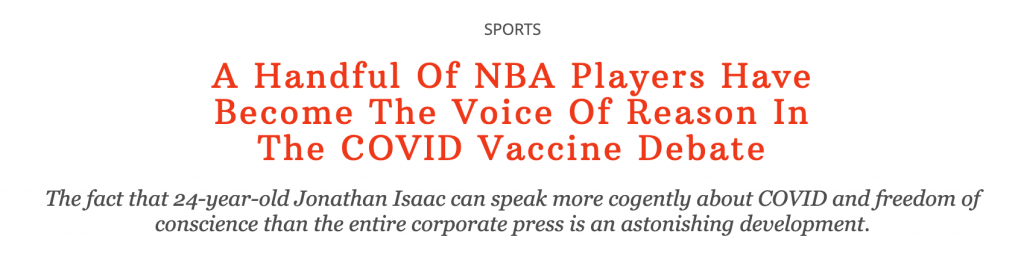
- AfterNBA players Kyrie Irving and Jonathan Isaac spoke publicly about their choice not to receive the COVID-19 vaccine despite the basketball’s league requirements, the Federalist heralded them as the “most cogent and principled defenders of liberty, common sense, and basic civic decency in America."
- The Federalist published a round-up of various groups of people around the country “using the power of protest to send a message” against “draconian” vaccine mandates. The article also asserted workplace vaccine requirements were attacks on the working class as “companies were lording their firing power” over their workers.
- George Mason University professor Todd Zywicki was profiled on the outlet after he spoke out against the university’s vaccine requirements for faculty and staff.The Federalist framed Zywicki’s case as a “blueprint” for others trying to circumvent “anti-science COVID-19 policies” as Zywicki received a medical exemption from the vaccine mandate after he argued that his natural immunity made vaccination unnecessary. Though antibodies from a previous infection can defend against reinfection, experts still recommend receiving the COVID-19 vaccine for prolonged protection across coronavirus variants.
- The outlet featured country musician Travis Tritt because of his efforts in “calling for freedom” against vaccine mandates. The article also highlighted Tritt urging others to speak out against vaccine mandates because such supposed “injustices” can be defeated only “with a unified front against them.”
---
alrt rt EUR
Krange, O. Kaltenborn, B.& Hultman, M. (2018). “Cool Dudes in Norway: Climate Change denial among conservative Norwegian Men”, Environmental Sociology.
McCright, A., Dunlap, R (2011). "Cool dudes: The denial of climate change among conservative white males in the United States", Global Environmental Change.
In their article ‘Cool dudes: The denial of climate change among conservative white males in the United States’ the authors state: ‘Clearly the extent to which the conservative white male effect on climate change denial exists outside the US is a topic deserving investigation.’ Following this recommendation, we report results from a study in Norway. McCright and Dunlap argue that climate change denial can be understood as an expression of protecting group identity and justifying a societal system that provides desired benefits. Our findings resemble those in the US study. A total of 63 per cent of conservative males in Norway do not believe in anthropogenic climate change, as opposed to 36 per cent among the rest of the population who deny climate change and global warming. Expanding on the US study, we investigate whether conservative males more often hold what we term xenosceptic views, and if that adds to the ‘cool dude-effect’.1 Multivariate logistic regression models reveal strong effects from a variable measuring ‘xenosceptic cool dudes’. Interpreting xenoscepticism as a rough proxy for right leaning views, climate change denial in Norway seems to merge with broader patterns of right-wing nationalism.
recall 80's new right BS we are the true student radicals, revolutionaries; trump is a disrupter which gets morphed into rebellion; 1776 Minute men were white wasp manly yeoman farmers who were going to solve problem with muskets; pseudo-populist US little ppl real Mercan vs gubmint/"establishment"
https://www.alternet.org/2021/02/qanon-revolution/
When a mob of far-right extremists violently attacked the U.S. Capitol Building on January 6, some of them were invoking the American Revolutionary War of the 1770s and 1780s and equating themselves with the colonies that overthrew British rule long ago. But author John Patrick Leary, in an article published by The New Republic on February 5, explains why that analogy and the far right's obsession with the word "patriot" are deeply flawed.
"The Capitol rioters invaded the Senate, looking for traitors [THOSE PPL WHO ARE MAKING US VICTIMS, TAKING AWAY OUR GOD GIVEN RIGHTS/SOCIAL STATUS/WAY OF LIFE CRISCO-NACHT] and crying out, 'Hold the line, patriots,'" Leary observes. "The right often seems to be reenacting an action movie fantasy of the Revolutionary War, folding a language of "patriotism" into their every leaflet and banner. It's there in the yellow Gadsden flag waved by the Tea Party, and in the names of dozens of militias active in practically every state, from Alabama's American Patriots Three Percent to Wisconsin's III% United Patriots."
Leary goes on to lay out some reasons why the far right badly misunderstands the word "patriot."
"A patriot is a good citizen, lover of order — and an insurgent, an unruly subject," Leary explains. "Given all of these confused loyalties, perhaps the real meaning of 'patriot,' what really fuels the sense of attachment it carries, is not the various positive meanings it is occasionally given, but its opposite: not 'love of country,' in other words, but hatred of the 'traitor.' The Ku Klux Klan, for instance, always pledged its service to civil government, the Constitution and 'pure patriotism,' even when the group waged war on federal and state governments and anyone else who betrayed its notion of 'purity.'"
Leary continues, "Whatever their stated political convictions — open White supremacy, anti-tax zealotry, or QAnon delirium — what appears to nourish Trump fetishists is a boundless sense of betrayal and a bottomless well of self-righteousness. It's a toxic, ridiculous combination."
FROM YOUR SITE ARTICLES
- Unraveling the dark and tangled origins of the QAnon myth - Alternet ... ›
- 'It's over and nothing makes sense: QAnon believers struggle to ... ›
- QAnon congresswoman faces calls for arrest after live-tweeting ... ›
RELATED ARTICLES AROUND THE WEB
- Why the alt-right believes another American Revolution is coming ›
- QAnon: What's the truth behind a pro-Trump conspiracy theory ... ›
- Fears QAnon Preparing for 'Second Revolution' With Repeat of ... ›
faketriot
https://www.mediamatters.org/alex-jones/infowars-alex-jones-funded-and-fomented-mob
no vid
great banner pix saved jnzmegaphone
Far-right conspiracy theorist Alex Jones says he spent hundreds of thousands of dollars and coordinated with the White House in the organizing of a January 6 event that culminated in a failed insurrection at the U.S. Capitol. In comments made on Infowars broadcasts and during speeches delivered in Washington, D.C., in the days before January 6, Jones and his fellow Infowars host Owen Shroyer frequently used violent and revolutionary rhetoric in calling for the overturning of legitimate election results.
Five people lost their lives during the violent incursion in the Capitol that immediately followed an inciting speech given by the president on January 6. Trump supporter Ashli Babbitt was fatally shot by a U.S. Capitol Police officer as she attempted to breach the Speaker’s Lobby, which is close to the U.S. House of Representatives floor. U.S. Capitol Police officer Brian Sicknick was beaten to death with a fire extinguisher by Trump supporters. Three other Trump supporters died after experiencing medical emergencies, including one who was trampled to death by the mob.
Some Trump supporters made it clear their purpose in the Capitol was to hunt down and kill lawmakers. The quick thinking of [AA] Capitol Police officer Eugene Goodman, who faced down the mob alone, diverted rioters away from the Senate floor, as captured in a stunning video taken by HuffPo reporter Igor Bobic.
Jones’ Infowars outlet was promoting a January 6 event as early as December 31. In a video posted to Infowars’ streaming platform Banned.video, a man ranted about the false claim that Trump won the 2020 election, saying, “These liberals think they can just do whatever the fuck they want. You know why that is? It’s because we sit there and we say we want to talk it out.” The video transitioned to promotional material for Infowars’ January 6 event and included a voiceover of Jones saying “It’s 1776 time,” a reference to the Revolutionary War. vid]
on January 2, Jones said during a broadcast that “it takes money to put my crew and security in D.C., and it takes money to organize this, and we put a lot of money -- myself -- into paying for the event Trump is going to be at and the other event.” He then encouraged viewers tobuy nutritional supplements from the Infowars Store and told them they “are funding the second American Revolution.” AHA ITS TEA PARTY DERIVATIVE]
The next day, Jones again discussed his involvement in planning and paying for the event. During his broadcast, he excoriated Trump supporters who were hesitant to travel to Washington, D.C., claiming, “I’ve seen people making a lot of excuses. ‘Oh, antifa is dangerous.’ It’s a lot more dangerous walking across the street.There’s hardly no antifa. They are a bunch of cowards.” (After mayhem unfolded at the Capitol, Jones and his outlet falsely blamed antifa supporters for the violence that took place.) He added, “It’s not about Infowars getting the credit for this, it’s about the fact that no one would step up and put the money in. ... I stepped up and put the money in for the 5th and for the 6th and then a donor came along, a great patriot, and paid $400,000-plus for the rest of it. I’m in over $130,000, and I'm not complaining about that. I had to do it when no one else was two weeks ago.”
Jones, Infowars host Owen Shroyer, and other Infowars employees then traveled to Washington, D.C. During a January 5 speech in downtown Washington, Shroyer said, “Americans are ready to fight. We’re not exactly sure what that is going to look like, perhaps, in a couple of weeks if we can’t stop this certification of the fraudulent election of Joe Biden.” He went on to “salute” Sens. Josh Hawley (R-MO) and Ted Cruz (R-TX) for their efforts to overturn the election and said of the people gathered there, “We are the new revolution.”
Meanwhile, Jones was at an event outside the Supreme Court, where he told a crowd, “We are facing Satan, and the answer to Satan’s 1984 is George Washington’s 1776.”
That evening, Jones and Shroyer regrouped to give more speeches in downtown Washington. Shroyer told a crowd, “Thomas Jefferson once said when the government fears the people, there is freedom. But for too long now the people have feared the government. … I can tell you that thecrooked politicians that occupy our Capitol are in fear right now. Do you know how I know this? Because they are scurrying around in secret tunnels to avoid ‘we the people.’ Right now as we speak they’re scurrying around like the little rats that they are to try to avoid you.”
When Jones took over the lectern, he told a cheering crowd that“we have only begun to resist the globalists” and that “they have tried to steal this election in front of everyone.” Jones also said,“I don’t know how all this is going to end, but if they want a fight, they better believe they’ve got one.”
He went on to say, “This will be their Waterloo. This will be their destruction.” (Waterloo refers to the pivotal battlefield defeat of Napoleon Bonaparte that ended the Seventh Coalition.) Jones also said that Winston Churchill “gave a famous speech where he said all I can promise you is blood, and pain, and war, and suffering. But the alternative is even worse:total slavery.” He then led the crowd in a “1776” chant.
The violent rhetoric continued the next day at Infowars’ event, which immediately preceded the insurrection at the U.S. Capitol. During a January 6 speech in downtown Washington, Jones again told a crowd, “We declare 1776 against the New World Order.” Shroyer spoke from his own bullhorn while standing beside Jones, saying, “They said you lost this election in a landslide to [Joe] Biden. We said, ‘No, we don’t buy your bullshit.’ But, guess what? You want to feed us bullshit? We’re going to bring it right to your front door and you can eat it yourselves.” (Some Trump insurrectionists at the Capitol did in fact smear their own feces throughout the building’s hallways during the attack.)
At one point, Jones told the crowd to head to the Capitol “peacefully,” in contradiction to much of what he had said about what should happen on January 6. He also attempted to rile up the crowd by falsely telling them that Biden’s win in Arizona had been reversed and that “we have only begun to fight. This is 1776.” As people began to make their way to the Capitol, Shroyer yelled from a bullhorn that Democrats are “tyrants” and led the crowd in a “death to tyrants” chant. Jones then can be then heard attempting to privately confer with his crew, saying, “Let’s take it to the Capitol.”
While Jones and Shroyer did not enter the Capitol building and instead retreated to a “secure location” during the insurrection, an Infowars cameraperson, who identified himself only as “your boy Sam with Infowars.com,” did go inside as both a mob participant and a recorder of the events. Shortly before entering the building, he said, “We have had enough,” and “I got to be honest, this is not a peaceful protest.” Once he crossed the threshold, he yelled, “Guess what? We are in the Capitol, baby!” From a video uploaded to Banned.video with the title “Patriots Storm Congress Raw Footage Includes Execution of Ashli Babbitt,” it is apparent that “Sam” was just feet away from Babbitt when she was fatally shot near the Speaker’s Lobby. Although recent Infowars videos identify him only as “Sam,” older videos posted to Banned.video reveal that he appears to go by the name Sam Montoya.
As the attempted insurrection unfolded, Infowars’ Harrison Smith, who was guest-hosting The Alex Jones Show because Jones and Shroyer were in Washington, praised the “patriots” who were storming the Capitol, at least one of whom participated in beating officer Sicknick to death. The following day, Jones again claimed to have spent “close to a half a million dollars” organizing the gathering in Washington and also said that he organized the event in coordination with the White House.
Following the 2020 presidential election, Jones called on his supporters to “surround” the Georgia governor’s mansion and “rise up” because officials in that state refused to overturn Biden’s legitimate victory. In December, Shroyer praised the efforts of Trump supporters to violently disrupt the Oregon state legislature’s consideration of a COVID-19 relief bill.
Throughout the Trump presidency, Jones has often hyped the prospect of a second American Civil War that would pit conservatives against liberals, including saying that he would personally participate in violence and help execute supposed traitors. In recent months, Jones has hosted Oath Keepers militia founder Stewart Rhodes, who said during his Infowars appearances that his followers were on alert for a command from Trump to start carrying out mass violence against Democrats in Washington, D.C., and at other locations.
For his part, Shroyer said during a November 18 broadcast that prominent Democrats and members of the mainstream media “deserve” to be the victims of mass violence if Trump is not allowed to continue to be president, despite his defeat. He added, “I know I won’t have to be the one to get my hands dirty. I can sit right here in studio and just broadcast the whole thing.”
blender of memes/ mirror /invert? who is traitor? coup? our sacred xian right/duty to secede from godless commie biden?
aha interesting morph of term: orig illegit use of mil force to take control, but soft coup is metaphorical, thus stop the steal is coup? // traitor
note rhet, note always defensive, it's kraken that is coup
https://www.alternet.org/2020/12/prepare-for-war-gop-official-pushes-dangerous-conspiracy-theories-over-election-outcome/
ME
It has been three days since the Electoral College confirmed President-elect Joe Biden's victory, but an overwhelming number of Republicans are still refusing to accept the outcome of the election. Propaganda articles and infotainment videos on conspiracy theories are still circulating as Trump supporters continue their fight to "stop the steal."
Now, an article published by the Seattle Times highlights another problem with the spread of misinformation. The writer notes that it is one thing when dangerous falsehoods come from unknown websites that lack credibility, but some of the latest threats are coming from members of the Republican Party.
According to the publication, on Monday, Rep. Robert J. Sutherland, a representative of the 39th legislative district of Eastern Snohomish County along with Skagit County, took to Facebook with a number of dangerous claims about the election.
In multiple posts, he referenced reports and claims from right-wing influencers and propaganda sites as he said,"prepare for war. Joe Biden is not now, nor will ever be my President. Am I a sore loser? No. I'm pro-America and anti-communist. Joe Biden is a bought and paid for Communist China puppet. Stay tuned, big things happening soon at the Federal level."
In a series of other Facebook posts and discussions, Sutherland also insisted that he supported the idea of going to war over the so-called "coup against the sitting president."
"Is the 'coup' against the sitting President the start of a second 'Civil War' here in the USA?" Sutherland asked as he noted his support of Trump possibly using the military to maintain his presidential power.
"What good and decent person [xian crusade? deus vult?] would not conduct a war to defend Life, Liberty, the Pursuit of happiness, their families, their neighbors?" Sutherland asked.
==
aha const is a god term (along wth FF old white wasp men), patriot, constituion, latter ironically used to overturn legal biden election:
https://boingboing.net/2020/11/19/trump-campaign-legal-clown-car-is-an-elite-strike-force-team-says-advisor-jenna-ellis.html
Trump campaign legal advisor Jenna Ellis TWT says the Trump campaign's legal team, which no longer includes any major law firms, but does include America's hairdripping mayor Rudy Giuliani, "is an elite strike force team."
Jenna Ellis: "This is an elite strike force team on behalf of the president and the campaign to make sure that our constitution is protected."
Can you lose your law license for making statements like that? Asking for America.
9/20 trump sez POW MIA KIA losers and suckers ~ gen lost dad VN pilot dog tag you are no patriot
kyle call to patriots?
also Whitmer assassination tyrant (traitor)? 10/20
Building the bomb
....
fake name to rent truck? Kling for buddy but also Klingon warrior mega-male
McVeigh's original plan had been to detonate the bomb at 11:00 am, but at dawn on April 19, 1995, he decided instead to destroy the building at 9:00 am.[62] As he drove toward the Murrah Federal Building in the Ryder truck, McVeigh carried with him an envelope containing pages from The Turner Diaries – a fictional account of white supremacists who ignite a revolution by blowing up the FBI headquarters at 9:15 one morning using a truck bomb.[24] McVeigh wore a printed T-shirt with the motto of the Commonwealth of Virginia, Sic semper tyrannis ("Thus always to tyrants", according to legend what Brutus said as he assassinated Julius Caesar, also claimed to have been shouted by John Wilkes Booth immediately after the assassination of Abraham Lincoln) and "The tree of liberty must be refreshed from time to time with the blood of patriots and tyrants" (from Thomas Jefferson).[36] He also carried an envelope full of revolutionary materials that included a bumper sticker with the slogan, falsely attributed[63] to Thomas Jefferson, "When the government fears the people, there is liberty. When the people fear the government, there is tyranny." Underneath, McVeigh had written, "Maybe now, there will be liberty!" with a hand-copied quote by John Locke asserting that a man has a right to kill someone who takes away his liberty.[24][64]
McVeigh entered Oklahoma City at 8:50 am.[65] At 8:57 am, the Regency Towers Apartments' lobby security camera that had recorded Nichols's pickup truck three days earlier recorded the Ryder truck heading towards the Murrah Federal Building.[66] At the same moment, McVeigh lit the five-minute fuse. Three minutes later, still a block away, he lit the two-minute fuse. He parked the Ryder truck in a drop-off zone situated under the building's day-care center, exited and locked the truck. As he headed to his getaway vehicle, he dropped the keys to the truck a few blocks away.[67]
...
https://www.alternet.org/2020/09/they-just-want-to-watch-the-world-burn-psychological-analysis-reveals-the-14-key-traits-that-explain-trump-supporters/
as he himself said even before he won the presidential election in 2016, “I could stand in the middle of 5th Avenue and shoot somebody and I wouldn’t lose voters.” Unfortunately for the American people, this wild-sounding claim appears to be truer than not, at least for the majority of his supporters, and that is something that should disturb us. It should also motivate us to explore the science underlying such peculiar human behavior, so we can learn from it, and potentially inoculate against it.
In all fairness, we should recognize that lying is sadly not uncommon for politicians on both sides of the political aisle, but the frequency and magnitude of the current president’s lies should have us all wondering why they haven’t destroyed his political career, and instead perhaps strengthened it. Similarly, we should be asking why his inflammatory rhetoric and numerous scandals haven’t sunk him. We are talking about a man who was caught on tape saying, “When you’re a star, they let you do it. You can do anything. Grab them by the pussy.” Politically surviving that video is not normal, or anything close to it, and we can be sure that such a revelation would have been the end of Barack Obama or George Bush had it surfaced weeks before the election.
While dozens of psychologists have analyzed Trump, to explain the man’s political invincibility, it is more important to understand the minds of his staunch supporters. While there have been various popular articles that have illuminated a multitude of reasons for his unwavering support, there appears to be no comprehensive analysis that contains all of them. Since there seems to be a real demand for this information, I have tried to provide that analysis below.
Some of the explanations come from a 2017 review paperpublished in the Journal of Social and Political Psychology by the psychologist and UC Santa Cruz professor Thomas Pettigrew. Others have been put forth as far back as 2016 by myself, a cognitive neuroscience and psychology researcher, in various articles and blog posts for publications like Psychology Today. A number of these were inspired by insights from psychologists like Sheldon Solomon, who laid the groundwork for the influential Terror Management Theory, and David Dunning, who did the same for the Dunning-Kruger effect.
this list will begin with the more benign reasons for Trump’s intransigent support, and as the list goes on, the explanations become increasingly worrisome, and toward the end, border on the pathological. It should be strongly emphasized that not all Trump supporters are racist, mentally vulnerable, or fundamentally bad people. It can be detrimental to society when those with degrees and platforms try to demonize their political opponents or paint them as mentally ill when they are not. That being said, it is just as harmful to pretend that there are not clear psychological and neural factors that underlie much of Trump supporters’ unbridled allegiance.
The psychological phenomena described below mostly pertain to those supporters who would follow Trump off a cliff. These are the people who will stand by his side no matter what scandals come to light, or what sort of evidence for immoral and illegal behavior surfaces.
- Practicality Trumps Morality
For some wealthy people, it’s simply a financial matter. Trump offers tax cuts for the rich and wants to do away with government regulation that gets in the way of businessmen making money, even when that regulation exists for the purpose of protecting the environment. Others, like blue-collared workers, like the fact that the president is trying to bring jobs back to America from places like China. Some people who genuinely are not racist (those who are will be discussed later) simply want stronger immigration laws because they know that a country with open borders is not sustainable. These people have put their practical concerns above their moral ones. To them, it does not matter if he’s a vagina-grabber, or if his campaign team colluded with Russia to help him defeat his political opponent. It is unknown whether these people are eternally bound to Trump in the way others are, but we may soon find out if the Mueller investigation is allowed to come to completion.
- The Brain’s Attention System Is More Strongly Engaged by Trump
According to a study that monitored brain activity while participants watched 40 minutes of political ads and debate clips from the presidential candidates, Donald Trump is unique in his ability to keep the brain engaged. While Hillary Clinton could only hold attention for so long, Trump kept both attention and emotional arousal high throughout the viewing session. This pattern of activity was seen even when Trump made remarks that individuals didn’t necessarily agree with. His showmanship and simple language clearly resonate with some at a visceral level.
- America’s Obsession with Entertainment and Celebrities
Essentially, the loyalty of Trump supporters may in part be explained by America’s addiction with entertainment and reality TV. To some, it doesn’t matter what Trump actually says because he’s so amusing to watch. With the Donald, you are always left wondering what outrageous thing he is going to say or do next. He keeps us on the edge of our seat, and for that reason, some Trump supporters will forgive anything he says. They are happy as long as they are kept entertained.
- “Some Men Just Want to Watch the World Burn.”
Some intelligent people who know better are supporting Trump simply to be rebellious or to introduce chaos into the political system. They may have such distaste for the establishment and democrats like Hillary Clinton that their support for Trump is a symbolic middle finger directed at Washington. These people do not have their priorities straight, and perhaps have other issues, like an innate desire to troll others, or a deranged obsession with schadenfreude.
- The Fear-Factor: Conservatives Are More Sensitive to Threat
Science has unequivocally shown that the conservative brain has an exaggerated fear response when faced with stimuli that may be perceived as threatening. A 2008 study in the journal Science found that conservatives have a stronger physiological reaction to startling noises and graphic images compared to liberals. A brain-imaging study published in Current Biology revealed that those who lean right politically tend to have a larger amygdala — a structure that is electrically active during states of fear and anxiety. And a 2014 fMRI study found that it is possible to predict whether someone is a liberal or conservative simply by looking at their brain activity while they view threatening or disgusting images, such as mutilated bodies. Specifically, the brains of self-identified conservatives generated more activity overall in response to the disturbing images.
These brain responses are automatic, and not influenced by logic or reason. As long as Trump continues his fear mongering by constantly portraying Muslims and Hispanic immigrants as imminent dangers, many conservative brains will involuntarily light up like light bulbs being controlled by a switch. Fear keeps his followers energized and focused on safety. And when you think you’ve found your protector, you become less concerned with offensive and divisive remarks.
- The Power of Mortality Reminders and Perceived Existential Threat
A well-supported theory from social psychology, known as Terror Management Theory, explains why Trump’s fear mongering is doubly effective. The theory is based on the fact that humans have a unique awareness of their own mortality. The inevitably of one’s death creates existential terror and anxietythat is always residing below the surface. In order to manage this terror, humans adopt cultural worldviews — like religions, political ideologies, and national identities — that act as a buffer by instilling life with meaning and value.
Terror Management Theory predicts that when people are reminded of their own mortality, which happens with fear mongering, they will more strongly defend those who share their worldviews and national or ethnic identity, and act out more aggressively towards those who do not. Hundreds of studies have confirmed this hypothesis, and some have specifically shown that triggering thoughts of death tends to shift people towards the right.
Not only do death reminders increase nationalism, they influence actual voting habits in favor of more conservative presidential candidates. And more disturbingly, in a study with American students, scientists found that making mortality salient increased support for extreme military interventions by American forces that could kill thousands of civilians overseas. Interestingly, the effect was present only in conservatives, which can likely be attributed to their heightened fear response.
By constantly emphasizing existential threat, Trump creates a psychological condition that makes the brain respond positively rather than negatively to bigoted statements and divisive rhetoric. Liberals and Independents who have been puzzled over why Trump hasn’t lost supporters after such highly offensive comments need look no further than Terror Management Theory.
- The Dunning-Kruger Effect: Humans Often Overestimate Their Political Expertise
Some support Donald Trump do so out of ignorance — basically they are under-informed or misinformed about the issues at hand. When Trump tells them that crimeis skyrocketing in the United States, or that the economy is the worst it’s ever been, they simply take his word for it.
The Dunning-Kruger effect explains that the problem isn’t just that they are misinformed; it’s that they are completely unaware that they are misinformed, which creates a double burden.
Studies have shown that people who lack expertise in some area of knowledge often have a cognitive bias that prevents them from realizing that they lack expertise. As psychologist David Dunning puts it in an op-ed for Politico, “The knowledge and intelligence that are required to be good at a task are often the same qualities needed to recognize that one is not good at that task — and if one lacks such knowledge and intelligence, one remains ignorant that one is not good at the task. This includes political judgment.” These people cannot be reached because they mistakenly believe they are the ones who should be reaching others.
- Relative Deprivation — A Misguided Sense of Entitlement
Relative deprivation refers to the experience of being deprived of something to which one believes they are entitled. It is the discontent felt when one compares their position in life to others who they feel are equal or inferior but have unfairly had more success than them.
Common explanations for Trump’s popularity among non-bigoted voters involve economics. There is no doubt that some Trump supporters are simply angry that American jobs are being lost to Mexico and China, which is certainly understandable, although these loyalists often ignore the fact that some of these careers are actually being lost due to the accelerating pace of automation.
These Trump supporters are experiencing relative deprivation, and are common among the swing states like Ohio, Michigan, and Pennsylvania. This kind of deprivation is specifically referred to as “relative,” as opposed to “absolute,” because the feeling is often based on a skewed perception of what one is entitled to.
- Lack of Exposure to Dissimilar Others
Intergroup contact refers to contact with members of groups that are outside one’s own, which has been experimentally shown to reduce prejudice. As such, it’s important to note that there is growing evidence that Trump’s white supporters have experienced significantly less contact with minorities than other Americans. For example, a 2016 study found that “…the racial and ethnic isolation of Whites at the zip-code level is one of the strongest predictors of Trump support.” This correlation persisted while controlling for dozens of other variables. In agreement with this finding, the same researchers found that support for Trump increased with the voters’ physical distance from the Mexican border. These racial biases might be more implicit than explicit, the latter which is addressed in #14.
- Trump’s Conspiracy Theories Target the Mentally Vulnerable
While the conspiracy theory crowd — who predominantly support Donald Trump and crackpot allies like Alex Jones and the shadowy QAnon — may appear to just be an odd quirk of modern society, the truth is that many of them suffer from psychological illnesses that involve paranoia and delusions, such as schizophrenia, or are at least vulnerable to them, like those with schizotypy personalities.
The link between schizotypy and belief in conspiracy theories is well-established, and a recent study published in the journal Psychiatry Research has demonstrated that it is still very prevalent in the population. The researchers found that those who were more likely to believe in outlandish conspiracy theories, such as the idea that the U.S. government created the AIDs epidemic, consistently scored high on measures of “odd beliefs and magical thinking.” One feature of magical thinking is a tendency to make connections between things that are actually unrelated in reality.
Donald Trump and his media allies target these people directly. All one has to do is visit alt-right websites and discussion boards to see the evidence for such manipulation.
- Trump Taps into the Nation’s Collective Narcissism
Collective narcissism is an unrealistic shared belief in the greatness of one’s national group. It often occurs when a group who believes it represents the ‘true identity’ of a nation — the ‘ingroup,’ in this case White Americans — perceives itself as being disadvantaged compared to outgroups who are getting ahead of them ‘unrightfully.’ This psychological phenomenon is related to relative deprivation (#6).
A study published last year in the journal Social Psychological and Personality Science found a direct link between national collective narcissism and support for Donald Trump. This correlation was discovered by researchers at the University of Warsaw, who surveyed over 400 Americans with a series of questionnaires about political and social beliefs. Where individual narcissism causes aggressiveness toward other individuals, collective narcissism involves negative attitudes and aggression toward ‘outsider’ groups (outgroups), who are perceived as threats.
Donald Trump exacerbates collective narcissism with his anti-immigrant, anti-elitist, and strongly nationalistic rhetoric. By referring to his supporters, an overwhelmingly white group, as being “true patriots” or “real Americans,” he promotes a brand of populism that is the epitome of “identity politics,” a term that is usually associated with the political left. Left-wing identity politics, as misguided as they may sometimes be, are generally aimed at achieving equality, while the right-wing brand is based on a belief that one nationality and race is superior or entitled to success and wealth for no other reason than identity.
- The Desire to Want to Dominate Others
Social dominance orientation (SDO) — which is distinct but related to authoritarian personality syndrome (#13) — refers to people who have a preference for the societal hierarchy of groups, specifically with a structure in which the high-status groups have dominance over the low-status ones. Those with SDO are typically dominant, tough-minded, and driven by self-interest.
In Trump’s speeches, he appeals to those with SDO by repeatedly making a clear distinction between groups that have a generally higher status in society (White), and those groups that are typically thought of as belonging to a lower status (immigrants and minorities). A 2016 survey study of 406 American adults published last year in the journal Personality and Individual Differences found that those who scored high on both SDO and authoritarianism were those who intended to vote for Trump in the election.
- Authoritarian Personality Syndrome
Authoritarianism refers to the advocacy or enforcement of strict obedience to authority at the expense of personal freedom, and is commonly associated with a lack of concern for the opinions or needs of others. Authoritarian personality syndrome — a well-studied and globally-prevalent condition — is a state of mind that is characterized by belief in total and complete obedience to one’s authority. Those with the syndrome often display aggression toward outgroup members, submissiveness to authority, resistance to new experiences, and a rigid hierarchical view of society. The syndrome is often triggered by fear, making it easy for leaders who exaggerate threat or fear monger to gain their allegiance.
Although authoritarian personality is found among liberals, it is more common among the right-wingaround the world.President Trump’s speeches, which are laced with absolutist terms like “losers” and “complete disasters,” are naturally appealing to those with the syndrome.
While research showed that Republican voters in the U.S. scored higher than Democrats on measures of authoritarianism before Trump emerged on the political scene, a 2016 Politico survey found that high authoritarians greatly favored then-candidate Trump, which led to a correct prediction that he would win the election, despite the polls saying otherwise
- Racism and Bigotry
It would be grossly unfair and inaccurate to say that every one of Trump’s supporters have prejudice against ethnic and religious minorities, but it would be equally inaccurate to say that many do not. It is a well-known fact that the Republican party, going at least as far back to Richard Nixon’s “southern strategy,” used tactics that appealed to bigotry, such as lacing speeches with “dog whistles” — code words that signaled prejudice toward minorities that were designed to be heard by racists but no one else.
While the dog whistles of the past were subtler, Trump’s signaling is sometimes shockingly direct. There’s no denying that he routinely appeals to racist and bigoted supporters when he calls Muslims “dangerous” and Mexican immigrants “rapists” and “murderers,” often in a blanketed fashion. Perhaps unsurprisingly, a recent study has shown that support for Trump is correlated with a standard scale of modern racism.
Bobby Azarian is a neuroscientist affiliated with George Mason University and a freelance journalist. His research has been published in journals such as Cognition & Emotion and Human Brain Mapping, and he has written for The New York Times, The Atlantic, Psychology Today, and Scientific American. Follow him on Twitter @BobbyAzarian.
// antifa coup sediton
https://www.alternet.org/2020/09/loving-your-country-is-not-the-same-as-loving-trump-how-the-right-makes-a-mockery-of-us-patriotism
on September 17, in a speech delivered at the National Archives Museum, President Trump announced he was signing an executive order establishing the 1776 Commission, aimed at promoting what he called a “patriotic” and “pro-America” education. The announcement was a direct attack on the 1619 Project, a New York Times initiative that explores the legacy of slavery in the United States. For Trump, teaching critical race studies is akin to committing child abuse “in the truest sense of those words.”
“Our youth will be taught to love America with all of their heart and souls,” Trump announced. He accused the left of destroying children’s love of their country by teaching the facts of its history — facts, he claimed, wrongly “rewrite” American history as founded on oppression rather than freedom. He’s demanded that schools “teach American exceptionalism” and said that schools are teaching students to “hate their own country.”
This was just the latest show of Trump’s blatant conflation of racism with patriotism and it served as yet another example of how Trump has turned patriotism into a self-serving performance free of any connection to facts. From the start, Trump has attempted to define patriotism not as loving the country, but rather as loving Trump. All we need to do is remember that the same man who dodged military service spent over $2.5 million on a Fourth of July military parade designed to be primarily a celebration of himself.
Before analyzing the damage Trump has done to U.S. patriotism, let me be blunt: “loving” your country is stupid. Patriotism, when it is nothing more than blind adoration of a country, is idiotic at best and fascist at worst. Countries don’t need to be loved; they need to be built, critiqued, developed and improved. They need to be held to the highest ideals and they need to face their shortcomings so that they can strive to be better. The relationship citizens have to their nations may always include some affect, but real support for a nation thrives when citizens emote less and reflect and engage more. So, when patriotism is synonymous with loving your country, it is always, already a bad idea. but setting aside the question of whether it even makes sense to debate who does or doesn’t love their country, there seems little doubt that the time has come to push back on the way that the right has conflated loving the United States with loving Trump.
It may have been the case that in the early days of Trump his supporters could rationalize backing a man with an absent moral compass, a profound disrespect for our public institutions, and a deeply and openly narcissistic personality. But the moment when a Trump supporter could hold him up as a welcome alternative to the traditional political establishment has long gone. Any hope that Trump signaled anything positive for this country has now been eclipsed by the avalanche of proof that he holds all of the core values we associate with our nation — whether from the left or the right — in profound disdain.
Take, for example, the information that has poured in just over the last month.
We learned that Trump was aware of reports of financial incentives given to Taliban fighters by officials linked to the Russian government to target and kill American troops in Afghanistan, and he did nothing about it.
We have had multiple confirmations of Trump’s inability to appreciate the value of military service, to respect veterans, and to understand the sacrifices those in the military make for their country. And that wasn’t all. Trump went after military leadership, claiming that they wage wars in order to boost the profits of defense manufacturing companies, somehow forgetting that, as President, he is Commander-in-Chief of the military.
Trump didn’t just attack the military; he attacked our electoral system as well. We have read reports of his concerted efforts to derail the electoral process and suppress voter turnout by criticizing mail-in voting and encouraging voters to vote twice. He has also repeated an expectation that election results could be delayed by months, stoking fears over a peaceful transition.
Then we also learned via Bob Woodward’s new book “Rage” that Trump only cares about himself and that he is willing to lie and deceive the American public when it suits him. Woodward reports that Trump knew well that COVID-19 posed a serious health threat, yet he deliberately downplayed it, saying he did so to avoid stoking public “panic.”
Yet, he is more than happy to foster public panic if it can help him win re-election. He has specifically suggested that if he isn’t elected in November, citizens will be in grave danger.
These more recent developments simply build on years of examples of his profoundly selfish desire to put himself before his office and above the national interest. Only last week we had further confirmation of his self-aggrandizing, unpatriotic behavior when we learned that he manipulated the Department of Homeland Security to downplay the threat of Russian election interference and minimize the threat of white supremacists.
This is a man who hasn’t protected our citizens, our health care workers, our military, our national security, or our elections. This is a man who has openly sown social division and purposefully put the future of the nation at risk.Without question, Donald Trump is the least patriotic man to have ever held the office of President. And, what’s more, he is entirely transparent about it.
How, then, to explain the fact that he still enjoys such an astonishing level of support by Republicans? Sure, there are dissenters, but the**latest Gallup poll numbers**still show Trump earning support of 90 percent of Republicans.
So, supporting Trump when he is obviously doesn’t care a wit about the United States means you can no longer claim to “love” your country.
By every metric that matters, Republicans’ ongoing support for Donald Trump officially ends any claim they have to anything resembling patriotism. Supporting Trump in the wake of these revelations suggests that your patriotism has turned into nothing more than blind fanaticism for a demagogue. There isn’t any other way to explain it.
For many, the idea that Trump and his supporters have ruined U.S. patriotism may not matter much given the fact that for many of us patriotism is too closely aligned with an uncritical American exceptionalism. The notion, though, that the rise of Trump signals the demise of Republican patriotism is a big deal for the simple fact that the Republican party has equated itself with U.S. patriotism for decades. In fact, the mere suggestion that they might not be the patriots they claim to be is likely to seem shocking even to those who are not in the party.
But that’s the thing. The left has generally allowed the Republicans to be the party of those who “love” their country because, for the left, the idea of loving your country uncritically rather than trying to make it better is ignorant and narrow-minded. If being patriotic means you can’t ask questions about the flaws in the system, interrogate injustices past and present, account for the facts of history, and point out deep hypocrisies in the national narrative, then who wants to be patriotic? So, if patriotism means loving your country, then it’s no wonder that the left gave free rein to Republicans to have at it.
And that’s exactly what they did. The story of how Republicans came to dominate the notion of U.S. patriotism is long and complex, but, as Geoffrey Nunberg points out in “Talking Right,” the key to understanding conservative control of U.S. patriotism lies in the deliberate ways that their party worked to merge conservative values with national ones.
According to Nunberg, conservatives exercised a methodical plan to co-opt terms like values, freedom, and patriotismso that these words were uniquely associated with the right — a plan that allowed them to increasingly paint the left as being unpatriotic, against freedom, and morally bankrupt.
This story is key to understanding the twisted patriotism of Trump supporters today, because it wasn’t just that the left let the right merge conservative values with patriotism; it was also that the left let the right suggest that anyone sharing a progressive platform hated their country. This was how it came to be that protesting the Iraq War or demanding accountability for systemic racism or claiming that health care in Canada was better than it is here meant you hated your country.
The love-hate patriotic drama that the right was allowed to develop meant that all thoughtful conversations about what it means to support the United States were absent, replaced, instead, by the right’s increasingly hysterical claims that they were the only ones who even knew what our nation’s values were. For decades the left avoided claims about their country being great, offering, instead, visions for hope and change and a better future.
The distinction makes sense: the right loves their country in a narrow minded and fanatical way while the left strives to take the best of America’s ideals and make them reality.The problem, though, as Nunberg explains in his book, was that the left forgot that they also needed to fight for their critical approach to nationalism to be understood as offering a set of patriotic values too. Absent that, the right was free to own the idea and mold it to their desires.
It is thanks to these developments that Trump was able to claim Ronald Reagan’s slogan and suggest that he was going to make America great again. Everyone was already used to seeing these sorts of claims from the right.
The problem, though, is that Trump has not ever wanted to make America great in any way at all. He has wanted to make it his to do with as he wishes. He has openly idolized despots and dictators. He has bemoaned that he is limited by our democratic process and commented glibly that he should be able to stay in office beyond eight years. And none of that unpatriotic, un-American behavior has caused his supporters to waver.
Because Trump’s base has spent decades forgetting what it actually means to uphold national values, they’ve been easily swayed into associating a selfish, self-aggrandizing, unethical and morally repugnant human with a patriot.Content to equate flag waving, eating hot dogs, going to football games and buying guns while wearing a red hat with being patriotic, Trump’s base has lost sight of what it means to uphold national values. For them, to love their country means loving Trump.
It’s time to push back on this love affair and call out Trump supporters for their anti-American values. No one should be able to claim that they love their country and still support him. We might disagree on whether schools should focus on teaching students the symbolism of 1619 and we might disagree on whether or not we should idolize the association of 1776 with freedom, but it’s time to agree that our nation deserves better than Trump.
==
https://www.alternet.org/2020/09/why-trumps-denials-of-his-contempt-for-the-military-are-likely-just-more-lies-and-why-it-matters/
Donald Trump is likely lying, of course, in denying a new report by Jeffrey Goldberg of The Atlantic that accuses the president of calling the fallen American soldiers of World War I “suckers” and “losers.”
We know this because of Trump’s pathological pattern of telling lies, first of all. But also because in his tweeted denials, Trump now claims he never called the Sen. John McCain a “loser” for being captured during the Vietnam War, even though there’s a recording of him doing so, in the same rant during which he declared, “I like people who weren’t captured.” Trump was so proud of this smear of the late Arizona Republican that he tweeted it out at the time.
Beyond his implausible but vehement denials, Trump’s other tell is that he falsely accuses others of doing what he himself has done. In this case, Trump has spent years bashing athletes who kneel during the national anthem, falsely accusing them of dishonoring veterans and war dead. In truth, the tradition — started by former San Francisco 49ers quarterback Colin Kaepernick — was formed with input from a former Green Beretas a way to speak out against racism and police brutality while still honoring the troops.
This is the same guy who found out that Russians were offering bounties to Afghan fighters who killed American soldiers and shrugged it off. Hetold a grieving widow of a U.S. Army sergeant that “he knew what he signed up for”, and then accused her of lying when she spoke out about it. He smeared the family of Army Capt. Humayun Khan, who was killed in action in Iraq, when Khan’s parentsspoke at the Democratic National Convention. In between Trump’s badly acted efforts at pretending to care about the troops, his actual contempt has often shown itself.
all of this is why it would be unwise to hold your breath waiting for this story to put a dent in that stubborn 41 to 43% approval rating, below which Trump has rarely dipped throughout his entire presidency. Nor will Trump’s voters be fussed about the Washington Post adding to Goldberg’s reporting with a story sourced to a “former senior administration official” that Trump had “told senior advisers that he didn’t understand why the U.S. government placed such value on finding soldiers missing in action because they had performed poorly and gotten caught and deserved what they got.”
The Trump base, which is stable enough to keep Trump within stealing range of the 2020 election,loves to talk about how patriotic they are and to make a big show out of how much they supposedly love the troops. As this unquestioning loyalty to Trump makes clear, it’s all nonsense.Given a choice between white supremacy and support for the men and women of the military, Trump voters will pick racism every single time.
As with Trump, much of the flag-hugging and declarations of love for “our troops” is just an act for the conservative base. As with the showy piety of the Christian right and the outrage over imaginary pedophilia play-acted by QAnon adherents, the ostentatious “honoring” of troops is just another performance meant to put a moralistic gloss on the deeply immoral ideology of the right.
This was blatant in the way Trump and his supporters weaponized their phony love of the troops to bash Black Lives Matter protesters in pro sports.
The real reason conservatives are angry at Kaepernick, or other athletes who kneel during the national anthem — who are predominantly but not exclusively Black — is plain old racism. Conservatives are loath to admit out loud that it bugs them to see athletes show support for racial equality, since admitting that comes uncomfortably close to admitting to racist beliefs. Instead, they pretend to be outraged about the supposed insult to “the troops,” even though there has never been an insult to the troops embedded in this somber and respectful form of protest.
The very notion that there’s anything disrespectful to the troops about demanding racial equality also overlooks the long history of how people of color have served with honor in the military, while continuing to face discrimination and abuse at home. A number of civil rights activists in the 50s and 60s were World War II veterans motivated by anger over how much they had sacrificed for America, only to return home to be treated, as activist Hosea Williams once said, “like a common dog.” The Tuskegee Airmen, a predominantly Black group of fighter and bomber pilots in World War II, were as famous for the work they did to desegregate the military and fight for civil rights in civilian lifeas they were for their feats of bravery during the war.
Currently, 43% of active duty military arepeople of color. There is no conflict between the fight for racial equality and supporting the troops. Indeed, doing the latter requires the former.
Right-wing pieties about flag, troops and country have often been a bunch of hot air meant to disguise what is really forceful opposition to what are supposed to be shared American values of freedom, justice and equality. Consider how many people on the right love the Confederate battle flag, valorizing an act of rebellion in the name of racism and chattel slavery that led to the bloodiest conflict in American history. In his typical ham-fisted fashion, Donald Trump simply lays bare how much of right-wing patriotism is pageantry designed to wrap racist impulses in the flag.
As I wrote on Thursday, polling data shows that the majority of Republicans have turned their backs on American values, the ones our troops take an oath to protect, such as freedom, equality and the rule of law. If protecting white supremacy requires abandoning bedrock American values, such as the universal right to vote, so-called conservatives seem distressingly eager to do so.
There’s literally nothing Trump can say or do to insult the troops, even those who have died in service to the nation, that would cause his supporters to turn away him. What’s become clear is that they never really believed that stuff in the first place. This is and always was about their commitment to racism, a commitment they believe — reasonably enough — that Trump shares. As long as he keeps delivering on that toxic current in American history and American life, his supporters will forgive him for everything else.
==
==
https://theconversation.com/trumps-use-of-religion-follows-playbook-of-authoritarian-leaning-leaders-the-world-over-140050
It was a striking moment: Donald Trump, Bible in hand, posing for photos in an apparent moment of political theater made possible by the dispersal of protesters through the use of tear gas.
:{
}:
The president’s visit to St. John’s Episcopal Church, known as “the Church of the Presidents,” came immediately after giving a Rose Garden speech framing himself as “your president of law and order” and threatening to send federal troops to “restore security and safety in America.” The next day, Trump made another high-profile visit to a place of worship, this time Washington’s St. John Paul II National Shrine.
Coming at a time of social turbulence, critics accused Trump of following authoritarian-leaning world leaders by sidling up to religion to reinforce an image as a strongman defending a particular brand of tradition. Bishop of the Episcopal Diocese of Washington Mariann Budde said as much, commenting that Trump used the Bible at St. John’s “as if it were a prop or an extension of his military and authoritarian position.”
As a scholar who has researched the interaction of politics and faith for decades, I know how potent religion can be as a political tool.
A powerful tool
Religion creates meaning in our lives by articulating values about how we relate to one another. But just as it can unite us, religion can also be a source of division – used to “other” people who are not of the faith and don’t share the same traditions and rituals.
When enough people perceive – or can be convinced – that traditional elements of the social fabric are at risk, religious signaling through the use of symbols and images can help would-be authoritarians cement their power. They present themselves as protectors of the faith and foes of any outsider who threatens tradition.
Russian President Vladimir Putin sunbathes with a cross on display over his bare chest. Alexey Nikolsky/AFP via Getty Images]
In Russia, this phenomenon is seen in President Vladimir Putin’s forging of a strategic alliance with the Russian Orthodox Church. For his part, Putin presents himself not just as a commanding leader, but also as a devoutly religious Russian. When he appears shirtless, for example, the large cross he wears around his neck is always visible. Meanwhile, the Church promotes traditional moral values and maintains a distance from the rest of the worldwide Orthodox Christian community, thereby separating the “truly Russian” from the outsider. In their most recent collaboration, Putin and the Church proposed amendments to the Russian constitution that would enshrine Russians’ faith in God, define marriage as the union of a man and a woman and, tellingly, proclaim “the great achievement of the [Russian] people in defense of the Fatherland.” These changes, all of which are intended to reinforce Putin’s base of support, would be jarringlynationalistic additions to the constitution.
Putin benefits from this insider-outsider dynamic in advancing his goal of restoring Russia to his vision of its past territorial glory. In justifying the Russian incursion into Crimea, Putin argued that the region had “sacral importance for Russia, like the Temple Mount in Jerusalem for the followers of Islam and Judaism.” Defending and expanding Russian territory is a much easier sell if it is framed as the defense of the holy.
Religious imagery
We see a similar dynamic in India, where Prime Minister Narendra Modi’s grip on power relies in large part on his embrace of a version of Hindu nationalism that elevates Hindus as “truly Indian” insiders and singles out Muslims as outsiders.
Like Putin, Modi wraps himself in religious imagery. He makes high-profile visits to remote Hindu temples while electioneering and never wears green because of its association with Islam.
Then-prime minister candidate Narendra Modi visits a shrine on horseback while electioneering in 2014. Strdel/AFP via Getty Images
Modi’s Hindu nationalism cements his popularity among devout Hindus and builds public support for anti-Muslim policies, such as stripping the only majority-Muslim state in India of its autonomy and enacting a controversial new law preventing Muslim migrants from attaining Indian citizenship.
Trump as savior
Trump has stumbled in attempts to portray himself as personally devout, declining to name a favorite passage from the Bible and stating that he has never sought forgiveness from God for his sins.
Nevertheless, public opinion polls have consistently shown that white Christians comprise the core of Trump’s base, although there are recent signs of a dip even among this key group.
And while it is important to note that many white Christians do not support Trump, 29% of evangelicals go so far as to say they believe he is anointed by God.
Where Trump succeeds is in presenting himself as a Christian nationalist, much as Putin and Modi style themselves as the stout defenders of their countries’ dominant religions.
One way Trump achieves this end is by making statements such as this one on the campaign trail earlier this year: “We’re going to win another monumental victory for faith and family, God and country, flag and freedom.”
In their new book “Taking America Back for God,” sociologists Andrew Whitehead and Samuel Perry contend that many of Trump’s white Christian supporters see him as their long-awaited savior – not just the protector of traditional religion, but also the defender of a bygone way of life.
In that imagined past, white men ruled the roost, families went to church every Sunday and outsiders knew their place.A deep-rooted desire for a return to that past may have been why Trump’s Make America Great Again slogan has proved so potent. As Yale scholar Philip Gorski has argued, that phrase can be interpreted to mean “making white Christianity culturally dominant again.”
As such, we should not be surprised that in the current moment of crisis Trump is attempting to use religion to reinforce differences between his supporters and his opponents. Like Putin, he is posing as the defender of a particular version of a glorious past. And echoing Modi, he is doing this by building support through the denigration of the outsider.
https://www.alternet.org/2019/12/trumps-most-fanatical-right-wing-followers-are-going-ballistic-over-impeachment-and-talking-of-civil-war
no lnx twit graf
Trump’s most fanatical right-wing followers are going ballistic over impeachment — and talking of ‘civil war’
Written by David Neiwert / Daily Kos December 27, 2019
The most fanatical right-wing followers of Donald Trump have been warning for some time that any attempt to impeach the man in the Oval Office would result in a second American civil war that will produce large amounts of bloodshed as they rise up with their weapons caches and begin murdering liberals.
Now that he actually has been impeached, they’re going even more ballistic.
“He’s not gonna be removed. He’s not gonna be removed. He’s not gonna be removed,” one attendee at Trump rally told a CBS reporter. When the reporter asked, “Do you feel confident in that?” he responded, “My .357 Magnum is comfortable with that. End of story.”
Rep. Louie Gohmert—who has talked up civil war on several previous occasions—went ballistic on the floor of the House last week, warning that impeachment meant the end of America: “This is a travesty. We’re in big trouble,” Gohmert huffed, adding, “Now it’s lowered even further, the bar. [Impeachment] will be used for political battles and this country’s end is now in sight. I hope I don’t live to see it. This is an outrage.”
Louisiana Congressman Clay Higgins was even more unhinged in his similar rant last week: “They fear the true will of we the people. They are deep established D.C. They fear, they call this Republican map flyover country. They call us deplorables. They fear our faith, they fear our strength, they fear our unity, they fear our vote, and they fear our president. We will never surrender our nation to career establishment D.C. politicians and bureaucrats. Our republic shall survive this threat from within. American patriots shall prevail.”
The real action, however, has been on social media, where Facebook and Twitter posts eagerly anticipating the violent uprising to preserve Trump’s presidency have been as common as dirt.
Ex-Navy SEAL Jonathan Gilliam, for instance, used Gohmert’s comments as a springboard on Twitterfor open discussion of a shooting civil war in which conservatives begin killing liberals for attempting to remove Trump: “Like so many, I see exactly what he sees. Therefor [sic] it is time we begin considering the possibility of civil war.”
“I am counting down the days until the vigilantes take to the streets. I dread the inevitable conflict that is coming but will do whatever I can I can to support the fight against the Left,” one commenter replied. Another answered: “lol it would be a short Civil War II. The vast majority of the peace officers, military personnel, and gritty hard-working 2nd Amendment loving Americans are on our side. The snowflakes have no idea about the sleeping bear they are about to awaken.”
[pix ReneHollan.PNG]
A fairly typical response among far-right extremists has been to pledge utter fealty to Trump, even unto death. Rene Hollan, a Monroe, Wash., man who is a regular participant in events organized by Patriot Prayer and the Proud Boys in the Pacific Northwest, posted a screed (later removed by Facebook) vowing that he would even detonate a nuclear bomb in a major liberal city:
As a naturalized U.S. citizen who swore the Oath of Allegiance, if President Trump orders me to drive a truck with a nuke into a city with Facebook offices or an illegal sanctuary city, and detonate it, killing myself, everyone in the city, and rendering it a sheet of glass, it would be my honor to comply.
Another Northwest far-right figure, “documentarian” Brandon Farley—long a player in the Portland-area “patriot” scene—invited neo-Nazis to start killing his critics: “Hey Atomwaffen, will you please take note of this and act accordingly?” he tweeted.
Farley3.png
A couple of days later, Farley discovered that his name came up in Twitter searches for Atomwaffen, and expressed his confusion.
Social scientist Caroline Orr collected a large cache of these kinds of comments on Twitter, noting, “It’s easy to laugh at the keyboard warriors in the mix, but there are definitely extremists using this opportunity to try to bring about social and political upheaval by issuing calls for violence.”
“Lock N Load, PATRIOTS, the demonrats just told us what they want for Christmas: #CivilWar2,” wrote one. “Let’s make the demon rats live on the streets of their own districts!”
“ALERT!! If the Democrats impeach OUR PRESIDENT WE NEED TO HAVE A CIVIL WAR,” tweeted another. “America as we have known it will be gone and the squad will be in charge of us. I shiver thinking of it. A civil war will be the only way to get America back as we remember it.”
Of course, it’s always worth remembering that this talking point has been deliberately promoted by Russian intelligence agenciesas part of their campaign to undermine American democracy. A Justice Department affidavit released in 2018 noted that the “civil war” meme is being directly encouraged by Internet Research Agency, the Russian-financed disinformation agency that purchased 3,500 ads on Facebook during the 2016 campaign with the intent of undermining American political consensus. The affidavit describes directions given to IRA’s writers.
Forcefully support Michael Savage’s point of view with competence and honesty. Savage made it clear that any attempt to remove Trump is a direct path to a civil war in the United States. Name those who oppose the president and those who impede his efforts to implement his pre-election promises. Focus on the fact that the Anti-Trump Republicans: a) drag their feet with regard to financing the construction of the border wall; b) are not lowering taxes; c) slander Trump and harm his reputation (bring up McCain); d) do not want to cancel Obamacare; e) are not in a hurry to adopt laws that oppose the refugees coming from Middle Eastern countries entering this country. Summarize that in case Republicans will not stop acting as traitors, they will bring upon themselves forces of civil retribution during the 2018 elections.
Over at Trump-friendly Russia Today, op-ed writer Robert Bridge bolstered the civil war talk with a piece headlined “Democrats’ push to impeach Trump is just the latest chapter of US Civil War 2.0,” in which he concluded, “What is happening now in Washington DC between the Republicans and Democrats is just mere dress rehearsal for far more disasters down the road. I just hope the costumes don’t end up being blue and gray, once again.”
==
==
https://www.alternet.org/2019/07/conservatives-dont-have-a-monopoly-on-patriotism-and-nationalism/
no lnx
Conservatives don’t have a monopoly on patriotism and nationalism
President Donald J. Trump celebrates the passage of the Tax Cuts Act with Vice President Mike Pence, Senate Majority Leader Mitch McConnell, and Speaker of the House Paul Ryan | December 20, 2017 (Official White House Photo by Joyce N. Boghosian)
written by Peter DreierAnd Dick Flacks / Common Dreams July 4, 2019
If the news stories leading up to July 4 are any indication, media coverage of our national Independence Day celebration will focus on the competing images of Donald Trump’s dictator-like display of American militarism and the efforts of an extremist lunatic to burn an American flag to protest Trumpism. Both of these endeavors are absurd distortions of patriotism and should be condemned by Americans across the political spectrum, but especially by progressives.
Trump has decided to waste taxpayer money by celebrating July 4 with a costly military parade and flyovers in Washington, D.C. before delivering a speech at the Lincoln Memorial. On Tuesday morning, Trump, a draft dodger, tweeted that “The Pentagon & our great Military Leaders are thrilled to be doing this & showing to the American people, among other things, the strongest and most advanced Military anywhere in the World.” Surely Abraham Lincoln will be rolling in his grave as Trump bellows his racist, nativist and bullying bombast from the steps in front of the memorial to our 16th president.
The media have been reporting that anti-Trump protesters will be on hand to challenge the president’s patriotic vision, including some who hope to fly the “Baby Trump” balloon over the parade. But, unfortunately, many news stories have focused on the plans of one lone lunatic who has pledged to burn an American flag to symbolize his disdain for the president. That lunatic is Gregory Lee “Joey” Johnson, an extremist affiliated with the Revolutionary Communist Party, a tiny fringe cult that couldn’t be more marginal to American politics. Since Trump took office, millions of Americans have protested in the streets in opposition to his views and policies, and not one of them has burned an American flag. Giving Johnson, who represents nobody, any publicity at all is an act of journalistic malpractice.
In 1968, in a famous speech against the Vietnam war, Norman Thomas, the aging leader of the Socialist Party, proclaimed, “I come to cleanse the American flag, not burn it.” That is the appropriate way for Americans to express their patriotism and protest Trump.
As both a candidate and as president, Trump has consistently confused patriotism and nationalism. According to the Merriam Webster dictionary, patriotism is a “love for or devotion to one’s country.” In contrast, nationalism is a “sense of national consciousness exalting one nation above all others and placing primary emphasis on promotion of its culture and interests as opposed to those of other nations or supranational groups.”
Trump doesn’t understand that the ways Americans express their patriotism are as diverse as our nation.
To some, patriotism means “my country—right or wrong.” To others, it means loyalty to a set of principles, and thus requires dissent and criticism when those in power violate those standards. One version of patriotism suggests “Love it or leave it.” The other version means “Love it and fix it.”
This is a longstanding debate in American history.
Former President George W. Bush questioned the patriotism of anyone who challenged his war on terrorism.[b1 flag burn, card carry member aclu?]In his 2001 State of the Union address, for example, Bush claimed, “You’re either with us, or with the terrorists.” He introduced the Patriot Act to codify this view, giving the government new powers to suppress dissent. (The anti-war movement countered with bumper stickers illustrated with an American flag that proclaimed “Peace is Patriotic.”)
In contrast, President Barack Obama said: “I have no doubt that, in the face of impossible odds, people who love their country can change it.” He observed that, “Loving your country shouldn’t just mean watching fireworks on the Fourth of July. Loving your country must mean accepting your responsibility to do your part to change it. If you do, your life will be richer, our country will be stronger.”
Obama was echoing the words ofRev. Martin Luther King, who declared, in a speech during the Montgomery bus boycott in 1955, “the great glory of American democracy is the right to protest for right.”
At a speech to the American Legion in Cincinnati during his campaign, Trump said, “We want young Americans to recite the Pledge of Allegiance.” He promised the war veterans that he would work “to strengthen respect for ourflag.” He pledged that: “We will be united by our common culture, values and principles, becoming one American nation, one country underone constitution saluting one American flag—and always saluting it—the flag all of you helped to protect and preserve, that flag deserves respect.”
Of course, many Americans believe that Trump has brought shame, not respect, on the American flag. His brand of flag-waving patriotism is rooted in xenophobia and racism. Only some kinds of people, Trump believes, deserve to be Americans.
At a campaign rally in Tampa, as his cult followers chanted “build that wall,” Trump interrupted his speech to give a bear hug to an American flag on the stage behind him—apparently as a way to demonstrate his patriotism.
“We want to make sure that anyone who seeks to join our country, shares our values and has the capacity to love our people,” Trump said at a rally at the Kennedy Center in 2017.
“We all salute the same great American flag,” Trump said in his 2017 inauguration address – a line he has repeated in many speeches since then.
To Trump and his followers, the flag means “America First,” deporting undocumented immigrants and caging their children in detention centers, restricting visitors from Muslim countries, withdrawing from the Paris climate accord and other international agreements, and engaging in bromances with dictators.
Trump and his advisors have determine that the path to re-election is for the president to label one who disagrees with him, including every Democratic candidate, as an unpatriotic socialist.
What would Trump think about Francis Bellamy, the Christian socialist who wrote the Pledge of Allegiance, or Katherine Lee Bates, the poet who penned America the Beautiful, who was not only a socialist but also a lesbian?
Progressives understand that people can disagree with their government and still love their country and its ideals.
Progressives understand that people can disagree with their government and still love their country and its ideals. The flag, as a symbol of the nation, is not owned by the administration in power, but by the people. We battle over what it means, but all Americans—across the political spectrum—have an equal right to claim the flag as their own.
Indeed, throughout our history, many American radicals and progressive reformers have proudly asserted their patriotism. To them, America stood for basic democratic values—economic and social equality, mass participation in politics, free speech and civil liberties, elimination of the second-class citizenship of women and racial minorities, a welcome mat for the world’s oppressed people. The reality of corporate power, right-wing xenophobia, and social injustice only fueled progressives’ allegiance to these principles and the struggle to achieve them.
Bellamy, a Baptist minister who lived from 1855 to 1931, wrote the Pledge of Allegiance in 1892 to express his outrage at the nation’s widening economic divide. He had been ousted from his Boston church for his sermons depicting Jesus as a socialist, and for his work among the poor in the Boston slums.
It was the Gilded Age, an era marked by major political, economic, and social conflicts. Progressive reformerswere outraged by the widening gap between rich and poor, and the behavior of corporate robber barons who were exploiting workers, gouging consumers, and corrupting politics with their money. Workers were organizing unions. Farmers were joining forces in the so-called Populist movement to rein in the power of banks, railroads and utility companies. Reformers fought for child labor laws, against slum housing and in favor of women’s suffrage. Socialists and other leftist radicals were gaining new converts.
In foreign affairs, Americans were battling over the nation’s role in the world. America was beginning to act like an imperial power, justifying its expansion with a combination of white supremacy, manifest destiny and the argument that it was spreading democracy. At the time, nativist groups across the country were pushing for restrictions on immigrants—Catholics, Jews, and Asians—who were cast as polluting Protestant America. In the South, the outcome of the Civil War still inflamed regional passions. Many Southerners, including Civil War veterans, swore allegiance not to the American but to the Confederate flag.
Bellamy, acousin of Edward Bellamy, author of two bestselling radical books, Looking Backward and Equality, believed that unbridled capitalism, materialism, and individualism betrayed America’s promise. He hoped that the Pledge of Allegiance would promote a different moral vision to counter the rampant greed he argued was undermining the nation.
When composing the Pledge, Bellamy had initially intended to use the phrase “liberty, fraternity, and equality,” but concluded that the radical rhetoric of the French Revolution wouldn’t sit well with many Americans. So he coined the phrase, “one nation, indivisible, with liberty and justice for all,” as a means to express his more egalitarian vision of America, and a secular patriotism aimed at helping unite a divided nation.
Bellamy wrote the Pledge of Allegiance for Youth’s Companion, a magazine for young people published in Boston with a circulation of about 500,000. A few years earlier, the magazine had sponsored a largely successful campaign to sell American flags to public schools. In 1891, the magazine hired Bellamy to organize a public relations campaign to celebrate the 400th anniversary of Christopher Columbus’s discovery of America by promoting use of the flag in public schools.
Bellamy gained the support of the National Education Association, along with President Benjamin Harrison and Congress, for a national ritual observance in the schools, and he wrote the Pledge of Allegiance as part of the program’s flag salute ceremony.
Bellamy thought such an event would be a powerful expression on behalf of free public education. Moreover, he wanted all the schoolchildren of America to recite the pledge at the same moment. He hoped the pledge would promote a moral vision to counter the individualism embodied in capitalism and expressed in the climate of the Gilded Age.
In 1923, over the objections of the aging Bellamy, the National Flag Conference, led by the American Legion and the Daughters of the American Revolution, changed the opening, “I pledge allegiance to my flag,” to “I pledge allegiance to the flag of the United States of America.” Ostensibly, it was revised to make sure that immigrant children — who might have thought that “my flag” referred to their native countries — knew that they were pledging allegiance to the American flag.
In 1954, at the height of the Cold War, when many political leaders believed that the nation was threatened by godless communism—the Knights of Columbus led a successful campaign to lobby Congress to add the words “under God.”
A year after Bellamy composed the Pledge, the same social conditions and political sympathies inspired Bates to write the poem America the Beautiful, which was later set to music written by Samuel Ward, the organist at Grace Episcopal Church in Newark, New Jersey. (The Mormon Tabernacle Choir sang their song at Trump’s inauguration).
Like Bellamy, Bates was a Christian socialist. A well-respected poet and professor of English at Wellesley College, Bates (1859-1929) was also a lesbian who lived with and was devoted to her colleague Katharine Coman, an economics professor. They were both part of progressive circles in the Boston area that supported labor unions, advocated for immigrants, and fought for women’s suffrage. She was an ardent foe of American imperialism.
America the Beautiful was initially published in 1895 to commemorate the Fourth of July. The poem is usually heard as an unalloyed paean to American virtue. But a close reading of her words makes it clear that she had something more in mind. She wrote:
America! America!
God shed His grace on thee
Till selfish gain no longer stain,
The banner of the free!
Bates hoped that a progressive movement, inspired by both religious and secular beliefs, could overcome the Gilded Age’s greed.
Most Americans are unaware that much of our patriotic culture—including many of the leading symbols and songs—was created by people with decidedly progressive sympathies.
Consider the lines inscribed on the Statue of Liberty: “Give me your tired, your poor/Your huddled masses yearning to breathe free.”Emma Lazarus was a poet of considerable reputation in her day, who was a strong supporter of Henry George and his “socialistic” single-tax program, and a friend of William Morris, a leading British socialist. Her welcome to the “wretched refuse” of the earth, written in 1883, was an effort to project an inclusive and egalitarian definition of the American Dream – a view clearly at odds with Trump’s narrow understanding of American history and values.
In the Depression years and during World War II, the fusion of populist, egalitarian and anti-racist values with patriotic expression reached full flower.
Langston Hughes’ poem, Let America Be America Again, written in 1936, contrasted the nation’s promise with its mistreatment of his fellow African-Americans, the poor, Native Americans, workers, farmers and immigrants:
O, let my land be a land where Liberty
Is crowned with no false patriotic wreath
But opportunity is real, and life is free
Equality is in the air we breathe.
In 1939, composer Earl Robinson teamed with lyricist John La Touche to write Ballad for Americans, which was performed on the CBS radio network by Paul Robeson, accompanied by chorus and orchestra. This 11-minute cantata provided a musical review of American history, depicted as a struggle between the “nobody who’s everybody” and an elite that fails to understand the real, democratic essence of America.
Robeson, at the time one of the best-known performers on the world stage, became, through this work, a voice of America.
Broadcasts and recordings of Ballad for Americans (by Bing Crosby as well as Robeson) were immensely popular. In the summer of 1940, it was performed at the national conventions of both the Republican and Communist parties. The work soon became a staple in school choral performances, but it was literally ripped out of many public school songbooks after Robinson and Robeson were identified with the radical left and blacklisted during the McCarthy period. Since then, however, Ballad for Americans has been periodically revived, notably during the bicentennial celebration in 1976, when a number of pop and country singers performed it in concerts and on TV.
Aaron Copland’s Fanfare for the Common Man and A Lincoln Portrait, both written in 1942, are now patriotic musical standards, regularly performed at major civic events. Few Americans know that Copland was a member of a radical composers’ group.
Many Americans consider Woody Guthrie’s song This Land Is Your Land, penned in 1940, to be our unofficial national anthem. Guthrie, a radical, was inspired to write the song as an answer to Irving Berlin’s popular God Bless America, which he thought failed to recognize that it was the “people” to whom America belonged.
The words to This Land Is Your Land reflect Guthrie’s belief that patriotism and support for the underdog were interconnected. In this song, Guthrie celebrated America’s natural beauty and bounty, but criticized the country for its failure to share its riches. This is reflected in the song’s last and least-known verse, which Pete Seeger and Bruce Springsteen included when they performed the song in January 2009 at a pre-inaugural concert in front of the Lincoln Memorial, with President-elect Obama in the audience:
One bright sunny morning;
In the shadow of the steeple;
By the relief office;
I saw my people.
As they stood hungry;
I stood there wondering;
If this land was made for you and me.
During the 1960s, American progressives continued to seek ways to fuse their love of country with their opposition to the government’s policies. The March on Washington in 1963 gathered at the Lincoln Memorial, where Martin Luther King Jr. famously quoted the words to My Country ‘Tis of Thee, repeating the phrase “Let freedom ring” 11 times.
Phil Ochs, then part of a new generation of politically conscious singer-songwriters who emerged during the 1960s, wrote an anthem in the Guthrie vein, The Power and the Glory, that coupled love of country with a strong plea for justice and equality. The words to the chorus echo the sentiments of the anti-Vietnam War movement:
Here is a land full of power and glory;
Beauty that words cannot recall;
Oh her power shall rest on the strength of her freedom;
Her glory shall rest on us all.
One of its stanzas updated Guthrie’s combination of outrage and patriotism:
Yet she’s only as rich as the poorest of her poor;
Only as free as the padlocked prison door;
Only as strong as our love for this land;
Only as tall as we stand.
This song later became part of the repertoire of the U.S. Army band.
In recent decades, Bruce Springsteen has most closely followed in the Guthrie tradition. From Born in the USA, to his songs about Tom Joad (the militant protagonist in John Steinbeck’s The Grapes of Wrath), to his anthem about the 9/11 tragedy (Empty Sky), to his album Wrecking Ball (including its opening song, We Take Care of Our Own), Springsteen has championed the downtrodden while challenging America to live up to its ideals.
Steve Van Zandt is best known as the guitarist with Springsteen’s E Street Band and for his role as Silvio Dante, Tony Soprano’s sidekick on the TV show, The Sopranos. But his most enduring legacy should be his love song about America, I Am a Patriot, including these lyrics:
I am a patriot, and I love my country;
Because my country is all I know.
Wanna be with my family;
People who understand me;
I got no place else to go.
And I ain’t no communist,
And I ain’t no socialist,
And I ain’t no capitalist,
And I ain’t no imperialist,
And I ain’t no Democrat,
Sure ain’t no Republican either,
I only know one party,
And that is freedom.
Since the American Revolution, each generation of progressives has expressed an American patriotism rooted in democratic values that challenged jingoism and “my country—right or wrong” thinking. They rejected blind nationalism, militaristic drum beating, and sheep-like conformism.
Throughout the United States’ history, they have viewed their movements—abolition of slavery, farmers’ populism, women’s suffrage, workers’ rights, civil rights, environmentalism, gay rights, and others—as profoundly patriotic. They believed that America’s core claims—fairness, equality, freedom, justice—were their own.
America now confronts a new version of the Gilded Age, brought upon by Wall Street greed and corporate malfeasance. The gap between rich and poor is still widening. Although the economy has improved in recent years, Americans are feeling more economically insecure than at any time since the Depression. They are upset by the unbridled selfishness and political influence-peddling demonstrated by banks, oil companies, drug companies, insurance companies, and other large corporations. They are angry at the growing power of American-based global firms who show no loyalty to their country, outsource jobs to low-wage countries, avoid paying taxes, and pollute the environment.
With Trump in the White House, we are, once again, battling over immigration and who belongs in America. With Trump’s approval, right-wing groups and talk-show pundits, calling themselves patriots, have unleashed a new wave of hate and bigotry.
Trump claims he wants to “make America great again” and “bring jobs home.” But those sentiments conflict with Trump’s own business practices. The entire Donald J. Trump Collection of clothing—including men’s dress shirts, suits, ties and accessories—was made in factories overseas, mostly in China, Bangladesh, and Central America, to take advantage of cheap labor.
Trump followed in the tradition of Sam Walton, the founder of Walmart, America’s largest corporation, who promoted the motto “Buy American.” But today the retail giant, now owned by his heirs, imports most of its merchandise from Asia, much of it made under inhumane sweatshop conditions.
Trump’s nativism, xenophobia, racism, selfishness, materialism, and faux patriotism would have appalled Francis Bellamy. Trump may want to require American schoolchildren to recite the Pledge of Allegiance, but his vision of America is a far cry from Bellamy’s – or any progressive who fights to push the country to live up to its ideals.
Over the past few years, efforts like Occupy Wall Street, Black Lives Matter, the Dreamers immigrant-rights movement, the battles against the Keystone pipeline and for marriage equality, the MeToo movement, and the Fight for $15 (minimum wage) campaign have generated a new wave of activism, but nothing has inspired more protest and resistance than Trump.
This movement, which embodies the Pledge of Allegiance’s idea of “liberty and justice for all,” reflects America’s tradition of progressive patriotism. It recognizes that conservatives don’t have a monopoly on Old Glory.
Happy July 4th
steven king busted for trying to reclaim, no distinction white nat'lism
https://www.alternet.org/2019/02/video-reveals-trump-loving-activist-candace-owens-suggesting-hitlers-plans-for-germany-were-fine-the-real-problem-is-globalism/
In a video posted on Twitter Friday by Media Matters for America’s John Whitehouse, right-wing activist Candace Owens shared disturbing comments about her views on nationalism and Adolf Hitler.
The video showed an event discussed in a BuzzFeed News article published Friday. It reported that the event, at which she was joined by fellow fan of President Donald Trump and founder of Turning Point USA, Charlie Kirk, was held in December.
During the event, Owens was asked about her views of nationalism.
“I actually don’t have any problems at all with the word ‘nationalism.’ I think that the definition gets poisoned by elitists that actually want globalism. Globalism is what I don’t want,” she said. “Whenever we say nationalism, the first thing people think about, at least in America, is Hitler. You know, he was a national socialist.”
She continued: “But if Hitler just wanted to make Germany great and have things run well, OK, fine. The problem is that he wanted, he had dreams outside of Germany. He wanted to globalize. He wanted everybody to be German, everybody to be speaking German. Everybody to look a different way. To me, that’s not nationalism. In thinking about how we could go bad down the line, I don’t really have an issue with nationalism. I really don’t.”
Of course, Hitler is famously one of history’s most horrendous dictators whose plan to “make Germany great” involved committing genocide internal to the country, not just outside its boundaries. This was driven by his nationalism — which Owens says she has no problem with — a monstrous view of what it meant to be German and who the nation’s enemies were. And the fact that she so carelessly dismisses this vicious part of the ideology is a perfect example of why those defending supposedly new versions of nationalism should not be taken seriously.
Watch the clip below:
also
https://twitter.com/existentialfish/status/1093923658446323712
==
https://www.alternet.org/cnn-exposes-trumps-nationalism-its-pathetic-disfiguration-american-legacy
...
Let us all respond, in whatever way we are able. But in the meantime here is what President Macron from France had to say:
Nationalism is a betrayal of patriotism. By saying 'our interests first; who cares about the others?', we erase what a nation holds dearest, what gives it life, what makes it great, and what makes it essential — its moral values… The old demons (have resurfaced). Giving into the fascination for withdrawal, isolationism, violence and domination would be a grave error.
==
https://www.alternet.org/why-are-poor-people-america-so-patriotic-one-man-went-odyssey-find-out
Why Are Poor People in America So Patriotic? One Man Went on an Odyssey to Find Out
How do poor and working-class Americans reconcile such enthusiastic support for a country that has in many ways failed them?
By Chauncey DeVega / Salon June 11, 2018, 2:26 AM GMT
The evidence is not hidden. Ninety percent of the wealth in the United States is held by 1 percent of households. Intergenerational class mobility has been stagnant for several decades. The racial wealth gap continues to persist. It is so extreme that economists and other experts predict that African-Americans as a group will have zero wealth by 2053. "Tax reform" has continued to divert money upward to the very rich and away from all other Americans. Political scientists Martin Gilens and Benjamin Page have shown that America's elected officials are almost wholly unresponsive to the political demands of the average American.
There can be no real democracy in a country where the courts have decided that money is speech. Such a power dynamic suppresses the political power of most citizens and grotesquely favors rich people and large corporations.
Despite these facts, poor and working-class Americans are extremely patriotic and nationalistic -- much more so than any other group in the country.
Why is this? How do poor and working-class Americans reconcile such enthusiastic support for a country that has in many ways failed them? Is this a form of false consciousness? What explains the power of cultural myths about meritocracy and individualism, in the face of ample evidence that they do not represent reality for most people? How was Donald Trump able to exploit the patriotism and nationalism of poor and working-class white Americans (and others) to win the White House?
In an effort to answer these questions I recently spoke with sociologist Francesco Duina. He is a professor of sociology at Bates College and the author of the award-winning new book "Broke and Patriotic: Why Poor Americans Love Their Country."
This conversation has been edited for clarity and length.
How would you explain how Donald Trump was able to win the 2016 presidential election?
I think there are two or three reasons. One is nationalism. National identity is especially important to certain sections of the population, but I think that the Democratic Party has assumed a type of "global elite," East Coast-West Coast mentality.
In so doing, I think it has forgotten a bit about national identity. For those who feel like many other things in their lives have fallen by the wayside such a person could hear “Make America great again" and it would resonate. I also think that people who voted for Trump were as he said, "not interested in that P.C. stuff".
Sociologists and others would rephrase "political correctness" as "collective demands for equality." This is a way of saying that these collective identities --whether it’s blacks, gays, women, etc. -- demand things from the government as a matter of right. To be clear I would agree that those demands are legitimate.
In a way this is, historically speaking, a non-American thing. It goes against the tradition of individualism. You have certain basic rights as an individual, not as a group. I think the people who voted for Trump by and large could be characterized as more individualistic-oriented. They lack interest in the government providing things for them and are more interested in the government getting out of their way. His voters and other supporters also feel that the government is corrupt and catering to all sorts of people instead of them.
There is all this talk about the perils of"identity politics" among liberals and progressives who want to privilege discussions of class inequality over racism and racial inequality. You hear Bernie Sanders and others echoing this narrative: "We need to get away from identity politics if we’re going to win the next election." How do we respond with the fact that all politics is identity politics? White identity politics has dominated America since before the founding.
I think the Trump supporters were in a way reacting against identity politics.
By embracing white identity politics, white supremacy and white nationalism.
Correct, but that’s you and I saying that. His voters and other supporters wouldn't say that they are embracing white supremacy at all. They would say, "I’m embracing true American values that are values of individualism and civic nationalism based on certain principles." They would also say, like Trump, “I am not racist. I don’t hate anybody. I love women, I love gays and I love everybody."
Trump is also giving his supporters a sense of value and identity by railing against "the system." His use of the language and terms like "political correctness" is a way of channeling resentment against experts, the college-educated, nonwhites, bureaucrats and others who his voters feel are telling them what to do.
That goes back to this sense of individual self-determination. They feel that they are unable to determine their own future as hard-working individuals, which should be the key to success in America. They think to themselves, “Well we do work hard, yet we’re unable to be successful because the government has been helping 'special interests' but also corporate America," As you said, these people also don’t want to be told what to do.
Trump's white voters -- and white Americans as a group -- benefit a great deal from government benefits such as tax subsidies to educational opportunities not historically allowed to nonwhites. They say that other people are "skipping ahead in line," but they are the ultimate group that has "skipped ahead in line" in America. But you're not going to get anywhere talking to Trump's voters, and most other white people, about those facts.
They don’t feel it. Another way of thinking about it that I find useful is to differentiate between the nation and the state. I think that Trump ran a campaign that was based on the nation, not the state. The state was made the culprit, almost. It was a partner in crime. It’s a swamp. The state has not done its job. It has, over the decades, done the wrong things -- gone against the fundamental American values of individual self-determination and colorblindness and all of these things.
On the other hand, I think Trump has said we need to go back to the nation. The nation is good. We need to rescue it. He played the "nation card," and it worked fantastically.
We also need to define terms. The nation is the fundamental social contract, which in every country is a bit different. In the American case, it is civic individualism, based on certain civic values such as self-determination and freedom and the like. That’s what is celebrated.
That’s the key to how Trump won. That’s why it doesn’t matter what you throw at him and his supporters. It can be logic, it can be fact. It doesn’t matter whether Trump contradicts himself one moment or the other because that’s not what they’re listening to. He is just a provocateur, as a revolutionary agent against the status quo.
What was the genesis of your book?
Symbols of patriotism are everywhere in America. National anthems at major sport events, the Pledge of Allegiance in schools, flags everywhere. Then you see those flags outside of homes which are not well kept, but somebody with barely any means has a flag pole with a big American flag.
Over the years I started wondering about that: It just doesn’t make sense to me. The poor in America are actually worse off by most measures than the poor in other advanced countries. Whether it’s the number of hours worked, the social safety net, intergenerational mobility, you name it. But by most measures the American poor are the most patriotic, compared to the poor elsewhere, and certainly relative to rich Americans.
I wanted to talk to these people and ask, "Why do you love this country so much? Why is it such a prominent aspect of your life?"
Americans do not like to talk about class.The old truism holds that everyone is middle-class in America. What was your approach to finding people to speak with?
I spent time at places like bus stations, laundromats and homeless shelters. I went to Montana and Alabama. I would begin general conversations with people. Those are places where people usually have a lot of time on their hands.
I would start talking to people, waiting for a moment. Maybe there was a basketball game on or something. The American flag shows up and I would say, "Hey, listen, I’m kind of curious: Are you patriotic? Do you like the American flag?" They would start talking to me. Then I would probe a little deeper and then eventually I would say, “Listen, I’m traveling across the country. I would like to talk to you, if you want to, for about a half hour or 45 minutes of your time. I’ll give you a little bit of money, I have some funding. Can we talk? "
I think it was rather smooth. I never had any trouble that way. People were very happy to talk. Many of the conversations became very emotional for them, and for me actually, once I got into their life stories and what happened to them over time. These are very poor people, working-class people, who had difficult lives. They really were hanging on to their America that deeply. It was very meaningful for me and for them. I also made sure to ensure variety by traveling to urban and rural areas, men and women, people of different ethnic and racial backgrounds.
Why would poor and working-class people be so patriotic? This country has failed them. Is this a form of false consciousness?
What is a puzzle for you and me is actually not a puzzle for them at all. It is in fact the opposite. It is precisely because so many things have gone wrong for them that they get so much mileage out of being an American, which still happens to be a very prestigious national identity. One could argue that in a way it gives them a sense of identity like nothing else. They’re hanging on to it precisely because they have nothing else to hang on to.
Saying they are possessed by false consciousness is actually a condescending take. Because when you talk to these people they are quite knowledgeable about American history. They are quite knowledgeable about the American social contract.
They don’t have their history wrong. I think they’re being too harsh on themselves. They also differentiate between themselves and the government and say, “What happened to me is my responsibility.” In the end, they hang onto this idea. They feel motivated to continue and to do better the next morning. Many of them said that.
I would push back and ask, "Have you reconciled what happened to you with your love of country? Didn’t you get screwed?" They would respond, “No, what happened to me is my thing.” This is not false consciousness. This is a true sense of dignity that they get from the social contract as they perceive it.
In America, aren't we brainwashed by capitalism through these myths about meritocracy and individualism? Every society has to reproduce itself.
I largely agree. But I must ask, who’s not brainwashed? I lived in Denmark for a year and I go to Denmark quite often. I love the society and it’s very humane and has done great in many ways. It’s a different society and an "almost perfect society," as they describe it. But they are equally collectively hypnotized around their nation and what they call themselves: "the Tribe." There are plenty of myths about themselves and plenty of stories they tell themselves about who they are. Citizens of Denmark are so homogeneous and so collectively oriented they’re just as brainwashed as anybody else.
Who are we to judge? Who am I to judge the person in Montana who tells me, “Yeah, I love the United States. I can own guns and that way I can feed my family.” Of course I can say, “Look, I can go to Canada and do the same thing.” But who am I to judge their logic?
How did the people you spoke to narrate the stories of their own lives?
I was talking to people who were prostitutes, former drug addicts and current drug addicts. Many were homeless. They would say several things in common. One was that they felt free to come and go and do the things they wanted and also to do and think whatever they wanted. In Montana, I met a young white person in the library who was homeless. I asked him, “Why are you homeless?” He said to me, “I’m homeless because it’s basically a sabbatical from life for me. I’m working on an app.” I thought, that cannot possibly be true. He then said, “In other countries, they would probably force me into a shelter. Whereas here, I can stay homeless and nobody bothers me for it.” I thought to myself that is amazing.
A type of radical autonomy.
Certainly. Many of them felt very autonomous. Many of these people would also say fantastical things to me like, “Look, I’ve turned a corner a month ago" or "I found God six months ago. Now I’m in good standing before God I don’t drink anymore. On Monday I have a job lined up." I don’t know if that was true or not.
The God thing, I should say, was also very prevalent. This sense that they’re walking with God and that America is God’s country. God loves America more than he loves other countries. This sense, still, of walking with God in God’s country, trying to do the right thing.
What were some of the conversations and life stories that really moved you?
One person I spoke with was a white woman struggling with brain cancer. She was young. She had three kids. We chatted at a bus station in Colorado but she was from Alabama. She was talking to me about her life. It was very important to her to have her kids read the Pledge of Allegiance, recite it at home. She was struggling to teach them the right values before she dies.
There was an African-American I met in Alabama. She was studying at a community college or the like to be a chef. She said to me, “Life out of country, life out of me.” She was saying: If you take the country away from me, you take the life away from myself; I have to have that. She was in her late 30s or early 40s.
I also met this couple who were living out of a very old Saab. I met them at laundromat in Billings, Montana. He was probably 20 years older than she was. He was probably in his 40s. She was in her early 20s. She had served in the military. He hadn’t.
She was expecting. We had an amazing conversation. They were very articulate and very thoughtful. It was him who said, “We have to be patriotic. You have to have a shred of dignity. Yeah, the system is corrupt, the police are corrupt, we’re being watched by everybody." Mind you, this is Montana, so they were very libertarian.
Does a person believe that the system is fair because to accept the truth of how unfair and biased it is would be too devastating?
Why don’t the poor rise up and rebel in America? Well, I think I discovered that part of the reason is that they still believe in the nation. Not necessarily the state, but the nation. They still believe in it.
Well, if they do, then they’re not going to ask for a major rewrite of the social contract. Maybe, if you want to be cynical about it, it is a way of perpetuating the inequality and the status quo. At the same time, I felt enormous power and self-determination and hope and knowledge.
How did the poor and working-class people you spoke with feel about the rich?
I asked that question many times. I would wait for the right moment when for example a big Mercedes would drive by. In almost all cases, what I heard was, "They earned it and they made it on their own. Just like my failures and my faults, their successes are their successes." Now I would challenge that and say, "Come on, you were probably born in a certain context that was not helpful to you. They were probably born in well-to-do families."
I have these quotes in my head. One fellow said to me, "It’s got to be choices. It’s got be bad choices or good choices, but it’s got to be choices. It comes down to choices." But this same man had just told me how his father had beaten him up all his life. He was 14 years old and homeless; he ran away. Those are not choices. It was very difficult to get them away from that type of thinking. They thought that the rich essentially deserved it. The rich were generous. They get a lot of things as a result of that. These poor and working-class people actually told me that.
Now, I also spoke to a few people -- out of the 90 total, three or four -- who were not so patriotic. They would talk about feeling that the system has duped us. They want to rip up the American flag. We are invaders of other countries. There’s imperialism. The rich don’t care for us. The government doesn’t care for us. One guy told me that American nationalism and the American flag reminded him of a bunch of preppy boys at a fraternity party at some university.
But no matter how you measure it, the poor in America are very patriotic.
==