STORY 1: Am Exceptionalism
---
primary 8 25 for ez?
MERRI OK
see techno-optimism
see 1776 am exceptionalism story 1 = Am Myth
see two story
see 1776 report
SEE CENSOR CULTURE CAPTURE
see memory hole 4 25 DoD DEI purge jackie r
SEE XIAN NAT’L FOUND FR BS
GINGRICH EARTH2
see rufo CRT desantis walters OKla racism parent rights brian kemp gov
innovation is god term ~ EO Wilson finite planet vs booster/ huckster [Donald Worster maxims
// alt rt western civ xian natl founding fr xian = exceptionalism steroids
progress is forward, up, scale up, positive growth
-=-=
---
RWW 9 26
...Gingrich has been wrong before. In 2012, after failing in his own bid for the Republican presidential nomination, he predicted that Mitt Romney would crush Barack Obama and that Republicans would take control of the Senate. He was wrong on both counts. Back in 1998, he predicted that Republicans would pick up six to 30 seats, but they ended up losing five and he was ousted as Speaker.
Gingrich helped lead the modern Republican Party far to the right in the 1990s. For the past 20 years, he has been promoting what Right Wing Watch in 2016 called “the Christian Right’s revisionist history, beliefs about a divinely inspired American exceptionalism, anti-Obama conspiracy theories and diatribes about the supposed war on Christianity in the U.S.” That’s why some Christian nationalists energetically encouraged Trump to pick Gingrich as his running mate in 2016.
Trump appointed Gingrich’s former mistress and third wife, Callista Gingrich, U.S. Ambassador to the Holy See during his first term; she currently serves as U.S. Ambassador to Switzerland and Liechtenstein.
---
AN TC 4 26
Christopher Columbus is back. At least, a statue of him is back, reinstalled by US President Donald Trump on the White House grounds in late March – part of the president’s stated mission to cancel “cancel culture”.
The resurrection of Columbus made good on Trump’s 2025 executive order, “Restoring Truth and Sanity to American History”.
The statue is in fact a replica of the original thrown into Baltimore Harbor by protesters on Independence Day 2020 during the Black Lives Matter upheavals of the first Trump presidency.
The protests targeted monuments “honoring white supremacists, owners of enslaved people, perpetrators of genocide, and colonizers”. But damaged pieces of the Columbus statue were later salvaged and became a model for the copy.
Trump has since championed Columbus as “the original American hero, a giant of Western civilization, and one of the most gallant and visionary men to ever walk the face of the earth”.
He might have chosen any statue of the explorer and navigator from Genoa who pioneered European colonisation of the Americas. But clearly reinstating one removed by his opponents sends a more powerful message.
‘Improper partisan ideology’
Restoring statues to their original location isn’t simply about undoing their previous removal. It’s designed to reverse what some see as attempts to “erase history”.
And it has a long history of its own. Roman emperors once feared being condemned to obscurity through “damnatio memoriae” – having their statues destroyed, coins melted down and names chiselled from the facades of buildings.
Trump’s executive order was very much about retaliating against those who want to “perpetuate a false reconstruction of American history, inappropriately minimize the value of certain historical events or figures, or include any other improper partisan ideology”.
Relocating a memorial to a more prominent location – from Baltimore to the White House, for instance – goes one step further. It amplifies the significance of the historical figure and the symbolic restoration of their reputation.
But sometimes just restoring a statue to its original site is symbolism enough.
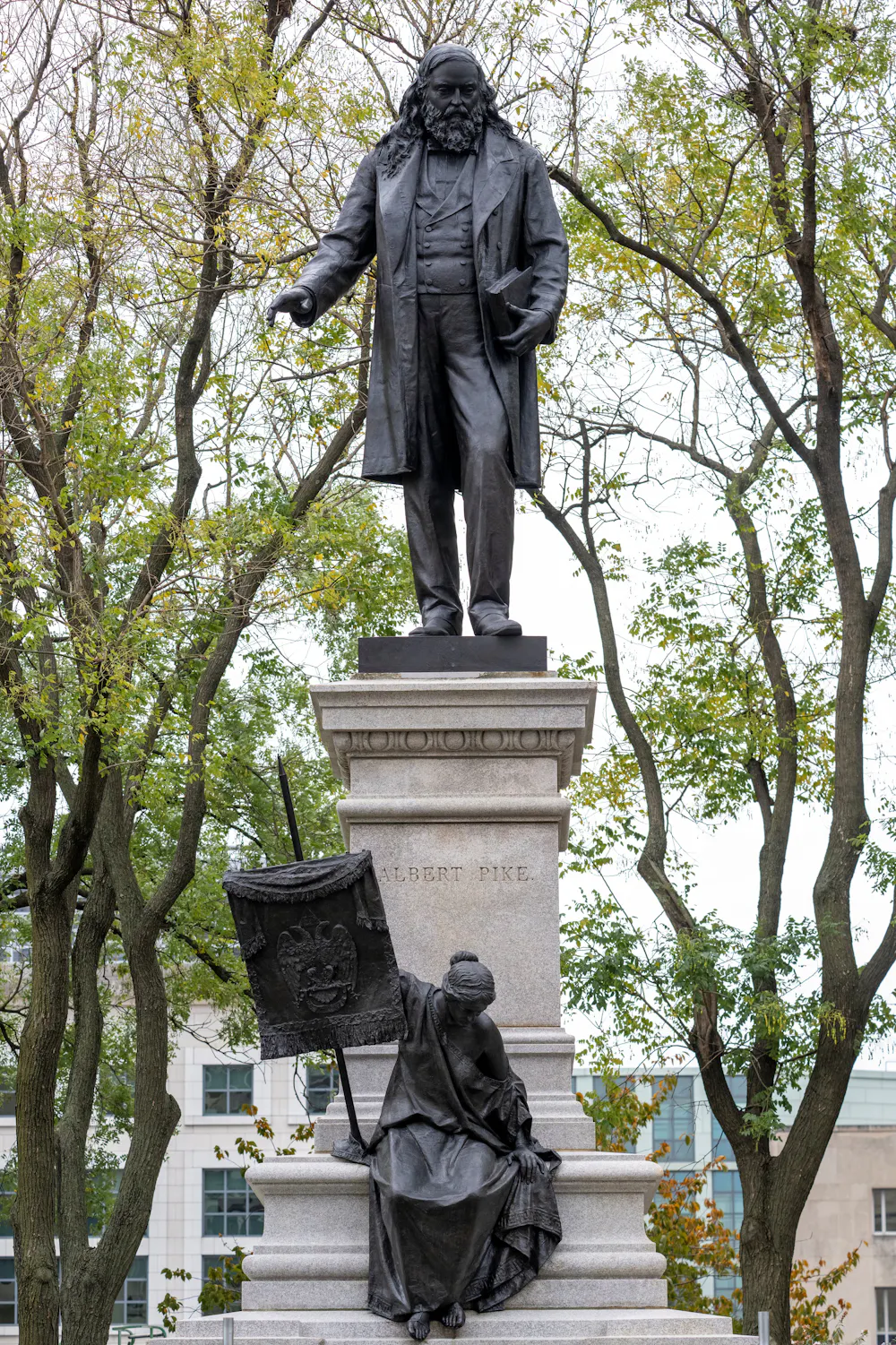
The memorial to Albert Pike, for example, was and is the only outdoor statue of a Confederate general in Washington DC. Pulled down by protesters in 2020 and returned in 2025, its merits have long been debated.
Pike was a disgraced figure, accused of misappropriating funds and allowing his troops to desecrate the bodies of Union soldiers. There are also alleged ties to an early version of the Ku Klux Klan.
In the words of congressional delegate Eleanor Holmes Norton, “Pike represents the worst of the Confederacy and has no claim to be memorialized in the Nation’s capital.”
Advocates for the statue’s retention note there is no mention of the Confederacy or depiction of a military uniform, only Pike’s contribution to the American Freemasons.
But when the statue was pulled down in 2020, Trump certainly took sides: “The DC police are not doing their job as they watched a statue be ripped down and burn. These people should be immediately arrested. A disgrace to our country.”
‘Woke lemmings’
Of course, history isn’t always simple, as memorialising the American Civil War shows.
Arlington National Cemetery in Virginia was established in 1864 as a national military cemetery, with a Confederate section dedicated in 1900 as part of the effort to promote reconciliation between the North and South.
Its Confederate Memorial (designed by a Confederate veteran) features a female figure representing the South holding symbols of peace. A bronze relief below depicts sanitised images of slavery: a woman caring for white children, and a man following his owner into battle as his servant.
A biblical quotation below preaches peace: “They have beat their swords into ploughshares and their spears into pruning hooks.”
But another quote in Latin – “Victrix causa diis placuit sed victa Caton” – references Julius Caesar’s victory in the Roman civil war and casts the South’s defeat as a noble lost cause.
The monument was erected in 1914, removed by Congress in 2023, and is scheduled to return in 2027. Secretary of War Pete Hegseth claimed on social media it “never should have been taken down by woke lemmings. Unlike the Left, we don’t believe in erasing American history – we honor it.”

Defiant choices
Similarly, an equestrian statue of Founding Father Caesar Rodney – installed in Wilmington, Delaware, in 1923 and removed in 2020 to prevent damage by protesters – highlights these contested readings of history.
Rodney is famous for riding all night from Delaware to Philadelphia, through a thunderstorm, to break a deadlock and cast the deciding vote in favour of American independence in 1776.
But as well as being a brigadier general and signatory to the Declaration of Independence, he owned 200 slaves on his family’s plantation.
The statue is now scheduled to reappear for six months, this time in Washington DC, to celebrate America’s 250th anniversary on July 4. It will be installed in Freedom Plaza, named in honour of Martin Luther King Junior.
Placing the contested statue of a famous slave owner in a space dedicated to a Black civil rights leader is a provocative, if not defiant, choice. And it shows again how powerful symbols and symbolic actions can be.
The argument that removing statues also erases history doesn’t hold up to scrutiny. It conflates public visibility and symbolic placement with actual knowledge of the past.
In that sense, reinstalling controversial memorials is, in itself, an attempt to rewrite history by erasing a more recent past and returning to an old, disputed status quo.
Garritt C. Van Dyk, Senior Lecturer in History, University of Waikato
This article is republished from The Conversation under a Creative Commons license. Read the original article.
---
---
AN 3 26
Hundreds of signs, merchandise and presentations by the National Park Service have been flagged by President Donald Trump’s administration for possible removal as part of its war against “ideological indoctrination.”
According to a NOTUS review of the material, an evaluation reveals that "in many instances, park staff acknowledged" the material was factual.
The removal reports were recently published online by an anonymous federal government employee and first reported by the Washington Post.
The removal requests were made to national parks, monuments and other sites. The order targets content that the administration deems “partisan” or “disparaging," according to Trump's executive order. Slavery, climate change and Native American issues were among the subjects to come under scrutiny.
The National Parks Conservation Association sued the Interior Department this month over removal of such content from park sites.
Whether the Interior Department and National Park Service subsequently reviewed each of the content reports isn’t clear. It has also avoided specifics on how much content is being removed or altered.
Molly Blake, a team member at Save Our Signs, told NOTUS the group has tracked hundreds of signs, displays and other material removed since Trump issued the executive order.
“The spreadsheet shows that the message that was sent is that we can’t talk about times in American history where people in power hurt other people. We can’t talk about times in American history where people’s civil rights were violated,” Blake said. “And that’s a really killing and disturbing development.”
A National Park Service spokesperson issued a statement calling such claims false.
The executive order has already had a chilling effect in some cases.
An exhibit at the Chesapeake and Ohio Canal National Historical Park that explores how people from different backgrounds can interpret archaeology in different ways was flagged as “factually accurite [sic], but submitting for review out of an abundance of caution,” the report said.
Another report that mentioned how Native American people were removed during development of the Transcontinental Railroad was also flagged, despite also being tagged as accurate by the reporting party.
“We understand a lot of folks are responding under duress, and I think that kind of comes out of some of the comments that have been leaked,” Blake said. “What I think is also just especially insidious is there’s no clear shared understanding of what it means to be quote-unquote ‘disparaging or inappropriate.’ And so then you get into these absurd situations where you’re reporting things that are historically accurate.”
---
---
RWW
03/02/2026
by
- Will Neal @ The Daily Beast: ‘Peace President’ Breaks Record for Attacking the Most Countries
Trump has reportedly authorized more assaults in just the first year of his second presidency than Biden did throughout four years at the White House.
- Edith Olmstead @ The New Republic: Trump Warns “The Big One” Is Still Coming for Iran
Donald Trump is ready to make it a whole lot worse for Iran.
- Mark Wingfield @ Baptist Press: The Iran bombing is a religion story for all but one person
When the United States and Israel bombed Iran Feb. 28, the motivations and repercussions were religious as well as political.
- Lee Moran @ HuffPost: Lindsey Graham Names 'Next' Country On Trump's Hit List: 'Their Days Are Numbered'
First Venezuela, then Iran — and now Cuba. Sen. Lindsey Graham (R-S.C.) told Fox News’ Trey Gowdy on Sunday that the U.S. under President Donald Trump will next target the communist-led Caribbean island for regime change.
- Liam Adams and Karissa Waddick @ USA Today: Trump's Freedom 250 hits the road with museum focused on faith, civics
Six mobile history museums, part of President Trump's Freedom 250 program, aim to counter 'woke agenda.' Historians say it leaves out key facts.
- Karin Brulliard and Brady Dennis @ The Washington Post: Confidential database reveals which items NPS thinks may ‘disparage’ America
An internal government database reviewed by The Washington Post demonstrates the vast scope of the Trump administration’s ongoing effort to revise or remove information on African American history, climate change and other topics at hundreds of national park sites.
- Chauncey DeVega @ Salon: Historians resist Trump’s effort to police the past
Attempts to reshape the Smithsonian reflect a broader campaign to control public memory and what Americans learn.
- Alice Gibbs @ Newsweek: What New Department of Education Banner Labels Charlie Kirk Raises Eyebrows
A large banner featuring conservative commentator Charlie Kirk has been hung on the exterior of the Lyndon Baines Johnson U.S. Department of Education building in Washington, D.C., prompting debate online over who should be publicly honored on government property.
- Michael Kruse @ Politico Magazine: ‘I Don’t Know That I’ll Ever Be OK With Myself’
Nancy Mace opens up about her trauma, why she does what she does and Donald Trump as a “father figure.”
---
---}:
AN 2 26
Trump has successfully pressured the Institute of Museum and Library Services (IMLS) into adopting new guidelines — and some officials feel that they amount to ideological loyalty tests.
The official letter emphasizes "uplifting and positive narratives of our shared American experience" but also instructs “improper ideology” be scrubbed from federal cultural institutions, according to a report by The Washington Post. Because the IMLS distributes grants to museums and libraries, they have the power to make both personnel and curatorial choices. As such, all references to "inclusive," "equity," and "diverse" or "diversity" have been removed from the IMLS’ recent 13 grant notices, even though they were previously commonplace in competitive applications. On some occasions, it has forced people out of the funding process.
"It feels like organizations like ours are boxed out from telling a complete and true and honest American story,” explained Ashley Rogers, executive director of the Whitney Plantation in New Orleans. Because of what Rogers does for a living, it is practically impossible for her to request grant money while remaining consistent with the administration’s standards.
"Our mission is to educate the public about the history and legacies of slavery,” Rogers told the Post. “We're a nonprofit. This is the only thing we do. I don't know how to make that align with the current funding opportunities at IMLS and more fundamentally than that, if I did, would I be betraying my mission?"
Lori Byrd, a former museum professional and IMLS grant reviewer, expressed a similar concern more broadly.
"If you even apply for this, are you going to get pushback from either your museum community or your fellow museum professionals because you're kind of caving to the administration?" Byrd asked. Museum consultant Andrea Jones made the same point when talking about her own professional responsibilities.
"Not only is the risk to my livelihood too great … but I care about doing credible, nuanced work — not being part of a propaganda machine,” Jones said.
Because of the uncertainty caused by the Trump administration’s approach, the IMLS grant cycle is already months behind schedule, The Post reported. Nor are Trump’s loyalty tests merely harming museums and libraries. A retired high-ranking military officer explained in a conservative publication that Trump’s policies are doing the same thing to America’s armed forces.
"The implications are immediate and corrosive," Lt. Gen. Mark Hertling wrote in The Bulwark earlier this week. "If promotions to general officer rank can be rescinded for perceived associations with others, officers may begin to prioritize 'safe' assignments or noncontroversial bosses. Candor — already fragile in large bureaucracies — may diminish if officers fear that honest service under controversial leaders will later be used against them. The apolitical ethic that underpins the profession of arms risks erosion."
Hertling added, "The Army's strength has always rested on trust: trust that performance matters more than patronage, that merit outweighs politics, and that the institution protects those who serve honorably in any job they are assigned. Undermining that trust does not merely harm an officer's career; it weakens the foundation of professional military service."
Loyalty oaths are not just in libraries, museums and the military. The US economy itself could be at risk because of Trump’s loyalty oaths, as evidenced by the controversy over National Economic Council directorKevin Hassett calling for Federal Reserve officers to be “disciplined” for issuing a report which showed Trump’s tariffs are hurting ordinary Americans.
“In the end, Mr. Trump’s decision evinced both the risk and reward for an economist whose previous views had morphed in service of the White House and its economic agenda," The New York Times recently reported. "The president did not want to lose one of his most forceful champions, whose full-throated advocacy had won deep praise from Mr. Trump but had fueled fears that Mr. Hassett could not guide monetary policy while resisting political influence.”
---
---
rww
02/10/2026
by
- Groyper gubernatorial candidate James Fishback is now promoting the radical "Doctrine of the Lesser Magistrates" book written by Matt Trewhella.
- FlashPoint's Gene Bailey is gullible enough to believe anti-Trump protesters are admitting to being directly recruited and paid by George Soros.
---
rww
02/06/2026
by
- Ryan Bort @ Rolling Stone: Trump Posts Wildly Racist Video of the Obamas
The president shared a video that included a clip depicting Barack and Michelle Obama as apes. The post has since been removed.
- David Gilmour @ Mediaite: White House Shrugs Off ‘Fake Outrage’ Over Trump Post Depicting Obamas as Apes
White House Press Secretary Karoline Leavitt has dismissed criticism of President Donald Trump for having shared an AI-generated video on Truth Social depicting former President Barack Obama and former First Lady Michelle Obama as apes.
- David Edwards @ Raw Story: Loyal Trump ally sickened by Obama attack: 'Most racist I've seen out of this White House'
Sen. Tim Scott (R-SC) lashed out after President Donald Trump posted a racist video that depicted Barack and Michelle Obama as apes.
- Chris Marquette, Mia McCarthy, Meredith Lee Hill, Ry Rivard and Jordain Carney @ Politico: Trump wanted Dulles Airport and Penn Station named after him as condition of releasing rail tunnel funds
Funding for the Gateway Project has been held up since October.
- John Fea @ The Way of Improvement Leads Home: On Trump’s “Presidential Message on the Anniversary of Our Victory in the Mexican-American War”
This is the kind of history the Trump administration wants taught in schools.
- Steve Benen @ The Maddow Blog: The key lesson from Trump’s embarrassing National Prayer Breakfast speech
Those who thought Trump might approach the event with any maturity or solemnity were kidding themselves: He has anti-gravitas.
---
---
AN 2 26
SEE GHOSTS OF MISS
Mississippi Today reports that President Donald Trump’s National Park Service (NPS) is replacing visitor brochures from the Medgar & Myrlie Evers Home National Monument, in Jackson, Mississippi.
Among the anticipated changes? No longer calling his murderer a “racist.”
“Edits to the brochure have removed that reference to Byron De La Beckwith, according to NPS officials, who asked not to be named for fear of retribution. Other edits include eliminating the reference to Medgar Evers lying in a pool of blood after being shot,” reports Mississippi Today writer Jerry Mitchell.
In 1963, Beckwith shot civil rights leader Medgar Evers in the back as he stood in the driveway of the Evers family home in northwest Jackson. His children were inside the home awaiting their father at the time of his death, and they saw him bleeding out in the front yard.
The original brochures pulled from the home described Beckwith as “a member of the racist and segregationist White Citizens’ Council.” That council, according to history author Stephanie Rolph, “believed in the natural superiority of the Aryan race.”
“They even went so far as to say that civilizations failed because of racial amalgamation,” Rolph added.
Mississippi Today reports Beckwith also belonged to the nation’s most violent white supremacist group, the White Knights of the Ku Klux Klan, responsible for at least 10 killings in Mississippi.
“You can’t call Beckwith a racist?” said Jeff Steinberg, founder of Sojourn to the Past, which regularly provides civil rights tours to the home. “If you opened a picture dictionary and turned to the definition for ‘racist,’ you’d probably find a picture of Byron De La Beckwith.”
Mississippi Today reports NPS' decision comes in the wake of Trump’s March 2025 executive order, “Restoring Truth and Sanity to American History,” which accused the Biden administration of a “widespread effort to rewrite our Nation’s history, replacing objective facts with a distorted narrative driven by ideology rather than truth.”
Furthermore, the order demanded the Secretary of the Interior “ensure” that all public monuments and properties within its jurisdiction “do not contain descriptions, depictions, or other content that inappropriately disparage Americans past or living.”
This apparently includes race-based assassins.
Mississippi Today adds that Trump initially hailed Evers, a World War II veteran, as a “great American hero” at the opening of the Mississippi Civil Rights Museum in 2017. But after his 2025 executive order, his U.S. Army removed Evers, and the names of other Black heroes, from a section on the Arlington National Cemetery website that honored non-white Americans who fought in the nation’s wars.
---
---
GREIVance IN A BIGGER SENSE // STORY 1
AN 12 25
In his New York Times column and frequent appearances on MS NOW, journalist David French isn't shy about attacking President Donald Trump from the right. Like other Never Trump conservatives — from attorney George Conway to MS NOW's Nicolle Wallace to The Lincoln Project's Rick Wilson — French believes that Trump and the MAGA movement have been terrible for the GOP and terrible for conservatism.
But French examines MAGA's belief system in his December 14 column for the Times. MAGA, according to French, believes that Trump is fighting to save the United States from a "death spiral" — and that combination of anger and "despair" is one of the things that makes MAGA and the "New Right" so dangerous.
"In this telling," French explains, "the 'strong men' of the American past had created a glorious and powerful nation. Our peace and prosperity had spawned a weak and feckless generation that had squandered America's strength and cultural identity, and now, it was time for hard men to arise to reclaim what was lost. This view of America's glorious past is indispensable to understanding MAGA's appeal — and the extremism of MAGA youth. After all, the slogan, 'Make America Great Again' implies the loss of greatness."
French continues, "This sense of loss provides the intellectual and — crucially — emotional foundation of the right's authoritarian turn. It's hard to overstate how much the New Right idealizes America's past. Online spaces are full of memes and images, for example, of families from the 1950s in idyllic settings, often with the caption, 'This is what they took from you.'"
The New Right, French observes, typically "contrasts its vision of a glorious past with a miserable present."
"Now, combine that hyperbole with smartphones and social media, and you've got a recipe for a nonstop sense of alarm," the conservative New York Times columnist warns. "I can open my Twitter feed and see video after video of outrageous conduct, and no amount of telling myself that these are isolated incidents in a nation of over 340 million people can blunt their emotional impact."
*David French's full New York Times column is available at this link (subscription required).
---
---
RWW
10/06/2025
by
- Josh Kovensky @ Talking Points Memo: The Trump Admin’s Mostly Unnoticed Move to Crack Down on the Opposition
Last month, the White House issued two executive orders that direct federal law enforcement to start cracking down on the political opposition. One of the two memos prompted some confusion and mockery for its attempt to designate “antifa” a terrorist organization. But the second has gone largely unnoticed in the mainstream press.
- Ann Marie Shambaugh @ The Roys Report: Son of Covenant Eyes Co-Founder Arrested after Planning Sexual Encounter with 14-Year-Old
Back in 2000, a Michigan entrepreneur named Ron DeHaas co-founded Covenant Eyes, an anti-porn internet accountability software program that has since grown to more than 2 million users. The idea, he said at the time, was to protect his teenage stepsons from sexual temptation online. Its effectiveness has been lauded by many, including Speaker of the House Rep. Mike Johnson. But this past Aug. 13, one of those stepsons was arrested at a meeting spot in Grand Rapids, Michigan, where he thought he would find a 14-year-old girl interested in having sex with him.
- Andrew Perez, Asawin Suebsaeng @ Rolling Stone: ‘They Need to Suffer’: Inside Trump’s War on Dissent
After Charlie Kirk’s murder, Trump expanded his war on free speech, the left, and ordinary Americans. It’s going to get worse.
- Jonathan Chait @ The Atlantic: Stephen Miller Is Going for Broke
The White House aide equates opposition to Trump’s agenda with terrorism—and pushes for the use of state power to suppress it.
- John Fea @ ARC: The Christian Nationalist Rewriting American History
Douglas Wilson’s rising influence shows how the past is at the center of today’s culture wars.
- Edith Olmstead @ The New Republic: Supreme Court Tells Laura Loomer to Shut Up Already
The Supreme Court refused to hear the far-right commentator’s censorship case.
---
---
RWW
[Christian Nationalism ## David And Tim Barton Blast The Smithsonian Institution's 'Obsession With Slavery'
Christian nationalist pseudo-historian Tim Barton cheers on Trump's attack on the Smithsonian, saying the museums should not treat slavery as "the most significant thing for American history" because "we had slaves for less than 100 years in our nation's history."
https://www.peoplefor.org/rightwingwatch/david-and-tim-barton-blast-smithsonian-institutions-obsession-slavery)
---
---
8 25
The top Trump official tasked with reshaping the Smithsonian’s collections into a more conservative presentation argues that, based on her experience and expectations, the institution should place less emphasis on the painful chapters of American history and more on its achievements.
Insurance attorney Lindsey Halligan is now Assistant to the President for Domestic Policy, as well as the Special Assistant to the President and Senior Associate Staff Secretary.
On Wednesday, Fox News host John Roberts told Halligan that “like just about every other country in the world, the United States has got a checkered past.”
He reminded her that “some of the worst episodes in our history were formative experiences that led us to where we are today, and those typically are reflected in museums.”
Halligan replied that from her point of view, “the fact that we had our country, was involved in slavery is awful. No one thinks otherwise.”
READ MORE: Stephen Miller Casts Trump’s D.C. Takeover as Race Issue in Fiery Tirade
“But what I saw when I was going through the museums personally was an overemphasis on slavery. And I think there should be more of an overemphasis on how far we’ve come since slavery.”
She insisted that Americans “should be able to take our kids, our students, through the Smithsonian, and feel proud when we leave,” and that “we need to keep moving forward.”
“We can’t just keep focusing on the negative. All it does is divide us, and we really need to unite the country and focus on all the positive as we approach America’s 250th birthday.”
A section of a Trump executive order titled “Saving Our Smithsonian” directs Halligan, by name, to seek “to remove improper ideology” from the Smithsonian Institution and its properties, “and shall recommend to the President any additional actions necessary to fully effectuate such policies.”
In April, Halligan told The Washington Post that she believes “improper ideology” means “weaponizing history.”
Halligan has a law degree from the University of Miami School of Law, and does not appear to have any education in museum sciences.
When she first moved to Washington, D.C. she “didn’t like everything she saw,” at the Smithsonian, the Post reported.. “Some exhibits, in her view, did not reflect the America she knows and loves.”
“And so I talked to the president about it,” Halligan said, “and suggested an executive order, and he gave me his blessing, and here we are.”
READ MORE: Trump’s Border Wall to Get $500M+ ‘Hot’ Makeover Experts Say Won’t Work
She told Fox News that “it’s common knowledge that our education system in general has been just indoctrinated with political ideology and various ideological narratives. And the Smithsonian is really a version of education.”
“It could be the foundation of our American education,” she claimed, explaining the as a young child she went to the Smithsonian Museum on a class trip, “and the Smithsonian is really supposed to be a trust instrument.”
“And what’s happened is it’s become more of a platform upon which the curators and leadership at the Smithsonian can push ideological narratives and we really want to help the Smithsonian be the gem,” she said. “Represent our nation, properly and truthfully.”
Critics denounced Halligan’s remarks.
U.S. Rep. Yvette Clarke (D-NY) remarked, “400 years of brutal bondage, torture, and murder should be emphasized. The generations of Black Americans who built this nation with their own hands and their own pain should be emphasized. The true history of this country SHOULD BE EMPHASIZED.”
“White American woman who went through the museum said there was an ‘overemphasis on slavery.’ What a thing. To say those words out loud,” wrote former Republican Tea Party Congressman Joe Walsh.
Watch the video below or at this link.
---
---
OMG
the conv an 8 25
When people use the term “Orwellian,” it’s not a good sign.
It usually characterizes an action, an individual or a society that is suppressing freedom, particularly the freedom of expression. It can also describe something perverted by tyrannical power.
It’s a term used primarily to describe the present, but whose implications inevitably connect to both the future and the past.
In his second term, President Donald Trump has revealed his ambitions to rewrite America’s official history to, in the words of the Organization of American Historians, “reflect a glorified narrative … while suppressing the voices of historically excluded groups.”
This ambition was manifested in efforts by the Department of Education to eradicate a “DEI agenda” from school curricula. It also included a high-profile assault on what detractors saw as “woke” universities, which culminated in Columbia University’s agreement to submit to a review of the faculty and curriculum of its Middle Eastern Studies department, with the aim of eradicating alleged pro-Palestinian bias.
Now, the administration has shifted its sights from formal educational institutions to one of the key sites of public history-making: the Smithsonian, a collection of 21 museums, the National Zoo and associated research centers, principally centered on the National Mall in Washington, D.C.
On Aug. 12, 2025, the Smithsonian’s director, Lonnie Bunch III, received a letter from the White House announcing its intent to carry out a systematic review of the institution’s holdings and exhibitions in the advance of the nation’s 250th anniversary in 2026.
The review’s stated aim is to ensure that museum content adequately reflects “Americanism” through a commitment to “celebrate American exceptionalism, [and] remove divisive or partisan narratives.”
On Aug. 19, 2025, Trump escalated his attack on the Smithsonian. “The Smithsonian is OUT OF CONTROL, where everything discussed is how horrible our Country is, how bad Slavery was…” he wrote in a Truth Social post. “Nothing about Success, nothing about Brightness, nothing about the Future. We are not going to allow this to happen.”
Such ambitions may sound benign, but they are deeply Orwellian. Here’s how.
Winners write the history
Author George Orwell believed in objective, historical truth. Writing in 1946, he attributed his youthful desire to become an author in part to a “historical impulse,” or “the desire to see things as they are, to find out true facts and store them up for the use of posterity.”
But while Orwell believed in the existence of an objective truth about history, he did not necessarily believe that truth would prevail.
Truth, Orwell recognized, was best served by free speech and dialogue. Yet absolute power, Orwell appreciated, allowed those who possessed it to silence or censor opposing narratives, quashing the possibility of productive dialogue about history that could ultimately allow truth to come out.
As Orwell wrote in “1984,” his final, dystopian novel, “Who controls the past controls the future. Who controls the present controls the past.”
Historian Malgorzata Rymsza-Pawlowska has written about America’s bicentennial celebrations that took place in 1976. Then, she says, “Americans across the nation helped contribute to a pluralistic and inclusive commemoration … using it as a moment to question who had been left out of the legacies of the American Revolution, to tell more inclusive stories about the history of the United States.”
This was an example of the kind of productive dialogue encouraged in a free society. “By contrast,” writes Rymsza-Pawlowska, “the 250th is shaping up to be a top-down affair that advances a relatively narrow and celebratory idea of Americanism.” The newly announced Smithsonian review aims to purge counternarratives that challenge that celebratory idea.
The Ministry of Truth
The desire to eradicate counternarratives drives Winston Smith’s job at the ironically named Ministry of Truth in “1984.”
The novel is set in Oceania, a geographical entity covering North America and the British Isles and which governs much of the Global South.
Oceania is an absolute tyranny governed by Big Brother, the leader of a political party whose only goal is the perpetuation of its own power. In this society, truth is what Big Brother and the party say it is.
The regime imposes near total censorship so that not only dissident speech but subversive private reflection, or “thought crime,” is viciously prosecuted. In this way, it controls the present.
But it also controls the past. As the party’s protean policy evolves, Smith and his colleagues are tasked with systematically destroying any historical records that conflict with the current version of history. Smith literally disposes of artifacts of inexpedient history by throwing them down “memory holes,” where they are “wiped … out of existence and out of memory.”
At a key point in the novel, Smith recalls briefly holding on to a newspaper clipping that proved that an enemy of the regime had not actually committed the crime he had been accused of. Smith recognizes the power over the regime that this clipping gives him, but he simultaneously fears that power will make him a target. In the end, fear of retaliation leads him to drop the slip of newsprint down a memory hole.
The contemporary U.S. is a far cry from Orwell’s Oceania. Yet the Trump administration is doing its best to exert control over the present and the past.
Down the memory hole
Even before the Trump administration announced its review of the Smithsonian, officials in departments across government had taken unprecedented steps to rewrite the nation’s official history, attempting to purge parts of the historical narrative down Orwellian memory holes.
Comically, those efforts included the temporary removal from government websites of information about the Enola Gay, the plane that dropped the atomic bomb over Hiroshima. The plane was unwittingly caught up in a mass purge of references to “gay” and LGBTQ+ content on government websites.
Other erasures have included the deletion of content on government sites related to the life ofHarriet Tubman, the Maryland woman who escaped slavery and then played a pioneering role as a conductor of the Underground Railroad, helping enslaved people escape to freedom.
Public outcry led to the restoration of most of the deleted content.
Over at the Smithsonian, which earlier in the year had been criticized by Trump for its “divisive, race-centered ideology,” staff removed a temporary placard with references to President Trump’s two impeachment trials from a display case on impeachment that formed part of the National Museum of American History exhibition on the American presidency. The references to Trump’s two impeachments were modified, with some details removed, in a newly installed placard in the updated display.
Responding to questions, the Smithsonian stated that the placard’s removal was not in response to political pressure: “The placard, which was meant to be a temporary addition to a 25-year-old exhibition, did not meet the museum’s standards in appearance, location, timeline, and overall presentation.”
Repressing thought
Orwell’s “1984” ends with an appendix on the history of “Newspeak,” Oceania’s official language, which, while it had not yet superseded “Oldspeak” or standard English, was rapidly gaining ground as both a written and spoken dialect.
According to the appendix, “The purpose of Newspeak was not only to provide a medium of expression for the worldview and mental habits proper to the devotees of [the Party], but to make all other modes of thought impossible.”
Orwell, as so often in his writing, makes the abstract theory concrete: “The word free still existed in Newspeak, but it could only be used in such statements as ‘This dog is free from lice’ or ‘This field is free from weeds.’ … political and intellectual freedom no longer existed even as concepts.”
The goal of this language streamlining was total control over past, present and future.
If it is illegal to even speak of systemic racism, for example, let alone discuss its causes and possible remedies, it constrains the potential for, even prohibits, social change.
It has become a cliché that those who do not understand history are bound to repeat it.
As George Orwell appreciated, the correlate is that social and historical progress require an awareness of, and receptivity to, both historical fact and competing historical narratives.
*This story is an updated version of an article originally published on June 9, 2025.
*The Smithsonian is a member of The Conversation U.S.
Laura Beers, Professor of History, American University
This article is republished from The Conversation under a Creative Commons license. Read the original article.
---
---
an 8 25
Next to his long-running radio show, Dennis Prager, now 77, is best known for PragerU — which isn't an actual university, but rather, a program of far-right propaganda videos launched in 2009. One of PragerU's admirers is Ryan Walters, Oklahoma's ultra-MAGA public schools superintendent. And according to CNN, Walters is now using PragerU to screen applicants for ideological purity and to make sure teachers in the state's public schools aren't "woke."
The screening process, CNN's Sunlen Serfaty reports, gets underway on Friday, August 15.
"Teachers from 'liberal' states who have relocated to Oklahoma and are seeking to work there must take a controversial new assessment, given for the first time today, that 'keeps away woke indoctrinators,' according to Oklahoma’s top education official," Serfaty explains. "Ryan Walters, Oklahoma's superintendent for public instruction, told CNN that if applicants do not pass the test, they will not earn a teaching certificate to be able to teach in public schools in the state this school year, which begins for some Oklahoma districts on Monday."
READ MORE: This single sentence will fast-track Trump to a prison cell
Serfaty adds, "The decision to use the assessment, developed by PragerU, a conservative media company whose teaching materials are now approved for use in public schools in ten U.S. states, opens a new front in the education culture wars just days before schools are to open their doors."
PragerU's materials, according to the CNN reporter, have "been embraced by the political right for offering curriculums that champion ideas aligned with the Make America Great Again movement."
According to Serfaty, Walters' "multiple-choice assessment for teachers" contains "around 50 questions." One proposed question, Serfaty reports, "deals with gender — asking teachers to select from a series of multiple-choice answers which chromosome pairs determine biological sex."
"Another question asks why freedom of religion is important to America's identity," Serafty notes. "Other questions include asking for the first three words of the Constitution, naming the two chambers of the U.S. Congress, and identifying the number of U.S. senators…. The test specifically evaluates educators on areas including their understanding of 'American exceptionalism' and their 'grasp of fundamental biological differences between boys and girls,' Walters said."
READ MORE: 'Financial ruin': Trump's White House is terrified of losing this lawsuit
*Read the full CNN article at this link.
---
---
yikes an 7 25
critics of far-right Oklahoma Schools Superintendent Ryan Walters often attack him as a highly performative MAGA troll. Walters' antics include purchasing Donald Trump-themed Bibles for classrooms and promoting the false, repeatedly debunked conspiracy theory that the 2020 presidential election was stolen from Trump.
But Slate's Molly Olmstead, in an article published on July 22, emphasizes that Walters' buffoonish qualities don't make him any less dangerous. And she emphasizes that his plan to screen education applicants for MAGA purity shouldn't be taken lightly.
"This month," Olmstead explains, "Oklahoma's education department announced an innovative new approach to screening aspiring teachers in the state: any applicants from 'woke' states would need to first pass an ideology test created by the right-wing group PragerU. It was an announcement that seemed engineered to draw national news coverage and inflame liberal audiences. Under this plan, teachers from states with 'progressive education policies' would be tested on the U.S. Constitution, American exceptionalism, and 'the fundamental biological differences between boys and girls.'"
READ MORE: This White House lie shows they know Trump is in trouble
Olmstead continues, "The screening is guaranteed to test teachers for a deeply MAGA-inflected understanding of U.S. history, government, and society: PragerU, a right-wing group with a stated mission of countering leftism in education, is already known for its white nationalist-adjacent content for schoolchildren."
PragerU is the brainchild of Dennis Prager, a far-right talk radio host and Trump supporter.
"Walters' proposals for the school system have included a mandate that all public schools teach the Bible; a plan to collect children's immigration status when they register for public school; and new social studies standards proposals that would have high school students 'identify discrepancies in 2020 election results,'" Olmstead observes. "Each of these announcements solidified Walters' reputation as a relentless attention-seeker, calculating every action from his office to appeal to the power players of the MAGA movement…. These stunts have paid off. Walters has been profiled in outlets all over the country, and he has become the face of the Christian nationalist campaigns into public education."
The MAGA Republican's stunts, Olmstead argues, raise the question: "Is Walters all superficiality, a media-obsessive without the stamina or standing for real, transformative politics? Or is he actually capable of remaking Oklahoma's schools — and signaling what MAGA could bring to schools across the country?"
READ MORE:GOP sen tells constituent he’s 'not obligated to listen' after she’s denied care over marital status
"In sign of just how bizarre American politics have become in this second Trump era," Olmstead warns, "Walters may be a bit of both. As traditional institutions and procedures buckle under MAGA politics, Walters has proven that with the right national climate, slapdash own-the-lib pronouncements can become serious policy. He's a performer, but he also happens to be a major change-maker…. It may be tempting not to take people like Walters seriously, but he has proven that with enough volume, some gimmicks stick."
READ MORE:'Errand boy': Trump official reveals what president talks about during nightly 1 AM calls
*Molly Olmstead's full article for Slate is available at this link (subscription required).
---
---
RWW
04/23/2025
by
- Khaya Himmelman @ Talking Points Memo: Trump’s DOJ Is Taking Cues From MAGA Influencers And Conspiracy Theorists
President Trump’s nominee for D.C. U.S. Attorney Ed Martin, and Donald Trump’s Department of Justice more broadly, are taking cues from right-wing influencers — allowing some of the loudest media figures on the right to influence significant decisions, including who gets fired from the DOJ and who and what gets investigated.
- Media Matters: Cigar company founder Michael Knowles asks Trump for a tariff exemption
Knowles: “Anyone listening right now in the admin, a great little carve out would be for all of the patriotic Americans who have been oppressed for too long, who work in the premium cigar industry, and for all of the premium cigar smokers.”
- Alex Griffing @ Mediaite: MAGA Influencer Tells Steve Bannon Trump ‘Will Have No Choice’ But to Suspend Habeas Corpus
Former Trump White House advisor turned podcaster, Steve Bannon, spoke to another MAGA influencer on Tuesday, who argued that President Donald Trump will eventually have to suspend habeas corpus in order to facilitate mass deportations.
- Judd Legum @ Popular Information: U.S. citizen wrongly detained by Border Patrol says government account is false
Jose Hermosillo was held in a detention facility for undocumented immigrants for 10 days.
- Amanda Lewellyn @ Vox: How Trump is rewriting American history
Yale professor David W. Blight explains why Trump is far from the first to try to rewrite the record.
- Steve Benen @ The Maddow Blog: Bondi launches dubious ‘Task Force to Eradicate Anti-Christian Bias’ in U.S. government
Trump administration officials could be focused on “anti-religion bias” within the government, but they’re instead focused only on “anti-Christian bias.”
---
REF VOX
NO LNX
Podcasts /
Today, Explained podcast
How Trump is rewriting American history
Yale professor David W. Blight explains why Trump is far from the first to try to rewrite the record.
by Amanda Lewellyn
:{:{Apr 23, 2025,}:
Protestors Rally At Stonewall Nat’l Monument After NPS Removes Trans References
Spencer Platt/Getty Images
Amanda Lewellyn is a tech-focused Today, Explained producer.
History has been disappearing from government websites.
First, it was Stonewall. The word “transgender” was removed from the National Park Service page commemorating the 1969 Stonewall Uprising, at which trans activists Marsha P. Johnson and Sylvia Rivera played a central role. The acronym LGBTQ was also changed to just “LGB.”
Then, Harriet Tubman was erased from a page about the Underground Railroad, and the language changed to highlight “Black/white cooperation.” A page about Jackie Robinson’s Army service was taken down from the Pentagon’s website. (Both pages were later restored after public criticism.) A Washington Post investigation also found that at least half a dozen pages referencing the Little Rock Nine, the Black students who integrated an Arkansas high school in the 1950s, previously said the students had “opened doors” for those seeking “equality and education.” Now, the pages say the students were just seeking “education.”
The edits come amid the Trump administration’s push to end DEI and “restore truth and sanity” to American history, an effort causing alarm among historians like Yale professor David W. Blight.
In an interview with Noel King on Today, Explained, Blight says the changes amount to a brazen attempt to rewrite our past — but that America is no stranger to revisionist history. The country has rewritten and re-saved and re-pushed its narrative of events so many times that it might as well look like the filename of a high schooler’s final project.
Below is an excerpt of the conversation, edited for length and clarity. There’s much more in the full podcast, so listen to Today, Explained wherever you get podcasts, including Apple Podcasts, Spotify, or wherever else you get your podcasts.
Reporters will often say, “Donald Trump is unprecedented. The things that he does are unprecedented.” But I imagine you would tell me that the United States has tried to rewrite its own history, at certain points.
Many times, yes.
Give me some examples of the times we’ve tried to do this.
During World War II, the United States created a massive propaganda machine called the Office of War Information. That’s what governments do during wartime. That organization did indeed engage in a lot of propaganda, selling stories to keep Americans patriotic.
Moving ahead from that to McCarthyism: Anti-communism was a very deep phenomenon in America — and not without some reason in the ’30s and ’40s. But McCarthyism caused a wave of attempts of trying to control what writers wrote, what historians could teach, who could teach anything.
Let’s take the Civil War. In 1865 to 1870, there was an organization in the South called the Southern Historical Society. That was originally made up mostly of former Confederate officers who were determined to try to control the story of what the war had been about, what they had actually fought for, what their crusade meant, what the Confederacy actually was.
On the Right The ideas and trends driving the conservative movement, from senior correspondent Zack Beauchamp.
:{:{}:
What was the story they were trying to sell?
They told a story that we’ve come to know as the “Confederate Lost Cause.” Namely, they were arguing early on that they did not really lose the war on the battlefield, they only lost to superior numbers and resources. They said they lost only to “the leviathan of northern industrialization.” There’s some truth in that, but that’s not the full explanation.
They also argued that the war was not really about slavery. It was really about state sovereignty and states’ rights. It was really about resisting the federal interference with their lives and their civilization and their morays and folkways…
Can I jump in and tell you something?
Sure.
I’m from central New York. I went to public school. That was what I learned.
Wow.
Why did I learn something that wasn’t true in public school?
Because over time, in culture, schooling, politics, and rituals from the 1870s and ’80s well on into the 20th century — and still surviving in a textbook you were learning from in the 1990s, I am sorry to hear — was this idea that the United States divided had this all-out horrific war. But it had to put itself back together again.
How do you put back together something so horrifically divided? You’re going to have to find mutuality. You’re going to have to find some kind of unified narrative. Well, one of the unified narratives they did develop in the 19th century — and there’s reality to this — is that you unify around the valor of soldiers. But if we admire valor without ever looking at the cause for which they fought, it’s of course limited.
“Our greatness is in the amazing strivings and triumphs of all kinds of people in the past who challenged power.”
Now, the typical and powerful belief was that everybody in that war fought for the cause they believed in. And if you fought for the cause you believed in with great valor, you fought for the right [reasons]. Everybody was equal in valor. The causes had to be muted, put aside. Well, you know, that’s a part of human relations as well: How do you keep a family together? Well, there’s some things you don’t talk about.
But for nations and whole peoples and cultures, the danger in this is that the stories you take on, the stories that you develop that define the identity of your nation — the identity of your past and now your future — is going to leave somebody out. In fact, it may end up allowing you to reconcile on the backs of those who most suffered from the conflict you are trying to reconcile. Obviously, in America, that meant Black Americans. It meant their civil and political rights, which were created and then slowly but surely abandoned and then crushed in the Jim Crow system of the South.
Now, the point of all of this is that the Confederate Lost Cause, which said the South fought for noble ends, they fought for their homes, they fought for their sovereignty, they fought for their integrity. … It eventually becomes, though, not a story of loss at all. It becomes, by the 1890s and into the 20th century, a victory narrative.
This was an age of a lot of sentimental literature. Americans came to love stories of the Old South. Of course, it’s there in Gone With the Wind, still, maybe the most famous movie ever made. So the Lost Cause was both a political movement and it was a literary movement. But it was at its core a racial ideology, and it lasted a very long time.
Related What comes after the DEI backlash?
Let’s compare to what we’re seeing today. What you’re talking about with these popular books and Gone With the Wind, that seems to me more subtle than the president saying, “You delete that information about Jackie Robinson’s military service from the website.” Will what Trump is doing succeed because it is so unsubtle?
That’s a very good question and my instinctive answer — and it’s partly my wishful answer — is that no he won’t. It is not subtle, you’re right: They’re wiping out websites. They are explicitly saying, “Professional history, whether it’s in our greatest museums or our greatest university, has been teaching us all the wrong ways. They’ve been dividing us.” This is the word they love to use: The history we write has been divisive, divisive, divisive.
Well, no, it’s not. It’s simply informative. Sometimes it gets people riled up and sometimes it gets them arguing and sometimes fighting. But what the Trumpists are doing is telling us that they know better — policy people at the Heritage Foundation or pseudo-historians who think that studying all this stuff about race, gender, all the ethnicities that make us up, all this pluralism, is just taking away from “American greatness.” They use that term a lot: “We’re no longer teaching our youth about American greatness.”
Yes we are! We’re teaching our youth that our greatness is in the pluralism. Our greatness is in the amazing strivings and triumphs of all kinds of people in the past who challenged power.
What will you know about World War I if you try to find nothing but greatness? What will you know about the history of imperialism and expansion if all you wanna know is about greatness? What will you actually know about Native American history if all you look for is greatness?
It defies the intelligence of anyone with an education, and a whole lot of people who don’t have a lot of formal education. I’m not very optimistic right now about what’s going on, but I do have a certain faith that people just aren’t going to buy this.
See More:
Donald Trump
Podcasts
Politics
Today, Explained podcast
===
an 4 25
---
story 1
mma
09/03/24
---
an 2 25 pro pub
This was the great, necessary undertaking of the four-year effort by the Department of Justice: to draw distinctions for the sake of allocating individual accountability. By poring over countless such videos and other evidence, investigators zeroed in on the hundreds of people who could be identified as engaging in and instigating the most violence. There was Daniel Rodriguez, who could be seen on camera driving a stun gun into the neck of Officer Michael Fanone; he was sentenced to more than 12 years. There was Thomas Webster, a former New York City police officer and member of the Marine Corps who swung a metal flagpole at an officer; he got 10 years. There was Peter Schwartz, a Pennsylvania welder who attacked the police with a chair and chemical spray; he got 14 years.
Inevitably, some of the outcomes were ripe for second-guessing. Kerstin Kohlenberg, the former U.S. correspondent for Germany’s Die Zeit newspaper, reported recently on the case of Stephen Randolph, a 34-year-old Kentucky man who received an eight-year sentence for his role in pushing over one of the metal security barriers on the Capitol grounds, injuring a police officer in the process; others in the same group received much milder sentences. Trump and his allies could have chosen to comb through cases and pardon only the defendants who they could argue had been painted with too broad a brush.
But that’s not what Trump did. Instead, he himself took up the broadest brush possible and wiped it all clear. In doing so, he let the defendants off the hook. But in another sense, with the mass pardon and deletion of the database, he deprived all of the Jan. 6 participants of individual agency, of individuality, period. In a sense, he rendered them just what the most ardent castigation on the other side had cast them as from the outset: a mindless mob.
As chance has it, at the end of Trump’s first week in office, I was in Tulsa. I went to the Greenwood Rising museum, which tells the story of the rise of the neighborhood and its sudden destruction. It is a powerful presentation despite the dearth of documentation of the violence: snatches of oral history from survivors play over a video simulation of gunfire and arson; before and after photos capture the near-total obliteration of the neighborhood’s prospering commercial core by first the attack and later urban renewal.
One of the museum’s central preoccupations is the attempt by Tulsa authorities and leading white denizens to downplay the massacre, by framing it as a “Negro uprising”; only a couple decades afterward, the museum notes, many in Tulsa were barely aware it happened at all. This cover-up came with lasting consequences for Greenwood survivors, who were denied insurance claims for their destroyed homes, not to mention any form of civic restitution.
Even now, many Black residents of Tulsa are left wondering why the reckoning represented by the Department of Justice investigation is not joined by substantive reparations of any sort. The last two living survivors of the massacre, Lessie Benningfield Randle and Viola Fletcher, said in a statement responding to the report, “The DOJ confirms the government’s role in the slaughter of our Greenwood neighbors but refuses to hold the institutions accountable under federal law.” Still, they said, “We are relieved to see one of the biggest coverups in American history come crashing down.”
And now, back in Washington, the federal government has embarked on an entirely new cover-up of another day of enormous violence. The erasure will not be nearly as successful this time around. There are, after all, all those videos, which live on ProPublica’s website, among other places, while much of the deleted database can be found on the Internet Archive’s Wayback Machine. (And ProPublica is one of 10 media organizations that have jointly sued the federal government, seeking to obtain 14,000 hours of Jan. 6 surveillance footage.)
But for the time being, at least, those seeking to preserve the record of one of the darkest days in recent U.S. history will be doing so, like the survivors of Greenwood and other outbursts of violence around the world, in direct opposition to their own government.
Alex Mierjeski and Agnel Philip contributed research....
---
---
---
judd 2 25
A Texas county has mandated public libraries move a well-regarded children's book documenting the mistreatment of Native Americans in New England — Colonization and the Wampanoag Story — from the "non-fiction" section to "fiction." The decision was made after the government of Montgomery County, under pressure from right-wing activists, removed librarians from the process of reviewing children's books and replaced them with a "Citizens Review Committee." Colonization and the Wampanoag Storywas "challenged" by an unknown person on September 10, 2024. The Committee responded by ordering that the book be moved to the fiction section of public libraries in Montgomery County by October 17, 2024, according to public records obtained by the Texas Freedom To Read Project shared with Popular Information.
The author of Colonization and the Wampanoag Story is Linda Coombs, a "historian from the Wampanoag Tribe." Coombs spent three decades working at the Wampanoag Indigenous Program, an initiative to preserve the history of the Wampanoag people. The book is published by Penguin Random House, which describes the book as "[t]he true story of the Indigenous Nations of the American Northeast, including the Wampanoag nation and others, and their history up to present day."
Colonization and the Wampanoag Storytells the real story of the brutalization of the Wampanoag people by European settlers. An excerpt:
[C]ertain ship captain began kidnapping Wampanoag men and those of other tribal nations along the coast. Sailors invited them aboard their ships under the pretense of trading, then lifted anchor and sailed away. The men were prisoners, stolen from their families and homes.
They were taken to England and Spain to be sold into slavery and paraded through the streets as "novelties," something for the people of Europe to gawk at as curiosities — not as human beings. Imagine how these men must of felt when they realized their situation: they would never see their children, parents, wives, relatives or communities and homelands again. What a terrible shock for all their families when they realized their men were gone — just disappeared forever.
This is fact, not fiction.
In addition to telling the history of the Wampanoag people, the book also includes several parables. But these sections are identified in italics. It does not change that it is a history book, which is why it is classified as non-fiction by the Library of Congress. The book's Library of Congress classification begins with "E99," the non-fiction classification for books about Native American peoples. It is also classified as non-fiction by Penguin Random House, the Houston Public Library, the Austin Public Library, and the Fort Worth Public Library.
The move to reclassify Colonization and the Wampanoag Storycomes after a controversial decision last March to remove librarians from the decision-making process when a children's book carried by Montgomery County is challenged. Previously, there was an advisory committee comprised of five librarians and five community members. As a result of the change, the librarians were removed from the Committee, and the determinations of the new Committee, which consisted of five non-librarians, became binding.
The change to the book review process was driven by a local right-wing group, Two Moms and Some Books. The group is led by Michele Nuckolls, a local mother. Nuckolls believes "children’s books with alternate gender ideology to be moved to the adult section." The group also is demanding more "conservative and Christian’s [sic] books in the public library." The group is especially enthusiastic about titles from Brave Books, which publishes children's books from far-right authors like Congressman Dan Crenshaw (R-TX), Donald Trump's former press secretary Sean Spicer, and Trump’s former national security adviser Michael Flynn. In case there is any confusion about the objectives of the group, its slogan is "Make Libraries Great Again!"
Before the change to the review process, Nuckolls expressed frustration that the local library system was not altering its holding to conform to her ideology. Nuckolls then successfully lobbied the Montgomery County Commission to change the policy and put non-librarians in charge:
“It’s been a long road,” said Michele Nuckolls, a Montgomery County mom who advocates for keeping the children’s section of local libraries safe and appropriate for kids.
“I first sounded the alarm about concerning children’s books at commissioners court a year ago,” Nuckolls told Texas Scorecard…
“I challenged two of the most alarming children’s books late last year and the committee head, a librarian, sent me a letter saying that they would stay right where they were,” said Nuckolls. “The old policy was not working.”
Under the new policy, once a children's book is challenged, it must immediately be moved to the adult section, with only adults allowed to access it. The book is then considered by the Citizens Review Committee at a meeting that is "closed to the public except for the Resident who made a formal request for review." The decisions of the Citizen's Review Committee are final, and there is no appeals process.
From the outset, critics of the new policy warned that it could be abused.
Teresa Kenney, a Montgomery County resident who owns an independent bookstore, submitted a public records request revealing the decision to reclassify Colonization and the Wampanoag Story. No explanation for the decision was provided.
The Committee's decision to reclassify Colonization and the Wampanoag Storymay have exceeded the Committee's authority. The new policy allows the Committee "to reassign the material to a more restrictive portion of the library" or "recommend removal of a material." There is no provision for changing the classification of a children's book from non-fiction to fiction. But with no appeals process, it's unclear whether the decision can be challenged.
At the October 8, 2024, meeting of the Montgomery County Commission, Kenney spoke about her ongoing concerns regarding the Citizens Review Committee. She asked the Montgomery County Commission to "return librarian oversight to the review process and open the meetings to the public for complete transparency." Her request was tabled.
Members of the Montgomery County Commission and the Citizens Review Committee did not respond to requests for comment.
---
==
AN 7 24
Do you know about Donald J. Trump’s Executive Order 13950? If you don’t, be afraid. Be very afraid.
Just weeks before he was fired by America’s voters in 2020, President Trump issued this piece of nastiness which was quickly rescinded by just-inaugurated President Biden.
The Executive Order is a “DCL,” what the right-wing brilliantly calls a, “Divisive Concepts Law.” These DCL’s terrorize teachers with the threat of losing their jobs if they dare teach the truth of America’s racial history: That white people enslaved Africans, that the Klan enforced racial vote suppression with the hanging rope. And God forbid, they teach that women were banned from the vote until the 20th Century. The Executive Order bans teaching any historical facts if,
“….any individual should feel discomfort, guilt, anguish, or any other form of psychological distress on account of his or her race or sex….”
As a practical matter, it means teaching the truth of America’s racial stain will get you fired. In 2021, Tennessee high school teacher Matt Hawn lost his job because a student accused him of teaching—cover your children’s ears—“Critical Race Theory.” Hawn said he’d never heard of Critical Race Theory when he was canned.
(Critical Race Theory, taught in law schools, says many of America’s laws and their enforcement, contain a racial bias. Well, D’oh!].
On Thursday, Vice-President Harris told the American Federation of Teachers convention in Houston, epicenter of the anti-CRT hysteria,
“While you teach students about our nation's past, these extremists attack the freedom to learn and acknowledge our nation's true and full history; including book bans! Book bans — in this year 2024! Just think about it: we want to ban assault weapons and they want to ban books.”
It was a century ago, that Tennessee was the laughingstock of the nation for prosecuting a schoolteacher for telling his class about human evolution, a story recounted in the film, Inherit the Wind. Now, a hundred years later, Trumpsters are again passing wind over Tennessee.
And he’s baaaaack! Trump has put his fixation with censoring “divisive concepts” into the GOP platform. Details are provided in the Heritage Foundation’s Project 2025 master plan for the master race.
This ill wind originated in Georgia when Gov. Brian Kemp signed HB1084, threatening the jobs of teachers for teaching ‘divisive concepts’ that could make a white child feel “discomfort.”
Who would feel “discomfort” about the uncensored history of Georgia? Well, maybe it’s Gov. Kemp himself. Because it was the Kemp family, then known as the Habershams, that first brought Africans in chains to Georgia.
Maybe Kemp and family should feel a bit of discomfort. I spoke with Janie Banse, who told me she is she is heartsick that her cousin, Gov. Kemp, won’t admit that their family’s wealth originated in the African slave trade. Kemp’s ancestors held the largest auction of human beings in American history, still remembered by Black Georgians today as “Weeping Time,” when 436 men, women and their children were separated and sold.
Georgia’s HB 1084, passed in 2022,
Prohibit[s] the use of curricula that addresses the topics of slavery, racial oppression, racial segregation, or racial discrimination, including topics relating to the enactment and enforcement of laws resulting in racial oppression, segregation, and discrimination in a professionally and academically appropriate manner and without espousing personal political beliefs;
And what if a teacher expresses a personal distaste for slavery?
Since Georgia was among the first to pass a “DCL,” and at least 16 states have followed.
In Florida, Gov. Ron DeSantis, dubbed his DCL the “Stop WOKE Act.”
He banned the College Board’s AP African American Studies course and supported new Black history standards that include the requirement to teach, “how slaves developed skills which, in some instances, could be applied for their personal benefit.”
I can’t make this up.
Since 2021, at least 27 states have imposed or proposed bans or restrictions on teaching topics related to race and gender. Mississippi, Alabama, Arizona and Oklahoma all passed these Divisive Concepts laws. What do these states have in common? According to rankings by US News and World Report, they are all in the nation’s bottom third in educational achievement. Apparently, they won’t teach uncensored history—but then, it’s not clear that they teach much history at all.
Trump’s DLC brigade is not just putting a blindfold over students regarding slavery and Jim Crow. Oklahoma’s Divisive Concepts Law has effectively silenced the true story of the state that was once known officially as, “Indian Territory.”
Jim Gray, former Principal Chief of the Osage Nation, told me that teachers throughout the state have been yanking copies of David Grann’s book Killers of the Flower Moon off their classroom shelves. Killers, on which the Martin Scorsese/Leonardo DiCaprio movie is based, tells the true story about how, in the 1920s, over 100 Oklahoma Osage were murdered for their oil rights.
The insidious brilliance of the Oklahoma law is that it has a fuzzy general prohibition on “divisive” concepts—with teachers facing loss of their teaching credentials and the entire school district losing funding. Because teachers have to guess which books or films will get them fired, the result is mass self-censorship, with Killers culled from classrooms across the state.
A RAND corporation study found that a breathtaking two out of three K-12 teachers, “have decided on their own to limit instruction about political and social issues in the classroom.” Can you blame them?
Any student or parent can put a legal gun to a school principal’s head. But when the law says, “students,” as a practical matter, they don’t mean young kids on the Reservation. Every year, on April 22, Oklahoma celebrates “Sooner Rush Day”, the day in 1889, when any white man could simply stand on a plot of land and seize the surrounding 160 acres of what was, by treaty, Indian Territory. Indigenous kids have to re-enact the theft of their property whether they feel discomfort or not.
I have included this story of the Sooner Rush land grab in my documentary, Long Knife: the Osage Nation, Koch Oil and the new Killers of the Flower Moon. And for that alone, says Chief Gray, the chance it will screen in an Oklahoma school, even a state university, is zilch.
But some states are not shy about creating Black Lists of books to ban. Assigning anti-racist classics Huckleberry Finn or To Kill a Mockingbird, could kill a teacher’s career. PEN America counted 3,132 books banned in nine states in the 2022-23 school year.
Cui Bono? Who benefits from historical amnesia? Kemp alone was not the only white boy to make his fortune from a slaver’s whip. Historic amnesia is a profit center covering many historic misdeeds from Jim Crow to union busting to corporate corruption.
I found this out when I was physically ejected from the Georgia Historical Society in Savannah. I was having a polite interview with the Society’s in-house historian, Dr. Stan Deaton, who was explaining that the Klan took over control of the South when, in 1876, Republicans lost both the popular vote and the Electoral vote—yet a pact between the Klan-backed Southern Democrats and northern Republicans used a sly maneuver to overturn the vote and install the GOP candidate as President. It came down to one official, Dr. Deaton noted, then added, “We saw Mike Pence in that situation recently.”
The second the historian uttered the words, “Mike Pence,” the door flew open and the Society’s PR man halted the interview and expelled me from the building, saying, “We have to protect the new corporate donors on our board.”
I was curious. Who were these “donors” needing protection from history? I found their gala dinner on YouTube with their tuxedoed corporate money men: Georgia Pacific (owned by Koch Industries), Home Depot (owned by right-wing union buster Ken Langone), and Southern Company, whom I investigated some years ago for racketeering and the inexplicable death of whistleblowers. And the Chairman of the Historical Society? Gov. Brian Kemp.
Just below Savannah, at the Kemp family’s old plantation, I spoke with caretaker and Councilman Griffin Lotson whose own great-grandmother was sold at Weeping Time by Kemp’s progenitors.
Lotson emphasizes the connection between this legally enforced historical amnesia and the fight for voting rights. He says, “Suppressing history is suppressing the vote.”
Back in Oklahoma, the current Principal Chief of the Osage, Geoffrey Standing Bear, explained that if Oklahoma were to admit that its “Sooner Rush” was simply theft from the indigenous owners of the land, then it would force open eyes to what he calls, the “military occupation [of Native land] that continues today.”
Napoleon famously said, “History is a set of lies agreed upon.” Trump’s DCL crusade sees history as a set of truths silenced.
*Greg Palast (Rolling Stone, Guardian, BBC) is the author of The New York Times bestsellers including The Best Democracy Money Can Buy. His latest film is Vigilantes Inc.: America’s New Vote Suppression Hitmen to be released in September. GregPalast.com
---
===
07/11/24
On July 9, Oklahoma’s superintendent of public instruction Ryan Walters announced that a number of people — many of them key figures in right-wing media — would be rewriting the social studies curriculum in the state. The list includes right-wing hosts with ties to Walters like Steve Deace, Dennis Prager, and Stacy Washington RENTA THOMASINA PJT 21, as well as Kevin Roberts, the head of The Heritage Foundation, which has organized Project 2025. (For more on the right-wing figures helping guide Oklahoma's curriculum, see here.)
Walters appeared on the July 11 episode of Jenna Ellis in the Morningand discussed the plans for a new curriculum, using rhetoric that appears to mirror Christian nationalism and expressing excitement with the group of right-wing figures that will help develop the curriculum.
Oklahoma’s top education official Ryan Walters praises right-wing media figures as among “the best minds” to develop the “best history standards in the country”
JULY 11, 2024
Audio CitationFrom the the July 11, 2024, edition of American Family Radio's Jenna Ellis in the Morning
JENNA ELLIS (HOST): I’m speaking with Oklahoma state superintendent Ryan Walters, who is overhauling the curriculum for schools to simply reflect the truth of our national heritage, to explain civics.
...
And yet, the left, who clearly they haven't read the Bible because they think that this is just, you know, a bunch of fairy stories that have nothing to do with reality. They don’t understand that the Bible is actually a history text. It’s actually so much more than that that gives a chronology of world history up until, of course, the New Testament, but then we also have Revelation, the end of all things.
I mean, they just think of this as a purely religious text that is trying to push the Christian religion onto students rather than, as you rightly point out Ryan Walters, the Bible actually is so much more than that and should be studied if kids actually want to understand our American heritage.
…
And so talk about this curriculum more that you have proposed, and I know that people like my good friend Steve Deace are already working on this. What was the design for, you know, bringing in some of these really great — I think just civics philosophers — like Dennis Prager, Kevin Roberts, Steve Deace?
RYAN WALTERS (OKLAHOMA STATE SUPERINTENDENT): Yes. What we’ve seen in education is education has been controlled by the radical left, by these left-wing institutions. You see them all the way down. You see it at the federal level with the Department of Education, but you see it all the way down to the local level. You see it embedded in state departments of education.
Jenna, when I came into the office, I fired 130 of the staff there. And we had embedded left-wing bureaucrats. And so we’ve come in and said, listen, you know, the left has completely tried to control everything, all the way down to curriculum.
So what I want is I want folks that understand American history, understand how to articulate that in a way that kids are going to be able to understand it. And we’re going to come in here, and we’re going to have the best history standards in the country. We’re going to find the best minds from around the country to come in here and help us develop out that story of America. We want our kids to be able to truly understand it. We don’t want any of our history censored from our kids.
We want them to truly understand that because, you know, you look at it too — And when the left has taken away any type of moral, religious reference in our history, you know, you look at folks like Benjamin Franklin, John Adams, Thomas Jefferson, who were very clearly — you know, you think about some of John Adams quotes about, you know, this constitution was made for a moral or religious people. And part of — so much of what they articulated was an equation that, yes, our rights come from God, we maximize those individual liberties. And there’s also the citizenry has to be moral or religious so that they can self govern. That’s how maximizing individual rights work.
Well, generally, we don’t tell half of that story. We’re lying to our kids. Our kids aren’t getting that picture. And Winston Churchill said the further back you look is the further ahead you can see. And how in the world are we going to move this country forward and continue to be the greatest country in the history of the world if our kids don’t even understand the history of where we came from? And that’s where we are so excited with this group that we have to help us develop these standards.
Related
07/10/24 1:21 PM EDT
07/08/24 9:59 AM EDT
10/06/23
---
---
hmmn mystery solved iowa caucus: anyone who criticizes am am values etc including acknowleding slavery HATES america and roots for contributes to its decline
---==
===
rww 4 24
during a recent appearance on the Christian nationalist program “FlashPoint,” religious-right activist and commentator Rick Green repeated the bogus right-wing talking point that the Constitution’s infamous “three-fifths clause” was “an anti-slavery clause.”
Green, founder of Patriot Academy, is also the co-host of the radio program “WallBuilders Live” with religious-right pseudo-historians David and Tim Barton, and he obviously shares their desire to mislead their audiences about the issue of slavery to help them portray the nation’s founding in righteous terms.
During the “FlashPoint” appearance, Green complained that millions of “illegal aliens” are being counted toward the appropriation of seats in Congress, thereby giving Democrats a larger presence in the House. Green voiced his desire to see a constitutional amendment passed to allocate seats based on “only American citizens” as counted by the Census.
“That was the intent of the Founding Fathers,” Green declared. “That’s why they had the whole debate over slavery and the three-fifths clause. They were saying, ‘If you’re not going to let them vote and you’re not going to let them be citizens, you shouldn’t get to count them in your numbers toward Congress.’ The three-fifths clause, by the way, is an anti-slavery clause, not a pro-slavery clause.”
When the Constitutional Convention met in Philadelphia in 1787, the issue of how the proposed new government would deal with the institution of slavery was a pressing concern, as southern slave-holding states made it abundantly clear that they would not join any union that threatened the practice.
During the debate over how to allocate seat in the House of Representatives, which was to be based on population, southern delegates asserted that their slaves should be included in the count whereas northern anti-slavery delegates insisted that slaves should not be counted at all since they were legally regarded as property in slave states. Eventually, a compromise was reached in which seats in the House would be “determined by adding to the whole Number of free Persons, including those bound to Service for a Term of Years, and excluding Indians not taxed, three fifths of all other Persons.”
While southern states did not get to count all of their slaves as part of their population in determining representation in the House, the compromise nevertheless gave them a distinct and powerful advantage.
As author David O. Stewart explained in his book, “The Summer of 1787: The Men Who Invented the Constitution“:
The politicians in the East Room calculated instantly the value of the three-fifths rule. If congressmen were allocated on the basis of population, an owner of 100 slaves (such as Washington or Madison) would count as 61 people-himself plus three-fifths of his slaves. This effect would be extended to presidential elections when the delegates created the electoral college to choose the president. The additional southern representation in Congress, and added sway in voting for the president, would be significant. With almost 700,000 slaves in the southern states from Maryland to Georgia, and an allocation of one congressman for every 30,000 persons, the three-fifths ratio gave the South at least a dozen additional congressmen, and a like number of additional electoral votes. To defeat the small states and achieve representation based on population, Wilson paid a high price: powerful reinforcement of the slave interest.
Predictably, southern states used their increased power in Congress to protect their interests, much to the outrage of northern states, which quickly realized the error of the “compromise.”
From “The Framers’ Coup: The Making of the United States Constitution” by Harvard professor Michael Klarman:
Over time, the three-fifths compromise that the convention had approved became increasingly objectionable to many northerners. After the presidential election of 1800, some Federalists attributed Jefferson’s narrow victory over John Adams to the three-fifths rule, which led them to disparage Jefferson as the “Negro president.” Northerners’ dissatisfaction with the Three-Fifths Clause only grew when, in 1803, President Jefferson consummated the Louisiana Purchase, which vastly extended the geographic scope of the United States, adding territory that was ripe for the expansion of slavery. In a letter written that year, Rufus King [an anti-slavery signer of the Constitution] called the Three-Fifths Clause one of the Constitution’s “greatest blemishes,” and he urged northerners to treat the clause as inapplicable to states added to the union as a result of Jefferson’s bargain with Emperor Napoleon. King also insisted that northerners had been “injudiciously led to concede to this unreasonable provision” on the supposition that Congress “must resort to direct taxes,” in combination with “the maxim that taxation and representation are inseparable.” In 1804, the Massachusetts legislature proposed repeal of the Three-Fifths Clause, though only Connecticut and Delaware supported such a constitutional amendment.
By 1820, the Three-Fifths Clause was in effect translating into eighteen additional southern congressional representatives, and it had become a consistent target of northern criticism. That year, when Congress was consumed by heated sectional debate over the admission of Missouri to the union as a slave state, King acknowledged in the US Senate that “the disproportionate power and influence allowed to the slaveholding states was a necessary sacrifice to the establishment of the Constitution,” and that “faith and honor stand pledged not to disturb it.” Yet he insisted that “the extension of this disproportionate power to the new states would be unjust and odious”—especially since none of the Founders had “anticipated the fact that the whole of the revenue of the United States would be derived from indirect taxes which cannot be apportioned.”
Clearly, the three-fifths clause was hardly an “anti-slavery clause,” as Green asserted.
Furthermore, the Constitution contained two other explicitly pro-slavery provisions: Article I’s prohibition on Congress passing any law to ban the slave trade for at least 20 years, and Article IV’s Fugitive Slave Clause, which required that escaped slaves be returned to their owners.
As Right Wing Watch has noted before, the willingness to misrepresent history has become a common theme among Christian nationalists who time and again spread blatant falsehoods in defense of their right-wing ideology.
---
---
moms-for-liberty-silent-on-having-registered-sex-offender-in-leadership
//
judd ymail 1 24
Activists from a South Carolina chapter of Moms for Liberty — a group best known for opposing LGBTQ rights, pushing for the removal of library books, and fighting racially inclusive curriculum — are starting their own public charter school. The new school, to be known as the Ashley River Classical Academy, will be fully taxpayer-funded, but is structured in a way that effectively avoids any state oversight or accountability. The school will use the 1776 Curriculum, created by Hillsdale College, a small right-wing institution with close ties to former president Donald Trump. Adam Laats, a historian at New York's Binghamton University, described the 1776 Curriculum as "the red [MAGA] hat in textbook form."
Three of the seven board members for Ashley River Classical Academy are leaders in the Charleston Moms for Liberty chapter, including chair Tara Wood, treasurer Janine Nagrodsky, and education committee head Nicole McCarthy. In 2022, Wood wrote that a "significant amount of the Charleston County School District's budget is spent on third-party consultants who are trying to sexualize our children through inappropriate books and lessons." Wood's background, according to Ashley River Classical Academy's charter application, is not in education but in "real estate and facility development." The school is planning to open for the 2024-25 academic year and the children of board members will be given priority admission.
In general, charter schools in South Carolina are approved and overseen by the state's Public Charter District or the local school board where the school is based. These entities sponsor the school's application, allowing them to open and monitor their performance. If a charter school is not meeting the needs of students, the sponsor is obligated to revoke the charter.
In 2017, the Public Charter District was poised to close several South Carolina charter schools that were "abysmal failures." The schools were "started by people who clearly didn't have the academic heft to run a school or the business acumen to run a business" or "private companies more interested in turning a profit than educating children.
But those charter schools were not closed. A provision was written into the South Carolina charter law to allow colleges and universities to also serve as charter sponsors. It was included to allow South Carolina State University "to open its own charter school." But, in 2017, a small Christian institution, Erskine College, declared itself a charter school sponsor. The only thing required for Erskine College or another institution to become a charter school sponsor is to "register," there are no standards or oversight from the state. Erskine College promptly became the sponsor for the schools the state was planning to close.
Erskine College is controlled by the Associate Reformed Presbyterian (ARP) Church. Both Erskine College and the ARP Church have taken a fundamentalist turn in recent years. Today, "anyone applying to work at Erskine must sign a form affirming their religious views align with the ARP Church." They must also affirm "abortion is a sin, that 'in all instances, one should seek to preserve the life of the unborn child,' that homosexuality is a sin and monogamous marriage is 'God’s intended design for humanity.'" The extreme policies, according to the Index Journal, have "alienate[d] faculty and students and has resulted in a drop in alumni giving." The school's mission "is to glorify God as a Christian academic community where students integrate knowledge and faith." Total enrollment has dropped from over 1,000 in 2008 to about 850 today.
As a result, Erskine College has faced severe financial distress, running a deficit and quickly eating into its modest endowment to pay the bills. The money woes have threatened the accreditation of Erskine College by the Southern Association of Colleges and Schools Commission on Colleges (SACSCOC). In December, the SACSCOC announced that Erskine College was "denied reaffirmation" of its accreditation due to a failure to "manage its financial resources in a responsible manner." The deficiency could result in the revocation of Erskine University's accreditation by SACSCOC in less than a year.
Erskine College has a compelling financial incentive to sponsor South Carolina charter schools since, as a sponsor, it receives "2 percent of the school’s state appropriations." Erskine currently sponsors 28 charter schools, generating millions of dollars in revenue.
Erskine College is sponsoring Ashley River Classical Academy, one of seven charter schools in the university's "pipeline." So even though Ashley River Classical Academy is being funded by state taxpayers, Erskine College will be the sole arbiter of whether the school founded by Moms for Liberty activists is meeting its obligation to students.
Ashley River Classical Academy has hired Alexandria Spry to serve as its first Head of School. Spry previously ran a charter school using the 1776 Curriculum in Florida, Jacksonville Classical Academy East. For the 2022-23 school year, when Spry served as Head of School, Jacksonville Classical Academy East received a grade of "F" from the Florida Department of Education. The school, under Spry's leadership, saw a low percentage of students receiving passing grades in state assessments for English (29%), math (23%), and science (12%).
Spry is scheduled to address a meeting of the Charleston Moms for Liberty chapter this Thursday. Also appearing at the same meeting is a member of the local school board who "allegedly threatened violence against a transgender teacher" and a representative from the South Carolina chapter of Gays Against Groomers (GAG), an anti-trans group. Among other things, GAG lobbies for the removal of books with LGBTQ characters from school libraries. “The school is not a political project,” Spry told the Post and Courier. “We are just trying to provide the best education we can.”
A request for comment, sent to the email address listed on Ashley River Classical Academy's website, bounced back as undeliverable.
Meet the board
The website for the Charleston County chapter of Moms for Liberty states that the group is “dedicated to the survival of America by unifying, educating and empowering parents to defend their parental rights at all levels of government.” Wood, who founded the chapter in August 2021, decided to start the group after attending a meeting where an “education expert spoke about critical race theory [CRT].” While Wood reportedly “does not think that critical race theory is being taught in schools,” she does think that its “tenants” are “trickl[ing] down into K-12 curriculums.” In an interview with the Post and Courier, Wood said, “Anytime you make the narrative ‘White man bad, dark man good’ that’s CRT and that’s horrible.” (CRT is a complex legal theory that is not taught in K-12 schools.)
Wood has been “talking to the Trump campaign about meeting with the former president” and “has already met with Trump’s state director.” Last April, Wood introduced Florida Governor Ron DeSantis (R) at an event in South Carolina.
Wood is reportedly friends with right-wing influencer Corey Allen. According to the Post and Courier, Wood has been seen on multiple occasions with Allen, who helped organize a rally that Proud Boys attended and was “on the steps of the U.S. Capitol livestreaming the Jan[uary] 6 insurrection.” Allen has since appeared with Wood at fundraising events and meetings for Moms for Liberty. On Facebook, Wood thanked Allen for attending a fundraising event in a comment, saying, “Thank you again for being there, Corey.”
Nagrodsky has also promoted posts by Allen on social media. Nagrodsky posts anti-trans memes and conspiracy theories about the safety of COVID-19 vaccines. On January 1, Nagrodsky reposted a Facebook post stating, “Well, I’m off to knock down the pyramids, because Egyptians had slaves 5,000 years ago. Wish me luck!”
The Board of Directors also includes Joel Schellhammer, who received his Bachelor’s Degree from Hillsdale College and was hired in February 2022 as CEO of “[a] new charter-school management organization associated with Hillsdale College.” Another board member is Elizabeth Crocker, who attended Erskine College, “served on the Erskine College Teacher Education Committee” and also worked at Erskine College as an adjunct professor.
Inside Hillsdale's "patriotic" education
The 1776 Curriculum, which Hillsdale claims “seeks to tell the entire grand narrative of the American story,” promotes a biased and often inaccurate version of American history.
For example, the 1776 Curriculum claims America's Founding Fathers “expressed regret and fear of divine retribution” about slavery. In reality, Thomas Jefferson wrote about his belief of “biological differences between blacks and whites” and reportedly had a relationship with his slave Sally Hemings. Instead of freeing his slaves in his will, James Madison chose to leave them to his wife, who “sold them off to pay debts.” George Washington left instructions to not free his slaves after his death until after his wife had also passed, and “aggressively pursued runaway” slaves. None of this is mentioned in the 1776 Curriculum.
A lesson in the 1776 Curriculum also encourages downplaying the history of slavery in America and emphasizing slavery in other areas of the world instead, stating that “of the nearly 11 million Africans who survived being brought to the Western Hemisphere, around 3 percent, or about 350,000, were brought to the North American continent” and that the “rest of all Africans [were] taken to other colonies in the Caribbean and South America.”
The 1776 Curriculum includes misleading information about the history of women’s rights in America, arguing that by saying “all men are created equal” in the Declaration of Independence, “the Founders meant that men and women share equally in human dignity and in possession of natural rights or freedoms.” The reality is that women at the time could not vote, were granted limited property rights, and could not earn their own income if they were married. The 1776 Curriculum is also circumspect about the cause of the Civil War, arguing many Southerners were motivated by “states’ rights” instead of “preserv[ing] the institution of slavery.”
According to a November report by the Collegian, Hillsdale College’s student newspaper, “the Hillsdale K-12 Education program [currently] has 23 member schools, 14 candidate member schools, and 69 curriculum schools across 33 states.” But some Hillsdale-affiliated schools have struggled with performance issues. According to a report by WFTS Tampa Bay, in the 2021-2022 school year, “three of Hillsdale’s member charter schools” in Florida “earned an overall ‘C’ by Florida’s Department of Education.” Other Hillsdale-affiliated schools have “complain[ed] of interference in individual school management and high fees charged by Barney Charter School Initiative, [Hillsdale’s] support arm.”
In some states, Hillsdale has had difficulty finding support or sponsors for new charter schools. In 2022, Tennessee Governor Bill Lee (R) announced that he planned to open “50 Hillsdale-affiliated charter schools,” but was faced with opposition after a video showing Hillsdale College President Larry Arnn at an event with Lee was released. In the video, Arnn says that teachers “are trained in the dumbest parts of the dumbest colleges.” Arnn later tried to walk back the comments, stating that he did not “mean ‘unintelligent’” but instead meant “ill-conceived” or “misdirected.”
Arnn, whose yearly compensation is reportedly over $1 million, objects to teaching about race and sexuality in schools. In an email obtained by News Channel 5 Nashville, Arnn said that “highly-charged subjects like racism and sexuality” should not be taught in the classroom, but instead teachers should focus on “classes of substance.”
In 2020, Arnn was named the leader of Trump’s 1776 Commission, which was created to advance a “patriotic education.” Hillsdale’s 1776 Curriculum was released “[s]ix months after President Joe Biden dissolved the commission,” although Hillsdale denies any “formal connection” between the two.
---
---
see story 1 crt rufo censor book ban
aha: trumpista maga qanon gop base about making AM dominant again, keeping power for shrinking white patriarchy rural less educated? that cannot win fair election
so must glorify mythologize past, which means denying slavery original sin, thus lost cause BS
an 12 23 no lnx
What Nikki Haley’s gaffe reveals about the GOP also tom cotton
John Stoehr
December 28, 2023
The new Nikki Haley news is that she refused to say that slavery was the cause of the Civil War. During an event in New Hampshire, she said that the bloodiest conflict on US soil was about, well, anything but slavery: “how government was going to run, the freedoms and what people could and couldn’t do,” she said, among other ridiculous things.
Magdi Jacobs, an Editorial Board contributor, said that “the fascinating thing about Haley's response was her discomfort. You could feel her flailing as she reached for the perfect combo of a pre-Donald Trump conservative ‘states’ rights’ answer to appeal to centrist voters, all while knowing that the insurrectionists want more racist red meat.”
“This is a balance no one can strike,” Magdi concluded. “It shows how fundamentally weak the current GOP is, even if our political media doesn't want to admit it. You can't win without Trump. I firmly believe – and I think Haley does, too – that you can't win with him either.”
More precisely (and I think Magdi would agree) is that this balance is impossible to strike because there’s nowhere to put it. There’s no such thing as a moderate position inside today’s Republican Party. There’s no foundation on which to build the broad coalition of voters that’s necessary to winning (ie, candidates need more than a base.) If such a position existed, Haley would have found it. It doesn’t, so all she can do is reach for a reason, any reason, as the true cause of the Civil War.
To her credit, Haley quickly walked back her remarks. Perhaps she sensed something was at risk in sounding so unreasonable. “Of course, the Civil War was about slavery,” she said. “We know that. That’s the easy part of it.” Then she went on to say that it was about “more than that,” citing, among other ridiculous things, “the role of government.”
That she walked back her initial remarks may seem “reasonable,” but it won’t matter. Remember, even if she wanted to strike a balance between “conservative states’ rights” and “racist red meat” – and that’s apparently what she wanted to do – there is no foundation inside the Republican Party on which to put it. There is no moderate position.
To be a moderate, you have to sound reasonable, but according to David Atkins, a frequent contributor to the Washington Monthly, the GOP base “doesn’t want even the perception of a more reasonable candidate. They want a dictator to punish their enemies.”
“Haley has zero chance of winning” the presidential election, David told me. “Even if she did win New Hampshire, it wouldn’t help her any more than it did Bernie Sanders in 2016 and Pete Buttigieg in 2020.”
There’s always makebelieve, though. Fortunately, Haley has a lot of help in that regard. The billionaire Koch brothers gave her their blessing. So did the popular governor of New Hampshire, Chris Sununu. They portray Haley as the champion of “conservative values,” as if “conservative values” was still shorthand for “moderate,” and as if Donald Trump’s gravity has not pulled the entire party to the far right.
While makebelieve is a powerful force in politics, it’s probably not going to be enough for Haley or any of the other GOP candidates. Oh, sure, they did OK while the neutral press was casting them as “legitimate alternatives” to Trump. But once the neutral press gets bored – and the neutral press always gets bored – whatever promise these “legitimate alternatives” once had melts into the air. It happened to Ron DeSantis. It happened to Vivek Ramaswamy. It will probably happen to Haley. Everything begins and ends with Trump. As Magdi said, the GOP can’t win with him and it can’t win without him.
In the following interview with me, David Atkins explains not only why he thinks Haley is doomed, but why, in 2024, the Republicans are, too.
JS: New Hampshire Governor Chris Sununu endorsed Republican candidate Nikki Haley after the Koch network did. Could that be enough for her to win New Hampshire? And will that matter in the long run?
DA: GOP megadonors need to come to terms with the reality that their base cannot be controlled. They let the MAGA flames burn out of control and now they get to reap the whirlwind. Haley has zero chance of winning absent some issue impacting Trump’s health, because the GOP base doesn’t want even the perception of a more reasonable candidate. They want a dictator to punish their enemies.
And let’s be clear: Haley is also a radical rightwing extremist, as her embrace of a six-week abortion ban makes clear. She just doesn’t seem like she wants to destroy the entire federal bureaucracy, send Democrats to gulags, weaponize the Justice Department and the IRS against all their domestic opponents, and institute mass deportation camps of immigrants. So she’s not the candidate of the GOP base, which does want those things and wants Trump to deliver them.
The Republican Party’s base isn’t in the thrall of Trumpism; Trump is the avatar of their desires, which is why he will be the nominee. Also, even if Haley did win New Hampshire, it wouldn’t help her any more than it did Bernie Sanders in 2016 and Pete Buttigieg in 2020.
JS: You said the culture war is over. Taylor Swift won, Elon Musk lost. I have written that obituary, too, only to see myself proven wrong.
DA: The culture war is over in the sense that people under the age of 50 in the areas of the country that make up more than 80 percent of the national GDP despise the theocratic conservatism that animates Republican activists. That isn’t going to change.
This doesn’t mean that Republicans can’t win elections, and institute rearguard policy actions, like restricting abortion and LGBT rights. They can. The threat of hard-right fascist dictatorship is very real.
But most of the culture wars can be explained by the fact that the marketplace responds primarily to 18- to 45-year-old consumers in cities, while the electoral system responds primarily to 65-plus-year-olds in exurbia. The electoral system can produce a fascist takeover, but it will do so by oppressing a majority that wants nothing to do with it. Such tyrannies rarely last for long.
In the meantime, the weight of popular culture is increasingly shifting to treat cultural progressivism as normative, if for no other reason than that’s the population advertisers want to appeal to. The engines of capitalism are working against social conservatives now, which is why you see such a growing rift between the evangelical base and the urbanite business Republican crowd.
JS: You said the GOP will lose 2024. You cited the fact that they have lost every special election. Special elections attract partisans. Presidential election attracts everyone. Am I wrong in noting the difference?
DA: It’s no secret that Trump and Biden at the top of the ticket will make for an interesting dynamic in 2024, since neither are popular, at least at the moment. But in this environment, a generic Democrat is consistently beating a generic Republican. If the public’s concerns about both Trump and Biden as individuals were sidelined, and the voters were to choose a party and its policies, Democrats would be marching into a confident victory in 2024.
The key will be to remind voters of the tremendous legislative accomplishments of the Biden administration, emphasize Trump’s rampant criminality and danger to democracy, and remind people that no matter what they think of the candidates, the policy choices are very real. Republican rule would be a cruel disaster.
JS: I think the GOP is going to impeach Biden. How does that factor into your thinking, if it does, that the Republicans are going to lose 2024?
DA: Republicans want to play tit-for-tat by impeaching Biden to take some of the sting out of Trump’s double impeachments. More generally, if they can make impeachment into a routine partisan clown show, then it minimizes and defangs the one tool in the Constitution that’s designed to stop an authoritarian, criminal unitary executive.
The flip side of doing this is that any impeachment of Biden by Republicans on flimsy pretexts is likely to have as minimal an impact on voters as Trump’s impeachments apparently have.
JS: What if there's a major polling error and Trump isn't really a mile ahead of every other Republican candidate? Most of us just assume he's going to be the nominee. Iowa and New Hampshire might be stunners?
DA: What’s particularly interesting about Trump seizing the GOP nomination is the low-key panic among many Republican activists. While Trump’s indictments have so far not impacted his popularity, we are in uncharted territory. It’s impossible to predict what impact multiple public trials and possible felony convictions of the sitting GOP nominee might have on public polling and electoral outcomes.
One could speculate that the polling might be wrong, and GOP voters in Iowa and New Hampshire might choose a different nominee out of self-preservation. But Trump has developed a cult-like following, and one thing that we know about cults is that they are largely impervious to even their leaders going to jail. If anything, it makes them feel like martyrs. So I find it extremely unlikely that Iowa and New Hampshire will surprise us by selecting a Haley or Ron DeSantis.
---
emigr post slavery 6 23
https://www.alternet.org/trump-wants-every-african-american/
---
---
an 1` 23
no lnx
as he gears up for a possible presidential run,Florida Gov. Ron DeSantis continues to be a highly polarizing figure. The far-right Republican, who was reelected by 19 percent in the 2022 midterms, is a rock star in the MAGA movement. But when he visited Philadelphia in late January to receive the Union League’s medal of honor, his visit inspired angry protests from a combination of Democratic officials, activists and Black church leaders.
Pennsylvania State Sen. State Vincent Hughes, Philadelphia City Councilman Kenyatta Johnson and the Rev. Robert Collier of the Black Clergy of Philadelphia, all of whom are African-American, were among the protestors. All of them viewed the award as an insult to Philly’s Black community in light of DeSantis’ recent decision to ban an advancement-placement Black studies course from Florida’s public high schools. DeSantis claimed that the course isn’t historically accurate — a claim that many historians have vehemently disagreed with.
DeSantis’ ban has drawn widespread criticism. Some of it is coming from journalist Mark Whitaker, author of the forthcoming book “Saying It Loud: 1966 — The Year Black Power Challenged the Civil Rights Movement.”
READ MORE:Scholars and lawmakers are outraged over DeSantis’ rejection of AP African-American curriculum
In an op-ed/think piece published by the Washington Post on January 31, Whitaker lays out some reasons why he believes DeSantis is dead wrong about the merits of that AP course.
“Although DeSantis and his allies have insisted that they are not against teaching ‘the history of African-Americans,’” Whitaker argues, “their rhetoric suggests that they are hostile to the idea of treating Black studies as a separate field of study, and that they believe it serves only to turn impressionable young people of different backgrounds against one another.”
Whitaker goes on to discuss the history of Black studies in the U.S., going back to the 1960s, the Black power movement and the Black Panther Party. During the 1960s, the author recalls, there was plenty of white pushback against teaching Black studies — the same type of pushback coming from DeSantis in 2023.
“In America,” Whitaker writes, “teaching history in high school has long been seen as having not just an educational, but a deeper civic purpose. DeSantis seems to be playing to his political base by harking back to a day when that meant offering students a one-size-fits-all, uplifting national story dominated by the noble deeds of great white men. But as far back as the 1960s, members of the Black power generation announced they were no longer accepting that sanitized narrative, and since then, they have been joined by millions of young women and members of other ethnic and LGBTQ communities.”
READ MORE: Ron DeSantis claims he banned teaching Black history because it includes 'indoctrination' on 'queer theory'
:{:{}:
Read Mark Whitaker’s full Washington Post op-ed at this link.}:
From Your Site Articles
'Not worthy': Some Union League members threaten to resign after group bestows gold medal on DeSantis ›
'Goes beyond ignorance' Historians slam DeSantis' claims about American slavery ›
'My heart is broken': Florida teachers ordered to remove, block class libraries or face felony prosecution ›
Related Articles Around the Web
Black education activist slams DeSantis over canceling AP course ... ›
Students threaten to sue DeSantis over rejection of AP course on ... ›
DeSantis crusades against AP African American course to keep the ... ›
---
---
an 1 23 tom d
rebecca gordon
---
an raw 11 22
Florida GOP Gov. Ron DeSantis received a fact-check on an outlandish claim about United States history that he made at his only debate with Democratic challenger Charlie Crist.
"You have people that are teaching — and actually his running mate has said this in the past — that teaching the United States was built on stolen land," DeSantis said. "That is inappropriate for our schools; it's not true."
PolitiFact, a nonprofit operated by the Poynter Institute in St. Petersburg, Florida, reached out to the DeSantis campaign for documentation that the statement was not true, but did not receive a response.
"We reached out to historians of Native and non-Native descent. All of them said it is well documented that the U.S. acquired Native American land through dubious treaties and, at times, forcefully confiscated ancestral territories to bolster the country's expansion," PolitiFact reported. "Sometimes the U.S. and Native American tribes struck treaties that defined boundaries and determined land sale prices and forms of compensation. Other times, tribes signed land-ceding agreements under duress."
DeSantis was not just wrong about U.S. history, but was also specifically wrong about Florida.
"Andrew Frank, a Florida State University professor who specializes in the history of the Seminoles, said the U.S. annexed much of Florida through treaties that a majority of the tribal leaders opposed," PolitiFact reported. "The U.S. military drove out more than 3,000 Seminoles from the state, according to the Florida Department of State. Around 300 members of the tribe remained in Florida."
The fact-check ranked DeSantis' claim as "Pants on Fire!"
"Historians of Native and non-Native descent said DeSantis' characterization is wrong. It's well-documented that the U.S. repeatedly made treaties with Native Americans and then violated them using force and other means to accommodate non-Native settlement. Courts, including the U.S. Supreme Court, have time and again affirmed that as fact," PolitiFact reported. "DeSantis' claim is wildly historically inaccurate."
---
https://www.alternet.org/exceptions-to-american-exceptionalism-2023/
...In the Biden era, with the January 6th moment more or less behind us, we’re back to American exceptionalism, not that:{ } :{ }::{ever truly left it in the dust. And as}::{ }:TomDispatch regular:{ }::{Rebecca Gordon, author of}::{ }:American Nuremberg:{, reminds us today, lest you think otherwise, this country does remain all too exceptional, even if in ways that couldn’t be more unnerving. Let her explain.}::{ }::{Tom}:
American Exceptionalism on Full Display:Why This Country Might Want to Lower Its Expectations
Let me start with a confession: I no longer read all the way through newspaper stories about the war in Ukraine. After years of writing about war and torture, I’ve reached my limit. These days, I just can’t pore through the details of the ongoing nightmare there. It’s shameful, but I don’t want to know the names of the dead or examine images caught by brave photographers of half-exploded buildings, exposing details — a shoe, a chair, a doll, some half-destroyed possessions — of lives lost, while I remain safe and warm in San Francisco. Increasingly, I find that I just can’t bear it.
And so I scan the headlines and the opening paragraphs, picking up just enough to grasp the shape of Vladimir Putin’s horrific military strategy: the bombing of civilian targets like markets and apartment buildings, the attacks on the civilian power grid, and the outright murder of the residents of cities and towns occupied by Russian troops. And these aren’t aberrations in an otherwise lawfully conducted war. No, they represent an intentional strategy of terror, designed to demoralize civilians rather than defeat an enemy military. This means, of course, that they’re also war crimes: violations of the laws and customs of war as summarized in 2005 by the International Committee of the Red Cross (ICRC).
The first rule of war, as laid out by the ICRC, requires combatant countries to distinguish between (permitted) military and (prohibited) civilian targets. The second states that “acts or threats of violence the primary purpose of which is to spread terror among the civilian population” — an all-too-on-target summary of Russia’s war-making these last 10 months — “are prohibited.” Violating that prohibition is a crime.
The Great Exceptions
How should war criminals be held accountable for their actions? At the end of World War II, the victorious Allies answered this question with trials of major German and Japanese officials. The most famous of these were held in the German city of Nuremberg, where the first 22 defendants included former high government officials, military commanders, and propagandists of the Nazi regime, as well as the banker who built its war machine. All but three were convicted and 12 were hanged.
The architects of those Nuremberg trials — representatives of the United States, the Soviet Union, the United Kingdom, and France — intended them as a model of accountability for future wars. The best of those men (and most of them were men) recognized their debt to the future and knew they were establishing a precedent that might someday be held against their own nations. The chief prosecutor for the United States, Robert H. Jackson, put it this way: “We must not forget that the record on which we judge the defendants today is the record on which we will be judged tomorrow.”
Indeed, the Nuremberg jurists fully expected that the new United Nations would establish a permanent court where war criminals who couldn’t be tried in their home countries might be brought to justice. In the end, it took more than half a century to establish the International Criminal Court (ICC). Only in 1998 did 60 nations adopt the ICC’s founding document, the Rome Statute. Today, 123 countries have signed.
Russia is a major exception, which means that its nationals can’t be tried at the ICC for war crimes in Ukraine. And that includes the crime the Nuremberg tribunal identified as the source of all the rest of the war crimes the Nazis committed: launching an aggressive, unprovoked war.
Guess what other superpower has never signed the ICC? Here are a few hints:
- Its 2021 military budget dwarfed that of the next nine countries combined and was 1.5 times the size of what the world’s other 144 countries with such budgets spent on defense that year.
- Its president has just signed a $1.7 trillion spending bill for 2023, more than half of which is devoted to “defense” (and that, in turn, is only part of that country’s full national security budget).
- It operates roughly 750 publicly acknowledged military bases in at least 80 countries.
- In 2003, it began an aggressive, unprovoked (and disastrous) war by invading a country 6,900 miles away.
War Crimes? No, Thank You
Yes, the United States is that other Great Exception to the rules of war. While, in 2000, during the waning days of his presidency, Bill Clinton did sign the Rome Statute, the Senate never ratified it. Then, in 2002, as the Bush administration was ramping up its “global war on terror,” including its disastrous occupation of Afghanistan and an illegal CIA global torture program, the United States simply withdrew its signature entirely. Secretary of Defense Donald Rumsfeld then explained why this way:
[T]he ICC provisions claim the authority to detain and try American citizens — U.S. soldiers, sailors, airmen and Marines, as well as current and future officials — even though the United States has not given its consent to be bound by the treaty. When the ICC treaty enters into force this summer, U.S. citizens will be exposed to the risk of prosecution by a court that is unaccountable to the American people, and that has no obligation to respect the Constitutional rights of our citizens.
That August, in case the U.S. stance remained unclear to anyone, Congress passed, and President George W. Bush signed, the American Servicemembers Protection Act of 2002. As Human Rights Watch reported at the time, “The new law authorizes the use of military force to liberate any American or citizen of a U.S.-allied country being held by the [International Criminal] Court, which is located in The Hague.” Hence, its nickname: the “Hague Invasion Act.” A lesser-known provision also permitted the United States to withdraw military support from any nation that participates in the ICC.
The assumption built into Rumsfeld’s explanation was that there was something special — even exceptional — about U.S. citizens. Unlike the rest of the world, we have “Constitutional rights,” which apparently include the right to commit war crimes with impunity. Even if a citizen is convicted of such a crime in a U.S. court, he or she has a good chance of receiving a presidential pardon. And were such a person to turn out to be one of the “current and future officials” Rumsfeld mentioned, his or her chance of being hauled into court would be about the same as mine of someday being appointed secretary of defense.
The United States is not a member of the ICC, but, as it happens, Afghanistan is. In 2018, the court’s chief prosecutor, Fatou Bensouda, formally requested that a case be opened for war crimes committed in that country. The New York Times reported that Bensouda’s “inquiry would mostly focus on large-scale crimes against civilians attributed to the Taliban and Afghan government forces.” However, it would also examine “alleged C.I.A. and American military abuse in detention centers in Afghanistan in 2003 and 2004, and at sites in Poland, Lithuania, and Romania, putting the court directly at odds with the United States.”
Bensouda planned an evidence-gathering trip to the United States, but in April 2019, the Trump administration revoked her visa, preventing her from interviewing any witnesses here. It then followed up with financial sanctions on Bensouda and another ICC prosecutor, Phakiso Mochochoko.
Republicans like Bush and Trump are not, however, the only presidents to resist cooperating with the ICC. Objection to its jurisdiction has become remarkably bipartisan. It’s true that, in April 2021, President Joe Biden rescinded the strictures on Bensouda and Mochochoko, but not without emphasizing this exceptional nation’s opposition to the ICC as an appropriate venue for trying Americans. The preamble to his executive order notes that:
The United States continues to object to the International Criminal Court’s assertions of jurisdiction over personnel of such non-State Parties as the United States and its allies absent their consent or referral by the United Nations Security Council and will vigorously protect current and former United States personnel from any attempts to exercise such jurisdiction.
Neither Donald Rumsfeld nor Donald Trump could have said it more clearly.
So where do those potential Afghan cases stand today? A new prosecutor, Karim Khan, took over as 2021 ended. He announced that the investigation would indeed go forward, but that acts of the U.S. and allies like the United Kingdom would not be examined. He would instead focus on actions of the Taliban and the Afghan offshoot of the Islamic State. When it comes to potential war crimes, the United States remains the Great Exception.
In other words, although this country isn’t a member of the court, it wields more influence than many countries that are – all of which means that, in 2023, the United States is not in the best position when it comes to accusing Russia of horrifying war crimes in Ukraine.
What the Dickens?
I blame my seven decades of life for the way my mind can now meander. For me, “great exceptions” brings to mind Charles Dickens’s classic story Great Expectations. His novels exposed the cruel reality of life among the poor in an industrializing Great Britain, with special attention to the pain felt by children. Even folks whose only brush with Dickens was reading Oliver Twistor watching The Muppets Christmas Carol know what’s meant by the expression “Dickensian poverty.” It’s poverty with that extra twist of cruelty — the kind the American version of capitalism has so effectively perpetuated.
When it comes to poverty among children, the United States is indeed exceptional, even among the 38 largely high-income nations of the Organization for Economic Cooperation and Development (OECD). As of 2018, the average rate of child poverty in OECD countries was 12.8%. (In Finland and Denmark, it was only 4%!) For the United States, with the world’s highest gross domestic product, however, it was 21%.
Then, something remarkable happened. In year two of the Covid pandemic, Congress passed the American Rescue Plan, which (among other measures) expanded the child tax credit from $2,000 up to as much as $3,600 per child. The payments came in monthly installments and, unlike the Earned Income Credit, a family didn’t need to have any income to qualify. The result? An almost immediate 40% drop in child poverty. Imagine that!
Given such success, you might think that keeping an expanded child tax credit in place would be an obvious move. Saving little children from poverty! But if so, you’ve failed to take into account the Republican Party’s remarkable commitment to maintaining its version of American exceptionalism. One of the items that the party’s congressional representatives managed to get expunged from the $1.7 trillion 2023 appropriation bill was that very expanded child tax credit. It seems that cruelty to children was the Republican party’s price for funding government operations.
Charles Dickens would have recognized that exceptional — and gratuitous — piece of meanness.
The same bill, by the way, also thanks to Republican negotiators, ended universal federal public-school-lunch funding, put in place during the pandemic’s worst years. And lest you think the Republican concern with (extending) poverty ended with starving children, the bill also will allow states to resume kicking people off Medicaid (federally subsidized health care for low-income people) starting in April 2023. The Kaiser Family Foundation estimates that one in five Americans will lose access to medical care as a result.
Great expectations for 2023, indeed.
We’re the Exception!
There are, in fact, quite a number of other ways in which this country is also exceptional. Here are just a few of them:
- Children killed by guns each year. In the U.S. it’s 5.6 per 100,000. That’s seven times as high as the next highest country, Canada, at 0.8 per 100,000.
- Number of required paid days off per year. This country is exceptional here as well, with zero mandatory days off and 10 federal holidays annually. Even Mexico mandates six paid vacation days and seven holidays, for a total of 13. At the other end of the scale, Chile, France, Germany, South Korea, Spain, and the United Kingdom all require a combined total of more than 30 paid days off per year.
- Life expectancy. According to 2019 data, the latest available from the World Health Organization for 183 countries, U.S. average life expectancy at birth for both sexes is 78.5 years. Not too shabby, right? Until you realize that there are 40 countries with higher life expectancy than ours, including Japan at number one with 84.26 years, not to mention Chile, Greece, Peru, and Turkey, among many others.
- Economic inequality. The World Bank calculates a Gini coefficient of 41.5 for the United States in 2019. The Gini is a 0-to-100-point measure of inequality, with 0 being perfect equality. The World Bank lists the U.S. economy as more unequal than those of 142 other countries, including places as poor as Haiti and Niger. Incomes are certainly lower in those countries, but unlike the United States, the misery is spread around far more evenly.
- Women’s rights. The United States signed the United Nations Convention on the Elimination of All Forms of Discrimination against Women in 1980, but the Senate has never ratified it (thank you again, Republicans!), so it doesn’t carry the force of law here. Last year, the right-wing Supreme Court gave the Senate a helping hand with its decision in Dobbs v. Jackson Women’s Health Organizationto overturnRoe v. Wade. Since then, several state legislatures have rushed to join the handful of nations that outlaw all abortions. The good news is that voters in states from Kansas to Kentucky have ratified women’s bodily autonomy by rejecting anti-abortion ballot propositions.
- Greenhouse gas emissions. Well, hooray! We’re no longer number one in this category. China surpassed us in 2006. Still, give us full credit; we’re a strong second and remain historically the greatest greenhouse gas emitter of all time.
Make 2023 a (Less) Exceptional Year...
---
https://www.zinnedproject.org/if-we-knew-our-history/koch-brothers-want-students-learn-slavery/
adam g -- 2018
given that the billionaire Charles Koch has poured millions of dollars into eliminating the minimum wage and paid sick leave for workers, and that in 2015 he had the gall to compare his ultra-conservative mission to the anti-slavery movement, he’s probably the last person you’d want educating young people about slavery.
Yet the history-teaching wing of the Koch brothers empire is seeking to promote an alternate narrative to slavery, the Civil War, and Reconstruction. The political goal of these materials is to ensure students see racism and slavery as flaws in an otherwise spotless U.S. record, rather than woven into the fabric of our country from its inception.
The Bill of Rights Institute (BRI) is the education arm of the network of front groups the Koch brothers use to promote their far-right ideology. Maureen Costello, the education director from Teaching Tolerance, has pointed out the:{many factual inaccuracies in the “Homework Help” video the BRI has recently promoted to teach students about slavery. She concludes that the history presented is “superficial, drained of humanity, and neglects to reckon with the economic and social reality of what opponents called ‘the slave power.’”}:
A dive into their “Documents of Freedom” readings reveals an even more disturbing agenda. The BRI bills the “Documents of Freedom” as a “modern take on the traditional textbook” — a “completely free digital course on history, government, and economics” authored by unnamed “teachers.” It’s essentially an online textbook that aims to promote a particular version of history, government, and economics that aligns with the interests of the Kochs.
 The main “Documents of Freedom” reading on slavery, titled “Slavery and the Constitution,” is essentially a defense of the founding fathers and the Constitution against “some scholars” who “portray the founding fathers as racists.” The reading cherry-picks quotes from “the Founders” to argue that they believed slavery was morally wrong. Although the authors write that “most of the signers of the Declaration and the Constitution own[ed] slaves,” they steer clear of the brutal reality of chattel slavery.
They paint Thomas Jefferson as an anti-slavery crusader who “attacked the slave trade in harsh language” and “included African Americans in the universal understanding of the promise of liberty and equality.” But the Kochs’ curriculum fails to mention that Jefferson wrote Black people were “inferior to the whites in the endowments both of body and mind.” Jefferson kept nearly 200 people in bondage, and even in his death emancipated only five. He regularly sold human beings away from their families to raise money to buy wine, art, and luxuries that only wealthy planters could afford. Nothing in the BRI reading acknowledges any contradiction between “the Founders’” awareness of “the immorality of slavery and the need for action” and their actual actions defending and protecting slavery.
Furthermore, the reading justifies the so-called three-fifths compromise — whereby an enslaved person was counted as three-fifths of a person for the purpose of congressional representation — by arguing “the Founders” had to make a “prudential compromise with slavery because they sought to achieve their highest goal of a stronger Union of republican self-government. Since some slaveholding delegations threatened to walk out . . .” Not only is this type of “compromise” immoral, but the problem with this logic is that the “slaveholding delegations” that threatened to walk out were themselves “Founders” who played an important role in crafting the Constitution.
In addition to selectively quoting the founders, the authors use quotations from Frederick Douglass and Abraham Lincoln to bolster their argument that the Constitution was an anti-slavery document. It ignores that most politicians, including Lincoln, believed that the Constitution protected slavery where it existed. It also ignores the very large wing of the abolitionist movement, whose most prominent figure was William Lloyd Garrison, that viewed the Constitution as a “devil’s pact,” one “dripping with blood.” Douglass himself was part of that wing of the movement until he broke with Garrison in the 1850s, when he became convinced that framing the Constitution as an anti-slavery document could be a useful tool in the struggle to end slavery.
 The reading also ignores how central slavery was to the economic growth of the United States, with phrases like “the number of slaves steadily grew through natural increase.” Natural? There was nothing natural about the expansion of slavery. Slavery expanded because it was profitable. The authors seek to divorce the expansion of slavery from the economic design of the capitalist cotton empire and from the horrific practice of breeding, which became a large source of revenue, especially for Virginia slaveholders.
What is most egregious is what the reading leaves out. Even today’s corporate textbooks will include a paragraph or two that attempt to provide the perspective of enslaved people. However, this reading concludes by arguing there was a steady “rise of freedom” after the Constitution because “the new nation was mostly bent on expanding liberty and equality.” The only way the Koch brothers’ Bill of Rights Institute can draw this conclusion is by completely ignoring the perspective of those whose land and labor were violently stolen by the wealthy U.S. elite.
As if that reading wasn’t bad enough, the follow-up reading, titled “Civil War and Reconstruction,” is a long, boring account that almost exclusively focuses on the battles between Radical Republicans in Congress, who the authors claim wanted to “punish the South,” and Presidents Lincoln and Johnson, who favored more “moderate” reconstruction plans. It might be the first reading I’ve ever looked at on Reconstruction that makes almost no mention of what Black people were doing during the era and barely discusses anything happening in the South.
Only in a pro-KKK film like *Birth of a Nation* and in the Koch brothers’ curriculum is Reconstruction reduced to a punishment for white Southerners. Let’s look at Reconstruction from the standpoint of those who were freed from more than 200 years of enslavement. It was a time when the formerly enslaved became congressmen; when the Black-majority South Carolina legislature taxed the rich to pay for public schools; when experiments in Black self-rule in the Georgia Sea Islands led to land reform, new schools, and a vital local governance. During Reconstruction Blacks and poor whites organized Union Leagues, and led strikes, boycotts, demonstrations, and educational campaigns. During this period other social movements, especially labor and feminist movements, were inspired by the actions of African Americans to secure and define their own freedom.....
---
---
aha: story 1 vs 2?
notably most recent act of bundy idaho // is armed invasion of gay pride picnic? so 1776 BS about guns used by gutsy rebels to overthrow foreign tyrant is BS, they are agents of oppression. Note below panthers about inclusion and justice thus 1619
CNN
no lnx
editor’s Note: Peniel Joseph is the Barbara Jordan Chair in Ethics and Political Values and the founding director of the Center for the Study of Race and Democracy at the LBJ School of Public Affairs at the University of Texas at Austin, where he is also a professor of history. He is the author of several books, most recently “Stokely: A Life.” The views expressed here are his.
President Trump’s decision to pardon cattle ranchers Dwight Hammond Jr. and his son Steven Hammond for committing arson on federal lands in Oregon sends a troubling signal about double standards of justice based on race in America. The Hammonds’ legal troubles dovetailed into the rise of Ammon Bundy, who led an armed struggle to take over federally preserved land that he and his group claimed belonged to the American people.
The Hammonds and Bundy tapped into a longstanding reservoir of anger and skepticism over the federal government’s seemingly capricious use of power. From this perspective, Uncle Sam does not represent a benign symbol of patriotism, but rather the specter of Big Brother ordering citizens to return their guns, land, and liberty in the name of the law.
:{:{}:
}:
Historically, the politics of armed insurrection against the US government has elicited tense standoffs between authorities and local movements who each strive to define their actions as patriotic.
The Hammond pardon showcases the double standard of justice the nation still clings to, one that is dependent upon the skin color of armed insurrectionists. White survivalists, many of whom are proud supporters of the President, the NRA, and the symbols (if not substance) of America found in declarations of faith, family, and football are treated as misguided patriots, overzealous citizens whose love of country and hatred of taxes got the best of them and caused them to misbehave.
BUNKERVILLE, NV - APRIL 24: Rancher Cliven Bundy speaks during a news conference near his ranch on April 24, 2014 in Bunkerville, Nevada. The Bureau of Land Management and Bundy have been locked in a dispute for a couple of decades over grazing rights on public lands. (Photo by David Becker/Getty Images)
VIDEO
The history of Cliven and Ammon Bundy
Black insurrectionists who are critical of the government are frequently labeled anti-American terrorists whose willingness to use self-defensive violence should be punished to the full extent of the law. The very presence of the Black Panthers, for example, spurred local, state, and federal authorities to enact new laws (including gun control in California) expressly designed to limit their impact and make it easier to arrest and prosecute them.
The Black Panthers notably protested during the 1960s against the growing and sometimes violent use of authority in black communities, going as far as organizing their own patrols to follow police officers and at times engage in armed conflict with law enforcement officials.
In stark contrast with the Hammonds’ original sentence of five years each, some of the Panthers faced steep legal consequences for their behavior, at times for crimes they were innocent of. Perhaps the most egregious example is the case of Elmer “Geronimo” Pratt, a former Green Beret turned Black Panther who served 27 years in prison for a crime the FBI allegedly knew he didn’t commit.
50 years later, who are the heirs of the Black Panthers?]
A Philadelphia-based group of black activists called MOVE also famously refused to cooperate with municipal authorities during the 1970s and early 1980s, setting off a period of tense relations that ended in tragedy. In 1985, Philadelphia law enforcement, under the command of the city’s first black mayor, Wilson Goode, dropped a bomb on 10 square city blocks and let the fire rage in an act of violence that arguably might never have been conceived of had the organization’s members been white.
More remarkable is what both of these groups were actually fighting for. The Black Panthers, for all their shortcomings, were vocal proponents of racial and economic justice. They fervently believed in the best and most resilient aspect of the nation’s founding dreams of liberty and democracy for all and were willing to use bold, at times reckless, tactics in pursuit of justice.
The Hammonds, on the other hand, represent a strain of anti-American insurrectionary politics whose goal is truly another country – one where the federal government exerts virtually no control over the lives of Americans, is unable to right political and moral wrongs in local communities, and political entitlement remains the birthright of white men. Both of these perspectives deserve equal treatment under the law, yet one is considered by many to be more American and less dangerous than the other, based on race and fear.
Mr. Trump’s pardon of the Hammonds continues his intimate rapprochement with his overwhelmingly white base of supporters. The rest of us await the President’s pardon of former Black Panthers and MOVE members who continue to languish in federal and state jails as political prisoners. They deserve nothing less than the empathy, compassion, and forgiveness that Mr. Trump has shown the Hammonds.
---
---
https://www.alternet.org/2022/07/ron-desantis-florida-real-history/
---
---
AHA FORK 1 SUNUNU VS MEADE/MACY LIMITS OF GROWTH
sununu // heartland founding reverse engineering: If AGW real, it will require ghlobal gov't action = evil therefore AGW not real (they are explicit on this?!)
---
--> CARTER VS RR (PROTO-TRUMP
---
"Human identity is no longer defined by what one does, but by what one owns,”the president said. “But we’ve discovered that owning things and consuming things does not satisfy our longing for meaning. We’ve learned that piling up material goods cannot fill the emptiness of lives which have no confidence or purpose.” No, this is not Alexandria Ocasio-Cortez’s 2032 inaugural address. It’s President Jimmy Carter speaking in 1980.
Carter used the same speech to announce “an extra $10 billion over the next decade to strengthen our public transportation systems. And I’m asking you, for your good and for your nation’s security, to take no unnecessary trips, to use carpools or public transportation whenever you can … and to set your thermostats to save fuel. Every act of energy conservation like this is more than just common sense, I tell you it is an act of patriotism.”
This address, which became known as the “Malaise” speech, was cited by 1980s champions of hyperconsumption as a key reason for Carter’s political demise. But it waswell-received at the time—Carter’s approval ratings went up by 12 percentage points, with 61 percent of the public saying the speech inspired confidence.
The speech reflected the president’s broader approach. Carter had been committed to alternative energy(at least, alternatives to oil and gas; he supported nuclear and coal) right from the start. At his inauguration in 1977, the reviewing stand was heated by approximately 1,000 square meters of solar thermal panels. Later, he became the first president to install solar panels on the White House (these first ones provided hot water for the cafeteria, the laundry, and the family quarters).
His administration vastly increased the budget for energy technology research and development to levels not equaled for another 30 years, until Barack Obama’s stimulus bill. He instituted the first tax credits for installing wind turbines and solar power, and set the goal of deriving 20 percent of U.S. energy needs from renewables by the millennium (so far we’ve made it to 9.4 percent).
Carter was not striking off in a bold new direction with any of these initiatives. He was reflecting the political mainstreaming of a movement that had been gathering momentum throughout the ’70s. The early part of the decade saw a raft of environmental legislation enacted during the Nixon administration: There was 1969’s National Environmental Policy Act, the Environmental Protection Agency was created in 1970, and the Clean Air, Clean Water, and Endangered Species acts all passed over the next few years. Several states introduced container deposit bills to encourage recycling. All of this was relatively uncontroversial: There was still such a thing as moderate Republicans, and conservatism encompassed conservation.
The idea that the clock was ticking on the chance to avert a climate emergency was already part of the scientific consensus. Carter’s speech was greatly influenced by a 1972 report from the Club of Rome, a transnational think tank (members have included Al Gore, Bill Gates, Ted Turner, and, er, Marianne Williamson) called “The Limits to Growth.” It warned of “exponential” population growth and the potential collapse of civilization as we know it around 2100 due to resource exhaustion.The CoR has gone on to publish more than 40 subsequent reports on environmental issues, many of them climate-focused.
Just as scorching heat waves and unprecedented wildfires have made global warming more urgent in the wider public’s mind today, so two events in the ’70s moved the needle by illustrating the effects of resource scarcity on people’s actual lives. Between 1970 and 1973, U.S. oil imports more than doubled thanks to decreasing domestic production and increasing consumer demand. Then, in 1973, the oil-producing Arab nations imposed an oil embargo on the United States in retaliation for U.S. support for Israel during the Yom Kippur War. Gas prices soared and new phenomena appeared: long lines at gas stations (and, needless to say, fights), gas tank cover locks to prevent siphoning, consumers deserting their giant American cars in favor of the recently introducedless thirsty Japanese imports. As a conservation measure, Congress instituted a 55 mph speed limit on federal highways, prompting widespread protests including a Sammy Hagar song that declared, “Take my license, all that jive/ I can’t drive 55!” Stories surfaced of drivers of Japanese models being run off the road in oil-producing states like Texas.
The other pivotal event was the California drought of 1976–77, the state’s most severe water shortage of the 20th century, which prompted the public service message to “save water, shower with a friend.” (Newly elected Gov. Jerry Brown was even more committed to renewables than Carter: His tightening up of refrigerator regulations increased energy efficiency by a factor of one nuclear power plant, and he also offered 55 percent tax credits on wind, solar, geothermal, and biomass.)
The response to these events was increased awareness of environmental limitation. Greenpeace’s long campaign of direct action had just started—the organization was founded in 1971. There was also a social movement. California was the epicenter of the “back to the land” wing of the zeitgeist, an aspect of the hippie counterculture that channeled suspicion of the System into adopting a self-sufficient lifestyle (like survivalists, without the guns and paranoia). Some adventurous souls moved to communes to pool resources and share consumer durables like washing machines and cars. Their numbers were never large, but making your own clothes, wearing vintage, or recycling Goodwill finds were in fashion. Frances Moore Lappé’s bestselling 1971 Diet for a Small Planet popularized a diet based on vegetables, grains, and legumes, so the world’s grain supply would go toward relieving food poverty over feeding cattle.
A backlash was inevitable. Americans don’t like limits, speed or otherwise.Ronald Reagan promised them they didn’t have to have any. His “morning in America” framing assured the public that nothing needed to change and was presented as an alternative to Carter’s gloomy warnings. And, sure enough, under Reagan it was back to living as though resources were infinite. The research and development budgets for renewable energy at the recently established Department of Energy was gutted by nearly 90 percent, and tax breaks for wind and solar technologies were eliminated. A study underway at Carter’s Solar Energy Research Institute, later the National Renewable Energy Laboratory, to provide a blueprint for a renewables-powered energy future was defunded, and the institute closed down.In a symbolic gesture, Reagan dismantled and junked the solar water heater Carter had installed on the roof of the White House.
Fossil fuels, steak dinners, and conspicuous consumption were once again unquestioned norms. Instead of “living lightly on the earth,” the decade’s guiding principle was, as a popular bumper sticker declared, “Whoever Dies with the Most Toys Wins.” Despite numerous attempts to veer back toward Carter’s vision, we’ve never really returned. One thing is certain: Whatever road we’re on, we’re running out of it.
---
---
story 1 variant? interlocking isms?
https://www.alternet.org/2022/04/christian-nationalism/
k joyce salon
If the New York Times' "1619 Project" and Donald Trump's 1776 Commission mark two defining moments in American history, as well as opposite sides of an ideological chasm, a new book by sociologists Philip Gorski and Samuel Perry identifies a third defining moment. It's not a new proposed founding, but rather an"inflection point," the moment when the nation's history could have gone in another direction.
In "The Flag and the Cross: White Christian Nationalism and the Threat to American Democracy," Gorski and Perry argue that in the years around 1690 — when Puritan colonists began envisioning their battles against Native Americans as an apocalyptic holy war to secure a new Promised Land, when Southern Christians began to formulate a theological justification for chattel slavery — a new national mythology was born. That mythology is the "deep story" of white Christian nationalism: the notion that America was founded as a Christian nation, blessed by God and imbued with divine purpose, but also under continual threat from un-American and ungodly forces, often in the form of immigrants or racial minorities.
The result was an ethnic nationalism sanctified by religion as it established a new "holy trinity" of "freedom, order and violence," meted out variously to in-groups and out.
When rioters driven by that vision broke into the U.S. Capitol on Jan. 6, 2021, they were just reenacting a story that has been told in this country for centuries. But it's a story that again threatens to "topple American democracy" unless, Gorski and Perry write, a new "united front" is formed to defend it.
Perry spoke with Salon this April.
You describe white Christian nationalism as the "San Andreas Fault" of American politics.
We see America torn apart by an authoritarian populism that was characteristic of Trump's movement, which distrusts any opinion not tied to the nationalist leader. There's a lot of distrust for experts, even medical experts when it came to COVID, in favor of somebody like Trump or organizations that put a conservative slant on all news related to politics, COVID, immigration, Muslims, all those things. So when we say white Christian nationalism is the San Andreas Fault, we mean it is a thread running through all of our current conflicts.
And the implication that we're waiting for the big one.
Exactly. We all observed the events that took place on Jan. 6 with horror and shock, but there's this puzzling juxtaposition of images from that day: violent chaos, suffused with Christian symbolism. There are "Jesus Saves" signs and Christian flags and a prayer in Jesus' name in the Senate chamber. Rather than see that event as fringe and those religious symbols as puzzling, we believe Jan. 6 should be thought of as an eruption of forces that have been building for a long, long time.
I appreciated the book's long historical view: You weren't just focusing on Jan. 6, but looking to the past to understand this idea of the "deep story" behind contemporary Christian nationalism.
From our perspective today, the white Christian nationalist deep story is that we as a country have our roots in white Anglo-Protestant culture, and that's what made us prosperous and successful. In the colonial era, we wouldn't have called it white Christian nationalism, but it would have tied together all the same elements: race, religion and nation. In the time of the Puritans, it could be called white Protestant Britishism: that the people to whom the land rightly belongs are white as opposed to Native American, Protestant as opposed to Catholic or any indigenous religious group, British as opposed to French or certainly the nations of Native Americans. White Christian nationalism in that form was just as exclusive, just as brutal, even apocalyptic in its thrust.
Manifestations of white Christian nationalism have ebbed and flowed throughout America's history, and usually they ebb and flow in response to threats against the ethno-cultural majority. Sometimes the enemies change. Early on it was Native Americans; later it was the French and Roman Catholics. At different times it was Asians and certainly Black Americans who were the out-group. Starting in the mid-20th century, it was socialists and all things associated with communism — which is racialized but also religious, because communists and socialists are thought to be godless. So all throughout American history, you see this tying together of race, religion and nation in the boundaries of who is and is not truly American. Who is not changes in response to the enemies. But the in-group is almost always the same. It's white, Christian and those who are either born in the U.S. or at least "belong" here as part of the dominant ethnic group.
The book includes a lot of original data research that's often absent from these conversations. What were some of your most surprising or compelling findings?
One thing we really wanted to contribute is to operationalize this thing called Christian nationalism and see how it plays in response to various issues. We collected all this national data over the last two years that allowed us to track national events — the election, COVID, George Floyd's and Ahmaud Arbery's murders, all these different factors. One of the most surprising findings is how differently Christian nationalism works for white and Black Americans, how stark the contrast is to the same questions. When African Americans hear the language of "Christian values" or "Christian nation," either it doesn't change their attitudes at all or they seem to think aspirationally about the country America should have been, but never was. When white Americans hear that language, they seem to think nostalgically about a time when the right people ruled and the right culture dominated.
I was also not only shocked but discouraged at how Christian nationalist ideology shaped responses when we asked who Americans went to for information about COVID. White Christian nationalism was powerfully associated with rejecting everybody's opinion about COVID-19 except for Donald Trump's.
I was also taken aback by how powerfully Christian nationalist ideology was associated with responses to the Capitol insurrection. White Christian nationalism powerfully predicted people blaming the violence on antifa or Black Lives Matter and placing none of the blame on Trump. We saw even a correlation between Christian nationalist ideology and supporting the rioters or being reluctant to say they should be prosecuted.
The association between Christian nationalist ideology and violence used for political purposes is one of the more sobering findings. We've collected more recent data since we finished the book, and there is a quite linear association between affirming Christian nationalist ideology and believing that things have gotten so far off track that true patriots may have to resort to physical violence. This is an ideology that doesn't just acknowledge violence as a possibility but in some ways actually affirms it as the way to get things done in our society.
White Christian nationalism supports the idea that the best way to stop a bad guy with a gun is a good guy with a gun; it affirms the use of torture if it means national security; it affirms that police should be able to use any means necessary to maintain law and order. There seems to be this powerful connection between Christian nationalist ideology and support for violence to accomplish political goals, and often that means to control "problem populations."
You describe a "holy trinity" within white Christian nationalism of freedom, order and violence.
White Christian nationalism seems to be characterized by a libertarian mindset that's only applied to the inside group. The ideology powerfully predicted a belief that we need to protect the economy rather than the vulnerable during COVID and that socialism is anathema — actually, that socialists are the worst. White Christian nationalism predicts antipathy towards atheists and Muslims, but socialists are the real demonized group, because socialism represents everything that is leftist or "anti-American." It is not only an economic threat, but a cultural, ethnic and religious threat.
White Christian nationalism advocates for maximum freedom for our group. But there is also this connection between authoritarian violence and social order. Christian nationalism wants order in the form of hierarchies. Men on top. Whites on top. Christians on top. Heterosexuals on top. And any threats to that order are met with justified, righteous, good-guy violence. That is what we saw on Jan. 6: the justification of righteous violence in taking back our country from, in the words of the QAnon Shaman, "the tyrants, the communists and the globalists," and showing them "this is our nation, not theirs." So there is this kind of holy trinity: Freedom for us, order for everybody else. And when that order is violated, they get the violence.
You include a number of historical examples of how this played out, long before Jan. 6, at various times in American history, including in the post-Reconstruction era and through lynchings, which you describe as the "high mass" of white Christian nationalism. Why is violence such an important element?
A thread through our narrative is this metaphor of blood. White Christian Americans' place in the cosmos and in our country has always been interpreted through the idea of blood purity — that we are distinct and superior people. There is also the idea of bloody conquest: that America is out there and the land is ours and we are justified in using violence to take what God has given us. Then there is this idea of bloody apocalypse — that violence is an inevitable part of the story, that there is a cosmic struggle going on that will involve us going to war against evil forces who try to take away what God has given us.
One thing we try to underscore is that Americans gripped by the white Christian nationalist deep story see violence as inevitable. Christian nationalism doesn't seem to be too strongly associated with violence for its own sake. But violence in the service of our group and of control is what white Christian nationalism is about — not a celebration of it, but an endorsement of violence as a tool to maintain order and maximize our freedom and power.
Tell me about the idea behind "The Spirit of 1690" and where that fits into the narrative battle between "The 1619 Project" and Trump's 1776 Commission.
The 1776 project is one narrative of America's past: this whitewashed story where Anglo-Protestant values are the secret to our national prosperity, and yes, slavery was real, but it was an aberration. Obviously, "The 1619 Project" has a completely different narrative that sees slavery and white supremacy as a constant thread throughout our history, and that we as a nation were set on the trajectory of white supremacy because our roots are founded in it.
We take a slightly different approach from "The 1619 Project." We see contingency. We see opportunities throughout America's history where oppression could have been lifted. And yet we decided not to go in that direction but to continue to live according to this white Christian nationalist mythology. And of course, different from the 1776 project, we believe that white supremacy has been a constant thread throughout our nation's history, not one that had to be, but one we chose again and again and again.
Much of this mythology involves white Christian nationalism framing itself in a position of victimhood.
White evangelicals — the group most beholden to Christian nationalist ideology — have long been characterized by what sociologist Christian Smith called an idea of "embattlement." They constantly feel they are at war with a surrounding culture that aims to persecute or marginalize them. This is part of the Christian nationalist story, because when you believe your culture is inextricably linked to the state of the nation, and you believe it is not your story but America'sstory, when you start to see cultural change, you perceive that as an attack on your group.
It used to be that people like Jerry Falwell could look at pornography and say, "That is immoral" and use the language of "filth" or "degradation." America has shifted so profoundly that what Christians on the right now do is to evoke the language of religious freedom — to claim the defensive posture and say, "We are under attack for claiming our moral views." What is happening now is that language of rights or religious freedom is no longer a shield but a sword and a battering ram to slash at your cultural enemies and justify discriminating against certain populations, even in agencies that take money from the government.
It seems that language is also being used to cast voter suppression in defensive terms.
When we surveyed Americans in October 2020, we found that white Christian nationalism was the most powerful predictor that you already thought voter fraud was rampant, that we make it too easy to vote and that you would support hypothetical civics tests in order to vote or disenfranchising certain criminal offenders for life. This paints a picture of white Christian nationalism being fundamentally anti-democratic, that it supports limiting voting access to those who prove worthy — and the people who are worthy are the people like us. If there is a thread tying together today's white Christian nationalists with the founding fathers, it is that only white landowning Anglo-Protestants should be able to vote.
In subsequent surveys, we asked, "Is voting a right or a privilege?" Thankfully, the majority believe that voting is a right, which it is. But we found that white Americans who affirm Christian nationalist ideology are more likely to think voting is not a right, but a privilege. In other words, something we can take away.
The book discusses figures like Christian right revisionist historian David Barton. How has historical misinformation played a role in both getting us to this point as well as the conflicts we're seeing now around education?
One of the things we document is that Christian nationalist theology is powerfully associated not just with believing misinformation about COVID, QAnon or the Capitol insurrection, but about religion in American history. That you believe the Constitution references our obligations to God, which it does not. Or that the First Amendment says Congress can privilege Christianity, which it does not.
For years, we have known that evangelical Christians tend to do poorly on quizzes of scientific knowledge, not because they're ignorant per se, but because when they're asked questions about the Big Bang theory or evolution or even continental drift, they get those answers wrong because of ideology. Not because they don't know what the answer is, but because they intentionally say, "That isn't the way it went down." We find the same thing with Christian nationalism: It inclines Americans to affirm answers that paint Christianity as central to American history. Part of that is ideology, but another part is the misinformation put out by agencies like Barton's WallBuilders that contribute to the narrative that America has been evangelical throughout history.
We see the effort to try to control American history in Trump's 1776 Commission, which was led by executives at Hillsdale College, none of whom are professional historians. They threw together this document that is supposed to be a counter to "The 1619 Project," talking about American exceptionalism and slavery as an aberration, but all in all, America is great and here are the reasons why. That is an effort to control the narrative about who we are as a people.
We have always seen this and it's often tied to race. A great recent book, "The Bible Told Them So" by J. Russell Hawkins, argues that there was a segregation theology that motivated white evangelicals in the South. It wasn't just explicit racism, but this interpretation of the Bible that said segregation is good and God wants it that way. Over time, as it became clear they were losing, they developed separate institutions, and separate schools were among them. So in the late '70s, segregation theology started to morph into this "family values" conservatism that was ostensibly about protecting children.
So you have always seen this move on the Christian right to control education and raise fear about what children are being taught. How do you scare enough parents to be mobilized? By saying that nefarious elements are infiltrating the schools and they're going to infect your children. Within that, you have this push for homeschooling, for vouchers to defund public schools and support privatized education in which parents on the right can raise kids who are white, Christian conservatives, and you can maybe stave off the forces of secularization and diversity.
Toward the end of the book, you write about how other camps on the right, like Catholic integrationists and post-liberals, are also advancing ideologies complementary to white Christian nationalism. Can you talk about that coming together?
What we've seen in the political and religious realignment over the last few decades is the concern that the Christian right is no longer strong enough by themselves to win victories politically. That required them to relax the bounds of who is part of their team. So you see Christian conservatives on the right uniting groups that formerly did not like one another, like Catholics, evangelicals, Mormons and even "pro-Christian" secularists. Increasingly, we can't talk about a Christian right so much as a "pro-Christian right," because Christian identity isn't really necessary anymore. You can be a secular pro-Christian American and think "Christian" is an ethno-cultural category that supports traditional values. All of these identities are on the same team, since what you want is an institutionalization of white Christian ethno-culture and victories for the political right.
Over on the Democratic side, they have nothing close to that. This is why Republicans are a lot stronger as a group than many realize, because they're united around ideology and ethno-religious belief in a way that Democrats are constantly fractured.
Even though we see demographic decline among white Christians, the unity on the right belies the demographic numbers. We also know that Christian nationalist ideology ebbs and flows in response to threats: When you tell white Christians about their imminent demographic decline, they respond with greater Christian nationalism. If you are a savvy politician, you can stoke a Christian nationalist response that mobilizes people in your target audience to collective action.
You also talk about the need for a popular front that could counter white Christian nationalism. What would that look like and what would it require?
I think it will take everybody from never-Trump evangelicals all the way to the secular left. It's going to take concentrated effort to not only name this, but to make sure it can't be institutionalized any further in the name of religious liberty, and that political candidates can't continue to deploy the language of Christian threat without it being called out as dog-whistle language that just means white Christian ethno-culture. It's going to take organizations like the Baptist Joint Committee and Americans United for Separation of Church and State, who are already trying to do this, and coalitions of Americans from all kinds of backgrounds to say this is what we're against.
That is difficult. Evangelical Christians, say, are understandably reticent to sign a document alongside people they fundamentally disagree with. Abortion is always going to be a sticking point. But we are confronted with a situation where the stakes may be high enough.
I'll say it this way: COVID should have been the asteroid that united us, but it just polarized us further. But if an asteroid was headed towards Earth, I wouldn't ask the neighbor next to me who they voted for in the last election. We would recognize that the threat is great enough to just focus on defeating this thing. For many Americans, it's going to take a recognition that the threat is that great.
One of the reasons we wanted to write the book is to say: This is the asteroid. This is the thing that is coming for democracy. And we've got to unite to overcome that.
===
===
aviva chomsky
https://www.alternet.org/2022/03/dark-side-of-american-exceptionalism/
... exceptional, but not in a good way]
Today, the situation has shifted — at least a bit. With approximately 4% of the world’s population, the United States still holds about 30% of its wealth, while its commitment to over-consumption and maintaining global dominance remains remarkably unshaken. To grasp that, all you have to do is consider the Biden White House’s recent Indo-Pacific Strategy policy brief, which begins in this telling way: “The United States is an Indo-Pacific power.” Indeed.
In 2022, the relationship between wealth, emissions, and climate catastrophe has become ever clearer. In the crucial years between 1990 and 2015, the global economy expanded from $47 trillion to $108 trillion. During that same period, global annual greenhouse-gas emissions grew by more than 60%. Mind you, 1990 was the year in which atmospheric levels of carbon dioxide (CO2) first surpassed what many scientists believed was the level of safety — 350 parts per million, or ppm. Yet in the 22 years since then, more CO2 and other greenhouse gases have been emitted into the atmosphere than in all of history prior to that date, as atmospheric CO2 careened past 400 ppm in 2016 with 420 ppm now fast approaching.
Inequality and Emissions
Growing global wealth is closely associated with growing emissions. But the wealth and responsibility for those emissions are not shared equally among the planet’s population. On an individual level, the wealthiest people on Earth consume — and emit — far more than their poorer counterparts. The richest 10% of the world’s population, or about 630 million people, were responsible for more than half of the increase in greenhouse-gas emissions over the last quarter-century. On a national level, rich countries are, of course, home to far more people with high levels of consumption, which means that the larger and wealthier the country, the greater its emissions.
In terms of per capita income, the United States ranks 13th in the world. But the countries above it on the list are mostly tiny, including some of the Persian Gulf states, Ireland, Luxembourg, Singapore, and Switzerland. So, despite their high per-capita emissions, their overall contribution isn’t that big. As the third-largest country on this planet, our soaring per-capita emissions have, on the other hand, had a devastating effect.
With a population of around 330 million, the United States today has less than a quarter of either China’s population of more than 1.4 billion or India’s, which is just under that figure. Four other countries — Brazil, Indonesia, Nigeria, and Pakistan — fall into the population range of 200 to 300 million, but their per-capita gross domestic products (GDPs) and their per-capita emissions are far below ours. In fact, the total U.S. GDP of more than $19 trillion far exceeds that of any other country, followed by China at $12 trillion and Japan at $5 trillion.
In sum, the United States is exceptional when it comes to both its size and wealth.I’m sure you won’t be surprised to learn then that, until 2006, it was also by far the world’s top CO2 emitter. After that, it was surpassed by a fast-developing China (though that country’s per capita emissions remain less than half of ours) and no other country’s greenhouse gas emissions come close to either of those two.
To fully understand different countries’ responsibilities, it’s necessary to go past yearly numbers and look at how much they’ve emitted over time, since the greenhouse gases we put in the atmosphere don’t disappear at the end of the year. Here again, one country stands out above all the others: theUnited States, whose cumulative emissions reached 416 billion tons by the end of 2020. China’s, which didn’t start rising rapidly until the 1980s, reached 235 billion tons in that year, while India trailed at 54 billion.
Having first hit 20 billion tons in 1910, U.S. cumulative emissions have only shot up ever since, while China’s didn’t hit that 20 billion mark until 1979. So the U.S. got a big head start and, cumulatively speaking, is still way ahead when it comes to taking down this planet.
The U.S. Climate Action Network (USCAN) argues that excessive emitters like the United States have already used up far more than their “fair share” of this planet’s carbon budget and so, in fact, owe a huge carbon debt to the rest of the world to make up for their outsized contribution to the problem of climate change over the past two centuries.Unfortunately, the 2015 Paris Agreement’s voluntary, non-enforceable, and nationally determined limits on emissions functionally let rich countries continue on their damaging ways.
In fact, nations should be held responsible for repaying their carbon debt. The world’s poorest people, who have contributed practically nothing to the problem, deserve access to a portion of the remaining budget and to the sort of aid that would enable them to develop alternative forms of energy to meet their basic needs.
Under the fair-share proposal, it’s not enough for the United States just to stop adding emissions. This country needs to repay the climate debt it’s already incurred. USCAN calculates that to pay back its fair share the United States must cut its emissions by 70% by 2030, while contributing the cash equivalent of another 125% of its current emissions every year through technical and financial support to energy-poor nations.
Bernie Sanders’s Green New Deal proposal adopted the concept of the “fair share.” True leadership in the global climate fight, Sanders has argued, means recognizing that “the United States has for over a century spewed carbon pollution emissions into the atmosphere in order to gain economic standing in the world. Therefore, we have an outsized obligation to help less industrialized nations meet their targets while improving quality of life.”
On this subject, however, his voice and others like it sadly remain far outside the all-too-right-wing mainstream. (And if you doubt that, just check Joe Manchin’s recent voting record).
Are We Making Progress Thanks to New Technologies?
In 2018, the U.N.’s Intergovernmental Panel on Climate Change (IPCC) issued a special report on our chances of limiting global warming to 1.5 degrees centigrade — the goal that the countries involved in the Paris Agreement, including the United States, accepted as their baseline for action. It concluded that, to have a 50% chance of staying below that temperature increase, our future collective emissions couldn’t exceed 480 gigatons (or 480 billion tons). That, in other words, was humanity’s remaining carbon budget.
Unfortunately, as of 2018, global emissions were exceeding 40 gigatons a year, which meant that even if they were flattened almost immediately (not exactly a likelihood), we would use up that budget in a mere dozen years or so. Worse yet, despite a Covid-induced decline in 2020, global emissions actually rebounded sharply in 2021.
Most scenarios for emission reductions, including those proposed by the IPCC, rely optimistically on new technologies to enable us to get there without making substantive changes in the global economy or in the excessive consumption of the world’s richest people and countries. Such technological advances, it’s hoped, would allow us to produce as much, or possibly more energy from renewable sources and even possibly begin removing CO2 from the atmosphere.
Unfortunately, there’s little evidence to support the likelihood of such progress, especially in the time we have left. No matter how much new technology we develop, there seems to be no completely “clean” form of energy. All of them — nuclear, wind, solar, hydropower, geothermal, biomass, and perhaps others still to be developed — rely on massive industrial operations to extract finite resources from the earth; factories to process them; facilities to create, store, and transmit energy; and, in the end, some form of waste (think batteries, solar panels, old electric cars, and so on). Every form of energy will have multiple dangerous environmental impacts. Meanwhile, as the use of alternative forms of energy production increases worldwide, it hasn’t yet reduced fossil-fuel use. Instead, it’s just added to our growing energy consumption.
It’s true that the world’s wealthiest countries have achieved some gains in decoupling economic growth from rising emissions. But much of this relatively minor decoupling is attributable to a shift from the use of coal to natural gas, along with the outsourcing of particularly dirty industries. Decoupling has, as yet, made no dent in global greenhouse gas emissions and seems unlikely to accelerate or even continue at a meaningful enough pace after these first and easiest steps have been taken. So almost all climate modeling, like that of the IPCC, suggests that new technologies to remove CO2 from the atmosphere will also be needed to counter rising emissions.
But negative emissions technologies are largely aspirational at this point. Instead of counting on what still to a significant extent remain technological fantasies, while the wealthy continue their profligacy, it’s time to shift our thinking more radically and focus, as I do in my new book Is Science Enough? Forty Critical Questions About Climate Justice, on how to reduce extraction, production, and consumption in far more socially just ways, so that we can indeed begin to live within our planet’s means. Call it “post-growth” or “degrowth” thinking.
Make no mistake: we can’t live without energy and we desperately do need to turn to alternatives to fossil fuels. But alternative energies are only going to be truly viable if we can also greatly reduce our energy needs, which means reconfiguring the global economy. If energy is a scarce and precious resource, then ways must be found to prioritize its use to meet the urgent needs of the world’s poor, rather than endlessly expanding the luxuries of the wealthiest among us. And that’s precisely what degrowth thinking is all about: scaling back the mindless pursuit of production, consumption, and profit in favor of “human wellbeing and ecological stability.”
Abandoning Exceptionalism
In April 2021, President Biden made a dramatic announcement, setting a new goal for U.S. greenhouse-gas emissions — to reduce them 50% from 2005 levels by 2030 and reach net-zero by 2050. Sounds pretty good, right?
But given that this country’s CO2 emissions had hit a high of 6.13 billion tons in 2005, that means by 2030 we’d still be emitting three billion tons of CO2 a year. Even if we could reach net-zero by 2050, our country alone would, by then, have used up one-quarter of the entire remaining carbon budget for the planet. And right now, given the state of the American political system, there’s neither a genuine plan nor an obvious way to reach Biden’s goal. If we stay on our current path — and don’t count on that if the Republicans take Congress in 2022 and the White House again in 2024 — we would barely achieve a 30% reduction by 2030.
At this point, there’s no guarantee we’ll stay on that path, no matter the political party in power. After all, consider just this:
- In 2010, about half of the new vehicles sold in the United States were cars and half were SUVs or trucks. By 2021, close to 80% were SUVs or trucks.
- In 2020, more than 900,000 new houses were built in this country, their median size, 2,261 square feet. Most of them had four or more bedrooms and 870,000 had central air conditioning.
- President Biden’s infrastructure bill, signed in November 2021, included $763 billion for new highways.
And let’s not even talk about the military-industrial-congressional complex and war. After all, the Department of Defense is the single largest institutional consumer of fossil fuels and emitter of CO2 in the world. Between its worldwide bases, promotion of the arms industry, and ongoing global wars, our military alone produces annual emissions greater than those of wealthy countries like Sweden and Denmark.
Meanwhile, in the run-up to the climate-change meeting in Glasgow, Scotland, in the fall of 2021, Special Presidential Envoy for Climate John Kerry insistedrepeatedly that the United States must work to bring China on board. Joe Biden too kept his attention focused on China. And indeed, given its greenhouse gas emissions and still-expanding use of coal, China does have a big role to play. But to the rest of the world, such an insistence on diverting attention from our own role in the climate crisis rings hollow indeed.
A 2021 study shows that almost all of the world’s remaining coal, not to speak of most of its gas and oil reserves, will need to stay in the ground if global warming is to be kept below 1.5 degrees centigrade. Back in 2018, another study found that even to meet a 2-degree centigrade goal, which it’s now all too clear would be catastrophic in climate-change terms, humanity would have to haltall new fossil-fuel-based infrastructure and immediately start decommissioning fossil-fuel-burning plants. Instead, such new facilities continue to be built in a relentless fashion globally. Unless the United States, which bears by far the greatest responsibility for our climate emergency, is ready to radically change course, how can it demand that others do so?
But to change course would mean to abandon exceptionalism.
Degrowth scholars argue that, rather than risking all of our futures on as-yet-unproven technologies in order to cling to economic growth, we should seek social and political solutions that would involve redistributing the planet’s wealth, its scarce resources, and its carbon budget in ways that prioritize basic needs and social wellbeing globally.
That, however, would require the United States to acknowledge the dark side of its exceptionalism and agree to relinquish it, something that, in March 2022, still seems highly unlikely.
==
https://www.mediamatters.org/one-america-news-network/genocide-denial-racist-myths-and-fight-against-canceling-columbus-look-0
no lnx ,ammy
Genocide denial, racist myths, and the fight against canceling Columbus: A look at One America News’ anti-Indigenous coverage
Over the past nine months, OAN has disseminated racist, revisionist content about Indigenous people in Canada and the United States. AT&T is responsible.
WRITTEN BY BEATRICE MOUNT
PUBLISHED 11/24/21
Note: The subjects discussed in this article may be triggering for some readers. If you need immediate care or long-term support, the National Native American Boarding School Healing Coalition has compiled a culturally sensitive resource kit.
Since February, right-wing cable outlet One America News Network has revived some of its favorite white nationalist conspiracy theories, bigoted lies, and racial epithets in a series of incendiary segments targeting Indigenous people of North America. Hosts, reporters, and guests have thrown fit after fit about small recognitions made in 2020 and 2021 to acknowledge the whitewashed history of colonization, power imbalances, and racist depictions of Indigenous people in North America.
In June, the network turned to full-fledged genocide denialism after ground-penetrating radar uncovered over 1,300 unmarked graves of First Nations, Métis, and Inuit children killed under Canada’s residential school policy. Canada's 2015 Truth and Reconciliation Commission called the residential school system a "cultural genocide" of Indigenous people, and the federal government formally apologized for it in 2008.OAN downplayed this history and dismissed the discovery of the graves as an “excuse” for “an anti-Christian crusade.”
In October, OAN used Indigenous Peoples Day to praise Christopher Columbus and Europeans for “civilizing” the “savages.” And throughout the nine-month period, OAN figures regurgitated right-wing talking points about “social justice warriors” forcing sports teams to change their names from racist slurs and “erasing” Columbus from our calendars.
Meanwhile, a Reuters investigation revealed that telecom giant AT&T had played a key role in creating and funding the far-right network, with 90% of OAN's revenue reportedly coming from its AT&T contract.
Less than a month later, in November, AT&T Vice President Tom Brooks (a member of the Kanien'kehà:ka nation) renewed his company's commitment to “support Indigenous peoples” for Native American Heritage Month. That marked AT&T’s latest commitment to support Indigenous people via nonprofit fundraising, policy research and advocacy, and its Inter-Tribal Council of AT&T employees.
But the company can't have it both ways: AT&T cannot support Indigenous rights in one breath while funding OAN in the next.
As we recognize National Native American Heritage Month, here’s a look at how OAN has attacked Indigenous people so far this year -- all enabled by AT&T’s continued support for the network
Key narratives
OAN denied the history of genocidal policies used to assimilate Indigenous children
In the 1800s, governments in the U.S. and Canada partnered with churches to force Indigenous children into boarding schools under a genocidal assimilation policy with the explicit goal to “kill the Indian, save the man.” An estimated minimum of 6,000 Indigenous children died from injuries, illness, abuse, and neglect sustained in Canada’s system alone. Countless more children disappeared alongside their languages, cultures, and traditional teachings. By the time Canada shuttered the last of these schools in 1996, the residential school system left behind an ongoing, traumatic legacy extending far beyond the immediate survivors of the cultural genocide.
This traumatic legacy made headlines earlier this year after the discovery of over 1,300 bodies on the sites of former residential schools in Canada. In the U.S., the story prompted Interior Secretary Deb Haaland (a member of the Pueblo of Laguna) to order the first comprehensive federal review of American residential schools with an explicit “emphasis on cemeteries or potential burial sites.” While imperfect, this order is a significant first step in America’s own slow reckoning with its genocidal assimilation policies -- one that OAN seems intent to undermine by spreading disinformation to its viewers.
Led by Tipping Point host Kara McKinney, OAN treated the discovery of more than a thousand Indigenous children’s graves as a lie meant to target churches, drawing a tenuous connection between the discoveries and a string of church vandalism and arson across Canada.
On July 12, McKinney called the reporting on mass graves of Indigenous people at former residential schools an “odious lie” used to “excuse” the “desecration of holy grounds.”
On July 23, McKinney asserted that the media had “exaggerated” its coverage of residential schools, stating, “Just like the history of slavery in America gets overexaggerated in some cases in order to be weaponized to reorder society to this day -- they make everything about race -- the same thing is happening with these schools in Canada.”
Days later, OAN irresponsibly blamed Canadian church fires on “activists seeking revenge for Indigenous students,” comparing them to “American churches [that] were burned down or vandalized” by “George Floyd protesters” in 2020. (Though some suspects have since been arrested and charged for the Canadian fires, authorities there have yet to discuss their possible motivations.)
In a Tipping Point segment promoting her deceptive YouTube video “The Canadian Mass Grave Hoax,” alt-right troll Lauren Southern downplayed the discoveries at former residential schools, saying, “If you scratch past the surface, none of it is true.” She later claimed that “it is a far stretch to say a pit of murdered children with thousands of bodies across Canada and a gravesite that the markers have been lost -- a massive stretch, and one that ... led to mass hatred and hate crimes and terrorism, quite frankly, across Canada.”
OAN mocked Indigenous Peoples Day
OAN was outraged after President Joe Biden issued a proclamation officially recognizing October 8 as Indigenous Peoples Day. The move neither removed nor replaced Columbus Day, which is still a federally recognized holiday. Instead, it simply shifted focus onto the Indigenous community by creating what the Indigenous Peoples’ Initiative calls a “more powerful, more accurate, and more inspiring narrative about the contemporary Native experience” than the whitewashed history of colonization long perpetuated by Columbus Day.
That didn’t stop OAN from calling the move a leftist attempt to divide America. OAN hosts and guests accused Biden of “trying to erase Italian Americans,” whitewashed and defended genocide, and used derogatory terms to refer to Native Americans.
Host Stephanie Hamill discussed the “divisive” decision with Andre DiMino, executive board member of the Italian American One Voice Coalition, who portrayed the recognition of Indigenous Peoples Day as Democrats “trying to revise history and attack western culture by starting at the foundation, which was the uniting of the continents by Columbus.” DiMino whined that Indigenous people were taking Italian Americans’ holiday even though they already have “August 9, the day after Thanksgiving, and the whole month of November.”
Host Natalie Harp cited Indigenous Peoples Day as proof that “the people running our country, they do hate America at this point.” Her guest, conservative columnist Lee Smith, claimed the new holiday was part of “a campaign of demoralization” by Democrats to tell other Americans “that we will replace you with whoever we can drop into the country at any particular time” -- a direct reference to the white nationalist “great replacement” conspiracy theory.
After accusing Indigenous groups of cannibalism during her October 11 program, McKinney contradicted Columbus’ own accounts of enslaving and brutalizing Indigenous people, asserting that he “actually treated native peoples with great respect for his time" and “actively punished his own crew members when they abused and hurt the native peoples.”
After repeatedly referring to Native Americans as “savages,” host Dan Ball asked, “What if Christopher Columbus had not found and tried to colonize this land? What if European settlers ... did not come to America and civilize the Native Americans? … If this land was left to tribes that were warring for the last 500 years, what would this land look like?” These types of rhetorical questions are predicated on racist myths about Indigenous people that continue to perpetuate systemic health, economic, political, and social inequalities.
OAN attacked Indigenous activism and spread racist misconceptions about Native Americans
OAN regularly derided historic figures and activism and ensuing media coverage, paying particular attention to the Washington Football Team’s decision in July 2020 to stop using its previous racist moniker after decades of Indigenous activism against harmful and racist naming practices in sports. Hosts and guests referred to the team by the defunct name well into 2021.
OAN segments consistently criticized and undermined the historic nomination of Interior Secretary Deb Haaland, claiming the media focused too much on “the fact she’s the first Native American named to a Cabinet position” instead of her supposedly “radical environmentalist agenda” to fight "so-called climate change.”
In an August 5 segment that repeatedly referred to the Washington Football Team by its racist former name, two OAN news hosts mocked Indigenous concerns and suggested that the Pittsburgh Pirates would be the next sports team to cede to “the left” and change its moniker “because a group of pirates are very upset about that.”
On the July 23 edition of The Real Story, American Principles Project President Terry Schilling told Indigenous people to “stop taking everything so personally” as “it’s a total honor to name your team after the Indians, or [the Washington Football Team’s former name], or the Cherokees, or the Chiefs or whatever” because they were “very tough adversaries” who “we had to fight … in America for 400 years.”
Over a graphic stating “No Whites Allowed,” Ball suggested applying to a reparations fund meant for Black and Indigenous Californians “because I have Native American on my dad’s side, with probably more than Pocahontas,” referring to Sen. Elizabeth Warren (D-MA), “but if I describe myself as an Indigenous person then I could apply to this.” His guest, former Trump adviser Harmeet Dhillon, said that this reparations policy is an example of “the ultimate racial privilege, really.” (Under current Federal enrollment guidelines, tribes do not consider a vague Indigenous ancestor or DNA test as valid proof of Native ancestry. Furthermore, using tenuous claims of Indigenous identity to avoid accountability for racist policies and beliefs is racist.)
On September 29, Tipping Point guest Christopher Check, president of Catholic Answers, downplayed Franciscan monk Junipero Serra’s brutal treatment toward Native American people, calling the colonizer a “saintly man that wanted nothing more than the best thing for natives of California, that eternal salvation." As Bad Indians author Deborah Miranda (Ohlone Costanoan Esselen nation) told KQED, “Serra did not just bring us Christianity. He imposed it, giving us no choice in the matter. He did incalculable damage to a whole culture.”
Sumantra Maitra, a senior contributor to The Federalist, used the October 11 edition of McKinney’s show to call the landback movement “a prelude to violence” and said that “the logical endpoint to that rhetoric is taking that land back, and taking that land back would've mean a reconquest,” explicitly comparing it to the Balkan genocides of the 1990s. Maitra’s comments grossly mischaracterize the landback movement, which is the latest social media-focused iteration of a broad political movement calling for settler governments to return land stewardship to Indigenous peoples.
===
===
an 1021
no lnx
The pernicious lies of neoliberalism still haunt us — threatening the future of life on Earth
Medea Benjamin and Nicolas J. S. Davies October 21, 2021
In country after country around the world, people are rising up to challenge entrenched, failing neoliberal political and economic systems, with mixed but sometimes promising results.
Progressive leaders in the U.S. Congress are refusing to back down on the Democrats' promises to American voters to reduce poverty, expand rights to healthcare, education and clean energy, and repair a shredded social safety net. After decades of tax cuts for the rich, they are also committed to raising taxes on wealthy Americans and corporations to pay for this popular agenda.
Germany has elected a ruling coalition of Social Democrats, Greens and Free Democrats that excludes the conservative Christian Democrats for the first time since 2000. The new government promises a $14 minimum wage, solar panels on all suitable roof space, 2% of land for wind farms and the closure of Germany's last coal-fired power plants by 2030.
Iraqis voted in an election that was called in response to a popular protest movement launched in October 2019 to challenge the endemic corruption of the post-2003 political class and its subservience to U.S. and Iranian interests. The protest movement was split between taking part in the election and boycotting it, but its candidates still won about 35 seats and will have a voice in parliament. The party of long-time Iraqi nationalist leader Muqtada al-Sadr won 73 seats, the largest of any single party, while Iranian-backed parties whose armed militias killed hundreds of protesters in 2019 lost popular support and many of their seats.
Chile's billionaire president, Sebastian Piñera, is being impeached after the Pandora Papers revealed details of bribery and tax evasion in his sale of a mining company, and he could face up to 5 years in prison. Mass street protests in 2019 forced Piñera to agree to a new constitution to replace the one written under the Pinochet military dictatorship, and a convention that includes representatives of indigenous and other marginalized communities has been elected to draft the constitution. Progressive parties and candidates are expected to do well in the general election in November.
Maybe the greatest success of people power has come in Bolivia. In 2020, only a year after a U.S.-backed right-wing military coup, a mass mobilization of mostly indigenous working people forced a new election, and the socialist MAS Party of Evo Morales was returned to power. Since then it has already introduced a new wealth tax and welfare payments to four million people to help eliminate hunger in Bolivia.
The Ideological Context
Since the 1970s, Western political and corporate leaders have peddled a quasi-religious belief in the power of "free" markets and unbridled capitalism to solve all the world's problems. This new "neoliberal" orthodoxy is a thinly disguised reversion to the systematic injustice of 19th-century laissez-faire capitalism, which led to gross inequality and poverty even in wealthy countries, famines that killed tens of millions of people in India and China, and horrific exploitation of the poor and vulnerable worldwide.
For most of the 20th century, Western countries gradually responded to the excesses and injustices of capitalism by using the power of government to redistribute wealth through progressive taxation and a growing public sector, and ensure broad access to public goods like education and healthcare. This led to a gradual expansion of broadly shared prosperity in the United States and Western Europe through a strong public sector that balanced the power of private corporations and their owners.
The steadily growing shared prosperity of the post-WWII years in the West was derailed by a combination of factors, including the 1973 OPEC oil embargo, Nixon's freeze on prices and wages, runaway inflation caused by dropping the gold standard, and then a second oil crisis after the 1979 Iranian Revolution.
Right-wing politicians led by Ronald Reagan in the United States and Margaret Thatcher in the U.K. blamed the power of organized labor and the public sector for the economic crisis. They launched a "neoliberal" counter-revolution to bust unions, shrink and privatize the public sector, cut taxes, deregulate industries and supposedly unleash "the magic of the market." Then they took credit for a return to economic growth that really owed more to the end of the oil crises.
The United States and the United Kingdom used their economic, military and media power to spread their neoliberal gospel across the world. Chile's experiment in neoliberalism under Pinochet's military dictatorship became a model for U.S. efforts to roll back the "pink tide" in Latin America. When the Soviet Union and Eastern Europe opened to the West at the end of the Cold War, it was the extreme, neoliberal brand of capitalism that Western economists imposed as "shock therapy" to privatize state-owned enterprises and open countries to Western corporations.
In the United States, the mass media shy away from the word "neoliberalism" to describe the changes in society since the 1980s. They describe its effects in less systemic terms, as globalization, privatization, deregulation, consumerism and so on, without calling attention to their common ideological roots. This allows them to treat its impacts as separate, unconnected problems: poverty and inequality, mass incarceration, environmental degradation, ballooning debt, money in politics, disinvestment in public services, declines in public health, permanent war, and record military spending.
After a generation of systematic neoliberal control, it is now obvious to people all over the world that neoliberalism has utterly failed to solve the world's problems. As many predicted all along, it has just enabled the rich to get much, much richer, while structural and even existential problems remain unsolved.
Even once people have grasped the self-serving, predatory nature of this system that has overtaken their political and economic life, many still fall victim to the demoralization and powerlessness that are among its most insidious products, as they are brainwashed to see themselves only as individuals and consumers, instead of as active and collectively powerful citizens.
In effect, confronting neoliberalism—whether as individuals, groups, communities or countries—requires a two-step process. First, we must understand the nature of the beast that has us and the world in its grip, whatever we choose to call it. Second, we must overcome our own demoralization and powerlessness, and rekindle our collective power as political and economic actors to build the better world we know is possible.
We will see that collective power in the streets and the suites at COP26 in Glasgow, when the world's leaders will gather to confront the reality that neoliberalism has allowed corporate profits to trump a rational response to the devastating impact of fossil fuels on the Earth's climate. Extinction Rebellion and other groups will be in the streets in Glasgow, demanding the long-delayed action that is required to solve the problem, including an end to net carbon emissions by 2025.
While scientists warned us for decades what the result would be, political and business leaders have peddled their neoliberal snake oil to keep filling their coffers at the expense of the future of life on Earth. If we fail to stop them now, living conditions will keep deteriorating for people everywhere, as the natural world our lives depend on is washed out from under our feet, goes up in smoke and, species by species, dies and disappears forever.
The Covid pandemic is another real-world case study on the impact of neoliberalism. As the official death toll reaches 5 million and many more deaths go unreported, rich countries are still hoarding vaccines, drug companies are reaping a bonanza of profits from vaccines and new drugs, and the lethal, devastating injustice of the entire neoliberal "market" system is laid bare for the whole world to see. Calls for a "people's vaccine" and "vaccine justice" have been challenging what has now been termed "vaccine apartheid."
Conclusion
In the 1980s, U.K. Prime Minister Margaret Thatcher often told the world, "There is no alternative" to the neoliberal order she and President Reagan were unleashing. After only one or two generations, the self-serving insanity they prescribed and the crises it has caused have made it a question of survival for humanity to find alternatives.
Around the world, ordinary people are rising up to demand real change. The people of Iraq, Chile and Bolivia have overcome the incredible traumas inflicted on them to take to the streets in the thousands and demand better government. Americans should likewise demand that our government stop wasting trillions of dollars to militarize the world and destroy countries like Afghanistan and Iraq, and start solving our real problems, here and abroad.
People around the world understand the nature of the problems we face better than we did a generation or even a decade ago. Now we must overcome demoralization and powerlessness in order to act. It helps to understand that the demoralization and powerlessness we may feel are themselves products of this neoliberal system, and that simply overcoming them is a victory in itself.
As we reject the inevitability of neoliberalism and Thatcher's lie that there is no alternative, we must also reject the lie that we are just passive, powerless consumers. As human beings, we have the same collective power that human beings have always had to build a better world for ourselves and our children — and now is the time to harness that power.
Medea Benjamin is cofounder of CODEPINK for Peace, and author of several books, including Inside Iran: The Real History and Politics of the Islamic Republic of Iran.
Nicolas J. S. Davies is an independent journalist, a researcher with CODEPINK and the author of Blood On Our Hands: the American Invasion and Destruction of Iraq.
FROM YOUR SITE ARTICLES
'Joker': A harsh indictment of neoliberalism and gangster capitalism ... ›
America has arrived at one of history's great crossroads - Alternet.org ›
'They've turned into raging monsters': Noam Chomsky links GOP lies ... ›
RELATED ARTICLES AROUND THE WEB
Neoliberalism: the deep story that lies beneath Donald Trump's ... ›
Economists Have Been Lying to Us for Decades | by Glen Hendrix ... ›
The fatal flaw of neoliberalism: it's bad economics | Economics | The ... ›
===
===
an 10 21
no lnx
Now that former President Donald Trump's reign is over, the members of his administration have been forced to take their careers in different directions. So, where are the members of the Trump administration now? According to The Intelligencer, many are doing an array of different things; some of which are synonymous with the questionable activities that long-haunted the Trump administration.
Here's where the top Trump White House officials are now:
1. Former Central Intelligence Agency (CIA) director and U.S. Secretary of State Mike Pompeo is still trying to distance himself from the kidnapping of Julian Assange. According to Pompeo, he had nothing to do with it.
Pompeo is adamantly denying any involvement in the plot to kidnap Assange. A report published by Yahoo! News back in September, suggested that Pompeo was livid when he learned Assange divulged U.S. national-security secrets. In fact, the report also claimed that he participated in discussions with members of the Trump administration on how to get retribution.
However, Pompeo is still suggesting the reports are not true. "There's pieces of it that are true," Pompeo said during an appearance on The Megyn Kelly Show. "We tried to protect American information from Julian Assange and WikiLeaks, absolutely, yes … We're not permitted by U.S. law to conduct assassinations. We never acted in a way that was inconsistent with that."
2. Former U.S. Treasury Secretary Steve Mnuchin has been milking his access to the Secret Service.
Thanks to Trump's order extending the use of the Secret Service to members of his administration, Mnuchin has used the professional perk to his benefit. The publication reports that in his first six months out of office, Mnuchin has racked up the highest Secret Service tab. The Washington Post detailed how Mnuchin managed to rack up more than $150,000 in Secret Service expenses.
The receipts showed that agents spent $114,000 over the six months to rent rooms at a W Hotel in Los Angeles, where Mnuchin has a home. They also followed Mnuchin on three trips to the Middle East, where Mnuchin is reportedly seeking to raise money from sovereign wealth funds for a new venture called Liberty Strategic Capital…
Mnuchin's travels with the Secret Service weren't all business, however. Over the six months, the records show three separate trips to Cabo San Lucas — the Mexican resort, where Mnuchin had also vacationed during Trump's presidency.
To guard Mnuchin during those three trips, the records show, the Secret Service paid $56,000 for hotel rooms and $2,000 to rent golf carts.
According to The Hollywood Reporter, Mnuchin is planning to use the $2.5 billion he has raised traveling so he can invest in technology and cybersecurity investments, along with "new forms of content." It remains unclear what Mnuchin specifically describes as "new forms of content" but "many big tech companies are pushing virtual- and augmented-reality hardware and content products and digital gaming."
3. Wilbur Ross is reportedly fantasizing about putting "Trump condos on the moon."
Back in February after the Trump administration transitioned out of the White House, Ross spoke with Bloomberg and shared his upcoming post-government plans; which involve "Trump condos on the moon."
On this particular afternoon, he's sitting in the living room of his 80-year-old home filled with Magrittes and Picassos, sipping a cappuccino, dressed in cashmere sweater, slacks and velvet slippers embroidered with octopuses.
Ironically, it's while ensconced in this paradise of earthly delights that Ross is gearing up to invest in space, among other possibilities. He sees opportunity in extraterrestrial tourism, manufacturing, research and habitation.
Habitation? When asked whether space would be a gold-plated real estate opportunity for Trump, Ross didn't disagree.
"Why not Trump condos on the moon?" he quipped back.
Ross' remarks came just months after the U.S. Commerce Department's inspector general released a scathing report about the former Trump official's behavior. According to The Washington Post, the IG's report "concluded that Ross had made many inaccurate statements to federal officials about his assets before taking office, though he did not willfully violate conflict-of-interest laws."
4. Ben Carson is launching a venture similar to Boy Scouts of America.
After departing Washington, D.C., Ben Carson —the former Housing and Urban Development Secretary— launched an organization called the American Cornerstone Institute. Carson's new think tank reportedly places an emphasis on discovering "commonsense solutions to some of our nation's biggest problems."
The American Cornerstone Institute
youtu.be
Carson has also created the Little Patriots program, which is described as a partisan organization for children. Speaking to The Washington Post, Carson explained the organization's initiative. "It will be something like the Boy Scouts," Carson told the publication. "But heavily exposed to the real history of America.
"You probably notice when ISIS goes into a place, they destroy the history, they destroy the monuments," Carson explained. "History is what gives you identity."
5. Elaine Chao contributed to calls for Kroger to be boycotted.
Chao —wife of Senate Minority Leader Mitch McConnell (R-Ky.) and former transportation secretary— worked for several of the country's top corporations prior to her role with the Trump administration. But Intelligencer reports that "she and other Trump Cabinet alums were having a hard time finding cushy landing spots after exiting the administration. 'The feedback was 'It's too soon,' said one of the headhunters involved in an unsuccessful effort to find companies willing to work with Chao."
:{:{}:
}:
Despite her struggles to re-enter the corporate world, Chao was appointed to Kroger's board of directors. But given her history of abusing her power and position with the government, social media users quickly expressed outrage and urged Kroger to drop the former Trump cabinet member from its board.
6. Alex Azar is reportedly conspiring against his former colleagues.
Former Health and Human Services Secretary Alex Azar is at odds with many of his former colleagues. In fact, several of them including —former FDA commissioner Stephen Hahn, former Centers for Disease Control and Prevention (CDC) director Robert Redfield, former Medicare chief Seema Verma, and former White House COVID coordinator Deborah Birx— have reportedly joined forces to prepare their statements regarding the Trump administration's handling of COVID-19.
According to Politico, they've done so out of caution and concern about Azar possibly using them as "scapegoats" to clear themselves.
"I know the way this goes — everyone has a different perspective," Hahn said in an interview. "I wanted to tell what it was that happened and why it happened and the perspective that we had."
In calls and text messages, members of the group have swapped notes, compared recollections, and sent updates on media requests and interview opportunities, four people with knowledge of the matter said …
And in a nod to their individual battles with Azar, some have jokingly referred to the group in private as "AAA," or Alex Azar Anonymous, according to a person in direct contact with multiple members.
From the looks of it, many Trump administration officials are still conducting shady business as they did while in office.
===
===
coal rolling MANly big murican truck no nanny state will tell me what to do /vax
dude hit mult cyclists 10 21?
===
9/21
Once Upon a Time a poor but honest smart entrepreneur went to Queen Isabella and king F for VC, dumb aristos so turned down but changed mind; he discovered the New World while being a good disruptor to find another way to rich Asian spices; at the same time, spreading god (glory, exploration, gold).
Pilgrims were being persecuted for being too godly (Luther vs the Bad Old Church sold indulgences) landed at Plymouth and had a potluck; Mean Old King Geo tax w/o rep so our forefathers picked up their god-ordained 2nd AMENDMENT remedies and shot at the Recoats dumb in rows; Rhett and Scarlett states rights, Lincoln freed the slaves; Yankee ingenuity --> robber barons, industrialization, we invented everything: cars, telephone, cotton gin; prosperity; we avoided foreign entangling alliances, in fact Wilson ran on promise no war, but Gary Cooper-like he saw we needed to go clean up mess in Europe (since those effete Limey and cheese-eating surrender monkeys could not defeat the manly/brutish Hun; war to end all wars (for 20 years); we love peace so we set up the League of Nation; fun flappers in roaring 20's ended by 1929 stock crash (act of god? bad luck?) Hoovervilles, Great Depression, FDR fear itself, WWII made us prosperous and we beat the nazis and japs w/ atomic bombs (technology/ innovation/science).
Post-war prosperity, Cold War, JFK eyeball to eyeball with Kruschev, AA sad because drinking fountains, so MLK gave two speeches and marched somewhere, problem solved (dodged that angry back extremist Malcolm X bullet] : no more racism, [we already fixed slavery]; LBJ had some bleeding heart liberal tax and spend Great Society that failed, including affirmative action, but scrapped b/c US meritocracy and if you're poor it's b/c you're lazy (and possibly dumb/sinful]. LBJ got us into Viet Nam, in which we fought commies with one hand behind our backs b/c bureaucrats, but Rambo went in and got our POW's back. Evil empire Rooskies defeated by tough manly Cooper-esque Reagan. Also Grenada.
GoGo 80's Gordon Gekko Morning in Am we're the last super-power standing, so we continue to bring Freedom / free market to the world. End of History, capitalism won (in HS?) Fukuyama. 9/11 war on terror; losers hate america; WMD? Obama proves no racism (but secret Kenyan Muslim, you didn't build that, road to serfdom via medicare). Wimpy/dumb Dems sold us out with bad trade deals, but w/ tough manly Mr Art of Deal our coal-fired factories will come back and we will rule/win forever. You’ll get tired of winning. I alone can fix it. I used to pay bribes, so i know how to eliminate them, will drain the swamp of corruption.
===
STORY (btw left/commie infidels who do not believe this story of Am exceptionalism hate america/freedom and want destroy/supplant it}:
aha rw pundits have an almost perfect record of being wrong, yet somehow paul Ehrlich gets to be poster boy punching bag for inaccurate prediction (did not help he lost long bet). Club of Rome? greens get tarred with that brush.
common ploy / complaint is that left is rooting for catastrophe (motive? if capitalist system crashes we get to build a better one? We hate America and thus want it to fail for pure spite?
related to alarmist Alar Scare chemophobia, manly stoic clear-eyes scientists and engineers are not scared b/c they see reality and are masters of the physical universe. eg nuclear power
Relates to to American Exceptionalism: we are not bound by rules/history, if we run out of X we'll just use Y (or as in peak oil, frack our way out).
we do not need data/experts do not know how world works systems/ laws of nature; // rove reality-based journalism: the story/truth is what we say it is [// magical thinking?] trump 9/14/20 ca wildfire science does not know
example?
===
2 stories?
https://www.alternet.org/2020/12/liberal-failure/
peter h ---
The post-election hangover that has accompanied the Democrats' failure to reclaim the Senate and the prospect of four more years of partisan gridlock and culture warfare largely results from the sense that Democrats have, in the cosmic drama of our time, once again played the fool. The failure was not in the Senate outcomes themselves. It was in the catastrophic misapprehension of human nature which led, as in 2016, to delusional magical thinking and overconfidence concerning the rationality and coherence of voter behavior (evidenced by trust, once again, in "the polls"), a pathetic and persistent blindness to the political and cultural dynamics that energize political psychology and drive election outcomes.
Indeed, the failings of liberal democracy since the end of the Cold War lie squarely in the donut hole of the Democratic Party in particular and liberalism in general. This donut hole emerges from what one might call the "cosmological emptiness" of the Democratic Party's organization and program, and of its governing principles and ideology.
What do I mean by this somewhat grandiose term? By cosmological emptiness, I am referring to the absence of any animating set of principles and beliefs about human nature, history, society and politics which is grounded in the mystery of creation itself. Say what one will about the take-no-prisoners, animal energy of the Trump insurgency, with its play to the darkest impulses of its religious and rural bases. Christian conservatives within the Republican Party take that mystery seriously, and have articulated and organized a coherent strategy that fully exploits its subdural power.
We have heard much talk in recent decades about the "clash of civilizations," which often means end-times conflict between Christianity and Islam, or Christianity and "godless liberalism" (which used to be "godless communism"), or between "nationalists" and "globalists," or between "the West" and "the Rest." In reality, the civilizational clash that promises to be the most likely axis of conflict in the next century will be the struggle between the creator-centered faiths and creation-centered science (using both terms broadly) — a struggle to define and hold onto conceptions of humanity in an unprecedented era of technological imperialism and environmental, ecosystem, and nation-state collapse. The battle between religion and science is ultimately a contest between competing and colliding cosmologies, an attunement to non-linear narratives of origins, epistemologies, forces, transitions and relationships in the universe, and on our planet, that frame and control specific perspectives on politics and power.
Democrats keep missing the target because party elites — and, to varying degrees, the liberal and progressive bases of the party — lack a cosmology of any kind, and therefore act upon a more constrained and less exalted stage of possibility, one that is specifically geared to short-term appeasement of interest groups, fractional change and limited audience engagement, and which lacks any clear narrative arc. Suspicious of power, fearful of bias, inhibited in their language, addicted to procedure and politesse, liberal and progressive avatars of the Democratic Party embrace everything, commit to nothing and routinely, predictably, miss the forest for the trees. But the forest is ablaze (literally) and in the absence of any anchoring cosmology to establish the meanings, stakes, significance and path through this conflagration — which are really the only things that justify and legitimate the exercise of power — we relinquish the limited agency we may have to forces that are more directly inclined to carve irremediably destructive paths into the future.
* * *
In times of "normal" politics in the United States — taking "normal" to mean the American-schoolbook "consensus," "pluralist" or "interest group" images of politics that prevailed for several decades after World War II — the center holds because ultimately it is in the interest of politicians and their parties, along with the organizations and groups and populations they represent, to compromise and take half a loaf in order to live to fight another day.
The premise of these "liberal" images of politics has been that people are mostly pragmatic rather than idealistic, and that bargaining and deal-making can hold the nation together because most people are fundamentally alike, at least in the sense that they are all rational agents who speak the same language and can build trust around their understanding of what words mean and how they represent the world. These agent-based notions are the mother's milk of our citizen identity, reinforced historically and culturally through our political and civic associations (including the media), our common law traditions, and our supposedly shared Enlightenment values.
The strength (and weakness) of these political habits and beliefs is that they are process-driven, not outcome-driven. We associate Enlightenment ideals of representative democracy, individual freedom, legal equality and political justice with rule-driven attributes and standards of process fairness, consistency and coherence. The container matters more than the content. This liberal political culture owes an enormous amount to the historically specific claims of the Enlightenment, in combination with English common law traditions, on the American founders.
Indeed, when one reads "The Federalist," despite the significant and meaningful differences in the political visions of James Madison and Alexander Hamilton, and between the Federalists and the Antifederalists, all parties communicate a deeply rooted commitment to the shared identity of humans bound together and lifted up by a capacity to reason, employ logic, deduce consequences, gather evidence and share knowledge. Baseline commitments to process (and progress) within our political culture depend on the Enlightenment assumption of epistemic coherence, meaning the shared notion that knowledge about the world objectively exists, and that we can discover and share this knowledge with each other.
The problem is that when we experience abnormal or disjunctive political moments — such as, most recently, 9/11 or Hurricane Katrina or Wall Street run amok or global pandemic or racial fracturing — we discover that the process coefficient breaks down and epistemic incoherence ensues. SYSTEM, RESILIENCE] We become strangers to each other. Irruptions from below disclose a chaotic, Bosch-like underworld that disputes almost every dimension of the reality our political institutions take for granted and require – that our votes matter, that our efforts matter, that science matters, that government helps us more than it harms us, that media seeks and tells the truth.
In those moments, unfairly disproportionate or unexpectedly unequal social outcomes shred the process container, and in the chaos that ensues we experience not simply the frailty of our political institutions, but the extent to which the rational Enlightenment vision on which they depend remains inaccessible and alien and threatening and illegitimate to vast layers and segments of the American population. At that moment, we no longer recognize ourselves.
* * *
Shortly after the 2016 election, when liberals such as Nicholas Kristof wasted way too much ink writing that we need to give Donald Trump a chance, what they were really communicating was that we needed to give America a chance. They were insisting that we should continue to trust in the strength of our democratic institutions and the vitality of our spirit as a nation. We must trust our belief that we are the exceptional nation.
This belief in American exceptionalism extends beyond the actual arrival of European settlers to the American strand. (Consider the idea of "utopia," for instance, in the westward-gazing imaginings of Thomas More, early in the 16th century.) But in the past century, particularly following World War II, this idea assumed more specific (if divergent) meanings. In "The Liberal Tradition in America," published some 65 years ago, Harvard professor Louis Hartz argued that the United States is exceptional because it is the product of unique and favorable historical and geographic circumstances that have insulated and sheltered its populations from the tectonic forces of class and creed that shaped the European experience.
"The Liberal Tradition in America" remained the canonical statement on American exceptionalism until the 1980s, when Ronald Reagan (along with speechwriters such as Peggy Noonan) subtly reframed the argument, mostly by repurposing the Puritan vision of the "City on a Hill." According to Reagan, America is an exceptional nation because our (Western, Judeo-Christian) circumstances, beliefs, traditions and institutions make us better than other nations that lack such a privileged foundation and divinely authored spirit.
rwi
Particularly since 9/11, conservative advocacy organizations such as the Heritage Foundation have evangelized this somewhat more mystical (and certainly more smug) understanding of American exceptionalism. They have also infused it with a dark, brooding, menacing, paranoid and toxic energy — the energy that powered Donald Trump to the presidency.
* * *
Bottom line, American exceptionalism is a creedal statement that it cannot happen here. That "it" might include: War. Genocide. State failure. Economic collapse. Civil strife. Boorish descent to the Hobbesian state of nature. Exceptit hashappened here. The prophets of American exceptionalism never had it right. Louis Hartz carefully elided the nation's traumatic experiences with racial conquest and civil war in order to sustain his consensus vision (for contemporary perspectives, see this New York Review of Books article). Ronald Reagan entirely ignored the deepest and most enduring meaning of John Winthrop's lovely and profound City on a Hill sermon, "A Model of Christian Charity":
If we shall deal falsely with our God in this work we have undertaken, and so cause Him to withdraw His present help from us, we shall be made a story and a by-word through the world.
Well, we have dealt falsely in our beliefs, with ourselves if not necessarily with our God. and liberal democracy has paid the price. Louis Hartz plumbed (and then released) his own personal demons to write "The Liberal Tradition in America. (Reagan was simply not terribly bright.) But the scorched-earth politics that have consumed our nation since the end of the Cold War have unleashed very smart, well-organized, technologically savvy and preposterously well-funded tribal movements in this country that have outmaneuvered ordinary, well-meaning liberals at nearly every turn, particularly in the past 15 years.
Demographic shifts aside, the coalescence of these groups around a newly transfigured commitment to "Western civilization" in 2016 (that which had originally "made America great") represented a pure will to power, difficult to define, pin down, understand and address because its raison d'etre has nothing to do with the conceptions of interest, logic and reason that continue to blinker the Democratic Party. Not just in 2016, but since 2001 (and, truly, since the early 1970s), the Democratic Party has been fighting the wrong war. Trump remains a freak of nature, but those who have attached themselves to him — the Steve Bannons and Stephen Millers of the world — are cynical, instrumental and ruthless. They are cunning, not wise, arrogant, not humble. Their currency is fear. And they have no respect or affinity for the truth.
One definition of an exceptional nation — not so different from Alexis de Tocqueville's original conception — is that it is somehow prelapsarian and has no experience with or true knowledge of evil. Well, if that blessed state were ever ours in the United States, it is no longer. But truly, that blessed state never even was. Those who would like to consider how thinkers and actors in less sheltered times and places addressed the irruption of evil into their world, and the undoing of all they imagined to be enduring, might start (but not end) with the insights of Albert Camus, Hannah Arendt and Reinhold Niebuhr.
We might also remember J.R.R. Tolkien, who found Mordor in the trenches of the Western Front during World War I, and wrote "The Lord of the Rings" as an allegory of "power exerted for domination." That work also instructs us in the dialectics of power and the capacity of "small" people, in dark times, to find within themselves hidden caverns of strength, resourcefulness, wisdom and love that evil can subdue but not destroy. This is a strategy, in our dark times, to which hope can attach itself. But as Tolkien's Oxford counterpart, Philip Pullman (no great fan himself of Tolkien), and his rival medieval-mythical fabulist, George R.R. Martin, both take pains to emphasize, Tolkien's own world founders within its own massive donut hole ({the elision of sexuality), and the }_{hyperbaric hope}_ that fills its void is usually misplaced, a kind of willful blindness or weakness. Winter is always coming.
* * *
One of the most brilliant moments in the TV series "Mad Men" occurs when Don Draper and his family are picnicking by a lake near their house. When they are done eating and return to their car, they leave behind a from their lunch. This pre-Earth Day moment discloses so much about the ways in which we manufacture and package virtue (civil and otherwise), but the moment fascinates us because it also captures the essential mystery of our condition as a species – the windblown detritus an image of everything we leave behind, the tailings of our existence, forgotten but not gone.
Several years earlier (in Don Draper time, not ours), in the preface to the revised edition of "The Sea Around Us," Rachel Carson had written about another, far more lethal sort of litter, the barrels of atomic waste the U.S. government had been dropping into the ocean, a new chapter in the story of "man's ability to change and to despoil" earth's natural resources. A representative of the Atomic Energy Commission had conceded to Carson that these atomic waste containers would be unlikely to maintain their integrity for very long and might possibly rupture under pressure at depths of little more than several hundred fathoms. She concluded:
The truth is that disposal has proceeded far more rapidly than our knowledge justifies. To dispose first and investigate later is an invitation to disaster, for once radioactive elements have been deposited at sea they are irretrievable. The mistakes that are made now are made for all time.
In this poignant elegy Carson bears witness to both the inestimably marvelous flux and complexity of ocean ecosystems, to their fragility and resilience, and ultimately to the unfathomable mysteries they contain and secure, no matter the degree to which we might irradiate their depths. The starting point, in all of her inquiries, is this mystery of creation born of complexity — the idea, indeed, that mystery, and the awe we experience when confronted with it, is complexity.
A cosmology starts with this mystery and awe, perhaps resolved through a reliance on myth and superstition (as with religion) or through exploration and inquiry (as with science), but in either case never lacking awareness of worlds and meanings beyond our ken.
Liberalism's cosmological emptiness has been the source of liberalism's great failure — a failure of imagination. As Trump's Republicans ratchet up their existential assault on American democracy, liberals and progressives would do well to ask themselves why they have so reliably underestimated and miscalculated this threat, under the grievously mistaken assumption that these attacks happen to other nations but not to us. They would do well to acknowledge the intellectual challenge encoded within this rancorous insurgency: Serious conservatives navigate by the stars of a well-mapped cosmology.What comparably robust and detailed cosmology guides you?
Indeed, we don't need to travel abroad to tear the scales from our eyes. We never did leave Kansas. The Enlightenment, as we mythologize it, never happened at all, never did occur. We have always been fallen. And the question has always only been: What will we do with that knowledge?
FROM YOUR SITE ARTICLES
- The 10 Obama Policies and Failures That Make Us Angriest ... ›
- Neoliberalism: Political success, economic failure - Alternet.org ›
- America has become a failed state - Alternet.org ›
RELATED ARTICLES AROUND THE WEB
- If Liberalism Is Dead, What Comes Next? - The New York Times ›
- The anti-liberal moment - Vox ›
- How Liberalism Failed | Dissent Magazine ›
===
===
421
aha: Am Exceptionalism means not only do rules not apply, but nor does history; nat am gemocide and slavery are two orig sins, so must be minimized, slaves were happy, lucky to be brought to land of progress; indians crude barbarians (both childish?? incapable of achievement or even self-gov?)
CNN's Rick Santorum: "We birthed a nation from nothing. I mean, there was nothing here. I mean, yes we have Native Americans but candidly there isn't much Native American culture in American culture"
===
===
https://www.alternet.org/2020/09/loving-your-country-is-not-the-same-as-loving-trump-how-the-right-makes-a-mockery-of-us-patriotism
on September 17, in a speech delivered at the National Archives Museum, President Trump announced he was signing an executive order establishing the 1776 Commission, aimed at promoting what he called a “patriotic” and “pro-America” education. The announcement was a direct attack on the 1619 Project, a New York Times initiative that explores the legacy of slavery in the United States. For Trump, teaching critical race studies is akin to committing child abuse “in the truest sense of those words.”
“Our youth will be taught to love America with all of their heart and souls,” Trump announced. He accused the left of destroying children’s love of their country by teaching the facts of its history — facts, he claimed, wrongly “rewrite” American history as founded on oppression rather than freedom. He’s demanded that schools “teach American exceptionalism” and said that schools are teaching students to “hate their own country.”
This was just the latest show of Trump’s blatant conflation of racism with patriotism and it served as yet another example of how Trump has turned patriotism into a self-serving performance free of any connection to facts. From the start, Trump has attempted to define patriotism not as loving the country, but rather as loving Trump. All we need to do is remember that the same man who dodged military service spent over $2.5 million on a Fourth of July military parade designed to be primarily a celebration of himself.
Before analyzing the damage Trump has done to U.S. patriotism, let me be blunt: “loving” your country is stupid. Patriotism, when it is nothing more than blind adoration of a country, is idiotic at best and fascist at worst. Countries don’t need to be loved; they need to be built, critiqued, developed and improved. They need to be held to the highest ideals and they need to face their shortcomings so that they can strive to be better. The relationship citizens have to their nations may always include some affect, but real support for a nation thrives when citizens emote less and reflect and engage more. So, when patriotism is synonymous with loving your country, it is always, already a bad idea. but setting aside the question of whether it even makes sense to debate who does or doesn’t love their country, there seems little doubt that the time has come to push back on the way that the right has conflated loving the United States with loving Trump.
It may have been the case that in the early days of Trump his supporters could rationalize backing a man with an absent moral compass, a profound disrespect for our public institutions, and a deeply and openly narcissistic personality. But the moment when a Trump supporter could hold him up as a welcome alternative to the traditional political establishment has long gone. Any hope that Trump signaled anything positive for this country has now been eclipsed by the avalanche of proof that he holds all of the core values we associate with our nation — whether from the left or the right — in profound disdain.
Take, for example, the information that has poured in just over the last month.
We learned that Trump was aware of reports of financial incentives given to Taliban fighters by officials linked to the Russian government to target and kill American troops in Afghanistan, and he did nothing about it.
We have had multiple confirmations of Trump’s inability to appreciate the value of military service, to respect veterans, and to understand the sacrifices those in the military make for their country. And that wasn’t all. Trump went after military leadership, claiming that they wage wars in order to boost the profits of defense manufacturing companies, somehow forgetting that, as President, he is Commander-in-Chief of the military.
Trump didn’t just attack the military; he attacked our electoral system as well. We have read reports of his concerted efforts to derail the electoral process and suppress voter turnout by criticizing mail-in voting and encouraging voters to vote twice. He has also repeated an expectation that election results could be delayed by months, stoking fears over a peaceful transition.
Then we also learned via Bob Woodward’s new book “Rage” that Trump only cares about himself and that he is willing to lie and deceive the American public when it suits him. Woodward reports that Trump knew well that COVID-19 posed a serious health threat, yet he deliberately downplayed it, saying he did so to avoid stoking public “panic.”
Yet, he is more than happy to foster public panic if it can help him win re-election. He has specifically suggested that if he isn’t elected in November, citizens will be in grave danger.
These more recent developments simply build on years of examples of his profoundly selfish desire to put himself before his office and above the national interest. Only last week we had further confirmation of his self-aggrandizing, unpatriotic behavior when we learned that he manipulated the Department of Homeland Security to downplay the threat of Russian election interference and minimize the threat of white supremacists.
This is a man who hasn’t protected our citizens, our health care workers, our military, our national security, or our elections. This is a man who has openly sown social division and purposefully put the future of the nation at risk. Without question, Donald Trump is the least patriotic man to have ever held the office of President. And, what’s more, he is entirely transparent about it.
How, then, to explain the fact that he still enjoys such an astonishing level of support by Republicans? Sure, there are dissenters, but the latest Gallup poll numbers still show Trump earning support of 90 percent of Republicans.
So, supporting Trump when he is obviously doesn’t care a wit about the United States means you can no longer claim to “love” your country.
By every metric that matters, Republicans’ ongoing support for Donald Trump officially ends any claim they have to anything resembling patriotism. Supporting Trump in the wake of these revelations suggests that your patriotism has turned into nothing more than blind fanaticism for a demagogue. There isn’t any other way to explain it.
For many, the idea that Trump and his supporters have ruined U.S. patriotism may not matter much given the fact that for many of us patriotism is too closely aligned with an uncritical American exceptionalism. The notion, though, that the rise of Trump signals the demise of Republican patriotism is a big deal for the simple fact that the Republican party has equated itself with U.S. patriotism for decades. In fact, the mere suggestion that they might not be the patriots they claim to be is likely to seem shocking even to those who are not in the party.
But that’s the thing. The left has generally allowed the Republicans to be the party of those who “love” their country because, for the left, the idea of loving your country uncritically rather than trying to make it better is ignorant and narrow-minded. If being patriotic means you can’t ask questions about the flaws in the system, interrogate injustices past and present, account for the facts of history, and point out deep hypocrisies in the national narrative, then who wants to be patriotic? So, if patriotism means loving your country, then it’s no wonder that the left gave free rein to Republicans to have at it.
And that’s exactly what they did. The story of how Republicans came to dominate the notion of U.S. patriotism is long and complex, but, as Geoffrey Nunberg points out in “Talking Right,” the key to understanding conservative control of U.S. patriotism lies in the deliberate ways that their party worked to merge conservative values with national ones.
According to Nunberg, conservatives exercised a methodical plan to co-opt terms like values, freedom, and patriotism so that these words were uniquely associated with the right — a plan that allowed them to increasingly paint the left as being unpatriotic, against freedom, and morally bankrupt.
This story is key to understanding the twisted patriotism of Trump supporters today, because it wasn’t just that the left let the right merge conservative values with patriotism; it was also that the left let the right suggest that anyone sharing a progressive platform hated their country. This was how it came to be that protesting the Iraq War or demanding accountability for systemic racism or claiming that health care in Canada was better than it is here meant you hated your country.
The love-hate patriotic drama that the right was allowed to develop meant that all thoughtful conversations about what it means to support the United States were absent, replaced, instead, by the right’s increasingly hysterical claims that they were the only ones who even knew what our nation’s values were. For decades the left avoided claims about their country being great, offering, instead, visions for hope and change and a better future.
The distinction makes sense: the right loves their country in a narrow minded and fanatical way while the left strives to take the best of America’s ideals and make them reality. The problem, though, as Nunberg explains in his book, was that the left forgot that they also needed to fight for their critical approach to nationalism to be understood as offering a set of patriotic values too. Absent that, the right was free to own the idea and mold it to their desires.
It is thanks to these developments that Trump was able to claim Ronald Reagan’s slogan and suggest that he was going to make America great again. Everyone was already used to seeing these sorts of claims from the right.
The problem, though, is that Trump has not ever wanted to make America great in any way at all. He has wanted to make it his to do with as he wishes. He has openly idolized despots and dictators. He has bemoaned that he is limited by our democratic process and commented glibly that he should be able to stay in office beyond eight years. And none of that unpatriotic, un-American behavior has caused his supporters to waver.
Because Trump’s base has spent decades forgetting what it actually means to uphold national values, they’ve been easily swayed into associating a selfish, self-aggrandizing, unethical and morally repugnant human with a patriot. Content to equate flag waving, eating hot dogs, going to football games and buying guns while wearing a red hat with being patriotic, Trump’s base has lost sight of what it means to uphold national values. For them, to love their country means loving Trump.
It’s time to push back on this love affair and call out Trump supporters for their anti-American values. No one should be able to claim that they love their country and still support him. We might disagree on whether schools should focus on teaching students the symbolism of 1619 and we might disagree on whether or not we should idolize the association of 1776 with freedom, but it’s time to agree that our nation deserves better than Trump.
==
===
https://www.nationalreview.com/2017/04/judicial-watch-lawsuit-seeks-obama-white-house-records-controversial-global-warming/
former scientist at the NOAA has exposed a shoddy report on global warming. Judicial Watch is suing to learn more.
:{:{}:
following allegations of impropriety over the handling of a controversial climate change report, a government watchdog group now wants to know whether there was any collaboration between the report’s lead author and a key Obama adviser. On March 27, Judicial Watchfiled a lawsuit seeking “all records of communications between a pair of federal scientists who heavily influenced the Obama administration’s climate change policy and its backing of the Paris Agreement.”}:
The FOIA specifically requests correspondence between Tom Karl, the former head of the climate-data program at the National Oceanic and Atmospheric Administration (NOAA), and John Holdren, the director of Obama’s Office of Science and Technology Policy. Holdren is from that species of Baby Boomer global catastrophists who make changing predictions each decade about how we will all die. He also happens to be the science guy who had the president’s ear for eight years....
---
Simon-Ehrlich wager
Main article: Simon-Ehrlich wager
Julian Lincoln Simon, a Cornucopian economist has argued that overpopulation is not a problem in itself, and that humanity will adapt to changing conditions. Simon argued that in the long run, human creativity would constantly improve living standards, and that the Earth's resources were, in effect, infinite.[27] Ehrlich called Simon the leader of a "space-age cargo cult" of economists convinced that new resources would miraculously appear and re-asserted the idea that population growth was outstripping the earth's supplies of food, fresh water and minerals.[6] This exchange led to the Simon-Ehrlich wager, a bet about the trend of prices for certain metals that he made in 1980 with, and lost to, Julian Simon.[6] Economists later showed that Ehrlich would have won in the majority of 10-year-periods over the last century.[28][29]^
---
aha: am except = patriot = love america vs global elite commie totalitarian hate am [slavery/ racist past/present?]
https://www.mediamatters.org/coronavirus-covid-19/rush-limbaugh-covid-19-lockdowns-are-attempt-establish-global-world-government
LIMBAUGH (HOST): I just ran across something, and it breaks my -- it breaks heart. It really does, even though it doesn’t surprise me. USA Today is running an op-ed piece today by somebody I’ve never heard of. It’s some guy named David Rothkopf, R-o-t-h-k-o-p-f. Never heard of him, doesn’t matter. It’s an op-ed piece. It’s not a news story, but it will probably be a news story before long.
And here is the headline: “America’s National Greatness Myths Are Shattering. Can They Survive? Should They Survive?” National greatness myths. So, you see, here’s another column, another op-ed piece from the left which has no respect whatsoever for this country, no understanding of the greatness, of theexceptionalism, of the uniqueness, of the blessed nature of this country. And it’s not hard to understand those things if they’re ever explained to you.
If people who understand how this country came to be can explain it to people, they will be in awe of it. It is a magical, wonderful story about how this country became something no other country ever has, about how this country was the first in human history to embody, acknowledge, and promote the concept of human liberty as that which comes first in any society. It comes before a government. It comes before government power. This country embodied the idea that a Constitution should limit what government can do to people, not limit the people.
The fact that this country established and acknowledged that by virtue of our holy creation that we have certain unalienable rights, which means they can’t be taken away by anybody. That’s what inalienable means. Life, liberty, pursuit of happiness, those three things were acknowledged to be the natural state of the human being in the United States and everywhere. Never before in history had that been done.
Most people in this world from the beginning of time have lived under tyranny, have lived under bondage, have lived under dictatorship, have lived in poverty, have never known the standard of living this country made possible. The greatness of this country’s not a myth. The greatness of this country is very specific. There's [[are]] specific reasons, specific explanations for it. It’s just heartbreaking that they haven’t been taught in almost 50 years.
We’ve lost two generations to the public education system, which then enables some dummkopf like this guy to write a piece saying America’s national greatness myths are shattering.Should they survive, can they survive? Here’s the subhead. “Rather than restore some idealized, jingoistic version of who we are, let’s use this painful moment of self-doubt to remake the reality of America.”
Speak for yourself, buddy. We who love this country have zero self-doubt about it. None. “Let’s use this painful moment of self-doubt to remake the reality -” how about we use this painful moment of self-doubt to vanquish the American left, to vanquish communism and socialism, which has never worked anywhere? How about we use this painful moment to teach more and more Americans the truth about their great and wonderful and God-blessed country?
“Live long enough and you can see the rise and fall of myths in real time. It does not take statues being pulled from their pedestals to reveal the fragility of the conjured history upon which so much of society depends. … The world is not, we are reminded, as we believed it was. Not only is that unsettling, it forces us to ask, what else about our bedrock beliefs about life may someday turn to quicksand? National myths can crash in an instant.”
[[National myths can crash in an instant.]] National myths are not crashing. National myths are not collapsing of their own weight of immorality and falsehood. National myths don’t exist. What’s happening is that America’s greatness is being disassembled right in front of our eyes. America’s history is being erased right in front of our eyes. Everything about America is being substantially destroyed, from our economy to our liberty and freedom, to our Constitution. And it is done at the urging, at the bequest of, with the support of the Democrat Party of the United States of America.
This -- none of this could be happening of its own. It couldn't -- this is not happening because a majority of the American people want this. That’s what makes this so outrageous. We are being ruled and governed here by a really small minority who are using the power of fear and intimidation and economic destruction — that is key.
Once you take people’s money away from them, you own them. Once you take people’s ability to earn a living and you become the provider, you own them. That’s the first thing they did, was shut down this nation’s economy. Now they’re trying to get it shut down again under bogus COVID-19 numbers.
“America’s National Greatness Myths Are Shattering. Can They Survive?” They damn well better survive or the world is not gonna be the place — you know in Italy right now, do you know how much money Italy is losing a day? Italy is losing $115 million a day in the hotel business alone. Do you know why? Because nobody from the United States is traveling or anywhere else. COVID-19 has [[it]] shut down[[.]] -- now, in the past it’s been, shall we say, fashionable to rip America as the biggest and the baddest, theUnited Nations rips America, other people rip America.
But at the end of the day, everybody needed America. Every nation on Earth’s economy needs America. But our economy has been shut down. We got 44 million people out of work. We’ve got in Chicago alone 4,400 businesses which have been shut down and are said never to reopen again. And that’s one city. In Rome and throughout Italy, they’re losing $115 million a day via tourism. There isn’t any. They miss the United States.
The world depends on it. This is another thing that is by design in all of this. You take out the United States of America and you take out the United States economy, and you have set up your precious globalism and world governmentbecause you are creating worldwide poverty and thus worldwide need. And when you, the global government or whoever you are, become the provider to those in need, guess who you own?
But none of this could be happening if it weren’t for the fact that the United States is under assault and being taken down on the basis of a pack of lies. That our great history is nothing but a bunch of lies, that our history is nothing but a bunch of myths. How in the world can anyone with any kind of intellect at all look at the United States, see its role that it played in the establishment of human liberty and freedom, and want no part of it?
Well, obviously people to whom human liberty and freedom are a problem. To communists and socialists, human liberty and freedom, free choice, that’s a problem. The state becomes the repository of all freedom. The state determines who can do what, when, where, why. The state determines who has what. The state determines who gets what.
But how in the world can this -- I ask myself how in the world can otherwise intellectually qualified people not value the concept of individual liberty and freedom? And yet people who are leading this anti-American movement are of exactly that frame of mind, that somehow individual liberty and freedom pose the threat,pose the problem to the ongoing future.
---
---
AHA: schiff impeach oversight is MODERATION checks and balance = diversity
https://www.alternet.org/2020/09/experts-who-warned-trumpism-could-destroy-us-democracy-in-2018-are-even-more-worried-now-we-werent-alarmist-enough/
alex h
When Steven Levitsky and Daniel Ziblatt’s book, “How Democracies Die,” was released in January 2018, critics of the Harvard University political science professors described them as alarmists. The book had a dire warning: the United States’ liberal democracy was in danger because of Trumpism. But two years later, Levitsky and Ziblatt have not backed down from that message — in fact, they are now saying that they should have been more worried in 2018.
Levitsky told HuffPost, “Joe Scarborough ridiculed it on TV, saying, ‘These guys are alarmists.’ It turns out we weren’t alarmist enough.”
Scarborough, the Never Trump conservative who hosts MSNBC’s “Morning Joe,” is no fan of President Donald Trump — who he bashes consistently. But when “How Democracies Die” came out, Scarborough argued that the United States’ democracy was robust enough to withstand Trump’s train wreck of a presidency. Scarborough, in a March 15, 2018 op-ed for the Washington Post, argued that American democracy was much stronger than Trump’s chaotic administration.
Journalist Travis Waldron, in HuffPost, notes that Levitsky and Ziblatt aren’t the only “political scholars” or “political leaders” who are “warning that 2020 is a referendum not just on Trump, but on the nation’s democratic experiment as a whole.” But Levitsky fears that too many Americans aren’t as worried as they need to be.
"People are getting killed over politics,” Levitsky told HuffPost. “There’s questions about whether the election will be free. Law enforcement bodies are being manipulated to protect allies of the president and go after rivals of the president. Things are happening on various fronts, and we’re not putting it all together and realizing that our democracy is on the line.”
Liberal democracies don’t necessarily come to power because of an armed coup d’etat or golpe de estado: in some cases, authoritarians are voted into office and gradually undermine a country’s checks and balances. Turkish President Recep Tayyip Erdogan is an obvious example. And Waldron cites Brazilian President Jair Bolsonaro as an example of a far-right authoritarian who was elected in a liberal democracy, warning that democracy in the U.S. is also in danger.
“Republicans in Congress have done whatever they can to protect Trump,” Waldron explains. “They blocked his removal from office after House Democrats impeached him and have kept administration officials from facing consequences for shirking their oversight duties.Without those checks, Trump has proceeded to do whatever he wants: fire inspectors general, attack the judiciary, violate laws and profit off his own office.”
Levitsky told HuffPost, “U.S. democracy has proven weaker and more vulnerable than I thought.”
Amy Erica Smith, a political science professor at Iowa State University, warns that some countries pretend to be democratic and have elections but are actually authoritarian states — or as she calls them, “hybrid regimes.”
“The number one defining feature of a hybrid regime is that the incumbent is using ― and I’ll say ‘his’ because almost always ‘his’ ― all of the benefits that come from office to get himself reelected in an unfair way,” Smith told HuffPost.
Waldron points to Russian President Vladimir Putin and Hungarian President Viktor Orbán as examples of authoritarians who pretend to hold fair elections and argues that Trump is trying to do the same type of thing in the U.S. “through his efforts to undermine the U.S. Postal Service and discredit the election as fraudulent before it even takes place — an admittedly odd tactic for a leader already in power…. Trump’s attacks on democracy are in effect the final shattering of the idea of American exceptionalism.”
---
---