Marocco Peter Usaid
kid killer
see meisberger ebola scam --> templeton
---
HE REFUSES TO SIGN PAPERWORK FOR WHAT CT RUBIO ORDERED?! 3/ 4//25
PAYWALL USAID Official Says Rubio Move Failed to Protect Life-Saving Aid - Bloomberg
---
tool timeline All The Positions | DOGE Track
- # Peter **Marocco** A veteran of the first Trump administration, he was reportedly placed on administrative leave in 2020 for establishing a pattern in a division of USAID that he ran where he would unilaterally freeze or revoke gra…- # Peter **Marocco** , Director of Foreign Assistance, $195,2200- # Peter **Marocco** , President/CEO- # Peter **Marocco** , Acting Chair of the Board- # Disruption 2025-03-04 IAF Peter **Marocco** sends emails to all grantees terminating all of IAF’s existing grants except for a single one that was almost completely disbursed by that point.- # Disruption 2025-02-23 USAID … a “Specific Notice of a RIF” effective in 60 days and signed by Peter **Marocco**. Many employees had already been placed on administrative leave. …- # Disruption 2025-03-04 IAF Peter **Marocco** announces himself to staff at IAF as President/CEO. He then begins immediately dismantling all contracts and places all staff on administrative leave for 30 days to prevent them from interfering or m…- # Interagency 2025-01-23 USAID, State …amed USAID official receives an angry late-night phone call from Peter **Marocco**, the newly appointed Director of Foreign Assistance at the US State Department, accusing employees of trying to subvert the President’…- # Disruption 2025-03-04 USADF …u Zahui receives an email from Nate Cavanaugh informing him that Peter **Marocco** would be coming to the office the following day in his declared capacity as Chairman of the Board. …- # Disruption 2025-03-01 USAID …ons to these awards being turned on.” Emailing later at 11:30pm, Peter **Marocco** also
- Anna Maria Barry-Jester and Brett Murphy @ ProPublica: Trump Officials Celebrated With Cake After Slashing Aid. Then People Died of Cholera
Trump officials were told that cutting aid to South Sudan would exacerbate a deadly cholera epidemic. They did so anyway.
---
2x?
nyt
Two Officials Who Helped Dismantle U.S. Aid Agency Are Named as Its New Leaders
Secretary of State Marco Rubio said he had canceled 83 percent of U.S.A.I.D.’s programs. A federal judge found that efforts to shutter the agency were likely unconstitutional.
Pete Marocco’s time at U.S.A.I.D. was marked by drastic cuts.Credit...Haiyun Jiang for The New York Times
Karoun DemirjianMattathias Schwartz
By Karoun Demirjian and Mattathias Schwartz
Karoun Demirjian reported from Washington, and Mattathias Schwartz from New York.
March 19, 2025
Pete Marocco, the State Department official who oversaw the Trump administration’s efforts to dismantle the main government agency distributing foreign aid, announced in an email on Tuesday night that he would be replaced at the agency by two officials who had been involved in making the cuts.
Mr. Marocco said in the email that he would remain at the State Department as director of foreign aid, but that two other officials would handle what remains of the U.S. Agency for International Development.
Those officials are Jeremy Lewin, who has been working for the cost-cutting task force led by the billionaire Elon Musk, and Kenneth Jackson, a State Department official who was named the acting president of the U.S. Institute of Peace this week.
Mr. Lewin will be the aid agency’s deputy administrator for policy and programs, and function as its chief operating officer. Mr. Jackson will be deputy administrator for management and resources, and serve as its chief financial officer.
The changes were effective immediately, according to the email, a copy of which was seen by The New York Times and several people who received it. A State Department spokeswoman did not immediately respond to a request for comment.
Mr. Marocco’s tumultuous tenure at U.S.A.I.D. was marked by drastic cuts as Mr. Musk’s team tried to shut down the agency. Secretary of State Marco Rubio said last week that he had canceled 83 percent of the agency’s programs. What used to be a staff of roughly 10,000 is now down to a skeleton crew.
On Tuesday, a federal judge found that the efforts to shutter U.S.A.I.D. were most likely unconstitutional.
Image
Kenneth Jackson, a State Department official, was named the acting president of the U.S. Institute of Peace this week.Credit...Eric Lee/The New York Times
But the changing of the guard may have little practical effect. State Department officials, including Mr. Rubio, have signaled that they intend to move U.S.A.I.D. programs that survive the administration’s review to the State Department, where Mr. Marocco, as the director of foreign aid, is likely to have significant influence over how they will be run.
The State Department plans to reconstitute U.S.A.I.D. as the U.S. Agency for International Humanitarian Assistance and abolish its status as an independent agency, according to an internal planning memo reviewed by The Times. Because of the way U.S.A.I.D. was established, Congress would have to approve changes the Trump administration makes to the agency.
If the planned changes take effect, the Trump administration intends to designate the leader of the renamed agency as the government’s special coordinator for international disaster assistance, the memo said.
Wherever U.S.A.I.D. ends up being housed, it is expected to go through a significant reorganization, according to people briefed on the administration’s plans, who spoke on the condition of anonymity to discuss strategies still in development. At least some programs that focus on delivering lifesaving assistance, such as medicine, are likely to be preserved, as well as some programs that focus on national security, the people said. Most development assistance, however, has already been canceled.
Mr. Marocco’s email also noted that Joel Borkert, who has been serving as U.S.A.I.D.’s acting chief of staff, would assume the role permanently. Marcus Thornton would serve as his deputy.
Mr. Borkert served in the Army before holding various roles at the State Department under President Trump and President Joseph R. Biden Jr., including positions in offices focused on crisis management, peacekeeping and hostage operations.
Mr. Thornton, a diplomat, clashed with senior Biden administration officials over his anti-vaccine activism. He became prominent in conservative circles when he helped found Feds for Freedom, a group that fought mandatory Covid-19 vaccinations and supported Project 2025, the Heritage Foundation blueprint for overhauling the federal government.
Karoun Demirjian reported from Washington, and Mattathias Schwartz from New York. Edward Wong, Nicholas Nehamas and Apoorva Mandavilli contributed reporting.
Karoun Demirjian is a breaking news reporter for the The Times.
A version of this article appears in print on , Section A, Page 17 of the New York edition with the headline: Officials Who Helped Dismantle Aid Agency Are Named as Its New Leaders. Order Reprints |
-=-=-
-=-=-
DOGE staffer takes over at the State Department's office of foreign aid
Jeremy Lewin takes the role from Peter Marocco, who was seemingly ousted over the weekend.
*By Elissa Miolene // 16 April 2025
Jeremy Lewin — a 28-year-old tech entrepreneur with no government experience — has just added another title to résumé: acting director of the State Department’s Office of Foreign Assistance.
It’s one of several roles Lewin has taken on since President Donald Trump returned to the White House. First, he joined the Department of Government Efficiency, or DOGE, the budget-slashing office run by billionaire and Trump ally Elon Musk. Then, he became instrumental in the dissolution of the U.S. Agency for International Development. And in March, Lewin became both the agency’s chief operating officer and deputy administrator for policy and programs, holding one of the top seats at the same agency he sought to dismantle.
Lewin was at USAID for a month before he got promoted to the State Department, the agency that has since subsumed what’s left of USAID’s operations. Lewin took over the role days after Peter Marocco, former director of the department’s Office of Foreign Assistance, was seemingly ousted over the weekend — and in the midst of a budget back-and-forth that may leave the State Department with...
---
NYT NO LNX
Missteps, Confusion and ‘Viral Waste’: The 14 Days That Doomed U.S.A.I.D.
The rapid dismantling of the global aid agency remains one of the most consequential outcomes of President Trump’s efforts to overhaul the federal government, showing his willingness to tear down institutions in defiance of the courts.
343
By Christopher Flavelle Nicholas Nehamas and Julie Tate
Reporting from Washington
June 22, 2025
It was the day of President Trump’s inauguration, and the U.S. Agency for International Development’s new director looked like he might pass out, as the color drained from his face.
Jason Gray, U.S.A.I.D.’s chief information officer, who had been at the agency for only two years, had just learned he would be in charge, effective immediately. Mr. Gray wasn’t supposed to be the boss. The outgoing Biden administration had selected somebody with more foreign aid experience to manage U.S.A.I.D. until the new president chose, and Congress approved, a permanent administrator. But Mr. Trump’s team, apparently eager to reverse any decisions by the former president, told Mr. Gray to take the helm instead.
Listen to our reporter’s commentary
Christopher Flavelle spent three months reporting on what led to the dismantling of U.S.A.I.D. Here, he details his main takeaways.
Inside the agency’s offices, Mr. Gray’s colleagues gathered around, trying to buck him up.
Yes, the job would be challenging under Mr. Trump, whose “America First” politics weren’t exactly sympathetic to sending U.S. taxpayer money around the world. But U.S.A.I.D. had come through the first Trump administration largely unscathed, and Marco Rubio, the incoming secretary of state, was a longtime supporter.
A little after 4 p.m., Mr. Gray issued an upbeat memo to the agency’s more than 10,000 employees, telling them to expect a focus on innovation and new partnerships.
“The next four years offer a great opportunity for our agency,” he wrote.
Two weeks later, U.S.A.I.D. was on the cusp of oblivion — its programs around the world stopped, its staff in Washington told to stay home.
Today, the rapid-fire dismantling of the country’s sprawling global aid agency remains one of the most consequential outcomes of the Trump administration’s efforts to overhaul the federal government. Not only did it transform U.S. foreign policy, but it also provided a vivid opening display of Mr. Trump’s willingness to tear down institutions as he saw fit, in defiance of Congress and the courts, with a speed that was hard for his opponents to comprehend, much less resist.
This is the story of those two weeks.
A New York Times examination found that Trump administration officials came to U.S.A.I.D. with no plan to dismantle the agency, at least not so quickly. Instead, that decision emerged day by day, marked by rash demands, shock and confusion. It culminated with a tense showdown 10 days after Mr. Trump’s inauguration, in which agency employees defied orders from Elon Musk, who was then at the height of his influence in Washington, and personally intervened to drive the agency’s elimination.
Mr. Musk demanded that Mr. Gray shut off email and cellphone access for U.S.A.I.D. workers around the world, including in conflict zones. Mr. Gray refused, saying that doing so would put their lives at risk, according to people familiar with the exchange. By the next day, he had been removed from his post.
ImageAn official government portrait of Jason Gray wearing a suit in front of an American flag and USAID flag.
Jason Gray suddenly found himself at the helm of an agency the Trump administration was eager to slash, then eliminate.Credit...U.S.A.I.D.
This account, the most definitive to date of the sprawling agency’s rapid demise, is based on interviews with more than 50 current and former U.S.A.I.D. and State Department officials, and a review of internal emails and other documents. Most of those interviewed for this article spoke on the condition of anonymity out of fear of retribution.
The Times investigation found that Mr. Musk’s Department of Government Efficiency first approached U.S.A.I.D. as a source of useful anecdotes of what it called “viral waste” — government spending that seemed foolish, and could be exploited to support the case for cuts.
When employees raised concerns about demands that they viewed as dangerous or unlawful, the administration branded their actions as “insubordination” — then used that charge to justify dismantling the agency.
The result was a real-time decision to take down an institution created almost 65 years ago as a linchpin of U.S. foreign policy, intended to advance the country’s national security interests by establishing new markets for American goods, reducing conflicts that risked entangling U.S. troops, and countering efforts by communist and autocratic regimes to expand their power.
Few Republicans had been as vocal in their support for U.S.A.I.D. as Mr. Rubio, who, as a senator, once said that “in every region of the world, we should always search for ways to use U.S.A.I.D. and humanitarian assistance to strengthen our influence.” But as the agency collapsed, its remnants placed under his control as secretary of state, Mr. Rubio was largely a bystander while Mr. Musk and others shaped decisions on foreign aid.
A spokeswoman for Mr. Musk did not respond to requests for comment.
The State Department did not address detailed questions outlining the findings of The Times’s investigation. In a statement, Jeremy Lewin, the department’s director of foreign assistance, said Mr. Rubio has “refocused foreign assistance to be more efficient, strategic and calibrated to advance American interests.”
“Folding U.S.A.I.D. under State has been an idea many have talked about for decades,” Mr. Lewin said. “President Trump and Secretary Rubio have actually gotten it done.”
Shuttering U.S.A.I.D. so quickly “likely violated the United States Constitution in multiple ways,” a federal judge ruled less than two months into the new administration. (That ruling is on hold while an appeals court completes a review.)
By that point, it didn’t matter. The agency was effectively gone.
Immediate Confusion
The decision to end U.S.A.I.D. brought deadly consequences. But the events leading to that moment can be traced in part to a particularly banal cause: a confusingly worded directive from Mr. Trump.
On the day he was sworn in — Monday, Jan. 20 — Mr. Trump signed 26 executive orders, far more than his predecessors. Among them was Executive Order 14169, directing officials to “immediately pause new obligations and disbursements of development assistance funds” for a 90-day review.
Image
President Trump signed an executive order on Inauguration Day mandating a pause on development spending. Senior officials at U.S.A.I.D. were unsure what it meant.Credit...Doug Mills/The New York Times
Even the agency’s supporters acknowledged it could use reform. Much of the more than $35 billion it managed last year went to Washington-based contractors, not directly to communities in need overseas. The success of its programs, especially those focused on economic and political development, was often hard to measure. And U.S.A.I.D.’s goals sometimes clashed with those of the State Department.
U.S.A.I.D. had its share of fraud, waste and abuse, according to Paul Martin, whose job as inspector general at U.S.A.I.D. gave him responsibility for investigating such cases.
But Mr. Martin, who like other inspectors general was fired by the Trump administration, said he had found no evidence that U.S.A.I.D. was subject to more fraud, waste or abuse than other agencies.
Whether U.S.A.I.D. was wasteful often depended on how the term was defined. Under President Joseph R. Biden Jr., U.S.A.I.D. emphasized priorities that many Republicans disagreed with, including promoting gay and transgender rights.
But Mr. Trump’s executive order created a more immediate problem: U.S.A.I.D.’s leadership, including the president’s own appointees, wasn’t sure what his directive meant.
The document blocked U.S.A.I.D. from signing contracts for new projects. But, staff members wondered, did it also stop U.S.A.I.D. from making payments for contracts that were already agreed to? And did the directive block payments for work that had already been performed? Such a step, some worried, might be illegal.
The following evening — Tuesday, Jan. 21 — Mr. Gray seemed to acknowledge the confusion. In a memo about the president’s instructions, Mr. Gray said that the order’s effect on payments “will be subject to further guidance.”
That guidance arrived two days later, but not in a way that Mr. Gray could have expected.
The Return of Pete Marocco
On the Trump administration’s third full day — Thursday, Jan. 23 — a U.S.A.I.D. official got a late-night call that marked the first sign of trouble for the agency.
On the phone was Pete Marocco, the State Department’s newly appointed director of foreign assistance, giving him a degree of authority over U.S.A.I.D. Mr. Marocco said he had reason to believe employees were trying to subvert the president’s executive order, according to people with direct knowledge of the call. He was upset.
Mr. Marocco’s forceful approach was no surprise. In 2020, near the end of the first Trump administration, Mr. Marocco had been appointed to run a division inside U.S.A.I.D., the Bureau for Conflict Prevention and Stabilization, where he tried to stop spending that he believed failed to support the president’s agenda.
A former Marine Corps platoon sergeant and an Oxford University graduate, Mr. Marocco followed a particular pattern at U.S.A.I.D. in the first Trump administration, according to people familiar with his time there. He would try to cancel contracts or freeze payments, then accuse U.S.A.I.D. employees of insubordination when they would complain.
Image
Pete Marocco was appointed to work at U.S.A.I.D. during the first Trump administration, where he built his reputation inside the agency.Credit...Haiyun Jiang for The New York Times
The political appointees above Mr. Marocco in 2020 soon encouraged him to take personal leave. They were frustrated that Mr. Marocco wouldn’t follow their guidance on how to run the bureau, according to people familiar with those events. U.S.A.I.D. employees viewed the episode as a public rebuke.
Now, back in power in a second Trump administration, Mr. Marocco was demanding that the employees he saw as subverting the president’s directives be identified, then pushed out.
The next morning — Friday, Jan. 24 — senior staff members met in the Ronald Reagan Building, U.S.A.I.D.’s glass and limestone headquarters three blocks from the White House, to decide how to respond to Mr. Marocco’s accusations.
Staff members said Mr. Marocco’s concerns appeared to reflect a misunderstanding of U.S.A.I.D.’s convoluted payment systems, according to people familiar with what happened during the meeting.
Even if the president’s order prohibited the flow of funding for existing contracts — and U.S.A.I.D.’s leaders believed it did not — there was still the question of timing. Employees explained that the agency’s payments moved slowly: After U.S.A.I.D. signed off on a payment, that money was transferred to other agencies, such as the Treasury Department, where it often sat for days or weeks before leaving the federal government.
In other words, the payments in question had likely been approved by U.S.A.I.D. before Mr. Trump’s directive. The administration appointees at the meeting seemed satisfied. Once that system could be explained to Mr. Marocco, the thinking went, he would realize his concerns were unfounded.
The meeting ended with U.S.A.I.D.’s leaders believing the problem was resolved. Instead, it was about to get worse.
Shock Waves to Global Aid
A few hours later, on Friday afternoon, the State Department issued a memo written by Mr. Marocco and signed by Mr. Rubio, putting a halt to all foreign assistance payments from the agency.
But that new directive also went a step further. It told U.S.A.I.D. to issue “stop-work orders” on its more than 6,200 grants and contracts.
Mr. Rubio’s instructions reverberated around the world.
U.S.A.I.D.’s programs included preventing and treating diseases like H.I.V. and malaria; providing emergency food assistance; supporting emerging democracies by funding election monitors and civil rights groups; and helping communities cope with climate shocks like storms or drought.
Sometimes the agency’s programs had even simpler goals, like reuniting families.
Gabriel Walder, 1 the head of a faith-based nonprofit called Alliance for Children Everywhere, was in London, meeting with prospective funders, when he got an email telling him to halt projects, including one helping destitute families in Africa whose children had been placed in orphanages. The group provided parents with the resources to feed and care for their children at home.
The group had signed a contract to reunite families in Malawi, with a focus on children who were younger than 5 — those at the greatest risk living in institutions. It had already identified the families whose children would be returned; after U.S.A.I.D.’s stop-work order, the families had to be told their children would not be coming home after all.
Sophia, a mother of six in Malawi, was separated from her year-old son, who had been placed in an orphanage because she couldn't afford to care for him. An American faith-based group, Alliance for Children Everywhere, was preparing to reunite Sophia with her child and support his care. Then U.S.A.I.D. cut off funding.Credit...Brian Otieno for The New York Times
On Saturday, Jan. 25, Dayne Curry, who was then the Afghanistan country director for Mercy Corps, a large nonprofit, awoke to an email carrying the same message to stop all programs.
The agency added that exceptions were available for “lifesaving” programs. But what counted as lifesaving? It was hard to know, because U.S.A.I.D.’s political appointees had also restricted employees from communicating with anyone outside the agency, including Congress, the State Department or even the aid groups affected by the freeze.
A U.S.A.I.D. employee who worked on projects in Afghanistan, and who held weekly meetings with aid groups, recalled suddenly being prohibited from attending those meetings, or canceling them. So when aid workers in Afghanistan signed into Google Meet for their weekly checkup, the space on the screen usually occupied by U.S.A.I.D. staff was blank.
Trump Administration: Live Updates
Updated
March 9, 2026, 3:53 p.m. ET
Two teenage mariachi musicians have been released from ICE custody.
A judge halts a Trump administration move to restrict immigration appeals.
A new lawsuit challenges Rubio’s threats against foreign tech regulators.
U.S.A.I.D. had been trying to prevent a humanitarian catastrophe in Afghanistan since 2021, when the Biden administration’s disastrous withdrawal of U.S. forces left the country without a functioning government.
“It felt like a betrayal,” the employee said of the stop-work order. “We owed people in Afghanistan just a little bit of something, and then we failed again.”
Enter DOGE
Back in Washington, U.S.A.I.D.’s problems were compounding.
One week into the Trump administration — Monday, Jan. 27 — Mr. Marocco arrived at the Reagan building. He said he still believed U.S.A.I.D. employees had deliberately violated the president’s order, and said he was expanding his investigation.
To do that, Mr. Marocco was accompanied by members of the Department of Government Efficiency — the effort set up by Mr. Musk, who had promised to cut $2 trillion in federal spending, though he would ultimately fall far short of that goal. U.S.A.I.D. was one of the first agencies visited by DOGE.
But the people who arrived at U.S.A.I.D. were neither experts in foreign assistance contracts nor trained auditors. Luke Farritor was a 23-year-old computer programmer who had dropped out of college. Edward Coristine was a 19-year-old high school graduate who goes by “Big Balls.” Clayton Cromer was a lawyer and former executive assistant to Ed Martin, Mr. Trump’s then-acting U.S. attorney in Washington, who had sought to investigate the president’s perceived enemies.
Key Players
Pete Marocco
Pete Marocco
Trump appointee at the State Department who oversaw the dismantling of U.S.A.I.D.
Jason Gray
Jason Gray
Acting U.S.A.I.D. administrator for the first two weeks of the Trump administration.
Marco Rubio
Marco Rubio
Mr. Trump’s secretary of state, and one-time U.S.A.I.D. advocate. Replaced Mr. Gray as acting administrator.
Clayton Cromer
Clayton Cromer
Member of the DOGE team at U.S.A.I.D.
Elon Musk
Elon Musk
Head of DOGE. Personally intervened on multiple occasions to tell U.S.A.I.D. employees what to do.
Luke Farritor
Luke Farritor
Member of the DOGE team at U.S.A.I.D., a 23-year-old computer scientist.
Jeremy Lewin
Jeremy Lewin
First came to U.S.A.I.D. as a DOGE member. Later replaced Mr. Marocco as director of foreign assistance.
The political appointees brought in to run U.S.A.I.D., by contrast, tended to have more and broader experience. They included an oil and gas executive, a naval intelligence officer, a former Heritage Foundation fellow, a retired Army lieutenant colonel, a reporter for a right-wing media outlet and the manager of a Christian elementary school. Several had served in the first Trump administration.
But despite their relative lack of experience, the DOGE members moved quickly to force changes.
After a few hours interviewing agency officials, DOGE staff presented Mr. Gray with a list of 57 U.S.A.I.D. employees they said were involved in the payments Mr. Marocco had complained about, according to people familiar with the events of that day. DOGE demanded those employees be put on administrative leave — removed from the building, cut off from their computer systems, email accounts and work phones.
The list made little sense, according to people with direct knowledge of the meeting: It included most of the senior career officials across the agency. Even if the payments had somehow violated the president’s order, most of the people DOGE had identified would have had nothing to do with them.
DOGE insisted, promising to compile the evidence and present it to U.S.A.I.D.’s leaders a few days later. Mr. Gray relented.
The 57 employees were put on leave that afternoon. Mr. Gray later issued a memo to the entire agency, saying the employees seemed to have taken steps to “circumvent the president’s executive orders,” according to a copy of the email reviewed by The Times.
‘Viral Waste’
There soon turned out to be another reason DOGE had come to U.S.A.I.D. It was looking for something — and not just savings. Its goal was finding “viral waste,” as one person familiar with the strategy put it, meaning examples of government spending that could be easily mocked.
On Tuesday, Jan. 28, Karoline Leavitt took the podium at the White House for her first media briefing as Mr. Trump’s press secretary. Ms. Leavitt listed examples of spending that the administration had frozen. One stood out.
“There was about to be 50 million taxpayer dollars that went out the door to fund condoms in Gaza,” Ms. Leavitt said. “That is a preposterous waste of taxpayer money.”
After Ms. Leavitt’s briefing, U.S.A.I.D. staff went to Laken Rapier, the agency’s political appointee for public affairs, and told her that the money in question wasn’t for condoms, but for family planning more broadly, such as birth-control pills, according to people familiar with the exchange.
More important, the Gaza in question was Gaza province, a part of Mozambique, in southern Africa — almost 4,000 miles away from the Gaza Strip. They urged Ms. Rapier to alert the White House, so it could at least avoid repeating the statement.
Image
“There was about to be 50 million taxpayer dollars that went out the door to fund condoms in Gaza,” Karoline Leavitt, the White House press secretary, claimed on Jan. 28. U.S.A.I.D. staff warned internally that the statement was wrong.Credit...Doug Mills/The New York Times
The warnings from staff went unheeded. The following day, Mr. Trump expanded on the claim during a White House event. “We identified and stopped $50 million being sent to Gaza to buy condoms for Hamas,” he said, generating laughter. Mr. Trump added that Hamas used condoms “as a method of making bombs,” without explaining what that meant.
“These were the types of payments, and many others,” Mr. Trump said. “I could stand here all day and tell you the things that we found.”
Asked if Mr. Trump knew at the time that his statement about Gaza was false, a White House spokeswoman, Anna Kelly, did not address the question.
“Over decades of mismanagement, USAID strayed from its original mission and became a bloated, taxpayer-funded nonprofit,” Ms. Kelly said in a statement. “President Trump was elected by the American people to put America First.”
The Big Day
The next day — Thursday, Jan. 30 — marked a turning point. Instead of redirecting U.S.A.I.D., the Trump administration and DOGE began moving to shut it down.
That morning, DOGE members approached top U.S.A.I.D. officials, seeking to back up their assertion that some of the people sent home were involved in improper payments.
That evidence turned out to be thin: It revolved around an email that Luke Farritor sent to his teammates in which he shared the results of his review of U.S.A.I.D. payments since the executive order was signed.
“I could be wrong,” Mr. Farritor wrote in the message, which was reviewed by The Times. “My numbers could be off.”
The members of DOGE also said they would not allow the senior employees who had been put on leave to come back, regardless of the evidence, according to an internal memo reviewed by The Times. They demanded that some of those people be fired.
Senior career staff members pushed back. Nick Gottlieb, U.S.A.I.D.’s director of employee and labor relations and the person who had put the 57 people on leave three days before, told Mr. Gray in the memo that he believed keeping the people on leave was unjustified, and that DOGE’s orders to fire some of them were unlawful.
“There is no evidence any of them attempted to circumvent the president’s orders,” Mr. Gottlieb wrote. He added that he would report DOGE’s actions to the Office of Special Counsel, an independent federal agency that protects federal employees, including whistle-blowers.
Mr. Gottlieb sent those employees a follow-up email on Thursday afternoon, saying he had no grounds for keeping them on leave.
It was, in the eyes of DOGE and the White House, the ultimate act of resistance — a clear-cut case of insubordination by a career official.
And it was, by many accounts, the moment that sealed U.S.A.I.D.’s fate.
Mr. Cromer, one of the DOGE members, immediately began running around looking for Mr. Gottlieb’s office, according to one person with direct knowledge of the events. Moments later, Mr. Cromer knocked on Mr. Gottlieb’s door, accompanied by a group of people, including other DOGE staff members — and security personnel, who walked Mr. Gottlieb out of the building.
That evening, members of DOGE — including Mr. Lewin, who was then part of the DOGE operation — accused Mr. Gray of losing control of the agency, according to three people familiar with the conversations that followed Mr. Gottlieb’s actions.
DOGE made a striking demand, ordering Mr. Gray to consent to locking every U.S.A.I.D. employee worldwide out of the agency’s systems, including phones and emails. Mr. Marocco, who joined some of those conversations by phone, echoed that demand, the people said.
Mr. Gray refused. Mr. Lewin then called Mr. Musk, and handed the phone to Mr. Gray. Mr. Musk repeated the demand, according to the people familiar with what happened.
Again, Mr. Gray refused. He said that U.S.A.I.D. staff members were in the midst of being evacuated from the Democratic Republic of Congo because of civil unrest. They were fighting Ebola in Uganda. They were helping move food into Gaza.
Suddenly cutting off access to U.S.A.I.D. systems could get people killed, Mr. Gray said.
U.S.A.I.D. canceled a project with Mercy Corps to provide clean water in Afghan villages. Rahmatullah, a local farmer, said the 400 families in his village don’t have the money to dig a new well. “Your country is rich,” he said. “I am asking you to have mercy.”Credit...Joao Silva/The New York Times
By the next day, the White House had removed Mr. Gray from his position as acting U.S.A.I.D. administrator.
Mr. Rubio became the new administrator, in addition to his responsibilities as secretary of state. He named Mr. Marocco the acting deputy administrator. Now Mr. Marocco had the reins — and freedom to impose what many saw as revenge for having been pushed out of the agency five years earlier.
‘Rank Insubordination’
That same night, a parallel struggle was underway for control of U.S.A.I.D.’s computer systems and access to the agency’s headquarters.
Members of DOGE demanded that U.S.A.I.D.’s security team provide them with full control of the agency’s networks, including the power to lock anyone out of the system.
Employees at first declined to give that kind of access to DOGE, most of whom lacked security clearances, according to people familiar with what happened. Members of DOGE got Mr. Musk on the phone, who told U.S.A.I.D. employees to cooperate.
Image
Elon Musk had a direct hand in the takeover of U.S.A.I.D. by DOGE.Credit...Eric Lee/The New York Times
Days later, when Mr. Rubio was asked if U.S.A.I.D. had to be abolished, he responded: “Well, that was always the goal, was to reform it. But now we have rank insubordination.”
“Their basic attitude is: ‘We don’t work for anyone. We work for ourselves. No agency of government can tell us what to do,’” Mr. Rubio told a reporter for Fox News.
In the days that followed, DOGE began to tear the agency down.
On Saturday, Feb. 1, DOGE demanded that U.S.A.I.D. staff members provide total access to the website, which was then shut down. One U.S.A.I.D. employee described the move as wiping away the public face of the agency.
That day also brought fresh turmoil inside the building. Some DOGE members wanted to work in the administrator’s suite, according to people familiar with what happened. But their badges were not properly coded to open that door.
DOGE members believed the agency’s employees were deliberately keeping them out. The episode cemented DOGE’s view that U.S.A.I.D. employees could not be trusted.
On Sunday, Feb. 2, thousands of U.S.A.I.D. staff members lost access to their email accounts and computer systems, according to a lawsuit filed by employees. At 12:20 p.m. that afternoon, Mr. Musk wrote on X: “U.S.A.I.D. is a criminal organization. Time for it to die.”
That evening, Mr. Trump weighed in publicly on U.S.A.I.D. “It’s been run by a bunch of radical lunatics, and we’re getting them out,” he told reporters a little after 7 p.m. “And then we’ll make a decision.”
Within a few hours, that decision was announced — not by the president or his secretary of state, but by Mr. Musk.
The Wood Chipper
That night around midnight, Mr. Musk said on X that he had obtained Mr. Trump’s approval to shut down the agency.
“As we dug into U.S.A.I.D.,” Mr. Musk said, “it became apparent that what we have here is not an apple with a worm in it, but we have actually just a ball of worms.”
Around 12:45 a.m. that morning — Monday, Feb. 3 — a DOGE member emailed U.S.A.I.D. employees, telling them not to come into the office that day. At 1:54 a.m., Mr. Musk posted his now-infamous message on X: “We spent the weekend feeding U.S.A.I.D. into the wood chipper. Could gone to some great parties. Did that instead.”
At the agency’s Washington offices that morning, staff members who got in fielded requests from colleagues to collect their personal items. One person recounted going desk to desk with a tote bag, gathering up family photos to return to their owners.
Image
Supporters of U.S.A.I.D. demonstrating outside the agency’s headquarters in Washington on Feb. 3, as employees were locked out of their offices.Credit...Tierney L. Cross for The New York Times
Not far away, at the State Department, Mr. Marocco told a meeting of senior diplomats and other officials that U.S.A.I.D. was getting shut down. “We’re going to be doing this,” Mr. Marocco said, according to a person who was in the meeting. Career officials in the room were too shocked to respond.
(Mr. Marocco would abruptly leave his role as director of foreign assistance at the State Department two months later, replaced by Mr. Lewin.)
Two thousand miles from Washington, Mr. Rubio walked onto the patio behind the American ambassador’s residence in El Salvador. Mr. Rubio had come to the country to meet with its president, Nayib Bukele; now he was scheduled to address embassy employees, many of whom worked for U.S.A.I.D.
That Mr. Rubio was in El Salvador on the day of U.S.A.I.D.’s demise carried a particular resonance. The agency spent more than $50 million on human rights and other pro-democracy programs in El Salvador last year, according to federal data. Now, Mr. Rubio was meeting with Mr. Bukele, who has called himself the world’s “coolest dictator,” to discuss sending undocumented migrants from the United States to a notorious Salvadoran prison.
One of the groups that U.S.A.I.D. funded in El Salvador, Cristosal, is a human rights group that investigates corruption by the country’s government.
When Cristosal’s director, Noah Bullock, heard Mr. Rubio would visit the country, he asked the embassy if the secretary would make time to meet with representatives from civil society groups like his, as had often been the case for such visits around the world. The embassy never responded. Cristosal’s U.S.A.I.D. funding has since been canceled; the head of its anticorruption unit, Ruth López, was arrested last month, and is still in prison.
The day before Mr. Rubio’s visit, as U.S.A.I.D. was being dismantled, Mr. Bukele posted on X that 90 percent of U.S.A.I.D.’s funding “is used to fuel dissent, finance protests, and undermine administrations that refuse to align with the globalist agenda.”
Image
Secretary of State Marco Rubio meeting with President Nayib Bukele of El Salvador at his residence on Feb. 3.Credit...Pool photo by Mark Schiefelbein
One of the U.S.A.I.D. employees at the ambassador’s residence asked Mr. Rubio what would happen to the agency’s programs in El Salvador, according to two people in attendance. The employee cited some of those programs and their importance to the United States — including work aimed at helping migrants find jobs in Central America, so that fewer people would journey north to the American border.
Mr. Rubio did not repeat Mr. Musk’s message from earlier in the day that U.S.A.I.D. was being torn apart, according to the people in attendance. And he said that U.S. foreign assistance programs would largely continue.
The same day, the State Department sent Congress a letter with Mr. Rubio’s signature, which seemed to better capture the scale of change underway.
“U.S.A.I.D. may move, reorganize, and integrate certain missions, bureaus, and offices into the Department of State,” the letter read. “The remainder of the agency may be abolished.”
A few days later, workers removed the agency’s name from above the entrance to the Ronald Reagan Building.
Mr. Trump seemed delighted. He posted on social media: “CLOSE IT DOWN!”
Image
By the end of the week, all employees around the world would be put on administrative leave, and the agency’s name would be removed from above the entrance to the Ronald Reagan Building.Credit...Kayla Bartkowski/Getty Images
Reporting was contributed by Michael Crowley, Zach Montague, Stephanie Nolen, Amy Schoenfeld Walker, Mattathias Schwartz, Jonathan Swan, Edward Wong and Ryan Mac. Sheelagh McNeill and Emily Powell contributed research.
Christopher Flavelle is a Times reporter covering how President Trump is transforming the federal government.
Nicholas Nehamas is a Washington correspondent for The Times, focusing on the Trump administration and its efforts to transform the federal government.
A version of this article appears in print on , Section A, Page 1 of the New York edition with the headline: 14 Stormy Days That Wiped Out An Aid Agency. Order Reprints | Today’s Paper |
See more on: U.S. Politics, Agency for International Development, Elon Musk, Marco Rubio, Donald Trump
Read 343 comments
---
The New York Times
Missteps, Confusion and ‘Viral Waste’: The 14 Days That Doomed U.S.A.I.D.
The rapid dismantling of the global aid agency remains one of the most consequential outcomes of President Trump's efforts to overhaul the...
.
Jun 22, 2025
Fortune
Elon Musk’s 28-year-old DOGE lieutenant dismantled USAID. Now it's taking place at the State Department
A senior U.S. official confirmed the new job for Jeremy Lewin, an associate of the DOGE earlier appointed to help finish dismantling USAID.
.
Apr 15, 2025
Business Insider
Elon Musk will have to sit for a deposition over what he did at DOGE, judge rules
Elon Musk will have to sit for a deposition for lawyers to examine his role in dismantling USAID, a Maryland judge ruled.
.
1 month ago
PBS
DOGE official taking leadership role at USAID, email obtained by AP says
A senior official at Elon Musk's Department of Government Efficiency is taking a leadership role at the US Agency for International Development.
.
Mar 19, 2025
AP News
DOGE official takes a leadership role at USAID, an agency Musk's team has helped dismantle
A senior official at Elon Musk's Department of Government Efficiency is taking a leadership role at the U.S..
.
Mar 19, 2025
Newsweek
Judge Rules Elon Musk Can’t Avoid Deposition in DOGE Case
The judge wrote it was “at best unclear” whether Musk, Marocco, and Lewin qualified as high-ranking officials for this doctrine.
.
1 month ago
CBS News
Trump appointee Pete Marocco hands control of USAID to DOGE official
Acting USAID Deputy Administrator Pete Marocco handed off control of the foreign aid agency to a DOGE official.
.
Mar 19, 2025
Devex
Devex Newswire: Peter Marocco out and new faces in at USAID
DOGE staffer Jeremy Lewin is now USAID's deputy administrator for policy and programs and chief operating officer.
.
Mar 20, 2025
Reuters
Member of Elon Musk's DOGE takes up senior post at USAID, email says
A member of Elon Musk's Department of Government Efficiency will take up a top role at the U.S. Agency for International Development,...
.
Mar 19, 2025
The Economic Times
DOGE associate who has history of misogyny, violent outbursts gets key position at State Department
DOGE associate Jeremy Lewin, who has a history of misogyny, racism and violent outbursts, has been made acting head of foreign assistance at...
.
Apr 15, 2025
---
REF
MANY LG PIC
NO LNX
Trump Officials Celebrated With Cake After Slashing Aid. Then People Died of Cholera.
by Anna Maria Barry-Jester and Brett Murphy, photography by Peter DiCampo
:{:{December 15, 2025,}:
Series:The End of Aid: Trump Destroyed USAID. What Happens Now?
More in this series
ProPublica is a nonprofit newsroom that investigates abuses of power. Sign up to receive our biggest stories as soon as they’re published.
This story is the first in a three-part series on the deadly fallout from U.S. foreign aid cuts in Africa.
Reporting Highlights
Early Warnings: Trump officials were told that cutting aid to South Sudan would exacerbate a deadly cholera epidemic. They did so anyway.
Aid Charade: Even as lifesaving programs closed in South Sudan, Rubio and other officials maintained they were still active and that no one had died. We found that wasn’t true.
A Surging Outbreak: After the funding cuts, cases in South Sudan spiked. It’s the worst cholera epidemic in the country’s history.
These highlights were written by the reporters and editors who worked on this story.
On the one-month anniversary of President Donald Trump’s inauguration earlier this year, a group of his appointed aides gathered to celebrate.
For four weeks, they had been working overtime to dismantle the U.S. Agency for International Development, freezing thousands of programs, including ones that provided food, water and medicine around the world. They’d culled USAID’s staff and abandoned its former headquarters in the stately Ronald Reagan Building, shunting the remnants of the agency to what was once an overflow space in a glass-walled commercial office above Nordstrom Rack and a bank.
There, the crew of newly minted political figures told the office manager to create a moat of 90 empty desks around them so no one could hear them talk. They ignored questions and advice from career staff with decades of experience in the field.
Despite the steps to insulate themselves, dire warnings poured in from diplomats and government experts around the world. The cuts would cost countless lives, Secretary of State Marco Rubio and the other Trump officials were told repeatedly. The team of aides pressed on, galvanized by two men who did little to hide their disdain for the agency: first Peter Marocco, a blunt-spoken Marine veteran, and then 28-year-old Jeremy Lewin, who, despite having no government or aid experience, often personally decided which programs should be axed.
By the third week in February, they were on track to wipe out 90% of USAID’s work. Created in 1961 to foster global stability and help advance American interests, USAID was the largest humanitarian donor in the world. In just a month’s time, the small band of appointees had set in motion its destruction.
In a corner conference room, it was time to party. They traded congratulatory speeches and cut into a sheet cake.
Days later, on a remote patch of land in South Sudan, a 38-year-old man named Tor Top gathered with his neighbors outside the local health clinic. Surrounded by floodwaters, their hamlet of thatch and mud homes had been battling a massive outbreak of cholera, a deadly disease spread by poor sanitation. Around the country, it had infected 36,000 people in three months, killing more than 600, many of them babies. Top’s family lived in the epicenter.
The clinic, one of 12 in the area run by the Christian, Maryland-based humanitarian organization World Relief and funded by USAID, provided a key weapon in the fight: IV bags to stave off dehydration and death. The bags cost just 62 cents each, and in three months, the clinics had helped save more than 500 people.
Now, Top, who lived with his wife, children and mother in a one-room house less than 50 feet from the clinic, listened as World Relief staff shared grim news: The Trump administration had stopped USAID’s funding to World Relief. Their clinic, their lifeline, was closing.
Top’s usual gentle demeanor broke down. Why would the U.S. just cut off their medical care in the middle of a deadly outbreak?
By now the broad story of USAID’s ruin has been widely told: The decree handed down by Trump; Elon Musk, who led the new Department of Government Efficiency; and Russell Vought, who holds the purse strings for the administration as the head of the Office of Management and Budget, to scuttle the agency and undo decades of humanitarian work in the name of austerity. Publicly, the administration tried to temper international backlash by promising to keep or restore critical lifesaving programs.
But that promise was not kept. Instead, a cast of Trump’s lesser-known political appointees and DOGE operatives cut programs in ways that guaranteed widespread harm and death in some of the world’s most desperate situations, according to an examination by ProPublica based on previously unreported episodes inside the government as well on-the-ground reporting in South Sudan. In some cases, they abandoned vital operations by clicking through a spreadsheet or ignoring requests in their inboxes.
The abrupt moves left aid workers and communities with no time to find other sources of funding, food or medicine. Borrowing from a phrase used to describe the U.S.’ overwhelming military campaign during the Iraq War, political appointee Tim Meisburger told senior USAID staff that the strategy was “shock and awe.” (Meisburger declined to comment.)
Tibor Nagy, a veteran diplomat who was Trump’s acting undersecretary of state for management until April, has long been a critic of the vast networks of nonprofit organizations funded by American taxpayers. But he told ProPublica the administration never cared to differentiate between the “fluff” and vital humanitarian programs. “It was the most harebrained operation I’d seen in my 38 years with the U.S. government,” Nagy said, referring to the methods used this year. “Who knows how much damage was done.”
In public statements and congressional testimony, Rubio has repeatedly insisted that no one died because of cuts to U.S. foreign aid and that his staff had reinstated lifesaving operations. But ProPublica found that those claims were a charade: Lifesaving programs remained on the books, but the flow of money didn’t restart for months, if at all. Lewin blocked funding requests for programs like tuberculosis treatment in Tajikistan and emergency earthquake response in Myanmar, records show.
This meant that dozens of supposedly “active” operations were dormant throughout most of the year. Rubio’s advisers let other critical programs, which typically run on one-year grants, expire without renewing them.
Few places were hit harder than South Sudan, the youngest and poorest country in the world, as well as one of the most dependent on American aid.
After Trump’s inauguration, career USAID and State Department staff spent months warning top officials that the funding cuts would exacerbate a historic cholera epidemic ripping through the country. They needed less than $20 million to fund lifesaving health programs, including cholera response efforts, for three months at the beginning of the year — an eighth of what Trump recently approved to buy private jets for one cabinet secretary and just 3% of USAID’s budget in South Sudan last year. But Rubio, Marocco and Lewin failed to heed their own agencies’ assessments, according to internal records and interviews.
As a result, people in South Sudan died.
By denying and delaying those funds for months, Trump’s appointees incapacitated the fragile nation’s emergency response systems at the very moment when doctors and aid workers were scrambling to contain cholera’s spread. “We had to start rationing lifesaving interventions,” said Lanre Williams-Ayedun, the senior vice president of international programs for World Relief. “To have something like this happen in a place like this, where there aren’t mechanisms for backup, just means people are going to die.”
Villages and towns that had been reining in the outbreak suddenly lost essential services. Cholera came roaring back. “The trend was going down,” said a former U.S. official. “When we stopped the funding, it just surged.”
This summer, ProPublica journalists hiked and boated across Rubkona County, the epicenter of South Sudan’s outbreak and home to the country’s largest refugee camp, to interview families that the U.S. cut off from help. We collected medical files, diaries, meeting notes and photographs documenting cholera’s devastation after essential services stopped.
Sudan
Detail
Disputed
Malakal
Bentiu
Rubkona
County
ethiopia
Wau
South sudan
Central
African
republic
Juba
Yei
D.R.
Congo
Kenya
Uganda
100 miles
ProPublica also interviewed more than 100 government and aid officials and reviewed enormous caches of previously unreported memos, correspondence and other documents from inside the Trump administration. Many were granted anonymity due to fears of reprisal.
In response to a detailed list of questions, a senior State Department official said fast, drastic changes to foreign aid were necessary to reform a “calcified system.” The world, especially U.S. interests, will be better for it in the long run, the official said, despite “some disruptions in the short term.”
The official also said that Rubio was the final decision-maker for all aid programs. They also contended that they had a limited budget to work with, “which required some tradeoffs on what programs to continue,” saying OMB has ultimate control over new humanitarian funds.
The official maintained that nobody died as a result of the funding cuts. “That’s a disgusting framing,” the official said. “There are people who are dying in horrible situations all around the world, all of the time.”
“Who is responsible for the suffering of the people of South Sudan?” the official added. “The South Sudanese [government leaders] who take their oil revenues and buy private jets and fancy watches and don’t see to their own people? Or the United States? Are we responsible for every poor person all around the world?”
Officially, the death count in South Sudan is nearly 1,600, making it the worst cholera epidemic in the country’s history. But that toll is a dramatic undercount. ProPublica found newly dug, unmarked graves alongside roads and in backyards. In one town, community leaders showed reporters an informal cemetery with at least three dozen people who they said did not make it to medical facilities in time.
Tor Top’s mother, Nyarietna, was one of the uncounted. In March, the clinic doors had been padlocked for two weeks when she developed vomiting and diarrhea. Top bundled her into a rented canoe and began paddling toward the nearest hospital, eight hours away. Less than halfway into the journey, long after they had stopped reassuring one another that she would be OK, Nyarietna died.
Top turned the canoe around and made his way back home, where he buried his mom in their backyard. Now he alone tends the small garden where she grew corn and okra for their family. “If there was medicine here,” he said later, “maybe her life would have been saved.”
A rustic gardening tool rests against the remains of a dead tree, in the midst of a muddy garden with corn and other plants.
Nyarietna’s gardening tool was left behind when she fell ill.
Aid to South Sudan
For years, Sudan’s Arab-led central government waged a campaign of brutal violence against its Christian minority in the south. Their persecution became a cause celebre of the American Evangelical movement, which convinced President George W. Bush’s administration to help broker a peace agreement that led to independence 15 years ago. Since then, the U.S. has given the fledgling nation nearly $10 billion in aid, according to federal data. That money subsidized virtually every corner of the health care system, among other institutions.
Still, South Sudan remains undeveloped. Political instability, corruption and dysfunction are rampant. The transitional government hasn’t paid public employees’ salaries for most of the last two years. U.S. officials had long been on alert to South Sudanese aid workers siphoning resources. Deadly political violence — left over from the civil war and threatening a new one — besets much of the country.
Well before Trump took office this year, the international community had broadly agreed that it was necessary to end the nation’s dependence on foreign aid, and U.S. officials were working on strategies to force its leaders to take responsibility for its citizens.
Some of the most vulnerable among them live in Rubkona County, an oil and cattle hub larger than Rhode Island near Sudan’s border. There, a refugee camp formed in 2014 during the nation’s civil war when thousands of people fled behind a United Nations peacekeeping mission to escape a massacre in the nearby town of Bentiu. As South Sudan’s political turmoil continued to spiral, tens of thousands more fled to the camp. In 2020, Rubkona was hit by a series of catastrophic floods that submerged the majority of the county. Generations of people are now essentially trapped there with nowhere else to go.
A view from above a square patch of land in the midst of blue water. The land is divided by dirt paths into square areas containing the roofs of thousands of small shack structures.
Since South Sudan was hit by catastrophic floods in 2020, the Bentiu refugee camp has been an island, made habitable only through a complex drainage and dike system largely funded by the U.S. Dara Johnston/UNICEF
The Man-Made Island of Trapped Refugees
After the U.N. lost its U.S. funding to maintain dikes, canals and latrines, the Bentiu refugee camp turned into an open sewer that helped spread cholera. More than 110,000 displaced people live in dark, single-room homes made of corrugated metal and tarps on a square mile of land surrounded by floodwaters.
N
Detail
Bentiu
1 mile
1/4 mile
An elaborate drainage system
prevents rainwater from
flooding the camp
Water flow
Canals cut through
neighborhoods, moving contaminated water past people’s homes and into an enormous basin at the camp’s center
United Nations
mission
Motorized pumps
keep the basin from
overflowing
Miles of dikes surround
the camp, the only barrier
between refugees and
the encroaching floodwaters
Floodwaters
Refugee
neighborhoods
Sources: Google Earth, Planet Labs PBC, ProPublica reporting. Chris Alcantara/ProPublica
Scores of people, including the elderly, share a single latrine, a walled-off, overflowing hole in the ground alongside drainage ditches.
A hole in the ground that is overflowing with feces, walled off on three sides by rusty, dilapidated metal doors. A mouse is perched on a wooden beam above the dirt floor.
Rainy months last half the year, softening the camp into a slurry of mud that’s nearly impossible to traverse.
Children play near ditches that are filled with thick, muddy water full of garbage and feces. In the background are a dilapidated metal latrine and numerous simple metal huts.
People survive by fishing in the polluted floodwaters.
A small strip of land divides floodwater. On the land, people use the floodwater to wash dishes, laundry and themselves. In the water, several people use poles to move canoes.
Even before the funding cuts, Bentiu was known by residents and humanitarian workers as one of the most punishing and dilapidated refugee camps in the world.
An intersection of dirt paths is lined with simple wooden and metal shacks used as storefronts. A man in the foreground handles clothing, another crosses the street on a motorcycle and several other people walk along the path.
Previously, USAID gave the U.N.’s International Organization for Migration $36 million for work in South Sudan, which included keeping the Bentiu camp habitable and making critical repairs to the dikes that surround the camp and hold back the rising floodwaters. The group maintained the drainage system and paid people to pick up garbage and clean the latrines — essentially performing sanitation services for 110,000 people.
Despite those efforts, cholera began spreading late last year as new refugees poured in from neighboring Sudan. Rubkona County quickly became the outbreak’s epicenter. In a matter of days, hundreds of infections turned to thousands and the death toll mounted. U.S.-funded organizations raced to set up treatment units in the camp and surrounding communities.
The situation was dire, and people had few viable options to leave Bentiu, U.S. Ambassador Michael Adler reported back to Washington after USAID staff visited the camp to assess the outbreak in early December. The U.S.-funded cholera clinics and other programs were necessary given the “explosivity” of the illness’ spread, he wrote.
It was the kind of routine crisis response that USAID was renowned for handling. The last cholera outbreak in Rubkona, in 2022, lasted seven months, and government statistics say that just one person died while about 420 were sickened. An aggressive sanitation campaign, largely funded by the U.S., was crucial to containing the disease.
In a blurry photograph, a person in a tan vest and surgical mask bends over to place an IV into the arm of a person who is lying on the floor, mostly undressed. Another person holds them.
A person sits on the ground outdoors. Another person lifts a cup of water to their mouth. In the background, people sit on the ground, and other people stand over them, some distributing water. IV bags hang from sticks.
Overwhelmed clinics struggled to keep up with patients during the height of Rubkona’s cholera outbreak. Obtained by ProPublica
Now faced with a new outbreak, the embassy’s staff rushed to get the aid organizations in Rubkona more money, according to the organizations and former officials. By early January, humanitarians were preparing to expand operations. World Relief planned to expand its mobile clinics, Williams-Ayedun said. USAID told Solidarités International, which repaired water pipes, provided sanitation services and distributed soap, to aggressively spend the money it had to combat cholera, with the understanding that the agency would immediately review a proposal for more funds, according to two former officials. An additional $30 million for the U.N.’s migration office — which planned to use the money to continue maintaining the refugee camps — was already committed.
Then Trump took office, signing an executive order on day one to freeze all foreign aid pending a review of whether it aligned with the administration’s stated values.
“Just Throw Them in the Pot”
Days later, Rubio issued sweeping stop-work orders to aid programs worldwide. Musk declared that his DOGE team had fed USAID “into the woodchipper.” After a swift backlash from aid organizations, foreign governments and U.S. ambassadors overseas, Rubio announced that lifesaving operations would continue during his review. Marocco told lawmakers as much during briefings.
It wasn’t true. Behind the scenes, Marocco and his lieutenants repeatedly obstructed USAID’s Africa, humanitarian aid and global health bureaus from restarting programs critical for responding to disease outbreaks, according to interviews and memos obtained by ProPublica. The money aid organizations in South Sudan were expecting by February didn’t come. Meanwhile, the appointees suspended nearly all of USAID’s staff, and those remaining said their bosses blocked payments even for approved programs.
Marocco was meant to be “the destroyer, and then someone else would come in to rebuild,” one former official said a senior political appointee had told her. “I guess the one thing happened, but not the other.” (Marocco did not respond to multiple requests for comment.)
The cuts were so frenetic that, for a brief time, the U.S. government stopped paying for the fuel that ran the electricity for the American embassy in Juba, including the security compound, just as violence was surging throughout South Sudan, according to former senior officials.
In response to questions about the episode in Juba, the senior State Department official denied it was a mistake or that Rubio’s review wasn’t careful. “Going back and looking at things again doesn’t mean that you’ve made a mistake,” the senior official said.
At one point in February, Marocco tried ordering the immediate return of foreign service officers stationed abroad. Several senior USAID officials protested, citing safety and logistical concerns for staff in war zones. During one meeting that month, Lewin responded, “You don’t want to get to know the lobsters. Just throw them in the pot,” according to an attendee and meeting notes.
Lewin joined the government via Musk’s DOGE and later took over for Marocco. He seldom came to the USAID office or met with his own staff experts, officials said. Publicly, he called the agency an “unaccountable independent institution” where secrets leak so quickly “we have to hand-walk memos around like we’re in the ’40s.”
In the weeks that followed, DOGE and Trump appointees forbade those who remained at USAID from communicating with aid groups and discouraged discussion internally, telling staff abroad not to approach ambassadors to advocate for programs, emails show.
Senior staffers said they were prohibited from meeting with congressional delegations to share basic information, which was critical to Congress’ oversight capabilities. The government’s health experts feared that taking any action to save lives could be a fireable offense.
Still, some spoke out.
“The consequences on lives lost and funding squandered will grow exponentially and irreversibly in many cases,” Nicholas Enrich, then an acting assistant administrator at USAID, warned in a Feb. 8 email to agency leaders, including Joel Borkert, the chief of staff, and Meisburger, who led the humanitarian affairs bureau. They did not respond to his plea, and Enrich was later put on administrative leave.
Crucially, even when USAID’s new bosses did approve organizations to resume lifesaving work, they at times denied requests for the money that would allow them to do so, internal records show. Other proposals to fund existing grants or reverse terminations languished in limbo.
The official responding on behalf of the State Department said Trump’s OMB ultimately has more control over approving new grants and extensions, but that it was never the administration’s intention to keep all of the lifesaving programs forever.
When ProPublica asked about the funding delays and the State Department’s explanation, OMB communications director Rachel Cauley said in an email, “That’s absolutely false. And that’s not even how this process works.” She did not clarify what was false, and the State Department did not address when Lewin sought funds from OMB for South Sudan’s cholera response.
In early February, embassy staff in South Sudan provided Adler, the ambassador, with a list of the most critical operations there, warning that funds had not been released and lifesaving programs would cease when their money ran out.
Hundreds of people gather on a large patch of dirt to watch people playing soccer. In the foreground, people walk on a dirt road, one of them pushing a wheelbarrow.
Soccer games are one of the few pastimes in the camp.
A career foreign service officer appointed to his post by the Biden administration, Adler had long been critical of the government of South Sudan for ongoing violence and deserting its own people, according to embassy cables and interviews with people familiar with his thinking.
Still, early on he appeared to recognize that without U.S. intervention, the most vulnerable people in the country did not stand a chance against cholera. In a Feb. 14 memo addressed to the leadership of the State Department’s Africa bureau, Adler asked the administration to release money to keep people alive.
“Lifesaving medicine and medical care, as well as emergency water and sanitation services, play a critical role in controlling disease outbreaks,” the embassy wrote, “notably a severe cholera outbreak in South Sudan’s border regions hosting the greatest number of refugees.”
Adler declined to meet with ProPublica in South Sudan and did not respond to a detailed list of questions.
Death by Spreadsheet
As humanitarian groups racked up unpaid bills, they began to file lawsuits challenging the foreign aid freeze. A federal judge ordered the administration to reimburse the organizations. But on Feb. 26, the Supreme Court temporarily paused the lower court’s order.
In a meeting with senior agency staff the next day, Lewin, who at that time was not yet in charge of USAID programs, indicated that he interpreted the recent legal decisions as a potential license to dispense with one of the key review processes for unfreezing operations, according to two attendees and meeting notes. One of those attendees took Lewin’s remarks to mean that “he had no intention to review contracts or implement lifesaving programs.”
In response, the senior State Department official told ProPublica, “No one meant that or said that.”
The next night, a Friday, staff at the Bureau of Humanitarian Assistance, the division of USAID that dealt with emergencies and ran nearly all of the programs in South Sudan, were working late, scrambling to keep emergency programs operational. Suddenly, they noticed Borkert making changes to a key spreadsheet.
To create the spreadsheet, DOGE had sidestepped career staff, pulling information from databases made for project management. It was so rudimentary that it was often impossible to tell what a program did from descriptions as vague as “extension No. 4” or “allocation of funds,” according to people who saw the spreadsheet.
Rubio and his aides had already terminated hundreds of programs in preceding days. Staff were bracing for another round of cuts, but many of the line items remaining in the file were for programs that provided food, clean water or essential medicines.
Veteran USAID officials watched as Borkert scrolled down the spreadsheet, turning rows red, yellow or green every few seconds, never asking a single question. Realizing the red programs were slated to be cut, they frantically started editing descriptions so that Borkert would at least know what those programs did. Within minutes, he’d flagged dozens of them for termination. (Borkert declined to comment.)
A senior staff member in the group raced upstairs and begged Borkert to reinstate them, according to two officials familiar with the episode. He relented on several. But the next day, Marocco and Lewin told the group they’d kept far too many programs, emails show. Lewin ordered 151 additional awards terminated, writing that he would “have strong objections to these awards being turned on.” Marocco followed up by email at 11:30 p.m. saying the reactivations were “far too broad,” indicating several more line numbers and writing “sound like terminations,” next to them, ultimately canceling even more programs.
A headshot of a man in a suit looking at the camera, in front of the American flag.
Peter Marocco U.S. Department of Defense
A yearbook photo of a man in a suit looking at the camera, in front of a blue background.
Jeremy Lewin Dartmouth Rauner Special Collections Library
A headshot of a man in a suit looking at the camera, in front of the American flag.
Joel Borkert U.S. Department of State
A headshot of a man in a suit looking at the camera, in front of the American flag and the USAID logo.
Tim Meisburger USAID
On March 10, Rubio announced on X that the review was over. In response to lawsuits, Trump officials told the courts that the review was a careful examination of USAID’s operations.
More than 5,000 programs had been canceled, and fewer than 1,000 remained — a figure that many officials told ProPublica was arbitrary but binding. In reality, the administration still wasn’t releasing money and many of the surviving programs had no funds, according to interviews with humanitarian groups and government officials, as well as memos and spreadsheets documenting those decisions.
When asked about the current status of the 1,000, the senior State Department official criticized USAID’s former vetting procedures and said the administration is in the process of creating new programs.
Soon after the review ended, the cholera response in South Sudan came crashing down.
A chaotic scene in which a patient is lying on a hospital bed in a tent, apparently unconscious, a woman is holding his hand and cleaning an injection site for an IV, and two other people are leaning in to offer her supplies.
Nyataba Gai, center, a nurse at Bentiu State Hospital, cares for Wicliak Tutdel, who arrived on the edge of death from cholera. Hospital staff revived him with two IV bags of fluids.
“God Is With Us”
Rebecca Nyariaka and Koang Kai were shrouded in grief throughout the upheaval in Washington. Their only child, 4-year-old son Geer, had been one of the first victims when cholera inundated the Bentiu camp in December.
The couple met in secondary school at a refugee camp in Kenya and got married after they’d both returned to their homeland in 2013. After violence broke out, they fled to Bentiu, finding occasional jobs working with health clinics.
Now, in early March, they prodded one another to stay hopeful: 28-year-old Nyariaka was once again pregnant.
In the refugee camp, the couple could see the signs of the funding cuts everywhere. Uncollected garbage barricaded the drainage ditches that encased their neighborhood. Human waste spilled out of the overflowing communal latrines near Nyariaka’s house and into the fetid water filling the culverts. Toilets crawling with rats, maggots and flies became so noxious that neighbors began defecating on the surrounding dirt roads. The stench was overwhelming. “Those who washed the latrines have gone,” Kai said. “And we are left here all alone.”
A latrine in the midst of a refugee camp. One of the stalls is missing a door and is overflowing, and the remaining stalls all have liquid flowing from them into a nearby culvert.
A latrine in the midst of a refugee camp. The latrine is dilapidated, with two missing doors and numerous holes in the walls.
A latrine in the midst of a refugee camp with overflowing stalls and holes in the walls.
A latrine in the midst of a refugee camp with doors that have been tied shut with string.
Latrines across the Bentiu camp are in a dilapidated state, filled with garbage and crawling with rats, maggots and flies.
The U.N.’s new sanitation contract had been committed before Trump took office, but it hadn’t received any money since last year. On March 12, USAID staff in the region sent Washington field notes about the conditions in the camp, where health services faced “closure or severe cutbacks” because of the funding shortfall. Officials at the organization pleaded behind the scenes as well. They repeatedly called and met with embassy leaders to request help, to no avail. “What we have now is survival of the fittest,” one U.N. official told ProPublica.
When Nyariaka gave birth to a healthy baby boy, cholera was rampant throughout the camp. Neighbors were dying around them, and Kai was worried for his wife and new baby. “When cholera enters your home, you know the chances of survival are very low. Very few people survive it,” he said later.
Nyariaka named the baby Kuothethin, “God is with us.” In her first days back from the hospital, her body still healing, the new mom used the bathroom frequently, teetering back and forth to the overflowing latrines close to her house. She soon developed violent vomiting and diarrhea, the hallmark symptoms of cholera.
Kai, tall and muscular, picked her up in his arms and raced to the camp hospital, but it was too late. Nyariaka died just after they arrived.
A man sits on a bed, with a mosquito net hanging above him, in a room with brown mud walls. He has his eyes closed and is holding his chin with one hand.
Koang Kai’s wife, Rebecca, died from cholera she contracted in the camp.
She had been nowhere except her house and the latrines since coming home from the hospital, Kai said. He’s certain the toilets are to blame for her death. Depressed and unable to care for their newborn, he sent the baby across the floodwaters to live with his mother-in-law on another side of the state.
Kai and Nyariaka had been best friends for years before they started dating, their lives intertwined for nearly two decades. “Her whole way of life was good. She loved our children and cared for them,” Kai said. “I am heartbroken.”
As the disease ripped through the camp, more services shut down, including transportation for the dead. Kai’s neighbor, John Gai, lost his father to cholera. Gai had to take him to the cemetery himself in a wheelbarrow, his father’s head bobbing at his knees. “Nobody should have to carry a dead body among the living,” Gai said.
A man stands in the center of a refugee camp, next to a muddy culvert that is full of trash, feces and mud. In the background are people walking by and simple homes made from straw.
John Gai believes his father contracted cholera from the overflowing latrines outside their home in the Bentiu refugee camp.
“Gross Neglect”
On March 28, Rubio notified Congress that he was officially shuttering most USAID operations and transferring programs that survived his review, including several in South Sudan, to the State Department.
Staffers spent the next weeks repeatedly appealing to Lewin — who by then had replaced Marocco as Rubio’s top foreign aid official — for authority to perform the mundane tasks needed to keep the programs operating. In late April, the agency’s humanitarian bureau submitted a blanket request to fund grants that Lewin had already approved. Lewin refused, records show, and the humanitarian bureau had to submit country-specific proposals for consideration. That process dragged on for months.
In June, just before USAID was shut down for good, Lewin finally approved some of the funding the staff had advocated for. But by then it was too late. The officials had run out of time to transfer money already appropriated by Congress to remaining programs.
On June 26, R. Clark Pearson, a supervisory contracting officer at USAID, sent a scathing email to USAID offices around the world in response to an email from the top procurement officer for the agency listing the hundreds of programs that were meant to be active. He said there was no one who could manage the awards, which he called “gross neglect on an astonishing level.”
“In a time of unimaginable hubris, gross incompetence and failures of leadership across the Agency, this has to be one of the most delusional emails I have seen to date,” Pearson wrote. “Lives depend on these awards and for the [U.S. government] to simply not manage them because of an arbitrary deadline is inexcusable.”
That same day, a senior humanitarian adviser informed Adler that payment extensions for several programs, with the exception of food aid, weren’t processed because the “approval was received late.”
In September, the Supreme Court issued another emergency ruling that let the administration withhold nearly $4 billion that Congress earmarked for foreign aid.
Later that month, OMB released some new foreign aid funds. That’s when World Relief finally began to receive funding, allowing the clinic in Tor Top’s community to reopen, even though the administration claimed the program had been “active” for almost seven months.
The U.N.’s migration program has not received a new South Sudan grant. The organization will run out of money for dike maintenance in Bentiu by February, after months of some of the most severe flooding in years.
Waves crash against a collapsed embankment as people walk by in the background.
Some of the heaviest floodwaters in years crashed along Bentiu’s dikes in November. The Trump administration stopped funding the U.N.’s efforts to repair and maintain them. Obtained by ProPublica
A spokesperson for the U.N.’s migration program said the organization was still in discussion with the State Department and “continues to engage with donors about the critical humanitarian needs in South Sudan.”
The Uncounted
During the first months of the cholera outbreak, a mobile health team run by the International Rescue Committee, a U.S.-based nonprofit that works in crisis zones around the world, visited Nyajime Duop’s remote village on the edges of Rubkona County twice weekly. The team brought soap and transported sick people to IRC’s nearby clinic for care.
At 27, Duop’s youthful face belied a life marked by war and poverty. She had arrived just a few months earlier, fleeing violence in Khartoum, Sudan, with an infant and toddler in tow, when Trump officials terminated IRC’s $5.5 million grant.
The IRC suspended its operations in the village in the spring. When Duop’s 1-year-old baby, Nyagoa, fell ill with cholera in July, on a day IRC would have visited, there was no one to help her. By the morning, Nyagoa was unconscious. She died that day, the Fourth of July.
Two women stand and look at the camera wearing brightly colored clothes in front of a field, trees and several homes made of woven straw.
Nyajime Duop, left, and her mother, Mary Nyapuoka. Duop’s 1-year-old daughter died from cholera on the Fourth of July.
Cholera has spread to nearly every corner of South Sudan, infected at least 100,000 people and killed 1,600, though cases began abating this fall. The true death toll is impossible to know, in part because clinics that would have cared for people and counted the dead were shuttered. The Trump administration also cut funding to the World Health Organization, which helped the South Sudanese government gather accurate data on the outbreak.
In a pasture a short walk from IRC’s clinic, ProPublica found at least three dozen mounds covered in sticks — the makeshift graves, village leaders said, of those who died of cholera before reaching the clinic. The clinic’s security guard told reporters he saw one man collapse and die just yards from the front gate.
“There are many more cases,” said Kray Ndong, then acting minister of health for the area, “many more deaths.”
The Trump administration recently announced a new era of foreign aid, where the U.S. will prioritize “trade over aid.” South Sudan, with a gross domestic product one-tenth the size of Vermont’s, has little to offer.
“The administration says they are committed to humanitarian needs,” one aid official in South Sudan said. “But we don’t know what that means, only that it will be transactional.”
---
---
came back with armed men, no ID?trms
an 3 25
Centibillionaire Elon Musk's Department of Government Efficiency (DOGE) has been largely effective so far in its goal of quickly laying off workers and slashing budgets. But Musk's employees are having a little more difficulty with a small agency that's putting up a big fight.
The Daily Beast reported that on Thursday, two "very young men" wearing backpacks apparently working for DOGE were stonewalled by staff at the African Development Foundation (USADF), which has a skeleton crew staff of roughly 30 people and a budget of just $40 million. The two men — who matched the description of DOGE employees who previously introduced themselves to agency employees — said they were ADF employees who didn't have keycards. They were also joined by State Department official Pete Marocco, who President Donald Trump appointed as the new chair of the USADF after firing its previous board members.
According to the Washington Post, the workers inside were aware that DOGE intended to shut down their agency. They reportedly agreed that locking the doors and refusing to let them in was "their last chance to stop DOGE from gaining access to the system." One of the Post's sources confirmed that the DOGE workers had come to the USADF office to fire staff.
READ MORE:'Dead on arrival': GOP lawmakers blast Trump's call for CHIPS Act repeal
Ward Brehm, who is president and CEO of the USADF, has sued the Trump administration, Marocco and DOGE officials, alleging that the effort to dismantle his agency was illegal. He argued that the agency's budget had already been appropriated by Congress and that the Trump administration was unlawfully attempting to shut it down.
White House spokesperson Anna Kelly stated that USADF had already had its budget "reduced to its statutory minimum" in line with Trump's executive order to shrink the federal workforce. She added that the USADF's prior board had already been "lawfully removed."
"Entitled bureaucrats like [Brehm] are only demonstrating why independent agencies must be held accountable to officials elected by the American people," Kelly said.
After a roughly hour-long standoff, the DOGE employees left and promised to bring back U.S. Marshals to gain entry.
READ MORE:Announced layoffs have 'jumped to levels not seen since the last two recessions': report
Watch a video of the confrontation below, or byclicking this link.
---
raw story 3 25
Trump's appointee in charge of the U.S. Agency for International Development repeatedly declined in a closed-door hearing to answer House Democrats' questions about whether he was inside the Capitol during the Jan. 6 attack, The Bulwark reported Thursday.
The question came during a contentious interrogation that also included Pete Marocco's role in dismantling the foreign aid system — during which he also complained that USAID had advanced LGBTQ issues, and parroted Russian talking points that the agency funded democracy protests in eastern European countries that ousted pro-Russian leaders.
"The most tense exchange, according to two people familiar with it, was when Democrats pressed Marocco on whether he had entered the Capitol during the riots on January 6th," wrote Joe Perticone. "Marocco was allegedly photographed inside the building and has never explicitly denied being there (though he's never been charged with any crimes, either). He did not directly answer questions about his whereabouts that day, saying he had only come to discuss the issue of USAID."

ALSO READ:'Absolutely unconscionable': Ex-Republican demands Trump removed from office after fight
On his first day in office, Trump issued sweeping, blanket pardons for almost everyone charged with crimes for storming the Capitol to try to disrupt the electoral certification of former President Joe Biden. The Justice Department has since tried to argue the pardons even clear rioters of some crimes not directly related to the attack, such as illegal gun possession.
Marocco has been a lightning rod for criticism as he has overseen the Trump administration's near-total shutdown of USAID, which has been repeatedly smacked down by federal courts even as Marocco has sought to keep the funds frozen anyway.
The Supreme Court ruled this week that the Trump administration can't withhold USAID payments on work that has already been done by federal contractors, with Chief Justice John Roberts and Justice Amy Coney Barrett siding with liberal justices.
ref D mag
Pete Marocco, the executive director of Dallas HERO, and his wife, Merritt Corrigan Marocco, have been accused by citizen investigators of entering the U.S. Capitol during the January 6, 2021, insurrection. A group of semi-anonymous, volunteer sleuths that has become known as the Sedition Hunters identified the couple by scouring social media, video footage, and by using facial recognition software, among other tools that have helped them identify more than 1,000 rioters. Sedition Hunters’ work has been highlighted in national media such as PBS Newshour and the Washington Post,as well as in the book Sedition Hunters: How January 6 Broke the Justice System,by NBC News justice reporter Ryan J. Reilly.
Marocco is the face of the effort to change Dallas’ city charter by way of three amendments—S, T, and U—that would require the city manager to allocate half of all new future revenue to hire police and fund the pension; forces the city to waive its governmental immunity, opening it up to lawsuits from residents; and ties the city manager’s employment to a resident survey.
A Sedition Hunter volunteer named Sandy—an alias she uses to protect her identity—says Marocco and his wife were first identified in early 2023 by her group, who provided a tip to the FBI. Neither Marocco nor his wife have been charged with a crime. “I was waiting for them to be arrested, or at least to find some charging documents before I released it,” Sandy told me on the phone tonight. “But we’re coming close to an election here, and it felt like it needed to go out.”
Sandy published the investigation on her X page on Monday afternoon. The government is on the clock; the five-year statute of limitation for Capitol trespassers expires January 6, 2026. Prior to posting, she said, she was unaware of Marocco’s work in Dallas and the HERO charter amendments.
Reached by email, Marocco did not address whether he and his wife are in the Capitol footage. He sent the following: “Petty smear tactics and desperate personal attacks by politicians with no solutions have no bearing on the urgency of voting in these charter amendments from 170,000 Dallas citizens for more accountability and public safety. Our commitment to strengthening our city through the will of the people is resolute.”
Sandy posted images of Pete Marocco allegedly wearing a navy blue Make America Great Again hat, a red face covering, and teal sneakers both inside and outside the Capitol. (“He’s got those teal blue shoes that nobody at the Capitol has on except for this guy,” Sandy wrote.) Merritt Marocco wore a white MAGA hat and a red face covering. Sandy says footage from a November 14 rally in Washington, D.C., also captured the couple, which helped the software identify them. Pete Marocco wore those same sneakers during the November rally and the January Capitol riot, Sandy said. While they each wore face coverings during January 6, they pulled them down during the November rally and Pete also showed his face outside the Capitol.
The software, called PimEyes, allows users to upload a photo then searches the internet to find other photos of the individuals. New York Timesreporters described in 2021 how effective the software was when they tested it with photographs of themselves.
Sandy said Merritt Marocco was identified by the shape of her earlobes and the pearl earrings she wore both days. “It’s a fingerprint, you know?” she said of the earlobes. “Are the lobes attached? What size is the keyhole?” Merritt also had the same phone and protective case during both days.
Sandy later posted video footage that appears to show the couple entering the Capitol corridor near the U.S. Senate chambers through a window and waving others inside. Sandy said the footage and images are sourced from Getty Images, various livestreams of the day’s events, and video from the U.S. Capitol released at the behest of the Committee on House Administration’s Subcommittee on Oversight.
“On January 6, they both had their facemasks on, so it was hard to try and figure out who they were,” Sandy told me. “So we start tracing steps backwards through footage and eventually I got a good face shot where he looks straight at the camera. When I ran through PimEyes, it pops up that it’s this guy. That’s kind of a big deal. Going through more footage, finding him in November at the previous rally, it made it clear who his companion was because in those images she had her facemask off.”
 Pete Marocco in an interview with CBS 11's Jack Fink in October 2024.CBS News Texas
The Maroccos are both former Trump appointees. Pete Marocco was hired by the Trump administration in July 2020 to oversee the conflict prevention bureau of the U.S. Agency for International Development. According to a *Foreign Policy*story from that September, he attempted to divert money from programs “designed to help countries such as Bosnia and Ukraine survive transitions to democracy” in favor of initiatives that protected Christian minorities abroad.
“Marocco’s effort to rewrite the bureau’s mandate and slash its overall funding not only threatens to hamstring the new bureau’s operations, former officials say, but it could put USAID on a collision course with leading Democrats and Republicans in Congress who helped drive the creation of the conflict prevention bureau to nurture delicate political transitions,” the magazine reported.
He also worked for stints in the federal departments of Commerce and State. His wife, Merritt, was also a Trump appointee to the United States Agency for International Development. She left her post after her homophobic online comments surfaced that said America was a “homo-empire” that promoted a “tyrannical LGBT agenda,” according to reporting from ProPublica.
In Dallas, Pete Marocco has emerged as the leader of the Dallas HERO effort, which secured enough signatures to force changes to the charter onto the November ballot. He has debated those who oppose the three amendments; most frequently, and recently, his opponent has been former Mayor Tom Leppert. He has presented the effort as a nonpartisan, people-powered push to hold City Hall and its leaders to account.
Author
Matt Goodman
Matt Goodman is the online editorial director for D Magazine. He's written about a surgeon who killed, a man who…
---
pro pub 2 25
Before Peter Marocco was selected to dismantle America’s entire foreign aid sector on behalf of President Donald Trump, he was an official with the State Department on a diplomatic mission.
In 2018, during Trump’s first term, Marocco was a senior political appointee tasked with promoting stability in areas with armed conflict. That summer, he made a two-week trip to the Balkans, visiting several Eastern European countries in what was advertised as an effort to “counter violent extremism” and “strengthen inter-religious dialogue.”
At the time, the U.S. was trying to maintain a fragile peace agreement it had helped broker two decades earlier in the region. The Balkans are still living in the shadows of the Bosnian war, a 1990s conflict between the region’s disparate ethno-religious groups that led to the deaths of an estimated 100,000 people, including thousands of Muslim civilians who were massacred by Serb forces.
To avoid compromising such delicate international relations, American diplomatic work is carefully prescribed, even down to the people U.S. officials meet — and those they should avoid, like politicians under Treasury Department sanctions for corruption or war crimes.
On a 2018 visit to the Balkans, Marocco secretly met with officials whom the American government had determined were off-limits without the highest levels of approval: ethnonationalist Bosnian Serb separatist leaders. Those politicians had been working for years to defy their nation’s constitution and undermine the American-backed peace deal in an effort to promote a Christian Bosnian Serb state. ProPublica pieced the episode together from interviews with seven current and former U.S. officials.
Among those in attendance was Milorad Dodik, according to one of the officials. The leader of a political region within the broader nation, Dodik was at the time under U.S. sanctions by the Trump administration for actively obstructing American efforts to prevent more bloodshed. (The officials interviewed for this article requested anonymity for fear of retaliation from the administration.)
What We’re Watching
During Donald Trump’s second presidency, ProPublica will focus on the areas most in need of scrutiny. Here are some of the issues our reporters will be watching — and how to get in touch with them securely.
Dodik has since called himself “pro-Russian, anti-Western and anti-American” in a meeting with Russian President Vladimir Putin and is currently under new sanctions for corruption charges. He has also vowed to tear the country apart rather than allow the U.S. to unify it.
Maureen Cormack, then the American ambassador to Bosnia and Herzegovina, discovered the meeting had taken place and confronted Marocco in the embassy at the end of his visit. Marocco initially demurred, an official said, before finally acknowledging the gathering. Cormack was furious, issuing a sharp rebuke, the official said. Cormack didn’t respond to repeated requests for comment.
Marocco left the country soon after. A year later, he was no longer working at the State Department.
What he had discussed with the Bosnian separatists is not clear. But the meeting itself provided legitimacy to far-right politicians pushing for a Christian state and undermined U.S. foreign policy, experts and officials said.
“He reinforced a whole political trajectory that is antithetical to what the U.S. is trying to do,” one U.S. official told ProPublica, “which is supporting a peace agreement.”
After the State Department, the Trump administration sent Marocco to a senior post at the U.S. Agency for International Development, where he attempted to delay or halt dozens of programs — including those that benefited Bosnia and Herzegovina’s unified government — and reinvent the agency to better align with his version of U.S. foreign policy. That agenda, former colleagues told ProPublica, was overtly militaristic and Christian nationalist. The complaints about Marocco alarmed agency leaders so much that they significantly curtailed his duties in the waning months of the administration.
Marocco’s turbulent tenure during the last Trump administration sheds light on his current efforts to destroy the American foreign aid system from the inside out. Current and former officials see it as a campaign of retribution against those who opposed his earlier work, as well as an opportunity to fulfill his most controversial policies by sidelining bureaucrats who get in his way.
Marocco is now the director for foreign assistance at the State Department and has been delegated the power of deputy administrator of USAID — helping lead the two agencies that previously rejected him. And unlike last time, Marocco is now without strictures and answers to few in the executive branch besides Trump himself.
Immediately after the inauguration last month, Marocco drafted the order shutting down all of USAID’s programs and freezing foreign aid. He’s led the efforts to place nearly all of the agency’s staff on administrative leave, though the courts have temporarily lifted many of those. Much of USAID’s work has not resumed, according to interviews with dozens of government employees and nongovernmental organizations, despite the State Department’s claim that waivers allow work involving “core lifesaving medicine, medical services, food, shelter and substance assistance” to continue.
“It’s an exact repeat of what he did but at scale,” said a former senior official at USAID who worked alongside Marocco during his previous stint in government. “He had no problem stopping foreign assistance. … He came in, he said, ‘We’re going to stop all programming, stop everything going on in the field.’”
Marocco and the State Department did not respond to a detailed list of questions about the meeting or his views. Dodik did not respond either.
Marocco’s meeting was not the only diplomatic misstep in his tumultuous career.
During a trip to Serbia, Marocco on his own volition invited the country’s president, Aleksandar Vučić, to visit Srebrenica, where more than 8,000 Muslims were killed during the Bosnian genocide, according to two officials familiar with the incident. Considered highly inappropriate — Bosnian Serb and Serbian paramilitary forces had massacred the people buried there — the invitation had not been approved by the U.S. ambassador.
In 2020, the Trump administration appointed Marocco to USAID, the world’s largest foreign aid organization. As assistant to the administrator in charge of the Bureau for Conflict Prevention and Stabilization, he bewildered staff by attempting to reorient the work exclusively toward his brand of U.S. national security interests, according to interviews with his former subordinates and superiors, as well as an official complaint, known as a dissent cable, lodged against him within three months after he’d joined. Some said he frequently favored programs that benefited Christian minorities abroad.
Marocco told subordinates that he disagreed with much of USAID’s traditional “soft power” approach toward diplomacy and ordered wide-ranging but vague reviews of the agency’s programs, insisting that he personally approve any expenses over $10,000, the officials said.
Those who worked alongside him throughout government were particularly alarmed by comments he had made during private conversations when discussing American foreign policy. Those officials told ProPublica that Marocco has questioned whether USAID should be funding programs to combat racist nationalism and hate speech abroad.
While he was at the agency, he frequently expressed wanting to cut programs he didn’t like or understand, his former colleagues said. In the internal cable filed to leaders of the agency, they accused Marocco of trying to withhold congressionally approved funds slated for most of the programs supporting democracy and fair elections in Bosnia and Herzegovina and redirect that money toward addressing Islamic extremism.
That cable warns that “operational capacity and strategic efficacy have been and continue to be rapidly degraded” by Marocco, and that the programs risk being irreversibly damaged “at significant financial cost to the American taxpayer.”
Diplomats said his efforts undermined U.S. strategic interests in the region and, by favoring one religion over another, likely ran afoul of the Constitution’s religious freedom clause, according to the cable. They were concerned that his actions “risk worsening BiH’s tense sectarian tensions by affirming one side’s narrative while stigmatizing the other,” they wrote in the cable, using the abbreviation for Bosnia and Herzegovina. Bosnia is about 50% Muslim with large minority populations of Serb Orthodox Christians and Roman Catholic Croats.
“He had it in for Bosnia,” a former official at USAID said, “and I didn’t know why at the time.”
Marocco’s short time at USAID was the last in a stretch of four jobs at four agencies, including the Pentagon and the Department of Commerce.
Marocco was next seen inside the U.S. Capitol during the Jan. 6, 2021, insurrection, according to footage gathered and analyzed by an online group. He was not charged with a crime and has not responded to multiple requests for comment about his role that day, though he has called the accusations “[p]etty smear tactics and desperate personal attacks by politicians with no solutions.”
Experts in and outside government now consider Marocco to be orchestrating the new Trump administration’s foreign aid policy largely by himself. His official position is director of foreign assistance at the State Department, and the powers of the deputy administrator of USAID have been delegated to him as well. “Right now he is the most important person at the State Department,” one official observed.
Marocco’s rapid-fire assault on USAID has come under legal scrutiny in recent days after dozens of employees and organizations filed lawsuits, seeking to reverse his most consequential changes. Judges have at least temporarily reined in the broad use of administrative leave for thousands of employees across the agency and told the agency to reinstate programs that were funded and approved prior to Trump’s inauguration.
Marocco has defended his sweeping takedown as a necessary measure to root out government waste and support Trump’s agenda to make America safer and more prosperous.
“His thinking was that the people in government were not abiding by the right theory,” another official told ProPublica. “Well we know now how far he’s willing to go.”
an 3 25
After the Trump administration moved to freeze nearly $60 billion in foreign aid in January, officials like Secretary of State Marco Rubio repeatedly assured Americans that lifesaving operations would continue. “We don’t want to see anybody die,” he told reporters in early February.
Aid organizations the world over scrambled to prove their work saved lives, seeking permission from the State Department and the U.S. Agency for International Development to continue operating.
The administration conceded that many programs prevent immediate death and should remain online: field hospitals in Gaza, an HIV drug supplier for the Democratic Republic of Congo, Syrian refugee food programs, health clinics that combat Ebola in Uganda and most of the landmark President’s Emergency Plan for AIDS Relief, known as PEPFAR.
In late January, Rubio and one of his top aides, Peter Marocco, said those programs and dozens of others could continue, granting them temporary waivers while the officials conducted what they have called a “targeted, case-by-case review” of all foreign aid programs managed by the State Department and USAID. That review, they said, would take three months.
Four weeks later, on Wednesday, Rubio and Marocco completely ended nearly 10,000 aid programs in one fell swoop — including those they had granted waivers just days earlier — saying the programs did not align with Trump’s agenda. The move consigns untold numbers of the world’s poorest children, refugees and other vulnerable people to death, according to several senior federal officials. Local authorities have already begun estimating a death toll in the hundreds of thousands.
Now, as the administration faces multiple lawsuits challenging its actions, the court fights largely hinge on whether government officials deliberated responsibly before cutting off funding. The U.S. has also refused to pay almost $2 billion that the government owes aid organizations for work they’ve already completed.
Rubio and Marocco appear to have taken their dramatic steps without the careful review they’ve described to the courts, according to internal documents and interviews with more than a dozen officials from the State Department and USAID, which raises fresh questions about the legality of President Donald Trump’s evisceration of the American foreign aid system.
Current and former officials say that Marocco and Rubio cut critical programs without consulting contract officers, who have oversight of individual programs and are aid groups’ primary contacts. “None of us believe that they’re conducting a careful, individualized review,” one official said.
In an episode that highlights how cursory and haphazard their efforts appear to have been, Marocco and Rubio ordered the cancellation of contracts, including for cellphone service, at an office they do not control. The move stranded people in war zones without phones, according to multiple officials and internal correspondence obtained by ProPublica. On Wednesday, AT&T received a termination notice for a $430,000 contract with USAID’s Office of Inspector General. That office is meant to be independent from USAID so that it can effectively audit the agency.
For more than 24 hours, OIG staff, including people in Ukraine and Haiti, did not have access to their government phones. No one at the OIG, including contract officers, knew it was coming, according to the officials. “This is an urgent issue for us, as we have OIG staff in warzones with no ability to receive security alerts,” a senior official in the agency wrote in an email to the company.
Eventually USAID reversed the termination.
Current and former officials throughout USAID and the State Department said the breakneck pace, lack of input from key officials, mistaken cancellations and boilerplate language in Wednesday’s termination notices undermine Marocco’s claims of a deliberative process.
“It’s a pretext,” one USAID official told ProPublica. “The review was supposed to take 90 days. An actual review based on substance requires laying out a process with guidelines, identifying info on each project, and selecting working groups to review. Any review they did was fake.”
If that turns out to be the case, legal experts and government officials say, the administration will have defied a federal judge’s order in a brazen gambit to continue dismantling USAID.
The morning after the mass termination notices went out, a senior USAID official sent an email saying Marocco and Rubio had canceled awards for essential services that the agency now wanted reinstated, telling staff, “We need your immediate input on any awards that may have been terminated that contain essential services related to the safety, security, and operations of USAID staff,” according to a court filing.
Since the initial decision to suspend foreign aid, humanitarian organizations and labor groups have taken the government to court, arguing that only Congress can dismantle USAID and that Trump’s blanket actions are unconstitutional. The government has told the courts that it has the right to cancel contracts, dismiss staff and reorganize USAID to align with Trump’s agenda.
Earlier this month, a federal judge issued a temporary restraining order prohibiting USAID and the State Department from following Trump’s executive orders to stop all foreign aid and to force the agency to pay its bills. When it didn’t comply, the judge issued another order, giving the government until midnight Wednesday to pay what it owes to aid groups.
On Wednesday, the Supreme Court temporarily paused the last order over unpaid bills to conduct further legal review. That same day, aid organizations around the world began receiving termination notices.
More than 90% of USAID’s global aid operations and half of those managed by the State Department received termination notices. The move is already putting children and refugees in gravely dangerous situations. The administration canceled almost 50 United Nations Population Fund projects worth more than $370 million, including programs to address maternal deaths and gender-based violence in Egypt, Nigeria and several other member nations around the world.
In early February, the nonprofit Alight received waivers for its programs supporting refugees in war-torn Sudan, Somalia and South Sudan. On Wednesday, they were all terminated.
Alight runs six centers for extremely malnourished children in Sudan, where the organization treats babies and infants so sick that they will die within hours without ongoing care. The centers cost about $120,000 a month to operate. Alight is trying to fundraise to keep them open, knowing that the day they close their doors, children will die, CEO Jocelyn Wyatt told ProPublica.
In the meantime, they have been forced to close other lifesaving programs. In Somalia, around 700 malnourished children visited Alight clinics every day for weight check-ins and to pick up special food. Thirteen health clinics and a mobile unit served around 1,200 patients a day. On Thursday, all of those clinics closed, Wyatt said.
Alight also shuttered 33 primary health clinics in Sudan and stopped providing water to three refugee camps that house people displaced by decades of war. Alight had kept all those programs running these past five weeks, even though the organization hasn’t received any payments since Trump took office.
“We believed when Rubio said that there was no intention of cutting emergency lifesaving services that would basically cause immediate death,” said Wyatt. “We trusted that those would be protected.”
One of the State Department’s highest-ranking humanitarian aid officials, Jennifer Davis, stepped down this week, according to her resignation letter, which was obtained by ProPublica. During a meeting earlier this week, Davis, the principal deputy assistant secretary of the agency’s refugees bureau, told staff she believed she was bound by the judge’s order to restore programs and their funding, according to an attendee. “She was in tears about it,” the attendee said. (Davis did not respond to a request for comment.)
The State Department, USAID and the White House did not respond to a detailed list of questions for this story. The State Department did not make Rubio available for an interview. Marocco also did not respond to questions.
By Thursday, hundreds of workers had returned to USAID’s former headquarters, where the name has been removed from the building facade, to collect their personal items. They left with boxes and suitcases. Some were crying. Dozens of people cheered and rang bells each time someone exited the building; many of them had recently lost humanitarian aid jobs as well.
“This is more than lost jobs. We’re losing the sector,” a former USAID employee said through tears as she waited for her allotted 15-minute time window to pick up her belongings. “The U.S. government is losing its influence. We’re now more unsafe as a country.”
In the early hours of Feb. 13 at a refugee camp in northern Syria, two armed men wearing masks and police uniforms broke into offices and a warehouse for the aid group Blumont, stealing more than $12,000 worth of laptops and other supplies the U.S. government had already paid for. Because the organization hadn’t received any funds since Trump took office, it no longer had personnel at the camp full time and had paused all its U.S.-funded work except a daily bread delivery.
The armed theft was the result of the U.S. not paying its bills, the group told USAID officials, according to an internal agency email obtained by ProPublica.
Shortly after the incident, the government started paying Blumont’s invoices and the aid group brought back staff and food services that had received a waiver. It is one of the few programs still online and receiving money.
Prior to Jan. 20, the U.S. spent about $60 billion on nonmilitary humanitarian and developmental aid each year — far more than any other country in total dollars, but less than 1% of the federal budget. The vast majority of that money is managed by USAID and the State Department. A network of aid organizations carry out the work, which is funded by Congress.
Since Trump took office, Marocco and Rubio have not only halted foreign aid, laid off thousands of workers and put many more on administrative leave, they have also stopped paying bills for work that has already been done. In one of several lawsuits related to the administration’s dismantling of USAID, aid groups are suing the federal government over the mass program closures and unpaid bills. It was that case that led federal district court Judge Amir Ali to order the administration to settle those bills, which by Feb. 13 totaled nearly $2 billion, according to figures Marocco gave the court. Almost none of it has been paid, the court filings show.
U.S. taxpayers will also be on the hook for interest and damages from the unpaid bills and broken contracts, legal experts told ProPublica.
Organizations have struggled to get through the opaque waiver process, and programs that succeeded were often so strapped for cash because the government hadn’t reimbursed them that they remained inoperative. Medicines that were already purchased by U.S. taxpayers are languishing in warehouses instead of being delivered to the people who need them, several contractors told ProPublica.
On Wednesday, as Chief Justice John Roberts temporarily paused the district court’s order to the federal government to pay its bills, the administration told the court it had terminated 5,800 of the 6,300 foreign aid programs that USAID administered. The government also shuttered 4,100 programs managed by the State Department, about 60% of the total.
In Marocco’s own testimony to the court on Feb. 18 about the process, he said that senior staff and political appointees choose “specific awards” to be evaluated for termination or suspension. He said he personally examines the program and any potential consequences of terminating it before making final recommendations to Rubio.
But USAID staff say that subject-area experts and key personnel who are responsible for the programs were not involved in many terminations, while most others had already lost their jobs.
In the case of the phone contract for the OIG office, for example, the contract officers had no idea the termination notices were coming, officials said. Those officers are specially trained in contract law and regulations to manage these agreements and make sure the government is in compliance. But they were cut out of the process and only learned about it from AT&T, according to the officials and internal emails obtained by ProPublica. (AT&T did not respond to a request for comment.)
The one-page notice to the telecom giant said that Rubio and Marocco had “determined your award is not aligned with Agency priorities and made a determination that continuing this program is not in the national interest.” The notice added: “Immediately cease all activities.”
The notice came as an emailed PDF and not through the normal file management and correspondence system, which led multiple OIG officials to question whether anyone even looked at the contract’s basic information, like its statement of work, much less conducted a careful review.
David Black, an attorney specializing in government contracts, said that the law requires contract officers to approve termination notices and that the episode with the OIG raises questions about Marocco’s claims in court about careful reviews. “It suggests the process was done very hastily,” he said.
On the ground, in the places where the aid kept starvation at bay and deadly viruses in check, program directors say there will now be little to stop those threats.
“What really bothers me is that we’re just looking at numbers, we’re not thinking about real people who are actually going to suffer the consequences of these terminations,” said Dr. Anja Giphart, the acting president of the Elizabeth Glaser Pediatric AIDS Foundation, which had HIV programs terminated in Eswatini, Lesotho and Tanzania.
Pulling treatment away from pregnant women means children will be infected with HIV in the weeks ahead, Giphart said. And doing it so suddenly means other governments and donors don’t have the opportunity to step in. Half of children who are undiagnosed and untreated for HIV die before their first birthday. “We don’t have the luxury of waiting months and months to get this back on track again,” she said.
In Uganda, Baylor College of Medicine Children’s Foundation, which is funded by USAID, treats tens of thousands of patients for HIV and tuberculosis. In addition, it has for years been one of the only organizations in the country that helps contain Ebola outbreaks — including the current one, which has so far killed two people and infected at least eight others. Earlier this month, the U.S. government issued the foundation a waiver and said it could continue its lifesaving work.
So those who run the foundation were shocked to receive a termination notice hours later. The foundation’s executive director, Dr. Dithan Kiragga, told ProPublica his staff had just begun contact tracing patients with Ebola. He said they will likely now have to halt all U.S.-funded operations and hope that the Uganda health ministry can step in.
“The patients will be told that we are closing,” Kiragga said. “They’ve relied on our systems and support for quite a few years. We saved lives.”
ProPublica plans to continue covering USAID, the State Department and the consequences of ending U.S. foreign aid. We want to hear from you. Reach out via Signal to reporters Brett Murphy at 508-523-5195 and Anna Maria Barry-Jester at 408-504-8131.
Maryam Jameel and Ashley Clarke contributed reporting.
---
no lnx nyt
In Trump’s War on Foreign Aid, a Loyal Soldier Returns to Battle
A meeting between a Hungarian official and Pete Marocco, the top Trump appointee in charge of foreign aid, signals a new future.
:{:{Pete Marocco, the State Department official who took over the remains of U.S.A.I.D., during a round table discussion in Colombia in 2019. He has described the agency as something of a rogue organization at odds with President Trump’s agenda.}:
}:
By Mark Mazzetti and Karoun Demirjian
Reporting from Washington
Feb. 18, 2025
Pete Marocco has spent much of this month hunkered in an office suite on the seventh floor of the State Department overseeing the dismantling of the architecture for how the United States delivers foreign aid.
But he did have time to greet a foreign guest who had been making the rounds in Washington during the Trump administration’s early days: an official in the government of Viktor Orban, Hungary’s autocratic leader.
During the meeting, according to statements released by the Hungarian official, Tristan Azbej, Mr. Marocco pledged to halt all aid programs that “intervened” in Hungary’s internal affairs.
The next day, Mr. Orban took to state radio to announce that media outlets, pro-democracy groups and other organizations that have received money from the U.S. Agency for International Development would be considered “illegal agents.” He praised the Trump administration’s efforts to shutter the aid agency as a “cleansing wind.”
It was a little noticed moment of symbiosis between the governments of President Trump and Mr. Orban, which has spent years trying to suffocate political opposition and independent news media in Hungary. The country remains a NATO member, even as Mr. Orban has assiduously cultivated closer ties to President Vladimir V. Putin of Russia.
But it is also a glimpse of how Mr. Marocco — the State Department official who took over the remains of U.S.A.I.D. and is now charged with reorienting a foreign aid mission to serve Mr. Trump’s agenda — sees his job.
Gutting aid programs can be a weapon to punish some countries, especially those that are poor. It can also be a gift for others where Mr. Trump is seeking a friendlier relationship.
Mr. Marocco is now directing the battle rhythm of the most high-profile fight the Trump administration has chosen to wage in its effort to shrink the federal work force and end what it portrays as left-wing policies. In doing so, he is all but shutting down an agency that presidents have seen for decades as an essential tool to advance U.S. interests by distributing aid abroad.
Whether this fight runs afoul of the law — and the Constitution — is a question at the center of numerous legal challenges to the Trump administration’s efforts. The foreign aid money that Mr. Trump ordered frozen during his first week in office had already been appropriated by Congress, and several lawsuits are making their way through the courts challenging his directives.
Image
A day after his appointment, Mr. Marocco informed 1,400 U.S.A.I.D. staff members that they had been put on indefinite administrative leave, according to two people with knowledge of the order and a copy of the note viewed by The New York Times.Credit...Kayla Bartkowski/Getty Images
Before his new job, Mr. Marocco worked as a conservative political activist in the Dallas area and used appearances on podcasts and other media to advance the false claim that Mr. Trump had won the 2020 election.
Tracking Trump’s First 100 Days ›
The Trump administration’s previous actions on U.S.A.I.D.
Mar. 2
Placed on leave an acting assistant administrator for the U.S. Agency for International Development who warned that dismantling the agency would cause suffering ›
Feb. 25
Terminated about 90 percent of U.S. Agency for International Development grants and contracts ›
Feb. 23
Fired another 2,000 U.S.A.I.D. employees ›
Feb. 21
Fired hundreds of employees at U.S.A.I.D. working on humanitarian assistance ›
Feb. 11
Fired the inspector general for U.S.A.I.D. ›
Feb. 7
Called for the closure of U.S.A.I.D. and accused the agency of rampant corruption ›
Feb. 6
Planned to reduce the work force at U.S.A.I.D. to 290 from more than 10,000 ›
Feb. 4
Forced nearly all U.S.A.I.D. employees to go on leave by Feb. 7 ›
Feb. 3
Moved to dismantle U.S.A.I.D. ›
Feb. 3
Put Secretary of State Marco Rubio in charge of U.S.A.I.D. ›
Feb. 3
Discussed shutting down U.S.A.I.D. ›
Feb. 2
Said U.S.A.I.D. was run by ‘radical lunatics’ ›
Feb. 1
Punished U.S.A.I.D. officials for denying access to Elon Musk’s team ›
Jan. 27
Placed dozens of U.S.A.I.D. officials on leave ›
See every major action by the Trump administration ›
The State Department did not make Mr. Marocco available for an interview. This article is based on interviews with more than a dozen current and former government officials who have worked with him.
Secretary of State Marco Rubio told members of Congress that he had given Mr. Marocco, a former Marine known for a hot temper and for demanding total loyalty from his staff, the job of reviewing all facets of foreign aid to “maximize efficiency and align operations with the national interest.”
For his part, Mr. Marocco has described U.S.A.I.D. as something of a rogue organization at odds with Mr. Trump’s agenda.
In an affidavit filed on Feb. 10 as part of a lawsuit brought by the American Foreign Service Association to halt the dismantling of the agency, Mr. Marocco said he had “grave concern about whether U.S.A.I.D. was faithfully following the president’s and secretary’s directives.” He said the freeze in American aid, what he called “pencils down,” was necessary “to gain control of an organization” that included employees who were insubordinate.
Last week, a federal judge ordered the Trump administration to unfreeze foreign aid, saying the blanket halt was based on dubious logic. He gave the administration until Tuesday to show it was complying with the order.
Mr. Marocco has told State Department officials that his job is a balancing act and that he understands the mandate of a team led by the billionaire Elon Musk to eliminate nearly all foreign aid. In social media posts, Mr. Musk has called U.S.A.I.D. a “criminal organization” and said it was “time for it to die.”
According to one former American official, Mr. Marocco accompanied Mr. Musk’s team when it first entered the agency’s headquarters on Jan. 27, after Mr. Marocco had been appointed overseer of foreign aid at the State Department but a week before he was officially appointed to his U.S.A.I.D. job.
On the other hand, Mr. Marocco has said that Mr. Rubio wants foreign aid to be more efficient, not eliminated, and that influential members of Congress have similar views. Mr. Rubio, he has told colleagues, provides him “top cover.”
Officials at U.S.A.I.D., who spoke on the condition of anonymity because the staff had been ordered not to publicly discuss the changes at the agency, have indicated that Mr. Marocco has been a driving force behind many of the steps to dismantle it since he was appointed on Feb. 3.
The following day, Mr. Marocco informed 1,400 U.S.-based staff members that they had been put on indefinite administrative leave, according to two people with knowledge of the order and a copy of the note viewed by The New York Times. Hours later, U.S.A.I.D. foreign service officers were told they would have to return to the United States within 30 days.
Those orders are now on hold until Friday, after a federal judge issued a temporary restraining order as part of the lawsuit to overturn the Trump administration’s cuts to the agency.
Image
Mr. Marocco has said that Secretary of State Marco Rubio wants foreign aid to be more efficient, not eliminated, and that influential members of Congress have similar views.Credit...Daniele Volpe for The New York Times
Mr. Marocco bounced around the government during the first Trump administration, with brief stints at the Commerce Department, the State Department, the Pentagon and U.S.A.I.D. One former Defense Department official who worked with him said that Mr. Marocco was deeply suspicious of anyone who raised questions about his policy initiatives, even Defense Department lawyers, whom he saw as insubordinate “deep state” bureaucrats.
In 2020, he spent several months at U.S.A.I.D., running a bureau that oversaw the agency’s Office of Transition Initiatives, which had a $225 million budget to mitigate conflict in select countries. U.S.A.I.D. employees who worked with Mr. Marocco said that job turned out to be a kind of dry run for his current role.
The Office of Transition Initiatives, unlike much of the rest of U.S.A.I.D., was supposed to move swiftly to deliver grants to countries vital to American interests. But when Mr. Marocco arrived at U.S.A.I.D. in the summer of 2020, according to five former employees, he ground to a halt the office’s operations by ordering an immediate review of most of its programs.
He insisted on personally approving expenditures above $10,000, and that he at least be notified about expenditures below that threshold. He started targeting staff members who he believed had espoused anti-Trump sentiments on their social media profiles or elsewhere. When managers resisted firing people he had identified as potentially disloyal, they also became targets.
In the process of trying to reshape the agency, Mr. Marocco clashed not just with career U.S.A.I.D. employees but also with the Trump administration’s political appointees.
In September 2020, U.S.A.I.D. employees wrote a 13-page memo in the agency’s “dissent channel” detailing a number of Mr. Marocco’s actions that they said had led to the office becoming “less flexible, less rapid, less trusted, less efficient” and “plummeting” morale.
“Intervention is urgently needed,” the cable concluded. Mr. Marocco left the agency shortly afterward.
Given how his previous tour at the agency had ended, some employees said they saw some of Mr. Marocco’s actions in recent weeks as retribution.
“In the past, what he was doing seemed designed to gum up the works, to slow everything down,” said Joseph Curtin, who worked at the Office of Transition Initiatives in 2020 and now works in a different bureau of U.S.A.I.D. “Now he wants to destroy everything.”
Mr. Curtin was publicly critical of Mr. Marocco and other appointees at the agency in 2020, which resulted in him being put on “Mr. Marocco’s list,” he said a colleague told him.
Another appointee whom Mr. Curtin criticized was Merritt Corrigan, who ended up leaving the agency in August 2020 amid criticism for her past statements, including that the United States was in the grip of a “homo-empire” pushing a “tyrannical L.G.B.T. agenda.”
Ms. Corrigan and Mr. Marocco are now married. She held a previous job at the Hungarian Embassy in Washington and has described Mr. Orban as “the shining champion of Western civilization.”
A group of investigators identified the couple as being outside the Capitol on Jan. 6, 2021. The group, which calls itself Sedition Hunters, has pored over videos and photographs of the mob and has aided the F.B.I. in its investigation into the attack. Neither Mr. Marocco nor Ms. Corrigan was charged, and neither has confirmed being at the Capitol that day.
When asked by a Dallas-based news outlet last year about his role in the attack, Mr. Marocco did not address whether he or his wife were part of the mob. Instead, he called the accusations “petty smear tactics and desperate personal attacks.”
But in a podcast interview in 2022, he made clear that he believed the results of the 2020 election were suspicious. Mr. Marocco said he had volunteered after the election for an effort to scrutinize and challenge the results in Pennsylvania, where he claimed to have seen “firsthand” evidence of fraud.
In particular, he cited the fact that in some counties, Joseph R. Biden Jr. had claimed a large share of registered Republican and independent votes, calling the idea “laughable on its face.”
“The decisions that were being made, and this characterization that there was no evidence of fraud, is absolutely untrue,” he said. “There’s evidence everywhere.”
Eric Schmitt, Edward Wong and Michael Crowley contributed reporting.
Mark Mazzetti is an investigative reporter based in Washington, D.C., focusing on national security, intelligence, and foreign affairs. He has written a book about the C.I.A. More about Mark Mazzetti
Karoun Demirjian is a breaking news reporter for the The Times. More about Karoun Demirjian
A version of this article appears in print on Feb. 18, 2025, Section A, Page 7 of the New York edition with the headline: In Second Stint at U.S.A.I.D., a Trump Loyalist Extends War on
---
THE MISSUS
https://www.alternet.org/2020/06/new-trump-appointee-to-foreign-aid-agency-has-denounced-liberal-democracy-and-our-homo-empire/
new Trump appointee to the United States’ foreign aid agency has a history of online posts denouncing liberal democracy and has said that the country is in the clutches of a “homo-empire” that pushes a “tyrannical LGBT agenda.”
In one post, Merritt Corrigan, who recently took up a position as deputy White House liaison at the U.S. Agency for International Development, wrote: “Liberal democracy is little more than a front for the war being waged against us by those who fundamentally despise not only our way of life, but life itself.”
Corrigan’s new position in the Trump administration, confirmed by two officials, has not been previously reported.
corrigan previously worked for the Hungarian Embassy in the United States and tweeted that Hungarian Prime Minister Viktor Orban is “the shining champion of Western civilization,” Politico reported last year. An embassy spokesman, Béla Gedeon, said Corrigan left her position there in mid-April.
Orban, a far-right politician, has cracked down on civil society, academic freedom and other liberties. USAID has recently partnered with Hungary to help Christians in Iraq, a pairing that some career USAID officials said they found unsettling.
Asked about Corrigan’s writing, acting USAID spokesperson Pooja Jhunjhunwala said the agency has a “zero-tolerance policy of any form of discrimination or harassment based on gender, race, sexual orientation, religion or any other possible distinguishing characteristic that can define any of us.”
“All employees are held to the highest of standards and are expected to treat one another with dignity and respect. Period,” she said. “This includes political appointees, civil servants, foreign service officers and contractors.”
Corrigan did not respond to emails asking about her past comments.
Politico reported last year that Corrigan wrote on her Twitter account that “our homo-empire couldn’t tolerate even one commercial enterprise not in full submission to the tyrannical LGBT agenda.” Corrigan’s Twitter account is now private.
In October, Corrigan wrote an op-ed in The Conservative Woman, a London publication, decrying “the false song of feminism” and calling for women to take up traditional roles of mother, wife and homemaker.
“A woman today is expected by society to come to marriage and motherhood in physical and spiritual decline, if ever,” she wrote. “This is the life women have been offered by those who would rather us toil away as isolated economic units for faceless corporations, far from the natural pleasures of the domestic, far from the guardianship of a loving husband, and far from the life-giving experience of motherhood.”
Corrigan’s biography on the website described her as a “conservative political strategist.” She was on the payroll of the Republican National Committee between 2016 and 2018, according to campaign finance records.
Her stated positions put her directly at odds with the stated goals of her new employer. USAID uses a “liberal democracy index” as one of its metrics in deciding whether a country is self-reliant, and it has an entire office dedicated to gender equality and women’s empowerment. The agency’s website says it is working for a world in which LGBT people are “respected and able to live with dignity, free from discrimination, persecution, and violence.”
Beirne Roose-Snyder, director of public policy at the Center for Health and Gender Equity, said, “An appointee who eschews gender equality, meaningful democracy and LGBTI rights cannot possibly fulfill the mission of USAID.”
Corrigan’s appointment is the latest example of the Trump administration bringing in officials to USAID whose stated views put them at odds with the agenda the agency says it promotes.
USAID’s new deputy chief of staff, Bethany Kozma, was previously an anti-transgender activist who wrote in 2016 that transgender girls are boys “claiming gender confusion.” Kozma was formerly a senior adviser for women’s empowerment at the agency.
And last week, The Washington Post reported that a Tea Party activist with a history of making and sharing anti-Islamic comments on his personal social media profiles would be the agency’s new religious freedom adviser. News of the appointment sparked criticism from Muslim groups in the U.S. and the Anti-Defamation League.
Filed under:
===
---
NO LNX RAW
The new guy in charge of USAID doesn't believe in foreign aid
Jordan Green, Investigative Reporter
The new deputy director of foreign aid at the U.S. State Department who is effectively overseeing what’s left of the USAID is a staunch supporter of restrictionist immigration policy who also takes a dim view of foreign aid.
The appointment of John A. Zadrozny to lead the State Department office responsible for supervising and setting the strategic direction of foreign assistance program has attracted little notice, with no formal announcement or White House press release heralding his arrival.
The new role was revealed in an FAQ document approved by Pete Marocco, the deputy director of USAID stating that effective Monday, Zadrozny was on the job. The FAQ stated that all requests for exceptions to the pause in foreign aid spending should be addressed to Zadrozny. The document was filed in federal court by the government on Wednesday in response to a request for a temporary restraining order filed by humanitarian groups that had relied on funds from USAID to carry out their missions.
Zadrozny is a longtime ally of Stephen Miller, who was the architect of President Trump’s hardline immigration policies in his first term and now serves as White House deputy chief of staff. Zadrozny previously served on the White House Domestic Policy Council, where he reported to Miller.
Zadrozny declined a request for an interview for this story through a State Department spokesperson.
Following his stint at the Domestic Policy Council in 2017, Zadrozny moved on to the State Department and Department of Homeland Security, where he worked closely with Miller to implement Trump’s restrictionist immigration policy. During the first Trump administration, Zadrozny pushed for policy changes to severely curtail the number of refugees accepted by the United States at the State Department and later U.S. Citizenship and Immigration Services, part of the Department of Homeland Security.
Following Trump’s electoral loss to Joe Biden in 2020, Zadrozny served as director of the Center for Homeland Security and Immigration at the America First Policy Institute, a nonprofit founded by Miller. Zadrozny was a contributor to the State Department chapter of Project 2025, and served on the Department of Homeland Security landing team for Trump’s second term.
During his time at U.S. Citizenship and Immigration Services during the first Trump administration, Zadrozny’s argued for keeping the number of refugees low because of security concerns, according to a 2019 report by Politico. The push by Zadrozny and others in the Miller camp ran into resistance from others in the administration such as former Defense Secretary Jim Mattis, who argued in a memo to Trump that “a failure to honor our commitments to those who have supported the U.S. in combat would undermine our diplomatic and military efforts to protect the Homeland and support key aspects of the president’s national security strategy by making it more difficult to sustain the support of partners elsewhere.”
Mattis also argued that “the U.S. military also reaps a higher enlistment level from immigrant families than native-born,” adding that “there is also a positive second-order effect” of allowing up to 45,000 refugees per year to settle in the United States.
Zadrozny expressed opposition to the Biden administration’s resettlement of Afghan refugees following the U.S. military withdrawal from the country in September 2021.
“The reality is a lot of dangerous people are fleeing the Taliban,” he told the far-right news network Newsmax at the time. “And this administration is putting them all on planes and sending them to a community near you.”
At the same time that he favored a restrictionist immigration policy, Zadrozny’s public comments in 2021 suggested he was also not a fan of foreign assistance, which has been traditionally seen as a force for stabilization that helps reduce migration pressures.
In June 2021, as migration from the so-called Northern Triangle countries of Guatemala, Honduras and El Salvador was surging, Zadrozny told another far-right network, One American News: “There’s probably a way to help them that doesn’t involve slathering foreign aid on them.”
Without providing specifics, Zadrozny said he would recommend helping the countries “develop 21st century economies on their own.” But the Biden administration, he charged, just wanted to “drop millions and millions of Americans’ hard-earned dollars on these three countries, and it won’t have any result.”
Even as the FAQ directed USAID and State Department employees to address requests for exceptions to Zadrozny, Marocco said in a declaration filed in court on Wednesday that Secretary of State Marco Rubio had already completed a review of USAID financial awards and had determined which to terminate and which to retain. Marocco said termination letters would be processed in the next 24 to 48 hours, with final notifications sent out by the end of the week. The administration wound up terminating almost 5,800 awards, Marocco said, keeping only about 500.
“In ordinary time, the government recognizes the importance of foreign-assistance funding to our national interests,” the humanitarian groups wrote in a filing in federal court on Thursday. “In ordinary times, the government would not gleefully try to dismantle a government agency overnight, fire American workers without cause or notice, or jeopardize the very existence of businesses and nonprofits that have for decades provided programming aimed at preventing starvation, disease and death, and employ thousands of Americans.”
Early on Thursday morning, according to the filing, the skeleton staff that remained at USAID received an email from the acting senior procurement executive.
“As you are aware, today USAID issued termination notices for a large number of awards,” the email read. “These awards were identified by the Front Office after a full review of USAID obligations and programs that were personally reviewed and approved for termination by Secretary Rubio and PTDO Deputy Administrator Marocco. We will be sharing a full list of awards terminated with additional details soon.
“We understand that some of these awards may have been for essential services, which the Front Office would like to turn back on,” the email continued. “We need your immediate input on any awards that may have been terminated that contain essential services related to the safety, security and operations of USAID staff.”
NOW READ: 'I want more': Republicans push for bigger IRS cuts amid fears of tax season chaos
Jordan Green is a North Carolina-based investigative reporter at Raw Story, covering domestic extremism, efforts to undermine U.S. elections and democracy, hate crimes and terrorism. Prior to joining the staff of Raw Story in March 2021, Green spent 16 years covering housing, policing, nonprofits and music as a reporter and editor at Triad City Beat in North Carolina and Yes Weekly. He can be reached at jordan@rawstory.com. More about Jordan Green.
---
Pete Marocco Keeps Trying to Prevent Bill Cassidy from Learning the Truth about USAID
March 3, 2025/by [emptywheel
There’s been an underlying tension throughout the five week DOGE effort to suffocate USAID (and with it, millions of people around the world).
After Trump halted foreign assistance, Republicans spoke up, often quietly; but John Cornyn did so publicly in a hearing, Jerry Moran did so as well (in part to support Kansas Ag markets), and Bill Cassidy did so on Xitter, demanding that lifesaving programs that Republicans have long supported be restarted.
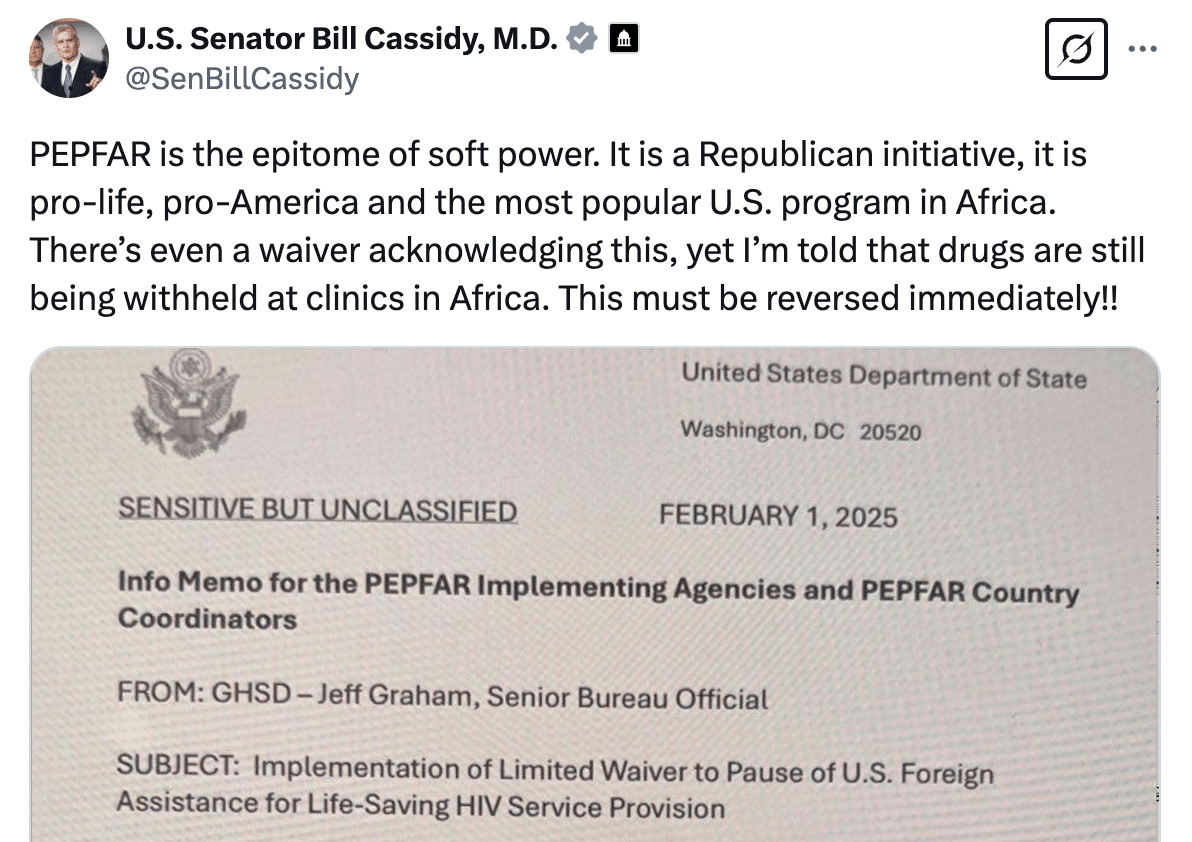
Over and over again, Rubio and others insisted that they had reversed course and restarted life-saving programs.
But both in court filings and anonymous leaks, people who have previously implemented USAID’s work (virtually all have been put on leave or ousted) disputed that the programs had been restarted.
That led to this intemperate comment from Rubio, in which he claimed that if humanitarian programs had not been restarted, it was because their organizations themselves were incompetent.
“Right now, there is no USAID humanitarian assistance happening,” a current USAID official in the humanitarian division said. “There are waivers put in place by Secretary Rubio for emergency food assistance and a number of other sectors, but they are a fraud and a sham and intended to give the illusion of continuity, which is untrue.”
The official also slammed the waiver as unclear and largely unactionable because staff has been furloughed, as Elon Musk’s Department of Government Efficiency seized control of the agency.
“There is no staff left anymore to actually process waiver requests or to move money or to make awards or to do anything,” that official added. “We’ve ceased to exist.”
Secretary of State Marco Rubio on Tuesday pushed back on nongovernmental organizations saying aid programs remained paused despite the waiver.
“I issued a blanket waiver that said if this is lifesaving programs, OK — if it’s providing food or medicine or anything that is saving lives and is immediate and urgent, you’re not included in the freeze,” he said. “I don’t know how much more clear we can be than that.
“And I would say if some organization is receiving funds from the United States and does not know how to apply a waiver, then I have real questions about the competence of that organization, or I wonder whether they’re deliberately sabotaging it for purposes of making a political point,” Rubio added.
Since then, USAID has twice silenced people continuing to debunk Rubio’s claim to have restored humanitarian care.
On February 13, USAID released a memo purporting to correct a “false narrative,” “clarifying that Global Health (GH) programming under the lifesaving humanitarian waiver has continued uninterrupted and was never paused” — effectively an order to adhere to the lie that Marco Rubio’s order had actually restored care.
Then, on Friday, USAID retaliated against the truth once again.
After the Acting Assistant Administrator for Global Health, Nicholas Enrich, issued a memo describing that such aide has never been restored, he was placed on paid leave.
The memo itself presents a detailed timeline of the various ways that aide was stalled and identifies a large number of specific documents where he memorialized each step of the process (the NYT, in its story on Enrich’s suspension, describes obtaining “a series of memos,” and I assume about five other outlets did too; it detailed and released a different memo cataloging likely impacts).
It details specific ways DOGE interfered with the release of lifesaving funds by restricting access to the financial systems needed to process waivers.
From the start, the Programs Group alerted Agency leadership that the lack of access to funds for implementing partners was a critical impediment to the ability to implement the waiver, as access to USAID financial systems (GLAAS and Phoenix) had been completely turned off by DOGE, per Bob Kingman and Daniel Gaush from Department of State ICASS Service Center, preventing the flow of any funds to implementing partners who were approved to implement LHA activities.
It describes how Christian nationalist Pete Marocco personally intervened to ensure that the Ebola relief Elon Musk claimed had been restored could not be restored if doing so involved the World Health Organization.
On February 18th, A-AA Enrich shared an action memo with Mark Lloyd recommending the utilization of an existing agreement with the WHO to utilize previously obligated funds to access a critical stockpile of PPE and lab supplies to support the Uganda Ebola outbreak response. While the activities would normally be covered in the regular process for the lifesaving humanitarian assistance waiver, this memo was drafted for approval from State/F Director Pete Marocco, given that the implementing partner of the agreement is WHO, the subject of a separate Executive Order. Mark Lloyd cleared the memo on Feb. 19th and it was sent forward for COS Borkert clearance and DFA Pete Marocco signature. COS Borkert specified that DFA Marocco would not sign the memo and would not agree to utilizing the agreement with WHO to access the PPE stockpile, and instead ordered A-AA Enrich to “pick up the PPE and deliver it to the necessary people and organizations in the region to respond to ongoing infectious disease outbreaks” without utilizing the agreement with WHO. DFA Marocco immediately responded to Borkert’s email, threatening to the jobs of GH staff if an alternate plan was not carried out immediately, directing political appointees Borkert, Lloyd and Meisburger to “take all necessary personnel actions in the event this is not completed in the next 12 hours.”
It continues the explanation of what happened with Ebola: six days later, political appointees specifically deprioritized getting Ebola funding (and that for other “neglected tropical diseases”) restarted.
On February 24, in an effort to move forward approvals and payments, the GH leadership team (A-AA Enrich and DAA Coles) walked through each waiver request with political leadership (Mark Lloyd and Tim Meisburger) in an effort to move forward approvals and payments. Political leadership provided guidance instructing GH to narrow the focus of its requests and to deprioritize activities related to neglected tropical diseases, Mpox, polio, Ebola, and any monitoring and surveillance activities, as those would not be approved.
Then, when State shut down virtually all foreign aide last week, they shut down (inadvertently, they claimed later) Ebola programs along with everything else.
Additionally, on February 26th, over 5,000 USAID awards were terminated globally; GH was not notified of this action before it happened. The terminated awards included almost all of the awards that were needed to implement lifesaving activities. A-AA Enrich informed COS Borkert, SBO Jackson, and AtAs Lloyd and Meisburger immediately of the grave impacts on lifesaving activities related to malaria, tuberculosis, and ebola. In an email following the February 26th terminations, DCOS Borkert indicated that the awards that were terminated should not have been, and had been terminated in error: “Please hold on these life saving programs and let us review in the morning. There is an acknowledgement some may have been sent out in error and we have the ability to rescind. We need to identify what those are.” [my emphasis]
The memo even details the genesis of the earlier, February 13 memo:
On February 13th, A-AA Enrich and Senior Deputy Assistant Administrator (SDAA) Julie Wallace were told by DCOS Borkert that there had been a false narrative spread in the media that GH had been told to pause on approving activities under the LHA waiver. A-AA Enrich stated that the Agency FO had in fact told GH to pause on further approvals, and reminded him of the previous day’s email. DCOS Borkert as well as other senior advisors, including AtA Tim Meisburger and Senior FO Advisor Laken Rapier shouted at A-AA Enrich that there had never been a pause, and instructed him to immediately draft another Info Memo to correct the “false narrative in the media that there had ever been a pause.”
On February 13th, GH circulated the memo from AtA Mark Lloyd “performing the duties of Assistant Administrator, Global Health” which among other things, reiterated GH’s approach to approval of waivers per the earlier February 4th memo.
While agency leadership previously told GH to only include requests for 30 days (articulated in the February 4th memo), GH was subsequently asked to shift to the original 90 days as articulated in the original waiver language. This was updated in the February 13th memo. [my emphasis]
As a whole, it provides this summary of who is responsible for preventing lifesaving programs from being sustained: political leadership and DOGE.
USAID’s failure to implement lifesaving humanitarian assistance under the waiver is the result of political leadership at USAID, the Department of State, and DOGE, who have created and continue to create intentional and/or unintentional obstacles that have wholly prevented implementation. These actions include the refusal to pay for assistance activities conducted or goods and services rendered, the blockage and restriction of access to USAID’s payment systems followed by the creation of new and ineffective processes for payments, the ever-changing guidance as to what qualifies as “lifesaving” and whose approval is needed in making that decision, and most recently, the sweeping terminations of the most critical implementing mechanisms necessary for providing lifesaving services. These actions individually and in combination have resulted in the U.S. Government’s failure to implement critical lifesaving activities. This will no doubt result in preventable death, destabilization, and threats to national security on a massive scale. This memo serves to document the LHA waiver process and challenges encountered by the Bureau for Global Health to date, excluding PEPFAR.
In other words, Nicholas Enrich documented everything that had happened in spite of Rubio’s public order, and he was ousted.
While it’s not surprising, it’s not entirely clear whether there’s a specific reason he was ousted. That is, it’s not clear to me which facts people like Pete Marocco are trying to suppress:
- The specific actions taken by DOGE to thwart Rubio’s order.
- Marocco’s own specific complicity with decisions that will lead to the deaths of millions.
- The sheer amount of advance warning that political leadership got
- Rubio’s possible lack of involvement in things that Marocco has told courts he was personally involved in, which I wrote up here
But I can’t help but notice that Rubio responded to demands from Republican Senators that life-saving programs be restarted. And State has spent a good deal of time since then trying to hide the ways that people at USAID and State — people like Marocco and DOGE — directly undermined all efforts to do what Rubio assured Republican Senators was being done.
Are they trying to hide that people reporting to Rubio have directly undermined his order, the real insubordination that Marocco has blamed on USAID staffers? Or are they trying to hide that Rubio’s order was always a lie?
Whichever it is, Senators who were placated by Rubio’s past public claims are now on notice. They were lying to you. And while they were lying to you, food and medicine was spoiling and people were dying.
Tags: Jerry Moran, John Cassidy, John Cornyn, Pete Marocco
---
ggl 3 25
ProPublica
The Trump Administration Said These Aid Programs Saved Lives. It Canceled Them Anyway.
2 days ago
Reuters
Trump administration official to brief Congress on USAID, sources say
2 hours ago
ProPublica
Internal Memos: Senior USAID Leaders Warned Trump Appointees of Hundreds of Thousands of Deaths From Closing Agency
1 hour ago
Devex
Why are thousands being culled from USAID, and who will be left standing?
6 days ago
More news
Peter Marocco
Wikipedia
https://en.wikipedia.org › wiki › Peter_Marocco
Peter W. Marocco is Director of the Office of Foreign Assistance at the United States Department of State and Deputy Administrator-designate at the US Agency ...
Trump Official Destroying USAID Secretly Met With ...
ProPublica
https://www.propublica.org › article › usaid-peter-maro...
marocco usaid from www.propublica.org
Feb 15, 2025 — Marocco is now the director for foreign assistance at the State Department and has been delegated the power of deputy administrator of USAID — ...
People also ask
Who is Pete Morocco?
Where is USAID headquarters?
Who is the mission director of USAID Morocco?
Who is behind USAID?
Feedback
Trump administration official to brief Congress on USAID, ...
Reuters
https://www.reuters.com › trump-administration-official...
2 hours ago — Pete Marocco, deputy administrator-designate at the U.S. Agency for International Development, will meet with members of Congress on ...
Inside Trump's State Department takeover of USAID - ABC News
ABC News
https://abcnews.go.com › story
8 days ago — Marocco told those gathered that the administration's review extended beyond USAID and would encompass a range of federal agencies ...
Secretary of State Marco Rubio empowers Pete Marocco to ...
NBC News
https://www.nbcnews.com › politics › white-house › us...
Feb 3, 2025 — Marocco held several national security positions during the first Trump administration, including at USAID, where he tried to consolidate ...
Why are thousands being culled from USAID, and who will ...
Devex
https://www.devex.com › news › why-are-thousands-be...
6 days ago — In recent court filings, USAID's Acting Deputy Administrator Peter Marocco said a blanket funding freeze — and blanket layoffs — were the only ...
What USAID does, and why Trump and Musk want to get ...
AP News
https://apnews.com › article › usaid-foreign-aid-freeze-t...
Feb 4, 2025 — The US Agency for International Development, which provides aid to fund education and fight hunger overseas.
Trump ally Peter Marocco behind evisceration of USAid
The Guardian
https://www.theguardian.com › us-news › feb › peter-m...
marocco usaid from www.theguardian.com
Feb 1, 2025 — Marocco's return to USAid has not been formally announced and the department website still lists a previous director for the office of foreign ...
New Head of the USAID Reportedly Stormed Capitol on ...
Rolling Stone
https://www.rollingstone.com › politics › politics-news
marocco usaid from www.rollingstone.com
Feb 4, 2025 — Pete Marocco, who has been reportedly tapped to head the USAID, allegedly participated in the Jan. 6 storming of the Capitol.
---
ggl news 3 25
emptywheel
Pete Marocco Keeps Trying to Prevent Bill Cassidy from Learning the Truth about USAID
There's been an underlying tension throughout the five week DOGE effort to suffocate USAID (and with it, millions of people around the...
.3 hours ago
Raw Story
The new guy in charge of USAID doesn't believe in foreign aid
The new deputy director of foreign aid at the U.S. State Department who is effectively overseeing what's left of the USAID is a staunch...
.11 hours ago
ProPublica
Trump Official Destroying USAID Secretly Met With Christian Nationalists Abroad in Defiance of U.S. Policy
Peter Marocco's turbulent tenure during the first Trump administration sheds light on his current efforts to dismantle the American foreign aid system from the...
.2 weeks ago
Rolling Stone
New Head of the USAID Reportedly Stormed Capitol on Jan. 6
Pete Marocco, who has been reportedly tapped to head the USAID, allegedly participated in the Jan. 6 storming of the Capitol.
.4 weeks ago
The Guardian
Trump ally Peter Marocco behind evisceration of USAid: ‘He’s a destroyer’
The Trump administration's evisceration of US overseas aid has been presided over by a campaign ally who sowed a trail of enmity at multiple...
.1 month ago
AP News
What USAID does, and why Trump and Musk want to get rid of it
The US Agency for International Development, which provides aid to fund education and fight hunger overseas.
.4 weeks ago
Politico
How spending $153M to pay its bills put USAID in DOGE’s crosshairs
Pete Marocco was furious. It was Thursday, Jan. 23, and the Trump administration official had discovered that the U.S. Agency for...
.3 weeks ago
NBC News
Secretary of State Marco Rubio empowers Pete Marocco to run USAID
Secretary of State Marco Rubio has empowered a top official at the State Department to run the U.S. Agency for International Development and...
.1 month ago
ABC News
'Radical change': Inside Trump's State Department takeover of USAID
Pete Marocco, the Trump administration official tasked with the dismantling of the U.S. Agency for International Development (USAID),...
.1 week ago
The New York Times
In Trump’s War on Foreign Aid, a Loyal Soldier Returns to Battle
A meeting between a Hungarian official and Pete Marocco, the top Trump appointee in charge of foreign aid, signals a new future.
.2 weeks ago
---
ggl 3 25 k
NPR
The Trump administration kills nearly all USAID programs
The Trump administration is terminating thousands of USAID foreign assistance grants and awards, according to the State Department.
.4 days ago
ProPublica
The Trump Administration Said These Aid Programs Saved Lives. It Canceled Them Anyway.
The axing of some 10000 programs has consigned untold numbers of children and refugees to death, officials say.
.2 days ago
Devex
Why are thousands being culled from USAID, and who will be left standing?
In recent court filings, USAID's Acting Deputy Administrator Peter Marocco said a blanket funding freeze — and blanket layoffs — were the...
.6 days ago
The Straits Times
Trump administration official to brief Congress on USAID, sources say
WASHINGTON - Pete Marocco, deputy administrator-designate at the U.S. Agency for International Development, will meet with members of...
.2 hours ago
DW
South Africa: Funding cuts to USAID programs spark concerns
The Trump administration's decision to halt funding for health programs in South Africa raises fears that millions, especially those on...
.3 days ago
ABC7 New York
President Donald Trump's administration putting thousands of USAID staffers on leave and cutting US jobs
President Donald Trump's administration said Sunday it is putting thousands of USAID staffers on leave and cutting U.S. jobs.
.1 week ago
Reuters
Non-profits ask judge to hold US officials in contempt for defying foreign aid order
Two non-profit groups suing the Trump administration over its freeze of nearly all foreign aid on Wednesday asked a federal judge to hold...
.2 weeks ago
The Washington Post
Judge allows Trump administration to resume placing USAID workers on leave
USAID may resume placing employees on administrative leave as Elon Musk and DOGE try to eliminate the agency entirely.
.1 week ago
Devex
Nearly 10,000 awards cut from USAID, State Department
The cuts came hours before the Trump administration was ordered to pay organizations for past work, which was mandated by a federal judge...
.5 days ago
MSNBC News
Rubio taps Pete Marocco to run USAID, despite his Jan. 6 past
Rubio taps Pete Marocco to run USAID, despite his Jan. 6 past. In case the Jan. 6 pardons weren't enough, one of the men who entered the Capitol...
.4 weeks ago
---