TEXAS 3
ESTB 6 24
SOME BAK HERE
---
THREE 6 24
SEE GERRY FASCISM RACISM ABBOTT CORNYN
PAXTON BACKUP ag FOR GAETZ? see this f guy pod
SEE ISLAMOPHOBE 2026
see main for older, also tag
NO MERRI
SEE RED STATES 2 AM
SEE MEASLES VAXX
see abortion
see voter suppression --> takeover
see state gop wackos
see xian nationalist
see state scotus city climate lawsuits abbott paxton?
xian --> abortion ban and book censor
bak 4 24
---
mebbe we shd've let the sombitches secede when we had the chance(s):
iterative voter suppression consolidates power minority rule
texas kill roe and voting in one day?! abbott
tx ct ordered baby jail reboot in 1 wk?! backed by scotus (no names ruling?]
-=-=
-=-=-
an 11 26
LT GOV?
Texas GOP loser wants Democrat who beat him stripped of power
Incoming Texas attorney general fires warning shot at Trump
-=-=
an 11 26
?
Dem sweep puts notorious MAGA court trick out of business in Texas paxton
-=-=
HEATED GMAIL 11 26
 |
An activist dressed as a fossil fuel executive pours fake gas over fake money outside Shell’s headquarters in May 2026. During the 2026 midterm elections, the U.S. fossil fuel industry lit actual money on fire trying to elect Republicans. Photo by James Willoughby/SOPA Images/LightRocket via Getty Images.
The U.S. oil and gas industry spent at least $182 million trying to elect Republicans in last night’s midterm elections¹.
It didn’t buy them very much.
Voters rejected fossil fuel allies and priorities across the country, not only stripping Republicans of control of both the House and Senate, but delivering stunning defeats in fossil-fueled governors’ races, state legislatures, regulatory commissions, and ballot measures.
Here are some notable examples.
- Republicans lost control of the House and Senate despite large oil industry donations. Chevron gave $8.2 million, Koch Inc. gave $6.8 million, and Energy Transfer gave $2 million to the Senate Leadership Fund and Congressional Leadership Fund, according to a Public Citizen analysis. The American Petroleum Institute gave at least another $8 million to the two super PACs, which work to elect Republican majorities in Congress. Republicans still lost both chambers.
- A Texas oil billionaire’s attempt to buy Michigan’s Senate race failed. Texas oil billionaire Tim Dunn gave $5 million to a super PAC backing Republican Mike Rogers in Michigan’s Senate race. It didn’t matter. Voters still elected Democrat Abdul El-Sayed, whose platform includes shutting down the Line 5 pipeline and transitioning to 100 percent renewable energy.
- In fact, pretty much everything Tim Dunn tried to do failed. The ultra-Christian oil billionaire gave more than $11 million to Texas Republican PACs, with almost all of it going to Texans United for a Conservative Majority. And what happened in Texas was the polar opposite of a conservative majority. Speaking of which:
- Chevron and fracking money couldn’t make Texans like Ken Paxton. Lone Star Liberty PAC, the group backing Republican Ken Paxton’s bid for U.S. Senate, received at least $2 million from oil and gas interests, including $200,000 from the Chevron Employees PAC and $250,000 from oil executive Russell Gordy. Fracking billionaire Farris Wilks gave another $250,000 to Paxton Victory. Voters still elected James Talarico, who campaigned on restoring federal support for renewable energy and strengthening clean air and water protections.
- Chevron couldn’t save Susan Collins, either. The oil company gave $200,000 to Pine Tree Results PAC, the super PAC backing Maine’s Republican senator. Voters still elected Democrat Troy Jackson, ending Collins’s nearly three decades in the Senate.
HEATED
- Two oil executives poured ~$6 million down the drain trying to save Greg Abbott. Midland Energy founder Javaid Anwar contributed about $4.37 million to the Texas Republican governor’s re-election campaign, and Energy Transfer’s Kelcy Warren also gave at least $1.5 million. Texans still elected Democrat Gina Hinojosa, who campaigned on making the energy industry pay its fair share and accused Abbott of letting gas companies profit at Texans’ expense during the deadly 2021 blackouts.
- Fossil fuel money couldn’t even save Texas’s fossil fuel regulator. In perhaps the most stunning blue flip in Texas, Democrat Jon Rosenthal won the race to oversee the Texas Railroad Commission, the agency that oversees the state’s massive oil and gas industry—and his did it despite his Republican opponent receiving $1.8 million from oil-linked donors. While Rosenthal hardly portrays himself as a climate champion, he’s campaigned on ending routine flaring and venting, requiring modern leak detection, and enforcing pollution rules.
- An oil heir wasted $18 million trying to buy the Texas attorney general’s office. Republican Mayes Middleton, president of his family’s Middleton Oil Company, contributed $18 million to his own campaign, but ultimately wound up losing to Nathan Johnson, who will become the first elected Democrat attorney general in Texas since 1994. This could have major implications for climate accountability, as state attorneys general have the power to investigate corporate deception and sue fossil fuel companies for misleading the public about climate change. (Middleton also received $100,000 donations from Energy Transfer vice chairman Kelcy Warren and Double Eagle co-founder Cody Campbell, to no avail.)
- Utility and coal money couldn’t keep Georgia’s energy regulators in Republican hands. For the first time in decades, Democrats gained control of Georgia Public Service Commission, which helps decide how much people pay for electricity and which power plants Georgia Power builds. They did this despite fossil fuel money flowing into the race: Republican candidate Fitz Johnson received nearly $200,000 from donors connected to companies the commission regulates, while Republican candidate Josh Tolbert received $63,200 from trusts linked to Alabama’s coal-rich Drummond family.
- Colorado voters will likely reject a Constitutional amendment establishing the right to buy methane gas. Amendment 82’s financial backers were largely unknown, but the ballot measure’s express purpose was to undermine state and local efforts to move buildings to electric appliances—so I’m just assuming it was a fossil fuel-backed measure. Nevertheless, it looks destined for defeat: With counting continuing, Amendment 82 had only about 46 percent support, well short of the 55 percent needed to pass.
- Bonus: Elon Musk flushed $445 million down the toilet. “But Elon Musk isn’t a fossil fuel billionaire,” you say. And sure, perhaps that’s technically true—but it’s getting less true by the day. Earlier this year, his company SpaceX acquired a literal fossil fuel company called APR Energy, in a deal valued at roughly $1 billion. APR operates mobile gas and diesel turbines to power AI data centers. Speaking of which, by June, Musk’s AI company xAI had installed at least 57 methane gas turbines at its Mississippi power plant, according to the NAACP and environmental groups—with enough generating capacity to power an estimated 738,000 to 950,000 homes. If that’s not a man in the fossil fuel business, please tell me what is.
Now, none of this is to say that oil money was entirely defeated in the 2026 midterms. Many fossil fuel-backed Republicans, including Texas Senator August Pfluger and U.S House Majority Leader Steve Scalise, handily won reelection.
Nor is it to say that the oil industry’s priorities will suddenly disappear from U.S. politics. Donald Trump is still the president, and *many* elected Democrats are out and proud champions of methane gas, one of the most climate-polluting fuels on the planet. (Perhaps now this is a good time to remind everyone that James Talarico championed ExxonMobil on the campaign trail).
But last night demonstrated something worth remembering, particularly for people who care about climate change but often doubt whether meaningful progress is possible, and as we head into two more difficult years of trying to achieve some kind of climate action under Donald Trump.
Fossil fuel money is one of the most powerful forces in American politics. It is the biggest obstacle we face in preserving a livable climate for everyone on Earth.
But it is not invincible.
Not even close.
-=-=
-=-=
RWW MISC
10/30/2026
- Mattathias Schwartz @ The New York Times: If Trump Gets Another Supreme Court Pick, MAGA Wants a Loyalist
For years, Supreme Court aspirants have avoided talking about how they might rule. Trump’s frustrations with his first-term picks could change that.
- Tess Owen @ Wired: Elon Musk’s Ties to Texas Republicans Go Much Deeper Than the Midterms
As Election Day approaches, the billionaire’s longstanding relationships with GOP leaders in Texas are under scrutiny.
Elon Musk has enjoyed a cozy relationship with top Texas brass for years. And in recent weeks, as the midterm elections approach and Musk’s financial support of the Texas GOP has become virtually limitless, that relationship has gone under the microscope.
While polls suggest that a number of races in deep-red Texas are looking dizzyingly close, Federal Election Commission filings show that Musk has given at least $158 million to super PACs supporting Texas attorney general Ken Paxton’s bid for Senate, and last week Musk explicitly endorsed him in a post on X. “The fate of Texas and America is at stake,” Musk wrote. “Vote for @KenPaxtonTX today.”
Newly released state campaign filings also show that Musk also donated $5,000,000 to Governor Greg Abbott’s bid for reelection, making him his single largest donor.
Abbott’s relationship with Musk has been the subject of public interest for years. State representative Gina Hinojosa, who is running against Abbott, recently sued to view, in full, 1,400 pages of the governor’s correspondences with Musk. Abbott has been trying to block their release for some time; his office has described the communications as too “intimate and embarrassing” to be made public. This week, a judge ruled that Abbott had illegally “obstructed and continues to obstruct” Hinojosa’s right to inspect the documents in her capacity as a state lawmaker and ordered their release to her.
Abbott has since appealed; a hearing is scheduled for November 2, one day before the election.
State representative James Talarico, who is running against Paxton for Senate, has campaigned on his opponents’ checkered past. As attorney general, Paxton has been indicted on felony securities fraud charges (which he settled without a plea), was accused by whistleblowers of using his office to benefit the financial interests of a political donor, and was impeached (though later acquitted).
And at a campaign event on Monday in El Paso, Talarico raised questions about Paxton and Musk’s relationship. “Ken Paxton has the ultimate megadonor,” Talarico said. “Elon Musk is trying to buy this Senate seat.”
But Musk’s business dealings in Texas politics didn’t start with the midterms. For years, he has enjoyed lucrative state contacts, tax breaks, and allyship from Texas leaders. In 2021, Musk moved Tesla’s corporate headquarters from Palo Alto, California, to Austin, and SpaceX’s headquarters from Hawthorne, California, to Starbase, Texas, in 2024.
Musk’s initial relocation to Texas coincided with a shift in operations inside the Texas Attorney General’s office. In the past, lawyers would prepare notices of investigation (administrative subpoenas known as CIDs) based on public complaints or evidence collected, then send them up the chain for approval.
Sources tell WIRED that from about 2021 onward, lawyers were increasingly instructed by Texas’ executive branch—which included Paxton and Abbott—who and what they were going to investigate, despite internal efforts to steer resources toward more “legitimate” issues. For example, in 2022, eyebrows were raised internally when, the same day Musk sent a letter to Twitter threatening to abandon a $44 billion acquisition agreement over Twitter’s alleged misrepresentation of the number of bots on the platform, Paxton’s office issued a statement asserting that his office would be launching its own investigation against Twitter.
A year later, Paxton once again appeared to use his office to benefit Musk. Musk sued the progressive watchdog Media Matters for defamation after it published an investigation showing that X, under Musk’s ownership, had been placing ads from major brands next to white-nationalist content. Moments after he filed his suit, Paxton’s office announced its own investigation into Media Matters. (Media Matters sued Paxton, asserting that his investigation was brought out of retaliation for its coverage of Musk and X.)
In 2024, after Musk filed an antitrust lawsuit against the World Federation of Advertisers and major brands, accusing them of a conspiracy to pull revenue from X, Paxton announced his own investigation into the organization, accusing them of a “potential anticompetitive scheme to withhold advertising dollars from certain social media platforms.” (He did not mention X by name.)
And when the Department of Justice’s Public Integrity Section wrote a letter to Musk warning that his America PAC million-dollar sweepstakes program ahead of the presidential election could violate federal election law, Paxton intervened by filing a FOIA request, accusing the government of “intimidation of businessman Elon Musk.”
This summer, Musk’s activities in Texas didn’t slow down: Texas legislators called for an audit after the Texas Broadband Development Office allocated $110 million in grants to Musk’s satellite internet company Starlink; Texas’ Office of the Comptroller recently announced that “Terafab,” Musk’s proposed 100-million-square-foot chip manufacturing facility in Grimes County, was the recipient of a $1.66 billion tax break; and SpaceX has also received around $30 million in state grants.
-=-=
- Robert Downen @ Texas Monthly: Greg Abbott Hired an Election Denier to Protect Texas Elections. He’s Using the Job to Attack Muslims.
Nate Schatzline, a Christian nationalist pastor who left his state House seat to work in the governor’s office, told a GOP group that “all Islam is radical” and described plans to “crack down” on it.
-=-=
an 8 26
Texas Republican redistricting 'comes back to bite them'
-=-=
RWW 8 26
TX State Rep. Andy Hopper Is Plotting Myriad Ways To 'Make Life Very Uncomfortable' For Muslims
-=-=
RWW 8 26
- J. David Goodman, Lauren McGaughy, Jesus Jiménez and Ruth Graham @ The New York Times: Islamophobia’s Rise in Texas: ‘I Won’t Rest Until Every Muslim Is Gone’
Muslim communities have been growing for decades, particularly around Dallas. Now, conservatives want to roll up the welcome mat.
=-=
-=-=
RWW 726
Joel Zapata @ Texas Observer: The Real Lesson Behind Texas’ New Bible Curriculum Requirements
Going forward, students will learn that life circumstances are beyond their power to change. They will learn that their place and the place of others in the economy and larger society should not be questioned.
-=-=
AN 7 26
Shame!': Man dragged from hearing as Texas judge clears room during anti-GOP remarks
-=-=
AN 6 26
A federal judge on Monday blocked the Trump administration’s overhaul of an immigration verification system to check voter eligibility across the nation, striking down a central pillar of the government’s efforts to exercise more federal control over elections.
This article was originally published by Votebeat, a nonprofit news organization covering local election administration and voting access.
The judge cited Texas’ use of the Systematic Alien Verification for Entitlements, or SAVE, database, which flagged several voters who were actually citizens as noncitizens, as evidence that it threatened both privacy and voting rights less than five months before the November midterm election.
“The federal government has knowingly trampled on the privacy rights of American citizens in a manner that threatens the sacred right to vote,” Judge Sparkle Sooknanan said in her 75-page ruling. “This Court cannot stand idly by while that happens.”
Sooknanan’s decision does not eliminate SAVE, a decades-old immigration-status verification program. But it blocks the Trump administration’s 2025 overhaul of the system, which made it easier for states to check their voter rolls against the federal database, which includes individuals’ citizenship status and Social Security numbers.
Election officials have found that the modified database, however, is prone to error, something Sooknanan referenced in her decision. Federal officials, she wrote, “haphazardly combined and repurposed the private information of millions of Americans, including citizenship data that they knew to be unreliable.”
The ruling could strengthen challenges by voters who were removed, flagged, or placed under review by the system.
“States have partnered with the federal government to access the database and are actively removing United States citizens from voter rolls based on inaccurate information,” the judge wrote.
Voting rights groups, Trump administration react to ruling
The case was filed by the League of Women Voters and other groups who argued that the SAVE system was inaccurate and that using it to check voter rolls violated citizen privacy rights.
“Today’s decision is a resounding victory for voters,” said Marcia Johnson, chief of activation and justice for the League of Women Voters. “Efforts to create a federal voter database to facilitate voter purges threaten the fundamental right at the heart of our democracy.”
Justin Levitt, a professor at Loyola Law School who worked in the White House on democracy and voting rights issues under President Joe Biden, agreed that voters would benefit from the ruling.
“This provides incremental reassurance that they won’t be inaccurately singled out and have to jump through even more hoops to vote,” he said. “It stops the use of a deeply flawed process to cause trouble for real eligible citizens.”
However, James Percival, the general counsel at the Department of Homeland Security, which maintains the SAVE database, criticized the ruling as a misguided effort to block the Trump administration from trying to address voter fraud.
“It’s amazing how hard the Left will fight to stop us from solving problems they insist do not exist,” Percival said in a statement.
The Justice Department did not immediately respond to requests for comment.
Michael Morley, a professor at the Florida State University College of Law and faculty director of the FSU Election Law Center, said the ruling prevents the federal government from using all the information at its disposal to ensure that only eligible voters take part in elections.
“It seems to leave the government in a somewhat tenuous position of being able to provide citizenship data to states for voting purposes that is less accurate than it otherwise would be,” he said. “It restricts the government’s ability to take advantage of all of the most accurate sources of information it has in order, in most cases, to confirm people’s citizenship status.”
Judge cites Texas’ use of SAVE database in ruling
Texas intervened as a defendant in the case since it had been actively using SAVE to verify the citizenship status of its more than 18 million registered voters. The state gained access to the database in March 2025 after signing a memorandum of agreement with the Department of Homeland Security.
In October, the Texas Secretary of State’s Office announced SAVE had flagged 2,724 people as “potential noncitizens” and sent the list to county election officials to investigate. That process involved mailing letters to each person flagged, requesting additional information to verify their citizenship. If county officials received no response after 30 days, the person’s registration was canceled.
Some voters who responded to the notices turned out to be U.S. citizens after all; others had their registrations canceled, although a specific number hasn’t been released. Hundreds of other registrants who were flagged had registered at the Texas Department of Public Safety, the agency that issues driver’s licenses and state IDs. In Texas, proof of citizenship is required to obtain those documents.
In the ruling, Sooknanan said the state’s use of the database burdened and risked disenfranchising voters by incorrectly flagging naturalized citizens as noncitizens. The judge pointed to examples of voters in Texas who were U.S. citizens and had to provide proof of citizenship to keep their registration active and at least one U.S. citizen whose registration was revoked without their knowledge.
Sooknanan also pointed to an amicus brief filed by Travis County voter registration officials as evidence that the use of the overhauled SAVE database was inaccurate. The state flagged 97 potential noncitizens in Travis County. Voter registration officials found that about a quarter of those voters had registered at DPS and therefore had likely provided proof of citizenship.
Travis County officials were later able to confirm that at least 11 people who were flagged as potential noncitizens were in fact citizens.
“Texas threatened to revoke their voter registrations because of information obtained through the modified SAVE system; and they were required to confirm their citizenship to maintain their voter registrations,” Sooknanan said.
The secretary of state’s office did not immediately respond to a request for comment.
Celia Israel, the Travis County tax assessor-collector and voter registrar, said the ruling is “validating.”
“We have asked a lot of questions in the past several months about the SAVE database and about its accuracy,” Israel said. “The lawsuit confirms that there are inaccuracies and that it is worthwhile for us officials at the county level to ask the state questions.”
Other civil rights groups and voters have also challenged Texas’ use of the database in a federal court in Austin. The lawsuit is still pending.
*Dion Nissenbaum is Votebeat’s senior national reporter and is based in Houston. Contact Dion atdnissenbaum@votebeat.org.
*Natalia Contreras is a reporter for Votebeat in partnership with the Texas Tribune. Contact Natalia atncontreras@votebeat.org.
Votebeat is a nonprofit news organization covering local election integrity and voting access. Sign up for their newsletters here.
AN 6 26
Muslim Republican in tears after being told to leave TX GOP convention — and the country
RWW :
5 26
{Candice Bernd @ Texas Observer: Bo French’s Blood-and-Oil Bid for Railroad Commissioner}:
The former Tarrant County GOP chair’s statewide campaign displaces blame for the fossil fuel industry’s ravages onto the far right’s favored scapegoats.
---
RWW 5 26
AN 5 26 WATER
Republicans hang red state out to dry — literally - Alternet.org
CFACT co-sponsors 'Land and Liberty' gathering in Texas - National Today
National Today
The 'Land and Liberty Conference' held on February 13-14 in Fort Worth, Texas brought together around 150 property rights activists from across ...
CFACT co-sponsors 'Land and Liberty' gathering in Texas
Around 150 property rights leaders convened in Fort Worth to discuss strategies and listen to speakers like former Trump Agriculture Secretary Brooke Rollins.
Published on Feb. 16, 2026
Got story updates?Submit your updates here. ›
The 'Land and Liberty Conference' held on February 13-14 in Fort Worth, Texas brought together around 150 property rights activists from across the country. The event, co-sponsored by CFACT, featured panels, workshops, and Texas hospitality including barbecue and a rodeo. Speakers included former Trump Agriculture Secretary Brooke Rollins, Congressman Harriett Hageman, and Texas Agriculture Secretary Sid Miller.
Why it matters
The conference highlighted the growing movement of property rights advocates who are pushing back against what they see as an overreach of environmental regulations and a 'far-Left political agenda that is decidedly anti-human and anti-freedom.' The gathering aimed to reclaim the mantle of 'wise stewardship' of natural resources.
The details
The two-day conference covered topics such as energy security, financial exploitation of natural resources, reopening federal lands, and defending landowner rights. CFACT, a prominent co-sponsor, hosted a panel featuring its president Craig Rucker and communications director Marc Morano, as well as representatives from the Heartland Institute.
- The 'Land and Liberty Conference' took place on February 13-14, 2026 in Fort Worth, Texas.
- This was the third time in recent years the event has been held.
The players
CFACT
The Committee for a Constructive Tomorrow (CFACT) is a nonprofit organization that promotes free market environmentalism and opposes what it sees as excessive environmental regulation.
Craig Rucker
The president of CFACT.
Marc Morano
The director of communications for CFACT.
Brooke Rollins
The former U.S. Secretary of Agriculture under President Trump.
Harriett Hageman
A U.S. Congressman.
Sid Miller
The Texas Secretary of Agriculture.
Got photos?Submit your photos here. ›
What they’re saying
“The Green movement has undergone a transition, one that moved from wise conservation and stewardship of the land, a position held by everyone a 100 years ago, to one that now promotes a far-Left political agenda that is decidedly anti-human and anti-freedom. We need to reclaim the mantle of 'wise stewardship' and save the environmental movement from itself.”
— Craig Rucker, President, CFACT (CFACT.org)
“I can feel the momentum building since our first gathering in Lincoln, Nebraska. President Trump's influence is clearly energizing the movement. I can't wait for next year!”
— Marc Morano, Director of Communications, CFACT (CFACT.org)
What’s next
The organizers plan to host the 'Land and Liberty Conference' again next year, building on the momentum from this year's event.
The takeaway
The 'Land and Liberty Conference' highlights the growing influence of property rights advocates who are pushing back against what they view as excessive environmental regulations and a political agenda that is 'anti-human and anti-freedom.' The conference aimed to reclaim the mantle of 'wise stewardship' of natural resources.
---
---
// TEX BS YT 2 17 26 republicans-go-all-in-on-sharia-law-attacks-ahead-of-texas-primary-00745647
Liz Crampton and Jessica Piper: 01/26/2026
-
Anti-Muslim rhetoric has emerged as a potent ingredient in the looming Texas Republican primary while candidates compete to raise fears about the spread of Sharia law in the state and portray themselves as the toughest option to stand against it.
From the state’s white-hot GOP Senate primary down to local races, Republican candidates are pledging to fight the hardest against a proposed residential development of 1,000 homes centered around a Mosque north of Dallas, while issuing dire warnings about the supposed threat of Islam and questioning their opponents’ commitment to the cause.
Sen. John Cornyn (R-Texas) and his top primary opponent, Texas Attorney General Ken Paxton, have sparred in attack ads and on the trail over that project and Afghan refugee resettlement program, at times veering into inflammatory anti-Islamic rhetoric. Cornyn called for a federal investigation into the project; Paxton launched several probes and in December sued the development over alleged securities fraud.
Texas is a heavily diverse state, with non-Hispanic whites representing less than two fifths of its total population — a flashpoint for years on the right. The state’s relatively small but fast-growing Muslim population has become a charged issue for Republicans seeking to distinguish themselves in competitive races. This year’s GOP ads – which vary from condemning terror attacks to burning the Quran – represent an escalation of rhetoric the party has long used to rally its voters.
“The Muslim community is the boogeyman for this cycle,” said Texas GOP consultant Vinny Minchillo. “One hundred percent this message works — there’s no question about it. This has been polled up one side and down the other, and with Texas Republican primary voters, it works. It is a thing they are legitimately scared of.”
Muslim advocacy organizations and Democrats decry the ads as racist and grossly inaccurate characterizations of those communities.
“The Texas GOP has declared war on Islam in Texas, claiming that Islamic leaders in the state are implementing Sharia law and using it in court,” said Joel Montfort, a north Texas-based Democratic strategist. “None of it is true, it is just fearmongering and racism to stir up the GOP base and get them to vote.”
A POLITICO review identified ads in half a dozen races since the start of 2025 that highlighted “Sharia law,” according to data from AdImpact, which tracks political advertising. All were from or backing Republican candidates touting their fights against it, and most were common in Texas.
Last week, Cornyn launched a seven-figure buy titled “Evil Face” that declares “radical Islam is a bloodthirsty ideology,” referencing the Oct. 7 Hamas attack against Israel and December Bondi Beach shooting in Australia. The ad also references his bill to revoke the tax-exempt status of Council on American-Islamic Relations, a Muslim advocacy organization.
Paxton has gone after Cornyn’s past support of an Afghan refugee resettlement program. And in his capacity as attorney general, Paxton said the project is an “illegal land development scheme” and its leaders are “engaged in a radical plot to destroy hundreds of acres of beautiful Texas land and line their own pockets.”
In the four-way GOP race for Texas attorney general, candidate Aaron Reitz says in an ad out this week that “Islam is not compatible with Western civilization” and vows to “stop the invasion” of Muslims. Reitz served less than a year in the Justice Department before launching his bid for attorney general. His opponent, state Sen. Mayes Middleton, also has an ad boasting that he’s running to “stop Sharia law” in Texas.
And, most provocatively, Valentina Gomez launched her candidacy in Texas’ 31st Congressional District last year with a video showing her burning a Quran and declaring that “your daughters will be raped and your sons beheaded, unless we stop Islam once and for all.” Gomez, who is challenging President Donald Trump-endorsed Rep. John Carter (R-Texas), is a known conservative activist and provocateur who won just 8 percent of the primary vote when she ran for Missouri secretary of state last year.
Anti-muslim sentiment in the U.S. grew out of the 9/11 terror attacks, which some Republicans used to rally their base for political gain. False rumors on the right that Barack Hussein Obama was a secret Muslim persisted from his rise to the White House and for years after. The planned construction of a mosque blocks from Ground Zero became a right-wing cause celebre early in his presidency, with multiple national Republican figures rallying against it.
Trump intensified those feelings, first by elevating conspiracy theories that Obama wasn’t born in the U.S., then by repeatedly disparaging Muslims, pledging in his 2016 campaign to ban Muslims from entering the country and once he became president implementing travel bans against majority-Muslim countries. On Tuesday, Trump reposted a comment calling Islam a “cult.”
But in recent years Islam hasn’t been as much of a focus within GOP campaigns — until now.
The Texas ads come as Republicans nationwide have placed heightened scrutiny on CAIR, the largest Muslim advocacy group in the U.S. Sameeha Rizvi, CAIR Action Texas Policy and Advocacy Coordinator, called Cornyn’s ad “defamatory and despicable” and borne out of “desperation to compete with Ken Paxton’s anti-Muslim bigotry.”
“CAIR is not going anywhere, American Muslims are not going anywhere, and our community will show its strength at the ballot box, God willing,” Rizvi said in a statement.
Cornyn has introduced legislation seeking to revoke CAIR’s tax-exempt status. U.S. Rep Chip Roy, who is also in the Texas attorney general race, introduced a similar bill last year.
When a super PAC on behalf of Cornyn launched an attack against Paxton on Thursday, calling him “weird” and highlighting his divorce and alleged extramarital affairs, Paxton shot back on X : “This desperate hail mary can’t erase the fact that he [Cornyn] helped radical Islamic Afghans invade Texas and that his family’s making a fortune securing visas for foreigners.”
Paxton was referencing Cornyn’s past support for increasing the number of Special Immigrant Visas available to Afghans following the Taliban’s 2021 takeover of the country. Cornyn, who had once been supportive of the program, reversed course along with other Republicans late last year following the shooting of two National Guard members by an Afghan who’d been granted asylum in the U.S., on the basis that the vetting of applicants was inadequate.
Cornyn has responded to Paxton’s attacks with a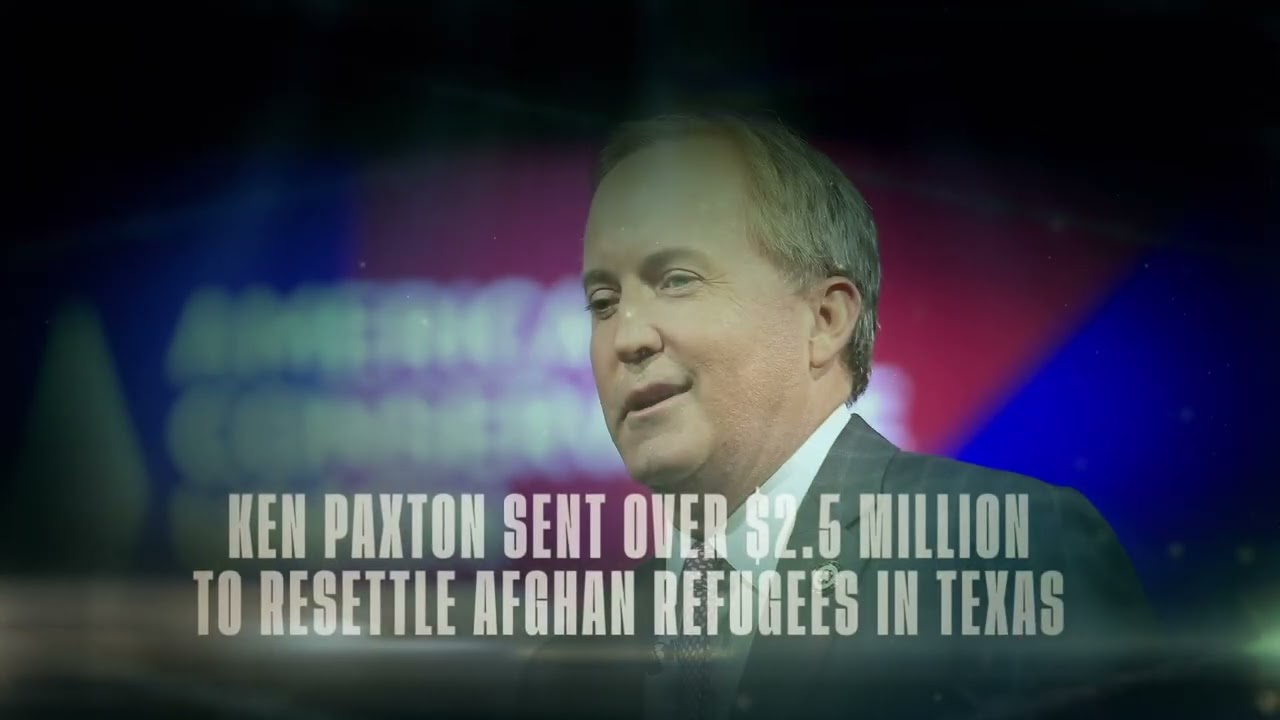 stating that Paxton talks tough but he’s actually “soft on radical Islam,” claiming that Paxton directed $2.5 million to resettle Afghan refugees in Texas, and his former attorney who defended him during impeachment proceedings now represents the East Plano Islamic Center.
Several ads from different candidates in Texas use footage of the project from the East Plano Islamic Center, which would also feature a K-12 school and retail. Texas leaders, including Gov. Greg Abbott, have said that the presence of the planned Muslim community raises national security concerns. The East Plano Islamic Center did not respond to a request for comment.
“Texans overwhelmingly care about this – they’re looking at their communities transform in radical ways,” said Reitz, the attorney general candidate.
“You look at the number of mosques that have been built in Texas in just the last 10 to 20 years, and it’s explosive,” he said. “It’s alarming for good reason, and I think that Republican voters in particular are looking for their public office holders to address it, and so it’s such a pressing issue that I chose to really lean into this.”
Cornyn’s ad declares that “Sharia law has no place in American courts or communities,” a reference to the development. Trump’s Justice Department also launched a civil rights investigation into the project last year after Cornyn requested the federal government to investigate “religious discrimination.”
The project was already on the radar of Paxton, who had opened his first of several probes into its construction. In December, Paxton — whose candidacy is boosted by his reputation as an aggressive attorney general who frequently files lawsuits on behalf of MAGA causes — sued the development for alleged securities fraud.
The Justice Department quietly closed its investigation last summer without filing any charges. But Abbott still went forward and signed multiple laws last year that banned “Sharia compounds” and designating CAIR and Muslim Brotherhood as terrorist organizations. CAIR sued Texas in response, arguing the action was unconstitutional and defamatory.
Paxton, in his official capacity as attorney general, said last week that the state comptroller can exclude private schools from the school voucher program if they violate the recently signed anti-terror laws, declaring that “Texans’ tax dollars should never fund Islamic terrorists or America’s enemies.”
---
RWW 1 26
- Robert Downen @ Texas Monthly: This Texas Church Became a Political Machine. Now It’s Going National.
With a prayer house across the street from the U.S. Supreme Court building, leaders of the Fort Worth–based Mercy Culture Church are taking their spiritual battle to Washington, D.C.
---
---
AN 2 26
The Texas Republican U.S. Senate primary is rapidly heating up, after incumbent Sen. John Cornyn (R-Texas) aired his primary opponent's dirty laundry on social media.
In a Wednesday post to X, Texas Attorney General Ken Paxton (R), who is challenging Cornyn to be on the general election ballot in November, highlighted a recent report about Cornyn raising tens of millions of dollars from donors across the country to keep his seat. Paxton accused Cornyn of "stealing $50+ million from races in NC, ME, MI, and GA," referring to hotly contested Senate seats Republicans are hoping to hold ahead of what's expected to be a Democratic wave election.
"He's stuck in the mid-20s, doesn't even know if he'll make the runoff, and is set to lose by huge margins even if he does," Paxton tweeted.
Cornyn's official campaign account fired back at Paxton, and reminded Texans of the attorney general's divorce from his wife, Angela Paxton, after he was accused of having an affair with a Louisiana-based author. The Daily Mail reported in September that Paxton allegedly had secret trysts with writer Angela Duhon, who herself was married.
"Ken, when this over, you will have nothing. Which turns out to be the same thing you offered to give Angela in divorce proceedings," Cornyn's campaign account posted. "This after you cheated on her multiple times."
Ken and Angela Paxton officially split after 38 years of marriage in July of 2025. Angela Paxton – a Republican state senator in Texas — announced she was filing for divorce in a tweet referencing "recent discoveries."
"I believe marriage is a sacred covenant and I have earnestly pursued reconciliation," she wrote at the time. "But in light of recent discoveries, I do not believe that it honors God or is loving to myself, my children, or Ken to remain in the marriage."
President Donald Trump has not yet made an endorsement in the Texas Senate Republican primary. On the Democratic side, Texas state representative James Talarico is running against Congresswoman Jasmine Crockett (D-Texas). That race was shaken up earlier this week after former Texas Democratic Senate nominee Colin Allred accused Talarico of calling him "mediocre." Talarico said his comments were misconstrued.
AN 12 25
During a Monday morning, December 29 appearance on MS NOW, conservative Republican Sarah Matthews — who served as deputy White House press secretary in the first Trump Administration but is now an outspoken critic of President Donald Trump — argued that liberal firebrand Rep. Jasmine Crockett (D-Texas) is probably too progressive for Texas' 2026 U.S. Senate race. But she didn't think the seat is totally out of reach for Democrats with a more centrist nominee.
Texas remains a red state; Trump carried it by roughly 14 percent in 2024. Yet it's far from the reddest of the red states, and Matthews believes that Republicans have vulnerabilities there — some of which Dallas-based journalist Mike Lee (not to be confused with GOP senator from Utah) identifies in a December 29 Politico Playbook column.
"Texas is still Trump country," Lee reports, "but the president's economic policies are starting to sting — and the fallout could hurt Republicans at the ballot box in 2026. Donald Trump took 56 percent of the vote in Texas when he won in 2024, improving his margins from both of his previous campaigns. Republicans also held onto their two-decade majority in the state legislature in the Lone Star State. But as 2025 closes out, polls show growing unrest within the Texas economy, and voters are beginning to blame Trump and Republicans for failing to produce results."
Texas is heavily Latino, and many Latinos voted for Trump there in 2024. But Lee notes that according to a UnidosUS survey of Latinos in November, two-thirds of the respondents were dissatisfied with his handling of the economy.
UnidosUS organizer Eric Holguín told Politico, "Right now, there's such a deep level of anger about what's happening."
Trump's immigration policies, according to Lee, are another liability for him in Texas.
"There are signs that Trump's signature policies are responsible for some of the malaise," Lee explains. "Trump's immigration raids may be hurting the broader Texas economy, according to the Dallas Federal Reserve. The raids have hit permanent residents and foreign students, and the fear has made foreign-born people more likely to miss work and less likely to visit shops and restaurants, the Fed's Texas Business Opportunity Survey said."
Lee adds, "About 13 percent of companies reported they were having a harder time finding and retaining workers, while only 2 percent said it was easier, the (UnidosUS) survey found. Hispanic Texans in the Rio Grande Valley were surprised to see ICE agents raiding local businesses, the AP reported back in July. Many of them voted for Trump and 'didn’t realize his deportation campaign would focus on their neighbors.'"
---
MORano talk radio
ford Admits Defeat Ending Production of Electric Vehicles
ByErica Smith
Dec 19, 2025
Officials with Ford Motor Company say they expect to incur $19.5 billion in charges as they end the production of electric vehicles almost a year after President Trump ended the electric vehicle government mandate signed and approved by Democratic presidents.
Creator and Publisher of the Climate Depot, Marc Morano says despite all the incentives Ford sales couldn’t get above 7 percent. “Even mandated, even with forcing people, and taking away their choice, they couldn’t get out of single digit sales.” Morano said.
He says now, reality sets in. “There’s no government subsidies coming, the EV tax credit is gone, sales are tanking.” He said.
Morano says Ford isn’t alone. Crysler and GM are also feeling the pain, forcing the companies to shift and retool their gas-powered vehicles.
Faced with mounting losses since 2023, totaling $13 billion dollars in its EV division, Ford says they will now offer gas powered, hybrid, and plug-in hybrid vehicles, aimed to pull back from loss-making assets and to redirect capital to more profitable models. “Instead of plowing billions into the future knowing these large EVs will never make money, we are pivoting. We know the US market enough where we have a lot more certainty in this second inning of reduced-emissions powertrains.” Ford CEO Jim Farley said.
Morano says this is good news for America when these so called “green” vehicles were said to be environmentally safe. “To make one TESLA size 1,000 lb. battery you had to dig up half-a-million pounds of material from the earth.” Morano said.
He says he hopes the green agenda will go away permanently and this is good news for the country.
“This is a great time for America as we are shedding this weird era that if you are not “green” you are essentially an “evil” person, and your choice was taken away.” Morano said.
He says the country has been in a “ying-yang” going back and forth the last 15 years depending on the president in office. Morano says Trump can accomplish this by one- getting rid of the ETA Carbon Dioxide Endangerment Finding Act and to withdraw the United States from the United Nations 1992 Rio Earth Summit Treaty which broadened the whole Net Zero Climate agenda.
---}:
RWW
12/10/2025
by
- Brianna Sacks @ The Washington Post: Election denier tapped for FEMA leadership role
Gregg Phillips, who claimed that millions of “noncitizens” voted illegally in the 2016 election, will head FEMA’s Office of Response and Recovery.
- Isaac Stanley-Becker @ The Atlantic: USAID Hired the Right-Wing Influencer Responsible for Its Decimation
Mike Benz was brought aboard to find evidence for his claims that the agency is secretly a spy operation.
- Steve Benen @ The Maddow Blog: Democrats score big wins in Florida and Georgia, as the GOP’s election woes continue
The more Donald Trump and his party pretend they don’t have an electoral problem, the more Republicans lose winnable elections.
- Megan Twohey and Isabella Kwai @ The New York Times: How a Manosphere Star Accused of Rape and Trafficking Was Freed
Barred from leaving Romania, Andrew Tate courted powerful figures on the American right, from Tucker Carlson to Barron Trump. Then an extraordinary order let him go.
- Michael Luciano @ Mediaite: Trump Suggests It’s ‘Treasonous’ To Report He’s in Bad Physical Shape
President Donald Trump slammed The New York Times and unnamed “some others” for reporting unfavorably about the 79-year-old’s health.
- Steven Monacelli @ The Barbed Wire: He’s an Unapologetic Fascist Who ‘Despises’ Democracy. He Still Wants You to Vote for Him.
The court-appointed public defender in North Texas was once leader of the Proud Boys, has posted racist threats online, and sports a white nationalist tattoo. Now he wants to represent you.
---
an 12 9 25
icn 12 25
Texas Workers Keep Dying in the Heat
BY MARTHA PSKOWSKI, KEERTI GOPAL
Despite its blazing temperatures, Texas has no labor protections for heat. That leaves workers, especially immigrants, vulnerable on the job.
---
AN 11 25
Texas’ plan to gerrymander its congressional map in favor of Republicans hit a massive snag on Tuesday as a federal panel of judges struck down the new district map on the grounds that they discriminated against minority groups.
The decision was handled down by a panel of three federal judges after a nine-day hearing last month in the case brought against the state of Texas voting rights advocates and minority voters. The judges — Obama, Reagan, and Trump appointees, respectively — found in favor of the plaintiffs arguments that the new map unlawfully gerrymanders based on minority communities.
As a result, the state will be required to continue using the congressional maps drawn back in 2021 and enjoined from using the new one passed into law over the summer. The fight is far from over, however, with Democracy Docket reporting that the ruling is highly likely to be appealed to the Supreme Court, which has been known to rule in favor of conservatives more often than not in recent years.
Congressional district maps are typically redrawn once a decade, based on new census data, to create districts that better reflect shifting demographics. Both parties have long been accused of redrawing state maps to better ensure they hang on to power, a process known as “gerrymandering.”
In defiance of this once-a-decade norm, the Texas state legislature passed new maps over the summer designed to create five new majority Republican districts in the state, thereby helping the party retain a majority in the House of Representatives. This came at the urging of President Donald Trump, who has called for as many GOP-controlled states as possible to do so in order to stop a potential Democratic majority in the 2026 midterms that could stunt his administration’s goals.
“When Texas tried to steal 5 seats, I said to watch the litigation my law firm had filed because we had a good chance of winning in court,” Marc Elias, founder of the voting rights focused Elias Law Group, wrote in a post to BlueSky following the ruling. “Today a federal court BLOCKED THE MAP.”
California’s recent Proposition 50 was drafted in response to this move from Texas, allowing the Golden State to alter its redistricting rules and redraw its map to create enough Democratic majority districts to counteract Texas. The measure was overwhelmingly approved by voters in the state, though it does feature a provision that will nullify itself if Texas’s gerrymander is definitively blocked.
---
AN 11 25
Texas Rep. Nate Schatzline’s energy was palpable as he gazed out from the video on the computer screen, grinning ear to ear, the sleeves of his white dress shirt rolled up.
The Republican legislator from Fort Worth had a message to share with people watching the prerecorded video: As a Christian, you have an essential role in politics and local government.
“There is no greater calling than being civically engaged and bringing the values that Scripture teaches us into every realm of the earth,” Schatzline said.
The legislator was teaching a section of Campaign University, a series of online lessons he and others associated with Fort Worth-based megachurch Mercy Culture created to raise up so-called “spirit-led candidates.”
The course, created in 2021, is an extension of Mercy Culture’s increasingly overt political activities that have included candidate endorsements. The church’s political nonprofit, For Liberty & Justice, houses Campaign University.
Campaign University builds on Mercy Culture’s growing political reach as Schatzline, a pastor at the church, joins President Donald Trump’s National Faith Advisory Board and as the course now is offered at other congregations across the country.
The lessons emphasize that would-be candidates don’t need to be experts in government or the Constitution to seek public office or a place in local government. They also train potential candidates to “stand for spiritual righteousness” and teach them how to build a platform and navigate the campaign trail while maintaining a strong family and church life.
At the core of Campaign University is the idea that there is no separation between what happens within the church and what happens in the government. Students are taught to interpret the First Amendment’s establishment clause on the separation of church and state as a protection against government involvement in religion, rather than vice versa.
Previously, churches risked losing their tax-exempt status by discussing or engaging in politics. Then this summer, the Internal Revenue Service decided to allow religious leaders to endorse political candidates from the pulpit, a decision Schatzline took as a green light for him and other pastors to ramp up political activity.
Programs such as Campaign University serve as the “next stage” of this religion-driven political movement, said Eric McDaniel, a government professor who researches the intersection of race, religion and politics at the University of Texas at Austin. Past movements encouraged churchgoers to become activists, he said, but Campaign University stands out for training Christian conservatives to seek public office.
“One of the things about this movement that’s really important is that they started winning local elections, then started winning state and then now they’re winning at the national level,” McDaniel said. “And that’s how you’re able to build a movement and maintain a movement — you start locally.”
In an attempt to better understand Mercy Culture’s approach to recruiting candidates, two journalists from the Fort Worth Report purchased and completed the more than five-hour Campaign University course and listened to hours of the For Liberty & Justice podcast. What became clear in the course is For Liberty & Justice’s mission to push Christian conservative values beyond church doors and into the public sphere.
The nonprofit states on its website that it vets and supports “candidates who are willing to do whatever it takes to protect our God-given liberties and take a stand for Biblical Justice!” Its leaders have said they stand against LGBTQ rights and abortion access, and they have pushed for the ban of diversity, equity and inclusion initiatives in government and public education.
For $100, Campaign University provides its students the knowledge, practical skills and spiritual guidance “to make an impact for the kingdom in government” — not “just in a way that’s passionate but in a way that’s calculated,” Schatzline says within the first five minutes of the course.
The Fort Worth Report identified at least 10 people — through social media posts, press releases and podcasts — who completed Campaign University. They included Texas GOP Chairman Abraham George; an unsuccessful candidate who ran for a Dallas City Council seat this year; Tarrant County Republican precinct chairs; campaign managers; and a number of people who work for or previously worked for Mercy Culture or For Liberty & Justice.
None returned the Fort Worth Report’s requests for comment.
Schatzline twice agreed to an interview but never responded to efforts to set a date and did not return phone calls and emails seeking comment. He and other Mercy Culture pastors created Campaign University after working on Texas political campaigns, including the legislator’s, through For Liberty & Justice. Schatzline previously told the Fort Worth Report that he’s working to take the nonprofit to the national level.
It’s not unusual for churches or spiritual leaders to encourage political activity from congregants, said Amanda Tyler, executive director of the Baptist Joint Committee for Religious Liberty and lead organizer of the national nonprofit’s Christians Against Christian Nationalism campaign.
“What does seem unusual — and perhaps unique — is an actual candidate training academy that’s run out of the church,” Tyler said. “Often, particularly if we’re talking about partisan campaigns for public office, that’s a place that churches and other houses of worship have largely steered clear of partisan politics.”
Schatzline has said he won’t seek reelection to his seat representing north Fort Worth and its surrounding suburbs but plans to continue as a pastor with Mercy Culture and to lead For Liberty & Justice.
The national faith board that Schatzline has been tapped to join declares its mission is to be “a strong, unified, uncompromising voice” on issues such as religious freedom, marriage, reproductive and parental rights, and gender-affirming care.
“It’s never been more apparent that the church has to rise up and be a bold voice in American government today,” Schatzline said in an Oct. 27 video he uploaded to social media announcing his new position.
That sentiment is recognizable in Campaign University.
At the start of the course, Schatzline tells Christians to ask themselves three questions the typical candidate might not consider but that he stresses are key to success if one is called to serve.
Did the call to government come from the Holy Spirit? Will your loved ones pray with you about it? Even if you don’t win, are you still giving God glory?
Don’t run if you “can’t hear the Holy Spirit” because other voices on the campaign trail may “shift your perspective,” Schatzline said.
A Divine Calling
Campaign University and other Mercy Culture political activities deliver on a commitment that Steve Penate told the Report he and fellow church pastor Landon Schott made to each other years ago: build a church that would “turn the city upside down” and be a leader in local politics.
Schott and his wife, Heather Schott, senior pastor of Mercy Culture, did not return emails seeking comment for this story.
Over its six years, the church has become a center of conservative religious politics in the region and increasingly across the state. This year, members gathered for prayer at the Texas Capitol, blessing its walls on the first day of the 2025 legislative session.
Last year, pastors urged Fort Worth City Council members — using threats of litigation — to approve the church’s new shelter for victims of human trafficking, despite opposition from residents of the adjacent neighborhood. Council members in favor of the move said at the time that politics did not affect their decision.
Fort Worth Mayor Mattie Parker, a Republican, did not return a request for comment on Mercy Culture’s impact on the city through political efforts such as Campaign University.
The skills taught in Campaign University build off lessons learned from Penate’s failed campaign for Fort Worth mayor in 2021, when he lost to Parker, the pastor told the Fort Worth Report.
Penate said “tons” of people have completed Campaign University since its creation. Neither he, Schatzline nor Campaign University’s other instructors provided lists of graduates. About 50 people were pictured in the Campaign University’s first graduating class, according to a 2022 Instagram post by For Liberty & Justice.
Mercy Culture’s expansion has included additional church campuses in Fort Worth, Dallas, Waco and Austin, and it plans to open a San Antonio campus next year. Penate said For Liberty & Justice aims to partner with churches across the country as it seeks to elevate Campaign University to a national level. Although he didn’t provide specifics, Penate said the goal is to create lessons for local churches to politically mobilize congregants, similarly to how Charlie Kirk’s Turning Point USA mobilizes students on college campuses.
He said the church is already spreading awareness about Campaign University by opening For Liberty & Justice chapters in other states.
As of late October, two For Liberty & Justice chapters outside of Texas offer Campaign University, Penate said. They are Florida’s nondenominational Revive Church and Hawaii’s Pentecostal megachurch King’s Maui, according to Schatzline’s social media posts. Representatives from the churches did not return requests for comment.
The nonprofit plans to open its next chapter in Arizona at the start of 2026, Penate said. After that, he expects For Liberty & Justice to grow exponentially thanks to Schatzline’s visibility on Trump’s faith advisory board.
“Next year is going to be explosive,” Penate said.
Religion has long had a historic role in major American political movements, McDaniel, the government professor, said.
Leaders such as Baptist minister Martin Luther King Jr. were involved in the Civil Rights Movement. Televangelist Jerry Falwell founded the political organization called the Moral Majority in 1979 and mobilized a generation of Christian conservative voters.
“This idea that God has called you to do this is a very empowering message. It gives you a clear source of identity and direction,” McDaniel said.
Many of Campaign University’s teachings address basic civics that might be useful to anyone running for office. Its lessons and 92-page course materials offer hands-on assignments for participants to start engaging with local government, such as reading the U.S. Constitution, identifying the elected officials who represent them at different levels of government and creating lists of potential campaign donors.
Campaign University’s goal is to bring Jesus into “every sphere of influence and every mountain,” Joshua Moore, another course instructor, says in the course’s second lesson. “That’s what we’re called to do as political activists.” Moore, who serves as Schatzline’s district director in the Texas House, is a former Republican New Hampshire state lawmaker. He did not return phone calls and emails seeking comment for this story.
In Campaign University, instructors often emphasize what they describe as a divine calling for Christians to serve in local government.
“A grandma can pray at home on her knees, but who’s in Austin on the inside, that has a voice, that has a vote?” Penate told the Report. “It starts in prayer, but you gotta get on the inside.”
Schatzline embodies this ethos in many ways, and he’s become a well-known face in far-right Christian conservative politics in Texas.
During this year’s legislative sessions, he authored 75 state bills on a range of issues, such as limiting DEI initiatives in local government, banning drag show performances in front of children and further penalizing the possession or promotion of child pornography. He failed to get many of his bills passed this year, except for one aimed at criminalizing the promotion or possession of child-like sex dolls.
“We’re going to give this space back to the Holy Spirit,” Schatzline said at the Capitol during the Mercy Culture-led worship session earlier this year. “We give you this room. … The 89th legislative session is yours, Lord. The members of this body are yours, Lord. This building belongs to you, Jesus.”
Landon Schott, the Mercy Culture co-founder, also participated in the January event at the Capitol, as did George, the state Republican Party chair, who has taken the Campaign University course.
“There is no separation between church and state,” George said at the event, according to published reports.
Campaign University lessons highlight what its instructors argue were the Founding Fathers’ “deep religious beliefs” as evidence that “God was not separate from the public square; nor was that the intent of the founders.”
The Founding Fathers “insisted upon a country that welcomed the role of religion in society, viewing it as a public good,” said Jeremy Dys, senior counsel for the First Liberty Institute, a Plano-based legal group known for representing clients in high-profile religious freedom cases, including a Plano student who was banned from distributing candy cane pens with a religious message on them at a school party and an Oregon woman who refused to bake a wedding cake for a same-sex couple due to her religious beliefs.
“Abandoning our societal cynicism toward religion would strengthen our commitment to liberty. It would do much to strengthen our country to regain the vision of our founders that celebrated the role of religion in our lives, public and private,” Dys said in an email to the Report.
But under the establishment clause, government entities shouldn’t impose religious laws or policies, said Tyler, the Christians Against Christian Nationalism organizer. Laws should “serve and support a pluralistic society,” she said.
“If our goal in engaging in partisan politics is to impose our own interpretation of the Bible, our own religious views on other people, that will lead to harm for people in our communities that are not of the same religious views,” Tyler said.
County at a Crossroads
For Liberty & Justice’s efforts to mobilize Christian conservatives through Campaign University come at a pivotal moment in Tarrant County, where Fort Worth is located, as Republicans seek to maintain control of the nation’s largest urban red county, which has shown occasional signs of turning purple. Tarrant voters supported Joe Biden’s presidential bid in 2020 and twice voted in favor of Republican Sen. Ted Cruz’s Democratic opponents, in 2018 and 2024.
“Every single seat matters, and now is the time to rise up. Now is the time to run. Now is the time to get godly men and women in office,” Schatzline told dozens of attendees at a Sept. 9 For Liberty & Justice event at Mercy Culture aimed at encouraging political action.
The Republican-majority Tarrant County Commissioners Court, the county’s governing body, led by County Judge Tim O’Hare, steamrolled through a redistricting process this summer to gain a stronger majority as detractors alleged racially motivated gerrymandering. In late October, a federal appeals court upheld a judge’s decision not to block the new map.
O’Hare did not respond to a request for comment.
After state lawmakers adopted a new congressional map to create additional GOP seats at Trump’s request this summer, the political makeup of Tarrant County’s congressional delegation is poised to shift from five Republicans and two Democrats to four Republicans and one Democrat.
For Liberty & Justice continues to develop its pipeline of candidates for local and state offices. The group circulates a friends and family list of candidates that it says share the same values. One candidate who repeatedly made the list was conservative Fort Worth City Council member Alan Blaylock, who announced his bid for Schatzline’s seat Oct. 27 after the lawmaker said he wouldn’t seek reelection.
Others named on the list included city council and school board candidates across the county. Several told the Report they weren’t required to complete Campaign University to be included on the list and that they hadn’t taken the course.
For Liberty & Justice is prepared to ensure strong Republican results as Tarrant voters gear up for next year’s elections, plus a runoff election to fill a Texas Senate seat vacated by now-Acting Comptroller Kelly Hancock.
It makes sense that Tarrant County, which political experts describe as a bellwether in national politics, may be a driver in national conversations around how religion and politics intersect, said McDaniel, the UT professor.
His message echoed the sentiments expressed by For Liberty & Justice leaders and attendees during a recent night of action at Mercy Culture Church.
Throughout the night, volunteers who completed Campaign University emphasized how the lessons can not only activate people to run for office but also enable them to lead small groups of fellow Christian conservatives in political action, such as advocating for policy issues at city council or school board meetings.
Event organizers encouraged attendees to get civically engaged that night by joining small political action groups in neighborhoods scattered across Tarrant County, with specific interests such as “biblical citizenship” or “prayer and intercession.”
To end the night, one Campaign University graduate led the crowd in prayer. “We need you, Lord, desperately to be able to accomplish what you are calling us to do for this nation, for our city, for our county, for our state.”
---
KFF AN 10 25
In the 1970s, persistent measles outbreaks provoked officials to strengthen child protection with enforced school mandates in every state. Today the partisan split on vaccine policy in the wake of the covid outbreak has changed the equation. This is nowhere more the case than in Florida, although legislators in Texas and Louisiana are also considering ending mandatory vaccination, and Idaho enables parents to get an exemption just by asking for it.
---
RWW
09/24/2025
by
- Katherine Kelaidis @ Vox: MAGA’s first martyr
The killing of Charlie Kirk could turn the movement into a faith that outlives Donald Trump.
- William Bredderman and Aneela Mirchandani @ Mother Jones: Inside the Hidden Conservative Network Bankrolling an “Ecosystem” of Right-Wing News
John Solomon’s Informing America set out to create an echo chamber to shape public opinion. It’s working.
- The Throckmorton Initiative: David Barton Appointed Texas History Advisor
State Board of Education picks Barton for advice on history.
- Jonathan Greco @ KOCO: Ryan Walters says every Oklahoma high school will have a Turning Point USA Club America chapter
Turning Point USA, which was co-founded by Charlie Kirk, helps organize and educate students in conservative principles.
- Will Neal @ The Daily Beast: Trump Goon Threatens Sandy Hook Hero for Suing Alex Jones
InfoWars founder celebrates after DOJ asks questions about FBI special agent who responded to the Connecticut school shooting.
- Matt Ford @ The New Republic: The Roberts Court Is Winning Its War on American Democracy
Twenty years ago, Chief Justice John Roberts took the oath of office and ushered in a new era for the Supreme Court. His 2005 confirmation vote marked the transition from the Rehnquist court—where a narrow majority of conservatives and moderates had largely maintained the status quo on abortion, affirmative action, and voting rights—into something much more reactionary.
===
---
LEGAL/JUDICIAL SUPPRESSION?
NOTE CORNYN SIC FBI ON THEM; REPS LOCKED IN BLDG, DOGGED BY DPS TO GO TO CVS FOR TOOTHBRUSH, PERMISSION SLIPS LIKE hs
AN 8 25
One Democratic state representative in Texas speaking out against the Republican effort to redraw congressional district boundaries was just threatened with a felony charge for speaking to journalists.
That's according to a Wednesday article in the Houston Chronicle, which reported that Rep. Nicole Collier (D) had to abruptly end a press conference she joined from a bathroom at the Texas State Capitol. A video of the moment posted to X shows Collier being interrupted mid-speech while on a Democratic National Committee video stream with California Governor Gavin Newsom (D) and Sen. Cory Booker (D-N.J.) while speaking to police.
"Sorry, I have to leave. They said it's a felony for me to do this," Collier said. "Apparently I can't be on the floor or in the bathroom — well, you told me I had to be here in the bathroom — no, hang on. Bye, everybody. I've gotta go."
READ MORE:'Baby out with the bathwater': Red state Trump voters speaking out against this key policy
After Collier left the call, Sen. Booker called it "outrageous" that the Texas Democrat was being forced to stop talking to the media.
"First of all, let me tell you something. Representative Collier in the bathroom has more dignity than Donald Trump in the Oval Office," Booker said. "...What they're trying to do right there is silence an American leader. Silence a Black woman. And that is outrageous. I hope everybody took note of that."
"The fact that she can't even let her voice be heard is freakin' outrageous. And this is what we're fighting for," he continued. "This is ultimately what this is about. What we just witnessed: Them trying to shut her down and say it's illegal for her to be in the bathroom and on this call? This is the lengths that they're going to in Texas."
Watch the video of the moment below, or byclicking this link.
READ MORE:Aides sat 'helpless' as 'incoherent' Trump
:{---
an 9 25
TX GOPer blasted for 'using religion for personal gain' as Trump promotes prayer in schools
AN 8 25
'Way out of line': Texas Republican slammed for 'racist' comment about Democratic lawmaker
an 7 25
The Trump admin just gave Texas megachurch pastors more power than ever
AN 7 25
Six years after Trump demanded Geogia Secretary of State Brad Raffensperger “find” him enough votes to win in 2020, Republicans are still trying to find him votes.
“Now, he’s calling on Texas Republicans to find five congressional seats — before a single vote is cast in the 2026 midterms. And the GOP is answering that call,” said MSNBC co-host Symone Sanders Townsend.
Townsend referenced Texas Republicans proposing a heavily gerrymandered congressional map this week that gives Republicans control of 30 out of 38 House seats, despite 42 percent of the state voting for Democratic presidential candidate Kamala Harris in 2024.
READ MORE: 'Buyouts': Trump’s mass layoffs are costing taxpayers a fortune — here’s why
If enacted, Townsend said the Republican map would “erase Democratic power in one of the most diverse states in the nation.”
“We’ve seen this kind of maneuver before,” said Townsend. “After the 2010 tea party wave election, Republicans launched a nationwide campaign called the Redistricting Majority Project (REDMAP) to win control of state legislatures ahead of the 2011 redistricting cycle. That effort paid off. Republicans gerrymandered themselves into durable congressional majorities in states like North Carolina, Ohio and Wisconsin. A decade later, we’re still living with the consequences.”
The map, she said, “slices up Black and Latino communities,” particularly in urban centers like Dallas and Houston and gives an advantage to a white population that only comprises about 40 percent of the state’s population. The Texas Tribune reportsat least 54 percent of lawmakers were white in 2023, and half are white men.
“Now, Trump is attempting a mid-decade REDMAP 2.0 in Texas, a state that already had one of the most gerrymandered congressional maps in the country and has a long history of using racial gerrymandering to suppress voters of color,” Townsend said.
READ MORE: 'You guys made this happen': Dems find a way to stick it to a furious GOP
This is part of a broader Republican Party strategy, said Townsend, which targets not only congressional maps but also state legislative lines.
“And that matters, because America’s policy doesn’t begin in Washington,” she said. “It starts in state capitols. Bathroom bills. Book bans. Voter roll purgers. Attacks on trans children. These policies are born in Republican-controlled legislatures and then bubble up to the national level.”
She added that Republicans know this, and "have been playing the long game," unlike Democrats
The public is already fighting back with hundreds of protestors showing up at redistricting hearings in Texas this week, but Townsend said Democrats need to get serious about investing in and flipping state seats or they could “lose a fair shot at the House not just in 2026, but until 2032. A full decade of minority rule.”
READ MORE: Behind the real reason Americans voted for Trump
Read the full MSNBC report at this link.
---
---}:
AN 7 25 TEX TRIB
In the week after the tragic July 4 flooding in Kerr County, several officials have blamed taxpayer pressure as the reason flood warning sirens were never installed along the Guadalupe River.
“The public reeled at the cost,” Kerr County Judge Rob Kelly told reporters one day after the rain pushed Guadalupe River levels more than 32 feet, resulting in nearly 100 deaths in the county, as of Thursday.
A community that overwhelmingly voted for President Donald Trump in 2016, 2020 and 2024, Kerr County constructed an economic engine on the allure of the Guadalupe River. Government leaders acknowledged the need for more disaster mitigation, including a $1 million flood warning system that would better alert the public to emergencies, to sustain that growth, but they were hamstrung by a small and tightfisted tax base.
An examination of transcripts since 2016 from Kerr County’s governing body, the commissioners court, offers a peek into a small Texas county paralyzed by two competing interests: to make one of the country’s most dangerous region for flash flooding safer and to heed to near constant calls from constituents to reduce property taxes and government waste.
“This is a pretty conservative county,” said former Kerr County Judge Tom Pollard, 86. “Politically, of course, and financially as well.”
County zeroes in on river safety in 2016
Cary Burgess, a local meteorologist whose weather reports can be found in the Kerrville Daily Times or heard on Hill Country radio stations, has noticed the construction all along the Guadalupe for the better part of the last decade.
More Texans and out-of-state residents have been discovering the river’s pristine waters lined with bald cypress trees, a long-time draw for camping, hiking and kayaking, and they have been coming in droves to build more homes and businesses along the water’s edge. If any of the newcomers were familiar with the last deadly flood in 1987 that killed 10 evacuating teenagers, they found the river’s threat easy to dismiss.
“They’ve been building up and building up and building up and doing more and more projects along the river that were getting dangerous,” Burgess recalls. “And people are building on this river, my gosh, they don't even know what this river's capable of.”
By the time the 1987 flood hit, the county had grown to about 35,000 people. Today, there are about 53,000 people living in Kerr County.
In 2016, Kerr County commissioners already knew they were getting outpaced by neighboring, rapidly growing counties on installing better flood warning systems and were looking for ways to pull ahead.
During a March 28 meeting that year, they said as much.
“Even though this is probably one of the highest flood-prone regions in the entire state where a lot of people are involved, their systems are state of the art,” Commissioner Tom Moser said then. He discussed how other counties like Comal had moved to sirens and more modern flood warning systems.
“And the current one that we have, it will give – all it does is flashing light,” explained W.B. “Dub” Thomas, the county’s emergency management coordinator. “I mean all – that's all you get at river crossings or wherever they're located at.”
Kerr County already had signed on with a company that allowed its residents to opt in and get a CodeRED alert about dangerous weather conditions. But Thomas urged the commissioners court to strive for something more. Cell service along the headwaters of the Guadalupe near Hunt was spotty in the western half of Kerr County, making a redundant system of alerts even more necessary.
“I think we need a system that can be operated or controlled by a centralized location where – whether it's the Sheriff's communication personnel, myself or whatever, and it's just a redundant system that will complement what we currently have,” Thomas said that year.
By the next year, officials had sent off its application for a $731,413 grant to FEMA to help bring $976,000 worth of flood warning upgrades, including 10 high water detection systems without flashers, 20 gauges, possible outdoor sirens, and more.
“The purpose of this project is to provide Kerr County with a flood warning system,” the county wrote in its application. “The System will be utilized for mass notification to citizens about high water levels and flooding conditions throughout Kerr County.”
But the Texas Division of Emergency Management, which oversees billions of FEMA dollars designed to prevent disasters, denied the application because they didn’t have a current hazard mitigation plan. They resubmitted it, news outlets reported, but by then, priority was given to counties that had suffered damage from Hurricane Harvey.
Political skepticism about a windfall
All that concern about warning systems seemed to fade over the next five years, as the political atmosphere throughout the county became more polarized and COVID fatigue frayed local residents’ nerves.
In 2021, Kerr County was awarded a $10.2 million windfall from the American Rescue Plan Act, or ARPA, which Congress passed that same year to support local governments impacted by the pandemic. Cities and counties were given flexibility to use the money on a variety of expenses, including those related to storm-related infrastructure. Corpus Christi, for example, allocated $15 million of its ARPA funding to “rehabilitate and/or replace aging storm water infrastructure.” Waco’s McLennan County spent $868,000 on low water crossings.
Kerr County did not opt for ARPA to fund flood warning systems despite commissioners discussing such projects nearly two dozen times since 2016. In fact, a survey sent to residents about ARPA spending showed that 42% of the 180 responses wanted to reject the $10 million bonus altogether, largely on political grounds.
“I’m here to ask this court today to send this money back to the Biden administration, which I consider to be the most criminal treasonous communist government ever to hold the White House,” one resident told commissioners in April 2022, fearing strings were attached to the money.
“We don't want to be bought by the federal government, thank you very much,” another resident told commissioners. “We'd like the federal government to stay out of Kerr County and their money.”
Even Kelly, the Kerr County judge remarked that this “old law partner” – U.S. Sen. John Cornyn – had told him that if the county did not spend the money it would go back to blue states.
“As far as where that money sits for the next year or two, my old law partner John Cornyn tells me that if we send it back it’s going to New Jersey or it’s going to New York or it’s going to … or California,” Kelly said. “And so I don’t know if I’d rather be the custodian of the money until we decide what we have to do with it rather than giving it back to the government to spend it on values that we in Kerr County don’t agree with.”
When it was all said and done, the county approved $7 million in ARPA dollars ona public safety radio communications system for the sheriff’s department and county fire services to meet the community’s needs for the next 10 years, although earlier estimates put that contract at $5 million. Another $1 million went to sheriff’s employees in the form of stipends and raises, and just over $600,000 went towards additional county positions. A new walking path was also created with the ARPA money.
While much has been made of the ARPA spending, it’s not clear if residents or the commissioners understood at the time they could have applied the funds to a warning system. Kelly, the Kerr County judge, and Thomas have declined repeated requests for interviews. Moser, who is no longer a commissioner, did not immediately respond to a Texas Tribune interview request.
Many Kerr County residents, including those who don’t normally follow every cog-turn of government proceedings, have now been poring over the county commissioners meetings this week including Ingram City Council member Raymond Howard. They’ve been digging into ARPA spending and other ways that the county missed opportunities to procure $1 million to implement the warning system commissioners wanted almost 10 years ago, and to prevent the devastating death toll from this week.
A week ago, Howard spent the early morning hours of July 4 knocking on neighbors’ doors to alert them to the flooding after he himself ignored the first two phone alerts on his phone in the middle of the night.
In the week since, the more he’s learned about Kerr County’s county inaction on a flood warning system, the angrier he has become.
“Well, they were obviously thinking about it because they brought it up 20 times since 2016 and never did anything on it,” Howard said, adding that he never thought to ask the city to install sirens previously because he didn’t realize the need for it. “I’m pretty pissed about that.”
Harvey Hilderbran, the former Texas House representative for Kerr County, said what he is watching play out in the community this week is what he’s seen for years in Texas: A disaster hits. There’s a rush to find out who’s accountable. Then outrage pushes officials to shore up deficiencies.
It’s not that Kerr County was dead set against making the area safer, Hilderbran said. Finding a way to pay for it is always where better ideas run aground, especially with a taxbase and leadership as fiscally conservative as Kerr’s.
“Generally everybody’s for doing something until it gets down to the details paying for it,” Hilderbran said. “It’s not like people don’t think about it … I know it’s an issue on their minds and something needs to be done.”
Howard, the 62-year-old Ingram city council member, came to Kerr County years ago to care for an ailing mother. Although he has now been diagnosed with stage four cancer, he said he intends to devote his life to make sure that his small two-mile town north of Kerrville has a warning system and he already knows where he’s going to put it.
“We’re going to get one, put it up on top of the tower behind the volunteer fire department,” he said. “It’s the thing I could do even if it’s the last thing I do …to help secure safety for the future.”
This article originally appeared in The Texas Tribune at https://www.texastribune.org/2025/07/10/texas-kerr-county-commissioners-flooding-warning/.
The Texas Tribune is a member-supported, nonpartisan newsroom informing and engaging Texans on state politics and policy. Learn more at texastribune.org.
---
FLOODS DOGE CUTS
RWW
07/09/2025
by
- Andrew Prokop @ Vox: The right’s meltdown over Jeffrey Epstein, explained
Trump officials say there’s no deeper Epstein conspiracy they can reveal. The right has reacted with fury.
- Nikki McCann Ramirez @ Rolling Stone: Yes, Right-Wingers Are Pushing Conspiracies About the Texas Flood
Republican Rep. Marjorie Taylor Greene has yet to encounter a national tragedy that she won't spread conspiracies about.
- Media Matters: Charlie Kirk on Texas flooding: “What you are not being told by the media anywhere is that the death toll likely would not have been as high if it wasn't for DEI”
"It's not just incompetence. This is DEI working to undermine meritocratic institutions, and more people likely died than otherwise would have because of DEI."
- Jennifer Bendery @ HuffPost: GOP Rep. Weirdly Lies About Helping His State Survive The Medicaid Cuts He Voted For
Rep. Derrick Van Orden (R-Wis.) insists he helped get $1 billion for hospitals in his state hit by Trump’s tax bill. Except his governor and state legislature did that.
- Cameron Oakes @ Rewire News Group: Anti-Choice Groups Seek Stricter Rules on Abortion Medication Mifepristone
A July 8 letter asks HHS Secretary Robert F. Kennedy, Jr. to allow its use only up to seven weeks of pregnancy and in-person, among other changes. The majority of U.S. abortions involve mifepristone.
- Art Jipson @ The Conversation: What is the ‘Seven Mountains Mandate’ and how is it linked to political extremism in the US?
Vance Boelter, who allegedly shot Melissa Hortman, a Democratic Minnesota state representative, and her husband, Mark Hortman, on June 14, 2025, studied at Christ for the Nations Institute in Dallas. The group is a Bible school linked to the New Apostolic Reformation, or NAR.
---
---
6 25
'This is stupid': Texas Republican's latest push draws rare backlash — from the right
Lt. Gov. Dan Patrick was clear from the start.
Weeks before this year’s legislative session began, and before he announced any other priorities, the Republican Senate leader said he wanted lawmakers to ban, at any cost, products that contain the psychoactive compound in weed. His target was the multibillion-dollar hemp industry that had sprouted up thanks to a loophole in a 2019 state law that legalized products providing a similar high to marijuana.
Patrick justified his conviction by contending that retailers had abused that loophole to sell products with dangerous amounts of tetrahydrocannabinol, or THC. He accused the retailers of preying on the state’s young people with shops posted near schools and marketing aimed at children.
“I couldn’t, in good conscience, leave here knowing if we don't do something about it in the next two years — how many kids get sick?” Patrick said in March, talking about his willingness to force a special legislative session by blocking must-pass legislation from making it through the Texas Senate.
And ultimately, Patrick got his way — and an explosion of backlash.
As pressure mounts on the governor to veto a THC ban sent to his desk, Patrick finds himself in the unfamiliar position of taking flak from conservative activists and media personalities outside the Capitol, many of whom typically march in political lockstep with a man who has long been a darling of the right and done more than perhaps any other elected official to drive Texas rightward.
After spearheading the THC ban, Patrick has been accused by some on the right of creating a nanny state and giving Mexican drug cartels a business opportunity to fill demand in the black market. He has been labeled a booze lobby shill for beer distributors who stand to benefit. A hardline conservative state lawmaker who voted against the ban said it contradicted “the Texas mantra of being pro-business, pro-farmer and pro-veteran.”
A Patrick spokesperson did not respond to requests for comment.
“This is stupid,” Dana Loesch, the former National Rifle Association spokesperson who is now the host of a nationally syndicated conservative talk radio show, wrote on social media in response to Patrick’s argument that the ban would keep THC away from children. “It's like the gun ban argument with a different variable. Kids aren't buying it anymore than any other controlled product (alcohol, cigarettes, et al) and if they are, do your job as a parent and parent instead of idiotically expanding government.”
Before the blowback erupted from inside his house, Patrick courted Republicans in both chambers of the Legislature to pass Senate Bill 3. The law bans products containing THC — and would eradicate the state’s $8 billion hemp industry and its estimated 50,000 jobs if it survives Gov. Greg Abbott’s veto pen and expected legal challenges.
Abbott, whose office has been inundated with calls to veto SB 3, has not revealed his intentions for the proposed law. The governor could sign SB 3 into law, veto it or do nothing and let it become law without his signature.
Proponents of the ban have argued it is needed to rein in a wild west industry that’s selling products with dangerously high levels of THC and without proper oversight. Patrick has argued it would be unrealistic to regulate the industry under tighter guardrails — as hemp business leaders and others proposed — because doing so would require an impossible amount of manpower.
Lawmakers also passed a bill to expand the state’s medical marijuana program by offering more products and adding more qualifying conditions, an olive branch extension to vets and THC users with chronic conditions who opposed the retail ban.
Patrick said the medical expansion “will help those in true need of relief.” But he and his allies have remained steadfast behind the THC ban, even amid pushback from the right.
“Retailers across Texas have exploited a state agriculture law to sell life-threatening, unregulated forms of tetrahydrocannabinol to Texans,” said Sen. Charles Perry, the Lubbock Republican who carried SB 3, when the upper chamber approved the bill. “These rogue retailers are selling THC products containing several times more THC content than marijuana purchased from a drug dealer off the street. These dangerous products must not be allowed to permeate our communities and endanger Texas children.”
Criticism on the right has come from veterans who say they use the products as alternatives to opioid painkillers to help with a variety of ails, industry leaders who say the Republican-controlled state is turning its back on small businesses, and conservative politicos who have no shortage of arrows they have been aiming at Patrick.
“What lives were destroyed by low grade THC shops, Dan? Can you name one?” Kenny Webster, a Houston conservative talk radio host, posted on social media. “Just one. Go ahead.”
Some recent scrutiny was driven by a news conference Patrick called to push back on criticism of the ban, even after it had already cleared both chambers and was on its way to Abbott’s desk. Flanked by senators and law enforcement officials, Patrick stood in front of a variety of THC products laid out on a table and made his case.
The lieutenant governor said he wanted to encourage the news media to write about the dangers of THC. He also said he had “total confidence in the governor. … I’m not worried about the governor understanding it. I’m worried about you all understanding it.”
At one point Patrick lobbed a bag of edibles at a reporter. He later asked another reporter if he was “crazy” for inquiring about the move to limit adults’ access to the products.
“If he was trying to make a case for a THC ban, I can’t think of a more bizarre and counterproductive spectacle than yesterday’s press conference,” said Rolando Garcia, a member of the State Republican Executive Committee who routinely criticizes GOP lawmakers for perceived breaches of conservative orthodoxy. “We have a mad king surrounded by courtiers and yes men afraid to tell him he’s making a fool of himself.”
Some opponents of the total ban have vowed retribution against Patrick, who is running for reelection in 2026 armed with an endorsement from President Donald Trump and more than $33 million in his campaign coffers. Those factors — and Patrick’s long history of promoting policies that most primary voters see as higher priorities than preserving THC access — mean it is unlikely the blowback will cost Patrick much, according to political observers.
“It’s hard to imagine given Patrick’s position and where he is now that somehow this is going to be in and of itself the source of some fundamental political threat,” said Jim Henson, director of the Texas Politics Project at the University of Texas at Austin. “Honestly I think we’re not used to seeing Dan Patrick criticized very much from within his own party and so it’s really sticking out, and that’s fair.”
Meanwhile, another member of the SREC, Morgan Eakin, on social media questioned Patrick’s conservative bona fides by pointing to when Patrick came under fire from his own party over gun rights.
As the Legislature in 2021 contemplated letting most Texans carry a handgun without a license or training, Patrick at first said the Senate did not have the votes to pass the measure.
Lawmakers ultimately passed the bill, often referred to by Republicans as constitutional carry because of their belief that it is an American’s constitutional right to pack heat without involving the government.
“We have to ask ourselves how so many were gaslit into believing the Senate and Dan Patrick were consistently more in line with basic constitutional principles and that [former House Speaker Dade Phelan] and the House were unequivocally liberal,” Eakin wrote.
Phelan, a Beaumont Republican who clashed with Patrick during his time as speaker, weighed in on SB 3 Monday, writing on social media that “Texans do not want a total ban.”
“They do want a reasonable, regulated hemp market free of dangerous products — especially those advertised and sold to minors,” Phelan, who voted for the bill, wrote. “The gas station garbage must go while Texans enjoy the freedom they expect from conservative governance.”
Despite the blowback, Patrick remains a champion of conservative policies and key player in GOP victories. This session alone, state lawmakers passed stiffer bail laws, required that most sheriffs work with federal immigration authorities and approved measures allowing time for prayer in public schools and requiring classrooms to display the Ten Commandments.
Patrick has rarely taken much heat from his own party. One notable instance was also related to guns after a pair of mass shootings.
In 2019, a gunman wanting to quell an “invasion” of Hispanic immigrants went to a Walmart in El Paso, where he opened fire and murdered 23 people and wounded 22 others. Shortly after that attack, a gunman terrorized Midland and Odessa with a shooting spree that resulted in the deaths of eight people.
Patrick said it was high time the state required background checks on gun sales between strangers.
"Someone in the Republican Party has to take the lead on this," he said at the time, adding that he was “willing to take an arrow” for the stance.
The backlash, once again, was swift. His conservatism was called into question and some on the right even painted him as a bigger threat to guns than Democrat Beto O’Rourke, who had infamously said during a presidential debate the same year, “Hell yes, we are going to take your AR-15.”
Patrick withstood the pushback. And lawmakers never approved legislation he called for regulating private stranger-to-stranger gun sales. Since allowing permitless carry in 2021, lawmakers have expanded access to firearms, including with a bill this year to legalize sawed-off shotguns, among other victories for gun rights advocates.
The lack of fallout from Patrick’s push to regulate private gun sales may offer a clue about how the SB 3 situation will shake out. Patrick received 77% of the 2022 GOP primary vote against only token opposition, and he was easily reelected in November.
*Disclosure: University of Texas at Austin has been a financial supporter of The Texas Tribune, a nonprofit, nonpartisan news organization that is funded in part by donations from members, foundations and corporate sponsors. Financial supporters play no role in the Tribune's journalism. Find a complete list of them here.
This article originally appeared in The Texas Tribune at https://www.texastribune.org/2025/06/10/dan-patrick-texas-thc-ban-republican-gop-backlash/.
---
an 625
'Monsters': Democrats lash out as TX legislature bans school clubs that support gay teens
---
AN 5 25
Controversial Republican firebrand and Texas Attorney General Ken Paxton is polling ahead of his soft-toned GOP rival Sen. John Cornyn, but Republican officials are not happy with his impending victory.
“It feels like Republicans are slow-walking into a disaster in Texas,” one senior Senate GOP aide told NOTUS. “Right now, it doesn’t look like John Cornyn has a path to victory against Ken Paxton, and Ken Paxton is completely capable of blowing a competitive general election. It’s fair to say folks on the Hill are getting concerned.”
NOTUS reports Cornyn is down substantially against Paxton in Texas Senate primary polls, but Paxton is polling behind Democratic contenders in the Texas general election, including Democratic state Rep. Colin Allred, who Sen. Ted Cruz defeated by less than 10 points in an election with President Donald Trump at the top of the ticket. Trump isn’t running this time, and the incumbent president’s party traditionally suffers in the mid-terms. This, coupled with Paxton’s record of controversy, could give Democrats a boost in deep-red Texas.
READ MORE: A dangerous new lie is being peddled by Trump’s toadies
Like Trump, Paxton’s ruby red political base is willing to overlook his personal failings, says the Texas Tribune, including an indictment from a Collin County grand jury on three felony counts of securities fraud and for failing to register as an investment adviser. Prosecutors accused him of offering to sell people stock in McKinney technology company without disclosing that the company was compensating him, a charge for which he faces up to 99 years in prison, if convicted.
Also, Paxton was impeached for allegedly using the powers of his AG office to protect Austin real estate developer and campaign donor Nate Paul for making false statements to banks. Seven of Paxton’s own top deputies reported him to the FBI, and their claims brought to light an affair Paxton had with one of Paul’s employees, which undercut his "family-values" conservative image.
But more Republicans in the Senate supported Paxton than opposed him, and he survived his impeachment in the Texas Senate.
However, Paxton’s support begins and ends with Republicans, and a general election containing independents and Democrats could topple him. In 2018 his statewide general election race for AG was a razor-edge 4-percentage point win against Democratic lawyer Justin Nelson.
READ MORE:White House scrambles to clean up Trump’s Walmart 'rage tweeting' amid upcoming 'standoff'
If Paxton loses in Texas, it could help delete Republicans’ narrow majority in the Senate and stifle Trump’s agenda.
Read the full NOTUS report here.---
AN 5 25
The grinding path to justice for the most lethal mass shooter to ever appear in a U.S. courtroom came to an end Monday when Patrick Crusius pleaded guilty to murdering 23 people and wounding 22 others in an anti-Hispanic assault on an El Paso Walmart in 2019.
“The community you tried to break has become a symbol of resilience, of love overcoming hate, of humanity enduring in the face of evil,” 409th District Judge Sam Medrano said to Crusius after sentencing him to 23 life terms in prison. “This community will always remember those whose lives you stole – their names, their stories, their accomplishments. Their light will never fade. While you, your name and your hate, will be forgotten.”
Crusius was sentenced to life in prison without the possibility of parole for capital murder, and life in prison for each of 22 counts of aggravated assault with a deadly weapon. The capital murder and aggravated assault sentences will be served concurrently, meaning at the same time.
While the hearing was focused on a horrific hate crime from 5 1⁄2 years ago, both the prosecution and defense spoke of anti-immigrant rhetoric that lit the fuse for Crusius’ explosion and continues to animate political and media conversations.
“While Patrick claimed in his manifesto that his views predated the then-President (Donald Trump) and that political figures were not to blame, he also explicitly stated the attack was a response to the Hispanic invasion of Texas, echoing the language used by political figures,” defense attorney Joe Spencer told the court. “Indeed, Patrick believed he was acting in the direction of the president at the time, seeing it as his duty to stop the invasion because that’s what he believed the president was telling him.”
Spencer had first spoken of the influence of Trump’s rhetoric in a March interview with El Paso Matters. The White House didn’t respond to a request for comment at that time, and hasn’t responded to a request for comment about statements in court on Monday.
District Attorney James Montoya also cited anti-immigrant rhetoric in his remarks to the court. But he urged the community to focus on those whose lives were torn about by the 2019 attack.
“There’s a lot to say about the defendant and the hateful ideology that motivated him, and that there are other public figures and elected officials that espouse and promote this ideology,” he said. “But my sincere hope is that for the rest of this proceeding, this afternoon in the next few days and moving forward, that the focus can remain on the 23 lives that were taken from us far too soon.”
Montoya also took the unusual step of criticizing actions taken by his predecessor, Yvonne Rosales, and her associates. Rosales resigned in 2022while facing a legal proceeding to remove her from office.
“I also wanted to take a moment, your Honor, on behalf of the state of Texas, to apologize to the community, and the court, and specifically the family of Gerhardt Alexander Hoffmann for the gross and abominable misconduct by one of my predecessors and her representatives, acting as representatives of the state of Texas, and their manipulation and terrorizing and frankly the revictimization of Mr. Hoffmann’s family during the pendency of these proceedings,” Montoya said.
El Paso Matters could not reach Rosales for comment.
An investigation ordered by Medrano found that then-Assistant District Attorney Curtis Cox and Roger Rodriguez, a private attorney working for Rosales, had retaliated against the family of Hoffmann, a Ciudad Juárez man killed in the attack, because they refused to participate in an effort to attack Medrano and a former prosecutor in the case.
Hoffmann’s son Thomas was at the hearing, but his widow, Rosa Maria Valdez Garcia, was not present.
The hearing
Crusius — in an orange and white jail jumpsuit and shackled — said little during the hearing other than pleading guilty and providing brief answers to Medrano’s questions about whether his guilty plea was voluntary and that he understood his rights.
During the hearing, Montoya read the names of each of the 23 people killed in the attack, as well as the 22 wounded.
The hearing was conducted amid intense security, both inside and outside the county courthouse. People attending the hearing had to go through multiple security screenings before being allowed in the courtroom.
Montoya decided last month to no longer pursue the death penalty, leading to the guilty plea.
While state and federal prosecutions of cases are now complete, the survivors of the mass shooting, and the families who lost loved ones face lives that have been horrifically altered.
More than 100 family members of those slain by Crusius were in the makeshift courtroom set up in the county commissioners’ meeting space to accommodate a large crowd.
A community shattered and healing
El Paso itself — selected by a man who lived 600 miles away to be the target of the deadliest act of anti-Hispanic violence in modern history — continues to heal. That path to healing has been complicated bypolitical changes that have seen the gunman’s rhetoric of an “invasion” of Hispanic immigrants as part of a “great replacement” move from the darkest corners of the internet to mainstream political and media conversation.
“On August 3rd 2019, Patrick Crusius afflicted a wound on our community that may never fully heal. He brought violence and terror to a place of peace, shattering lives and forever changing the landscape of El Paso,” defense attorney Spencer said. “To everyone who lost loved ones, to those who were injured, to everyone who’s sense of safety was violated, we offer our deepest, most sincere condolences.”
Looking directly at Crusius, Medrano said: “Now, as you begin the rest of your life locked away, remember this: Your mission failed. You did not divide this city, you strengthened it. You did not silence its voice, you made it louder. You did not instill fear, you inspired unity. El Paso rose stronger and braver. The community you tried to break has become a symbol of resilience, of love overcoming hate, of humanity enduring in the face of evil.”
The Aug. 3, 2019, attack on the Cielo Vista Walmart killed 23 people, the sixth-deadliest mass shooting in U.S. history. The gunmen in the five more lethal killings — in Las Vegas; Orlando, Florida; Blacksburg, Virginia; Newtown, Connecticut; and Sutherland Springs, Texas — took their own lives or were killed by law enforcement.
Crusius, who was from Allen, a Dallas suburb, is the deadliest U.S. mass shooter to have to answer for his crimes in a courtroom.
Shortly before his attack, he posted what he called a “manifesto” on a website frequented by white nationalists that outlined his racist motivations.
In his statement to the court Monday, Spencer said his client had a long history of mental illness and had become radicalized by reading white nationalist websites on platforms like 4Chan and 8Chan. He has made similar statements at his client’s federal sentencing and in media interviews.
“This explanation of a severe mental illness and toxic political environment does not, in any way, justify or excuse the horrific violence that Patrick committed. He bears responsibility for the choices he made and the devastation that he caused,” he said.
In addition to his guilty pleas to state charges of capital murder and aggravated assault with a deadly weapon, he also pleaded guilty in 2023 to federal hate crimes and weapons charges and was sentenced to 90 consecutive life terms in federal prison. Federal prosecutors also opted not to seek the death penalty against Crusius.
Crusius likely will head to the Texas state prison system to serve his sentences, spokespeople for the federal and state prison systems told El Paso Matters.
People whose lives were upended by Crusius will face him as they deliver victim impact statements starting Monday afternoon. More than 40 victims have asked to give statements, the District Attorney’s Office said. Medrano has said he will allow victims to speak as long as they want, and will continue the hearing throughout the week if necessary to allow everyone to speak.
This is a developing story and will be updated.
---
an 4 25
an no lnx
'Get your weapon!' Violent MAGA man launches run for Congress
Ryan Nichols' Facebook via U.S. Department of Justice
Jordan GreenApril 14, 2025
An East Texas man who broke into the U.S. Capitol building on Jan. 6, 2021, and stood on a window ledge holding a crowbar and a bullhorn while exhorting pro-Trump rioters to “get in the building,” wants to go back — this time, as a member of Congress.
Ryan Nichols, a Marine Corps veteran, announced his plan to run for the 1st congressional district seat in Texas, which is currently represented by Republican Nathaniel Moran, on Wednesday.
Nichols was sentenced to 63 months in prison after pleading guilty to assaulting law enforcement officers, before receiving a pardon from President Trump. He said during a press conference on Wednesday that he knows “what it feels like to have the full weight of the United States government on top of you.”
Nichols live-streamed himself marching towards the Capitol on a GoPro camera on Jan. 6, according to a filing by federal prosecutors, unleashing an expletive-laden rant against Vice President Mike Pence for his refusal to interfere with the certification of Joe Biden as president.
“I’m telling you if Pence caved, we’re gonna drag mother---ers through the streets," Nichols said. "You f---ing politicians are going to get f------ drug through the streets. Because we’re not going to have our f------ s--- stolen. We’re not going to have our election or our country stolen.”
According to the government, Nichols and his friend Alex Harkrider were outfitted with tactical gear. Nichols carried a crowbar while Harkrider carried a tactical tomahawk axe.
Later, during a pitched battle in front of the Capitol, Nichols hit law enforcement officers with two streams of chemical spray, according to the government. As detailed in a Department of Justice press release, Nichols entered the Capitol through a broken window and rummaged around a conference room.
Standing on a window ledge after emerging from the Capitol, Nichols reportedly held his crowbar in one hand and a bullhorn in the other, while shouting to other rioters: “Get in the building, this is your country, get in the building, we will not be told, ‘No.’” He also reportedly said, “If you have a weapon, you need to get your weapon!”
Nichols told reporters during his press conference that he expressed remorse when he stood before the judge to receive his sentence.
“I apologized to the judge that day,” he said. “I apologized to the officers who were there that day. I apologized to the members of Congress and to the people of Washington, D.C. Because ultimately they didn’t ask for all that to happen.”
NOW READ: The suffering of white Trump voters isn't going to change a thing
===
---
an 4 25
Texas Governor Greg Abbott finally set a special election to replace Rep. Sylvester Turner (D-TX) after House Democrats threatened to sue the governor for allegedly dragging his feet to prevent an additional Democrat in the US House.
The date, however, still has critics furious.
“So, Greg Abbott just set our special election date for Congress: November 4th, 2025. They want us to go *8 months* without a voice in Congress,” tweeted Democrat Isaiah Martin, who is running for Turner’s 18th District seat this year. TAXATION WITHOUT REPRESENTATION! But here’s the thing: Republicans can try to delay all they want — they can’t stop what’s coming!”
READ MORE:'Is that really where we should be?' Fox host fact-checks Trump official to his face
Martin is confident a beleaguered Trump economy plagued with tariff-fueled chaos and GOP threats to cut Social Security could open a path for Democrats in the House for the upcoming midterm election.
Turner — who was both congressman and the former mayor of Houston (the fourth-largest U.S. city by population) — died of cancer on March 5, leaving behind a district with a high Latino and African American population that largely votes Democrat. Democrats seethed over Abbott delaying a special election long enough to prevent an earlier election.
“It's getting buried, but Houston will almost certainly not have representation in Congress until January 2027,” said MSNBC columnist Brandon Friedman on X prior to Abbott's announcement. “Democratic Rep. Sylvester Turner died nearly a month ago and Republican Texas Governor Greg Abbott has simply decided not to call a special election to fill the seat.”
Houston Chronicle reporter Jeremy Wallace agreed Abbott’s delay means the 18th Congressional District won't have a vote in Congress for another 7 months, and he added this gives a distinct advantage to US House Republicans this year.
READ MORE:Judge Trump wants impeached has 'a lot in common' with one of his Supreme Court appointees
“It also gives House Speaker Mike Johnson 7 months with one less Democratic vote to worry about,” said Wallace. “Currently Republicans have a 220-213 edge in House with two vacancies because of last month’s deaths of Turner and Rep. Raul Grijalva of Arizona.”
Arizona Democratic Gov. Katie Hobbs set the special election to replace Grijalva, who died of lung cancer on March 13, for July 15. In contrast, Florida Gov. Ron Desantis set special elections to replace Trump appointees Matt Gaetz and Michael Waltz on April 1, after they left Congress in January.
---
AN 3 25
Texas poised to make measles a nationwide epidemic: public health experts
---
TEXAS TRIB AN 3 25
Two people have been arrested and charged with performing illegal abortions at a Houston-area health clinic, the first criminal charges brought under the state’s near-total abortion ban.
Maria Margarita Rojas, 48, a midwife, and Jose Ley, her employee, were charged with the illegal performance of an abortion, as well as practicing medicine without a license. The abortion charge is a second-degree felony, which comes with up to 20 years in prison.
Rojas, who identified herself as “Dr. Maria,” operated a network of clinics in Waller, Cypress and Spring. According to a news release from Texas Attorney General Ken Paxton, the clinics “unlawfully employed unlicensed individuals who falsely presented themselves as licensed medical professionals.” Rojas, with Ley’s assistance, attempted an abortion on a person identified as E.G. on two separate occasions in March, according to court records.In its bail motion, the state says Rojas also performed an abortion in Harris County earlier this year.
Court records show Rojas was first arrested on March 6, charged with practicing medicine without a license and given a $10,000 bond. She was again arrested Monday morning, alongside Ley, and charged with practicing medicine without a license and performingillegal abortions.
Waller County District Attorney Sean Whittmore told The Texas Tribune that Paxton’s office brought the case to his attention. The Office of the Attorney General does not have independent prosecutorial authority in Texas, but Whittmore, a former assistant attorney general who was appointed district attorney by Gov. Greg Abbott in December 2023, said he invited the state to handle the prosecution. Whittmore said the case will next go to a grand jury to consider indictment.
The state recommended Rojas and Ley each be held on a million dollar bond. On Monday, a Waller County judge ordered their bonds set at $500,000 for the abortion-related charges and $200,000 for the medical license charges.
Abortion is banned in Texas, except in narrow circumstances to save the life of a pregnant patient. The law does not allow for the person who terminated their pregnancy to be prosecuted.
“In Texas, life is sacred. I will always do everything in my power to protect the unborn, defend our state’s pro-life laws, and work to ensure that unlicensed individuals endangering the lives of women by performing illegal abortions are fully prosecuted,” Paxton said in a statement. “Texas law protecting life is clear, and we will hold those who violate it accountable.”
Calls to Rojas’ clinics were not immediately answered Monday. Holly Shearman, a midwife who runs Tomball Birth Center, where Rojas worked part-time providing prenatal care, said she was “shocked” by the news of her arrest. She described Rojas as a devout Catholic and skilled midwife whose clinics provided health care to a primarily Spanish-speaking, low-income community.
“I don’t believe it for one second,” she said about the allegations. “I’ve known her for eight years and I’ve never heard her talk about anything like that. I just can’t picture Maria being involved in something like this.”
---
an 3 25
Some Texas Republican lawmakers are reviving a previously stalled effort to expand the Texas attorney general’s power to prosecute election crimes.
*This article was originally published by Votebeat, a nonprofit news organization covering local election administration and voting access.
The long-running push is a response to a 2022 ruling from the Texas Court of Criminal Appeals, which found that Texas Attorney General Ken Paxton’s office does not have unilateral authority to independently prosecute criminal cases in trial courts without the request of a local prosecutor.
Senate Bill 1026, filed by state Sen. Bryan Hughes, a powerful Republican from Central Texas, would amend the law to require the Texas attorney general’s office to prosecute election crimes if no local proceedings have begun after six months. The bill was approved by the GOP-led Senate Committee on State Affairs Thursday. Similar bills have also been filed in the House.
Some election and voting rights advocates said they’re concerned that the bill, as written, would require Paxton’s office to prosecute even if local district attorneys had chosen not to, or didn’t find enough evidence to do so.
The bill specifically changes the wording of a section of the law that now says the office “may” prosecute a criminal offense to “shall.” They warned that the bill seemed aimed at increasing election prosecutions, potentially intimidating voters and local election officials.
“On its own, that is a problem,” said Ashley Harris, staff attorney for the ACLU of Texas. “It’s all part of an attempt to control not only local prosecutors, but also election offices.”
Geoff Barr, chief of the election integrity division at the Texas Attorney General’s Office, said he interpreted the bill as giving his office discretion.
“If I don’t feel that I can prove the case, if the evidence is insufficient, I would argue that that ‘shall’ does not mandate me to prosecute against my ethical duties,” Barr said during a Senate Committee on State Affairs public hearing last week on the bill.
At the hearing, Hughes said lawmakers have been aware of instances where local district attorneys, who are elected, may have conflicts when asked to prosecute alleged election crimes.
“Who knows whether politics or other matters in any given county could affect prosecution?” Hughes said. “So election law is a matter of paramount statewide importance. This bill is intended to restore the authority the attorney general has had for decades to handle those matters.”
Paxton has actively pursued election-related crimes since he took office in 2015. After his office set up the election integrity unit, it has opened more than 300 investigations of suspected crimes by voters — in a state which has more than 18 million voters registered — but has successfully convicted only a handful.
Republican lawmakers filed similar bills in 2023, which failed to pass. Those bills came during a legislative session that ended with the House impeaching Paxton over other matters. The Senate later acquitted Paxton of several impeachment articles.
The debate over whether the attorney general’s office should have such authority was put to the test following the 2018 election of a local sheriff in Jefferson County, where the elected district attorney declined to prosecute alleged campaign-finance violations against Sheriff Zena Stephens.
Paxton then obtained an indictment from neighboring Chambers County. In 2021, the Texas Court of Criminal Appeals dismissed the indictment. After Paxton asked the court to rehear the case, it upheld its previous ruling, saying the attorney general does not have the independent authority to pursue criminal cases in trial courts unless the local prosecutor asks the office to do so.
Paxton later targeted three of the judges who reached that decision when they were up for reelection, successfully leading a campaign to oust them during the 2024 Republican primary.
Hughes’ bill would explicitly give Paxton’s office the authority he sought from the appeals court.
*Natalia Contreras covers election administration and voting access for Votebeat in partnership with the Texas Tribune. She is based in Corpus Christi. Contact Natalia atncontreras@votebeat.org
Votebeat is a nonprofit news organization covering local election integrity and voting access. Sign up for their newsletters here.
---
---
an pp tt
In 2019, the Keller Independent School District in North Texas looked a lot like its counterpart just 30 miles to the east in the Dallas suburb of Richardson. Each served about 35,000 children and had experienced sharp increases in the racial diversity of students in recent decades. Each was run by a school board that was almost entirely white.
In the five years since, the districts have followed strikingly divergent paths as culture war battles over how to teach race and gender exploded across the state.
In Keller, candidates backed by groups seeking to limit the teaching of race and gender took control of the school board and immediately passed sweeping policies that gave outsized power to any individual who wanted to prevent the purchase of books they believed to be unsuitable for children.
Though more than half of Keller’s students are from racially diverse backgrounds, the district in 2023 nixed a plan to buy copies of a biography of Black poet Amanda Gorman after a teacher at a religious private school who had no children in the district complained about this passage: “Amanda realized that all the books she had read before were written by white men. Discovering a book written by people who look like her helped Amanda find her own voice.” The passage, the woman wrote, “makes it sound like it’s okay to judge a book by the authors skin color rather than the content of the book.”
Board members at the Richardson school district went in the opposite direction, even as they contended with similar pressure from groups aiming to rid the district of any materials that they claimed pushed critical race theory, an advanced academic concept that discusses systemic racism. The school board did not ban library books but instead allowed parents to limit their own children’s access to them, keeping them available for other students.
One major difference contributed to the districts’ divergence: the makeup of their school boards.
The way communities elect school board members plays a key, if often overlooked, role in whether racially diverse districts like Keller and Richardson experience takeovers by ideologically driven conservatives seeking to exert greater influence over what children learn in public schools, ProPublica and The Texas Tribune found. Since the pandemic, such groups have successfully leveraged the state’s long-standing and predominantly at-large method of electing candidates to flip school boards in their direction.
Most of Texas’ 1,000 school districts use an at-large method, where voters can cast ballots for all candidates. Supporters say that allows for broader representation for students, but voting rights advocates argue that such systems dilute the power of voters of color. If board members are elected districtwide, there tends to be less diversity, according to research, which also shows that if they are elected by smaller geographic zones, candidates of color often have more success.
“What you’re seeing happening in Texas is how at-large districts make it easy for somebody to come in, usually from the outside, and hijack the process and essentially buy a board,” said Michael Li, senior counsel for the Democracy Program at the Brennan Center for Justice, a nonprofit public policy institute that champions small-donor campaign financing. “Because of this conflux of factors — at-large elections and large amounts of outside money — it just sort of defeats the idea of representative democracy.”
ProPublica and the Tribune examined 14 rapidly diversifying suburban school districts where children from diverse backgrounds now make up more than half of the student population. In the six districts that used at-large voting systems, well-funded and culture-war-driven movements successfully helped elect school board members who have moved aggressively to ban or remove educational materials that teach children about diversity, even in districts where a majority of children are not white. Nearly 70% of board members in such districts live in areas that are whiter than their district’s population.
Eight nearby school systems with similar demographics employ single-member voting systems to elect school board candidates. Under the single-member system, voters within certain boundaries elect a board member who specifically represents their area. Candidates in those districts received less campaign support from ideologically driven political action committees, and none of the districts experienced school board takeovers fueled by culture war issues.
About 150 Texas school districts have transitioned to a single-member system since the Voting Rights Act of 1965, which is intended to prevent voter discrimination and has brought greater racial representation to local governments. Richardson joined that list in 2019 after a former Black board member sued the district.
Such legal challenges, however, could soon become more difficult. In one of his first acts in office, President Donald Trump froze civil rights litigation against school districts accused of discriminating against minority groups, and many legal experts believe that under his administration, federal prosecutors will refuse to bring challenges against at-large systems. DOJ officials did not respond to questions from the news organizations.
Trump, a staunch critic of diversity and inclusion programs, has threatened to cut federal funding to schools that he says are pushing “inappropriate racial, sexual or political content onto the shoulders of our children.”
Districts whose boards oppose sweeping efforts to restrict curriculum and books related to race and racism face even more headwinds in Texas. In January, Gov. Greg Abbott vowed to ban diversity, equity and inclusion initiatives in public schools, a move that would expand the state’s existing ban on college campuses. And Texas lawmakers continue to target the books students can access. One bill, authored by North Texas state Sen. Angela Paxton, the wife of Attorney General Ken Paxton, would require every district in the state to follow a version of Keller’s library book purchase policy.
The president of the Keller board, Charles Randklev, did not respond to multiple requests for comment, and the district did not answer written questions. District officials have previously said that the board represents all students, not just those in a specific neighborhood or area.
But Laney Hawes, the parent of four students in the district and an outspoken critic of the school board, said the policy on library purchases spawned a backdoor channel to banning materials about race. That, she said, has deprived her children of reading books about Americans like Gorman that provide points of view they might not find otherwise.
“They have created a system that allows anyone in the community to complain about any book for any reason, and now that book is not on library shelves,” said Hawes, who is white. She added that the book does not contain any sexually explicit material and was strictly targeted because it dealt with race.
“They just hate the racial undertones.”
“Up Against a Machine”
School districts across Texas have drawn considerable attention for removing books from their shelves, but board members in Keller went further when they passed a policy in August 2022 that, in practice, allowed community members to block proposed purchases.
Students spoke out against the district’s removal policies during a board meeting months later, pleading for access to books about race. One biracial student, who has since graduated, told the board that books about characters from different racial backgrounds helped her feel more accepted.
“All kids deserve to see themselves in literature,” the student said. “Racial minorities being written into a story does not instantly equate the book to being propaganda. Having books that mirror the experience of race is not pushing an agenda. It's simply documenting the hardships that consistently happen to most students of color that they’re able to relate to. Concealing ideas just because they tell an uncomfortable truth is not protecting your children.”
The students’ pleas didn’t sway the board, and by July 2023, challenges to such books began pouring in.
One person opposed the purchase of “Jim Crow: Segregation and the Legacy of Slavery.” The person, who did not provide their name, pointed to a photo of a young girl participating in a Black Lives Matter protest with the caption: “Just as in the past, people continue fighting for change.” They also took issue with this quote: “You can’t ‘get over’ something that is still happening. Which is why black Americans can’t ‘get over’ slavery or Jim Crow.”
The photo and the quotes, the book challenger said, were “potentially CRT,” showed the Black Lives Matter Movement in “a positive light” and claimed “oppression is still happening.”
Another person challenged the planned purchase of “Our Skin: A First Conversation About Race,” saying that the book started “beautifully,” but that “unfortunately tenets of CRT, social justice, and anti-white activism are portrayed.” The person, who used a pseudonym, did not offer specifics.
Administrators removed those books, the Gorman biography and 26 others from the purchase list after receiving the complaints, according to district officials. Librarians can reinstate books on future lists, but 75% of those flagged for further review never made it to the shelves, an online search of district libraries shows. That includes the three books about race.
Hawes, who heads two PTA groups at her children’s schools, said book challenges and complaints have come from allies of school board members. In 2022, Patriot Mobile Action, a North Texas Christian nationalist PAC funded by a cellphone company, spent more than $115,000 supporting three ideologically driven conservatives running for control of the school board.
Leigh Wambsganss, Patriot Mobile’s spokesperson and executive director of the PAC, declined to comment but said in a 2022 podcast that the PAC chose candidates based on their Christian conservative views and sought out those who “absolutely would stand against critical race theory.” Patriot Mobile supported eight candidates in three other North Texas districts that used at-large voting during the same election cycle. All of them won their races.
“We weren’t prepared for what was coming,” Hawes said. “We were literally up against a machine.”
Another PAC, KISD Family Alliance, spent $50,000 to help elect the same Keller school board candidates. Its donors included conservative activist Monty Bennett, who previously told the Tribune that he believes schools have been taken over by ideologues “pushing their outlandish agendas.” Neither Bennett nor the PAC’s treasurer responded to requests for comment.
The slate of Keller candidates, whose combined campaign war chests dwarfed that of their opponents’ by a more than 4 to 1 margin, focused their agendas squarely on culture war issues related to library books and curriculum.
“While I have many priorities I want to focus on, if concerns over child safety, and sexualization and politicization of children make me a one-issue candidate, so be it. I will be a one-issue candidate all day long,” Joni Shaw Smith wrote on her campaign website. Smith, who is now a board member, declined to comment.
Her election contributed to what would become a sweep of the seven seats on the board. Five of those seats are held by board members who live in the city of Keller, where three-quarters of residents are white and the median household income of more than $160,000 is among the highest in the state.
Most of the Keller district’s 42 schools, however, are located in the more diverse neighborhoods of Fort Worth.
A Different Approach
Thirty miles away, the makeup of Richardson’s school board changed dramatically after the district settled a lawsuit filed in 2018 by David Tyson Jr. He argued that the continued use of at-large voting to select candidates was a “relic of the district’s segregated past.”
Tyson became the district’s first Black board member when he was elected in 2004. After he retired in 2010, he watched with growing consternation as no candidates from diverse backgrounds followed in his footsteps, even though students of color accounted for nearly 70% of the district’s population.
Frustrated, Tyson sued Richardson, challenging its system for electing candidates under the Voting Rights Act of 1965. He and Richardson officials settled the lawsuit in 2019, and the district converted primarily to a system in which candidates needed to live within specific boundaries and receive a majority of votes from residents who also lived within those boundaries to be elected.
As ideologically driven candidates swept Keller school board elections, similar efforts played out differently in Richardson. In 2022, two candidates supported by groups seeking to limit instruction and library books that deal with race and gender ran against two candidates of color with differing views. A local PAC that accused the district of teaching “CRT nonsense” in a mailer hired the same Republican campaign consulting firm that was working in support of the Keller candidates.
Despite being outspent 2-to-1, the candidates of color won their elections. Their wins gave Richardson four board members of diverse backgrounds, a remarkable evolution from an all-white board just three years earlier. And, as nearby districts began mass removals of library books dealing with race and gender, the Richardson school board embraced an “opt-out” process to give concerned parents control over their children’s reading “without impacting the choices of other families who may have different values, wishes or expectations.” Opponents say opt-out systems do not go far enough in protecting students from materials they deem objectionable.
“Single-member districts benefited us in making sure our school board maintains the diversity, and diversity of thought, we have, and not just fall into those culture wars,” said Vanessa Pacheco, one of the board members who won.
Pacheco said not being consumed by such fights allowed the board to focus on “real stuff” like dual-language classes for elementary students, expanding pre-K opportunities and scheduling school events for parents in the evenings and on weekends to account for working families.
So striking was the district’s atmosphere following the 2022 election that a Dallas Morning News commentary dubbed Richardson a “no-drama district” in a sea of school boards consumed by fights over race and gender.
Tyson, whose lawsuit set the stage for the Richardson school board’s dramatic transformation, said that the shift in voting methods has accomplished what he had hoped for.
“The goal was to get representation,” he said. “We’re a majority-minority school district, and so we need to have a majority-minority representation on the school board.”
“Now or Never”
Hawes watched as voters down the road in Richardson rejected candidates seeking to limit what the district’s diverse student body could read and learn. She watched as the board itself grew increasingly diverse. And she watched with a touch of envy as the district embraced the idea that parents and community members who opposed certain books should not make decisions for every child in the district.
With Richardson as their north star, Hawes and a growing number of concerned parents began discussing ways to force the Keller school district to adopt what they believed was a more representative voting system. It wasn’t just a question of race for Hawes. It was also about geographic diversity. Board members who live in the city of Keller hold a majority, even though less than a third of students in the district attend schools there.
So last year, Hawes and other concerned parents met with law firms and the NAACP and began planning a petition drive that would require the board to hold an election to do away with at-large voting. Members planned to meet in January to finalize a strategy.
Then, in mid-January, the Keller school board shocked many in the community by proposing to split the district in two, separating the whiter, more affluent city of Keller to the east from the neighborhoods of northern Fort Worth, which are home to the majority of the district’s students, including many who are low income. Like many districts in the state, Keller faces a massive budget shortfall.
Randklev, the board president, defended the split as financially beneficial for both districts in a Facebook post last month. He also wrote that “neighboring school districts have been forced into single-member districts, and that’s a no-win situation regardless of where you live.” He did not explain his position but said the proposed split “could provide programming opportunities that best reflect local community goals and values and foster greater parent and community involvement.”
But many parents, including Dixie Davis, who previously ran unsuccessfully for the board, said the proposed change would leave the vast majority of the district’s low-income student population, and most of its students of color, with uncertain access to facilities like an advanced learning center and the district’s swimming complex.
On Friday, board members abandoned plans to divide the school district in two, citing the cost of restructuring the district’s debt. But their push to split the district has further energized efforts by some parents to do away with at-large voting. Brewer Storefront, the same law firm that fought to change the voting system in Richardson, has filed a similar legal challenge in federal court against Keller and concerned parents have launched a petition drive to force the district to vote on its at-large system. The district has not yet filed a response to the lawsuit and did not respond to multiple requests for comment.
“With the momentum and uproar around this proposed district split, it's now or never to get this done,” Davis said. “It'll be a huge uphill battle, but this is our best shot.”
Lexi Churchill, ProPublica and The Texas Tribune, and Jessica Priest, The Texas Tribune, contributed research.
---
AN PRO PUB 3 25
Over the last three years, the head of a small charter school network that serves fewer than 1,000 students has taken home up to $870,000 annually, a startling amount that appears to be the highest for any public school superintendent in the state and among the top in the nation.
Valere Public Schools Superintendent Salvador Cavazos’ compensation to run three campuses in Austin, Corpus Christi and Brownsville exceeds the less than $450,000 that New York City’s chancellor makes to run the largest school system in the country.
But Cavazos’ salary looks far more modest in publicly posted records that are supposed to provide transparency to taxpayers. That’s because Valere excludes most of his bonuses from its reports to the state and on its own website, instead only sharing his base pay of about $300,000.
The fact that the superintendent of a small district could pull in a big-time salary shocked experts and previewed larger transparency and accountability challenges that could follow as Texas moves to approve a voucher-like program that would allow the use of public funds for private schools.
Cavazos’ total pay is alarming, said Duncan Klussmann, an associate professor at the University of Houston Department of Educational Leadership & Policy Studies.
“I just can’t imagine that there’d be any citizen in the state of Texas that would feel like that’s OK,” Klussmann said.
Details concerning Cavazos’ compensation, and that of two other superintendents identified by ProPublica and The Texas Tribune, drew a sharp rebuke from the association that advocates for charter schools across the state.
“It’s not acceptable for any public school to prioritize someone’s personal enrichment ahead of students’ best interests,” Brian Whitley, a spokesperson for the Texas Public Charter Schools Association, said in a statement. He added that any payment decisions made at the expense of students should be reversed immediately.
“The public charter school community has long embraced strong accountability and transparency. That’s what Texans deserve, both for academic outcomes and taxpayer dollars,” he said. “To that end, the full picture of superintendent compensation at all public schools should be made clearer.”
Texas lawmakers have filed legislation that would cap public school superintendents’ annual salaries, but most bills would not restrict bonuses. Those bills also don’t apply to private schools that stand to receive an influx of taxpayer dollars if lawmakers pass legislation this session approving education savings accounts, a type of voucher program. Private schools wouldn’t be subject to the same level of state oversight as public schools.
Lawmakers who advocate for vouchers won’t be able to gauge whether the investments were worthwhile if they don’t mandate that private schools follow the same financial and academic reporting requirements as public schools, said Bruce Baker, a professor at the University of Miami Department of Teaching and Learning.
Cavazos’ compensation proves that even those reporting standards are “woefully inadequate,” Baker said.
Texas school districts must post all compensation and benefits provided to their superintendent online or in public annual reports, according to rules set by the Texas Education Agency. They must also report superintendents’ salaries and any supplemental pay for extra duties to the state. But Valere excluded more than a dozen bonuses and additional payments it awarded Cavazos, some of which its board granted to him in perpetuity.
ProPublica and The Texas Tribune uncovered the total amount the district paid Cavazos by combing through federal tax records that the charter network must file annually with the Internal Revenue Service to maintain its nonprofit status. The news organizations then gathered additional details through public records requests to the district and the state.
Cavazos, who has overseen the charter district since 2014 and previously served as superintendent in two other public school systems, declined an interview and did not answer written questions for this story.
Board members provided written responses to questions through attorney Ryan Lione, who serves as outside counsel for the district. In defending Cavazos’ compensation, they likened his role to that of a corporate CEO, which they said comes with “many more day-to-day duties,” including fundraising, overseeing expansion and guiding the charter through a 2020 split from its parent organization.
“We believe that the benefits that Dr. Cavazos brings to Valere through his vast experience and knowledge justify the compensation that the Board has and continues to award him,” the Valere board’s statement read.
Board members said that they did not believe the district had run afoul of any state reporting requirements because no one from the state had told them that they had.
But Jake Kobersky, a spokesperson for the state’s education agency, said it does not monitor whether districts post their compensation information online and that it only follows up if it receives tips about violations. He declined to comment on whether the district’s omission of bonuses paid to Cavazos in its reporting to the state or on the district’s website was a violation, but after questions from the news organizations, Kobersky said the agency is now reviewing the district’s reporting to “determine what next steps, if any, are necessary.”
Bonus After Bonus
At least two other Texas charter school districts have also paid their superintendents hundreds of thousands of dollars on top of what they publicly reported in recent years, our analysis found.
Dallas-based Gateway Charter Academy, which serves about 600 students, paid its superintendent Robbie Moore $426,620 in 2023, nearly double his base salary of $215,100, the latest available federal tax filings show. Pay for Mollie Purcell Mozley of Faith Family Academy, another Dallas-area charter school superintendent, hit a high of $560,000 in 2021, despite a contracted salary of $306,000. She continued to receive more than $400,000 during each of the two subsequent years, according to tax filings.
The districts didn’t publicly post the additional payments on their websites, and only Faith Family Academy has reported any extra pay to the state. Moore, Mozley and Faith Family Academy did not respond to requests for comment. In a statement, Gateway Charter Academy did not address questions related to the superintendent’s compensation. Without providing any details, the statement said the district has made mistakes but is implementing “corrective measures.” Since it was contacted by the newsrooms, the district has updated its website with a new document that lists an undated $75,000 bonus for Moore. The Texas Education Agency did not answer questions about either school district.
Valere, however, stands out among the charter school districts identified by the news organizations.
Board members have voted to increase Cavazos’ pay or other financial benefits in 14 of their 24 meetings since 2021.
In one instance, the board granted Cavazos a bonus of $20,000 after taxes for every month that he continued to work for the district. The increase, described as a “retention incentive,” bolstered his take-home pay by an additional $240,000 annually.
“It’s almost like they’re just convening just to keep giving away their school’s money to this individual,” said David DeMatthews, a professor at the University of Texas Department of Educational Leadership and Policy. “I don’t think teachers that work in that school would feel so great that rather than make those investments into their children, they’re making it into this gentleman’s bank account.”
Board members defended their decision to dole out repeated bonuses to Cavazos, including payments totaling roughly half a million dollars to fully reimburse a withdrawal he made from his retirement fund in 2018 for a “personal emergency.”
They declined to discuss the nature of the personal emergency but said the payments were “the right thing to do” to ensure that Cavazos could retire one day. Board members claimed that a “significant” portion of Cavazos’ compensation came from private donations but would not say how much or provide documents to support their assertion.
The board also said that it rewarded Cavazos for his work leading the district through a “difficult” 2020 separation from its former parent organization, Southwest Key Programs, the Texas-based nonprofit that provides housing for unaccompanied minors who arrive at the southern border.
The split came after The New York Times revealed that Southwest Key’s leaders, including then-CEO Juan Sanchez, had used money from the charter district and its for-profit companies to bolster their pay well beyond the $187,000 federal cap for migrant shelter grants. Sanchez, who also served on Valere’s school board at the time, received $1.5 million in 2017 as the charter struggled with debt and students contended with deteriorating buildings, the Times found. In response to the reporting, a Southwest Key spokesperson disputed that the nonprofit had unfairly taken money from the schools. Sanchez, who resigned in 2019, denied wrongdoing, saying in an interview with ProPublica and the Tribune that his salary did not come from the charter’s coffers.
State records show that the state education agency closed an investigation in 2022 into “conflict of interest, nepotism, and misuse of funds” at Valere. The agency would not provide details on what prompted the probe or share information about its findings.
To piece together Cavazos’ compensation, the newsrooms filed public records requests for payment records and meeting minutes, which the district had not posted online for years. On at least two occasions, Cavazos received payments that initially appeared to have no record of board approval.
Minutes from a January 2024 meeting showed that the board did not vote on a $73,000 payment he later received. When the newsrooms asked about the discrepancy, the board said it provided the reporters with the wrong copy of the minutes and pointed to a different version the district had later posted online that included approval of both the payment, for a life insurance plan, and a car lease.
Another bonus came after a November board meeting attended by a reporter from the news organizations who heard no discussion of the payment. Questioned about when the board approved the bonus, members said they had done so during a closed-door portion of the meeting. After the reporter pointed out that such an action was against state law, board members said they voted after ending the closed session but before allowing the public, including the reporter, back into the meeting room.
Student Performance Lags
Three academics who study school performance and compensation data said they have never seen a school board fully reimburse any employee’s retirement account or approve so many hefty bonuses in such a short period.
Experts, including Klussmann, a former superintendent of the Spring Branch Independent School District in Houston, said that the money should be put toward students’ education. The vast majority of Valere’s students qualify for free and reduced meals and more than a third are English-language learners, which education experts say are often clear indicators that students are at a learning disadvantage.
Valere’s student performance on state exams also lags behind statewide averages, data shows.
Last year, Valere teachers left at a higher rate than in most schools across the state. The turnover has been difficult for Marisol Gauna’s son, who has autism and ADHD. Gauna says he no longer has a special education teacher who works with him one on one to help overcome learning hurdles. As a result, she worries he could fail the eighth grade.
A parent of three children in the district, Gauna was flabbergasted when she learned about Cavazos’ pay from ProPublica and the Tribune. Those funds, she said, could be used to retain teachers, improve sports facilities and provide healthier cafeteria food.
“It should go to the school or even to the teachers so that way there can be good, responsible teachers that want to stay there,” Gauna said.
Correction
March 6, 2025: This story originally incorrectly referred to the school district where Duncan Klussmann had been a superintendent. He worked for the Spring Branch Independent School District in Houston, not a district in Spring Branch, Texas.
Andrea Suozzo contributed reporting.
---
an 225 tex trib
Emboldened by recent U.S. Supreme Court rulings and President Donald Trump’s second term, conservative Christians are rallying behind a series of Texas bills that would further infuse religion into public education and potentially spark legal fights that could upend church-state separations.
Last week, the Texas Senate advanced a bill that would allow public taxpayer money to flow to private, religious schools via vouchers. And on Monday, Sens. Mayes Middleton of Galveston and Phil King of Weatherford filed bills, respectively, that would allow time for prayer in public schools and require classrooms to display the Ten Commandments — both of them priorities for Lt. Gov. Dan Patrick and co-sponsored by all 20 Republican senators.
The impact could extend beyond Texas. In the U.S. Supreme Court’s conservative supermajority, those on the religious right see an ally in their decades-long fight to crater the church-state wall and allow more Christianity in classrooms across the country.
“Our schools are not God-free zones,” Middleton said in a statement announcing Senate Bill 11, the school prayer legislation. “We are a state and nation built on ‘In God We Trust.’ … There is no such thing as ‘separation of church and state’ in our Constitution, and recent Supreme Court decisions by President Trump’s appointees reaffirmed this.”
Legal experts and religion scholars say those arguments misrepresent history or potentially overestimate the effects of recent high court rulings.
“The Christian Right feels very empowered by this particular moment,” said Mark Chancey, a religion professor at Southern Methodist University who focuses on movements to put Christianity in schools. “They see the present configuration of the U.S. Supreme Court as sympathetic to their efforts.”

A monument to the Ten Commandments on the grounds of the Capitol in Austin on June 24, 2024. Credit: Olivia Anderson/The Texas Tribune
The religious right entered this legislative session amid a string of legal and political victories. In just the last few years, state Republicans have required classrooms to hang donated signs that say “In God We Trust”; allowed unlicensed religious chaplains to supplant mental health counselors in public schools; and approved new curriculum materials that teach the Bible and other religious texts alongside grade-school lessons.
Those moves have corresponded with a broader normalization in the GOP of claims that church-state separation is a myth, or that the nation’s founding was ordained by God and its laws and institutions should therefore reflect fundamentalist Christianity. Some lawmakers began the 2025 session with calls for “spiritual warfare” with demonic spirits that they believe seek control of the Capitol.
A new legal landscape
In his statement introducing Senate Bill 10 on the Ten Commandments, King said the legal landscape favored more opportunities for religion in school following the 2022 Supreme Court case Kennedy v. Bremerton School District decision.
In that landmark decision, the Supreme Court ruled along ideological lines that a Washington state school district could not prevent a high school football coach from engaging in prayer with students on the 50-yard line after school games. Justices said the school district’s efforts to discipline the coach and prevent his praying violated his free speech rights and right to freely exercise his religion.
In issuing that opinion, the court outlined that it was moving away from the long relied upon legal test
— called the “Lemon test” — to determine if the government is unconstitutionally allowing the infusion of religion in public spaces.
The more than 50-year-old test has been used by courts to make sure that laws involving religion have primarily non-religious purposes. For example, in the 1980 case Stone v. Graham, the Supreme Court relied on the Lemon test — named for a 1971 case — when it struck down a Kentucky law requiring the Ten Commandments in public school classrooms.
In the Kennedy decision, justices suggested they were replacing the Lemon test with a consideration of “historical practices and understandings” that is based on an analysis of “original meaning and history.” Legal experts describe the new test as vague and unclear.

The U.S. Supreme Court building in Washington on Nov. 4, 2022. Credit: Jason Garza for The Texas Tribune
Christian conservatives see hope in their path to put religion back in public schools, with the court’s move to sideline the Lemon test. They view the new history-based test as a pathway to reverse long-standing precedents that prohibit school-sponsored prayer or putting the Ten Commandments in public school classrooms.
Rep. Mike Olcott, R-Aledo, who has proposed his own Ten Commandments bill, said in an email that “after the Kennedy decision, there is no merit in prohibiting expressions of faith or our collective history.”
Under a new history-based test, Matt Krause, a former Texas House member and attorney for the First Liberty Institute, a conservative legal organization, said he thinks a law putting the Ten Commandments in public school classrooms would survive given their “very conspicuous history” in the U.S. and purported influence on the nation’s laws and government. Among other high-profile cases, First Liberty Institute represented the football coach in the Kennedy case, and Krause has previously testified in favor of putting the Ten Commandments in classrooms in part to prompt a “restoration of faith in America.”
Rep. David Spiller, R-Jacksboro, holds a similar view to Krause. This session, he’s introduced separate bills that would put the Ten Commandments in public school classrooms and allow prayer during the school day. Because of the Kennedy ruling, Spiller said he believes both bills are constitutional — though he wasn’t confident they would have survived prior. A new history-based test would bode well for his Ten Commandments bill, he added, since “most of our laws are based on principles that are contained” within them.
But Amanda Tyler, executive director of the Baptist Joint Committee on Religious Freedom, which advocates for a strong wall between church and state, said the Constitution and American law are not rooted in Biblical texts.
“There is this zombie myth that all of American law is based on the Ten Commandments,” Tyler said. “But when you look at the U.S. Constitution, there is no mention of God. There is no mention of Christianity. The only mention of religion is to prohibit religious tests for public office.”
Moreover, she takes issue with those arguments, which she said reframe a sacred text as a secular document in order to justify its inclusion in public schools.
“There are so many different translations, and there's just such a rich and diverse depth of the Holy Scripture, she said. “And when the government gets its hands on the Holy Scripture, it standardizes it in ways that really cheapen the mystery and the beauty.”
Religious and legal experts say it isn’t immediately clear exactly how the Supreme Court will apply the history-based test in future cases. There are lingering questions about the specific type of history that would be considered as part of the test.
Chancey, the SMU religion professor, expects those laws, if passed, will prompt lawsuits that could end up in front of the Supreme Court. But he isn’t confident the Ten Commandments bill could survive a test on historical merits.
“There was no time in American history when the Ten Commandments were routinely placed in American public school classrooms,” Chancey said.
School prayer, however, presents a slightly different history. Chancey said while school-endorsed prayer was common in early American history, it was not universal and sometimes divisive.
Steven Collis, director of the First Amendment Center and the Law and Religion Clinic at the University of Texas at Austin, said he’s also not convinced that the Lemon test has been completely thrown out. It’s possible that some parts of the test could still apply, he added.
The school prayer bill, he said, may address the legal question of whether a school cannot endorse prayer or simply cannot coerce prayer, by directly or indirectly forcing students to partake. The current court appears to be leaning toward the latter, he said, which could mean they’d allow a bill similar to the one proposed to go unchallenged. Prior to Kennedy v. Bremerton and under the old test, however, a similar law likely would have been struck down by lower courts, he said.
In the 1962 case, Engel v. Vitale, the Supreme Court ruled that states cannot hold prayers in public schools even if the prayer is not tied to a specific religion and participation is optional. The ruling has since been consistently upheld by subsequent decisions, but conservative groups have pushed for it to be overturned.
Regardless, Collis said parties on both sides of the school prayer and Ten Commandments bills would likely try to get the Supreme Court to “bite off on it.”
Efforts to challenge related bills are already underway. Last November, a federal judge said it was “unconstitutional on its face” for Louisiana to require the Ten Commandments be posted in public school classrooms. In January, a federal circuit court heard an appeal on the case. A decision is pending.
Freedom from religion
The religious right’s legal and legislative pushes have come as America continues to diversify and secularize. At roughly two-thirds of the population, Christians still are by far a majority.
Even so, some Christians have been alarmed by the steady decrease in their share of the population — and the simultaneous rise of religiously unaffiliated Americans. So-called “nones” — short for believing “nothing in particular” — now make up 28% of the U.S. adult population — a 12% jump since 2007 that makes them a larger group than Catholics or Protestants, according to Pew Research.
Religion experts say that trend has been accelerated by broader discontent with organized religion, namely Christianity. Interfaith groups have said as much for years, warning that the push to redefine America as a Christian nation is actually driving people away from religion altogether.

Members of atheist and anti-Christian nationalism groups speak with Rep. Jon E. Rosenthal, D-Houston, at his office at the Capitol in Austin on Feb. 10, 2025. Credit: Lorianne Willett/The Texas Tribune
“They are interfering with the right of every American in Texas to practice religion freely, which includes practicing no religion, if that’s what you choose,” said Bee Moorhead, executive director of the interfaith group Texas Impact.
Benjamin Clodfelter counts himself among the 4% of U.S. adults who are atheist — though he has not always been up front about his views. During his 7-year stint in the Army, Clodfelter was a closeted atheist, fearing his disbelief in God would draw unwanted attention and cut off career opportunities.
The U.S. Military is supposed to be secular. But Clodfelter said those rules were openly flouted by his unit leader, who required those in his command to attend prayer breakfasts and, at the same time that he had broad authority over their promotions, told soldiers that “you have to have faith to be a good leader in the Army.”
Ten years after leaving the military, those remarks still stick with him. Clodfelter has since dedicated his life to maintaining a strong church-state wall, serving as a board member for the Atheist Community of Austin and, on Monday, joining about 25 other Texans as they lobbied state lawmakers to preserve those separations.
It’s at times felt like an uphill battle, with increasing hostility crowding out nuanced conversations about religion and government.
“It used to be more of a conversation,” he said. “It was an actual dialogue. And I noticed that there was more thought terminating cliches, where they are just denying the existence of our side. It is both perplexing and really frustrating.”
This article originally appeared in The Texas Tribune at https://www.texastribune.org/2025/02/12/texas-ten-commandments-school-prayer/.
The Texas Tribune is a member-supported, nonpartisan newsroom informing and engaging Texans on state politics and policy. Learn more at texastribune.org.
---
AN 2 25
Texas reports new measles outbreak in West Texas
---
judd 2 25
A Texas county has mandated public libraries move a well-regarded children's book documenting the mistreatment of Native Americans in New England — Colonization and the Wampanoag Story — from the "non-fiction" section to "fiction." The decision was made after the government of Montgomery County, under pressure from right-wing activists, removed librarians from the process of reviewing children's books and replaced them with a "Citizens Review Committee." Colonization and the Wampanoag Storywas "challenged" by an unknown person on September 10, 2024. The Committee responded by ordering that the book be moved to the fiction section of public libraries in Montgomery County by October 17, 2024, according to public records obtained by the Texas Freedom To Read Project shared with Popular Information.
The author of Colonization and the Wampanoag Story is Linda Coombs, a "historian from the Wampanoag Tribe." Coombs spent three decades working at the Wampanoag Indigenous Program, an initiative to preserve the history of the Wampanoag people. The book is published by Penguin Random House, which describes the book as "[t]he true story of the Indigenous Nations of the American Northeast, including the Wampanoag nation and others, and their history up to present day."
Colonization and the Wampanoag Storytells the real story of the brutalization of the Wampanoag people by European settlers. An excerpt:
[C]ertain ship captain began kidnapping Wampanoag men and those of other tribal nations along the coast. Sailors invited them aboard their ships under the pretense of trading, then lifted anchor and sailed away. The men were prisoners, stolen from their families and homes.
They were taken to England and Spain to be sold into slavery and paraded through the streets as "novelties," something for the people of Europe to gawk at as curiosities — not as human beings. Imagine how these men must of felt when they realized their situation: they would never see their children, parents, wives, relatives or communities and homelands again. What a terrible shock for all their families when they realized their men were gone — just disappeared forever.
This is fact, not fiction.
In addition to telling the history of the Wampanoag people, the book also includes several parables. But these sections are identified in italics. It does not change that it is a history book, which is why it is classified as non-fiction by the Library of Congress. The book's Library of Congress classification begins with "E99," the non-fiction classification for books about Native American peoples. It is also classified as non-fiction by Penguin Random House, the Houston Public Library, the Austin Public Library, and the Fort Worth Public Library.
The move to reclassify Colonization and the Wampanoag Storycomes after a controversial decision last March to remove librarians from the decision-making process when a children's book carried by Montgomery County is challenged. Previously, there was an advisory committee comprised of five librarians and five community members. As a result of the change, the librarians were removed from the Committee, and the determinations of the new Committee, which consisted of five non-librarians, became binding.
The change to the book review process was driven by a local right-wing group, Two Moms and Some Books. The group is led by Michele Nuckolls, a local mother. Nuckolls believes "children’s books with alternate gender ideology to be moved to the adult section." The group also is demanding more "conservative and Christian’s [sic] books in the public library." The group is especially enthusiastic about titles from Brave Books, which publishes children's books from far-right authors like Congressman Dan Crenshaw (R-TX), Donald Trump's former press secretary Sean Spicer, and Trump’s former national security adviser Michael Flynn. In case there is any confusion about the objectives of the group, its slogan is "Make Libraries Great Again!"
Before the change to the review process, Nuckolls expressed frustration that the local library system was not altering its holding to conform to her ideology. Nuckolls then successfully lobbied the Montgomery County Commission to change the policy and put non-librarians in charge:
“It’s been a long road,” said Michele Nuckolls, a Montgomery County mom who advocates for keeping the children’s section of local libraries safe and appropriate for kids.
“I first sounded the alarm about concerning children’s books at commissioners court a year ago,” Nuckolls told Texas Scorecard…
“I challenged two of the most alarming children’s books late last year and the committee head, a librarian, sent me a letter saying that they would stay right where they were,” said Nuckolls. “The old policy was not working.”
Under the new policy, once a children's book is challenged, it must immediately be moved to the adult section, with only adults allowed to access it. The book is then considered by the Citizens Review Committee at a meeting that is "closed to the public except for the Resident who made a formal request for review." The decisions of the Citizen's Review Committee are final, and there is no appeals process.
From the outset, critics of the new policy warned that it could be abused.
Teresa Kenney, a Montgomery County resident who owns an independent bookstore, submitted a public records request revealing the decision to reclassify Colonization and the Wampanoag Story. No explanation for the decision was provided.
The Committee's decision to reclassify Colonization and the Wampanoag Storymay have exceeded the Committee's authority. The new policy allows the Committee "to reassign the material to a more restrictive portion of the library" or "recommend removal of a material." There is no provision for changing the classification of a children's book from non-fiction to fiction. But with no appeals process, it's unclear whether the decision can be challenged.
At the October 8, 2024, meeting of the Montgomery County Commission, Kenney spoke about her ongoing concerns regarding the Citizens Review Committee. She asked the Montgomery County Commission to "return librarian oversight to the review process and open the meetings to the public for complete transparency." Her request was tabled.
Members of the Montgomery County Commission and the Citizens Review Committee did not respond to requests for comment.
---
Pastors prep for ‘spiritual battle’ as Texas GOP chair denies church-state separation
an 1 25
---
an 1 25
Of the 11 Texas Republicans who lost their seats this year in Gov. Greg Abbott’s quest to create a school voucher program, none went down swinging quite like state House Rep. Steve Allison.
Last session Allison, a former Alamo Heights ISD board president, was one of 21 Republicans in the Texas House who joined Democrats in stripping school vouchers out of a broader education funding bill.
The move turned him from a longtime ally of the governor into an overnight political target, drawing a deluge of attack ads from his own party’s leaders in his primary race.
In the face of that fight, Allison’s long record as a conservative lawmaker has quickly been overshadowed by his unusual cross-party efforts to keep public education in the spotlight.
The roughly $4.5 billion that Texas lawmakers approved for public schools last session never made it into districts’ hands after the governor demanded school vouchers be included in the legislation. Even after losing his primary, Allison tried unsuccessfully to rally lawmakers back to pass a school funding bill over the summer.
“When [schools] have to lay off staff, lay off teachers, discontinue programs, that is moving towards a breaking point,” Allison said in a Dec. 18 interview. “The money was there this last session. And for it to be held up over this voucher scheme that could have just been separate, it’s really heartbreaking.”
In a stunning rebuke to his party’s leaders, this fall Allison joined forces with the Democrat running for his seat who shared his views on school finance.
He’s also been speaking out about a messy 88th legislative session that left public schools scraping for money while Abbott cashed campaign checks from a billionaire voucher proponent and Attorney General Ken Paxton sought taxpayer dollars to cover his own legal defense.
“I’ve been asked several times if I regret my vote on Paxton’s impeachment, or regret my position on school vouchers, and I don’t regret either one one bit. I’d do the same thing again,” Allison said. “Integrity is so important and I think we’re missing that … I’m not haunted.”
When state lawmakers return to work on Jan. 14, House District 121 will be represented by a new face. Republican Marc LaHood, who defeated Allison in the primary, and is a member of the conservative wing who found success in a district that’s elected moderates.
While wrapping up his final weeks in office, Allison spoke about a changing Republican Party, rifts with party leaders and lessons learned from six years in the Texas House.
San Antonio Report:When you were first running in 2018, the incumbent, then-Speaker Joe Straus, had just been through his own disagreements with the party’s conservative wing, and a crowded field of Republicans signed up to run for his seat. What was on your mind when you joined that race?
Steve Allison: Education. Education was terribly important. And then I thought it was important — and the encouragement I was receiving was — that Joe Straus was well-respected in our district and had done a good job. I think there was a strong interest in having someone older and more experienced, that had been around, to try to fill that role. My background in business and education and transportation, and my experience at the capitol, seemed to fit. I wasn’t planning on it at all, it just kind of snowballed.
SAR:So even though the party as a whole was shifting right, this district was still in the market for someone more moderate. What do you think changed in this election?
Allison: I think I’ve got a pretty conservative voting record… so to be labeled a RINO [Republican in Name Only], or Democrat sympathizer, more recently. Even sometimes to be called a moderate, I guess I do kind of tend more there.
But I think we’ve seen it around the country — we saw it in this primary in particular — a lot of outside influence. A tremendous amount of money and mailers and campaign efforts came from outside [the district], some pro-choice, some pro-voucher, and some just on extreme conservative issues. Then the governor picked up on that, and that changed everything.
There was a feeling, really up until this election, that House District 121 was changing and becoming a more middle, moderate — however you want to describe it — that there was a Democrat increase. I won the first two times by seven or eight percentage points, and the last time by 10. But then you see this time LaHood won it by just under five. So what does that say? … That kind of supports the fact, I think, that this district is still a little more middle of the road.
SAR: You’ve been working on public education issues in Texas for a long time, well before running for a seat in the legislature. How have those policy discussions changed in recent years?
Allison: When I first got involved… it was primarily over school finance. That’s when recapture and Robin Hood started [which is the practice of redistributing property tax dollars from wealthy districts]. Alamo Heights was one of the original Robin Hood districts and it was devastating. What’s frustrating is, it’s come full circle. This was back in the ’90s, and it’s where we are again: There’s a funding issue.
This last session, going into it, I thought if there was any place we had a consensus, it was to fix education, improve education and address the needs that we know are there. And we didn’t do it because it got bogged down. I blame the governor 100%.
[Abbott] suddenly wanted to push what he was calling “school choice,” and when he held funding for important educational needs hostage for his school choice scheme, that was just devastating and inexcusable in my mind.
We’ve got some important, important educational needs and financial needs for the development of our students that hit over so many different things: Mental health issues, safety issues, accountability issues, financial issues. We’ve got to address those.
This “school choice” thing, as [Abbott] likes to call it — I don’t care what you want to call it, it’s a voucher — that is totally separate, and they ought to be kept separate.
I know [Abbott] thinks that he has the votes, now that he was able to get rid of [11] of us. So be it. Do it. Don’t let it interfere with the more important educational needs.
SAR: What does it say about the state of Texas politics, if the policy fights boil down to rooting out the people who disagree with you until you get your way?
Allison:I think it’s a very bad statement, and particularly the way he did it. It’d be one thing if [Abbott] opposed me or any of the others over the school choice or school voucher issue. But he didn’t do that, and I think that is very sad and quite inexcusable and really goes to character and integrity.
Rather than taking us on over school choice, he accused each one of us — me included — of being weak on the border and being weak on property taxes, and wanting to raise taxes. Those were absolute falsehoods.
This past session, I was put on the Select Committee on Sustainable Property Tax Relief. On the border, I was on Appropriations and I supported and voted for every request [Abbott] made. It got sizable. We spent a lot of money on the border. But I supported it. So for him to come back and say I was not supportive on the border, or weak on property taxes, it’s just outrageous.
And then he makes it worse. While [Abbott] used those issues to get rid of us, the border and property tax, then he flips back and says, “See, people wanted school choice.” … That is so disingenuous.
SAR:You wound up backing the Democrat, Laurel Jordan Swift, in the race to replace you this fall. How did you come to that decision and did it surprise folks in your personal life?
Allison:I knew because of the way the campaign went, and just what I saw as qualifications as experience, that I could not support Marc LaHood, so I was just going to stay out of it. The education problem is so important to me … it was troubling when I saw that he was in alignment with the governor.
Then I started getting a number of calls and running into people, and they’d say, “I can’t support LaHood, what do you know about the Democrat?” I didn’t know much at all, so I decided I’ve got to look into this.
I met with [Swift], talked to her several times. She was very strong on education. Strong on health care. She had a health care background. Those are two very important things to me, but particularly education.
There were some issues that we didn’t agree on at all [like her support for abortion rights]. But I determined, with the current makeup of the House and the Senate, those issues aren’t going anywhere. The ones that are going to go somewhere — education, health care, property tax — she was good on, or much better than LaHood, so that’s where I went.
SAR: Do you plan to continue to be involved in Republican politics? And what’s next for you?
Allison: I don’t know. I just don’t really recognize the Republican Party. It’s changed, and I don’t think for the good. I’ve been a Republican my whole life. Ronald Reagan was my hero, and I’d like to see us back in those days. We’re not there now, that’s for sure.
I know I’m going to stay involved in education issues. … Beyond that, we’ll just see what’s in store next. I’ve been a stalwart for education for many, many years and continue to be, and I really see that as the most important issue facing the legislature this next session.
I get so very frustrated over the single-issue mentality, people getting bogged down over a single issue and being blind to everything else and voting just over a single issue … but I don’t see education that way at all.
It is so multifaceted and so foundational and so important for our children’s development for society, development for our workforce, development for our economy.
If you don’t have an educated populace and an educated workforce, I don’t think you have much of a society or much of a community, state or country, and that’s what we’re on the throes of.
I think there needs to be some changes in direction of what I’m seeing from the Republican Party, if anything’s going to get accomplished, I think the worst thing we’d have is go to a stalemate, and we’re sure on that road. I think it’s become so horribly partisan. That’s just not good for our district, and it’s certainly not good for the state. I think we’ve got to work in a bipartisan way to the extent possible on any occasion to get things and things accomplished.
This article originally appeared in The Texas Tribune at https://www.texastribune.org/2025/01/08/texas-house-steve-allison-republican/.
The Texas Tribune is a member-supported, nonpartisan newsroom informing and engaging Texans on state politics and policy. Learn more at texastribune.org.
---
an 12 24
texas Attorney General Ken Paxton has filed a lawsuit accusing a New York doctor of prescribing abortion drugs to a Texas resident in violation of state law.
This lawsuit is the first attempt to test what happens when state abortion laws are at odds with each other. New York has a shield law that protects providers from out-of-state investigations and prosecutions, which has served as implicit permission for a network of doctors to mail abortion pills into states that have banned the procedure.
Texas has vowed to pursue these cases regardless of those laws, and legal experts are divided on where the courts may land on this issue, which involves extraterritoriality, interstate commerce and other thorny legal questions last meaningfully addressed before the Civil War.
In this case, Paxton accuses Dr. Margaret Carpenter of mailing pills from New York to a 20-year-old woman in Collin County. The woman allegedly took the medication when she was nine weeks pregnant. When she began experiencing severe bleeding, the lawsuit says, she asked the man who impregnated her to take her to the hospital. He had not been aware she was pregnant or seeking an abortion, according to the filing.
The lawsuit does not say whether the woman successfully terminated her pregnancy or experienced any long-term medical complications. Mifepristone and misoprostol, the medications Carpenter is accused of sending, are more than 95% effective if taken before 10 weeks of pregnancy.
Paxton is asking a Collin County court to block Carpenter from violating Texas law, and order her to pay $100,000 for every violation of the state’s near-total abortion ban. Texas’ near-total abortion ban comes with up to life in prison, fines of at least $100,000 and the loss of a provider’s Texas medical license.
Carpenter is not licensed to practice in Texas, according to the complaint. She is the founder of the Abortion Coalition for Telemedicine, a national group that helps doctors in states with shield laws provide telemedicine consultations and abortion pills to patients in states that have banned abortions.
The group was founded after the overturn of Roe v. Wade by Carpenter, Dr. Linda Prine, and Julie Kay, a former ACLU lawyer who successfully argued the case that overturned Ireland’s abortion ban. They support doctors who want to become “shield providers” by advising them on licensure, data security, pharmacy contacts and legality.
Carpenter also works with AidAccess, an international medication abortion provider, and helped found Hey Jane, a telehealth abortion provider. Neither Carpenter nor Kay immediately responded to a request for comment.
This article originally appeared in The Texas Tribune at https://www.texastribune.org/2024/12/13/texas-paxton-abortion-pill-mail-lawsuit/.
The Texas Tribune is a member-supported, nonpartisan newsroom informing and engaging Texans on state politics and policy. Learn more at texastribune.org.
---
---
an 12 24
Key Texas lawmakers are reviving legislation that would require election officials to respond within set time frames to requests to explain “election irregularities” from certain party officials and election workers.
*This article was originally published by Votebeat, a nonprofit news organization covering local election administration and voting access.
If the complainants aren’t satisfied, the bill would let them take their requests to the Texas Secretary of State’s Office, which would have to decide whether to investigate further and conduct an audit.
State Sen. Paul Bettencourt, a Houston Republican who authored the bill, said it will help clear up “any misunderstanding” about elections.
But experts and local election officials said Texas already has policies in place that have increased election transparency and security.
The bill, they said, could instead undermine voters’ trust if election officials have to prioritize an influx of meritless complaints. The measure would also add to the burdens on election officials who are already contending with a flood of public records requests, questions from residents worried about election integrity, and voter challenges, while also trying to comply with strict election deadlines set by state and federal laws, experts said.
“It’s difficult to see how this is anything other than just a really cumbersome administrative process that’s just going to in a lot of ways throw sand in the gears of election administration,” said Daniel Griffith, senior director of policy at Secure Democracy, a nonprofit organization that produces research and analysis focused on voting and elections.
Bettencourt first filed a similar bill in 2021 and reintroduced it in 2023. Both times, it passed in the Senate but not the House. Senate Bill 505, which he filed last month, is identical to his 2023 legislation.
The bill would allow candidates, county party chairs, election or alternate judges — election judges are tasked with supervising polling locations — and leaders of political action committees to request that election officials “provide an explanation to election irregularities or violations of the law and to provide supporting documentation” of such.
Bettencourt said problems during Harris County’s November 2022 election prove such a measure is needed.
The county, home to Houston, is the state’s most populous. During that election, the county’s elections department failed to provide sufficient paper to two dozen of the county’s more than 700 polling locations. There were also reports of malfunctioning equipment at various locations, long lines and polling locations that had late openings.
Citing the problems, multiple losing Republican candidates challenged the results of that election. A judge ordered a redo of the election for one race. After that election, Bettencourt championed legislation that abolished the Harris elections administration department and returned election duties to the county clerk, an elected official.
Bettencourt said that for months after that election, county election officials “refused to answer questions.” The bill would help prevent that, he said. He also pointed to more recent incidents in Dallas County, another Democratic stronghold, involving false claims by Dallas County Republican leaders who said that the voting equipment had not been certified by state officials. Bettencourt said “miscommunication” between the party and the elections office fueled the problems, and he thinks his bill would help in situations like that.
“This sets up an organized structure for people to ask questions, get answers, and then if the answers aren’t suitable or not getting any answers they can go to the secretary of state,” Bettencourt said.
The latest bill is part of a legislative package — which includes other election measures, such as penalties for election officials who fail to comply with election laws and one that would prevent the distribution of unsolicited voter registration cards — supported and written by seven other Republican senators: Brandon Creighton, Joan Huffman, Lois Kolkhorst, Mayes Middleton, Tan Parker, Angela Paxton, and Charles Perry. Several have been members of the Senate State Affairs Committee.
The committee discusses and helps decide which election legislation moves forward in the Senate chamber.
Bill requires election audits, fines in certain cases
According to the legislation, once party officials or election workers submit a request, election officials would have 20 days to respond. If that person isn’t satisfied with the response, the bill states, they can ask for more information. The election official at that point would have 10 additional days to respond further.
Then, if a requester is still not satisfied, they “may issue a request to the secretary of state for an audit of the issue.” Such a request for an audit must include copies of communications and responses provided by the election official.
The secretary of state will then determine if the information provided “sufficiently explains the irregularity identified,” the bill says. If the secretary of state concludes it isn’t, that office must “immediately begin an audit of the identified irregularity at the expense of the county or other authority conducting the election.”
The secretary of state’s office is already required to audit the elections of four counties that are randomly selected every two years. Elections in Harris County have been audited twice recently by the agency.
The Secretary of State’s Office declined to comment on the legislation.
In a fiscal note about Bettencourt’s 2023 bill, the Secretary of State’s Office anticipated multiple audits would require “substantial document review and analysis, labor intensive work, and travel to the applicable locations.” In addition, according to the fiscal note, the office would need six additional full-time employees.
Bettencourt told Votebeat a new cost analysis would have to be done next year as the bill moves through the legislative process.
There would also be additional costs to county taxpayers if the secretary of state finds violations of election law. In such cases, the office would then be permitted to appoint a conservator to oversee elections in the county, at the county’s expense. And if county election officials do not remedy the violations, they could incur fines starting at $500 per violation, the bill states.
How Bettencourt’s bill would impact election officials
Election officials are already required to keep detailed documentation for nearly every step of the election process. Human error, technical problems, and minor irregularities occur during every election in some form, and officials are required to identify the issues and respond.
Election administrators answer to bipartisan election boards and commissions. They have to respond to questions from members of the counties’ commissioners court, who set the budgets for election departments. Election officials respond to public records requests submitted by members of the public, which also have to be fulfilled within a specific time frame by law.
And the law already allows the Texas secretary of state, who is the chief election officer, to report any legitimate evidence of illegality or malfeasance to the Texas Attorney General’s Office for investigation.
Nonetheless, in recent years, election officials across the state report contending with streams of requests from organized conservative activists who have claimed laws aren’t being followed, or the process is flawed. No matter what information they provide, they said they are sometimes unable to satisfy people.
That’s why some election officials said, as it stands now, the bill’s effort to increase transparency would instead create additional hardships.
During the March 5 primary election, Bruce Sherbet, the Collin County elections administrator, was also preparing for a city school district election happening in May and the primary runoff election that same month. The county had another election looming in June.
Sherbet said he can’t fathom how election officials could handle more requests for information in the midst of such election preparations.
He added that depending on the type and timing of requests, some documentation may not be available for public inspection, may need redactions, or simply may not exist.
“I can see it as an invitation for abuse and both parties could be a part of that abuse,” Sherbet said. “Where does it stop? And where do you have time to do the job that you have to do?”
For his part, Bettencourt said his intent is not to create more work for election officials. He said that’s why the bill limits who can submit the requests to individuals involved with the election, including election judges and alternate judges. Those are the individuals responsible for supervising polling locations.
Those categories, though, still include substantial numbers of people. During the Nov. 5 election 117 judges and 117 alternate judges worked in Collin County. The bill would allow all of them to submit requests at any point during the election, Sherbet said. “It’s going to cause bigger mistakes to happen, or noncompliance,” he said.
He’s also concerned that this could further undermine trust in the process. The complaints and requests made to election officials would also become public record. Voters would have access to all of them whether or not they have merit.
“It’s not building confidence at all. What it’s doing is further harming the confidence of the election that we’re trying to turn a corner and get back on track again from the 2020 election,” Sherbet said.
Natalia Contreras covers election administration and voting access for Votebeat in partnership with the Texas Tribune. She is based in Corpus Christi. Contact Natalia at[ncontreras@votebeat.or (mailto:ncontreras@votebeat.org)
Votebeat is a nonprofit news organization covering local election integrity and voting access. Sign up for their newsletters here.
---
AN 11 24
Texas State Board of Education signals support for Bible-infused curriculum
//
MAGA superintendent’s mandatory Trump prayer video is against the law: report
---
---
BB 9 24
Texas is suing to block a new rule that protects the privacy of women who travel over state lines to receive an abortion. Attorney General Ken Paxton wants to know who they are—as a matter of "state investigative authority"—so they and anyone helping them leave the state may ultimately be prosecuted.
President Joe Biden, a Democrat, said in announcing the rule in April that no one should have their medical records "used against them, their doctor, or their loved one just because they sought or received lawful reproductive health care."
The measure came in response to efforts by authorities in some Republican-led states that ban abortion, including Texas, to restrict out-of-state travel for abortion. So far, no criminal prosecutions or civil judgments have resulted from those efforts.
Goverment so small it not only gets to know where you are and what you're doing, but gets to know everything everyone else knows about those things in the service of physically controlling what you do.
Texas already struck out on a similar plan for drug users, but 2017 was three Supreme Court seats ago. As an administrative law judge said then, why isn't Texas charging people for gambling in Vegas, given that it's illegal in Texas?
Previously:
• New doctors avoiding states with abortion bans
• Texas woman sues prosecutors who charged her with murder for using abortion medication
• Beverly Hills is an abortion rights battleground
• Arizona repeals 1864 abortion ban
---
Chevron’s faux news site exploits local journalism’s decline, epitomizing the fossil fuel industry’s insidious greenwashing strategies
Special ProgramsClimate & Energy
Written by Evlondo Cooper
:{:{Published 08/28/24 }:
Chevron-sponsored “news” site Permian Proud represents one of the fossil fuel industry's latest and most insidious greenwashing strategies, exploiting the decline of local journalism to shape public opinion in oil-rich regions. This tactic epitomizes a broader trend of deceptive practices by Big Oil, which — combined with national TV news’ failure to scrutinize the industry amid the escalating climate crisis — highlights an urgent need for robust accountability reporting.
Chevron's PR firm published a local “news” site without journalists
Felicia Alvarez's investigation for Floodlight, published in the Louisiana Illuminator, exposed Chevron's Permian Proud as a calculated ploy to manipulate public opinion under the guise of local journalism. The site, devoid of actual reporters or editors, is crafted by a San Francisco PR firm and a Chevron public affairs adviser, eliminating any pretense of editorial independence or journalistic integrity.
A search of the Permian Proud’s two-year-old website shows just a smattering of stories about climate change or greenhouse gas emissions — despite the oil and gas industry’s leading role in causing the climate crisis. As of Aug. 12, there were two stories mentioning climate change; one is a recap of a Texas Tribune series about training oil and gas workers and the other quotes a Chevron official about new techniques for measuring methane emissions.
The site has plenty of articles boasting of the importance of the Permian Basin and Chevron, sprinkled in with coverage of events, sports and awards given to local residents.
One story reported on Chevron receiving the highest environmental rating in the Permian Basin. Another announced that Chevron plans to boost its production to meet U.S. energy needs.
And the site reported on a $145,000 company donation to help students in Carlsbad, New Mexico — to pursue careers in energy and natural resources.
Notably absent is any critical coverage of the oil industry's environmental impact or role in the escalating climate crisis — and an eroding local media landscape leaves local residents vulnerable to a distorted view of the oil industry's true impact on their communities and the planet.
“Many of the counties within the Permian Basin are considered ‘news deserts,’ or areas with limited access to local, credible news sources,” Alvarez writes. “Of the 61 counties considered part of the Permian Basin region in Texas, 13 counties had no local newspapers, and the majority had only one newspaper, according to the news desert map maintained by the University of North Carolina.”
Alvarez reveals that Permian Proud isn't an isolated experiment:
It is also part of a network of Chevron-owned news outlets amplifying the company's viewpoint while publishing feel-good stories about local events and people. The same San Francisco public relations firm that provides content for Permian Proud runs the Richmond Standard news site in Richmond, California. It also operates an English-language website in Ecuador, where the energy giant has fought back decades of litigation.
This model, replicated across Chevron's operational areas, forms part of a broader strategy to control the narrative as the fossil fuel industry faces mounting scrutiny.
Permian Proud ignores climate crisis as Texas faces escalating climate disasters and environmental injustice
Texas recently endured a record-breaking heat wave, with temperatures soaring above 110 F in multiple cities. The Washington Post reported that Abilene shattered its all-time high at 113 F, while other cities set new August records. This extreme heat isn't just uncomfortable, it's potentially deadly — and it’s straining the state's power grid to its limits.
This recent crisis is just the latest example of Texas’ extreme vulnerability to climate change. A stark analysis from Public Citizen reveals that between 1980 and 2022, a staggering 44% of all billion-dollar climate and weather disasters in the country affected Texas. The state faces an onslaught of heat waves, hurricanes, floods, droughts, and wildfires that are increasing in both frequency and intensity.
The climate crisis is also creating significant financial impacts for Texas residents. Erin Douglas of The Texas Tribune reported that insurance rates in Texas have skyrocketed by 22% in 2023, twice the average national increase. Even more troubling, “many areas of the state are likely underpriced relative to their climate risk, according to a model created by the First Street Foundation, a nonprofit group of academics and experts that quantifies climate risks,” suggesting that the financial strain on homeowners is only set to worsen.
Notably, the fossil fuel industry operating in Texas bears outsized responsibility for climate change, amplifying the risks facing communities across the state:
Texas emits more greenhouse gas emissions than any other state, according to the Environmental Protection Agency. It accounts for 14% of the nation’s climate-warming emissions, and produces more than twice the total emissions of California, the next largest greenhouse gas emitter. Texas is also the nation’s largest oil and gas producing state, accounting for more than 40% of the nation’s oil production.
Beyond the climate impacts of the fossil fuel industry, Texas also faces severe environmental justice challenges. Low-income communities and communities of color bear a disproportionate burden of industrial pollution — in Port Arthur and Houston, the concentration of petrochemical facilities and other polluting industries near residential areas is a direct result of historical segregation and discriminatory land-use practices. The Texas Commission on Environmental Quality's permitting decisions, particularly for facilities like concrete batch plants in Harris County, have further entrenched these disparities, leading to ongoing health risks for vulnerable populations.
The fossil fuel industry deploys multifaceted deception campaigns like Permian Proud to delay climate action
As the climate crisis intensifies, the fossil fuel industry has shifted from outright denial to a broader PR campaign employing more insidious forms of deception. This multifaceted approach, exemplified by Chevron's Permian Proud, aims to manipulate public opinion and delay climate action.
Recent investigations reveal oil giants are targeting youth via gaming platforms, exploiting inconsistent social media ad labeling, and rebranding as “clean energy providers” while promoting false solutions. In addition, The Guardian exposed the industry's funding of legal efforts to block climate action, with the Republican Attorneys General Association receiving $5.8 million from oil and gas interests since 2020.
These coordinated efforts — from exploiting declining local journalism to influencing younger generations and funding legal challenges — demonstrate the fossil fuel industry’s determination to shape public opinion and policy in its favor. As climate change impacts worsen, the industry's tactics aim to preserve its dominance in a decarbonizing world despite scientific evidence demanding a rapid transition away from fossil fuels. Outlets like Permian Proud are just one facet of this larger industry campaign, underscoring the urgency of recognizing and counteracting these corporate greenwashing strategies.
Local news vacuum enables corporate narrative control
The erosion of local journalism in the United States has reached crisis levels, creating dangerous information vacuums. A Media Matters analysis in May starkly illustrated this problem: Donald Trump's recent corrupt offer to Big Oil executives, asking them to raise $1 billion for his presidential campaign while assuring that they'd be getting a “deal” due to the taxation and regulation they would avoid if he is reelected, was almost entirely ignored by top local newspapers and TV markets in key battleground states.
The 2023 Medill Local News Initiative report quantifies this crisis: Over 50% of U.S. counties now have just one local news source, or none at all. The rate of newspaper closures averages more than two per week, with 2,900 papers having shuttered since 2005 — and “all but about 100 were weeklies, which are often the sole provider of local news in small and mid-sized communities.” Most significantly, 43,000 newspaper journalists representing two-thirds of the industry's workforce have lost their jobs.
This systemic erosion of local news coverage is creating information vacuums across the country, leaving communities vulnerable to misinformation and unchecked corporate narratives — with far-reaching implications for public information and democracy. The absence of robust local journalism directly impacts civic engagement, political accountability, and public understanding of critical issues like climate change and climate solutions.
National TV news fails to consistently connect climate dots, enabling industry narratives
As local journalism crumbles, the responsibility of national media to provide comprehensive reporting about critical issues such as global warming becomes even more crucial.
However, recent Media Matters studies reveal that national outlets are falling short, particularly in their coverage of climate-related extreme weather events in places such as Texas. This failure at both the local and national level creates a dangerous information vacuum that fossil fuel companies like Chevron are eager to exploit.
In February, only 2% of cable and corporate broadcast news segments about the Texas wildfires mentioned climate change. Similarly, just 3 out of 21 broadcast news segments connected January’s Texas flooding to climate issues, while 5% of national TV news segments about the June 2023 Texas heat wave mentioned climate change.
This pattern of omission extends far beyond extreme weather coverage, undermining public understanding of the broader climate crisis. In 2023, for example, a mere 12% of climate segments on corporate broadcast networks mentioned fossil fuels. This persistent failure to connect the dots between fossil fuel consumption, global warming, and their cascading harms leaves viewers uninformed about the true drivers of climate change.
The information vacuum created by this lack of context in extreme weather reporting enables misleading narratives from the fossil fuel industry to flourish unchallenged. Chevron's Permian Proud, for instance, exploits this gap to further its Big Oil agenda, shaping public opinion in oil-rich regions without meaningful counterbalance from mainstream media. This vacuum also allows broader industry greenwashing campaigns to go largely unexamined.
Better news reporting on climate change and corporate accountability is crucial to combating industry narratives
Amid declining local journalism and inadequate national coverage, Chevron’s Permian Proud demonstrates that fossil fuel companies are increasingly willing to fill the void left by traditional journalism with their own content.
In the face of these corporate-sponsored narratives, real news outlets must be pressured to provide coverage that consistently connects extreme weather events and fossil fuels to climate change and potential solutions. This comprehensive approach is essential for public understanding of the climate crisis and for holding the fossil fuel industry accountable, empowering news audiences to cut through Big Oil's propaganda and understand the true scale of the challenge we face.
------
August 16, 2024 rww
- Shane Goldmacher, Russ Buettner and Maggie Haberman @ The New York Times: Trump Made $300,000 for Endorsing Bible, Financial Disclosure Shows
Donald J. Trump’s latest financial disclosure lists more than $100 million in liabilities stemming from three civil lawsuits he lost in New York that required him to obtain bonds to pay the judgments — but also profits from licensing fees at Trump-branded properties in Dubai and Oman, as well as income that he made from his post-presidential books, including a Trump-endorsed Bible.
- Angry White Men: Candace Owens: ‘I’m Definitely A Bigot’
During an interview with misogynistic alleged human trafficker Andrew Tate, ex-Daily Wire host Candace Owens admitted that she’s “definitely a bigot.” Referring to her own bigotry as a “divine gut instinct” and a sign from the Holy Spirit, Owens also claimed that the government tries to get people to ignore that instinct.
- Hemant Mehta @ Friendly Atheist: Christian pastors were told to start private schools since taxpayers would foot the bill
During a training session for future pastors, one Christian speaker urged the audience to have their churches launch their own private schools as soon as possible. It was easy, he told them, because taxpayers were subsidizing the one his church began in Florida to the tune of millions of dollars—and, more importantly, it gave them the chance to win new child converts.
- Nikki McCann Ramirez @ Rolling Stone: Project 2025 Co-Author Says It’s Time to ‘Rehabilitate’ Christian Nationalism
Former Trump administration official Russell Vought gave a candid interview to undercover members of the Centre for Climate Reporting posing as potential donor.
- Natalia Contreras @ The Texas Tribune: Texas election officials are dealing with a flood of challenges to voter registrations
County election departments across Texas are trying to reassure voters amid a flood of formal challenges questioning whether their registrations are valid. The challenges, filed by conservative groups and individual activists, seek to remove tens of thousands of voters from the rolls on the grounds that they don’t live in the county, are not citizens or have died.
mofo
public citizen
....
Local Efforts to Protect Workers
In states without occupational heat standards, some local governments have tried to create ordinances to protect workers from heat stress. However, strong lobbying by corporate interests has blocked those efforts, turning life-saving worker protections into a political tug-of-war. Espousing the goal of creating consistent statewide policy, Republican-controlled state legislatures have passed aggressive preemption laws that have steam-rolled efforts by local governments to protect workers.[[79]](https://www.citizen.org/article/scorched-states/#_ftn79)
Texas
Texas is one of the hottest states in the country and the impact of heat on workers there is undeniable. For example, data from the Houston Health Department on ER admissions for heat-related illness in 2022 showed that 58% of the illnesses occurred while working and the patients were largely construction workers, warehouse workers, and firefighters.[[80]](https://www.citizen.org/article/scorched-states/#_ftn80)
The cities of Austin and Dallas attempted to address the dangerous conditions facing construction workers. They passed ordinances requiring that construction workers to be given 10-minute water breaks every four hours.
But in July of 2023 Governor Greg Abbott signed HB 2127, the sweeping “Death Star Law,” which bars local governments from issuing regulations across a wide range of categories without approval from the Texas Legislature, including labor regulations.[[81]](https://www.citizen.org/article/scorched-states/#_ftn81) The legislation went as far as specifically preempting rules on rest breaks. In a legal challenge to the new law brought by Houston, El Paso and San Antonio, Travis County Civil District Court Judge Maya Guerra Gamble blocked the Death Star law as unconstitutionally vague under the Texas Constitution.[[82]](https://www.citizen.org/article/scorched-states/#_ftn82) The Texas Attorney General Ken Paxton immediately appealed the ruling and the Appellate Court temporarily suspended Judge Gamble’s ruling, allowing the law to go into effect on September 1, 2023, as planned.[[83]](https://www.citizen.org/article/scorched-states/#_ftn83) It may be 2025 before the Texas Supreme Court issues a final ruling on the statute.[[84]](https://www.citizen.org/article/scorched-states/#_ftn84)
Florida
For 46 straight days in 2023 Miami’s heat index exceeded 100°F.[[85]](https://www.citizen.org/article/scorched-states/#_ftn85)
In March of 2024, Miami-Dade County was just weeks away from instituting employer requirements to protect workers from heat-related illnesses, injuries and fatalities. In a preemptive strike, fueled by the the Florida Chamber of Commerce and the powerful agriculture and construction lobbies,[[86]](https://www.citizen.org/article/scorched-states/#_ftn86) Florida lawmakers passed HB 433[[87]](https://www.citizen.org/article/scorched-states/#_ftn87) to prevent it from happening. Taking a page from the Texas Death Star Law, the legislation prohibits local governments from instituting protections for workers. However, the Florida law is much more narrowly targeted.[[88]](https://www.citizen.org/article/scorched-states/#_ftn88)
Instead of prohibiting local governments from instituting a wide range of regulations, the cruel Florida law very specifically attacks heat stress protections. It details a list of prohibited workplace requirements — basic protocols to prevent heat stress including hydration, rest breaks, acclimatization, and any form of training for workers about the dangers of heat illness and how to prevent it. It even prohibits requirements for employers to have the first aid and emergency response protocols necessary to save lives. Finally, the law undermined all pretext of maintaining consistent requirements for employers throughout the state by prohibiting the state government from passing workplace heat stress protections for the next two years.
The law is expected to impact nearly 1.8 million Florida workers, having a disproportionate impact on Latino and undocumented immigrant workers.[[89]](https://www.citizen.org/article/scorched-states/#_ftn89) In Florida, 40% of outdoor workers are Latino, whereas Latinos make up only 30% of the total workforce in the state. While undocumented immigrants make up only 12% of the Florida workforce, they make up 22% of outdoor workers.[[90]](https://www.citizen.org/article/scorched-states/#_ftn90) This pattern of heightened exposure to heat stress is broadly reflected in the national outdoor workforce.
Phoenix, Arizona
For millions in the American South and Southwest, intense heat waves lasted for weeks in the summer of 2023. Phoenix, Arizona experienced a record-setting 31 consecutive days above 110°F[[91]](https://www.citizen.org/article/scorched-states/#_ftn91) with only a brief intermission — two days with highs of 108°F and
109°F — before suffering through another week surpassing the 110°F mark again.[[92]](https://www.citizen.org/article/scorched-states/#_ftn92) The scorching Phoenix daytime highs were accompanied by 16 consecutive days when overnight lows didn’t sink below 90°F.
On March 26, 2024, the Phoenix City Council passed an ordinance to protect all outdoor workers of city contractors and subcontractors from heat stress.[[93]](https://www.citizen.org/article/scorched-states/#_ftn93) The definition of outdoor work environments is work conducted on city-owned, city-leased or city-licensed outdoor property and includes greenhouses, sheds, tents, and jet bridges to aircrafts.[[94]](https://www.citizen.org/article/scorched-states/#_ftn94) The ordinance requires employers to provide — (1) regular breaks and necessary breaks as needed in the shade or air-conditioning; (2) free, accessible and cool drinking water; (3) air-conditioning in vehicles by May 1, 2025; (4) effective acclimatization for newly assigned or reassigned to outdoor workers.[[95]](https://www.citizen.org/article/scorched-states/#_ftn95) And it requires detailed comprehensive training for all employees and contract workers with required elements similar to those found in the Washington heat standard.[[96]](https://www.citizen.org/article/scorched-states/#_ftn96) Failure to comply with the requirements of the Phoenix heat standard could result in cancellation or suspension of the contract.[[97]](https://www.citizen.org/article/scorched-states/#_ftn97)
Conclusion
Protection from occupational heat illness, injury and death is a matter of human rights and social justice.[[98]](https://www.citizen.org/article/scorched-states/#_ftn98) While some jobs are inherently dangerous, no one should be unnecessarily risking their lives or health to go to work each day. Employers have a responsibility to create a safe workspace.
The five U.S. states that have heat stress standards in place —1/10th of all states — have taken a positive step to protecting workers in their states. Unfortunately, this patchwork of rules is inadequate — leaving the vast majority of workers in the U.S. without any protection from dangerously high heat on the job. Until a federal OSHA heat standard is issued, these workers can only hope to have a benevolent employer who is dedicated to learning about how to protect workers from heat stress and committed to implementing a thorough, well-considered set of protection protocols.
Where no state workplace heat stress standards are in place, a few local communities have tried to provide protections for workers in their jurisdictions. Unfortunately, the business lobby in Texas and Florida has been very effective at quashing these local efforts through the use of preemption laws that prevent local jurisdictions from putting regulations in place that are stronger than state regulations on heat stress. Preemption laws “take power away from communities to appease corporations,“ said Katie Bellinger of the Local Solutions Support Center.
Congress could act today to protect all workers in this country by passing the Asunción Valdivia Heat Illness, Injury and Fatality Prevention Act of 2023 (S.2501/H.R.4897), which would direct OSHA to implement an enforceable interim heat standard right now that would be in effect until a final federal OSHA standard is issued. The bill has the support of the Heat Stress Network — more than 100 workers rights organizations, unions, occupational health groups and experts, climate change organizations, and faith-based organizations — representing millions of workers across the country.[[99]](https://www.citizen.org/article/scorched-states/#_ftn99) Additionally, the Attorneys General of 10 states and the District of Columbia have called upon congress to pass the bill: New York, Connecticut, Illinois, Maryland, Arizona, Colorado, Maine, Massachusetts, New Jersey, Pennsylvania, and the District of Columbia.[[100]](https://www.citizen.org/article/scorched-states/#_ftn100) Despite nearly 100 cosponsors in the U.S. House and 25 cosponsors in the U.S. Senate, the bipartisan bill currently languishes in congressional committees.[[101]](https://www.citizen.org/article/scorched-states/#_ftn101)
Workers lives are at stake.
The federal and state OSHAs have a responsibility to hold employers accountable for workplace safety. And we, as a society, have a responsibility to workers to ensure that they are able to safely make a living and support their families. It is far past time for the federal government to step up and protect workers before what will be the hottest summer of our lives.[[102]](https://www.citizen.org/article/scorched-states/#_ftn102) Congress must immediately pass the Asuncíon Valdivia Heat Illness, Injury and Fatality Prevention Act of 2023. Yet it would be foolish to place hope in a dysfunctional Congress. States have an equal obligation to protect their workers and the 45 states and District of Columbia that have not yet done so should follow the example of the five that have.
How a Texas program funnels millions to anti-abortion groups with little accountability
an 7 24
exxon-texas-courts-critics-climate-crimes
guard uk
exxonMobil is attempting to use an unusual Texas law to target and intimidate its critics, claiming that lawsuits against the company over its long history of downplaying and denying the climate crisis violate the US constitution’s guarantees of free speech.
The US’s largest oil firm is asking the Texas supreme court to allow it to use the law, known as rule 202, to pursue legal action against more than a dozen California municipal officials. Exxon claims that in filing lawsuits against the company over its role in the climate crisis, the officials are orchestrating a conspiracy against the firm’s first amendment rights.
A US small-town mayor sued the oil industry. Then Exxon went after him
Read more](https://www.theguardian.com/environment/2021/oct/16/imperial-beach-california-exxon-mobil-climate-crisis)
The oil giant also makes the curious claim that legal action in the California courts is an infringement of the sovereignty of Texas, where the company is headquartered.
Eight California cities and counties have accused Exxon and other oil firms of breaking state laws by misrepresenting and burying evidence, including from its own scientists, of the threat posed by rising temperatures. The municipalities are seeking billions of dollars in compensation for damage caused by wildfires, flooding and other extreme weather events, and to meet the cost of building new infrastructure to prepare for the consequences of rising global temperatures.
Rule 202 in effect allows corporations to go on a fishing expedition for incriminating evidence. They are able to question individuals under oath and demand access to documents even before any legal action is filed against them.
Exxon wants to use the provision to force the California officials to travel to Texas to be questioned by the firm’s lawyers about what the company describes as “lawfare” – the misuse of the legal system for political ends.
Exxon claims in a petition to the Texas supreme court that it is entitled to question the officials in order to collect evidence of “potential violations of ExxonMobil’s rights in Texas to exercise its first amendment privileges” to say what it likes about climate science.
“The potential defendants’ lawfare is aimed at chilling the speech of not just ExxonMobil, but of other prominent members of the Texas energy sector on issues of public debate, in this case, climate change,” the company claims in its petition.
The oil giant’s critics say Exxon’s attempt to use claims of free speech to curtail the first amendment rights of others follows a pattern of harassment toward those who challenge the company’s claims about the climate crisis.
Patrick Parenteau, a law professor and former director of the Environmental Law Center at Vermont law school, has described the company’s move as “intimidation” intended to make “it cost a lot and be painful to take on Exxon” whether or not the company wins its case.
Greg Abbott made the unusual move of writing to the state supreme court to advocate on the behalf of Exxon. Photograph: Bob Daemmrich/Zuma Wire/Rex/Shutterstock
In a highly unusual move, Texas’s governor, Greg Abbott, has written to the all-Republican court – half of whose members he appointed – in support of Exxon. He accused the California litigants of attempting “to suppress the speech of eighteen Texas-based energy companies on the subject of climate and energy policies”.
“When out-of-state officials try to project their power across our border, as respondents have done by broadly targeting the speech of an industry crucial to Texas, they cannot use personal jurisdiction to scamper out of our courts and retreat across state lines,” Abbott wrote.
In backing its claim, Exxon’s petition to the Texas supreme court gives the example of the Oakland city attorney, Barbara Parker, who in 2017 “issued a press release seeking to stifle the speech of the Texas energy sector or, as she likes to refer to it, ‘BIG OIL’”.
The press release said: “It is past time to debate or question the reality of global warming … Just like BIG TOBACCO, BIG OIL knew the truth long ago and peddled misinformation to con their customers and the American public.”
Big oil and gas kept a dirty secret for decades. Now they may pay the price
Read more](https://www.theguardian.com/environment/2021/jun/30/climate-crimes-oil-and-gas-environment)
The company also names the then San Francisco city attorney, Dennis Herrera, because he accused fossil fuel companies of launching a “disinformation campaign to deny and discredit” the reality of global heating, and pledged to hold the companies responsible “to account”.
Exxon has, in addition, targeted an environmental lawyer in Boston, Matthew Pawa, who represents some of the California municipalities. The firm describes him as “an outspoken advocate of misusing government power to limit free speech” and alleges that Pawa “recruited” the California cities and counties to sue Exxon.
“Those lawsuits are an affront to the first amendment,” the company claims.
Naomi Oreskes, a Harvard professor and co-author of Merchants of Doubt: How a Handful of Scientists Obscured the Truth on Issues from Tobacco Smoke to Global Warming, said Exxon had a long history of attempting to bully its critics into silence.
“Now that the arguments have moved into the legal sphere, this feels to me like an extension of the sort of harassment, bullying and intimidation that we’ve seen in the scientific sphere for the last two decades,” she said.
Oreskes said that the legal strategy is also part of a broader public relations campaign to paint the company as a victim of radical environmentalists and opportunistic politicians when Exxon argues that it should be heralded for its efforts to combat the climate crisis.
“Exxon Mobil has for a long time now tried to make themselves out to be the victim, as if somehow they’re the innocent party here,” she said.
The Texas supreme court is considering the case after a lower court backed Exxon’s attempts to use rule 202 against the California officials. The ruling was later overturned on appeal.
The appeal court sympathised with Exxon by acknowledging “an impulse to safeguard an industry that is vital to Texas’s economic well-being” and saying that “lawfare is an ugly tool by which to seek the environmental policy changes” pursued by California municipalities. But the appeal court said the defendants did not have sufficient direct connection to Texas for the case to be heard in the state.
Exxon has ‘a track record of promoting half truths, misrepresentations and in some cases outright lies’
Naomi Oreskes
Exxon has tried to head off climate litigation before with lawsuits claiming that the attorney generals of Massachusetts and New York were violating the company’s rights by investigating it. Those moves were blocked by the Massachusetts supreme court and by a federal court.
If the Texas supreme court allows its rule 202 bid to proceed, Exxon might expect a more sympathetic hearing for its claims in a state court system that has shown deference to big oil.
Exxon is facing a barrage of other lawsuits across the US. A number accuse the company and other fossil fuel firms of breaching consumer protection laws by propagating misinformation about climate science.
Oreskes said Exxon went further than most other oil companies in seeking to hide the evidence of its own scientists collected about global heating and in running a disinformation campaign.
“They’re pushing their freedom of speech as an issue because more than any other company, it’s been proven by people like me and others that they have a track record of promoting half truths, misrepresentations and in some cases outright lies in the public sphere,” she said.
“This is so well documented that unless they can come up with some strategy to defend it, they’re in potentially pretty serious trouble.”
This story is published as part of Covering Climate Now, a global collaboration of news outlets strengthening coverage of the climate story
a US small-town mayor sued the oil industry. Then Exxon went after him
This article is more than 2 years old
The mayor of Imperial Beach, California, says big oil wants him to drop the lawsuit demanding the industry pay for the climate crisis
Chris McGreal in Imperial Beach, California
Sat 16 Oct 2021
Serge Dedina is a surfer, environmentalist and mayor of Imperial Beach, a small working-class city on the California coast.
He is also, if the fossil fuel industry is to be believed, at the heart of a conspiracy to shake down big oil for hundreds of millions of dollars.
ExxonMobil and its allies have accused Dedina of colluding with other public officials across California to extort money from the fossil-fuel industry. Lawyers even searched his phone and computer for evidence he plotted with officials from Santa Cruz, a city located nearly 500 miles north of Imperial Beach.
The problem is, Dedina had never heard of a Santa Cruz conspiracy. Few people had.
“The only thing from Santa Cruz on my phone was videos of my kids surfing there,” Dedina said. “I love the fact that some lawyer in a really expensive suit, sitting in some horrible office trying to find evidence that we were in some kind of conspiracy with Santa Cruz, had to look at videos of my kids surfing.”
That’s where the laughter stopped.
The lawyers found no evidence to back up their claim. But that did not stop the industry from continuing to use its legal muscle to try to intimidate Dedina, who leads one of the poorest small cities in the region.
The mayor became a target after Imperial Beach filed a lawsuit against ExxonMobil, Chevron, BP and more than 30 other fossil-fuel companies demanding they pay the huge costs of defending the city from rising seas caused by the climate crisis.
Homes along the final stretch of Imperial Beach coast before reaching the border with Mexico. Photograph: John Francis Peters/The Guardian
Imperial Beach’s lawsuit alleges the oil giants committed fraud by covering up research showing that burning fossil fuels destroys the environment. The industry then lied about the evidence for climate change for decades, deliberately delaying efforts to curb carbon emissions.
The city’s lawsuit was among the first of a wave of litigation filed by two dozen municipalities and states across the US that could cost the fossil-fuel industry billions of dollars in compensation for the environmental devastation and the deception.
Dedina says his minority majority community of about 27,000 cannot begin to afford the tens of millions of dollars it will cost to keep at bay the waters bordering three sides of his financially strapped city. Th.. have turned Imperial Beach into an island.
One assessment calculated that, without expensive mitigation measures, rising sea levels will eventually swamp some of the city’s neighbourhoods, routinely flood its two schools and overwhelm its drainage system.
Imperial Beach’s annual budget is $20m. Exxon’s chief executive, Darren Woods, was paid more than $15m last year.
“We don’t have a pot to piss in in this city. So why not go after the oil companies?” he said. “The lawsuit is a pragmatic approach to making the people that caused sea level rise pay for the impacts it has on our city.”
That’s not how Exxon, the US’s largest oil company, saw it. Its lawyers noted that Imperial Beach filed its case in July 2017, at the same time as two California counties, Marin and San Mateo. The county and city of Santa Cruz followed six months later with similar suits seeking compensation to cope with increasing wildfires and drought caused by global heating.
Exxon alleged that the sudden burst of litigation, and the fact that the municipalities shared a law firm specialising in environmental cases, Sher Edling, was evidence of collusion.
Exxon filed lawsuits claiming the municipalities conspired to extort money from the company by following a strategy developed during an environmental conference at the Scripps Institution of Oceanography in La Jolla, 25 miles north of Imperial Beach, nine years ago.
The meeting, organised by the Climate Accountability Institute and the Union of Concerned Scientists, produceda report outlining how legal strategies used by US states against the tobacco industry in the 1990s could be applied to cases against fossil fuel companies.
Dedina was also targeted by one of the US’s biggest business groups at the forefront of industry resistance to increased regulation to reduce greenhouse gases, the National Association of Manufacturers, and a rightwing thinktank, the Energy & Environment Legal Institute.
Mayor Dedina looks out to sea. Photograph: John Francis Peters/The Guardian
The manufacturing trade group was behind the efforts to obtain data from Dedina’s phone and documents in 2018. In its public disclosure request to the mayor’s office, NAM called Imperial Beach’s lawsuit “litigation based on political or ideological objections more appropriately addressed through the political process”.
Exxon is attempting to use a Texas law that allows corporations to go on a fishing expedition for incriminating evidence by questioning individuals under oath even before any legal action is filed against them. The company is trying to force Dedina, two other members of Imperial Beach’s government, and officials from other jurisdictions, to submit to questioning on the grounds they were joined in a conspiracy against the oil industry.
“A collection of special interests and opportunistic politicians are abusing law enforcement authority and legal process to impose their viewpoint on climate change,”the oil firm claimed. “ExxonMobil finds itself directly in that conspiracy’s crosshairs.”
[
How cities and states could finally hold fossil fuel companies accountable
Read more](https://www.theguardian.com/environment/ng-interactive/2021/jun/30/climate-crimes-fossil-fuels-cities-states-interactive)
A Texas district judge approved the request to depose Dedina, but then a court of appeals overturned the decision last year. The state supreme court is considering whether to take up the case.
The target on Dedina is part of a wider pattern of retaliation against those suing Exxon and other oil companies.
In an unusual move in 2016, Exxon persuaded a Texas judge to order the attorney general of Massachusetts, Maura Healey, to travel to Dallas to be deposed about her motives for investigating the company for alleged fraud for suppressing evidence on climate change. The judge also ordered that New York’s attorney general, Eric Schneiderman, be “available” in Dallas on the same day in case Exxon wanted to question him about a similar investigation.
Healey accused Exxon of trying to “squash the prerogative of state attorneys general to do their jobs”. The judge reversed the deposition order a month later and Healey filed a lawsuit against the company in 2019, which is still awaiting trial.
But similar tactics persuaded the US Virgin Islands attorney general to shut down his investigation of the oil giant.
Patrick Parenteau, a law professor and former director of the Environmental Law Center at Vermont law school, said the attempt to question Dedina and other officials is part of a broader strategy by the oil industry to counter lawsuits with its own litigation.
“These cases are frivolous and vexatious. Intimidation is the goal. Just making it cost a lot and be painful to take on Exxon. They think that if they make the case painful enough, Imperial Beach will quit,” he said.
The city’s lawsuit claims it faces a ‘significant and dangerous sea-level rise’. Photograph: John Francis Peters/The Guardian
If the intent is to kill off the litigation against the oil industry, it’s not working. Officials from other municipalities have called Exxon’s move “repugnant”, “a sham” and “outrageous”, and have vowed to press on with their lawsuits.
Dedina described the action as a “bullying tactic” by the oil industry to avoid accountability.
“The only conspiracy is [that] a bunch of suits and fossil-fuel companies decided to pollute the earth and make climate change worse, and then lie about it,” he said. “They make more money than our entire city has in a year.”
The city’s lawsuit claims it faces a “significant and dangerous sea-level rise” through the rest of this century that threatens its existence. Imperial Beachcommissioned an analysis of its vulnerability to rising sea levels which concluded that nearly 700 homes and businesses were threatened at a cost of more than $100m. It said that flooding will hit about 40% of the city’s roads, including some that will be under water for long periods. Two elementary schools will have to be moved. The city’s beach, regarded as one of the best sites for surfing on the California coast, is being eroded by about a foot a year.
Imperial Beach sits at the southern end of San Diego bay. Under one worst-case scenario, the bay could merge with the Tijuana River estuary to the south and permanently submerge much of the city’s housing and roads.
A view of the Tijuana River estuary. Photograph: John Francis Peters/The Guardian
The city has received some help with creating natural climate barriers. The Fish and Wildlife Service restored 400 acres of wetland next to the city as a national wildlife refuge which also acts as a barrier to flooding, and is expected to restore other wetlands together with the Port of San Diego. A grant is paying for improved equipment to warn of floods.
But that still leaves the huge costs of building new schools and drainage systems, and adapting other infrastructure. Dedina said that without the oil companies stumping up, it won’t happen.
“People ask, how did you go against the world’s largest fossil fuel companies? Isn’t that scary? No. What’s scary is coastal flooding and the idea that whole cities would be under water,” said the mayor.
“Honestly, bring it on. I can’t wait to make our case. I can’t wait to take the fight to them because we have nothing to lose.”
===
an 6 24
it was late 2020 and the pandemic was in full swing. Ingrid Sullivan was still navigating the consequences of her divorce when she caught COVID-19 and lost her job. The mother of four needed a hand.
Sullivan applied for financial aid from the city of San Antonio and received about $5,000 over two years. She used the money to fill her gas tank and pay her car insurance. Sullivan said the funds allowed her to land a higher-paying job and move from an apartment into a house.
“I just ran with the help I had and stabilized my family, and now we are in a very stable position in life,” she said.
The city didn’t ask Sullivan for anything in return. The aid was part of San Antonio’s Two-Year Fund, a so-called guaranteed income program that gave money to low-income households with no strings attached. The pandemic relief program ran from 2020 to 2023.
Guaranteed income programs have become more popular since the pandemic as dozens of cities across the country launched pilot programs using federal COVID-19 relief funds. Whereas other welfare funds like food stamps and housing vouchers provide assistance for specific expenses, guaranteed income programs allow recipients to decide how they spend the money. Researchers have found them to be an effective way to combat poverty.
In recent years, a handful of Texas cities and counties have piloted their own guaranteed income programs for low-income households. Financed by a combination of federal, local and philanthropic funds, Austin, San Antonio and El Paso County have collectively issued about $9 million in payments to roughly 1,500 households since 2020.
But the notion is facing stiff opposition from conservatives who say these programs are a bad use of taxpayers’ money and amount to government overreach. Attorney General Ken Paxton recently sued Harris County to block its guaranteed income program, Uplift Harris. The Texas Supreme Court indefinitely paused the pilot while the case goes to trial. Financed by funds from the American Rescue Plan Act, the program would have provided almost 2,000 households in the area’s poorest neighborhoods with $500 a month for 18 months.
Proponents say the “no strings attached” aspect of guaranteed income programs makes them particularly effective. Recipients are allowed to prioritize what they want to spend the funds on, which could include costs that other welfare programs do not cover. The Urban Institute found that people who participated in Austin’s pilot program, which ran from 2022 to 2023, spent 58% of the money on rent and the rest mostly on basic needs and utilities.
Anti-poverty initiatives traditionally have specific objectives, such as increasing house ownership or providing workforce development, but guaranteed income programs enable households to decide what’s the best way for them to build wealth, said Jesús Gerena, CEO of UpTogether. UpTogether is a California-based nonprofit that plans guaranteed income funds across the country and has helped organize four in Texas so far.
“We need to stop thinking that we have to come up with an answer [for] people, but that people have the ability to [come up with answers] themselves,” Gerena said. “We've been able to demonstrate that over and over and over again.”
When evaluating the guaranteed income programs, policymakers are often concerned there is not a strong relationship between giving people funds and an increase in employment, according to Mary Bogle, a researcher at the Urban Institute who analyzed Austin’s pilot program.
Bogle instead emphasized the almost guaranteed positive effect that direct cash programs have on the children in participating families. For example, she said the federal Child Tax Credit, which acts like an annual guaranteed income payment, cut child poverty in the United States by 43% in 2021. Bogle pointed to research that shows increases in household income improve future employment opportunities for children, which helps break the cycle of welfare.
“Researchers and I often say to one another, ‘Why are we still studying this? It’s a settled case,’” she said. “It is the most evidence-based thing you can do to improve outcomes for individuals and families.”
Across the country, several states have moved to pass laws that restrict local governments from implementing guaranteed income programs. In Paxton’s suit against Harris County, the attorney general argues its guaranteed income program would give recipients money without any accountability and that there is no “reasonable expectation of a general benefit from the program.”
Paxton accused Harris County of violating a state law that says governments cannot use public money for private purposes. To qualify as a public purpose, a program must demonstrate that the funding is used to meet specific goals for the good of the public and not for the benefit of private parties, among other requirements, said Randy Erben, adjunct professor at the University Texas School of Law.
Opponents also criticize guaranteed income programs for excessively expanding government spending, a traditional conservative concern. Guaranteed income programs increase government involvement, which raises the burden on taxpayers, according to James Quintero, policy director at the Texas Public Policy Foundation. Quintero argued local governments should focus on providing core services like public safety and transportation infrastructure.
“Every dollar that those recipients spent was taken away from somebody else,” Quintero said. “It's not an appropriate role for government to simply be a redistributed mechanism that takes from some and gives to others for no good reason.”
Discussion in Texas over guaranteed income programs could intensify next year, as Lt. Gov. Dan Patrick included the use of federal funds by local governments in his list of priorities for next year’s legislative session.
Sullivan said these kinds of programs can be effective in helping people who, like her, had a brush with poverty due to unforeseen events, not from a lack of determination.
“A lot of legislation believes you’re given a handout, but really it’s a hand up for the person that already has a plan,” Sullivan said. “I’ve always had a life plan. I didn’t plan for divorce. I’m college educated. I just was in poverty due to my circumstances.”
disclose tppf $?!]
This article originally appeared in The Texas Tribune at https://www.texastribune.org/2024/06/10/texas-guaranteed-income-programs/.
===
an 6 24
defacto gerry
at their annual convention in late May, the Texas Republican Party approved their new 50-page 2024 platform — which calls for the Bible to be taught in public schools, doctors who perform abortions to be charged with homicide, and the United States to permanently withdraw from the United Nations.
The Washington Post's Karen Tumulty, in a June 3 column, attacks the "hair-raising" proposals as proof that "the id of a political party" has "gone off the deep end." Similarly, The New Republic's Matt Ford describes the Texas GOP's platform as "outlandish" in an article published on June 4.
But Ford emphasizes that one part of the platform goes way beyond "outlandish" and is downright "ominous" — a proposal that, Ford warns, "would effectively end representative democracy in Texas" and "keep the state firmly in GOP hands even as it becomes increasingly diverse and urban."
READ MORE: 'Republicans are twisting themselves in knots': CNN host flattens Ted Cruz on election denial
Ford describes the proposal as an "electoral college of sorts for Texas statewide races."
The platform reads, "The State Legislature shall cause to be enacted a State Constitutional Amendment to add the additional criteria for election to a statewide office to include the majority vote of the counties with each individual county being assigned one vote allocated to the popular majority vote winner of each individual county."
This proposal, according to Ford, is "born from the party's fear that it will not rule Texas forever."
Texas is still a red state, but some Democratic strategists believe it is light red rather than deep red at this point. Sen. Ted Cruz (R-Texas) was narrowly reelected in 2018, defeating former Rep. Beto O'Rourke by only 2 percent. And President Joe Biden lost Texas by roughly 6 percent in 2020 — compared to the double-digit wins GOP presidential nominees typically enjoyed in Texas during the 1990s and 2000s.
READ MORE: '[Ted Cruz isn't fooling anyone': Texas senator slammed over outreach to Democrats
But those statewide election results would have been much different under the proposal in the Texas GOP's new platform.
"It is hard to imagine that such a system as the Texas GOP has proposed would comply with the one-person, one-vote principle, to put it lightly," Ford explains. "Texas has 254 counties, some of which are extremely sparsely populated. Loving County, which is on the state's western border with New Mexico, counted only 64 residents during the 2020 census, making it the least populous county in the United States. Eight Texas counties are home to fewer than 1000 people, and an additional 86 counties each have fewer than 10,000 inhabitants."
Ford continues, "Adopting a county-majority requirement for statewide elections would obviously cement Republicans into perpetual power in statewide races. In modern American politics, Democratic voters tend to be concentrated in urban areas, while Republican voters are overwhelmingly popular in rural counties. President Joe Biden received 1.9 million votes just from the three Texas counties in 2020 that cover Houston, Dallas, and Austin."
The New Republic journalist points out that a "county-majority requirement" in Texas "would dramatically shift the state's electoral power toward its rural residents in general."
"Roughly 3.9 million people live in the least-populated half of Texas counties," Ford observes. "They would enjoy an effective veto in statewide elections over the other 26 million or so Texans who live in denser areas."
READ MORE: Donald Trump says he'd consider Ken Paxton for US attorney general
---
===
an 5 24
at Texas GOP convention, Republicans call for spiritual warfare]
(https://www.texastribune.org/2024/05/28/texas-gop-convention-elections-religion-delegates-platform/)" was first published by The Texas Tribune, a nonprofit, nonpartisan media organization that informs Texans — and engages with them — about public policy, politics, government and statewide issues.
SAN ANTONIO — From his booth in the exhibit hall of the Texas GOP’s 2024 convention, Steve Hotze saw an army of God assembled before him.
For four decades, Hotze, an indicted election fraud conspiracy theorist, has helmed hardline anti-abortion movements and virulently homophobic campaigns against LGTBQ+ rights, comparing gay people to Nazis and helping popularize the “groomer” slur that paints them as pedophiles. Once on the fringes, Hotze said Saturday that he was pleased by the party's growing embrace of his calls for spiritual warfare with “demonic, Satanic forces” on the left.

From left: Conservative activists Steven Hotze and Jared Woodfill enter the Senate gallery during the afternoon session of Day 1 of the Ken Paxton impeachment trial in the Texas Senate on Sept. 5, 2023. Credit: Bob Daemmrich for The Texas Tribune
“People that aren’t in Christ have wicked, evil hearts,” he said. “We are in a battle, and you have to take a side.”
Those beliefs were common at the party’s three-day biennial convention last week, at which delegates adopted a series of new policies that would give the party unprecedented control over the electoral process and further infuse Christianity into public life.
Delegates approved rules that ban Republican candidates — as well as judges — who are censured by the party from appearing on primary ballots for two years, a move that would give a small group of Republicans the ability to block people from running for office, should it survive expected legal challenges. The party’s proposed platform also included planks that would effectively lock Democrats out of statewide office by requiring candidates to win a majority of Texas’ 254 counties, many of which are dark-red but sparsely populated, and called for laws requiring the Bible to be taught in public schools.
Those moves, delegates and leaders agreed, were necessary amid what they say is an existential fight with a host of perceived enemies, be it liberals trying to indoctrinate their children through “gender ideology” and Critical Race Theory, or globalists waging a war on Christianity through migration.

Lt. Gov. Dan Patrick speaks during the Texas GOP Convention on Thursday, May 23, 2024 in San Antonio. Credit: Eli Hartman/The Texas Tribune
Those fears were stoked by elected officials in almost every speech given over the week. “They want to take God out of the country, and they want the government to be God,” Lt. Gov. Dan Patrick said Thursday morning.
“Our battle is not against flesh and blood,” Sen. Angela Paxton, R-McKinney, said Friday. “It is against the spiritual forces of evil in the heavenly realms.”
”Look at what the Democrats have done,” U.S. Sen. Ted Cruz, R-Texas, said Saturday. “If you were actively trying to destroy America, what would you do differently?”
Controlling elections
The Texas GOP’s conventions have traditionally amplified the party’s most hardline activists and views. In 2022, for instance, delegates approved a platform that included calls for a referendum on Texas secession; resistance to the “Great Reset,” a conspiracy theory that claims global elites are using environmental and social policies to enslave the world’s population; proclamations that homosexuality is an “abnormal lifestyle choice”; and a declaration that President Joe Biden was not legitimately elected.
The 2024 convention went a step further.
It was the first Texas GOP convention set against the backdrop of a civil war that was sparked by the impeachment of Attorney General Ken Paxton and inflamed by scandals over white supremacists and antisemites working for the party’s top funders, West Texas oil billionaires Tim Dunn and Farris Wilks. This year’s convention was also sparsely attended compared to past years, which some longtime party members said helped the Dunn and Wilks faction further consolidate their power and elect their candidate, Abraham George, for party chair.
“What we're seeing right now is a shift toward more populism,” said Summer Wise, a former member of the party’s executive committee who has attended most conventions since 2008, including last week’s. “And the [party’s] infrastructure, leadership, decision-making process, power and influence are being controlled by a small group of people.”
(https://thumbnails.texastribune.org/_X93OkVqWjKf0MF0YqIovXarXM4=/1200x804/smart/filters:quality(75)/https://static.texastribune.org/media/files/37d777dfbb61f282f112bd04a575cbbc/0523%20GOP%20Convention%20EH%20TT%2055.jpg)
Texas Attorney General Ken Paxton and his wife, state Sen. Angela Paxton, R-McKinney, wave to attendees during the Republican Party of Texas convention in San Antonio on Thursday, May 23, 2024. Credit: Eli Hartman/The Texas Tribune
That shift was most evident, she said, in a series of changes to the party’s rules that further empower its leaders to punish dissent. The party approved changes that would dramatically increase the consequences of censures — which were used most recently to punish House Speaker Dade Phelan for his role in impeaching Paxton, and against U.S. Rep. Tony Gonzales for voting for gun safety legislation.
Under the changes, any person who is censured by the party would be banned for two years from appearing on GOP primary ballots — including judges, who are elected in partisan races but expected to be politically neutral once on the bench. The party also voted to unilaterally close its primaries, bypassing the Legislature, in a move intended to keep Democrats from voting in Republican primaries.
“It’s pretty hypocritical,” Wise said of the changes, which legal experts and some party members expect will face legal challenges. “Republicans have always opposed activist judges, and this seems to be obligating judges to observe and prioritize party over law — which is straight-up judicial activism.”
The convention came amid a broader embrace of Christian nationalism on the right, which falsely claims that the United States’ founding was God-ordained and that its institutions and laws should reflect their conservative, Christian views. Experts have found strong correlations between Christian nationalist beliefs and opposition to migration, religious pluralism and the democratic process.
Wise said she has seen parts of the party similarly shift toward dogmatic political and religious views that have been used “to justify or rationalize corrupting the institution and stripping away its integrity, traditions, fundamental and established principles" — as if “‘God wants it, so we can rewrite the rules.’”
“Being Republican and being Christian have become the same thing,” she said. “If you're accused of being a (Republican in Name Only), you're essentially not as Christian as someone else. … God help you if you're Jewish.”
The “rabbit hole”
Bob Harvey is a proud member of the “Grumpy Old Men’s Club,” a group in Montgomery County that he said pushes back against Fox News and other outlets that he claims have been infiltrated by RINOs.
“People trust Fox News, and they need to get outside of that and find alternative news and like-minded people,” Harvey, 71, said on Friday, as he waited in a long line to meet Kyle Rittenhouse, who has ramped up his engagement in Texas politics since he was acquitted of homicide after fatally shooting two Black Lives Matter protesters.
Rather, Harvey’s group recommends places such as the Gateway Pundit, Steve Bannon’s Breitbart News or the Epoch Times, a far-right website that also had a booth at this year’s convention and is directly linked to the Falun Gong, a hardline anti-communist group.
Such outlets, Harvey said, are crucial to getting people “further down the rabbit hole,” after which they can begin to connect the dots between the deep-state that has spent years attacking former President Donald Trump, and the agenda of the left to indoctrinate kids through the Boy Scouts of America, public schools and the Democratic Party.
Harvey’s views were widely-held by his fellow delegates, many of whom were certain that broader transgender acceptance, Critical Race Theory or “diversity, equity and inclusion” initiatives were parts of a sinister plot to destroy the country and take over its churches.
The culprits behind the ploy differed — Democrats, socialists or “globalists,” to name a few. But their nefarious end goals loomed over the convention. Fearing a transgender takeover of the Republican Party of Texas, delegates pushed to explicitly stipulate that the party’s chair and vice chair must be “biological” men or women.
At events to recruit pastors and congregations to ramp up their political activism, elected leaders argued that churches were the only thing standing between evil and children. And the party’s proposed platform included planks that claim gender-transition care is child abuse, or urge new legislation in Texas that's "even more comprehensive" than Florida’s so-called “Don’t Say Gay” law, which prohibits the teaching of sexual orientation or gender identity in public schools.

Kyle Rittenhouse shakes hands with conventioneers at a meet and greet during the Texas GOP convention on Thursday in San Antonio. Credit: Eli Hartman/The Texas Tribune
“Our next generation is being co-opted and indoctrinated where they should have been educated,” Rep. Nate Schatzline, R-Fort Worth, said at a Friday luncheon for pastors and churches. “We are in a spiritual battle. This isn't a political one.”
For at least a half-century, conservative Christian movements have been fueled by notions of a shadowy and coordinated conspiracy to destroy America, said Mark Chancey, a religious studies professor at Southern Methodist University who focuses on movements to put the Bible in public schools.
“It's like the boogeyman that won't go away, that gets summoned whenever a justification is needed for these types of agendas,” he said. “They say that somebody is threatening quintessential American freedoms, and that these threats are posed by some sort of global conspiracy — rather than just recognizing that we're a pluralistic democracy.”
In the 1950s, such claims were the driving force behind the emergence of groups such as the John Birch Society, a hardline anti-communist group whose early members included the fathers of conspiracy theorist Alex Jones and Trump. After decades of dwindling influence, the society has seen a revival since Trump's 2016 election. And in the exhibit hall last week, so-called Birchers passed out literature and pamphlets that detailed the New World Order's secret plans for "world domination."
Steve Oglesby, field director for the Birch Society's North Texas chapter, said interest and membership in the group has been on the rise in recent years — particularly, as COVID-19 lockdowns and international climate change initiatives have spurred right-wing fears of an international cabal working against the United States.
"COVID really helped," he said, adding that the pandemic proved the existence of a global elite that has merely shifted its tactics since the 1950s. “It’s not just communism — it’s the people pulling the strings.”
Throughout the week, prominent Republicans invoked similar claims of a coordinated conspiracy against the United States. On Friday, Patrick argued that a decadeslong decline in American religion was part of a broader, “Marxist socialist left” agenda to “create chaos,” including through migration — despite studies showing that migrants are overwhelmingly Christian. Attorney General Ken Paxton echoed those claims in his own speech minutes later, saying migration was part of a plan to "steal another election."
“The Biden Administration wants the illegals here to vote,” he said.

Ella Maulding and Konner Earnest watch as Lt. Gov. Dan Patrick speaks during the Republican Party of Texas convention in San Antonio on Thursday, the first day of the gathering. Credit: Eli Hartman/The Texas Tribune
As Paxton continued, Ella Maulding and Konner Earnest held hands and nodded their approval from the convention hall’s front row. Last year, the two were spotted outside of a Tarrant County office building where Nick Fuentes, a prominent white nationalist and Adolf Hitler fan, was hosted for nearly seven hours by Jonathan Stickland, then the leader of Dunn and Wilks' most powerful political action committee. They eventually lost their jobs after The Texas Tribune reported on their ties to Fuentes or white nationalist groups.
Maulding has been particularly vocal about her support for Great Replacement Theory, a conspiracy theory that claims there is an intentional, often Jewish-driven, effort to replace white people through migration, LGBTQ+ acceptance or interracial marriage. Once a fringe, white nationalist worldview, experts say that Great Replacement Theory has been increasingly mainstreamed as Republican leaders, including some who spoke last week, continue to claim that migration is part of a coordinated effort to aid Democrats. The theory has also been cited by numerous mass shooters, including the gunman who murdered 22 Hispanic people at an El Paso WalMart in 2019.
Five hours after Paxton and Patrick spoke, Maulding took to social media, posting a cartoon of a rabbi with the following text: “I make porn using your children and then make money distributing it under the banner of women’s rights while flooding your nation with demented lunatics who then rape your children.”
David Barton
Kason Huddleston has spent the last few years helping elect Christians and push back against what he believes is indoctrination of children in Rowlett, near Dallas. Far too often, he said, churches and pastors have become complacent, or have been scared away from political engagement by federal rules that prohibit churches from overt political activity.
Through trainings from groups like Christians Engaged, which advocates for church political activity and had a booth at this year’s convention, he said he has been able show more local Christians that they can be “a part of the solution” to intractable societal ills such as fatherlessness, crime or teen drug use. And while he thinks that some of his peers’ existential rhetoric can be overwrought, he agreed that there is an ongoing effort to “tear down the family unit” and shroud America’s true, Christian roots.
“If you look at our government and our laws, all of it goes back to a Judeo-Christian basis,” he said. “Most people don’t know our true history because it’s slowly just been removed.”
He then asked: “Have you ever read David Barton?”
Since the late 1980s, Barton has barnstormed the state and country claiming that church-state separation is a “myth” meant to shroud America’s true founding as a Christian nation. Barton, a self-styled “amateur historian” who served as Texas GOP vice chair from 1997 to 2006, has been thoroughly debunked by an array of historians and scholars — many of them also conservative Christians.

David Barton, left, of WallBuilders, at a Texas Eagle Forum reception at the Republican Party of Texas convention in Fort Worth on June 7, 2012. Credit: Bob Daemmrich for The Texas Tribune
Despite that, Barton’s views have become widespread among Republicans, including Patrick, Texas Supreme Court Justice John Devine and U.S. House Speaker Mike Johnson. And his influence over the party was clear at last week’s convention, where his group, WallBuilders, maintained a booth and delegates frequently cited him.
This year’s platform, the votes for which are expected to be released later this week, included planks that urged lawmakers and the State Board of Education to “require instruction on the Bible, servant leadership and Christian self-governance,” and supports the use of religious chaplains in schools — which was made legal under a law passed by the state Legislature last year.
Warren Throckmorton, a former Grove City College professor and prominent conservative, Christian critic of Barton, told the Tribune that the platform emblematized Barton’s growing influence, and his movement’s conflicting calls to preserve “religious liberty” while attempting to elevate their faith over others. The platform, he noted, simultaneously demands that students’ religious rights be protected, and for schools to be forced to teach the Bible.
“What about the other students who aren’t Christians and who don't believe in the Bible?” he said. “This is not religious liberty — it’s Christian dominance.”
As Zach Maxwell watched his fellow Republicans debate and vote last week, he said he was struck by the frequency and intensity with which Christianity was invoked. Maxwell previously served as chief of staff for former Rep. Mike Lang, then the leader of the ultraconservative Texas House Freedom Caucus, and he later worked for Empower Texans, a political group that was funded primarily by Dunn and Wilks.
He eventually became disillusioned with the party’s right wing, which he said has increasingly been driven by purity tests and opposition to religious or political diversity. This year’s convention, he said, was the culmination of those trends.
“God was not only used as a tool at this convention, but if you didn’t mention God in some way, fake or genuine, I did feel it was seen as distasteful,” he said. “There is a growing group of people who want to turn this nation into a straight-up theocracy. I believe they are doing it on the backs of people who are easily manipulated.”
Nancy Leclerc poses for a photo in front of a GOP elephant statue during the Texas GOP convention in San Antonio on Thursday, May 23, 2024. Credit: Eli Hartman/The Texas Tribune
This article originally appeared in The Texas Tribune at https://www.texastribune.org/2024/05/28/texas-gop-convention-elections-religion-delegates-platf
===
an 5 24
former far-right hard-liner says pro-voucher billionaires are using school board races to sow distrust in public education](https://www.texastribune.org/2024/05/15/texas-tim-dunn-wilks-brothers-vouchers-courtney-gore/)" was first published by The Texas Tribune, a nonprofit, nonpartisan media organization that informs Texans — and engages with them — about public policy, politics, government and statewide issues.
*This article is co-published with ProPublica, a nonprofit newsroom that investigates abuses of power. Sign up for ProPublica’s Big Story newsletter to receive stories like this one in your inbox as soon as they are published. Also, sign up for The Brief, our daily newsletter that keeps readers up to speed on the most essential Texas news.
When Courtney Gore ran for a seat on her local school board in 2021, she warned about a movement to indoctrinate children with “leftist” ideology. After 2 1/2 years on the board, Gore said she believes a much different scheme is unfolding: an effort by wealthy conservative donors to undermine public education in Texas and install a voucher system in which public money flows to private and religious schools.
Gore points to West Texas billionaires Tim Dunn and brothers Farris and Dan Wilks, who have contributed to various political action committees that have poured millions into legislative candidates who have promoted vouchers. The men also fund or serve on the boards of a host of public policy and advocacy organizations that have led the fight for vouchers in Texas.
In recent years, the largesse from Dunn and the Wilks brothers has reached local communities across Texas, including Granbury, near Fort Worth, where fights over library books, curriculum and vouchers have dominated the community conversation.
Gore said that she believes school board candidates are being recruited, at times without their full knowledge, in an effort “to cause as much disruption and chaos as possible” and weaken community faith in local school districts.
In 2021, two local men — former state representative Mike Lang and political consultant Nate Criswell — asked Gore to run for school board. At the time, the three were co-hosts of a web-based talk show that targeted local officials they believed were insufficiently conservative and were straying from GOP platform positions. They took frequent aim at the Granbury school district, which they alleged was allowing explicit sexual content into school libraries and teaching divisive ideas about race.
Gore broke from the group shortly after taking office in January 2022, when she concluded that the materials she had warned about on the campaign trail were not present in Granbury schools. She claims the men and other leaders of the far-right faction in Hood County, home to Granbury, dismissed her findings. They continued to pummel the district over books and curriculum, supported school board candidates who sought to remove a growing number of titles from library shelves, and worked to derail three bond elections that would have funded new and renovated buildings for the overcrowded district.
That’s when Gore said she began to piece together connections that hadn’t been previously apparent to her.
Lang, a Republican who represented Hood County in the state Legislature for four years, received more than $600,000 in campaign contributions — more than half his total — from direct donations from or PACs funded by the Wilks brothers and Dunn. On the campaign trail, Lang supported providing public money for private schools and, in 2017, voted against a House measure that prohibited funding for school vouchers. He did not respond to requests for comment.
In addition, in January 2022, Criswell’s political consulting company received $3,000 from Defend Texas Liberty, one of the PACs funded by the Wilks family and Dunn. The PAC donated another $3,000 to Criswell this year when he unsuccessfully ran for Hood County commissioner.
Criswell declined to answer specific questions but said he has closed his consulting firm, Criswell Strategies, and has “stepped away from the local political scene, aside from occasionally sharing posts on social media.”
According to her campaign finance reports, Gore did not receive any money from the men. But another school board candidate, her then-ally Melanie Graft, received a $100 in-kind contribution from Defend Texas Liberty for advertising expenses. Graft did not respond to written questions or requests for comment.
“I was knee-deep in it,” Gore said about the local connections to the billionaires. “I guess I was just too naive. I should have known better.”
Neither Dunn nor a representative of the Wilks family responded to questions. Dunn recently penned an opinion piece in the Midland Reporter-Telegram arguing that he was not the leader of the statewide push for vouchers and has never made public statements on the topic.
Nearly two decades ago, however, Dunn argued in favor of a voucher-like program, saying that the Texas Public Policy Foundation, a conservative think tank on whose board he has served for more than 20 years, supported such an idea “as long-time advocates of eliminating the government monopoly in public education.” In March, Texas Gov. Greg Abbott, who is among the state’s fiercest advocates for directing public education funds to private schools, credited the organization’s longtime advocacy with bringing the state to the “threshold” of a voucher-like program.
Dunn is also the founder of Midland Classical Academy, a private school that offers its approximately 600 K-12 students a “Classical Education from a Biblical Worldview,” according to its website. The school believes in interpreting the Bible in its literal sense, which it takes to mean that marriage can only be between a man and a woman and that there are only two genders.
Zachary Maxwell, Lang’s former chief of staff who later worked for Empower Texans, a pro-voucher public policy organization whose associated PAC was largely funded by Dunn and the Wilks brothers, would not speak about his time there, citing a nondisclosure agreement he signed when he left the organization.
Maxwell, however, said he has become disenchanted by Dunn and the Wilks family’s efforts to exert control over the state’s politics. He said Hood County hard-liners, some of whom have close ties to PACs funded by Dunn and the Wilks brothers, were trying to use Gore and Graft to drive a wedge between rural residents and their school district in an effort to build support for vouchers. The women’s presence on the school board enhanced the legitimacy of the group’s claims about pornography in libraries and Marxist indoctrination, Maxwell said.
“It’s all about destroying the trust with the citizens to the point where they would tolerate something like doing away with public schools,” he said in an interview.
Over the past two years, Abbott has teamed up with the Texas Public Policy Foundation, embarking on a tour of Texas towns to promote vouchers. Following the narrow defeat of voucher legislation in November in the Texas House of Representatives, the Republican governor campaigned to unseat lawmakers in his party who opposed such legislation. He successfully ousted five of them.
One of the Republicans who lost in the primary was Glenn Rogers, whose rural district sits just north of Hood County and whom Abbott endorsed in 2020. This time around, Abbott gave $200,000 in campaign support to Rogers’ pro-voucher opponent. Dunn and the WiIlks brothers donated another $100,000.
Rogers, who represented Hood County until 2021, when lawmakers changed the boundaries of his district, said he believes privatizing public education is at the core of Dunn and the Wilks brothers’ political efforts in Hood County and across the state.
“Whether it’s at the school board level or it’s what’s happening in the Texas Legislature right now, that’s their end goal,” he said.
This article originally appeared in The Texas Tribune at https://www.texastribune.org/2024/05/15/texas-tim-dunn-wilks-brothers-vouchers-courtney-gore/.
===
---
tex trib an 4 24
when David Dzul approached his principal about setting up a voter registration drive on campus in 2019, he quickly realized why voting participation rates are so abysmal among his peers.
Texas high schools have long been required to distribute voter registration forms to older teens twice a year. But Dzul said that wasn’t happening at Houston’s DeBakey High School, and he initially couldn’t nail down who the school’s designated voter registrar was — or if the school was even complying with the decades-old state law at all.
*:{Get the data and visuals that accompany this story →
Dzul was trying to galvanize civic engagement after hearing about low participation rates among young voters at a meeting of Mi Familia Vota, a group that encourages Latinos to cast ballots. He eventually organized a group of peers to track classmates when they turned 18 years old, help them register and follow up with a link to confirm they could cast a ballot in the next election.
“I don’t think the administration supported the initiative so much as they tolerated it,” Dzul said. “They weren’t actively setting up tables and telling students to register, but they allowed us to occupy space and get volunteer deputy voter registrars into the schools.”
Texas is home to about 409,000 18-year-old U.S. citizens, according to 2022 U.S. Census Bureau data. According to the U.S. Census Bureau, 39.6% of Texans ages 18 to 24 were registered to vote in November 2022. And that was the biggest decline in voter registration for any age group compared to the previous midterm election in 2018.
And even once younger adults are registered, they cast ballots at lower rates than other age groups. During the 2022 midterms, only 49% of registered Texas voters between 18 and 24 participated. That compares to 86% of voters 65 and older.
Research has found that voting is habit-forming, and high schools are a critical training ground to initiating that pattern. The 2023 Harvard Youth Poll found that two-thirds of 18-to-29-year-olds who definitely plan to vote said their high school education made voting feel important. But only 47% of less committed voters in that age group feel that way about their high school education.
“Starting that habit early is a predictor of lifelong voting,” said Brandon Rottinghaus, a political science professor at the University of Houston. “We want the students to start this process early and then bring that forward through their civic lives.”
The 1983 law requiring high schools to distribute voter registration forms to students who are 17 years and 10 months old or older was intended to boost turnout among young voters. But the secretary of state’s office, which was charged with creating the instructions to implement the law, doesn’t track compliance. And schools that fail to distribute registration forms to eligible students aren’t penalized.
The University of Houston’s Election Lab estimated in 2021 that only a quarter of schools were complying with the law, though that number is not conclusive. Some high school seniors told the Tribune they had never been given a voter registration form at school, and nonprofit leaders said they have spoken to school administrators who are unaware of the law.

Tania Cora, left, education coordinator at the Harris County Elections Department, provides guidance on how to use a voting machine at DeBakey Civics Club’s voter education conference in Houston. Only 49% of registered Texas voters ages 18 to 24 year old participated in the 2022 midterm election. Credit: Joseph Bui for The Texas Tribune
And many critics of Texas voting laws — including new limits passed in 2021 — say getting registered outside of school isn’t very friendly to teenagers. While other states have online voter registration, Texans must complete a paper application, creating a possible barrier to young people who do everything — from shopping to banking — digitally.
State lawmakers in 2021 also restricted how educators can teach current events and history. The law, designed to keep “critical race theory” out of Texas public schools, also prohibits teachers from discussing “a widely debated and currently controversial issue of public policy or social affairs.” Without defining “controversial,” the law created widespread confusionabout what topics teachers could and could not legally cover.
“It’s not enough to just tell people, ‘voting is important,’” said Maggie Stern, who promotes youth civic engagement through the nonprofit organization Children’s Defense Fund Texas.
“Young people are motivated by the issues affecting their community, so as they understand the ways elected officials have power over those issues, they are more motivated to vote — that piece of civics education is really lacking in Texas.”
[How a fraction of voters decide who runs Texas]
Efforts to change Texas’ legal landscape
Kevin Brown can still vividly remember learning how to vote in his government class as a high school student in San Marcos in the mid 80s. A nonprofit brought a voting booth into his classroom and taught students how to punch in their selections. Students ran a mock election, and the tally was shared the following day in the morning announcements.
Brown, who now serves as the executive director of the Texas Association of School Administrators, said administrators took civics education seriously when he later became a public school teacher. They wanted to develop citizens who would be engaged with the world and the issues around them.
Now, he has trouble imagining a school running a mock presidential election without raising concerns that doing so might create controversy. Senate Bill 3, the same 2021 law that limits lessons about racism in American history, also prohibits teachers from giving students class credit for any public policy advocacy.
“That produced a really big chilling effect on anything related to civics education,” Stern said. “It has really deterred a lot of schools who used to be doing this work from having any sort of conversation with students around voting and civic participation.”

TaKasha Francis, who won the Democratic nomination for judge of a state district court, speaks to DeBakey Civics Club students on the importance of voting. Credit: Joseph Bui for The Texas Tribune
SB 3 requires the Texas Education Agency to create a civics training program that will outline the knowledge and skills students are expected to have. The program is supposed to be implemented no later than the 2025-2026 school year. A TEA spokesperson said the agency is in the “planning phase” for developing the program.
Although public school students in Texas are required to take a government class to graduate, many students say they do not learn about civic engagement or voter registration in the course. That’s despite the fact that the Texas Essential Knowledge and Skills states that students who complete the class should be able to “describe the voter registration process and the criteria for voting in elections.”
“It’s a daunting task to learn what is a primary, what is a general election and who are all the candidates running,” said Ashton Sanchez, a senior at Sam Houston Math, Science and Technology Center High School in Houston. “We need to find a way to integrate that into the classroom.”
Voting rights advocates argue that the state should do more to ensure students are registered to vote, for example, by documenting compliance with the high school voter registration law.
Katya Ehresman, voting rights program manager at Common Cause Texas, noted that some states reward schools that register students. Tennessee acknowledges schools that reach a certain voter registration threshold, and Pennsylvania has a governor’s civic engagement award to celebrate schools that register 85% of eligible students to vote, for example.
Common Cause also recommends that the secretary of state’s office mail each school voter registration applications, instead of requiring schools to request them twice a year. Rep. Mary González, D-Clint, introduced a bill in 2021 that would require the secretary of state to mail the applications directly to all high schools, but the bill never got a hearing before the House Elections Committee.
Alicia Pierce, spokesperson for the secretary of state, said mailing applications is expensive and that it might not address noncompliance.
“I’m not sure you would get much better results,” Pierce said. “If it just shows up at their door and they weren’t already planning to use them, then you just have these registration forms sitting there.”
Student action
Some students have taken matters into their own hands. Rice University has partnered with the League of Women Voters to create an internship program where students, most of whom are in the Houston Independent School District, organize voter registration drives at their high schools. The goal, according to Rice University professor Melissa Marschall, who leads the program, is to get students to take ownership of the activity and encourage their friends to register.
“I’ve never heard of a school where the principal takes charge of the event, because technically, most of them are not trained as deputy voter registrars,” Marschall said. “We prioritize events with peer to peer civic education.”
About 130 students applied to the internship and 10 are participating, Marschall said. She said she hopes the program makes it easier for organizations like the League of Women Voters to enter schools. The organization has historically relied on relationships with administrators, who are not always amenable to welcoming outside organizations. Administrator turnover, which has increased this year due to the state’s takeover of HISD, creates additional hurdles.

DeBakey Civics Club Vice President Mihir Relan fills out a voter registration form. Some Texas high school students have organized voter registration drives to increase the participation of younger voters. Credit: Joseph Bui for The Texas Tribune
At Round Rock High School, a student chapter of Junior State of America has taken the lead on organizing a voter registration drive. Junior Indira Moparthi recalled an uphill battle to create a drive during her freshman year. She said administrators rejected the idea because they thought the event would be partisan.
“Seniors and parents got involved, and a petition went around saying we weren’t supporting a particular political party,” Moparthi said. “Finally the administration signed off.”
For some students, school is the only place where they can gain critical information about voting. Among immigrant families who have historically been marginalized for voting, civics participation is rarely talked about in the household.
For Dzul, whose parents did not grow up voting in the U.S., it was frustrating to see 18-year-olds who could vote fail to take advantage of their right. That motivated him to create a civics club, which has continued to hold registration drives since he graduated.
“We need to get more power to marginalized communities, and voter registration is the first step to getting people that power,” Dzul said
---
rww 3 24
Texas state Rep. Matt Schaefer appeared on a Christians Engaged livestream[, where he put his radical Christian nationalist worldview on full display, declaring that every elected official at every level is obligated to “worship God” and ensure that biblical commands are turned into public policy.
Schaefer, who insists that every elected official must “really understand what the Bible says” before running for office, proclaimed that any government that failed to use its power to uphold “biblical mandates” is in direct rebellion against God.
“The first biblical command for all rulers and all persons in authority is to worship God,” Schaefer said. “It’s all over the Bible. Look at the cycle of Israel and all the kings and the rulers that came along; when they obeyed, they had blessing, and then when they disobeyed, they had curses. The overriding command to every person, and every king, every state representative, every county commissioner—doesn’t matter what level—is to worship God and to love him. If you’re not doing that, then you’re out of his will.”
“All government is established by God, and if you’re not doing it his way, then you’re in disobedience,” he added. “There’s only two courses: there’s obedience or rebellion. Those are really the only two options for any elected official.”
Later in the interview, Schaefer explained just what this means in practice when he asserted that right-wing Christians have a “biblical mandate” to use the power of the state to outlaw abortion in the name of “pure religion.”
“A Christian has to be a steward of civil government,” Schaefer said. “I think there are very practical issues like the issue of abortion. In the book of James, it talks about pure religion, and that’s taking care of sick, going into the widow and the orphan in their distress. That is pure religion.”
“If you look at that word ‘orphan,'” he continued, “when a woman has gone into a Planned Parenthood clinic and she’s sitting in the waiting room, and she’s filling out the paperwork, and she signs that bottom line—that consent—for that doctor to kill her child, and she puts the pen down on the clipboard and hands it back to the nurse, in that moment, that child has become an orphan because no earthly mother or father stands there to protect that little girl or a little boy anymore. And so as Christians, we have a biblical mandate to visit the orphan in their distress. And we do that through public policy. We do that through our elected representatives. How can you neglect that? How can we neglect the orphan inside the mother’s womb when we have a chance to vote on people who will decide whether that is legal or not?”
---
WALSH KIRK BLAZE?
In response to a recent Supreme Court ruling allowing Border Patrol agents to cut razor wire Texas laid along the border with Mexico, right-wing pundits are claiming the Biden administration has sparked a second American Civil War. Chief Justice John Roberts and Justice Amy Coney Barrett, two members of the court’s conservative block, sided with the three liberal justices in ruling for the federal government.
The issue stems from Texas Gov. Greg Abbott’s decision to stretch razor wire over dozens of miles along the state’s southern border, a cruel policy that has failed in its stated objective of deterring unauthorized border crossings. The Biden administration opposes the measures, and has ordered the Border Patrol to remove the barriers. The stand-off between Border Patrol and the Texas National Guard escalated earlier this month, with federal officials blaming Abbott for the deaths of a mother and her two children who drowned in the Rio Grande. (Texas authorities dispute this version of events.)
For his part, Gov. Abbott pledged that Texas will “continue to deploy this razor wire to repel illegal immigration.” Although it may appear that Abbott is in direct defiance of the Supreme Court, the American Immigration Council’s Aaron Reichlin-Melnick explained that the ruling overturned an “order saying Border Patrol COULDN’T remove Texas razor wire to process migrants. It didn’t affirmatively rule that the Border Patrol COULD remove Texas razor wire.” Or, as the New Republic's Matt Ford put it, the Supreme Court “lifted an injunction” on the Department of Homeland Security, so there's “nothing in this case for Texas to obey or defy at the moment.”
This simmering confrontation is the new backdrop for an old story. During election years, conservative media outlets generally ramp up their attacks on immigrants. Separately, over the last year, conservatives have become increasingly comfortable calling for, threatening, or warning about a coming civil war in the country. Responses to the recent court ruling have married these two trends.
As the news broke on January 22, conservative YouTube streamer Tim Pool said it “looks like a Fort Sumter-esque type scenario,” referencing the first battle of the Civil War, adding that “it does feel like it could be escalating to this federal versus state conflict.”
That evening, former Fox News star Tucker Carlson posted on X (formerly Twitter), asking: “Where are the men of Texas? Why aren’t they protecting their state and the nation?”
The same night, Rep. Clay Higgins (R-LA) wrote that “the feds are staging a civil war, and Texas should stand their ground.”
Then on January 23, former Trump adviser Steve Bannon appeared to favorably reference that post, saying “as Clay Higgins said” there is “kind of a civil war between the federal government and the state of Texas.”
Hours later, Turning Point USA founder Charlie Kirk fantasized about Gov. Abbott openly defying the court’s ruling at the barrel of a gun.
Video CitationFrom the January 23, 2024, edition of Salem Media Group's The Charlie Kirk Show, streamed on Rumble
“So someone says right here, ‘Charlie, what would happen if Texas ignores the ruling? Will the government go to war with Texas?’” he asked.
“The federal government would come in, and some people would say, ‘Well, that's the seeds of a civil war.’ Is that what you want? Where does this end?” Kirk added moments later. “By the way, I'm all on board.”
“If we had an actual governor of Texas that was willing — 100% defy this,” Kirk continued, before advising Abbott on the logistics.
“If you're going to defy, here's how it works: press conference flanked by your most loyal Texas Rangers. ‘I am ignoring the Supreme Court's decision,’” Kirk said, adopting Abbott’s point of view. “‘I will enforce the border of Texas. If you're going to arrest me, you have to go through the Texas Rangers.’”
“If we had more governors on the border, it would be even more powerful,” he added, implicitly invoking the Confederacy. “Get every red state on board. Fly in every Republican governor.”
On Wednesday afternoon Abbott issued a statement invoking “Texas’s constitutional authority to defend and protect itself,” which he claimed is “the supreme law of the land.” Throughout the day, at least nine governors backed Abbott on X, even if they fell short of Kirk’s demand that they travel to the border. Virginia Gov. Glenn Youngkin, Tennessee Gov. Bill Lee, Montana Gov. Greg Gianforte, Utah Gov. Spencer J. Cox, Oklahoma Gov. Kevin Stitt, West Virginia Gov. Jim Justice, South Dakota Gov. Kristi Noem, Florida Gov. Ron DeSantis, and Georgia Gov. Brian Kemp all posted their support for Texas, as did Speaker of the House Mike Johnson.
In the same episode, Kirk told his audience that they had “better buy weapons,” and “have a lot of guns at your disposal.”
That afternoon, The Daily Wire’s Matt Walsh echoed Kirk. “Red state governors will need to ignore the Supreme Court and do what needs to be done to protect their citizens and the border,” Walsh said. He later added, “The last civil war was unimaginable until it wasn't.”
In the early evening, Bannon returned to the topic with guest Rep. Marjorie Taylor Greene (R-GA). “That Supreme Court decision that was made has now put the federal government at war with the state of Texas,” Greene said.
“If they fund a war in Ukraine when Zelensky is raising the white flag, asking for peace talks in Switzerland, and they weaken our border policy while the federal government is at war with Texas, that is truly, possibly the start of a civil war in this country,” she added.
Blaze TV’s Steve Deace also invoked the memory of the Civil War. “Basically, the Supreme Court has told Texas your choices are: be invaded or secede,” Deace said.
Video
CitationFrom the January 23, 2024, edition of BlazeTV's The Steve Deace Show
On January 25, Fox News’ Brian Kilmeade adopted the same framing on Fox & Friends.
Video
CitationFrom the January 25, 2024, edition of Fox News' Fox & Friends
“It feels like almost like a soft civil war,” Kilmeade said. “You’ve got all the Republicans saying, ‘Can we secure our borders?’ the Democrats saying, ‘I want this to go away’ and blaming Republicans, the President against the governor of Texas — the most independent state in the union. I mean, this is getting a little crazy.”
Fox News sounded little different than the fringe. “This is a constitutional crisis,” said conspiracy theorist Alex Jones, in a video titled: “Supreme Court Decision Provokes Civil War in Texas.”
The story was the same in the right-wing blogosphere, too, with conservative news site PJ Media asking, “Is Joe Biden Mounting a Civil War at the Border?”
Conservative influencer Jordan Peterson posted: “So is it the case that@TheDemocrats are truly ready to go to war with Texas?”
While right-wing media figures fantasize about a new civil war, their rhetoric has real implications for immigration policy. They are stoking xenophobia and nativism, and endorsing cruel policies that are already injuring and killing some of the most vulnerable people in the world.
---
---
12 23
Texas businesses are rebelling against draconian GOP rule - Alternet.org
---
an 11 23 no lnx