More Everything Forever, adam becker
gil
A Must-Read Book
The good news: U.S. media outlets are finally waking up.
The bad news: Yarvin is only the tip of the iceberg. The ideas coming out of Silicon Valley these days are a lot weirder and scarier than most people imagine.
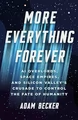
If you want to understand those nightmarish ideas in great and entertaining detail, I highly recommend reading More Everything Forever: AI Overlords, Space Empires, and Silicon Valley's Crusade to Control the Fate of Humanity by Adam Becker. I started reading it on a recent plane ride and couldn't put it down.
I'll have more to say on this, but this book deserves the widest possible audience because the dangerous ideas Becker exposes are exerting tremendous influence on our lives in 2025.
Here's the official description of the book:
Tech billionaires have decided that they should determine our futures for us. According to Elon Musk, Jeff Bezos, Sam Altman, and more, the only good future for humanity is one powered by technology: trillions of humans living in space, functionally immortal, served by superintelligent AIs.
In More Everything Forever, science journalist Adam Becker investigates these wildly implausible and often profoundly immoral visions of tomorrow--and shows why, in reality, there is no good evidence that they will, or should, come to pass. Nevertheless, these obsessions fuel fears that overwhelm reason--for example, that a rogue AI will exterminate humanity--at the expense of essential work on solving crucial problems like climate change. What's more, these futuristic visions cloak a hunger for power under dreams of space colonies and digital immortality. The giants of Silicon Valley claim that their ideas are based on science, but the reality is darker: they come from a jumbled mix of shallow futurism and racist pseudoscience.
More Everything Forever exposes the powerful and sinister ideas that dominate Silicon Valley, challenging us to see how foolish, and dangerous, these visions of the future are.
-=-=
atl mo
Technologists currently wield a level of political influence that was recently considered unthinkable. While Elon Musk’s Department of Government Efficiency slashes public services, Jeff Bezos takes celebrities to space on Blue Origin and the CEOs of AI companies speak openly of radically transforming society. As a result, there has never been a better moment to understand the ideas that animate these leaders’ particular vision of the future.
In his new book, More Everything Forever, the science journalist Adam Becker offers a deep dive into the worldview of techno-utopians such as Musk—one that’s underpinned by promises of AI dominance, space colonization, boundless economic growth, and eventually, immortality. Becker’s premise is bracing: Tech oligarchs’ wildest visions of tomorrow amount to a modern secular theology that is both mesmerizing and, in his view, deeply misguided. The author’s central concern is that these grand ambitions are not benign eccentricities, but ideologies with real-world consequences.
By Adam Becker
What do these people envision? In their vibrant utopia, humanity has harnessed technology to transcend all of its limits—old age and the finite bounds of knowledge most of all. Artificial intelligence oversees an era of abundance, automating labor and generating wealth so effectively that every person’s needs are instantly met. Society is powered entirely by clean energy, while heavy industry has been relocated to space, turning Earth into a pristine sanctuary. People live and work throughout the solar system. Advances in biotechnology have all but conquered disease and aging. At the center of th
...
-=-=
Go to Mars, Never Die and Other Big Tech Pipe Dreams
In “More Everything Forever,” the science journalist Adam Becker subjects Silicon Valley’s “ideology of technological salvation” to critical scrutiny.
By Jennifer Szalai
Published April 23, 2025
Updated May 12, 2025
MORE EVERYTHING FOREVER: AI Overlords, Space Empires, and Silicon Valley’s Crusade to Control the Fate of Humanity, by Adam Becker
Elon Musk predicts that a million Earthlings will be living on Mars in 20 years — not just for the exciting adventure but as a matter of survival: “We must preserve the light of consciousness by becoming a space-faring civilization & extending life to other planets.”
Not so fast, says the science journalist Adam Becker. As he puts it in his smart and wonderfully readable new book, “More Everything Forever,” life on Mars is bound to be worse than life on our own planet, however much ecological havoc we have wreaked.
Becker, who has a Ph.D. in astrophysics and is the author of a previous (equally readable) book about quantum theory, clearly lays out the many problems of getting to, and surviving on, the Red Planet. There is the not insignificant issue of enormous amounts of surface radiation. There is also the not insignificant issue of the toxic dust. Exposure to Martian air will boil the saliva off your tongue before it asphyxiates you.
And even if astronauts manage to build a system of pressurized tunnels for living underground — a very big if, given the difficulties of getting astronauts there, let alone construction materials — the number of people living in such bunkers would have to be pretty small. They would require regular shipments of food and water from Earth, presumably via Musk’s company SpaceX. “Even the air the Mars residents breathe would cost money,” Becker writes. It sounds like a miserable way to live. “Mars would make Antarctica look like Tahiti.”
The plan to colonize Mars is just one of the fantastical scenarios Becker writes about in “More Everything Forever,” which traces the various plans advanced by billionaire tech entrepreneurs in their grand bids to “save humanity.” From artificial intelligence to colonizing outer space, the animating force behind such projects is what Becker calls “the ideology of technological salvation.” The ideas it propagates have three main features, he says. First, they are reductive. Second, they are profitable, aligning neatly with the tech industry’s imperative of perpetual growth. Third, and most important, they offer transcendence — the promise of an imagined end that justifies blowing through any actual limits, including conventional morality.
The futuristic visions that flow from this ideology are binary: paradise or annihilation. Becker draws an incisive portrait of the debates over artificial intelligence, showing how A.I.’s champions and doomsayers occupy two sides of the same coin. On one side are techno-optimists like Ray Kurzweil, who predicts a day when all-powerful machines will eliminate poverty and disease and allow us to “live as long as we want.”
The doomsayers, by contrast, worry about “A.I. alignment,” or the prospect that such machines will one day take our jobs or even kill us all. An influential thought experiment among the doomsayers involves a “superintelligence” whose sole goal is to manufacture as many paper clips as possible; eventually this creature turns everything into paper clips.
Toggling between dystopian warnings and promises of deliverance are the tech entrepreneurs. Becker cites Sam Altman, the C.E.O. of OpenAI, who has proposed that his company capture the wealth created by A.I. and ameliorate the socioeconomic fallout by redistributing part of that wealth to the public. “The changes coming are unstoppable,” Altman once wrote, yet “the future can be almost unimaginably great.”
Becker argues that Silicon Valley’s preoccupations have created their own kind of warped ethics. “The credence that tech billionaires give to these specific science-fictional futures validates their pursuit of more — to portray the growth of their businesses as a moral imperative, to reduce the complex problems of the world to simple questions of technology, to justify nearly any action they might want to take — all in the name of saving humanity from a threat that doesn’t exist, aiming at a utopia that will never come.”
While tech moguls make passing mention of how A.I. will bring untold abundance, the grubbier problems of the here and now typically get less attention in Silicon Valley than spectacular thought experiments on “existential risk,” however far-fetched. If you’re a billionaire who has been richly rewarded for your contrarian moonshots, why waste time analyzing stubbornly ordinary problems, like poverty and inequality, when you could be dreaming about colonizing the galaxy and thwarting runaway paper-clip machines?
And so Silicon Valley has given a lot of money to the effective altruism community, which has provided scholarly legitimacy to tech billionaires’ hobbyhorses. Effective altruists encourage the use of reason and data for making philanthropic decisions, but Becker highlights how some of their most influential thinkers have come up with truly bizarre “longtermist” calculations by multiplying minuscule probabilities of averting a hypothetical cataclysm with gargantuan estimates of “future humans” saved.
One prominent paper concluded that $100 spent on A.I. safety saves one trillion future lives — making it “far more” valuable “than the near-future benefits” of distributing anti-malarial bed nets. “For a strong longtermist,” Becker writes, “investing in a Silicon Valley A.I. safety company is a more worthwhile humanitarian endeavor than saving lives in the tropics.”
Tech billionaires’ pet projects can sound deliriously futuristic, but lurking underneath them all is an obsession that is very old. It’s the primal fear of death, encased in a shiny new rocket ship. Becker quotes other writers who have noticed how Silicon Valley, with its omnivorous appetite, has turned existential angst into yet another input. “Space has become the ultimate imperial ambition,” the scholar Kate Crawford writes in “Atlas of A.I.,” “symbolizing an escape from the limits of Earth, bodies and regulation.” In “God, Human, Animal, Machine” (2021), Meghan O’Gieblyn describes how technology took over the domain of religion and philosophy: “All the eternal questions have become engineering problems.”
The “ideology of technological salvation” that Becker identifies can therefore be understood, too, as a desperate attempt to deal with despair. Amid his sharp criticisms of the tech figures he writes about is a resolute call for compassion. He encourages us not to get hung up on galaxies far, far away but to pay more attention to our own fragile planet and the frail humans around us.
“We are here now, in a world filled with more than we could ever reasonably ask for,” Becker writes. “We can take joy in that, and find satisfaction and meaning in making this world just a little bit better for everyone and everything on it, regardless of the ultimate fate of the cosmos.”
MORE EVERYTHING FOREVER: AI Overlords, Space Empires, and Silicon Valley’s Crusade to Control the Fate of Humanity | By Adam Becker | Basic Books | 367 pp. | $32
Jennifer Szalai is the nonfiction book critic for The Times.
A version of this article appears in print on May 18, 2025, Page 11 of the Sunday Book Review with the headline: Science Friction.
-=-=-