Constructor typology
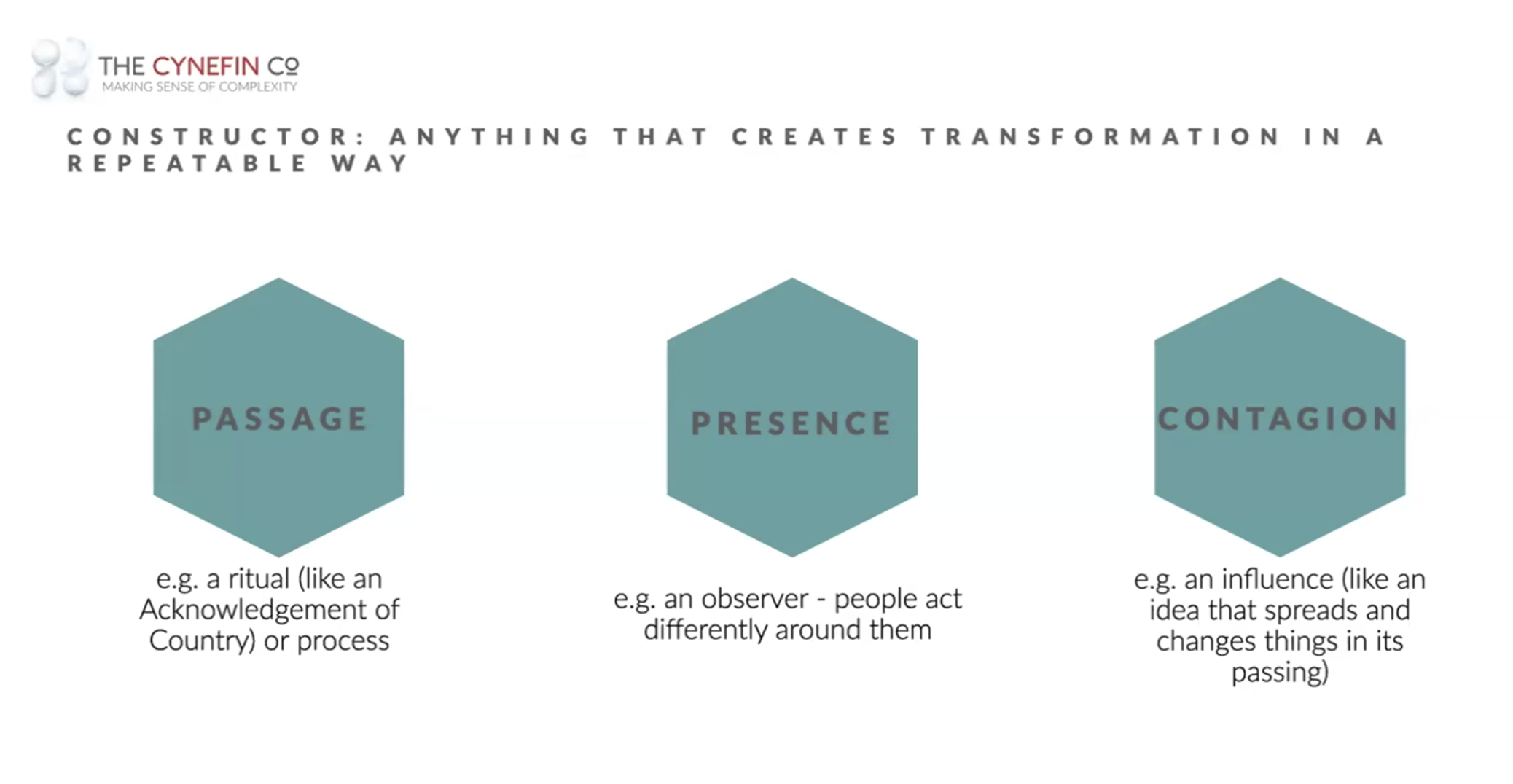
CONSTRUCTOR: PASSAGE
- This type of constructor changes something as it passes through the constructor – like rituals and processes.
- For example, the ritual of a graduation ceremony transforms a student into a professional by taking them through a series of practices
CONSTRUCTOR: CONTAGION
- This type of constructor changes things by influencing or affecting them, like a virus
- An example is a spreading fashion that provokes transformation through copying and imitation
CONSTRUCTOR: PRESENCE
- This type of constructor transforms other elements by its presence alone
- For example, the appearance of senior executive in a meeting of subordinate staff can change the whole atmosphere, or the presence of a woman in a typically male environment
- Think of a Constructor which you either encounter or enter and as a result of which some transformation takes place
- There is also a working dyad, namely the difference between a constructor which has been constructed and one which has emerged
Any structure is an emergent property so for the moment we will work with a list that currently stands as set out below
- Catalyst
- Something which triggers and accelerates a change without itself undergoing significant change
- Process
- A defined pathway which can be measured and for which compliance can be enforced
- Ritual
- “The process whereby some behaviour became progressively modified and specialized for its communicative function”
- Example is a surgical operating theatre where the act of scrubbing up doesn’t just have a hygiene function it also triggers an identity shift from person to the role
- More details can be found here
- Habit
- In this context more “Liberating force” than a “rut we get stuck in”
- Explored in three posts starting here
- Custom & practice
- The way we’ve always done things, more fully elaborated here
- Machine
- Probably the most obvious example and I am using it here in the sense of something which has been designed for a purpose
- Artefact
- All machines are artefacts
- Using it here in the sense of Material Engagement theory with the idea that there is some agency involved
- Rules
- Although they might be seen as a restraint, rules are a form of formalized habit, defined as a liberating force per the above
- Collage
- The elements of a collage have meaning in their own right but when they are put together there is a whole new level of meaning
- Mosaic
- Here the components have no particular meaning, but when they are assembled by a skilled artisan they create a work of art
- Roles
- Humans are very good at creating roles, ritualising entry into roles and creating expectations on the role holder
- Deep knowledge
- Different from roles, in that the expertise is universally acknowledged, it’s more personal based on people’s experience rather than a formal role
- A profession
- Law, Medicine, Accountancy and the Military among others have multi-generational established processes that generate roles, ethics and practices