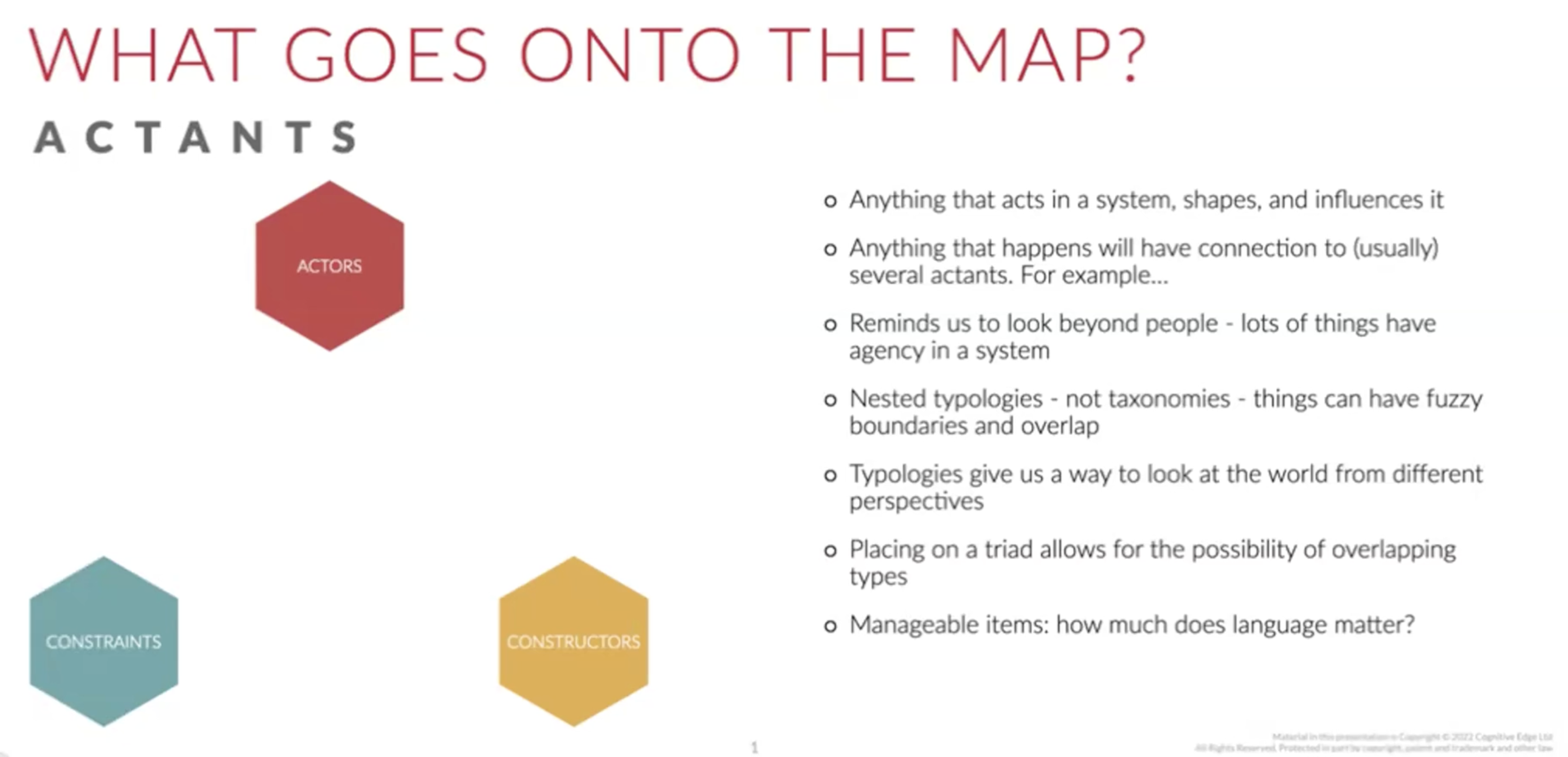
Stage 1: Actants
- There are a series of changes from a year ago when we only looked at constraints and constructors as the things to be mapped
- The goal is to get people to identify things that can be managed, and the typologies are a means to that end, not an end in themselves
- Changing how actants interact will be more effective and ethical unless you push it to extremes
- Trying to change mindsets, mental models, etc, has questionable ethics and won’t work at scale
- Actant framework is useful in the broader field of complex adaptive systems
- If it acts within the CAS, it’s an actant
- 3 types of actants
- Constraints can connect or contain and be resilient or robust
- 3 resilient constraint types are permeable, phase shift, and dark
- 3 robust types are rigid, elastic, and tether
- Constructors transport
- by passage (such as a ritual or a process)
- by contagion
- by their presence (this includes a Panopticon Effect)
- Actors can be
- roles (which can include experts as well as organisational roles)
- a collective such as a team
- an individual (rarely)