Complex Facilitation
Complex facilitation works well in the Complex domain. When working in the Complicated domain, use Traditional Facilitation.
- Focus: Designed for situations where the challenges or goals are not well-defined, and the group dynamics/relationships are messy, entangled and uncertain
- Goals: Suitable when dealing with complex, adaptive challenges that involve multiple perspectives, ambiguity, and emerging solutions
- Process: Emphasizes creating an environment where participants can explore different viewpoints, experiment with ideas, and co-create solutions
- Control: Facilitator takes a more adaptive and less directive role, allowing the group to self-organize, generate ideas, and navigate through the uncertainty of the situation
- Emergence: Facilitator allows for the emergence of novel insights, creative solutions, and exaptive responses that might not have been initially apparent
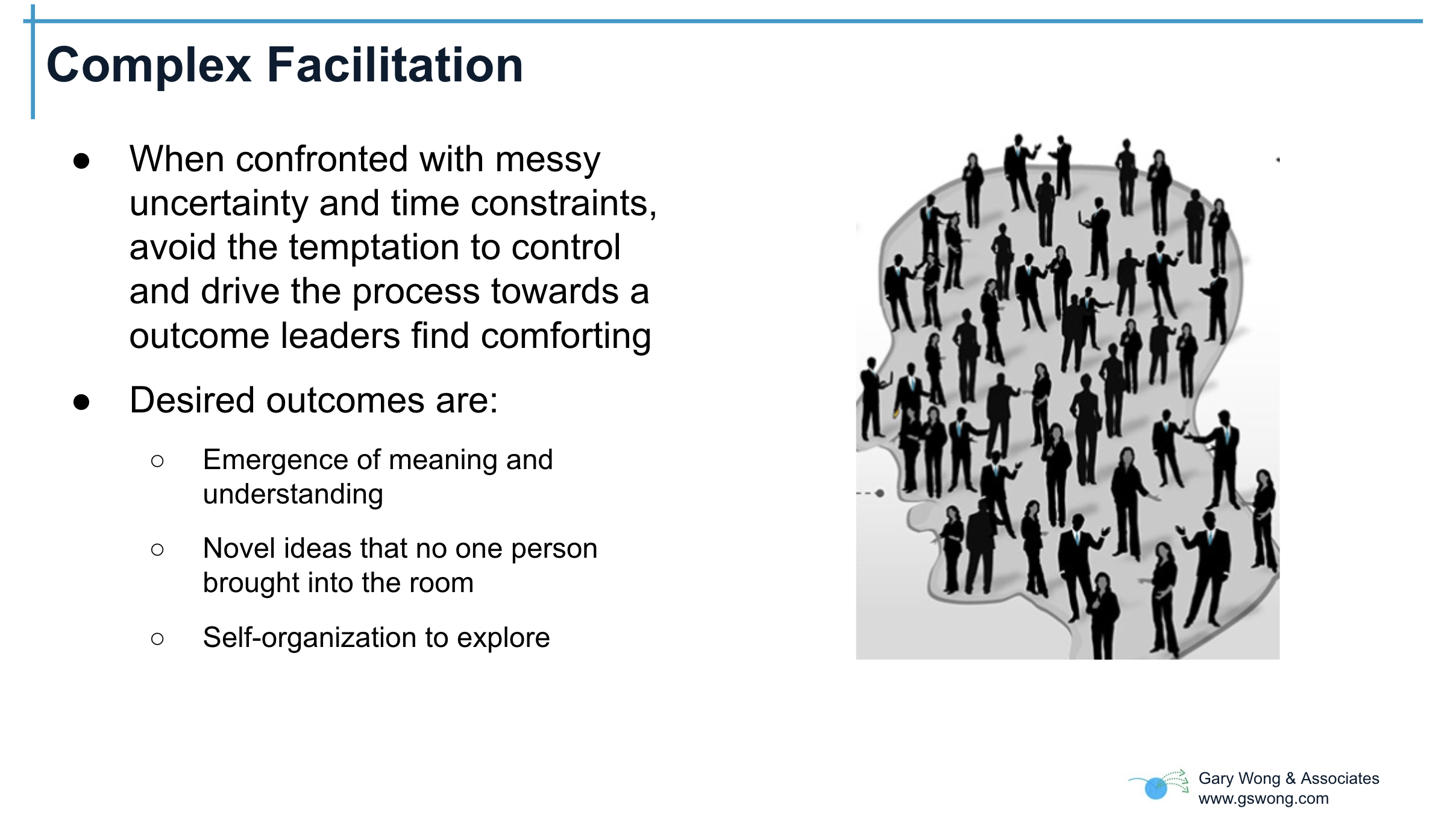
- Emergence means that a group of people leaves a room with insights that no one person brought into a room with them
- The whole is greater than the sum of its parts
- Flexibility: Facilitator needs to be comfortable with ambiguity and dealing with unknown unknowns, adapting the approach based on the evolving dynamics of the group and the situation rather adhering to a fixed agenda
- Time Constraints: Understanding that the “compass not the clock” guides when the session should end