Dependency matrix
We need to understand what are the current issues and opportunities faced by decision makers with the organisation and we need this understanding at multiple levels from the board room to operational managers.
Following process which takes place in a workshop creates a portfolio of projects that work with the reality of both what we know (or don't know) and what is concerning decision makers.
- To start we simply ask the decision makers what is keeping them away at nights (or some more tactful variation thereof).
- Ideally you do this using a journaling application of SenseMaker® so that they can record them as they occur, but it can also be done by more conventional interviewing.
- Ask people to rank the issues in order of importance
- We can then look across the reports of multiple decision makers and see what is in common, look at the relative ranking and differences.
- Once that is done you get people together to resolve conflicts and talk about differences
- At the end of that we have ranked problems that form one part of the dependency matrix show here, marked as P1 etc.
- Various ASHEN elements are clustered and grouped into knowledge objects.
- That gives us a list of knowledge objects that can be ranked based on their vulnerability to loss. Probably the key priority measure for knowledge.
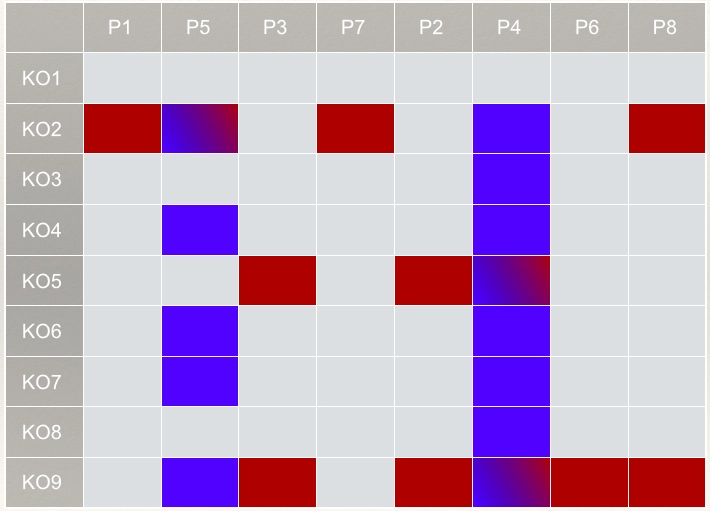
- Mark each box where there is a high dependency between problem and a knowledge object.
- Those in blue show where a single problem can be addressed only if we effectively manage multiple knowledge objects
- easy to sell more difficult to implement.
- Those in red show where managing a single knowledge object could have an impact on many problems
- more difficult to sell but easy to implement.
- Those in blue show where a single problem can be addressed only if we effectively manage multiple knowledge objects