Code
Videos
Public law vs. code, ways to defeat a code violation
Man and Code
Through the Code we have debt slaves in peonage . It’s the code enforcing bills of attainders and bills of pains and penalties, fundamentally altering our form of government. Subjecting us to pretended acts of legislation.
In the practice of law, a code is an organized compilation of existing “laws”. It is
a collection of all the laws in force, including the enacted laws and case law, covering a complete legal system or a specific area. A code can make the formulation of legal principles and rules more concise, clear, and thorough, so that people can understand the rules more quickly and comprehensively.
Many states publish official codes of all existing laws, which are compiled by code commissions and enacted by the legislature. The UNITED STATES CODE (U.S.C.) (USC) is a compilation of federal law, and the Uniform Commercial Code (UCC) is a collection of commercial law.
Difference between UCC and U.S.C.
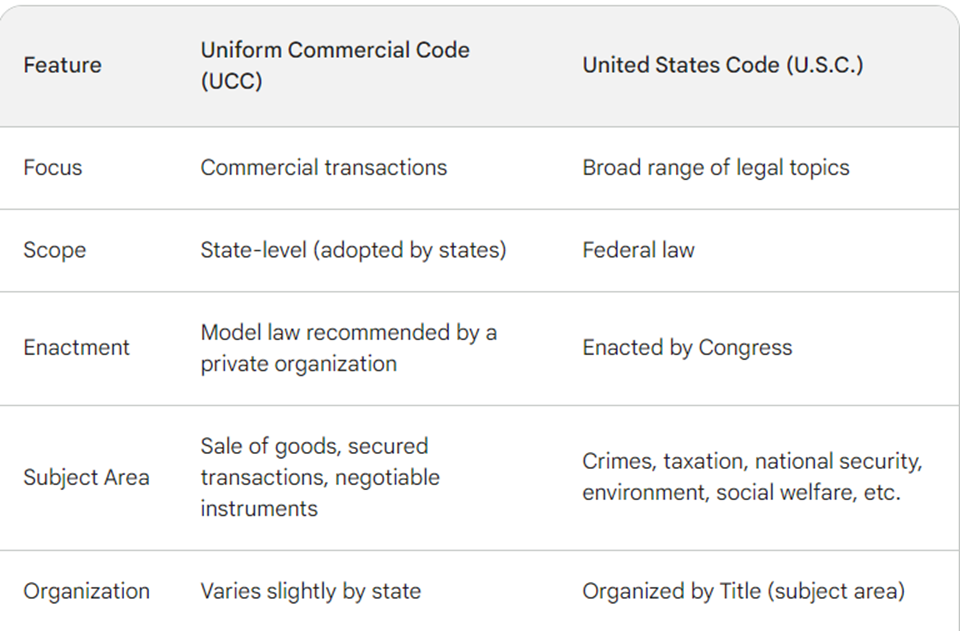
The Uniform Commercial Code (UCC) and the United States Code (U.S.C.) are two fundamental sets of laws in the United States, but they serve different purposes and have distinct scopes:
Uniform Commercial Code (UCC):
- Focuses on commercial transactions between private parties, including the sale of goods, secured transactions (loans with collateral), and negotiable instruments (checks, promissory notes).
- Standardized across most states: The UCC is a model law that has been adopted by all 50 states and the District of Columbia, with some variations. This promotes uniformity and predictability in commercial transactions across different jurisdictions within the US.
- Not a federal law: The UCC itself is not a federal law enacted by Congress. It's a set of recommended guidelines that states have chosen to adopt into their own legal codes.
United States Code (U.S.C.):
- Covers a much broader range of legal topics, encompassing federal laws enacted by the United States Congress.
- Federal law: The U.S.C. is the official compilation of federal laws of the United States. It includes laws related to criminal justice, taxation, national security, environmental protection, social welfare programs, and many other areas.
- Organized by Title: The U.S.C. is divided into 54 Titles, with each Title focusing on a specific subject area (e.g., Title 18 covers crimes and criminal procedure).
Here's a table summarizing the key differences: