UNITED STATES CODE (U.S.C.)
The Code is the Roman Civil Law which was implemented in America through the Reconstruction Act of 1871. The American Bar Association was created in 1878 and brought in the Code in 1881, the Code of Civil Procedure. It is enforced by Bills of Attainder / “Bill of pains and penalties”, forbidden in the U.S. Constitution. Crimes are supposed to be tried under Common Law.
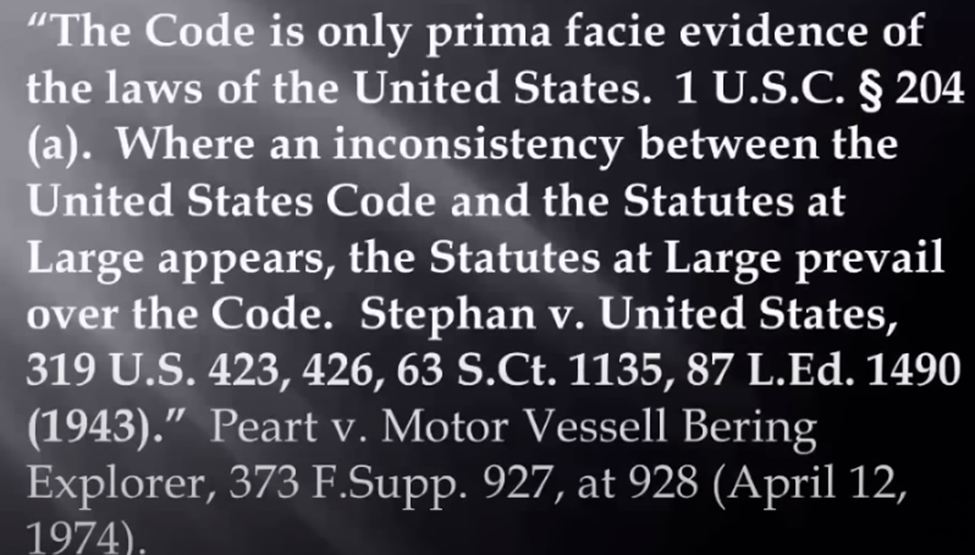
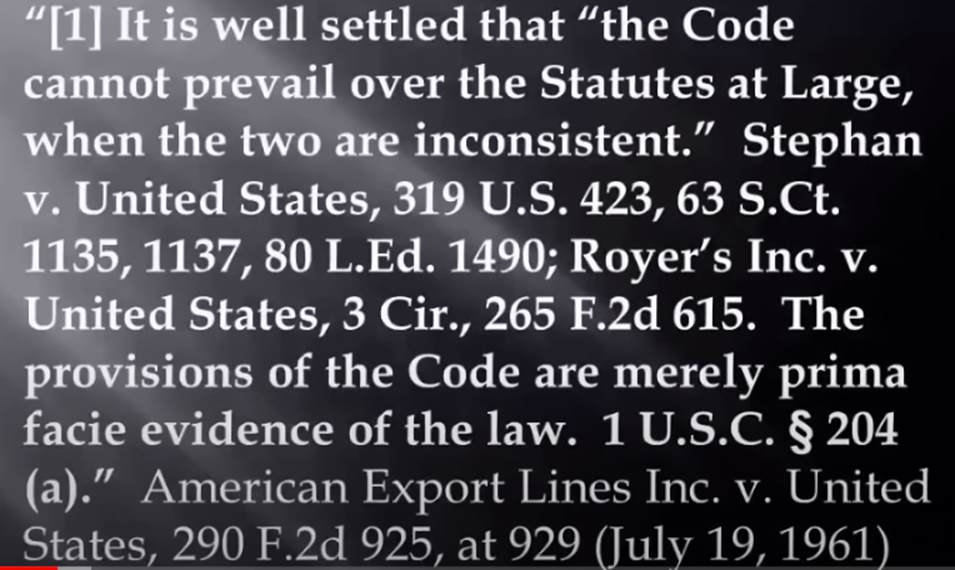
The United States Code is not generally the law. The law that is actually enacted by Congress and signed by the president can be found in the Statutes at Large, a giant chronological compilation of everything Congress has enacted, with subsequent amendments and repeals. The United States Code is a helpful edited collection that tries to reflect what the Statutes at Large actually add up to, but it is “prima facie” evidence of law, not the law itself.
All codes, rules and regulations are unconstitutional and lacking in due process. Rodrigues v Donovan, 769 F. 2d 1344
From Tobias Dorsey, “Some Reflections on Not Reading the Statutes,:
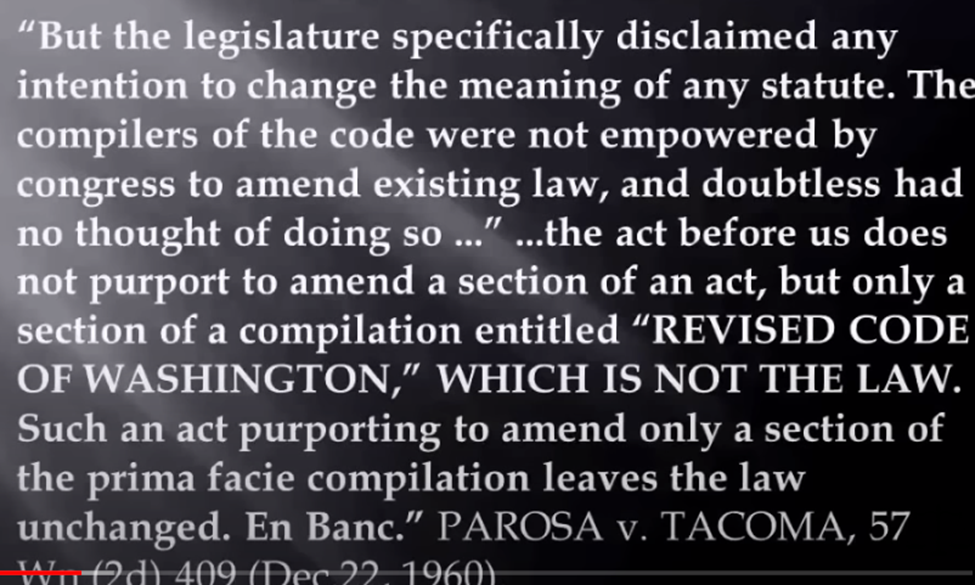
”The Code is–no disrespect intended–a Frankenstein’s monster of session laws. The Code is made by taking the session laws, hacking them to pieces, rearranging them, and stitching them back together in a way that gives them false life. Many pieces are altered, and many others are thrown away. The result is something like a Cliffs Notes guide to the real law. That is all the Code is, and that is all it is supposed to be.”
The Roman Civil Code was lost by 600 A.D. but found and reinstated in 1130 where the King is the sovereign. The Magna Carta arose out of the effects of this. The Statutory Act of England in 1881 extended the High Court of Admiralty in England, over here.
The United States Code is meant to be an organized, logical compilation of the laws passed by Congress. At its top level, it divides the world of legislation into fifty topically-organized Titles, and each Title is further subdivided into any number of logical subtopics. In theory, any law -- or individual provisions within any law -- passed by Congress should be classifiable into one or more slots in the framework of the Code. On the other hand, legislation often contains bundles of topically unrelated provisions that collectively respond to a particular public need or problem. A farm bill, for instance, might contain provisions that affect the tax status of farmers, their management of land or treatment of the environment, a system of price limits or supports, and so on. Each of these individual provisions would, logically, belong in a different place in the Code. (Of course, this isn't always the case; some legislation deals with a fairly narrow range of related concerns.)
The process of incorporating a newly-passed piece of legislation into the Code is known as "classification" -- essentially a process of deciding where in the logical organization of the Code the various parts of the particular law belong. Sometimes classification is easy; the law could be written with the Code in mind, and might specifically amend, extend, or repeal particular chunks of the existing Code, making it no great challenge to figure out how to classify its various parts. And as we said before, a particular law might be narrow in focus, making it both simple and sensible to move it wholesale into a particular slot in the Code. But this is not normally the case, and often different provisions of the law will logically belong in different, scattered locations in the Code. As a result, often the law will not be found in one place neatly identified by its popular name. Nor will a full-text search of the Code necessarily reveal where all the pieces have been scattered. Instead, those who classify laws into the Code typically leave a note explaining how a particular law has been classified into the Code. It is usually found in the Note section attached to a relevant section of the Code, usually under a paragraph identified as the "Short Title".
The United States Code is the corporate by-laws, it’s not law.
This is when they fundamentally changed our form of governance, subjecting us to pretended acts of legislation and basically converting us back into a monarchy. Article IV, section 4 of the Constitution was intended to prevent even one state from turning us back into a monarchy. That Article is the remedy and relief, that (in a Republic) we have the right to demand and when a judge fails to grant relief when it is demanded, that is Ultra Vires and the judge has lost all immunity. Where do you have to go for that? The Legislature. See Right to Petition for Redress of Grievances. The Arkansas Constitution begins with All political power is inherent in the people and government is instituted for their protection, security and benefit; and they have the right to alter, reform or abolish the same, in such manner as they may think proper.
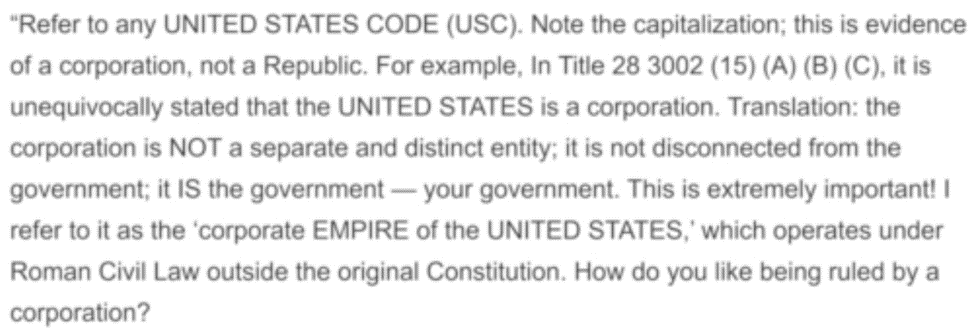
Refer to any UNITED STATES CODE (USC) . Note the capitalization; this is evidence of a corporation, not a Republic. For example, in Title 28 002 (15)(A)(B)(C), it is unequivocally stated that the UNITED STATES is a corporation. Translation: the corporation is NOT a separate and distinct entity; it is not disconnected from the government; it IS the government – your government.
The United States Code includes all general and permanent laws of the United States. Temporary laws, such as appropriations acts, and special laws, such as one naming a post office, are not included in the Code. The United States Code is the result of an effort to make finding relevant and effective statutes simpler by reorganizing them by subject matter, and eliminating expired and amended sections. The Code is maintained by the Office of the Law Revision Counsel (LRC) of the U.S. House of Representatives. The LRC determines which statutes in the United States Statutes at Large should be codified, and which existing statutes are affected by amendments or repeals, or have simply expired by their own terms. The LRC updates the Code accordingly.
In general, the term "positive law" connotes statutes, i.e., law that has been enacted by a duly authorized legislature as oppose to natural laws. As used in this sense, positive law is distinguishable from the preexisting natural laws of our Creator which humans do not write but can only discover through their capacity for rational analysis.
Within the context of the Code, the term "positive law" is used in a more limited sense. A positive law title of the Code is a title that has been enacted as a statute. To enact the title, a positive law codification bill is introduced in Congress. The bill repeals existing laws on a certain subject and restates those laws in a new form–a positive law title of the Code.
The titles of the Code that have not been enacted through this process are called non-positive law titles. Non-positive law titles of the Code are compilations of statutes. Non-positive law titles, as such, have not been enacted by Congress, but the laws assembled in the non-positive law titles have been enacted by Congress. By law, those titles of the United States Code that have not been enacted into positive law are "prima facie evidence" of the law in effect. The United States Statutes at Large remains the ultimate authority. If a dispute arises as to the accuracy or completeness of the codification of an un-enacted title, the courts will turn to the language in the United States Statutes at Large.
In contrast, if Congress enacts a particular title of the Code into positive law, the enactment repeals all of the previous Acts of Congress from which that title of the Code was derived. In their place, Congress gives the title of the Code itself the force of law. This process makes that title of the United States Code "legal evidence" of the law in force. Where a title has been enacted into positive law, a court may neither permit nor require proof of the underlying original Acts of Congress. Currently 27 titles out of present 54 titles of the United States Code have been enacted into positive law title of the code.
For the print version of the Code, each title is updated once a year to include all of the laws enacted during the latest session of Congress. Only the printed version of the Code is recognized under law as evidence of the laws of the United States in all courts, tribunals, and public offices of the United States, the States, and the Territories and possessions of the United States ( 1 U.S.C. 204 ). Volume one contains Titles 1 through 5 of the United States Code, preceded by the four Organic Laws of the United States of America. Anyone interesting to confirming the limitation of taxation and legislation in America should buy Volume one of the United States Code from the U.S. Government Printing Office Bookstore. Volume one of the United States Code is all the evidence you will need to confirm the territorial limitations of federal law. Titles 1, 3 and 4 of the United States Code have all been enacted into positive law and all of them can be read in a few hours. Each of these Titles can be used to easily prove federal law is limited to the territory owned by or ceded to the United States of America. Federal law is made for the federal government, federal employees, federal territory and federal citizens. Close examination of all State constitutions will reveal that they only apply to government, to government property and people on government land. In America, all written laws, local, State, and federal, is applicable only in the territory owned by or ceded to the United States of America.
The title was enacted into positive law by Pub.L. 95–473, § 1, October 17, 1978, 92 Stat. 1337; Pub.L. 97–449, § 1, January 12, 1983, 96 Stat. 2413; and Pub.L. 103–272, July 5, 1994, 108 Stat. 745 (subtitles II, III, and V-X)
During the time between when the Title 49 positive law codification began in 1978 and when it was completed in 1994, the remaining non-positive law sections were placed in an appendix to Title 49.[1] ^[2]
In 1995, the ICC Termination Act, substantively and significantly amended Title 49.[3]
In 2010, Congress enacted Title 51 as a new positive law title concerning NASA and commercial space programs. As part of the codification, the heading of Subtitle IX was marked "transferred" and the contents of such subtitle were moved to Title 51.[4] Five years later, the FAST Act inserted a new Subtitle IX. The heading of new Subtitle IX was given the heading "Multimodal Freight Transportation."[5]
- Subtitle I—Department of Transportation
- Subtitle II—Other Government Agencies
- Subtitle III—General and Intermodal Programs
- Subtitle IV—Interstate Transportation
- Subtitle V—Rail Programs
- Subtitle VI—Motor Vehicle and Driver Programs
- Subtitle VII—Aviation Programs
- Subtitle VIII—Pipelines
- Subtitle IX—Multimodal Freight Transportation
- Subtitle X—Miscellaneous
UCC 1-201. General Definitions. (38)"State" means a State of the [corporate] United States,…
As opposed to…
USC TITLE 28 > PART VI > CHAPTER 176 > SUBCHAPTER A >§ 3002Definitions (14)"State" means any of the [dejure union states] several States,…