Stare Decisis

Stare decisis is the doctrine that courts will adhere to precedent in making their decisions. Stare decisis means “to stand by things decided” in Latin.
(latin) meaning “historical decisions and judicial decisions” rule over current law cases and evidence. This is the opposite decision system of Common Law where case history does not provide the facts of a trial. The law libraries are skewed with facts of history moving court decisions far away from current evidence. As example, Supreme Court decisions have skewed the US Constitution and many decisions are reversed. Courts cannot collect the facts from the millions of pages of case law evidence, resulting in no current justice to common law trials. The juris court must reach its own decisions.
When a court faces a legal argument, if a previous court has ruled on the same or a closely related issue, then the court will make their decision in alignment with the previous court’s decision. The previous deciding-court must have binding authority over the court; otherwise, the previous decision is merely persuasive authority. In Kimble v. Marvel Enterprises, the U.S. Supreme Court described the rationale behind stare decisis as “promot[ing] the evenhanded, predictable, and consistent development of legal principles, foster[ing] reliance on judicial decisions, and contribut[ing] to the actual and perceived integrity of the judicial process.”
Judges cannot make law
Judges can ONLY compare a given case to other similar cases and make a ruling based on what other courts have done – stare decisis
If there is a case that has NOT been previously decided, then they have to convene a jury
“We the People” make the law
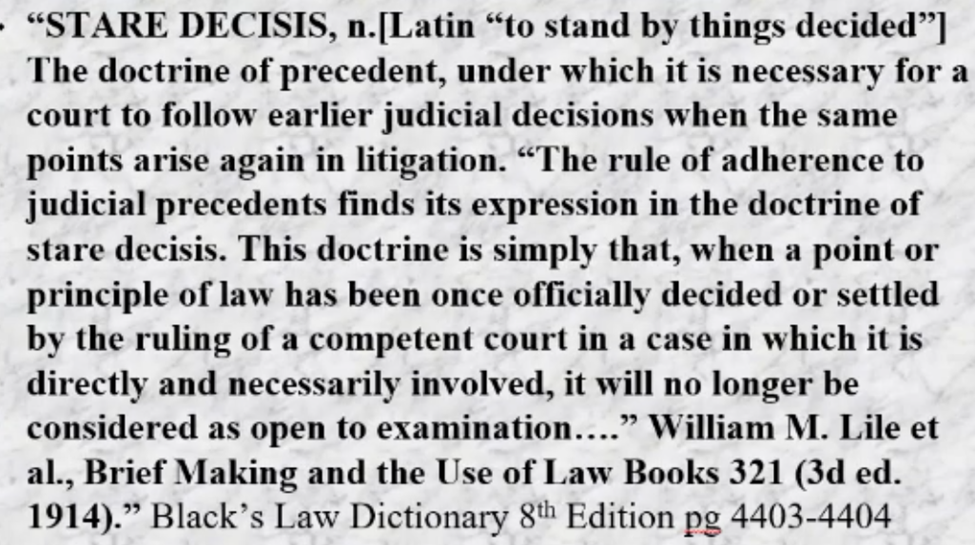
“STARE DECISIS, n.[Latin “to stand by things decided”] The doctrine of precedent, under which it is necessary for a court to follow earlier judicial decisions when the same points arise again in litigation. “The rule
of adherence to judicial precedents finds its expression in the doctrine of stare decisis. This doctrine is simply that, when a point or principle of law has been once officially decided or settled by the ruling of a competent
court in a case in which it is directly and necessarily involved, it will no longer be considered as open to examination….” William M. Lile et al., Brief Making and the Use of Law Books 321 (3d ed. 1914).” Black’s
Law Dictionary 8th Edition pg 4403-4404
Some useful precedents:

If it is specifically mentioned in the Constitution.
