Common law
Index:
- Agency
- Citizenship vs. common law, merger of equity w common law
- Committee of Safety
- Common Law Abatement
- Common Law Claim
- Common Law Courts
- Common Law Lien
- Common Law Trust
- Corpus Delicti
- Due Process of Law
- First Principal - Liberty
- History of American Common Law
- ID Cards
- Larceny
- Maxims of Law
- Natural Law / Law of Nature
- Parliamentary Law
- Personal Injury
- Private Rights
- Writs
Videos

Original Common Law
Karl Lentz: This is Common Law Land
John Quade Common Law, Understanding your God given Rights
Evoking the Common Law
Life. Liberty. Property. - Common Law School George Gordon Lesson 3 Part 2
Using common law to restore kids(or other property) currently in government custody
Common law, wrong vs. negligence, keeping officers out of your house
Exercising citizenship, IRS exempt, decedent and infant, exhibits, court access
Be precise with your words, and the common laws of different peoples
Understanding statute and common law courts Is this correct?
Negotiating with public servants, and understanding common law
Your relationship to the IRS in regards to common law
The two primary systems of law are Civil Law and Common Law. The primary differences between them is that in Civil Law, the primary assumption is that your rights come from government. In Common Law, your rights come from Natural Law / Law of Nature / God. Common law has nothing to do with the Constitution and involves suits between man and man in the private. The highest court on the land is a common law court.
There is a difference between American Common Law and English Common Law. It began in 1606 with the first charter of Virginia. Read Lex Parliamentaria Americana for history of American Common Law.
One of the differences is that laws decided through English Common Law were not automatically recognized in America. When we refer to Common Law, we are specifically referring to American Common Law, laws that were formulated and recognized through our own system.
The English model (which is often misunderstood to be our form of common law) is defined as “Common law, also known as case law, relies on detailed records of similar situations and statutes because there is no official legal code that can apply to a case at hand. The judge presiding over a case determines which precedents apply to that particular case.”
In the English System – Common law refers to the body of law that is developed through judicial decisions and precedent rather than through legislative statutes or executive regulations.
In the American System – We adapted English common law, taking some but not all of it. According to American Jurisprudence, which is the Science of law, in our nation, Bills of rights are merely declarative of the common law. In other words, the common law refers to rights as the law. We are born with rights which cannot be turned into governmental privilege with a stroke of the pen.
The problem is they are trying to convince us that our common law system relies heavily on court precedent. They refer to a concept of “Judge-made Law” otherwise known as case law.
When we say common law isn’t written, that only means there is no single authoritative source you can go to for the common law. Common law is custom and usage since time immemorial. Whereas with statutory law, you have a legislature to look at.
Common Law according to American Jurisprudence, Second Edition: In a broader sense the common law is the system of rules and declaration of principles from which our judicial ideas and legal definitions are derived and which are continually expanding. It is not a codification of exact or inflexible rules for human conduct, for the redress of injuries or for the protection against wrongs. But is rather, the embodiment of the broad and comprehensive understanding of unwritten principles inspired by natural reason and an innate sense of justice and adopted by common consent of the regulation of government of the affairs of men.
Constitutions must be written in reference to the common law.
See American Jurisprudence Volume 16, section 114 , and 117
Why You Can't Understand the Constitution Without the Common Law
Its been termed the legal embodiment of practical sense, whose guiding star has always been the rule of right and wrong and whose principles demonstrate that there is in fact, as well as in theory, a remedy for all wrongs.
While in one sense common law has no fixed meaning since it varies with time and place, when viewed as a system for deducing from litigated instances just, reasonable, and consistent with rules, it can be said that the common law never changes.
Common Law isn’t like what the “indoctrination camps” have taught us that law is.
Common Law is the law of the Land, laid down over centuries of court cases in front of juries, humans making law for humans. It is based on the Ten Commandments and the Magna Carta. Common Law is common sense. The question each jurist must ask themselves is, “Is there an injured party?”. There is a Common Law principle which states that for there to be a crime, there must first be a victim (corpus delicti), the state cannot be the injured party. In the absence of a victim there can be no crime. This is what the grand jurist must discover.
Common Law pertains to “Lawful” and anything outside of Lawful falls under “Legal” or no system at all.


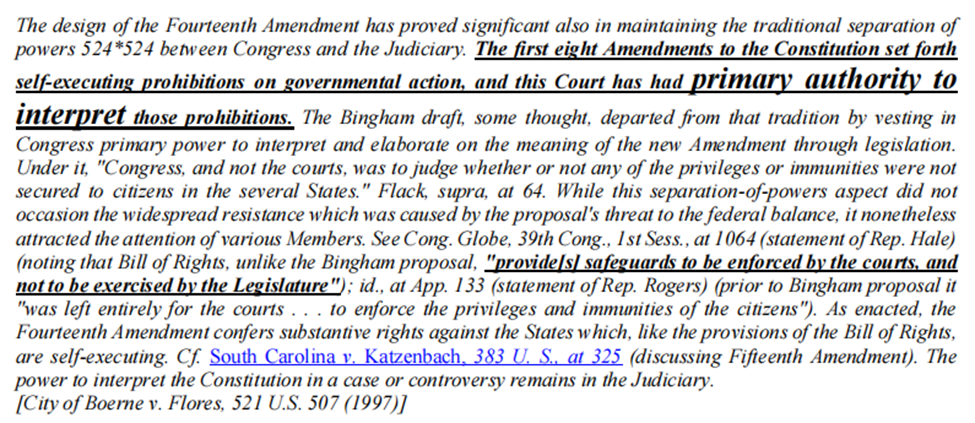
South Carolina v. Katzenbach, 383 U.S. 325
When you say “I claim...” you are under Common Law. When you file a complaint you are under legalese.
Suits between man and man are common law. Also, suits in law (contract). Where is the contract that binds me to this.
“The common law is the real law, the Supreme Law of the land, the code, rules, regulations, policy and statues are “not the law”, -- Self v. Rhay, 61 WNN (2nd) 261
If there’s anything in Common Law, Grand Jury, or Assembly that’s important for everyone to understand its how to do affidavits. That’s how we get to the truth in our common law system.
Commonlaw Copyright for legal name
AT LAW, Bouvier’s Law, 1856 Edition . This phrase is used to point out that a thing is to be done according to the course of the common law; it is distinguished from a proceeding in equity.
Common Law and substance cannot be divorced from one another. The substance of our Common Law was divorced in 1933 with HGR192. When that happened our Common Law degenerated into the old Roman Civil Law (Law Merchant).
Common Law as defined by Noah Webster, 1828:Unwritten, or common law, a rule of action which derives its authority from long usages, or established custom, which has been immemorially received and recognized by judicial tribunal. As this law can be traced to no positive statues, its rules or principles are to be found only in the records of courts and in the reports of judicial decisions.
Common Law as defined by Black's Law Dictionary 5th ed.: "Consists of those principles, usages and rules of action applicable to government and security of person and property which do NOT rest for their authority upon any express and positive declaration of the will of thelegislature."
When a crime occurs, between two living souls, the people implement the use of Common Law Courts and Common Law Grand Juries and Petit Juries made up of the people, who determine the law and the facts as well as the sentence. There are no "Judges"- Only Justice's of the Peace and the Jury.
Common Law applies to mankind: men and women functioning in the private realm (as compared to public or commercial realm).
Common Law* is very simple: Do unto others as you would have done unto you.
- Cause no harm, no injury, no loss to anyone's body or property
- Take responsibility for your actions
- Be honest and truthful
- Honor your contracts
Common Law Action: Action governed by common law rather than statutory, equitable or civil law. (Blacks Law 5th ED.)
Article 7 of the Bill of Rights (7th Amendment): "In suits at common lawwhere the value in controversy shall exceed twenty dollars,the right of a trial by jury shall be preserved and no fact tried by a jury shall be otherwise re-examined in any Court of the United States, than according to the rules of the common law
Also reference the Northwest Ordinance of 1787: "...The (https://app.thebrain.com/brain/5b2775f6-b2ba-493b-a54a-6426ad841bb9/1d09682d-042e-4df3-9e4d-fb623d6ad8b7)inhabitants of the said territory shall always be entitled to the writ of habeas corpus, and of the trial by jury; of a proportionate representation of the people in the legislature; and of judicial proceedings according to the course of the common law.." Further more: "...whenever any of the said States shall have sixty thousand free inhabitants therein, such State shall be admitted, by its delegates, into the the Congress of the United States, on an equal footing with the original States in all respects whatever, and shall be at liberty to form a permanent constitution and State government: Provided, the constitution and government so to be formed, shall be republican, and in conformity to the principles contained in these articles;and, so far as it can be consistent with the general interest of the confederacy, such admission shall be allowed at an earlier period, and when there may be a less number of free inhabitants in the state than sixty thousand."
- Please review the difference between "Resident", "Non-resident / Non-Person", and "inhabitant"
“We can’t even begin to count the number of times Judges, Lawyers and Statesmen have said: ‘There isn’t any common Law anymore. It has been replaced by Statutes.’ They would be more truthful if they said: ‘There isn’t any common-law any more, it has been replaced by martial law.’” Non-ratification of the Fourteenth Amendment, by Judge A.H. Ellett, Utah Supreme Court, Dyett v Turner.
“There are no common law offenses against the United States. Only those acts which Congress has forbidden, with penalties for disobedience of its command, are crimes.” *United States v. Hudson & Goodwin,* 11 U.S. (7^th Cr.) 32 (112); *United States v. Coolidge*, 14 U.S. (I Wheat) 415 (1816); *United States v Britton,* 108 U.S. 199, 206 (1813); *United States v. Eaton,* 144 U.S. 677, 687 (1892)
COMMON LAW IS STILL THE LAW OF THE LAND
All cases which have been cited Marbury v. Madison case, to the Supreme Court have not ever been over turned. See Shephard’s Citation of Marbury v. Madison
The constitution was ordained and established by the people “for” the United States of America aka government. Therefore government was created by an act of the people. Therefore the creation cannot trump the creator.
“If any statement, within any law, which is passed, unconstitutional, the whole law is unconstitutional.” [5 U.S. 137, Marbury v. Madison] : Therefore no legislation...that statues which would deprive a citizen of the rights of person or property without a regular trial, according to the course and usage of common law, would not be the law of the land. **[Hoke vs. Henderson, 15, N.C.15,25 AM Dec 677]
“Where rights secured by the Constitution are involved, there can be no rule making or legislation which would abrogate them: Miranda v. Arizona, 384 U.S. 436, 491
Thumbprint vs Seal
The only seal is our thumbprint. Any other seal is beneath it and without significance. If there’s a gold seal, put your thumbprint over it because Man created that gold seal. No gold seal ever created a man or a thumbprint.
Links:
A maxim of law: fraud vitiates all
Karl Lentz: https://theloresociety.com
Lentz Q&A: https://www.youtube.com/c/CraigLynch/videos
The American States Assembly: https://theamericanstatesassembly.net
Christopher James: https://awarriorcalls.com
Cal Washington: https://www.inpowermovement.com
Bibi Bacchus: https://newearth.university/courses/ucc-how-to-own-your-strawman/
Yusef El: https://privatesidesolutions.com/blog
Ron Gibson: http://landgrantpatent.org
Brent Allan Winters: https://commonlawyer.com
Robert Michael: https://www.houseofmarkus.org
Mark Pytellek: https://www.solutionsempowerment.com