Arkansas, Counties
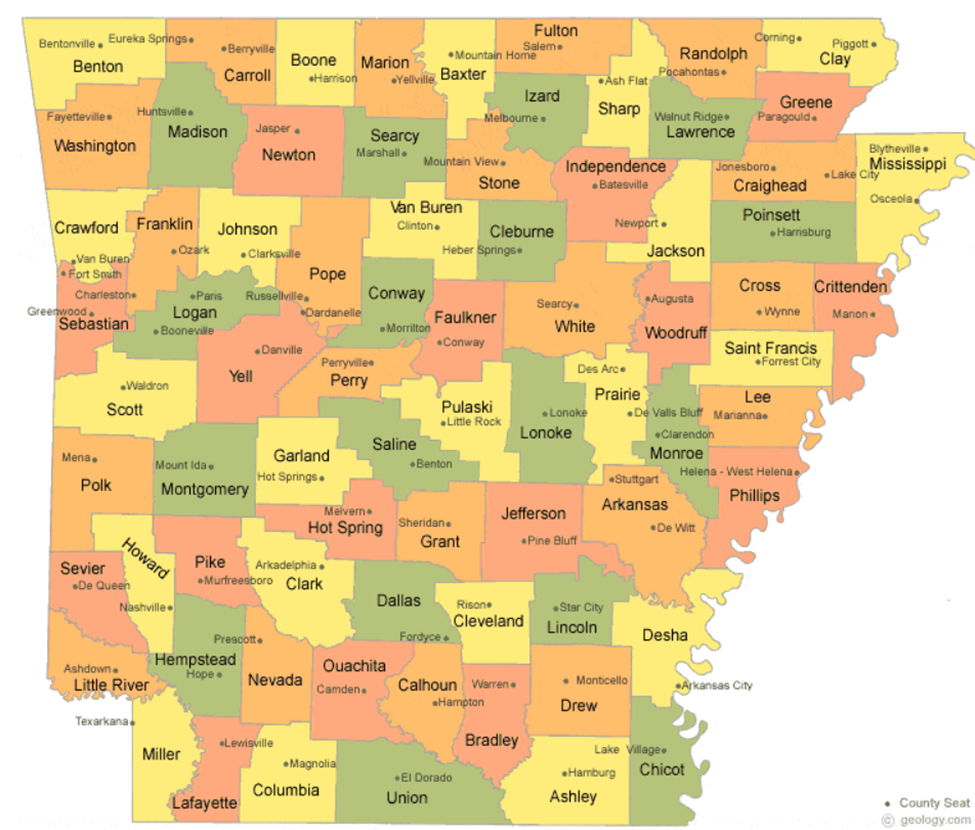
There were counties when Arkansas became a state in 1836. In fact, Arkansas had numerous counties by the time it achieved statehood. The territory that became Arkansas started with five counties in 1819 when it was established as Arkansas Territory: Arkansas, Lawrence, Pulaski, Clark, and Hempstead 12. Over the years leading up to statehood, more counties were created through subdivision and realignment of these original counties 2.By 1836, when Arkansas became a state, it had significantly more than the original five counties. For example:
- Benton County was created on September 30, 18363.
- Madison County was established on September 30, 18361.
- Marion County was formed on September 25, 18361.
These counties, created in the same year Arkansas achieved statehood, indicate that numerous counties existed prior to and at the time of statehood. The process of county creation continued after statehood, eventually resulting in the 75 counties that make up Arkansas today
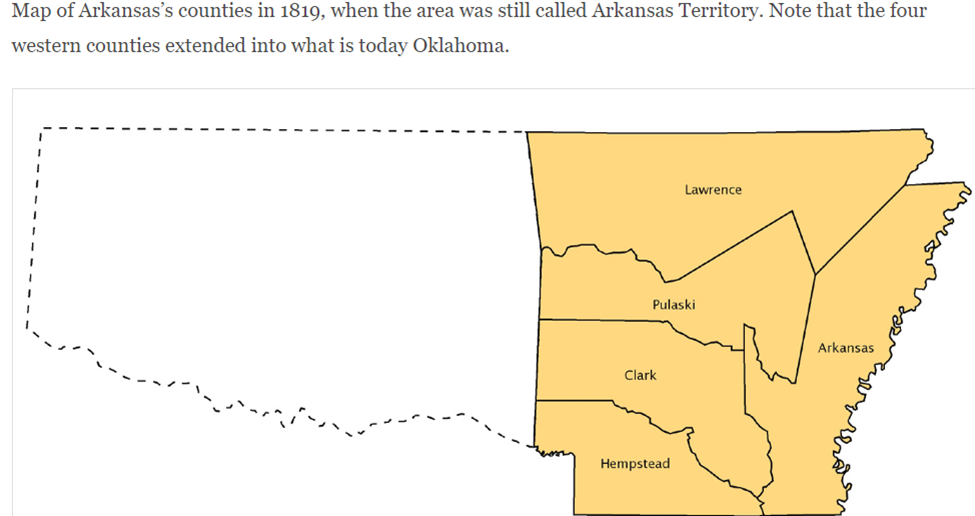
Major counties directly carved out of Lawrence County (established between 1819 and 1851):
- Independence County: Formed in 1828, encompassing the northeastern portion of Lawrence County.
- Crawford County: Established in 1829, taking territory from the western and southern regions of Lawrence County.
- Izard County: Created in 1833, including parts of northwest Lawrence County.
- Cleburne County: Established in 1833, comprising a portion of southeast Lawrence County.
- White County: Formed in 1833, incorporating lands from south-central Lawrence County.
- Van Buren County: Established in 1833, taking territory from north-central Lawrence County.
- Pope County: Created in 1833, including parts of western Lawrence County.
- Conway County: Formed in 1833, incorporating lands from eastern Lawrence County.
- Faulkner County: Established in 1833, taking territory from central Lawrence County.
- Johnson County: Created in 1833, including parts of north-central Lawrence County.
- Sebastian County: Formed in 1833, incorporating lands from western Lawrence County.
- Yell County: Established in 1844, taking territory from northwest Lawrence County.
- Scott County: Created in 1844, including parts of western Lawrence County.
- Franklin County: Formed in 1849, incorporating lands from western Lawrence County.
- Madison County: Established in 1851, taking territory from northwest Lawrence County.
Washington County, Arkansas was not originally part of Lawrence County. Contrary to what might seem intuitive based on the information about Lawrence County's initial size and later divisions, Washington County actually predates Lawrence County.
Here's the timeline:
- 1817: The Treaty of St. Louis between the United States and the Cherokee Nation resulted in the creation of Lovely County, encompassing a large swathe of land in northwest Arkansas, including future Washington County.
- 1818: Another agreement with the Cherokee people led to the establishment of Washington County, effectively splitting Lovely County.
- 1819: Lawrence County was created as one of the five initial counties in the newly formed Arkansas Territory, covering a vast territory encompassing several present-day counties.
So, while both counties existed simultaneously for a period, Washington County wasn't carved out from Lawrence County. Instead, they were established independently around the same time but from different treaties and territories.
Here are the major counties directly formed from Pulaski County over time:
Counties directly created from Pulaski County:
- Saline County: Established in 1833, encompassing the southwestern portion of Pulaski County.
- Lonoke County: Formed in 1833, incorporating lands from the eastern regions of Pulaski County.
- Perry County: Created in 1833, including parts of central Pulaski County.
- Jefferson County: Established in 1833, taking territory from southeastern Pulaski County.
- Grant County: Formed in 1833, incorporating lands from southwestern Pulaski County.
- Prairie County: Created in 1833, including parts of eastern Pulaski County.
- Dallas County: Established in 1845, taking territory from southwestern Pulaski County.
- Calhoun County: Formed in 1845, incorporating lands from southwestern Pulaski County.
- Columbia County: Created in 1852, including parts of southwestern Pulaski County.
- Hot Spring County: Established in 1853, taking territory from southwestern Pulaski County.
It's important to note that this list reflects major direct subdivisions and doesn't capture all historical shifts and boundary adjustments affecting Pulaski County. Smaller parts of the original territory might have contributed to other county formations as well.
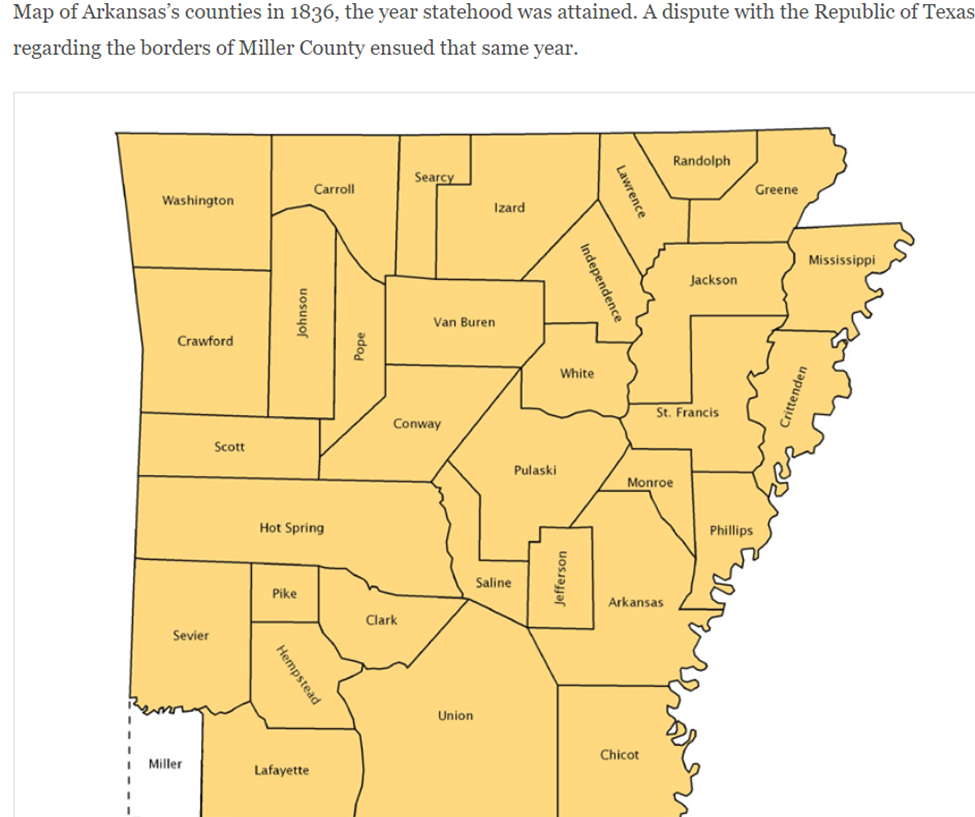
When Arkansas became a state on June 15, 1836, it consisted of a total of 33 counties. These counties were established and organized prior to Arkansas achieving statehood. There are now 75.
In Arkansas, counties can have different laws and ordinances, but there are some important limitations and considerations:
County Ordinances
Counties in Arkansas have the authority to enact their own ordinances through their respective quorum courts. These ordinances can address various local issues and may differ from county to county 1. However, there are several key points to understand:
- Scope: County ordinances must relate to matters within the county's jurisdiction and cannot conflict with state or federal law.
- Procedure: The process for enacting county ordinances is standardized across Arkansas. Ordinances must be introduced by a justice of the peace or through initiative and referendum 1.
- Style and Format: There are specific requirements for how ordinances should be formatted and styled, including a comprehensive title and division into articles 1.
- Passage: Ordinances require a majority vote of the quorum court members and must be read on three different days unless two-thirds of the court members vote to dispense with this rule 1.
- Approval: The county judge must approve ordinances within seven days of passage, or they become law without signature if not signed within that period 1.
Limitations on County Authority
While counties can enact their own ordinances, there are important limitations:
- State Preemption: State laws can preempt county ordinances if there is a direct conflict or if the state has occupied the entire field of regulation on a particular issue4.
- Federal Preemption: Federal laws and regulations supersede both state and county laws when there is a direct conflict4.
- Constitutional Constraints: County ordinances must comply with both the Arkansas and U.S. Constitutions.
Uniformity and Differences
While the basic framework for county governance is consistent across Arkansas, individual counties may have different ordinances based on their specific needs, demographics, and local issues. This can lead to some variation in local laws from county to county, particularly in areas not heavily regulated by state or federal law.It's important to note that many aspects of law and governance in Arkansas are standardized at the state level, ensuring a degree of consistency across counties. However, within the bounds of their authority, counties do have the ability to create and enforce local ordinances that may differ from those in other counties.
How do counties in Arkansas typically differ in their local ordinances
Counties in Arkansas can differ in their local ordinances, but there are some important factors to consider:
- Scope of Authority: Counties in Arkansas have limited authority to enact ordinances. They can only create ordinances for matters within their jurisdiction and cannot conflict with state or federal law.
- Local Needs: Counties often tailor their ordinances to address specific local issues, demographics, and priorities. This can lead to differences in:
- Zoning and land use regulations
- Business licensing requirements
- Public safety ordinances
- Environmental regulations
- Animal control policies
- Quorum Court Decisions: Each county's quorum court (the legislative body) has the power to enact ordinances. The composition and priorities of these courts can vary, leading to different outcomes across counties.
- Procedural Consistency: While the content of ordinances may differ, the process for enacting them is standardized across Arkansas counties. This includes introduction by a justice of the peace, specific formatting requirements, and a standardized approval process.
- Population and Geography: Larger, more urban counties may have more complex and numerous ordinances compared to smaller, rural counties. This can reflect differences in population density, economic activity, and infrastructure needs.
- Dual County Seats: Arkansas has 10 counties with dual county seats, which can sometimes lead to slight variations in how ordinances are implemented within the same county.
- State Preemption: In many areas, state law preempts county authority, limiting the extent to which counties can differ in their regulations.
- Interlocal Agreements: Counties may enter into agreements with cities or other counties, which can affect local ordinances and their implementation.
It's important to note that while counties can have different ordinances, they must all operate within the framework established by state law. Major areas of law such as criminal justice, taxation, and basic government structure are largely uniform across counties due to state-level regulation.
What is the process for a county in Arkansas to adopt unique laws
The process for a county in Arkansas to adopt unique laws, typically in the form of ordinances, involves several key steps:
- Introduction: A county ordinance can only be introduced by a justice of the peace of the county or through the initiative and referendum process as outlined in the Arkansas Constitution12.
- Style and Format: The ordinance must follow specific style requirements:
- It must contain only one comprehensive topic
- It must be styled "Be It Enacted by the Quorum Court of the County of..............., State of Arkansas; an Ordinance to be Entitled:"
- The body must be divided into sequentially numbered articles, each expressing a single general topic related to the main topic12.
- Readings: The ordinance must be fully and distinctly read on three different days, unless two-thirds of the quorum court members vote to dispense with this rule12.
- Voting:
- The yeas and nays must be called and recorded for every ordinance
- A majority of the whole number of elected quorum court members must concur to pass an ordinance12.
- Approval:
- After passage, the county judge has seven days to approve the ordinance
- If not signed within seven days, it becomes law without the judge's signature
- The county judge can veto the ordinance12.
- Publication: After approval, the county clerk must publish the ordinance as prescribed by law12.
- Effective Date: The ordinance becomes effective after publication, unless specified otherwise2.
- Potential Referendum: Within 30 days of adoption and before the effective date, the quorum court may refer the ordinance to voters for acceptance or rejection. This requires a three-fifths affirmative vote of the quorum court1.
It's important to note that county ordinances must relate to matters within the county's jurisdiction and cannot conflict with state or federal law. The quorum court, composed of elected justices of the peace, is the legislative body responsible for enacting these ordinances3.This process allows counties in Arkansas to create laws tailored to their specific needs, while still operating within the framework established by state law.
How does the initiative and referendum process work for county ordinances in Arkansas
The initiative and referendum process for county ordinances in Arkansas allows citizens to propose new laws or repeal existing ones. Here's how it works:
Initiative Process
- Proposal: A county ordinance can be proposed by citizens through the initiative process23.
- Signature Requirements: To get an initiative on the ballot, petitioners must collect signatures from at least 15% of the legal voters in the county 45.
- Calculation Basis: The number of required signatures is calculated based on the total votes cast for the office of circuit clerk in the last preceding general election 4.
- Filing Timeline: Initiative petitions must be filed between 60 and 90 days before the election in which they will be voted upon 4.
Referendum Process
- Triggering a Referendum: At least 15% of the legal voters in a county can order a referendum on any local measure45.
- Filing Timeline: For county measures, referendum petitions must be filed within 90 days after the passage of the measure by the county quorum court4.
General Provisions
- Petition Requirements: Petitions can be circulated and presented in parts. Each part must have an affidavit from the person circulating it, stating that all signatures were made in their presence and are believed to be genuine and from legal voters45.
- Ballot Title: For county measures, the ballot title must be submitted to the county election board, which will place it on the ballot for the county election4.
- Signature Verification: Only legal votes are counted on petitions. No additional affidavit or verification is required beyond the circulator's affidavit to establish the genuineness of signatures45.
- No Limitations: There are no limitations on the number of measures that can be proposed through initiative or referendum45.
- County-Specific Provisions: The state legislature is required to enact general laws providing for the exercise of initiative and referendum in counties45.
It's important to note that while this process allows for citizen-initiated changes to county ordinances, any proposed measure must still comply with state and federal laws. The process gives Arkansas residents a direct way to participate in local lawmaking, either by proposing new ordinances or challenging existing ones.