Arkansas
Arkansas is (like the other States) a corporation: Dunn & Bradstreet: State of Arkansas, Inc.
Search for Arkansas Laws & Statutes
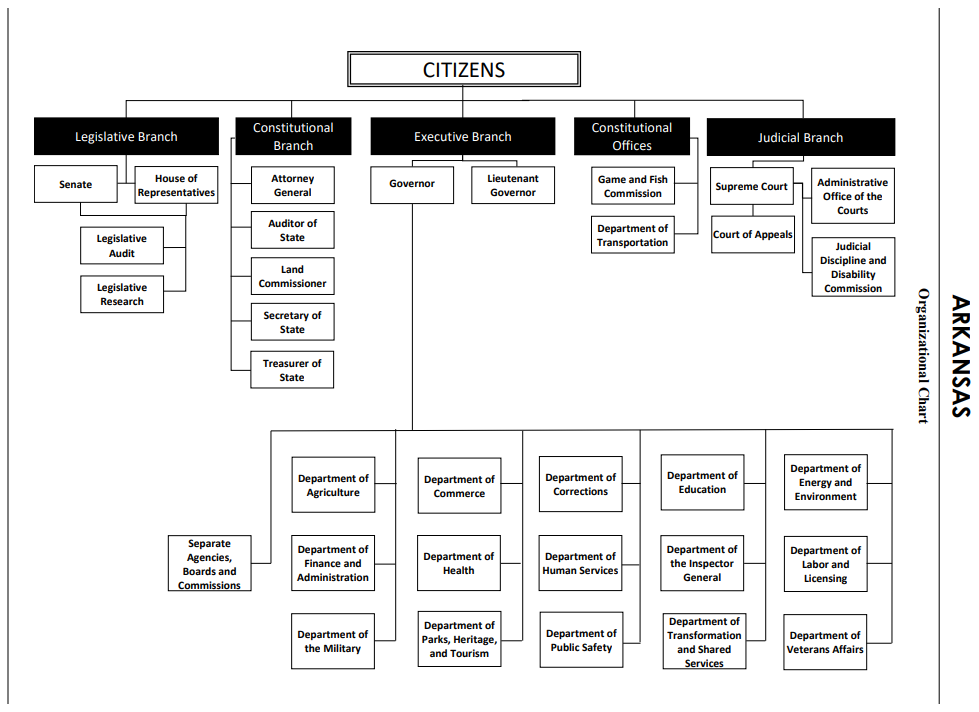
Arkansas state executive offices
Transparency in Arkansas Government
Historical House Journals (must view microfilm at State Archives)
Online Historical House Journals
Online Historical Senate Journals
Playlist on YouTube: Introduction to the Ozarks
Arkansas was considered a federal territory at various points in its history.
Arkansas was initially part of the Louisiana Territory, which was acquired by the United States from France as part of the Louisiana Purchase in 1803. The Louisiana Territory was a vast area that included what is now Arkansas, as well as other parts of the central United States.
When Arkansas became a US territory in 1819, it had five counties: Arkansas, Lawrence, Pulaski, Clark, and Hempstead. The territory originally had nine counties, including Crawford, Independence, Miller, and Phillips.
In 1812, the portion of the Louisiana Territory that is now Arkansas was organized as the Territory of Missouri, with St. Louis as its capital. However, in 1819, as part of the Missouri Compromise, the territory was split into the Territory of Arkansas and the Territory of Missouri, with Arkansas serving as a separate federal territory.
Arkansas remained a federal territory until it was admitted as the 25th state of the United States on June 15, 1836. At that point, it ceased to be a territory and became a fully recognized state within the Union.
Arkansas was made a territory of the United States on March 2, 1819, when President James Monroe signed the Arkansas Organic Act into law. The Arkansas Territory was created out of the Missouri Territory, which had been established in 1812.
The Arkansas Territory was bounded by the Mississippi River to the east, the Louisiana Territory to the south, and the Missouri Territory to the north. The Arkansas River served as the western boundary of the territory.
The Arkansas Organic Act provided for a territorial government, which consisted of a governor, secretary, and three judges, all appointed by the President of the United States. The territorial legislature consisted of a council and a house of representatives, with members elected by the people.
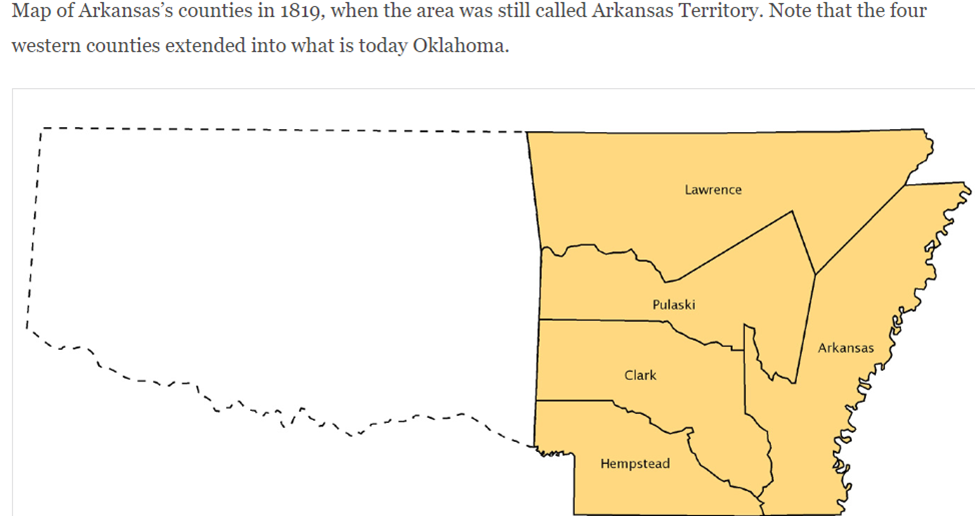
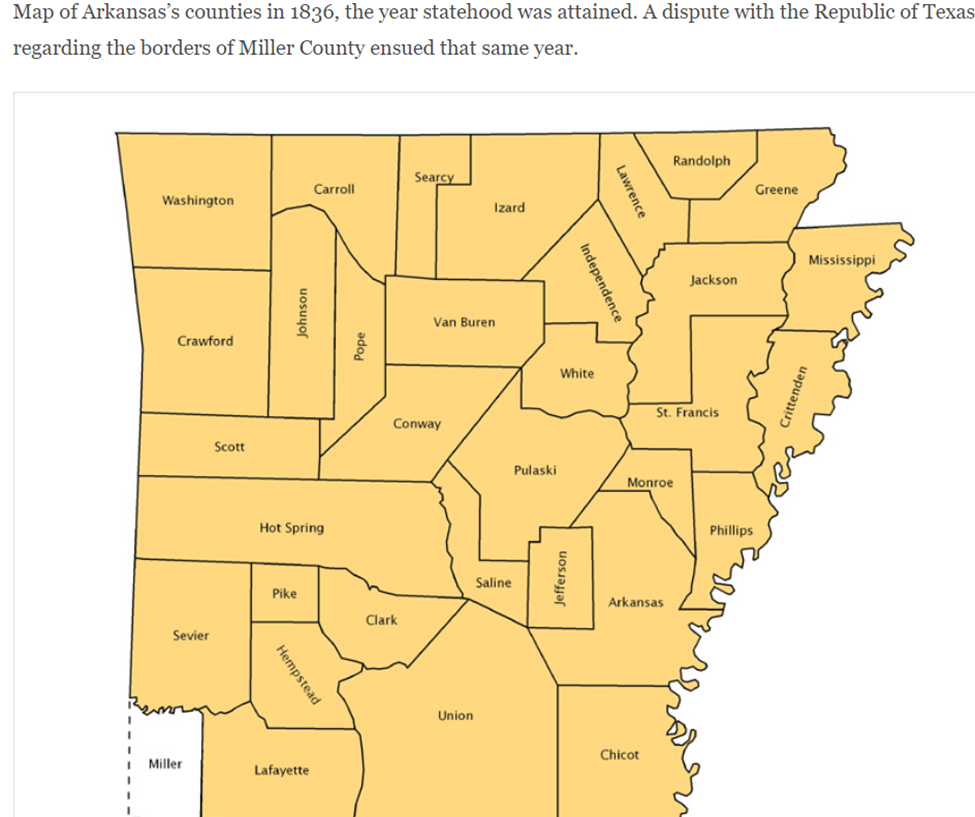
The capital of the Arkansas Territory was initially located in Arkansas Post, but it was later moved to Little Rock in 1821. The territory remained under federal control until 1836 when Arkansas was admitted to the Union as a state.
Arkansas became a state in the United States on June 15, 1836. The process of becoming a state began in 1819 when Arkansas was made a territory of the United States. The territory was established by an act of Congress, and its boundaries were established to include the land that is now the state of Arkansas, as well as parts of Oklahoma, Missouri, and Kansas.
In 1835, a convention was held in Little Rock to draft a state constitution, which was later approved by Congress. The constitution provided for a bicameral legislature, a governor elected for four years, and a judiciary consisting of a supreme court and lower courts.
The path to statehood was not without controversy. One issue was the question of slavery, which was a divisive issue at the time. In order to gain support for statehood in Congress, Arkansas had to agree to become a slave state. This decision was not without opposition, but in the end, Arkansas became a state in 1836.
Arkansas was a part of the Confederacy during the American Civil War.
Arkansas has been mediocre on economic freedom for most of the past two decades, but it improved on regulatory policy in the early 2010s and on fiscal policy in the past four years, restoring the state nearly to heights not seen since George W. Bush’s first term. Arkansas has ranked consistently worse than most states on personal freedom, declining substantially relative to others since 2007 and receiving very little bump from the Supreme Court’s legalization of same-sex marriage in 2015.
Arkansas’s tax burden is about average, but the state is highly fiscally centralized. State taxes are way above the national average, and local taxes are way below. The overall tax burden has drifted downward since FY 2014. Debt is low, but government employment at 13.1 percent of private employment is high (though declining consistently since 2010). Government GDP has fallen from 11.3 percent of income in 2013 to 9.9 percent in 2019.
Arkansas does well on land use despite its unreformed eminent domain laws. Still, our proxies for zoning stringency show a growth in such restrictions over time. The state has above-average labor-market freedom, although it began regular minimum-wage increases in 2014 because of a popular initiative; minimum wage stands at $11 as of 2021. The state has a problem with cronyism, especially on entry and price controls. The extent of occupational licensing is more than a standard deviation worse than the national average. Hospital construction requires a certificate of need, the state has an anti-price-gouging law, and also a general law against “unfair pricing” or sales below cost. However, Arkansas does better than most other southern states, and indeed better than the national average, on its civil liability regime. Like most other states, it did not replace the federal government’s health insurance individual mandate and, therefore, saw a bump up on health insurance freedom in 2019.
Arkansas is one of the worst states in the country on criminal justice policies. Its crime-adjusted incarceration rate is more than a standard deviation worse than the national average and has not come down much recently, while its drug enforcement rate has moved in the wrong direction. It also suspends driver’s licenses for those with drug offenses unrelated to driving. In contrast, it has improved significantly on gun rights with the adoption of constitutional carry for both concealed and open carry in 2018. Marijuana laws are largely unreformed, although voters did pass a medical marijuana initiative in 2016. Arkansas deviates little from the average on many personal freedom policies. School choice remains an opportunity for improvement, given the state’s fiscal centralization (education funding comes substantially from the state), its generally conservative ideological orientation, and its minority student populations. A voucher program for students with disabilities was adopted in 2017. (source)
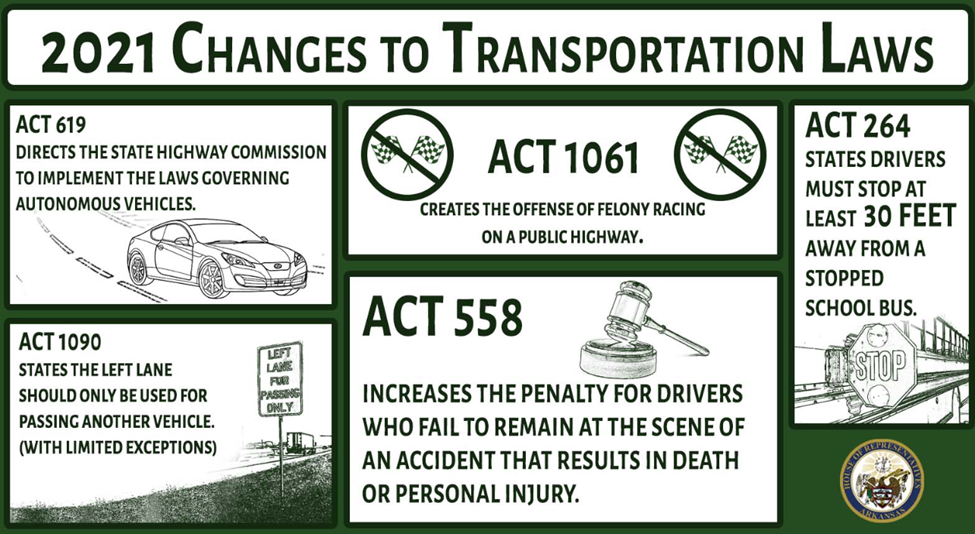
Changes to Transportation Legislation