1863 General Order 100 / Lieber Code
Frances Lieber, the author of General Orders 100 was a Rothschild Agent.
Rules of Engagement for the Civil War
General Orders #100, The Lieber Code, Washington, D.C., April 24, 1863
Instructions for the Government of Armies of the United States in the Field by Order of the Secretary of War:
A few important parts follow:
Article I:
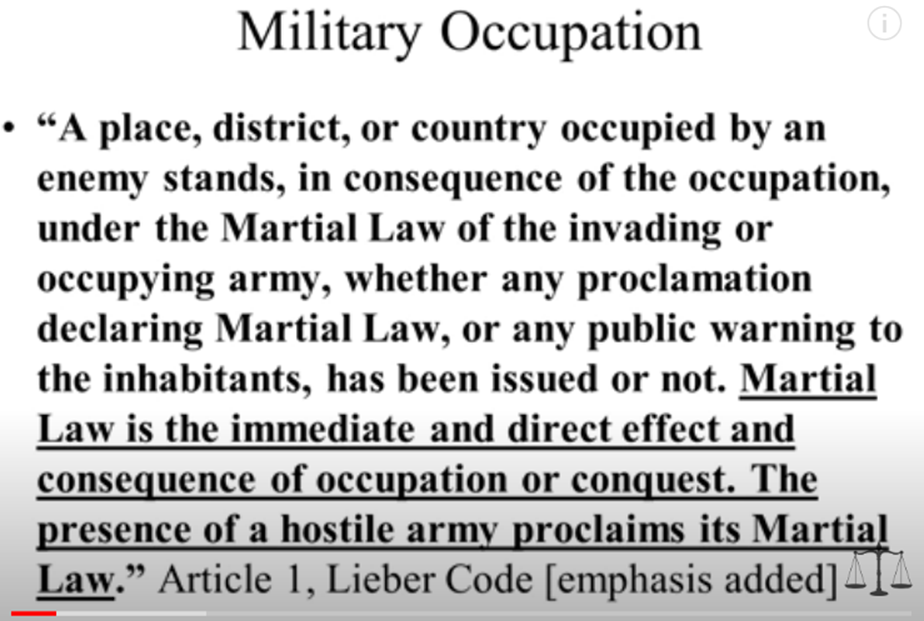
“A place, district, or country occupied by an enemy stands, in consequence of the occupation, under the Martial Law of the invading or occupying army, whether any proclamation declaring Martial Law, or any public warning to the inhabitants, has been issued or not. Martial Law is the immediate and direct effect and consequence of occupation or conquest. The presence of a hostile army proclaims its Martial Law.
Article II
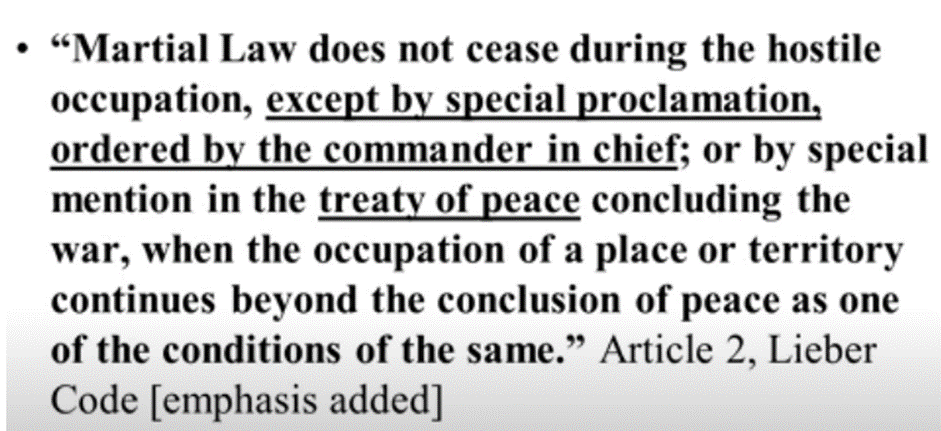
“Martial Law does not cease during the hostile occupation, except by special proclamation, ordered by the commander in chief; or by special mention in the treaty of peace concluding the war, when the occupation of a place or territory continues beyond the conclusion of peace as one of the conditions of the same....The commander of the forces may proclaim that the administration of all civil and penal law shall continue either wholly or in part, as in times of peace, unless otherwise ordered by the military authority.”
Article III
Martial Law in a hostile country consists in the suspension, by the occupying military authority, of the criminal and civil law, and of the domestic administration and government in the occupied place or territory, and in the substitution of military rule and force for the same, as well as in the dictation of general laws, as far as military necessity requires this suspension, substitution, and dictation.
Article VII
Martial Law extends to property, and to persons, whether they are subjects of the enemy or aliens to that government
Article X
“Martial Law affects chiefly the police and collection of public revenue and taxes, whether imposed by the expelled government or by the invader, and refers mainly to support and efficiency of the army, its safety, and the safety of its operations.”
“Article XIII”
“Military jurisdiction is of two kinds: First, that which is concerned and defined by statute; second, that which is derived from the common law of war. Military offenses under the statute law must be tried in the manner therein directed; but military offenses which do not come within the statute must be tried and punished under the common law of war. The character of the courts which exercise these jurisdictions depends upon the local laws of each particular country. In the armies of the United States the first is exercised by courts-martial, while cases which do not come within the “Rules and Articles of War,” or the jurisdiction conferred by statute on courts-martial, are tried by military commissions.”
Article XXVI
Commanding generals may cause the magistrates and civil officers of the hostile country to take the oath of temporary allegiance or an oath of fidelity to their own victorious government or rulers, and they may expel everyone who declines to do so. But whether they do so or not, the people and their civil officers owe strict obedience to them (commanding generals) as long as they hold sway over the district or country, at the peril of their lives.
Article XXXI
A victorious army appropriates (seizes) all public money, seizes all public movable property until further direction by its government, and sequesters for its own benefit or of that of its government all the revenues of real property belonging to the hostile government or nation. The title to such real property remains in abeyance (suspension) during military occupation, and until the conquest is made complete.
Article XXXII
The commander of the army must leave it to the ultimate treaty of peace to settle the permanency of this change.
Article XLIV - The Good Faith Doctrine
All wanton violence committed against persons in the invaded country, all destruction of property not commanded by the authorized officer, all robbery, all pillage or sacking, even after taking a place by main force, all rape, wounding, maiming or killing of such inhabitants, are prohibited under the penalty of death or such other severe punishment as may seem adequate for the gravity of the offense.
A soldier, officer or private, in the act of committing such violence, and disobeying a superior ordering him to abstain from it, may be lawfully killed on the spot by such superior.
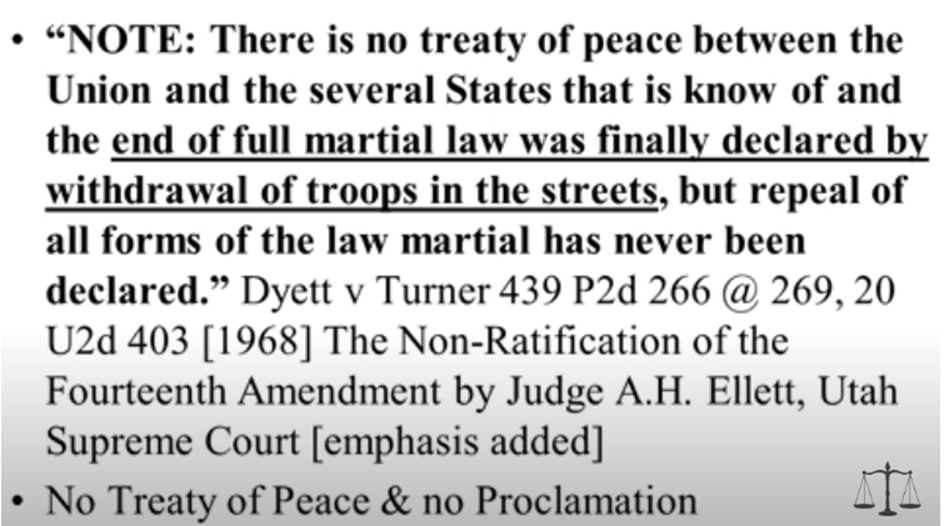
THERE HAS NEVER BEEN A “TREATY OF PEACE” ENDING THE CIVIL WAR, WE ARE STILL UNDER THESE RULES.
The "Lieber Instructions" represent the first attempt to codify the laws of war. They were prepared during the American Civil War by Francis Lieber, then a professor of Columbia College in New York, revised by a board of officers and promulgated by President Lincoln. Although they were binding only on the forces of the United States, they correspond to a great extend to the laws and customs of war existing at that time. The "Lieber Instructions" strongly influenced the further codification of the laws of war and the adoption of similar regulations by other states. They formed the origin of the project of an international convention on the laws of war presented to the Brussels Conference in 1874 and stimulated the adoption of the Hague Conventions on land warfare of 1899 and 1907.
When Abraham Lincoln was forced to declare the Northern States of States bankrupt in 1863, he issued the Lieber Code to the military leaders of the Grand Army of the Republic. The British Territorial United States Government has continued to operate under the Lieber Code (also known as General Order 100) ever since. The Code has since been adopted as the Hague Conventions.
In 1863, during the Civil War, Lincoln declared martial law under General Order 100, also referred to as the Lieber Code of 1863. This turned all private property and civil liberty rights over to the government. According to this Lieber Code, "the commander of the army must leave it to the ultimate treaty of peace to settle the permanency of this change." A peace treaty was never signed. Lee surrendered to Grant, and over the next 16 months, other southern generals surrendered to northern generals. However, the commander of the army, Abraham Lincoln, never signed a peace treaty. By not signing a Peace Treaty he perpetuated the Lieber Code and the illusion that the United States of America was still based on the Constitution when in actuality, we were, and still are, under military rule.
All civil war states are under a military occupation – Virginia, North Carolina, South Carolina, Georgia, Florida, Alabama, Mississippi, Louisiana, Arkansas, Texas, Missouri, Tennessee, Kentucky
All of the states in the territory conquered in the War with Mexico are under a military occupation – Arizona, New Mexico, Utah, Nevada