Private Property
Freedom is impossible when there is no private property.
Rules for Lawfully Converting Private Property to Public Property
- All property starts out as EXCLUSIVELY PRIVATE and beyond the civil control of government.
- It is VERY important to understand the simple rules the government must abide by in converting YOUR PRIVATE property to PUBLIC property.
- Any attempt by government to do any of the following in respect to one’s PRIVATE rights and/or PRIVATE property is THEFT and a taking of property in violation of the 5th Amendment if the rules below have been violated:
- Asserts a right to regulate the use of private property
- Asserts a right to convert the character of property from PRIVATE to PUBLIC
- Asserts of right to TAX said property. A tax converts private property into public property, which is a theft. It’s called a conversion, converting private to public without the consent of the owner.
Supreme Court rules for Lawfully Converting Private Property into Public Property
“Men are endowed by their Creator with certain unalienable rights, - “life, liberty, and the pursuit of happiness;’ and to ‘secure,’ not grant or create, these rights, governments are instituted. That property [or income] which a man has honestly acquired he retains full control of, subject to these limitations;
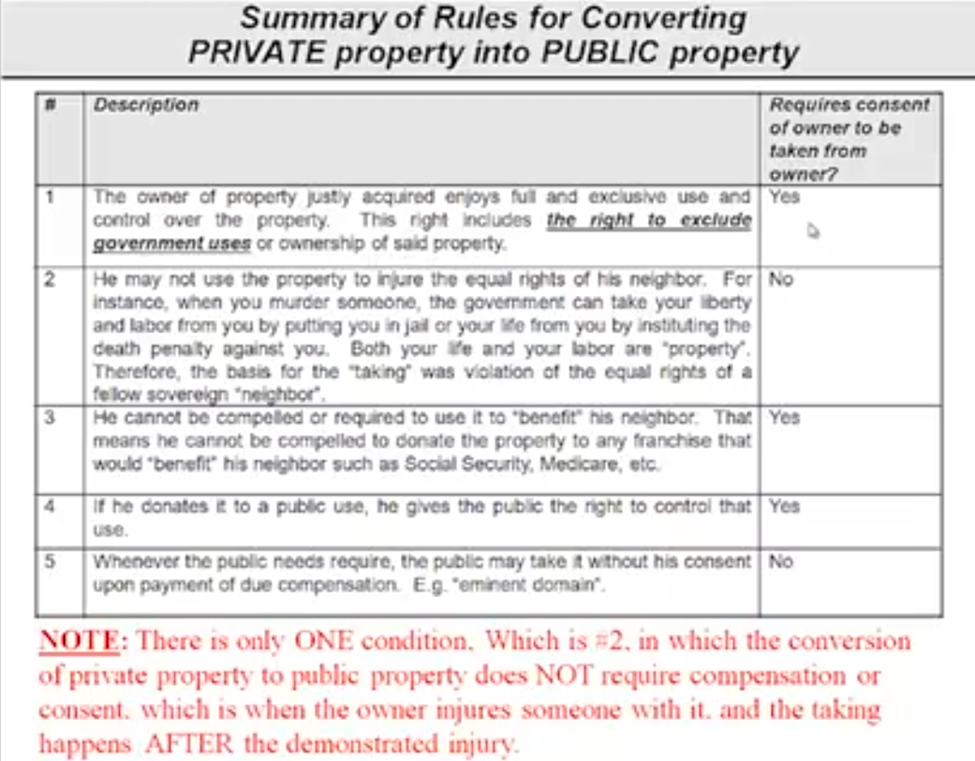
- (1) First, that he shall not use it to his neighbor’s injury, and that does not mean that he must use it for his neighbor’s benefit [e.g. SOCIAL SECURITY, Medicare, and every other public “benefit”]
- (2) second, that if he devotes it to a public use, he gives to the public a right to control that use; and
- (3) third, that whenever the public needs require, the public may take it upon payment of due compensation.”
Budd v. People of State of New York, 142 U.S. 17 (1892)
You can’t become a statutory “taxpayer” without volunteering, and thereby donating your property to the government.
Only by volunteering to assume the status of a franchisee (e.g. “taxpayer”, “citizen”, “spouse”, “driver”), ABSENT DURESS OR COERCION of any kind, can the government regulate the use of exclusively private property.
- In this way, you DONATE your private property to a PUBLIC use, public purpose and public office.
- If there was any duress applied to force you to volunteer, then the regulation becomes a form of theft.
Violation of the Rules for Converting Private property to Public property:
A theft of property has occurred on behalf of the government if it attempts to do any of the following:
- Circumvents any of the above rules
- Tries to blur, confuse, or obfuscate the distinction between private property and public property
- Refuses to identify exactly which of the five mechanisms identified in the preceding table was employed in each specific case where it:
- Asserts a right to regulate the use of PRIVATE property.
- Asserts a right to CONVERT the character of property from PRIVATE to PUBLIC
- Asserts a right to TAX what you thought was private property.
Is your ignorance of law and the rules for converting property causing you to:
- Unknowingly donate property to the government
- Condone and further government theft? The only difference between theft and a donation is consent.
- Aid and abet conspiracies by public servants to:
- Deceive you about what the law permits and requires
- Deprive you of Constitutional rights?
5th Amendment / Grand Jury, Double Jeopardy, Self-Incrimination, Due Process:
No person shall be held to answer for a capital, or otherwise infamous crime, unless on a presentment or indictment of a grand jury, except in cases arising in the land or naval forces, or in the militia, when in actual service in time of war or public danger; nor shall any person be subject for the same offense to be twice put in jeopardy of life or limb; nor shall be compelled in any criminal case to be a witness against himself, nor be deprived of life, liberty, or property, without due process of law; nor shall private property be taken for public use, without just compensation.
In a nutshell, the plan calls for governments to take control of all land use and not leave any of the decision making in the hands of private property owners
In 1863, during the Civil War, Lincoln declared martial law under General Order 100, also referred to as the Lieber Code of 1863. This turned all private property and civil liberty rights over to the government.
Sometimes, a government regulation infringes upon private property ownership to such an extent that the regulation can be considered a taking, thus requiring just compensation. The Supreme Court, over a series of regulatory takings cases, has developed a 4-part test to determine whether a regulation is considered to be a taking.