Pv histones
The Pv histones are almost identical to the Pf histones.
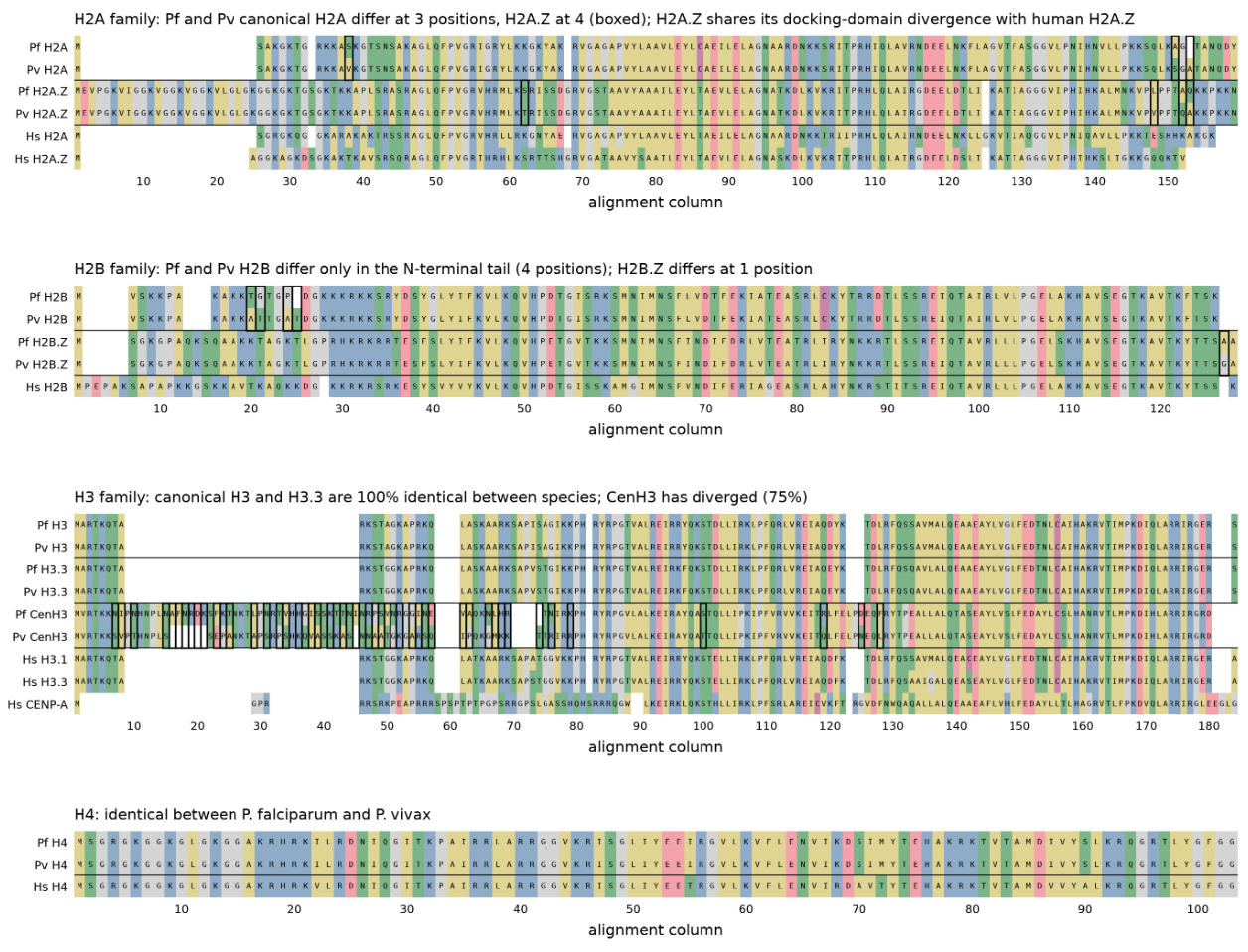

P. vivax has both H2A.Z and H2B.Z, one gene each, and they are orthologues of the P. falciparum proteins rather than independent duplications. PVX_095190 (A5K7L8, 158 aa) is 97.5 % identical to PfH2A.Z (PF3D7_0320900 / O97320, 158 aa — same length, same Gly/Lys-rich
N-terminal extension)
PVX_122930 (A5JZL1, 123 aa) is 99.2 % identical to PfH2B.Z (PF3D7_0714000 / Q8IBV7, 123 aa).
The P. vivax set is not larger or smaller, and there is no third H2A or H2B paralogue in either.
| Assignment | P. falciparum 3D7 | aa | P. vivax Sal-1 | aa |
|---|---|---|---|---|
| H2A canonical | PF3D7_0617800 · C6KT18 · XP_966163.1 | 132 | PVX_114015 · A5K214 · XP_001616191.1 | 133 |
| H2A.Z | PF3D7_0320900 · O97320 · XP_001351279.1 | 158 | PVX_095190 · A5K7L8 · XP_001614504.1 | 158 |
| H2B canonical | PF3D7_1105100 · Q8IIV1 · XP_001347738.1 | 117 | PVX_090935 · A5K475 · XP_001615180.1 | 118 |
| H2B.Z | PF3D7_0714000 · Q8IBV7 · XP_001349046.1 | 123 | PVX_122930 · A5JZL1 · XP_001617149.1 | 123 |
| H3 canonical | PF3D7_0610400 · C6KSV0 · XP_966093.1 | 136 | PVX_113665 · A5K1U7 · XP_001616124.1 | 136 |
| H3.3 | PF3D7_0617900 · C6KT19 · XP_966164.1 | 136 | PVX_114020 · A5K215 · XP_001616192.1 | 136 |
| CenH3 (CSE4) | PF3D7_1333700 · Q8IDZ1 · XP_001350068.1 | 170 | PVX_082615 · A5K7Y3 · XP_001614124.1 | 164 |
| H4 | PF3D7_1105000 · Q8IIV2 · XP_001347737.1 | 103 | PVX_090930 · A5K474 · XP_001615179.1 | 103 |
Variant vs canonical, within each species
| Pair | identity | differences |
|---|---|---|
| PfH2A.Z vs PvH2A.Z | 97.5 % | S62→T62, L147→V147, A151→Q151, Q152→A152 |
| PfH2B.Z vs PvH2B.Z | 99.2 % | A122→G122 |
| PfH3.3 vs PvH3.3 | 100 % | none |
| PfCenH3 vs PvCenH3 | 74.8 % | 49 positions + 8 indel columns (N-terminal tail) |
So among all eight histones, CenH3 is the only one that has genuinely diverged between the two species; H2A.Z and H2B.Z are as conserved as the canonical histones.
- H2A.Z vs H2A: 51 % (Pf), 52 % (Pv) — nearly all of the difference is the 26-residue Gly/Lys-rich N-terminal extension plus the classic H2A.Z αC/docking-domain substitutions. The N-terminal extension is identical in the two species over residues 1–35 and lysine-rich (K6, K11, K15, K19, K25, K28, K30, K35, K37, K38 in both), consistent with it being the acetylation-bearing region (PMID 23320541, PMID 23373537, PMID 37882786).
- H2B.Z vs H2B: 62 % (Pf), 64 % (Pv). Again the N-terminal tails are identical between species over residues 1–35, with the same seven lysines (K4, K9, K14, K15, K19, K26, K28) and the same basic
RHKRKRRblock at 24–30. - Both Z-variants keep the acidic-patch residues (H2A.Z E83/E88/E91/D117/E118/E119; H2B.Z E102/E110 — offsets reflect the N-terminal extensions), so the double-variant nucleosome should present a wild-type acidic patch in both species.
- H3 vs H3.3 differ at the same 8 positions in both species (A13G, I32V, A34T, R54K, Y55F, D78E, S88Q, M91L) — the substitution set is species-invariant.